Open Innovation and Strategy Group 2b
Open innovationopen innovation is creating new empirical phenomena that exist uneasily with well-established theories of business strategy.Forcing firms to reassess their leadership positions which reflect the performance outcomes of their business strategies.To take benefit from collective intelligence and consumer participation.
Open strategyBalances the tenets of traditional business strategy. Embraces the benefits of openness as a means of expanding value creation for organizations.Places certain limits on traditional business models when those limits are necessary to foster greater adoption of an innovation approach.Introduces new business models based on invention and coordination undertaken within a community of innovators.Effective open strategy will balance value capture and value creation. Open strategy is an important approach for those who wish to lead through innovation.
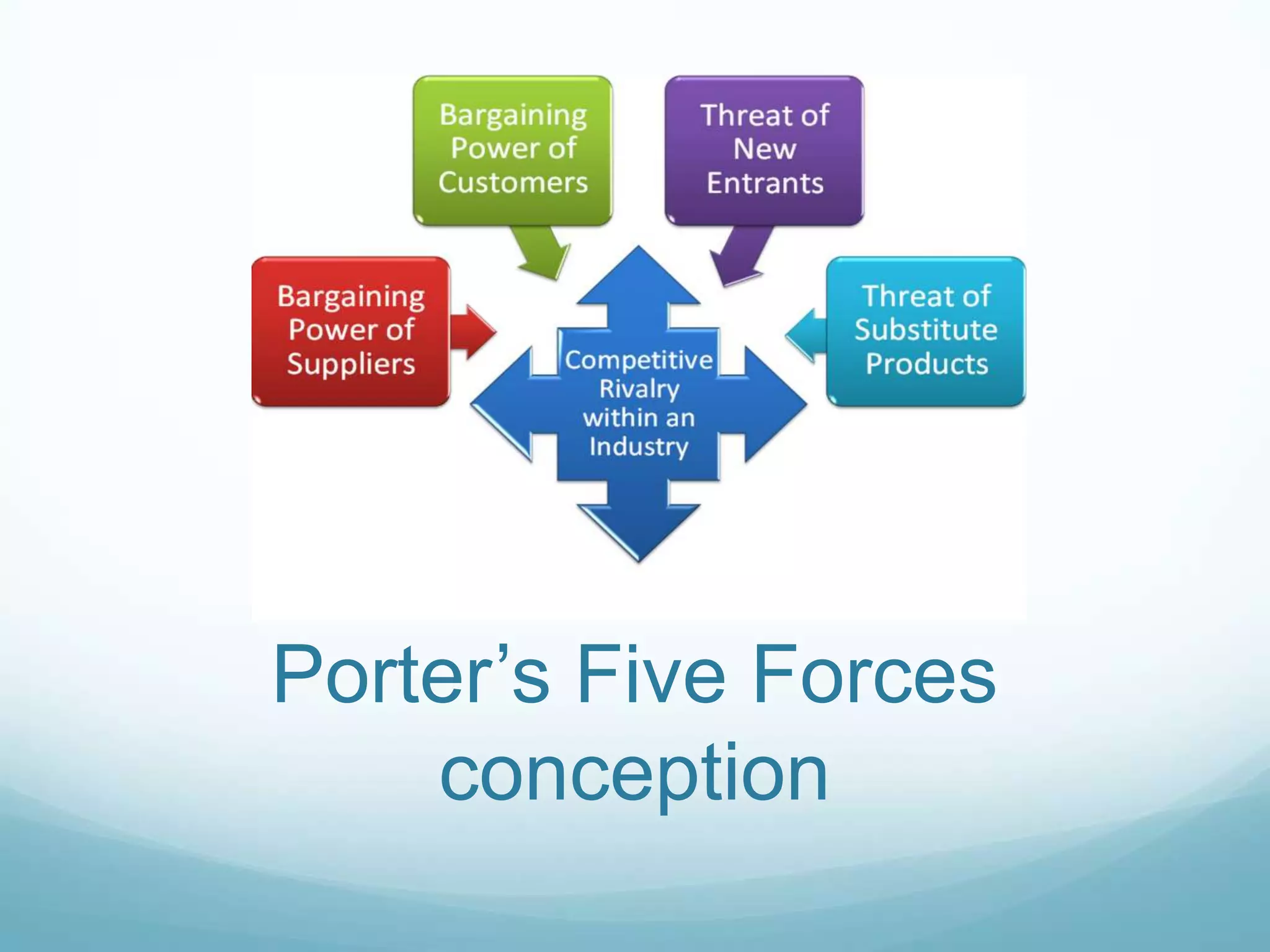
Porter’s Five Forces conception
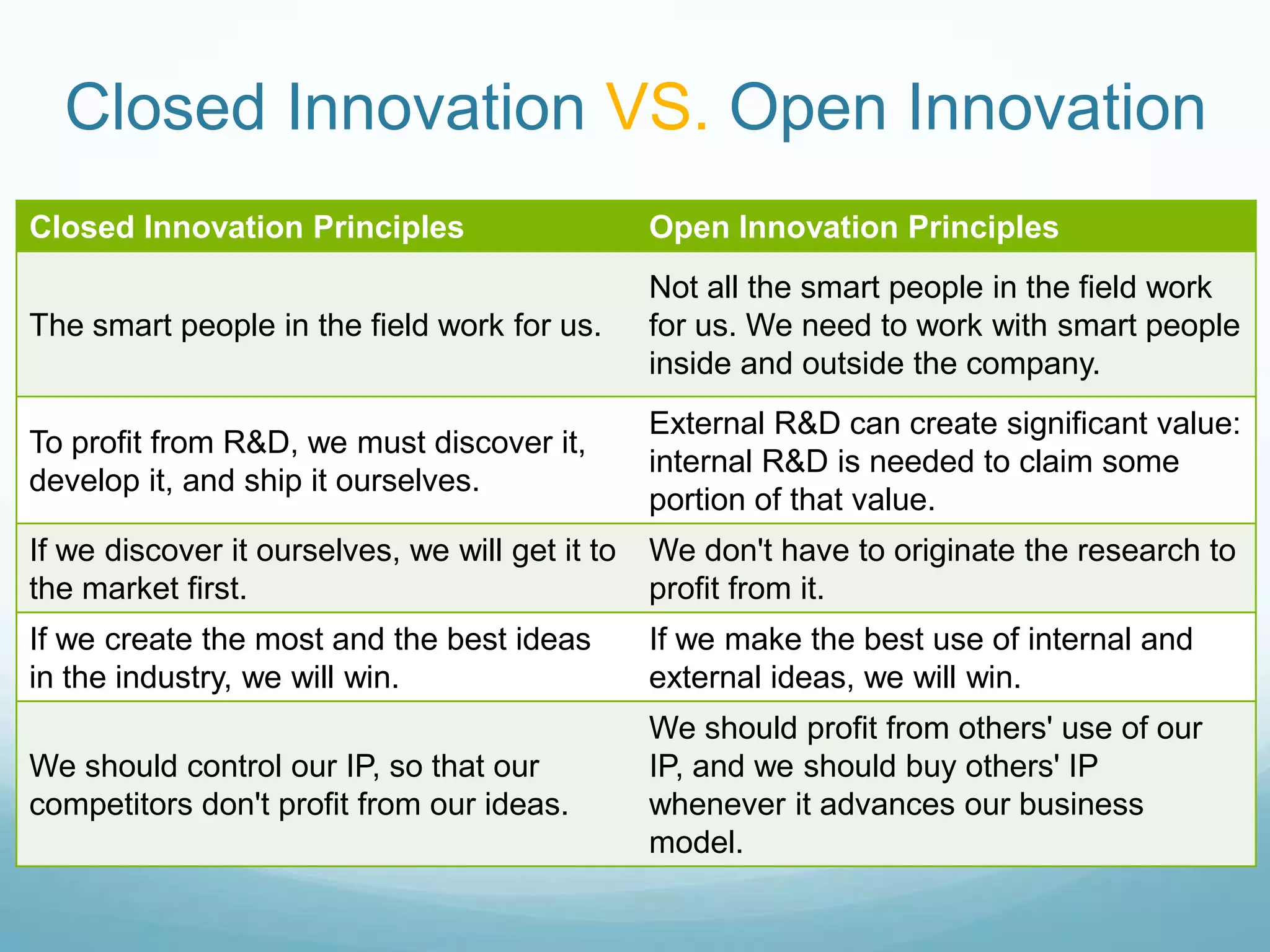
Closed Innovation VS. Open Innovation
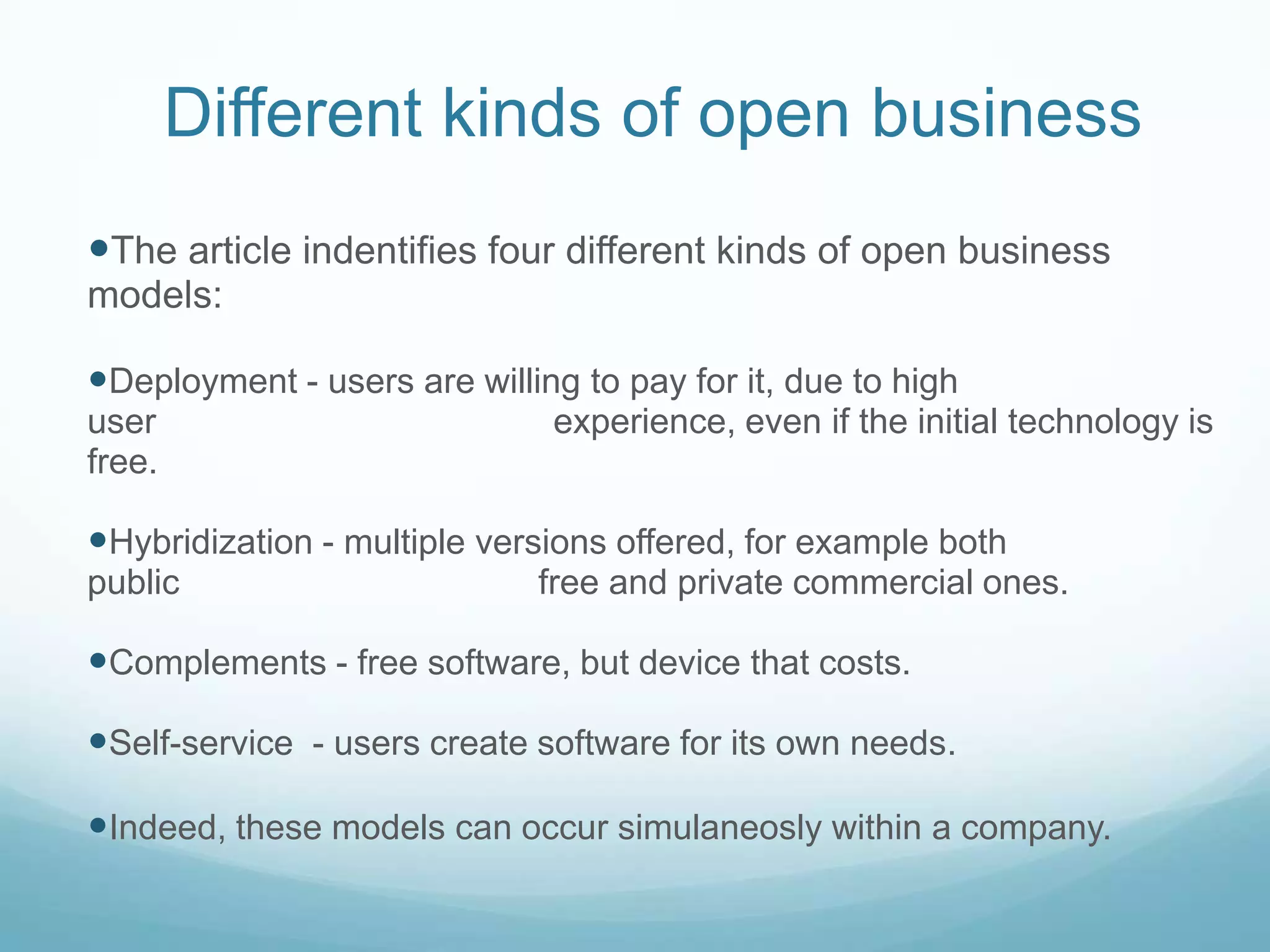
Different kinds of open businessThe article indentifies four different kinds of open business models: Deployment - users are willing to pay for it, due to high user                                         experience, even if the initial technology is free. Hybridization - multiple versions offered, for example both public                                     free and private commercial ones.  Complements - free software, but device that costs. Self-service  - users create software for its own needs.Indeed, these models can occur simulaneosly within a company.
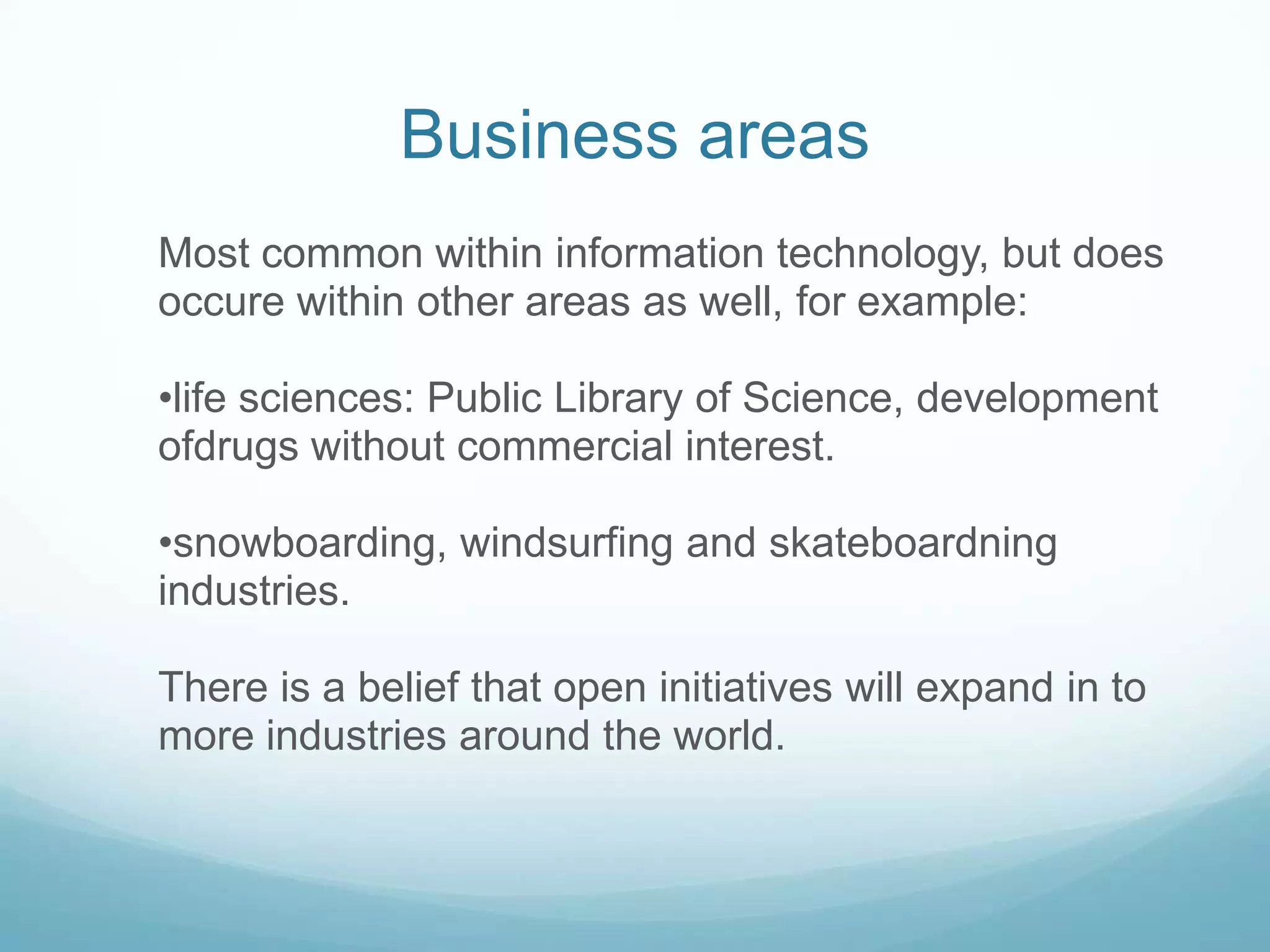
Business areasMost common within information technology, but does occure within other areas as well, for example: life sciences: Public Library of Science, development ofdrugs without commercial interest. snowboarding, windsurfing and skateboardning industries.There is a belief that open initiatives will expand in to more industries around the world.
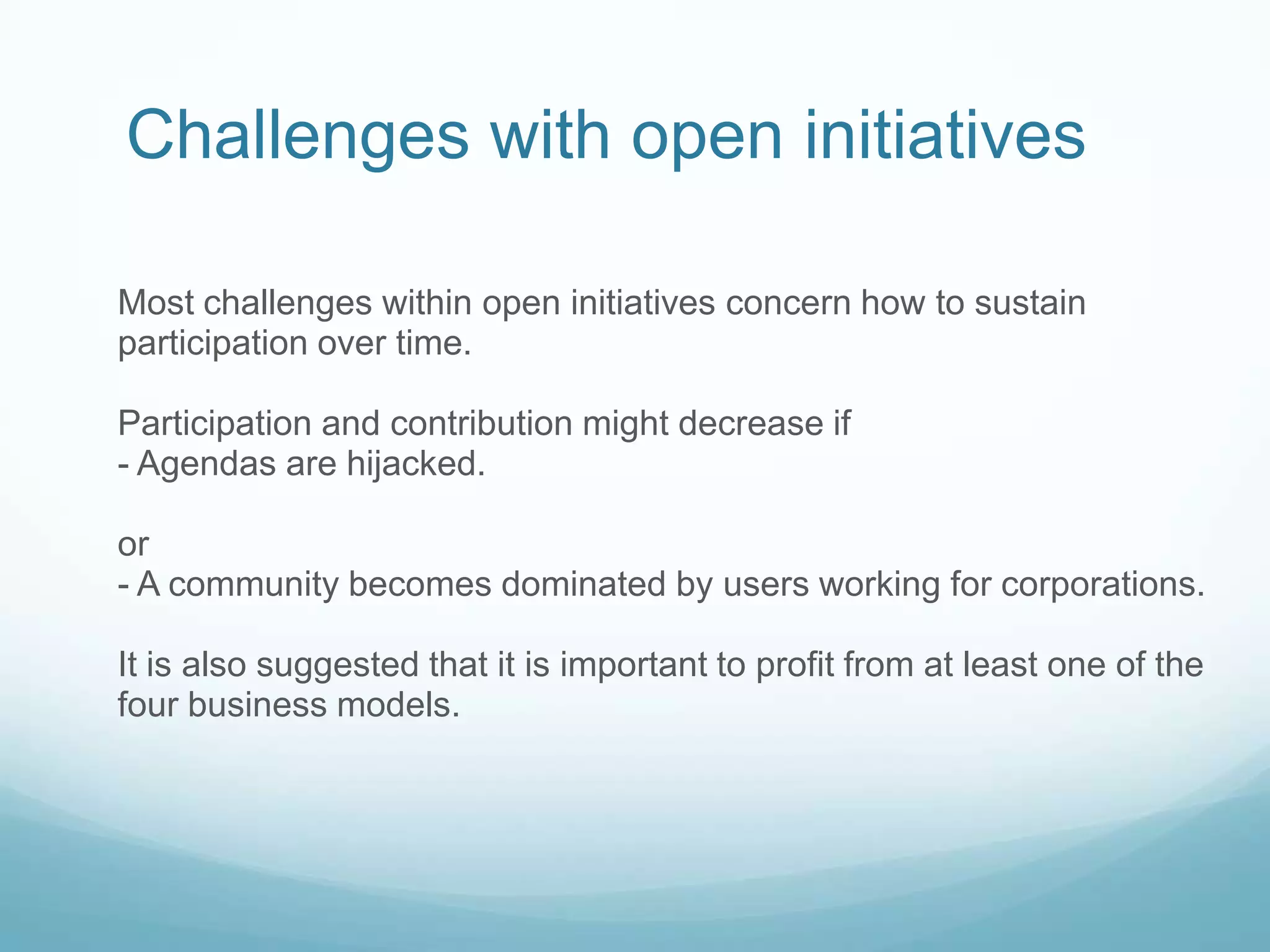
Challenges with open initiatives    Most challenges within open initiatives concern how to sustain participation over time. Participation and contribution might decrease if- Agendas are hijacked.  or - A community becomes dominated by users working for corporations.It is also suggested that it is important to profit from at least one of the four business models.
Traditional Strategy and Open InitiativesIronically, we believe that the best chance for open initiatives to sustain themselves will come from returning to the perspectives of traditional business strategy. (Chesbrough et al)For starters, traditional business strategy has spotlighted settings in which cooperation would likely break down. Traditional strategy also provides two guideposts for value capture. The first points to IP ownership and the second points to creative management of the value chain.Finally, open initiatives may allow for the creation of whole new complementary links in a value chain.(Chesbrough et al)
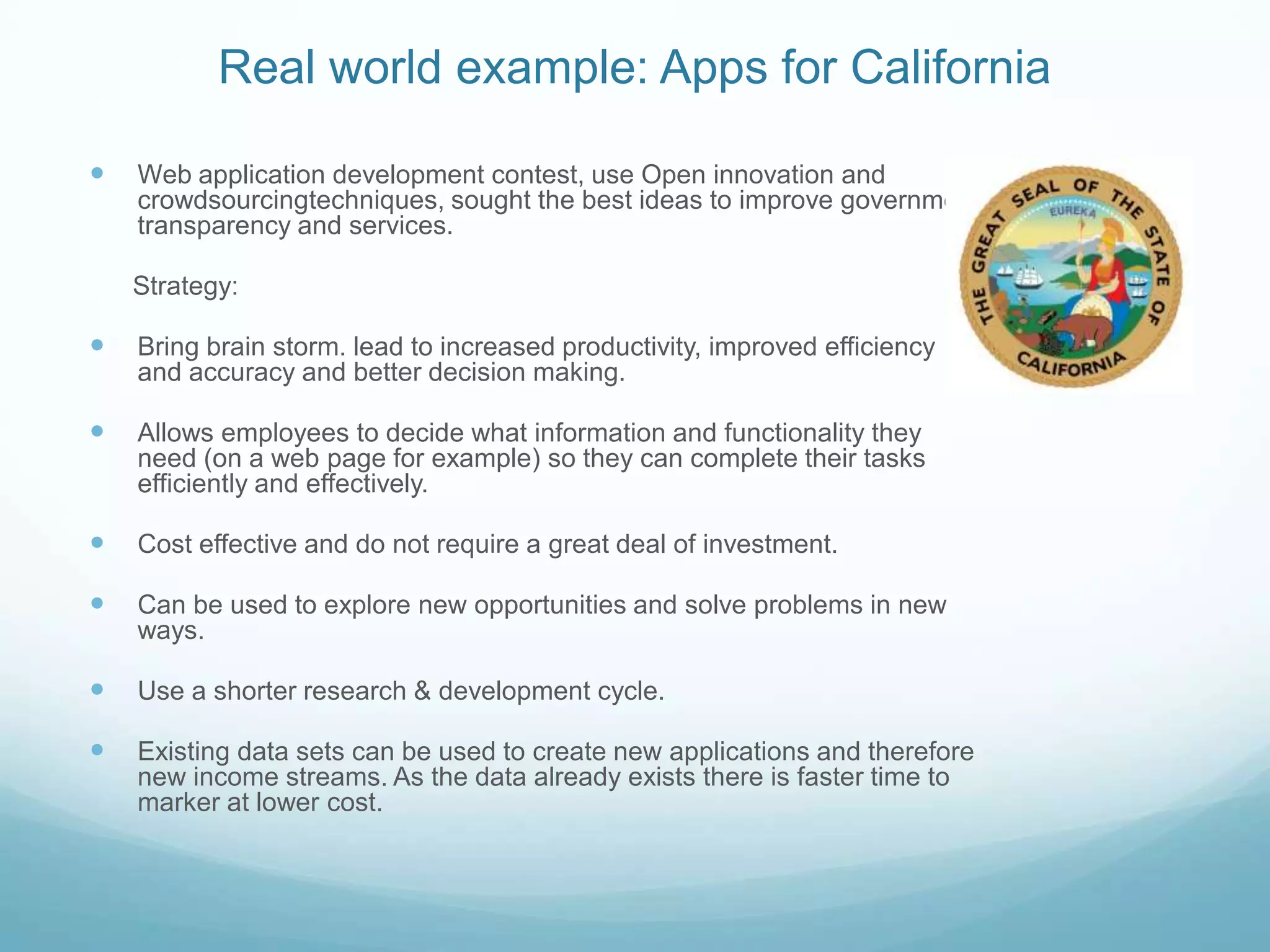
Real world example: Apps for CaliforniaWeb application development contest, use Open innovation and crowdsourcingtechniques, sought the best ideas to improve government transparency and services.      Strategy: Bring brain storm. lead to increased productivity, improved efficiency and accuracy and better decision making.Allows employees to decide what information and functionality they need (on a web page for example) so they can complete their tasks efficiently and effectively.Cost effective and do not require a great deal of investment.Can be used to explore new opportunities and solve problems in new ways.Use a shorter research & development cycle.Existing data sets can be used to create new applications and therefore new income streams. As the data already exists there is faster time to marker at lower cost.
Sourceshttp://www.strategicinnovation.org/wp-content/uploads/c933d0f5f935a2f.gifhttp://en.wikipedia.org/wiki/Porter_five_forces_analysis

Sse open innovation and strategy group2b_2011

  • 1.
    Open Innovation andStrategy Group 2b
  • 2.
    Open innovationopen innovationis creating new empirical phenomena that exist uneasily with well-established theories of business strategy.Forcing firms to reassess their leadership positions which reflect the performance outcomes of their business strategies.To take benefit from collective intelligence and consumer participation.
  • 3.
    Open strategyBalances thetenets of traditional business strategy. Embraces the benefits of openness as a means of expanding value creation for organizations.Places certain limits on traditional business models when those limits are necessary to foster greater adoption of an innovation approach.Introduces new business models based on invention and coordination undertaken within a community of innovators.Effective open strategy will balance value capture and value creation. Open strategy is an important approach for those who wish to lead through innovation.
  • 4.
  • 5.
    Closed Innovation VS.Open Innovation
  • 6.
    Different kinds ofopen businessThe article indentifies four different kinds of open business models: Deployment - users are willing to pay for it, due to high user                                         experience, even if the initial technology is free. Hybridization - multiple versions offered, for example both public                                     free and private commercial ones.  Complements - free software, but device that costs. Self-service  - users create software for its own needs.Indeed, these models can occur simulaneosly within a company.
  • 7.
    Business areasMost commonwithin information technology, but does occure within other areas as well, for example: life sciences: Public Library of Science, development ofdrugs without commercial interest. snowboarding, windsurfing and skateboardning industries.There is a belief that open initiatives will expand in to more industries around the world.
  • 8.
    Challenges with openinitiatives    Most challenges within open initiatives concern how to sustain participation over time. Participation and contribution might decrease if- Agendas are hijacked.  or - A community becomes dominated by users working for corporations.It is also suggested that it is important to profit from at least one of the four business models.
  • 9.
    Traditional Strategy andOpen InitiativesIronically, we believe that the best chance for open initiatives to sustain themselves will come from returning to the perspectives of traditional business strategy. (Chesbrough et al)For starters, traditional business strategy has spotlighted settings in which cooperation would likely break down. Traditional strategy also provides two guideposts for value capture. The first points to IP ownership and the second points to creative management of the value chain.Finally, open initiatives may allow for the creation of whole new complementary links in a value chain.(Chesbrough et al)
  • 10.
    Real world example:Apps for CaliforniaWeb application development contest, use Open innovation and crowdsourcingtechniques, sought the best ideas to improve government transparency and services. Strategy: Bring brain storm. lead to increased productivity, improved efficiency and accuracy and better decision making.Allows employees to decide what information and functionality they need (on a web page for example) so they can complete their tasks efficiently and effectively.Cost effective and do not require a great deal of investment.Can be used to explore new opportunities and solve problems in new ways.Use a shorter research & development cycle.Existing data sets can be used to create new applications and therefore new income streams. As the data already exists there is faster time to marker at lower cost.
  • 11.