“ P artnerships  P romote  S uccess” King Philip Middle School  Open House  2010
“ When I was a boy of fourteen, my father was so ignorant I could hardly stand to have the old man around.  But when I got to be twenty-one, I was astonished at how much he had learned in seven years.”  ~Mark Twain, "Old Times on the Mississippi"  Atlantic Monthly , 1874
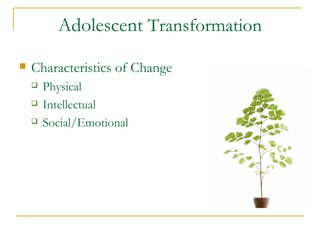
Adolescent  Transformation Characteristics of Change Physical Intellectual Social/Emotional
Signs of Physical Change Rapid growth and hormonal changes Preoccupation with appearance High levels of activity coupled with frequent fatigue Increased brain development Source:  American School Counselor Association Normal Adolescent Development in Middle School Years
Signs of Intellectual Change Explore a variety of interests Better able to problem solve Establish a sense of self and individuality Need to see the connection between learning and practical life applications Difficulty planning and anticipating consequences of their actions (impulsivity) Source:  American School Counselor Association Normal Adolescent Development in Middle School Years
Signs of Social/Emotional Change May be moody and display less affection  Sensitive to comments from others Reliant on friends to provide comfort and approval. Beginning to turn to peers rather than parents for ideas and affirmations, but continue to need parental support and guidance. Source:  American School Counselor Association Normal Adolescent Development in Middle School Years
Implications for Parents Share time engaged in fun activities Make time to discuss school: ask questions and listen Encourage self-advocacy: Don’t solve problems for them. Be firm, fair, and consistent  Communicate that learning is central focus Praise your child for his/her efforts Let praise stand alone Allow for natural consequences at school
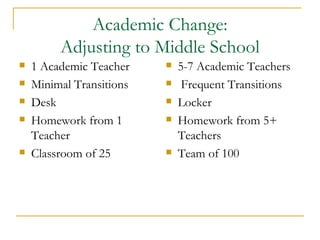
Academic Change: Adjusting to Middle School 1 Academic Teacher Minimal Transitions Desk Homework from 1 Teacher Classroom of 25 5-7 Academic Teachers Frequent Transitions  Locker Homework from 5+ Teachers Team of 100
Common Challenges for Parents   My child resists my efforts to help. My child won’t communicate with me. Homework completion is an issue. Agenda is not filled out completely Organizational issues-lost papers, forgot book  “ I did it in learning lab” Motivating my child  Grades, achievement, and career ambition Avoid a negative consequence
Overcoming Potential Challenges Become familiar with team homework expectations Create a nightly routine Review agenda Check off completed work Look for long-term assignments  Organize completed work Pack book bag before bed Maintain a distraction-free supervised setting  Access team and teacher Blogs Give positive praise for effort
School Counselors Role & Delivery of Services Alphabetical Split A-D Mrs. Brohinsky  E-K Mr. D’Addio L-K Mrs. Johnson  R-Z Mrs. Stevenson Web-Page http://blog.whps.org/KPCounsel/ Frequently Asked Questions/Contact Information
Implications for Educators  Emphasize critical thinking Provide connections beyond the classroom Curriculum-connections Focus on essential questions and learning goals Structure student learning  Modeling, guided practice, independent practice, and feedback Multiple forms of assessment Develop personal relationship- “foundation for powerful learning” Source: Turning Points Transforming Middle Schools

Open house-partnerships-promote-success1

  • 1.
    “ P artnerships P romote S uccess” King Philip Middle School Open House 2010
  • 2.
    “ When Iwas a boy of fourteen, my father was so ignorant I could hardly stand to have the old man around.  But when I got to be twenty-one, I was astonished at how much he had learned in seven years.”  ~Mark Twain, "Old Times on the Mississippi" Atlantic Monthly , 1874
  • 3.
    Adolescent TransformationCharacteristics of Change Physical Intellectual Social/Emotional
  • 4.
    Signs of PhysicalChange Rapid growth and hormonal changes Preoccupation with appearance High levels of activity coupled with frequent fatigue Increased brain development Source: American School Counselor Association Normal Adolescent Development in Middle School Years
  • 5.
    Signs of IntellectualChange Explore a variety of interests Better able to problem solve Establish a sense of self and individuality Need to see the connection between learning and practical life applications Difficulty planning and anticipating consequences of their actions (impulsivity) Source: American School Counselor Association Normal Adolescent Development in Middle School Years
  • 6.
    Signs of Social/EmotionalChange May be moody and display less affection Sensitive to comments from others Reliant on friends to provide comfort and approval. Beginning to turn to peers rather than parents for ideas and affirmations, but continue to need parental support and guidance. Source: American School Counselor Association Normal Adolescent Development in Middle School Years
  • 7.
    Implications for ParentsShare time engaged in fun activities Make time to discuss school: ask questions and listen Encourage self-advocacy: Don’t solve problems for them. Be firm, fair, and consistent Communicate that learning is central focus Praise your child for his/her efforts Let praise stand alone Allow for natural consequences at school
  • 8.
    Academic Change: Adjustingto Middle School 1 Academic Teacher Minimal Transitions Desk Homework from 1 Teacher Classroom of 25 5-7 Academic Teachers Frequent Transitions Locker Homework from 5+ Teachers Team of 100
  • 9.
    Common Challenges forParents My child resists my efforts to help. My child won’t communicate with me. Homework completion is an issue. Agenda is not filled out completely Organizational issues-lost papers, forgot book “ I did it in learning lab” Motivating my child Grades, achievement, and career ambition Avoid a negative consequence
  • 10.
    Overcoming Potential ChallengesBecome familiar with team homework expectations Create a nightly routine Review agenda Check off completed work Look for long-term assignments Organize completed work Pack book bag before bed Maintain a distraction-free supervised setting Access team and teacher Blogs Give positive praise for effort
  • 11.
    School Counselors Role& Delivery of Services Alphabetical Split A-D Mrs. Brohinsky E-K Mr. D’Addio L-K Mrs. Johnson R-Z Mrs. Stevenson Web-Page http://blog.whps.org/KPCounsel/ Frequently Asked Questions/Contact Information
  • 12.
    Implications for Educators Emphasize critical thinking Provide connections beyond the classroom Curriculum-connections Focus on essential questions and learning goals Structure student learning Modeling, guided practice, independent practice, and feedback Multiple forms of assessment Develop personal relationship- “foundation for powerful learning” Source: Turning Points Transforming Middle Schools

Editor's Notes

  • #5 Physical changes - Feeling self-conscious, awkward, etc. Brain dev’t (prefrontal cortex) – responsible for many of emotional/social/intellectual/behavioral changes we are going to talk about (increased memory and problem solving skills, more emotional, less responsive to rewards, more responsive to stress, more impulsive, difficulty seeing consequences of actions
  • #6 Exploring interests- Need to learn about world and find their place in it “ When am I ever gonna use this again?” As begin to search for identity/identity, they will challenge you. This is part of growing up. Don’t take it personally.
  • #7 As parent, can easily feel rejected. Remember, this is necessary for kids to develop their own identity. They must begin to become independent of you. Although annoying, this is healthy! -want to try out new things, but usually realize have little experience to fall back on when things get difficult (can feel very adult one minute, and inexperienced the next.
  • #8 Do not rush to solve problems for them! adolescents need limits Consistency between parents and households