
Building Bridges: Developing and
Maintaining Positive Parent- Teacher
Relationships
OPEN~UA
November 18,2015
Parenting in like building a
ship when you’re already at
sea.
- Allyson Pearson
 Discuss research on parent-school relationship
 Identify methods of building relationships between
educational team members
 List roles and responsibilities of educational team
members
 Set a measurable goal to enhance communication
between team members
What do we KNOW?
 Positive parent-teacher relationships directly affect
student achievement
 Poor parent school relationships result in feelings of
conflict for the child
 Parents’ sense of efficacy shapes their participation
 Teachers’ perception of parents’
efficacy affects partnership
 Mutual respect
 Clear understanding of roles
 Opportunity for feedback
 Openness to change and adjustment
 Similar expectation
 Define common goal
Gorman,Jean Cheng(2004). “working with Challenging Parents of Students
with Special Needs”
Students whose parents and teachers work together are
more likely to
 Earn higher grades and test scores
 Enroll in higher-level programs
 Are promoted more and earn more credits
 Adapt better to school and attend more regularly
 Have better social skills and behavior
 Graduate and go on to higher education
Henderson, Mapp (2002). A New Wave of Evidence: the Impact of family, school and
community connections on student achievement. Southwest Educational Development
Laboratory, Austin, TX.
Discord between parents and teachers creates
 Confusion
 Divided loyalties
 Diminished respect for the teachers
 Increased defiance and arrogance
Katz, Lillian G. (1996). Building Resilience: Helping Your Child Cope with
Frustrations at school. INSTRUCTOR 106(3): 95-98
 Education affects a parent’s sense of efficacy
 Attitudes about effectiveness and involvement yields
greater sense of efficacy
 Teachers’ assessment of parents efficacy is correlated
to the amount and type of help offered by parents
 High levels of teacher and parent self-efficacy lead to
greater communication and more positive relationship
Hoover-Dempsey, K.V. Bassler. O.C., & Brissle,J.S. (1992). Explorations in parent-
schools relations. Journal of Educational Research, 85(5), 287-294.
Developing the Fully-Engaged
Parents:
A Model for Understanding Parent Involvement in
Education
Price-Mitchell and Grijalva (2004)
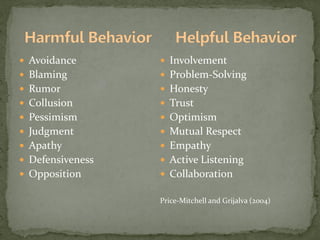
 Avoidance
 Blaming
 Rumor
 Collusion
 Pessimism
 Judgment
 Apathy
 Defensiveness
 Opposition
 Involvement
 Problem-Solving
 Honesty
 Trust
 Optimism
 Mutual Respect
 Empathy
 Active Listening
 Collaboration
Price-Mitchell and Grijalva (2004)
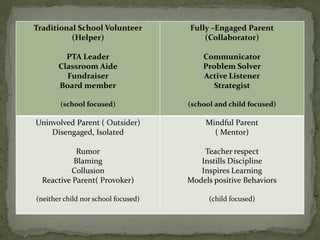
Traditional School Volunteer
(Helper)
PTA Leader
Classroom Aide
Fundraiser
Board member
(school focused)
Fully –Engaged Parent
(Collaborator)
Communicator
Problem Solver
Active Listener
Strategist
(school and child focused)
Uninvolved Parent ( Outsider)
Disengaged, Isolated
Rumor
Blaming
Collusion
Reactive Parent( Provoker)
(neither child nor school focused)
Mindful Parent
( Mentor)
Teacher respect
Instills Discipline
Inspires Learning
Models positive Behaviors
(child focused)
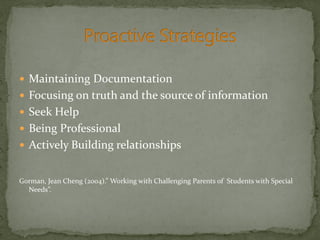
 Maintaining Documentation
 Focusing on truth and the source of information
 Seek Help
 Being Professional
 Actively Building relationships
Gorman, Jean Cheng (2004).” Working with Challenging Parents of Students with Special
Needs”.
 Anxiety- for parents and teachers
 Frustration- which can define your
contact
 Limited Time-demands are different
but add up to the same result
“Begin with the end in Mind”
~Stephen Covey
 What do you want your relationship with the school
to be like….
- in one month
-At the end of this school year
-At the end of five school years
-When your child is finished with public education
 DREAM BIG and plan annually
 Planning for Efficiency
 Know the disability, how it effect his/her learning
 Consider Strengths and needs
 Include the Child
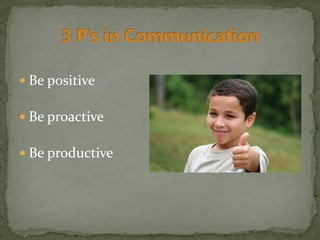
 Be positive
 Be proactive
 Be productive
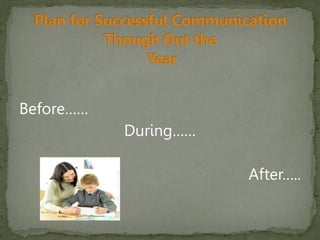
Before……
During……
After…..
Introducing …MY CHILD
Using the 3 P’s send a quick note and then set up a
face to face meeting ( avoid an email at this time)
 Medical information
 Child’s strengths and needs
 Summary of goals
 Contact information and best time to communicate
 Emergency information
 Day to Day communication
 home to school notebook
 Notes in planner
 Check in/out sheet
 If phone call is required set up a consistent call time
and keep it short
 Conferences
 IEP meetings
 “Reviews and Snafus”
 Get the lay of the Land
 Do your homework
 Include the “Most Valuable Player”
 Take five…or as long as you need
 Get on the same side of the table
 Have a follow-up plan
 Is it TRUE?
 Is it HELPFUL?
 Is it IMPORTANT?
 Is it NECESSARY?
 Is it KIND?
 What are people saying…without saying anything at
all?
 What are YOU saying?
 Posture, facial expressions, fidgeting…..
1. Intervention or Special Education Teacher( Case
Manager)*
2. General Education Teacher*
3. Principle
4. Special Education Supervisor( when applicable)
5. Director of Special Education
6. Superintendent
7. Board of Education
8. State board of Education
*paraprofessionals report directly to teachers
 “He’s an equal opportunity low-achiever”
 “ADHD? That’s a cop out”
 “You’ve probably been bending the rules for her since
she’s been so sick”
 “I don’t see the OCD. He just keeps going back to his
locker all the time”
 “We can’t afford to just give every kid intervention”
 “ your child isn’t failing enough”
 “He is just lazy”
 “ What I want you to do is spend quality time with my
son”
 “Either you do what we want, or we’ll get a lawyer who
will say you have to”
 “I don’t care if the kid gets F’s. But you can’t fail him…”
 “ I know you are giving 8 weeks of ESY to Mrs. Jones’s
kid . I want that , too..”
 “ What degree do you have that qualifies you to work
with my child?”
 Be sure to have your paperwork
 Copy of IEP, all assessments and progress reports
 Get recommendations for the summer
 Create templates for record keeping
 Write genuine thank you notes
Open~UA 11.18.2015
Open~UA 11.18.2015

Open~UA 11.18.2015

  • 1.
    Building Bridges: Developingand Maintaining Positive Parent- Teacher Relationships OPEN~UA November 18,2015
  • 2.
    Parenting in likebuilding a ship when you’re already at sea. - Allyson Pearson
  • 3.
     Discuss researchon parent-school relationship  Identify methods of building relationships between educational team members  List roles and responsibilities of educational team members  Set a measurable goal to enhance communication between team members
  • 4.
    What do weKNOW?  Positive parent-teacher relationships directly affect student achievement  Poor parent school relationships result in feelings of conflict for the child  Parents’ sense of efficacy shapes their participation  Teachers’ perception of parents’ efficacy affects partnership
  • 5.
     Mutual respect Clear understanding of roles  Opportunity for feedback  Openness to change and adjustment  Similar expectation  Define common goal Gorman,Jean Cheng(2004). “working with Challenging Parents of Students with Special Needs”
  • 6.
    Students whose parentsand teachers work together are more likely to  Earn higher grades and test scores  Enroll in higher-level programs  Are promoted more and earn more credits  Adapt better to school and attend more regularly  Have better social skills and behavior  Graduate and go on to higher education Henderson, Mapp (2002). A New Wave of Evidence: the Impact of family, school and community connections on student achievement. Southwest Educational Development Laboratory, Austin, TX.
  • 7.
    Discord between parentsand teachers creates  Confusion  Divided loyalties  Diminished respect for the teachers  Increased defiance and arrogance Katz, Lillian G. (1996). Building Resilience: Helping Your Child Cope with Frustrations at school. INSTRUCTOR 106(3): 95-98
  • 8.
     Education affectsa parent’s sense of efficacy  Attitudes about effectiveness and involvement yields greater sense of efficacy  Teachers’ assessment of parents efficacy is correlated to the amount and type of help offered by parents  High levels of teacher and parent self-efficacy lead to greater communication and more positive relationship Hoover-Dempsey, K.V. Bassler. O.C., & Brissle,J.S. (1992). Explorations in parent- schools relations. Journal of Educational Research, 85(5), 287-294.
  • 9.
    Developing the Fully-Engaged Parents: AModel for Understanding Parent Involvement in Education Price-Mitchell and Grijalva (2004)
  • 10.
     Avoidance  Blaming Rumor  Collusion  Pessimism  Judgment  Apathy  Defensiveness  Opposition  Involvement  Problem-Solving  Honesty  Trust  Optimism  Mutual Respect  Empathy  Active Listening  Collaboration Price-Mitchell and Grijalva (2004)
  • 11.
    Traditional School Volunteer (Helper) PTALeader Classroom Aide Fundraiser Board member (school focused) Fully –Engaged Parent (Collaborator) Communicator Problem Solver Active Listener Strategist (school and child focused) Uninvolved Parent ( Outsider) Disengaged, Isolated Rumor Blaming Collusion Reactive Parent( Provoker) (neither child nor school focused) Mindful Parent ( Mentor) Teacher respect Instills Discipline Inspires Learning Models positive Behaviors (child focused)
  • 12.
     Maintaining Documentation Focusing on truth and the source of information  Seek Help  Being Professional  Actively Building relationships Gorman, Jean Cheng (2004).” Working with Challenging Parents of Students with Special Needs”.
  • 13.
     Anxiety- forparents and teachers  Frustration- which can define your contact  Limited Time-demands are different but add up to the same result
  • 14.
    “Begin with theend in Mind” ~Stephen Covey
  • 15.
     What doyou want your relationship with the school to be like…. - in one month -At the end of this school year -At the end of five school years -When your child is finished with public education
  • 16.
     DREAM BIGand plan annually  Planning for Efficiency  Know the disability, how it effect his/her learning  Consider Strengths and needs  Include the Child
  • 17.
     Be positive Be proactive  Be productive
  • 18.
  • 19.
    Introducing …MY CHILD Usingthe 3 P’s send a quick note and then set up a face to face meeting ( avoid an email at this time)  Medical information  Child’s strengths and needs  Summary of goals  Contact information and best time to communicate  Emergency information
  • 20.
     Day toDay communication  home to school notebook  Notes in planner  Check in/out sheet  If phone call is required set up a consistent call time and keep it short  Conferences  IEP meetings  “Reviews and Snafus”
  • 21.
     Get thelay of the Land  Do your homework  Include the “Most Valuable Player”  Take five…or as long as you need  Get on the same side of the table  Have a follow-up plan
  • 22.
     Is itTRUE?  Is it HELPFUL?  Is it IMPORTANT?  Is it NECESSARY?  Is it KIND?
  • 23.
     What arepeople saying…without saying anything at all?  What are YOU saying?  Posture, facial expressions, fidgeting…..
  • 24.
    1. Intervention orSpecial Education Teacher( Case Manager)* 2. General Education Teacher* 3. Principle 4. Special Education Supervisor( when applicable) 5. Director of Special Education 6. Superintendent 7. Board of Education 8. State board of Education *paraprofessionals report directly to teachers
  • 25.
     “He’s anequal opportunity low-achiever”  “ADHD? That’s a cop out”  “You’ve probably been bending the rules for her since she’s been so sick”  “I don’t see the OCD. He just keeps going back to his locker all the time”  “We can’t afford to just give every kid intervention”  “ your child isn’t failing enough”  “He is just lazy”
  • 26.
     “ WhatI want you to do is spend quality time with my son”  “Either you do what we want, or we’ll get a lawyer who will say you have to”  “I don’t care if the kid gets F’s. But you can’t fail him…”  “ I know you are giving 8 weeks of ESY to Mrs. Jones’s kid . I want that , too..”  “ What degree do you have that qualifies you to work with my child?”
  • 27.
     Be sureto have your paperwork  Copy of IEP, all assessments and progress reports  Get recommendations for the summer  Create templates for record keeping  Write genuine thank you notes