Paul Maharg Glasgow Graduate School of Law open educational resources (OER): why they matter paul maharg
preview… OER – what are they? Who develops them? Why? Problems to be overcome simSHARE Transformation of HE?
OER – what are they? Learning content  - full courses, course materials, content modules, learning objects, collections and journals Tools  - software to support the creation, delivery, use and improvement of open learning content including searching and organisation of content, content and learning management systems, content development tools and online learning communities. Implementation resources  - intellectual property licenses to promote open publishing of materials, design principles and localisation of content .
other Open initiatives… UNESCO Forum on the Impact of Open Courseware for Higher Education in Developing Countries (2002) SSRN – Social Science Research Networks Digital Access to Scholarship at Harvard (DASH) Wikipedia SourceForge Open-source software, eg OpenOffice Mozilla Foundation (Firefox, etc) Open primary resources in law, eg AUSTLII, BAILII
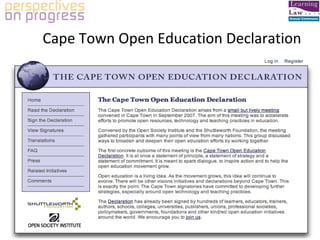
Cape Town Open Education Declaration
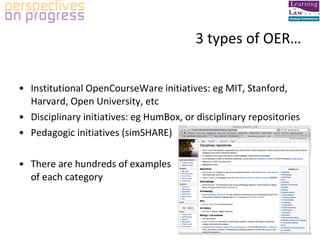
3 types of OER… Institutional OpenCourseWare initiatives: eg MIT, Stanford, Harvard, Open University, etc Disciplinary initiatives: eg HumBox, or disciplinary repositories Pedagogic initiatives (simSHARE) There are hundreds of examples of each category http://oad.simmons.edu/oadwiki/Disciplinary_repositories
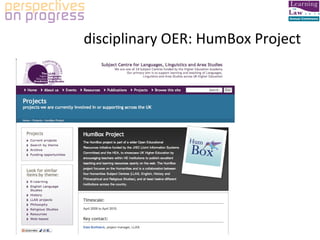
disciplinary OER: HumBox Project
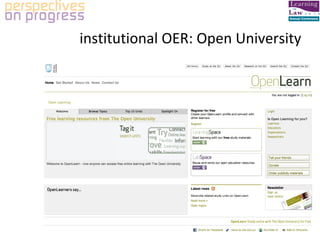
institutional OER: Open University
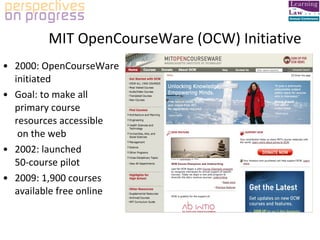
MIT OpenCourseWare (OCW) Initiative 2000: OpenCourseWare initiated Goal: to make all primary course  resources accessible  on the web 2002: launched  50-course pilot 2009: 1,900 courses available free online
Extent of MIT OCW? 86.8 M visits to OCW content as of Oct 09  791 courses translated and on 220 mirror sites globally OCW materials are being widely distributed offline and through secondary channels. 10 M course zip files have been downloaded off the site since July 2006, equivalent to 5,100 copies of the entire site 3.7 M OCW video and audio files have been downloaded through iTunes U 2009 Program Evaluation Findings Summary http://ocw.mit.edu/ans7870/global/09_Eval_Summary.pdf
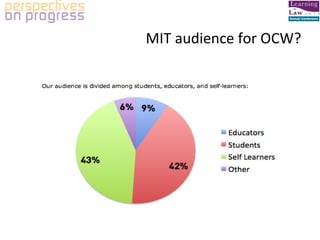
MIT audience for OCW?
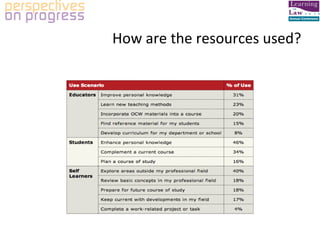
How are the resources used?
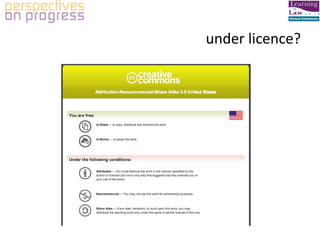
under licence?
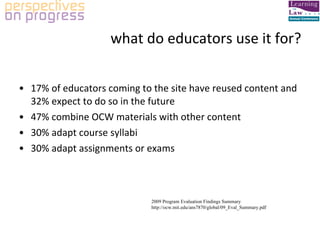
what do educators use it for? 17% of educators coming to the site have reused content and 32% expect to do so in the future 47% combine OCW materials with other content 30% adapt course syllabi 30% adapt assignments or exams 2009 Program Evaluation Findings Summary http://ocw.mit.edu/ans7870/global/09_Eval_Summary.pdf
why create OER? Lowers the costs of educational materials for students Fosters pedagogical innovation and relevance that avoids ‘teaching from the textbook’ Gives faculty tools to gain control over learning content and delivery. Share and remix learning materials for customized and localized use Fast feedback loop on quality and relevance of learning materials => continual improvement and rapid development http://edtechpost.wikispaces.com/OER+Benefits
why create OER? Philanthropic : Sharing and providing education to people all over the world, with special attention to those in third-world countries or without access to high-quality local education. Strategic : Adapting educational practices to the changing world culture may increase viability of educational institutions. (Additional motivations exist here as well, but are perhaps more subtle or less overarching). Pedagogic : The act of sharing may increase attention to quality; the act of adapting or remixing may increase quality; the utilization of new technologies may enhance educational engagement amongst learners. Economic : Cost-savings to the institution by digitally archiving their own materials, and then sharing and reusing within the institution and amongst peers. http://mfeldstein.com/itoe-motivations-for-open-education/
some fatal characteristics of OERs OER Creators Hubris Poor quality product No business plan No sustainability plan Focus on product to detriment of community A heroic leader (who gets promoted or fed up or too busy) OER Community No community No embedded sense of a remix culture Other employment factors, eg management rules, block use of OER Community takes and doesn’t give
aims of the simSHARE project? Collation of simulation resources  which are repurposed as open educational content Creation of guidelines  for future publication of simulation projects Help staff to use simulation more widely and effectively through  staff development . Create  methodologies  that will help staff to see more clearly how simulation OER can be interpreted and in particular how to: Generate or re-purpose a simulation Archive a simulation Retrieve a simulation and analyse its component parts for educational value and purpose
project details Funded  in the by JISC & HEA through the subject centre – see  http://www.jisc.ac.uk/oer  for list of current projects Core personnel: Danielle Lysaght (Project Manager, UKCLE) Patricia McKellar Project Advisor, UKCLE) Julian Priddle, (Project Co-ordinator) Sheila Skinner (Development Officer) Gavin Maxwell (Web Developer) Project partners: University of Glamorgan University of Strathclyde University of Warwick
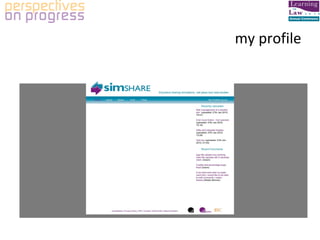
my profile
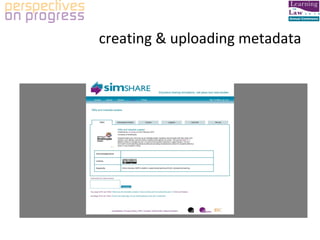
creating & uploading metadata
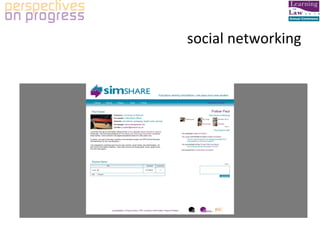
social networking
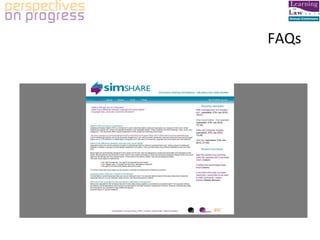
FAQs
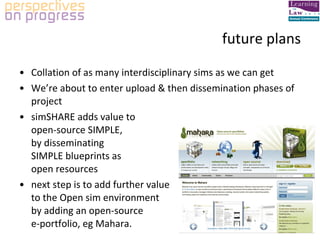
future plans Collation of as many interdisciplinary sims as we can get We’re about to enter upload & then dissemination phases of project simSHARE adds value to  open-source SIMPLE,  by disseminating  SIMPLE blueprints as  open resources next step is to add further value  to the Open sim environment  by adding an open-source  e-portfolio, eg Mahara.
transformation of HE?

Open educational resources (OER): why they matter

  • 1.
    Paul Maharg GlasgowGraduate School of Law open educational resources (OER): why they matter paul maharg
  • 2.
    preview… OER –what are they? Who develops them? Why? Problems to be overcome simSHARE Transformation of HE?
  • 3.
    OER – whatare they? Learning content - full courses, course materials, content modules, learning objects, collections and journals Tools - software to support the creation, delivery, use and improvement of open learning content including searching and organisation of content, content and learning management systems, content development tools and online learning communities. Implementation resources - intellectual property licenses to promote open publishing of materials, design principles and localisation of content .
  • 4.
    other Open initiatives…UNESCO Forum on the Impact of Open Courseware for Higher Education in Developing Countries (2002) SSRN – Social Science Research Networks Digital Access to Scholarship at Harvard (DASH) Wikipedia SourceForge Open-source software, eg OpenOffice Mozilla Foundation (Firefox, etc) Open primary resources in law, eg AUSTLII, BAILII
  • 5.
    Cape Town OpenEducation Declaration
  • 6.
    3 types ofOER… Institutional OpenCourseWare initiatives: eg MIT, Stanford, Harvard, Open University, etc Disciplinary initiatives: eg HumBox, or disciplinary repositories Pedagogic initiatives (simSHARE) There are hundreds of examples of each category http://oad.simmons.edu/oadwiki/Disciplinary_repositories
  • 7.
  • 8.
  • 9.
    MIT OpenCourseWare (OCW)Initiative 2000: OpenCourseWare initiated Goal: to make all primary course resources accessible on the web 2002: launched 50-course pilot 2009: 1,900 courses available free online
  • 10.
    Extent of MITOCW? 86.8 M visits to OCW content as of Oct 09 791 courses translated and on 220 mirror sites globally OCW materials are being widely distributed offline and through secondary channels. 10 M course zip files have been downloaded off the site since July 2006, equivalent to 5,100 copies of the entire site 3.7 M OCW video and audio files have been downloaded through iTunes U 2009 Program Evaluation Findings Summary http://ocw.mit.edu/ans7870/global/09_Eval_Summary.pdf
  • 11.
  • 12.
    How are theresources used?
  • 13.
  • 14.
    what do educatorsuse it for? 17% of educators coming to the site have reused content and 32% expect to do so in the future 47% combine OCW materials with other content 30% adapt course syllabi 30% adapt assignments or exams 2009 Program Evaluation Findings Summary http://ocw.mit.edu/ans7870/global/09_Eval_Summary.pdf
  • 15.
    why create OER?Lowers the costs of educational materials for students Fosters pedagogical innovation and relevance that avoids ‘teaching from the textbook’ Gives faculty tools to gain control over learning content and delivery. Share and remix learning materials for customized and localized use Fast feedback loop on quality and relevance of learning materials => continual improvement and rapid development http://edtechpost.wikispaces.com/OER+Benefits
  • 16.
    why create OER?Philanthropic : Sharing and providing education to people all over the world, with special attention to those in third-world countries or without access to high-quality local education. Strategic : Adapting educational practices to the changing world culture may increase viability of educational institutions. (Additional motivations exist here as well, but are perhaps more subtle or less overarching). Pedagogic : The act of sharing may increase attention to quality; the act of adapting or remixing may increase quality; the utilization of new technologies may enhance educational engagement amongst learners. Economic : Cost-savings to the institution by digitally archiving their own materials, and then sharing and reusing within the institution and amongst peers. http://mfeldstein.com/itoe-motivations-for-open-education/
  • 17.
    some fatal characteristicsof OERs OER Creators Hubris Poor quality product No business plan No sustainability plan Focus on product to detriment of community A heroic leader (who gets promoted or fed up or too busy) OER Community No community No embedded sense of a remix culture Other employment factors, eg management rules, block use of OER Community takes and doesn’t give
  • 18.
    aims of thesimSHARE project? Collation of simulation resources which are repurposed as open educational content Creation of guidelines for future publication of simulation projects Help staff to use simulation more widely and effectively through staff development . Create methodologies that will help staff to see more clearly how simulation OER can be interpreted and in particular how to: Generate or re-purpose a simulation Archive a simulation Retrieve a simulation and analyse its component parts for educational value and purpose
  • 19.
    project details Funded in the by JISC & HEA through the subject centre – see http://www.jisc.ac.uk/oer for list of current projects Core personnel: Danielle Lysaght (Project Manager, UKCLE) Patricia McKellar Project Advisor, UKCLE) Julian Priddle, (Project Co-ordinator) Sheila Skinner (Development Officer) Gavin Maxwell (Web Developer) Project partners: University of Glamorgan University of Strathclyde University of Warwick
  • 20.
  • 21.
  • 22.
  • 23.
  • 24.
    future plans Collationof as many interdisciplinary sims as we can get We’re about to enter upload & then dissemination phases of project simSHARE adds value to open-source SIMPLE, by disseminating SIMPLE blueprints as open resources next step is to add further value to the Open sim environment by adding an open-source e-portfolio, eg Mahara.
  • 25.