Open Educational Resources:
Opportunities and Challenges
Dr. Jan Hylén
OECD/CERI
Paris, France
www.oecd.org/edu/ceri
2
OER Project
 Why this is happening?
 Who is involved?
 What are the policy implications?
3
The OECD/CERI study on OER
 How to develop sustainable costs/benefits models for
OER initiatives?
 What are the intellectual property right issues linked to
OER initiatives?
 What are the incentives and barriers for universities and
faculty staff to deliver their material to OER initiatives?
 How to improve access and usefulness for the users of
OER initiatives?
4
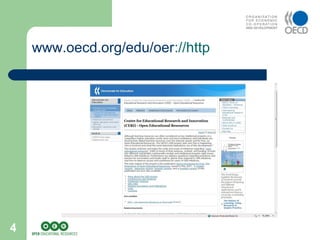
http://www.oecd.org/edu/oer
5
 OER Definition
 OER Elements
 OER Arguments
What is OER?
A Conceptual Discussion
6
What is OER?
OER Definition
UNESCO Conference (2002)
“The open provision of educational resources,
enabled by information and communication
technologies, for consultation, use and adaptation
by a community of users for non-commercial
purposes.”
The Currently Most Used Definition
“OER are digitized materials offered freely and
openly for educators, students and self-learners to
use and re-use for teaching, learning and
research.”
7
What is OER?
OER Elements
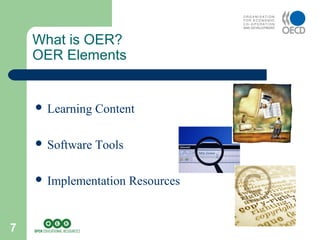
 Learning Content
 Software Tools
 Implementation Resources
8
What is OER?
OER Arguments
 OPEN - Freedom to use, contribute and share. Freedom
from technical, price, or legal barriers for the end-user.
“while “open” may on the one hand may mean “without cost”,
it does not follow that it also means “without conditions”.
 EDUCATIONAL – Includes only materials actually used
for teaching and learning should be considered. (OLCOS,
2006)
 RESOURCES - OER are digital resources
9
 OER Is A Worldwide Movement
 Categories of OER Providers
 Findings of OECD Survey
 Barriers To Produce OER
Mapping OER
Who Is The User & The Producer?
10
Mapping OER
OER Is A Worldwide Movement (1)
 Over 150 Chinese universities with over 450 courses online
 11 French universities (ParisTech OCW project), offer 150
courses
 9 Japanese universities in the Japanese OCW Alliance offer
over 250 courses
 7 American universities with OER projects (MIT,Rice, John
Hopkins, Tufts, Carnegie Mellon, Utah State University)
 More OER projects at universities in Australia, Brazil, Canada,
Hungary, India, Iran, Ireland, the Netherlands, Portugal, Russia,
South Africa, Spain, Thailand, the UK, the US, and Vietnam.
11
 OER Translation Projects: Universia’s Spanish and Portuguese
translations and China Open Resource for Education’s simplified Chinese
translations.
 OER non-course Projects: Rice’s Connexions project offers over 2800
resources, MERLOT offers 15000 resources, European based ARIADNE.
 Textbook Revolution contains links to hundreds of freely available,
copyright-clean textbooks.
 Freely accessible encyclopedias like Wikipedia and Math World grow in
size and quality.
 More resources available by way of search engines like Google or
Yahoo.
Mapping OER
OER Is A Worldwide Movement (2)
12
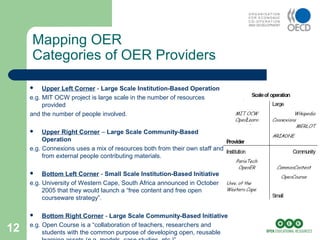
 Upper Left Corner - Large Scale Institution-Based Operation
e.g. MIT OCW project is large scale in the number of resources
provided
and the number of people involved.
 Upper Right Corner – Large Scale Community-Based
Operation
e.g. Connexions uses a mix of resources both from their own staff and
from external people contributing materials.
 Bottom Left Corner - Small Scale Institution-Based Initiative
e.g. University of Western Cape, South Africa announced in October
2005 that they would launch a “free content and free open
courseware strategy”.
 Bottom Right Corner - Large Scale Community-Based Initiative
e.g. Open Course is a “collaboration of teachers, researchers and
students with the common purpose of developing open, reusable
Mapping OER
Categories of OER Providers
13
Mapping OER
Findings of OECD Survey
For Individuals (Teachers & Researchers)
 The majority of the respondents said they were deeply involved in OER
activities, mostly as users of open content and only slightly less as
producers.
 According to MIT, users of OCW are typically: (Nov. 2003 – Oct. 2004)
-Well educated self-learners with bachelor’s or master’s degree (MIT
48%)
-Students (31%), and Educators (15%)
-From North America (36%) and were non-US visitors (36%)
 According to Tufts, users of OCW are typically: (Tufts 2006)
-Self Learners with bachelor’s or master’s degree (over 50%)
-Students or Faculty Members (43%)
14
 Lack of Time
 Lack of Skills – Technical know-how among faculty
 Lack of interest for pedagogical innovation
 The absence of a reward system
 Lack of a business model for open content
 Lack of access to computers
 Lack of Software
Mapping OER
Barriers To Produce OER
15
 Fundamental Questions
 Arguments For Open Sharing of OER
 Motives For Institutions
 Motives For Individuals
Why Are Individuals & Institutions
Engaged In OER?
16
 Why should anyone give away anything for free?
 What are the possible gains in doing that?
 Are there negative effects that might appear if
software developers, scientists and educationalists
do not share their work openly?
Why Engaged In OER?
Fundamental Questions
17
IF NO:
 Traditional academic values will be increasingly
marginalized by market forces
 The risk of a software monopoly
 The risk of ownership monopoly
 Increased costs
 Increased social inequality
 Slower technical and scientific development
Why Engaged In OER?
Arguments For Open Sharing of OER (1)
18
IF YES:
 Broader and faster dissemination of research results and
educational materials
 More people are involved in problem solving
 Rapid quality improvement and faster technical and
scientific development
 Societal development and diminished social inequality
Why Engaged In OER?
Arguments For Open Sharing of OER (2)
19
 Altruistic reason
 Leverage on taxpayers’ money by allowing free
sharing and reuse of resources between institutions
 “What you give, you receive back improved” – cuts
costs and improves quality
 Good public relations and show-window attracting
new students
 Growing competition – new business models & new
ways of making revenue are needed
Why Engaged In OER?
Motives For Institutions
20
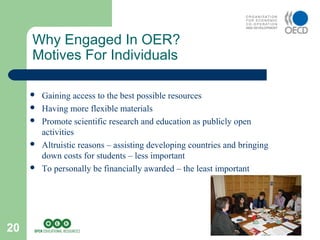
 Gaining access to the best possible resources
 Having more flexible materials
 Promote scientific research and education as publicly open
activities
 Altruistic reasons – assisting developing countries and bringing
down costs for students – less important
 To personally be financially awarded – the least important
Why Engaged In OER?
Motives For Individuals
21
Challenges To The
Growing OER Movement
 Lack of Awareness of Copyright Issues
 Quality Assurance
 Sustainability of OER Initiatives
22
Challenges To OER Movement
Intellectual Property Rights (1(
Challenge
Lack of knowledge and awareness among researchers and
faculty of copyright issues. They hesitate to share their
work for fear of losing their right to their work.
Solution
A need to use open licenses such as Creative Commons
23
Open Content Licenses:
Advantages
 Provides a way of controlled sharing with some rights reserved to the
author.
 Reduce the administrative burden of having to clear rights before use.
 Establish a body of works licensed as “open content” that may be
freely shared.
Disadvantages
 Rights holders must be prepared to exercise control over their work
 Moral rights are waived under open licenses
 Overlapping boundaries between not-for-profit, educational and
commercial distribution.
Challenges To OER Movement
Intellectual Property Rights (2(
24
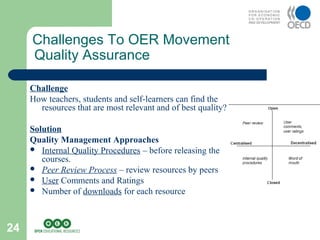
Challenge
How teachers, students and self-learners can find the
resources that are most relevant and of best quality?
Solution
Quality Management Approaches
 Internal Quality Procedures – before releasing the
courses.
 Peer Review Process – review resources by peers
 User Comments and Ratings
 Number of downloads for each resource
Challenges To OER Movement
Quality Assurance
25
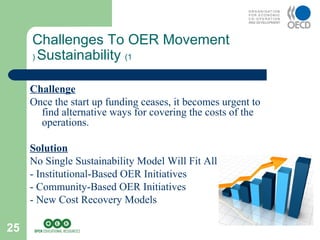
Challenge
Once the start up funding ceases, it becomes urgent to
find alternative ways for covering the costs of the
operations.
Solution
No Single Sustainability Model Will Fit All
- Institutional-Based OER Initiatives
- Community-Based OER Initiatives
- New Cost Recovery Models
Challenges To OER Movement
Sustainability (1(
26
Institutional-Based OER Initiatives (e.g. MIT OCW Project)
The growing competition among them creates a need to develop a strong
band, user communities, increased site usability and improved quality
of the resources offered -“Community Marketing”. Institutional
Model production, use and distribution is centralized.
Community-Based Initiatives (e.g. Connexions & MERLOT
Projects)
This is more of a grass roots activity where individuals contribute with
their time, knowledge and resources on a voluntary basis. Community
Model production, use and distribution is decentralized. Since it is
build on voluntary work, sustainability is not so much a matter of
financial resources as of dismantling barriers that hinders the
community to flourish and grow.
Challenges To OER Movement
Sustainability (2(
27
Sustainable Costs/Benefits Models
 Replacement Model (e.g., Blackboard)
 Foundation, Donation or Endowment Model/Government
 Support Model
 Segmentation Model
 Conversion Model
 Voluntary Support Model/Membership Model
 Contributor-Pay Model
Challenges To OER Movement
Sustainability (3(
28
Thank You
Mai M. Aly
OER

OER: Opportunities and Challenges

  • 1.
    Open Educational Resources: Opportunitiesand Challenges Dr. Jan Hylén OECD/CERI Paris, France www.oecd.org/edu/ceri
  • 2.
    2 OER Project  Whythis is happening?  Who is involved?  What are the policy implications?
  • 3.
    3 The OECD/CERI studyon OER  How to develop sustainable costs/benefits models for OER initiatives?  What are the intellectual property right issues linked to OER initiatives?  What are the incentives and barriers for universities and faculty staff to deliver their material to OER initiatives?  How to improve access and usefulness for the users of OER initiatives?
  • 4.
  • 5.
    5  OER Definition OER Elements  OER Arguments What is OER? A Conceptual Discussion
  • 6.
    6 What is OER? OERDefinition UNESCO Conference (2002) “The open provision of educational resources, enabled by information and communication technologies, for consultation, use and adaptation by a community of users for non-commercial purposes.” The Currently Most Used Definition “OER are digitized materials offered freely and openly for educators, students and self-learners to use and re-use for teaching, learning and research.”
  • 7.
    7 What is OER? OERElements  Learning Content  Software Tools  Implementation Resources
  • 8.
    8 What is OER? OERArguments  OPEN - Freedom to use, contribute and share. Freedom from technical, price, or legal barriers for the end-user. “while “open” may on the one hand may mean “without cost”, it does not follow that it also means “without conditions”.  EDUCATIONAL – Includes only materials actually used for teaching and learning should be considered. (OLCOS, 2006)  RESOURCES - OER are digital resources
  • 9.
    9  OER IsA Worldwide Movement  Categories of OER Providers  Findings of OECD Survey  Barriers To Produce OER Mapping OER Who Is The User & The Producer?
  • 10.
    10 Mapping OER OER IsA Worldwide Movement (1)  Over 150 Chinese universities with over 450 courses online  11 French universities (ParisTech OCW project), offer 150 courses  9 Japanese universities in the Japanese OCW Alliance offer over 250 courses  7 American universities with OER projects (MIT,Rice, John Hopkins, Tufts, Carnegie Mellon, Utah State University)  More OER projects at universities in Australia, Brazil, Canada, Hungary, India, Iran, Ireland, the Netherlands, Portugal, Russia, South Africa, Spain, Thailand, the UK, the US, and Vietnam.
  • 11.
    11  OER TranslationProjects: Universia’s Spanish and Portuguese translations and China Open Resource for Education’s simplified Chinese translations.  OER non-course Projects: Rice’s Connexions project offers over 2800 resources, MERLOT offers 15000 resources, European based ARIADNE.  Textbook Revolution contains links to hundreds of freely available, copyright-clean textbooks.  Freely accessible encyclopedias like Wikipedia and Math World grow in size and quality.  More resources available by way of search engines like Google or Yahoo. Mapping OER OER Is A Worldwide Movement (2)
  • 12.
    12  Upper LeftCorner - Large Scale Institution-Based Operation e.g. MIT OCW project is large scale in the number of resources provided and the number of people involved.  Upper Right Corner – Large Scale Community-Based Operation e.g. Connexions uses a mix of resources both from their own staff and from external people contributing materials.  Bottom Left Corner - Small Scale Institution-Based Initiative e.g. University of Western Cape, South Africa announced in October 2005 that they would launch a “free content and free open courseware strategy”.  Bottom Right Corner - Large Scale Community-Based Initiative e.g. Open Course is a “collaboration of teachers, researchers and students with the common purpose of developing open, reusable Mapping OER Categories of OER Providers
  • 13.
    13 Mapping OER Findings ofOECD Survey For Individuals (Teachers & Researchers)  The majority of the respondents said they were deeply involved in OER activities, mostly as users of open content and only slightly less as producers.  According to MIT, users of OCW are typically: (Nov. 2003 – Oct. 2004) -Well educated self-learners with bachelor’s or master’s degree (MIT 48%) -Students (31%), and Educators (15%) -From North America (36%) and were non-US visitors (36%)  According to Tufts, users of OCW are typically: (Tufts 2006) -Self Learners with bachelor’s or master’s degree (over 50%) -Students or Faculty Members (43%)
  • 14.
    14  Lack ofTime  Lack of Skills – Technical know-how among faculty  Lack of interest for pedagogical innovation  The absence of a reward system  Lack of a business model for open content  Lack of access to computers  Lack of Software Mapping OER Barriers To Produce OER
  • 15.
    15  Fundamental Questions Arguments For Open Sharing of OER  Motives For Institutions  Motives For Individuals Why Are Individuals & Institutions Engaged In OER?
  • 16.
    16  Why shouldanyone give away anything for free?  What are the possible gains in doing that?  Are there negative effects that might appear if software developers, scientists and educationalists do not share their work openly? Why Engaged In OER? Fundamental Questions
  • 17.
    17 IF NO:  Traditionalacademic values will be increasingly marginalized by market forces  The risk of a software monopoly  The risk of ownership monopoly  Increased costs  Increased social inequality  Slower technical and scientific development Why Engaged In OER? Arguments For Open Sharing of OER (1)
  • 18.
    18 IF YES:  Broaderand faster dissemination of research results and educational materials  More people are involved in problem solving  Rapid quality improvement and faster technical and scientific development  Societal development and diminished social inequality Why Engaged In OER? Arguments For Open Sharing of OER (2)
  • 19.
    19  Altruistic reason Leverage on taxpayers’ money by allowing free sharing and reuse of resources between institutions  “What you give, you receive back improved” – cuts costs and improves quality  Good public relations and show-window attracting new students  Growing competition – new business models & new ways of making revenue are needed Why Engaged In OER? Motives For Institutions
  • 20.
    20  Gaining accessto the best possible resources  Having more flexible materials  Promote scientific research and education as publicly open activities  Altruistic reasons – assisting developing countries and bringing down costs for students – less important  To personally be financially awarded – the least important Why Engaged In OER? Motives For Individuals
  • 21.
    21 Challenges To The GrowingOER Movement  Lack of Awareness of Copyright Issues  Quality Assurance  Sustainability of OER Initiatives
  • 22.
    22 Challenges To OERMovement Intellectual Property Rights (1( Challenge Lack of knowledge and awareness among researchers and faculty of copyright issues. They hesitate to share their work for fear of losing their right to their work. Solution A need to use open licenses such as Creative Commons
  • 23.
    23 Open Content Licenses: Advantages Provides a way of controlled sharing with some rights reserved to the author.  Reduce the administrative burden of having to clear rights before use.  Establish a body of works licensed as “open content” that may be freely shared. Disadvantages  Rights holders must be prepared to exercise control over their work  Moral rights are waived under open licenses  Overlapping boundaries between not-for-profit, educational and commercial distribution. Challenges To OER Movement Intellectual Property Rights (2(
  • 24.
    24 Challenge How teachers, studentsand self-learners can find the resources that are most relevant and of best quality? Solution Quality Management Approaches  Internal Quality Procedures – before releasing the courses.  Peer Review Process – review resources by peers  User Comments and Ratings  Number of downloads for each resource Challenges To OER Movement Quality Assurance
  • 25.
    25 Challenge Once the startup funding ceases, it becomes urgent to find alternative ways for covering the costs of the operations. Solution No Single Sustainability Model Will Fit All - Institutional-Based OER Initiatives - Community-Based OER Initiatives - New Cost Recovery Models Challenges To OER Movement Sustainability (1(
  • 26.
    26 Institutional-Based OER Initiatives(e.g. MIT OCW Project) The growing competition among them creates a need to develop a strong band, user communities, increased site usability and improved quality of the resources offered -“Community Marketing”. Institutional Model production, use and distribution is centralized. Community-Based Initiatives (e.g. Connexions & MERLOT Projects) This is more of a grass roots activity where individuals contribute with their time, knowledge and resources on a voluntary basis. Community Model production, use and distribution is decentralized. Since it is build on voluntary work, sustainability is not so much a matter of financial resources as of dismantling barriers that hinders the community to flourish and grow. Challenges To OER Movement Sustainability (2(
  • 27.
    27 Sustainable Costs/Benefits Models Replacement Model (e.g., Blackboard)  Foundation, Donation or Endowment Model/Government  Support Model  Segmentation Model  Conversion Model  Voluntary Support Model/Membership Model  Contributor-Pay Model Challenges To OER Movement Sustainability (3(
  • 28.