“This document reflects the views only of the authors, and the European Union cannot be held responsible for any use which may be made of the information contained therein.”
https://opengame-project.eu @OpenGame_eu
THE OPENGAME COMPETENCES FRAMEWORK
Fabio Nascimbeni Antonio Teixeira, Ulf-Daniel Ehlers, Alicia García Holgado, Francisco García Peñalvo,
Natalia Padilla Zea, James Brtunton & Daniel Burgos
Erasmus+ project, aiming at developing the capacity of HE
educators to teach with open approaches, through an
engaging gamified approach.
October 2019 – September 2021
Main outcomes:
1. Opengame Handbook of Open Teaching practices
(including the OE competencies framework)
2. Gamified course structure and content
3. The game (coming: stay tuned…)
Context: the OpenGame project
2
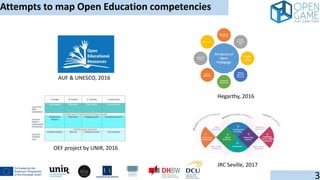
Attempts to map Open Education competencies
3
OEF project by UNIR, 2016
AUF & UNESCO, 2016
JRC Seville, 2017
Hegarthy, 2016
The OpenGame approach
4
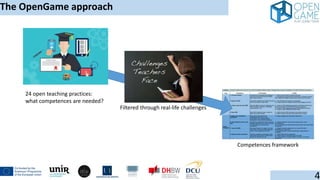
24 open teaching practices:
what competences are needed?
Filtered through real-life challenges
Competences framework
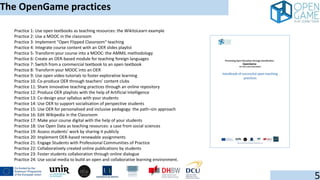
The OpenGame practices
5
Practice 1: Use open textbooks as teaching resources: the WikitoLearn example
Practice 2: Use a MOOC in the classroom
Practice 3: Implement "Open Flipped Classroom" teaching
Practice 4: Integrate course content with an OER slides playlist
Practice 5: Transform your course into a MOOC: the AMMIL methodology
Practice 6: Create an OER-based module for teaching foreign languages
Practice 7: Switch from a commercial textbook to an open textbook
Practice 8: Transform your MOOC into an OER
Practice 9: Use open video tutorials to foster explorative learning
Practice 10. Co-produce OER through teachers' content clubs
Practice 11: Share innovative teaching practices through an online repository
Practice 12: Produce OER playlists with the help of Artificial Intelligence
Practice 13: Co-design your syllabus with your students
Practice 14: Use OER to support socialisation of perspective students
Practice 15: Use OER for personalised and inclusive pedagogy: the path²in approach
Practice 16: Edit Wikipedia in the Classroom
Practice 17: Make your course digital with the help of your students
Practice 18: Use Open Data as teaching resources: a case from social sciences
Practice 19: Assess students' work by sharing it publicly
Practice 20: Implement OER-based renewable assignments
Practice 21: Engage Students with Professional Communities of Practice
Practice 22: Collaboratively created online publications by students
Practice 23: Foster students collaboration through online dialogue
Practice 24: Use social media to build an open and collaborative learning environment.
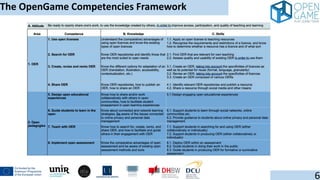
The OpenGame Competencies Framework
6
Be ready to openly share one's work, to use the knowledge created by
others, in order to improve access, participation, and quality of
teaching and learning
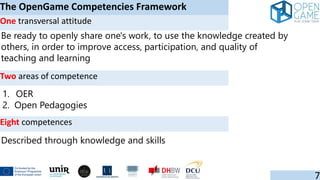
The OpenGame Competencies Framework
7
One transversal attitude
Two areas of competence
1. OER
2. Open Pedagogies
Eight competences
Described through knowledge and skills
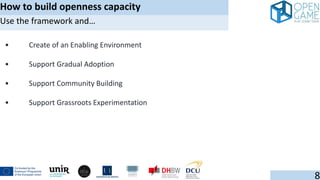
• Create of an Enabling Environment
• Support Gradual Adoption
• Support Community Building
• Support Grassroots Experimentation
How to build openness capacity
8
Use the framework and…
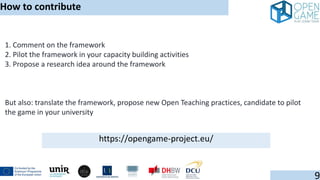
1. Comment on the framework
2. Pilot the framework in your capacity building activities
3. Propose a research idea around the framework
But also: translate the framework, propose new Open Teaching practices, candidate to pilot
the game in your university
How to contribute
9
https://opengame-project.eu/
“This document reflects the views only of the authors, and the European Union cannot be held responsible for any use which may be made of the information contained therein.”
https://opengame-project.eu @OpenGame_eu
Thank you!

Open Education Competences Framework (OpenGame project)

  • 1.
    “This document reflectsthe views only of the authors, and the European Union cannot be held responsible for any use which may be made of the information contained therein.” https://opengame-project.eu @OpenGame_eu THE OPENGAME COMPETENCES FRAMEWORK Fabio Nascimbeni Antonio Teixeira, Ulf-Daniel Ehlers, Alicia García Holgado, Francisco García Peñalvo, Natalia Padilla Zea, James Brtunton & Daniel Burgos
  • 2.
    Erasmus+ project, aimingat developing the capacity of HE educators to teach with open approaches, through an engaging gamified approach. October 2019 – September 2021 Main outcomes: 1. Opengame Handbook of Open Teaching practices (including the OE competencies framework) 2. Gamified course structure and content 3. The game (coming: stay tuned…) Context: the OpenGame project 2
  • 3.
    Attempts to mapOpen Education competencies 3 OEF project by UNIR, 2016 AUF & UNESCO, 2016 JRC Seville, 2017 Hegarthy, 2016
  • 4.
    The OpenGame approach 4 24open teaching practices: what competences are needed? Filtered through real-life challenges Competences framework
  • 5.
    The OpenGame practices 5 Practice1: Use open textbooks as teaching resources: the WikitoLearn example Practice 2: Use a MOOC in the classroom Practice 3: Implement "Open Flipped Classroom" teaching Practice 4: Integrate course content with an OER slides playlist Practice 5: Transform your course into a MOOC: the AMMIL methodology Practice 6: Create an OER-based module for teaching foreign languages Practice 7: Switch from a commercial textbook to an open textbook Practice 8: Transform your MOOC into an OER Practice 9: Use open video tutorials to foster explorative learning Practice 10. Co-produce OER through teachers' content clubs Practice 11: Share innovative teaching practices through an online repository Practice 12: Produce OER playlists with the help of Artificial Intelligence Practice 13: Co-design your syllabus with your students Practice 14: Use OER to support socialisation of perspective students Practice 15: Use OER for personalised and inclusive pedagogy: the path²in approach Practice 16: Edit Wikipedia in the Classroom Practice 17: Make your course digital with the help of your students Practice 18: Use Open Data as teaching resources: a case from social sciences Practice 19: Assess students' work by sharing it publicly Practice 20: Implement OER-based renewable assignments Practice 21: Engage Students with Professional Communities of Practice Practice 22: Collaboratively created online publications by students Practice 23: Foster students collaboration through online dialogue Practice 24: Use social media to build an open and collaborative learning environment.
  • 6.
  • 7.
    Be ready toopenly share one's work, to use the knowledge created by others, in order to improve access, participation, and quality of teaching and learning The OpenGame Competencies Framework 7 One transversal attitude Two areas of competence 1. OER 2. Open Pedagogies Eight competences Described through knowledge and skills
  • 8.
    • Create ofan Enabling Environment • Support Gradual Adoption • Support Community Building • Support Grassroots Experimentation How to build openness capacity 8 Use the framework and…
  • 9.
    1. Comment onthe framework 2. Pilot the framework in your capacity building activities 3. Propose a research idea around the framework But also: translate the framework, propose new Open Teaching practices, candidate to pilot the game in your university How to contribute 9 https://opengame-project.eu/
  • 10.
    “This document reflectsthe views only of the authors, and the European Union cannot be held responsible for any use which may be made of the information contained therein.” https://opengame-project.eu @OpenGame_eu Thank you!