Green or gold:
What will open access mean for the
LSE?
8 May 2013
LSE Impact of Social Science blog/LSE Library event
LSE Library Services
Understanding Open Access :
Background & Context
Martin Reid
Head of Academic Services
LSE Library
m.j.reid@lse.ac.uk
020 7955 7616
What is Open Access?
The process of making research outputs freely available online to anyone
with an internet connection, in agreement with the author and/or copyright
holder.
Involves removing price and permission barriers to access and reuse of
research
Benefits for:
• Authors: Greater exposure for work; increased citations; broader audience
• Institutions: Improved knowledge exchange and impact; enhanced reputation
• Society: Transparency and accountability; more effective use of research
funding; more innovation and return on investment
Routes to Open Access
Gold
• Publication in an Open Access journal: peer reviewed text is immediately
available free of charge – no subscriptions
• Publication costs (+ profits) met in other ways: fees for publication –
Article Processing Charge (APC); but also subsidies
Green
• Deposit of authoritative version of research in online institutional or
subject repository (e.g. LSE Research Online)
• Publication possible in pay-for-access journal at the same time
• Can involve delay in making text available in repository - embargos
Finch Report
• Working Group on Expanding Access to Published Research Findings chaired by
Janet Finch - Report published June 2012
• Aim to finds ways of expand access to published research without:
• undermining scholarly publishing industry and learned societies
• affecting standards of peer review and quality of UK research
• imposing unsustainable costs on universities
• Reconcile conflicting interests: researchers, funders, publishers
• Identify Gold Open Access as most effective means of achieving aims as final
peer reviewed text available immediately
• Recognize change has to be made gradually – UK part of global scholarly
communication system – transitional funding required
Finch Report - Recommendations
Key
• Policy direction to support publication in open access journals funded by APCs as
main vehicle for research
• RCUK and public funders to establish effective arrangements to meet costs of
publishing in open access journals
• Support for open access publication to be accompanied by policies to minimise
restrictions on use and re-use
Other
• Develop repositories to concentrate on complementary areas: research data,
digital preservation, grey literature
• Extended licensing
• Negotiation on journal pricing
• Investigation of open access publication of monographs
• Avoid undermining valuable journals not funded by APCs
Finch Report - Recommendations
For universities
• Establish mechanisms to enable universities to meet costs of APCs
• Establish publication funds within universities
• Establish arrangements for payment of APCs, minimising transaction
costs
• Develop policies and procedures in relation to open access publishing
and how it is funded
• Develop infrastructure of repositories and enhance interoperability to
provide:
• effective access routes for reports, working papers, other grey literature , and theses
• mechanism for enhancing links between publication and associated research data
• preservation service
Green or gold: What will open
access mean for the LSE?
The School’s response
David Coombe
Director of the Research Division
d.coombe@lse.ac.uk
8 May 2013
RCUK open access policy
• Step-change from 2005 policy
• Applies to (all) RCUK-acknowledged peer-
reviewed articles and conference
proceedings only
• RCUK prefers Gold; allows Green
• 5-year ‘journey’: 45% compliance (Gold or
Green) in year 1; 75% Gold by year 5
• Supported by block grant (£63k)
RCUK open access policy #2
• Compliant if journal offers Gold (with CC
BY licence) or Green (with CC BY NC)
within 12 months for AHRC/ESRC (24
months if funding not available)
• Compliance will be monitored
• RCUK policy will be reviewed in 2014
School response
• Support OA for all publications – LSERO
• Journal choice: ensure quality and impact
– ie highest quality journals
• Institutional publication fund for RCUK
Gold APCs where Green is not allowed
• Monitoring and influencing HEFCE REF
2020 policy
Issues – sector/institution
• Problems with the business model: eg
publishers’ ‘double-dipping’
• Costs of compliance:
– Not supported by block grant nor project
funding
– Opportunity cost: research funding
– Reporting costs
• International competitors
Issues – institution/individual
• Potential constraints on publication
strategies:
– Undermines commitment to world-leading
research
– Spectre of managing publication strategies
• Legal/IP: terms of licensing
Issues – institution/individual
• Effects on early career researchers
• Implications for collaborative research
• Other outputs, eg books
• Research material, eg data
• Acknowledging RCUK funding
• Embargo periods
OPENING UP YOUR RESEARCH
JANE TINKLER
• Use facilities that the School already provides to open
up your research by making it more visible
• Blog about your findings on one of the LSE’s
academic blogs
• Put all of your publications and other outputs into
LSE Research Online
• Create an Experts page as well as a Google Scholar
Citations profile
Increased open access won’t happen overnight,
in the meantime why not . . .
• Yes.
• Using social media such as academic blogging to
disseminate your publications increases their
visibility, which in turn increases their readership.
• Placing your work in LSE Research Online means that
when people search for you or your work, they find full-
text articles to download.
• LSE Research Online works with both LSE Experts and
Google Scholar Citations to allow all of your full-text
publications to be held in one place.
Will this really make a difference?
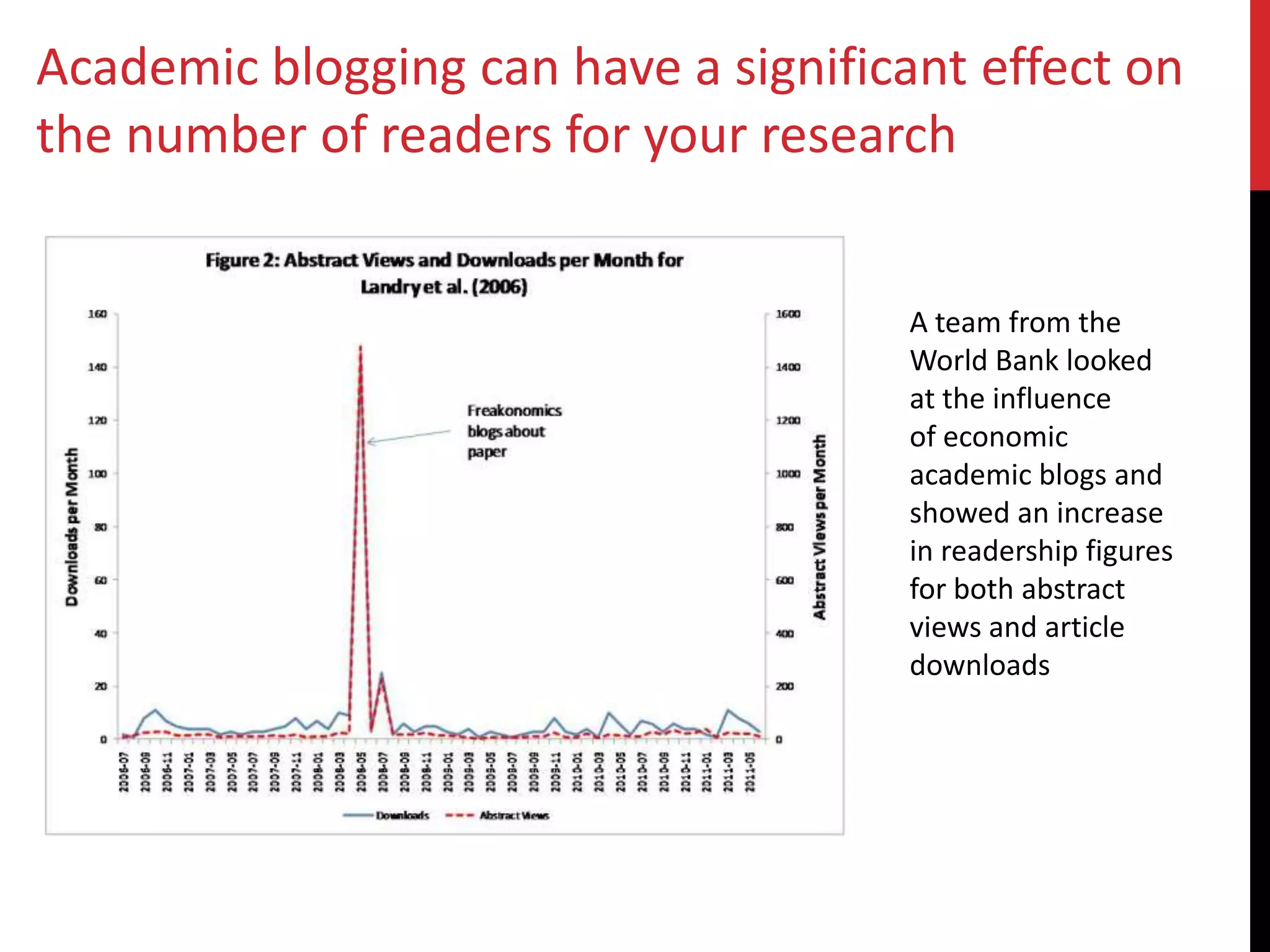
Academic blogging can have a significant effect on
the number of readers for your research
A team from the
World Bank looked
at the influence
of economic
academic blogs and
showed an increase
in readership figures
for both abstract
views and article
downloads
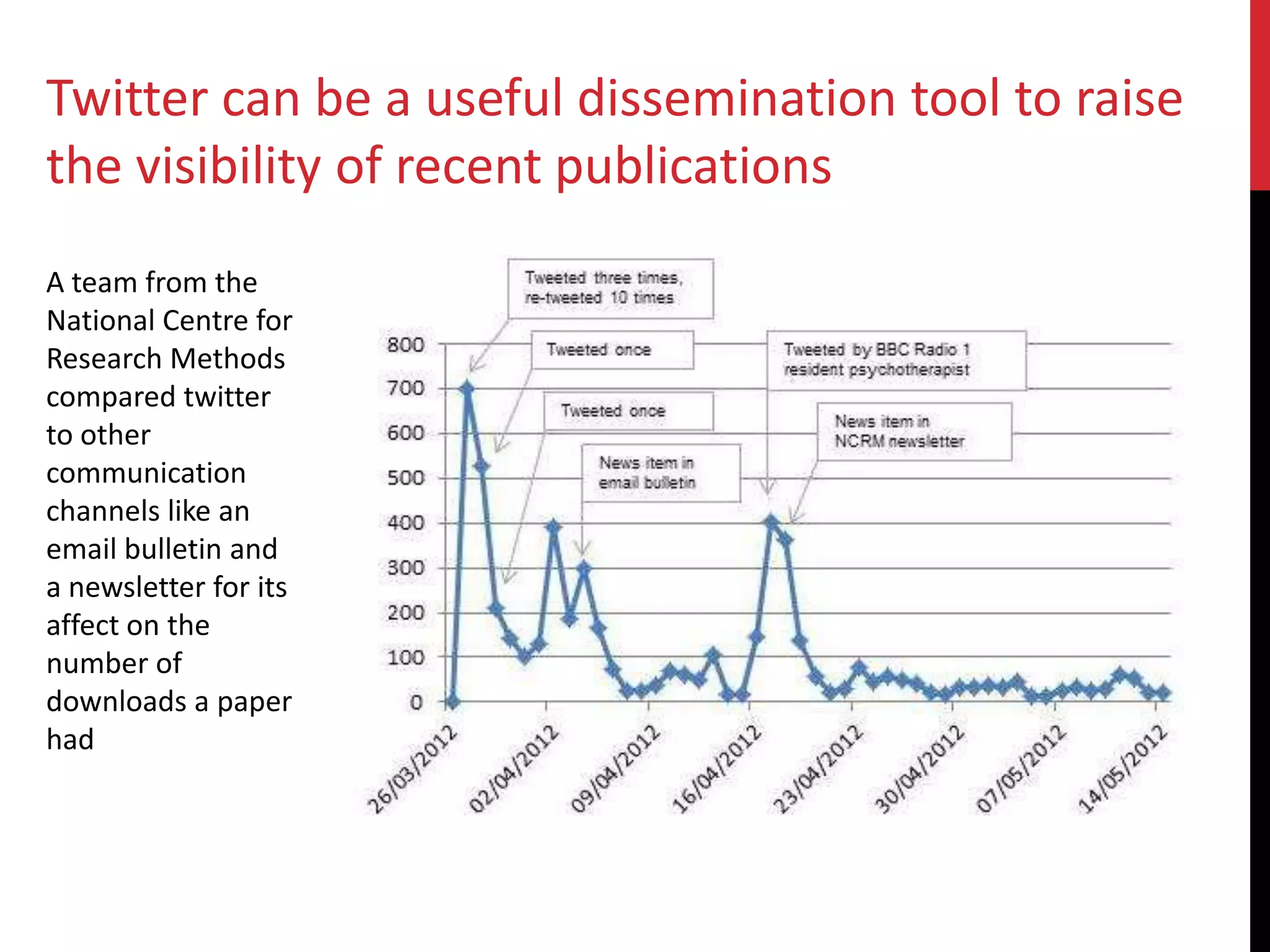
Twitter can be a useful dissemination tool to raise
the visibility of recent publications
A team from the
National Centre for
Research Methods
compared twitter
to other
communication
channels like an
email bulletin and
a newsletter for its
affect on the
number of
downloads a paper
had
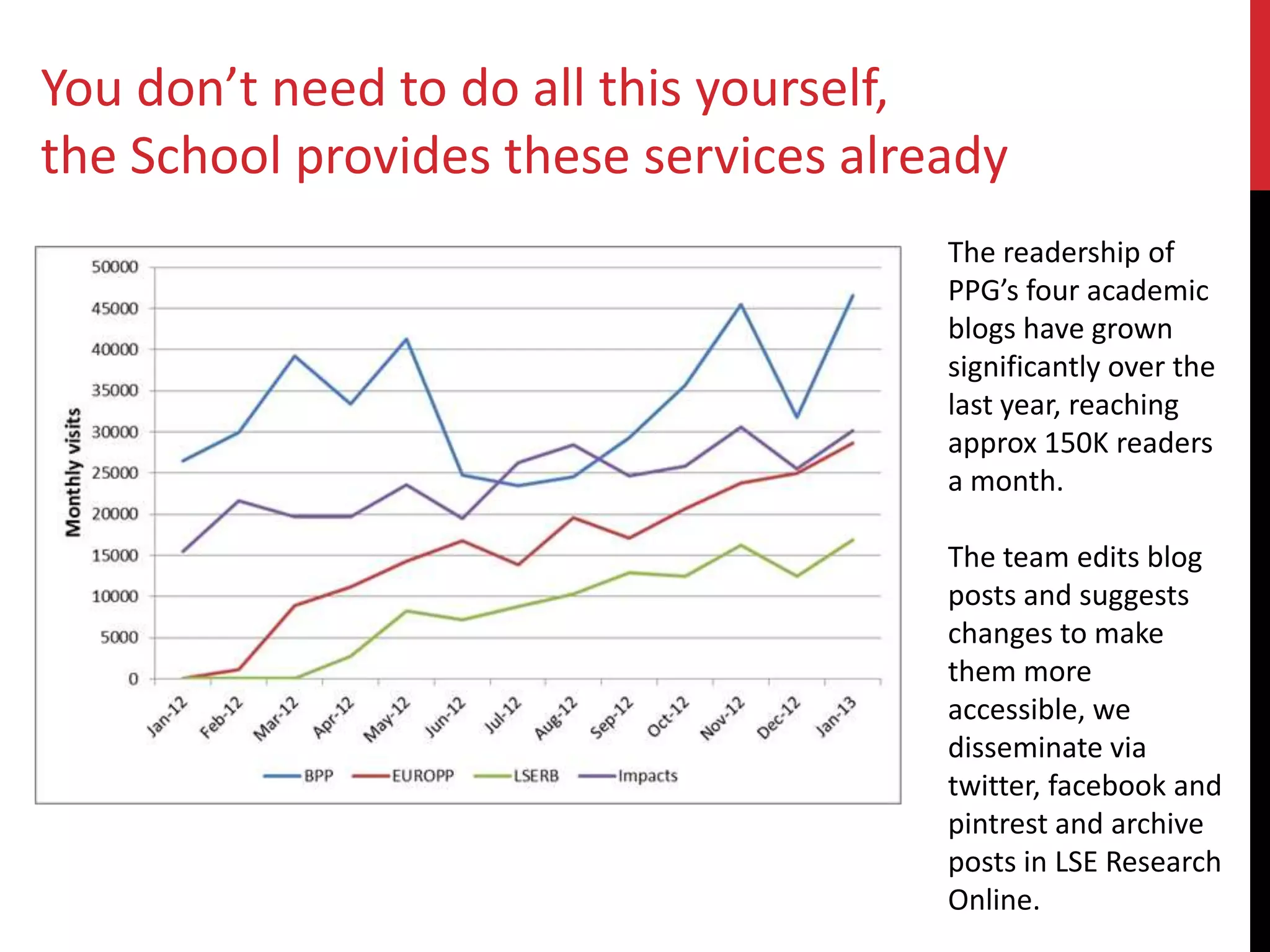
You don’t need to do all this yourself,
the School provides these services already
The readership of
PPG’s four academic
blogs have grown
significantly over the
last year, reaching
approx 150K readers
a month.
The team edits blog
posts and suggests
changes to make
them more
accessible, we
disseminate via
twitter, facebook and
pintrest and archive
posts in LSE Research
Online.
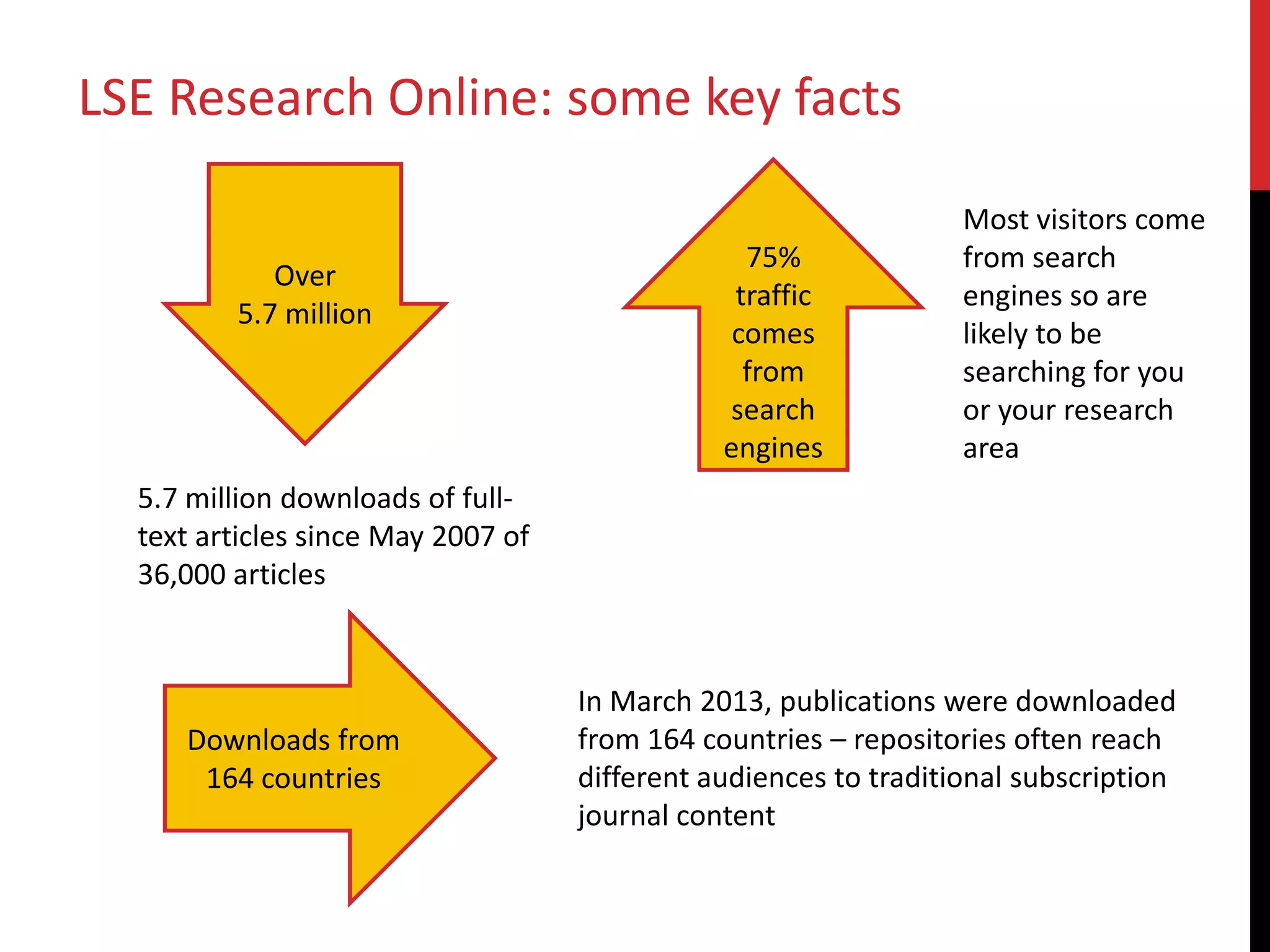
LSE Research Online: some key facts
Over
5.7 million
Downloads from
164 countries
5.7 million downloads of full-
text articles since May 2007 of
36,000 articles
Most visitors come
from search
engines so are
likely to be
searching for you
or your research
area
In March 2013, publications were downloaded
from 164 countries – repositories often reach
different audiences to traditional subscription
journal content
75%
traffic
comes
from
search
engines
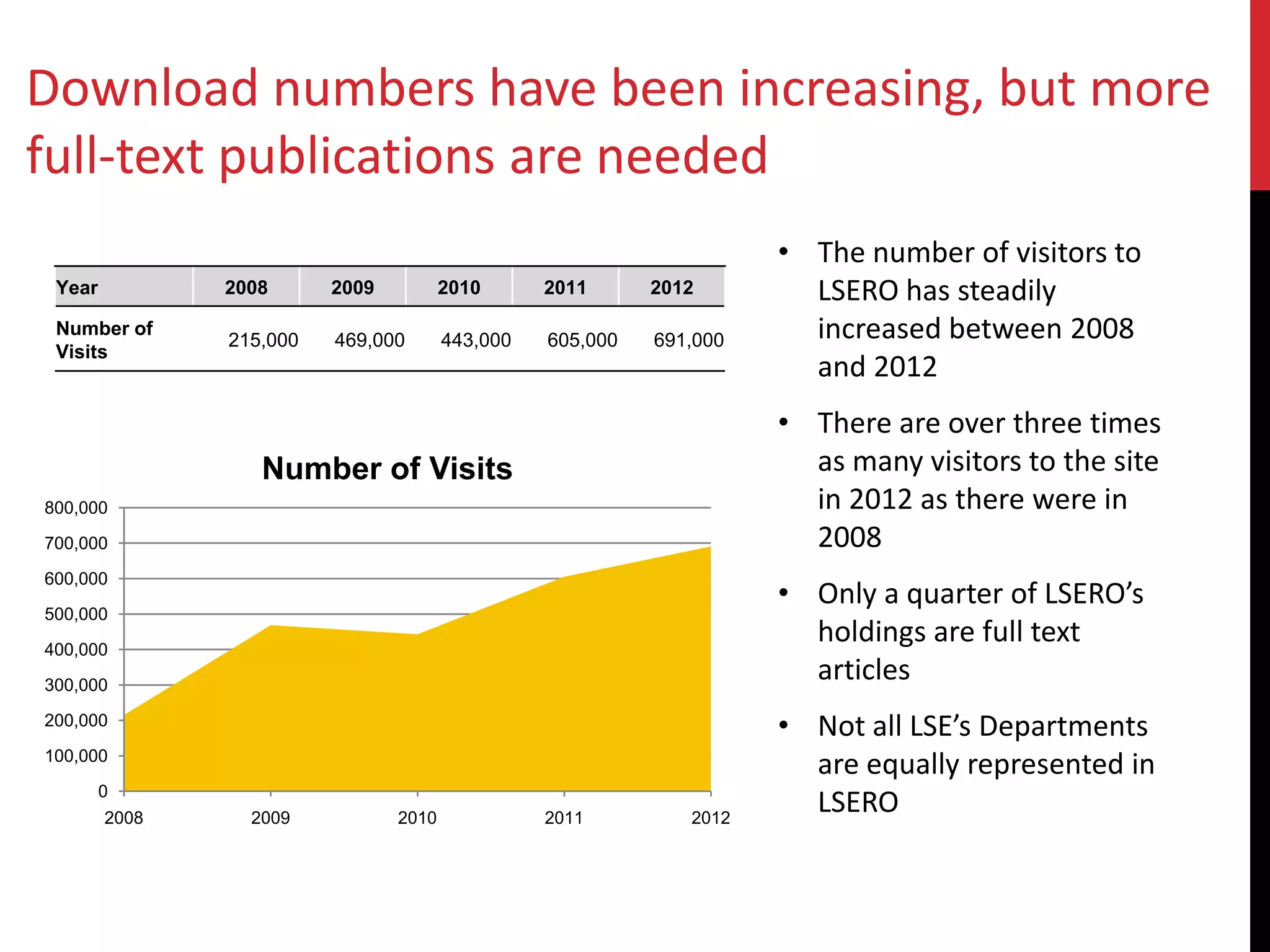
Year 2008 2009 2010 2011 2012
Number of
Visits
215,000 469,000 443,000 605,000 691,000
0
100,000
200,000
300,000
400,000
500,000
600,000
700,000
800,000
2008 2009 2010 2011 2012
Number of Visits
• The number of visitors to
LSERO has steadily
increased between 2008
and 2012
• There are over three times
as many visitors to the site
in 2012 as there were in
2008
• Only a quarter of LSERO’s
holdings are full text
articles
• Not all LSE’s Departments
are equally represented in
LSERO
Download numbers have been increasing, but more
full-text publications are needed
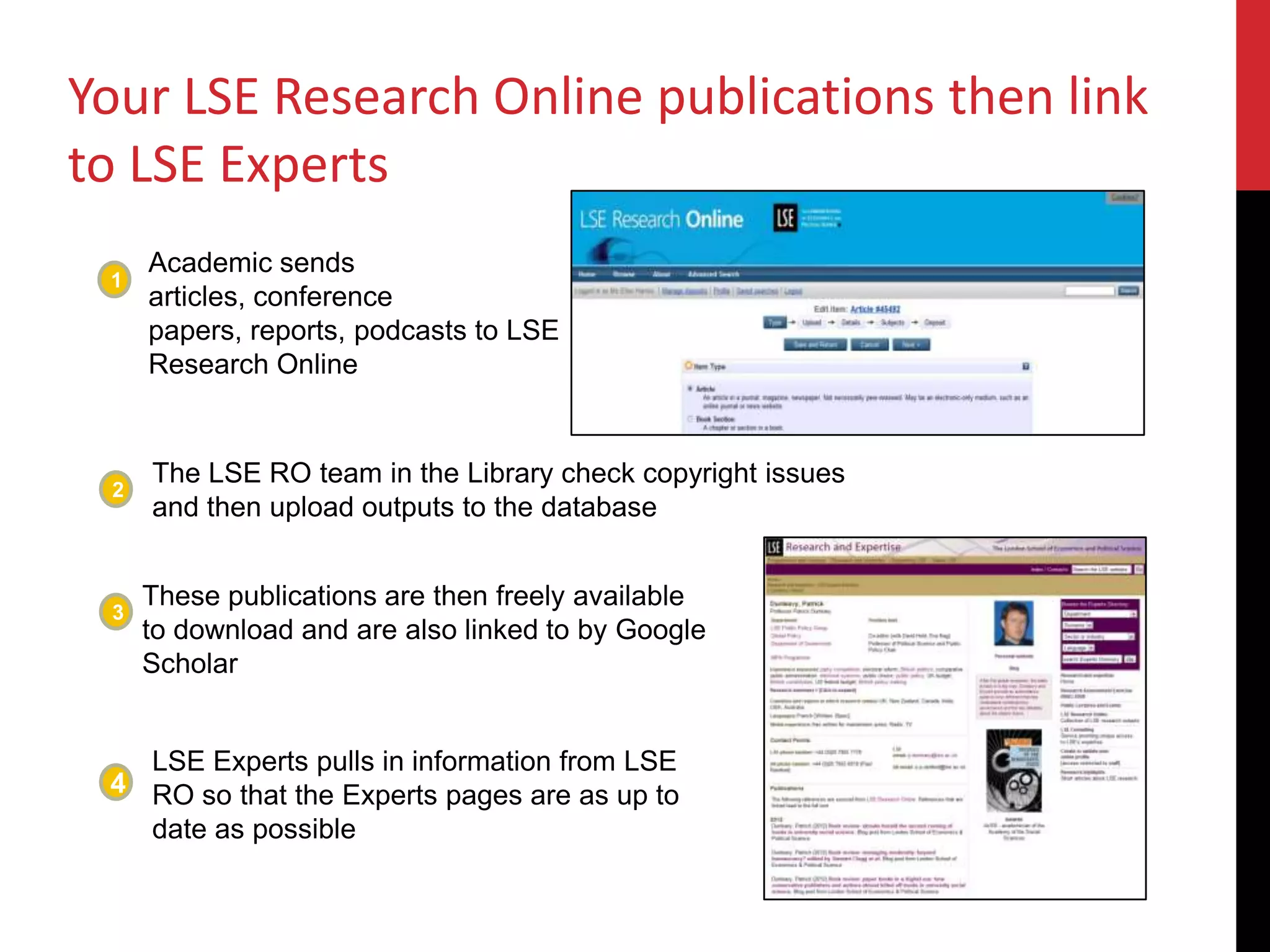
1
Academic sends
articles, conference
papers, reports, podcasts to LSE
Research Online
2
The LSE RO team in the Library check copyright issues
and then upload outputs to the database
4
LSE Experts pulls in information from LSE
RO so that the Experts pages are as up to
date as possible
3
These publications are then freely available
to download and are also linked to by Google
Scholar
Your LSE Research Online publications then link
to LSE Experts
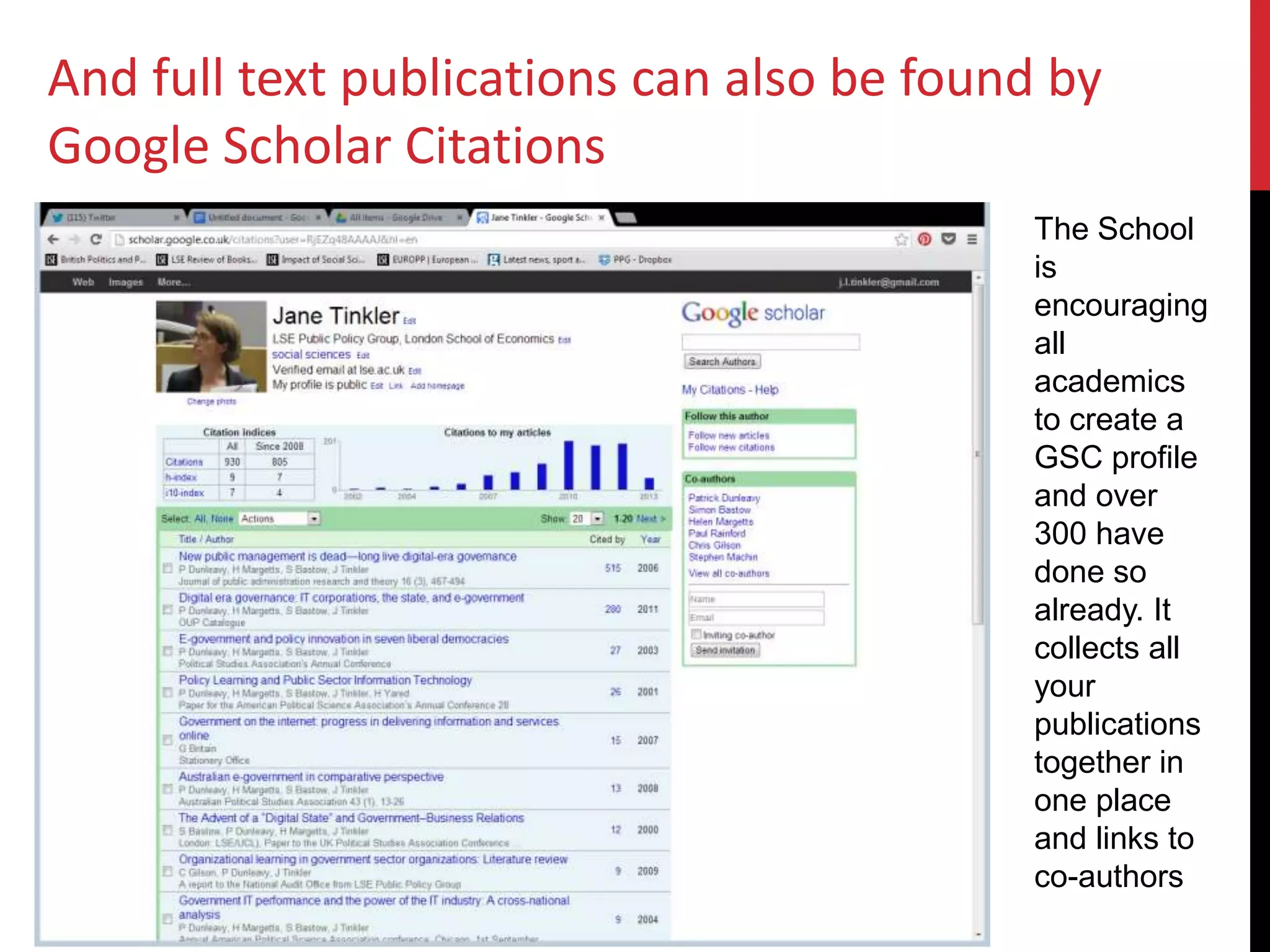
And full text publications can also be found by
Google Scholar Citations
The School
is
encouraging
all
academics
to create a
GSC profile
and over
300 have
done so
already. It
collects all
your
publications
together in
one place
and links to
co-authors

Green or gold: What will Open Access mean for the LSE?

  • 1.
    Green or gold: Whatwill open access mean for the LSE? 8 May 2013 LSE Impact of Social Science blog/LSE Library event
  • 2.
    LSE Library Services UnderstandingOpen Access : Background & Context Martin Reid Head of Academic Services LSE Library m.j.reid@lse.ac.uk 020 7955 7616
  • 3.
    What is OpenAccess? The process of making research outputs freely available online to anyone with an internet connection, in agreement with the author and/or copyright holder. Involves removing price and permission barriers to access and reuse of research Benefits for: • Authors: Greater exposure for work; increased citations; broader audience • Institutions: Improved knowledge exchange and impact; enhanced reputation • Society: Transparency and accountability; more effective use of research funding; more innovation and return on investment
  • 4.
    Routes to OpenAccess Gold • Publication in an Open Access journal: peer reviewed text is immediately available free of charge – no subscriptions • Publication costs (+ profits) met in other ways: fees for publication – Article Processing Charge (APC); but also subsidies Green • Deposit of authoritative version of research in online institutional or subject repository (e.g. LSE Research Online) • Publication possible in pay-for-access journal at the same time • Can involve delay in making text available in repository - embargos
  • 5.
    Finch Report • WorkingGroup on Expanding Access to Published Research Findings chaired by Janet Finch - Report published June 2012 • Aim to finds ways of expand access to published research without: • undermining scholarly publishing industry and learned societies • affecting standards of peer review and quality of UK research • imposing unsustainable costs on universities • Reconcile conflicting interests: researchers, funders, publishers • Identify Gold Open Access as most effective means of achieving aims as final peer reviewed text available immediately • Recognize change has to be made gradually – UK part of global scholarly communication system – transitional funding required
  • 6.
    Finch Report -Recommendations Key • Policy direction to support publication in open access journals funded by APCs as main vehicle for research • RCUK and public funders to establish effective arrangements to meet costs of publishing in open access journals • Support for open access publication to be accompanied by policies to minimise restrictions on use and re-use Other • Develop repositories to concentrate on complementary areas: research data, digital preservation, grey literature • Extended licensing • Negotiation on journal pricing • Investigation of open access publication of monographs • Avoid undermining valuable journals not funded by APCs
  • 7.
    Finch Report -Recommendations For universities • Establish mechanisms to enable universities to meet costs of APCs • Establish publication funds within universities • Establish arrangements for payment of APCs, minimising transaction costs • Develop policies and procedures in relation to open access publishing and how it is funded • Develop infrastructure of repositories and enhance interoperability to provide: • effective access routes for reports, working papers, other grey literature , and theses • mechanism for enhancing links between publication and associated research data • preservation service
  • 8.
    Green or gold:What will open access mean for the LSE? The School’s response David Coombe Director of the Research Division d.coombe@lse.ac.uk 8 May 2013
  • 9.
    RCUK open accesspolicy • Step-change from 2005 policy • Applies to (all) RCUK-acknowledged peer- reviewed articles and conference proceedings only • RCUK prefers Gold; allows Green • 5-year ‘journey’: 45% compliance (Gold or Green) in year 1; 75% Gold by year 5 • Supported by block grant (£63k)
  • 10.
    RCUK open accesspolicy #2 • Compliant if journal offers Gold (with CC BY licence) or Green (with CC BY NC) within 12 months for AHRC/ESRC (24 months if funding not available) • Compliance will be monitored • RCUK policy will be reviewed in 2014
  • 11.
    School response • SupportOA for all publications – LSERO • Journal choice: ensure quality and impact – ie highest quality journals • Institutional publication fund for RCUK Gold APCs where Green is not allowed • Monitoring and influencing HEFCE REF 2020 policy
  • 12.
    Issues – sector/institution •Problems with the business model: eg publishers’ ‘double-dipping’ • Costs of compliance: – Not supported by block grant nor project funding – Opportunity cost: research funding – Reporting costs • International competitors
  • 13.
    Issues – institution/individual •Potential constraints on publication strategies: – Undermines commitment to world-leading research – Spectre of managing publication strategies • Legal/IP: terms of licensing
  • 14.
    Issues – institution/individual •Effects on early career researchers • Implications for collaborative research • Other outputs, eg books • Research material, eg data • Acknowledging RCUK funding • Embargo periods
  • 15.
    OPENING UP YOURRESEARCH JANE TINKLER
  • 16.
    • Use facilitiesthat the School already provides to open up your research by making it more visible • Blog about your findings on one of the LSE’s academic blogs • Put all of your publications and other outputs into LSE Research Online • Create an Experts page as well as a Google Scholar Citations profile Increased open access won’t happen overnight, in the meantime why not . . .
  • 17.
    • Yes. • Usingsocial media such as academic blogging to disseminate your publications increases their visibility, which in turn increases their readership. • Placing your work in LSE Research Online means that when people search for you or your work, they find full- text articles to download. • LSE Research Online works with both LSE Experts and Google Scholar Citations to allow all of your full-text publications to be held in one place. Will this really make a difference?
  • 18.
    Academic blogging canhave a significant effect on the number of readers for your research A team from the World Bank looked at the influence of economic academic blogs and showed an increase in readership figures for both abstract views and article downloads
  • 19.
    Twitter can bea useful dissemination tool to raise the visibility of recent publications A team from the National Centre for Research Methods compared twitter to other communication channels like an email bulletin and a newsletter for its affect on the number of downloads a paper had
  • 20.
    You don’t needto do all this yourself, the School provides these services already The readership of PPG’s four academic blogs have grown significantly over the last year, reaching approx 150K readers a month. The team edits blog posts and suggests changes to make them more accessible, we disseminate via twitter, facebook and pintrest and archive posts in LSE Research Online.
  • 21.
    LSE Research Online:some key facts Over 5.7 million Downloads from 164 countries 5.7 million downloads of full- text articles since May 2007 of 36,000 articles Most visitors come from search engines so are likely to be searching for you or your research area In March 2013, publications were downloaded from 164 countries – repositories often reach different audiences to traditional subscription journal content 75% traffic comes from search engines
  • 22.
    Year 2008 20092010 2011 2012 Number of Visits 215,000 469,000 443,000 605,000 691,000 0 100,000 200,000 300,000 400,000 500,000 600,000 700,000 800,000 2008 2009 2010 2011 2012 Number of Visits • The number of visitors to LSERO has steadily increased between 2008 and 2012 • There are over three times as many visitors to the site in 2012 as there were in 2008 • Only a quarter of LSERO’s holdings are full text articles • Not all LSE’s Departments are equally represented in LSERO Download numbers have been increasing, but more full-text publications are needed
  • 23.
    1 Academic sends articles, conference papers,reports, podcasts to LSE Research Online 2 The LSE RO team in the Library check copyright issues and then upload outputs to the database 4 LSE Experts pulls in information from LSE RO so that the Experts pages are as up to date as possible 3 These publications are then freely available to download and are also linked to by Google Scholar Your LSE Research Online publications then link to LSE Experts
  • 24.
    And full textpublications can also be found by Google Scholar Citations The School is encouraging all academics to create a GSC profile and over 300 have done so already. It collects all your publications together in one place and links to co-authors

Editor's Notes

  • #17 I have been working with colleagues on the Impact of Social Sciences project. We quickly identified how invisible academic work in the social sciences is, much more so than science subjects. Social science academics are less likely to create a profile page, put their publications online or blog about their work. It was one of the reasons we started the four academic blogs that we now run in PPG. I want to talk briefly about some short term steps you can take to make your research more open.
  • #19 David McKenzie and Berk Özler (2011) ‘Academic blogs are proven to increase dissemination of economic research and improve impact.’ LSE Impact of Social Science blog. http://blogs.lse.ac.uk/impactofsocialsciences/2011/11/15/world-bank-dissemination/.15 November 2011.
  • #20 Kaisa Puustinen and Rosalind Edwards (2012) ‘Who gives a tweet? After 24 hours and 860 downloads, we think quite a few actually do’. LSE Impact of Social Sciences blog. http://blogs.lse.ac.uk/impactofsocialsciences/2012/05/18/who-gives-a-tweet-860-downloads/. 18 May