Dr. Aravind.T.K
PG RESIDENT
DEPTT OF SURGERY
 THE WORLD SOCIETY OF ABDOMINAL COMPARTMENT
SYNDROME (WSACS) DEFINITION
“Open Abdomen (OA) is defined as one that requires Temporary
Abdominal Closure (TAC) due to skin and fascia being not closed after
laparotomy”
 The first person to describe the use of open abdomen technique was
Andrew J. McCosh in 1897 for generalized peritonitis however this
approach was unusual at that time and was not received well at that time
 The OA process recently became popular in the context of damage control
surgery (DCS)
 WHERE THE ABDOMEN CANNOT BE CLOSED
1. Necrotising fascitis of abdomen wall
2. Severe bowel edema
3. Severe peritonitis
4. Gross abdominal contamination
 WHEN THE ABDOMEN SHOULD NOT BE CLOSED
1. IAH (intra-abdominal hypertension)
2. ACS (abdominal compartment syndrome)
3. DCS (damage control surgery)
1.
INCISION TYPE - midline aw higher
incidence than tranverse
2.
CLOSURE - hasty closure
3.
Too small bites of fascia
4.
SUTURE MATERIAL - short absorbable
suture
5.
SUTURE LENGTH TO WOUND LENGTH RATIO
should be 4:1 (less than this causes
wound disruption).

Sex-M:F =2:1

Age

Emergency procedure

Obesity

Uncontrolled diabetes

Jaundice

Anemia
Disease causing delayed wound healing :

Hypoalbuminemia

Vit-C deficiency

Prolonged adminstration of corticosteroids.

Zinc deficiency
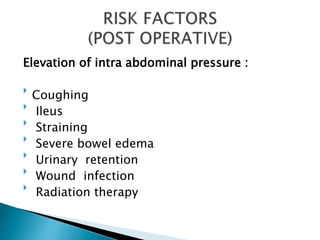
Elevation of intra abdominal pressure :

Coughing

Ileus

Straining

Severe bowel edema

Urinary retention

Wound infection

Radiation therapy
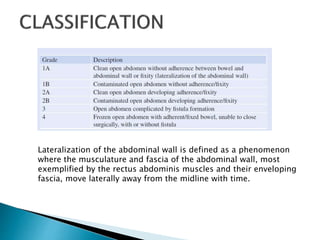
Lateralization of the abdominal wall is defined as a phenomenon
where the musculature and fascia of the abdominal wall, most
exemplified by the rectus abdominis muscles and their enveloping
fascia, move laterally away from the midline with time.
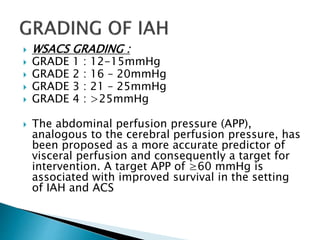
 WSACS GRADING :
 GRADE 1 : 12-15mmHg
 GRADE 2 : 16 – 20mmHg
 GRADE 3 : 21 – 25mmHg
 GRADE 4 : >25mmHg
 The abdominal perfusion pressure (APP),
analogous to the cerebral perfusion pressure, has
been proposed as a more accurate predictor of
visceral perfusion and consequently a target for
intervention. A target APP of ≥60 mmHg is
associated with improved survival in the setting
of IAH and ACS
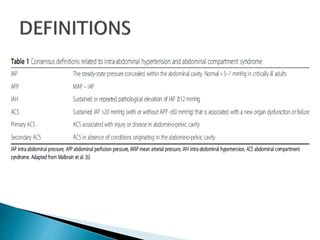
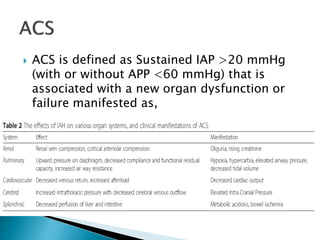
 ACS is defined as Sustained IAP >20 mmHg
(with or without APP <60 mmHg) that is
associated with a new organ dysfunction or
failure manifested as,
• Dehiscence usually declares itself 7-14 days post op and may
come wo warning.
• An otherwise unexpected serosanguinous discharge from the
wound is the most common forerunner of disruption .
• Patient may even complain of “something giving way”
1. Heat loss : It is the most devastating problem of OA
occurring due to exposed bowel loops causing evaporation
2. Fluid loss
3. Bleeding: Sources of bleeding may be omentum or wound
edge or dilated fragile vessels of granulation tissue.
4. Hernia formation due to weakness of abdominal wall.
5. Intestinal fistulation (Entero atmospheric fistula)
Predisposing factors :
1. Bowel exposure to air causing drying and dessication of serosa.
2. Injury caused by wound dressing .
3. Exposed suture lines .
4. Shearing force of the bowel adherent to abdomen wall or mesh.
5. Negative pressure wound therapy
6. Psychological disturbance
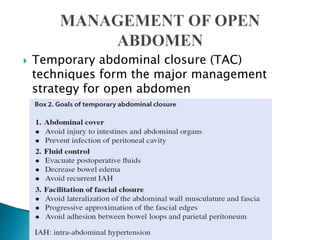
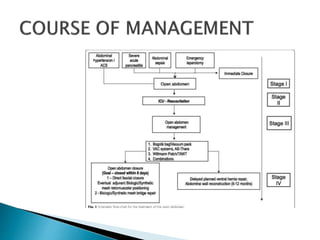
 Temporary abdominal closure (TAC)
techniques form the major management
strategy for open abdomen
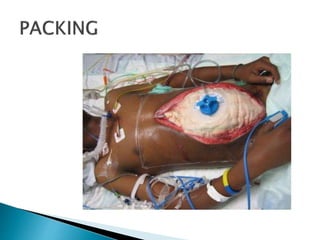
• 1. SIMPLE PACKING :
• Simple packing was the most commonly used technique in the
1980’s consisting of placing non adherent wet gauzes or
hydrophilic dressings directly on top of the abdominal
contents without the use of any sutures
• DISADVANTAGES :
• High mortality rates (approx. 30%)
• Wound left to heal by contraction leading to reconstructive
procedures later
• Fluid and protein loss, fistulization, hemorrhage
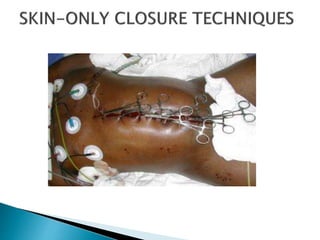
2. SKIN-ONLY CLOSURE TECHNIQUES
• Use the skin to provide some abdominal wall
stability with containment of abdominal viscera by
techniques like using a series of towel clips or a
rapid monofilament running sutures
 Disadvantages:
• Increased risk of evisceration as bursting pressure
of skin is low
• Infection
• Injury and loss of skin
• Recurrent ACS
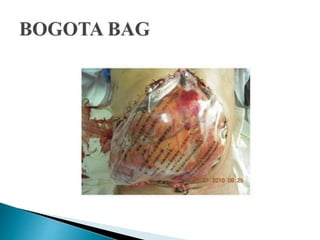
3. BOGOTA BAG :
• The BOGOTA bag was named so by mattox while observing
in bogota, Columbia uses a large presterilised bowel bag to
cover the intraabdominal viscera.
• DISADVANTAGES :
• Bogota bag does not prevent abdominal wall retraction
• Effective removal of abdominal fluids is not present
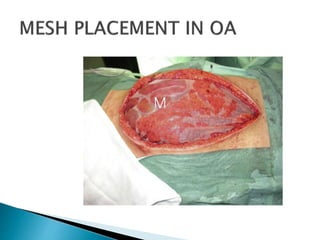
4. MESH :
• Involves suturing of a prosthetic mesh along
the fascial edges
• Types
• Non absorbable – polypropylene ,
polytetrafluoroethylene(ePTFE).
• Absorbable – polyglactin 910(vicryl) ,
polyglycolic acid
• Disadvantages – infection , fistulisation
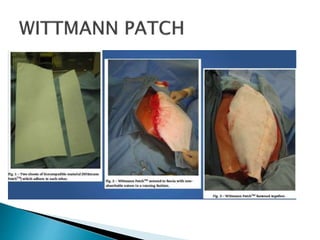
5. WITTMANN PATCH :
• The WITTMANN PATCH also called “artificial burr”
consists of two detachable components a loop sheet
and a closure sheet
• Typically the patch is sutured to the abdominal fascia
and sequentially tightened every 24 – 48 hrs until
fascia is 2-4cm apart
• This method is used in cases where primary closure
cannot be achieved within 10 days to prevent fascial
retraction.
 DISADVANTAGES :
• More costly
• Requires suturing to the abdominal fascia
which increases risk of fascial trauma and
necrosis
• Risk of incisional hernias
• Does not evacuate peritoneal fluid adequately
and hence abdominal wound drainage may
become an issue.
 In the management of OA the aforementioned
methods often need frequent and time
consuming changing of dressing, intensive
nursing and prolonged treatment before final
wound closure.
 Moreover they do not offer built in drainage
systems to drain peritoneal fluids
 Hence there came a concept of negative
pressure therapy (NPT) to overcome the
above challenges
 Works by the concept of reverse tissue
expansion in the wound bringing together the
wound edges
 Advantages :
• Increases local blood perfusion and nutrient
delivery to wound
• Accelerates growth of granulation tissue
• Decreases bacterial wound contamination
• Reduces bowel edema
• Application of mechanical stress to wounds
also increases proliferation and angiogenesis
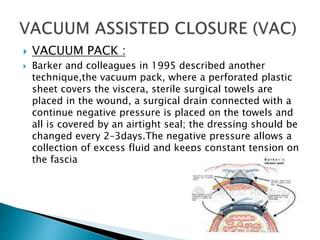
 VACUUM PACK :
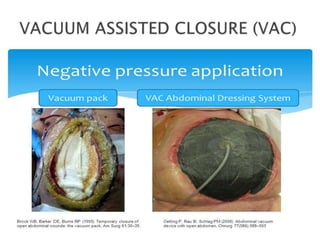
 Barker and colleagues in 1995 described another
technique,the vacuum pack, where a perforated plastic
sheet covers the viscera, sterile surgical towels are
placed in the wound, a surgical drain connected with a
continue negative pressure is placed on the towels and
all is covered by an airtight seal; the dressing should be
changed every 2–3days.The negative pressure allows a
collection of excess fluid and keeps constant tension on
the fascia
 V.A.C PACK :
 The vacuum pack was then modified with the
use of a polyurethane sponge and an
adjustable pump to set the negative pressure
named as V.A.C PACK with some advantages
like,
1. Reduced need for frequent dressing
changes
2. Increased vascularity of the wound
3. Decreased bacterial counts
4. Extended opportunity for definitive fascial
closure
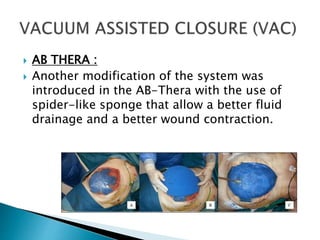
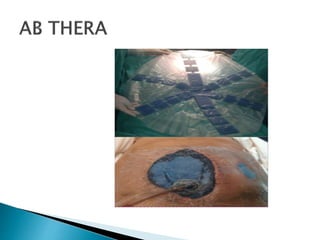
 AB THERA :
 Another modification of the system was
introduced in the AB-Thera with the use of
spider-like sponge that allow a better fluid
drainage and a better wound contraction.
 A recent modification of the Wittmann patch
was described by Dennis et al. in 2013
 The underlying plastic sheet is sutured not
directly on the medial fascia but to the
underside of the abdominal wall, lateral to
the rectus sheath, using external bolsters on
the wound is applied a vacuum pack
dressing. With this technique they showed a
primary fascia closure in 100 % of the
patients.
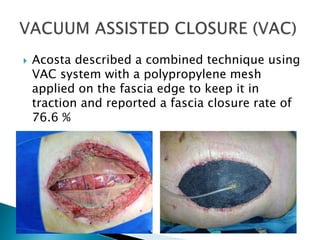
 Acosta described a combined technique using
VAC system with a polypropylene mesh
applied on the fascia edge to keep it in
traction and reported a fascia closure rate of
76.6 %
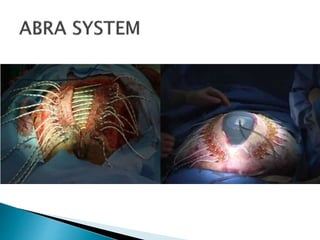
 Another combined technique consist in the
use of the ABRA (ABDOMINAL
REAPPROXIMATION ANCHOR) system which
consist in a dynamic fascial tension device
with elastomers anchored to the abdominal
wall with plastic “button anchors” with the
VAC system with interesting results and a
reported fascial apposition rate of 83 %
The main goal in open abdomen treatment
remains abdominal closure.
 DEFINITIVE CLOSURE is to be attempted
within 8 days because a progressive
complication rate increase after the 8th day
of OA
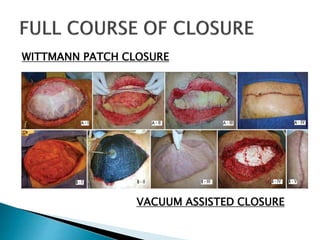
WITTMANN PATCH CLOSURE
VACUUM ASSISTED CLOSURE
THANK YOU

Open abdomen and its management

  • 1.
  • 2.
     THE WORLDSOCIETY OF ABDOMINAL COMPARTMENT SYNDROME (WSACS) DEFINITION “Open Abdomen (OA) is defined as one that requires Temporary Abdominal Closure (TAC) due to skin and fascia being not closed after laparotomy”  The first person to describe the use of open abdomen technique was Andrew J. McCosh in 1897 for generalized peritonitis however this approach was unusual at that time and was not received well at that time  The OA process recently became popular in the context of damage control surgery (DCS)
  • 3.
     WHERE THEABDOMEN CANNOT BE CLOSED 1. Necrotising fascitis of abdomen wall 2. Severe bowel edema 3. Severe peritonitis 4. Gross abdominal contamination  WHEN THE ABDOMEN SHOULD NOT BE CLOSED 1. IAH (intra-abdominal hypertension) 2. ACS (abdominal compartment syndrome) 3. DCS (damage control surgery)
  • 4.
    1. INCISION TYPE -midline aw higher incidence than tranverse 2. CLOSURE - hasty closure 3. Too small bites of fascia 4. SUTURE MATERIAL - short absorbable suture 5. SUTURE LENGTH TO WOUND LENGTH RATIO should be 4:1 (less than this causes wound disruption).
  • 5.
     Sex-M:F =2:1  Age  Emergency procedure  Obesity  Uncontrolleddiabetes  Jaundice  Anemia Disease causing delayed wound healing :  Hypoalbuminemia  Vit-C deficiency  Prolonged adminstration of corticosteroids.  Zinc deficiency
  • 6.
    Elevation of intraabdominal pressure :  Coughing  Ileus  Straining  Severe bowel edema  Urinary retention  Wound infection  Radiation therapy
  • 7.
    Lateralization of theabdominal wall is defined as a phenomenon where the musculature and fascia of the abdominal wall, most exemplified by the rectus abdominis muscles and their enveloping fascia, move laterally away from the midline with time.
  • 9.
     WSACS GRADING:  GRADE 1 : 12-15mmHg  GRADE 2 : 16 – 20mmHg  GRADE 3 : 21 – 25mmHg  GRADE 4 : >25mmHg  The abdominal perfusion pressure (APP), analogous to the cerebral perfusion pressure, has been proposed as a more accurate predictor of visceral perfusion and consequently a target for intervention. A target APP of ≥60 mmHg is associated with improved survival in the setting of IAH and ACS
  • 10.
     ACS isdefined as Sustained IAP >20 mmHg (with or without APP <60 mmHg) that is associated with a new organ dysfunction or failure manifested as,
  • 11.
    • Dehiscence usuallydeclares itself 7-14 days post op and may come wo warning. • An otherwise unexpected serosanguinous discharge from the wound is the most common forerunner of disruption . • Patient may even complain of “something giving way”
  • 12.
    1. Heat loss: It is the most devastating problem of OA occurring due to exposed bowel loops causing evaporation 2. Fluid loss 3. Bleeding: Sources of bleeding may be omentum or wound edge or dilated fragile vessels of granulation tissue. 4. Hernia formation due to weakness of abdominal wall.
  • 13.
    5. Intestinal fistulation(Entero atmospheric fistula) Predisposing factors : 1. Bowel exposure to air causing drying and dessication of serosa. 2. Injury caused by wound dressing . 3. Exposed suture lines . 4. Shearing force of the bowel adherent to abdomen wall or mesh. 5. Negative pressure wound therapy 6. Psychological disturbance
  • 14.
     Temporary abdominalclosure (TAC) techniques form the major management strategy for open abdomen
  • 15.
    • 1. SIMPLEPACKING : • Simple packing was the most commonly used technique in the 1980’s consisting of placing non adherent wet gauzes or hydrophilic dressings directly on top of the abdominal contents without the use of any sutures • DISADVANTAGES : • High mortality rates (approx. 30%) • Wound left to heal by contraction leading to reconstructive procedures later • Fluid and protein loss, fistulization, hemorrhage
  • 17.
    2. SKIN-ONLY CLOSURETECHNIQUES • Use the skin to provide some abdominal wall stability with containment of abdominal viscera by techniques like using a series of towel clips or a rapid monofilament running sutures  Disadvantages: • Increased risk of evisceration as bursting pressure of skin is low • Infection • Injury and loss of skin • Recurrent ACS
  • 19.
    3. BOGOTA BAG: • The BOGOTA bag was named so by mattox while observing in bogota, Columbia uses a large presterilised bowel bag to cover the intraabdominal viscera. • DISADVANTAGES : • Bogota bag does not prevent abdominal wall retraction • Effective removal of abdominal fluids is not present
  • 21.
    4. MESH : •Involves suturing of a prosthetic mesh along the fascial edges • Types • Non absorbable – polypropylene , polytetrafluoroethylene(ePTFE). • Absorbable – polyglactin 910(vicryl) , polyglycolic acid • Disadvantages – infection , fistulisation
  • 23.
    5. WITTMANN PATCH: • The WITTMANN PATCH also called “artificial burr” consists of two detachable components a loop sheet and a closure sheet • Typically the patch is sutured to the abdominal fascia and sequentially tightened every 24 – 48 hrs until fascia is 2-4cm apart • This method is used in cases where primary closure cannot be achieved within 10 days to prevent fascial retraction.
  • 25.
     DISADVANTAGES : •More costly • Requires suturing to the abdominal fascia which increases risk of fascial trauma and necrosis • Risk of incisional hernias • Does not evacuate peritoneal fluid adequately and hence abdominal wound drainage may become an issue.
  • 26.
     In themanagement of OA the aforementioned methods often need frequent and time consuming changing of dressing, intensive nursing and prolonged treatment before final wound closure.  Moreover they do not offer built in drainage systems to drain peritoneal fluids  Hence there came a concept of negative pressure therapy (NPT) to overcome the above challenges
  • 27.
     Works bythe concept of reverse tissue expansion in the wound bringing together the wound edges  Advantages : • Increases local blood perfusion and nutrient delivery to wound • Accelerates growth of granulation tissue • Decreases bacterial wound contamination • Reduces bowel edema • Application of mechanical stress to wounds also increases proliferation and angiogenesis
  • 28.
     VACUUM PACK:  Barker and colleagues in 1995 described another technique,the vacuum pack, where a perforated plastic sheet covers the viscera, sterile surgical towels are placed in the wound, a surgical drain connected with a continue negative pressure is placed on the towels and all is covered by an airtight seal; the dressing should be changed every 2–3days.The negative pressure allows a collection of excess fluid and keeps constant tension on the fascia
  • 29.
     V.A.C PACK:  The vacuum pack was then modified with the use of a polyurethane sponge and an adjustable pump to set the negative pressure named as V.A.C PACK with some advantages like, 1. Reduced need for frequent dressing changes 2. Increased vascularity of the wound 3. Decreased bacterial counts 4. Extended opportunity for definitive fascial closure
  • 31.
     AB THERA:  Another modification of the system was introduced in the AB-Thera with the use of spider-like sponge that allow a better fluid drainage and a better wound contraction.
  • 33.
     A recentmodification of the Wittmann patch was described by Dennis et al. in 2013  The underlying plastic sheet is sutured not directly on the medial fascia but to the underside of the abdominal wall, lateral to the rectus sheath, using external bolsters on the wound is applied a vacuum pack dressing. With this technique they showed a primary fascia closure in 100 % of the patients.
  • 34.
     Acosta describeda combined technique using VAC system with a polypropylene mesh applied on the fascia edge to keep it in traction and reported a fascia closure rate of 76.6 %
  • 35.
     Another combinedtechnique consist in the use of the ABRA (ABDOMINAL REAPPROXIMATION ANCHOR) system which consist in a dynamic fascial tension device with elastomers anchored to the abdominal wall with plastic “button anchors” with the VAC system with interesting results and a reported fascial apposition rate of 83 %
  • 37.
    The main goalin open abdomen treatment remains abdominal closure.  DEFINITIVE CLOSURE is to be attempted within 8 days because a progressive complication rate increase after the 8th day of OA
  • 38.
  • 40.