Old days amplifiers will be designed for some gain but due to unavoidable variation
in surroundings, It's gain changed.
Op-amp's has very big advantage over other amplifiers, Since it's gain is not a
function internals, Rather it is governed by passive components connected to it.
The op amp used an amplifier with a large open loop gain, and when the loop was
closed, the amplifier performed the mathematical operations dictated by the
external passive components.
The op amp output drives current into RF until the negative input is at the voltage,
VIN. This action causes VIN to appear across RG
Points to remember
Open-loop voltage gain is Large-signal voltage gain. Even though gain is
dimensionless datasheets often mention it as
For Example again of 200,000 is represented as .
LIC/Class notes/02-03-2.jpg
Since OP-Amp has differential amplifier as input stage, It has same 2 modes as
differential amplifier.
1. Differential mode - If either one of signal is applied to input and other is
grounded. or Signals of opposite polarity.
2. Common mode - Signals of same phase, frequency and amplitude applied to
both inputs.
Internal structure of Op-Amp
V
mV
or
V
µV
200V /mV
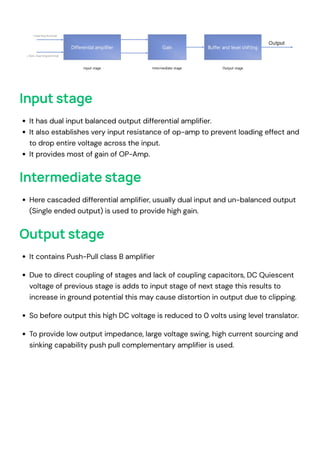
Input stage
It has dual input balanced output differential amplifier.
It also establishes very input resistance of op-amp to prevent loading effect and
to drop entire voltage across the input.
It provides most of gain of OP-Amp.
Intermediate stage
Here cascaded differential amplifier, usually dual input and un-balanced output
(Single ended output) is used to provide high gain.
Output stage
It contains Push-Pull class B amplifier
Due to direct coupling of stages and lack of coupling capacitors, DC Quiescent
voltage of previous stage is adds to input stage of next stage this results to
increase in ground potential this may cause distortion in output due to clipping.
So before output this high DC voltage is reduced to 0 volts using level translator.
To provide low output impedance, large voltage swing, high current sourcing and
sinking capability push pull complementary amplifier is used.

OP amp intro.pdf

  • 1.
    Old days amplifierswill be designed for some gain but due to unavoidable variation in surroundings, It's gain changed. Op-amp's has very big advantage over other amplifiers, Since it's gain is not a function internals, Rather it is governed by passive components connected to it. The op amp used an amplifier with a large open loop gain, and when the loop was closed, the amplifier performed the mathematical operations dictated by the external passive components. The op amp output drives current into RF until the negative input is at the voltage, VIN. This action causes VIN to appear across RG Points to remember Open-loop voltage gain is Large-signal voltage gain. Even though gain is dimensionless datasheets often mention it as For Example again of 200,000 is represented as . LIC/Class notes/02-03-2.jpg LIC/Class notes/02-03-2.jpg Since OP-Amp has differential amplifier as input stage, It has same 2 modes as differential amplifier. 1. Differential mode - If either one of signal is applied to input and other is grounded. or Signals of opposite polarity. 2. Common mode - Signals of same phase, frequency and amplitude applied to both inputs. Internal structure of Op-Amp V mV or V µV 200V /mV
  • 2.
    Input stage It hasdual input balanced output differential amplifier. It also establishes very input resistance of op-amp to prevent loading effect and to drop entire voltage across the input. It provides most of gain of OP-Amp. Intermediate stage Here cascaded differential amplifier, usually dual input and un-balanced output (Single ended output) is used to provide high gain. Output stage It contains Push-Pull class B amplifier Due to direct coupling of stages and lack of coupling capacitors, DC Quiescent voltage of previous stage is adds to input stage of next stage this results to increase in ground potential this may cause distortion in output due to clipping. So before output this high DC voltage is reduced to 0 volts using level translator. To provide low output impedance, large voltage swing, high current sourcing and sinking capability push pull complementary amplifier is used.