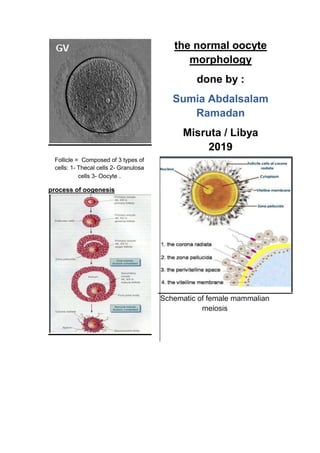
the normal oocyte
morphology
done by :
Sumia Abdalsalam
Ramadan
Misruta / Libya
2019
Follicle = Composed of 3 types of
cells: 1- Thecal cells 2- Granulosa
cells 3- Oocyte .
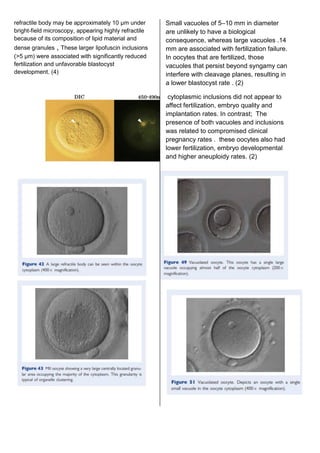
process of oogenesis
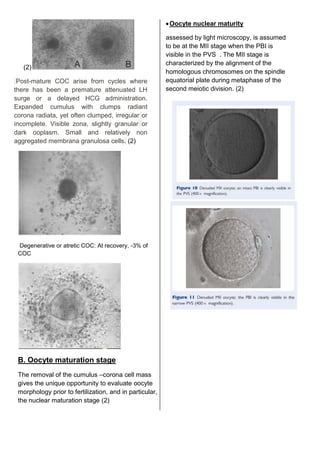
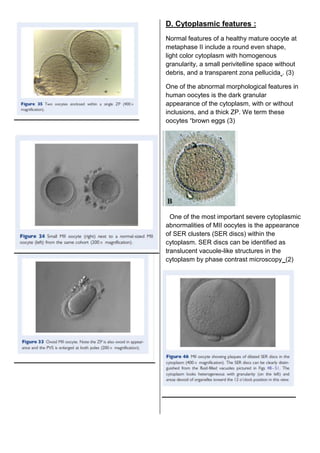
Schematic of female mammalian
meiosis
Mammalian oocytes arrested at the
dictyate stage of prophase I are
identifiable by the presence of a
germinal vesicle (GV). Resumption of
meiosis I is marked by GV breakdown
(GVBD ) .
following which bivalents are brought to
alignment at the spindle equator by
metaphase I. Anaphase I then ensues when
chromosomes segregate between the
secondary oocyte and the polar body.
Following first polar body extrusion (PBE),
oocytes progress without a hiatus into
meiosis II where they are are arrested for a
second time at metaphase II
abnormal oocyte morphology
Mounting evidence that oocyte quality profoundly
affects fertilisation and subsequent embryo
development drives the continued search for
reliable predictors of oocyte developmental
competence. (1)
These criteria are specifically classified as
morphological and cellular/molecular predictors. (1)
. Oocyte quality is not only influenced by the nuclear
and mitochondrial genome, but also by the
microenvironment provided by the ovary and the
pre-ovulatory follicle that influences transcription
and translation, and as a consequence, cytoplasmic
maturity (2) .
Morphological oocyte assessment is based on the
aspects of : 1- Cumulus-corona cells 2- if
denudation is performed 3- Oocyte morphology : a
rapid evaluation using an inverted microscopic is
also performed after denudation; the cytoplasm, the
perivitelline space, the first polar body, the zona
pellucida. provides very superficial and approximate
information about; the stage of development
[germinal vesicle, metaphase I (MI) or MII phase]
the quality [degenerative signs in the cytoplasm,
polar body (PB) or zona pellucida] Oocyte quality
assessment (2)
A. Cumulus-enclosed oocytes Oocyte
morphological assessment in the laboratory is
first based on the presentation of the cumulus –
corona cells. (2) . During follicular antrum
formation, granulosa cells (GCs) differentiate
into mural GCs, lining the follicular wall, and
CCs, surrounding the oocyte. Within the
cumulus mass, CCs in close contact with the
oocyte (corona cells) develop cytoplasmic
projections which cross the ZP and form gap
junctions with the oolemma. This organized
structure is called the cumulus –oocyte complex
(COC (2); For mature oocytes, the cumulus–
corona mass should appear as an expanded
and mucified layer, due to active secretion of
hyaluronic acid. This extracellular matrix
molecule interposes between the cumulus cells
(CCs), eparating them and conferring to the
cumulus –corona mass a fluffy ‘cloud-like’
appearance. (2) Immature COC: Dense compact
cumulus if present. Adherent compact layer of
corona cells. Ooplasm if visible with the presence of
germinal vesicle. Compact and non-aggregated
membrana granulosa cells
(2)
Post-mature COC arise from cycles where
there has been a premature attenuated LH
surge or a delayed HCG administration.
Expanded cumulus with clumps radiant
corona radiata, yet often clumped, irregular or
incomplete. Visible zona, slightly granular or
dark ooplasm. Small and relatively non
aggregated membrana granulosa cells. (2)
Degenerative or atretic COC: At recovery, -3% of
COC
B. Oocyte maturation stage
The removal of the cumulus –corona cell mass
gives the unique opportunity to evaluate oocyte
morphology prior to fertilization, and in particular,
the nuclear maturation stage (2)
Oocyte nuclear maturity
assessed by light microscopy, is assumed
to be at the MII stage when the PBI is
visible in the PVS . The MII stage is
characterized by the alignment of the
homologous chromosomes on the spindle
equatorial plate during metaphase of the
second meiotic division. (2)
C. Oocyte size and shape
The mean ovarian diameter of MII oocytes is 100
may vary substantially but it is not related to
fertilization or developmental quality of human
ICSI embryos at the cleavage stage of
development. Oocyte size and shape (2)
giant oocytes (about 200 m) and is tetraploid
(4n) before meiosis due to their origin, i.e.
nuclear but no cytoplasmic division in an
oogonium or cytoplasmic fusion of two oogonia. •
These oocytes always contribute to digynic
triploidy and must never be transferred (2)
when oocytes with ovoid zonae develop, day 2
embryos show a flat array of blastomeres rather
than the more traditional tetrahedral arrangement
and further development is often delayed (2)
D. Cytoplasmic features :
Normal features of a healthy mature oocyte at
metaphase II include a round even shape,
light color cytoplasm with homogenous
granularity, a small perivitelline space without
debris, and a transparent zona pellucida . (3)
One of the abnormal morphological features in
human oocytes is the dark granular
appearance of the cytoplasm, with or without
inclusions, and a thick ZP. We term these
oocytes “brown eggs (3)
One of the most important severe cytoplasmic
abnormalities of MII oocytes is the appearance
of SER clusters (SER discs) within the
cytoplasm. SER discs can be identified as
translucent vacuole-like structures in the
cytoplasm by phase contrast microscopy (2)
refractile body may be approximately 10 μm under
bright-field microscopy, appearing highly refractile
because of its composition of lipid material and
dense granules , These larger lipofuscin inclusions
(>5 μm) were associated with significantly reduced
fertilization and unfavorable blastocyst
development. (4)
Small vacuoles of 5–10 mm in diameter
are unlikely to have a biological
consequence, whereas large vacuoles .14
mm are associated with fertilization failure.
In oocytes that are fertilized, those
vacuoles that persist beyond syngamy can
interfere with cleavage planes, resulting in
a lower blastocyst rate . (2)
cytoplasmic inclusions did not appear to
affect fertilization, embryo quality and
implantation rates. In contrast; The
presence of both vacuoles and inclusions
was related to compromised clinical
pregnancy rates . these oocytes also had
lower fertilization, embryo developmental
and higher aneuploidy rates. (2)
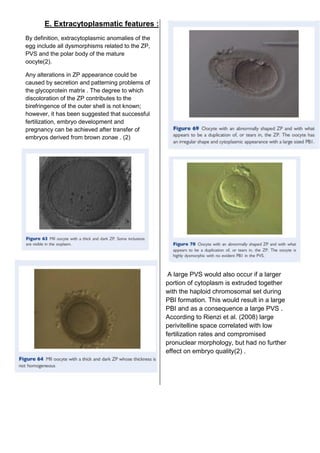
E. Extracytoplasmatic features :
By definition, extracytoplasmic anomalies of the
egg include all dysmorphisms related to the ZP,
PVS and the polar body of the mature
oocyte(2).
Any alterations in ZP appearance could be
caused by secretion and patterning problems of
the glycoprotein matrix . The degree to which
discoloration of the ZP contributes to the
birefringence of the outer shell is not known;
however, it has been suggested that successful
fertilization, embryo development and
pregnancy can be achieved after transfer of
embryos derived from brown zonae . (2)
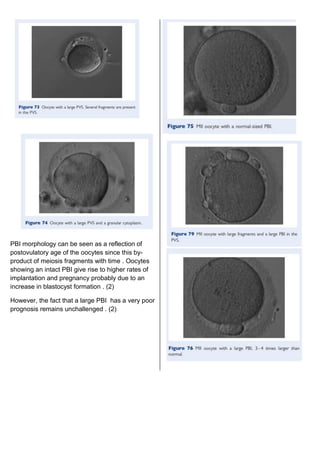
A large PVS would also occur if a larger
portion of cytoplasm is extruded together
with the haploid chromosomal set during
PBI formation. This would result in a large
PBI and as a consequence a large PVS .
According to Rienzi et al. (2008) large
perivitelline space correlated with low
fertilization rates and compromised
pronuclear morphology, but had no further
effect on embryo quality(2) .
PBI morphology can be seen as a reflection of
postovulatory age of the oocytes since this by-
product of meiosis fragments with time . Oocytes
showing an intact PBI give rise to higher rates of
implantation and pregnancy probably due to an
increase in blastocyst formation . (2)
However, the fact that a large PBI has a very poor
prognosis remains unchallenged . (2)
‫مراجع‬
1. Sun QY. Wang Q1 .Evaluation of oocyte
quality: morphological, cellular and molecular
predictors .Reprod Fertil Dev .7002 vol19(1) .1-17
7. Basak Balaban, Thomas Ebner Laura Rienzi .
The oocyte .Human Reproduction .7017 vol27، pp
i2 –i21.
3. Brown oocytes .Esfandiari et .5، Toronto :
American Society for Reproductive Medicine ،
7002، vol 62. .
4. corresponding author1,2 Yasushi Nagai,2
and Kazuyoshi Chiba1 Junko Otsuki .Lipofuscin
bodies in human oocytes as an indicator of oocyte
quality .Journal of Assisted Reproduction and
Genetics .70027

Normal and abnormal oocyte morphology

  • 1.
    the normal oocyte morphology doneby : Sumia Abdalsalam Ramadan Misruta / Libya 2019 Follicle = Composed of 3 types of cells: 1- Thecal cells 2- Granulosa cells 3- Oocyte . process of oogenesis Schematic of female mammalian meiosis
  • 2.
    Mammalian oocytes arrestedat the dictyate stage of prophase I are identifiable by the presence of a germinal vesicle (GV). Resumption of meiosis I is marked by GV breakdown (GVBD ) . following which bivalents are brought to alignment at the spindle equator by metaphase I. Anaphase I then ensues when chromosomes segregate between the secondary oocyte and the polar body. Following first polar body extrusion (PBE), oocytes progress without a hiatus into meiosis II where they are are arrested for a second time at metaphase II
  • 3.
    abnormal oocyte morphology Mountingevidence that oocyte quality profoundly affects fertilisation and subsequent embryo development drives the continued search for reliable predictors of oocyte developmental competence. (1) These criteria are specifically classified as morphological and cellular/molecular predictors. (1) . Oocyte quality is not only influenced by the nuclear and mitochondrial genome, but also by the microenvironment provided by the ovary and the pre-ovulatory follicle that influences transcription and translation, and as a consequence, cytoplasmic maturity (2) . Morphological oocyte assessment is based on the aspects of : 1- Cumulus-corona cells 2- if denudation is performed 3- Oocyte morphology : a rapid evaluation using an inverted microscopic is also performed after denudation; the cytoplasm, the perivitelline space, the first polar body, the zona pellucida. provides very superficial and approximate information about; the stage of development [germinal vesicle, metaphase I (MI) or MII phase] the quality [degenerative signs in the cytoplasm, polar body (PB) or zona pellucida] Oocyte quality assessment (2) A. Cumulus-enclosed oocytes Oocyte morphological assessment in the laboratory is first based on the presentation of the cumulus – corona cells. (2) . During follicular antrum formation, granulosa cells (GCs) differentiate into mural GCs, lining the follicular wall, and CCs, surrounding the oocyte. Within the cumulus mass, CCs in close contact with the oocyte (corona cells) develop cytoplasmic projections which cross the ZP and form gap junctions with the oolemma. This organized structure is called the cumulus –oocyte complex (COC (2); For mature oocytes, the cumulus– corona mass should appear as an expanded and mucified layer, due to active secretion of hyaluronic acid. This extracellular matrix molecule interposes between the cumulus cells (CCs), eparating them and conferring to the cumulus –corona mass a fluffy ‘cloud-like’ appearance. (2) Immature COC: Dense compact cumulus if present. Adherent compact layer of corona cells. Ooplasm if visible with the presence of germinal vesicle. Compact and non-aggregated membrana granulosa cells
  • 4.
    (2) Post-mature COC arisefrom cycles where there has been a premature attenuated LH surge or a delayed HCG administration. Expanded cumulus with clumps radiant corona radiata, yet often clumped, irregular or incomplete. Visible zona, slightly granular or dark ooplasm. Small and relatively non aggregated membrana granulosa cells. (2) Degenerative or atretic COC: At recovery, -3% of COC B. Oocyte maturation stage The removal of the cumulus –corona cell mass gives the unique opportunity to evaluate oocyte morphology prior to fertilization, and in particular, the nuclear maturation stage (2) Oocyte nuclear maturity assessed by light microscopy, is assumed to be at the MII stage when the PBI is visible in the PVS . The MII stage is characterized by the alignment of the homologous chromosomes on the spindle equatorial plate during metaphase of the second meiotic division. (2)
  • 5.
    C. Oocyte sizeand shape The mean ovarian diameter of MII oocytes is 100 may vary substantially but it is not related to fertilization or developmental quality of human ICSI embryos at the cleavage stage of development. Oocyte size and shape (2) giant oocytes (about 200 m) and is tetraploid (4n) before meiosis due to their origin, i.e. nuclear but no cytoplasmic division in an oogonium or cytoplasmic fusion of two oogonia. • These oocytes always contribute to digynic triploidy and must never be transferred (2) when oocytes with ovoid zonae develop, day 2 embryos show a flat array of blastomeres rather than the more traditional tetrahedral arrangement and further development is often delayed (2)
  • 6.
    D. Cytoplasmic features: Normal features of a healthy mature oocyte at metaphase II include a round even shape, light color cytoplasm with homogenous granularity, a small perivitelline space without debris, and a transparent zona pellucida . (3) One of the abnormal morphological features in human oocytes is the dark granular appearance of the cytoplasm, with or without inclusions, and a thick ZP. We term these oocytes “brown eggs (3) One of the most important severe cytoplasmic abnormalities of MII oocytes is the appearance of SER clusters (SER discs) within the cytoplasm. SER discs can be identified as translucent vacuole-like structures in the cytoplasm by phase contrast microscopy (2)
  • 7.
    refractile body maybe approximately 10 μm under bright-field microscopy, appearing highly refractile because of its composition of lipid material and dense granules , These larger lipofuscin inclusions (>5 μm) were associated with significantly reduced fertilization and unfavorable blastocyst development. (4) Small vacuoles of 5–10 mm in diameter are unlikely to have a biological consequence, whereas large vacuoles .14 mm are associated with fertilization failure. In oocytes that are fertilized, those vacuoles that persist beyond syngamy can interfere with cleavage planes, resulting in a lower blastocyst rate . (2) cytoplasmic inclusions did not appear to affect fertilization, embryo quality and implantation rates. In contrast; The presence of both vacuoles and inclusions was related to compromised clinical pregnancy rates . these oocytes also had lower fertilization, embryo developmental and higher aneuploidy rates. (2)
  • 8.
    E. Extracytoplasmatic features: By definition, extracytoplasmic anomalies of the egg include all dysmorphisms related to the ZP, PVS and the polar body of the mature oocyte(2). Any alterations in ZP appearance could be caused by secretion and patterning problems of the glycoprotein matrix . The degree to which discoloration of the ZP contributes to the birefringence of the outer shell is not known; however, it has been suggested that successful fertilization, embryo development and pregnancy can be achieved after transfer of embryos derived from brown zonae . (2) A large PVS would also occur if a larger portion of cytoplasm is extruded together with the haploid chromosomal set during PBI formation. This would result in a large PBI and as a consequence a large PVS . According to Rienzi et al. (2008) large perivitelline space correlated with low fertilization rates and compromised pronuclear morphology, but had no further effect on embryo quality(2) .
  • 9.
    PBI morphology canbe seen as a reflection of postovulatory age of the oocytes since this by- product of meiosis fragments with time . Oocytes showing an intact PBI give rise to higher rates of implantation and pregnancy probably due to an increase in blastocyst formation . (2) However, the fact that a large PBI has a very poor prognosis remains unchallenged . (2)
  • 10.
    ‫مراجع‬ 1. Sun QY.Wang Q1 .Evaluation of oocyte quality: morphological, cellular and molecular predictors .Reprod Fertil Dev .7002 vol19(1) .1-17 7. Basak Balaban, Thomas Ebner Laura Rienzi . The oocyte .Human Reproduction .7017 vol27، pp i2 –i21. 3. Brown oocytes .Esfandiari et .5، Toronto : American Society for Reproductive Medicine ، 7002، vol 62. . 4. corresponding author1,2 Yasushi Nagai,2 and Kazuyoshi Chiba1 Junko Otsuki .Lipofuscin bodies in human oocytes as an indicator of oocyte quality .Journal of Assisted Reproduction and Genetics .70027