How to integrate graduate survey
results into QA
Stefan Humpl
Alexandra Fabrykowska
3s
TRACKING LEARNING AND CAREER
PATHS OF VET GRADUATES TO
IMPROVE QUALITY OF VET PROVISION
Background Info - Disclaimer
• The following slides are based on real experiences
working within an educational institution in Austria
• Terms valuing specific items of Graduate Tracking do
go back to these experiences and may not be
relevant for all educational institutions
 The presentation is an example of making use of
Graduate Tracking in a specific case
Introduction
Educational Institutions should conduct graduate
surveys every 2-3 years for the graduates of all
study programmes.
Various topics are possible:
- Satisfaction with study programme including
feedback to curriculum and its delivery,
satisfaction with institution as such
- Employment: Transition from education to
employment, current employment situation
- Further education: What and why
Internal QA topics involved
• Institutional development
– Marketing
– Partnerships
– Student Life
– Feedback Culture
• Development of study programme
– Curriculum development
– Delivery of curriculum (didactics, form of exams)
– Teaching staff involved
– Contact to labour market
Quality Processes
• Institutional Evaluation
– Accreditation Body visits every 5-7 years
– Total Quality Management throughout the whole
institution with ongoing quality cycles
– Alumni Network
• Study Programme Evaluation
– Teaching and learning processes
– Form and timing of exams and assessment
– Student Feedback Culture
– Contacts to labour market
Roles of Graduates
• Former Students – they are able to give an overall
feedback to their study programme for the time they
studied there
• Employees – they are able to provide information on
recent labour market conditions and how their study
programmes influenced their career
• Agents between work and education – they do know
aspects from both worlds, therefore their feedback is
relevant
Input from Graduates to…
… Marketing:
• Employment rates and career examples – often
showing also non-linear careers
• Positive feedback to study programmes and
institution
• Some graduates act as “role models” and recent
partners
Input from Graduates to…
… Partnerships:
• Graduates are asked, if their employers would act as
partners (low feedback, but if it is highly relevant)
• Graduates in highly relevant companies for the field
of employment are invited to take place in
curriculum development meetings
• Some graduates are asked to act as teachers in the
future
Input from Graduates to…
… Student Life:
• Graduates can say what they liked / did not like /
were missing at the institution. This can be taken for
institutional reforms (e.g. cafeteria, rooms for
informal meetings, feedback culture as a whole…)
• Some positive aspects from graduates’ remembers
are taken for marketing purposes
Input from Graduates to…
… Feedback Culture:
• Results from graduate surveys are taken seriously in
all institutional bodies and study programme working
groups. High respect for feedback improved feedback
culture from the institution also against students
• Graduates do not fear specific persons any more –
they tend to be more clear in their feedback
• Graduates do know usually about the whole study
programme and not only one course – their feedback
is more reflected
Input from Graduates to…
… Curriculum Development:
• If graduates state specific courses as useless or badly delivered, this
is reflected in curriculum development
• Graduates’ further education is reflected in curriculum
development
• Recent labour market requirements are reflected in the curriculum
• Even bipolar feedback is reflected in the curriculum (e.g. by
developing courses that can be selected)
 IMPORTANT: This has to be done in a whole process of curriculum
development, otherwise it reflects only pieces of a whole puzzle
 IMPORTANT: Feedback must be reflected by a wider group
Input from Graduates to…
… Delivery of Curriculum:
• Most feedback to curriculum is not about content, but on how
content was delivered – didactics, forms of teaching and learning
etc.
• Sometimes feedback is given to exams and assessment procedures
different to student feedback
• Study programme leader is responsible to provide feedback to all
teaching staff and to discuss possible changes
• Requires a highly developed feedback culture among teaching staff
 IMPORTANT: Requires relevant feedback mechanisms (regular
feedback talks between programme leader and teachers)!
 IMPORTANT: Compare with changes within the last years, maybe
feedback comes to a situation, which is not the case anymore!
Input from Graduates to…
… Teaching Staff Involved:
• In very specific cases teaching staff was changed (but
never ONLY because of graduates feedback)
• Graduates have the chance to name other relevant
experts for specific fields
Input from Graduates to…
… Contact to Labour Market:
• Graduates know about their own internships and
how they may be assessed from the perspective of
being employed now
• Graduates can be contacted for internships for recent
students
• Graduates can be asked to act as teachers and
mentors
• Establishing partnerships with the study programme
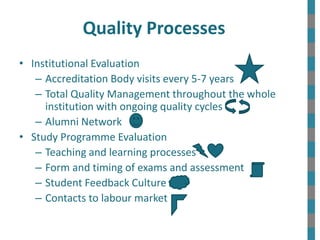
Quality Processes
• Institutional Evaluation
– Accreditation Body visits every 5-7 years
– Total Quality Management throughout the whole
institution with ongoing quality cycles
– Alumni Network
• Study Programme Evaluation
– Teaching and learning processes
– Form and timing of exams and assessment
– Student Feedback Culture
– Contacts to labour market
Possible main steps to implement GT
1. Define target population and sampling
2. Which data do you want to survey and how?
3. Develop a questionnaire
4. Data protection arrangements
5. Contact, follow-up procedures, and statistical analysis
6. Data collection and monitor/influence survey
participation
7. Focus groups? In-depth interviews?
8. Organisation specific reports

OnTrack - Experiences with Graduate Tracking

  • 1.
    How to integrategraduate survey results into QA Stefan Humpl Alexandra Fabrykowska 3s TRACKING LEARNING AND CAREER PATHS OF VET GRADUATES TO IMPROVE QUALITY OF VET PROVISION
  • 2.
    Background Info -Disclaimer • The following slides are based on real experiences working within an educational institution in Austria • Terms valuing specific items of Graduate Tracking do go back to these experiences and may not be relevant for all educational institutions  The presentation is an example of making use of Graduate Tracking in a specific case
  • 3.
    Introduction Educational Institutions shouldconduct graduate surveys every 2-3 years for the graduates of all study programmes. Various topics are possible: - Satisfaction with study programme including feedback to curriculum and its delivery, satisfaction with institution as such - Employment: Transition from education to employment, current employment situation - Further education: What and why
  • 4.
    Internal QA topicsinvolved • Institutional development – Marketing – Partnerships – Student Life – Feedback Culture • Development of study programme – Curriculum development – Delivery of curriculum (didactics, form of exams) – Teaching staff involved – Contact to labour market
  • 5.
    Quality Processes • InstitutionalEvaluation – Accreditation Body visits every 5-7 years – Total Quality Management throughout the whole institution with ongoing quality cycles – Alumni Network • Study Programme Evaluation – Teaching and learning processes – Form and timing of exams and assessment – Student Feedback Culture – Contacts to labour market
  • 6.
    Roles of Graduates •Former Students – they are able to give an overall feedback to their study programme for the time they studied there • Employees – they are able to provide information on recent labour market conditions and how their study programmes influenced their career • Agents between work and education – they do know aspects from both worlds, therefore their feedback is relevant
  • 7.
    Input from Graduatesto… … Marketing: • Employment rates and career examples – often showing also non-linear careers • Positive feedback to study programmes and institution • Some graduates act as “role models” and recent partners
  • 8.
    Input from Graduatesto… … Partnerships: • Graduates are asked, if their employers would act as partners (low feedback, but if it is highly relevant) • Graduates in highly relevant companies for the field of employment are invited to take place in curriculum development meetings • Some graduates are asked to act as teachers in the future
  • 9.
    Input from Graduatesto… … Student Life: • Graduates can say what they liked / did not like / were missing at the institution. This can be taken for institutional reforms (e.g. cafeteria, rooms for informal meetings, feedback culture as a whole…) • Some positive aspects from graduates’ remembers are taken for marketing purposes
  • 10.
    Input from Graduatesto… … Feedback Culture: • Results from graduate surveys are taken seriously in all institutional bodies and study programme working groups. High respect for feedback improved feedback culture from the institution also against students • Graduates do not fear specific persons any more – they tend to be more clear in their feedback • Graduates do know usually about the whole study programme and not only one course – their feedback is more reflected
  • 11.
    Input from Graduatesto… … Curriculum Development: • If graduates state specific courses as useless or badly delivered, this is reflected in curriculum development • Graduates’ further education is reflected in curriculum development • Recent labour market requirements are reflected in the curriculum • Even bipolar feedback is reflected in the curriculum (e.g. by developing courses that can be selected)  IMPORTANT: This has to be done in a whole process of curriculum development, otherwise it reflects only pieces of a whole puzzle  IMPORTANT: Feedback must be reflected by a wider group
  • 12.
    Input from Graduatesto… … Delivery of Curriculum: • Most feedback to curriculum is not about content, but on how content was delivered – didactics, forms of teaching and learning etc. • Sometimes feedback is given to exams and assessment procedures different to student feedback • Study programme leader is responsible to provide feedback to all teaching staff and to discuss possible changes • Requires a highly developed feedback culture among teaching staff  IMPORTANT: Requires relevant feedback mechanisms (regular feedback talks between programme leader and teachers)!  IMPORTANT: Compare with changes within the last years, maybe feedback comes to a situation, which is not the case anymore!
  • 13.
    Input from Graduatesto… … Teaching Staff Involved: • In very specific cases teaching staff was changed (but never ONLY because of graduates feedback) • Graduates have the chance to name other relevant experts for specific fields
  • 14.
    Input from Graduatesto… … Contact to Labour Market: • Graduates know about their own internships and how they may be assessed from the perspective of being employed now • Graduates can be contacted for internships for recent students • Graduates can be asked to act as teachers and mentors • Establishing partnerships with the study programme
  • 15.
    Quality Processes • InstitutionalEvaluation – Accreditation Body visits every 5-7 years – Total Quality Management throughout the whole institution with ongoing quality cycles – Alumni Network • Study Programme Evaluation – Teaching and learning processes – Form and timing of exams and assessment – Student Feedback Culture – Contacts to labour market
  • 16.
    Possible main stepsto implement GT 1. Define target population and sampling 2. Which data do you want to survey and how? 3. Develop a questionnaire 4. Data protection arrangements 5. Contact, follow-up procedures, and statistical analysis 6. Data collection and monitor/influence survey participation 7. Focus groups? In-depth interviews? 8. Organisation specific reports