Presented by : Siddhi Kuperkar
M.Sc. Part 1
Institute of Forensic Science, Mumbai
 Introduction
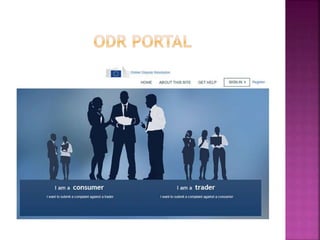
 ODR Platform
 Definition
 Classical Forms of ODR
 Basic Steps on ODR Portal
 ODR Service Providers
 Possible reforms required in ODR System
 The Fourth Party
 Advantages of ODR
 Disadvantages of ODR
 ODR in India
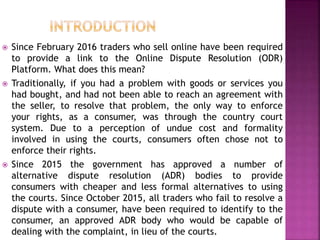
 Since February 2016 traders who sell online have been required
to provide a link to the Online Dispute Resolution (ODR)
Platform. What does this mean?
 Traditionally, if you had a problem with goods or services you
had bought, and had not been able to reach an agreement with
the seller, to resolve that problem, the only way to enforce
your rights, as a consumer, was through the country court
system. Due to a perception of undue cost and formality
involved in using the courts, consumers often chose not to
enforce their rights.
 Since 2015 the government has approved a number of
alternative dispute resolution (ADR) bodies to provide
consumers with cheaper and less formal alternatives to using
the courts. Since October 2015, all traders who fail to resolve a
dispute with a consumer, have been required to identify to the
consumer, an approved ADR body who would be capable of
dealing with the complaint, in lieu of the courts.
 Developed by European Commission.
 Objective was to help consumers and traders
to resolve their contractual disputes about
online purchases of goods and services out-of-
court at a low cost in a simple and fast way.
 Allows to submit the online disputes in any of
the 23 official languages of the European
Union.
 Accessible to consumers and traders since 15
February 2016.
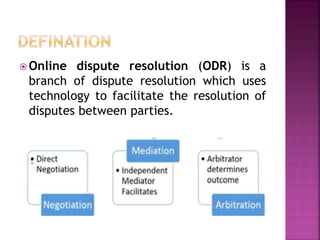
 Online dispute resolution (ODR) is a
branch of dispute resolution which uses
technology to facilitate the resolution of
disputes between parties.
1. NEGOTIATION
 Negotiation has been defined as any form of
direct or indirect communication whereby
parties who have opposing interests discuss
the form of any joint action which they
might take to manage and ultimately resolve
the dispute between them.
 Negotiations may be used to resolve an
already-existing problem or to lay the
groundwork for a future relationship
between two or more parties.
2. MEDIATION
 Mediation is negotiation between disputing
parties, assisted by a neutral. While the
mediator is not empowered to impose a
settlement, the mediator's presence alters the
dynamics of the negotiation and often helps
shape the final settlement.
 The Canadian Bar Association defines
mediation as “the intervention into a dispute
or negotiation by an acceptable, impartial
and neutral third party who has no decision
making power, to assist disputing parties in
voluntarily reaching their own mutually
acceptable settlement of issues in dispute.
3. ARBITRATION
 Arbitration is perhaps the most popular and
widely known dispute resolution process. Like
litigation, arbitration utilizes an adversarial
approach that requires a neutral party to
render a decision.
 Historically, arbitration has been used most
widely in commercial disputes as a private
alternative to litigation. Arbitration
developed as a binding, adjudicative process.
 While these features closely parallel those of
traditional court proceedings, there are
important distinctions between the two
processes which will be discussed further in
this document.
4. EXPERT DETERMINATION
 Expert determination is another dispute
resolution tool utilized by WIPO. It has all the
advantages of other forms of ADR in that it is
quick, effective and cost efficient.
 It is a consensual agreement between
interested parties to have an issue or entire
dispute resolved by an expert.
 It is an excellent procedure to solve disputes
arising out of Cyberspace that require
specialized knowledge.
 In addition to disputes about Intellectual
Property, there are a number of disputes in
Cyberspace that might require extensive
knowledge about the technological
underpinnings of the web.
5. CREDIT CARD CHARGEBACKS
 It is a very basic form of dispute resolution.
It is frequently used and gives a customer a
very potent tool to resolve disputes.
 The international character of a transaction
does not matter, since the customer needs
only to contact his own local credit card
issuer.
 Chargebacks therefore offer quick dispute
resolution across borders. Since most
transactions in cyberspace are conducted via
credit card, chargebacks may be the most
common means of dispute resolution in
cyberspace and can be used in almost any e-
commerce dispute
6. BLIND BIDDING SYSTEM
 Blind bidding is a negotiation method for two
parties where the offer and demand are kept
hidden during the negotiation.
 It commences when one party invites the
other to negotiate the amount of money in
dispute.
 If the other party agrees, they start a blind
bidding process whereby both parties make
secret offers or bids, which will only be
disclosed if both offers match certain
standards.
1) Create an account.
2) The dashboard identifies both the parties
and stage of the process you are in.
3) Conversation between two parties.
4) Mediator request for sending messages and
documents. (Date and time mentioned of
request)
5) Private chat between the Mediator and each
party.
6) After agreement is proposed, the business
will receive the proposal and will have
chance to accept it or not and make
suggestions.
1. The Virtual Magistrate Project
 Origin in a meeting sponsored by the National
Center for Automated Information Research
(NCAIR) and the Cyberspace Law Institute (CLI)
on October 25, 1995.
2. The Online Ombuds Office
 Hosted by the University of Massachusetts.
 Founded in 1996.
 e-bay disputes
3. Square Trade
 Contracted with e-bay and later PayPal.
 Founded in 1999.
 Now offers insurance packages.
1. TECHNOLOGICAL REFORMS
 Video- Conferencing
2. LEGAL REFORMS
3. NEW SYSTEMS
 Specialized procedures can be simple, fast,
and make full use of the advantages of
Cyberspace.
 ADR providers should be immediately
accessible from the webpage where the
dispute occurred, and offering specialized
proceedings and knowledge to quickly resolve
the disputes.
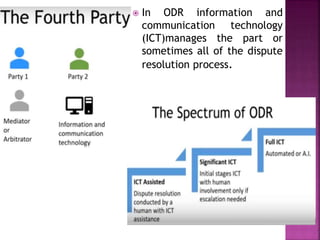
 In ODR information and
communication technology
(ICT)manages the part or
sometimes all of the dispute
resolution process.
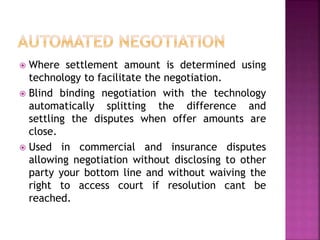
 Where settlement amount is determined using
technology to facilitate the negotiation.
 Blind binding negotiation with the technology
automatically splitting the difference and
settling the disputes when offer amounts are
close.
 Used in commercial and insurance disputes
allowing negotiation without disclosing to other
party your bottom line and without waiving the
right to access court if resolution cant be
reached.
 Where the technology provides process
structure and may also provide legal
information or evaluation.
 Interact support uses video mediation
exclusively to provide family dispute
resolution including property negotiation.
 Avoids Jurisdiction Issues
 Cost Reduction
 Speedy Resolution
 Non-confrontational Mechanism
 Neutral And Transparent Forum
 Freedom From Geographical Location
 Organised Digital Data Storage
 Lack Of Trust
 Lack Of Awareness
 Virtual World
 Lack Of Access Of Technology
 Lack Of Training To Lawyers
 Online dispute resolution (ODR) in India is in its
infancy stage and it is gaining prominence day by day.
With the enactment of Information Technology Act,
2000 in India, e-commerce and e-governance have
been given a formal and legal recognition in India.
 Even the traditional arbitration law of India has been
reformulated and now India has Arbitration and
Conciliation Act, 1996 in place that is satisfying the
harmonised standards of UNCITRAL Model.
 The amendment made in the Code of Civil
Procedure, 1908 by introducing section 89 was made
to provide methods of alternative dispute resolution
(ADR) in India.
 Online Dispute Resolution: A Step in the Right Direction,
PSA, Issue V, January 2010.
 The Legal and Institutional Framework of Online Dispute
Resolution (ODR), The Arbitration Hub, April 29, 2016,
available at http://thearbitrationhub.com/online-
dispute-resolution-framework.
 Feliksas Petrauskas, Eglė Kybartien, ‘Online Dispute
Resolution in Consumer Disputes’, 18(3) Jurisprudence
921–941(2011).
 K. Ukey, ‘Cyber Forensics: A Legal Perspective of Data
Protection and E-Commerce’, (2018), ‘Alternate
Dispute Resolution (ADR) and Online Dispute Resolution
(ODR)’, 272-288.
 E. Katsh & J. Rifkin, Online Dispute Resolution:
Resolving Conflicts in Cyberspace (John Wiley & Sons
Inc., 2001).
 www.wikipedia.com dated 10/04/2019.
Online dispute resolution

Online dispute resolution

  • 1.
    Presented by :Siddhi Kuperkar M.Sc. Part 1 Institute of Forensic Science, Mumbai
  • 2.
     Introduction  ODRPlatform  Definition  Classical Forms of ODR  Basic Steps on ODR Portal  ODR Service Providers  Possible reforms required in ODR System  The Fourth Party  Advantages of ODR  Disadvantages of ODR  ODR in India
  • 4.
     Since February2016 traders who sell online have been required to provide a link to the Online Dispute Resolution (ODR) Platform. What does this mean?  Traditionally, if you had a problem with goods or services you had bought, and had not been able to reach an agreement with the seller, to resolve that problem, the only way to enforce your rights, as a consumer, was through the country court system. Due to a perception of undue cost and formality involved in using the courts, consumers often chose not to enforce their rights.  Since 2015 the government has approved a number of alternative dispute resolution (ADR) bodies to provide consumers with cheaper and less formal alternatives to using the courts. Since October 2015, all traders who fail to resolve a dispute with a consumer, have been required to identify to the consumer, an approved ADR body who would be capable of dealing with the complaint, in lieu of the courts.
  • 5.
     Developed byEuropean Commission.  Objective was to help consumers and traders to resolve their contractual disputes about online purchases of goods and services out-of- court at a low cost in a simple and fast way.  Allows to submit the online disputes in any of the 23 official languages of the European Union.  Accessible to consumers and traders since 15 February 2016.
  • 6.
     Online disputeresolution (ODR) is a branch of dispute resolution which uses technology to facilitate the resolution of disputes between parties.
  • 7.
    1. NEGOTIATION  Negotiationhas been defined as any form of direct or indirect communication whereby parties who have opposing interests discuss the form of any joint action which they might take to manage and ultimately resolve the dispute between them.  Negotiations may be used to resolve an already-existing problem or to lay the groundwork for a future relationship between two or more parties.
  • 8.
    2. MEDIATION  Mediationis negotiation between disputing parties, assisted by a neutral. While the mediator is not empowered to impose a settlement, the mediator's presence alters the dynamics of the negotiation and often helps shape the final settlement.  The Canadian Bar Association defines mediation as “the intervention into a dispute or negotiation by an acceptable, impartial and neutral third party who has no decision making power, to assist disputing parties in voluntarily reaching their own mutually acceptable settlement of issues in dispute.
  • 9.
    3. ARBITRATION  Arbitrationis perhaps the most popular and widely known dispute resolution process. Like litigation, arbitration utilizes an adversarial approach that requires a neutral party to render a decision.  Historically, arbitration has been used most widely in commercial disputes as a private alternative to litigation. Arbitration developed as a binding, adjudicative process.  While these features closely parallel those of traditional court proceedings, there are important distinctions between the two processes which will be discussed further in this document.
  • 10.
    4. EXPERT DETERMINATION Expert determination is another dispute resolution tool utilized by WIPO. It has all the advantages of other forms of ADR in that it is quick, effective and cost efficient.  It is a consensual agreement between interested parties to have an issue or entire dispute resolved by an expert.  It is an excellent procedure to solve disputes arising out of Cyberspace that require specialized knowledge.  In addition to disputes about Intellectual Property, there are a number of disputes in Cyberspace that might require extensive knowledge about the technological underpinnings of the web.
  • 11.
    5. CREDIT CARDCHARGEBACKS  It is a very basic form of dispute resolution. It is frequently used and gives a customer a very potent tool to resolve disputes.  The international character of a transaction does not matter, since the customer needs only to contact his own local credit card issuer.  Chargebacks therefore offer quick dispute resolution across borders. Since most transactions in cyberspace are conducted via credit card, chargebacks may be the most common means of dispute resolution in cyberspace and can be used in almost any e- commerce dispute
  • 12.
    6. BLIND BIDDINGSYSTEM  Blind bidding is a negotiation method for two parties where the offer and demand are kept hidden during the negotiation.  It commences when one party invites the other to negotiate the amount of money in dispute.  If the other party agrees, they start a blind bidding process whereby both parties make secret offers or bids, which will only be disclosed if both offers match certain standards.
  • 13.
    1) Create anaccount. 2) The dashboard identifies both the parties and stage of the process you are in. 3) Conversation between two parties. 4) Mediator request for sending messages and documents. (Date and time mentioned of request) 5) Private chat between the Mediator and each party. 6) After agreement is proposed, the business will receive the proposal and will have chance to accept it or not and make suggestions.
  • 15.
    1. The VirtualMagistrate Project  Origin in a meeting sponsored by the National Center for Automated Information Research (NCAIR) and the Cyberspace Law Institute (CLI) on October 25, 1995. 2. The Online Ombuds Office  Hosted by the University of Massachusetts.  Founded in 1996.  e-bay disputes 3. Square Trade  Contracted with e-bay and later PayPal.  Founded in 1999.  Now offers insurance packages.
  • 16.
    1. TECHNOLOGICAL REFORMS Video- Conferencing 2. LEGAL REFORMS 3. NEW SYSTEMS  Specialized procedures can be simple, fast, and make full use of the advantages of Cyberspace.  ADR providers should be immediately accessible from the webpage where the dispute occurred, and offering specialized proceedings and knowledge to quickly resolve the disputes.
  • 17.
     In ODRinformation and communication technology (ICT)manages the part or sometimes all of the dispute resolution process.
  • 18.
     Where settlementamount is determined using technology to facilitate the negotiation.  Blind binding negotiation with the technology automatically splitting the difference and settling the disputes when offer amounts are close.  Used in commercial and insurance disputes allowing negotiation without disclosing to other party your bottom line and without waiving the right to access court if resolution cant be reached.
  • 19.
     Where thetechnology provides process structure and may also provide legal information or evaluation.  Interact support uses video mediation exclusively to provide family dispute resolution including property negotiation.
  • 20.
     Avoids JurisdictionIssues  Cost Reduction  Speedy Resolution  Non-confrontational Mechanism  Neutral And Transparent Forum  Freedom From Geographical Location  Organised Digital Data Storage
  • 21.
     Lack OfTrust  Lack Of Awareness  Virtual World  Lack Of Access Of Technology  Lack Of Training To Lawyers
  • 22.
     Online disputeresolution (ODR) in India is in its infancy stage and it is gaining prominence day by day. With the enactment of Information Technology Act, 2000 in India, e-commerce and e-governance have been given a formal and legal recognition in India.  Even the traditional arbitration law of India has been reformulated and now India has Arbitration and Conciliation Act, 1996 in place that is satisfying the harmonised standards of UNCITRAL Model.  The amendment made in the Code of Civil Procedure, 1908 by introducing section 89 was made to provide methods of alternative dispute resolution (ADR) in India.
  • 23.
     Online DisputeResolution: A Step in the Right Direction, PSA, Issue V, January 2010.  The Legal and Institutional Framework of Online Dispute Resolution (ODR), The Arbitration Hub, April 29, 2016, available at http://thearbitrationhub.com/online- dispute-resolution-framework.  Feliksas Petrauskas, Eglė Kybartien, ‘Online Dispute Resolution in Consumer Disputes’, 18(3) Jurisprudence 921–941(2011).  K. Ukey, ‘Cyber Forensics: A Legal Perspective of Data Protection and E-Commerce’, (2018), ‘Alternate Dispute Resolution (ADR) and Online Dispute Resolution (ODR)’, 272-288.  E. Katsh & J. Rifkin, Online Dispute Resolution: Resolving Conflicts in Cyberspace (John Wiley & Sons Inc., 2001).  www.wikipedia.com dated 10/04/2019.