Online Disputes Resolution for consumers redress

                    Aura Esther Vilalta
              Universitat Oberta de Catalunya


                                                Espai de paginació   2 / 25
SPAIN
• From the National Consumers authority survey (Instituto Nacional de
  Consumo):

- 49,5% tend to e-transactions by reasons
• of simplicity and comfort.
- 71% declare to be very satisfied with etransactions + 26% just
  satisfied.
• - 65% is concerned with the lack of ODRs in e-transactions.
• - 47% disputes get solved through internal services of companies.
EUROPEAN UNION
• From Pilot project lead by the European Commission:
•   - More than 40% expressed total satisfaction with the communication of the provider + an
    additional 12% expressed partial satisfaction obtained.
•
•   - From those people who could not settle their problems in a friendly manner, 38 % said
    they did nothing (in Spain, 49%).
•
•   - And when asked about the reasons, for 73% too expensive in relation to the cost of the
    product or service.

• From final Report of DG SANCO:
•   - 80% of compliance of outcomes in recommendations.
•   - 90% of compliance of outcomes in binding decisions.
•   - In general, ADR schemes are considered a very effective to obtain redress.
EUROPEAN UNION STRATEGIC INITIATIVES
•   (1985) First European Commission communication on consumer redress.
•   (1993) The E. Commission presented a Green paper on access of consumers to
    justice and settlement of disputes.
•   (1996) The E. Commission set an Action Plan on consumer access to justice
    and the settlement of disputes in the internal market.
•   (2000) The European Parliament stressed the significance of expanding
    extrajudicial methods for consumer redress, in particular in transnational
    conflicts.
•   (2001) The E. Commission declared the key role of extra-judicial methods and
    noticed the significant role of ICTs in providing tools to resolve disputes.
    Technology is seen, since then, as a core issue in disputes resolution because
    access is widened, speed is increased and control of the process remain in the
    hands of the parties.
•   (2001 -.) The European Council and the Commission keep emphasizing that it is
    better for the interests of consumers and companies that both try to solve
    conflicts friendly, avoiding judicial processes, and highlights the importance of
    devoting efforts on alternative methods. European Claim Form.
•   (2005) the European Union fostered a European Consumer Centres Network
    ("ECC-Net") as we mentioned before.
•   (2009) The Stockholm program.
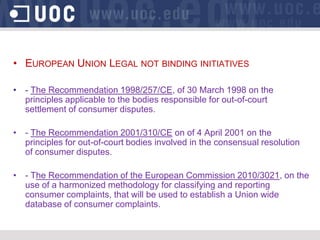
• EUROPEAN UNION LEGAL NOT BINDING INITIATIVES

• - The Recommendation 1998/257/CE, of 30 March 1998 on the
  principles applicable to the bodies responsible for out-of-court
  settlement of consumer disputes.

• - The Recommendation 2001/310/CE on of 4 April 2001 on the
  principles for out-of-court bodies involved in the consensual resolution
  of consumer disputes.

• - The Recommendation of the European Commission 2010/3021, on the
  use of a harmonized methodology for classifying and reporting
  consumer complaints, that will be used to establish a Union wide
  database of consumer complaints.
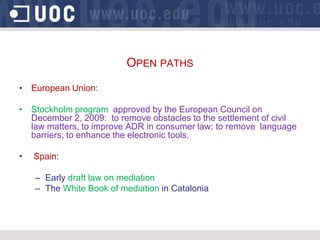
OPEN PATHS
• European Union:

• Stockholm program approved by the European Council on
  December 2, 2009: to remove obstacles to the settlement of civil
  law matters, to improve ADR in consumer law; to remove language
  barriers; to enhance the electronic tools.

•   Spain:

    – Early draft law on mediation
    – The White Book of mediation in Catalonia
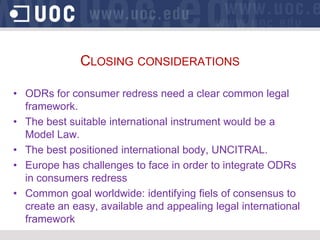
CLOSING CONSIDERATIONS

• ODRs for consumer redress need a clear common legal
  framework.
• The best suitable international instrument would be a
  Model Law.
• The best positioned international body, UNCITRAL.
• Europe has challenges to face in order to integrate ODRs
  in consumers redress
• Common goal worldwide: identifying fiels of consensus to
  create an easy, available and appealing legal international
  framework

Aura esther vilalta

  • 1.
    Online Disputes Resolutionfor consumers redress Aura Esther Vilalta Universitat Oberta de Catalunya Espai de paginació 2 / 25
  • 2.
    SPAIN • From theNational Consumers authority survey (Instituto Nacional de Consumo): - 49,5% tend to e-transactions by reasons • of simplicity and comfort. - 71% declare to be very satisfied with etransactions + 26% just satisfied. • - 65% is concerned with the lack of ODRs in e-transactions. • - 47% disputes get solved through internal services of companies.
  • 3.
    EUROPEAN UNION • FromPilot project lead by the European Commission: • - More than 40% expressed total satisfaction with the communication of the provider + an additional 12% expressed partial satisfaction obtained. • • - From those people who could not settle their problems in a friendly manner, 38 % said they did nothing (in Spain, 49%). • • - And when asked about the reasons, for 73% too expensive in relation to the cost of the product or service. • From final Report of DG SANCO: • - 80% of compliance of outcomes in recommendations. • - 90% of compliance of outcomes in binding decisions. • - In general, ADR schemes are considered a very effective to obtain redress.
  • 4.
    EUROPEAN UNION STRATEGICINITIATIVES • (1985) First European Commission communication on consumer redress. • (1993) The E. Commission presented a Green paper on access of consumers to justice and settlement of disputes. • (1996) The E. Commission set an Action Plan on consumer access to justice and the settlement of disputes in the internal market. • (2000) The European Parliament stressed the significance of expanding extrajudicial methods for consumer redress, in particular in transnational conflicts. • (2001) The E. Commission declared the key role of extra-judicial methods and noticed the significant role of ICTs in providing tools to resolve disputes. Technology is seen, since then, as a core issue in disputes resolution because access is widened, speed is increased and control of the process remain in the hands of the parties. • (2001 -.) The European Council and the Commission keep emphasizing that it is better for the interests of consumers and companies that both try to solve conflicts friendly, avoiding judicial processes, and highlights the importance of devoting efforts on alternative methods. European Claim Form. • (2005) the European Union fostered a European Consumer Centres Network ("ECC-Net") as we mentioned before. • (2009) The Stockholm program.
  • 5.
    • EUROPEAN UNIONLEGAL NOT BINDING INITIATIVES • - The Recommendation 1998/257/CE, of 30 March 1998 on the principles applicable to the bodies responsible for out-of-court settlement of consumer disputes. • - The Recommendation 2001/310/CE on of 4 April 2001 on the principles for out-of-court bodies involved in the consensual resolution of consumer disputes. • - The Recommendation of the European Commission 2010/3021, on the use of a harmonized methodology for classifying and reporting consumer complaints, that will be used to establish a Union wide database of consumer complaints.
  • 6.
    OPEN PATHS • EuropeanUnion: • Stockholm program approved by the European Council on December 2, 2009: to remove obstacles to the settlement of civil law matters, to improve ADR in consumer law; to remove language barriers; to enhance the electronic tools. • Spain: – Early draft law on mediation – The White Book of mediation in Catalonia
  • 7.
    CLOSING CONSIDERATIONS • ODRsfor consumer redress need a clear common legal framework. • The best suitable international instrument would be a Model Law. • The best positioned international body, UNCITRAL. • Europe has challenges to face in order to integrate ODRs in consumers redress • Common goal worldwide: identifying fiels of consensus to create an easy, available and appealing legal international framework