Why is comprehension one of
the most challenging issues
facing teachers of reading?
Comprehension is important because
without it the student is not truly
reading.
There has been a growing body of
research on comprehension and one of
the most significant findings is that
proficient readers are active readers.
They actively engage with the text using
a number of strategies to gain meaning
from it.
Before reading
During reading
After reading
What do “good” readers do
Authors and researchers include
from 6-18 strategies as being
important for reading
comprehension.
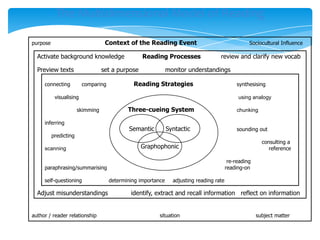
connecting comparing Reading Strategies synthesising
visualising using analogy
skimming chunking
inferring
sounding out
predicting
consulting a
scanning reference
re-reading
paraphrasing/summarising reading-on
self-questioning determining importance adjusting reading rate
The Multidimensional Model of Reading
Activate background knowledge Reading Processes review and clarify new vocab
Preview texts set a purpose monitor understandings
Adjust misunderstandings identify, extract and recall information reflect on information
Three-cueing System
Graphophonic
SyntacticSemantic
purpose Context of the Reading Event Sociocultural Influence
author / reader relationship situation subject matter
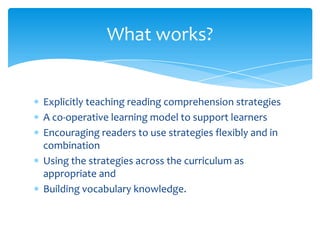
Explicitly teaching reading comprehension strategies
A co-operative learning model to support learners
Encouraging readers to use strategies flexibly and in
combination
Using the strategies across the curriculum as
appropriate and
Building vocabulary knowledge.
What works?
Where does
comprehension fit in the
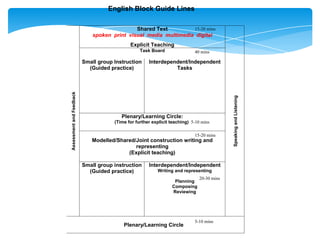
English block?
English Block Guide Lines
AssessmentandFeedback
Shared Text
spoken print visual media multimedia digital
Explicit Teaching
SpeakingandListening
Task Board
Small group Instruction
(Guided practice)
Interdependent/Independent
Tasks
Plenary/Learning Circle:
(Time for further explicit teaching) 5-10 mins
Modelled/Shared/Joint construction writing and
representing
(Explicit teaching)
Small group instruction
(Guided practice)
Interdependent/Independent
Writing and representing
Planning
Composing
Reviewing
Plenary/Learning Circle
15-20 mins
40 mins
15-20 mins
20-30 mins
5-10 mins

Online comprehensionmodule

  • 1.
    Why is comprehensionone of the most challenging issues facing teachers of reading?
  • 2.
    Comprehension is importantbecause without it the student is not truly reading.
  • 3.
    There has beena growing body of research on comprehension and one of the most significant findings is that proficient readers are active readers. They actively engage with the text using a number of strategies to gain meaning from it.
  • 4.
    Before reading During reading Afterreading What do “good” readers do
  • 5.
    Authors and researchersinclude from 6-18 strategies as being important for reading comprehension.
  • 6.
    connecting comparing ReadingStrategies synthesising visualising using analogy skimming chunking inferring sounding out predicting consulting a scanning reference re-reading paraphrasing/summarising reading-on self-questioning determining importance adjusting reading rate The Multidimensional Model of Reading Activate background knowledge Reading Processes review and clarify new vocab Preview texts set a purpose monitor understandings Adjust misunderstandings identify, extract and recall information reflect on information Three-cueing System Graphophonic SyntacticSemantic purpose Context of the Reading Event Sociocultural Influence author / reader relationship situation subject matter
  • 7.
    Explicitly teaching readingcomprehension strategies A co-operative learning model to support learners Encouraging readers to use strategies flexibly and in combination Using the strategies across the curriculum as appropriate and Building vocabulary knowledge. What works?
  • 8.
    Where does comprehension fitin the English block?
  • 9.
    English Block GuideLines AssessmentandFeedback Shared Text spoken print visual media multimedia digital Explicit Teaching SpeakingandListening Task Board Small group Instruction (Guided practice) Interdependent/Independent Tasks Plenary/Learning Circle: (Time for further explicit teaching) 5-10 mins Modelled/Shared/Joint construction writing and representing (Explicit teaching) Small group instruction (Guided practice) Interdependent/Independent Writing and representing Planning Composing Reviewing Plenary/Learning Circle 15-20 mins 40 mins 15-20 mins 20-30 mins 5-10 mins

Editor's Notes

  • #2 One reason is that comprehension is something that occurs inside the reader’s head. It is often a silent, motionless, personal act that involves cognitive, social and interactive processes and most of these processes are not observable. For proficient or “good” readers comprehending most text is automatic;m the focus is on the text’s content and not the ‘how’ of reading.
  • #3 Teachers are often heard saying, “This child is reading well but their comprehension is not strong.” If we revisit the definition of comprehension given in the syllabus as – the processes by which readers bring meaning to and extract meaning from texts, then teachers will need to see the clear relationship between reading and comprehension for a child to be truly reading. The syllabus states that there are key comprehension strategies that proficient readers use. These strategies are described in detail in the recommended professional reading within this module.
  • #4 What does it mean for children to be actively engaged with text? At this point it would be ideal to reflect upon our own classroom practice. The way that comprehension is explicitly taught and the structures that are in place to support students active engagement with text.
  • #5 In understanding what proficient or “good” readers do before, during and after reading it is important to refer to the graphic in this module that highlights the key comprehension strategies used at each stage of the reading process.
  • #6 This module has highlighted a range of comprehension strategies through the professional reading and the video and it is recommended that these strategies be explicitly taught. Some of these key startegies are seen on the next slide.
  • #10 Comprehension Can be explicitly taught through the shared text. It is at the heart of any small group instruction. In line with the Gradual Release of Responsibility model children should also be given the opportunity to independently practice their knowledge and skills of comprehension through meaningful, connected tasks. Comprehension also belongs in all aspects of writing AND across all Key Learning areas.