Reader’s Circle

Aidan Chambers (1994)


Readers’ Circle involves each group of students
selecting a text to read. The students individually
read an agreed part of the text and come together
to explore their understanding and interpretations
of the text.
Choose a text together
 initial discussion should focus on the cover, the
author and blurb as you lead the group to make
predictions on content.
 After beginning the reading in their own time the
group will come together on a weekly basis with
the teacher to discuss responses to the text.






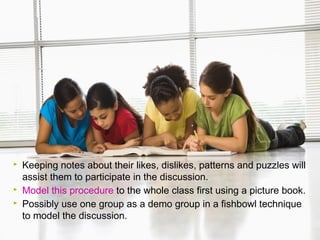
Keeping notes about their likes, dislikes, patterns and puzzles will
assist them to participate in the discussion.
Model this procedure to the whole class first using a picture book.
Possibly use one group as a demo group in a fishbowl technique
to model the discussion.
Teacher leads/facilitates the discussion
beginning with the 4 basic questions- likes,
dislikes, patterns and puzzles
 These questions are only the beginning of the
discussion, a catalyst to lead to the general and
special questions.
(see extract from “Tell Me”)
 Bring the readers back to the text to ‘back up’
their ideas and opinions
 Now and then, sum up the discussion and ideas.










Weekly ‘journal’ entries
Writing about the main question from the discussion in
a response format
Decide on a way to ‘share’ the book with other groups
(poster, play, book ‘trailer’)
(Check out one student ’s response in the form
of a ‘trailer’ on “The Canterville Ghost ” at the
end of this slide presentation )
Follow up with related texts.
The teacher needs to take anecdotal evidence of
the discussion and use this against a criteria to
measure and track students comprehension and
reading skills.
 It is recommended that the ‘Reading Texts’ and
‘Comprehension’ skills listed in the K-6 Literacy
continuum is used to create a rubric or checklist
for this purpose.

This strategy is best suited to fiction texts
 The teacher needs to have read the text before
the students and be prepared with ideas and
questions for each discussion session
 Be aware of the implications of having ALL the
class engaging in Readers Circle.

the students taking responsibility to read
independently between sessions
 the development of strategies for making meaning
 the development of understanding that there are
different interpretations of the same text
 the involvement of students in deeply reading a
variety of text types.

the students taking responsibility to read
independently between sessions
 the development of strategies for making meaning
 the development of understanding that there are
different interpretations of the same text
 the involvement of students in deeply reading a
variety of text types.


Reader's Circle

  • 1.
  • 2.
     Readers’ Circle involveseach group of students selecting a text to read. The students individually read an agreed part of the text and come together to explore their understanding and interpretations of the text.
  • 3.
    Choose a texttogether  initial discussion should focus on the cover, the author and blurb as you lead the group to make predictions on content.  After beginning the reading in their own time the group will come together on a weekly basis with the teacher to discuss responses to the text. 
  • 4.
       Keeping notes abouttheir likes, dislikes, patterns and puzzles will assist them to participate in the discussion. Model this procedure to the whole class first using a picture book. Possibly use one group as a demo group in a fishbowl technique to model the discussion.
  • 5.
    Teacher leads/facilitates thediscussion beginning with the 4 basic questions- likes, dislikes, patterns and puzzles  These questions are only the beginning of the discussion, a catalyst to lead to the general and special questions. (see extract from “Tell Me”)  Bring the readers back to the text to ‘back up’ their ideas and opinions  Now and then, sum up the discussion and ideas. 
  • 6.
         Weekly ‘journal’ entries Writingabout the main question from the discussion in a response format Decide on a way to ‘share’ the book with other groups (poster, play, book ‘trailer’) (Check out one student ’s response in the form of a ‘trailer’ on “The Canterville Ghost ” at the end of this slide presentation ) Follow up with related texts.
  • 7.
    The teacher needsto take anecdotal evidence of the discussion and use this against a criteria to measure and track students comprehension and reading skills.  It is recommended that the ‘Reading Texts’ and ‘Comprehension’ skills listed in the K-6 Literacy continuum is used to create a rubric or checklist for this purpose. 
  • 8.
    This strategy isbest suited to fiction texts  The teacher needs to have read the text before the students and be prepared with ideas and questions for each discussion session  Be aware of the implications of having ALL the class engaging in Readers Circle. 
  • 9.
    the students takingresponsibility to read independently between sessions  the development of strategies for making meaning  the development of understanding that there are different interpretations of the same text  the involvement of students in deeply reading a variety of text types. 
  • 10.
    the students takingresponsibility to read independently between sessions  the development of strategies for making meaning  the development of understanding that there are different interpretations of the same text  the involvement of students in deeply reading a variety of text types. 

Editor's Notes

  • #2 The following slides outline the process for setting up and conducting a Readers’ Circle session in a classroom. The process I will explain is based on the work of Aidan Chambers from his book ‘Tell Me’ as well as references from Harvey Daniels book, ‘Literature Circles’.
  • #3 As already outlined in this module, the strategy is part of the suite of strategies that teachers use at small group instructional reading time. In these strategies the teacher becomes the ‘guide on the side’, leading students to read, and comprehend texts that are targeted to their point of need learning. In Readers’ Circle the students independently read the text and the group time is the opportunity to discuss the text read and the meaning it has for the group of readers.
  • #4 The first step in the process and a very important one is the choosing of a text by the group. It is important to the process that the students have some say in their choice of text. How this process looks depends on many factors; availability of texts, learning needs of the students, students ‘tastes’ in texts. Teachers can help steer the choice by limiting the choice to between 3-5 books that are within the ‘success’ level for the group but it is also important to honour the students tastes. Teachers can ‘advertise’ each book to the group. As Chambers states, ’a good teacher is skilled at generating enthusiasms for books she or he wants the students to read’. Give students time to read the cover, blurb and maybe the first few pages and then vote for the one they would like to read. During this first ‘choosing’ session the teacher could then lead a discussion about student predictions for the text and connection of the text to prior knowledge. The group then negotiates how much of the text is to be read before the next meeting.
  • #5 The students are expected to read the negotiated amount of text independently. This could be in a home reading situation or in class reading, possibly as one of their group activities for the week. However, students need to prepare for the discussion in their meeting with the teacher session by taking notes. A good way to begin the note taking process is for students to note their likes, dislikes, patterns and puzzles from their reading. This could be recorded in a journal, noting page numbers or ‘post-it notes could be used to mark pages. This reading and note taking process needs to be demonstrated to students who have not engaged in Readers Circle. This could be done as a whole class session where for example, the teacher reads a picture book and then the class discusses their likes, dislikes, patterns and puzzles and the teacher can record on a large chart.
  • #6 At the discussion session with the teacher the conversation begins with students stating their likes, dislikes, patterns and puzzles from their reading and notetaking. It is important at this point to state that this process is not a ‘round the circle’ process but an invitation from the teacher for ideas and opinions and a catalyst to begin a rich discussion about the text. It is recommended that teachers have a copy of Chambers framework of questions during the group session for their own reference. These can be found in the extract from his book included in this module. The basic and general questions can be applied to all texts but the special questions are quite individual to a text. Teachers can plan and develop their own special questions for each text. With practice, teachers will become more skilled at asking questions based on the students responses and discussion. It is important for teachers to direct students back to the text for evidence and possibly for a student to read aloud certain sections to assist with the discussion. The teacher can also help direct the discussion by summarising what the group seems to be saying so that ideas can be reconsidered. As students become more comfortable with the process they will ‘lead’ the discussion more and more. The process is not intended to be a question and answer session with the teacher. However, the teacher is still present as the guide on the side and to assess the understanding and skills of the students.
  • #7 Teachers can prepare a ‘follow up’ task for students to complete on their task group time the following day. This could be in a written format as a response to the discussion or such activities as sociogram of the characters, Venn diagram to compare characters or simply a weekly journal entry. These response tasks could also be used for assessment purposes. The teacher should be prepared to base the follow up task on the discussion and learning from the group, therefore some flexibility in programming is necessary. It may take anything from 3-7 meeting sessions for a group to complete a text. At the completion of the text the group may like to ‘share’ the text with the rest of the class in a group created ad or book trailer.
  • #8 In Readers Circle teachers are guiding the learning of comprehension and reading skills. These skills can be assessed and recorded using anecdotal records and rubrics or checklists based on a standard criteria. A standard criteria can be found on the K-6 Literacy continuum under the sections of Reading comprehension and Reading. By locating the appropriate cluster to the grade level a teacher can develop a rubric of the skills demonstrated during Readers circle via the discussion or follow up tasks.
  • #9 The strategy is obviously best suited to fiction texts. Teachers must be aware that they need to have read the text and be prepared with their own notes and questions for the discussion sessions. Therefore when planning the implementation of the Readers Circle process with the class the teacher may need to consider how many groups they can ‘keep up with’ at a time.
  • #10 The Readers Circle, ‘Tell Me’ approach tries to build on the basic conversational mode of a book club, enlarging the process to one of a community of readers whose mutual interest is focused by a shared text. Each participant must listen to what others have to say and take account of what everyone else thinks, building awareness that there are many different opinions of the one text, all justified. Students read individually but have the chance to expand their understanding and meaning through the discussion, therefore developing their comprehension skills.