NSW SYLLABUS for the
Australian curriculum
Mathematics K-10 (Vol. 1)
Guiding school leaders
Diocese of Broken Bay
Session One:
Learning Intent:
To explore the structure of the new syllabus
(2014), focusing on:
 Aim
 Objectives
 Stage statements
 Strand overviews
 Content organisation
 Coding and Icons
 Outcome statements
 Pedagogical implications
Aim (p. 16):
The aim of Mathematics in K–10 is for students to:
• be confident, creative users and communicators of
mathematics, able to investigate, represent and interpret
situations in their personal and work lives and as active
citizens
• develop an increasingly sophisticated understanding of
mathematical concepts and fluency with mathematical
processes, and be able to pose and solve problems and
reason in Number and Algebra, Measurement and
Geometry, and Statistics and Probability
• recognise connections between the areas of
mathematics and other disciplines and appreciate
mathematics as an important aspect of lifelong learning.
Reflecting on the aim
 In what ways does teaching and
learning in your school currently enact
these aims?
 What challenges do the aims pose for
you, given your knowledge of how
mathematics is currently taught and
learned at your school?
Objectives (p. 16):
 KNOWLEDGE, SKILLS AND UNDERSTANDING Students:
Working Mathematically
• develop understanding and fluency in mathematics through inquiry, exploring and
connecting mathematical concepts, choosing and applying problem-solving skills and
mathematical techniques, communication and reasoning
Number and Algebra
• develop efficient strategies for numerical calculation, recognise patterns, describe
relationships and apply algebraic techniques and generalisation
Measurement and Geometry
• identify, visualise and quantify measures and the attributes of shapes and objects, and
explore measurement concepts and geometric relationships, applying formulas, strategies
and geometric reasoning in the solution of problems
Statistics and Probability
• collect, represent, analyse, interpret and evaluate data, assign and use
probabilities, and
make sound judgements.
Objectives
 VALUES AND ATTITUDES
Students:
• appreciate mathematics as an essential and relevant part
of life, recognising that its cross-cultural development has
been largely in response to human needs
• demonstrate interest, enjoyment and confidence in the
pursuit and application of mathematical knowledge, skills
and understanding to solve everyday problems
• develop and demonstrate perseverance in undertaking
mathematical challenges.
How can we foster these dispositions?
Stage Statements (p. 26)
 Foundation
statements have
been replaced by
stage statements
which reflect the
intent of the
Australian
Curriculum
Achievement
Standards.
 Stage statements
summarise the
knowledge, understa
nding, skills, values
and attitudes that
students develop as
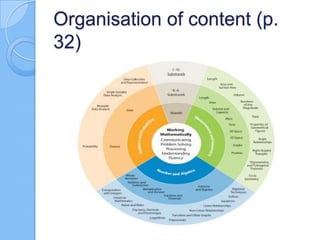
Organisation of content (p.
32)
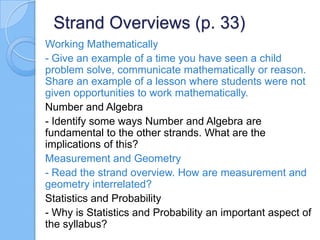
Strand Overviews (p. 33)
Working Mathematically
- Give an example of a time you have seen a child
problem solve, communicate mathematically or reason.
Share an example of a lesson where students were not
given opportunities to work mathematically.
Number and Algebra
- Identify some ways Number and Algebra are
fundamental to the other strands. What are the
implications of this?
Measurement and Geometry
- Read the strand overview. How are measurement and
geometry interrelated?
Statistics and Probability
- Why is Statistics and Probability an important aspect of
the syllabus?
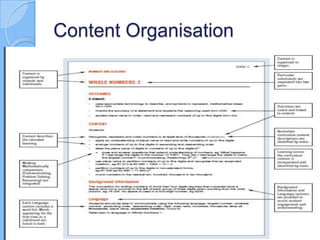
Content Organisation
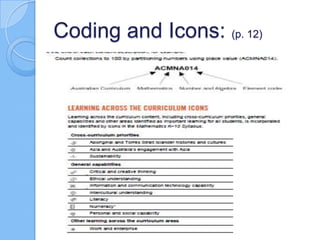
Coding and Icons: (p. 12)
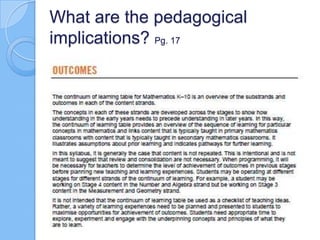
What are the pedagogical
implications? Pg. 17
Session 2:
Learning Intent:
 To highlight the differences between the
current and new syllabuses and explore
the implications for teaching.
Focusing on:
• Early Stage 1
• Stage 1
• Stage 2
Early Stage 1
1. Select a Strand
2. Compare the current syllabus to the
new syllabus
- What is the same?
- What is different?
- What do you notice?
- What are the implications for PL?
3. Share in table groups
Stage 1
1. Select a Strand
2. Compare the current syllabus to the
new syllabus
- What is the same?
- What is different?
- What do you notice?
- What are the implications for PL?
3. Share in table groups
Activity: Using ES1/ Stage 1
Content
 Choose a number between 20 and
300.
 Partition it using place value as many
different ways as you can.
 Can you position your number on an
empty number line?
Discussion:
 What is the syllabus outcome?
 What is the content knowledge
teachers need to know to teach this?
 Why is it important for students to be
able to partition?
 Where does this fit in on the
continuum of learning?
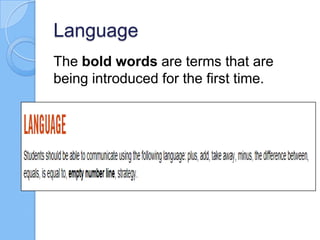
Language
The bold words are terms that are
being introduced for the first time.
Stage 2
1. Select a Strand
2. Compare the current syllabus to the
new syllabus
- What is the same?
- What is different?
- What do you notice?
- What are the implications for PL?
3. Share in table groups
Activity: Stage 2
The new syllabus has a much stronger focus on
quadrilaterals.
Take a look at Two- Dimensional Space 1 and 2
(Stage 2) in particular the language section.
1. Draw two non- congruent quadrilaterals on 3 x 3
dots.
2. Record the properties of your shape. Can you
use the language from the syllabus?
3. As a group agree on a rule for classification
4. Does your criteria make sorting easy?
5. Can you make another so all items can be
sorted?
Discussion:
 What is the syllabus outcome?
 What is the content knowledge
teachers need to know?
 What will it look like when this content
is taught for conceptual
understanding?
 How will you ensure this is taught
conceptually and not procedurally?
 Where does this fit in on the
continuum of learning?
Session 3:
Learning Intent:
 To highlight the differences between
the current and new syllabuses and
explore the implications for teaching.
Focusing on:
Stage 3
Stage 3
1. Select a Strand
2. Compare the current syllabus to the
new syllabus
- What is the same?
- What is different?
- What do you notice?
- What are the implications for PL?
3. Share in table groups
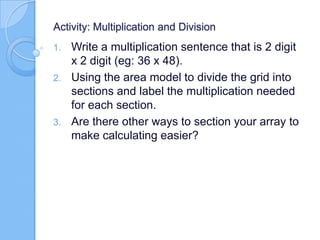
Activity: Multiplication and Division
1. Write a multiplication sentence that is 2 digit
x 2 digit (eg: 36 x 48).
2. Using the area model to divide the grid into
sections and label the multiplication needed
for each section.
3. Are there other ways to section your array to
make calculating easier?
Discussion:
 What is the syllabus outcome?
 What is the content knowledge
teachers need to know?
 Why is the area model an important
representation?
 How will you ensure this is taught
conceptually and not procedurally?
 Where does this fit in on the
continuum of learning?
Programming
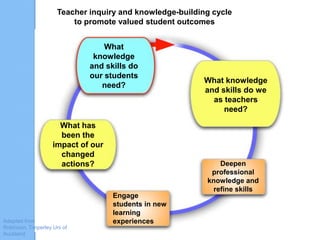
What
knowledge
and skills do
our students
need?
What knowledge
and skills do we
as teachers
need?
What has
been the
impact of our
changed
actions? Deepen
professional
knowledge and
refine skills
Engage
students in new
learning
experiences
Teacher inquiry and knowledge-building cycle
to promote valued student outcomes
Adapted from
Robinson, Timperley Uni of
Auckland
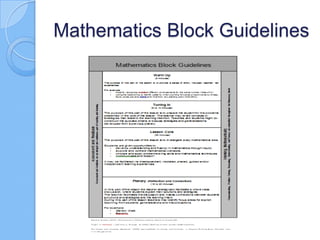
Mathematics Block Guidelines

20 may mathematics

  • 1.
    NSW SYLLABUS forthe Australian curriculum Mathematics K-10 (Vol. 1) Guiding school leaders Diocese of Broken Bay
  • 2.
    Session One: Learning Intent: Toexplore the structure of the new syllabus (2014), focusing on:  Aim  Objectives  Stage statements  Strand overviews  Content organisation  Coding and Icons  Outcome statements  Pedagogical implications
  • 3.
    Aim (p. 16): Theaim of Mathematics in K–10 is for students to: • be confident, creative users and communicators of mathematics, able to investigate, represent and interpret situations in their personal and work lives and as active citizens • develop an increasingly sophisticated understanding of mathematical concepts and fluency with mathematical processes, and be able to pose and solve problems and reason in Number and Algebra, Measurement and Geometry, and Statistics and Probability • recognise connections between the areas of mathematics and other disciplines and appreciate mathematics as an important aspect of lifelong learning.
  • 4.
    Reflecting on theaim  In what ways does teaching and learning in your school currently enact these aims?  What challenges do the aims pose for you, given your knowledge of how mathematics is currently taught and learned at your school?
  • 5.
    Objectives (p. 16): KNOWLEDGE, SKILLS AND UNDERSTANDING Students: Working Mathematically • develop understanding and fluency in mathematics through inquiry, exploring and connecting mathematical concepts, choosing and applying problem-solving skills and mathematical techniques, communication and reasoning Number and Algebra • develop efficient strategies for numerical calculation, recognise patterns, describe relationships and apply algebraic techniques and generalisation Measurement and Geometry • identify, visualise and quantify measures and the attributes of shapes and objects, and explore measurement concepts and geometric relationships, applying formulas, strategies and geometric reasoning in the solution of problems Statistics and Probability • collect, represent, analyse, interpret and evaluate data, assign and use probabilities, and make sound judgements.
  • 6.
    Objectives  VALUES ANDATTITUDES Students: • appreciate mathematics as an essential and relevant part of life, recognising that its cross-cultural development has been largely in response to human needs • demonstrate interest, enjoyment and confidence in the pursuit and application of mathematical knowledge, skills and understanding to solve everyday problems • develop and demonstrate perseverance in undertaking mathematical challenges. How can we foster these dispositions?
  • 7.
    Stage Statements (p.26)  Foundation statements have been replaced by stage statements which reflect the intent of the Australian Curriculum Achievement Standards.  Stage statements summarise the knowledge, understa nding, skills, values and attitudes that students develop as
  • 8.
  • 9.
    Strand Overviews (p.33) Working Mathematically - Give an example of a time you have seen a child problem solve, communicate mathematically or reason. Share an example of a lesson where students were not given opportunities to work mathematically. Number and Algebra - Identify some ways Number and Algebra are fundamental to the other strands. What are the implications of this? Measurement and Geometry - Read the strand overview. How are measurement and geometry interrelated? Statistics and Probability - Why is Statistics and Probability an important aspect of the syllabus?
  • 10.
  • 11.
  • 12.
    What are thepedagogical implications? Pg. 17
  • 13.
    Session 2: Learning Intent: To highlight the differences between the current and new syllabuses and explore the implications for teaching. Focusing on: • Early Stage 1 • Stage 1 • Stage 2
  • 14.
    Early Stage 1 1.Select a Strand 2. Compare the current syllabus to the new syllabus - What is the same? - What is different? - What do you notice? - What are the implications for PL? 3. Share in table groups
  • 15.
    Stage 1 1. Selecta Strand 2. Compare the current syllabus to the new syllabus - What is the same? - What is different? - What do you notice? - What are the implications for PL? 3. Share in table groups
  • 16.
    Activity: Using ES1/Stage 1 Content  Choose a number between 20 and 300.  Partition it using place value as many different ways as you can.  Can you position your number on an empty number line?
  • 17.
    Discussion:  What isthe syllabus outcome?  What is the content knowledge teachers need to know to teach this?  Why is it important for students to be able to partition?  Where does this fit in on the continuum of learning?
  • 18.
    Language The bold wordsare terms that are being introduced for the first time.
  • 19.
    Stage 2 1. Selecta Strand 2. Compare the current syllabus to the new syllabus - What is the same? - What is different? - What do you notice? - What are the implications for PL? 3. Share in table groups
  • 20.
    Activity: Stage 2 Thenew syllabus has a much stronger focus on quadrilaterals. Take a look at Two- Dimensional Space 1 and 2 (Stage 2) in particular the language section. 1. Draw two non- congruent quadrilaterals on 3 x 3 dots. 2. Record the properties of your shape. Can you use the language from the syllabus? 3. As a group agree on a rule for classification 4. Does your criteria make sorting easy? 5. Can you make another so all items can be sorted?
  • 21.
    Discussion:  What isthe syllabus outcome?  What is the content knowledge teachers need to know?  What will it look like when this content is taught for conceptual understanding?  How will you ensure this is taught conceptually and not procedurally?  Where does this fit in on the continuum of learning?
  • 22.
    Session 3: Learning Intent: To highlight the differences between the current and new syllabuses and explore the implications for teaching. Focusing on: Stage 3
  • 23.
    Stage 3 1. Selecta Strand 2. Compare the current syllabus to the new syllabus - What is the same? - What is different? - What do you notice? - What are the implications for PL? 3. Share in table groups
  • 24.
    Activity: Multiplication andDivision 1. Write a multiplication sentence that is 2 digit x 2 digit (eg: 36 x 48). 2. Using the area model to divide the grid into sections and label the multiplication needed for each section. 3. Are there other ways to section your array to make calculating easier?
  • 25.
    Discussion:  What isthe syllabus outcome?  What is the content knowledge teachers need to know?  Why is the area model an important representation?  How will you ensure this is taught conceptually and not procedurally?  Where does this fit in on the continuum of learning?
  • 26.
  • 27.
    What knowledge and skills do ourstudents need? What knowledge and skills do we as teachers need? What has been the impact of our changed actions? Deepen professional knowledge and refine skills Engage students in new learning experiences Teacher inquiry and knowledge-building cycle to promote valued student outcomes Adapted from Robinson, Timperley Uni of Auckland
  • 28.