Acta Polytechnica Vol. 50 No. 5/2010
On Uq (sl2)-actions on the Quantum Plane
S. Duplij, S. Sinel’shchikov
Abstract
To give the complete list of Uq (sl2)-actions of the quantum plane, we first obtain the structure of quantum plane
automorphisms. Then we introduce some special symbolic matrices to classify the series of actions using the weights.
There are uncountably many isomorphism classes of the symmetries. We give the classical limit of the above actions.
Keywords: quantum universal enveloping algebra, Hopf algebra, Verma module, representation, composition series,
projection, weight.
We present and classify Uq (sl2)-actions on the quan-
tum plane [1]. The general form of an automorphism
of the quantum plane [5] allows us to use the no-
tion of weight. To classify the actions we introduce
a pair of symbolic matrices, which label the presence
of nonzero weight vectors. Finally, we present the
classical limit of the obtained actions.
The definitions of a Hopf algebra H and H-action,
the quantum universal enveloping algebra Uq (sl2)
(determined by its generators k, k−1
, e, f), and other
notations can be found in [3]. The quantum plane is
a unital algebra Cq[x, y] generated by x, y and the
relation yx = qxy, and we assume that 0 < q < 1.
The notation Cq[x, y]i for the i-th homogeneous
component of Cq[x, y], being the linear span of the
monomials xm
yn
with m + n = i, is used. De-
note by (p)i the i-th homogeneous component of
a polynomial p ∈ Cq[x, y], that is the projection
of p onto Cq[x, y]i parallel to the direct sum of all
other homogeneous components of Cq[x, y]. Denote
by C[x] and C[y] the linear spans of {xn
|n ≥ 0} and
{yn
|n ≥ 0}, respectively. The direct sum decompo-
sitions Cq[x, y] = C[x] ⊕ yCq[x, y] = C[y] ⊕ xCq[x, y]
is obvious. Let (P)x be a projection of a polynomial
P ∈ Cq[x, y] to C[x] parallel to yCq[x, y].
Proposition 1 Let Ψ be an automorphism of
Cq[x, y], then there exist nonzero constants α, β such
that [5]
Ψ: x → αx, y → βy. (1)
For any Uq (sl2)-action on Cq[x, y], we associate a
2 × 3 matrix, to be referred to as a full action matrix
M
def
=
k (x) k (y)
e (x) e (y)
f (x) f (y)
. (2)
An extension of Uq (sl2)-action from the generators
to Cq[x, y] is given by (ab) u
def
= a (bu) , a (uv)
def
=
Σi (aiu) · (ai v) , a, b ∈ Uq (sl2) , u, v ∈ Cq[x, y] to-
gether with the natural compatibility conditions [3].
We have from (1) that the action of k is deter-
mined by its action Ψ on x and y given by a 1 × 2
matrix Mk
Mk
def
= k (x) , k (y) = αx, βy , (3)
where α, β ∈ C {0}. This allows us to introduce the
weight of xn
ym
∈ Cq[x, y] as wt (xn
ym
) = αn
βm
.
Another submatrix of M is
Mef
def
=
e (x) e (y)
f (x) f (y)
. (4)
We call Mk and Mef an action k-matrix and an ac-
tion ef-matrix, respectively.
Each entry of M is a weight vector (by (3) and
(1)), and all the nonzero monomials which constitute
a specific entry have the same weight. We use the
notation
wt (M)
def
=
⎛
⎜
⎜
⎝
wt (k (x)) wt (k (y))
wt (e (x)) wt (e (y))
wt (f (x)) wt (f (y))
⎞
⎟
⎟
⎠ (5)
⎛
⎜
⎜
⎝
wt (x) wt (y)
q2
wt (x) q2
wt (y)
q−2
wt (x) q−2
wt (y)
⎞
⎟
⎟
⎠ =
⎛
⎜
⎜
⎝
α β
q2
α q2
β
q−2
α q−2
β
⎞
⎟
⎟
⎠,
where the matrix relation is treated as a set of
elementwise equalities if they are applicable, that is,
when the corresponding entry of M is nonzero (hence
admits a well-defined weight).
Denote by (M)i the i-th homogeneous component
of M which, if nonzero, admits a well-defined weight.
Introduce the constants a0, b0, c0, d0 ∈ C such that
the zero degree component of the full action matrix
25
Acta Polytechnica Vol. 50 No. 5/2010
is
(M)0 =
⎛
⎜
⎜
⎝
0 0
a0 b0
c0 d0
⎞
⎟
⎟
⎠
0
. (6)
We keep the subscript 0 to the matrix in the r.h.s.
to emphasize the origin of this matrix as the 0-th
homogeneous component of M. Weights of nonzero
projections of (weight) entries of M should have the
same weight, then
wt ((M)0)
⎛
⎜
⎜
⎝
0 0
q2
α q2
β
q−2
α q−2
β
⎞
⎟
⎟
⎠
0
. (7)
All the entries of (M)0 are constants (6), and so
wt ((M)0)
⎛
⎜
⎜
⎝
0 0
1 1
1 1
⎞
⎟
⎟
⎠
0
. (8)
Let us use (Mef )i to construct a symbolic ma-
trix Mef
i
whose entries are symbols 0 or in such
a way: a nonzero entry of (Mef )i is replaced by ,
while a zero entry is replaced by the symbol 0. For
0-th components the specific relations involved in (7)
imply that each column of Mef
0
should contain at
least one 0, therefore we have 9 possibilities.
Apply e and f to yx = qxy using (3) to get
ye (x) − qβe (x) y = qxe (y) − αe (y) x, (9)
f (x) y − q−1
β−1
yf (x) = (10)
q−1
f (y) x − α−1
xf (y) .
We project (9)-(10) to Cq[x, y]1 and obtain
a0 (1 − qβ) y = b0 (q − α) x, d0 1 − qα−1
x =
c0 q − β−1
y, which gives
a0 (1 − qβ) = b0 (q − α) = (11)
d0 1 − qα−1
= c0 q − β−1
= 0.
Due to (11), weight constants α and β are
1) a0 = 0 =⇒ β = q−1
, (12)
2) b0 = 0 =⇒ α = q, (13)
3) c0 = 0 =⇒ β = q−1
, (14)
4) d0 = 0 =⇒ α = q. (15)
We compare this to (7)–(8) and deduce that the
symbolic matrices containing two ’s should be ex-
cluded. Using (7) and (12)–(15) we conclude that
the position of in the remaining symbolic matrices
determines the associated weight constants
0
0 0
0
=⇒ α = q−2
, β = q−1
, (16)
0
0 0
0
=⇒ α = q, β = q−2
, (17)
0 0
0
0
=⇒ α = q2
, β = q−1
, (18)
0 0
0
0
=⇒ α = q, β = q2
, (19)
and the matrix
0 0
0 0
0
does not determine any
weight constants.
In the 1-st homogeneous component we have
wt (e (x)) = q2
wt (x) = wt (x) (because 0 < q < 1),
which implies (e (x))1 = a1y, and similarly we obtain
(Mef )1 =
a1y b1x
c1y d1x
1
, (20)
where a1, b1, c1, d1 ∈ C. So we introduce a sym-
bolic matrix Mef
1
as above. The relations be-
tween weights similar to (7) give
wt (Mef )1
q2
α q2
β
q−2
α q−2
β
1
(21)
β α
β α
1
.
As a consequence we have that every row and ev-
ery column of Mef
1
should contain at least one 0.
We project (9)-(10) to Cq[x, y]2 and get
a1 (1 − qβ) y2
= b1 (q − α) x2
, (22)
d1 1 − qα−1
x2
= c1 q − β−1
y2
, (23)
whence a1 (1 − qβ) = b1 (q − α) = d1 1 − qα−1
=
c1 q − β−1
= 0. So we obtain
1) a1 = 0 =⇒ β = q−1
, (24)
2) b1 = 0 =⇒ α = q, (25)
3) c1 = 0 =⇒ β = q−1
, (26)
4) d1 = 0 =⇒ α = q. (27)
The symbolic matrix
0
0
1
can be dis-
carded from the list of symbolic matrices with at
least one 0 at every row or column, because of (21),
26
Acta Polytechnica Vol. 50 No. 5/2010
(24)–(27). For other symbolic matrices with the
above property we have
0
0 0
1
=⇒ α = q−3
, β = q−1
, (28)
0
0 0
1
=⇒ α = q, β = q−1
, (29)
0 0
0
1
=⇒ α = q, β = q−1
, (30)
0 0
0
1
=⇒ α = q, β = q3
, (31)
0
0
1
=⇒ α = q, β = q−1
, (32)
and the matrix
0 0
0 0
1
does not determine the
weight constants.
Let us introduce a table of families of Uq (sl2)-
actions, each family is labeled by two symbolic
matrices Mef
0
, Mef
1
, and we call it a
Mef
0
; Mef
1
-series.
Note that the series labeled with pairs of nonzero
symbolic matrices at both positions are empty, be-
cause each such matrix determines a pair of specific
weight constants α and β (16)–(19) which fails to co-
incide to any pair of such constants associated to the
set of nonzero symbolic matrices at the second posi-
tion (28)–(32). Also the series with zero symbolic ma-
trix at the first position and symbolic matrices con-
taining only one at the second position are empty.
In this way we get 24 “empty” Mef
0
; Mef
1
-
series.
Let us turn to “non-empty” series and begin with
the case in which the action ef-matrix is zero.
Theorem 2 The
0 0
0 0
0
;
0 0
0 0
1
-series
consists of four Uq (sl2)-module algebra structures on
the quantum plane given by
k (x) = ±x, k (y) = ±y, (33)
e (x) = e (y) = f (x) = f (y) = 0, (34)
which are pairwise non-isomorphic.
The next theorem describes the well-known sym-
metry [6, 7].
Theorem 3 The
0 0
0 0
0
;
0
0
1
-series
consists of a one-parameter (τ ∈ C  {0}) family
of Uq (sl2)-module algebra structures on the quantum
plane
k (x) = qx, k (y) = q−1
y, (35)
e (x) = 0, e (y) = τx, (36)
f (x) = τ−1
y, f (y) = 0. (37)
All these structures are isomorphic, in particular
to the action as above with τ = 1.
The essential claim here which is not covered
by [6, 7], is that no higher (> 1) degree terms could
appear in the expressions for e(x), e(y), f(x), f(y)
in (36) and (37). This can be proved by a rou-
tine computation which relies upon our assumption
0 < q < 1.
Consider the symmetries whose symbolic matrix
Mef
0
contains one .
Theorem 4 The
0
0 0
0
;
0 0
0 0
1
-series
consists of a one-parameter (b0 ∈ C  {0}) family
of Uq (sl2)-module algebra structures on the quantum
plane
k (x) = qx, k (y) = q−2
y, (38)
e (x) = 0, e (y) = b0, (39)
f (x) = b−1
0 xy, f (y) = −qb−1
0 y2
. (40)
All these structures are isomorphic, in particular
to the action as above with b0 = 1.
Theorem 5 The
0 0
0
0
;
0 0
0 0
1
-series
consists of a one-parameter (c0 ∈ C  {0}) family
of Uq (sl2)-module algebra structures on the quantum
plane
k (x) = q2
x, k (y) = q−1
y, (41)
e (x) = −qc−1
0 x2
, e (y) = c−1
0 xy, (42)
f (x) = c0, f (y) = 0. (43)
All these structures are isomorphic, in particular
to the action as above with c0 = 1.
Theorem 6 The
0
0 0
0
;
0 0
0 0
1
-series
consists of a three-parameter (a0 ∈ C  {0}, s, t ∈ C)
family of Uq (sl2)-actions on the quantum plane
k (x) = q−2
x, k (y) = q−1
y, (44)
e (x) = a0, e (y) = 0, (45)
f (x) = −qa−1
0 x2
+ ty4
, f (y) = −qa−1
0 xy + sy3
. (46)
27
Acta Polytechnica Vol. 50 No. 5/2010
The generic domain {(a0, s, t) |s = 0, t = 0} with
respect to the parameters splits into uncountably
many disjoint subsets
{(a0, s, t) |s = 0, t = 0, ϕ = const} ,
where ϕ =
t
a0s2
. Each of these subsets corresponds
to an isomorphism class of Uq (sl2)-module algebra
structures. Additionally there exist three more iso-
morphism classes which correspond to the subsets
{(a0, s, t) |s = 0, t = 0} ,
{(a0, s, t) |s = 0, t = 0} , (47)
{(a0, s, t) |s = 0, t = 0} .
The specific form of weights for x and y discards
primordially all but finitely many terms (monomials)
that could appear in the expressions for e(x), e(y),
f(x), f(y) in (45) and (46). Thus it becomes much
easier to establish the latter relations than to do this
for the corresponding relations in the previous theo-
rems. To prove the rest of the claims, one needs to
guess the explicit form of the required isomorphisms.
Theorem 7 The
0 0
0
0
;
0 0
0 0
1
-series
consists of a three-parameter (d0 ∈ C  {0}, s, t ∈ C)
family of Uq (sl2)-actions on the quantum plane
k (x) = qx, k (y) = q2
y, (48)
e (x) = −qd−1
0 xy + sx3
, e (y) = −qd−1
0 y2
+ tx4
, (49)
f (x) = 0, f (y) = d0, (50)
Here we have the domain {(d0, s, t) |s = 0, t = 0}
which splits into the disjoint subsets {(d0, s, t) |s = 0,
t = 0, ϕ = const} with ϕ =
t
d0s2
. This uncount-
able family of subsets is in one-to-one correspon-
dence to isomorphism classes of Uq (sl2)-module alge-
bra structures. In addition, one also has three more
isomorphism classes which are labelled by the sub-
sets {(d0, s, t) |s = 0, t = 0}, {(d0, s, t) |s = 0, t = 0},
{(d0, s, t) |s = 0, t = 0}.
Remark 8 The Uq (sl2)-symmetries on Cq[x, y] pic-
ked from different series are nonisomorphic, and the
actions of k in different series are different.
Remark 9 There are no Uq (sl2)-symmetries on
Cq[x, y] other than those presented in the above theo-
rems, because the assumptions exhaust all admissible
forms for the components (Mef )0, (Mef )1 of the ac-
tion ef-matrix.
The associated classical limit actions of the Lie alge-
bra sl2 (here it is the Lie algebra generated by e, f,
h subject to the relations [h, e] = 2e, [h, f] = −2f,
[e, f] = h) on C[x, y] by differentiations is derived
from the quantum action via substituting k = qh
with
subsequent formal passage to the limit as q → 1.
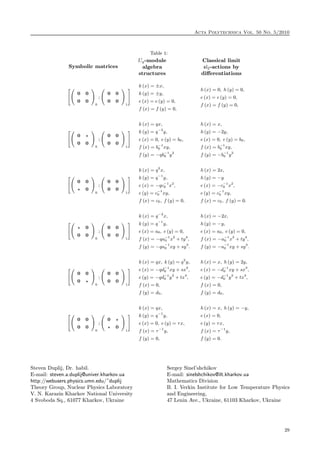
We present all quantum and classical actions in
Table 1. Note that there exist more sl2-actions on
C[x, y] by differentiations (see, e.g. [8]) than one can
see in Table 1. It follows from our results that the
rest of the classical actions admit no quantum coun-
terparts. On the other hand, among the quantum
actions listed in the first row of Table 1, the only
one to which the above classical limit procedure is
applicable, is the action with k(x) = x, k(y) = y.
The remaining three actions of this series admit no
classical limit in the above sense.
Acknowledgement
One of the authors (S.D.) is grateful to Yu. Be-
spalov, J. Cuntz, B. Dragovich, J. Fuchs, A. Gavri-
lik, H. Grosse, D. Gurevich, J. Lukierski, M. Pavlov,
H. Steinacker, Z. Raki´c, W. Werner, and S. Woronow-
icz for many fruitful discussions. Also, he would like
to thank M. Znojil for his invitation to the conference
“Analytic and algebraic methods VI”, Villa Lanna,
Prague, and kind hospitality at the Doppler Institute
in Rez.
References
[1] Manin, Y. I.: Topics in Noncommutative Dif-
ferential Geometry, Princeton University Press,
Princeton, 1991.
[2] Castellani, L., Wess, J. (eds.): Quantum groups
and their applications in physics, IOS Press, Am-
sterdam, 1996.
[3] Kassel, C.: Quantum Groups, Springer-Verlag,
New York, 1995.
[4] Sweedler, M. E.: Hopf Algebras, Benjamin, New
York, 1969.
[5] Alev, J., Chamarie, M.: D´erivations et automor-
phismes de quelques alg`ebres quantiques, Comm.
Algebra 20, 1787–1802 (1992).
[6] Montgomery, S., Smith, S. P.: Skew derivations
and Uq(sl(2)), Israel J. Math. 72, 158–166 (1990).
[7] Lambe, L. A., Radford, D. E.: Introduction to
the Quantum Yang-Baxter Equation and Quan-
tum Groups: An Algebraic Approach, Kluwer,
Dordrecht, 1997.
[8] Gonz´alez-L´opez, A., Kamran, N., Olver, P.:
Quasi-exactly solvable Lie algebras of differential
operators in two complex variables, J. Phys. A:
Math. Gen. 24, 3 995–4 078 (1991).
28
Acta Polytechnica Vol. 50 No. 5/2010
Table 1:
Symbolic matrices
Uq-module
algebra
structures
Classical limit
sl2-actions by
differentiations
0 0
0 0
0
;
0 0
0 0
1
k (x) = ±x,
k (y) = ±y,
e (x) = e (y) = 0,
f (x) = f (y) = 0,
h (x) = 0, h (y) = 0,
e (x) = e (y) = 0,
f (x) = f (y) = 0,
0
0 0
0
;
0 0
0 0
1
k (x) = qx,
k (y) = q−2
y,
e (x) = 0, e (y) = b0,
f (x) = b−1
0 xy,
f (y) = −qb−1
0 y2
h (x) = x,
h (y) = −2y,
e (x) = 0, e (y) = b0,
f (x) = b−1
0 xy,
f (y) = −b−1
0 y2
0 0
0
0
;
0 0
0 0
1
k (x) = q2
x,
k (y) = q−1
y,
e (x) = −qc−1
0 x2
,
e (y) = c−1
0 xy,
f (x) = c0, f (y) = 0,
h (x) = 2x,
h (y) = −y
e (x) = −c−1
0 x2
,
e (y) = c−1
0 xy,
f (x) = c0, f (y) = 0.
0
0 0
0
;
0 0
0 0
1
k (x) = q−2
x,
k (y) = q−1
y,
e (x) = a0, e (y) = 0,
f (x) = −qa−1
0 x2
+ ty4
,
f (y) = −qa−1
0 xy + sy3
.
h (x) = −2x,
h (y) = −y,
e (x) = a0, e (y) = 0,
f (x) = −a−1
0 x2
+ ty4
,
f (y) = −a−1
0 xy + sy3
.
0 0
0
0
;
0 0
0 0
1
k (x) = qx, k (y) = q2
y,
e (x) = −qd−1
0 xy + sx3
,
e (y) = −qd−1
0 y2
+ tx4
,
f (x) = 0,
f (y) = d0,
h (x) = x, h (y) = 2y,
e (x) = −d−1
0 xy + sx3
,
e (y) = −d−1
0 y2
+ tx4
,
f (x) = 0,
f (y) = d0,
0 0
0 0
0
;
0
0
1
k (x) = qx,
k (y) = q−1
y,
e (x) = 0, e (y) = τx,
f (x) = τ−1
y,
f (y) = 0,
h (x) = x, h (y) = −y,
e (x) = 0,
e (y) = τx,
f (x) = τ−1
y,
f (y) = 0.
Steven Duplij, Dr. habil.
E-mail: steven.a.duplij@univer.kharkov.ua
http://webusers.physics.umn.edu/˜duplij
Theory Group, Nuclear Physics Laboratory
V. N. Karazin Kharkov National University
4 Svoboda Sq., 61077 Kharkov, Ukraine
Sergey Sinel’shchikov
E-mail: sinelshchikov@ilt.kharkov.ua
Mathematics Division
B. I. Verkin Institute for Low Temperature Physics
and Engineering,
47 Lenin Ave., Ukraine, 61103 Kharkov, Ukraine
29

On Uq(sl2)-actions on the quantum plane

  • 1.
    Acta Polytechnica Vol.50 No. 5/2010 On Uq (sl2)-actions on the Quantum Plane S. Duplij, S. Sinel’shchikov Abstract To give the complete list of Uq (sl2)-actions of the quantum plane, we first obtain the structure of quantum plane automorphisms. Then we introduce some special symbolic matrices to classify the series of actions using the weights. There are uncountably many isomorphism classes of the symmetries. We give the classical limit of the above actions. Keywords: quantum universal enveloping algebra, Hopf algebra, Verma module, representation, composition series, projection, weight. We present and classify Uq (sl2)-actions on the quan- tum plane [1]. The general form of an automorphism of the quantum plane [5] allows us to use the no- tion of weight. To classify the actions we introduce a pair of symbolic matrices, which label the presence of nonzero weight vectors. Finally, we present the classical limit of the obtained actions. The definitions of a Hopf algebra H and H-action, the quantum universal enveloping algebra Uq (sl2) (determined by its generators k, k−1 , e, f), and other notations can be found in [3]. The quantum plane is a unital algebra Cq[x, y] generated by x, y and the relation yx = qxy, and we assume that 0 < q < 1. The notation Cq[x, y]i for the i-th homogeneous component of Cq[x, y], being the linear span of the monomials xm yn with m + n = i, is used. De- note by (p)i the i-th homogeneous component of a polynomial p ∈ Cq[x, y], that is the projection of p onto Cq[x, y]i parallel to the direct sum of all other homogeneous components of Cq[x, y]. Denote by C[x] and C[y] the linear spans of {xn |n ≥ 0} and {yn |n ≥ 0}, respectively. The direct sum decompo- sitions Cq[x, y] = C[x] ⊕ yCq[x, y] = C[y] ⊕ xCq[x, y] is obvious. Let (P)x be a projection of a polynomial P ∈ Cq[x, y] to C[x] parallel to yCq[x, y]. Proposition 1 Let Ψ be an automorphism of Cq[x, y], then there exist nonzero constants α, β such that [5] Ψ: x → αx, y → βy. (1) For any Uq (sl2)-action on Cq[x, y], we associate a 2 × 3 matrix, to be referred to as a full action matrix M def = k (x) k (y) e (x) e (y) f (x) f (y) . (2) An extension of Uq (sl2)-action from the generators to Cq[x, y] is given by (ab) u def = a (bu) , a (uv) def = Σi (aiu) · (ai v) , a, b ∈ Uq (sl2) , u, v ∈ Cq[x, y] to- gether with the natural compatibility conditions [3]. We have from (1) that the action of k is deter- mined by its action Ψ on x and y given by a 1 × 2 matrix Mk Mk def = k (x) , k (y) = αx, βy , (3) where α, β ∈ C {0}. This allows us to introduce the weight of xn ym ∈ Cq[x, y] as wt (xn ym ) = αn βm . Another submatrix of M is Mef def = e (x) e (y) f (x) f (y) . (4) We call Mk and Mef an action k-matrix and an ac- tion ef-matrix, respectively. Each entry of M is a weight vector (by (3) and (1)), and all the nonzero monomials which constitute a specific entry have the same weight. We use the notation wt (M) def = ⎛ ⎜ ⎜ ⎝ wt (k (x)) wt (k (y)) wt (e (x)) wt (e (y)) wt (f (x)) wt (f (y)) ⎞ ⎟ ⎟ ⎠ (5) ⎛ ⎜ ⎜ ⎝ wt (x) wt (y) q2 wt (x) q2 wt (y) q−2 wt (x) q−2 wt (y) ⎞ ⎟ ⎟ ⎠ = ⎛ ⎜ ⎜ ⎝ α β q2 α q2 β q−2 α q−2 β ⎞ ⎟ ⎟ ⎠, where the matrix relation is treated as a set of elementwise equalities if they are applicable, that is, when the corresponding entry of M is nonzero (hence admits a well-defined weight). Denote by (M)i the i-th homogeneous component of M which, if nonzero, admits a well-defined weight. Introduce the constants a0, b0, c0, d0 ∈ C such that the zero degree component of the full action matrix 25
  • 2.
    Acta Polytechnica Vol.50 No. 5/2010 is (M)0 = ⎛ ⎜ ⎜ ⎝ 0 0 a0 b0 c0 d0 ⎞ ⎟ ⎟ ⎠ 0 . (6) We keep the subscript 0 to the matrix in the r.h.s. to emphasize the origin of this matrix as the 0-th homogeneous component of M. Weights of nonzero projections of (weight) entries of M should have the same weight, then wt ((M)0) ⎛ ⎜ ⎜ ⎝ 0 0 q2 α q2 β q−2 α q−2 β ⎞ ⎟ ⎟ ⎠ 0 . (7) All the entries of (M)0 are constants (6), and so wt ((M)0) ⎛ ⎜ ⎜ ⎝ 0 0 1 1 1 1 ⎞ ⎟ ⎟ ⎠ 0 . (8) Let us use (Mef )i to construct a symbolic ma- trix Mef i whose entries are symbols 0 or in such a way: a nonzero entry of (Mef )i is replaced by , while a zero entry is replaced by the symbol 0. For 0-th components the specific relations involved in (7) imply that each column of Mef 0 should contain at least one 0, therefore we have 9 possibilities. Apply e and f to yx = qxy using (3) to get ye (x) − qβe (x) y = qxe (y) − αe (y) x, (9) f (x) y − q−1 β−1 yf (x) = (10) q−1 f (y) x − α−1 xf (y) . We project (9)-(10) to Cq[x, y]1 and obtain a0 (1 − qβ) y = b0 (q − α) x, d0 1 − qα−1 x = c0 q − β−1 y, which gives a0 (1 − qβ) = b0 (q − α) = (11) d0 1 − qα−1 = c0 q − β−1 = 0. Due to (11), weight constants α and β are 1) a0 = 0 =⇒ β = q−1 , (12) 2) b0 = 0 =⇒ α = q, (13) 3) c0 = 0 =⇒ β = q−1 , (14) 4) d0 = 0 =⇒ α = q. (15) We compare this to (7)–(8) and deduce that the symbolic matrices containing two ’s should be ex- cluded. Using (7) and (12)–(15) we conclude that the position of in the remaining symbolic matrices determines the associated weight constants 0 0 0 0 =⇒ α = q−2 , β = q−1 , (16) 0 0 0 0 =⇒ α = q, β = q−2 , (17) 0 0 0 0 =⇒ α = q2 , β = q−1 , (18) 0 0 0 0 =⇒ α = q, β = q2 , (19) and the matrix 0 0 0 0 0 does not determine any weight constants. In the 1-st homogeneous component we have wt (e (x)) = q2 wt (x) = wt (x) (because 0 < q < 1), which implies (e (x))1 = a1y, and similarly we obtain (Mef )1 = a1y b1x c1y d1x 1 , (20) where a1, b1, c1, d1 ∈ C. So we introduce a sym- bolic matrix Mef 1 as above. The relations be- tween weights similar to (7) give wt (Mef )1 q2 α q2 β q−2 α q−2 β 1 (21) β α β α 1 . As a consequence we have that every row and ev- ery column of Mef 1 should contain at least one 0. We project (9)-(10) to Cq[x, y]2 and get a1 (1 − qβ) y2 = b1 (q − α) x2 , (22) d1 1 − qα−1 x2 = c1 q − β−1 y2 , (23) whence a1 (1 − qβ) = b1 (q − α) = d1 1 − qα−1 = c1 q − β−1 = 0. So we obtain 1) a1 = 0 =⇒ β = q−1 , (24) 2) b1 = 0 =⇒ α = q, (25) 3) c1 = 0 =⇒ β = q−1 , (26) 4) d1 = 0 =⇒ α = q. (27) The symbolic matrix 0 0 1 can be dis- carded from the list of symbolic matrices with at least one 0 at every row or column, because of (21), 26
  • 3.
    Acta Polytechnica Vol.50 No. 5/2010 (24)–(27). For other symbolic matrices with the above property we have 0 0 0 1 =⇒ α = q−3 , β = q−1 , (28) 0 0 0 1 =⇒ α = q, β = q−1 , (29) 0 0 0 1 =⇒ α = q, β = q−1 , (30) 0 0 0 1 =⇒ α = q, β = q3 , (31) 0 0 1 =⇒ α = q, β = q−1 , (32) and the matrix 0 0 0 0 1 does not determine the weight constants. Let us introduce a table of families of Uq (sl2)- actions, each family is labeled by two symbolic matrices Mef 0 , Mef 1 , and we call it a Mef 0 ; Mef 1 -series. Note that the series labeled with pairs of nonzero symbolic matrices at both positions are empty, be- cause each such matrix determines a pair of specific weight constants α and β (16)–(19) which fails to co- incide to any pair of such constants associated to the set of nonzero symbolic matrices at the second posi- tion (28)–(32). Also the series with zero symbolic ma- trix at the first position and symbolic matrices con- taining only one at the second position are empty. In this way we get 24 “empty” Mef 0 ; Mef 1 - series. Let us turn to “non-empty” series and begin with the case in which the action ef-matrix is zero. Theorem 2 The 0 0 0 0 0 ; 0 0 0 0 1 -series consists of four Uq (sl2)-module algebra structures on the quantum plane given by k (x) = ±x, k (y) = ±y, (33) e (x) = e (y) = f (x) = f (y) = 0, (34) which are pairwise non-isomorphic. The next theorem describes the well-known sym- metry [6, 7]. Theorem 3 The 0 0 0 0 0 ; 0 0 1 -series consists of a one-parameter (τ ∈ C {0}) family of Uq (sl2)-module algebra structures on the quantum plane k (x) = qx, k (y) = q−1 y, (35) e (x) = 0, e (y) = τx, (36) f (x) = τ−1 y, f (y) = 0. (37) All these structures are isomorphic, in particular to the action as above with τ = 1. The essential claim here which is not covered by [6, 7], is that no higher (> 1) degree terms could appear in the expressions for e(x), e(y), f(x), f(y) in (36) and (37). This can be proved by a rou- tine computation which relies upon our assumption 0 < q < 1. Consider the symmetries whose symbolic matrix Mef 0 contains one . Theorem 4 The 0 0 0 0 ; 0 0 0 0 1 -series consists of a one-parameter (b0 ∈ C {0}) family of Uq (sl2)-module algebra structures on the quantum plane k (x) = qx, k (y) = q−2 y, (38) e (x) = 0, e (y) = b0, (39) f (x) = b−1 0 xy, f (y) = −qb−1 0 y2 . (40) All these structures are isomorphic, in particular to the action as above with b0 = 1. Theorem 5 The 0 0 0 0 ; 0 0 0 0 1 -series consists of a one-parameter (c0 ∈ C {0}) family of Uq (sl2)-module algebra structures on the quantum plane k (x) = q2 x, k (y) = q−1 y, (41) e (x) = −qc−1 0 x2 , e (y) = c−1 0 xy, (42) f (x) = c0, f (y) = 0. (43) All these structures are isomorphic, in particular to the action as above with c0 = 1. Theorem 6 The 0 0 0 0 ; 0 0 0 0 1 -series consists of a three-parameter (a0 ∈ C {0}, s, t ∈ C) family of Uq (sl2)-actions on the quantum plane k (x) = q−2 x, k (y) = q−1 y, (44) e (x) = a0, e (y) = 0, (45) f (x) = −qa−1 0 x2 + ty4 , f (y) = −qa−1 0 xy + sy3 . (46) 27
  • 4.
    Acta Polytechnica Vol.50 No. 5/2010 The generic domain {(a0, s, t) |s = 0, t = 0} with respect to the parameters splits into uncountably many disjoint subsets {(a0, s, t) |s = 0, t = 0, ϕ = const} , where ϕ = t a0s2 . Each of these subsets corresponds to an isomorphism class of Uq (sl2)-module algebra structures. Additionally there exist three more iso- morphism classes which correspond to the subsets {(a0, s, t) |s = 0, t = 0} , {(a0, s, t) |s = 0, t = 0} , (47) {(a0, s, t) |s = 0, t = 0} . The specific form of weights for x and y discards primordially all but finitely many terms (monomials) that could appear in the expressions for e(x), e(y), f(x), f(y) in (45) and (46). Thus it becomes much easier to establish the latter relations than to do this for the corresponding relations in the previous theo- rems. To prove the rest of the claims, one needs to guess the explicit form of the required isomorphisms. Theorem 7 The 0 0 0 0 ; 0 0 0 0 1 -series consists of a three-parameter (d0 ∈ C {0}, s, t ∈ C) family of Uq (sl2)-actions on the quantum plane k (x) = qx, k (y) = q2 y, (48) e (x) = −qd−1 0 xy + sx3 , e (y) = −qd−1 0 y2 + tx4 , (49) f (x) = 0, f (y) = d0, (50) Here we have the domain {(d0, s, t) |s = 0, t = 0} which splits into the disjoint subsets {(d0, s, t) |s = 0, t = 0, ϕ = const} with ϕ = t d0s2 . This uncount- able family of subsets is in one-to-one correspon- dence to isomorphism classes of Uq (sl2)-module alge- bra structures. In addition, one also has three more isomorphism classes which are labelled by the sub- sets {(d0, s, t) |s = 0, t = 0}, {(d0, s, t) |s = 0, t = 0}, {(d0, s, t) |s = 0, t = 0}. Remark 8 The Uq (sl2)-symmetries on Cq[x, y] pic- ked from different series are nonisomorphic, and the actions of k in different series are different. Remark 9 There are no Uq (sl2)-symmetries on Cq[x, y] other than those presented in the above theo- rems, because the assumptions exhaust all admissible forms for the components (Mef )0, (Mef )1 of the ac- tion ef-matrix. The associated classical limit actions of the Lie alge- bra sl2 (here it is the Lie algebra generated by e, f, h subject to the relations [h, e] = 2e, [h, f] = −2f, [e, f] = h) on C[x, y] by differentiations is derived from the quantum action via substituting k = qh with subsequent formal passage to the limit as q → 1. We present all quantum and classical actions in Table 1. Note that there exist more sl2-actions on C[x, y] by differentiations (see, e.g. [8]) than one can see in Table 1. It follows from our results that the rest of the classical actions admit no quantum coun- terparts. On the other hand, among the quantum actions listed in the first row of Table 1, the only one to which the above classical limit procedure is applicable, is the action with k(x) = x, k(y) = y. The remaining three actions of this series admit no classical limit in the above sense. Acknowledgement One of the authors (S.D.) is grateful to Yu. Be- spalov, J. Cuntz, B. Dragovich, J. Fuchs, A. Gavri- lik, H. Grosse, D. Gurevich, J. Lukierski, M. Pavlov, H. Steinacker, Z. Raki´c, W. Werner, and S. Woronow- icz for many fruitful discussions. Also, he would like to thank M. Znojil for his invitation to the conference “Analytic and algebraic methods VI”, Villa Lanna, Prague, and kind hospitality at the Doppler Institute in Rez. References [1] Manin, Y. I.: Topics in Noncommutative Dif- ferential Geometry, Princeton University Press, Princeton, 1991. [2] Castellani, L., Wess, J. (eds.): Quantum groups and their applications in physics, IOS Press, Am- sterdam, 1996. [3] Kassel, C.: Quantum Groups, Springer-Verlag, New York, 1995. [4] Sweedler, M. E.: Hopf Algebras, Benjamin, New York, 1969. [5] Alev, J., Chamarie, M.: D´erivations et automor- phismes de quelques alg`ebres quantiques, Comm. Algebra 20, 1787–1802 (1992). [6] Montgomery, S., Smith, S. P.: Skew derivations and Uq(sl(2)), Israel J. Math. 72, 158–166 (1990). [7] Lambe, L. A., Radford, D. E.: Introduction to the Quantum Yang-Baxter Equation and Quan- tum Groups: An Algebraic Approach, Kluwer, Dordrecht, 1997. [8] Gonz´alez-L´opez, A., Kamran, N., Olver, P.: Quasi-exactly solvable Lie algebras of differential operators in two complex variables, J. Phys. A: Math. Gen. 24, 3 995–4 078 (1991). 28
  • 5.
    Acta Polytechnica Vol.50 No. 5/2010 Table 1: Symbolic matrices Uq-module algebra structures Classical limit sl2-actions by differentiations 0 0 0 0 0 ; 0 0 0 0 1 k (x) = ±x, k (y) = ±y, e (x) = e (y) = 0, f (x) = f (y) = 0, h (x) = 0, h (y) = 0, e (x) = e (y) = 0, f (x) = f (y) = 0, 0 0 0 0 ; 0 0 0 0 1 k (x) = qx, k (y) = q−2 y, e (x) = 0, e (y) = b0, f (x) = b−1 0 xy, f (y) = −qb−1 0 y2 h (x) = x, h (y) = −2y, e (x) = 0, e (y) = b0, f (x) = b−1 0 xy, f (y) = −b−1 0 y2 0 0 0 0 ; 0 0 0 0 1 k (x) = q2 x, k (y) = q−1 y, e (x) = −qc−1 0 x2 , e (y) = c−1 0 xy, f (x) = c0, f (y) = 0, h (x) = 2x, h (y) = −y e (x) = −c−1 0 x2 , e (y) = c−1 0 xy, f (x) = c0, f (y) = 0. 0 0 0 0 ; 0 0 0 0 1 k (x) = q−2 x, k (y) = q−1 y, e (x) = a0, e (y) = 0, f (x) = −qa−1 0 x2 + ty4 , f (y) = −qa−1 0 xy + sy3 . h (x) = −2x, h (y) = −y, e (x) = a0, e (y) = 0, f (x) = −a−1 0 x2 + ty4 , f (y) = −a−1 0 xy + sy3 . 0 0 0 0 ; 0 0 0 0 1 k (x) = qx, k (y) = q2 y, e (x) = −qd−1 0 xy + sx3 , e (y) = −qd−1 0 y2 + tx4 , f (x) = 0, f (y) = d0, h (x) = x, h (y) = 2y, e (x) = −d−1 0 xy + sx3 , e (y) = −d−1 0 y2 + tx4 , f (x) = 0, f (y) = d0, 0 0 0 0 0 ; 0 0 1 k (x) = qx, k (y) = q−1 y, e (x) = 0, e (y) = τx, f (x) = τ−1 y, f (y) = 0, h (x) = x, h (y) = −y, e (x) = 0, e (y) = τx, f (x) = τ−1 y, f (y) = 0. Steven Duplij, Dr. habil. E-mail: steven.a.duplij@univer.kharkov.ua http://webusers.physics.umn.edu/˜duplij Theory Group, Nuclear Physics Laboratory V. N. Karazin Kharkov National University 4 Svoboda Sq., 61077 Kharkov, Ukraine Sergey Sinel’shchikov E-mail: sinelshchikov@ilt.kharkov.ua Mathematics Division B. I. Verkin Institute for Low Temperature Physics and Engineering, 47 Lenin Ave., Ukraine, 61103 Kharkov, Ukraine 29