1
CLINICAL NOTES SERIES (September 2016)
ON TRANSITIONAL OBJECTS
Donald W. Winnicott (1953). ‘Transitional Objects and Transitional Phenomena,’
Playing and Reality (London: Routledge Classics, 2005), pp. 1-34.
INTRODUCTION
These clinical notes will describe Donald Winnicott’s analysis of ‘transitional objects
and transitional phenomena’ in a paper that was first published in 1953 and
reprinted in 1958. The concept of transitional objects is extremely important in
Winnicott’s work for reasons that will become obvious in these notes.1 But, before
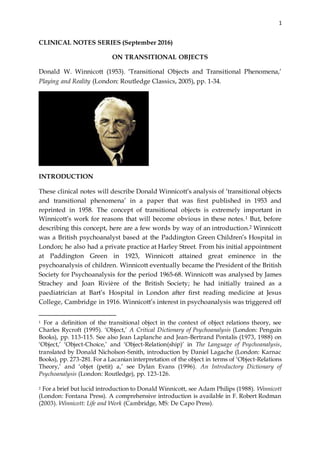
describing this concept, here are a few words by way of an introduction.2 Winnicott
was a British psychoanalyst based at the Paddington Green Children’s Hospital in
London; he also had a private practice at Harley Street. From his initial appointment
at Paddington Green in 1923, Winnicott attained great eminence in the
psychoanalysis of children. Winnicott eventually became the President of the British
Society for Psychoanalysis for the period 1965-68. Winnicott was analysed by James
Strachey and Joan Rivière of the British Society; he had initially trained as a
paediatrician at Bart’s Hospital in London after first reading medicine at Jesus
College, Cambridge in 1916. Winnicott’s interest in psychoanalysis was triggered off
1 For a definition of the transitional object in the context of object relations theory, see
Charles Rycroft (1995). ‘Object,’ A Critical Dictionary of Psychoanalysis (London: Penguin
Books), pp. 113-115. See also Jean Laplanche and Jean-Bertrand Pontalis (1973, 1988) on
‘Object,’ ‘Object-Choice,’ and ‘Object-Relation(ship)’ in The Language of Psychoanalysis,
translated by Donald Nicholson-Smith, introduction by Daniel Lagache (London: Karnac
Books), pp. 273-281. For a Lacanian interpretation of the object in terms of ‘Object-Relations
Theory,’ and ‘objet (petit) a,’ see Dylan Evans (1996). An Introductory Dictionary of
Psychoanalysis (London: Routledge), pp. 123-126.
2 For a brief but lucid introduction to Donald Winnicott, see Adam Philips (1988). Winnicott
(London: Fontana Press). A comprehensive introduction is available in F. Robert Rodman
(2003). Winnicott: Life and Work (Cambridge, MS: De Capo Press).
2
by reading Sigmund Freud’s book on the interpretation of dreams in 1919; he was
also influenced by the work of Melanie Klein. The British Society was deeply
interested in the psychoanalysis of children during the war years. Most of the
pioneering work in this area was done by Anna Freud3 and Melanie Klein. Though
greatly influenced by these pioneers, Winnicott is more closely associated with the
Middle Group of Independent psychoanalysts at the British School.4 Winnicott went
on to publish a number of papers and books in this area; he is best known for trying
to explain the significance of his clinical work to parents who wanted to benefit from
the insights of psychoanalysis.5 These notes however focus only on his paper on
transitional objects since this concept made an impact on not only the psychoanalysis
of children at the British Society, but affected how analysts thought about object
relations theory in Britain, France, and the United States. My own interest in
Winnicott is related to the public lectures and interactive seminars that I attended at
the British Society during the years 1991-1992 as a graduate student in London. My
intention is not to take on a greater chunk of Winnicott than I can do justice to in
these notes since my doctoral work was on Jacques Lacan and not Winnicott.
Nonetheless, there has been a great deal of interest shown in the concepts of
Winnicott amongst Lacanians in recent years. I therefore thought it would be a
worthwhile endeavour to include Winnicott amongst the clinical sources to include
in this series.6
DEFINING THE TRANSITIONAL OBJECT
Let me start with Rycroft’s definition of the transitional object. Rycroft points out
that the transitional object is ‘halfway’ between the child and ‘another person.’ The
main task of the transitional object is to comfort the child, but it does not have to be
treated with the consideration due to a human being. It helps children to make the
existential transition ‘from infantile narcissism to object-love and from dependence
to self-reliance.’ Winnicott even compares it to the piece of bread that Christ shared
with his disciples during the last supper. So whether the bread that symbolizes
transubstantiation is interpreted literally or metaphorically, it is akin to a transitional
object. Winnicott also finds the invocation of the transitional object a common motif
3 See Elisabeth Young-Bruehl (1988). Anna Freud: A Biography (New York: Simon & Schuster).
4 Joseph Schwartz (1999). ‘Breakthrough in Britain,’ Cassandra’s Daughter: A History of
Psychoanalysis (New York: Penguin Books), pp. 216-244.
5 See Donald W. Winnicott (1993). Talking to Parents, introduction by T. Berry Brazelton
(Cambridge, MS: Perseus Publishing).
6 See, for instance, Lewis A. Kirshner (2011). Between Winnicott and Lacan: A Clinical
Engagement (New York: Routledge).
3
in the metaphysical poetry of John Donne. A more commonplace instantiation of the
transitional object is Winnie the Pooh or a teddy bear which children can play with.
The function of the transitional object is however characterized by a paradox; that is
because what is at stake is not the transitional object as such but the use of the object.
Winnicott’s initial hypothesis on the role played by the transitional object led to
empirical research where clinicians would make note of instances where a
transitional object is invoked by the child patient in an analysis. These objects matter
to Winnicott because it gives the clinician an opportunity to study the following
phenomena: the structure, function, and role played by the object; the infant’s
cognition of the object in terms of the ‘me and not-me’ zones that characterise his
sense of being; and his ability to manipulate, play, and relate affectionately with the
object. Transitional phenomena and objects are those that precede the advent of
object relationships in a child’s life; they include playing with words and sucking the
thumb during and after weaning. These transitional phenomena relate to the process
of reality testing in a child; it includes building the capacity for experiences and
differentiating between reality and illusion. So what is at stake is not the transitional
object as such, but the sense of possessing an object and putting it to some kind of
use in the child’s mind.
TRANSITIONAL OBJECTS AS SYMBOLS
The study of such personal patterns of human behaviour as represented in the child
is conceived by Winnicott as a universal. Children show an interest in transitional
phenomena from as early as four months. These include the sounds that they make.
The mother herself could be in the locus of the transitional object when dolls or soft
toys are not present. Winnicott points out that only the child and not adults can
change the object; it will be cathected and gradually de-cathected as the child grows
older. It is not subject to amnesia, repression, or mourning, but simply ‘loses
meaning’ as the child grows up. There is a symbolic dimension to transitional objects
like blankets since they substitute for the mother; comparisons and distortions in
how such symbolic objects are used by siblings can provide clues to the
psychological differences between them in a clinical analysis. It will also help the
analyst to situate the child in terms of whether he is fixated on the mother, free,
mature, psychopathic, or developing well. Analysts influenced by Winnicott are
more likely to take note of the presence or absence of transitional objects while
taking the history of the child patient. In addition to symbolizing the mother, the
maternal breast, and the process of reality testing, a transitional object may also be a
stand in for faeces or develop into a fetish in some children. The transitional object is
neither a Kleinian internal object nor a simple external object in the world; it is for
Winnicott mainly to be understood as a form of existential ‘possession.’ The focus
should therefore be on how the child relates to the object rather than on the object as such.
4
CONCLUSION
In order to make a transition from the realm of pleasure to that of reality, a child
needs a ‘good-enough mother.’ The mother cannot however be omnipresent for a
child. It is therefore important for a child to come to terms with her limitations in its
attempts to adapt itself to the world around in which he lives. While the mother is
completely available in the beginning, her presence reduces considerably as a child
grows up. The child’s relation to the maternal breast is based on the illusion of
complete presence. In its absence, a child may even hallucinate the presence of the
mother. The transitional object then is that which comes in place of the illusion; it is
something that the child can hold on to in the mother’s absence; hence its importance
in the process of weaning. In other words, weaning is not merely the termination of
breast feeding. It is a process of getting used to the relationship between the absence
and the presence of the mother; the illusion that the mother is always there; and the
child’s eventual adaptation to empirical reality.
Winnicott concludes with an analysis of two clinical examples of transitional objects
and transitional phenomena; the objects in contention included a ‘string’ in the first
case and a ‘rug’ in the second case. In the former, the child was using a string to cope
with separation from his mother; and in the latter, a rug. As should be obvious from
such case vignettes, Winnicott is mainly interested in using the transitional object
and transitional phenomena as ways of describing the advent of a child’s ability to
relate to others without succumbing to illusions about the permanence of the
maternal presence. This dimension is taken further in the work of Jacques Lacan
where; in addition to the maternal presence, there is also the question of ‘maternal
desire.’ In this approach to the mother, the child will grow up wondering whether he
can become the object cause of the mother’s desire; and asking himself what is it that
he must do to complement (rather than merely supplement) what is missing in his
mother’s life.7
SHIVA KUMAR SRINIVASAN
7 See, for instance, Serge Leclaire (1998). ‘Pierre-Marie, or the Child,’ A Child is Being Killed:
On Primary Narcissism and the Death Drive, translated by Marie-Claude Hays (Stanford:
Stanford University Press), pp. 1-15. See also Ellie Ragland (1995). ‘Lacan and the Ethics of
Desire,’ Essays on the Pleasures of Death:From Freud to Lacan (New York: Routledge), pp. 144-
181.

On Transitional Objects

  • 1.
    1 CLINICAL NOTES SERIES(September 2016) ON TRANSITIONAL OBJECTS Donald W. Winnicott (1953). ‘Transitional Objects and Transitional Phenomena,’ Playing and Reality (London: Routledge Classics, 2005), pp. 1-34. INTRODUCTION These clinical notes will describe Donald Winnicott’s analysis of ‘transitional objects and transitional phenomena’ in a paper that was first published in 1953 and reprinted in 1958. The concept of transitional objects is extremely important in Winnicott’s work for reasons that will become obvious in these notes.1 But, before describing this concept, here are a few words by way of an introduction.2 Winnicott was a British psychoanalyst based at the Paddington Green Children’s Hospital in London; he also had a private practice at Harley Street. From his initial appointment at Paddington Green in 1923, Winnicott attained great eminence in the psychoanalysis of children. Winnicott eventually became the President of the British Society for Psychoanalysis for the period 1965-68. Winnicott was analysed by James Strachey and Joan Rivière of the British Society; he had initially trained as a paediatrician at Bart’s Hospital in London after first reading medicine at Jesus College, Cambridge in 1916. Winnicott’s interest in psychoanalysis was triggered off 1 For a definition of the transitional object in the context of object relations theory, see Charles Rycroft (1995). ‘Object,’ A Critical Dictionary of Psychoanalysis (London: Penguin Books), pp. 113-115. See also Jean Laplanche and Jean-Bertrand Pontalis (1973, 1988) on ‘Object,’ ‘Object-Choice,’ and ‘Object-Relation(ship)’ in The Language of Psychoanalysis, translated by Donald Nicholson-Smith, introduction by Daniel Lagache (London: Karnac Books), pp. 273-281. For a Lacanian interpretation of the object in terms of ‘Object-Relations Theory,’ and ‘objet (petit) a,’ see Dylan Evans (1996). An Introductory Dictionary of Psychoanalysis (London: Routledge), pp. 123-126. 2 For a brief but lucid introduction to Donald Winnicott, see Adam Philips (1988). Winnicott (London: Fontana Press). A comprehensive introduction is available in F. Robert Rodman (2003). Winnicott: Life and Work (Cambridge, MS: De Capo Press).
  • 2.
    2 by reading SigmundFreud’s book on the interpretation of dreams in 1919; he was also influenced by the work of Melanie Klein. The British Society was deeply interested in the psychoanalysis of children during the war years. Most of the pioneering work in this area was done by Anna Freud3 and Melanie Klein. Though greatly influenced by these pioneers, Winnicott is more closely associated with the Middle Group of Independent psychoanalysts at the British School.4 Winnicott went on to publish a number of papers and books in this area; he is best known for trying to explain the significance of his clinical work to parents who wanted to benefit from the insights of psychoanalysis.5 These notes however focus only on his paper on transitional objects since this concept made an impact on not only the psychoanalysis of children at the British Society, but affected how analysts thought about object relations theory in Britain, France, and the United States. My own interest in Winnicott is related to the public lectures and interactive seminars that I attended at the British Society during the years 1991-1992 as a graduate student in London. My intention is not to take on a greater chunk of Winnicott than I can do justice to in these notes since my doctoral work was on Jacques Lacan and not Winnicott. Nonetheless, there has been a great deal of interest shown in the concepts of Winnicott amongst Lacanians in recent years. I therefore thought it would be a worthwhile endeavour to include Winnicott amongst the clinical sources to include in this series.6 DEFINING THE TRANSITIONAL OBJECT Let me start with Rycroft’s definition of the transitional object. Rycroft points out that the transitional object is ‘halfway’ between the child and ‘another person.’ The main task of the transitional object is to comfort the child, but it does not have to be treated with the consideration due to a human being. It helps children to make the existential transition ‘from infantile narcissism to object-love and from dependence to self-reliance.’ Winnicott even compares it to the piece of bread that Christ shared with his disciples during the last supper. So whether the bread that symbolizes transubstantiation is interpreted literally or metaphorically, it is akin to a transitional object. Winnicott also finds the invocation of the transitional object a common motif 3 See Elisabeth Young-Bruehl (1988). Anna Freud: A Biography (New York: Simon & Schuster). 4 Joseph Schwartz (1999). ‘Breakthrough in Britain,’ Cassandra’s Daughter: A History of Psychoanalysis (New York: Penguin Books), pp. 216-244. 5 See Donald W. Winnicott (1993). Talking to Parents, introduction by T. Berry Brazelton (Cambridge, MS: Perseus Publishing). 6 See, for instance, Lewis A. Kirshner (2011). Between Winnicott and Lacan: A Clinical Engagement (New York: Routledge).
  • 3.
    3 in the metaphysicalpoetry of John Donne. A more commonplace instantiation of the transitional object is Winnie the Pooh or a teddy bear which children can play with. The function of the transitional object is however characterized by a paradox; that is because what is at stake is not the transitional object as such but the use of the object. Winnicott’s initial hypothesis on the role played by the transitional object led to empirical research where clinicians would make note of instances where a transitional object is invoked by the child patient in an analysis. These objects matter to Winnicott because it gives the clinician an opportunity to study the following phenomena: the structure, function, and role played by the object; the infant’s cognition of the object in terms of the ‘me and not-me’ zones that characterise his sense of being; and his ability to manipulate, play, and relate affectionately with the object. Transitional phenomena and objects are those that precede the advent of object relationships in a child’s life; they include playing with words and sucking the thumb during and after weaning. These transitional phenomena relate to the process of reality testing in a child; it includes building the capacity for experiences and differentiating between reality and illusion. So what is at stake is not the transitional object as such, but the sense of possessing an object and putting it to some kind of use in the child’s mind. TRANSITIONAL OBJECTS AS SYMBOLS The study of such personal patterns of human behaviour as represented in the child is conceived by Winnicott as a universal. Children show an interest in transitional phenomena from as early as four months. These include the sounds that they make. The mother herself could be in the locus of the transitional object when dolls or soft toys are not present. Winnicott points out that only the child and not adults can change the object; it will be cathected and gradually de-cathected as the child grows older. It is not subject to amnesia, repression, or mourning, but simply ‘loses meaning’ as the child grows up. There is a symbolic dimension to transitional objects like blankets since they substitute for the mother; comparisons and distortions in how such symbolic objects are used by siblings can provide clues to the psychological differences between them in a clinical analysis. It will also help the analyst to situate the child in terms of whether he is fixated on the mother, free, mature, psychopathic, or developing well. Analysts influenced by Winnicott are more likely to take note of the presence or absence of transitional objects while taking the history of the child patient. In addition to symbolizing the mother, the maternal breast, and the process of reality testing, a transitional object may also be a stand in for faeces or develop into a fetish in some children. The transitional object is neither a Kleinian internal object nor a simple external object in the world; it is for Winnicott mainly to be understood as a form of existential ‘possession.’ The focus should therefore be on how the child relates to the object rather than on the object as such.
  • 4.
    4 CONCLUSION In order tomake a transition from the realm of pleasure to that of reality, a child needs a ‘good-enough mother.’ The mother cannot however be omnipresent for a child. It is therefore important for a child to come to terms with her limitations in its attempts to adapt itself to the world around in which he lives. While the mother is completely available in the beginning, her presence reduces considerably as a child grows up. The child’s relation to the maternal breast is based on the illusion of complete presence. In its absence, a child may even hallucinate the presence of the mother. The transitional object then is that which comes in place of the illusion; it is something that the child can hold on to in the mother’s absence; hence its importance in the process of weaning. In other words, weaning is not merely the termination of breast feeding. It is a process of getting used to the relationship between the absence and the presence of the mother; the illusion that the mother is always there; and the child’s eventual adaptation to empirical reality. Winnicott concludes with an analysis of two clinical examples of transitional objects and transitional phenomena; the objects in contention included a ‘string’ in the first case and a ‘rug’ in the second case. In the former, the child was using a string to cope with separation from his mother; and in the latter, a rug. As should be obvious from such case vignettes, Winnicott is mainly interested in using the transitional object and transitional phenomena as ways of describing the advent of a child’s ability to relate to others without succumbing to illusions about the permanence of the maternal presence. This dimension is taken further in the work of Jacques Lacan where; in addition to the maternal presence, there is also the question of ‘maternal desire.’ In this approach to the mother, the child will grow up wondering whether he can become the object cause of the mother’s desire; and asking himself what is it that he must do to complement (rather than merely supplement) what is missing in his mother’s life.7 SHIVA KUMAR SRINIVASAN 7 See, for instance, Serge Leclaire (1998). ‘Pierre-Marie, or the Child,’ A Child is Being Killed: On Primary Narcissism and the Death Drive, translated by Marie-Claude Hays (Stanford: Stanford University Press), pp. 1-15. See also Ellie Ragland (1995). ‘Lacan and the Ethics of Desire,’ Essays on the Pleasures of Death:From Freud to Lacan (New York: Routledge), pp. 144- 181.