Advance
T.O.P.
Born: March 30,1882, Vienna, Austria
Died: September 22, 1960 (age 78 years),
London, United Kingdom
Spouse: Arthur Klein
Children:
Melitta Schmideberg
Erich Klein
Hans Klein
Education: University of Vienna
Siblings:
Sidonie Reizes
Emilie Reizes
Emmanuel Reizes
MELANIE
KLEIN
MSP 1 - B
A.M.N.
3.
Advance
T.O.P.
Klein sought psychotherapydue to an
extremely challenging personal life. Sandor
Ferenczi, Klein's therapist at the time urged her to
attempt psychoanalysis on her own kids.
Ultimately, this would result in the creation of
object relations theory, which addresses how our
psyches evolve in connection to the objects in our
environment. Klein claims that our early
experiences with objects have a lasting impact
on how we develop as adults.
MELANIE
KLEIN
MSP 1 - B
A.M.N.
4.
OBJECT
RELATIONS
THEORY
MSP 1 -B
A.M.N.
It is essential to comprehend the development of the
theory, which begins with Freud. The father of psychoanalysis,
Sigmund Freud, held that most human behavior is a result of
unconscious urges and that the unconscious mind controls
conscious behavior. Not everyone, though, agreed with this
notion.
Renowned psychologist, Melanie Klein made the bold
assumption that human conduct was not dependent on the
unconscious inner workings of the mind after studying Freud.
She believed that the key to comprehending an individual's
behavior was to identify patterns in their varied relationships
with others. As a result, she developed the object relations
theory.
5.
OBJECT
RELATIONS
THEORY
MSP 1 -B
A.M.N.
Although Klein's Object Relations Theory is a relative of Freud's
Theory, it is distinct in three main aspects:
It more strongly denotes the regular pattern of interpersonal
interactions;
Places more emphasis on the mother's closeness and
nurturing (maternalistic) than the father's authority and
control;
Believes that human beings are essentially driven by human
contact and relatedness rather than sexual pleasure.
Beginning with this fundamental premise of Freud, Klein and
other theories predict how an infant's actual or imagined
early associations with the mother or the beast establish a
foundation for all future interpersonal relationships.
6.
OBJECT
RELATIONS
THEORY
MSP 1 -B
A.M.N.
→ It was built on careful observations of young children. As it
stresses the significance of the first 4 to 6 months after birth.
→ Insisting the infant's drives (hunger, sex, etc.) are directed to
an object.
*Drives are directed to an object - a breast
→ According to Klein, the child relation to breast is fundamental
and serves as a prototype for later relations to whole objects.
→ Speculated on the significance of a child's early mother-child
interactions.
7.
PSYCHIC
LIFE OF THE
INFANT
Sheagreed with Freud
regarding humans having
innate drives or instinct. Drives
must have some objects.
are the psychic representations
of unconscious id instincts; It
means that the infants
possess unconscious images of
“good” and “bad.”
Klein highlighted the importance of a
baby's first four or six months of existence.
According to her, babies are born with a
predisposition to reduce the anxiety they feel
as a result of the battle between their life
and death instincts.
PHANTASIES OBJECTS
8.
POSITIONS
Infants organize theirexperiences into
views, or methods of dealing with both
internal and exterior things, in an effort to
resolve the conflict between the life and
death instinct.
PARANOID-SCHIZOID
POSITION
DEPRESSIVE
POSITION
9.
POSITIONS
The newborns experiencedboth good
and bad breasts, which resulted in two
conflicting emotions: the need to dominate
the breast by consuming and nurturing it
and the impulse to destroy it by biting and
destroying it. The ego divides in order to
bear the emotions; it keeps some aspects
of the life and death instinct while
reflecting other aspects of the instinct on
the breast.
PARANOID-SCHIZOID
POSITION
10.
POSITIONS
It starts atthe age of five or six
months, when the baby starts to see both
the good and the bad in one individual as
well as the external objects as a whole.
The baby now sees their mother as an
independent individual and fears the
unexpected loss of their mother.
The baby simultaneously feels a
destructive drive toward their mother and
wants to protect her. It is their feelings of
guilt as they wish to destroy their beloved
possession and their fear of losing it.
DEPRESSIVE POSITION
11.
PSYCHIC
DEFENSE
MECHANISMS
Babies form amental image of
a "good me" and a "bad me,"
which enables them to control
impulses that are both satisfying
and harmful towards external
objects.
Splitting
Infants separate undesirable
parts of themselves, project
them onto an object, and then
introject the modified pieces of
themselves back into
themselves.
Projective Identification
It is a fantasy in which one's
established emotions and urges
are felt by someone else. It
permits people to believe what
their own subjective beliefs tell
them to believe.
Projection
Initially, babies try to
introject positive objects
to help them cope with
anxiety, but occasionally
they incorporate bad
objects to acquire
control over them.
Introjection
12.
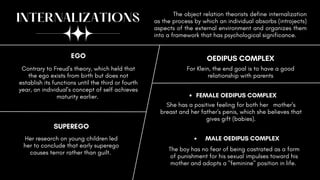
INTERNALIZATIONS
Contrary to Freud'stheory, which held that
the ego exists from birth but does not
establish its functions until the third or fourth
year, an individual's concept of self achieves
maturity earlier.
For Klein, the end goal is to have a good
relationship with parents
The object relation theorists define internalization
as the process by which an individual absorbs (introjects)
aspects of the external environment and organizes them
into a framework that has psychological significance.
SUPEREGO
OEDIPUS COMPLEX
EGO
Her research on young children led
her to conclude that early superego
causes terror rather than guilt.
She has a positive feeling for both her mother's
breast and her father's penis, which she believes that
gives gift (babies).
FEMALE OEDIPUS COMPLEX
The boy has no fear of being castrated as a form
of punishment for his sexual impulses toward his
mother and adopts a "feminine" position in life.
MALE OEDIPUS COMPLEX
13.
MARGARET
MAHLER
She focused on
thepsychological
birth of the
person, which
occurs in the first
three years of
existence.
She believes it
starts during the
first weeks of
prenatal and
lasts for the
following three
years.
Later Theories in Object Relations
DEVELOPMENTAL STAGES
Normal Autism
NormalSymbiosis
Separation-individuation
14.
MARGARET
MAHLER
Later Theories inObject Relations
DEVELOPMENTAL STAGES
Normal Autism (3 - 4 weeks old)
the infants satisfy their needs within the all-
powerful protective orbit of a mother’s care.
referred as an “objectless” stage
15.
MARGARET
MAHLER
Later Theories inObject Relations
DEVELOPMENTAL STAGES
Normal Symbiosis (4 - 5 weeks old)
as the infant behaves and functions as if they
and the mother were an omnipotent system -
a dual unity within one common boundary.
not “objects” but “preobjects”
16.
MARGARET
MAHLER
Later Theories inObject Relations
DEVELOPMENTAL STAGES
Separation-Individuation (5 - 36 months)
the child was now psychologically separated
from their mothers, as they began to have a
sense of personal identity.
Differentiation (5 - 10 months)
1.
Practicing (7 - 16 months)
2.
Rapprochement (16 - 25 months)
3.
Libidinal Object Consistency
4.
Substages
17.
HEINZ
KOHUT
emphasized the processby which the self evolves
from a vague and undifferentiated image to a
clear and precise sense of individual identity.
treat infants as if they had a sense of self.
the “center of initiative (you know what you will be
doing) and recipient of impressions (you can feel
what others will be doing to you)
Later Theories in Object Relations
18.
ATTACHMENT THEORY
JOHN
BOWLBY
Later Theoriesin Object Relations
Protest Stage - the infant cries if the caregiver is out of
the vicinity or sight
Despair - the infant becomes quiet, sad, passive, listless,
and apathetic
Detachment - if the caregiver returns, he/she will be
avoided by the infant, as the infant became
emotionally detached to others
19.
THE STRANGE SITUATION
MARY
AINSWORTH
LaterTheories in Object Relations
Secure Attachment - if the caregiver or mother
returns, the infant is happy and enthusiastic and initiates
contact
Anxious-Resistant Attachment - the infants are
ambivalent. If the mother leaves, the child is upset, but
when the mother comes back she rejects the contact
Anxious-Avoidant Attachment - as the child calms
when the mother leaves, they accept the stranger and
then when the mother returns the infant ignores and
avoids her.
20.
Klein believed thatboth healthy and disturbed
children should be psychoanalyzed as the healthy
child would profit in prophylactic analysis while the
disturbed child would receive benefit from
therapeutic treatment.
PSYCHOTHERAPY
MSP 1 - B
A.M.N.
To nurture the negative transference and
aggressive fantasies of the child, she provided
them things to play with as she believed that the
child expressed their conscious and unconscious
wishes through play therapy.
The goal of this therapy is to
lessen depressive anxieties and
persecutory fears and to mitigate
the harshness of internalized objects.
Also, she encourages her patients to
reexperience early emotions and
fantasies but this time with the
therapist pointing out the differences
between reality and fantasy,
between conscious and unconscious.
21.
CRITIQUE
Low ability togenerate research
Low in falsification because it
generate very few testable
hypotheses




![Psychoanalytic Theory [educationresourcehub.blogspot.com].pdf](https://cdn.slidesharecdn.com/ss_thumbnails/psychoanalytictheoryeducationresourcehub-250812110521-e7dcdff3-thumbnail.jpg?width=640&height=640&fit=bounds)


