On Tocharian Exceptionality to
                 the centum-satem Isogloss


                                                        Richard Littauer
                                      MSc Saarland University | MA University of Edinburgh
                                                rlittauer.com | @richlitt
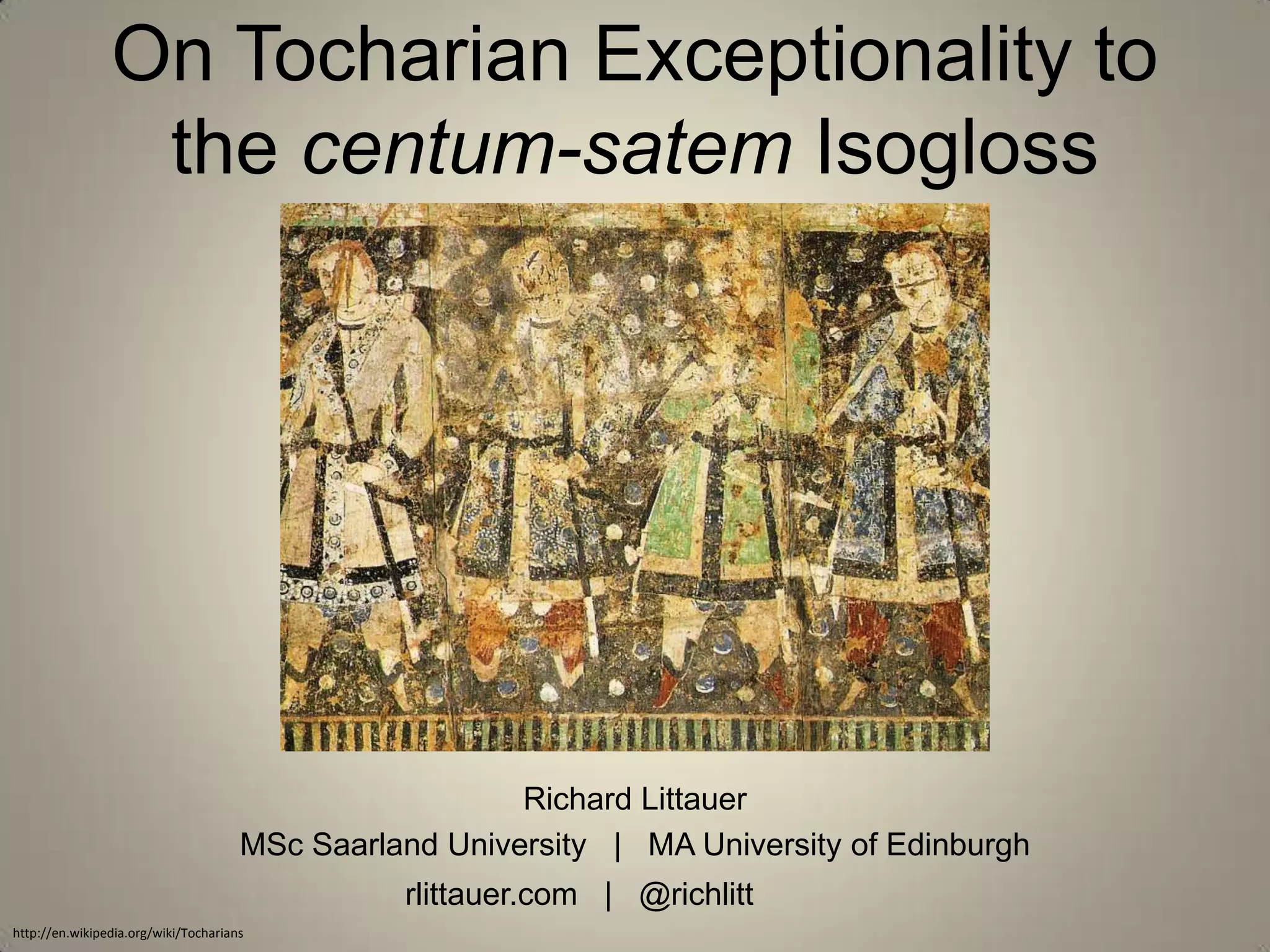
http://en.wikipedia.org/wiki/Tocharians
Tocharian


  What is it?
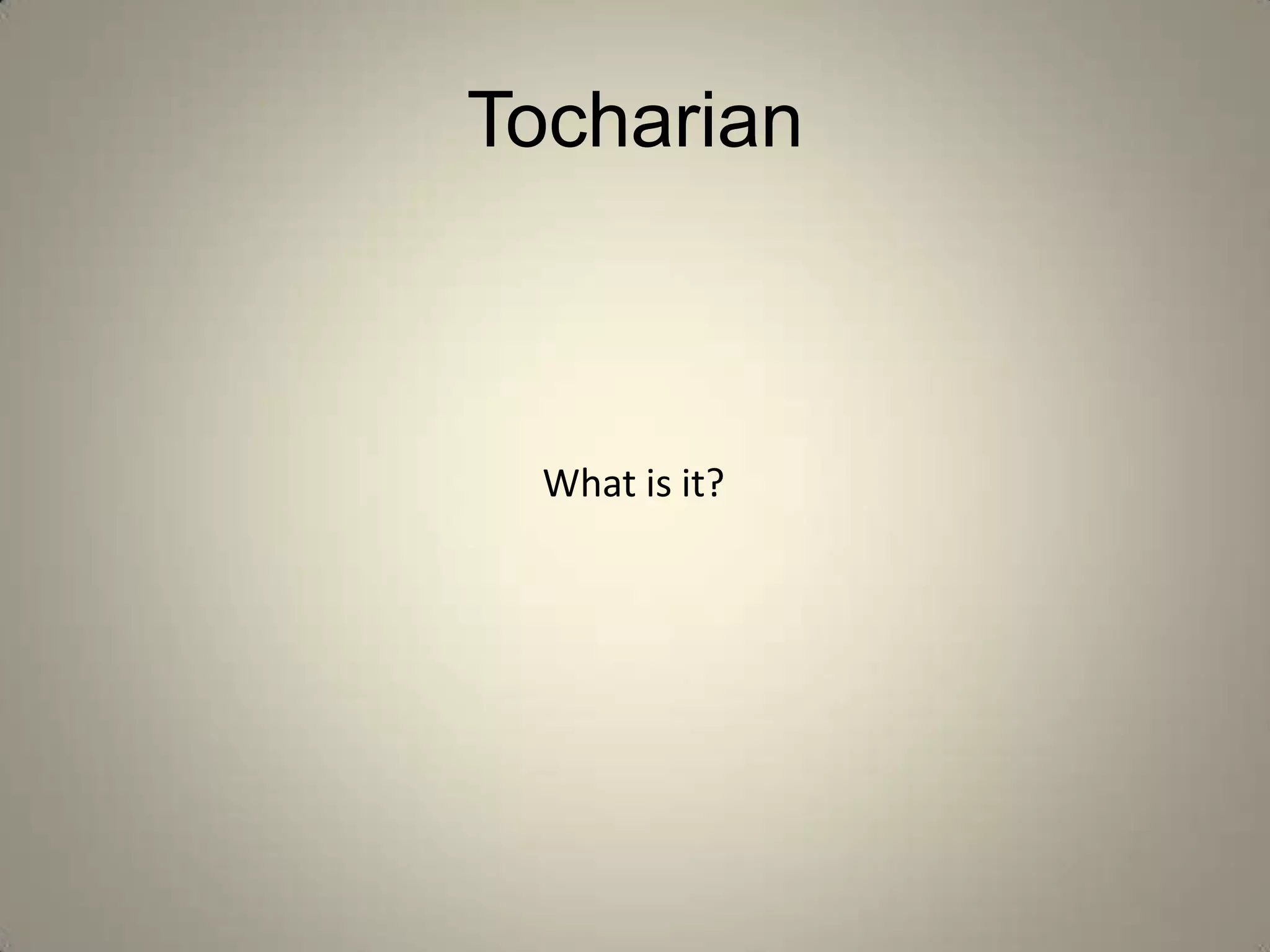
Tocharian


http://webscript.princeton.edu/~lingclub/challenge/tocharian.php
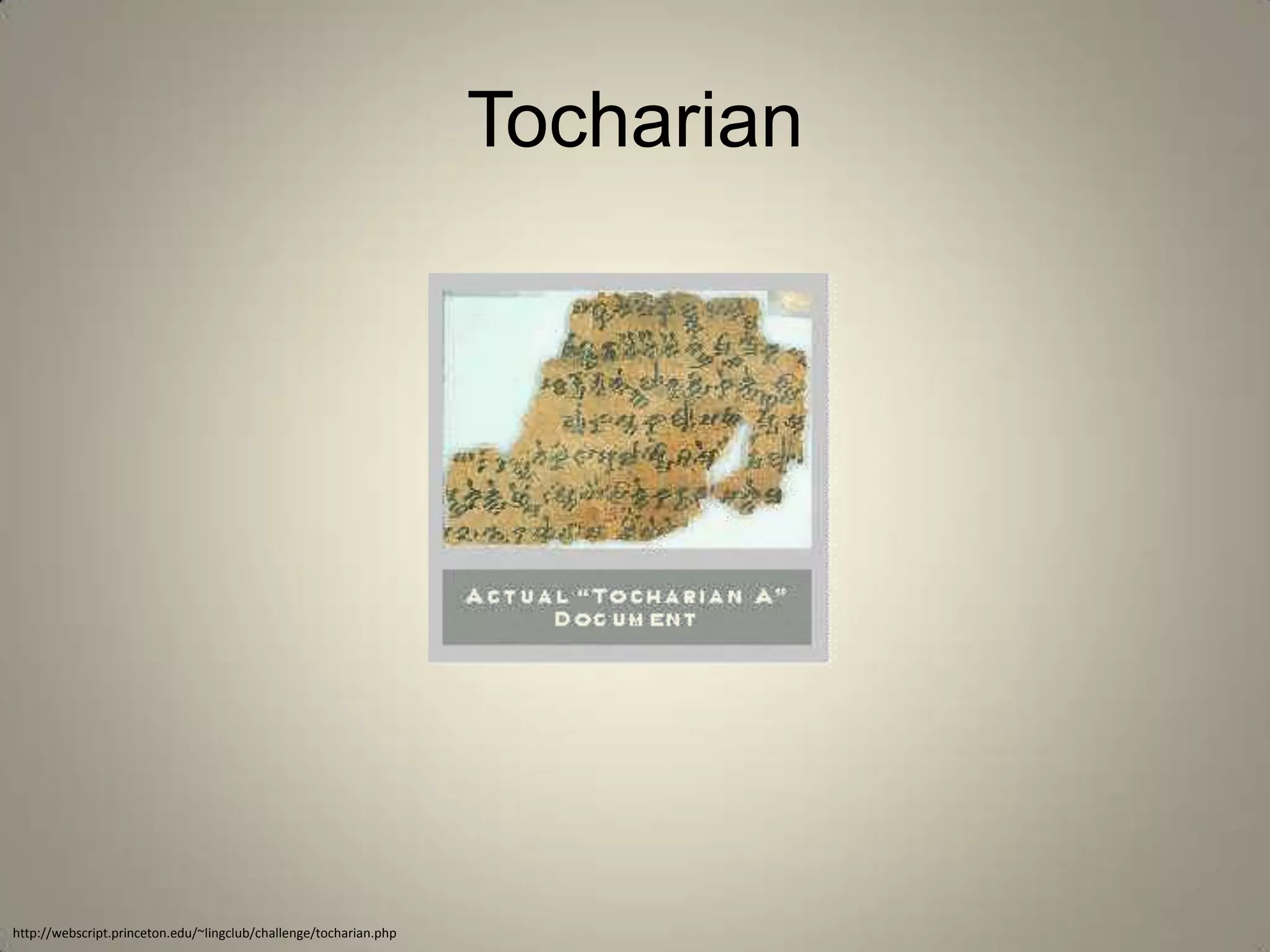
Tocharian


http://001yourtranslationservice.com/translations/jobs/Tocharian.html
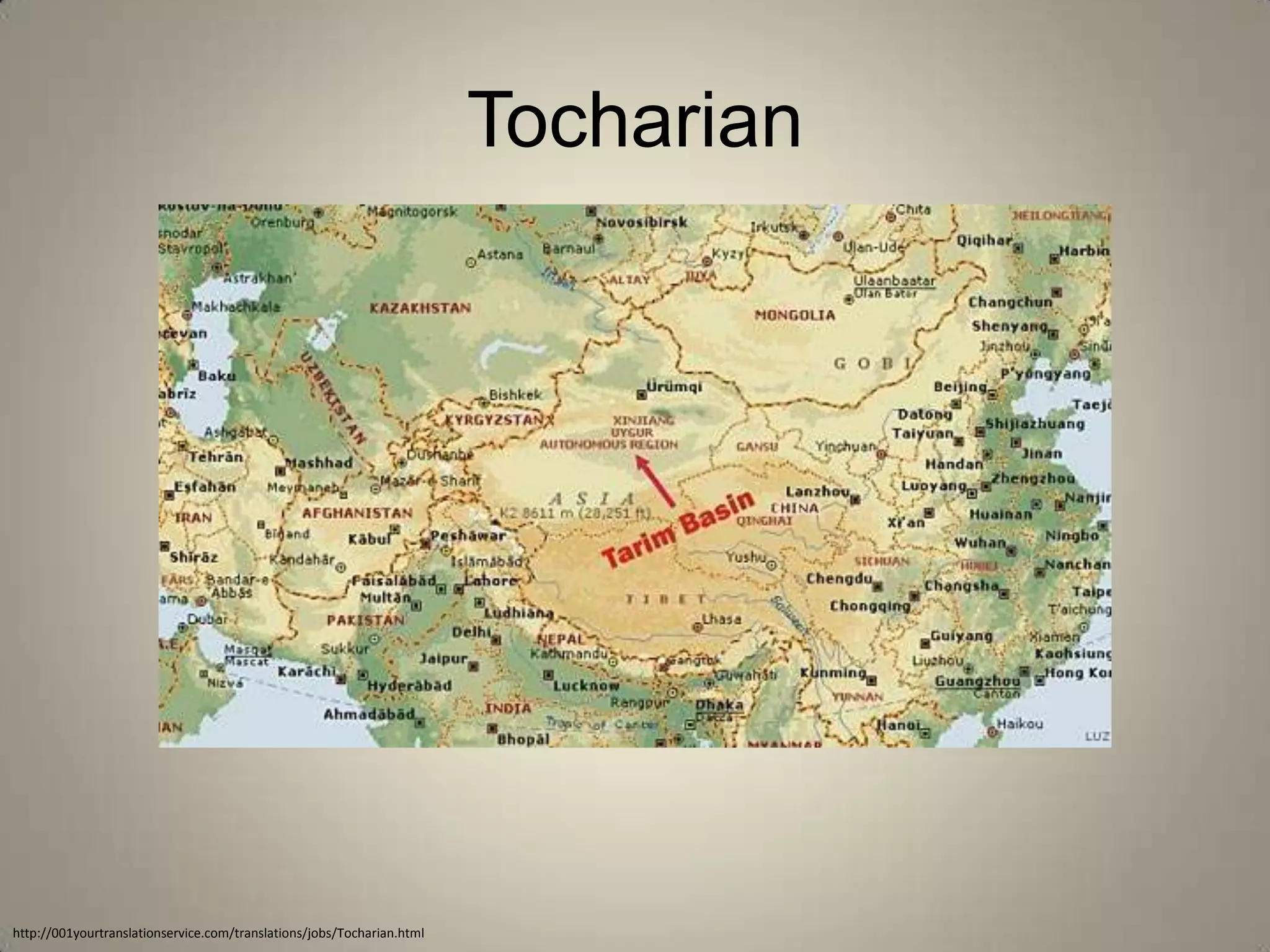
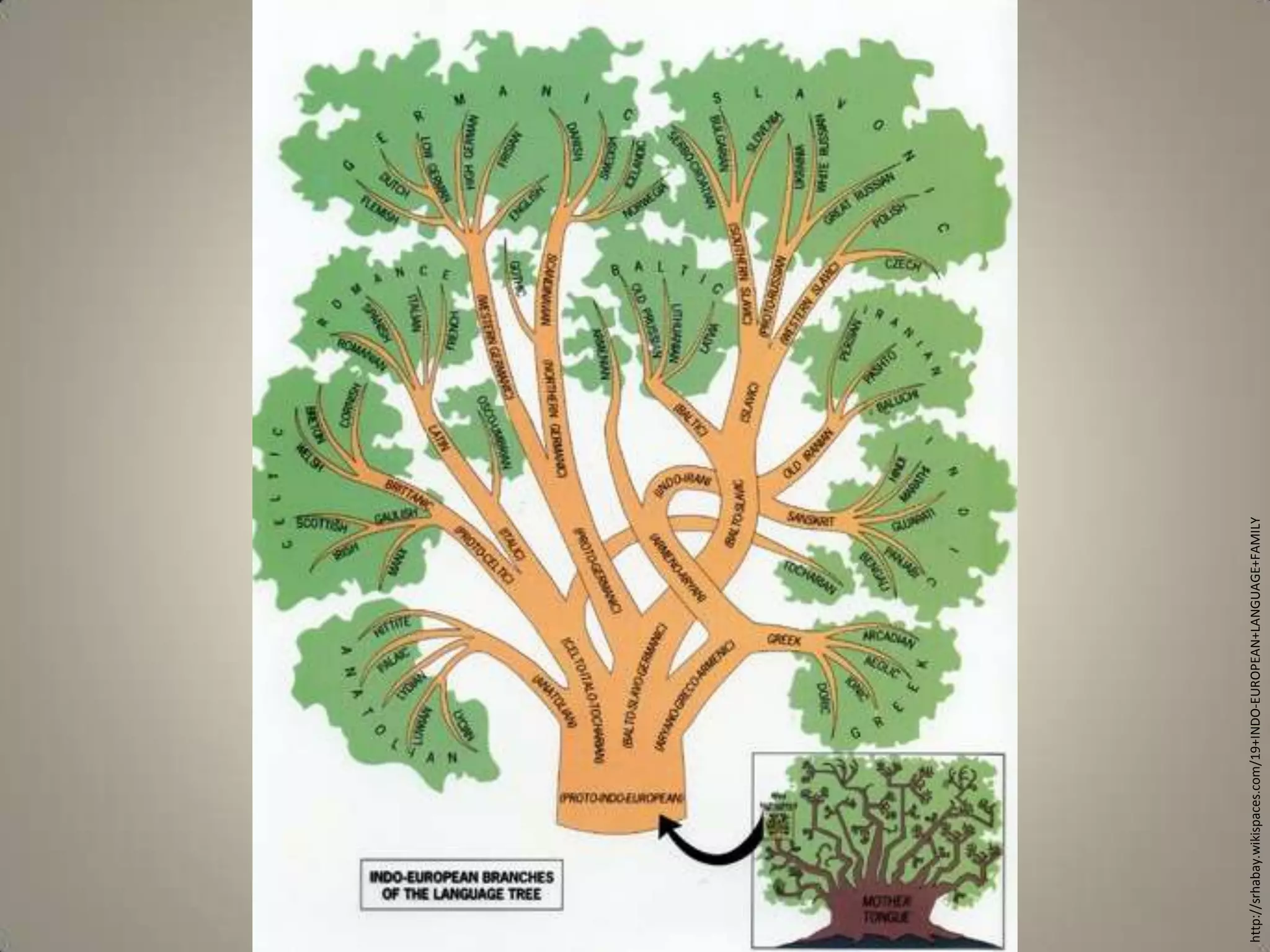
http://srhabay.wikispaces.com/19+INDO-EUROPEAN+LANGUAGE+FAMILY
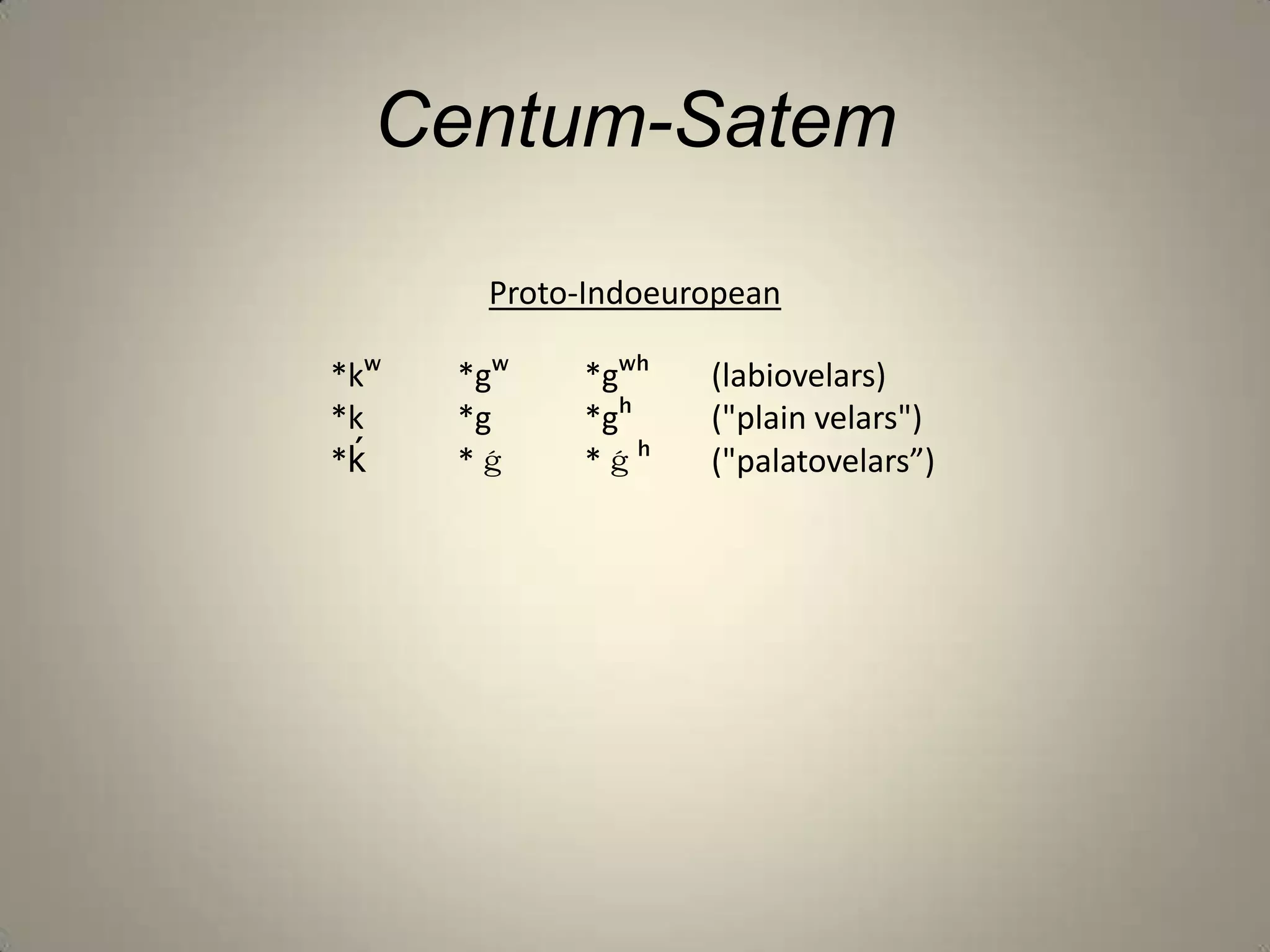
Centum-Satem

       Proto-Indoeuropean

*kʷ   *gʷ   *gʷʰ    (labiovelars)
*k    *g    *gʰ     ("plain velars")
*ḱ    *ǵ    *ǵʰ     ("palatovelars”)
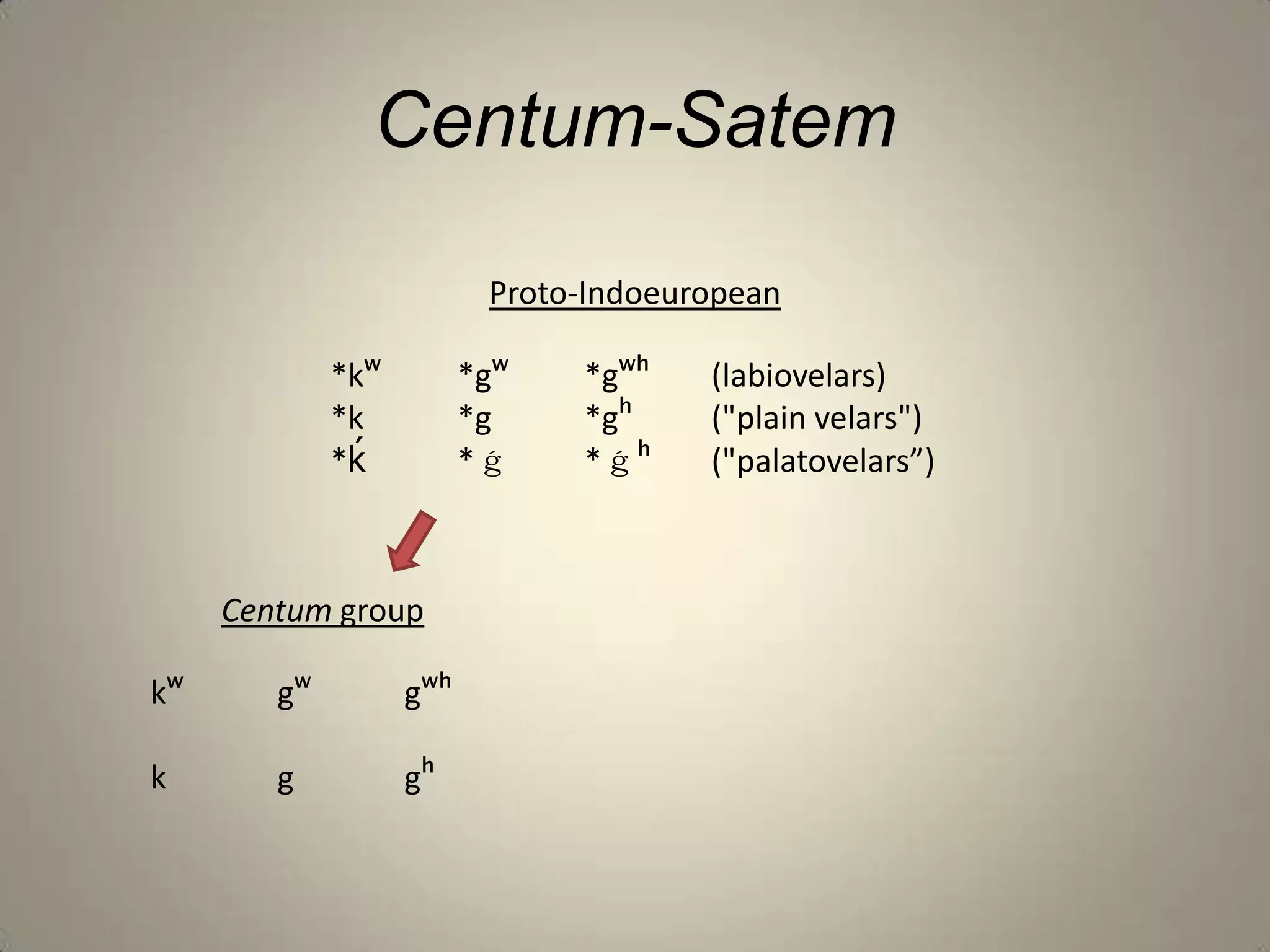
Centum-Satem

                          Proto-Indoeuropean

             *kʷ         *gʷ   *gʷʰ    (labiovelars)
             *k          *g    *gʰ     ("plain velars")
             *ḱ          *ǵ    *ǵʰ     ("palatovelars”)


     Centum group

kʷ      gʷ         gʷʰ

k       g          gʰ
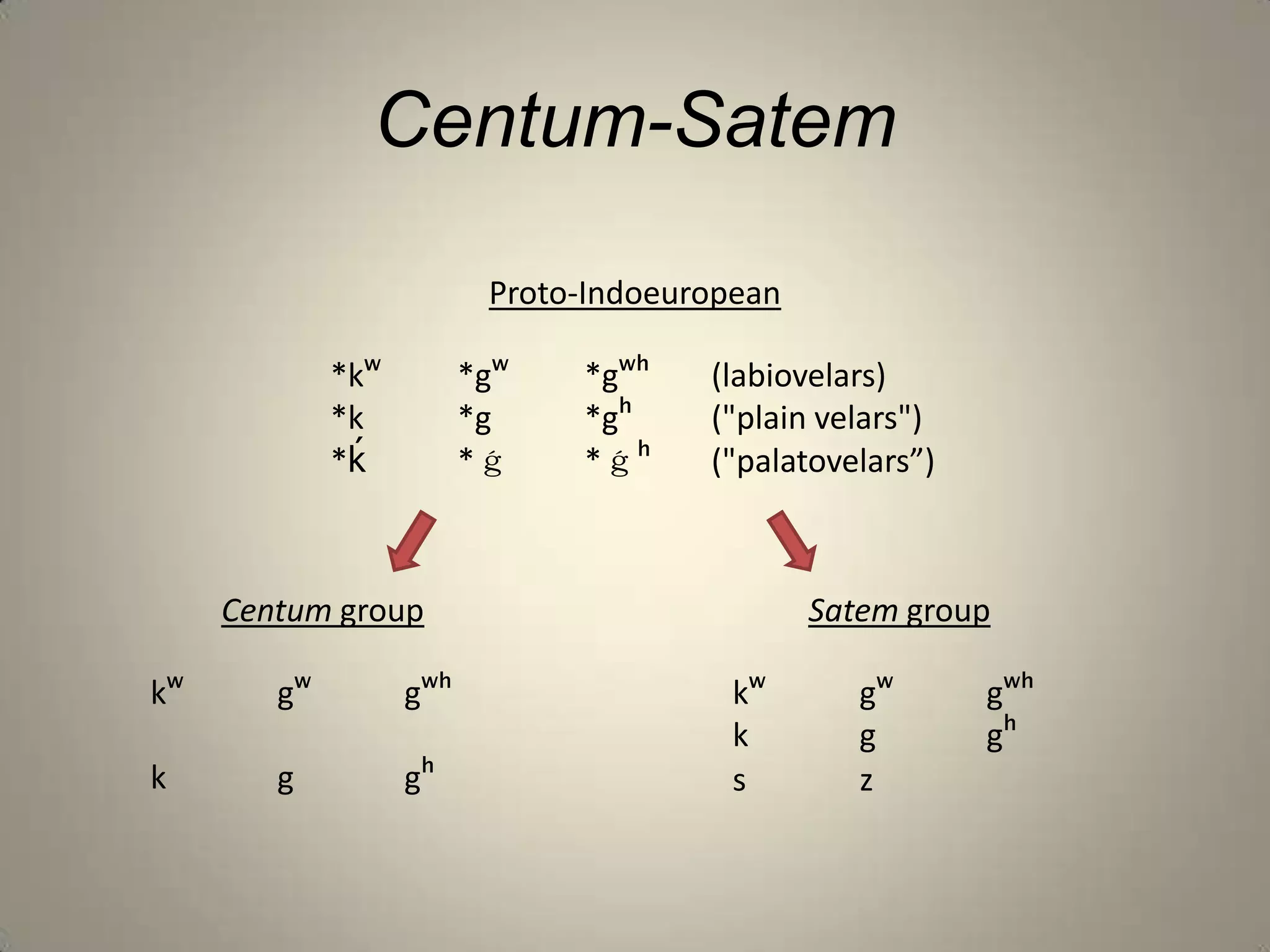
Centum-Satem

                          Proto-Indoeuropean

             *kʷ         *gʷ   *gʷʰ    (labiovelars)
             *k          *g    *gʰ     ("plain velars")
             *ḱ          *ǵ    *ǵʰ     ("palatovelars”)


     Centum group                              Satem group

kʷ      gʷ         gʷʰ                   kʷ       gʷ      gʷʰ
                                         k        g       gʰ
k       g          gʰ                    s        z
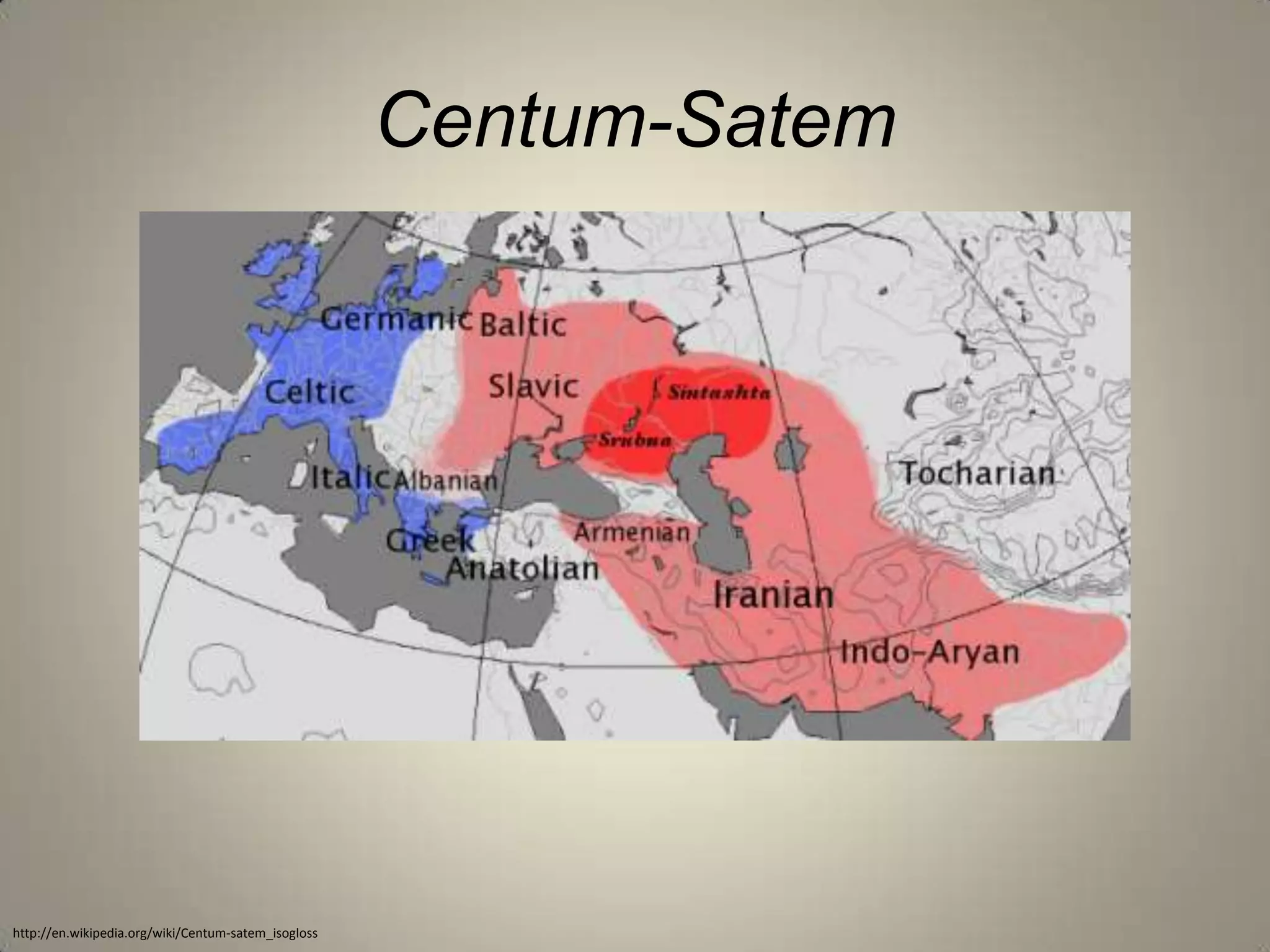
Centum-Satem


http://en.wikipedia.org/wiki/Centum-satem_isogloss
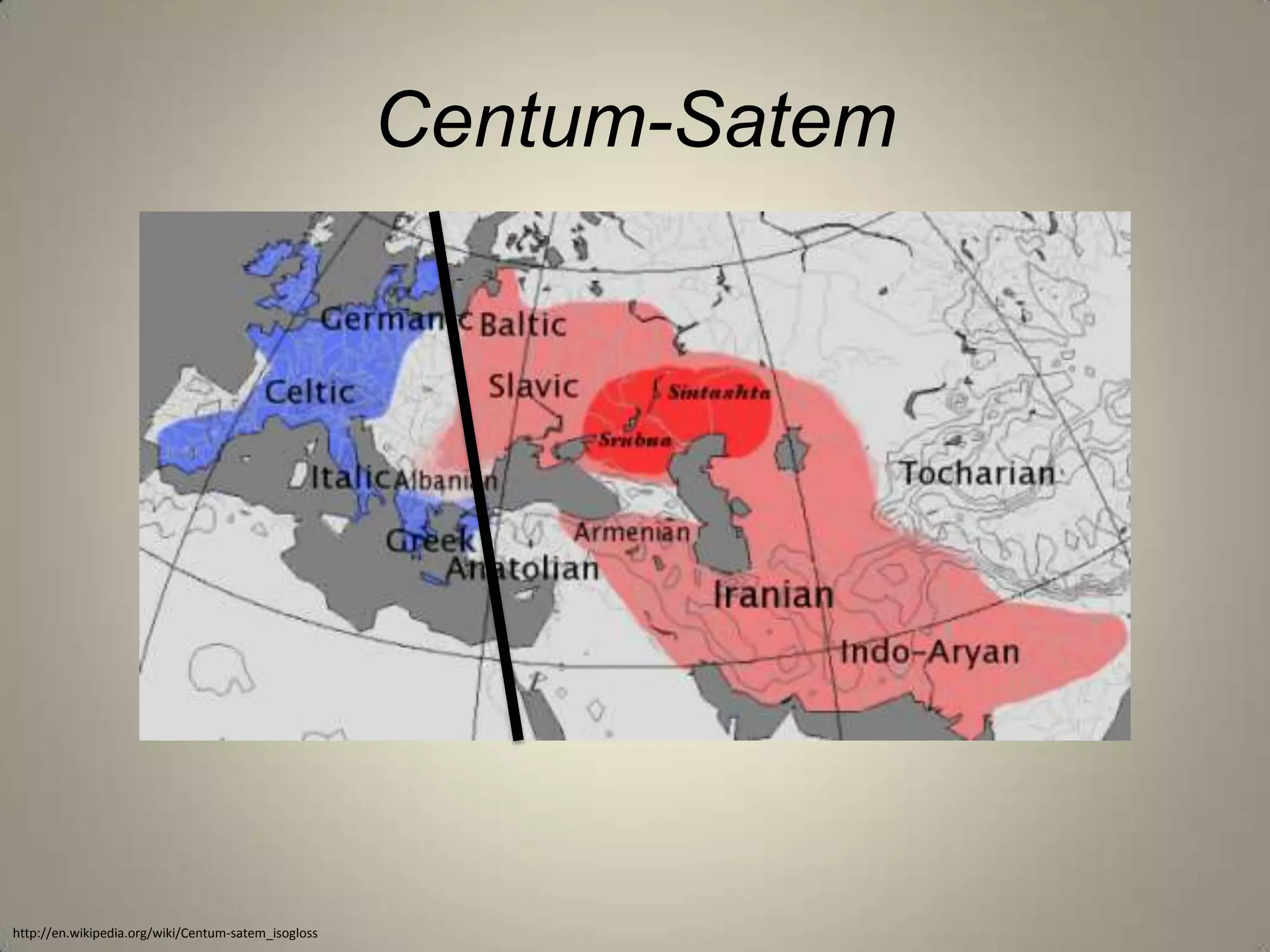
Centum-Satem


http://en.wikipedia.org/wiki/Centum-satem_isogloss
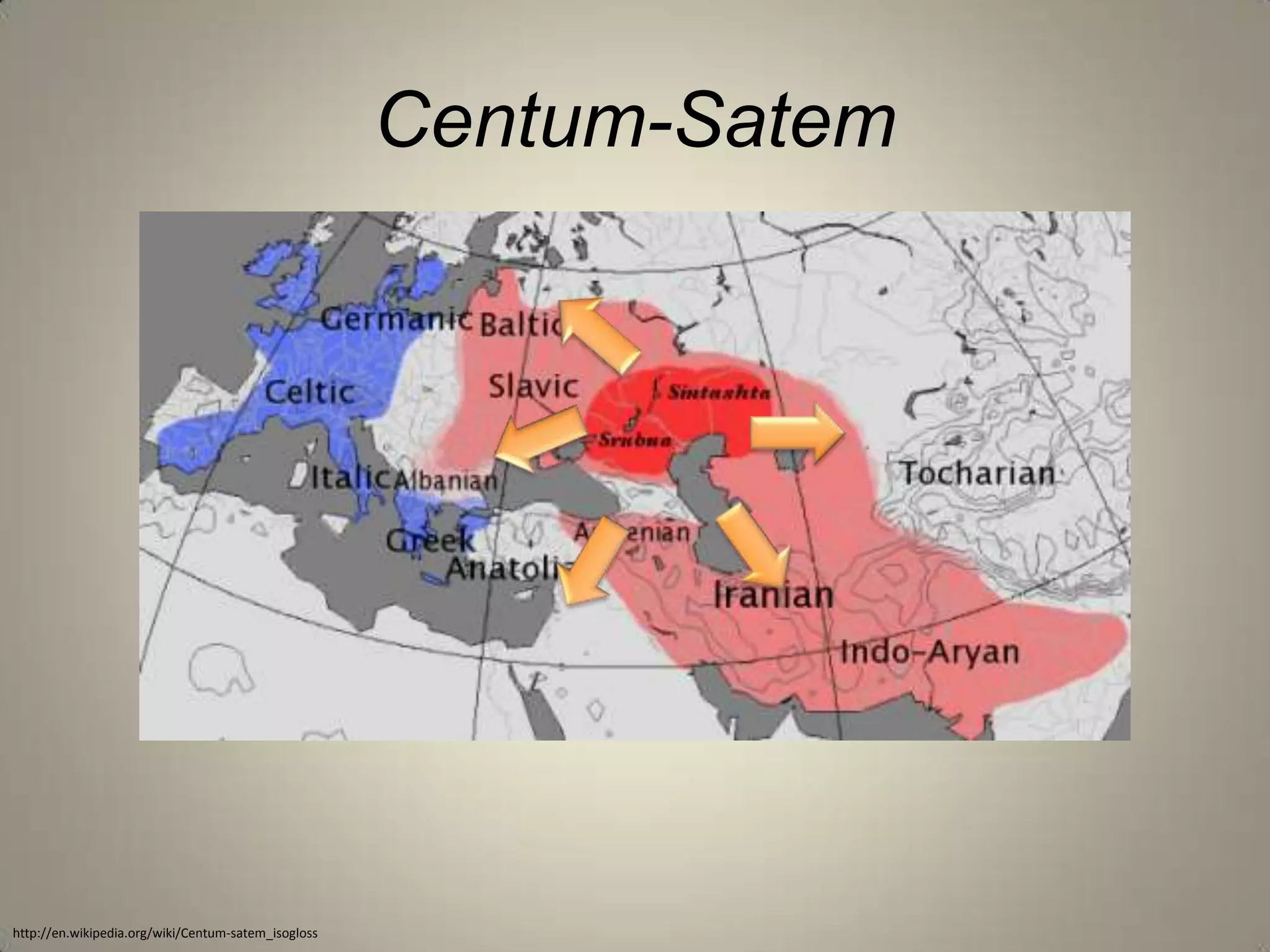
Centum-Satem


http://en.wikipedia.org/wiki/Centum-satem_isogloss
Outline


• Overall language complexity

• Possible language contact

• Changes in language use
Language Complexity


    All languages are equal.
Language Complexity


              All languages are equal.

All languages are equally complex in different ways.
Language Complexity


               All languages are equal.

 All languages are equally complex in different ways.

Language complexity differs across the board, but stays
                     the same.
Language Complexity


               All languages are equal.

 All languages are equally complex in different ways.

Language complexity differs across the board, but stays
                     the same.
Language Complexity


Overall complexity of a language may change over time.

Language Complexity as an Evolving Variable, Sampson
2009.
Language Complexity

Kupwar, India:

   • Urdu (IE)
   • Marathi (IE)
   • Kanneda (Dravidian)

Minimal lexical and phonological borrowings.
Language Complexity

Kupwar, India:

   • Urdu (IE)
   • Marathi (IE)
   • Kanneda (Dravidian)

Minimal lexical and phonological borrowings.

But syntactically: “the sentences can be seen as exact
calques of each other.” (Myers-Scotton 2002, 176)
Language Complexity

Tocharian has drastic changes in the:

   • syntax
   • morphology
   • lexically


This may have influenced the changes in the phonemic
inventory of the language.
Horizontal Transfer

Could Tocharian have been influenced by non-IE
languages, leading to the merge into [k]?
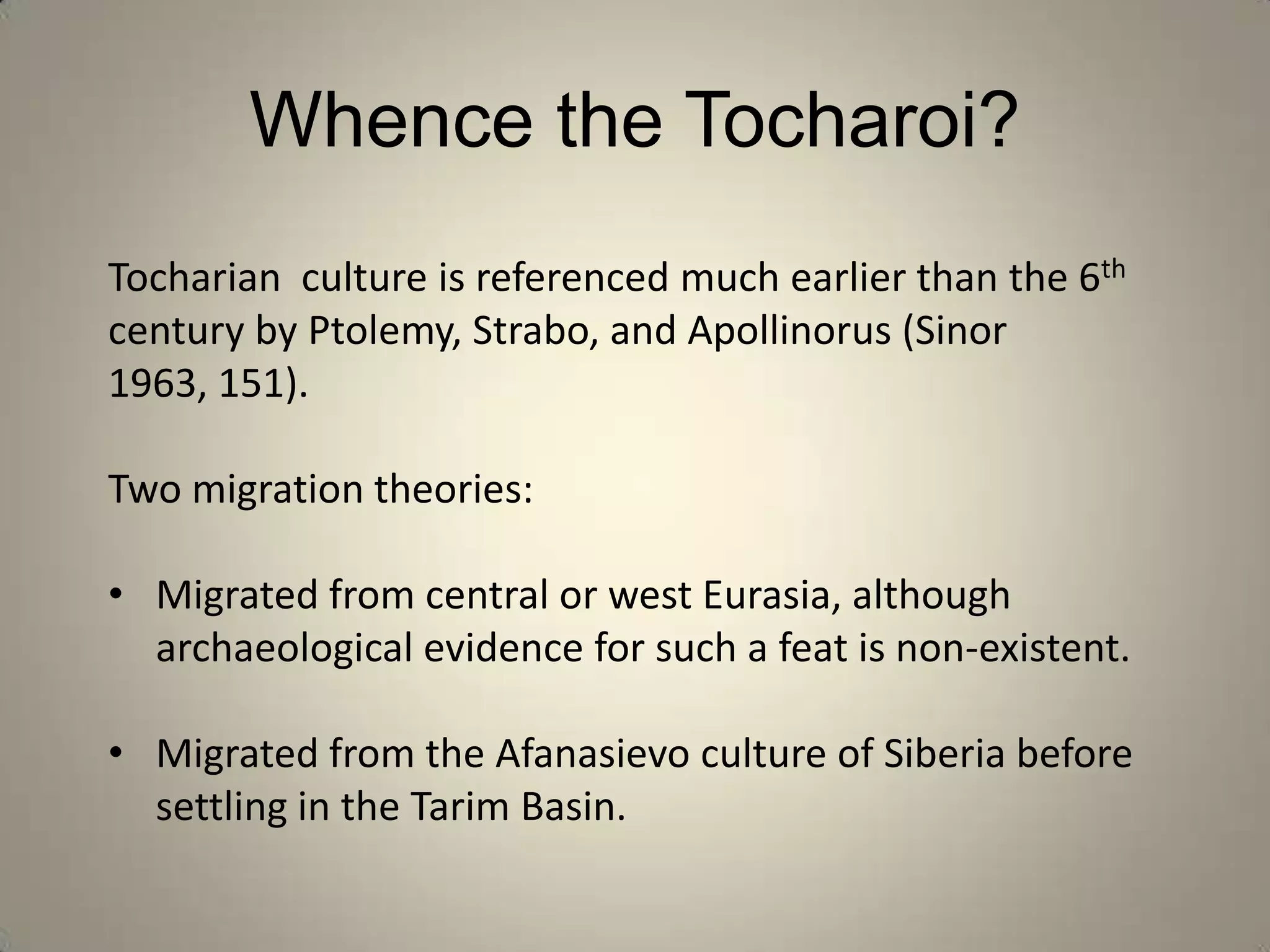
Whence the Tocharoi?
Tocharian culture is referenced much earlier than the 6th
century by Ptolemy, Strabo, and Apollinorus (Sinor
1963, 151).

Two migration theories:

• Migrated from central or west Eurasia, although
  archaeological evidence for such a feat is non-existent.

• Migrated from the Afanasievo culture of Siberia before
  settling in the Tarim Basin.
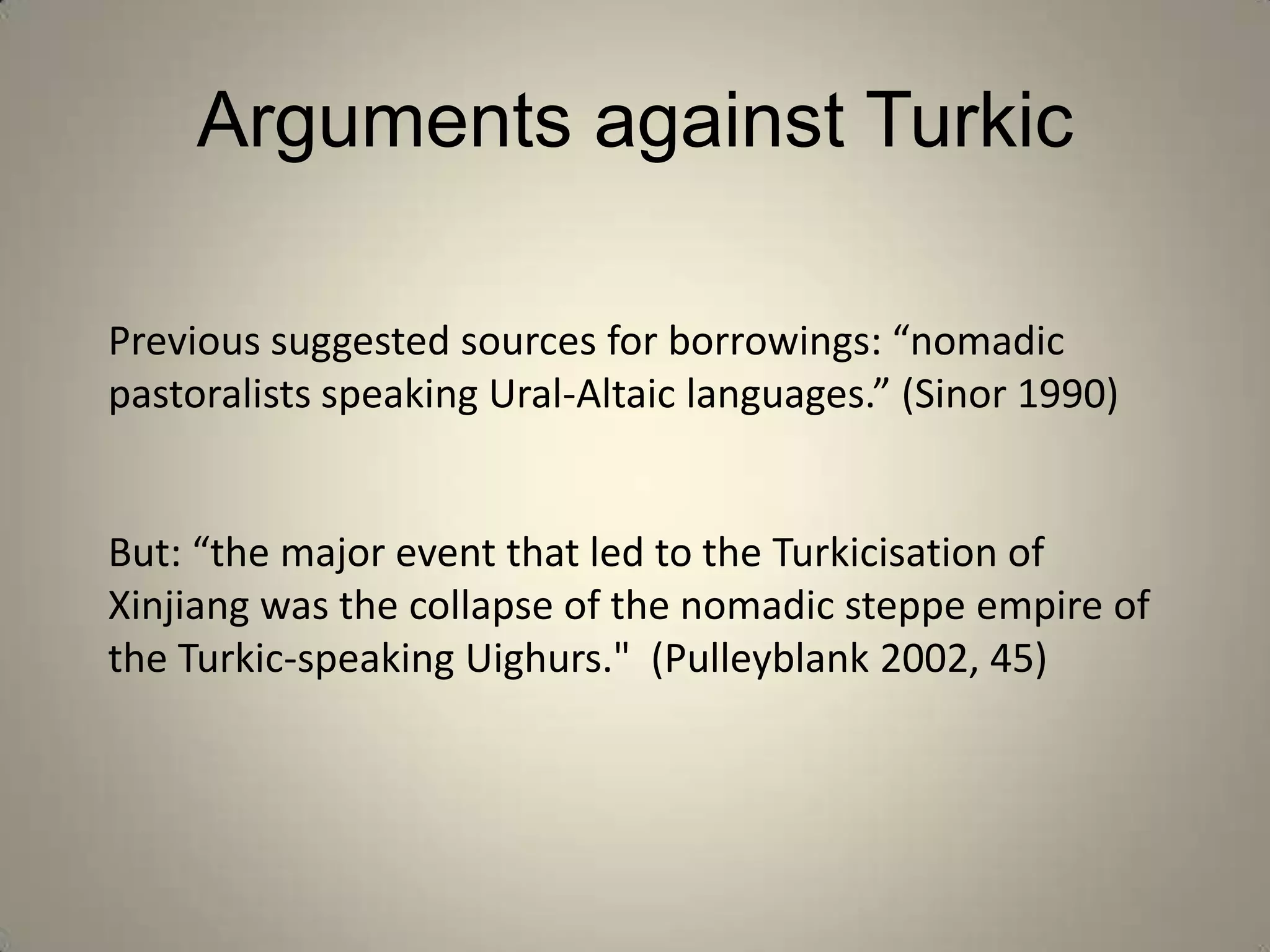
Arguments against Turkic

Previous suggested sources for borrowings: “nomadic
pastoralists speaking Ural-Altaic languages.” (Sinor 1990)


But: “the major event that led to the Turkicisation of
Xinjiang was the collapse of the nomadic steppe empire of
the Turkic-speaking Uighurs." (Pulleyblank 2002, 45)
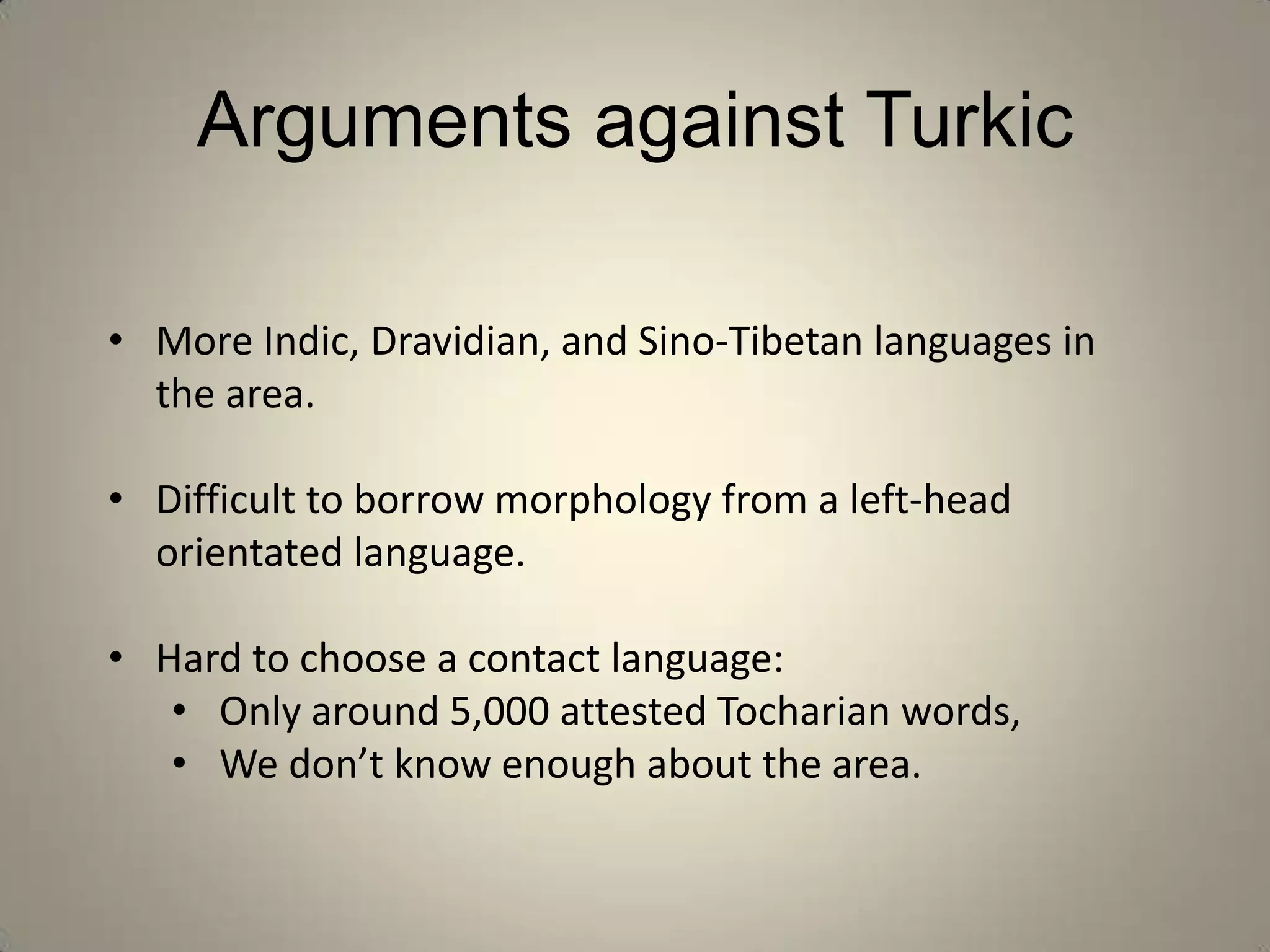
Arguments against Turkic

• More Indic, Dravidian, and Sino-Tibetan languages in
  the area.

• Difficult to borrow morphology from a left-head
  orientated language.

• Hard to choose a contact language:
   • Only around 5,000 attested Tocharian words,
   • We don’t know enough about the area.
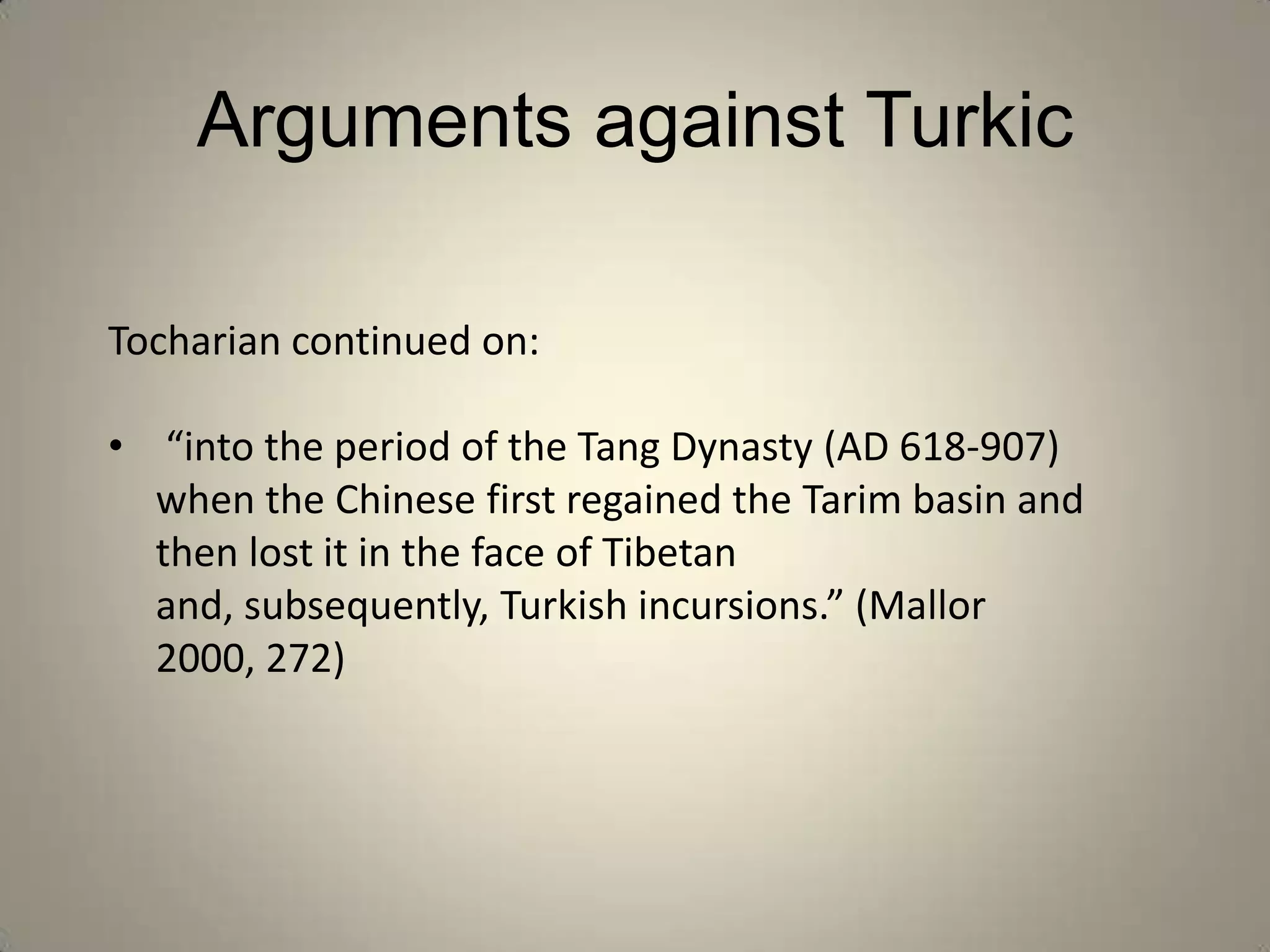
Arguments against Turkic

Tocharian continued on:

• “into the period of the Tang Dynasty (AD 618-907)
  when the Chinese first regained the Tarim basin and
  then lost it in the face of Tibetan
  and, subsequently, Turkish incursions.” (Mallor
  2000, 272)
Other Languages

Mithridates VI of Pontus reputedly knew all twenty-two
languages in his Anatolian empire.
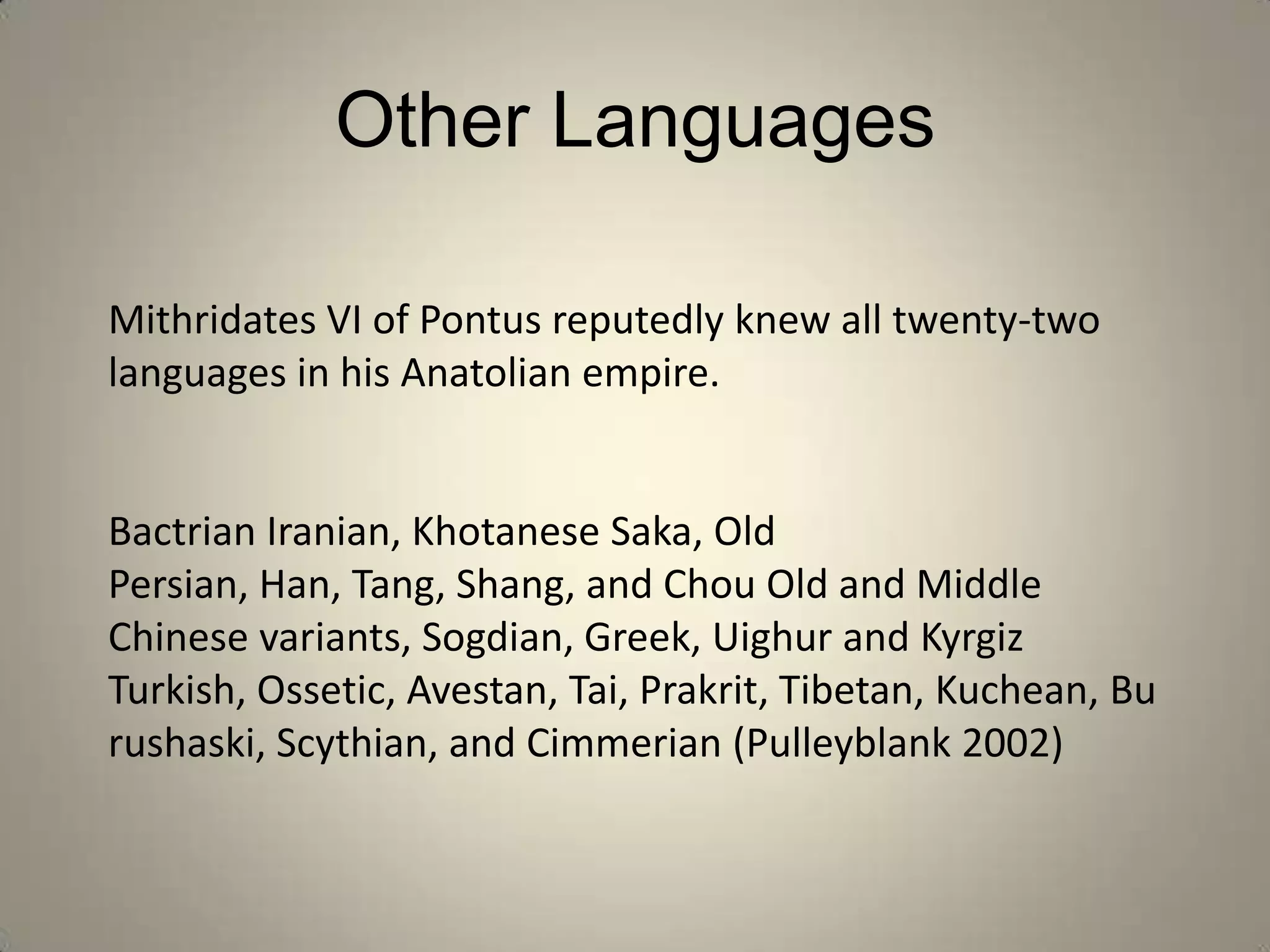
Other Languages

Mithridates VI of Pontus reputedly knew all twenty-two
languages in his Anatolian empire.


Bactrian Iranian, Khotanese Saka, Old
Persian, Han, Tang, Shang, and Chou Old and Middle
Chinese variants, Sogdian, Greek, Uighur and Kyrgiz
Turkish, Ossetic, Avestan, Tai, Prakrit, Tibetan, Kuchean, Bu
rushaski, Scythian, and Cimmerian (Pulleyblank 2002)
Maintaining Distinction

Ma’a:

• Has one idiosyncratic phoneme, a voiceless lateral
  fricative:


• “to emphasize the differentness of their other
  language, they sometimes introduce it into Bantu
  words.” (Thompson 2001)
Maintaining Distinction

The velar merging might then have been used as a way of
keeping distinct from other sounds in the region.


In the sprachbund of Mesopotamia and central
Asia, allophonic variants might have been minimalised to
retain maximum distinction.
Change in Domain

The merge may have occurred due a change in
Tocharian in general.
Change in Domain

The Tocharian population was never large, and may
have been influenced by the ‘founder effect.’ (cf
Atkinson 2011)
Change in Domain

Research correlates phonemic inventory size with
the size of the language community. (Hay and Bauer
2007)
Change in Domain

Tocharian already showed signs of decaying use:


Tocharian A is found almost exclusively in liturgical
documents.
Change in Domain

It is possible that a change in the size of the
community from a larger foundation, combined with
decay in use and horizontal transfer, may have led to
detrition of the phonemic system.
Conclusion

Tocharian may not have been susceptible to a weak
dialect wave, or to a possible early branching of IE.
References
•   Atkinson, Quentin (2011). Phonemic Diversity Supports a Serial Founder Effect Model of Language
    Expansion from Africa Science 332, 346.
•   Hay, J., and Bauer, L. (2007). Phoneme inventory size and population size. Language 83(2): 388–
    400.
•   Mallor, J.P., and Mair, Victor H. (2000). The Tarim Mummies. London: Thames and Hudson.
•   Myers-Scotton, Carol (2002). Contact Linguistics: Bilingual Encounters and Grammatical Outcomes.
    Oxford, UK: Oxford University Press.
•   Pulleyblank, Edwin G. (2002). Central Asia and Non-Chinese Peoples of Ancient China.
    Hampshire, UK: Ashgate.
•   Renfrew, Colin (1990). Archaeology and language. Cambridge: Cambridge University Press. ISBN
    9780521386753.
•   Sampson, Geoffrey, Gil, David, and Trudgill, Peter (ed.) (2009). Language Complexity as an Evolving
    Variable. Volume 13 of Studies in the Evolution of Language. Oxford, UK: Oxford University Press.
•   Sinor, Denis (1963). Introduction a` l’E tude de l’Asie Centale. Wiesbaden: Harrasowitz.
•   Sinor, Denis (ed.) (1990). The Cambridge History of Early Inner Asia. Cambridge, UK: SMC
    Publishing Inc.
•   Thomason, Sarah G. (2001). Language Contact. Edinburgh: Edinburgh University Press.
THANKS.

Questions?

On Tocharian Exceptionality to the centum/satem Isogloss

  • 1.
    On Tocharian Exceptionalityto the centum-satem Isogloss Richard Littauer MSc Saarland University | MA University of Edinburgh rlittauer.com | @richlitt http://en.wikipedia.org/wiki/Tocharians
  • 2.
  • 3.
  • 4.
  • 5.
  • 6.
    Centum-Satem Proto-Indoeuropean *kʷ *gʷ *gʷʰ (labiovelars) *k *g *gʰ ("plain velars") *ḱ *ǵ *ǵʰ ("palatovelars”)
  • 7.
    Centum-Satem Proto-Indoeuropean *kʷ *gʷ *gʷʰ (labiovelars) *k *g *gʰ ("plain velars") *ḱ *ǵ *ǵʰ ("palatovelars”) Centum group kʷ gʷ gʷʰ k g gʰ
  • 8.
    Centum-Satem Proto-Indoeuropean *kʷ *gʷ *gʷʰ (labiovelars) *k *g *gʰ ("plain velars") *ḱ *ǵ *ǵʰ ("palatovelars”) Centum group Satem group kʷ gʷ gʷʰ kʷ gʷ gʷʰ k g gʰ k g gʰ s z
  • 9.
  • 10.
  • 11.
  • 12.
    Outline • Overall languagecomplexity • Possible language contact • Changes in language use
  • 13.
    Language Complexity All languages are equal.
  • 14.
    Language Complexity All languages are equal. All languages are equally complex in different ways.
  • 15.
    Language Complexity All languages are equal. All languages are equally complex in different ways. Language complexity differs across the board, but stays the same.
  • 16.
    Language Complexity All languages are equal. All languages are equally complex in different ways. Language complexity differs across the board, but stays the same.
  • 17.
    Language Complexity Overall complexityof a language may change over time. Language Complexity as an Evolving Variable, Sampson 2009.
  • 18.
    Language Complexity Kupwar, India: • Urdu (IE) • Marathi (IE) • Kanneda (Dravidian) Minimal lexical and phonological borrowings.
  • 19.
    Language Complexity Kupwar, India: • Urdu (IE) • Marathi (IE) • Kanneda (Dravidian) Minimal lexical and phonological borrowings. But syntactically: “the sentences can be seen as exact calques of each other.” (Myers-Scotton 2002, 176)
  • 20.
    Language Complexity Tocharian hasdrastic changes in the: • syntax • morphology • lexically This may have influenced the changes in the phonemic inventory of the language.
  • 21.
    Horizontal Transfer Could Tocharianhave been influenced by non-IE languages, leading to the merge into [k]?
  • 22.
    Whence the Tocharoi? Tocharianculture is referenced much earlier than the 6th century by Ptolemy, Strabo, and Apollinorus (Sinor 1963, 151). Two migration theories: • Migrated from central or west Eurasia, although archaeological evidence for such a feat is non-existent. • Migrated from the Afanasievo culture of Siberia before settling in the Tarim Basin.
  • 23.
    Arguments against Turkic Previoussuggested sources for borrowings: “nomadic pastoralists speaking Ural-Altaic languages.” (Sinor 1990) But: “the major event that led to the Turkicisation of Xinjiang was the collapse of the nomadic steppe empire of the Turkic-speaking Uighurs." (Pulleyblank 2002, 45)
  • 24.
    Arguments against Turkic •More Indic, Dravidian, and Sino-Tibetan languages in the area. • Difficult to borrow morphology from a left-head orientated language. • Hard to choose a contact language: • Only around 5,000 attested Tocharian words, • We don’t know enough about the area.
  • 25.
    Arguments against Turkic Tochariancontinued on: • “into the period of the Tang Dynasty (AD 618-907) when the Chinese first regained the Tarim basin and then lost it in the face of Tibetan and, subsequently, Turkish incursions.” (Mallor 2000, 272)
  • 26.
    Other Languages Mithridates VIof Pontus reputedly knew all twenty-two languages in his Anatolian empire.
  • 27.
    Other Languages Mithridates VIof Pontus reputedly knew all twenty-two languages in his Anatolian empire. Bactrian Iranian, Khotanese Saka, Old Persian, Han, Tang, Shang, and Chou Old and Middle Chinese variants, Sogdian, Greek, Uighur and Kyrgiz Turkish, Ossetic, Avestan, Tai, Prakrit, Tibetan, Kuchean, Bu rushaski, Scythian, and Cimmerian (Pulleyblank 2002)
  • 28.
    Maintaining Distinction Ma’a: • Hasone idiosyncratic phoneme, a voiceless lateral fricative: • “to emphasize the differentness of their other language, they sometimes introduce it into Bantu words.” (Thompson 2001)
  • 29.
    Maintaining Distinction The velarmerging might then have been used as a way of keeping distinct from other sounds in the region. In the sprachbund of Mesopotamia and central Asia, allophonic variants might have been minimalised to retain maximum distinction.
  • 30.
    Change in Domain Themerge may have occurred due a change in Tocharian in general.
  • 31.
    Change in Domain TheTocharian population was never large, and may have been influenced by the ‘founder effect.’ (cf Atkinson 2011)
  • 32.
    Change in Domain Researchcorrelates phonemic inventory size with the size of the language community. (Hay and Bauer 2007)
  • 33.
    Change in Domain Tocharianalready showed signs of decaying use: Tocharian A is found almost exclusively in liturgical documents.
  • 34.
    Change in Domain Itis possible that a change in the size of the community from a larger foundation, combined with decay in use and horizontal transfer, may have led to detrition of the phonemic system.
  • 35.
    Conclusion Tocharian may nothave been susceptible to a weak dialect wave, or to a possible early branching of IE.
  • 36.
    References • Atkinson, Quentin (2011). Phonemic Diversity Supports a Serial Founder Effect Model of Language Expansion from Africa Science 332, 346. • Hay, J., and Bauer, L. (2007). Phoneme inventory size and population size. Language 83(2): 388– 400. • Mallor, J.P., and Mair, Victor H. (2000). The Tarim Mummies. London: Thames and Hudson. • Myers-Scotton, Carol (2002). Contact Linguistics: Bilingual Encounters and Grammatical Outcomes. Oxford, UK: Oxford University Press. • Pulleyblank, Edwin G. (2002). Central Asia and Non-Chinese Peoples of Ancient China. Hampshire, UK: Ashgate. • Renfrew, Colin (1990). Archaeology and language. Cambridge: Cambridge University Press. ISBN 9780521386753. • Sampson, Geoffrey, Gil, David, and Trudgill, Peter (ed.) (2009). Language Complexity as an Evolving Variable. Volume 13 of Studies in the Evolution of Language. Oxford, UK: Oxford University Press. • Sinor, Denis (1963). Introduction a` l’E tude de l’Asie Centale. Wiesbaden: Harrasowitz. • Sinor, Denis (ed.) (1990). The Cambridge History of Early Inner Asia. Cambridge, UK: SMC Publishing Inc. • Thomason, Sarah G. (2001). Language Contact. Edinburgh: Edinburgh University Press.
  • 37.