Historical Linguistics And Endangered Languages
Exploring Diversity In Language Change 1st
Edition download
https://ebookbell.com/product/historical-linguistics-and-
endangered-languages-exploring-diversity-in-language-change-1st-
edition-36858076
Explore and download more ebooks at ebookbell.com
Here are some recommended products that we believe you will be
interested in. You can click the link to download.
Historical Linguistics And Biblical Hebrew Steps Toward An Integrated
Approach 1st Edition Robert Rezetko Ian Young
https://ebookbell.com/product/historical-linguistics-and-biblical-
hebrew-steps-toward-an-integrated-approach-1st-edition-robert-rezetko-
ian-young-51380882
Historical Linguistics And Philology Of Central Asia Essays In Turkic
And Mongolic Studies 1st Edition Bayarma Khabtagaeva
https://ebookbell.com/product/historical-linguistics-and-philology-of-
central-asia-essays-in-turkic-and-mongolic-studies-1st-edition-
bayarma-khabtagaeva-38476424
Historical Linguistics And The Comparative Study Of African Languages
Gerrit J Dimmendaal
https://ebookbell.com/product/historical-linguistics-and-the-
comparative-study-of-african-languages-gerrit-j-dimmendaal-5850428
Studies In Historical Linguistics And Language Change
Grammaticalization Refunctionalization And Beyond Dorien
Nieuwenhuijsen Mar Garachana
https://ebookbell.com/product/studies-in-historical-linguistics-and-
language-change-grammaticalization-refunctionalization-and-beyond-
dorien-nieuwenhuijsen-mar-garachana-36371114
Historical Linguistics Theory And Method 1st Edition Mark Hale
https://ebookbell.com/product/historical-linguistics-theory-and-
method-1st-edition-mark-hale-2557852
Historical Romance Linguistics Retrospective And Perspectives 1st
Randall Gess Ed
https://ebookbell.com/product/historical-romance-linguistics-
retrospective-and-perspectives-1st-randall-gess-ed-4726390
Sociohistorical Linguistics Its Status And Methodology 1st Edition
Suzanne Romaine
https://ebookbell.com/product/sociohistorical-linguistics-its-status-
and-methodology-1st-edition-suzanne-romaine-1800528
Transhimalayan Linguistics Historical And Descriptive Linguistics Of
The Himalayan Area Thomas Owensmith Editor Nathan W Hill Editor
https://ebookbell.com/product/transhimalayan-linguistics-historical-
and-descriptive-linguistics-of-the-himalayan-area-thomas-owensmith-
editor-nathan-w-hill-editor-50266696
Transhimalayan Linguistics Historical And Descriptive Linguistics Of
The Himalayan Area Thomas Owensmith
https://ebookbell.com/product/transhimalayan-linguistics-historical-
and-descriptive-linguistics-of-the-himalayan-area-thomas-
owensmith-5558478
i
Historical Linguistics and
Endangered Languages
This collection showcases the contributions of the study of endangered
and understudied languages to historical linguistic analysis, and the broader
relevance of diachronic approaches toward developing better informed
approaches to language documentation and description.
The volume brings together perspectives from both established and up-​
and-​
coming scholars and represents a globally and linguistically diverse
range of languages. The collected papers demonstrate the ways in which
endangered languages can challenge existing models of language change
based on more commonly studied languages, and can generate innovative
insights into linguistic phenomena such as pathways of grammaticalization,
forms and dynamics of contact-​
driven change, and the diachronic relation-
ship between lexical and grammatical categories. In so doing, the book
highlights the idea that processes and outcomes of language change long
held to be universally relevant may be more sensitive to cultural and typo-
logical variability than previously assumed.
Taken as a whole, this collection brings together perspectives from lan-
guage documentation and historical linguistics to point the way forward for
richer understandings of both language change and documentary-​
descriptive
approaches, making this key reading for scholars in these fields.
Patience Epps is Professor of Linguistics at the University of Texas at
Austin, USA.
Danny Law is Associate Professor of Linguistics at the University of Texas
at Austin, USA.
Na’ama Pat-​El is Professor of Middle Eastern Studies at the University of
Texas at Austin, USA.
ii
Routledge Studies in Historical Linguistics
Edited by Claire Bowern,Yale University, USA
The Diachrony of Verb Meaning
Aspect and Argument Structure
Elly van Gelderen
Advances in Proto-​
Basque Reconstruction with Evidence for the
Proto-​Indo-​European-​Euskarian Hypothesis
Juliette Blevins
Historical Linguistics and Endangered Languages
Exploring Diversity in Language Change
Patience Epps, Danny Law and Na’ama Pat-​
El
For more information about this series, please visit: https://​www.routledge.
com/​Routledge-​Studies-​in-​Historical-​Linguistics/​book-​series/​RSHL
iii
Historical Linguistics and
Endangered Languages
Exploring Diversity in Language Change
Edited by Patience Epps,
Danny Law and Na’ama Pat-​
El
i
v
First published 2022
by Routledge
605 Third Avenue, NewYork, NY 10158
and by Routledge
2 Park Square, Milton Park,Abingdon, Oxon OX14 4RN
Routledge is an imprint of theTaylor & Francis Group, an informa business
© 2022 Taylor & Francis
The right of Patience Epps, Danny Law and Na’ama Pat-​
El to be identified as the
authors of the editorial material, and of the authors for their individual chapters,
has been asserted in accordance with sections 77 and 78 of the Copyright,
Designs and Patents Act 1988.
All rights reserved. No part of this book may be reprinted or reproduced or utilised
in any form or by any electronic, mechanical, or other means, now known or
hereafter invented, including photocopying and recording, or in any information
storage or retrieval system, without permission in writing from the publishers.
Trademark notice: Product or corporate names may be trademarks or registered trademarks,
and are used only for identification and explanation without intent to infringe.
Library of Congress Cataloging-​
in-​
Publication Data
Names: Epps, Patience, 1973– editor. | Law, Danny, 1980–​editor. |
Pat-​
El, Na’ama, editor. | International Conference on Historical Linguistics
(23rd: 2017: San Antonio,Tex.)
Title: Historical linguistics and endangered languages: exploring diversity in
language change /​edited by Patience Epps, Danny Law, and Na’ama Pat-​
El.
Description: NewYork, NY: Routledge, 2021. |
Series: Routledge studies in historical linguistics |
Chapters are based on presentations held at the panel Endangered
Languages and Historical Linguistics, organized as part of the International
Conference of Historical Linguistics held in San Antonio,Texas in August 2017. |
Includes bibliographical references and index. |
Identifiers: LCCN 2021003400 (print) | LCCN 2021003401 (ebook)
Subjects: LCSH: Endangered languages―Congresses. |
Linguistic change―Congresses. | Language and languages―
Variation―Congresses. | Historical linguistics―Congresses.
Classification: LCC P40.5.E53 H58 2021 (print) |
LCC P40.5.E53 (ebook) | DDC 306.44–​
dc23
LC record available at https://​lccn.loc.gov/​2021003400
LC ebook record available at https://​lccn.loc.gov/​2021003401
ISBN: 978-​0-​367-​14127-​1 (hbk)
ISBN: 978-​1-​032-​04129-​2 (pbk)
ISBN: 978-​0-​429-​03039-​0 (ebk)
DOI: 10.4324/9780429030390
Typeset in Bembo
by Newgen Publishing UK
v
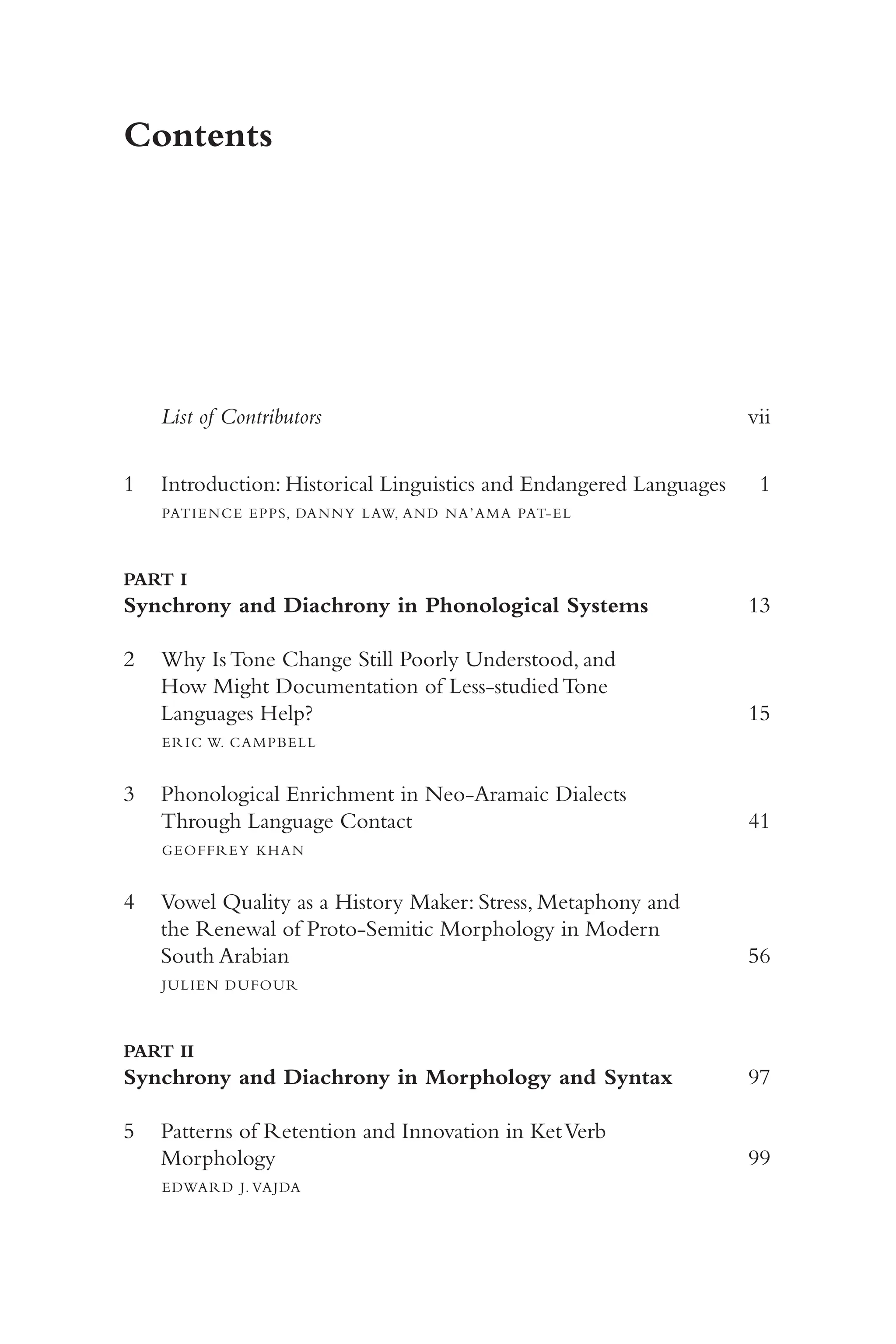
Contents
List of Contributors 	 vii
1 Introduction: Historical Linguistics and Endangered Languages 	
1
PATIENCE EPPS, DANNY LAW, AND NA’AMA PAT-​
EL
PART I
Synchrony and Diachrony in Phonological Systems 	 13
2 Why Is Tone Change Still Poorly Understood, and
How Might Documentation of Less-​
studied Tone
Languages Help? 	 15
ERIC W. CAMPBELL
3 Phonological Enrichment in Neo-​
Aramaic Dialects
Through Language Contact 	 41
GEOFFREY KHAN
4 Vowel Quality as a History Maker: Stress, Metaphony and
the Renewal of Proto-​
Semitic Morphology in Modern
South Arabian 	 56
JULIEN DUFOUR
PART II
Synchrony and Diachrony in Morphology and Syntax 	 97
5 Patterns of Retention and Innovation in KetVerb
Morphology 	 99
EDWARD J. VAJDA
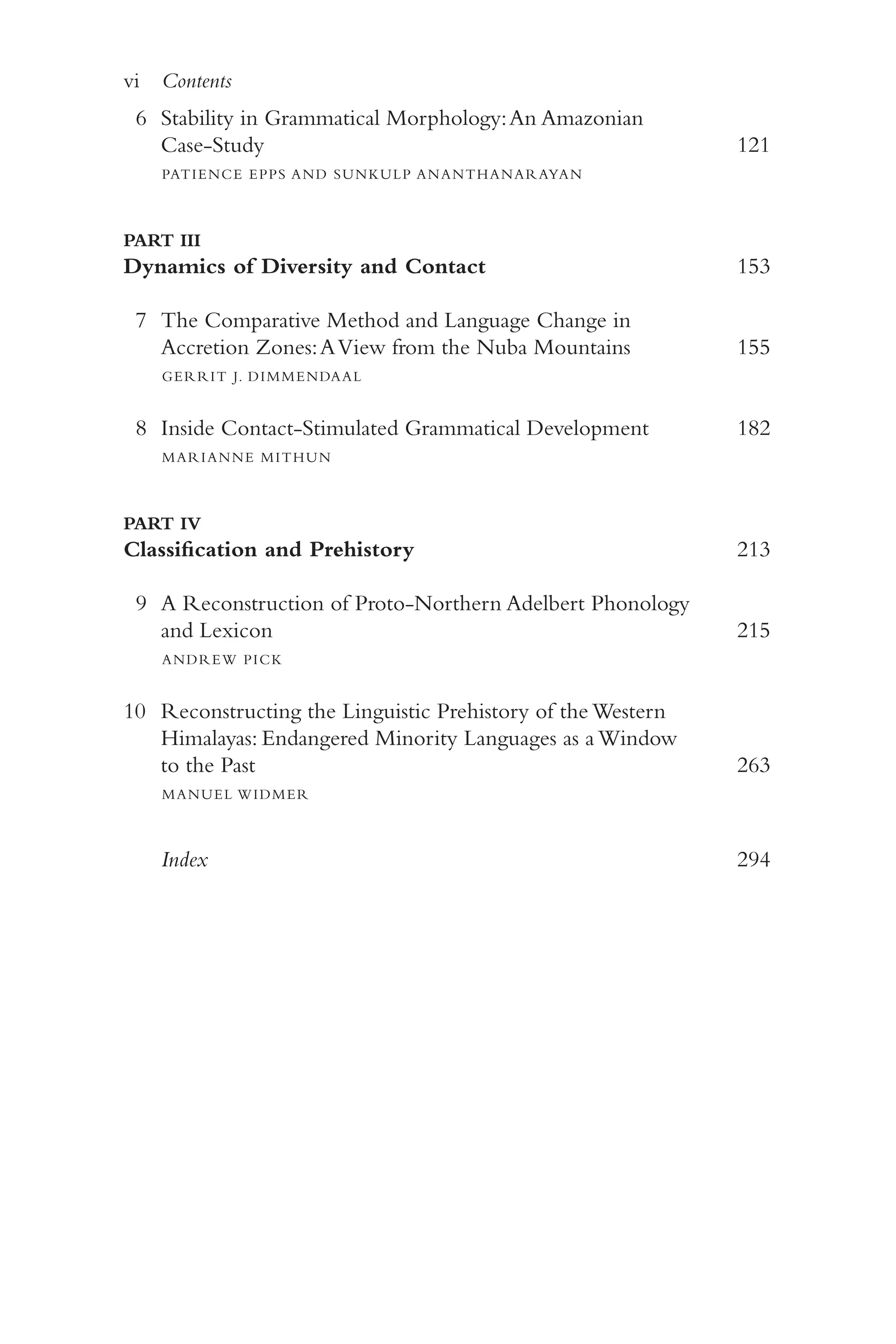
vi Contents
v
i
6 Stability in Grammatical Morphology:An Amazonian
Case-​Study 	 121
PATIENCE EPPS AND SUNKULP ANANTHANARAYAN
PART III
Dynamics of Diversity and Contact 	 153
7 The Comparative Method and Language Change in
Accretion Zones:AView from the Nuba Mountains 	 155
GERRIT J. DIMMENDAAL
8 Inside Contact-​
Stimulated Grammatical Development 	 182
MARIANNE MITHUN
PART IV
Classification and Prehistory 	 213
9 A Reconstruction of Proto-​
Northern Adelbert Phonology
and Lexicon 	 215
ANDREW PICK
10 Reconstructing the Linguistic Prehistory of the Western
Himalayas: Endangered Minority Languages as a Window
to the Past 	 263
MANUEL WIDMER
Index 	 294
v
i
i
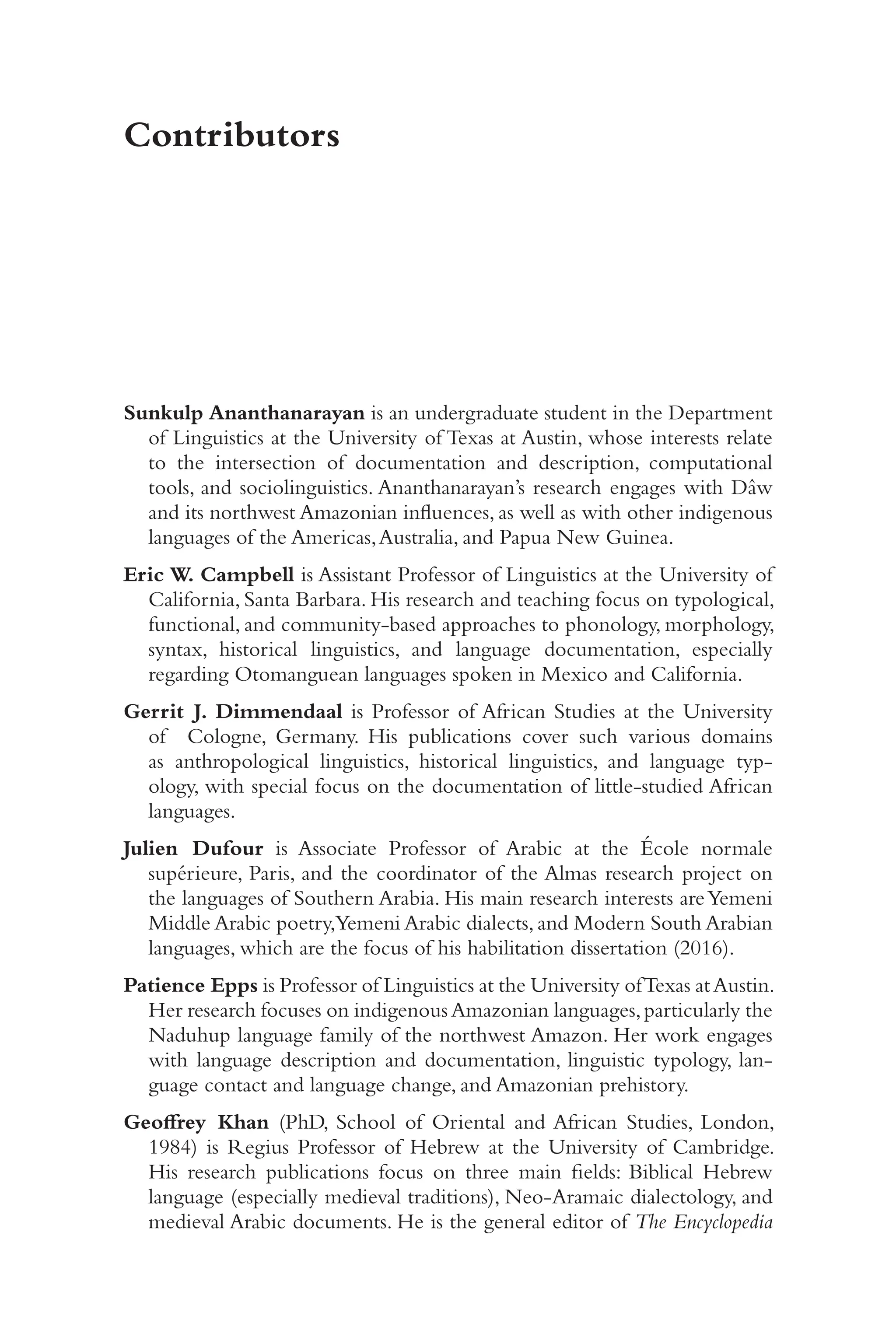
Contributors
Sunkulp Ananthanarayan is an undergraduate student in the Department
of Linguistics at the University of Texas at Austin, whose interests relate
to the intersection of documentation and description, computational
tools, and sociolinguistics. Ananthanarayan’s research engages with Dâw
and its northwest Amazonian influences, as well as with other indigenous
languages of the Americas,Australia, and Papua New Guinea.
Eric W. Campbell is Assistant Professor of Linguistics at the University of
California, Santa Barbara. His research and teaching focus on typological,
functional, and community-​
based approaches to phonology, morphology,
syntax, historical linguistics, and language documentation, especially
regarding Otomanguean languages spoken in Mexico and California.
Gerrit J. Dimmendaal is Professor of African Studies at the University
of Cologne, Germany. His publications cover such various domains
as anthropological linguistics, historical linguistics, and language typ-
ology, with special focus on the documentation of little-​
studied African
languages.
Julien Dufour is Associate Professor of Arabic at the École normale
supérieure, Paris, and the coordinator of the Almas research project on
the languages of Southern Arabia. His main research interests areYemeni
Middle Arabic poetry,Yemeni Arabic dialects, and Modern South Arabian
languages, which are the focus of his habilitation dissertation (2016).
Patience Epps is Professor of Linguistics at the University ofTexas atAustin.
Her research focuses on indigenousAmazonian languages,particularly the
Naduhup language family of the northwest Amazon. Her work engages
with language description and documentation, linguistic typology, lan-
guage contact and language change, and Amazonian prehistory.
Geoffrey Khan (PhD, School of Oriental and African Studies, London,
1984) is Regius Professor of Hebrew at the University of Cambridge.
His research publications focus on three main fields: Biblical Hebrew
language (especially medieval traditions), Neo-​
Aramaic dialectology, and
medieval Arabic documents. He is the general editor of The Encyclopedia
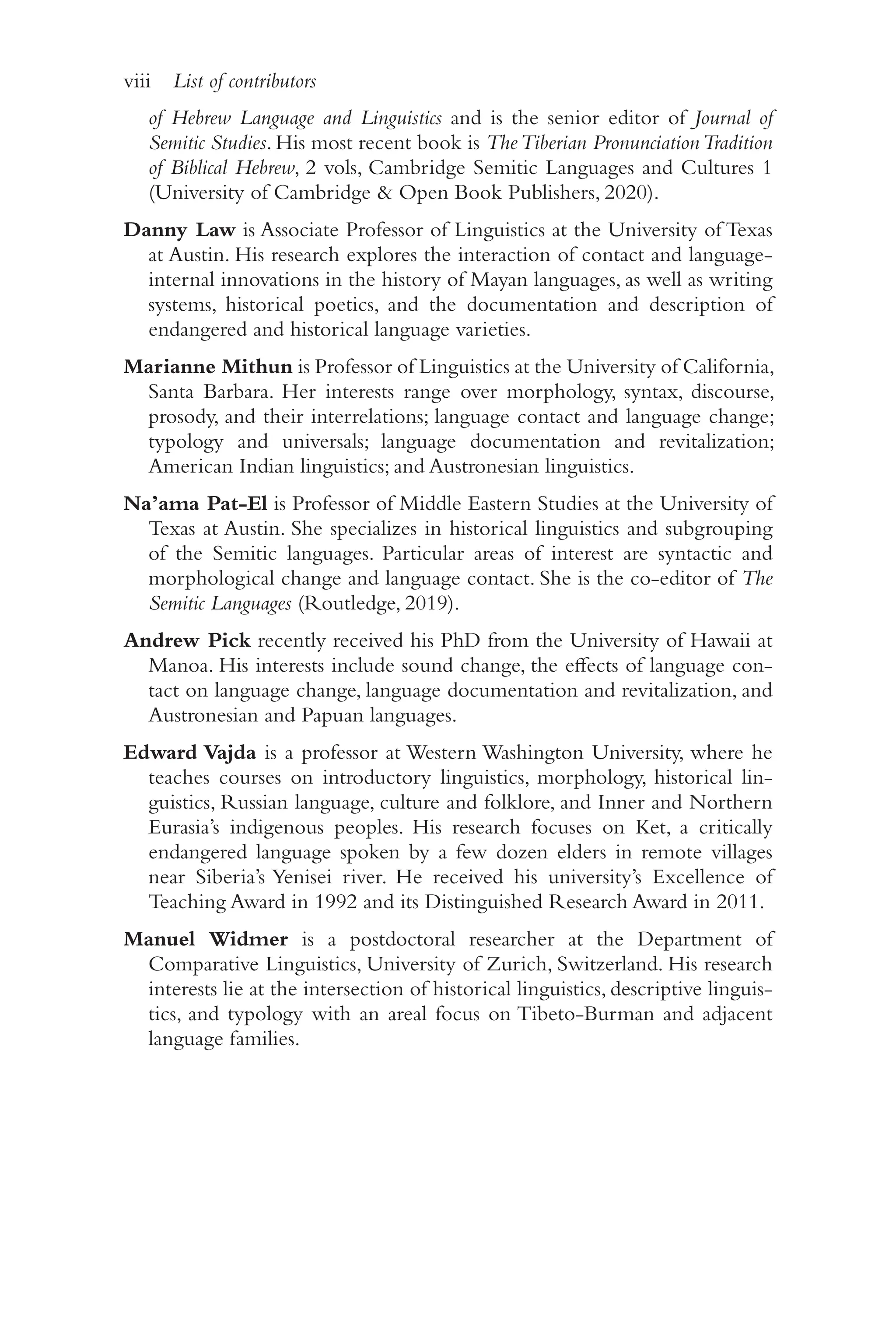
viii List of contributors
v
i
i
i
of Hebrew Language and Linguistics and is the senior editor of Journal of
Semitic Studies. His most recent book is TheTiberian PronunciationTradition
of Biblical Hebrew, 2 vols, Cambridge Semitic Languages and Cultures 1
(University of Cambridge & Open Book Publishers, 2020).
Danny Law is Associate Professor of Linguistics at the University of Texas
at Austin. His research explores the interaction of contact and language-​
internal innovations in the history of Mayan languages, as well as writing
systems, historical poetics, and the documentation and description of
endangered and historical language varieties.
Marianne Mithun is Professor of Linguistics at the University of California,
Santa Barbara. Her interests range over morphology, syntax, discourse,
prosody, and their interrelations; language contact and language change;
typology and universals; language documentation and revitalization;
American Indian linguistics; and Austronesian linguistics.
Na’ama Pat-​El is Professor of Middle Eastern Studies at the University of
Texas at Austin. She specializes in historical linguistics and subgrouping
of the Semitic languages. Particular areas of interest are syntactic and
morphological change and language contact. She is the co-​
editor of The
Semitic Languages (Routledge, 2019).
Andrew Pick recently received his PhD from the University of Hawaii at
Manoa. His interests include sound change, the effects of language con-
tact on language change, language documentation and revitalization, and
Austronesian and Papuan languages.
Edward Vajda is a professor at Western Washington University, where he
teaches courses on introductory linguistics, morphology, historical lin-
guistics, Russian language, culture and folklore, and Inner and Northern
Eurasia’s indigenous peoples. His research focuses on Ket, a critically
endangered language spoken by a few dozen elders in remote villages
near Siberia’s Yenisei river. He received his university’s Excellence of
Teaching Award in 1992 and its Distinguished Research Award in 2011.
Manuel Widmer is a postdoctoral researcher at the Department of
Comparative Linguistics, University of Zurich, Switzerland. His research
interests lie at the intersection of historical linguistics, descriptive linguis-
tics, and typology with an areal focus on Tibeto-​
Burman and adjacent
language families.
newgenprepdf
1
DOI: 10.4324/9780429030390-1
1	
Introduction
Historical Linguistics and Endangered
Languages1
Patience Epps, Danny Law and Na’ama Pat-​
El
The discipline of historical linguistics engages with the intersection of the
particular and the general –​the individual histories of specific languages
and the features that define them, and the universal processes and cross-​
linguistic tendencies that characterize language change. Our reconstructions
of particular linguistic histories rely heavily on the predictive power of our
generalizations, drawing on such observations as the tendency for stops
to give rise to fricatives, and spatial expressions to temporal ones. These
generalizations are thus expected to be comprehensive, substantiated, and
well established.Yet they have tended to be heavily based on observations
drawn from languages that are relatively well studied within the European
tradition, and especially on languages with long written histories –​centered
primarily on the Indo-​
European language family, which is still the focus of
much historical work.
Many widely held views concerning possible and probable pathways and
mechanisms of language change have thus taken shape with reference to
only a small fraction of the world’s language families,geographic regions,and
sociocultural contexts.Yet just as larger comparative data sets indicate that
some features of Indo-​
European languages, such as relative pronouns and
subject-​
verb inversion in questions, are in fact quite rare cross-​
linguistically
(see e.g. Comrie 2006; Haspelmath 2001), the same is presumably also true
of the particular pathways of change through which these and many other
features emerge.The converse is also likely, in that some cross-​
linguistically
relevant mechanisms of change may seem vanishingly rare from an Indo-​
European perspective. Similarly, non-​
European languages with only modern
attestations,such as many languages ofAfrica and theAmericas,have received
far less robust diachronic inquiry than languages with a longer written his-
tory, such as Chinese.Thus one is more likely to find insights on processes
of language change in the literature on Indo-​
European or Sino-​
Tibetan
languages than in the literature on Chadic languages;and such insights are in
turn used to support historical analyses that may be applied far beyond the
languages or language families from which the generalizations derive (Pat-​
El
2020). One need only look as far as glottochronology, with its assumption
of constant rates of replacement in basic vocabulary, for an example of an
2 Patience Epps, Danny Law and Na’ama Pat-El
2
initiative that was based largely on Indo-​
European languages and quickly
foundered when its scope was expanded (Lees 1953; Bergsland and Vogt
1962; Guy 1983). A paucity of well-​
informed research on lesser-​
studied
languages has consequences.
Such questions of variability across languages and regions relate to the
notion of ‘uniformitarianism’ in language change, and to its predictive
power. As Walkden (2019) points out, while methodological uniformitar-
ianism (‘actualism’) remains a key operational null hypothesis for historical
linguists –​as it is leveraged by the authors in this volume –​more substan-
tive assumptions relating to uniformity across states, rates, and outcomes of
change are difficult to sustain.As we gain insights into the diversity of geo-
graphic regions, population histories, sociocultural contexts, and typological
profiles of the world’s languages, we may raise more nuanced questions
regarding characterizations like that of Labov (1972: 275):“the forces oper-
ating to produce linguistic change today are of the same kind and order of
magnitude as those which operated five or ten thousand years ago”; and of
Lass (1997:29):“the (global,cross-​
linguistic) likelihood of any linguistic state
of affairs (structure,inventory,process,etc.) has always been roughly the same
as it is now” (see Trudgill 2011).As more and more languages from under-​
documented regions and language families are brought into the scope of
our investigation, we face mounting questions about how our observations
relating to uniformity must interact with those of variability across languages,
regions, and time periods –​and what this diversity implies for our ability to
make robust and specific predictions about the rates,pathways,and outcomes
associated with language change (Janda and Joseph 2003; Newmeyer 2002;
Bergs 2012; Blasi et al. 2019). These questions in turn allow us to refine
our toolkit, honing our understanding of what in fact is uniform across
languages, and of how our methods should reflect this.
As the chapters in this volume explore, a full response to the questions
raised here requires broad and empirically based exploration.It has long been
recognized that evidence from understudied languages both complicates
and enhances our understanding of linguistic processes and taxonomies
(Haspelmath 2007).And just as documentary linguistics has been shifting the
focus of linguistic typology from absolute universals to tendencies, work on
understudied languages and varieties is providing new insights concerning
the dynamics of language change and the structure and fabric of global lin-
guistic diversity (Evans and Levinson 2009; Epps 2010).
Recent decades have seen an explosion of work focused on the docu-
mentation and description of endangered and lesser-​
studied languages, with
many initiatives led by and/​
or carried out in close collaboration with their
speakers and community members.At the same time,however,there has been
a sharp increase in the rates of language endangerment and loss: Of some
7000 languages spoken worldwide today, 45% of these can be considered
endangered, and nearly a quarter of the world’s approximately 420 known
language families are now without speakers (L. Campbell 2016: 256; see also
Krauss 1992, inter alia).
Introduction 3
3
Just as more linguistic evidence is bound to contribute to a more nuanced
understanding of the mechanisms of language change, the loss of linguistic
diversity robs us of the diversity of that linguistic evidence.This point holds
not only on the level of languages and language families, but from a more
fine-​
grained perspective as well –​a dwindling speaker population is likely
to drastically reduce or alter patterns of variation within a given speech
community, which may relate directly to processes of language change
(Weinreich, Labov, and Herzog 1968; Labov 1994, inter alia). In addition, as
an integral part of a larger cultural and expressive ecology, languages com-
municate and reproduce aspects of the cultural context in which they are
spoken;and the loss of languages,varieties,styles,and registers entails the loss
of key aspects of the cultural context in which to understand and interpret
language change (Woodbury 1993). Recent decades have seen a return to
a focus on language in its cultural context, and an interest in how grammar
and lexicon intersect with discourse and verbal art (see e.g. Epps,Webster,
and Woodbury 2017).A deeper awareness of language history in its cultural
context may also be meaningful for the communities in which the languages
are spoken, as we observe below.
As we add to our knowledge of understudied and endangered languages,
we come across more and more novel and important insights concerning
pathways of grammaticalization, forms and dynamics of contact-​
driven
change, and further diachronic relationships among lexical and grammatical
categories. In many cases, these new data provide additional support to our
understanding of cross-​
linguistically established processes and methods, and
help to confirm previous predictions. In a particularly celebrated example,
data from Swampy Cree corroborated Bloomfield’s (1925,1928) reconstruc-
tion of an additional consonant cluster in Central Algonquian, attested in its
sister languages only via a distinct correspondence pattern.Another example
can be seen in Bowern et al.’s (2011) finding that lexical borrowing rates
among hunter-​
gatherer languages are broadly consistent with borrowing
rates cross-​
linguistically, despite prior proposals to the contrary. Data from
such understudied languages provide a plethora of new opportunities to
apply the Comparative Method, and to test its limits (see Pick, this volume).
Studies of diachrony in endangered languages are also expanding our
understanding of the range of trajectories of change, and of the diver-
sity of possible sources for emergent morphological forms and categories.
For example, Gerdts and Hinkson (2004) show that the dative applicative
in Halkomelem (Salishan, North America) derives from a noun meaning
‘face,’ a previously undocumented source for an applicative. Epps (2008)
demonstrates that the future tense marker in Hup (Naduhupan family,
Amazonia) derives ultimately from a noun meaning ‘stick, wood’ –​a source
that appears highly improbable at first glance, but is in fact consistent with
our wider understanding of diachronic pathways in each of the steps that
connected these two endpoints in a grammaticalization chain (from noun
 classifier  nominalizer  purpose adverbial  future tense marker).
Phonological systems can also reveal diachronic surprises,as seen in Dufour’s
4 Patience Epps, Danny Law and Na’ama Pat-El
4
(this volume) exploration of a typologically unusual form of interaction
between stress and vowel quality.
Some of these insights do more than simply corroborate or expand our
understanding of the dynamics of change; they may also challenge our
assumptions about the universality of particular rates and pathways. Work
on endangered and understudied languages is feeding a growing list of ways
in which processes of language change are sensitive to social, cultural, and/​
or typological variables. For example, Sweetser’s (1990) generalization that
verbs of visual perception (i.e. ‘see’) are the principal source of cognition
verbs (‘think,’ ‘know,’ etc.) was taken to be a universal fact about human
language, though based on a sample of mostly Indo-​
European languages.
However,Evans andWilkins (2000) demonstrate that in Australian languages
the primary source is aural perception (‘hear’), and observe that this pathway
is correlated with a prioritization of hearing over seeing in many aspects
of aboriginal Australian cultures. Similarly, we find mounting evidence that
the frequencies of particular diachronic pathways vary non-​
trivially with
typological profiles, which may be regionally variable, such that routes of
change common in languages of Eurasia may be less accessible in other parts
of the world, and vice versa (see Newmeyer 2002; Janda and Joseph 2003;
Vajda, this volume). For example, the prevalence of noun incorporation and
productive verb serialization in languages of the western Amazon region
appears to encourage both grammaticalization and relatively loose mor-
phological bonding (Tallman and Epps 2020; Epps and Ananthanarayan, this
volume). Likewise, the extremely complex tone systems found in languages
of Mesoamerica offer new insights into the diachrony of tone, such as when
tonogenesis arises from other tones rather than from consonants, as posited
for Asian languages (E. Campbell and Woodbury 2010; E. Campbell, this
volume). Work on Neo-​
Aramaic dialects, which developed (and subse-
quently lost) various alignment systems, supplies new evidence for historical
sources of such systems and the paths by which they develop (Coghill 2016).
Finally, work with endangered languages spoken by hunter-​
gatherer and
other small-​
scale communities has deepened our understanding of the dia-
chronic trajectories and typological parameters of numeral systems, schemes
of ethnobiological nomenclature,and other domains (e.g.Brown 1986;Epps
et al. 2012; Bowern et al. 2014).The fact that language endangerment has
affected entire lineages as well as languages, thus depriving us of opportun-
ities to investigate whole diachronic assemblages, makes the linguistic diver-
sity that still exists all the more valuable.
Many understudied languages are spoken in highly multilingual contexts,
which are often themselves likewise endangered by shifting linguistic ecol-
ogies prioritizing a dominant national or regional language (e.g.Lüpke 2016).
Such traditionally multilingual regions provide further illustration of the role
of social and ideological factors in directing processes of maintenance, diver-
sification, and change; and culturally grounded approaches to documenta-
tion add much to our understanding of these systems. For example, social
constraints against language mixing in the Vaupés region of the northwest
Introduction 5
5
Amazon have closely constrained lexical borrowing, while allowing exten-
sive calquing and grammatical convergence to proceed among languages
of several families (Aikhenvald 2002; Epps 2007) –​a pattern that violates a
number of generalizations about contact-​
driven change drawn from more
large-​
scale urban contexts, but is fully coherent within the cultural and
social framework of small-​
scale multilingualism and language maintenance.
Similarly,groups of related languages inVanuatu and in parts ofAustralia have
apparently experienced rapid lexical divergence, while maintaining (and/​
or
converging to) closely parallel grammatical systems (François 2012; Miceli
2015; Ellison and Miceli 2017). In contrast, for groups like the Haruai of
Papua New Guinea (Comrie 2000), social practices of word taboo have so
accelerated the replacement of basic vocabulary that attempts to establish
family relationship on the basis of lexical similarity are completely derailed;
and in still other linguistically diverse regions, social constraints on inter-
action may foster maintenance without any particular convergence at all
(Dimmendaal, this volume). Intensive contact zones like those mentioned
above provide key opportunities to explore contact-​
driven grammatical-
ization and other processes of change, often involving an elaboration of
existing complexity (see the chapters by Mithun and Khan, this volume).
Other processes that are particularly relevant to endangered languages, such
as shift and changing norms relating to bilingual practice, have also yielded
key insights into the dynamics of contact-​
driven change; for example, by
illustrating the formation of new mixed languages (e.g. McConvell and
Meakins 2005; O’Shannessy 2013).
Just as research on endangered and understudied languages is contributing
to historical linguistics, an understanding of diachrony has much to con-
tribute to our understanding of endangered languages. Earlier approaches
to linguistic description placed a heavy emphasis on synchrony, informed
by the Saussurean “prohibition against mixing synchrony and diachrony,”
coupled with the Chomskyan argument that a child can access only the pre-
sent state of the language in constructing his/​
her grammar (Evans and Dench
2006: 19). However, as more contemporary approaches have demonstrated,
an awareness of processes of language change leads to more satisfying
explanations for synchronic variation, thus greatly enriching documenta-
tion and description (Harris 2004; Evans and Dench 2006; Joseph 2006;
Rankin 2006). Such insights can also be of direct relevance to speakers; for
example, a diachronic understanding of tone in Eastern Chatino informed
the standardization of tone-​
writing practices across the varieties (Cruz and
Woodbury 2014).
Historical considerations play a particularly valuable role in explaining
idiosyncratic patterns encountered in the language under investigation. As
Dryer (2006: 218) notes, some patterns in the synchronic data “will be fossil
remains whose description should be messy but which make sense only at
the level of explanation,” i.e. in diachronic terms. For example, Mithun’s
(2011) investigation of the typologically unusual affix ordering principles
in the Navajo verb –​in which mutually dependent morphemes may be
6 Patience Epps, Danny Law and Na’ama Pat-El
6
non-​
contiguous, and some inflectional affixes are buried inside layers of
derivational morphology –​shows that these are derivative of their source
constructions, molded by particular processes of grammaticalization. Thus
where the particular structures that provide the initial conditions for
change are rare or regionally variable, so may also be the outcomes (see also
Harris 2017).
Finally, a deeper understanding of language history can also provide key
insights into the histories of their speakers, illuminating past interactions,
paths of migration, and distant associations among groups, and may include
meaningful opportunities for speakers of under-​
resourced languages to learn
more about their own pasts. Examples of such studies include Lukaniec
and Chafe’s (2016) investigation of the Wendat (Huron) influences vis-
ible in modern Seneca (both of which are Iroquoian languages) in light
of longstanding contact between these groups; Law’s (2014) study of con-
tact among lowland Mayan languages; and Widmer’s (this volume) explor-
ation of language relationships in the Himalayas. Similarly, a more finely
articulated view of language classification, as well as of the connections –​or
lack thereof –​among established groupings, informs our view of the extent
and distribution of linguistic diversity around the globe.The implications of
language endangerment are implicitly grounded in our ability to compre-
hend and appreciate this diversity.
The present volume grew out of the panel Endangered Languages and
Historical Linguistics,organized as part of the International Conference of Historical
Linguistics held in San Antonio,Texas in August 2017.All of the contributors
are actively involved in the documentation of endangered languages through
fieldwork, and are familiar with both the linguistic and the sociocultural
contexts of the speaker communities they study. They are also all deeply
engaged in the exploration of diachrony.The studies in this collection expli-
citly engage with both sides of the mutual relationship between endangered
language research and historical linguistics: the contributions that a dia-
chronic perspective brings to the study of these particular languages and
language families, and the ways that these understudied and endangered
languages inform the study of language change writ large. More broadly,
this volume explores the contributions that endangered and lesser-​
studied
languages are making to historical linguistics.These insights offer important
revisions to models of change that have been constructed primarily with ref-
erence to standard and well-​
attested languages.At the same time,an attention
to diachrony enriches our understanding of particular languages, families,
and regions, and helps us refine our approaches to documentation, descrip-
tion, and theory in the study of a diverse set of languages.
The first part of the volume engages with diachrony in phonological
systems. Eric W. Campbell’s contribution explores tone change, an area
of study that has lagged far behind the study of segmental sound change.
This neglect can be attributed to several factors: much descriptive work
on tone languages includes no or only superficial treatment of tone, and
analyses often vary widely; tone languages tend to be scarce in areas where
Introduction 7
7
comparative linguistic work is extensive; and tone is often reported to
change faster or more sporadically than segments, such that even when
tonal correspondences are robust, the phonetic distance between cognate
tones may be so great that the phonetic properties of reconstructable elem-
ents may be especially indeterminate. Campbell’s chapter illustrates these
challenges with examples from the Chatino languages of southern Mexico
(Otomanguean family), whose extremely complex tonal systems have only
recently been investigated in detail.
The following two chapters bring insights from understudied members of
the Semitic family to bear on questions of sound change. Geoffrey Khan’s
chapter explores the question of what motivates elaboration in phonological
systems, focusing on North-​
Eastern Neo-​
Aramaic, a group of dialects ori-
ginally from northern Iraq. Some of these dialects have developed a series
of unaspirated stops and affricates, departing from the more general Aramaic
and Semitic profile in which unvoiced stops are generally aspirated. Khan
argues that the development in these Neo-​
Aramaic dialects was catalyzed
in part by contact with Kurmanji Kurdish and Eastern Armenian; however,
it was also encouraged by internal factors such as the reduction of com-
plexity, the marking of morpheme boundaries, and sound symbolism. Julien
Dufour’s contribution considers how the development of a new type of
stress system in the Modern South Arabian branch, spoken in the southern
Arabian Peninsula, led to transformations in the morphology, with refer-
ence to Proto-​
(Western-​
)Semitic.The prior stress rules we are led to posit
when we compare the Modern South Arabian forms with their plausible
Proto-​
Semitic etyma are sensitive to the quality of the original vowels,a type
of stress sensitivity that appears to be typologically rare or even otherwise
unattested.
The volume’s second part focuses on morphological and syntactic change.
Edward J. Vajda’s chapter describes how work with the last speakers of
Ket, the only surviving member of the Yeniseian family of central Siberia,
has provided important insights into the diachrony of the polysynthetic
verb. Through centuries of influence from the surrounding Turkic, Uralic,
Tungusic, and Mongolic families, noun and verb morphology in Ket show
a typologically rare shift from strongly prefixing to predominantly suffixing,
while still retaining the original prefixes. In light of the ground-​
breaking
proposal of a genetic relationship between Yeniseian and the Na-​
Dene
(Athabaskan-​
Eyak-​
Tlingit) family of North America, the Ket patterns also
highlight the unexpected prevalence of metathesis, reanalysis, and multiple
exponence in changes experienced by these languages.
While grammaticalization is often conceptualized as a tidy process by
which lexical elements develop into bound morphology, the chapter
by Patience Epps and Sunkulp Ananthanarayan emphasizes that the
relationship between the lexical-​
functional distinction and the syntax-​
morphology distinction is typologically and regionally variable. In languages
of western Amazonia, the prevalence of verb serialization and noun incorp-
oration may contribute to blurring the distinction between syntax and
8 Patience Epps, Danny Law and Na’ama Pat-El
8
morphology, which can itself be understood to both feed and be fed by
processes of grammaticalization.The authors suggest that this situation may
foster two outcomes that challenge our assumptions of ‘normal’ diachronic
processes: on one hand, the relative stability of elements whose behavior
can be understood as in some sense indeterminate between morphology
and syntax; on the other, a relatively fast turnover in grammatical morph-
ology.This idea is explored via a case study of grammaticalization processes
facilitated by serial verb constructions in two sister languages of the north-
west Amazon, Hup and Dâw (Naduhupan family).
The volume turns next to the dynamics of linguistic diversity and con-
tact. Gerrit J. Dimmendaal investigates the extraordinarily high linguistic
diversity of the Nuba Mountain region of Sudan,where dozens of languages
correspond to three different genetic stocks –​Niger-​
Congo, Nilo-​
Saharan,
and Kadu –​and also exhibit a high degree of typological disparity. Ongoing
work relying on the Comparative Method has contributed to the classifi-
cation and reconstruction of the Nuba Mountain languages, and highlights
the fact that, despite their close proximity, they appear to have experienced
very little contact-​
driven convergence. Dimmendaal argues that this diverse
linguistic constellation is grounded in regional sociocultural ideologies,
associated with largely autarkic economies without trading networks and
where marriage between language groups is avoided. In contrast, Marianne
Mithun’s chapter considers the processes by which grammatical structures
may be transferred between languages and language families,noting that par-
allel patterns are often the result of processes that unfolded over an extended
period of time. Mithun observes that for the vast majority of languages, the
absence of written records means that evidence of these processes must be
gleaned from descriptions of languages based on material recorded over a
brief period.She considers the case of‘switch-​reference’constructions,which
tend to be deeply embedded in grammar but show strong areal distributions.
Drawing on examples from the Clear Lake area of Northern California, she
focuses on the earliest stages of replication underlying such areality,involving
replicated frequency of specification.This chapter also emphasizes the value
of rich, open-​
ended documentation of connected speech for exploring the
world’s variety of grammatical structures and their pathways of development,
particularly for endangered languages.
The final two chapters engage with questions of language classifica-
tion and prehistory. Andrew Pick offers a reconstruction of the Proto-​
Northern Adelbert branch of the Madang family of New Guinea, a region
of enormous linguistic diversity that is still only minimally represented in
our understanding of cross-​
linguistic patterns of language structure and
pathways of change. Histories of intense and long-​
term contact throughout
the region offer particular challenges to reconstruction,which Pick considers
in proposing the first historical classification of the Northern Adelbert
grouping based on regular sound correspondences and shared phonological
innovations. This study demonstrates the applicability of the Comparative
Method even in complex, multilingual contexts like those found in New
Introduction 9
9
Guinea. Finally, the chapter by Manuel Widmer investigates the linguistic
prehistory of the western Himalayan region, an ancient linguistic area in
which Indo-​
European and Tibeto-​
Burman have been in longstanding con-
tact for more than three millennia.Taking the effects of both contact and
genetic inheritance into account, he establishes the internal subgrouping
of the West Himalayish subgroup of Tibeto-​
Burman, and traces the ori-
ginal distribution of these languages in an area which now has a distinct
linguistic makeup.This work sheds light on the dynamics of language spread
and maintenance over time, involving the interplay of small-​
scale, relatively
mobile societies and more sedentary, socially stratified ones.
The fields of historical linguistics and endangered language research
are moving in new and exciting directions, enriched by the deepening
synergy between them. As the chapters in this volume illustrate, a robust
understanding of language change depends on continued documentary and
descriptive work from a wide range of languages and regions;likewise,a robust
understanding of synchronic language patterns,both language-​
particular and
cross-​
linguistic, depends on a finely tuned diachronic perspective.
Note
1 We are grateful to the participants and audience of the panel Endangered Languages
and Historical Linguistics, organized as part of the 23rd International Conference of
Historical Linguistics (San Antonio,Texas; August 2017) for their contributions in
shaping this volume. This endeavor was funded by NSF-​
DEL award 1649065,
“New vistas: The intersection of endangered languages and language change.”
Our heartfelt thanks go to Bridget Drinka for her work in organizing and encour-
aging this initiative.We are also grateful to the series editor for the constructive
comments on this introduction and the other chapters in this volume.
References
Aikhenvald,Alexandra. 2002. Language Contact in Amazonia. Oxford and NewYork:
Oxford University Press.
Bergs, Alexander. 2012.The uniformitarian principle and the risk of anachronisms
in language and social history. In The Handbook of Historical Sociolinguistics, ed. by
Juan Manuel Hernández-​
Campoy and Juan Camilo Conde-​
Silvestre, pp. 80–​
98.
Hoboken, NJ: Blackwell.
Bergsland, Knut and Hans Vogt. 1962. On the validity of glottochronology. Current
Anthropology 3(2): 115–​
153.
Blasi, Damián E., Steven Moran, Scott R. Moisik, Paul Widmer, Dan Dediu, and
Balthasar Bickel. 2019. Human sound systems are shaped by post-​
Neolithic
changes in bite configuration. Science 363(6432), eaav3218.
Bloomfield, Leonard. 1925. On the sound system of Central Algonquian. Language
1: 130–​156.
Bloomfield, Leonard. 1928.A note on sound-​
change. Language 4: 99–​
100.
Bowern, Claire, Patience Epps, Russell Gray, Jane Hill, Keith Hunley, Patrick
McConvell, and Jason Zentz. 2011. Does lateral transmission obscure inheritance
in hunter-​
gatherer languages? PLoS ONE 6(9): e25195.
10 Patience Epps, Danny Law and Na’ama Pat-El
1
0
Bowern, Claire, Hannah Haynie, Catherine Sheard, Barry Alpher, Patience Epps,
Jane Hill,and Patrick McConvell.2014.Loan and inheritance patterns in hunter-​
gatherer ethnobiological nomenclature. Journal of Ethnobiology 34(2): 195–​
227.
Brown, Cecil H. 1986. The growth of ethnobiological nomenclature. Current
Anthropology 27: 1–​
18.
Campbell, Lyle. 2016. Language documentation and historical linguistics. In
Language Contact and Change in the Americas: Studies in Honor of Marianne Mithun,
ed. by Andrea L. Berez-​
Kroeker, Diane M. Hintz, and Carmen Jany, pp. 249–​
271.
Philadelphia, PA: John Benjamins.
Campbell, Eric and Anthony C. Woodbury. 2010. The comparative tonology of
Chatino:A prolegomenon. Paper presented at the annual meeting of the Society
for the Study of the Indigenous Languages of the Americas, Baltimore, MD.
Coghill, Eleanor. 2016. The Rise and Fall of Ergativity in Aramaic: Cycles of Alignment
Change. Oxford: Oxford University Press.
Comrie, Bernard. 2000. Language contact, lexical borrowing, and semantic fields.
In Languages in Contact, ed. by Dicky Gilbers, John Nerbonne, and Jos Schaeken,
pp.73–​
86.Amsterdam and Atlanta, GA: Rodopi.
Comrie, Bernard. 2006. Syntactic typology: Just how exotic are European-​
type rela-
tive clauses? In Linguistic Universals, ed. by Ricardo Mairal and Juana Gil, pp. 130–​
154. Cambridge: Cambridge University Press.
Cruz, Emiliana and Anthony C Woodbury. 2014. Finding a way into a family of
tone languages:The story and methods of the Chatino Language Documentation
Project. Language Documentation  Conservation 8: 490–​
524.
Dryer,Matthew.2006.Descriptive theories,explanatory theories,and Basic Linguistic
Theory. In Catching Language:The Standing Challenge of Grammar Writing, ed. by
FelixAmeka,Alan Dench,and Nicholas Evans,pp.207–​
234.Berlin and NewYork:
Mouton de Gruyter.
Ellison, T. Mark and Luisa Miceli. 2017. Language monitoring in bilinguals as a
mechanism for rapid lexical divergence. Language 93(2): 255–​
287.
Epps, Patience. 2007. The Vaupés melting pot: Tucanoan influence on Hup. In
Grammars in Contact: A Cross-​
linguistic Typology, ed. by Alexandra Y. Aikhenvald
and R.M.W. Dixon, pp. 267–​
289. Oxford: Oxford University Press.
Epps,Patience.2008.From‘wood’to future tense:nominal origins of the future con-
struction in Hup. Studies in Language 32(2): 383–​
404.
Epps, Patience. 2010. Linguistic typology and language documentation. The Oxford
Handbook of LinguisticTypology,ed.by Jae Jung Song,pp.634–​
649.Oxford:Oxford
University Press.
Epps, Patience, Claire Bowern, Cynthia Hansen, Jane Hill, and Jason Zentz. 2012.
On numeral complexity in hunter-​
gatherer languages. Linguistic Typology 16:
39–​107.
Epps, Patience,Anthony Webster, and Anthony Woodbury. 2017.A holistic human-
ities of speaking: Franz Boas and the continuing centrality of texts. International
Journal of American Linguistics 83: 41–​
78.
Evans, Nicholas and Alan Dench. 2006. Introduction: Catching language. In
Catching Language: The Standing Challenge of Grammar Writing, ed. by Felix
Ameka, Alan Dench, and Nicholas Evans, pp. 1–​
41. Berlin and New York:
Mouton de Gruyter.
Evans, Nicholas and Stephen C. Levinson. 2009.The myth of language universals:
Language diversity and its importance for cognitive science. Behavioral and Brain
Sciences 32/​5: 429–​448.
Introduction 11
1
1
Evans, Nicholas and David Wilkins. 2000. In the mind’s ear: Semantic extensions of
perception verbs in Australian languages. Language 76(3): 546–​
592.
François,Alexandre. 2012.The dynamics of linguistic diversity: Egalitarian multilin-
gualism and power imbalance among northern Vanuatu languages. International
Journal of the Society of Language 214: 85–​
110.
Gerdts, Donna and Mercedes Q. Hinkson. 2004. The grammaticalization of
Halkomelem ‘face’ into a dative applicative suffix. International Journal of American
Linguistics 70: 227–​
250.
Guy, J. B. M. 1983. On lexicostatistics and glottochronology. Proceedings of the XVth
Pacific Science Congress, Dunedin, New Zealand. Manuscript, 36 pp.
Harris,Alice C. 2004. History in support of synchrony. Annual Meeting of the Berkeley
Linguistics Society 30/​1: 142–​159.
Harris,Alice C. 2017. Multiple Exponence. Oxford: Oxford University Press.
Haspelmath, Martin. 2001.The European linguistic area: Standard Average European.
Language Typology and Language Universals (Handbücher zur Sprach-​und
Kommunikationswissenschaft vol.20.2),pp.1492–​
1510.Berlin:De Gruyter Mouton.
Haspelmath, Martin. 2007. Pre-​
established categories don’t exist: Consequences for
language description and typology. LinguisticTypology 11: 119–​
132.
Janda, Richard and Brian D. Joseph. 2003. On language, change, and language
change –​Or, of history, linguistics, and historical linguistics. In The Handbook of
Historical Linguistics, ed. by Brian Joseph and Richard Janda, pp. 3–​
180. Malden,
MA and Oxford: Blackwell.
Joseph, Brian D. 2006.The historical and cultural dimensions in grammar forma-
tion:The case of Modern Greek. In Catching Language:The Standing Challenge of
GrammarWriting, ed. by Felix Ameka,Alan Dench, and Nicholas Evans, pp. 549–​
564. Berlin and NewYork: Mouton de Gruyter.
Krauss, Michael. 1992.The world’s languages in crisis. Language 68(1): 4–​
10.
Labov, William. 1972. Sociolinguistic Patterns. Philadelphia, PA: University of
Philadelphia Press.
Labov,William. 1994. Principles of Linguistic Change.Volume I: Internal Factors. Oxford:
Blackwell.
Lass, Roger. 1997. Historical Linguistics and Language Change. Cambridge: Cambridge
University Press.
Law, Danny. 2014. Language Contact, Inherited Similarity and Social Difference:The Story
of Language Contact in the Maya Lowlands. Amsterdam: John Benjamins.
Lees, Robert B. 1953.The basis of glottochronology. Language 29: 113–​
127.
Lukaniec, Megan and Wallace Chafe. 2016. Huron/​
Wendat interactions with the
Seneca language. Language Contact and Change in the Americas: Studies in Honor of
Marianne Mithun, ed. by Andrea L. Berez-​
Kroeker, Diane M. Hintz, and Carmen
Jany, pp. 189–​
218. Philadelphia, PA: John Benjamins.
Lüpke, Friederike. 2016. Uncovering small-​
scale multilingualism. Critical
Multilingualism Studies 4(2): 35–​
74.
McConvell, Patrick and Felicity Meakins. 2005. Gurindji Kriol: A mixed language
emerges from code-​
switching. Australian Journal of Linguistics 25: 9–​
30.
Miceli, Luisa. 2015. Pama-​
Nyungan. The Routledge Handbook of Historical Linguistics,
ed. by Claire Bowern and Bethwyn Evans, pp. 713–​
724. NewYork and London:
Routledge.
Mithun, Marianne. 2011. Grammaticalization and explanation. In The Oxford
Handbook of Grammaticalization, ed. by Bernd Heine and Heiko Narrog, pp. 177–​
192. Oxford: Oxford University Press.
12 Patience Epps, Danny Law and Na’ama Pat-El
1
2
Newmeyer, Frederick J. 2002. Uniformitarian assumptions and language evolution
research. In The Transition to Language, ed. by Alison Wray, pp. 359–​
375. Oxford:
Oxford University Press.
O’Shannessy, Carmel. 2013. The role of multiple sources in the formation of an
innovative auxiliary category in Light Warlpiri, a new Australian mixed language.
Language 89: 328–​
353.
Pat-​
El, Na’ama. 2020. Typological approaches and historical linguistics. In The
Handbook of Historical Linguistics,Volume II, ed. by Richard Janda, Brian Joseph,
and BarbaraVance, pp. 183–​
195. Malden, MA and Oxford: Blackwell.
Rankin, Robert L. 2006.The interplay of synchronic and diachronic discovery in
Siouan grammar-​
writing.In Catching Language:The Standing Challenge of Grammar
Writing,ed.by Felix Ameka,Alan Dench,and Nicholas Evans,pp.527–​
548.Berlin
and NewYork: Mouton de Gruyter.
Sweetser, Eve. 1990. From Etymology to Pragmatics: Metaphorical and Cultural Aspects of
Semantic Structure. Cambridge: Cambridge University Press.
Tallman,Adam J. R. and Patience Epps. 2020. Morphological complexity, autonomy,
and areality in Amazonia. In The Complexities of Morphology, ed. by Peter Arkadiev
and Francesco Gardani, pp. 230–​
263. Oxford: Oxford University Press.
Trudgill,Peter.2011.SociolinguisticTypology:Social Determinants of Linguistic Complexity.
Oxford: Oxford University Press.
Walkden, George. 2019.The many faces of uniformitarianism in linguistics. Glossa:
A Journal of General Linguistics, 4(1): 52, 1–​
17. DOI: http://​
doi.org/​
10.5334/​
gjgl.888.
Weinreich,Uriel,William Labov,and Marvin I.Herzog.1968.Empirical foundations
for a theory of language change. In Directions for Historical Linguistics, ed. by
Winfred P.Lehmann andYakov Malkiel,95–​
188.Austin:University ofTexas Press.
Woodbury,Anthony C. 1993.A defense of the proposition,‘When a language dies,
a culture dies’. In Texas Linguistic Forum 33: 101–​
129.Austin: University of Texas.
1
3
Part I
Synchrony and Diachrony
in Phonological Systems
1
4
1
5
DOI: 10.4324/9780429030390-2
2	
Why Is Tone Change Still Poorly
Understood, and How Might
Documentation of Less-​
studied
Tone Languages Help?
EricW. Campbell
1. Introduction1
Tone change remains poorly understood. One need only peruse histor-
ical linguistics textbooks (L. Campbell 2013; Crowley and Bowern 2010;
Hock 1991) to find that they include little discussion of tone change or
tonal reconstruction that would guide the historical tonologist in training.
Acknowledging this in footnote #128 of their colorful 177-​
page intro-
duction to the Handbook of Historical Linguistics, Janda and Joseph (2003:
173) write,
…we considered offering an apology for this volume’s lack of a spe-
cific chapter on historical tonology. But, when we looked for references
to offer in lieu of such a chapter, we found that, in recent years, there
has been no book-​or even article-​
length study presenting a general,
consensus-​
based overview of the various ways in which tones seem to
arise, split, merge, shift (in quality), move (laterally within a word), and
the like in the world’s languages. [emphasis in original]
One might wonder why this was relegated to a footnote, when
understanding tone is crucial to understanding grammar and language in
general (see e.g.Hyman 2018a),and asYip (2002:1) notes,“by some estimates
as much as 60–​
70 per cent of the world’s languages are tonal.”2
That is, for
perhaps a majority of the world’s languages, understanding their historical
phonology entails understanding their historical tonology. While studies in
tonogenesis –​the process of non-​
tonal languages becoming tonal –​have
significantly advanced over the last 65 years (Haudricourt 1954; Hombert
et al. 1979; Kingston 2005, 2011; Matisoff 1973; Mazaudon 1977;Thurgood
2002), our understanding of tone change in already tonal languages trails
behind our understanding of tonogenesis, and it remains distantly behind
our general and typological knowledge about segmental change (but see
e.g. Hyman and Schuh 1974 and also Ratliff 2015). Furthermore, in most
known cases, tonogenesis is linked to segmental change, and perhaps the
most understood type of tone change is tone splitting involving mechanisms
of segmental change similar to those that lead to tonogenesis.
16 EricW. Campbell
1
6
Another question, and the one addressed in this paper, is why do we know
so little about tone change? There seem to be several interrelated reasons
for this. First, reconstructions of presumably tonal protolanguages often omit
tone, and without tonal reconstructions we lack the starting points of tonal
changes that could then be identified. A second factor, feeding the first, is
that many descriptions of tone languages include only superficial or even no
description or representation of tone.A third factor,feeding the second,is that
tonal analysis is challenging and linguists may arrive at quite different ana-
lyses of a language’s tone system. Fourth, in some cases tone seems to change
faster or more sporadically than segments, yielding more correspondences to
handle, more changes to unravel, and/​
or less-​
regular sound correspondences
to deal with; thus, even in language groups where tone analyses exist, tonal
reconstruction may still be limited. Fifth, and finally, even in language groups
in which tonal correspondences are robust,the phonetic nature of the recon-
structable elements may be especially indeterminate ̶that is, more indeter-
minate than reconstructed segments inherently are ̶making it impossible to
accurately characterize any identifiable tonal changes.
While some of the world’s major language families are tonal and some
synchronic and diachronic knowledge of their tone systems exists, many of
the world’s tone languages are not documented, or remain poorly under-
stood, especially in their tonal systems. Endangered tone languages can thus
provide useful or necessary information for understanding tone change –​
a challenging and relatively neglected area of historical linguistics –​and
thereby advance our understanding of sound change in general.This chapter
explores this issue in several steps. Challenges in tone analysis are discussed
in Section 2. The difficulty and rarity of tonal reconstruction is discussed
in Section 3. A case study from the Chatino languages of Mexico, which
illustrates all of these challenges, is presented in Section 4, and conclusions
are provided in Section 5.
2. Challenges in Tone Analysis
Linguists and speakers of tone languages first approaching a linguistic study
of tone may hear rising pitch contours as falling, or vice versa, or they may
hear high pitch as low, or interpret the same tone inconsistently at different
pitch levels in different instances.Once the challenges of perception and data
gathering are overcome, the challenges of tone analysis remain. Pike (1948:
18–​
39) dedicates a whole section of his seminal monograph and field-​
guide
to the challenges of tonal analysis, showing that it can be a confusing or
intimidating area of linguistic structure to study.Welmers (1959: 1) laments
that many language students and even linguists “seem to think of tone as a
species of esoteric, inscrutable, and utterly unfortunate accretion character-
istic of underprivileged languages […] and the usual treatment is to ignore
it, in hope that it will go away of itself.”
Welmers’hyperbole aside,it remains a fact that a significant proportion of
linguistic work on tone languages omits tone. Greenberg (1948: 196) notes
Tone change and less-studied tone languages 17
1
7
that a“great majority of descriptions of Bantu languages either disregard tonal
phenomena or list a few pairs of minimal contrasts” without providing any
thorough account. Ross (2005: 5) echoes that in Papua New Guinea “some
descriptions of Highlands languages ignore tone,while others mention it but
give few details, despite the attention drawn to Highlands tone by [Eunice]
Pike (1964).” Omission of tone in linguistic work on tone languages is likely
partly due to the difficulty or uncertainty in how to handle it.
However, even when tone is given its deserved attention, it is not
uncommon to find cases in which linguists arrive at differing analyses of
a tone system. While evaluating prior proposals of genetic relationship
between the Naduhup language family, Kakua-​
Nukak, and Puinave, Epps
and Bolaños (2017: 477) note that these Northwest Amazonian “languages
present analytical challenges in their phonological systems,and that the status
of tone, nasalization, and glottalization in particular has led to conflicting
analyses both within and across languages.” Joseph and Burling (2001: 51)
point out that prior analyses of Boro, a Tibeto-​
Burman language of North
East India, had posited inventories of two tones, three tones, and even four
tones, and they themselves tentatively settle on a two tone analysis. Then,
in later work (Burling and Joseph 2010: 57), they revise their analysis to
three tones,but concede that the problem remains recalcitrant for Boro even
though the tone systems of other languages of the Bodo-​
Garo subgroup are
not problematic.As a further example of differing tone analyses, Munro and
Lopez (1999) analyze San Lucas Quiaviní Zapotec (Otomanguean, Mexico)
as non-​
tonal, with pitch differences being due to effects of sequences of
contrastive phonation types. Chávez Peón (2010) agrees that the language
displays phonation contrasts,but argues that it also has four contrastive tones:
High, Low, Falling, and Rising.
So, why might linguists arrive at such differing analyses of tone systems?
And why is tone analysis so challenging? First, tone may consist of other
laryngeal features in combination with pitch (Matisoff 2000: 86; Beam de
Azcona 2004; Mazaudon 2014), as in the Quiaviní Zapotec case, and tone
may interact with quantity (Remijsen 2014), stress (Inkelas and Zec 1988;
Michael 2011),or intonation (Connell and Ladd 1990;Downing and Rialland
2017). Second, in depth tone studies are still few enough that there is yet to
emerge a refined and cohesive typological framework in which to situate
tonal analysis (Section 2.1).Third, no analytic or representational framework
has emerged that can handle the broad typological diversity of tone systems
(Section 2.2).And fourth,the often autosegmental nature of tone may lead to
there being great distance between phonological representations of tone and
its phonetic realization (Section 2.3), opening the way for linguists to arrive
at differing analyses of the system that underlies observed pitch patterns.
2.1. ATypological Framework for DescribingTone?
Pike’s (1948) monograph is usually considered the departing point of
modern tone typology; he roughly classifies tone languages into either the
18 EricW. Campbell
1
8
register type common in Africa, the contour type typical of Asia, and over-
lapping types such as the Mixtec and Mazatec varieties (Otomanguean,
Mexico) that he describes in detail. In register tone systems, the basic tonal
contrasts involve mostly level pitch, and pitch contours are often analyzable
as sequences of level tones.In contour tone languages,most contrasts involve
gliding pitch contours that are not fruitfully decomposable into level-​
tone
sequences.
The register versus contour typology is one that is based essentially on the
nature of the tonal inventory.Another tone system typology based on inven-
tory is that of Maddieson (2013), who distinguishes between simple tone
systems with a two-​
way tonal contrast and complex tone systems with at least
a three-​
way tonal contrast.Within register tone systems, another typology
based on inventory is that which classifies tone systems based on how many
tone levels they contrast (Longacre 1952; Maddieson 1978; Edmondson and
Gregerson 1992).
The analysis of a language’s tonal inventory is closely linked to the ana-
lysis of the distribution of tone in the language. For example, tone languages
differ with respect to what serves as the Tone Bearing Unit (TBU), which
is often either the mora or the syllable, but may also be the morpheme,
or the prosodic word as in the Papuan languages Kairi and Kewa (among
others) with so-​
called “word-​
tone” systems (Donohue 1997; Cahill 2011).
Another distributional difference across tone systems, especially of the
register type, is whether they are privative or not, that is, whether some
TBUs may be underlyingly unspecified for tone (Stevick 1969) and if they
may remain unspecified on the surface as in Chichewa (Myers 1998) and
Zenzontepec Chatino (Campbell 2014). Privativity is of course also rele-
vant for tonal inventory analysis since the absence of tone on some TBUs
can be considered one of the language’s tonal specification contrasts. Pike
(1948: 32) notes that the distribution of tones may be restricted by their
phonetic context or syllable shape (see also Gordon 2001), especially in
languages of the contour type, and that syntagmatic restrictions on tone
sequences within words are more common in register tone languages (Pike
1948: 34).
Ratliff (1992) offers a tone system typology that focuses on the functions
of tone. In her Type A tone languages tone’s function is mostly lexical,
roughly corresponding to the contour type. In her Type B tone languages,
tone also plays a role in inflection and/​
or derivation,which is more common
in register type languages. These differences in the functions of tone cor-
relate with other patterns in tonal inventory (larger vs. smaller), distribution
(independence vs. sensitivity to word class), and tonal processes (paradig-
matic vs. syntagmatic), as well as segmental phonotactics (monosyllabic
[Benedict 1948] vs. polysyllabic), and morphological type (analytic vs. syn-
thetic). Interestingly, some Otomanguean languages of Mesoamerica that
would fall into the contour type based on inventory alone are necessarily of
Ratliff’sType B due to the high functional load of grammatical tone, such as
Quiotepec Chinantec (Castillo Martínez 2011), San Juan Quiahije Chatino
Tone change and less-studied tone languages 19
1
9
(Cruz 2011), Chicahuaxtla Trique (Hernández Mendoza 2017), and others
(see e.g. Palancar 2016).
Other typologies of tone systems focus on tonal processes, for example
the difference between inert tone languages (Hyman 2001: 1376) and those
with tonal rules (Hyman and Schuh 1974),or those with paradigmatic sandhi
rules vs. those with syntagmatic tonal processes (Ratliff 1992: 240).Another
example is the difference between non-​
terracing and terracing register
tone languages (Welmers 1959; Clements 1979), the latter of which display
processes of downstep (Stewart 1965; Hombert 1974) or upstep (Pike and
Wistrand 1974).
What is still lacking is a comprehensive and more refined tone typology
that brings together all of the different ways that tone systems may differ in
their inventories, distributional patterns, and tonal processes, and how these
patterns may correlate. Such a typology would provide a common frame-
work for describing tone systems so that they can be better understood,
described, and compared in order to better carry out tone reconstruction
and accurately characterize tone changes.
2.2. Other Frameworks for UnderstandingTone
Early work on tone following Pike (1948) was largely of a typological and
descriptive nature.Since then,various efforts have been made to include tone
in generative approaches to phonology. Several proposals for tone features
have been put forth (Wang 1967; Fromkin 1972;Anderson 1978;Yip 1980;
Biber 1981; Bao 1999), but recent survey-​
assessments of the issue cast doubt
on the usefulness or existence of tone features (Clements et al. 2010;Hyman
2010). Certain tonal phenomena have been handled in Optimality Theory
(Myers 1997; de Lacy 2002; Morén and Zsiga 2006), but limitations of a
purely constraint-​
based treatment of tone have been pointed out by Chen
(2000: 506). More thorough OT accounts of tone (e.g.Yip 2002) have not
been widely followed in the literature.
Based on the often suprasegmental behavior of tone (Leben 1973),
autosegmental phonology (Goldsmith 1976) –​essentially a representational
tool –​has provided a breakthrough in the representation and understanding
of some tone languages. Moreover, some insights of lexical phonology
(Kiparsky 1982;Mohanan 1982) are compatible with those of autosegmental
phonology (Pulleyblank 1986), especially in languages of the register type.
Some of the challenges in tonal analysis mentioned in the preceding discus-
sion are due in part to the often autosegmental nature of tone. In languages
with autosegmental-​
type tone systems, new tones can be created when
processes of assimilation,dissimilation,fusion,or syntagmatic effects between
level tones, such as downstep or upstep, yield new pitch levels that may
become contrastive via reanalysis or when one of the TBUs involved in a
process elides (Hyman 2018b). Just as with segmental sound patterns, a solid
understanding of synchronic tonal processes in a particular language (and in
general) can be applied in internal reconstruction.
20 EricW. Campbell
2
0
2.3. Distance between PhonologicalTones and Phonetic Realizations
Morén and Zsiga (2006: 114) report that in Thai “the realization of some of
the tones changes dramatically from citation form to connected speech”due
to post-​
lexical tonal processes. Such distance between lexical tones and their
phonetic implementation presents another challenge to the analyst.A brief
example will illustrate.
Zenzontepec Chatino (czn; Otomanguean, Mexico) has a three-​
height,
privative tone system (Campbell 2014; 2016).TheTBU is the mora, and the
inventory of tonal specification contrasts on the mora consists of /​H/​vs./​
M/​
vs. Ø, with unspecified moras displaying a relaxed mid-​
to-​
low falling pitch.
Most words are bimoraic, and aside from words with 2SG person inflec-
tion, they bear one of five basic bimoraic tone melodies: /​
MH/​
, /​
ØM/​,
/​HM/​,/​HØ/​,and Ø.3
Two primary tonal processes operate both within and
between words in the language: H tone spreading, and H and M downstep.
First,H tone spreads progressively through following unspecified moras until
the end of the intonational phrase. Second, H and M undergo downstep
when following a H tone, whether it is spreading or not. Due to these two
processes, there is significant distance between the basic underlying tone
melodies and their surface pitch realizations:
(1) Zenzontepec Chatino tone melodies and their basic realizations
‘vine’ lūtí /​MH/​ [‑ ˉ] M target followed by H target
‘river’ kelā /​
ØM/​ [˗ ‑] level, or slight declination followed
by M target
‘yellow’ nkát
͡ ʃi /​HM/​ [ˉ ˍ] H target followed by downstepped M
‘six’ súkʷa /​HØ/​ [ˉ ˉ] initial H target, spreads through
second mora
‘tortilla’ tʃaha Ø [‑ ˍ] mid-​
to-​
low pitch, no tonal targets,
declination
If one were to analyze the Zenzontepec Chatino tone system based solely
on the surface pitch of isolated words, the basic word melodies would be
/​
MH,MM,HL,HH,ML/​and the tonal processes of spreading and downstep
observable between words would be difficult to explain and hard to recon-
cile with such an inventory.It is only by considering the tonal inventory,dis-
tribution, and processes all together that the nature of the system as a whole
becomes clear.This is crucial because it is the basic tonal contrasts (or tone
melody contrasts) –​and not merely their surface forms –​that are ultimately
compared in order to reconstruct tone and understand tone change.
3. Tonal Reconstruction
Understanding tone change is dependent on identifying individual tone
changes,and identifying tone changes is mutually dependent on tonal recon-
struction.That is,one identifies sound changes by reconstructing sounds of a
Tone change and less-studied tone languages 21
2
1
protolanguage based on regular sound correspondences and considering the
sound changes that differing possible reconstructions would entail.Decisions
about which sounds to reconstruct –​and thus which entailed sound changes
to posit –​are informed by a broader understanding of sound change typology.
Unfortunately,we still have a limited tone change typology compared to that
of segmental change and relatively few cases of thorough and successful tonal
reconstruction exist in the literature.Thus,our limited tone change typology
is both a cause and effect of the scarcity of tonal reconstructions.
Reconstructions of likely tonal protolanguages often exclude tonal
reconstructions.4
Dimmendaal (2011: 39) states, “comparative tonal studies
are still relatively rare for African language families” (but see Greenberg
1948 and Guthrie 1967–1971 for proto-​
Bantu).And this observation is true
more broadly. Another example comes from the Zapotec language group
(Otomanguean, Mexico).There are five main works in proto-​
Zapotec lex-
ical reconstruction, which are of varied scope and quality: Swadesh (1947),
Suárez (1973), Benton (1988), Fernández de Miranda (1995), and Kaufman
(2016). Only Swadesh and Benton reconstruct tone. However, due to avail-
able tone analyses, they each base their proto-​
Zapotec tone reconstructions
on only two varieties, and Zapotec is highly diversified (de Córdova 1578:
119). Moreover, Swadesh reconstructed only 94 words, and Benton only
280,and not all with tone,so the tonal reconstructions are not very thorough
or reliable. Benton (2001) followed up with a more detailed proto-​
Zapotec
tone reconstruction, based on Fernández de Miranda’s (1995) 430 cognate
sets, but he could only reconstruct tone for about 90 words with any con-
fidence, that is, only about 21% of the reconstructions include tone. Why
so few?
Beyond the lack of tone descriptions, several challenges conspire to limit
progress in tonal reconstruction. First, in some language groups, tones seem
to change relatively quickly, yielding more correspondences to handle and
more changes to unravel (Section 3.1). Second, even among closely related
languages, cognate tones may display distant –​or even opposite –​phonetic
realizations (Section 3.2), making reconstruction of pitch impossible even
if abstract categories can be reconstructed.Third, in some language groups
sporadic tone changes appear to be common, creating divergences from
the regular correspondences and making tonal reconstruction uncertain for
some or many words (Section 3.3).
3.1. DoTones Change Faster than Segments?
In the literature on language families and subgroups from various corners of
the world one finds statements suggesting that tone may change relatively
quickly, presumably relative to segmental change. For example, Cahill (2011:
19) observes,“even closely related dialects in PNG may have quite different
prosodic systems.” In Mesoamerica, Josserand (1983: 243) notes, “tone is
among the first features to vary between towns speaking similar varieties
22 EricW. Campbell
2
2
of Mixtec.” In Asia as well, Morey (2005: 146) notes that the “most salient
differences between languages in theTai family are often found in their tonal
systems, in terms of the number, distribution and realisation of those tones,”
and Ratliff (2015: 249) echoes this sentiment, stating that “tones in Asian
languages tend to change rapidly and in unexpected ways.”
Before moving on,it is important to point out that the perceived propen-
sity for tones to change quickly involves an entirely different phenomenon
from what is discussed in other literature as a high degree of diachronic
“stability” of tone as a typological feature (Nichols 1995; Wichmann and
Holman 2009). In the latter studies, what is referred to is the stability of
tonality, that is, the presence or absence of tone in languages, and not the sta-
bility of tones themselves or the nature or rates of tone change per se.
3.2. Phonetic Divergence
Another of the several interrelated factors contributing to the difficulty
in tonal reconstruction is that cognate tones often display quite distant or
even opposite phonetic values. Strecker (1979: 171) notes that while “the
phonetics of the vowel and consonant correspondences amongTai languages
are –​for the most part –​fairly straightforward, the phonetics of the tonal
correspondences are very diverse and puzzling.”Consider Strecker’s example
of the divergent tones in the cognate words for ‘paddy field’ across a sample
of Tai languages in (2), which display all heights of level tones, falling tones,
a rising tone, and some with accompanying glottalization:
(2) Reflexes of proto-​
TaiTone A when following a voiced initial:‘paddy
field’
naː ˥˨ 52 High falling Khamti (Mān Chong
Kham locality)
naː �’ 53’ High falling, glottalized Tho (That-​
Khe locality)
naː ˧˩ 31 Mid falling Tho (Lungchow locality)
naː ˧˦ 334 Mid rising Kam Mųang (Chengrāi
locality)
naː ˥ 55 High level Shan (Hsi Paw locality)
naː ˦ʔ 44ʔ High-​
mid level, glottal
stop
White Tai (Lai Chau
locality)
naː ˧ 33 Mid level (Xieng Khouang locality)
naː ˩ 11 Low level Pu-​i (Lu-​jung locality)
Despite the puzzling phonetics of Tai tonal correspondences, the regularity
of the correspondences is robust (Morey 2005: 151). Due to the regularity
of Tai tonal correspondences and advances in the understanding of Tai his-
torical tonology, for half a century Tai tonologists have enjoyed Gedney’s
(1989 [1972]) Tai “tone box” for outlining the tone system of a previously
undescribed variety (Figure 2.1).
Tone change and less-studied tone languages 23
2
3
Sets of several words have been established for probing the various
outcomes of the proto-​
Tai tones depending on the laryngeal features of the
initial consonants at the time of tonal splits. However, due to the drastically
different phonetics of cognate tones across varieties –​even closely related
varieties –​the phonetic nature of the proto-​
Tai tones is indeterminate.
Because of this, the proto-​
Tai tones are referred to by the arbitrary letters A,
B, C, and D. Thus, while Tai historical tonology is relatively advanced, it
remains difficult to precisely characterize particular Tai tone changes that
would contribute to a general typology of tone change.
Recent lines of research, however, have produced some promising results
for understanding tone change, at least for languages of East and Southeast
Asia, over short time periods. Recordings and pitch analysis of Bangkok
Thai exist from a little over a century ago (Bradley 1911), and Zhu et al.
(2015, cited in Yang  Xu 2019) observe that Thai tones have changed in
a “clockwise” fashion since then: mid-​
falling  high-​
falling  high-​
level 
mid-​
rising  falling-​
rising  low-​
level  mid-​
falling. Pittayaporn (2018)
attributes this directionality to phonetic variation due to articulatory delays
in reaching tonal targets and contour reduction in connected speech, from
which structural (systemic) forces privilege certain variants for reanalysis.
Yang  Xu (2019) find similar patterns in synchronic variation in a sample
of 52 Asian tone languages (from the Tai-​
Kadai, Hmong-​
Mien, Sinitic, and
Tibeto-​
Burman families), and argue that truncation of pitch trajectories in
natural speech also plays a role.It is important to note,however,that the level
tones in Bangkok Thai have remained relatively stable (Pittayaporn 2018),
and the mechanisms of change described in these studies may apply mostly
to contour tones.
1
Voiceless friction sounds,
*s, hm, ph, etc.
Voiceless unaspirated
stops, *p, etc.
Glottal, *ʔ, ʔb, etc.
Initials
at time of
tonal splits
Voiced, *b, m, l, z, etc.
5 9 13 17
A B C
Proto-Tai Tones
D-short D-long
2 6 10 14 18
3 7 11 15 19
4
Smooth Syllables Checked Syllables
8 12 16 20
Figure 2.1 
Gedney’s (1989[1972]: 202) Tai tone box
24 EricW. Campbell
2
4
3.3. Irregular Correspondences
Another factor making tonal reconstruction difficult is a tendency in some
language groups for tonal correspondences to display greater irregularity,
perhaps due to tones having undergone many changes, or perhaps due to
changes resulting in great phonetic divergence between cognate tones. For
example, when reconstructing the Oto-​
Pamean subgroup of Otomanguean,
Bartholomew (1994:351) faced“problems because the two contrastive tones
of Matlatzinca seemed to correspond to any and all of the three or four con-
trastive tones of the other” languages.
Looking at Zapotec varieties of the Southern Sierra region, Beam de
Azcona (2007) finds regular tonal correspondences but also many unex-
plained correspondences, some of which display very different phonetic
values that may be due in part to effects of laryngealization but also perhaps
due to varying effects of the areal spread of vowel loss.That study provides
an opportunity to highlight the importance of subgrouping for any work
in reconstruction and sound change. While Southern Zapotec was long
assumed to be a Zapotec subgroup (deAngulo and Freeland 1935;Fernández
de Miranda 1995; Smith Stark 2007), there remained some doubt about it
(Swadesh 1947; Suárez 1973), and recent work has not shown any valid evi-
dence for it (Operstein 2012; Beam de Azcona 2014; Campbell 2017).Tonal
correspondences and tone changes always have to be interpreted through the
lens of appropriate subgrouping.
Just as subgrouping, once established, should inform studies of tone
change and reconstruction, studies in tone change can of course inform
classification and subgrouping. In East and Southeast Asia, a long-​
standing
challenge to progress in this area has been separating shared innovations
from contact effects within and among language families in the prosodically
promiscuous Sinospheric Tonbund, where “ancient written records are rela-
tively few, and where the languages tend to have monosyllabic morphemes
and minimal inflectional apparatus” (Matisoff 2001: 291). Dockum (2019)
describes how fine-​
grained subgrouping of the many languages and varieties
of the Tai group can advance thanks to Gedney’s “tone box” (see §3.2), but
this still relies on the segmental origins of tone and relatively shallow time
depths. Other language families, such as Otomanguean, are so thoroughly
and anciently tonal that no tonogenetic signal has been identified, and in
such cases subgrouping based on non-​
tonal changes can provide a necessary
foothold for exploring tone reconstruction and change.
4. A Case Study from the Chatino (Otomanguean)
Languages of Mexico
The preceding discussion highlights work in which linguists have reported
that tone may be challenging to analyze, may change relatively quickly or
sporadically, and may display greater phonetic distance or irregularity in
correspondences.All of these factors create challenges for tonal reconstruction
Tone change and less-studied tone languages 25
2
5
and the characterization of tone changes.A brief case study using data from
recent documentation of the Chatino languages of Mexico illustrates these
points.For what is likely not a very temporally deep and diversified language
group (Campbell 2018), Chatino varieties display great diversity in every
aspect of their tone systems: the size and character of their tonal inventories,
tonal distributions,tonal processes,and phonetic divergence of cognate tones
across the group. Some background information on Chatino is provided in
Section 4.1. Segmental changes are summarized in Section 4.2. The most
basic tonal correspondences and reconstructions are sketched in Section 4.3.
Some of the many minor and irregular tonal correspondences are discussed
in Section 4.4, and the potential role of grammatical tone in lexical tone
change is briefly addressed in Section 4.5.
4.1. Chatino Languages
The term “Chatino” refers to about 20 distinct linguistic varieties and their
associated speech communities situated in the southern Sierra Madre moun-
tains of Oaxaca,Mexico.Chatino is sister to Zapotec,a more diversified group
of languages to the east,and the two together form the larger Zapotecan group
(Mechling 1912; Boas 1913), which is one of the major subgroups of the
Otomanguean language family (Rensch 1976;Kaufman 2016;Campbell 2017).
The subgrouping of Chatino is now well understood. Eastern Chatino is
a dialect cluster that consists of about 15 varieties, and it is coordinate with
Tataltepec Chatino in the Coastal Chatino subgroup (E. Campbell 2013).
Zenzontepec Chatino is a divergent variety that is coordinate with Coastal
Chatino (Figure 2.2) in the Core Chatino primary subgroup. Teojomulco
Chatino (not shown on the map) is a dormant,scarcely documented,and most
divergent Chatino variety that lay to the east of Zenzontepec (Sullivant 2016).
The data presented here are from four recently documented Chatino
varieties that are endangered or understudied: Santa Cruz Zenzontepec
(Campbell 2014),Tataltepec deValdés (Sullivant 2015),San Marcos Zacatepec
(Villard 2015), and San Juan Quiahije (Cruz 2011). Since nothing is known
about tone in the dormant Teojomulco variety, the present study will focus
solely on Core Chatino.The proto-​
Core-​
Chatino reconstructions are based
on recent work (Campbell and Woodbury 2010; E. Campbell 2013, 2018)
that expands and refines the work of Upson and Longacre (1965),which did
not handle tone at all.
4.2. Segmental Changes
Monosyllabification due to weakening and then loss of vowels in non-​
prominent (i.e. non-​
final) syllables has precipitated recent consonantal
changes independently in San Juan Quiahije Chatino, Tataltepec Chatino,
and other varieties. Otherwise, a relative paucity of segmental changes across
Chatino varieties suggests a shallow diversification of the language group,
and identification of semantic shifts and sporadic morphological changes was
26 EricW. Campbell
2
6
necessary in order to establish subgrouping based on shared innovations (E.
Campbell 2013).The main regular segmental changes that have occurred in
Core Chatino varieties are listed in Table 2.1.
Since relatively few segmental changes have occurred in Chatino var-
ieties, segmental correspondences are phonetically close and quite regular, as
can be seen in the cognate sets and reconstructions throughout the following
presentation.
4.3. BasicTonal Correspondences, Reconstructions, and Changes
Preliminary tonal reconstruction (Campbell andWoodbury 2010) posits that
proto-​
Core-​
Chatino (pCCh) had a three-​
way tonal specification contrast:
ZEN
Coastal Chatino
Eastern Chatino
Chatino Language Groupings
Panixtlahuaca
YAI
TEO
SJQ
ZAC
TAT
Panixtlahuaca
YAI
TEO
SJQ
ZAC
TAT
ZEN
Puerto Escondido
Río Grande
N
Pacific Ocean
Río Atoyac
R
í
o
V
e
r
d
e
MIXTEC
M
I
X
T
E
C
Figure 2.2 
Chatino varieties and their subgrouping (E. Campbell 2013)
Table 2.1 
Regular segmental changes in four Chatino varieties
Regular segmental
changes
Zenzontepec Tataltepec Zacatepec Quiahije
*t
͡ s, *s  t
͡ ʃ, ʃ /​ _​_​ i ✓ ― ― ―
*t
͡ s, *s  t
͡ ʃ, ʃ /​i _​
_​ ― ✓ ✓ ✓
*e  i /​_​
_​(C)CV# ― ― ✓ ✓
C[+cor]  Cʲ /​e _​
_​ ― ✓ ― ―
*V  Ø /​ _​_​ (C)CV ― ✓ ― ✓
Tone change and less-studied tone languages 27
2
7
*H vs. *L vs. Ø. The TBU was the mora, and most words were bimoraic.
Leaving aside floating tones for the moment (see Section 4.4 and Section 4.5),
there were six basic tonal melodies on morphologically simplex bimoraic
words:Ø,*H,*L,*LH,*HØ,*LL.As still evidenced in the Zenzontepec and
Zacatepec varieties, *H tone would spread progressively through toneless
moras until the end of the intonational unit. Table 2.2 presents the
correspondences and reflexes of the six pCCh basic tonal melodies.
Zenzontepec Chatino lost its reflex of *LL,merging it with Ø.Tataltepec
Chatino underwent tonal apheresis: the initial tones of two-​
tone melodies
were elided,causing mergers of tonal melodies *LH and *HØ ( H) with *H
and *LL with *L. Zacatepec Chatino underwent a change in which the two
tones of the *LH tone melody linked to the final mora.All varieties main-
tain privativity, that is, some TBUs remain toneless (Ø), and toneless words
across Chatino varieties have a default low level or mid-​
to-​
low falling pitch.
While segmental correspondences are phonetically close due to the rela-
tive paucity of segmental changes, the basic tonal correspondences across
Chatino varieties illustrated in Table 2.2 already display divergent phon-
etic values. For example, while the reflexes of proto-​
Core-​
Chatino *H are
unchanged in Tataltepec and San Juan Quiahije, the Zenzontepec reflex is
a high falling melody HM (phonetically HL due to downstep, as discussed
in Section 2.3) and the Zacatepec reflex is a mid-​
rising melody MH.The
reflex of *L in Tataltepec Chatino is L, but in Zenzontepec Chatino it is M,
and in Eastern Chatino varieties it is a mid tone with a final high floating
tone: MH
. Basic reflexes of *LL range from Ø (mid-​
to-​
low relaxed fall),
to L, to MM, to a rising contour L͡H.Thus, Chatino languages are like Tai
languages (Section 3.2) in displaying phonetically disparate, though regular,
tone correspondences.
4.4. Many Minor and IrregularTone Correspondences
Besides the basic correspondences in Table 2.2 there are numerous less fre-
quent tone correspondences across Chatino varieties. Some of these
Table 2.2 
Basic bimoraic tonal melodies in proto-​
Core-​
Chatino and daughter
varieties
gloss Zenzontepec Tataltepec Zacatepec Quiahije pCCh
‘salt’ teheʔ    Ø theʔ Ø teheʔ Ø theʔ Ø *teheʔ Ø
‘copal
incense’
jánā HM janá H jānã́ MH jná H *janá *H
‘arm of’ ʃikȭ M skõ̀ L sikȭˊ MH
skȭ
ˊ MH
*sikõ̀ *L
‘jaguar’ kʷīt͡ʃí MH kʷt͡ʃí H kʷit͡ʃǐ L͡H kt͡ʃĭ M͡H *kʷìt͡sí *LH
‘mother of’ nʲáʔa HØ ʃtʲaʔã́ H hnʲāʔã́ MH jʔã́ H *ʃnʲáʔa *HØ
‘ant’ kʷitʲeeʔ Ø kʷtʲeèʔ L kʷitʲēēʔ MM kʷtʲěʔ L͡H *kʷi-​tèèʔ *LL
28 EricW. Campbell
2
8
“irregular” correspondences consist of a mix of the basic tone melody
reflexes. For example, the Zenzontepec word meaning ‘sun’ displays a reflex
of pCCh *L.The Zacatepec and San Juan Quiahije cognates reflect *LL,and
Tataltepec’s tone is consistent with either *L or *LL (Table 2.3). Since
Zacatepec and San Juan Quiahije agree but belong to the Eastern Chatino
subgroup, which excludes the other varieties, the tone melody cannot be
reconstructed with confidence (pCCh words in parentheses are those whose
tone cannot yet be reconstructed). In the case of ‘yellow,’ Zenzontepec
reflects pCCh *H,Tataltepec reflects Ø,Zacatepec reflects *LL,and San Juan
Quiahije reflects *L.Therefore, tone cannot be reconstructed with any con-
fidence for this word.5
Many irregular correspondences are likely due to sporadic changes in
one variety or subgroup. For example, in San Juan Quiahije Chatino, some
words that were originally toneless (with low, level pitch) were reanalyzed as
bearing a phonological L tone, as in ‘stone’ in Table 2.4.6
The word for ‘day’
may display the same change in San Juan Quiahije ̶ since Tataltepec and
Zacatepec cognates are toneless ̶ but Zenzontepec displays the expected
reflex of pCCh *H, making the tonal reconstruction indeterminate.
The Zenzontepec and Zacatepec words for ‘raw’ in Table 2.5 display
the same irregular tonal correspondence found in ‘day’ (Table 2.4), but the
Tataltepec form displays an innovated H͡L tone.Thus, the tone for ‘raw’ is not
yet reconstructable either.TheTataltepec word for‘scorpion’displays the same
innovated H͡L tone.The Zenzontepec word is toneless,and Zacatepec and San
Juan Quiahije reflect a very regular Eastern Chatino process of dissimilation of
the second of two toneless words in sequence.Thus,‘scorpion’ can be tenta-
tively reconstructed as toneless, but with an unlinked initial *M
(Campbell and
Woodbury 2010),and note the great phonetic difference in the tones between
the two closely related Eastern Chatino varieties: MML vs. M͡H.7
Table 2.3 
Some irregular tone correspondences
gloss Zenzontepec Tataltepec Zacatepec Quiahije pCCh
‘sun’ kʷi-​t͡saā M kʷt͡ʃaà L ku
̄t͡ʃā MM kt͡ʃǎ L͡H (*kʷi-​t͡saa) ?
‘yellow’ nkát͡ʃī HM nkat͡si Ø nkā t͡sī MM kt͡sīˊ MH
(*kat͡si) ?
Table 2.4 
Other irregular tone correspondences
gloss Zenzontepec Tataltepec Zacatepec Quiahije pCCh
‘stone’ kee Ø kee Ø kee Ø kè L *kee Ø
‘day’ t͡sáã HM t͡saã Ø t͡saã Ø t͡sã L (*t͡saã) ?
Tone change and less-studied tone languages 29
2
9
Other irregular tonal correspondences display mixed pCCh basic tone
reflexes along with additional innovations.The numeral ‘six’ in Zenzontepec
reflects *HØ, which underwent a split in San Juan Quiahije yielding a new
M͡L contour tone that is common in numerals (Table 2.6), while other
instances merged with the reflex of *H (see Table 2.2). Tataltepec and
Zacatepec appear to reflect pCCh Ø, but these varieties underwent tonal
leveling (analogical contamination) in numeral sequences.The Zenzontepec
andTataltepec words for‘nance (Byrsonima crassifolia)’reflect pCCh Ø,which
can thus be tentatively reconstructed, while Zacatepec reflects pCCh *LL
and San Juan Quiahije displays an innovated high tone with a super-​
high
floating tone: HH̋
. The Zenzontepec word for ‘chick’ reflects pCCh Ø,
Tataltepec reflects *L or *LL, and Eastern Chatino varieties display an
innovated tone with a linked final rise to super-​
high pitch that has spread in
the lexicon to other words for cute or small creatures.
Other tonal correspondences require the reconstruction of a word-​
initial
floating super-​
high tone H̋
that co-​
occurred with some of the pCCh basic
tonal melodies, such as *H̋
L in ‘night’ and *H̋
Ø in ‘poor’ (Table 2.7). The
initial floating tone was lost by apheresis in Zenzontepec but it is preserved
in Tataltepec, where it only links when following certain other tonal mel-
odies. In Eastern Chatino, the floating tone is now word-​
final (a low to
super-​
high rising floating tone in Zacatepec!) and in some varieties the
different original basic tonal melodies have merged. In turn, there are fur-
ther tone correspondences that appear to be related to these, as in the words
for ‘ring’ and ‘pineapple,’ which display irregular correspondences between
Zenzontepec and Tataltepec Chatino.These words do not preserve the ini-
tial super-​
high floating tone in Tataltepec, which suggests that the Eastern
Chatino reflexes of the pCCh initial floating tone may have spread to these
lexemes by analogy.
Table 2.5 
More irregular tone correspondences
gloss Zenzontepec Tataltepec Zacatepec Quiahije pCCh
‘raw’ jéʔē HM jeʔe H͡L jaʔa Ø jʔà L (*jaʔa) ?
‘scorpion’ jneʔe Ø t͡ʃuniʔi H͡L ʃūnēʔẽ̀ MML sʔẽ̆ M͡H *ʃuneʔẽ Ø
Table 2.6 
Further irregular tone correspondences
gloss Zenzontepec Tataltepec Zacatepec Quiahije pCCh
‘six’ súkʷa HØ skʷa Ø sukʷa Ø skʷȃ M͡L *súkʷa *HØ
‘nance’ ntat͡ʃi Ø ntat͡si Ø ntāt͡sī MM nt͡sí˝ HH̋
*ntat͡si Ø
‘chick’ kit͡ʃiʔ Ø kt͡ʃìʔ L kìt͡ʃi̋ʔ LL͡H̋ kt͡ʃi̋ʔ M͡H̋ (*kit͡siʔ) ?
30 EricW. Campbell
3
0
4.5. GrammaticalTone As a Source of LexicalTone Change?
Tone plays a central role in Chatino inflectional morphology (Campbell
2016, 2019; Cruz 2011; McIntosh 2015; Sullivant 2015; Villard 2015;
Woodbury 2019), as it does in many Otomanguean languages (Palancar
2016), and Chatino verbs inflect for aspect or mood by prefixation, tonal
ablaut, and/​
or segmental alternations in the stem. Consider the Perfective
Aspect forms of the verb ‘cry’ inTable 2.8, which display the regular reflexes
of pCCh *LH. The proto-​
Core-​
Chatino Potential Mood prefix carried a
high or super high floating tone that has cognate high or rising tones in
diverse Zapotec varieties (Beam de Azcona 2004; Pérez Báez and Kaufman
2016;Sicoli 2007:97;Smith Stark 2002;inter alia).InTataltepec and San Juan
Quiahije we see the same tonal melodies with initial and final floating tones,
respectively, as seen for the noun ‘night’ in Table 2.7, and the Zenzontepec
M tone matches ‘night’ as well. In Zacatepec, however, the Potential Mood
form bears a distinct floating low tone.
Now consider ‘tomato’ in Table 2.9, which in Zenzontepec displays the
expected reflex of pCCh *LH.The San Juan Quiahije melody reflects the
initial floating tone. In this infrequent and irregular correspondence set,
Tataltepec displays an innovated linked super-​
high tone and Zacatepec
Table 2.7 
pCCh word-​
initial super-​
high floating tone
gloss Zenzontepec Tataltepec Zacatepec Quiahije pCCh
‘night’ telā M H̋
talʲà H̋
L tilà˝ LLH̋
tlâ˝ H͡LH̋
*H
telà *H
L
‘poor’ tiʔi Ø H̋
tiʔi H̋
Ø tiʔì˝ LLH̋
tʔî˝ H͡LH̋
*H
tiʔi *H
Ø
‘ring’ nkʷ īíʔ MH kʷiiʔ Ø kʷiìʔ˝ LLH̋
kʷîʔ˝ H͡LH̋
(*kʷiiʔ) ?
‘pineapple’ nkʷitít͡sūʔ HM nt͡ʃuʔ Ø tit͡ʃòʔ˝ LLH̋
t͡ʃûʔ˝ H͡LH̋
(*kʷi-​tit͡suʔ) ?
Table 2.9 
More floating tones
gloss Zenzontepec Tataltepec Zacatepec Quiahije pCCh
‘tomato’ nkʷīʃí MH nkʷʃi̋ H̋ nkʷi̋ʃì` L͡H̋LL
wʃî˝ H͡LH̋̋
(*nkʷisi) ?
‘twenty’ kālá MH kalá H kalà LL
klȃ˘ M͡LM͡H
*kàlá *LH
Table 2.8 
Potential mood and floating tones
gloss Zenzontepec Tataltepec Zacatepec Quiahije pCCh
PFV-​cry nkaj-​
ūná MH ntj
-​uná H nkaj-​unǎ L͡H j-​nă M͡H *nkaj-​
ùná *LH
POT-​cry k-​unā M H̋
kunà H̋
L kunàL
LL
knâ˝ H͡LH̋
(*kH
-​una)
Tone change and less-studied tone languages 31
3
1
displays a complex tonal melody involving the low to super-​
high rise on the
first syllable followed by L tone on the final syllable and a final floating low
tone.The Zacatepec numeral ‘twenty’ displays the LL
melody that parallels
the result of the perturbation of the Potential Mood prefix’s floating super-​
high tone in the verb‘cry’shown inTable 2.8.In this case,both Zenzontepec
and Tataltepec regularly reflect pCCh *LH but San Juan Quiahije displays
yet another complex tone involving the linked M͡L contour common in
numerals (see ‘six’ inTable 2.6) but with a floating final mid to high contour
tone: M͡H
.
What these data illustrate is that the prefixal floating tone in verbal morph-
ology creates tonal melodies on verb forms that are found in irregular or infre-
quent tonal correspondences in other word classes.Several scenarios are possible.
Perhaps the other words (nouns, adjectives, and numerals) preserve tonal traces
of earlier prefixes that have now been lost.Alternatively, perhaps proto-​
Core-​
Chatino had various types of floating tones that underwent mergers in only
some varieties. Or perhaps new tonal melodies created in verbal inflection
propagate to other parts of the lexicon via analogy, creating new lexical tone
melodies in some varieties.More in-​
depth tonal comparison in verb paradigms
is necessary in order to better understand the origins of the many infrequent
tone correspondences that involve complex tonal melodies and floating tones.
Understanding grammatical tone is essential to understanding tone change in
Chatino, as tonal melodies become morphological in nature and distribute
unevenly across word classes,in different ways in different varieties.The irregular
tone correspondences presented here are meant to show just a sample of the
many that exist, in order to demonstrate some of the challenges in doing tonal
reconstruction and understanding tone change.
5. Discussion and Conclusions
This paper has investigated the fact that general and specific knowledge
about tone change remains surprisingly limited.It lags far behind typological
knowledge about segmental change, whose general regularity is the bed-
rock of historical linguistics.8
Examining statements of historical linguists
and tonologists in the literature, we find several clues for why this might
be the case. Synchronic tonal analysis is challenging, and unfortunately, it is
often avoided.The sometimes autosegmental nature of tone –​its ability to
float, relink, and spread, for ­
example –​may lead linguists to differing ana-
lyses. In some languages, subgroups, or language families, tone may change
faster than segments, and it may be more susceptible to sporadic changes or
yield correspondences that are so phonetically disparate that the pitch of
reconstructable tonal elements may remain indeterminate.All of these issues
pose problems for tonal reconstruction, which relies on accurate synchronic
analyses and regular tone correspondences.Tonal reconstruction in turn is
necessary for identifying tone changes and furthering our understanding of
tone change.
32 EricW. Campbell
3
2
The brief case study on Chatino tonal reconstruction and tone change
presented here illustrates all of the issues mentioned above.Analysis of Chatino
tone is challenging (though no longer avoided), as illustrated with the basic
Zenzontepec Chatino data in Section 2.3. Chatino tones change faster than
Chatino segments, and the phonetics of cognate tones or tonal melodies are
often quite distant. Chatino tones seem prone to sporadic change, which
yields many irregular correspondences and many words whose tones cannot
be confidently reconstructed.In fact,such extensive and compounded change
has led Chatino languages to display an “astonishing typological diversity” in
their tone systems (Woodbury 2012). Chatino tone systems range from 3 to
11 contrastive moraic specification possibilities; from 7 to 15 lexical tonal
melodies that occur on the phonological word; from 0 to 3 distinct floating
tones,some of which are contours;and from 0 to 2 different tones that spread
through toneless morae (Table 2.10).9
Such typological diversity of tone
systems in what otherwise appears to be a language group of not great time
depth suggests that tone in fact changes very fast in Chatino languages, even
while consonantal correspondences remain very close and regular.
While tone change is usually attributed to loss of laryngeal contrasts
(Dürr 1987;Haudricourt 1954;Kingston 2005;Pulleyblank 1978),this paper
suggests that tone’s autosegmental nature, tonal perturbations via morph-
ology (Donohue 1997:379),and analogical reanalysis (Kenstowicz 2008:121;
Ratliff 2015:254) may also contribute to tone’s predilection to change.Even
though lexical tone is perceived (Yeung et al. 2013) and acquired relatively
early due to articulatory simplicity (Li and Thompson 1977; Hua and Dodd
2000;To et al. 2013), experimental work on Chinese languages has shown
that for adults tones are less crucial for lexical processing than segments
(Cutler and Chen 1997; Sereno and Lee 2015;Wiener and Turnbull 2016),
which could open the door for tone to change more rapidly than segments.
Such findings need to be explored further, however, especially across a more
diverse sample of languages.10
Since tone is not well represented among well-​
studied and major world
languages –​at least outside of Asia –​tone is an important example of
how the study of endangered and less-​
studied languages may inform our
Table 2.10 
Typological diversity of Chatino tone systems
Zenzontepec Tataltepec Zacatepec San Juan Quiahije
Inventory of tonal
contrasts on the
mora
H, M, Ø H, L, Ø,
H̋, H͡L
H, M, L, Ø,
L͡H, L͡H̋
H, M, L, H̋,, Ø,
M͡H̋, M͡H, L͡M,
L͡H, H͡L, M͡L
# of tonal melodies
on the word
7 8 15 15
Floating tones ― H̋ H, L, L͡H̋ H, H̋, M͡H
Tones that spread H H, L H, H̋ ―
Tone change and less-studied tone languages 33
3
3
broader understanding of language change. Since likely more than half of
the world’s languages are tonal, our limited understanding of tone change is
a glaring lacuna. Much more historical tonology work is needed in Africa,
the Americas, New Guinea, and elsewhere, in order to begin to fill this gap,
and further documentation of endangered or less-​
studied tone languages is
necessary as a foundation for further historical work.
Finally, and importantly, what does all of this mean for communities and
speakers of less-​
studied or endangered tone languages? First, people gener-
ally value and take interest in the deeper cultural and social histories of their
communities,which comparative reconstruction,subgrouping,and language
and prehistory can shed unique light on.As Gedney (1989[1972]:191) notes,
“the most useful criterion for dialect boundaries within the Tai-​
speaking
area is perhaps that of tonal systems.”Second,in-​
depth knowledge about the
tone systems of closely related languages and their tonal correspondences
can facilitate community-​
based literacy development and unite efforts across
multiple varieties and communities (Cruz and Woodbury 2014). Such lan-
guage activism can open up new domains and new media for language use
and help promote language maintenance and multi-​
literacy.
Notes
1 Sincere thanks to Pattie Epps, Na’ama Pat-​
El, and Danny Law for the invi-
tation to develop this work for the 2017 ICHL meeting in San Antonio,
Texas, and for their work as editors of this volume. The paper was substan-
tially improved with feedback from Tony Woodbury at several stages, feedback
from the Routledge series editor, and discussion by the audience at ICHL.
Thanks to Tranquilino Cavero Ramírez for his long-​
standing collaboration on
documenting Zenzontepec Chatino,and thanks to Emiliana Cruz,Hilaria Cruz,
Ryan Sullivant, StéphanieVillard, and Tony Woodbury for sharing the data and
knowledge they have created with many Chatino collaborators.Any remaining
errors are the author’s sole responsibility.
2 A more conservative and likewise tentative estimate of the percentage of the
world’s languages that may be tonal is offered by Maddieson (2013):“Of the 526
languages included in the data used for this chapter, 306 (58.2%) are classified
as non-​
tonal. This probably underrepresents the proportion of the world’s
languages which are tonal since the sample is not proportional to the density of
languages in different areas.”
3 The tonal melodies have phonological and morphological status of their own in
Chatino languages (Woodbury 2019), and for diachronic study and comparison,
the melodies provide more traction than the tonal primitives on their own (see
Section 4.3).
4 For Chinese, the presence of tone, and its reconstruction, is only established for
Middle Chinese (~200–900 CE) (Mei 1970; Chen 2000: 5), and Early Middle
Chinese may have still had only an“incipient or quasi-​
tonal system”(Pulleyblank
1978: 175).
5 This root was originally a verb, and different layers of now opaque derivation
across the varieties may be responsible for the lack of regular correspondence.
34 EricW. Campbell
3
4
6 Woodbury (p.c.) points out that nearly all adjectives and alienably possessed
nouns underwent this change, while verbs did not, reflecting morphologization
of tonal contrasts.
7 Woodbury (p.c.) notes that the Panixtlahuaca (Eastern) Chatino cognate tone is
a level super-​
high tone.
8 Yang et al.(2015) point out that tone is similarly under-​
investigated in studies of
the social factors that lead to sound change.
9 Chatino varieties also differ significantly in their paradigmatic (tone sandhi) rules.
10 Some work suggests that tone processes like spreading and delinking may be
acquired later than lexical tone (Demuth 1995).However,little research has been
done in this area, and little is known about the acquisition of grammatical tone.
References
Anderson,Stephen R.1978.Tone features.In Tone:A Linguistic Survey,ed.byVictoria
A. Fromkin, pp. 133–175. NewYork:Academic Press.
Bao, Zhiming. 1999. The Structure of Tone. Oxford: Oxford University Press. DOI:
10.1017/​S0022226701218659.
Bartholomew, Doris. 1994. Panorama of studies in Otopamean languages. In
Panorama de los estudios de las lenguas indígenas de México,Tomo I, ed. by Leonardo
Manrique,Yolanda Lastra and Doris Bartholomew,pp.335–​
377.Quito:Ediciones
Abya-​Yala.
Beam de Azcona, Rosemary. 2004.A Coatlan-​
Loxicha Zapotec grammar. PhD dis-
sertation, University of California, Berkeley.
Beam de Azcona, Rosemary. 2007. Problems in Zapotec tone reconstruction.
Proceedings of the Annual Meeting of the Berkeley Linguistics Society S.l.: 3–​
15. DOI:
10.3765/​bls.v33i2.3497.
Beam de Azcona,Rosemary.2014.Algunas isoglosas de la Sierra Sur.Paper presented
at the Seminario de Lenguas Indígenas, IIFL, UNAM.
Benedict, Paul K. 1948. Tonal systems in Southeast Asia. Journal of the American
Oriental Society 68(4): 184–​
191. DOI: 10.2307/​
595942.
Benton, Joe. 1988. Proto-​
Zapotec Phonology, unpublished Ms.
Benton, Joe. 2001.A Reconstruction of the Tone System of proto Zapotec, unpub-
lished Ms.
Biber,Douglas.1981.The lexical representation of contour tones.International Journal
of American Linguistics 47(4): 271–​
282. DOI: 10.1086/​
465699.
Boas,Franz.1913.Notes on the Chatino language of Mexico.AmericanAnthropologist,
New Series 15: 78–​
86. DOI: 10.1525/​
aa.1913.15.1.02a00080.
Bradley, Cornelius B. 1911. Graphic analysis of the tone-​
accents in the Siamese lan-
guage. Journal of the American Oriental Society 31(3): 282–289.
Burling, Robbins and U.V. Joseph. 2010. Boro Tones. In North East Indian Linguistics
Vol. 2, ed. by Stephen Morey and Mark Post, pp. 45–​
58. New Delhi, India:
Cambridge University Press, India.
Cahill, Michael. 2011. Tonal diversity in languages of Papua New Guinea. SIL
ElectronicWorking Paper 2011-​008.
Campbell, Eric. 2013. The internal diversification and subgrouping of Chatino.
International Journal of American Linguistics 79(3): 395–​
420. DOI: 10.1086/​
670924.
Campbell, EricW. 2014.Aspects of the phonology and morphology of Zenzontepec
Chatino, a Zapotecan language of Oaxaca, Mexico. PhD dissertation, University
of Texas at Austin.
Tone change and less-studied tone languages 35
3
5
Campbell, Eric. 2016. Tone and inflection in Zenzontepec Chatino. In Tone and
Inflection: New facts under new perspectives, ed. by Enrique Palancar and Jean
Léo Léonard, pp. 141–​
162. Berlin: De Gruyter Mouton. DOI: 10.1515/​
9783110452754.
Campbell,EricW.2017.Otomanguean historical linguistics:exploring the subgroups.
Language and Linguistics Compass 11: e12244. DOI: 10.1111/​
lnc3.12244.
Campbell, Eric W. 2018. Una mirada al desarrollo fonológico del protochatino. In
Discusiones recientes en torno a la lingüística histórica indomexicana, ed. by Lucero
Meléndez Guadarrama, Cristina Buenrostro and Marcela San Giacomo Trinidad,
pp. 15–​
38. Mexico D.F.: UNAM.
Campbell, EricW. 2019. Layered complexity in Zenzontepec Chatino verbal inflec-
tional classes. Amerindia 41: 39–74.
Campbell, Eric W. and Anthony C.Woodbury. 2010.The comparative tonology of
Chatino: A prolegomenon. Paper presented at the Society for the Study of the
Indigenous Languages of the Americas,Annual Meeting, Baltimore, MD.
Campbell, Lyle. 2013. Historical Linguistics: An Introduction (3rd ed.). Edinburgh:
Edinburgh University Press.
Castillo Martínez, Rafael. 2011. El sistema tonal del chinanteco de San Juan
Quiotepec, Oaxaca. MA thesis, Centro de Investigaciones y Estudios Superiores
en Antropología Social, D.F.
Chávez Peón, Mario E. 2010. The interaction of metrical structure, tone, and
phonation types in Quiaviní Zapotec. PhD dissertation, University of British
Columbia.
Chen, Matthew Y. 2000. Tone Sandhi: Patterns across Chinese dialects. Cambridge:
Cambridge University Press. DOI: 10.1017/​
CBO9780511486364.
Clements, George N. 1979. The description of terraced-​
level tone languages.
Language 55(3): 536–​
558.
Clements, G. N.,Alexis Michaud and Cédric Patin. 2010. Do we need tone features?
In Tones and Features:Phonetic and phonological perspectives,ed.by JohnA.Goldsmith,
Elizabeth Hume and W. Leo Wetzels, pp. 3–​
24. Berlin: De Gruyter Mouton.
Connell, Bruce and Robert D. Ladd. 1990. Aspects of pitch realisation in Yoruba.
Phonology 7(1): 1–​
29. DOI: 10.1017/​
S095267570000110X.
Crowley,Terry and Claire Bowern. 2010. An Introduction to Historical Linguistics (4th
ed.). Oxford: Oxford University Press.
Cruz,Emiliana.2011.Phonology,tone and the functions of tone in San Juan Quiahije
Chatino. PhD dissertation, University of Texas at Austin.
Cruz, Emiliana and Anthony C. Woodbury. 2014. Finding a way into a family of
tone languages:The story and methods of the Chatino Language Documentation
Project. Language Documentation  Conservation 8: 490–​
524.
Cutler, Anne and Hsuan-​
Chih Chen. 1997. Lexical tone in Cantonese spoken-​
word processing. Perception and Psychophysics 59(2): 165–​
179. DOI: 10.3758/​
BF03211886.
de Angulo, Jaime and L. S. Freeland. 1935.The Zapotekan linguistic group:A com-
parative study of Chinanteco, Chocho, Mazateco, Cuicateco, Mixteco, Chatino,
and especially of Zapoteco proper and its dialects. International Journal of American
Linguistics 8(1): 1–​
38. DOI: 10.1086/​
463805.
de Córdova, Juan. 1578. Arte en lengva zapoteca. Mexico: Casa de Pedro Balli.
Republished by Nicolás León as Arte del idioma zapoteco de Juan de Córdova
(Morelia,Michoacán:Imprenta del Gobierno en la Escuela de Artes,1886).A fac-
simile edition of León’s edition published as Arte del idioma zapoteco (Mexico
City: Ediciones Toledo and INAH, 1987).
36 EricW. Campbell
3
6
de Lacy,Paul.2002.The interaction of tone and stress in OptimalityTheory.Phonology
19: 1–​
32. DOI: 10.1017/​
S0952675702004220.
Demuth,Katherine.1995.The acquisition of tonal systems.In Phonological Acquisition
and Phonological Theory, ed. by J.Archibald, pp. 111–​
134. Hillsdale, NJ.: Lawrence
Erlbaum Associates. DOI: 10.4324/​
9781315806686.
Dimmendaal, Gerrit J. 2011. Historical Linguistics and the Comparative Study of African
Languages.Amsterdam: John Benjamins. DOI: 10.1075/​
z.161.
Dockum, Rikker. 2019.The tonal comparative method:Tai tone in historical per-
spective. PhD dissertation,Yale University.
Donohue, Mark. 1997.Tone systems in New Guinea. LinguisticTypology 1: 347–​
386.
DOI: 10.1515/​lity.1997.1.3.347
Downing, Laura J. and Annie Rialland. 2017. Introduction. In Intonation in African
Tone Languages, ed. by Laura J. Downing and Annie Rialland, pp. 1 –​
16. Berlin:
De Gruyter Mouton.
Dürr,Michael.1987.A preliminary reconstruction of the proto-​
Mixtec tonal system.
Indiana 11: 19–​
61. DOI: 10.18441/​
ind.v11i0.19-​
61.
Edmondson, Jerold A. and Kenneth J. Gregerson. 1992. On five-​
level tone systems.
In Language in Context: Essays for Robert E. Longacre, ed. by Shin Ja J. Hwang and
William R. Merrifield, pp. 555–576. Dallas: Summer Institute of Linguistics.
Epps, Patience and Katherine Bolaños. 2017. Reconsidering the “Makú” language
family of Northwest Amazonia. International Journal of American Linguistics 83(3):
467–​507. DOI: 10.1086/​691586.
Fernández de Miranda, MaríaTeresa. 1995. El protozapoteco. México, D.F.: El Colegio
de México and Instituto Nacional de Antropología e Historia.
Fromkin,Victoria A. 1972.Tone features and tone rules. Studies in African Linguistics
3(1): 47–76.
Gedney,William J. 1989[1972].A checklist for determining tones in Tai dialects. In
Selected Papers on ComparativeTai Studies,ed.by Robert J.Bickner,John Hartmann,
Thomas John Hudak and Patcharin Peyasantiwong, pp. 191–206. Ann Arbor:
Center for South and Southeast Asian studies, the University of Michigan.
Goldsmith,John A.1976.Autosegmental phonology.PhD dissertation,Massachusetts
Institute of Technology.
Gordon, Matthew. 2001.A typology of contour tone restrictions. Studies in Language
25(3): 423–​
462. DOI: 10.1075/​
sl.25.3.03gor.
Greenberg, Joseph. 1948. The tonal system of Proto-​
Bantu. Word 4(3): 196–​
208.
DOI: 10.1080/​00437956.1948.11659343.
Guthrie, Malcolm. 1967–1971. Comparative Bantu (4 vols.). London: Gregg.
Haudricourt, André-​
Georges. 1954. De l’origine des tons du vietnamien. Journal
asiatique 242: 69–​
82.
Hernández Mendoza, Fidel. 2017. Tono y fonología segmental en el Triqui de
Chicahuaxtla. PhD dissertation, Universidad Nacional Autónoma de México.
Hock, Hans Heinrich. 1991. Principles of Historical Linguistics (2nd ed.). Berlin:
Mouton de Gruyter. DOI: 10.1515/​
9783110219135.
Hombert, Jean-​
Marie. 1974. Universals of downdrift: their phonetic basis and
significance for a theory of tone. Studies in African Linguistics, Supplement 5:
169–​184.
Hombert, Jean-​
Marie, John J. Ohala, and William G. Ewan. 1979. Phonetic
explanations for the development of tones. Language 55(1): 37–​
58.
Hua, Zhu and Barbara Dodd. 2000. The phonological acquisition of Putonghua
(Modern Standard Chinese). Journal of Child Language 27: 3–​
42. DOI: 10.1017/​
S030500099900402X.
Tone change and less-studied tone languages 37
3
7
Hyman, Larry M. and Russell G. Schuh. 1974. Universals of tone rules: evidence
from West Africa. Linguistic Inquiry 5(1): 8–​
115.
Hyman,Larry M.2001.The representation of tone.In LanguageTypology and Language
Universals:An International Handbook,Vol. 2, ed. by Martin Haspelmath, Ekkehard
König,Wulf Oesterreicher andWolfgang Raible,pp.1367–1380.Berlin:Walter de
Gruyter. DOI: 10.1002/​
9781444335262.wbctp0045.
Hyman, Larry M. 2010. Do tones have features? In Tones and Features: Phonetic and
phonological perspectives, ed. by John A. Goldsmith, Elizabeth Hume, and W. Leo
Wetzels, pp. 50–​
80. Berlin: De Gruyter Mouton.
Hyman, Larry M. 2018a.What tone teaches us about language. Language 94(3): 698–
709. DOI: 10.1353/​
lan.2018.0040.
Hyman,Larry M.2018b.Towards a typology of tone system changes.In Tonal Change
and Neutralization, ed. by Haruo Kubozono and Mikio Giriko, pp. 203–222.
Berlin: Mouton de Gruyter. DOI: 10.1515/​
9783110567502‑008.
Inkelas, Sharon and Draga Zec. 1988. Serbo-​
Croatian pitch accent: the interaction
of tone, stress, and intonation. Language 64(2): 227–​
248. DOI:10.2307/​
415433.
Janda, Richard D. and Brian D. Joseph. 2003. On language, change, and language
change –​or, of history, linguistics, and historical linguistics. In The Handbook
of Historical Linguistics, ed. by Brian D. Joseph and Richard D. Janda, pp. 3–​
180.
Oxford: Blackwell. DOI: 10.1002/​
9780470756393.
Joseph, U.V. and Robbins Burling. 2001. Tone correspondences among the Bodo
languages. Linguistics of theTibeto-​
Burman Area 24(2): 41–​
55.
Josserand, Judy Kathryn. 1983. Mixtec dialect history. PhD dissertation, Tulane
University.
Kaufman, Terrence. 2016. Proto-​
Sapotek(an) reconstructions. Institute for
Mesoamerican Studies, University at Albany, State University of New York.
https://​www.albany.edu/​ims/​PDLMA_​publications_​new.html
Kenstowicz, Michael. 2008. On the origin of tonal classes in Kinande noun stems.
Studies in African Linguistics 37(2): 115–151.
Kingston, John. 2005. The phonetics of Athabaskan tonogenesis. In Athabaskan
Prosody, ed. by Sharon Hargus and Keren Rice, pp. 137–​
184. Amsterdam: John
Benjamins. DOI: 10.1075/​
cilt.269.
Kingston, John. 2011. Tonogenesis. In Blackwell Companion to Phonology,Vol. 4, ed.
by Marc van Oostendorp, Colin. J. Ewen, Elizabeth Hume and Keren Rice, pp.
2304–​
2334. Oxford: Blackwell. DOI: 10.1002/​
9781444335262.wbctp0097.
Kiparsky,Paul.1982.Lexical morphology and phonology.In Linguistics in the Morning
Calm:Selected papers from SICOL-​1981,ed.by SeokYang,pp.3–​91.Seoul:Hanshin.
Leben, William. 1973. Suprasegmental phonology. PhD dissertation, Massachusetts
Institute of Technology.
Li, Charles N. and Sandra A.Thompson. 1977.The acquisition of tone in Mandarin-​
speaking children. Journal of Child Language 4: 185–​
199. DOI: 10.1017/​
S0305000900001598.
Longacre, Robert E. 1952. Five phonemic pitch levels in Trique. Acta Linguistica
7(1–2): 62–82. DOI: 10.1080/​
03740463.1952.10415402.
Maddieson, Ian. 1978. Universals of tone. In Universals of Human Language,Vol. 2,
Phonology, ed. by Joseph H. Greenberg, pp. 335–​
365. Stanford, CA: Stanford
University Press.
Maddieson, Ian. 2013.Tone. In The World Atlas of Language Structures Online, ed. by
Matthew S. Dryer and Martin Haspelmath.
Matisoff,JamesA.1973.Tonogenesis in SoutheastAsia.In ConsonantTypes andTone,ed.
by Larry M. Hyman, pp. 71–​
95. Los Angeles: University of Southern California.
38 EricW. Campbell
3
8
Matisoff, James A. 2000.Tibeto-​
Burman tonology in an areal context. In The Fifth
International Symposium on Languages and Linguistics, pp. 85–​
151. Ho Chi Minh
City: Vietnam National University, Ho Chi Minh City University of Social
Sciences and Humanities.
Matisoff, James A. 2001. Genetic versus contact relationship: Prosodic diffusability
in South-​
East Asian languages. In Areal Diffusion and Genetic Inheritance: Problems
in comparative linguistics, ed. by Alexandra Y. Aikhenvald and R. M. W. Dixon,
pp. 291–327. Oxford: Oxford University Press.
Mazaudon, Martine. 1977. Tibeto-​
Burman tonogenetics. Linguistics of the Tibeto-​
Burman Area 3: 1–​
123.
Mazaudon, Martine. 2014. Studying emergent tone-​
systems in Nepal: pitch, phon-
ation and word-​
tone in Tamang. Language Documentation and Conservation 8:
587–​612.
McIntosh, Justin Daniel. 2015. Aspects of phonology and morphology of Teotepec
Eastern Chatino. PhD dissertation, University of Texas at Austin.
Mechling, William H. 1912. The Indian linguistic stocks of Oaxaca, Mexico.
American Anthropologist, New Series14(4): 643–​
682.
Mei,Tsu-​
lin.1970.Tones and prosody in Middle Chinese and the origin of the rising
tone. Harvard Journal of Asiatic Studies 30: 86–​
110. DOI: 10.2307/​
2718766.
Michael, Lev. 2011. The interaction of tone and stress in the prosodic system of
Iquito (Zaparoan, Peru). Amerindia 35: 53–​
74.
Mohanan, Karuvannur Puthanveettil. 1982. Lexical phonology. PhD dissertation,
Massachusetts Institute of Technology.
Morén, Bruce and Elizabeth Zsiga. 2006.The lexical and post-​
lexical phonology of
Thai tones. Natural Language and Linguistic Theory 24: 113–178. DOI: 10.1007/​
s11049-​004-​5454-​y.
Morey,Stephen.2005.Tonal change in theTai languages of northeast India.Linguistics
of theTibeto-​Burman Area 28(2): 145–​
212.
Munro, Pamela and Felipe H. Lopez. 1999. Di’csyonaary x:tèeʼn dìi’zh sah Sann
Lu’uc (San Lucas Quiaviní Zapotec Dictionary /​Diccionario Zapoteco de San
Lucas Quiaviní), with Olivia.V. Méndez Martínez, Rodrigo García, and Michael.
R. Galant. Los Angeles: UCLA Chicano Studies Research Center Publications.
Myers,Scott.1997.OCP effects in OptimalityTheory.Natural Language and Linguistic
Theory 15(4): 847–​
892. DOI: 10.1023/​
A:1005875608905.
Myers,Scott.1998.Surface underspecification of tone in Chichewa.Phonology 15(3):
367–​391. DOI: 10.1017/​S0952675799003620.
Nichols, Johanna. 1995. Diachronically stable structural features. In Historical
Linguistics 1993: Selected papers from the 11th International Conference on Historical
Linguistics, Los Angeles, 16–20 August 1993, ed. by Henning Andersen, pp. 337–
355.Amsterdam: John Benjamins. DOI: 10.1075/​
cilt.124.27nic.
Operstein,Natalie.2012.Proto-​
Zapotec *tty/​*ty and *ttz/​*tz.International Journal of
American Linguistics 78(1): 1–​
40. DOI: 10.1086/​
662636.
Palancar, Enrique. 2016. A typology of tone and inflection: A view from the Oto-​
Manguean languages of Mexico. In Tone and Inflection: New facts under new
perspectives, ed. by Enrique Palancar and Jean Léo Léonard, pp. 109–​
139. Berlin:
De Gruyter Mouton. DOI: 10.1515/​
9783110452754-​
006.
Pérez Báez, Gabriela and Terrence Kaufman. 2016.Verb classes in Juchitán Zapotec.
Anthropological Linguistics 3: 217–​
257. DOI: 10.1353/​
anl.2016.0030.
Pike, EuniceV. 1964.The phonology of New Guinea Highlands languages. American
Anthropologist, New Series 66(4), Part 2: New Guinea: The central highlands:
121–​132.
Tone change and less-studied tone languages 39
3
9
Pike, Eunice V. and Kent Wistrand. 1974. Step-​
up terrace tone in Acatlán Mixtec
(Mexico).In Advances inTagmemics,ed.by Ruth M.Brend,pp.81–​
104.Amsterdam:
North-​Holland.
Pike, Kenneth L. 1948. Tone Languages:A technique for determining the number and type
of pitch contrasts in a language, with studies in tonemic substitution and fusion. Ann
Arbor: University of Michigan Press.
Pittayaporn, Pittayawat. 2018. Phonetic and systemic biases in tonal contour changes
in Bangkok Thai. In Tonal Change and Neutralization, ed. by Haruo Kubozono
and Mikio Giriko, pp. 249–278. Berlin: Mouton de Gruyter. DOI: 10.1515/​
9783110567502‑010.
Pulleyblank, Douglas. 1986. Tone in Lexical Phonology. Dordrecht: Reidel. DOI:
10.1007/​978-​94-​009-​4550-​0.
Pulleyblank, E. G. 1978.The nature of the Middle Chinese tones and their develop-
ment to Early Mandarin. Journal of Chinese Linguistics 6: 173–​
203.
Ratliff, Martha. 1992.Tone language type change in Africa and Asia:!Xũ, Gokana,
and Mpi. Diachronica 9(2): 239–​
257.
Ratliff, Martha. 2015. Tonoexodus, tonogenesis, and tone change. In The Oxford
Handbook of Historical Phonology, ed. by Patrick Honeybone and Joseph Salmons,
pp. 245–​
261. Oxford: Oxford University Press. DOI: 10.1093/​
oxfordhb/​
9780199232819.013.021.
Remijsen, Bert. 2014. The study of tone in languages with a quantity contrast.
Language Documentation and Conservation 8: 672–​
689.
Rensch, Calvin Ross. 1976. Comparative Otomanguean Phonology. Bloomington:
Indiana University.
Ross, Malcolm. 2005.Towards a reconstruction of the history of tone in the Trans
New Guinea family. In Proceedings of the Symposium Cross-​
linguistic Studies ofTonal
Phenomena: Historical Development,Tone-​
Syntax Interface, and Descriptive Studies, ed.
by Sigeki Kaji, pp. 3–​
31.Tokyo: Research Institute for Languages and Cultures of
Asia of Africa (ILCAA).
Sereno, Joan A. and Hyunjung Lee. 2015.The contribution of segmental and tonal
information in Mandarin spoken word processing. Language and Speech 58(2):
131–​151. DOI: 10.1177/​0023830914522956.
Sicoli, Mark A. 2007.Tono:A linguistic ethnography of tone and voice in a Zapotec
region. PhD dissertation,The University of Michigan.
Smith Stark,Thomas C. 2002. Las clases verbales del zapoteco de Chichicapan. In
Proceedings of the VI Encuentro Internacional de Lingüística en el Noroeste, 165–​212.
Hermosillo, Mexico: Editorial UniSon.
Smith Stark, Thomas C. 2007. Algunas isoglosas zapotecas. In Memorias del III
Coloquio Internacional de Lingüística Mauricio Swadesh, ed. by Cristina Buenrostro,
Samuel Herrera Castro,Yolanda Lastra, Fernando Nava, Juan José Rendón, Otto
Schumann, Leopoldo Valiñas, and María Aydeé Vargas Monroy, pp. 69–​
133.
México,D.F.:Universidad NacionalAutónoma de México and Instituto Nacional
de Lenguas Indígenas.
Stevick, EarlW. 1969.Tone in Bantu. International Journal of American Linguistics 35(4):
330–​341. DOI: 10.1086/​465078.
Stewart, J. M. 1965. TheTypology of theTwiTone System. Legon, Ghana: Bulletin of the
Institute of African Studies.
Strecker,David.1979.A preliminary typology of tone shapes and tonal sound changes
inTai:the Lān Nā A-​tones.In Studies inTai and Mon-​
Khmer Phonetics and Phonology,
ed. by Therapan L.Thongkum, Pranee Kullavanijaya,Vichin Panupong, and M.
R. Kalaya Tingsabadh, pp. 171–240. Bangkok: Chulalongkorn University Press.
40 EricW. Campbell
4
0
Suárez, Jorge.A. 1973. On proto-​
Zapotec phonology. International Journal of American
Linguistics 39(4): 236–​
249. DOI: 10.1086/​
465272.
Sullivant,John Ryan.2015.The phonology and inflectional morphology of Cháʔknyá,
Tataltepec deValdés Chatino, a Zapotecan language. PhD dissertation, University
of Texas at Austin.
Sullivant, J. Ryan. 2016. Reintroducing Teojomulco Chatino. International Journal of
American Linguistics 82(4): 393–​
423. DOI: 10.1086/​
688318.
Swadesh, Morris. 1947. The phonemic structure of proto-​
Zapotec. International
Journal of American Linguistics 13(4): 220–​
230. DOI: 10.1086/​
463959.
Thurgood, Graham. 2002.Vietnamese tonogenesis: revising the model and the ana-
lysis. Diachronica 19(2): 333–​
363. DOI: 10.1075/​
dia.19.2.04thu.
To, Carol K. S., Pamela S. P. Cheung, and Sharynne McLeod. 2013. A population
study of children’s acquisition of Hong Kong Cantonese consonants, vowels,
and tones. Journal of Speech, Language, and Hearing Research 56: 103–​
122. DOI:
10.1044/​1092-​4388(2012/​11-​0080).
Upson, B.W. and Robert E. Longacre. 1965. Proto-​
Chatino phonology. International
Journal of American Linguistics 31(4): 312–​
322. DOI: 10.1086/​
464861.
Villard, Stéphanie. 2015. The phonology and morphology of Zacatepec Eastern
Chatino. PhD dissertation, University of Texas at Austin.
Wang, William S-​
Y. 1967 Phonological features of tones. International Journal of
American Linguistics 33(2): 93–​
105. DOI: 10.1086/​
464946.
Welmers,Wm. E. 1959.Tonemics, morphotonemics, and tonal morphemes. General
Linguistics 5(1): 1–​
9.
Wichmann,Søren and EricW.Holman.2009.Temporal Stability for LinguisticTypological
Features. München: Lincom Europa.
Wiener, Seth and Rory Turnbull. 2016. Constraints of tones, vowels and consonants
on lexical selection in Mandarin Chinese.Language and Speech 59(1):59–​
82.DOI:
10.1177/​0023830915578000.
Woodbury,Anthony C. 2012.The astonishing typological diversity of Chatino tone
systems: a work in progress. Keynote address at the 11th Workshop on American
Indian Languages, University of California, Santa Barbara.
Woodbury,Anthony C. 2019.Verb inflection in the Chatino languages:The separate
life cycles of prefixal vs. tonal conjugational classes. Amerindia 41: 75–120.
Yang, Cathryn, James N. Stanford, and Zhengyu Yang. 2015. A sociotonetic study
of Lalo tone change in progress. Asia-​Pacific Language Variation 1(1): 52–77. DOI:
10.1075/​aplv.1.1.03yan.
Yang, Cathryn andYi Xu. 2019. Crosslinguistic trends in tone change:A review of
tone change studies in East and Southeast Asia. Diachronica 36(3): 417–459. DOI:
10.1075/​dia.18002.yan
Yeung, H. Henry, Ke Heng Chen, and Janet F.Werker. 2013.When does native lan-
guage input affect phonetic perception? The precocious case of lexical tone.
Journal of Memory and Language 68: 123–​
139. DOI: 10.1016/​
j.jml.2012.09.004.
Yip, Moira. 1980.The tonal phonology of Chinese. PhD dissertation, Massachusetts
Institute of Technology.
Yip, Moira. 2002. Tone. Cambridge: Cambridge University Press. DOI: 10.1017/​
CBO9781139164559.
Zhu, Xiaonong 朱晓农, Lin Qing 林晴 Pachaya 趴差桠. 2015. 泰语声调的类型
和顺时针 链移 [Thai tone typology and the clockwise tonal chain shift]. 民族
语文 [Minority Languages of China] (4): 3–​
18.
4
1
DOI: 10.4324/9780429030390-3
3	
Phonological Enrichment
in Neo-​
Aramaic Dialects
Through Language Contact
Geoffrey Khan
1. The Neo-​
Aramaic Dialects
Aramaic is a Semitic language with an exceptionally long documented his-
tory. It is first attested in written form in inscriptions datable to approxi-
mately 1,000 BC and is still used as a spoken vernacular language by various
minority communities in the Middle East. It had the status of an offi-
cial lingua franca in the middle of the first millennium BC in the Persian
Achaemenid empire, which extended from Egypt to India. In the first half
of the first millennium AD it remained the main spoken language of the
Levant and Mesopotamia, until the advent of Arabic in the region with the
rise of Islam.
Spoken vernacular dialects of Aramaic, generally known as Neo-​
Aramaic
dialects, have survived down to modern times in four subgroups:
1. Central Neo-​Aramaic
2. North-​Eastern Neo-​Aramaic
3. Neo-​Mandaic
4. Western Neo-​Aramaic
The dialect geography of Neo-​
Aramaic has undergone radical changes
over the last one hundred years due to a variety of upheavals in the region
that have resulted in the displacement of a large number of the speakers of the
dialects from the places where they have lived for many centuries.As a con-
sequence many of the dialects today are highly endangered.The following
geographical description, therefore, relates to the situation that existed at the
beginning of the twentieth century, before these major displacements.
The Central Neo-​
Aramaic subgroup of dialects were spoken by
Christian communities in south-​
eastern Turkey in the region of Ṭūr
ʿAbdīn, which extends from the town of Mardin in the west up to the
boundary of theTigris river in the east and north.The main component of
this subgroup is the cluster of dialects of the Neo-​
Aramaic variety gener-
ally known in the academic literature asṬuroyo. Native speakers of the lan-
guage generally refer to it by the term Ṣurāyt (Jastrow 1985, 2011; Ritter
1990;Waltisberg 2016).
Another Random Scribd Document
with Unrelated Content
Some praised, others wept, and a sweet peace and calmness filled
my soul. As I ascended from the water, I sung the following lines
with the Spirit, and I think with the understanding also:
'But who is this that cometh forth,
Sweet as the blooming morning,
Fair as the moon, clear as the sun?
'Tis Jesus Christ adorning.'[10]
We returned singing; and truly, like the Ethiopian worshipper, we
'went on our way rejoicing.' From this time, I felt that I was newly
established in God's grace. I had more strength to withstand
temptation, more confidence to speak in the holy cause of the
Redeemer. Here, with the Psalmist, I could say, 'How love I thy law;
it is my meditation all the day.'
'Let wonder still with love unite,
And gratitude and joy;
Be holiness my heart's delight,
Thy praises my employ.'
Thus reads the narrative of such outward and inward facts as belong
to the early religious history of Joseph Badger. Its component parts
are, deep feeling, much thought, temporary doubting and
despondency, penitence, inward aspiration, prayerful reliance on
God, and at last a wide Christian fellowship, untinged by sectarian
preference, and a conscious peace and joy in God. Through the
many changes of theory, each winning admirers and having its day;
through the stormy excitements of the religious feeling in the world,
Mr. B. always retained his equilibrium and his constancy. And why?
Because he laid his basis not in dogma, not in speculation, but in
experience. By this he held his course, it being an anchor in the sea-
voyage of life, a pole-star to the otherwise doubtful wanderings of
the world's night. What can we or any one know of Divinity, except
what we hold in our inward consciousness and experience? Nothing
else. Words do not reveal holy mysteries. The soul must have God in
its own life, or He is a mere intellectual conception, a mere word.
We admire the poetic, marvellous vein that enables one to linger
upon a beautiful dream. The young man, already rich in the Spirit's
baptism, saw sacred value in the outward form, in the pure Scripture
symbol. Earlier than the dates of Christian records in Palestine, did
the religious feeling of man, in different climes, select water as one
of its best formal expressions; and, though not heretofore inattentive
to what theological controversy has said on the subject, we should
say it is as well to stake one's duty now on a beautiful dream, as on
all the light engendered by the ablest controversy ever held by
polemic divines. The Coatecook and the Jordan are, through faith,
equally sacred, as it is the Spirit that sanctifies. What can surpass in
beauty and loveliness, the idea of the grand baptismal scene of the
sacred river of Judea? We imagine the numerous multitude walking
silently thither through the overshadowing woods, and in anxious,
reverent musings, standing upon its banks. We feel the thoughts of
penitence, the gleams of hope, half shaded by melancholy, as they
here stole into the hearts of Abraham's dejected sons; and with
them we muse upon the expected Christ of their deliverance, whom
they daily hoped to see. We gaze upon the form of one whose moral
and physical beauty it had delighted the eyes of the most beautiful
to have seen; and as the waters glide by him on either side in
graceful loveliness,—as the yellow sunbeams here and there rest
calmly upon the shaded current, we see him meekly bowed into the
genial waters; and what artist shall ever picture the beauty of the
ideal in our minds when we view the circling dove from on high
hovering upon the Saviour's breast, and the golden stream of light
through the opening heaven descending upon his brow? Formal
baptism, thus honored and glorified, remains a permanent institution
of religion and of the Christian Church.
CHAPTER V.
CALL TO AND ENTRANCE UPON THE
MINISTRY.
But rise, and stand upon thy feet: for I have appeared unto thee for
this purpose, to make thee a minister and a witness both of these
things which thou hast seen, and of those things in the which I will
appear unto thee.—Acts 26: 16.
With these words of a high mission Mr. Badger's journal opens, and
how well does it accord with the idea of divine agency in placing
moral lights in the world, and with what to him was a common
thought, the unequalled greatness of the minister's station. More
than once or twice have I heard him say to the young man who was
publicly receiving the honors of ordination, or of a conferential
reception, You are called, my brother, to fulfil the duties of the
highest station ever occupied by a human being. No station on earth
is so great in its nature, and so responsible in its duties, as that of
the Christian minister; and more than once, in the quiet social
circle, and when alone, heard him say: I would not exchange the
joys and trials and honors of the Christian ministry, for the throne of
the ablest king on earth. And this was the settled, serious feeling of
his mind. He recognized God in the call of the true minister, not
leaving the sacred choice at the mercy of family policy, of individual
ambition, or the efficiency of college endowment.
In ages past, says Mr. Badger, God has seen fit to raise up,
qualify, and send forth ambassadors to the people. He has frequently
sent angels with celestial messages to men. Men also have been
employed in the same work, have received the word from Him and
declared it to the people. Aaron, Moses, Jeremiah, Isaiah and others,
are striking illustrations of the truth that God has appeared unto
men to make them ministers and witnesses of those things they
have seen, and of those which he shall reveal unto them. John said,
'We speak the things we do know, and testify the things we have
seen.' The Gospel is not something learned by human teaching, as
are the mathematics and divers natural sciences. St. Paul was nearer
its fountain-head and true attainment when he said, 'I neither
received it from man, neither was I taught it but by the revelation of
Jesus Christ.' 'Wo is unto me if I preach not the Gospel.' Neither
reputation nor worldly recompense prompted the apostolical
preaching. 'We preach not ourselves, but the Lord Jesus Christ.'
'Freely thou hast received, freely give.' The Gospel is not an earthly
product, but a divine institution for divine ends. The preaching of it,
therefore, is the highest possible work, demanding the greatest
deliberation and integrity. Its effects are either 'a savor of life unto
life, or of death unto death.' How delightful also is this employment,
as it brings life, light and comfort to all who yield to its elevating,
enlightening and purifying power.
These passages, written in the early years of his ministerial life, at
once recalled the second sermon[11] that the writer of this ever
heard him preach, founded on the heroic text of St. Paul, I am not
ashamed of the Gospel of Christ,[12] in which he announced the
Gospel as a divine science, as a refining power, as according with
human nature and its wants; and, indeed, as the only perfect
science of human happiness known on earth. Such is the
supremacy he unwaveringly gave to Christ, to his Gospel, and to its
genuine ministry.
The feeling that drew the mind of Mr. Badger into the ministry, was
an early one, having birth almost contemporaneously with the deep
strivings of his mind already narrated in the previous chapter. It was
the highest aspiration of his youth. Often, when at work, as early as
the autumn of 1811, then nineteen years of age, his mind scarcely
within his own control, he was frequently in a preaching frame, and
often fancied that he was speaking to audiences of people on the
attractions of Christ; so thoroughly was his mind engrossed in these
meditations, that he often spoke several words before being aware
of it, and not unfrequently did he find himself suffused with tears. I
had at this time, says Mr. B., no idea that I should ever be a
minister.
As soon as I had myself partaken of the pardoning love of Christ, I
felt as though all others should be sharers in eternal life. In prayer,
my mind was drawn out for all men, for the chief of sinners. My
mind was quickly weaned from earthly delights, and all my powers
were devoted to spiritual interests. The few good ministers I knew I
esteemed as the best and happiest of human beings; and, as the
harvest seemed great, I often prayed that the Lord would send forth
more laborers into the field. I thought if I were in such a minister's
place I would go to the ends of the earth to sound the message of
redeeming love. It was in the midst of such meditations that, in the
first of the year 1812, all at once the idea broke into my mind that I
must leave all and preach Christ. My soul shrunk away from the
overpowering greatness of the thought, which I immediately
banished from my mind; but with its banishment there came a
gloomy despondency, as through the winter I continued at times to
be exercised with the spirit of a station, which I supposed I never
could fill.
In the spring I went into the woods to make sugar, a business much
followed in that country. Night and day for several weeks I was here
confined, a scene that might once have been gloomy, but now was
delightsome, as I enjoyed much of God's presence in my secret
devotions. I kept my Bible with me, had some opportunity of
reading, which I eagerly improved with the greatest satisfaction.
Here my mind was again powerfully exercised in relation to
preaching; these impressions always brought with them the greatest
solemnity. At such times I sought the most retired places I could
find, wishing that I might hide, as it were, 'in the cleft of the rock,'
as the sacred vision passed before me. I said, 'Lord, who is sufficient
for these things?' and with Jeremiah I was constrained to say, 'I
cannot speak, for I am a child.' While these things like mountains
were rolled upon my mind, I frequently spent the greater part of the
whole night in prayer, in which I asked that I might be excused, and
that these things might be taken from me. Hours in the lonely woods
I passed in tears, and none but the angels witnessed the action and
utterance of my grief. Once I opened my Bible wishing to know my
duty, and the first words I beheld were, 'The harvest is past, the
summer is ended, and we are not saved;' language that impressed
me with the great importance of the present time as an opportunity
to lay up treasure in heaven; to call the attention of men to their
salvation, before the lamentation of the prophet should become their
sad and unhopeful song. From the depth of my spirit I said, Oh! my
soul, can I be excusable for my silence, when I behold the dark tide
of sin on which myriads are rushing to eternal wo? Hearing the voice
of Heaven perpetually resounding 'Why will ye die?' and beholding
the crimson tide of the loving, dying Christ, that ever spoke of
mercy, whilst angels appeared to my view as waiting and longing to
rejoice over one repenting sinner, I said, Can I refrain from warning
men of their danger, from inviting them to the Christ of their
deliverance? For several days the above named scripture occupied
my mind, and I was satisfied that God was drawing me into the
ministry by these impressions, and soon I was willing to leave all,
and suffer the loss of all things for Christ.
Late in the spring I left my retirement, with a countenance wan and
fallen, and a heart filled with 'wo is me if I preach not the Gospel.' I
was silent, no company seemed agreeable, and to no one did I
confide my feelings. In the summer of 1812, I searched the
Scriptures, and often did my mind so extensively open to an
understanding of what I read, that I was impressed to communicate
what I felt and what I saw. On some particular passage my mind
would rest for several days at a time, and ideas of which I had never
before thought, would present themselves. Well do I remember the
great power in which the words of the apostolical commission came
to my mind: 'Go ye into all the world and preach the Gospel to every
creature;' words that seemed night and day to sound as a voice of
thunder through my spirit. I regarded this as the divine voice; as Job
says, 'God thundereth marvellously with his voice.' From all the
scripture I read I gathered something that taught me the moral
situation of mankind, God's willingness and ways for saving them,
also my own duty to my race. Remarkable dreams at this time united
with other evidences to confirm me in my duty, as often in the
midnight slumber I dreamed of speaking to large assemblies in the
name and spirit of the Lord. Frequently, under these exercises, I
spoke so loud as to awaken the people in the house, and sometimes
awoke in tears calling on sinners to repent and embrace the Saviour.
When sleep departed from my eyes, as it frequently did, I would
spend most of the night in prayer to God. Often could I say, with the
weeping Hebrew prophet, 'Oh, that mine head were waters, and
mine eyes a fountain of tears, that I might weep day and night.' But
none, except those who have passed through similar trials, can
understand the peculiar experience touched upon in these last
paragraphs.
The passage of men, called in any divine way, from worldly business
into the work of reclaiming souls from sin, cannot be as smooth and
easy as the passage one makes from a machine-shop to a counting-
room. Fashion and custom may render it so, but these are far from
being God's prime ministers. Is there no preparatory process by
which the spirit of the prophet is stirred to its depth? Did not the fine
nature of Jesus undergo temptations and trials in the wilderness for
forty days before he entered upon his public mission? Did he not
there feel the grandeur of his mission, when he foresaw the cost of
all that the world and its ambition holds dear, as the result of his
future procedure? He casts the worldly crown beneath his feet, and
steadily fixes his eye on the immortal good of the world as his end.
The coarser heart of Arabia's prophet also sought solitude as its
home ere it gave to the East its lasting oracles. The question of the
calculating European and New Englander, as to which one of his
family he shall select with whom to stock the sacred profession,
never came from the land of inspiration and of divine missions. He
that was too dull to be a rogue, or a successful practitioner in law,
medicine or merchandise, the old maxim thought to promise best for
the pulpit. No such plottings had aught to do in the election of this
young man. It was warm from his heart, was seasoned in prayers,
baptized in tears, and cherished in sleepless night-watchings and
lonely meditations. Preaching skilfully, learned as an art, may be had
almost as cheaply as Parisian dancing; but the living word that
breaketh the rocks in pieces never comes in it.
Mr. Badger attended meetings through the summer, heard, when
they had no minister, one of John Wesley's sermons read, as
dictated by the discipline; mingling with others his own voice of
exhortation and prayer. The eyes of all were soon fixed upon him,
and the brethren began to complain of his disobedience to the
heavenly vision long before he had intimated to any one the state of
his mind. Some assured him confidently that they had an evidence
from God that it was his duty to preach, and that their meetings
were impoverished by his unfaithful withholding. This, says he, I
could not deny. Though encouraged by the kindred sympathy of Mr.
Gilson, who narrated to him his own trials before entering the
ministry, though finding a response to his own conviction of duty in
the hearts of all the spiritually minded about him, he did not
immediately or hastily go forth in ministerial action and armor. He
waited the call of circumstance and occasion. His journal narrates a
most beautiful visit he had at the house of Capt. Felix Ward, where
the conversation was wholly devoted to religion; where scripture
inquiry, prayer and holy song united to enlighten their minds, and to
lay the basis of a valuable lasting friendship; and though strangers
to each other, the family spoke of him afterwards as one whom they
then believed would be a chosen vessel to bear the honor of God
before the Gentiles. I thought, says Mr. B., I scarcely ever saw a
house so full of the glory of God.
But particular occasion calls. In June or July, 1812, persecution arose
in Ascott, which drove from the province two successful ministers,
Messrs. Bates and Granger, because they would not swear allegiance
to King George, which they boldly affirmed that they would never
do. Thanking God that they were counted worthy to suffer for Christ,
they meekly submitted to the persecution that seized them as
prisoners in the midst of a happy meeting, and that drove them,
after a lengthy arbitration, back into their own country, the State of
Vermont.
When I heard of this circumstance, says Mr. B., my heart, filled
with love for the dear converts and brethren who were bereaved of
their pastors by the counsel of the ungodly, caused me to feel my
responsibility anew; as I was a citizen of the country, knew the
manners and customs of the people, and could easily take a position
from which the same persecuting powers could not drive me. My
heart, like David's, began to burn with a holy resolve to go forth into
the field, and take the place of my injured brothers.
Though a stranger in the town of Ascott, where these events
occurred, (a town about twelve miles from Compton,) he started on
Saturday, near Sept. 1st, to attend with them a general meeting of
which he had previously heard, and as he was riding through a
space of woods, it suddenly struck him that Mr. Moulton would be
absent, and that he should be obliged to speak; and the hundreds
who remember the simplicity and naturalness of the texts from
which he almost invariably preached in after life, will see something
characteristic in the passage, Heb. 13: 1, that came at once to his
mind, Let brotherly love continue. Hesitating for a time whether he
would proceed or return, as he was satisfied that he should meet
this great duty if he proceeded, he went forward, found a large
audience assembled and no minister present. As he entered, all eyes
were attracted to him, and though many present regarded him as
one whom the Holy Spirit had called to preach, he remained through
the meeting in silence, except at the close he owned his
disobedience, and received from several present warnings to be
faithful hereafter. In personal figure Mr. B. was a noble and
commanding man, one that could not pass among strangers without
drawing to himself a marked attention.
Saturday evening he was invited to pass at Mr. Bullard's, where they
spent part of the evening in singing, and hours, he says, upon their
knees in prayer,—an evening by him never forgotten, as the Holy
Spirit consciously filled their hearts with joy. I thought then, says
our youth, I never saw so happy a family. Oh, what a glorious age
will it be when the principles of pure religion shall pervade the
world! On Sunday they repaired to the place of worship, where Mr.
M. most beautifully described from James 1: 25, the perfect law of
liberty. Many were in spirit refreshed, and indeed we sat together in
heavenly places in Christ Jesus. As the Lord's Supper was not then
administered, another appointment was made, and from the happy
influences of this meeting with saints, Mr. B. returned home in the
power of the Spirit, firmly resolved to do all that duty might ever
require. He again returned to Ascott to attend the appointment
made for the communion, where Mr. M. gave an able discourse on
having a sound mind, and where, for the first time in his life, he
partook of the symbols of Jesus' truth and dying love. He says:
I trembled at the thought of attending on so sacred an ordinance,
and with so holy a band of brethren; but as I could not feel justified
in the neglect of the privilege, I came forward in the worthiness of
my Lord, and I believe with his fear before my eyes. A deep
solemnity rested on the whole assembly, and our souls, at the close,
were seemingly on flame for the realms above. I was never happier
in my life at the close of a meeting.
Mr. M., having appointments over St. Francis River, wished me to
take a journey with him. I complied. We crossed the river, visited
several families, had one meeting; then passing up the river to
Westbury (eight miles), through a woody region mostly, we arrived
in the afternoon much fatigued, as we had to encounter the
buffetings of a violent storm. On our way, I had fallen back and rode
several miles alone in the most serious meditations. I clearly saw the
hardships of a missionary life, and felt that I must enter the field.
We found a loving company of brethren, who received us kindly, and
who appeared to be steadfast in faith. We held several good
meetings in the place. Some were baptized. I also made the
acquaintance of Mr. Zenas Adams, a young minister who had just
begun to preach. This journey increased my confidence, as Mr.
Moulton was a discerning man, and qualified both from knowledge
and sympathy to assist young ministers. The conversations with Mr.
Adams were also advantageous. He was but a few months my elder.
I had now arrived at a crisis in which I must earnestly dispose of
every practical objection. I had said, 'I am a child—I cannot speak.' I
was but twenty years of age; I thought my friends might be
unwilling. Soon, however, my father gave me my freedom; and I felt
that there was much meaning yet in the good scripture which saith,
'It shall be given you in that same hour what ye shall speak.' I plead
a comparative illiteracy, as the minister is ordained to teach, and
ought to command the various resources of knowledge. This
objection also fled before that potent scripture, James 1: 5, 'If any of
you lack wisdom, let him ask of God, who giveth to all men liberally,
and upbraideth not; and it shall be given him.' I was satisfied of this,
that if God had called me to the work, with health, youth, and
industry on my part, He would give me every necessary qualification.
As swimming is learned by swimming, and agriculture is acquired by
its active pursuit, it struck me that fidelity in the new work would
secure the only effectual skill in conducting it. I thought of a kind
father's house, of my loving parents who had watched over my
childhood, of the four brothers and four sisters with whom I had
lived in the greatest friendship; and I did not omit to think of the
needful renunciation of worldly prospects, and of the censures I
should get from some, and the various treatment I had reason to
expect from the world if I went out as a faithful, uncompromising
ambassador of Christ. To take the parting hand with my dear
relatives, and to live in the world as a stranger and foreigner, called
up many painful emotions in my breast as I glanced into the
uncertain future. Still no tide of emotion could carry me back in my
purposes, and with much feeling I felt to say:
'Farewell, oh my parents, the joy of my
childhood,
My brothers and sisters, I bid you adieu!
To wander creation, its fields and its
wildwood,
And call upon mortals their God to
pursue:
When driven by rain-drops, and night shades
prevailing,
And keen piercing north-winds my thin robes
assailing,
And stars of the twilight in lustre regaling,
I'll seek some repose in a cottage
unknown.'
Through all my discouragements and melancholy hours,
interspersed throughout nearly a year's continuance, there were
times when the sweet peace of God grew conscious in my heart, and
always did this passage bring with it a cheering light, Lo, I am with
you alway, even unto the end of the world! I felt that it was mine,
that it was for me, and for all true ministers through time, as well as
for the worthier ones who carried the Master's truth through
suffering and trial over the earth. Feeling now that the time had
come when I must venture forth, and finding that nothing among
the armory of Saul would suit my form or answer my purpose, I
concluded that no other way remained for me but to rely on 'the
mighty arm of the God of Jacob,' under whose name I would fight
the battle of life. In the latter part of October, 1812, on a pleasant
Sabbath morning, while the people were gathering from every
direction for meeting, the following passage came with power to my
mind, and as no minister was present that day, I knew I could offer
no good excuse for a refusal to speak. Phil. 2: 5. 'Let this mind be in
you, which was also in Christ Jesus.' On this text, on this very
glorious theme, my public life began, and doubtless in a weak,
broken, and trembling manner. I have often thought of my first text,
and have endeavored to make it my motto for life, for it is on the
idea here advanced that the vital merit of ministers and Christians
must forever depend. How important that the Gospel minister should
have the mind of Christ! How can he otherwise preach Him to the
world? How may he penetrate the centre of other souls and hold up
the living evidence of Christianity without it? How important that all
Christians have His spirit and temper! For it is this that directs, this
that supports, this that adorns the child of God.
But when the echo of the first effort came back from the
community, 'Joseph Badger has become a preacher,' a sentence then
in everybody's mouth, I was greatly mortified, particularly when the
invitations came to me before the week had ended, to go and
preach in different parts of the town. I complied as far as practicable
with these requests, and our meetings were thronged with people
who came to hear the new minister, the young man—young, indeed,
in a double sense,—in years and in experience. Perhaps never before
did surrounding circumstances unite to render me more thoroughly
conscious of my weakness, dependence, and inefficiency. I spent
much time in secret prayer, and in pensive meditation, and the cry I
once before had made in the anticipation now arose with redoubled
energy, 'Lord, who is sufficient for these things?' More than ever did
I begin to fell the worth of souls by night and by day; and through
the bodily fatigues to which my labors subjected me, the sense of
responsibility and insufficiency that weighed upon me, my mind was
somewhat shaded with melancholy, and often did my heart find
relief in tears.
The next Thursday evening after my first sermon, I attended a
Conference, where I met Mr. Gilson, a well-known minister. He
appeared much rejoiced at what he called 'the good news,' and
insisted that as there were many present, I should occupy the desk
as the speaker, and give the introductory sermon. This, to me, was a
great cross, particularly so as one of my brothers was present. After
enduring for a time the conflict of feelings, which may be easily
imagined, I went forward in prayer, then arose to speak from 1 John
5, 19th verse: 'And we know that we are of God, and the whole
world lieth in wickedness.' In speaking, I had a good time, and both
branches of the subject, which run over the ground occupied by
saints and sinners, seemed to have a good effect; it inspired joy in
the one, and awakened solemnity in the other. Mr. G. approbated my
discourse, but I felt much mortified that I, a mere lad, was called out
to set my few loaves and small fishes before the great multitude.
CHAPTER VI.
PUBLIC LABORS IN THE PROVINCE.
From this time, I continued to improve my gift in public speaking, in
this and other neighborhoods of the town. Feeling much friendship
and care for the brethren in Ascott, I spent as much time as my
business would allow among them, which was to my instruction and
comfort, as there were in that place many faithful and experienced
Christians. As I had some leisure, and found it duty to visit the
neighboring towns, I thought it would be proper to have something
to show, upon my introduction to strange communities, what my
character and standing were at home. As I felt commissioned from
God's throne, I saw no necessity of applying to men for license or
liberty to preach, and therefore only sought a confirmation of my
moral character. It would indeed be an absurd mission that did not
include the liberty of fulfilling the duty imposed. Thus 'I did not go
up to Jerusalem to those who were Apostles before me,' though I
conferred much with 'flesh and blood.' I submitted this question to
Mr. John Gilson, who as a minister was highly respected. He
concurred with me in opinion, gave me a letter stating that my moral
and Christian character was good, and that the religious community
believed me to be called to preach the Gospel. This was singular, as
I was not a Methodist, and was in no way pledged to their peculiar
doctrines. We always had, however, a good understanding, and it
was with tears that I parted from them. Since then I have often met
them with joy, and they are still dear in my memory.[13] For one year
from the time I began to preach, this was all the letter I had, whilst
with solemn joy I went through the region of Lower Canada to
preach, experiencing the mingled cup of joy and trial common to a
missionary life, which was my heart's choice.
In the winter of 1812 I made it my home in Ascott, attended school
some, but, so far as scholarship is concerned, to little profit, as my
mind was subjected to impressions that constrained me to leave
school and preach Christ. In the early part of the winter, I concluded
to visit Shipton, on a preaching tour of about sixty miles, with Zenas
Adams. He was a well-informed young man, who had commenced
preaching a few months earlier than myself. We started on foot, and
travelled along with mind and conversation seriously imbued with
the spirit of our calling, to the appointments we had made, where
we met large assemblies, who had convened to hear what the boys
could say. Brother A. spoke mostly on this tour. We attended
meetings in Brompton, Melbourne, Shipton, and other places,
meeting kind receptions and gentle treatment from many good
Christians, and short answers from some of our enemies. At Shipton
we were joyfully received by Capt. Ephraim Magoon, in a manner
never to be forgotten by me; also were we kindly greeted by many
other good friends. We passed several days in this place, which laid
the foundation for a long acquaintance, and for my subsequent
labors in that community.
The following paragraph is so characteristic of Mr. B., that no one
can fail to see the man as present in the youth. It was in sudden
emergency that the energy and creativeness of his genius were
always manifest. Though naturally diffident, no one ever saw him in
an emergency that proved greater than his own mind. His dignity,
firmness, composure and aptness at such times, were always
striking and heroic. In a crisis, who ever saw him at a loss?
On our return, at a meeting held at Mr. Hovey's, whilst Adams was
preaching, a British officer came in. When the sermon was ended, I
arose to speak by way of exhortation. It was a solemn, weeping
time, and I observed the officer to shed tears. When the meeting
was dismissed he made known to us his business, informing us that
Esquire Cushing had sent him to arrest us, and to bring us before
him for examination, as it was a time of war between two nations,
and we were strangers. 'But as for myself,' he kindly observed, 'I am
not concerned about you, and if you will agree to call on Esquire C.
to-morrow, I will return home;' to which we agreed, exhorting him
to repent. The next day we called at Esquire Cushing's tavern (for
his were the double honors of landlord and magistrate) and ordered
refreshment. At evening we were formally summoned into his
presence. I walked forward and Adams fell in the rear, in order that I
might act as the chief speaker. Mr. Cushing then exclaimed, with all
the harsh authority a British tyrant could assume 'What's your
business in this country?' I replied, 'To preach Christ's Gospel, sir.'
'By what authority?' 'By the authority of Heaven, sir.' At this the old
man began to look surprised and beaten, thinking that I probably
knew his character too well for him to succeed in this sort of
treatment; and my friend Adams, constitutionally mild and retiring,
began to take courage. He then observed, 'How came you in this
country?' 'My father purchasing a large tract of land in the town of
Compton, brought me into this country when nine years old, and,
sir, I have as good a right here as you or any other man.' 'Have you
taken the oath of allegiance?' 'Yes, sir.' 'Let me see your certificate,'
added he. I presented it; it was read and returned. 'Are you a son of
Major Badger, of Compton?' 'I am, sir.' 'Well, you'd better be at home
than to be strolling about the country.' 'I thank you, sir, I shall attend
to what employment I think best, and shall visit what part of the
country I please.' Here I was dismissed, and I conclude he thought
me a saucy fellow.
Next poor Adams had to walk up. He came forward with a calm and
delicate countenance, clothed in the sweet temper of the Lamb. The
blood which had forsaken his beardless face, now returned, and
adorned his cheeks with their accustomed bloom, as he stood before
a 'beast of the deep,' who possessed much of the spirit that
prevailed in his mother-country during the reign of Queen Mary, who
caused her own beautiful cousin, Lady Jane Grey, to ascend the
scaffold at the age of seventeen to suffer death for her religion.
Brother Adams had taken the oath of allegiance, but as he could
present no certificate he experienced some difficulty and suffered
much abuse. But his soft answers served to turn away wrath. As I
knew him I spoke in his favor, and after a short time we were
dismissed. The next morning, after paying an extravagant price for
poor, and to us disagreeable entertainment, we departed, rejoicing
that we in our youthful days were counted worthy to suffer for Jesus'
sake.
This journey was very beneficial to me. Here a friendship was
formed between brother Adams and myself which has never since
been destroyed. He was an excellent young man, and had not at
that time joined the Methodist connection. After a most agreeable
acquaintance for more than one year, it was heart-rending to part
with him. I found that he was resolved to join the Society, and that
he was very anxious that I should. We conversed on the measure
lengthily. I proposed to him that we would travel at large, and not be
confined to sect or party, but preach a free salvation to all who
would hear us. He said that his confidence was so small, that he
thought it best to preach upon an established circuit, where he
should be sure of a living and where he should have homes to
receive him. I replied, that I could not fear to trust in God for a
living; that the faithful minister would never starve; and that if I
could not get further on my way, at any time, I would go home and
resume my daily toil. I saw that he was set on going to Conference;
he also saw that I had a permanent dislike to the Bishop's power,
and that I would not become subject to the Methodist laws. We did
not longer urge each other, but parted in love. I walked with him half
a mile, when he started, and I felt the trial of our parting to be
great. We kneeled in the woods with our arms around each other,
and when we had prayed and bathed each other's bosoms in tears,
we arose and parted with affectionate salutation, never expecting to
meet again on earth. He went to unite with the American
Methodists, and I, more from duty than inclination, remained among
enemies in Lower Canada, to stem the torrent of opposition alone.
In the month of January I left school, rode to Hatley and Stanstead,
on the shore of Lake Mogogue, where I spent certain days, and
attended several meetings. The greater part of the winter, when out
of school, I spent at Ascott, Compton, and Westbury, where I had
good times, though mingled with trials and temptations. The first
day of January, 1813, was a very glorious time at a general meeting
in Ascott. Mr. Gilson, and a colored man by the name of Dunbar, who
was both a godly man and a faithful preacher, were our principal
speakers. In the month of March I took a journey to Shipton alone,
where I enjoyed a glorious meeting, and made an engagement to
return in the spring.
During this month, my eldest brother came four miles to hear me
preach. He requested me to make an appointment at his house,
which was near my father's residence; and but few of our family had
ever heard me speak. His house was one where I had attended
many balls and had met assemblies for vain recreations. The
audience to whom I spoke was composed of my parents, brothers,
sisters, neighbors, and my fellow youth, who had been my old
companions in sin—circumstances that rendered my cross very
great. My father's presence made my embarrassment much greater,
as I knew the critical cast of his mind, the extensive reading and
education by which his intellect was enriched. I observed that my
father selected a seat with his back towards me. Excessive as my
cross was, I could not be reconciled to this. I arose and presented
him my chair, and when he had again taken his seat, I read a hymn
from the Methodist collection, which was sweetly sung by the young
people, my brother serving as chorister. After prayer and the second
singing, I announced my text, at which every countenance fell, a
general surprise being visible all around, and the young people
appeared as solemn as if the day of doom had dawned. I believe I
have intimated heretofore that, as a town, the people were
irreligious. My text was Matt. 23: 33. 'Ye serpents, ye generation of
vipers! how can ye escape the damnation of hell?' My text was
harsh, but my discourse was mild. I first noticed the natural qualities
of serpents and vipers that constituted the analogy of the passage,
and that furnished the reason of their being so called. Second, I
described what I considered to be the damnation of hell. Third, I
endeavored to show how we might escape this, and the necessity of
improving a present day of grace. I then addressed myself to the
assembly in the following order: 1st, to my parents; 2d, to my
brothers and sisters; 3d, to the young people; 4th, to the neighbors.
This was indeed one of the most affecting scenes I ever had
witnessed. When I came to address the young people in relation to
our former sports in that room, and to express my regard for them,
and to tell them of the new and better inheritance I had discovered,
some wept aloud, and at the close several said 'Pray for me.' I name
this circumstance, as it was the first time my parents ever heard me
preach, and it being a time deeply impressed on my own memory.
After this I rode four miles, and preached in the evening at Mr.
Benjamin Sleeper's, in whose house a most beautiful child lay dead,
and which on the following morning received its burial.
I find, on another page of his journal, that the sermon here spoken
of bears date March 23d, 1813.
Welcome to our website – the perfect destination for book lovers and
knowledge seekers. We believe that every book holds a new world,
offering opportunities for learning, discovery, and personal growth.
That’s why we are dedicated to bringing you a diverse collection of
books, ranging from classic literature and specialized publications to
self-development guides and children's books.
More than just a book-buying platform, we strive to be a bridge
connecting you with timeless cultural and intellectual values. With an
elegant, user-friendly interface and a smart search system, you can
quickly find the books that best suit your interests. Additionally,
our special promotions and home delivery services help you save time
and fully enjoy the joy of reading.
Join us on a journey of knowledge exploration, passion nurturing, and
personal growth every day!
ebookbell.com

Historical Linguistics And Endangered Languages Exploring Diversity In Language Change 1st Edition

  • 1.
    Historical Linguistics AndEndangered Languages Exploring Diversity In Language Change 1st Edition download https://ebookbell.com/product/historical-linguistics-and- endangered-languages-exploring-diversity-in-language-change-1st- edition-36858076 Explore and download more ebooks at ebookbell.com

  • 2.
    Here are somerecommended products that we believe you will be interested in. You can click the link to download. Historical Linguistics And Biblical Hebrew Steps Toward An Integrated Approach 1st Edition Robert Rezetko Ian Young https://ebookbell.com/product/historical-linguistics-and-biblical- hebrew-steps-toward-an-integrated-approach-1st-edition-robert-rezetko- ian-young-51380882 Historical Linguistics And Philology Of Central Asia Essays In Turkic And Mongolic Studies 1st Edition Bayarma Khabtagaeva https://ebookbell.com/product/historical-linguistics-and-philology-of- central-asia-essays-in-turkic-and-mongolic-studies-1st-edition- bayarma-khabtagaeva-38476424 Historical Linguistics And The Comparative Study Of African Languages Gerrit J Dimmendaal https://ebookbell.com/product/historical-linguistics-and-the- comparative-study-of-african-languages-gerrit-j-dimmendaal-5850428 Studies In Historical Linguistics And Language Change Grammaticalization Refunctionalization And Beyond Dorien Nieuwenhuijsen Mar Garachana https://ebookbell.com/product/studies-in-historical-linguistics-and- language-change-grammaticalization-refunctionalization-and-beyond- dorien-nieuwenhuijsen-mar-garachana-36371114
  • 3.
    Historical Linguistics TheoryAnd Method 1st Edition Mark Hale https://ebookbell.com/product/historical-linguistics-theory-and- method-1st-edition-mark-hale-2557852 Historical Romance Linguistics Retrospective And Perspectives 1st Randall Gess Ed https://ebookbell.com/product/historical-romance-linguistics- retrospective-and-perspectives-1st-randall-gess-ed-4726390 Sociohistorical Linguistics Its Status And Methodology 1st Edition Suzanne Romaine https://ebookbell.com/product/sociohistorical-linguistics-its-status- and-methodology-1st-edition-suzanne-romaine-1800528 Transhimalayan Linguistics Historical And Descriptive Linguistics Of The Himalayan Area Thomas Owensmith Editor Nathan W Hill Editor https://ebookbell.com/product/transhimalayan-linguistics-historical- and-descriptive-linguistics-of-the-himalayan-area-thomas-owensmith- editor-nathan-w-hill-editor-50266696 Transhimalayan Linguistics Historical And Descriptive Linguistics Of The Himalayan Area Thomas Owensmith https://ebookbell.com/product/transhimalayan-linguistics-historical- and-descriptive-linguistics-of-the-himalayan-area-thomas- owensmith-5558478
  • 6.
    i Historical Linguistics and EndangeredLanguages This collection showcases the contributions of the study of endangered and understudied languages to historical linguistic analysis, and the broader relevance of diachronic approaches toward developing better informed approaches to language documentation and description. The volume brings together perspectives from both established and up-​ and-​ coming scholars and represents a globally and linguistically diverse range of languages. The collected papers demonstrate the ways in which endangered languages can challenge existing models of language change based on more commonly studied languages, and can generate innovative insights into linguistic phenomena such as pathways of grammaticalization, forms and dynamics of contact-​ driven change, and the diachronic relation- ship between lexical and grammatical categories. In so doing, the book highlights the idea that processes and outcomes of language change long held to be universally relevant may be more sensitive to cultural and typo- logical variability than previously assumed. Taken as a whole, this collection brings together perspectives from lan- guage documentation and historical linguistics to point the way forward for richer understandings of both language change and documentary-​ descriptive approaches, making this key reading for scholars in these fields. Patience Epps is Professor of Linguistics at the University of Texas at Austin, USA. Danny Law is Associate Professor of Linguistics at the University of Texas at Austin, USA. Na’ama Pat-​El is Professor of Middle Eastern Studies at the University of Texas at Austin, USA.
  • 7.
    ii Routledge Studies inHistorical Linguistics Edited by Claire Bowern,Yale University, USA The Diachrony of Verb Meaning Aspect and Argument Structure Elly van Gelderen Advances in Proto-​ Basque Reconstruction with Evidence for the Proto-​Indo-​European-​Euskarian Hypothesis Juliette Blevins Historical Linguistics and Endangered Languages Exploring Diversity in Language Change Patience Epps, Danny Law and Na’ama Pat-​ El For more information about this series, please visit: https://​www.routledge. com/​Routledge-​Studies-​in-​Historical-​Linguistics/​book-​series/​RSHL
  • 8.
    iii Historical Linguistics and EndangeredLanguages Exploring Diversity in Language Change Edited by Patience Epps, Danny Law and Na’ama Pat-​ El
  • 9.
    i v First published 2022 byRoutledge 605 Third Avenue, NewYork, NY 10158 and by Routledge 2 Park Square, Milton Park,Abingdon, Oxon OX14 4RN Routledge is an imprint of theTaylor & Francis Group, an informa business © 2022 Taylor & Francis The right of Patience Epps, Danny Law and Na’ama Pat-​ El to be identified as the authors of the editorial material, and of the authors for their individual chapters, has been asserted in accordance with sections 77 and 78 of the Copyright, Designs and Patents Act 1988. All rights reserved. No part of this book may be reprinted or reproduced or utilised in any form or by any electronic, mechanical, or other means, now known or hereafter invented, including photocopying and recording, or in any information storage or retrieval system, without permission in writing from the publishers. Trademark notice: Product or corporate names may be trademarks or registered trademarks, and are used only for identification and explanation without intent to infringe. Library of Congress Cataloging-​ in-​ Publication Data Names: Epps, Patience, 1973– editor. | Law, Danny, 1980–​editor. | Pat-​ El, Na’ama, editor. | International Conference on Historical Linguistics (23rd: 2017: San Antonio,Tex.) Title: Historical linguistics and endangered languages: exploring diversity in language change /​edited by Patience Epps, Danny Law, and Na’ama Pat-​ El. Description: NewYork, NY: Routledge, 2021. | Series: Routledge studies in historical linguistics | Chapters are based on presentations held at the panel Endangered Languages and Historical Linguistics, organized as part of the International Conference of Historical Linguistics held in San Antonio,Texas in August 2017. | Includes bibliographical references and index. | Identifiers: LCCN 2021003400 (print) | LCCN 2021003401 (ebook) Subjects: LCSH: Endangered languages―Congresses. | Linguistic change―Congresses. | Language and languages― Variation―Congresses. | Historical linguistics―Congresses. Classification: LCC P40.5.E53 H58 2021 (print) | LCC P40.5.E53 (ebook) | DDC 306.44–​ dc23 LC record available at https://​lccn.loc.gov/​2021003400 LC ebook record available at https://​lccn.loc.gov/​2021003401 ISBN: 978-​0-​367-​14127-​1 (hbk) ISBN: 978-​1-​032-​04129-​2 (pbk) ISBN: 978-​0-​429-​03039-​0 (ebk) DOI: 10.4324/9780429030390 Typeset in Bembo by Newgen Publishing UK
  • 10.
    v Contents List of Contributors  vii 1 Introduction: Historical Linguistics and Endangered Languages  1 PATIENCE EPPS, DANNY LAW, AND NA’AMA PAT-​ EL PART I Synchrony and Diachrony in Phonological Systems  13 2 Why Is Tone Change Still Poorly Understood, and How Might Documentation of Less-​ studied Tone Languages Help?  15 ERIC W. CAMPBELL 3 Phonological Enrichment in Neo-​ Aramaic Dialects Through Language Contact  41 GEOFFREY KHAN 4 Vowel Quality as a History Maker: Stress, Metaphony and the Renewal of Proto-​ Semitic Morphology in Modern South Arabian  56 JULIEN DUFOUR PART II Synchrony and Diachrony in Morphology and Syntax  97 5 Patterns of Retention and Innovation in KetVerb Morphology  99 EDWARD J. VAJDA
  • 11.
    vi Contents v i 6 Stabilityin Grammatical Morphology:An Amazonian Case-​Study  121 PATIENCE EPPS AND SUNKULP ANANTHANARAYAN PART III Dynamics of Diversity and Contact  153 7 The Comparative Method and Language Change in Accretion Zones:AView from the Nuba Mountains  155 GERRIT J. DIMMENDAAL 8 Inside Contact-​ Stimulated Grammatical Development  182 MARIANNE MITHUN PART IV Classification and Prehistory  213 9 A Reconstruction of Proto-​ Northern Adelbert Phonology and Lexicon  215 ANDREW PICK 10 Reconstructing the Linguistic Prehistory of the Western Himalayas: Endangered Minority Languages as a Window to the Past  263 MANUEL WIDMER Index  294
  • 12.
    v i i Contributors Sunkulp Ananthanarayan isan undergraduate student in the Department of Linguistics at the University of Texas at Austin, whose interests relate to the intersection of documentation and description, computational tools, and sociolinguistics. Ananthanarayan’s research engages with Dâw and its northwest Amazonian influences, as well as with other indigenous languages of the Americas,Australia, and Papua New Guinea. Eric W. Campbell is Assistant Professor of Linguistics at the University of California, Santa Barbara. His research and teaching focus on typological, functional, and community-​ based approaches to phonology, morphology, syntax, historical linguistics, and language documentation, especially regarding Otomanguean languages spoken in Mexico and California. Gerrit J. Dimmendaal is Professor of African Studies at the University of Cologne, Germany. His publications cover such various domains as anthropological linguistics, historical linguistics, and language typ- ology, with special focus on the documentation of little-​ studied African languages. Julien Dufour is Associate Professor of Arabic at the École normale supérieure, Paris, and the coordinator of the Almas research project on the languages of Southern Arabia. His main research interests areYemeni Middle Arabic poetry,Yemeni Arabic dialects, and Modern South Arabian languages, which are the focus of his habilitation dissertation (2016). Patience Epps is Professor of Linguistics at the University ofTexas atAustin. Her research focuses on indigenousAmazonian languages,particularly the Naduhup language family of the northwest Amazon. Her work engages with language description and documentation, linguistic typology, lan- guage contact and language change, and Amazonian prehistory. Geoffrey Khan (PhD, School of Oriental and African Studies, London, 1984) is Regius Professor of Hebrew at the University of Cambridge. His research publications focus on three main fields: Biblical Hebrew language (especially medieval traditions), Neo-​ Aramaic dialectology, and medieval Arabic documents. He is the general editor of The Encyclopedia
  • 13.
    viii List ofcontributors v i i i of Hebrew Language and Linguistics and is the senior editor of Journal of Semitic Studies. His most recent book is TheTiberian PronunciationTradition of Biblical Hebrew, 2 vols, Cambridge Semitic Languages and Cultures 1 (University of Cambridge & Open Book Publishers, 2020). Danny Law is Associate Professor of Linguistics at the University of Texas at Austin. His research explores the interaction of contact and language-​ internal innovations in the history of Mayan languages, as well as writing systems, historical poetics, and the documentation and description of endangered and historical language varieties. Marianne Mithun is Professor of Linguistics at the University of California, Santa Barbara. Her interests range over morphology, syntax, discourse, prosody, and their interrelations; language contact and language change; typology and universals; language documentation and revitalization; American Indian linguistics; and Austronesian linguistics. Na’ama Pat-​El is Professor of Middle Eastern Studies at the University of Texas at Austin. She specializes in historical linguistics and subgrouping of the Semitic languages. Particular areas of interest are syntactic and morphological change and language contact. She is the co-​ editor of The Semitic Languages (Routledge, 2019). Andrew Pick recently received his PhD from the University of Hawaii at Manoa. His interests include sound change, the effects of language con- tact on language change, language documentation and revitalization, and Austronesian and Papuan languages. Edward Vajda is a professor at Western Washington University, where he teaches courses on introductory linguistics, morphology, historical lin- guistics, Russian language, culture and folklore, and Inner and Northern Eurasia’s indigenous peoples. His research focuses on Ket, a critically endangered language spoken by a few dozen elders in remote villages near Siberia’s Yenisei river. He received his university’s Excellence of Teaching Award in 1992 and its Distinguished Research Award in 2011. Manuel Widmer is a postdoctoral researcher at the Department of Comparative Linguistics, University of Zurich, Switzerland. His research interests lie at the intersection of historical linguistics, descriptive linguis- tics, and typology with an areal focus on Tibeto-​ Burman and adjacent language families. newgenprepdf
  • 14.
    1 DOI: 10.4324/9780429030390-1 1 Introduction Historical Linguisticsand Endangered Languages1 Patience Epps, Danny Law and Na’ama Pat-​ El The discipline of historical linguistics engages with the intersection of the particular and the general –​the individual histories of specific languages and the features that define them, and the universal processes and cross-​ linguistic tendencies that characterize language change. Our reconstructions of particular linguistic histories rely heavily on the predictive power of our generalizations, drawing on such observations as the tendency for stops to give rise to fricatives, and spatial expressions to temporal ones. These generalizations are thus expected to be comprehensive, substantiated, and well established.Yet they have tended to be heavily based on observations drawn from languages that are relatively well studied within the European tradition, and especially on languages with long written histories –​centered primarily on the Indo-​ European language family, which is still the focus of much historical work. Many widely held views concerning possible and probable pathways and mechanisms of language change have thus taken shape with reference to only a small fraction of the world’s language families,geographic regions,and sociocultural contexts.Yet just as larger comparative data sets indicate that some features of Indo-​ European languages, such as relative pronouns and subject-​ verb inversion in questions, are in fact quite rare cross-​ linguistically (see e.g. Comrie 2006; Haspelmath 2001), the same is presumably also true of the particular pathways of change through which these and many other features emerge.The converse is also likely, in that some cross-​ linguistically relevant mechanisms of change may seem vanishingly rare from an Indo-​ European perspective. Similarly, non-​ European languages with only modern attestations,such as many languages ofAfrica and theAmericas,have received far less robust diachronic inquiry than languages with a longer written his- tory, such as Chinese.Thus one is more likely to find insights on processes of language change in the literature on Indo-​ European or Sino-​ Tibetan languages than in the literature on Chadic languages;and such insights are in turn used to support historical analyses that may be applied far beyond the languages or language families from which the generalizations derive (Pat-​ El 2020). One need only look as far as glottochronology, with its assumption of constant rates of replacement in basic vocabulary, for an example of an
  • 15.
    2 Patience Epps,Danny Law and Na’ama Pat-El 2 initiative that was based largely on Indo-​ European languages and quickly foundered when its scope was expanded (Lees 1953; Bergsland and Vogt 1962; Guy 1983). A paucity of well-​ informed research on lesser-​ studied languages has consequences. Such questions of variability across languages and regions relate to the notion of ‘uniformitarianism’ in language change, and to its predictive power. As Walkden (2019) points out, while methodological uniformitar- ianism (‘actualism’) remains a key operational null hypothesis for historical linguists –​as it is leveraged by the authors in this volume –​more substan- tive assumptions relating to uniformity across states, rates, and outcomes of change are difficult to sustain.As we gain insights into the diversity of geo- graphic regions, population histories, sociocultural contexts, and typological profiles of the world’s languages, we may raise more nuanced questions regarding characterizations like that of Labov (1972: 275):“the forces oper- ating to produce linguistic change today are of the same kind and order of magnitude as those which operated five or ten thousand years ago”; and of Lass (1997:29):“the (global,cross-​ linguistic) likelihood of any linguistic state of affairs (structure,inventory,process,etc.) has always been roughly the same as it is now” (see Trudgill 2011).As more and more languages from under-​ documented regions and language families are brought into the scope of our investigation, we face mounting questions about how our observations relating to uniformity must interact with those of variability across languages, regions, and time periods –​and what this diversity implies for our ability to make robust and specific predictions about the rates,pathways,and outcomes associated with language change (Janda and Joseph 2003; Newmeyer 2002; Bergs 2012; Blasi et al. 2019). These questions in turn allow us to refine our toolkit, honing our understanding of what in fact is uniform across languages, and of how our methods should reflect this. As the chapters in this volume explore, a full response to the questions raised here requires broad and empirically based exploration.It has long been recognized that evidence from understudied languages both complicates and enhances our understanding of linguistic processes and taxonomies (Haspelmath 2007).And just as documentary linguistics has been shifting the focus of linguistic typology from absolute universals to tendencies, work on understudied languages and varieties is providing new insights concerning the dynamics of language change and the structure and fabric of global lin- guistic diversity (Evans and Levinson 2009; Epps 2010). Recent decades have seen an explosion of work focused on the docu- mentation and description of endangered and lesser-​ studied languages, with many initiatives led by and/​ or carried out in close collaboration with their speakers and community members.At the same time,however,there has been a sharp increase in the rates of language endangerment and loss: Of some 7000 languages spoken worldwide today, 45% of these can be considered endangered, and nearly a quarter of the world’s approximately 420 known language families are now without speakers (L. Campbell 2016: 256; see also Krauss 1992, inter alia).
  • 16.
    Introduction 3 3 Just asmore linguistic evidence is bound to contribute to a more nuanced understanding of the mechanisms of language change, the loss of linguistic diversity robs us of the diversity of that linguistic evidence.This point holds not only on the level of languages and language families, but from a more fine-​ grained perspective as well –​a dwindling speaker population is likely to drastically reduce or alter patterns of variation within a given speech community, which may relate directly to processes of language change (Weinreich, Labov, and Herzog 1968; Labov 1994, inter alia). In addition, as an integral part of a larger cultural and expressive ecology, languages com- municate and reproduce aspects of the cultural context in which they are spoken;and the loss of languages,varieties,styles,and registers entails the loss of key aspects of the cultural context in which to understand and interpret language change (Woodbury 1993). Recent decades have seen a return to a focus on language in its cultural context, and an interest in how grammar and lexicon intersect with discourse and verbal art (see e.g. Epps,Webster, and Woodbury 2017).A deeper awareness of language history in its cultural context may also be meaningful for the communities in which the languages are spoken, as we observe below. As we add to our knowledge of understudied and endangered languages, we come across more and more novel and important insights concerning pathways of grammaticalization, forms and dynamics of contact-​ driven change, and further diachronic relationships among lexical and grammatical categories. In many cases, these new data provide additional support to our understanding of cross-​ linguistically established processes and methods, and help to confirm previous predictions. In a particularly celebrated example, data from Swampy Cree corroborated Bloomfield’s (1925,1928) reconstruc- tion of an additional consonant cluster in Central Algonquian, attested in its sister languages only via a distinct correspondence pattern.Another example can be seen in Bowern et al.’s (2011) finding that lexical borrowing rates among hunter-​ gatherer languages are broadly consistent with borrowing rates cross-​ linguistically, despite prior proposals to the contrary. Data from such understudied languages provide a plethora of new opportunities to apply the Comparative Method, and to test its limits (see Pick, this volume). Studies of diachrony in endangered languages are also expanding our understanding of the range of trajectories of change, and of the diver- sity of possible sources for emergent morphological forms and categories. For example, Gerdts and Hinkson (2004) show that the dative applicative in Halkomelem (Salishan, North America) derives from a noun meaning ‘face,’ a previously undocumented source for an applicative. Epps (2008) demonstrates that the future tense marker in Hup (Naduhupan family, Amazonia) derives ultimately from a noun meaning ‘stick, wood’ –​a source that appears highly improbable at first glance, but is in fact consistent with our wider understanding of diachronic pathways in each of the steps that connected these two endpoints in a grammaticalization chain (from noun classifier nominalizer purpose adverbial future tense marker). Phonological systems can also reveal diachronic surprises,as seen in Dufour’s
  • 17.
    4 Patience Epps,Danny Law and Na’ama Pat-El 4 (this volume) exploration of a typologically unusual form of interaction between stress and vowel quality. Some of these insights do more than simply corroborate or expand our understanding of the dynamics of change; they may also challenge our assumptions about the universality of particular rates and pathways. Work on endangered and understudied languages is feeding a growing list of ways in which processes of language change are sensitive to social, cultural, and/​ or typological variables. For example, Sweetser’s (1990) generalization that verbs of visual perception (i.e. ‘see’) are the principal source of cognition verbs (‘think,’ ‘know,’ etc.) was taken to be a universal fact about human language, though based on a sample of mostly Indo-​ European languages. However,Evans andWilkins (2000) demonstrate that in Australian languages the primary source is aural perception (‘hear’), and observe that this pathway is correlated with a prioritization of hearing over seeing in many aspects of aboriginal Australian cultures. Similarly, we find mounting evidence that the frequencies of particular diachronic pathways vary non-​ trivially with typological profiles, which may be regionally variable, such that routes of change common in languages of Eurasia may be less accessible in other parts of the world, and vice versa (see Newmeyer 2002; Janda and Joseph 2003; Vajda, this volume). For example, the prevalence of noun incorporation and productive verb serialization in languages of the western Amazon region appears to encourage both grammaticalization and relatively loose mor- phological bonding (Tallman and Epps 2020; Epps and Ananthanarayan, this volume). Likewise, the extremely complex tone systems found in languages of Mesoamerica offer new insights into the diachrony of tone, such as when tonogenesis arises from other tones rather than from consonants, as posited for Asian languages (E. Campbell and Woodbury 2010; E. Campbell, this volume). Work on Neo-​ Aramaic dialects, which developed (and subse- quently lost) various alignment systems, supplies new evidence for historical sources of such systems and the paths by which they develop (Coghill 2016). Finally, work with endangered languages spoken by hunter-​ gatherer and other small-​ scale communities has deepened our understanding of the dia- chronic trajectories and typological parameters of numeral systems, schemes of ethnobiological nomenclature,and other domains (e.g.Brown 1986;Epps et al. 2012; Bowern et al. 2014).The fact that language endangerment has affected entire lineages as well as languages, thus depriving us of opportun- ities to investigate whole diachronic assemblages, makes the linguistic diver- sity that still exists all the more valuable. Many understudied languages are spoken in highly multilingual contexts, which are often themselves likewise endangered by shifting linguistic ecol- ogies prioritizing a dominant national or regional language (e.g.Lüpke 2016). Such traditionally multilingual regions provide further illustration of the role of social and ideological factors in directing processes of maintenance, diver- sification, and change; and culturally grounded approaches to documenta- tion add much to our understanding of these systems. For example, social constraints against language mixing in the Vaupés region of the northwest
  • 18.
    Introduction 5 5 Amazon haveclosely constrained lexical borrowing, while allowing exten- sive calquing and grammatical convergence to proceed among languages of several families (Aikhenvald 2002; Epps 2007) –​a pattern that violates a number of generalizations about contact-​ driven change drawn from more large-​ scale urban contexts, but is fully coherent within the cultural and social framework of small-​ scale multilingualism and language maintenance. Similarly,groups of related languages inVanuatu and in parts ofAustralia have apparently experienced rapid lexical divergence, while maintaining (and/​ or converging to) closely parallel grammatical systems (François 2012; Miceli 2015; Ellison and Miceli 2017). In contrast, for groups like the Haruai of Papua New Guinea (Comrie 2000), social practices of word taboo have so accelerated the replacement of basic vocabulary that attempts to establish family relationship on the basis of lexical similarity are completely derailed; and in still other linguistically diverse regions, social constraints on inter- action may foster maintenance without any particular convergence at all (Dimmendaal, this volume). Intensive contact zones like those mentioned above provide key opportunities to explore contact-​ driven grammatical- ization and other processes of change, often involving an elaboration of existing complexity (see the chapters by Mithun and Khan, this volume). Other processes that are particularly relevant to endangered languages, such as shift and changing norms relating to bilingual practice, have also yielded key insights into the dynamics of contact-​ driven change; for example, by illustrating the formation of new mixed languages (e.g. McConvell and Meakins 2005; O’Shannessy 2013). Just as research on endangered and understudied languages is contributing to historical linguistics, an understanding of diachrony has much to con- tribute to our understanding of endangered languages. Earlier approaches to linguistic description placed a heavy emphasis on synchrony, informed by the Saussurean “prohibition against mixing synchrony and diachrony,” coupled with the Chomskyan argument that a child can access only the pre- sent state of the language in constructing his/​ her grammar (Evans and Dench 2006: 19). However, as more contemporary approaches have demonstrated, an awareness of processes of language change leads to more satisfying explanations for synchronic variation, thus greatly enriching documenta- tion and description (Harris 2004; Evans and Dench 2006; Joseph 2006; Rankin 2006). Such insights can also be of direct relevance to speakers; for example, a diachronic understanding of tone in Eastern Chatino informed the standardization of tone-​ writing practices across the varieties (Cruz and Woodbury 2014). Historical considerations play a particularly valuable role in explaining idiosyncratic patterns encountered in the language under investigation. As Dryer (2006: 218) notes, some patterns in the synchronic data “will be fossil remains whose description should be messy but which make sense only at the level of explanation,” i.e. in diachronic terms. For example, Mithun’s (2011) investigation of the typologically unusual affix ordering principles in the Navajo verb –​in which mutually dependent morphemes may be
  • 19.
    6 Patience Epps,Danny Law and Na’ama Pat-El 6 non-​ contiguous, and some inflectional affixes are buried inside layers of derivational morphology –​shows that these are derivative of their source constructions, molded by particular processes of grammaticalization. Thus where the particular structures that provide the initial conditions for change are rare or regionally variable, so may also be the outcomes (see also Harris 2017). Finally, a deeper understanding of language history can also provide key insights into the histories of their speakers, illuminating past interactions, paths of migration, and distant associations among groups, and may include meaningful opportunities for speakers of under-​ resourced languages to learn more about their own pasts. Examples of such studies include Lukaniec and Chafe’s (2016) investigation of the Wendat (Huron) influences vis- ible in modern Seneca (both of which are Iroquoian languages) in light of longstanding contact between these groups; Law’s (2014) study of con- tact among lowland Mayan languages; and Widmer’s (this volume) explor- ation of language relationships in the Himalayas. Similarly, a more finely articulated view of language classification, as well as of the connections –​or lack thereof –​among established groupings, informs our view of the extent and distribution of linguistic diversity around the globe.The implications of language endangerment are implicitly grounded in our ability to compre- hend and appreciate this diversity. The present volume grew out of the panel Endangered Languages and Historical Linguistics,organized as part of the International Conference of Historical Linguistics held in San Antonio,Texas in August 2017.All of the contributors are actively involved in the documentation of endangered languages through fieldwork, and are familiar with both the linguistic and the sociocultural contexts of the speaker communities they study. They are also all deeply engaged in the exploration of diachrony.The studies in this collection expli- citly engage with both sides of the mutual relationship between endangered language research and historical linguistics: the contributions that a dia- chronic perspective brings to the study of these particular languages and language families, and the ways that these understudied and endangered languages inform the study of language change writ large. More broadly, this volume explores the contributions that endangered and lesser-​ studied languages are making to historical linguistics.These insights offer important revisions to models of change that have been constructed primarily with ref- erence to standard and well-​ attested languages.At the same time,an attention to diachrony enriches our understanding of particular languages, families, and regions, and helps us refine our approaches to documentation, descrip- tion, and theory in the study of a diverse set of languages. The first part of the volume engages with diachrony in phonological systems. Eric W. Campbell’s contribution explores tone change, an area of study that has lagged far behind the study of segmental sound change. This neglect can be attributed to several factors: much descriptive work on tone languages includes no or only superficial treatment of tone, and analyses often vary widely; tone languages tend to be scarce in areas where
  • 20.
    Introduction 7 7 comparative linguisticwork is extensive; and tone is often reported to change faster or more sporadically than segments, such that even when tonal correspondences are robust, the phonetic distance between cognate tones may be so great that the phonetic properties of reconstructable elem- ents may be especially indeterminate. Campbell’s chapter illustrates these challenges with examples from the Chatino languages of southern Mexico (Otomanguean family), whose extremely complex tonal systems have only recently been investigated in detail. The following two chapters bring insights from understudied members of the Semitic family to bear on questions of sound change. Geoffrey Khan’s chapter explores the question of what motivates elaboration in phonological systems, focusing on North-​ Eastern Neo-​ Aramaic, a group of dialects ori- ginally from northern Iraq. Some of these dialects have developed a series of unaspirated stops and affricates, departing from the more general Aramaic and Semitic profile in which unvoiced stops are generally aspirated. Khan argues that the development in these Neo-​ Aramaic dialects was catalyzed in part by contact with Kurmanji Kurdish and Eastern Armenian; however, it was also encouraged by internal factors such as the reduction of com- plexity, the marking of morpheme boundaries, and sound symbolism. Julien Dufour’s contribution considers how the development of a new type of stress system in the Modern South Arabian branch, spoken in the southern Arabian Peninsula, led to transformations in the morphology, with refer- ence to Proto-​ (Western-​ )Semitic.The prior stress rules we are led to posit when we compare the Modern South Arabian forms with their plausible Proto-​ Semitic etyma are sensitive to the quality of the original vowels,a type of stress sensitivity that appears to be typologically rare or even otherwise unattested. The volume’s second part focuses on morphological and syntactic change. Edward J. Vajda’s chapter describes how work with the last speakers of Ket, the only surviving member of the Yeniseian family of central Siberia, has provided important insights into the diachrony of the polysynthetic verb. Through centuries of influence from the surrounding Turkic, Uralic, Tungusic, and Mongolic families, noun and verb morphology in Ket show a typologically rare shift from strongly prefixing to predominantly suffixing, while still retaining the original prefixes. In light of the ground-​ breaking proposal of a genetic relationship between Yeniseian and the Na-​ Dene (Athabaskan-​ Eyak-​ Tlingit) family of North America, the Ket patterns also highlight the unexpected prevalence of metathesis, reanalysis, and multiple exponence in changes experienced by these languages. While grammaticalization is often conceptualized as a tidy process by which lexical elements develop into bound morphology, the chapter by Patience Epps and Sunkulp Ananthanarayan emphasizes that the relationship between the lexical-​ functional distinction and the syntax-​ morphology distinction is typologically and regionally variable. In languages of western Amazonia, the prevalence of verb serialization and noun incorp- oration may contribute to blurring the distinction between syntax and
  • 21.
    8 Patience Epps,Danny Law and Na’ama Pat-El 8 morphology, which can itself be understood to both feed and be fed by processes of grammaticalization.The authors suggest that this situation may foster two outcomes that challenge our assumptions of ‘normal’ diachronic processes: on one hand, the relative stability of elements whose behavior can be understood as in some sense indeterminate between morphology and syntax; on the other, a relatively fast turnover in grammatical morph- ology.This idea is explored via a case study of grammaticalization processes facilitated by serial verb constructions in two sister languages of the north- west Amazon, Hup and Dâw (Naduhupan family). The volume turns next to the dynamics of linguistic diversity and con- tact. Gerrit J. Dimmendaal investigates the extraordinarily high linguistic diversity of the Nuba Mountain region of Sudan,where dozens of languages correspond to three different genetic stocks –​Niger-​ Congo, Nilo-​ Saharan, and Kadu –​and also exhibit a high degree of typological disparity. Ongoing work relying on the Comparative Method has contributed to the classifi- cation and reconstruction of the Nuba Mountain languages, and highlights the fact that, despite their close proximity, they appear to have experienced very little contact-​ driven convergence. Dimmendaal argues that this diverse linguistic constellation is grounded in regional sociocultural ideologies, associated with largely autarkic economies without trading networks and where marriage between language groups is avoided. In contrast, Marianne Mithun’s chapter considers the processes by which grammatical structures may be transferred between languages and language families,noting that par- allel patterns are often the result of processes that unfolded over an extended period of time. Mithun observes that for the vast majority of languages, the absence of written records means that evidence of these processes must be gleaned from descriptions of languages based on material recorded over a brief period.She considers the case of‘switch-​reference’constructions,which tend to be deeply embedded in grammar but show strong areal distributions. Drawing on examples from the Clear Lake area of Northern California, she focuses on the earliest stages of replication underlying such areality,involving replicated frequency of specification.This chapter also emphasizes the value of rich, open-​ ended documentation of connected speech for exploring the world’s variety of grammatical structures and their pathways of development, particularly for endangered languages. The final two chapters engage with questions of language classifica- tion and prehistory. Andrew Pick offers a reconstruction of the Proto-​ Northern Adelbert branch of the Madang family of New Guinea, a region of enormous linguistic diversity that is still only minimally represented in our understanding of cross-​ linguistic patterns of language structure and pathways of change. Histories of intense and long-​ term contact throughout the region offer particular challenges to reconstruction,which Pick considers in proposing the first historical classification of the Northern Adelbert grouping based on regular sound correspondences and shared phonological innovations. This study demonstrates the applicability of the Comparative Method even in complex, multilingual contexts like those found in New
  • 22.
    Introduction 9 9 Guinea. Finally,the chapter by Manuel Widmer investigates the linguistic prehistory of the western Himalayan region, an ancient linguistic area in which Indo-​ European and Tibeto-​ Burman have been in longstanding con- tact for more than three millennia.Taking the effects of both contact and genetic inheritance into account, he establishes the internal subgrouping of the West Himalayish subgroup of Tibeto-​ Burman, and traces the ori- ginal distribution of these languages in an area which now has a distinct linguistic makeup.This work sheds light on the dynamics of language spread and maintenance over time, involving the interplay of small-​ scale, relatively mobile societies and more sedentary, socially stratified ones. The fields of historical linguistics and endangered language research are moving in new and exciting directions, enriched by the deepening synergy between them. As the chapters in this volume illustrate, a robust understanding of language change depends on continued documentary and descriptive work from a wide range of languages and regions;likewise,a robust understanding of synchronic language patterns,both language-​ particular and cross-​ linguistic, depends on a finely tuned diachronic perspective. Note 1 We are grateful to the participants and audience of the panel Endangered Languages and Historical Linguistics, organized as part of the 23rd International Conference of Historical Linguistics (San Antonio,Texas; August 2017) for their contributions in shaping this volume. This endeavor was funded by NSF-​ DEL award 1649065, “New vistas: The intersection of endangered languages and language change.” Our heartfelt thanks go to Bridget Drinka for her work in organizing and encour- aging this initiative.We are also grateful to the series editor for the constructive comments on this introduction and the other chapters in this volume. References Aikhenvald,Alexandra. 2002. Language Contact in Amazonia. Oxford and NewYork: Oxford University Press. Bergs, Alexander. 2012.The uniformitarian principle and the risk of anachronisms in language and social history. In The Handbook of Historical Sociolinguistics, ed. by Juan Manuel Hernández-​ Campoy and Juan Camilo Conde-​ Silvestre, pp. 80–​ 98. Hoboken, NJ: Blackwell. Bergsland, Knut and Hans Vogt. 1962. On the validity of glottochronology. Current Anthropology 3(2): 115–​ 153. Blasi, Damián E., Steven Moran, Scott R. Moisik, Paul Widmer, Dan Dediu, and Balthasar Bickel. 2019. Human sound systems are shaped by post-​ Neolithic changes in bite configuration. Science 363(6432), eaav3218. Bloomfield, Leonard. 1925. On the sound system of Central Algonquian. Language 1: 130–​156. Bloomfield, Leonard. 1928.A note on sound-​ change. Language 4: 99–​ 100. Bowern, Claire, Patience Epps, Russell Gray, Jane Hill, Keith Hunley, Patrick McConvell, and Jason Zentz. 2011. Does lateral transmission obscure inheritance in hunter-​ gatherer languages? PLoS ONE 6(9): e25195.
  • 23.
    10 Patience Epps,Danny Law and Na’ama Pat-El 1 0 Bowern, Claire, Hannah Haynie, Catherine Sheard, Barry Alpher, Patience Epps, Jane Hill,and Patrick McConvell.2014.Loan and inheritance patterns in hunter-​ gatherer ethnobiological nomenclature. Journal of Ethnobiology 34(2): 195–​ 227. Brown, Cecil H. 1986. The growth of ethnobiological nomenclature. Current Anthropology 27: 1–​ 18. Campbell, Lyle. 2016. Language documentation and historical linguistics. In Language Contact and Change in the Americas: Studies in Honor of Marianne Mithun, ed. by Andrea L. Berez-​ Kroeker, Diane M. Hintz, and Carmen Jany, pp. 249–​ 271. Philadelphia, PA: John Benjamins. Campbell, Eric and Anthony C. Woodbury. 2010. The comparative tonology of Chatino:A prolegomenon. Paper presented at the annual meeting of the Society for the Study of the Indigenous Languages of the Americas, Baltimore, MD. Coghill, Eleanor. 2016. The Rise and Fall of Ergativity in Aramaic: Cycles of Alignment Change. Oxford: Oxford University Press. Comrie, Bernard. 2000. Language contact, lexical borrowing, and semantic fields. In Languages in Contact, ed. by Dicky Gilbers, John Nerbonne, and Jos Schaeken, pp.73–​ 86.Amsterdam and Atlanta, GA: Rodopi. Comrie, Bernard. 2006. Syntactic typology: Just how exotic are European-​ type rela- tive clauses? In Linguistic Universals, ed. by Ricardo Mairal and Juana Gil, pp. 130–​ 154. Cambridge: Cambridge University Press. Cruz, Emiliana and Anthony C Woodbury. 2014. Finding a way into a family of tone languages:The story and methods of the Chatino Language Documentation Project. Language Documentation Conservation 8: 490–​ 524. Dryer,Matthew.2006.Descriptive theories,explanatory theories,and Basic Linguistic Theory. In Catching Language:The Standing Challenge of Grammar Writing, ed. by FelixAmeka,Alan Dench,and Nicholas Evans,pp.207–​ 234.Berlin and NewYork: Mouton de Gruyter. Ellison, T. Mark and Luisa Miceli. 2017. Language monitoring in bilinguals as a mechanism for rapid lexical divergence. Language 93(2): 255–​ 287. Epps, Patience. 2007. The Vaupés melting pot: Tucanoan influence on Hup. In Grammars in Contact: A Cross-​ linguistic Typology, ed. by Alexandra Y. Aikhenvald and R.M.W. Dixon, pp. 267–​ 289. Oxford: Oxford University Press. Epps,Patience.2008.From‘wood’to future tense:nominal origins of the future con- struction in Hup. Studies in Language 32(2): 383–​ 404. Epps, Patience. 2010. Linguistic typology and language documentation. The Oxford Handbook of LinguisticTypology,ed.by Jae Jung Song,pp.634–​ 649.Oxford:Oxford University Press. Epps, Patience, Claire Bowern, Cynthia Hansen, Jane Hill, and Jason Zentz. 2012. On numeral complexity in hunter-​ gatherer languages. Linguistic Typology 16: 39–​107. Epps, Patience,Anthony Webster, and Anthony Woodbury. 2017.A holistic human- ities of speaking: Franz Boas and the continuing centrality of texts. International Journal of American Linguistics 83: 41–​ 78. Evans, Nicholas and Alan Dench. 2006. Introduction: Catching language. In Catching Language: The Standing Challenge of Grammar Writing, ed. by Felix Ameka, Alan Dench, and Nicholas Evans, pp. 1–​ 41. Berlin and New York: Mouton de Gruyter. Evans, Nicholas and Stephen C. Levinson. 2009.The myth of language universals: Language diversity and its importance for cognitive science. Behavioral and Brain Sciences 32/​5: 429–​448.
  • 24.
    Introduction 11 1 1 Evans, Nicholasand David Wilkins. 2000. In the mind’s ear: Semantic extensions of perception verbs in Australian languages. Language 76(3): 546–​ 592. François,Alexandre. 2012.The dynamics of linguistic diversity: Egalitarian multilin- gualism and power imbalance among northern Vanuatu languages. International Journal of the Society of Language 214: 85–​ 110. Gerdts, Donna and Mercedes Q. Hinkson. 2004. The grammaticalization of Halkomelem ‘face’ into a dative applicative suffix. International Journal of American Linguistics 70: 227–​ 250. Guy, J. B. M. 1983. On lexicostatistics and glottochronology. Proceedings of the XVth Pacific Science Congress, Dunedin, New Zealand. Manuscript, 36 pp. Harris,Alice C. 2004. History in support of synchrony. Annual Meeting of the Berkeley Linguistics Society 30/​1: 142–​159. Harris,Alice C. 2017. Multiple Exponence. Oxford: Oxford University Press. Haspelmath, Martin. 2001.The European linguistic area: Standard Average European. Language Typology and Language Universals (Handbücher zur Sprach-​und Kommunikationswissenschaft vol.20.2),pp.1492–​ 1510.Berlin:De Gruyter Mouton. Haspelmath, Martin. 2007. Pre-​ established categories don’t exist: Consequences for language description and typology. LinguisticTypology 11: 119–​ 132. Janda, Richard and Brian D. Joseph. 2003. On language, change, and language change –​Or, of history, linguistics, and historical linguistics. In The Handbook of Historical Linguistics, ed. by Brian Joseph and Richard Janda, pp. 3–​ 180. Malden, MA and Oxford: Blackwell. Joseph, Brian D. 2006.The historical and cultural dimensions in grammar forma- tion:The case of Modern Greek. In Catching Language:The Standing Challenge of GrammarWriting, ed. by Felix Ameka,Alan Dench, and Nicholas Evans, pp. 549–​ 564. Berlin and NewYork: Mouton de Gruyter. Krauss, Michael. 1992.The world’s languages in crisis. Language 68(1): 4–​ 10. Labov, William. 1972. Sociolinguistic Patterns. Philadelphia, PA: University of Philadelphia Press. Labov,William. 1994. Principles of Linguistic Change.Volume I: Internal Factors. Oxford: Blackwell. Lass, Roger. 1997. Historical Linguistics and Language Change. Cambridge: Cambridge University Press. Law, Danny. 2014. Language Contact, Inherited Similarity and Social Difference:The Story of Language Contact in the Maya Lowlands. Amsterdam: John Benjamins. Lees, Robert B. 1953.The basis of glottochronology. Language 29: 113–​ 127. Lukaniec, Megan and Wallace Chafe. 2016. Huron/​ Wendat interactions with the Seneca language. Language Contact and Change in the Americas: Studies in Honor of Marianne Mithun, ed. by Andrea L. Berez-​ Kroeker, Diane M. Hintz, and Carmen Jany, pp. 189–​ 218. Philadelphia, PA: John Benjamins. Lüpke, Friederike. 2016. Uncovering small-​ scale multilingualism. Critical Multilingualism Studies 4(2): 35–​ 74. McConvell, Patrick and Felicity Meakins. 2005. Gurindji Kriol: A mixed language emerges from code-​ switching. Australian Journal of Linguistics 25: 9–​ 30. Miceli, Luisa. 2015. Pama-​ Nyungan. The Routledge Handbook of Historical Linguistics, ed. by Claire Bowern and Bethwyn Evans, pp. 713–​ 724. NewYork and London: Routledge. Mithun, Marianne. 2011. Grammaticalization and explanation. In The Oxford Handbook of Grammaticalization, ed. by Bernd Heine and Heiko Narrog, pp. 177–​ 192. Oxford: Oxford University Press.
  • 25.
    12 Patience Epps,Danny Law and Na’ama Pat-El 1 2 Newmeyer, Frederick J. 2002. Uniformitarian assumptions and language evolution research. In The Transition to Language, ed. by Alison Wray, pp. 359–​ 375. Oxford: Oxford University Press. O’Shannessy, Carmel. 2013. The role of multiple sources in the formation of an innovative auxiliary category in Light Warlpiri, a new Australian mixed language. Language 89: 328–​ 353. Pat-​ El, Na’ama. 2020. Typological approaches and historical linguistics. In The Handbook of Historical Linguistics,Volume II, ed. by Richard Janda, Brian Joseph, and BarbaraVance, pp. 183–​ 195. Malden, MA and Oxford: Blackwell. Rankin, Robert L. 2006.The interplay of synchronic and diachronic discovery in Siouan grammar-​ writing.In Catching Language:The Standing Challenge of Grammar Writing,ed.by Felix Ameka,Alan Dench,and Nicholas Evans,pp.527–​ 548.Berlin and NewYork: Mouton de Gruyter. Sweetser, Eve. 1990. From Etymology to Pragmatics: Metaphorical and Cultural Aspects of Semantic Structure. Cambridge: Cambridge University Press. Tallman,Adam J. R. and Patience Epps. 2020. Morphological complexity, autonomy, and areality in Amazonia. In The Complexities of Morphology, ed. by Peter Arkadiev and Francesco Gardani, pp. 230–​ 263. Oxford: Oxford University Press. Trudgill,Peter.2011.SociolinguisticTypology:Social Determinants of Linguistic Complexity. Oxford: Oxford University Press. Walkden, George. 2019.The many faces of uniformitarianism in linguistics. Glossa: A Journal of General Linguistics, 4(1): 52, 1–​ 17. DOI: http://​ doi.org/​ 10.5334/​ gjgl.888. Weinreich,Uriel,William Labov,and Marvin I.Herzog.1968.Empirical foundations for a theory of language change. In Directions for Historical Linguistics, ed. by Winfred P.Lehmann andYakov Malkiel,95–​ 188.Austin:University ofTexas Press. Woodbury,Anthony C. 1993.A defense of the proposition,‘When a language dies, a culture dies’. In Texas Linguistic Forum 33: 101–​ 129.Austin: University of Texas.
  • 26.
    1 3 Part I Synchrony andDiachrony in Phonological Systems
  • 27.
  • 28.
    1 5 DOI: 10.4324/9780429030390-2 2 Why IsTone Change Still Poorly Understood, and How Might Documentation of Less-​ studied Tone Languages Help? EricW. Campbell 1. Introduction1 Tone change remains poorly understood. One need only peruse histor- ical linguistics textbooks (L. Campbell 2013; Crowley and Bowern 2010; Hock 1991) to find that they include little discussion of tone change or tonal reconstruction that would guide the historical tonologist in training. Acknowledging this in footnote #128 of their colorful 177-​ page intro- duction to the Handbook of Historical Linguistics, Janda and Joseph (2003: 173) write, …we considered offering an apology for this volume’s lack of a spe- cific chapter on historical tonology. But, when we looked for references to offer in lieu of such a chapter, we found that, in recent years, there has been no book-​or even article-​ length study presenting a general, consensus-​ based overview of the various ways in which tones seem to arise, split, merge, shift (in quality), move (laterally within a word), and the like in the world’s languages. [emphasis in original] One might wonder why this was relegated to a footnote, when understanding tone is crucial to understanding grammar and language in general (see e.g.Hyman 2018a),and asYip (2002:1) notes,“by some estimates as much as 60–​ 70 per cent of the world’s languages are tonal.”2 That is, for perhaps a majority of the world’s languages, understanding their historical phonology entails understanding their historical tonology. While studies in tonogenesis –​the process of non-​ tonal languages becoming tonal –​have significantly advanced over the last 65 years (Haudricourt 1954; Hombert et al. 1979; Kingston 2005, 2011; Matisoff 1973; Mazaudon 1977;Thurgood 2002), our understanding of tone change in already tonal languages trails behind our understanding of tonogenesis, and it remains distantly behind our general and typological knowledge about segmental change (but see e.g. Hyman and Schuh 1974 and also Ratliff 2015). Furthermore, in most known cases, tonogenesis is linked to segmental change, and perhaps the most understood type of tone change is tone splitting involving mechanisms of segmental change similar to those that lead to tonogenesis.
  • 29.
    16 EricW. Campbell 1 6 Anotherquestion, and the one addressed in this paper, is why do we know so little about tone change? There seem to be several interrelated reasons for this. First, reconstructions of presumably tonal protolanguages often omit tone, and without tonal reconstructions we lack the starting points of tonal changes that could then be identified. A second factor, feeding the first, is that many descriptions of tone languages include only superficial or even no description or representation of tone.A third factor,feeding the second,is that tonal analysis is challenging and linguists may arrive at quite different ana- lyses of a language’s tone system. Fourth, in some cases tone seems to change faster or more sporadically than segments, yielding more correspondences to handle, more changes to unravel, and/​ or less-​ regular sound correspondences to deal with; thus, even in language groups where tone analyses exist, tonal reconstruction may still be limited. Fifth, and finally, even in language groups in which tonal correspondences are robust,the phonetic nature of the recon- structable elements may be especially indeterminate ̶that is, more indeter- minate than reconstructed segments inherently are ̶making it impossible to accurately characterize any identifiable tonal changes. While some of the world’s major language families are tonal and some synchronic and diachronic knowledge of their tone systems exists, many of the world’s tone languages are not documented, or remain poorly under- stood, especially in their tonal systems. Endangered tone languages can thus provide useful or necessary information for understanding tone change –​ a challenging and relatively neglected area of historical linguistics –​and thereby advance our understanding of sound change in general.This chapter explores this issue in several steps. Challenges in tone analysis are discussed in Section 2. The difficulty and rarity of tonal reconstruction is discussed in Section 3. A case study from the Chatino languages of Mexico, which illustrates all of these challenges, is presented in Section 4, and conclusions are provided in Section 5. 2. Challenges in Tone Analysis Linguists and speakers of tone languages first approaching a linguistic study of tone may hear rising pitch contours as falling, or vice versa, or they may hear high pitch as low, or interpret the same tone inconsistently at different pitch levels in different instances.Once the challenges of perception and data gathering are overcome, the challenges of tone analysis remain. Pike (1948: 18–​ 39) dedicates a whole section of his seminal monograph and field-​ guide to the challenges of tonal analysis, showing that it can be a confusing or intimidating area of linguistic structure to study.Welmers (1959: 1) laments that many language students and even linguists “seem to think of tone as a species of esoteric, inscrutable, and utterly unfortunate accretion character- istic of underprivileged languages […] and the usual treatment is to ignore it, in hope that it will go away of itself.” Welmers’hyperbole aside,it remains a fact that a significant proportion of linguistic work on tone languages omits tone. Greenberg (1948: 196) notes
  • 30.
    Tone change andless-studied tone languages 17 1 7 that a“great majority of descriptions of Bantu languages either disregard tonal phenomena or list a few pairs of minimal contrasts” without providing any thorough account. Ross (2005: 5) echoes that in Papua New Guinea “some descriptions of Highlands languages ignore tone,while others mention it but give few details, despite the attention drawn to Highlands tone by [Eunice] Pike (1964).” Omission of tone in linguistic work on tone languages is likely partly due to the difficulty or uncertainty in how to handle it. However, even when tone is given its deserved attention, it is not uncommon to find cases in which linguists arrive at differing analyses of a tone system. While evaluating prior proposals of genetic relationship between the Naduhup language family, Kakua-​ Nukak, and Puinave, Epps and Bolaños (2017: 477) note that these Northwest Amazonian “languages present analytical challenges in their phonological systems,and that the status of tone, nasalization, and glottalization in particular has led to conflicting analyses both within and across languages.” Joseph and Burling (2001: 51) point out that prior analyses of Boro, a Tibeto-​ Burman language of North East India, had posited inventories of two tones, three tones, and even four tones, and they themselves tentatively settle on a two tone analysis. Then, in later work (Burling and Joseph 2010: 57), they revise their analysis to three tones,but concede that the problem remains recalcitrant for Boro even though the tone systems of other languages of the Bodo-​ Garo subgroup are not problematic.As a further example of differing tone analyses, Munro and Lopez (1999) analyze San Lucas Quiaviní Zapotec (Otomanguean, Mexico) as non-​ tonal, with pitch differences being due to effects of sequences of contrastive phonation types. Chávez Peón (2010) agrees that the language displays phonation contrasts,but argues that it also has four contrastive tones: High, Low, Falling, and Rising. So, why might linguists arrive at such differing analyses of tone systems? And why is tone analysis so challenging? First, tone may consist of other laryngeal features in combination with pitch (Matisoff 2000: 86; Beam de Azcona 2004; Mazaudon 2014), as in the Quiaviní Zapotec case, and tone may interact with quantity (Remijsen 2014), stress (Inkelas and Zec 1988; Michael 2011),or intonation (Connell and Ladd 1990;Downing and Rialland 2017). Second, in depth tone studies are still few enough that there is yet to emerge a refined and cohesive typological framework in which to situate tonal analysis (Section 2.1).Third, no analytic or representational framework has emerged that can handle the broad typological diversity of tone systems (Section 2.2).And fourth,the often autosegmental nature of tone may lead to there being great distance between phonological representations of tone and its phonetic realization (Section 2.3), opening the way for linguists to arrive at differing analyses of the system that underlies observed pitch patterns. 2.1. ATypological Framework for DescribingTone? Pike’s (1948) monograph is usually considered the departing point of modern tone typology; he roughly classifies tone languages into either the
  • 31.
    18 EricW. Campbell 1 8 registertype common in Africa, the contour type typical of Asia, and over- lapping types such as the Mixtec and Mazatec varieties (Otomanguean, Mexico) that he describes in detail. In register tone systems, the basic tonal contrasts involve mostly level pitch, and pitch contours are often analyzable as sequences of level tones.In contour tone languages,most contrasts involve gliding pitch contours that are not fruitfully decomposable into level-​ tone sequences. The register versus contour typology is one that is based essentially on the nature of the tonal inventory.Another tone system typology based on inven- tory is that of Maddieson (2013), who distinguishes between simple tone systems with a two-​ way tonal contrast and complex tone systems with at least a three-​ way tonal contrast.Within register tone systems, another typology based on inventory is that which classifies tone systems based on how many tone levels they contrast (Longacre 1952; Maddieson 1978; Edmondson and Gregerson 1992). The analysis of a language’s tonal inventory is closely linked to the ana- lysis of the distribution of tone in the language. For example, tone languages differ with respect to what serves as the Tone Bearing Unit (TBU), which is often either the mora or the syllable, but may also be the morpheme, or the prosodic word as in the Papuan languages Kairi and Kewa (among others) with so-​ called “word-​ tone” systems (Donohue 1997; Cahill 2011). Another distributional difference across tone systems, especially of the register type, is whether they are privative or not, that is, whether some TBUs may be underlyingly unspecified for tone (Stevick 1969) and if they may remain unspecified on the surface as in Chichewa (Myers 1998) and Zenzontepec Chatino (Campbell 2014). Privativity is of course also rele- vant for tonal inventory analysis since the absence of tone on some TBUs can be considered one of the language’s tonal specification contrasts. Pike (1948: 32) notes that the distribution of tones may be restricted by their phonetic context or syllable shape (see also Gordon 2001), especially in languages of the contour type, and that syntagmatic restrictions on tone sequences within words are more common in register tone languages (Pike 1948: 34). Ratliff (1992) offers a tone system typology that focuses on the functions of tone. In her Type A tone languages tone’s function is mostly lexical, roughly corresponding to the contour type. In her Type B tone languages, tone also plays a role in inflection and/​ or derivation,which is more common in register type languages. These differences in the functions of tone cor- relate with other patterns in tonal inventory (larger vs. smaller), distribution (independence vs. sensitivity to word class), and tonal processes (paradig- matic vs. syntagmatic), as well as segmental phonotactics (monosyllabic [Benedict 1948] vs. polysyllabic), and morphological type (analytic vs. syn- thetic). Interestingly, some Otomanguean languages of Mesoamerica that would fall into the contour type based on inventory alone are necessarily of Ratliff’sType B due to the high functional load of grammatical tone, such as Quiotepec Chinantec (Castillo Martínez 2011), San Juan Quiahije Chatino
  • 32.
    Tone change andless-studied tone languages 19 1 9 (Cruz 2011), Chicahuaxtla Trique (Hernández Mendoza 2017), and others (see e.g. Palancar 2016). Other typologies of tone systems focus on tonal processes, for example the difference between inert tone languages (Hyman 2001: 1376) and those with tonal rules (Hyman and Schuh 1974),or those with paradigmatic sandhi rules vs. those with syntagmatic tonal processes (Ratliff 1992: 240).Another example is the difference between non-​ terracing and terracing register tone languages (Welmers 1959; Clements 1979), the latter of which display processes of downstep (Stewart 1965; Hombert 1974) or upstep (Pike and Wistrand 1974). What is still lacking is a comprehensive and more refined tone typology that brings together all of the different ways that tone systems may differ in their inventories, distributional patterns, and tonal processes, and how these patterns may correlate. Such a typology would provide a common frame- work for describing tone systems so that they can be better understood, described, and compared in order to better carry out tone reconstruction and accurately characterize tone changes. 2.2. Other Frameworks for UnderstandingTone Early work on tone following Pike (1948) was largely of a typological and descriptive nature.Since then,various efforts have been made to include tone in generative approaches to phonology. Several proposals for tone features have been put forth (Wang 1967; Fromkin 1972;Anderson 1978;Yip 1980; Biber 1981; Bao 1999), but recent survey-​ assessments of the issue cast doubt on the usefulness or existence of tone features (Clements et al. 2010;Hyman 2010). Certain tonal phenomena have been handled in Optimality Theory (Myers 1997; de Lacy 2002; Morén and Zsiga 2006), but limitations of a purely constraint-​ based treatment of tone have been pointed out by Chen (2000: 506). More thorough OT accounts of tone (e.g.Yip 2002) have not been widely followed in the literature. Based on the often suprasegmental behavior of tone (Leben 1973), autosegmental phonology (Goldsmith 1976) –​essentially a representational tool –​has provided a breakthrough in the representation and understanding of some tone languages. Moreover, some insights of lexical phonology (Kiparsky 1982;Mohanan 1982) are compatible with those of autosegmental phonology (Pulleyblank 1986), especially in languages of the register type. Some of the challenges in tonal analysis mentioned in the preceding discus- sion are due in part to the often autosegmental nature of tone. In languages with autosegmental-​ type tone systems, new tones can be created when processes of assimilation,dissimilation,fusion,or syntagmatic effects between level tones, such as downstep or upstep, yield new pitch levels that may become contrastive via reanalysis or when one of the TBUs involved in a process elides (Hyman 2018b). Just as with segmental sound patterns, a solid understanding of synchronic tonal processes in a particular language (and in general) can be applied in internal reconstruction.
  • 33.
    20 EricW. Campbell 2 0 2.3.Distance between PhonologicalTones and Phonetic Realizations Morén and Zsiga (2006: 114) report that in Thai “the realization of some of the tones changes dramatically from citation form to connected speech”due to post-​ lexical tonal processes. Such distance between lexical tones and their phonetic implementation presents another challenge to the analyst.A brief example will illustrate. Zenzontepec Chatino (czn; Otomanguean, Mexico) has a three-​ height, privative tone system (Campbell 2014; 2016).TheTBU is the mora, and the inventory of tonal specification contrasts on the mora consists of /​H/​vs./​ M/​ vs. Ø, with unspecified moras displaying a relaxed mid-​ to-​ low falling pitch. Most words are bimoraic, and aside from words with 2SG person inflec- tion, they bear one of five basic bimoraic tone melodies: /​ MH/​ , /​ ØM/​, /​HM/​,/​HØ/​,and Ø.3 Two primary tonal processes operate both within and between words in the language: H tone spreading, and H and M downstep. First,H tone spreads progressively through following unspecified moras until the end of the intonational phrase. Second, H and M undergo downstep when following a H tone, whether it is spreading or not. Due to these two processes, there is significant distance between the basic underlying tone melodies and their surface pitch realizations: (1) Zenzontepec Chatino tone melodies and their basic realizations ‘vine’ lūtí /​MH/​ [‑ ˉ] M target followed by H target ‘river’ kelā /​ ØM/​ [˗ ‑] level, or slight declination followed by M target ‘yellow’ nkát ͡ ʃi /​HM/​ [ˉ ˍ] H target followed by downstepped M ‘six’ súkʷa /​HØ/​ [ˉ ˉ] initial H target, spreads through second mora ‘tortilla’ tʃaha Ø [‑ ˍ] mid-​ to-​ low pitch, no tonal targets, declination If one were to analyze the Zenzontepec Chatino tone system based solely on the surface pitch of isolated words, the basic word melodies would be /​ MH,MM,HL,HH,ML/​and the tonal processes of spreading and downstep observable between words would be difficult to explain and hard to recon- cile with such an inventory.It is only by considering the tonal inventory,dis- tribution, and processes all together that the nature of the system as a whole becomes clear.This is crucial because it is the basic tonal contrasts (or tone melody contrasts) –​and not merely their surface forms –​that are ultimately compared in order to reconstruct tone and understand tone change. 3. Tonal Reconstruction Understanding tone change is dependent on identifying individual tone changes,and identifying tone changes is mutually dependent on tonal recon- struction.That is,one identifies sound changes by reconstructing sounds of a
  • 34.
    Tone change andless-studied tone languages 21 2 1 protolanguage based on regular sound correspondences and considering the sound changes that differing possible reconstructions would entail.Decisions about which sounds to reconstruct –​and thus which entailed sound changes to posit –​are informed by a broader understanding of sound change typology. Unfortunately,we still have a limited tone change typology compared to that of segmental change and relatively few cases of thorough and successful tonal reconstruction exist in the literature.Thus,our limited tone change typology is both a cause and effect of the scarcity of tonal reconstructions. Reconstructions of likely tonal protolanguages often exclude tonal reconstructions.4 Dimmendaal (2011: 39) states, “comparative tonal studies are still relatively rare for African language families” (but see Greenberg 1948 and Guthrie 1967–1971 for proto-​ Bantu).And this observation is true more broadly. Another example comes from the Zapotec language group (Otomanguean, Mexico).There are five main works in proto-​ Zapotec lex- ical reconstruction, which are of varied scope and quality: Swadesh (1947), Suárez (1973), Benton (1988), Fernández de Miranda (1995), and Kaufman (2016). Only Swadesh and Benton reconstruct tone. However, due to avail- able tone analyses, they each base their proto-​ Zapotec tone reconstructions on only two varieties, and Zapotec is highly diversified (de Córdova 1578: 119). Moreover, Swadesh reconstructed only 94 words, and Benton only 280,and not all with tone,so the tonal reconstructions are not very thorough or reliable. Benton (2001) followed up with a more detailed proto-​ Zapotec tone reconstruction, based on Fernández de Miranda’s (1995) 430 cognate sets, but he could only reconstruct tone for about 90 words with any con- fidence, that is, only about 21% of the reconstructions include tone. Why so few? Beyond the lack of tone descriptions, several challenges conspire to limit progress in tonal reconstruction. First, in some language groups, tones seem to change relatively quickly, yielding more correspondences to handle and more changes to unravel (Section 3.1). Second, even among closely related languages, cognate tones may display distant –​or even opposite –​phonetic realizations (Section 3.2), making reconstruction of pitch impossible even if abstract categories can be reconstructed.Third, in some language groups sporadic tone changes appear to be common, creating divergences from the regular correspondences and making tonal reconstruction uncertain for some or many words (Section 3.3). 3.1. DoTones Change Faster than Segments? In the literature on language families and subgroups from various corners of the world one finds statements suggesting that tone may change relatively quickly, presumably relative to segmental change. For example, Cahill (2011: 19) observes,“even closely related dialects in PNG may have quite different prosodic systems.” In Mesoamerica, Josserand (1983: 243) notes, “tone is among the first features to vary between towns speaking similar varieties
  • 35.
    22 EricW. Campbell 2 2 ofMixtec.” In Asia as well, Morey (2005: 146) notes that the “most salient differences between languages in theTai family are often found in their tonal systems, in terms of the number, distribution and realisation of those tones,” and Ratliff (2015: 249) echoes this sentiment, stating that “tones in Asian languages tend to change rapidly and in unexpected ways.” Before moving on,it is important to point out that the perceived propen- sity for tones to change quickly involves an entirely different phenomenon from what is discussed in other literature as a high degree of diachronic “stability” of tone as a typological feature (Nichols 1995; Wichmann and Holman 2009). In the latter studies, what is referred to is the stability of tonality, that is, the presence or absence of tone in languages, and not the sta- bility of tones themselves or the nature or rates of tone change per se. 3.2. Phonetic Divergence Another of the several interrelated factors contributing to the difficulty in tonal reconstruction is that cognate tones often display quite distant or even opposite phonetic values. Strecker (1979: 171) notes that while “the phonetics of the vowel and consonant correspondences amongTai languages are –​for the most part –​fairly straightforward, the phonetics of the tonal correspondences are very diverse and puzzling.”Consider Strecker’s example of the divergent tones in the cognate words for ‘paddy field’ across a sample of Tai languages in (2), which display all heights of level tones, falling tones, a rising tone, and some with accompanying glottalization: (2) Reflexes of proto-​ TaiTone A when following a voiced initial:‘paddy field’ naː ˥˨ 52 High falling Khamti (Mān Chong Kham locality) naː �’ 53’ High falling, glottalized Tho (That-​ Khe locality) naː ˧˩ 31 Mid falling Tho (Lungchow locality) naː ˧˦ 334 Mid rising Kam Mųang (Chengrāi locality) naː ˥ 55 High level Shan (Hsi Paw locality) naː ˦ʔ 44ʔ High-​ mid level, glottal stop White Tai (Lai Chau locality) naː ˧ 33 Mid level (Xieng Khouang locality) naː ˩ 11 Low level Pu-​i (Lu-​jung locality) Despite the puzzling phonetics of Tai tonal correspondences, the regularity of the correspondences is robust (Morey 2005: 151). Due to the regularity of Tai tonal correspondences and advances in the understanding of Tai his- torical tonology, for half a century Tai tonologists have enjoyed Gedney’s (1989 [1972]) Tai “tone box” for outlining the tone system of a previously undescribed variety (Figure 2.1).
  • 36.
    Tone change andless-studied tone languages 23 2 3 Sets of several words have been established for probing the various outcomes of the proto-​ Tai tones depending on the laryngeal features of the initial consonants at the time of tonal splits. However, due to the drastically different phonetics of cognate tones across varieties –​even closely related varieties –​the phonetic nature of the proto-​ Tai tones is indeterminate. Because of this, the proto-​ Tai tones are referred to by the arbitrary letters A, B, C, and D. Thus, while Tai historical tonology is relatively advanced, it remains difficult to precisely characterize particular Tai tone changes that would contribute to a general typology of tone change. Recent lines of research, however, have produced some promising results for understanding tone change, at least for languages of East and Southeast Asia, over short time periods. Recordings and pitch analysis of Bangkok Thai exist from a little over a century ago (Bradley 1911), and Zhu et al. (2015, cited in Yang Xu 2019) observe that Thai tones have changed in a “clockwise” fashion since then: mid-​ falling high-​ falling high-​ level mid-​ rising falling-​ rising low-​ level mid-​ falling. Pittayaporn (2018) attributes this directionality to phonetic variation due to articulatory delays in reaching tonal targets and contour reduction in connected speech, from which structural (systemic) forces privilege certain variants for reanalysis. Yang Xu (2019) find similar patterns in synchronic variation in a sample of 52 Asian tone languages (from the Tai-​ Kadai, Hmong-​ Mien, Sinitic, and Tibeto-​ Burman families), and argue that truncation of pitch trajectories in natural speech also plays a role.It is important to note,however,that the level tones in Bangkok Thai have remained relatively stable (Pittayaporn 2018), and the mechanisms of change described in these studies may apply mostly to contour tones. 1 Voiceless friction sounds, *s, hm, ph, etc. Voiceless unaspirated stops, *p, etc. Glottal, *ʔ, ʔb, etc. Initials at time of tonal splits Voiced, *b, m, l, z, etc. 5 9 13 17 A B C Proto-Tai Tones D-short D-long 2 6 10 14 18 3 7 11 15 19 4 Smooth Syllables Checked Syllables 8 12 16 20 Figure 2.1  Gedney’s (1989[1972]: 202) Tai tone box
  • 37.
    24 EricW. Campbell 2 4 3.3.Irregular Correspondences Another factor making tonal reconstruction difficult is a tendency in some language groups for tonal correspondences to display greater irregularity, perhaps due to tones having undergone many changes, or perhaps due to changes resulting in great phonetic divergence between cognate tones. For example, when reconstructing the Oto-​ Pamean subgroup of Otomanguean, Bartholomew (1994:351) faced“problems because the two contrastive tones of Matlatzinca seemed to correspond to any and all of the three or four con- trastive tones of the other” languages. Looking at Zapotec varieties of the Southern Sierra region, Beam de Azcona (2007) finds regular tonal correspondences but also many unex- plained correspondences, some of which display very different phonetic values that may be due in part to effects of laryngealization but also perhaps due to varying effects of the areal spread of vowel loss.That study provides an opportunity to highlight the importance of subgrouping for any work in reconstruction and sound change. While Southern Zapotec was long assumed to be a Zapotec subgroup (deAngulo and Freeland 1935;Fernández de Miranda 1995; Smith Stark 2007), there remained some doubt about it (Swadesh 1947; Suárez 1973), and recent work has not shown any valid evi- dence for it (Operstein 2012; Beam de Azcona 2014; Campbell 2017).Tonal correspondences and tone changes always have to be interpreted through the lens of appropriate subgrouping. Just as subgrouping, once established, should inform studies of tone change and reconstruction, studies in tone change can of course inform classification and subgrouping. In East and Southeast Asia, a long-​ standing challenge to progress in this area has been separating shared innovations from contact effects within and among language families in the prosodically promiscuous Sinospheric Tonbund, where “ancient written records are rela- tively few, and where the languages tend to have monosyllabic morphemes and minimal inflectional apparatus” (Matisoff 2001: 291). Dockum (2019) describes how fine-​ grained subgrouping of the many languages and varieties of the Tai group can advance thanks to Gedney’s “tone box” (see §3.2), but this still relies on the segmental origins of tone and relatively shallow time depths. Other language families, such as Otomanguean, are so thoroughly and anciently tonal that no tonogenetic signal has been identified, and in such cases subgrouping based on non-​ tonal changes can provide a necessary foothold for exploring tone reconstruction and change. 4. A Case Study from the Chatino (Otomanguean) Languages of Mexico The preceding discussion highlights work in which linguists have reported that tone may be challenging to analyze, may change relatively quickly or sporadically, and may display greater phonetic distance or irregularity in correspondences.All of these factors create challenges for tonal reconstruction
  • 38.
    Tone change andless-studied tone languages 25 2 5 and the characterization of tone changes.A brief case study using data from recent documentation of the Chatino languages of Mexico illustrates these points.For what is likely not a very temporally deep and diversified language group (Campbell 2018), Chatino varieties display great diversity in every aspect of their tone systems: the size and character of their tonal inventories, tonal distributions,tonal processes,and phonetic divergence of cognate tones across the group. Some background information on Chatino is provided in Section 4.1. Segmental changes are summarized in Section 4.2. The most basic tonal correspondences and reconstructions are sketched in Section 4.3. Some of the many minor and irregular tonal correspondences are discussed in Section 4.4, and the potential role of grammatical tone in lexical tone change is briefly addressed in Section 4.5. 4.1. Chatino Languages The term “Chatino” refers to about 20 distinct linguistic varieties and their associated speech communities situated in the southern Sierra Madre moun- tains of Oaxaca,Mexico.Chatino is sister to Zapotec,a more diversified group of languages to the east,and the two together form the larger Zapotecan group (Mechling 1912; Boas 1913), which is one of the major subgroups of the Otomanguean language family (Rensch 1976;Kaufman 2016;Campbell 2017). The subgrouping of Chatino is now well understood. Eastern Chatino is a dialect cluster that consists of about 15 varieties, and it is coordinate with Tataltepec Chatino in the Coastal Chatino subgroup (E. Campbell 2013). Zenzontepec Chatino is a divergent variety that is coordinate with Coastal Chatino (Figure 2.2) in the Core Chatino primary subgroup. Teojomulco Chatino (not shown on the map) is a dormant,scarcely documented,and most divergent Chatino variety that lay to the east of Zenzontepec (Sullivant 2016). The data presented here are from four recently documented Chatino varieties that are endangered or understudied: Santa Cruz Zenzontepec (Campbell 2014),Tataltepec deValdés (Sullivant 2015),San Marcos Zacatepec (Villard 2015), and San Juan Quiahije (Cruz 2011). Since nothing is known about tone in the dormant Teojomulco variety, the present study will focus solely on Core Chatino.The proto-​ Core-​ Chatino reconstructions are based on recent work (Campbell and Woodbury 2010; E. Campbell 2013, 2018) that expands and refines the work of Upson and Longacre (1965),which did not handle tone at all. 4.2. Segmental Changes Monosyllabification due to weakening and then loss of vowels in non-​ prominent (i.e. non-​ final) syllables has precipitated recent consonantal changes independently in San Juan Quiahije Chatino, Tataltepec Chatino, and other varieties. Otherwise, a relative paucity of segmental changes across Chatino varieties suggests a shallow diversification of the language group, and identification of semantic shifts and sporadic morphological changes was
  • 39.
    26 EricW. Campbell 2 6 necessaryin order to establish subgrouping based on shared innovations (E. Campbell 2013).The main regular segmental changes that have occurred in Core Chatino varieties are listed in Table 2.1. Since relatively few segmental changes have occurred in Chatino var- ieties, segmental correspondences are phonetically close and quite regular, as can be seen in the cognate sets and reconstructions throughout the following presentation. 4.3. BasicTonal Correspondences, Reconstructions, and Changes Preliminary tonal reconstruction (Campbell andWoodbury 2010) posits that proto-​ Core-​ Chatino (pCCh) had a three-​ way tonal specification contrast: ZEN Coastal Chatino Eastern Chatino Chatino Language Groupings Panixtlahuaca YAI TEO SJQ ZAC TAT Panixtlahuaca YAI TEO SJQ ZAC TAT ZEN Puerto Escondido Río Grande N Pacific Ocean Río Atoyac R í o V e r d e MIXTEC M I X T E C Figure 2.2  Chatino varieties and their subgrouping (E. Campbell 2013) Table 2.1  Regular segmental changes in four Chatino varieties Regular segmental changes Zenzontepec Tataltepec Zacatepec Quiahije *t ͡ s, *s t ͡ ʃ, ʃ /​ _​_​ i ✓ ― ― ― *t ͡ s, *s t ͡ ʃ, ʃ /​i _​ _​ ― ✓ ✓ ✓ *e i /​_​ _​(C)CV# ― ― ✓ ✓ C[+cor] Cʲ /​e _​ _​ ― ✓ ― ― *V Ø /​ _​_​ (C)CV ― ✓ ― ✓
  • 40.
    Tone change andless-studied tone languages 27 2 7 *H vs. *L vs. Ø. The TBU was the mora, and most words were bimoraic. Leaving aside floating tones for the moment (see Section 4.4 and Section 4.5), there were six basic tonal melodies on morphologically simplex bimoraic words:Ø,*H,*L,*LH,*HØ,*LL.As still evidenced in the Zenzontepec and Zacatepec varieties, *H tone would spread progressively through toneless moras until the end of the intonational unit. Table 2.2 presents the correspondences and reflexes of the six pCCh basic tonal melodies. Zenzontepec Chatino lost its reflex of *LL,merging it with Ø.Tataltepec Chatino underwent tonal apheresis: the initial tones of two-​ tone melodies were elided,causing mergers of tonal melodies *LH and *HØ ( H) with *H and *LL with *L. Zacatepec Chatino underwent a change in which the two tones of the *LH tone melody linked to the final mora.All varieties main- tain privativity, that is, some TBUs remain toneless (Ø), and toneless words across Chatino varieties have a default low level or mid-​ to-​ low falling pitch. While segmental correspondences are phonetically close due to the rela- tive paucity of segmental changes, the basic tonal correspondences across Chatino varieties illustrated in Table 2.2 already display divergent phon- etic values. For example, while the reflexes of proto-​ Core-​ Chatino *H are unchanged in Tataltepec and San Juan Quiahije, the Zenzontepec reflex is a high falling melody HM (phonetically HL due to downstep, as discussed in Section 2.3) and the Zacatepec reflex is a mid-​ rising melody MH.The reflex of *L in Tataltepec Chatino is L, but in Zenzontepec Chatino it is M, and in Eastern Chatino varieties it is a mid tone with a final high floating tone: MH . Basic reflexes of *LL range from Ø (mid-​ to-​ low relaxed fall), to L, to MM, to a rising contour L͡H.Thus, Chatino languages are like Tai languages (Section 3.2) in displaying phonetically disparate, though regular, tone correspondences. 4.4. Many Minor and IrregularTone Correspondences Besides the basic correspondences in Table 2.2 there are numerous less fre- quent tone correspondences across Chatino varieties. Some of these Table 2.2  Basic bimoraic tonal melodies in proto-​ Core-​ Chatino and daughter varieties gloss Zenzontepec Tataltepec Zacatepec Quiahije pCCh ‘salt’ teheʔ    Ø theʔ Ø teheʔ Ø theʔ Ø *teheʔ Ø ‘copal incense’ jánā HM janá H jānã́ MH jná H *janá *H ‘arm of’ ʃikȭ M skõ̀ L sikȭˊ MH skȭ ˊ MH *sikõ̀ *L ‘jaguar’ kʷīt͡ʃí MH kʷt͡ʃí H kʷit͡ʃǐ L͡H kt͡ʃĭ M͡H *kʷìt͡sí *LH ‘mother of’ nʲáʔa HØ ʃtʲaʔã́ H hnʲāʔã́ MH jʔã́ H *ʃnʲáʔa *HØ ‘ant’ kʷitʲeeʔ Ø kʷtʲeèʔ L kʷitʲēēʔ MM kʷtʲěʔ L͡H *kʷi-​tèèʔ *LL
  • 41.
    28 EricW. Campbell 2 8 “irregular”correspondences consist of a mix of the basic tone melody reflexes. For example, the Zenzontepec word meaning ‘sun’ displays a reflex of pCCh *L.The Zacatepec and San Juan Quiahije cognates reflect *LL,and Tataltepec’s tone is consistent with either *L or *LL (Table 2.3). Since Zacatepec and San Juan Quiahije agree but belong to the Eastern Chatino subgroup, which excludes the other varieties, the tone melody cannot be reconstructed with confidence (pCCh words in parentheses are those whose tone cannot yet be reconstructed). In the case of ‘yellow,’ Zenzontepec reflects pCCh *H,Tataltepec reflects Ø,Zacatepec reflects *LL,and San Juan Quiahije reflects *L.Therefore, tone cannot be reconstructed with any con- fidence for this word.5 Many irregular correspondences are likely due to sporadic changes in one variety or subgroup. For example, in San Juan Quiahije Chatino, some words that were originally toneless (with low, level pitch) were reanalyzed as bearing a phonological L tone, as in ‘stone’ in Table 2.4.6 The word for ‘day’ may display the same change in San Juan Quiahije ̶ since Tataltepec and Zacatepec cognates are toneless ̶ but Zenzontepec displays the expected reflex of pCCh *H, making the tonal reconstruction indeterminate. The Zenzontepec and Zacatepec words for ‘raw’ in Table 2.5 display the same irregular tonal correspondence found in ‘day’ (Table 2.4), but the Tataltepec form displays an innovated H͡L tone.Thus, the tone for ‘raw’ is not yet reconstructable either.TheTataltepec word for‘scorpion’displays the same innovated H͡L tone.The Zenzontepec word is toneless,and Zacatepec and San Juan Quiahije reflect a very regular Eastern Chatino process of dissimilation of the second of two toneless words in sequence.Thus,‘scorpion’ can be tenta- tively reconstructed as toneless, but with an unlinked initial *M (Campbell and Woodbury 2010),and note the great phonetic difference in the tones between the two closely related Eastern Chatino varieties: MML vs. M͡H.7 Table 2.3  Some irregular tone correspondences gloss Zenzontepec Tataltepec Zacatepec Quiahije pCCh ‘sun’ kʷi-​t͡saā M kʷt͡ʃaà L ku ̄t͡ʃā MM kt͡ʃǎ L͡H (*kʷi-​t͡saa) ? ‘yellow’ nkát͡ʃī HM nkat͡si Ø nkā t͡sī MM kt͡sīˊ MH (*kat͡si) ? Table 2.4  Other irregular tone correspondences gloss Zenzontepec Tataltepec Zacatepec Quiahije pCCh ‘stone’ kee Ø kee Ø kee Ø kè L *kee Ø ‘day’ t͡sáã HM t͡saã Ø t͡saã Ø t͡sã L (*t͡saã) ?
  • 42.
    Tone change andless-studied tone languages 29 2 9 Other irregular tonal correspondences display mixed pCCh basic tone reflexes along with additional innovations.The numeral ‘six’ in Zenzontepec reflects *HØ, which underwent a split in San Juan Quiahije yielding a new M͡L contour tone that is common in numerals (Table 2.6), while other instances merged with the reflex of *H (see Table 2.2). Tataltepec and Zacatepec appear to reflect pCCh Ø, but these varieties underwent tonal leveling (analogical contamination) in numeral sequences.The Zenzontepec andTataltepec words for‘nance (Byrsonima crassifolia)’reflect pCCh Ø,which can thus be tentatively reconstructed, while Zacatepec reflects pCCh *LL and San Juan Quiahije displays an innovated high tone with a super-​ high floating tone: HH̋ . The Zenzontepec word for ‘chick’ reflects pCCh Ø, Tataltepec reflects *L or *LL, and Eastern Chatino varieties display an innovated tone with a linked final rise to super-​ high pitch that has spread in the lexicon to other words for cute or small creatures. Other tonal correspondences require the reconstruction of a word-​ initial floating super-​ high tone H̋ that co-​ occurred with some of the pCCh basic tonal melodies, such as *H̋ L in ‘night’ and *H̋ Ø in ‘poor’ (Table 2.7). The initial floating tone was lost by apheresis in Zenzontepec but it is preserved in Tataltepec, where it only links when following certain other tonal mel- odies. In Eastern Chatino, the floating tone is now word-​ final (a low to super-​ high rising floating tone in Zacatepec!) and in some varieties the different original basic tonal melodies have merged. In turn, there are fur- ther tone correspondences that appear to be related to these, as in the words for ‘ring’ and ‘pineapple,’ which display irregular correspondences between Zenzontepec and Tataltepec Chatino.These words do not preserve the ini- tial super-​ high floating tone in Tataltepec, which suggests that the Eastern Chatino reflexes of the pCCh initial floating tone may have spread to these lexemes by analogy. Table 2.5  More irregular tone correspondences gloss Zenzontepec Tataltepec Zacatepec Quiahije pCCh ‘raw’ jéʔē HM jeʔe H͡L jaʔa Ø jʔà L (*jaʔa) ? ‘scorpion’ jneʔe Ø t͡ʃuniʔi H͡L ʃūnēʔẽ̀ MML sʔẽ̆ M͡H *ʃuneʔẽ Ø Table 2.6  Further irregular tone correspondences gloss Zenzontepec Tataltepec Zacatepec Quiahije pCCh ‘six’ súkʷa HØ skʷa Ø sukʷa Ø skʷȃ M͡L *súkʷa *HØ ‘nance’ ntat͡ʃi Ø ntat͡si Ø ntāt͡sī MM nt͡sí˝ HH̋ *ntat͡si Ø ‘chick’ kit͡ʃiʔ Ø kt͡ʃìʔ L kìt͡ʃi̋ʔ LL͡H̋ kt͡ʃi̋ʔ M͡H̋ (*kit͡siʔ) ?
  • 43.
    30 EricW. Campbell 3 0 4.5.GrammaticalTone As a Source of LexicalTone Change? Tone plays a central role in Chatino inflectional morphology (Campbell 2016, 2019; Cruz 2011; McIntosh 2015; Sullivant 2015; Villard 2015; Woodbury 2019), as it does in many Otomanguean languages (Palancar 2016), and Chatino verbs inflect for aspect or mood by prefixation, tonal ablaut, and/​ or segmental alternations in the stem. Consider the Perfective Aspect forms of the verb ‘cry’ inTable 2.8, which display the regular reflexes of pCCh *LH. The proto-​ Core-​ Chatino Potential Mood prefix carried a high or super high floating tone that has cognate high or rising tones in diverse Zapotec varieties (Beam de Azcona 2004; Pérez Báez and Kaufman 2016;Sicoli 2007:97;Smith Stark 2002;inter alia).InTataltepec and San Juan Quiahije we see the same tonal melodies with initial and final floating tones, respectively, as seen for the noun ‘night’ in Table 2.7, and the Zenzontepec M tone matches ‘night’ as well. In Zacatepec, however, the Potential Mood form bears a distinct floating low tone. Now consider ‘tomato’ in Table 2.9, which in Zenzontepec displays the expected reflex of pCCh *LH.The San Juan Quiahije melody reflects the initial floating tone. In this infrequent and irregular correspondence set, Tataltepec displays an innovated linked super-​ high tone and Zacatepec Table 2.7  pCCh word-​ initial super-​ high floating tone gloss Zenzontepec Tataltepec Zacatepec Quiahije pCCh ‘night’ telā M H̋ talʲà H̋ L tilà˝ LLH̋ tlâ˝ H͡LH̋ *H telà *H L ‘poor’ tiʔi Ø H̋ tiʔi H̋ Ø tiʔì˝ LLH̋ tʔî˝ H͡LH̋ *H tiʔi *H Ø ‘ring’ nkʷ īíʔ MH kʷiiʔ Ø kʷiìʔ˝ LLH̋ kʷîʔ˝ H͡LH̋ (*kʷiiʔ) ? ‘pineapple’ nkʷitít͡sūʔ HM nt͡ʃuʔ Ø tit͡ʃòʔ˝ LLH̋ t͡ʃûʔ˝ H͡LH̋ (*kʷi-​tit͡suʔ) ? Table 2.9  More floating tones gloss Zenzontepec Tataltepec Zacatepec Quiahije pCCh ‘tomato’ nkʷīʃí MH nkʷʃi̋ H̋ nkʷi̋ʃì` L͡H̋LL wʃî˝ H͡LH̋̋ (*nkʷisi) ? ‘twenty’ kālá MH kalá H kalà LL klȃ˘ M͡LM͡H *kàlá *LH Table 2.8  Potential mood and floating tones gloss Zenzontepec Tataltepec Zacatepec Quiahije pCCh PFV-​cry nkaj-​ ūná MH ntj -​uná H nkaj-​unǎ L͡H j-​nă M͡H *nkaj-​ ùná *LH POT-​cry k-​unā M H̋ kunà H̋ L kunàL LL knâ˝ H͡LH̋ (*kH -​una)
  • 44.
    Tone change andless-studied tone languages 31 3 1 displays a complex tonal melody involving the low to super-​ high rise on the first syllable followed by L tone on the final syllable and a final floating low tone.The Zacatepec numeral ‘twenty’ displays the LL melody that parallels the result of the perturbation of the Potential Mood prefix’s floating super-​ high tone in the verb‘cry’shown inTable 2.8.In this case,both Zenzontepec and Tataltepec regularly reflect pCCh *LH but San Juan Quiahije displays yet another complex tone involving the linked M͡L contour common in numerals (see ‘six’ inTable 2.6) but with a floating final mid to high contour tone: M͡H . What these data illustrate is that the prefixal floating tone in verbal morph- ology creates tonal melodies on verb forms that are found in irregular or infre- quent tonal correspondences in other word classes.Several scenarios are possible. Perhaps the other words (nouns, adjectives, and numerals) preserve tonal traces of earlier prefixes that have now been lost.Alternatively, perhaps proto-​ Core-​ Chatino had various types of floating tones that underwent mergers in only some varieties. Or perhaps new tonal melodies created in verbal inflection propagate to other parts of the lexicon via analogy, creating new lexical tone melodies in some varieties.More in-​ depth tonal comparison in verb paradigms is necessary in order to better understand the origins of the many infrequent tone correspondences that involve complex tonal melodies and floating tones. Understanding grammatical tone is essential to understanding tone change in Chatino, as tonal melodies become morphological in nature and distribute unevenly across word classes,in different ways in different varieties.The irregular tone correspondences presented here are meant to show just a sample of the many that exist, in order to demonstrate some of the challenges in doing tonal reconstruction and understanding tone change. 5. Discussion and Conclusions This paper has investigated the fact that general and specific knowledge about tone change remains surprisingly limited.It lags far behind typological knowledge about segmental change, whose general regularity is the bed- rock of historical linguistics.8 Examining statements of historical linguists and tonologists in the literature, we find several clues for why this might be the case. Synchronic tonal analysis is challenging, and unfortunately, it is often avoided.The sometimes autosegmental nature of tone –​its ability to float, relink, and spread, for ­ example –​may lead linguists to differing ana- lyses. In some languages, subgroups, or language families, tone may change faster than segments, and it may be more susceptible to sporadic changes or yield correspondences that are so phonetically disparate that the pitch of reconstructable tonal elements may remain indeterminate.All of these issues pose problems for tonal reconstruction, which relies on accurate synchronic analyses and regular tone correspondences.Tonal reconstruction in turn is necessary for identifying tone changes and furthering our understanding of tone change.
  • 45.
    32 EricW. Campbell 3 2 Thebrief case study on Chatino tonal reconstruction and tone change presented here illustrates all of the issues mentioned above.Analysis of Chatino tone is challenging (though no longer avoided), as illustrated with the basic Zenzontepec Chatino data in Section 2.3. Chatino tones change faster than Chatino segments, and the phonetics of cognate tones or tonal melodies are often quite distant. Chatino tones seem prone to sporadic change, which yields many irregular correspondences and many words whose tones cannot be confidently reconstructed.In fact,such extensive and compounded change has led Chatino languages to display an “astonishing typological diversity” in their tone systems (Woodbury 2012). Chatino tone systems range from 3 to 11 contrastive moraic specification possibilities; from 7 to 15 lexical tonal melodies that occur on the phonological word; from 0 to 3 distinct floating tones,some of which are contours;and from 0 to 2 different tones that spread through toneless morae (Table 2.10).9 Such typological diversity of tone systems in what otherwise appears to be a language group of not great time depth suggests that tone in fact changes very fast in Chatino languages, even while consonantal correspondences remain very close and regular. While tone change is usually attributed to loss of laryngeal contrasts (Dürr 1987;Haudricourt 1954;Kingston 2005;Pulleyblank 1978),this paper suggests that tone’s autosegmental nature, tonal perturbations via morph- ology (Donohue 1997:379),and analogical reanalysis (Kenstowicz 2008:121; Ratliff 2015:254) may also contribute to tone’s predilection to change.Even though lexical tone is perceived (Yeung et al. 2013) and acquired relatively early due to articulatory simplicity (Li and Thompson 1977; Hua and Dodd 2000;To et al. 2013), experimental work on Chinese languages has shown that for adults tones are less crucial for lexical processing than segments (Cutler and Chen 1997; Sereno and Lee 2015;Wiener and Turnbull 2016), which could open the door for tone to change more rapidly than segments. Such findings need to be explored further, however, especially across a more diverse sample of languages.10 Since tone is not well represented among well-​ studied and major world languages –​at least outside of Asia –​tone is an important example of how the study of endangered and less-​ studied languages may inform our Table 2.10  Typological diversity of Chatino tone systems Zenzontepec Tataltepec Zacatepec San Juan Quiahije Inventory of tonal contrasts on the mora H, M, Ø H, L, Ø, H̋, H͡L H, M, L, Ø, L͡H, L͡H̋ H, M, L, H̋,, Ø, M͡H̋, M͡H, L͡M, L͡H, H͡L, M͡L # of tonal melodies on the word 7 8 15 15 Floating tones ― H̋ H, L, L͡H̋ H, H̋, M͡H Tones that spread H H, L H, H̋ ―
  • 46.
    Tone change andless-studied tone languages 33 3 3 broader understanding of language change. Since likely more than half of the world’s languages are tonal, our limited understanding of tone change is a glaring lacuna. Much more historical tonology work is needed in Africa, the Americas, New Guinea, and elsewhere, in order to begin to fill this gap, and further documentation of endangered or less-​ studied tone languages is necessary as a foundation for further historical work. Finally, and importantly, what does all of this mean for communities and speakers of less-​ studied or endangered tone languages? First, people gener- ally value and take interest in the deeper cultural and social histories of their communities,which comparative reconstruction,subgrouping,and language and prehistory can shed unique light on.As Gedney (1989[1972]:191) notes, “the most useful criterion for dialect boundaries within the Tai-​ speaking area is perhaps that of tonal systems.”Second,in-​ depth knowledge about the tone systems of closely related languages and their tonal correspondences can facilitate community-​ based literacy development and unite efforts across multiple varieties and communities (Cruz and Woodbury 2014). Such lan- guage activism can open up new domains and new media for language use and help promote language maintenance and multi-​ literacy. Notes 1 Sincere thanks to Pattie Epps, Na’ama Pat-​ El, and Danny Law for the invi- tation to develop this work for the 2017 ICHL meeting in San Antonio, Texas, and for their work as editors of this volume. The paper was substan- tially improved with feedback from Tony Woodbury at several stages, feedback from the Routledge series editor, and discussion by the audience at ICHL. Thanks to Tranquilino Cavero Ramírez for his long-​ standing collaboration on documenting Zenzontepec Chatino,and thanks to Emiliana Cruz,Hilaria Cruz, Ryan Sullivant, StéphanieVillard, and Tony Woodbury for sharing the data and knowledge they have created with many Chatino collaborators.Any remaining errors are the author’s sole responsibility. 2 A more conservative and likewise tentative estimate of the percentage of the world’s languages that may be tonal is offered by Maddieson (2013):“Of the 526 languages included in the data used for this chapter, 306 (58.2%) are classified as non-​ tonal. This probably underrepresents the proportion of the world’s languages which are tonal since the sample is not proportional to the density of languages in different areas.” 3 The tonal melodies have phonological and morphological status of their own in Chatino languages (Woodbury 2019), and for diachronic study and comparison, the melodies provide more traction than the tonal primitives on their own (see Section 4.3). 4 For Chinese, the presence of tone, and its reconstruction, is only established for Middle Chinese (~200–900 CE) (Mei 1970; Chen 2000: 5), and Early Middle Chinese may have still had only an“incipient or quasi-​ tonal system”(Pulleyblank 1978: 175). 5 This root was originally a verb, and different layers of now opaque derivation across the varieties may be responsible for the lack of regular correspondence.
  • 47.
    34 EricW. Campbell 3 4 6Woodbury (p.c.) points out that nearly all adjectives and alienably possessed nouns underwent this change, while verbs did not, reflecting morphologization of tonal contrasts. 7 Woodbury (p.c.) notes that the Panixtlahuaca (Eastern) Chatino cognate tone is a level super-​ high tone. 8 Yang et al.(2015) point out that tone is similarly under-​ investigated in studies of the social factors that lead to sound change. 9 Chatino varieties also differ significantly in their paradigmatic (tone sandhi) rules. 10 Some work suggests that tone processes like spreading and delinking may be acquired later than lexical tone (Demuth 1995).However,little research has been done in this area, and little is known about the acquisition of grammatical tone. References Anderson,Stephen R.1978.Tone features.In Tone:A Linguistic Survey,ed.byVictoria A. Fromkin, pp. 133–175. NewYork:Academic Press. Bao, Zhiming. 1999. The Structure of Tone. Oxford: Oxford University Press. DOI: 10.1017/​S0022226701218659. Bartholomew, Doris. 1994. Panorama of studies in Otopamean languages. In Panorama de los estudios de las lenguas indígenas de México,Tomo I, ed. by Leonardo Manrique,Yolanda Lastra and Doris Bartholomew,pp.335–​ 377.Quito:Ediciones Abya-​Yala. Beam de Azcona, Rosemary. 2004.A Coatlan-​ Loxicha Zapotec grammar. PhD dis- sertation, University of California, Berkeley. Beam de Azcona, Rosemary. 2007. Problems in Zapotec tone reconstruction. Proceedings of the Annual Meeting of the Berkeley Linguistics Society S.l.: 3–​ 15. DOI: 10.3765/​bls.v33i2.3497. Beam de Azcona,Rosemary.2014.Algunas isoglosas de la Sierra Sur.Paper presented at the Seminario de Lenguas Indígenas, IIFL, UNAM. Benedict, Paul K. 1948. Tonal systems in Southeast Asia. Journal of the American Oriental Society 68(4): 184–​ 191. DOI: 10.2307/​ 595942. Benton, Joe. 1988. Proto-​ Zapotec Phonology, unpublished Ms. Benton, Joe. 2001.A Reconstruction of the Tone System of proto Zapotec, unpub- lished Ms. Biber,Douglas.1981.The lexical representation of contour tones.International Journal of American Linguistics 47(4): 271–​ 282. DOI: 10.1086/​ 465699. Boas,Franz.1913.Notes on the Chatino language of Mexico.AmericanAnthropologist, New Series 15: 78–​ 86. DOI: 10.1525/​ aa.1913.15.1.02a00080. Bradley, Cornelius B. 1911. Graphic analysis of the tone-​ accents in the Siamese lan- guage. Journal of the American Oriental Society 31(3): 282–289. Burling, Robbins and U.V. Joseph. 2010. Boro Tones. In North East Indian Linguistics Vol. 2, ed. by Stephen Morey and Mark Post, pp. 45–​ 58. New Delhi, India: Cambridge University Press, India. Cahill, Michael. 2011. Tonal diversity in languages of Papua New Guinea. SIL ElectronicWorking Paper 2011-​008. Campbell, Eric. 2013. The internal diversification and subgrouping of Chatino. International Journal of American Linguistics 79(3): 395–​ 420. DOI: 10.1086/​ 670924. Campbell, EricW. 2014.Aspects of the phonology and morphology of Zenzontepec Chatino, a Zapotecan language of Oaxaca, Mexico. PhD dissertation, University of Texas at Austin.
  • 48.
    Tone change andless-studied tone languages 35 3 5 Campbell, Eric. 2016. Tone and inflection in Zenzontepec Chatino. In Tone and Inflection: New facts under new perspectives, ed. by Enrique Palancar and Jean Léo Léonard, pp. 141–​ 162. Berlin: De Gruyter Mouton. DOI: 10.1515/​ 9783110452754. Campbell,EricW.2017.Otomanguean historical linguistics:exploring the subgroups. Language and Linguistics Compass 11: e12244. DOI: 10.1111/​ lnc3.12244. Campbell, Eric W. 2018. Una mirada al desarrollo fonológico del protochatino. In Discusiones recientes en torno a la lingüística histórica indomexicana, ed. by Lucero Meléndez Guadarrama, Cristina Buenrostro and Marcela San Giacomo Trinidad, pp. 15–​ 38. Mexico D.F.: UNAM. Campbell, EricW. 2019. Layered complexity in Zenzontepec Chatino verbal inflec- tional classes. Amerindia 41: 39–74. Campbell, Eric W. and Anthony C.Woodbury. 2010.The comparative tonology of Chatino: A prolegomenon. Paper presented at the Society for the Study of the Indigenous Languages of the Americas,Annual Meeting, Baltimore, MD. Campbell, Lyle. 2013. Historical Linguistics: An Introduction (3rd ed.). Edinburgh: Edinburgh University Press. Castillo Martínez, Rafael. 2011. El sistema tonal del chinanteco de San Juan Quiotepec, Oaxaca. MA thesis, Centro de Investigaciones y Estudios Superiores en Antropología Social, D.F. Chávez Peón, Mario E. 2010. The interaction of metrical structure, tone, and phonation types in Quiaviní Zapotec. PhD dissertation, University of British Columbia. Chen, Matthew Y. 2000. Tone Sandhi: Patterns across Chinese dialects. Cambridge: Cambridge University Press. DOI: 10.1017/​ CBO9780511486364. Clements, George N. 1979. The description of terraced-​ level tone languages. Language 55(3): 536–​ 558. Clements, G. N.,Alexis Michaud and Cédric Patin. 2010. Do we need tone features? In Tones and Features:Phonetic and phonological perspectives,ed.by JohnA.Goldsmith, Elizabeth Hume and W. Leo Wetzels, pp. 3–​ 24. Berlin: De Gruyter Mouton. Connell, Bruce and Robert D. Ladd. 1990. Aspects of pitch realisation in Yoruba. Phonology 7(1): 1–​ 29. DOI: 10.1017/​ S095267570000110X. Crowley,Terry and Claire Bowern. 2010. An Introduction to Historical Linguistics (4th ed.). Oxford: Oxford University Press. Cruz,Emiliana.2011.Phonology,tone and the functions of tone in San Juan Quiahije Chatino. PhD dissertation, University of Texas at Austin. Cruz, Emiliana and Anthony C. Woodbury. 2014. Finding a way into a family of tone languages:The story and methods of the Chatino Language Documentation Project. Language Documentation Conservation 8: 490–​ 524. Cutler, Anne and Hsuan-​ Chih Chen. 1997. Lexical tone in Cantonese spoken-​ word processing. Perception and Psychophysics 59(2): 165–​ 179. DOI: 10.3758/​ BF03211886. de Angulo, Jaime and L. S. Freeland. 1935.The Zapotekan linguistic group:A com- parative study of Chinanteco, Chocho, Mazateco, Cuicateco, Mixteco, Chatino, and especially of Zapoteco proper and its dialects. International Journal of American Linguistics 8(1): 1–​ 38. DOI: 10.1086/​ 463805. de Córdova, Juan. 1578. Arte en lengva zapoteca. Mexico: Casa de Pedro Balli. Republished by Nicolás León as Arte del idioma zapoteco de Juan de Córdova (Morelia,Michoacán:Imprenta del Gobierno en la Escuela de Artes,1886).A fac- simile edition of León’s edition published as Arte del idioma zapoteco (Mexico City: Ediciones Toledo and INAH, 1987).
  • 49.
    36 EricW. Campbell 3 6 deLacy,Paul.2002.The interaction of tone and stress in OptimalityTheory.Phonology 19: 1–​ 32. DOI: 10.1017/​ S0952675702004220. Demuth,Katherine.1995.The acquisition of tonal systems.In Phonological Acquisition and Phonological Theory, ed. by J.Archibald, pp. 111–​ 134. Hillsdale, NJ.: Lawrence Erlbaum Associates. DOI: 10.4324/​ 9781315806686. Dimmendaal, Gerrit J. 2011. Historical Linguistics and the Comparative Study of African Languages.Amsterdam: John Benjamins. DOI: 10.1075/​ z.161. Dockum, Rikker. 2019.The tonal comparative method:Tai tone in historical per- spective. PhD dissertation,Yale University. Donohue, Mark. 1997.Tone systems in New Guinea. LinguisticTypology 1: 347–​ 386. DOI: 10.1515/​lity.1997.1.3.347 Downing, Laura J. and Annie Rialland. 2017. Introduction. In Intonation in African Tone Languages, ed. by Laura J. Downing and Annie Rialland, pp. 1 –​ 16. Berlin: De Gruyter Mouton. Dürr,Michael.1987.A preliminary reconstruction of the proto-​ Mixtec tonal system. Indiana 11: 19–​ 61. DOI: 10.18441/​ ind.v11i0.19-​ 61. Edmondson, Jerold A. and Kenneth J. Gregerson. 1992. On five-​ level tone systems. In Language in Context: Essays for Robert E. Longacre, ed. by Shin Ja J. Hwang and William R. Merrifield, pp. 555–576. Dallas: Summer Institute of Linguistics. Epps, Patience and Katherine Bolaños. 2017. Reconsidering the “Makú” language family of Northwest Amazonia. International Journal of American Linguistics 83(3): 467–​507. DOI: 10.1086/​691586. Fernández de Miranda, MaríaTeresa. 1995. El protozapoteco. México, D.F.: El Colegio de México and Instituto Nacional de Antropología e Historia. Fromkin,Victoria A. 1972.Tone features and tone rules. Studies in African Linguistics 3(1): 47–76. Gedney,William J. 1989[1972].A checklist for determining tones in Tai dialects. In Selected Papers on ComparativeTai Studies,ed.by Robert J.Bickner,John Hartmann, Thomas John Hudak and Patcharin Peyasantiwong, pp. 191–206. Ann Arbor: Center for South and Southeast Asian studies, the University of Michigan. Goldsmith,John A.1976.Autosegmental phonology.PhD dissertation,Massachusetts Institute of Technology. Gordon, Matthew. 2001.A typology of contour tone restrictions. Studies in Language 25(3): 423–​ 462. DOI: 10.1075/​ sl.25.3.03gor. Greenberg, Joseph. 1948. The tonal system of Proto-​ Bantu. Word 4(3): 196–​ 208. DOI: 10.1080/​00437956.1948.11659343. Guthrie, Malcolm. 1967–1971. Comparative Bantu (4 vols.). London: Gregg. Haudricourt, André-​ Georges. 1954. De l’origine des tons du vietnamien. Journal asiatique 242: 69–​ 82. Hernández Mendoza, Fidel. 2017. Tono y fonología segmental en el Triqui de Chicahuaxtla. PhD dissertation, Universidad Nacional Autónoma de México. Hock, Hans Heinrich. 1991. Principles of Historical Linguistics (2nd ed.). Berlin: Mouton de Gruyter. DOI: 10.1515/​ 9783110219135. Hombert, Jean-​ Marie. 1974. Universals of downdrift: their phonetic basis and significance for a theory of tone. Studies in African Linguistics, Supplement 5: 169–​184. Hombert, Jean-​ Marie, John J. Ohala, and William G. Ewan. 1979. Phonetic explanations for the development of tones. Language 55(1): 37–​ 58. Hua, Zhu and Barbara Dodd. 2000. The phonological acquisition of Putonghua (Modern Standard Chinese). Journal of Child Language 27: 3–​ 42. DOI: 10.1017/​ S030500099900402X.
  • 50.
    Tone change andless-studied tone languages 37 3 7 Hyman, Larry M. and Russell G. Schuh. 1974. Universals of tone rules: evidence from West Africa. Linguistic Inquiry 5(1): 8–​ 115. Hyman,Larry M.2001.The representation of tone.In LanguageTypology and Language Universals:An International Handbook,Vol. 2, ed. by Martin Haspelmath, Ekkehard König,Wulf Oesterreicher andWolfgang Raible,pp.1367–1380.Berlin:Walter de Gruyter. DOI: 10.1002/​ 9781444335262.wbctp0045. Hyman, Larry M. 2010. Do tones have features? In Tones and Features: Phonetic and phonological perspectives, ed. by John A. Goldsmith, Elizabeth Hume, and W. Leo Wetzels, pp. 50–​ 80. Berlin: De Gruyter Mouton. Hyman, Larry M. 2018a.What tone teaches us about language. Language 94(3): 698– 709. DOI: 10.1353/​ lan.2018.0040. Hyman,Larry M.2018b.Towards a typology of tone system changes.In Tonal Change and Neutralization, ed. by Haruo Kubozono and Mikio Giriko, pp. 203–222. Berlin: Mouton de Gruyter. DOI: 10.1515/​ 9783110567502‑008. Inkelas, Sharon and Draga Zec. 1988. Serbo-​ Croatian pitch accent: the interaction of tone, stress, and intonation. Language 64(2): 227–​ 248. DOI:10.2307/​ 415433. Janda, Richard D. and Brian D. Joseph. 2003. On language, change, and language change –​or, of history, linguistics, and historical linguistics. In The Handbook of Historical Linguistics, ed. by Brian D. Joseph and Richard D. Janda, pp. 3–​ 180. Oxford: Blackwell. DOI: 10.1002/​ 9780470756393. Joseph, U.V. and Robbins Burling. 2001. Tone correspondences among the Bodo languages. Linguistics of theTibeto-​ Burman Area 24(2): 41–​ 55. Josserand, Judy Kathryn. 1983. Mixtec dialect history. PhD dissertation, Tulane University. Kaufman, Terrence. 2016. Proto-​ Sapotek(an) reconstructions. Institute for Mesoamerican Studies, University at Albany, State University of New York. https://​www.albany.edu/​ims/​PDLMA_​publications_​new.html Kenstowicz, Michael. 2008. On the origin of tonal classes in Kinande noun stems. Studies in African Linguistics 37(2): 115–151. Kingston, John. 2005. The phonetics of Athabaskan tonogenesis. In Athabaskan Prosody, ed. by Sharon Hargus and Keren Rice, pp. 137–​ 184. Amsterdam: John Benjamins. DOI: 10.1075/​ cilt.269. Kingston, John. 2011. Tonogenesis. In Blackwell Companion to Phonology,Vol. 4, ed. by Marc van Oostendorp, Colin. J. Ewen, Elizabeth Hume and Keren Rice, pp. 2304–​ 2334. Oxford: Blackwell. DOI: 10.1002/​ 9781444335262.wbctp0097. Kiparsky,Paul.1982.Lexical morphology and phonology.In Linguistics in the Morning Calm:Selected papers from SICOL-​1981,ed.by SeokYang,pp.3–​91.Seoul:Hanshin. Leben, William. 1973. Suprasegmental phonology. PhD dissertation, Massachusetts Institute of Technology. Li, Charles N. and Sandra A.Thompson. 1977.The acquisition of tone in Mandarin-​ speaking children. Journal of Child Language 4: 185–​ 199. DOI: 10.1017/​ S0305000900001598. Longacre, Robert E. 1952. Five phonemic pitch levels in Trique. Acta Linguistica 7(1–2): 62–82. DOI: 10.1080/​ 03740463.1952.10415402. Maddieson, Ian. 1978. Universals of tone. In Universals of Human Language,Vol. 2, Phonology, ed. by Joseph H. Greenberg, pp. 335–​ 365. Stanford, CA: Stanford University Press. Maddieson, Ian. 2013.Tone. In The World Atlas of Language Structures Online, ed. by Matthew S. Dryer and Martin Haspelmath. Matisoff,JamesA.1973.Tonogenesis in SoutheastAsia.In ConsonantTypes andTone,ed. by Larry M. Hyman, pp. 71–​ 95. Los Angeles: University of Southern California.
  • 51.
    38 EricW. Campbell 3 8 Matisoff,James A. 2000.Tibeto-​ Burman tonology in an areal context. In The Fifth International Symposium on Languages and Linguistics, pp. 85–​ 151. Ho Chi Minh City: Vietnam National University, Ho Chi Minh City University of Social Sciences and Humanities. Matisoff, James A. 2001. Genetic versus contact relationship: Prosodic diffusability in South-​ East Asian languages. In Areal Diffusion and Genetic Inheritance: Problems in comparative linguistics, ed. by Alexandra Y. Aikhenvald and R. M. W. Dixon, pp. 291–327. Oxford: Oxford University Press. Mazaudon, Martine. 1977. Tibeto-​ Burman tonogenetics. Linguistics of the Tibeto-​ Burman Area 3: 1–​ 123. Mazaudon, Martine. 2014. Studying emergent tone-​ systems in Nepal: pitch, phon- ation and word-​ tone in Tamang. Language Documentation and Conservation 8: 587–​612. McIntosh, Justin Daniel. 2015. Aspects of phonology and morphology of Teotepec Eastern Chatino. PhD dissertation, University of Texas at Austin. Mechling, William H. 1912. The Indian linguistic stocks of Oaxaca, Mexico. American Anthropologist, New Series14(4): 643–​ 682. Mei,Tsu-​ lin.1970.Tones and prosody in Middle Chinese and the origin of the rising tone. Harvard Journal of Asiatic Studies 30: 86–​ 110. DOI: 10.2307/​ 2718766. Michael, Lev. 2011. The interaction of tone and stress in the prosodic system of Iquito (Zaparoan, Peru). Amerindia 35: 53–​ 74. Mohanan, Karuvannur Puthanveettil. 1982. Lexical phonology. PhD dissertation, Massachusetts Institute of Technology. Morén, Bruce and Elizabeth Zsiga. 2006.The lexical and post-​ lexical phonology of Thai tones. Natural Language and Linguistic Theory 24: 113–178. DOI: 10.1007/​ s11049-​004-​5454-​y. Morey,Stephen.2005.Tonal change in theTai languages of northeast India.Linguistics of theTibeto-​Burman Area 28(2): 145–​ 212. Munro, Pamela and Felipe H. Lopez. 1999. Di’csyonaary x:tèeʼn dìi’zh sah Sann Lu’uc (San Lucas Quiaviní Zapotec Dictionary /​Diccionario Zapoteco de San Lucas Quiaviní), with Olivia.V. Méndez Martínez, Rodrigo García, and Michael. R. Galant. Los Angeles: UCLA Chicano Studies Research Center Publications. Myers,Scott.1997.OCP effects in OptimalityTheory.Natural Language and Linguistic Theory 15(4): 847–​ 892. DOI: 10.1023/​ A:1005875608905. Myers,Scott.1998.Surface underspecification of tone in Chichewa.Phonology 15(3): 367–​391. DOI: 10.1017/​S0952675799003620. Nichols, Johanna. 1995. Diachronically stable structural features. In Historical Linguistics 1993: Selected papers from the 11th International Conference on Historical Linguistics, Los Angeles, 16–20 August 1993, ed. by Henning Andersen, pp. 337– 355.Amsterdam: John Benjamins. DOI: 10.1075/​ cilt.124.27nic. Operstein,Natalie.2012.Proto-​ Zapotec *tty/​*ty and *ttz/​*tz.International Journal of American Linguistics 78(1): 1–​ 40. DOI: 10.1086/​ 662636. Palancar, Enrique. 2016. A typology of tone and inflection: A view from the Oto-​ Manguean languages of Mexico. In Tone and Inflection: New facts under new perspectives, ed. by Enrique Palancar and Jean Léo Léonard, pp. 109–​ 139. Berlin: De Gruyter Mouton. DOI: 10.1515/​ 9783110452754-​ 006. Pérez Báez, Gabriela and Terrence Kaufman. 2016.Verb classes in Juchitán Zapotec. Anthropological Linguistics 3: 217–​ 257. DOI: 10.1353/​ anl.2016.0030. Pike, EuniceV. 1964.The phonology of New Guinea Highlands languages. American Anthropologist, New Series 66(4), Part 2: New Guinea: The central highlands: 121–​132.
  • 52.
    Tone change andless-studied tone languages 39 3 9 Pike, Eunice V. and Kent Wistrand. 1974. Step-​ up terrace tone in Acatlán Mixtec (Mexico).In Advances inTagmemics,ed.by Ruth M.Brend,pp.81–​ 104.Amsterdam: North-​Holland. Pike, Kenneth L. 1948. Tone Languages:A technique for determining the number and type of pitch contrasts in a language, with studies in tonemic substitution and fusion. Ann Arbor: University of Michigan Press. Pittayaporn, Pittayawat. 2018. Phonetic and systemic biases in tonal contour changes in Bangkok Thai. In Tonal Change and Neutralization, ed. by Haruo Kubozono and Mikio Giriko, pp. 249–278. Berlin: Mouton de Gruyter. DOI: 10.1515/​ 9783110567502‑010. Pulleyblank, Douglas. 1986. Tone in Lexical Phonology. Dordrecht: Reidel. DOI: 10.1007/​978-​94-​009-​4550-​0. Pulleyblank, E. G. 1978.The nature of the Middle Chinese tones and their develop- ment to Early Mandarin. Journal of Chinese Linguistics 6: 173–​ 203. Ratliff, Martha. 1992.Tone language type change in Africa and Asia:!Xũ, Gokana, and Mpi. Diachronica 9(2): 239–​ 257. Ratliff, Martha. 2015. Tonoexodus, tonogenesis, and tone change. In The Oxford Handbook of Historical Phonology, ed. by Patrick Honeybone and Joseph Salmons, pp. 245–​ 261. Oxford: Oxford University Press. DOI: 10.1093/​ oxfordhb/​ 9780199232819.013.021. Remijsen, Bert. 2014. The study of tone in languages with a quantity contrast. Language Documentation and Conservation 8: 672–​ 689. Rensch, Calvin Ross. 1976. Comparative Otomanguean Phonology. Bloomington: Indiana University. Ross, Malcolm. 2005.Towards a reconstruction of the history of tone in the Trans New Guinea family. In Proceedings of the Symposium Cross-​ linguistic Studies ofTonal Phenomena: Historical Development,Tone-​ Syntax Interface, and Descriptive Studies, ed. by Sigeki Kaji, pp. 3–​ 31.Tokyo: Research Institute for Languages and Cultures of Asia of Africa (ILCAA). Sereno, Joan A. and Hyunjung Lee. 2015.The contribution of segmental and tonal information in Mandarin spoken word processing. Language and Speech 58(2): 131–​151. DOI: 10.1177/​0023830914522956. Sicoli, Mark A. 2007.Tono:A linguistic ethnography of tone and voice in a Zapotec region. PhD dissertation,The University of Michigan. Smith Stark,Thomas C. 2002. Las clases verbales del zapoteco de Chichicapan. In Proceedings of the VI Encuentro Internacional de Lingüística en el Noroeste, 165–​212. Hermosillo, Mexico: Editorial UniSon. Smith Stark, Thomas C. 2007. Algunas isoglosas zapotecas. In Memorias del III Coloquio Internacional de Lingüística Mauricio Swadesh, ed. by Cristina Buenrostro, Samuel Herrera Castro,Yolanda Lastra, Fernando Nava, Juan José Rendón, Otto Schumann, Leopoldo Valiñas, and María Aydeé Vargas Monroy, pp. 69–​ 133. México,D.F.:Universidad NacionalAutónoma de México and Instituto Nacional de Lenguas Indígenas. Stevick, EarlW. 1969.Tone in Bantu. International Journal of American Linguistics 35(4): 330–​341. DOI: 10.1086/​465078. Stewart, J. M. 1965. TheTypology of theTwiTone System. Legon, Ghana: Bulletin of the Institute of African Studies. Strecker,David.1979.A preliminary typology of tone shapes and tonal sound changes inTai:the Lān Nā A-​tones.In Studies inTai and Mon-​ Khmer Phonetics and Phonology, ed. by Therapan L.Thongkum, Pranee Kullavanijaya,Vichin Panupong, and M. R. Kalaya Tingsabadh, pp. 171–240. Bangkok: Chulalongkorn University Press.
  • 53.
    40 EricW. Campbell 4 0 Suárez,Jorge.A. 1973. On proto-​ Zapotec phonology. International Journal of American Linguistics 39(4): 236–​ 249. DOI: 10.1086/​ 465272. Sullivant,John Ryan.2015.The phonology and inflectional morphology of Cháʔknyá, Tataltepec deValdés Chatino, a Zapotecan language. PhD dissertation, University of Texas at Austin. Sullivant, J. Ryan. 2016. Reintroducing Teojomulco Chatino. International Journal of American Linguistics 82(4): 393–​ 423. DOI: 10.1086/​ 688318. Swadesh, Morris. 1947. The phonemic structure of proto-​ Zapotec. International Journal of American Linguistics 13(4): 220–​ 230. DOI: 10.1086/​ 463959. Thurgood, Graham. 2002.Vietnamese tonogenesis: revising the model and the ana- lysis. Diachronica 19(2): 333–​ 363. DOI: 10.1075/​ dia.19.2.04thu. To, Carol K. S., Pamela S. P. Cheung, and Sharynne McLeod. 2013. A population study of children’s acquisition of Hong Kong Cantonese consonants, vowels, and tones. Journal of Speech, Language, and Hearing Research 56: 103–​ 122. DOI: 10.1044/​1092-​4388(2012/​11-​0080). Upson, B.W. and Robert E. Longacre. 1965. Proto-​ Chatino phonology. International Journal of American Linguistics 31(4): 312–​ 322. DOI: 10.1086/​ 464861. Villard, Stéphanie. 2015. The phonology and morphology of Zacatepec Eastern Chatino. PhD dissertation, University of Texas at Austin. Wang, William S-​ Y. 1967 Phonological features of tones. International Journal of American Linguistics 33(2): 93–​ 105. DOI: 10.1086/​ 464946. Welmers,Wm. E. 1959.Tonemics, morphotonemics, and tonal morphemes. General Linguistics 5(1): 1–​ 9. Wichmann,Søren and EricW.Holman.2009.Temporal Stability for LinguisticTypological Features. München: Lincom Europa. Wiener, Seth and Rory Turnbull. 2016. Constraints of tones, vowels and consonants on lexical selection in Mandarin Chinese.Language and Speech 59(1):59–​ 82.DOI: 10.1177/​0023830915578000. Woodbury,Anthony C. 2012.The astonishing typological diversity of Chatino tone systems: a work in progress. Keynote address at the 11th Workshop on American Indian Languages, University of California, Santa Barbara. Woodbury,Anthony C. 2019.Verb inflection in the Chatino languages:The separate life cycles of prefixal vs. tonal conjugational classes. Amerindia 41: 75–120. Yang, Cathryn, James N. Stanford, and Zhengyu Yang. 2015. A sociotonetic study of Lalo tone change in progress. Asia-​Pacific Language Variation 1(1): 52–77. DOI: 10.1075/​aplv.1.1.03yan. Yang, Cathryn andYi Xu. 2019. Crosslinguistic trends in tone change:A review of tone change studies in East and Southeast Asia. Diachronica 36(3): 417–459. DOI: 10.1075/​dia.18002.yan Yeung, H. Henry, Ke Heng Chen, and Janet F.Werker. 2013.When does native lan- guage input affect phonetic perception? The precocious case of lexical tone. Journal of Memory and Language 68: 123–​ 139. DOI: 10.1016/​ j.jml.2012.09.004. Yip, Moira. 1980.The tonal phonology of Chinese. PhD dissertation, Massachusetts Institute of Technology. Yip, Moira. 2002. Tone. Cambridge: Cambridge University Press. DOI: 10.1017/​ CBO9781139164559. Zhu, Xiaonong 朱晓农, Lin Qing 林晴 Pachaya 趴差桠. 2015. 泰语声调的类型 和顺时针 链移 [Thai tone typology and the clockwise tonal chain shift]. 民族 语文 [Minority Languages of China] (4): 3–​ 18.
  • 54.
    4 1 DOI: 10.4324/9780429030390-3 3 Phonological Enrichment inNeo-​ Aramaic Dialects Through Language Contact Geoffrey Khan 1. The Neo-​ Aramaic Dialects Aramaic is a Semitic language with an exceptionally long documented his- tory. It is first attested in written form in inscriptions datable to approxi- mately 1,000 BC and is still used as a spoken vernacular language by various minority communities in the Middle East. It had the status of an offi- cial lingua franca in the middle of the first millennium BC in the Persian Achaemenid empire, which extended from Egypt to India. In the first half of the first millennium AD it remained the main spoken language of the Levant and Mesopotamia, until the advent of Arabic in the region with the rise of Islam. Spoken vernacular dialects of Aramaic, generally known as Neo-​ Aramaic dialects, have survived down to modern times in four subgroups: 1. Central Neo-​Aramaic 2. North-​Eastern Neo-​Aramaic 3. Neo-​Mandaic 4. Western Neo-​Aramaic The dialect geography of Neo-​ Aramaic has undergone radical changes over the last one hundred years due to a variety of upheavals in the region that have resulted in the displacement of a large number of the speakers of the dialects from the places where they have lived for many centuries.As a con- sequence many of the dialects today are highly endangered.The following geographical description, therefore, relates to the situation that existed at the beginning of the twentieth century, before these major displacements. The Central Neo-​ Aramaic subgroup of dialects were spoken by Christian communities in south-​ eastern Turkey in the region of Ṭūr ʿAbdīn, which extends from the town of Mardin in the west up to the boundary of theTigris river in the east and north.The main component of this subgroup is the cluster of dialects of the Neo-​ Aramaic variety gener- ally known in the academic literature asṬuroyo. Native speakers of the lan- guage generally refer to it by the term Ṣurāyt (Jastrow 1985, 2011; Ritter 1990;Waltisberg 2016).
  • 55.
    Another Random ScribdDocument with Unrelated Content
  • 56.
    Some praised, otherswept, and a sweet peace and calmness filled my soul. As I ascended from the water, I sung the following lines with the Spirit, and I think with the understanding also: 'But who is this that cometh forth, Sweet as the blooming morning, Fair as the moon, clear as the sun? 'Tis Jesus Christ adorning.'[10] We returned singing; and truly, like the Ethiopian worshipper, we 'went on our way rejoicing.' From this time, I felt that I was newly established in God's grace. I had more strength to withstand temptation, more confidence to speak in the holy cause of the Redeemer. Here, with the Psalmist, I could say, 'How love I thy law; it is my meditation all the day.' 'Let wonder still with love unite, And gratitude and joy; Be holiness my heart's delight, Thy praises my employ.' Thus reads the narrative of such outward and inward facts as belong to the early religious history of Joseph Badger. Its component parts are, deep feeling, much thought, temporary doubting and despondency, penitence, inward aspiration, prayerful reliance on God, and at last a wide Christian fellowship, untinged by sectarian preference, and a conscious peace and joy in God. Through the many changes of theory, each winning admirers and having its day; through the stormy excitements of the religious feeling in the world, Mr. B. always retained his equilibrium and his constancy. And why? Because he laid his basis not in dogma, not in speculation, but in experience. By this he held his course, it being an anchor in the sea- voyage of life, a pole-star to the otherwise doubtful wanderings of the world's night. What can we or any one know of Divinity, except what we hold in our inward consciousness and experience? Nothing else. Words do not reveal holy mysteries. The soul must have God in
  • 57.
    its own life,or He is a mere intellectual conception, a mere word. We admire the poetic, marvellous vein that enables one to linger upon a beautiful dream. The young man, already rich in the Spirit's baptism, saw sacred value in the outward form, in the pure Scripture symbol. Earlier than the dates of Christian records in Palestine, did the religious feeling of man, in different climes, select water as one of its best formal expressions; and, though not heretofore inattentive to what theological controversy has said on the subject, we should say it is as well to stake one's duty now on a beautiful dream, as on all the light engendered by the ablest controversy ever held by polemic divines. The Coatecook and the Jordan are, through faith, equally sacred, as it is the Spirit that sanctifies. What can surpass in beauty and loveliness, the idea of the grand baptismal scene of the sacred river of Judea? We imagine the numerous multitude walking silently thither through the overshadowing woods, and in anxious, reverent musings, standing upon its banks. We feel the thoughts of penitence, the gleams of hope, half shaded by melancholy, as they here stole into the hearts of Abraham's dejected sons; and with them we muse upon the expected Christ of their deliverance, whom they daily hoped to see. We gaze upon the form of one whose moral and physical beauty it had delighted the eyes of the most beautiful to have seen; and as the waters glide by him on either side in graceful loveliness,—as the yellow sunbeams here and there rest calmly upon the shaded current, we see him meekly bowed into the genial waters; and what artist shall ever picture the beauty of the ideal in our minds when we view the circling dove from on high hovering upon the Saviour's breast, and the golden stream of light through the opening heaven descending upon his brow? Formal baptism, thus honored and glorified, remains a permanent institution of religion and of the Christian Church.
  • 58.
    CHAPTER V. CALL TOAND ENTRANCE UPON THE MINISTRY. But rise, and stand upon thy feet: for I have appeared unto thee for this purpose, to make thee a minister and a witness both of these things which thou hast seen, and of those things in the which I will appear unto thee.—Acts 26: 16. With these words of a high mission Mr. Badger's journal opens, and how well does it accord with the idea of divine agency in placing moral lights in the world, and with what to him was a common thought, the unequalled greatness of the minister's station. More than once or twice have I heard him say to the young man who was publicly receiving the honors of ordination, or of a conferential reception, You are called, my brother, to fulfil the duties of the highest station ever occupied by a human being. No station on earth is so great in its nature, and so responsible in its duties, as that of the Christian minister; and more than once, in the quiet social circle, and when alone, heard him say: I would not exchange the joys and trials and honors of the Christian ministry, for the throne of the ablest king on earth. And this was the settled, serious feeling of his mind. He recognized God in the call of the true minister, not leaving the sacred choice at the mercy of family policy, of individual ambition, or the efficiency of college endowment. In ages past, says Mr. Badger, God has seen fit to raise up, qualify, and send forth ambassadors to the people. He has frequently sent angels with celestial messages to men. Men also have been employed in the same work, have received the word from Him and declared it to the people. Aaron, Moses, Jeremiah, Isaiah and others, are striking illustrations of the truth that God has appeared unto
  • 59.
    men to makethem ministers and witnesses of those things they have seen, and of those which he shall reveal unto them. John said, 'We speak the things we do know, and testify the things we have seen.' The Gospel is not something learned by human teaching, as are the mathematics and divers natural sciences. St. Paul was nearer its fountain-head and true attainment when he said, 'I neither received it from man, neither was I taught it but by the revelation of Jesus Christ.' 'Wo is unto me if I preach not the Gospel.' Neither reputation nor worldly recompense prompted the apostolical preaching. 'We preach not ourselves, but the Lord Jesus Christ.' 'Freely thou hast received, freely give.' The Gospel is not an earthly product, but a divine institution for divine ends. The preaching of it, therefore, is the highest possible work, demanding the greatest deliberation and integrity. Its effects are either 'a savor of life unto life, or of death unto death.' How delightful also is this employment, as it brings life, light and comfort to all who yield to its elevating, enlightening and purifying power. These passages, written in the early years of his ministerial life, at once recalled the second sermon[11] that the writer of this ever heard him preach, founded on the heroic text of St. Paul, I am not ashamed of the Gospel of Christ,[12] in which he announced the Gospel as a divine science, as a refining power, as according with human nature and its wants; and, indeed, as the only perfect science of human happiness known on earth. Such is the supremacy he unwaveringly gave to Christ, to his Gospel, and to its genuine ministry. The feeling that drew the mind of Mr. Badger into the ministry, was an early one, having birth almost contemporaneously with the deep strivings of his mind already narrated in the previous chapter. It was the highest aspiration of his youth. Often, when at work, as early as the autumn of 1811, then nineteen years of age, his mind scarcely
  • 60.
    within his owncontrol, he was frequently in a preaching frame, and often fancied that he was speaking to audiences of people on the attractions of Christ; so thoroughly was his mind engrossed in these meditations, that he often spoke several words before being aware of it, and not unfrequently did he find himself suffused with tears. I had at this time, says Mr. B., no idea that I should ever be a minister. As soon as I had myself partaken of the pardoning love of Christ, I felt as though all others should be sharers in eternal life. In prayer, my mind was drawn out for all men, for the chief of sinners. My mind was quickly weaned from earthly delights, and all my powers were devoted to spiritual interests. The few good ministers I knew I esteemed as the best and happiest of human beings; and, as the harvest seemed great, I often prayed that the Lord would send forth more laborers into the field. I thought if I were in such a minister's place I would go to the ends of the earth to sound the message of redeeming love. It was in the midst of such meditations that, in the first of the year 1812, all at once the idea broke into my mind that I must leave all and preach Christ. My soul shrunk away from the overpowering greatness of the thought, which I immediately banished from my mind; but with its banishment there came a gloomy despondency, as through the winter I continued at times to be exercised with the spirit of a station, which I supposed I never could fill. In the spring I went into the woods to make sugar, a business much followed in that country. Night and day for several weeks I was here confined, a scene that might once have been gloomy, but now was delightsome, as I enjoyed much of God's presence in my secret devotions. I kept my Bible with me, had some opportunity of reading, which I eagerly improved with the greatest satisfaction. Here my mind was again powerfully exercised in relation to preaching; these impressions always brought with them the greatest solemnity. At such times I sought the most retired places I could find, wishing that I might hide, as it were, 'in the cleft of the rock,' as the sacred vision passed before me. I said, 'Lord, who is sufficient
  • 61.
    for these things?'and with Jeremiah I was constrained to say, 'I cannot speak, for I am a child.' While these things like mountains were rolled upon my mind, I frequently spent the greater part of the whole night in prayer, in which I asked that I might be excused, and that these things might be taken from me. Hours in the lonely woods I passed in tears, and none but the angels witnessed the action and utterance of my grief. Once I opened my Bible wishing to know my duty, and the first words I beheld were, 'The harvest is past, the summer is ended, and we are not saved;' language that impressed me with the great importance of the present time as an opportunity to lay up treasure in heaven; to call the attention of men to their salvation, before the lamentation of the prophet should become their sad and unhopeful song. From the depth of my spirit I said, Oh! my soul, can I be excusable for my silence, when I behold the dark tide of sin on which myriads are rushing to eternal wo? Hearing the voice of Heaven perpetually resounding 'Why will ye die?' and beholding the crimson tide of the loving, dying Christ, that ever spoke of mercy, whilst angels appeared to my view as waiting and longing to rejoice over one repenting sinner, I said, Can I refrain from warning men of their danger, from inviting them to the Christ of their deliverance? For several days the above named scripture occupied my mind, and I was satisfied that God was drawing me into the ministry by these impressions, and soon I was willing to leave all, and suffer the loss of all things for Christ. Late in the spring I left my retirement, with a countenance wan and fallen, and a heart filled with 'wo is me if I preach not the Gospel.' I was silent, no company seemed agreeable, and to no one did I confide my feelings. In the summer of 1812, I searched the Scriptures, and often did my mind so extensively open to an understanding of what I read, that I was impressed to communicate what I felt and what I saw. On some particular passage my mind would rest for several days at a time, and ideas of which I had never before thought, would present themselves. Well do I remember the great power in which the words of the apostolical commission came to my mind: 'Go ye into all the world and preach the Gospel to every
  • 62.
    creature;' words thatseemed night and day to sound as a voice of thunder through my spirit. I regarded this as the divine voice; as Job says, 'God thundereth marvellously with his voice.' From all the scripture I read I gathered something that taught me the moral situation of mankind, God's willingness and ways for saving them, also my own duty to my race. Remarkable dreams at this time united with other evidences to confirm me in my duty, as often in the midnight slumber I dreamed of speaking to large assemblies in the name and spirit of the Lord. Frequently, under these exercises, I spoke so loud as to awaken the people in the house, and sometimes awoke in tears calling on sinners to repent and embrace the Saviour. When sleep departed from my eyes, as it frequently did, I would spend most of the night in prayer to God. Often could I say, with the weeping Hebrew prophet, 'Oh, that mine head were waters, and mine eyes a fountain of tears, that I might weep day and night.' But none, except those who have passed through similar trials, can understand the peculiar experience touched upon in these last paragraphs. The passage of men, called in any divine way, from worldly business into the work of reclaiming souls from sin, cannot be as smooth and easy as the passage one makes from a machine-shop to a counting- room. Fashion and custom may render it so, but these are far from being God's prime ministers. Is there no preparatory process by which the spirit of the prophet is stirred to its depth? Did not the fine nature of Jesus undergo temptations and trials in the wilderness for forty days before he entered upon his public mission? Did he not there feel the grandeur of his mission, when he foresaw the cost of all that the world and its ambition holds dear, as the result of his future procedure? He casts the worldly crown beneath his feet, and steadily fixes his eye on the immortal good of the world as his end. The coarser heart of Arabia's prophet also sought solitude as its home ere it gave to the East its lasting oracles. The question of the calculating European and New Englander, as to which one of his family he shall select with whom to stock the sacred profession, never came from the land of inspiration and of divine missions. He
  • 63.
    that was toodull to be a rogue, or a successful practitioner in law, medicine or merchandise, the old maxim thought to promise best for the pulpit. No such plottings had aught to do in the election of this young man. It was warm from his heart, was seasoned in prayers, baptized in tears, and cherished in sleepless night-watchings and lonely meditations. Preaching skilfully, learned as an art, may be had almost as cheaply as Parisian dancing; but the living word that breaketh the rocks in pieces never comes in it. Mr. Badger attended meetings through the summer, heard, when they had no minister, one of John Wesley's sermons read, as dictated by the discipline; mingling with others his own voice of exhortation and prayer. The eyes of all were soon fixed upon him, and the brethren began to complain of his disobedience to the heavenly vision long before he had intimated to any one the state of his mind. Some assured him confidently that they had an evidence from God that it was his duty to preach, and that their meetings were impoverished by his unfaithful withholding. This, says he, I could not deny. Though encouraged by the kindred sympathy of Mr. Gilson, who narrated to him his own trials before entering the ministry, though finding a response to his own conviction of duty in the hearts of all the spiritually minded about him, he did not immediately or hastily go forth in ministerial action and armor. He waited the call of circumstance and occasion. His journal narrates a most beautiful visit he had at the house of Capt. Felix Ward, where the conversation was wholly devoted to religion; where scripture inquiry, prayer and holy song united to enlighten their minds, and to lay the basis of a valuable lasting friendship; and though strangers to each other, the family spoke of him afterwards as one whom they then believed would be a chosen vessel to bear the honor of God before the Gentiles. I thought, says Mr. B., I scarcely ever saw a house so full of the glory of God. But particular occasion calls. In June or July, 1812, persecution arose in Ascott, which drove from the province two successful ministers, Messrs. Bates and Granger, because they would not swear allegiance to King George, which they boldly affirmed that they would never
  • 64.
    do. Thanking Godthat they were counted worthy to suffer for Christ, they meekly submitted to the persecution that seized them as prisoners in the midst of a happy meeting, and that drove them, after a lengthy arbitration, back into their own country, the State of Vermont. When I heard of this circumstance, says Mr. B., my heart, filled with love for the dear converts and brethren who were bereaved of their pastors by the counsel of the ungodly, caused me to feel my responsibility anew; as I was a citizen of the country, knew the manners and customs of the people, and could easily take a position from which the same persecuting powers could not drive me. My heart, like David's, began to burn with a holy resolve to go forth into the field, and take the place of my injured brothers. Though a stranger in the town of Ascott, where these events occurred, (a town about twelve miles from Compton,) he started on Saturday, near Sept. 1st, to attend with them a general meeting of which he had previously heard, and as he was riding through a space of woods, it suddenly struck him that Mr. Moulton would be absent, and that he should be obliged to speak; and the hundreds who remember the simplicity and naturalness of the texts from which he almost invariably preached in after life, will see something characteristic in the passage, Heb. 13: 1, that came at once to his mind, Let brotherly love continue. Hesitating for a time whether he would proceed or return, as he was satisfied that he should meet this great duty if he proceeded, he went forward, found a large audience assembled and no minister present. As he entered, all eyes were attracted to him, and though many present regarded him as one whom the Holy Spirit had called to preach, he remained through the meeting in silence, except at the close he owned his disobedience, and received from several present warnings to be faithful hereafter. In personal figure Mr. B. was a noble and commanding man, one that could not pass among strangers without drawing to himself a marked attention.
  • 65.
    Saturday evening hewas invited to pass at Mr. Bullard's, where they spent part of the evening in singing, and hours, he says, upon their knees in prayer,—an evening by him never forgotten, as the Holy Spirit consciously filled their hearts with joy. I thought then, says our youth, I never saw so happy a family. Oh, what a glorious age will it be when the principles of pure religion shall pervade the world! On Sunday they repaired to the place of worship, where Mr. M. most beautifully described from James 1: 25, the perfect law of liberty. Many were in spirit refreshed, and indeed we sat together in heavenly places in Christ Jesus. As the Lord's Supper was not then administered, another appointment was made, and from the happy influences of this meeting with saints, Mr. B. returned home in the power of the Spirit, firmly resolved to do all that duty might ever require. He again returned to Ascott to attend the appointment made for the communion, where Mr. M. gave an able discourse on having a sound mind, and where, for the first time in his life, he partook of the symbols of Jesus' truth and dying love. He says: I trembled at the thought of attending on so sacred an ordinance, and with so holy a band of brethren; but as I could not feel justified in the neglect of the privilege, I came forward in the worthiness of my Lord, and I believe with his fear before my eyes. A deep solemnity rested on the whole assembly, and our souls, at the close, were seemingly on flame for the realms above. I was never happier in my life at the close of a meeting. Mr. M., having appointments over St. Francis River, wished me to take a journey with him. I complied. We crossed the river, visited several families, had one meeting; then passing up the river to Westbury (eight miles), through a woody region mostly, we arrived in the afternoon much fatigued, as we had to encounter the buffetings of a violent storm. On our way, I had fallen back and rode several miles alone in the most serious meditations. I clearly saw the hardships of a missionary life, and felt that I must enter the field. We found a loving company of brethren, who received us kindly, and who appeared to be steadfast in faith. We held several good meetings in the place. Some were baptized. I also made the
  • 66.
    acquaintance of Mr.Zenas Adams, a young minister who had just begun to preach. This journey increased my confidence, as Mr. Moulton was a discerning man, and qualified both from knowledge and sympathy to assist young ministers. The conversations with Mr. Adams were also advantageous. He was but a few months my elder. I had now arrived at a crisis in which I must earnestly dispose of every practical objection. I had said, 'I am a child—I cannot speak.' I was but twenty years of age; I thought my friends might be unwilling. Soon, however, my father gave me my freedom; and I felt that there was much meaning yet in the good scripture which saith, 'It shall be given you in that same hour what ye shall speak.' I plead a comparative illiteracy, as the minister is ordained to teach, and ought to command the various resources of knowledge. This objection also fled before that potent scripture, James 1: 5, 'If any of you lack wisdom, let him ask of God, who giveth to all men liberally, and upbraideth not; and it shall be given him.' I was satisfied of this, that if God had called me to the work, with health, youth, and industry on my part, He would give me every necessary qualification. As swimming is learned by swimming, and agriculture is acquired by its active pursuit, it struck me that fidelity in the new work would secure the only effectual skill in conducting it. I thought of a kind father's house, of my loving parents who had watched over my childhood, of the four brothers and four sisters with whom I had lived in the greatest friendship; and I did not omit to think of the needful renunciation of worldly prospects, and of the censures I should get from some, and the various treatment I had reason to expect from the world if I went out as a faithful, uncompromising ambassador of Christ. To take the parting hand with my dear relatives, and to live in the world as a stranger and foreigner, called up many painful emotions in my breast as I glanced into the uncertain future. Still no tide of emotion could carry me back in my purposes, and with much feeling I felt to say: 'Farewell, oh my parents, the joy of my childhood,
  • 67.
    My brothers andsisters, I bid you adieu! To wander creation, its fields and its wildwood, And call upon mortals their God to pursue: When driven by rain-drops, and night shades prevailing, And keen piercing north-winds my thin robes assailing, And stars of the twilight in lustre regaling, I'll seek some repose in a cottage unknown.' Through all my discouragements and melancholy hours, interspersed throughout nearly a year's continuance, there were times when the sweet peace of God grew conscious in my heart, and always did this passage bring with it a cheering light, Lo, I am with you alway, even unto the end of the world! I felt that it was mine, that it was for me, and for all true ministers through time, as well as for the worthier ones who carried the Master's truth through suffering and trial over the earth. Feeling now that the time had come when I must venture forth, and finding that nothing among the armory of Saul would suit my form or answer my purpose, I concluded that no other way remained for me but to rely on 'the mighty arm of the God of Jacob,' under whose name I would fight the battle of life. In the latter part of October, 1812, on a pleasant Sabbath morning, while the people were gathering from every direction for meeting, the following passage came with power to my mind, and as no minister was present that day, I knew I could offer no good excuse for a refusal to speak. Phil. 2: 5. 'Let this mind be in you, which was also in Christ Jesus.' On this text, on this very glorious theme, my public life began, and doubtless in a weak, broken, and trembling manner. I have often thought of my first text, and have endeavored to make it my motto for life, for it is on the idea here advanced that the vital merit of ministers and Christians must forever depend. How important that the Gospel minister should
  • 68.
    have the mindof Christ! How can he otherwise preach Him to the world? How may he penetrate the centre of other souls and hold up the living evidence of Christianity without it? How important that all Christians have His spirit and temper! For it is this that directs, this that supports, this that adorns the child of God. But when the echo of the first effort came back from the community, 'Joseph Badger has become a preacher,' a sentence then in everybody's mouth, I was greatly mortified, particularly when the invitations came to me before the week had ended, to go and preach in different parts of the town. I complied as far as practicable with these requests, and our meetings were thronged with people who came to hear the new minister, the young man—young, indeed, in a double sense,—in years and in experience. Perhaps never before did surrounding circumstances unite to render me more thoroughly conscious of my weakness, dependence, and inefficiency. I spent much time in secret prayer, and in pensive meditation, and the cry I once before had made in the anticipation now arose with redoubled energy, 'Lord, who is sufficient for these things?' More than ever did I begin to fell the worth of souls by night and by day; and through the bodily fatigues to which my labors subjected me, the sense of responsibility and insufficiency that weighed upon me, my mind was somewhat shaded with melancholy, and often did my heart find relief in tears. The next Thursday evening after my first sermon, I attended a Conference, where I met Mr. Gilson, a well-known minister. He appeared much rejoiced at what he called 'the good news,' and insisted that as there were many present, I should occupy the desk as the speaker, and give the introductory sermon. This, to me, was a great cross, particularly so as one of my brothers was present. After enduring for a time the conflict of feelings, which may be easily imagined, I went forward in prayer, then arose to speak from 1 John 5, 19th verse: 'And we know that we are of God, and the whole world lieth in wickedness.' In speaking, I had a good time, and both branches of the subject, which run over the ground occupied by saints and sinners, seemed to have a good effect; it inspired joy in
  • 69.
    the one, andawakened solemnity in the other. Mr. G. approbated my discourse, but I felt much mortified that I, a mere lad, was called out to set my few loaves and small fishes before the great multitude.
  • 70.
    CHAPTER VI. PUBLIC LABORSIN THE PROVINCE. From this time, I continued to improve my gift in public speaking, in this and other neighborhoods of the town. Feeling much friendship and care for the brethren in Ascott, I spent as much time as my business would allow among them, which was to my instruction and comfort, as there were in that place many faithful and experienced Christians. As I had some leisure, and found it duty to visit the neighboring towns, I thought it would be proper to have something to show, upon my introduction to strange communities, what my character and standing were at home. As I felt commissioned from God's throne, I saw no necessity of applying to men for license or liberty to preach, and therefore only sought a confirmation of my moral character. It would indeed be an absurd mission that did not include the liberty of fulfilling the duty imposed. Thus 'I did not go up to Jerusalem to those who were Apostles before me,' though I conferred much with 'flesh and blood.' I submitted this question to Mr. John Gilson, who as a minister was highly respected. He concurred with me in opinion, gave me a letter stating that my moral and Christian character was good, and that the religious community believed me to be called to preach the Gospel. This was singular, as I was not a Methodist, and was in no way pledged to their peculiar doctrines. We always had, however, a good understanding, and it was with tears that I parted from them. Since then I have often met them with joy, and they are still dear in my memory.[13] For one year from the time I began to preach, this was all the letter I had, whilst with solemn joy I went through the region of Lower Canada to preach, experiencing the mingled cup of joy and trial common to a missionary life, which was my heart's choice.
  • 71.
    In the winterof 1812 I made it my home in Ascott, attended school some, but, so far as scholarship is concerned, to little profit, as my mind was subjected to impressions that constrained me to leave school and preach Christ. In the early part of the winter, I concluded to visit Shipton, on a preaching tour of about sixty miles, with Zenas Adams. He was a well-informed young man, who had commenced preaching a few months earlier than myself. We started on foot, and travelled along with mind and conversation seriously imbued with the spirit of our calling, to the appointments we had made, where we met large assemblies, who had convened to hear what the boys could say. Brother A. spoke mostly on this tour. We attended meetings in Brompton, Melbourne, Shipton, and other places, meeting kind receptions and gentle treatment from many good Christians, and short answers from some of our enemies. At Shipton we were joyfully received by Capt. Ephraim Magoon, in a manner never to be forgotten by me; also were we kindly greeted by many other good friends. We passed several days in this place, which laid the foundation for a long acquaintance, and for my subsequent labors in that community. The following paragraph is so characteristic of Mr. B., that no one can fail to see the man as present in the youth. It was in sudden emergency that the energy and creativeness of his genius were always manifest. Though naturally diffident, no one ever saw him in an emergency that proved greater than his own mind. His dignity, firmness, composure and aptness at such times, were always striking and heroic. In a crisis, who ever saw him at a loss? On our return, at a meeting held at Mr. Hovey's, whilst Adams was preaching, a British officer came in. When the sermon was ended, I arose to speak by way of exhortation. It was a solemn, weeping time, and I observed the officer to shed tears. When the meeting was dismissed he made known to us his business, informing us that Esquire Cushing had sent him to arrest us, and to bring us before him for examination, as it was a time of war between two nations, and we were strangers. 'But as for myself,' he kindly observed, 'I am not concerned about you, and if you will agree to call on Esquire C.
  • 72.
    to-morrow, I willreturn home;' to which we agreed, exhorting him to repent. The next day we called at Esquire Cushing's tavern (for his were the double honors of landlord and magistrate) and ordered refreshment. At evening we were formally summoned into his presence. I walked forward and Adams fell in the rear, in order that I might act as the chief speaker. Mr. Cushing then exclaimed, with all the harsh authority a British tyrant could assume 'What's your business in this country?' I replied, 'To preach Christ's Gospel, sir.' 'By what authority?' 'By the authority of Heaven, sir.' At this the old man began to look surprised and beaten, thinking that I probably knew his character too well for him to succeed in this sort of treatment; and my friend Adams, constitutionally mild and retiring, began to take courage. He then observed, 'How came you in this country?' 'My father purchasing a large tract of land in the town of Compton, brought me into this country when nine years old, and, sir, I have as good a right here as you or any other man.' 'Have you taken the oath of allegiance?' 'Yes, sir.' 'Let me see your certificate,' added he. I presented it; it was read and returned. 'Are you a son of Major Badger, of Compton?' 'I am, sir.' 'Well, you'd better be at home than to be strolling about the country.' 'I thank you, sir, I shall attend to what employment I think best, and shall visit what part of the country I please.' Here I was dismissed, and I conclude he thought me a saucy fellow. Next poor Adams had to walk up. He came forward with a calm and delicate countenance, clothed in the sweet temper of the Lamb. The blood which had forsaken his beardless face, now returned, and adorned his cheeks with their accustomed bloom, as he stood before a 'beast of the deep,' who possessed much of the spirit that prevailed in his mother-country during the reign of Queen Mary, who caused her own beautiful cousin, Lady Jane Grey, to ascend the scaffold at the age of seventeen to suffer death for her religion. Brother Adams had taken the oath of allegiance, but as he could present no certificate he experienced some difficulty and suffered much abuse. But his soft answers served to turn away wrath. As I knew him I spoke in his favor, and after a short time we were
  • 73.
    dismissed. The nextmorning, after paying an extravagant price for poor, and to us disagreeable entertainment, we departed, rejoicing that we in our youthful days were counted worthy to suffer for Jesus' sake. This journey was very beneficial to me. Here a friendship was formed between brother Adams and myself which has never since been destroyed. He was an excellent young man, and had not at that time joined the Methodist connection. After a most agreeable acquaintance for more than one year, it was heart-rending to part with him. I found that he was resolved to join the Society, and that he was very anxious that I should. We conversed on the measure lengthily. I proposed to him that we would travel at large, and not be confined to sect or party, but preach a free salvation to all who would hear us. He said that his confidence was so small, that he thought it best to preach upon an established circuit, where he should be sure of a living and where he should have homes to receive him. I replied, that I could not fear to trust in God for a living; that the faithful minister would never starve; and that if I could not get further on my way, at any time, I would go home and resume my daily toil. I saw that he was set on going to Conference; he also saw that I had a permanent dislike to the Bishop's power, and that I would not become subject to the Methodist laws. We did not longer urge each other, but parted in love. I walked with him half a mile, when he started, and I felt the trial of our parting to be great. We kneeled in the woods with our arms around each other, and when we had prayed and bathed each other's bosoms in tears, we arose and parted with affectionate salutation, never expecting to meet again on earth. He went to unite with the American Methodists, and I, more from duty than inclination, remained among enemies in Lower Canada, to stem the torrent of opposition alone. In the month of January I left school, rode to Hatley and Stanstead, on the shore of Lake Mogogue, where I spent certain days, and attended several meetings. The greater part of the winter, when out of school, I spent at Ascott, Compton, and Westbury, where I had good times, though mingled with trials and temptations. The first
  • 74.
    day of January,1813, was a very glorious time at a general meeting in Ascott. Mr. Gilson, and a colored man by the name of Dunbar, who was both a godly man and a faithful preacher, were our principal speakers. In the month of March I took a journey to Shipton alone, where I enjoyed a glorious meeting, and made an engagement to return in the spring. During this month, my eldest brother came four miles to hear me preach. He requested me to make an appointment at his house, which was near my father's residence; and but few of our family had ever heard me speak. His house was one where I had attended many balls and had met assemblies for vain recreations. The audience to whom I spoke was composed of my parents, brothers, sisters, neighbors, and my fellow youth, who had been my old companions in sin—circumstances that rendered my cross very great. My father's presence made my embarrassment much greater, as I knew the critical cast of his mind, the extensive reading and education by which his intellect was enriched. I observed that my father selected a seat with his back towards me. Excessive as my cross was, I could not be reconciled to this. I arose and presented him my chair, and when he had again taken his seat, I read a hymn from the Methodist collection, which was sweetly sung by the young people, my brother serving as chorister. After prayer and the second singing, I announced my text, at which every countenance fell, a general surprise being visible all around, and the young people appeared as solemn as if the day of doom had dawned. I believe I have intimated heretofore that, as a town, the people were irreligious. My text was Matt. 23: 33. 'Ye serpents, ye generation of vipers! how can ye escape the damnation of hell?' My text was harsh, but my discourse was mild. I first noticed the natural qualities of serpents and vipers that constituted the analogy of the passage, and that furnished the reason of their being so called. Second, I described what I considered to be the damnation of hell. Third, I endeavored to show how we might escape this, and the necessity of improving a present day of grace. I then addressed myself to the assembly in the following order: 1st, to my parents; 2d, to my
  • 75.
    brothers and sisters;3d, to the young people; 4th, to the neighbors. This was indeed one of the most affecting scenes I ever had witnessed. When I came to address the young people in relation to our former sports in that room, and to express my regard for them, and to tell them of the new and better inheritance I had discovered, some wept aloud, and at the close several said 'Pray for me.' I name this circumstance, as it was the first time my parents ever heard me preach, and it being a time deeply impressed on my own memory. After this I rode four miles, and preached in the evening at Mr. Benjamin Sleeper's, in whose house a most beautiful child lay dead, and which on the following morning received its burial. I find, on another page of his journal, that the sermon here spoken of bears date March 23d, 1813.
  • 76.
    Welcome to ourwebsite – the perfect destination for book lovers and knowledge seekers. We believe that every book holds a new world, offering opportunities for learning, discovery, and personal growth. That’s why we are dedicated to bringing you a diverse collection of books, ranging from classic literature and specialized publications to self-development guides and children's books. More than just a book-buying platform, we strive to be a bridge connecting you with timeless cultural and intellectual values. With an elegant, user-friendly interface and a smart search system, you can quickly find the books that best suit your interests. Additionally, our special promotions and home delivery services help you save time and fully enjoy the joy of reading. Join us on a journey of knowledge exploration, passion nurturing, and personal growth every day! ebookbell.com