- 323 -
REVIEW: The Influence of the Ancient Egyptian Language
on the European Languages
Ramy Samir MINA *
Introduction:
Throughout the centuries, people wondered about “the Mother Language of the World”,
mentioned in Genesis 11.1, and they were divided among themselves whether there is really a
master language from which the other languages were derived or it was just a legend called
“the myth of Babylon”.
Many people came out with theories, 1
and many people tried to prove, in one way or
another, that their own language is the origin of the languages of the world depending on
some similarities that are normal to be found among languages.
A serious relation has been discovered between Sanskrit, the ancient language of India,
and the European languages so that we use a special term, “The Indo-European Languages”. 2
The author of this article works as an Egyptian tourist guide in seven living languages
since 1992. He also knows some other dead languages as ancient Coptic, Syrian, and Hebrew.
Out of his knowledge of the ancient Egyptian language and his work in Arabic, English,
French, German, Spanish, Italian and Japanese he noticed many words that seem to be similar
in many languages and are very similar to the ancient Egyptian language that he first studied
with Prof. Dr. Nur el-Din, the ex-head of the Supreme Council of Antiquities in Egypt and the
ex-dean of the Faculty Archaeology. He noticed many words such as ‘desert’ in English,3
with similar pronunciation in French, Spanish and Italian (désert, desierto, deserto in order),
from the Latin origin,4
and he noticed that it is also “dSrt’ (pronounced: Deshret) in the
ancient Egyptian language meaning 'das Rote Land: die Wüste, das Ausland' 5
(the Red Land:
the Desert, the Foreign Country).
When hundreds of these similarities have been collected, he decided to go further with
his study of the ancient Egyptian language to make sure of the derivation relation on a
scientific basis. Then the author asked his Prof. Dr. Nur el-Din to start a Master thesis with
him, aiming at trying to pursue the supposed relationship between the ancient Egyptian
language and modern languages. In spite of the strangeness of the idea, Prof. Nur el-Din
asked the researcher to collect 100 examples and to show them to him. When he saw them, he
agreed to supervise the thesis, but he had to confront powerfully some opinions that were
against the registration of the title of the thesis in the faculty council. The title was registered,
the thesis lasted six years and a half before it was discussed by the dean of the Faculty of
Archaeology, professor of the ancient Egyptian language, Prof. Dr. Adel Tobia and Dr. Heba
Moustafa, then assistant professor of the ancient Egyptian language in September 2005.
The researcher looks forward to continue on the same trend in his PhD thesis with an
extensive focusing on Semitic languages 6
(ex. Wb. VI, 243-4 attested 192 Hebrew words).
Methodology:
The Master thesis focuses, in its first chapter, upon the linguistic rules 7
through which
sounds change from one language to another. It illustrates the different forms that sounds
follow to change among themselves with many examples, as the sound alternation between B
and V, etc... A table of these rules was compiled. According to this table, words change from
one language to another.
The Influence of the Ancient Egyptian Language on the European Languages
- 324 -
In the second chapter the previous rules are applied to the ancient Egyptian vocabulary,
to show how they changed to their equivalents in Greek 8
(see Wb. VI, 245-56, especially 248
as well as 249 ff.; while Er, 372-4 mentioned 217 words) and Latin (Er, 374 attested 15
words), then consequently in English, French, German, Spanish, Italian, and the other
languages that are derived from the Greco-Latin family.
As the Greeks ruled Egypt from 332 BC to 30 BC; then the Romans, whose language is
Latin, ruled Egypt from 30 BC to 641 AD, so the thesis explains that the transition from
ancient Egyptian vocabulary to the European vocabulary occurred during this 1000-year
period in particular, with proofs from the Greek and Latin vocabulary.
In this part the thesis shows that the influence of ancient Egyptian vocabulary on
European vocabulary, through Greek and Latin, occurred in two ways: first, the influence on
vocabulary as words, then the influence of the Greek and Latin roots such as the stems “act,
main, semi”, etc…
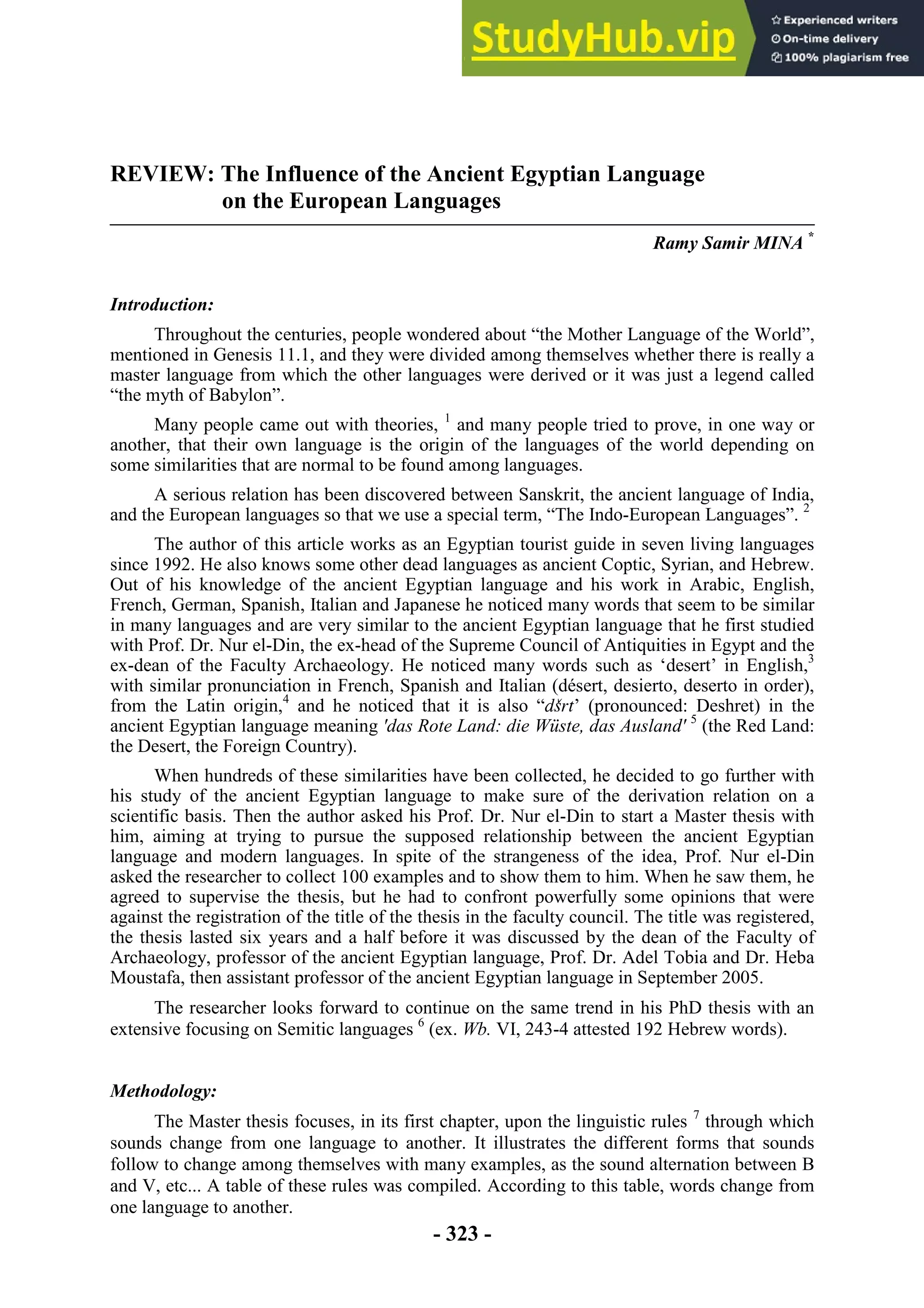
To clarify the previous idea, a Greek root as “act” (pronounced AKT) meant “work” in
Greek. When this Greek stem influenced the European vocabulary, it resulted that the
European words that contained the root “act”, as a part of the word, were always related to
“work”. For example the words: “act, actual, action, actor, transaction, actuary” are all related
to work. This applies to all European languages of the Greco-Latin family, and not only to
English. For example, the words (action in French, acto and accion in Spanish, azione in
Italian, Aktion in German, 9
etc…) give the same meaning as “action” in English, and they are
influenced by the Greek stem or root “AKT”, which is influenced by the ancient Egyptian
word “kAt” (pronounced “KAT”). This also means “to work”, then the sounds “K” and “A”
changed their position according to phonetic rules previously explained in the first part of the
thesis.
The thesis presents about 600 Greek and Latin roots that were influenced by the ancient
Egyptian vocabulary, just as an example. If we suppose that each of these 600 roots has
affected only 10 words in each European language that belongs to the Greco-Latin linguistic
family, we can suppose that at least 50000 words in the European vocabulary are influenced
by the ancient Egyptian vocabulary through only 600 stems. Add to that a direct influence in
European words by ancient Egyptian words through Greek and Latin words and not through
the roots. This means that the previous figure would exceed 100000 words.
The third part of the thesis and further studies of the researcher showed also the
extensive influence of the ancient Egyptian vocabulary on such Semitic languages as Arabic
and Hebrew.
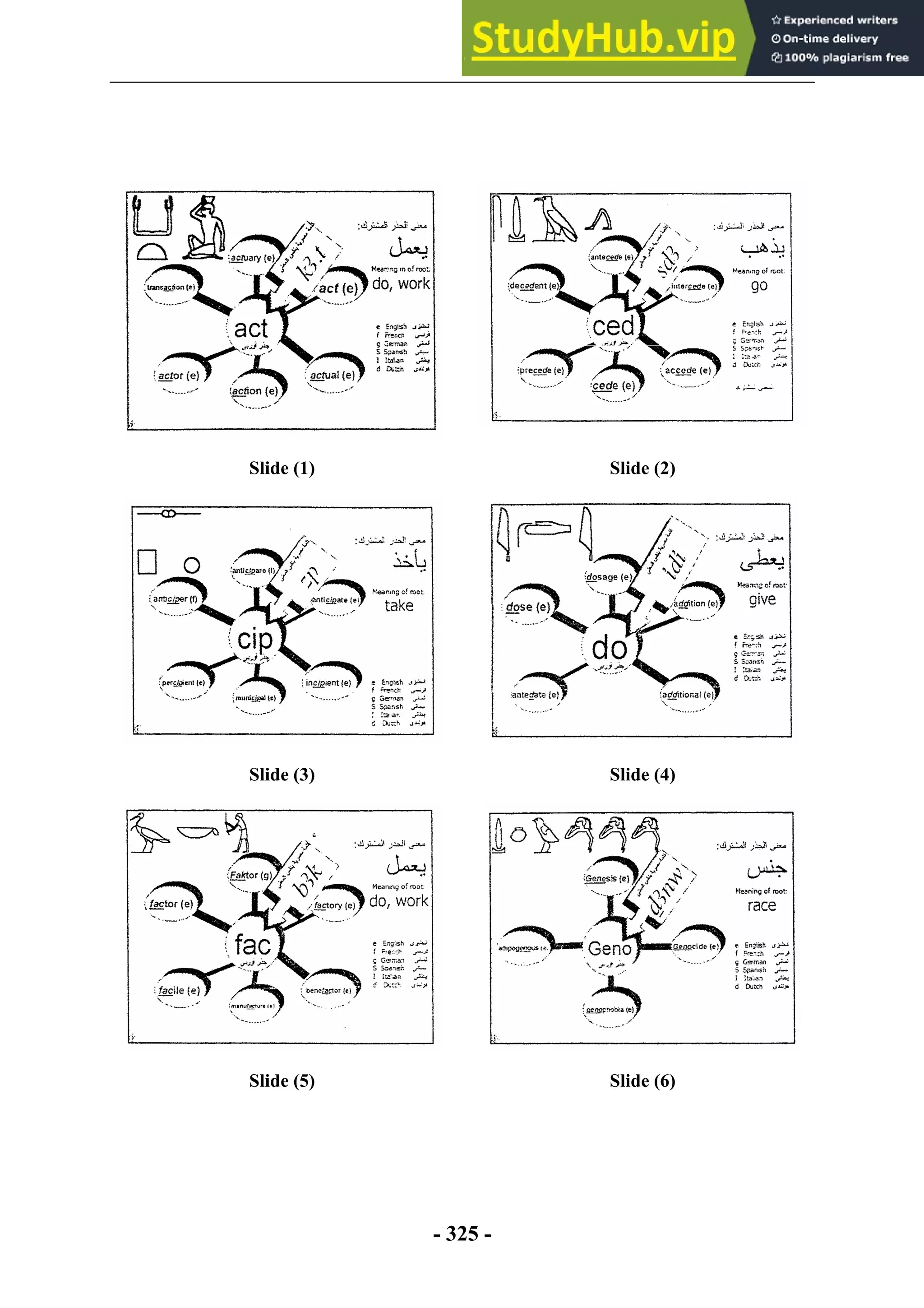
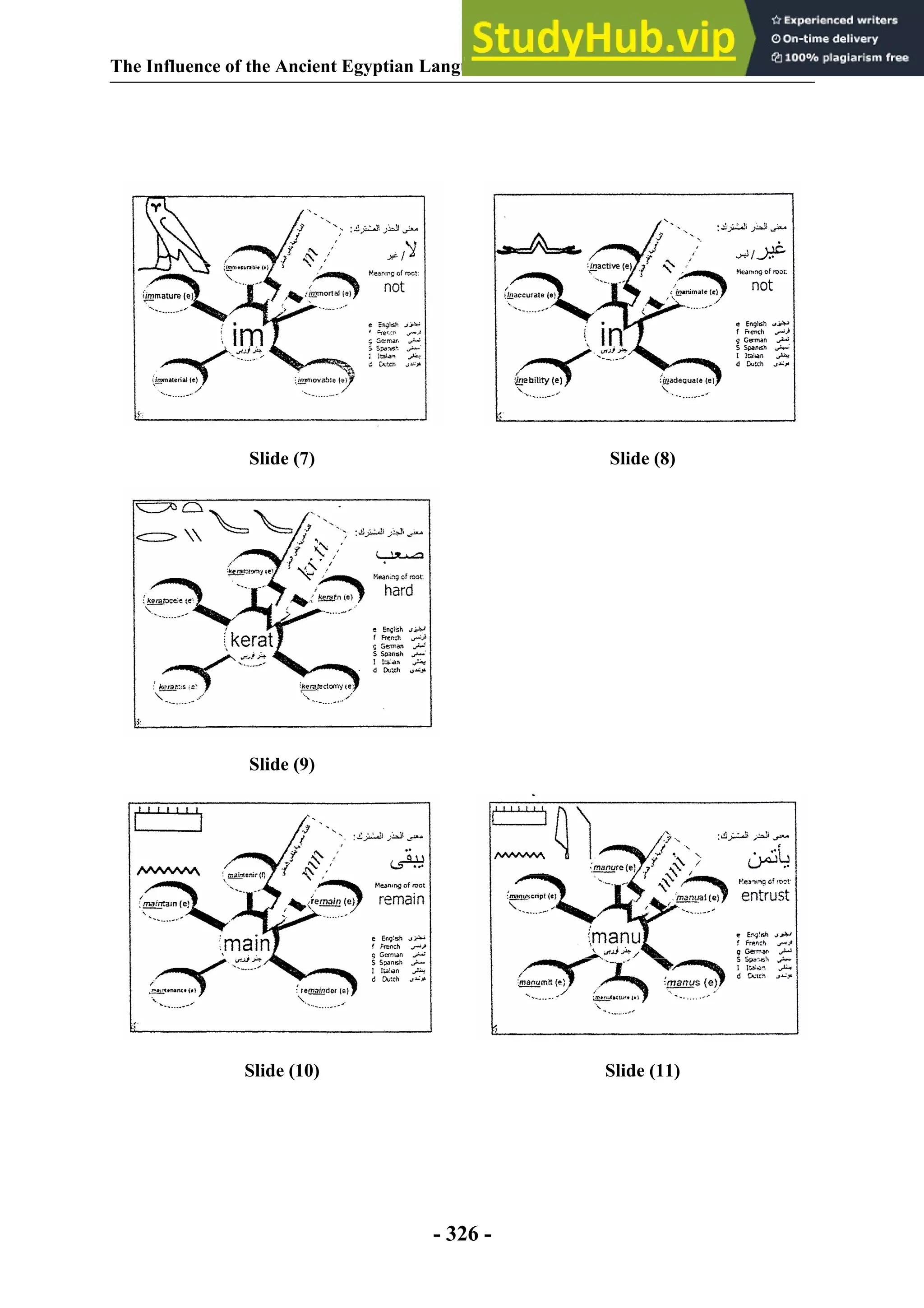
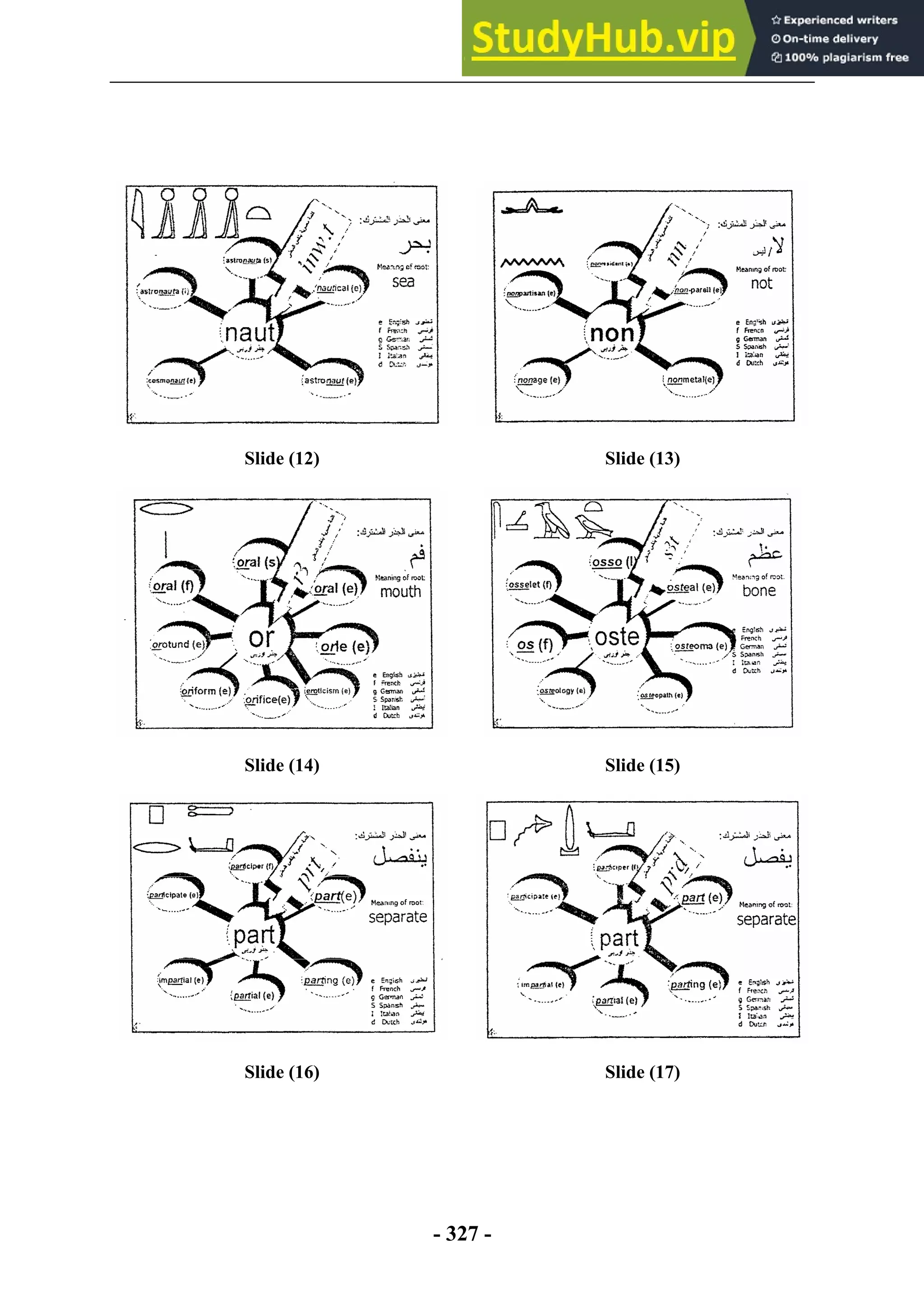
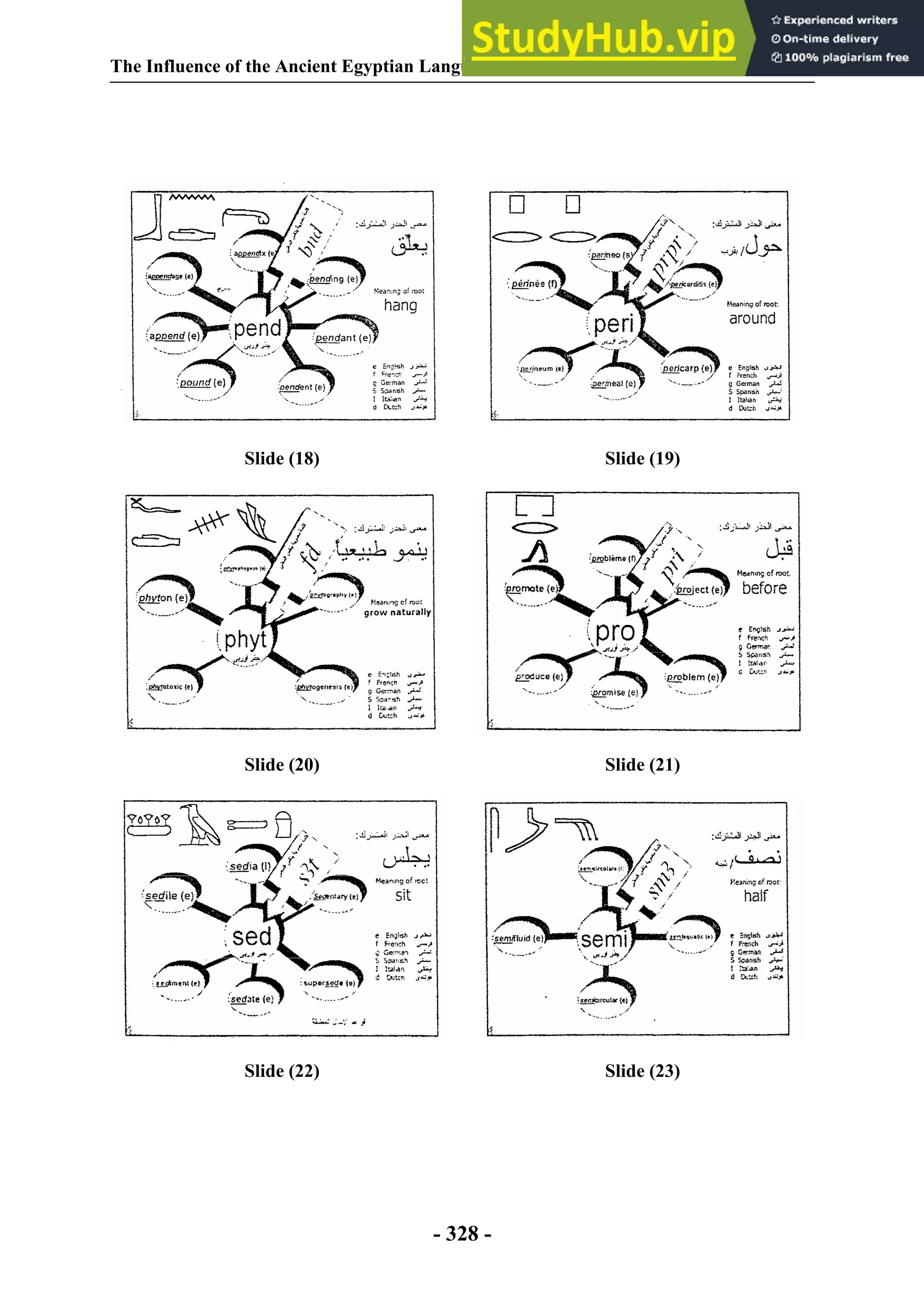
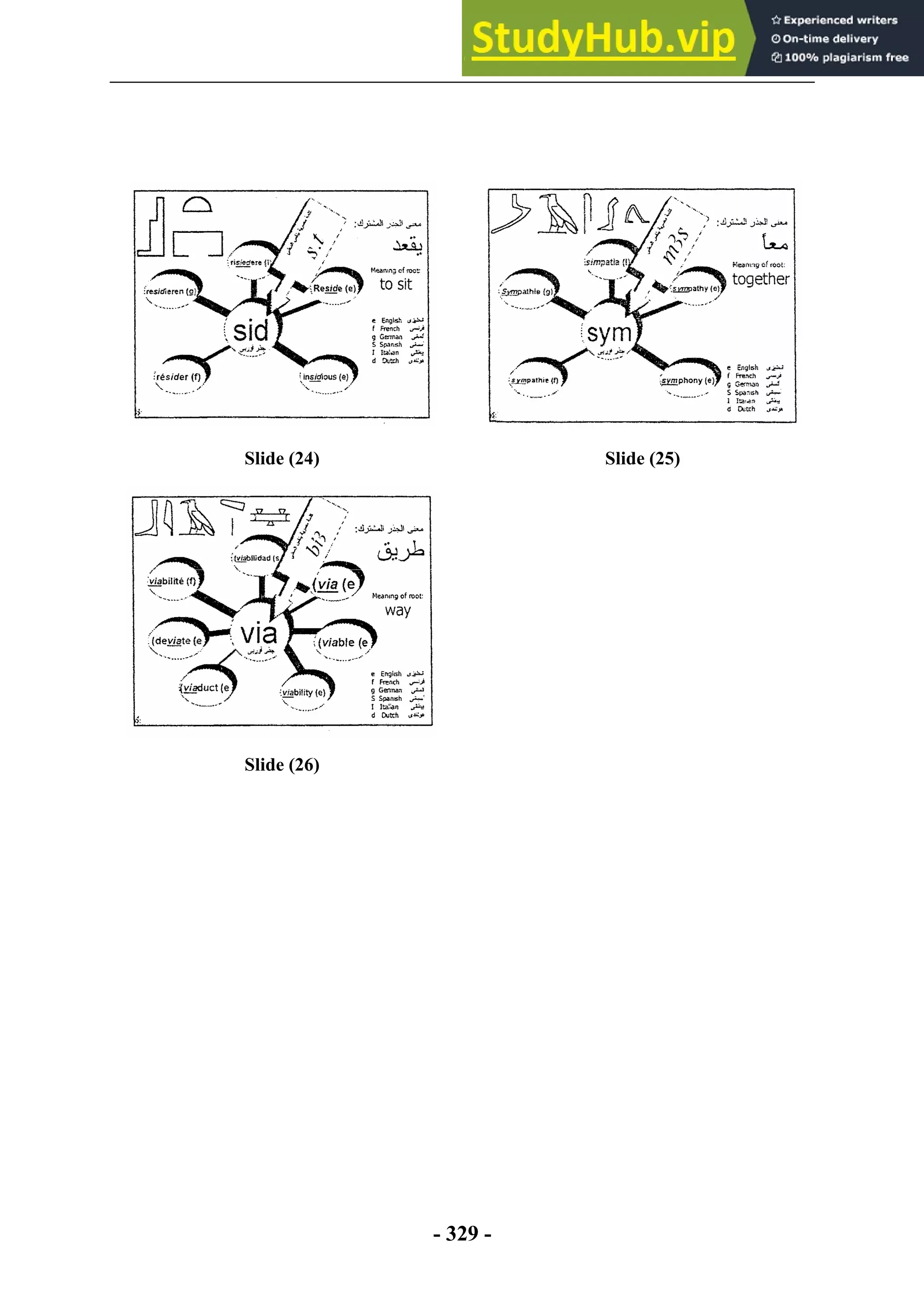
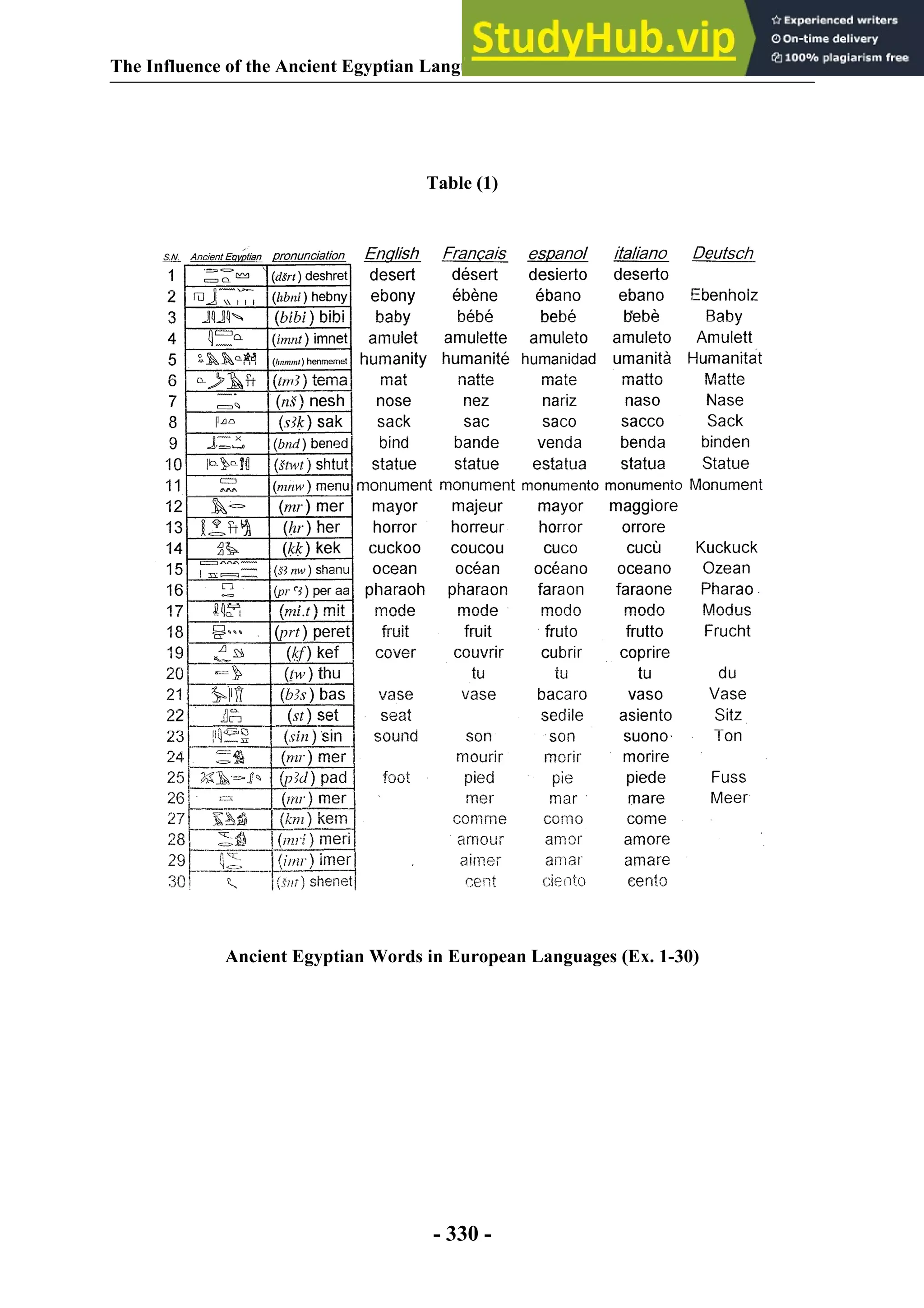
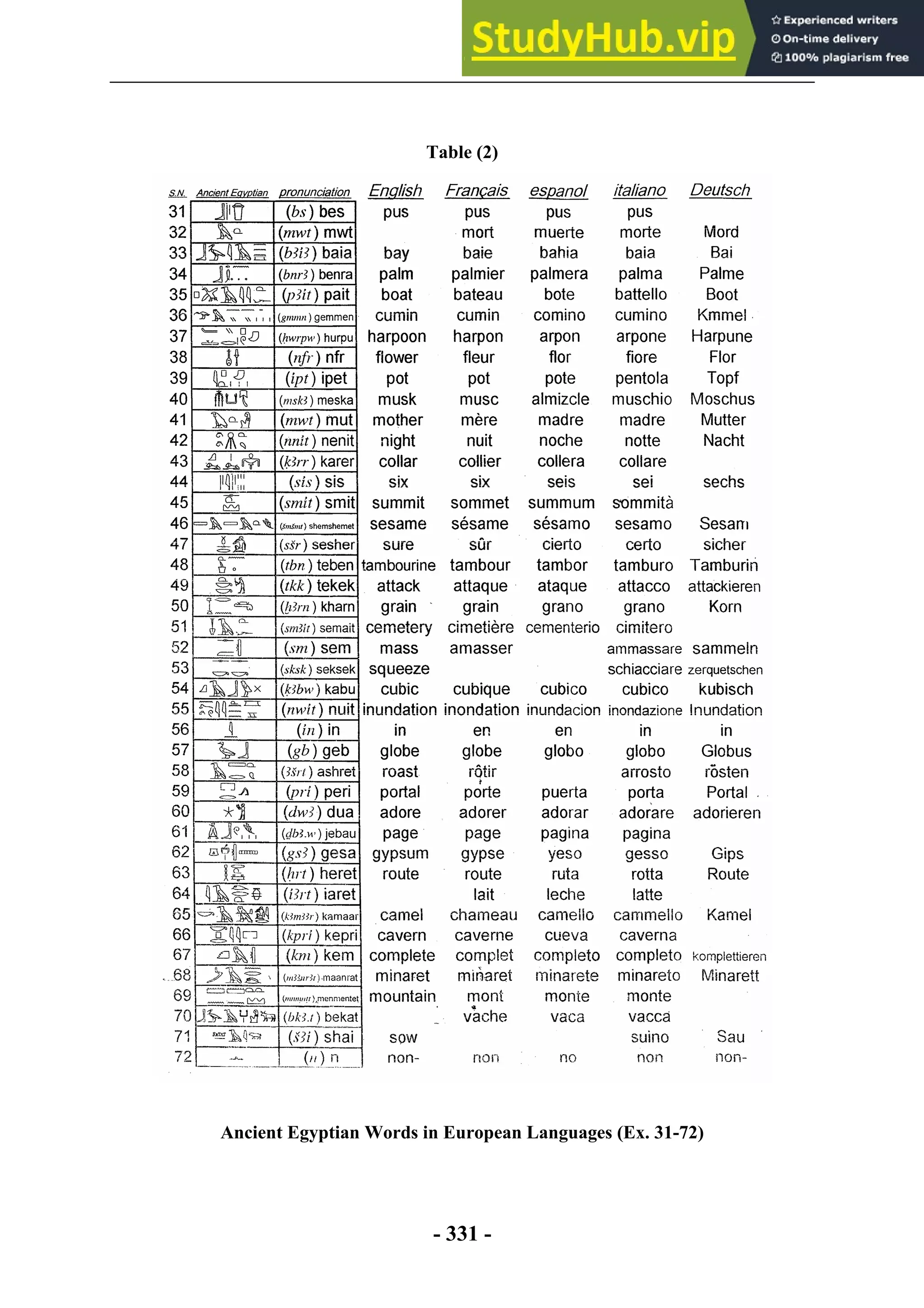
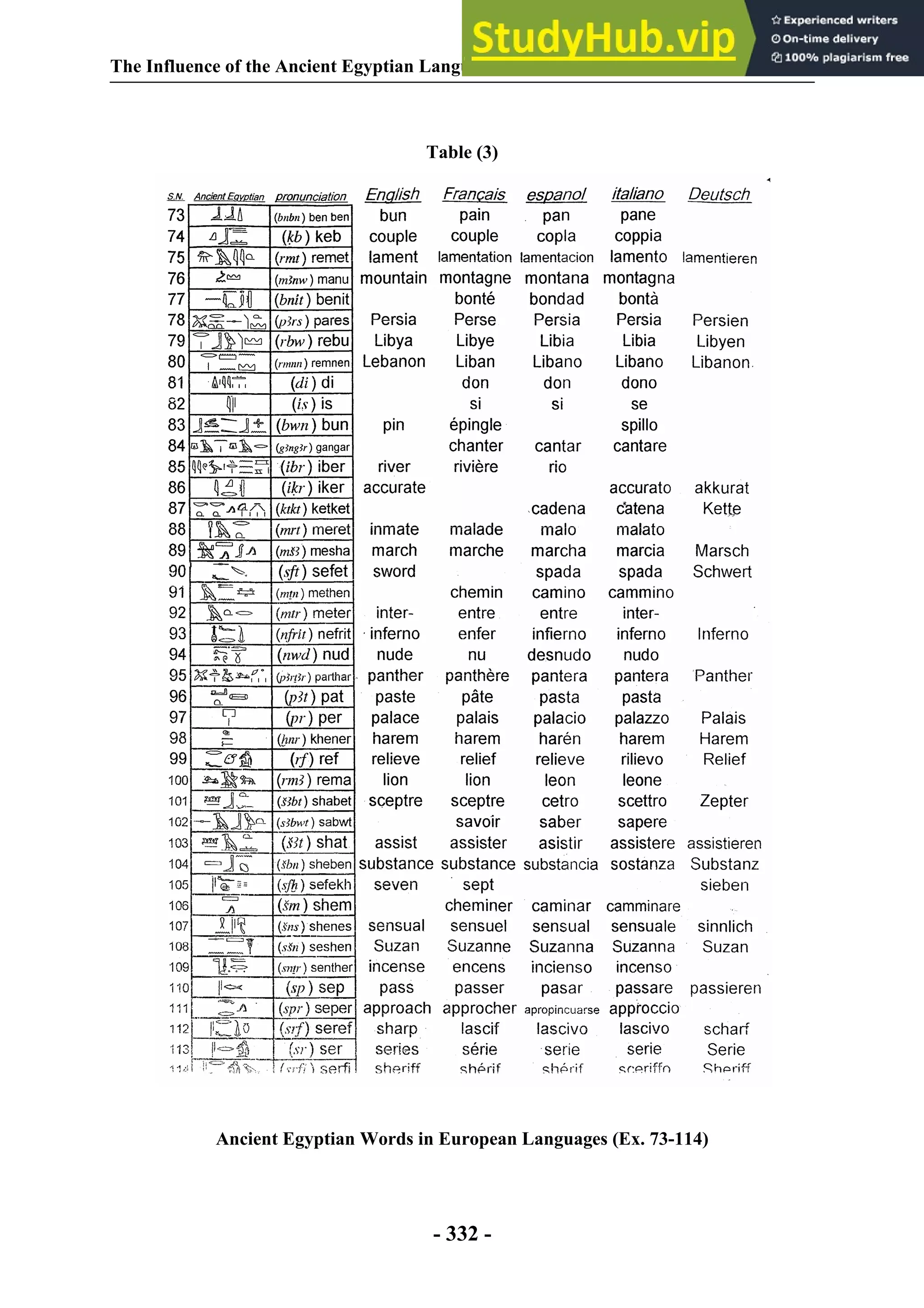
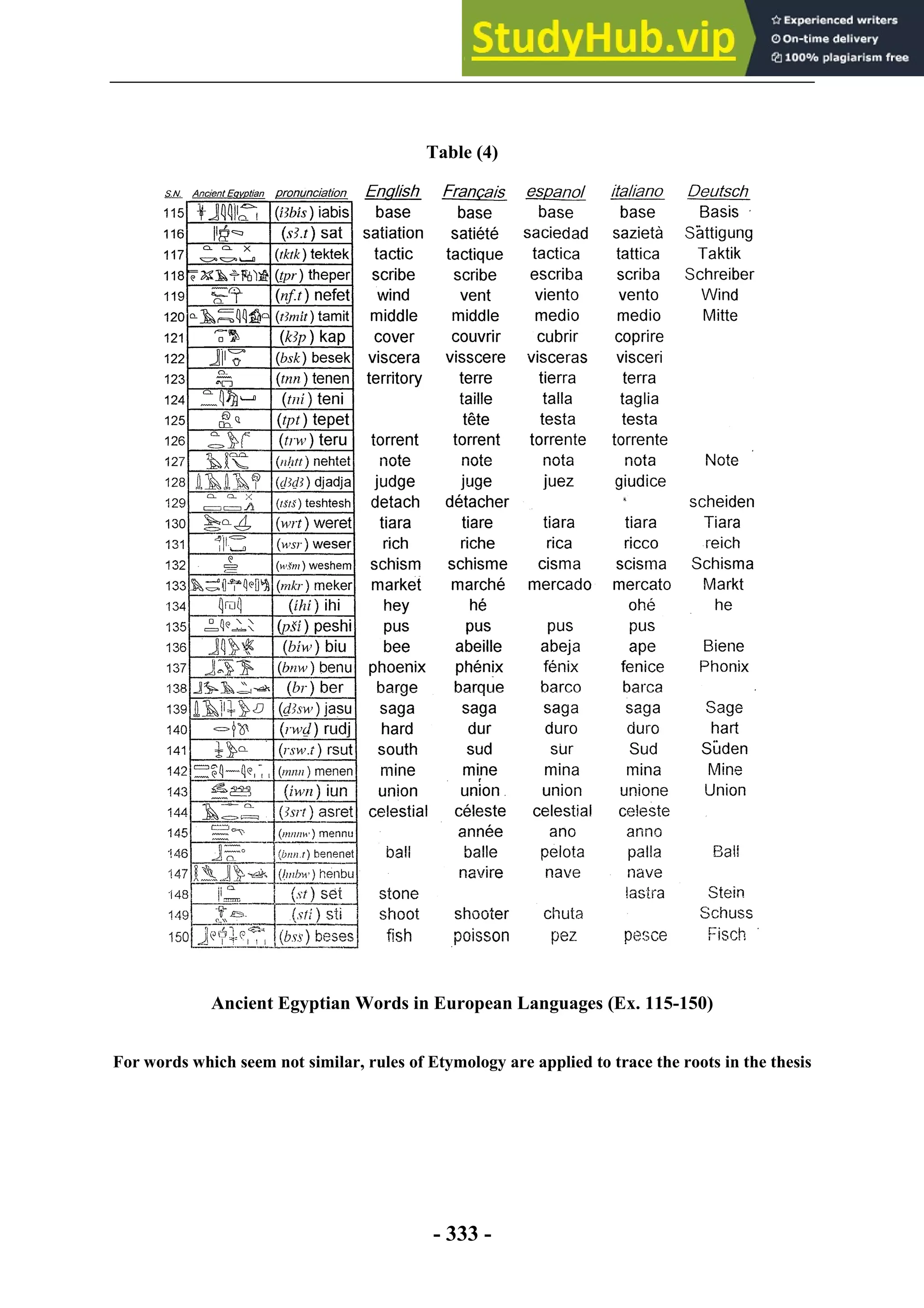
The following slides (Nos. 1-26) and tables (Nos. 1-4) show some examples of the
influence of ancient Egyptian vocabulary on European languages; first through words
themselves, then through the Greek and Latin roots. The first slide explains the details of the
next slides.
Abbreviations of References:
The key of the abbreviations of the references mentioned under each of the following
slides is as follows:
AL Dimitri Meeks, Année Lexicographique I-III (Paris, 1980-2).
-r J. -erny, Coptic Etymological Dictionary (Cambridge, 1976).
Er W. Erichsen, Demotisches Glossar (Copenhagen, 1954).
[Wb.] I-VII Different volumes of the “Wörterbuch”: A. Erman and H. Grapow, Wörterbuch der
Ägyptische Sprache, 7 Volumes, Akademie Verlag (Berlin, 1971).
Ramy Samir Mina
- 325 -
Slide (1) Slide (2)
Slide (3) Slide (4)
Slide (5) Slide (6)
The Influence of the Ancient Egyptian Language on the European Languages
- 326 -
Slide (7) Slide (8)
Slide (9)
Slide (10) Slide (11)
Ramy Samir Mina
- 327 -
Slide (12) Slide (13)
Slide (14) Slide (15)
Slide (16) Slide (17)
The Influence of the Ancient Egyptian Language on the European Languages
- 328 -
Slide (18) Slide (19)
Slide (20) Slide (21)
Slide (22) Slide (23)
Ramy Samir Mina
- 329 -
Slide (24) Slide (25)
Slide (26)
The Influence of the Ancient Egyptian Language on the European Languages
- 330 -
Table (1)
Ancient Egyptian Words in European Languages (Ex. 1-30)
Ramy Samir Mina
- 331 -
Table (2)
Ancient Egyptian Words in European Languages (Ex. 31-72)
The Influence of the Ancient Egyptian Language on the European Languages
- 332 -
Table (3)
Ancient Egyptian Words in European Languages (Ex. 73-114)
Ramy Samir Mina
- 333 -
Table (4)
Ancient Egyptian Words in European Languages (Ex. 115-150)
For words which seem not similar, rules of Etymology are applied to trace the roots in the thesis
The Influence of the Ancient Egyptian Language on the European Languages
- 334 -
Endnotes
*
M.A. of Ancient Egyptian Language, from Faculty of Archaeology, Cairo University.
1
See for example: Tyler Stephen, Cognitive Anthropology (New York: Holt, Rinehart and Winston, 1969);
Lee Yup, Linguistic anthropology, Man as the Prayer: The Origin and Nature of Mankind (Victoria, BC:
Trafford, 2000).
2
Monier-Williams, Monier, Sanskrit-English Dictionary: Etymologically and Philologically Arranged with
Special Reference to Cognate Indo-European Languages (Oxford: Clarendon Press, 2000).
3
James Morwood (ed.), The Oxford Latin Mini Dictionary: Latin-English, English-Latin, Oxford University
Press (1997), 386 (English-Latin: Desert, n., wilderness = Desertum; v.t., Desero). See: Skeat Walter,
Principles of English Etymology. First Series: The Native Element (Clarendon, 1887); Andrew Findlater,
Chambers's Etymological Dictionary (Chambers, 1948); C. Onions, Oxford Dictionary of English
Etymology (OUP, 1966); Harrison Black, Etymological and Explanatory Dictionary of Words Derived from
the Latin (Longman 1971); T. F. Hoad, The Concise Oxford Dictionary of English Etymology (Oxford
University Press, 1986).
4
J. Morwood (ed.), The Oxford Latin Mini Dictionary: Latin-English, English-Latin, 79 (Latin-English:
Desertus, Deserta, Desertum, adj. = Desert – lonely). See: J. U. Jarnik, Neuer vollständiger Index zu Diez'
Etymologischem Wörterbuche der Romanischen Sprachen (Heilbronn: Henninger 1889).
5
Wb. V, 494: 5-13.
6
About the Hebrew equivalents of the ancient Egyptian words, see for example: Ahmad Kamal Pacha
[1851-1923], Manuscript Lesique de la langue Égyptienne Ancienne, 22 vols. [1906-1923], The Supreme
Council of Antiquities Press (Cairo, 2002), vol. 8: 12 (3rd
and 8th
words); vol. 15: 40 (3rd
word), 118 (3rd
word), 168 (1st
word), 178 (1st
word), 191 (middle), 236 (3rd
word), 274 (1st
word), 276 (2nd
word), 288 (1st
word), 290 (1st
and 2nd
words), 306 (6th
word), 314 (3rd
word); vol. 17: 23 (1st
word), 24 (4th
word, 2nd
meaning), 30 (1st
and 4th
words), 34 (1st
and 4th
words) , 62 (2nd
word, 7th
meaning).
7
See: Partridge Eric, A Charm of Words: Essays and Papers on Language (Hamilton, 1960); Karl-
Dieter Bünting, Einführung in die Linguistik (Frankfurt: Athenäum 1971); Cazden Courtney, Vera
John, Functions of Language, Anthropology and Education Series (Columbia University: Teachers College
Press 1972); Georg Heike, Phonologie (Stuttgart: Metzler, 1972); Fudge Erik, Phonology: Modern Linguistics
Readings (Penguin, 1973); R. Jordan, Handbook of Middle English Grammar: Phonology, Translated and
revised by E. J. Crook (The Hague: Mouton, 1974); Hyman Larry, Phonology: Theory and Analysis (New
York: Holt, Rinehart & Winston 1975); Ernest Duranti, Alessandro Haya, Phonology, Gramatical structure,
Discourse (Southern California UP 1977); Fasold Ralph, Shuy Roger, Studies in Language Variation.
Semantics, syntax, phonology, pragmatics, social situations, ethnographic approaches (Georgetown
University Press, 1977); Rowley Anthony, Sprachliche Orientierung, 1: Untersuchungen zur Morphologie und
Semantik der Richtungsadverbien in oberdeutschen Mundarten, mit einer Einleitung von Hans-Werner
Eroms (Heidelberg, 1979; Bayreuth: Sprach- und Literaturwissenschafliche Fakultät, 1980); Charles Jones, A
history of English phonology (London: Longman, 1989); E. E. Sweetser, From etymology to pragmatics:
metaphorical and cultural aspects of semantic structure (Cambridge: Cambridge University Press, 1990); Lass
Roger, "Phonology and morphology", in Norman Blake, The Cambridge History of the English Language,
Volume II (Cambridge University Press, 1992); Sun Sylvia, The Development of a Lexical Tone Phonology in
American Learners of Standard Mandarin Chinese (Hawai'i UP, 1998); Synchronic and diachronic studies
center, English phonology and phonological theory (Cambridge University Press, 1998); C. Traugott
Elizabeth, ‘From etymology to historical pragmatics’, Plenary papers presented at the conference on Studies
in English Historical Linguistics (UCLA, 2000); Jha Sunil Kumar, Maithili: Some Aspects of Its Phonetics and
Phonology (Delhi, Motilal Banarsidass, 2001); Laca Brenda, Temps et Aspect: De la Morphologie à l'
Interprétation. Textes réunis et présentés par B Laca (Saint-Denis: Presses Universitaires de Vincennes,
2002); Roger Lass, 'Phonology and Morphology', in: The Cambridge History of the English Language, vol. III
(Cambridge University Press, 2003); Paula Rosman, Abraham, Translating Cultures: Perspectives on
Translation and Anthropology (Oxford: Berg, 2003).
8
About the Greek equivalents of the ancient Egyptian words, see for example: Ahmad Kamal Pacha,
Manuscript Lesique de la langue Égyptienne Ancienne, vol. 15: 34 (1st
word), 36 (below), 42 (7th
word), 52
(2nd
word), 70 (1st
word, middle), 84 (1st
word), 86 (3rd
word), 187 (1st
word), 194 (3rd
word), 274 (1st
word),
290 (1st
word), 306 (4th
word), 366 (2nd
word), 367 (2nd
word); vol. 17: 30 (4th
word); cf. Wb. VI, 245-256.
9
See: Kluge Friedrich, Etymologisches Wörterbuch der deutschen Sprache, 11th
ed. mit Unterstützung durch
Wolfgang Krause bearbeitet von Alfred Götze (Berlin: Gruyter, 1934); Wright Joseph, Historical German
Grammar, Vol. 1: Phonology, Word-Formation and Accidence (OUP, 1966); Wolfgang Herrlitz, Historische
Phonologie des Deutschen 1: Vokalismus (Tübingen: Niemeyer 1970).

Ancient Egyptian Language And Its Influence On Modern Languages

  • 1.
    - 323 - REVIEW:The Influence of the Ancient Egyptian Language on the European Languages Ramy Samir MINA * Introduction: Throughout the centuries, people wondered about “the Mother Language of the World”, mentioned in Genesis 11.1, and they were divided among themselves whether there is really a master language from which the other languages were derived or it was just a legend called “the myth of Babylon”. Many people came out with theories, 1 and many people tried to prove, in one way or another, that their own language is the origin of the languages of the world depending on some similarities that are normal to be found among languages. A serious relation has been discovered between Sanskrit, the ancient language of India, and the European languages so that we use a special term, “The Indo-European Languages”. 2 The author of this article works as an Egyptian tourist guide in seven living languages since 1992. He also knows some other dead languages as ancient Coptic, Syrian, and Hebrew. Out of his knowledge of the ancient Egyptian language and his work in Arabic, English, French, German, Spanish, Italian and Japanese he noticed many words that seem to be similar in many languages and are very similar to the ancient Egyptian language that he first studied with Prof. Dr. Nur el-Din, the ex-head of the Supreme Council of Antiquities in Egypt and the ex-dean of the Faculty Archaeology. He noticed many words such as ‘desert’ in English,3 with similar pronunciation in French, Spanish and Italian (désert, desierto, deserto in order), from the Latin origin,4 and he noticed that it is also “dSrt’ (pronounced: Deshret) in the ancient Egyptian language meaning 'das Rote Land: die Wüste, das Ausland' 5 (the Red Land: the Desert, the Foreign Country). When hundreds of these similarities have been collected, he decided to go further with his study of the ancient Egyptian language to make sure of the derivation relation on a scientific basis. Then the author asked his Prof. Dr. Nur el-Din to start a Master thesis with him, aiming at trying to pursue the supposed relationship between the ancient Egyptian language and modern languages. In spite of the strangeness of the idea, Prof. Nur el-Din asked the researcher to collect 100 examples and to show them to him. When he saw them, he agreed to supervise the thesis, but he had to confront powerfully some opinions that were against the registration of the title of the thesis in the faculty council. The title was registered, the thesis lasted six years and a half before it was discussed by the dean of the Faculty of Archaeology, professor of the ancient Egyptian language, Prof. Dr. Adel Tobia and Dr. Heba Moustafa, then assistant professor of the ancient Egyptian language in September 2005. The researcher looks forward to continue on the same trend in his PhD thesis with an extensive focusing on Semitic languages 6 (ex. Wb. VI, 243-4 attested 192 Hebrew words). Methodology: The Master thesis focuses, in its first chapter, upon the linguistic rules 7 through which sounds change from one language to another. It illustrates the different forms that sounds follow to change among themselves with many examples, as the sound alternation between B and V, etc... A table of these rules was compiled. According to this table, words change from one language to another.
  • 2.
    The Influence ofthe Ancient Egyptian Language on the European Languages - 324 - In the second chapter the previous rules are applied to the ancient Egyptian vocabulary, to show how they changed to their equivalents in Greek 8 (see Wb. VI, 245-56, especially 248 as well as 249 ff.; while Er, 372-4 mentioned 217 words) and Latin (Er, 374 attested 15 words), then consequently in English, French, German, Spanish, Italian, and the other languages that are derived from the Greco-Latin family. As the Greeks ruled Egypt from 332 BC to 30 BC; then the Romans, whose language is Latin, ruled Egypt from 30 BC to 641 AD, so the thesis explains that the transition from ancient Egyptian vocabulary to the European vocabulary occurred during this 1000-year period in particular, with proofs from the Greek and Latin vocabulary. In this part the thesis shows that the influence of ancient Egyptian vocabulary on European vocabulary, through Greek and Latin, occurred in two ways: first, the influence on vocabulary as words, then the influence of the Greek and Latin roots such as the stems “act, main, semi”, etc… To clarify the previous idea, a Greek root as “act” (pronounced AKT) meant “work” in Greek. When this Greek stem influenced the European vocabulary, it resulted that the European words that contained the root “act”, as a part of the word, were always related to “work”. For example the words: “act, actual, action, actor, transaction, actuary” are all related to work. This applies to all European languages of the Greco-Latin family, and not only to English. For example, the words (action in French, acto and accion in Spanish, azione in Italian, Aktion in German, 9 etc…) give the same meaning as “action” in English, and they are influenced by the Greek stem or root “AKT”, which is influenced by the ancient Egyptian word “kAt” (pronounced “KAT”). This also means “to work”, then the sounds “K” and “A” changed their position according to phonetic rules previously explained in the first part of the thesis. The thesis presents about 600 Greek and Latin roots that were influenced by the ancient Egyptian vocabulary, just as an example. If we suppose that each of these 600 roots has affected only 10 words in each European language that belongs to the Greco-Latin linguistic family, we can suppose that at least 50000 words in the European vocabulary are influenced by the ancient Egyptian vocabulary through only 600 stems. Add to that a direct influence in European words by ancient Egyptian words through Greek and Latin words and not through the roots. This means that the previous figure would exceed 100000 words. The third part of the thesis and further studies of the researcher showed also the extensive influence of the ancient Egyptian vocabulary on such Semitic languages as Arabic and Hebrew. The following slides (Nos. 1-26) and tables (Nos. 1-4) show some examples of the influence of ancient Egyptian vocabulary on European languages; first through words themselves, then through the Greek and Latin roots. The first slide explains the details of the next slides. Abbreviations of References: The key of the abbreviations of the references mentioned under each of the following slides is as follows: AL Dimitri Meeks, Année Lexicographique I-III (Paris, 1980-2). -r J. -erny, Coptic Etymological Dictionary (Cambridge, 1976). Er W. Erichsen, Demotisches Glossar (Copenhagen, 1954). [Wb.] I-VII Different volumes of the “Wörterbuch”: A. Erman and H. Grapow, Wörterbuch der Ägyptische Sprache, 7 Volumes, Akademie Verlag (Berlin, 1971).
  • 3.
    Ramy Samir Mina -325 - Slide (1) Slide (2) Slide (3) Slide (4) Slide (5) Slide (6)
  • 4.
    The Influence ofthe Ancient Egyptian Language on the European Languages - 326 - Slide (7) Slide (8) Slide (9) Slide (10) Slide (11)
  • 5.
    Ramy Samir Mina -327 - Slide (12) Slide (13) Slide (14) Slide (15) Slide (16) Slide (17)
  • 6.
    The Influence ofthe Ancient Egyptian Language on the European Languages - 328 - Slide (18) Slide (19) Slide (20) Slide (21) Slide (22) Slide (23)
  • 7.
    Ramy Samir Mina -329 - Slide (24) Slide (25) Slide (26)
  • 8.
    The Influence ofthe Ancient Egyptian Language on the European Languages - 330 - Table (1) Ancient Egyptian Words in European Languages (Ex. 1-30)
  • 9.
    Ramy Samir Mina -331 - Table (2) Ancient Egyptian Words in European Languages (Ex. 31-72)
  • 10.
    The Influence ofthe Ancient Egyptian Language on the European Languages - 332 - Table (3) Ancient Egyptian Words in European Languages (Ex. 73-114)
  • 11.
    Ramy Samir Mina -333 - Table (4) Ancient Egyptian Words in European Languages (Ex. 115-150) For words which seem not similar, rules of Etymology are applied to trace the roots in the thesis
  • 12.
    The Influence ofthe Ancient Egyptian Language on the European Languages - 334 - Endnotes * M.A. of Ancient Egyptian Language, from Faculty of Archaeology, Cairo University. 1 See for example: Tyler Stephen, Cognitive Anthropology (New York: Holt, Rinehart and Winston, 1969); Lee Yup, Linguistic anthropology, Man as the Prayer: The Origin and Nature of Mankind (Victoria, BC: Trafford, 2000). 2 Monier-Williams, Monier, Sanskrit-English Dictionary: Etymologically and Philologically Arranged with Special Reference to Cognate Indo-European Languages (Oxford: Clarendon Press, 2000). 3 James Morwood (ed.), The Oxford Latin Mini Dictionary: Latin-English, English-Latin, Oxford University Press (1997), 386 (English-Latin: Desert, n., wilderness = Desertum; v.t., Desero). See: Skeat Walter, Principles of English Etymology. First Series: The Native Element (Clarendon, 1887); Andrew Findlater, Chambers's Etymological Dictionary (Chambers, 1948); C. Onions, Oxford Dictionary of English Etymology (OUP, 1966); Harrison Black, Etymological and Explanatory Dictionary of Words Derived from the Latin (Longman 1971); T. F. Hoad, The Concise Oxford Dictionary of English Etymology (Oxford University Press, 1986). 4 J. Morwood (ed.), The Oxford Latin Mini Dictionary: Latin-English, English-Latin, 79 (Latin-English: Desertus, Deserta, Desertum, adj. = Desert – lonely). See: J. U. Jarnik, Neuer vollständiger Index zu Diez' Etymologischem Wörterbuche der Romanischen Sprachen (Heilbronn: Henninger 1889). 5 Wb. V, 494: 5-13. 6 About the Hebrew equivalents of the ancient Egyptian words, see for example: Ahmad Kamal Pacha [1851-1923], Manuscript Lesique de la langue Égyptienne Ancienne, 22 vols. [1906-1923], The Supreme Council of Antiquities Press (Cairo, 2002), vol. 8: 12 (3rd and 8th words); vol. 15: 40 (3rd word), 118 (3rd word), 168 (1st word), 178 (1st word), 191 (middle), 236 (3rd word), 274 (1st word), 276 (2nd word), 288 (1st word), 290 (1st and 2nd words), 306 (6th word), 314 (3rd word); vol. 17: 23 (1st word), 24 (4th word, 2nd meaning), 30 (1st and 4th words), 34 (1st and 4th words) , 62 (2nd word, 7th meaning). 7 See: Partridge Eric, A Charm of Words: Essays and Papers on Language (Hamilton, 1960); Karl- Dieter Bünting, Einführung in die Linguistik (Frankfurt: Athenäum 1971); Cazden Courtney, Vera John, Functions of Language, Anthropology and Education Series (Columbia University: Teachers College Press 1972); Georg Heike, Phonologie (Stuttgart: Metzler, 1972); Fudge Erik, Phonology: Modern Linguistics Readings (Penguin, 1973); R. Jordan, Handbook of Middle English Grammar: Phonology, Translated and revised by E. J. Crook (The Hague: Mouton, 1974); Hyman Larry, Phonology: Theory and Analysis (New York: Holt, Rinehart & Winston 1975); Ernest Duranti, Alessandro Haya, Phonology, Gramatical structure, Discourse (Southern California UP 1977); Fasold Ralph, Shuy Roger, Studies in Language Variation. Semantics, syntax, phonology, pragmatics, social situations, ethnographic approaches (Georgetown University Press, 1977); Rowley Anthony, Sprachliche Orientierung, 1: Untersuchungen zur Morphologie und Semantik der Richtungsadverbien in oberdeutschen Mundarten, mit einer Einleitung von Hans-Werner Eroms (Heidelberg, 1979; Bayreuth: Sprach- und Literaturwissenschafliche Fakultät, 1980); Charles Jones, A history of English phonology (London: Longman, 1989); E. E. Sweetser, From etymology to pragmatics: metaphorical and cultural aspects of semantic structure (Cambridge: Cambridge University Press, 1990); Lass Roger, "Phonology and morphology", in Norman Blake, The Cambridge History of the English Language, Volume II (Cambridge University Press, 1992); Sun Sylvia, The Development of a Lexical Tone Phonology in American Learners of Standard Mandarin Chinese (Hawai'i UP, 1998); Synchronic and diachronic studies center, English phonology and phonological theory (Cambridge University Press, 1998); C. Traugott Elizabeth, ‘From etymology to historical pragmatics’, Plenary papers presented at the conference on Studies in English Historical Linguistics (UCLA, 2000); Jha Sunil Kumar, Maithili: Some Aspects of Its Phonetics and Phonology (Delhi, Motilal Banarsidass, 2001); Laca Brenda, Temps et Aspect: De la Morphologie à l' Interprétation. Textes réunis et présentés par B Laca (Saint-Denis: Presses Universitaires de Vincennes, 2002); Roger Lass, 'Phonology and Morphology', in: The Cambridge History of the English Language, vol. III (Cambridge University Press, 2003); Paula Rosman, Abraham, Translating Cultures: Perspectives on Translation and Anthropology (Oxford: Berg, 2003). 8 About the Greek equivalents of the ancient Egyptian words, see for example: Ahmad Kamal Pacha, Manuscript Lesique de la langue Égyptienne Ancienne, vol. 15: 34 (1st word), 36 (below), 42 (7th word), 52 (2nd word), 70 (1st word, middle), 84 (1st word), 86 (3rd word), 187 (1st word), 194 (3rd word), 274 (1st word), 290 (1st word), 306 (4th word), 366 (2nd word), 367 (2nd word); vol. 17: 30 (4th word); cf. Wb. VI, 245-256. 9 See: Kluge Friedrich, Etymologisches Wörterbuch der deutschen Sprache, 11th ed. mit Unterstützung durch Wolfgang Krause bearbeitet von Alfred Götze (Berlin: Gruyter, 1934); Wright Joseph, Historical German Grammar, Vol. 1: Phonology, Word-Formation and Accidence (OUP, 1966); Wolfgang Herrlitz, Historische Phonologie des Deutschen 1: Vokalismus (Tübingen: Niemeyer 1970).