Omega-3 Fatty Acid
Supplementation in Children
with ADHD
By: Aly Worf, PA-S2
Background
• Attention Deficit Hyperactivity Disorder (ADHD), DSM-V diagnosis
• ADHD is one of the most common diseases in children
• More common in males than females
• Diagnosis is complex: medical exam, behavior/symptom rating scales,
teacher documentation of core symptoms
• Pathophysiology is poorly understood: primary genetic and secondary
environmental factors
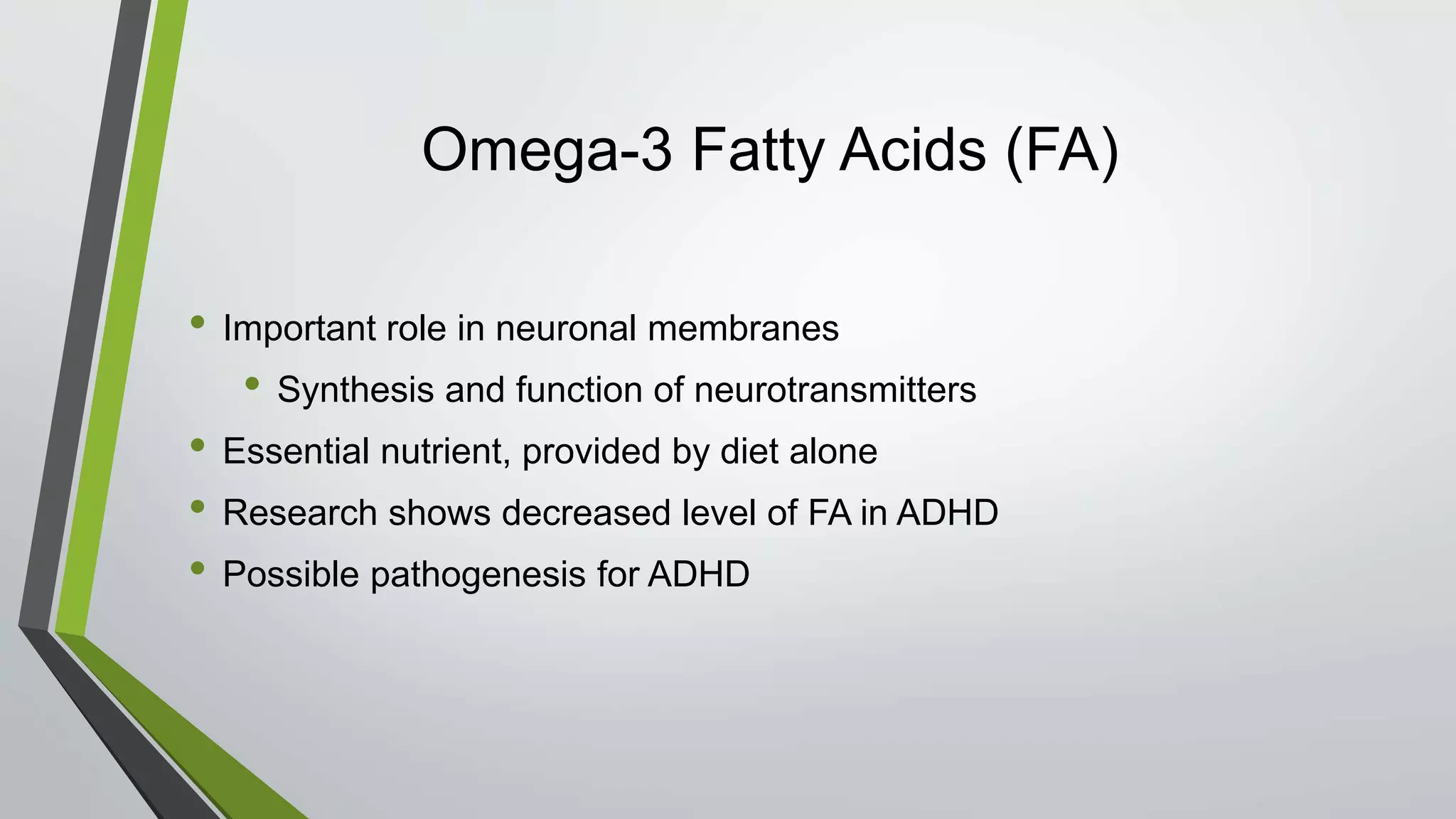
Omega-3 Fatty Acids (FA)
• Important role in neuronal membranes
• Synthesis and function of neurotransmitters
• Essential nutrient, provided by diet alone
• Research shows decreased level of FA in ADHD
• Possible pathogenesis for ADHD
Clinical Question
•In children with ADHD, does omega-3
supplementation improve ADHD symptoms?
Data Sources & Study Selection
• PubMed and MeSH search tool
• Key words “omega-3 fatty acids” and “ADHD”
• Limits:
• 2009-2016
• Clinical Trials
• Five articles were selected for this review
Study Design
Author
(Date)
Study Type Sample
size
Supplement Placebo Treatment
duration
Country
Widenhorn-Muller et al
(2014)
Double-blind
placebo-
controlled
95 EPA 600 mg
DHA 120 mg
Two olive oil
capsules
16 weeks Germany
Bos et al
(2015)
Double-blind
placebo-
controlled
77 Margarine fortified
EPA 650 mg
DHA 650 mg
Margarine with
refined plant oils
16 weeks The
Netherlands
Milte et al
(2012)
Randomized
placebo-
controlled three-
way crossover
70 EPA-rich
EPA 1109 mg
DHA 108 mg
DHA-rich
EPA 264 mg
DHA 1032 mg
Safflower oil
LA 1467 mg
16 weeks Australia
Belanger et al
(2009)
Double-blind one-
way crossover
randomized
26 EPA 250 mg
DHA 100 mg
Phospholipids 25
mg
Sunflower oil
500mg
16 weeks Canada
Dubnov-Raz et al
(2014)
Double-blind
placebo-
controlled
17 ALA 1 g Lactose 8 weeks Israel
Patient Recruitment
• ADHD clinics
• Health care professionals
• Leaflets, newspaper, school newsletters, flyers
• Department of Psychiatry
• Advertising in primary and secondary schools
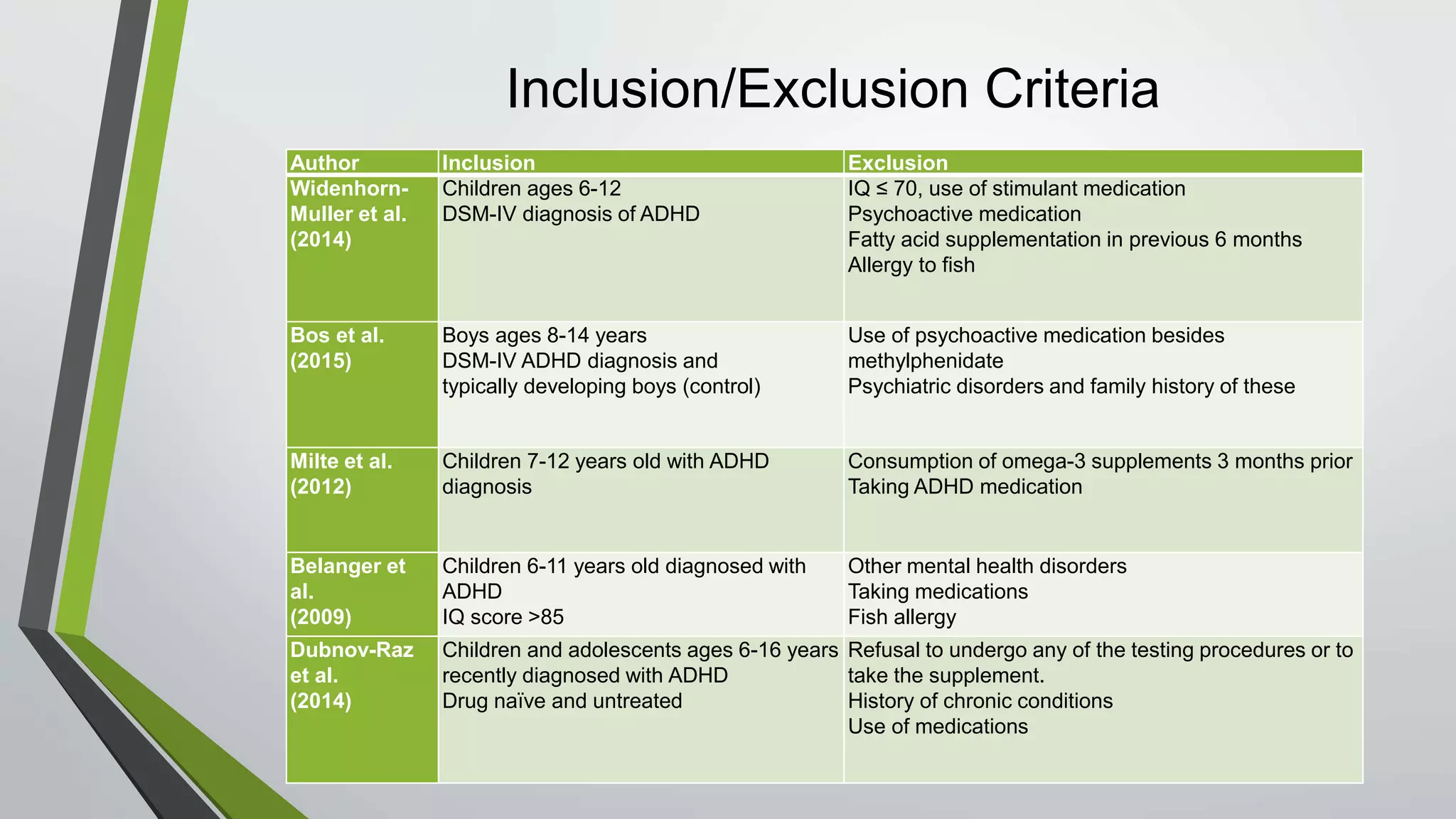
Inclusion/Exclusion Criteria
Author Inclusion Exclusion
Widenhorn-
Muller et al.
(2014)
Children ages 6-12
DSM-IV diagnosis of ADHD
IQ ≤ 70, use of stimulant medication
Psychoactive medication
Fatty acid supplementation in previous 6 months
Allergy to fish
Bos et al.
(2015)
Boys ages 8-14 years
DSM-IV ADHD diagnosis and
typically developing boys (control)
Use of psychoactive medication besides
methylphenidate
Psychiatric disorders and family history of these
Milte et al.
(2012)
Children 7-12 years old with ADHD
diagnosis
Consumption of omega-3 supplements 3 months prior
Taking ADHD medication
Belanger et
al.
(2009)
Children 6-11 years old diagnosed with
ADHD
IQ score >85
Other mental health disorders
Taking medications
Fish allergy
Dubnov-Raz
et al.
(2014)
Children and adolescents ages 6-16 years
recently diagnosed with ADHD
Drug naĂŻve and untreated
Refusal to undergo any of the testing procedures or to
take the supplement.
History of chronic conditions
Use of medications
Demographics
Author (year) Mean Age (years) Gender (% M/F) Race IQ
Widenhorn-
Muller et al
(2014)
8.9 78 % Male
22 % Female
NR 100.18 ±9.27
Bos et al
(2015)
10.6 100% Male NR 104.3 ± 16.2
Milte et al
(2012)
8.8 77% Male
23 % Female
NR NR
Belanger et al
(2009)
9. 2 70% Male
30% Female
NR NR
Dubnov-Raz et
al
(2014)
6-16 NR NR NR
Study Treatment
• Fish oil omega-3 FA
• EPA- Eicosapentaenoic acid
• DHA- Docosahexaenoic acid
• Plant-based omega-3 FA
• ALA- Alpha-linolenic acid
• Placebo
• Omega-6 oils
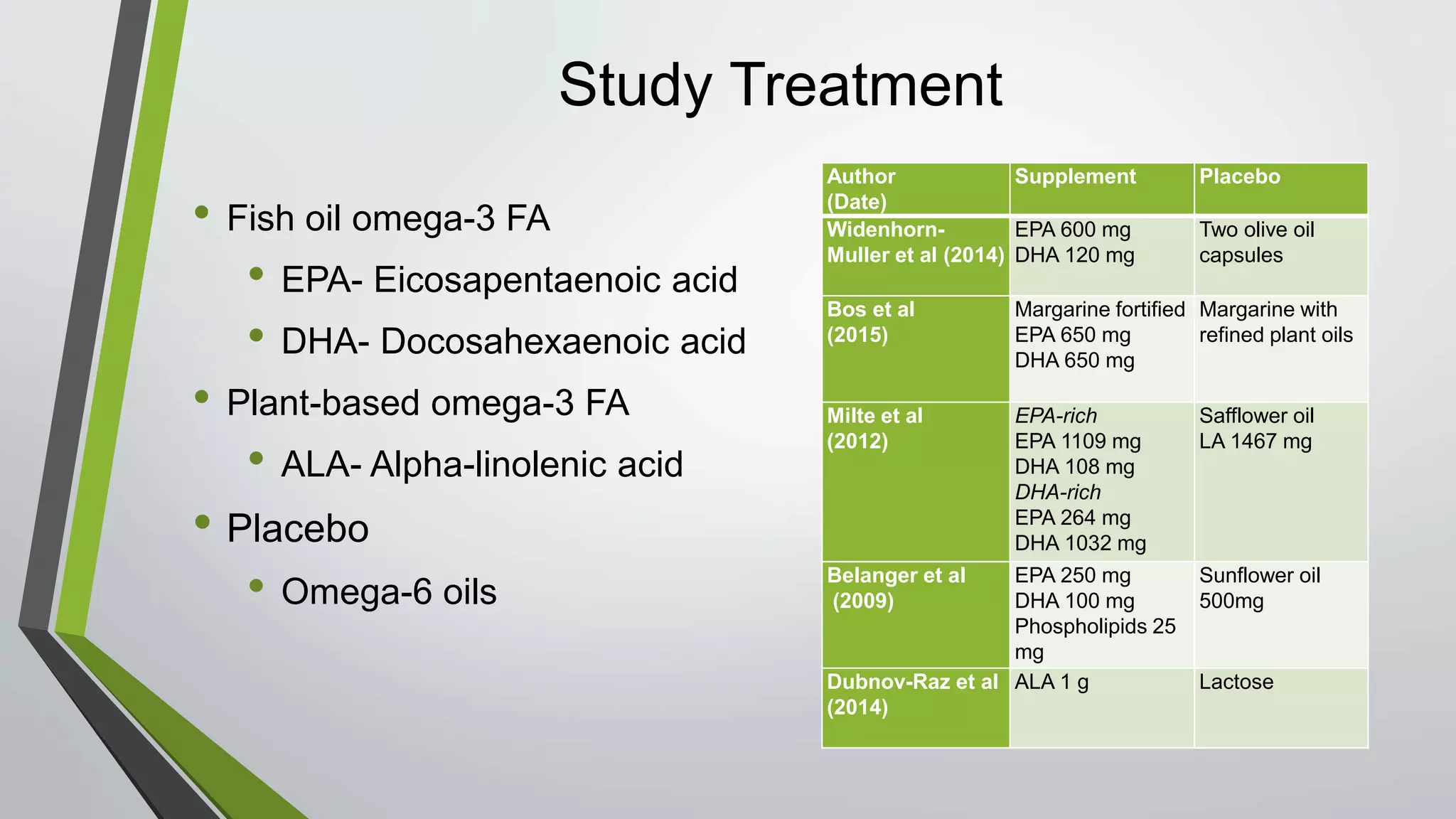
Author
(Date)
Supplement Placebo
Widenhorn-
Muller et al (2014)
EPA 600 mg
DHA 120 mg
Two olive oil
capsules
Bos et al
(2015)
Margarine fortified
EPA 650 mg
DHA 650 mg
Margarine with
refined plant oils
Milte et al
(2012)
EPA-rich
EPA 1109 mg
DHA 108 mg
DHA-rich
EPA 264 mg
DHA 1032 mg
Safflower oil
LA 1467 mg
Belanger et al
(2009)
EPA 250 mg
DHA 100 mg
Phospholipids 25
mg
Sunflower oil
500mg
Dubnov-Raz et al
(2014)
ALA 1 g Lactose
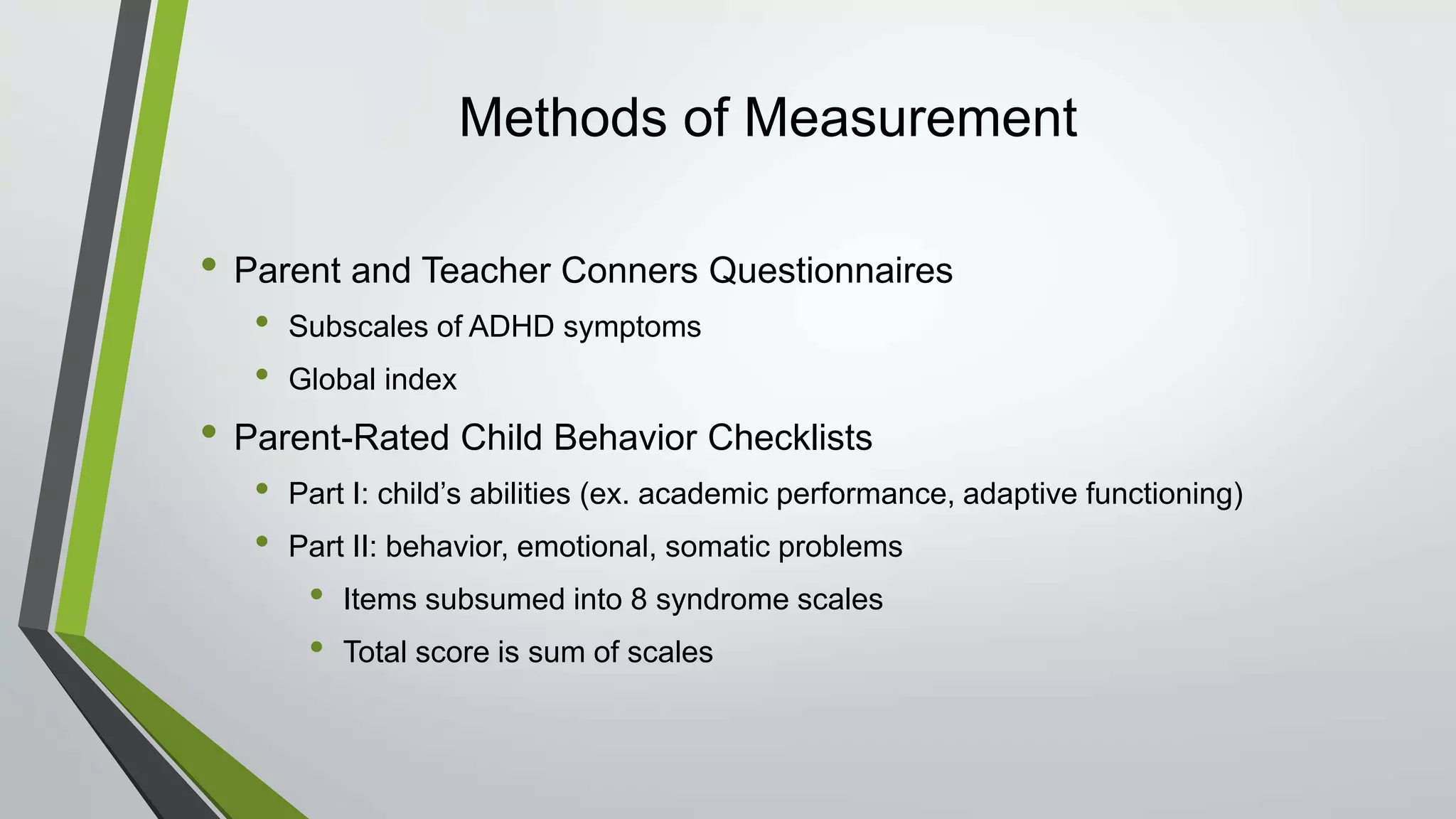
Methods of Measurement
• Parent and Teacher Conners Questionnaires
• Subscales of ADHD symptoms
• Global index
• Parent-Rated Child Behavior Checklists
• Part I: child’s abilities (ex. academic performance, adaptive functioning)
• Part II: behavior, emotional, somatic problems
• Items subsumed into 8 syndrome scales
• Total score is sum of scales
Safety and Ethics
• Informed consent
• Approval by Ethics Committees or Review boards
• No conflict of interest
• Adverse effects monitoring
Statistical Methods
• Mann-Whitney U tests
• T-tests
• No power analyses
• P values, < 0.05
• Chi-square analysis
• Demographics
• Linear mixed modeling
• Wilcoxon’s signed rank test
Results
Parent Conners Questionnaires
• Milte et al. Conners global index EPA vs. LA p-value of 0.57; DHA vs. LA p-value of 0.36
• Belanger et al. Conners global index
• Time 0 to time 1 Group A had a -7.3% difference from baseline scores, significant change
(P<0.05)
• Time 0 to time 2 Group A had -9.5% and Group B had -8.6%, both significant changes
(P<0.05)
• Dubnov-Raz et al. Conners global index for treatment group p-value of 0.46
Results
Parent-Rated Child Behavior Checklists
• Bos et al. attention problems had significant improvement (P<0.001)
• Mean score at baseline was 9.1 and at follow-up was 7.7 for those with ADHD
in treatment group
• Windenhorn-Muller et al. minimal changes in attention at baseline and follow-up
• Treatment group at baseline was 70.5 and follow-up was 68.6 for attention
scores
• P-value of 0.32, not significant
Limitations
• Small sample size
• No power analysis
• Lack of healthy participants as control group
• Duration of studies (8-16 weeks)
• Supplement dosage
Strengths
• RCTs
• ADHD clinical diagnosis in participants
• Similar methods of measurement
• ADHD symptom questionnaires
• Blood analysis for FA levels
• Well-tolerated supplement
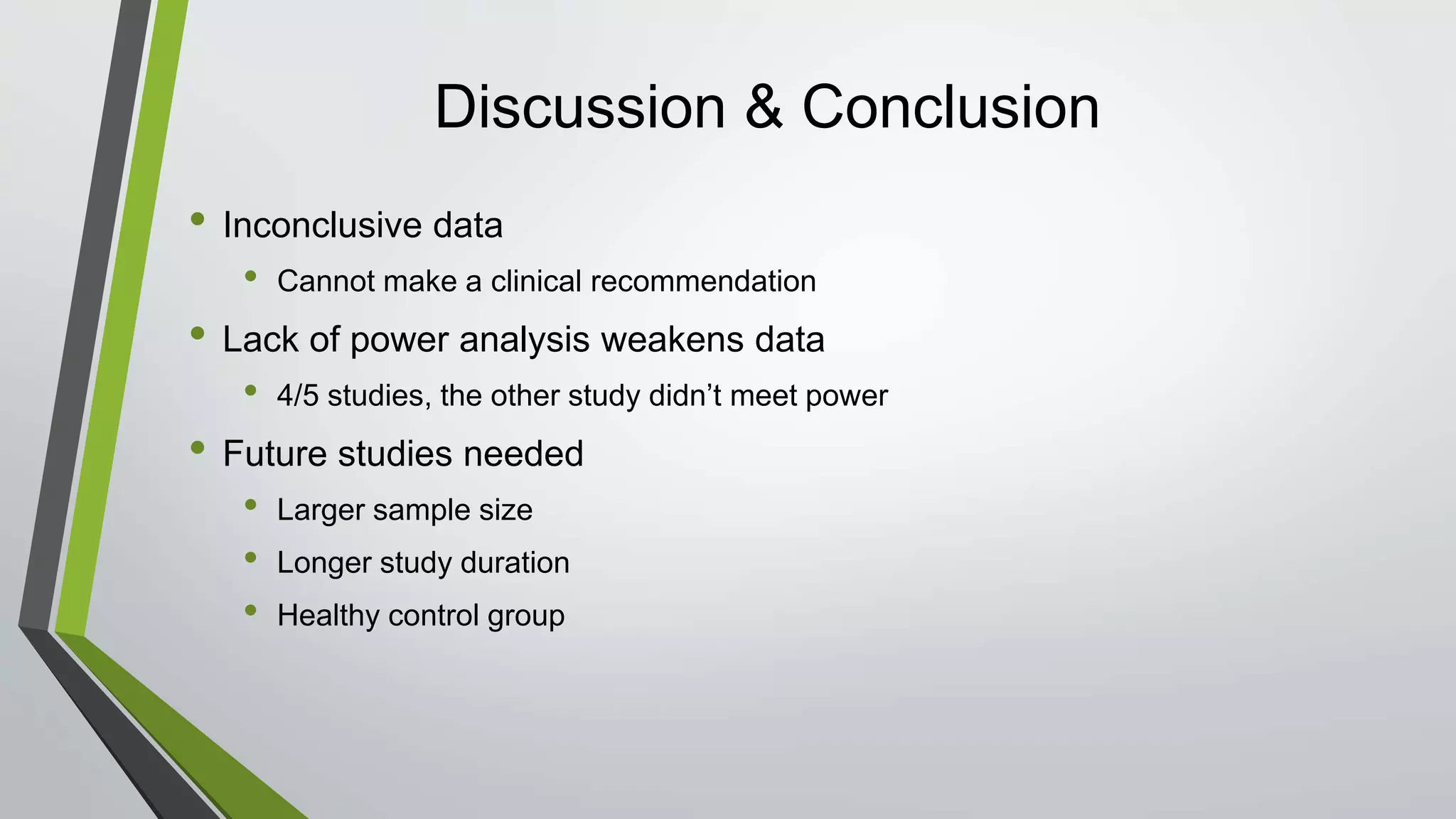
Discussion & Conclusion
• Inconclusive data
• Cannot make a clinical recommendation
• Lack of power analysis weakens data
• 4/5 studies, the other study didn’t meet power
• Future studies needed
• Larger sample size
• Longer study duration
• Healthy control group
References
1. Kevin R Krull P. Attention deficit hyperactivity disorder in children and adolescents: Epidemiology and pathogenesis.
http://www.uptodate.com.proxy.campbell.edu/contents/attention-deficit-hyperactivity-disorder-in-children-and-adolescents-epidemiology-and-
pathogenesis?source=search_result&search=adhd&selectedTitle=5~150. Updated 2015. Accessed 02/12, 2016.
2. Centers for Disease Control and Prevention. Attention-deficit/ hyperactivity disorder (ADHD): Data and statistics.
http://www.cdc.gov/ncbddd/adhd/data.html. Updated 2016. Accessed 2/19, 2016.
3. Kevin R Krull P. Attention deficit hyperactivity disorder in children and adolescents: Clinical features and evaluation.
http://www.uptodate.com.proxy.campbell.edu/contents/attention-deficit-hyperactivity-disorder-in-children-and-adolescents-clinical-features-and-
evaluation?source=search_result&search=adhd+children&selectedTitle=2~150. Updated 2015. Accessed 2/16, 2016.
4. Widenhorn-Muller K, Schwanda S, Scholz E, Spitzer M, Bode H. Effect of supplementation with long-chain omega-3 polyunsaturated fatty
acids on behavior and cognition in children with attention deficit/hyperactivity disorder (ADHD): A randomized placebo-controlled intervention
trial. Prostaglandins Leukot Essent Fatty Acids. 2014;91(1-2):49-60. doi: 10.1016/j.plefa.2014.04.004 [doi].
5. Bos DJ, Oranje B, Veerhoek ES, et al. Reduced symptoms of inattention after dietary omega-3 fatty acid supplementation in boys with and
without attention deficit/hyperactivity disorder. Neuropsychopharmacology. 2015;40(10):2298-2306. doi: 10.1038/npp.2015.73 [doi].
6. Dubnov-Raz G, Khoury Z, Wright I, Raz R, Berger I. The effect of alpha-linolenic acid supplementation on ADHD symptoms in children: A
randomized controlled double-blind study. Front Hum Neurosci. 2014;8:780. doi: 10.3389/fnhum.2014.00780 [doi].
7. Belanger SA, Vanasse M, Spahis S, et al. Omega-3 fatty acid treatment of children with attention-deficit hyperactivity disorder: A
randomized, double-blind, placebo-controlled study. Paediatr Child Health. 2009;14(2):89-98.
8. Milte CM, Parletta N, Buckley JD, Coates AM, Young RM, Howe PR. Increased erythrocyte eicosapentaenoic acid and docosahexaenoic
acid are associated with improved attention and behavior in children with ADHD in a randomized controlled three-way crossover trial. J Atten
Disord. 2015;19(11):954-964. doi: 10.1177/1087054713510562 [doi].

Omega-3 Fatty Acid Supplementation in Children with ADHD

  • 1.
    Omega-3 Fatty Acid Supplementationin Children with ADHD By: Aly Worf, PA-S2
  • 2.
    Background • Attention DeficitHyperactivity Disorder (ADHD), DSM-V diagnosis • ADHD is one of the most common diseases in children • More common in males than females • Diagnosis is complex: medical exam, behavior/symptom rating scales, teacher documentation of core symptoms • Pathophysiology is poorly understood: primary genetic and secondary environmental factors
  • 3.
    Omega-3 Fatty Acids(FA) • Important role in neuronal membranes • Synthesis and function of neurotransmitters • Essential nutrient, provided by diet alone • Research shows decreased level of FA in ADHD • Possible pathogenesis for ADHD
  • 4.
    Clinical Question •In childrenwith ADHD, does omega-3 supplementation improve ADHD symptoms?
  • 5.
    Data Sources &Study Selection • PubMed and MeSH search tool • Key words “omega-3 fatty acids” and “ADHD” • Limits: • 2009-2016 • Clinical Trials • Five articles were selected for this review
  • 6.
    Study Design Author (Date) Study TypeSample size Supplement Placebo Treatment duration Country Widenhorn-Muller et al (2014) Double-blind placebo- controlled 95 EPA 600 mg DHA 120 mg Two olive oil capsules 16 weeks Germany Bos et al (2015) Double-blind placebo- controlled 77 Margarine fortified EPA 650 mg DHA 650 mg Margarine with refined plant oils 16 weeks The Netherlands Milte et al (2012) Randomized placebo- controlled three- way crossover 70 EPA-rich EPA 1109 mg DHA 108 mg DHA-rich EPA 264 mg DHA 1032 mg Safflower oil LA 1467 mg 16 weeks Australia Belanger et al (2009) Double-blind one- way crossover randomized 26 EPA 250 mg DHA 100 mg Phospholipids 25 mg Sunflower oil 500mg 16 weeks Canada Dubnov-Raz et al (2014) Double-blind placebo- controlled 17 ALA 1 g Lactose 8 weeks Israel
  • 7.
    Patient Recruitment • ADHDclinics • Health care professionals • Leaflets, newspaper, school newsletters, flyers • Department of Psychiatry • Advertising in primary and secondary schools
  • 8.
    Inclusion/Exclusion Criteria Author InclusionExclusion Widenhorn- Muller et al. (2014) Children ages 6-12 DSM-IV diagnosis of ADHD IQ ≤ 70, use of stimulant medication Psychoactive medication Fatty acid supplementation in previous 6 months Allergy to fish Bos et al. (2015) Boys ages 8-14 years DSM-IV ADHD diagnosis and typically developing boys (control) Use of psychoactive medication besides methylphenidate Psychiatric disorders and family history of these Milte et al. (2012) Children 7-12 years old with ADHD diagnosis Consumption of omega-3 supplements 3 months prior Taking ADHD medication Belanger et al. (2009) Children 6-11 years old diagnosed with ADHD IQ score >85 Other mental health disorders Taking medications Fish allergy Dubnov-Raz et al. (2014) Children and adolescents ages 6-16 years recently diagnosed with ADHD Drug naïve and untreated Refusal to undergo any of the testing procedures or to take the supplement. History of chronic conditions Use of medications
  • 9.
    Demographics Author (year) MeanAge (years) Gender (% M/F) Race IQ Widenhorn- Muller et al (2014) 8.9 78 % Male 22 % Female NR 100.18 ±9.27 Bos et al (2015) 10.6 100% Male NR 104.3 ± 16.2 Milte et al (2012) 8.8 77% Male 23 % Female NR NR Belanger et al (2009) 9. 2 70% Male 30% Female NR NR Dubnov-Raz et al (2014) 6-16 NR NR NR
  • 10.
    Study Treatment • Fishoil omega-3 FA • EPA- Eicosapentaenoic acid • DHA- Docosahexaenoic acid • Plant-based omega-3 FA • ALA- Alpha-linolenic acid • Placebo • Omega-6 oils Author (Date) Supplement Placebo Widenhorn- Muller et al (2014) EPA 600 mg DHA 120 mg Two olive oil capsules Bos et al (2015) Margarine fortified EPA 650 mg DHA 650 mg Margarine with refined plant oils Milte et al (2012) EPA-rich EPA 1109 mg DHA 108 mg DHA-rich EPA 264 mg DHA 1032 mg Safflower oil LA 1467 mg Belanger et al (2009) EPA 250 mg DHA 100 mg Phospholipids 25 mg Sunflower oil 500mg Dubnov-Raz et al (2014) ALA 1 g Lactose
  • 11.
    Methods of Measurement •Parent and Teacher Conners Questionnaires • Subscales of ADHD symptoms • Global index • Parent-Rated Child Behavior Checklists • Part I: child’s abilities (ex. academic performance, adaptive functioning) • Part II: behavior, emotional, somatic problems • Items subsumed into 8 syndrome scales • Total score is sum of scales
  • 12.
    Safety and Ethics •Informed consent • Approval by Ethics Committees or Review boards • No conflict of interest • Adverse effects monitoring
  • 13.
    Statistical Methods • Mann-WhitneyU tests • T-tests • No power analyses • P values, < 0.05 • Chi-square analysis • Demographics • Linear mixed modeling • Wilcoxon’s signed rank test
  • 14.
    Results Parent Conners Questionnaires •Milte et al. Conners global index EPA vs. LA p-value of 0.57; DHA vs. LA p-value of 0.36 • Belanger et al. Conners global index • Time 0 to time 1 Group A had a -7.3% difference from baseline scores, significant change (P<0.05) • Time 0 to time 2 Group A had -9.5% and Group B had -8.6%, both significant changes (P<0.05) • Dubnov-Raz et al. Conners global index for treatment group p-value of 0.46
  • 15.
    Results Parent-Rated Child BehaviorChecklists • Bos et al. attention problems had significant improvement (P<0.001) • Mean score at baseline was 9.1 and at follow-up was 7.7 for those with ADHD in treatment group • Windenhorn-Muller et al. minimal changes in attention at baseline and follow-up • Treatment group at baseline was 70.5 and follow-up was 68.6 for attention scores • P-value of 0.32, not significant
  • 16.
    Limitations • Small samplesize • No power analysis • Lack of healthy participants as control group • Duration of studies (8-16 weeks) • Supplement dosage
  • 17.
    Strengths • RCTs • ADHDclinical diagnosis in participants • Similar methods of measurement • ADHD symptom questionnaires • Blood analysis for FA levels • Well-tolerated supplement
  • 18.
    Discussion & Conclusion •Inconclusive data • Cannot make a clinical recommendation • Lack of power analysis weakens data • 4/5 studies, the other study didn’t meet power • Future studies needed • Larger sample size • Longer study duration • Healthy control group
  • 19.
    References 1. Kevin RKrull P. Attention deficit hyperactivity disorder in children and adolescents: Epidemiology and pathogenesis. http://www.uptodate.com.proxy.campbell.edu/contents/attention-deficit-hyperactivity-disorder-in-children-and-adolescents-epidemiology-and- pathogenesis?source=search_result&search=adhd&selectedTitle=5~150. Updated 2015. Accessed 02/12, 2016. 2. Centers for Disease Control and Prevention. Attention-deficit/ hyperactivity disorder (ADHD): Data and statistics. http://www.cdc.gov/ncbddd/adhd/data.html. Updated 2016. Accessed 2/19, 2016. 3. Kevin R Krull P. Attention deficit hyperactivity disorder in children and adolescents: Clinical features and evaluation. http://www.uptodate.com.proxy.campbell.edu/contents/attention-deficit-hyperactivity-disorder-in-children-and-adolescents-clinical-features-and- evaluation?source=search_result&search=adhd+children&selectedTitle=2~150. Updated 2015. Accessed 2/16, 2016. 4. Widenhorn-Muller K, Schwanda S, Scholz E, Spitzer M, Bode H. Effect of supplementation with long-chain omega-3 polyunsaturated fatty acids on behavior and cognition in children with attention deficit/hyperactivity disorder (ADHD): A randomized placebo-controlled intervention trial. Prostaglandins Leukot Essent Fatty Acids. 2014;91(1-2):49-60. doi: 10.1016/j.plefa.2014.04.004 [doi]. 5. Bos DJ, Oranje B, Veerhoek ES, et al. Reduced symptoms of inattention after dietary omega-3 fatty acid supplementation in boys with and without attention deficit/hyperactivity disorder. Neuropsychopharmacology. 2015;40(10):2298-2306. doi: 10.1038/npp.2015.73 [doi]. 6. Dubnov-Raz G, Khoury Z, Wright I, Raz R, Berger I. The effect of alpha-linolenic acid supplementation on ADHD symptoms in children: A randomized controlled double-blind study. Front Hum Neurosci. 2014;8:780. doi: 10.3389/fnhum.2014.00780 [doi]. 7. Belanger SA, Vanasse M, Spahis S, et al. Omega-3 fatty acid treatment of children with attention-deficit hyperactivity disorder: A randomized, double-blind, placebo-controlled study. Paediatr Child Health. 2009;14(2):89-98. 8. Milte CM, Parletta N, Buckley JD, Coates AM, Young RM, Howe PR. Increased erythrocyte eicosapentaenoic acid and docosahexaenoic acid are associated with improved attention and behavior in children with ADHD in a randomized controlled three-way crossover trial. J Atten Disord. 2015;19(11):954-964. doi: 10.1177/1087054713510562 [doi].

Editor's Notes

  • #3 8-11% of children in the United States Diagnosis- Conners Behavior rating scales Pathogenesis: primary genetic factors- genetic imbalance of catecholamine metabolism in the cerebral cortex is a key feature. (that is why the mechanism of the primary treatment for this is methylphenidate which has noradrenergic properties.
  • #4 -development and function of neuronal membranes -Children with ADHD have decreased levels of omega- 3 and 6 (essential fatty acids) in their blood when compared to healthy children. Essential fatty acids cannot be created, they must be provided by the diet. Foods rich in these include: fish, vegetable oils, nuts, flax seed, leafy vegetables, which is lacking in many American’s diets.