1 
My First PPT 
This Is my first ppt.
2 
Overview 
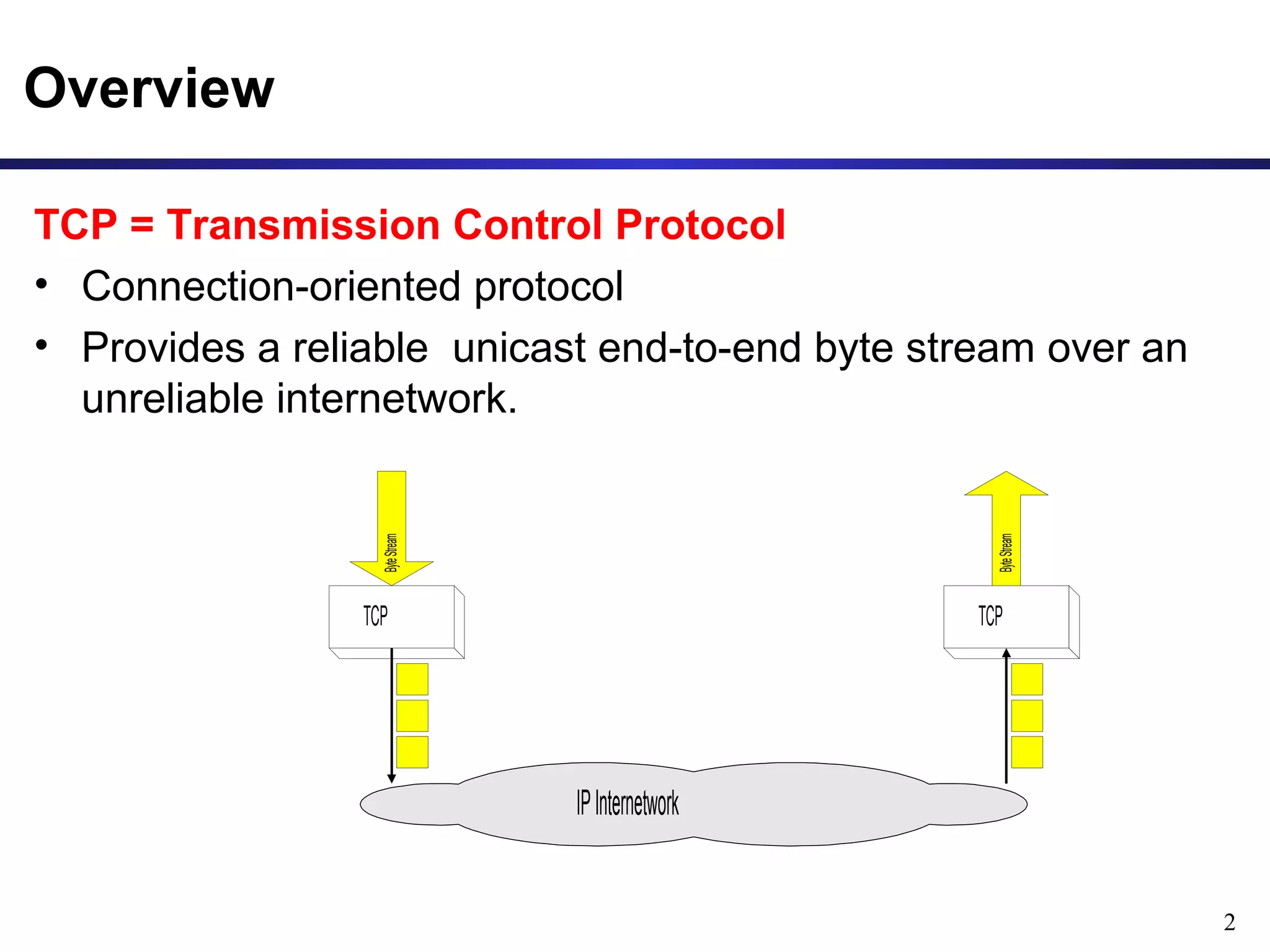
TCP = Transmission Control Protocol 
• Connection-oriented protocol 
• Provides a reliable unicast end-to-end byte stream over an 
unreliable internetwork. 
TCP 
IP Internetwork 
Byte Stream 
Byte Stream 
TCP
3 
Connection-Oriented 
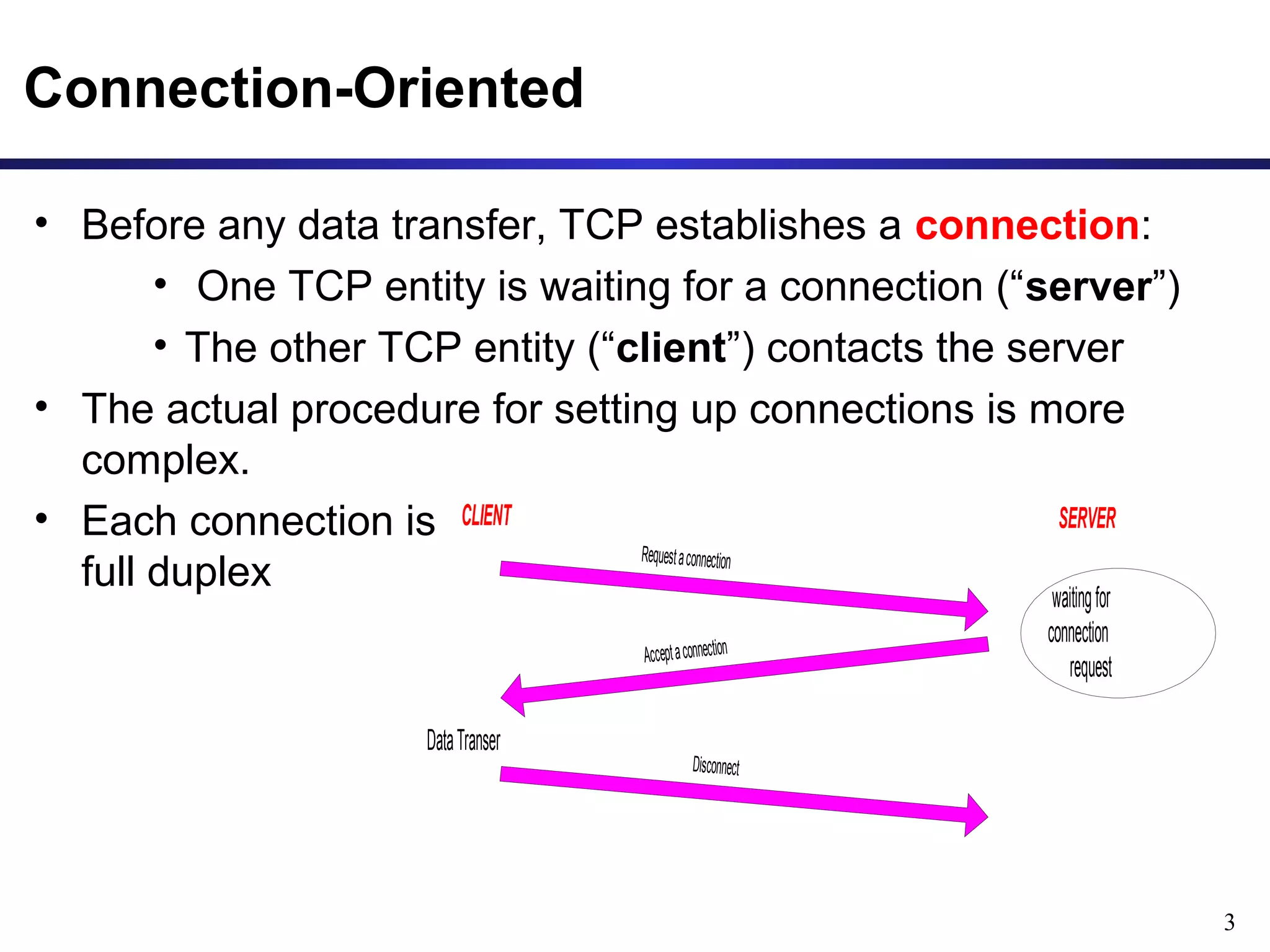
• Before any data transfer, TCP establishes a connection: 
• One TCP entity is waiting for a connection (“server”) 
• The other TCP entity (“client”) contacts the server 
• The actual procedure for setting up connections is more 
complex. 
• Each connection is 
CLIENT SERVER 
full duplex 
waiting for 
connection 
request 
Request a connection 
Accept a connection 
Disconnect Data Transer
4 
Reliable 
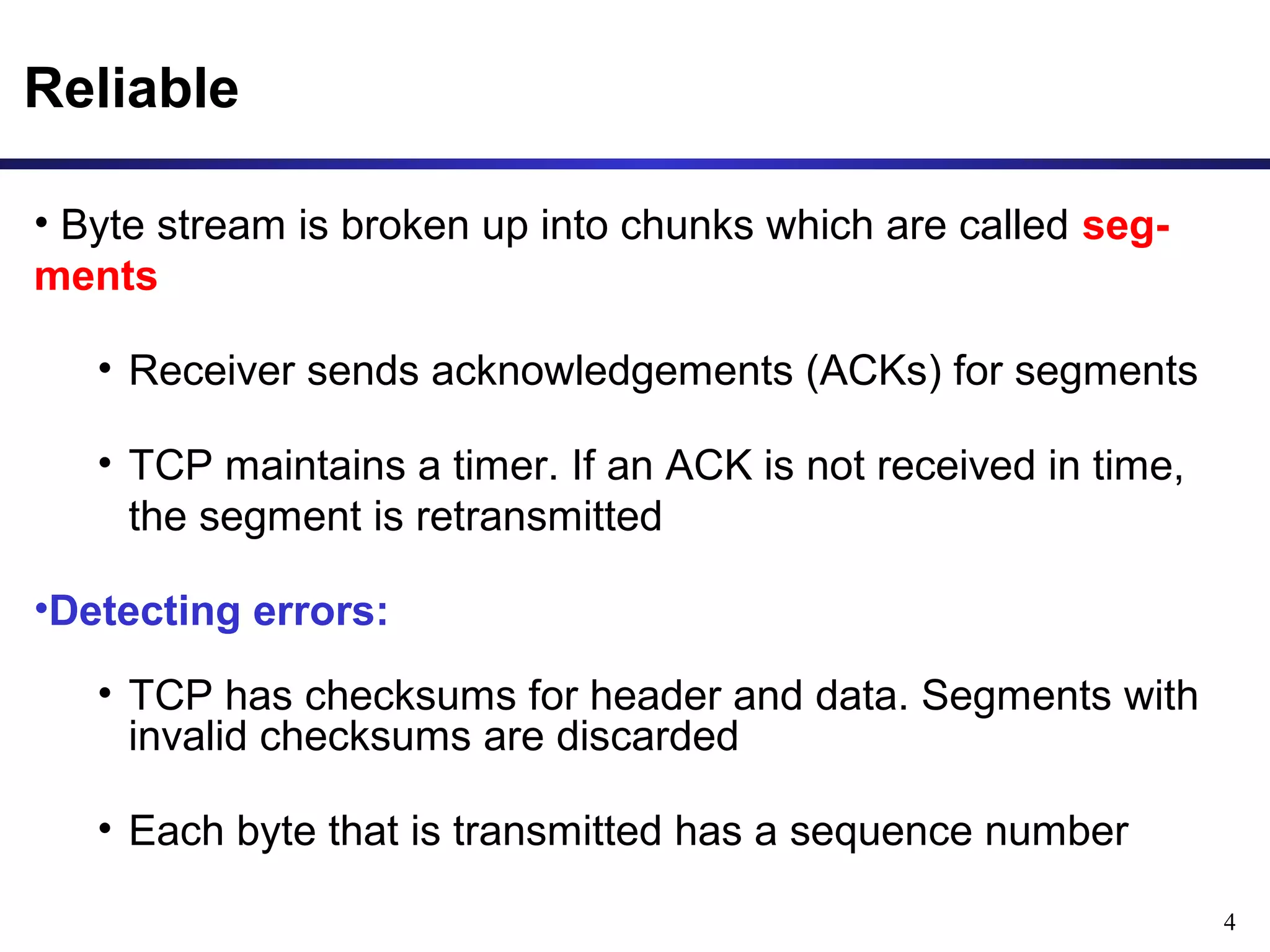
• Byte stream is broken up into chunks which are called seg-ments 
• Receiver sends acknowledgements (ACKs) for segments 
• TCP maintains a timer. If an ACK is not received in time, 
the segment is retransmitted 
•Detecting errors: 
• TCP has checksums for header and data. Segments with 
invalid checksums are discarded 
• Each byte that is transmitted has a sequence number
5 
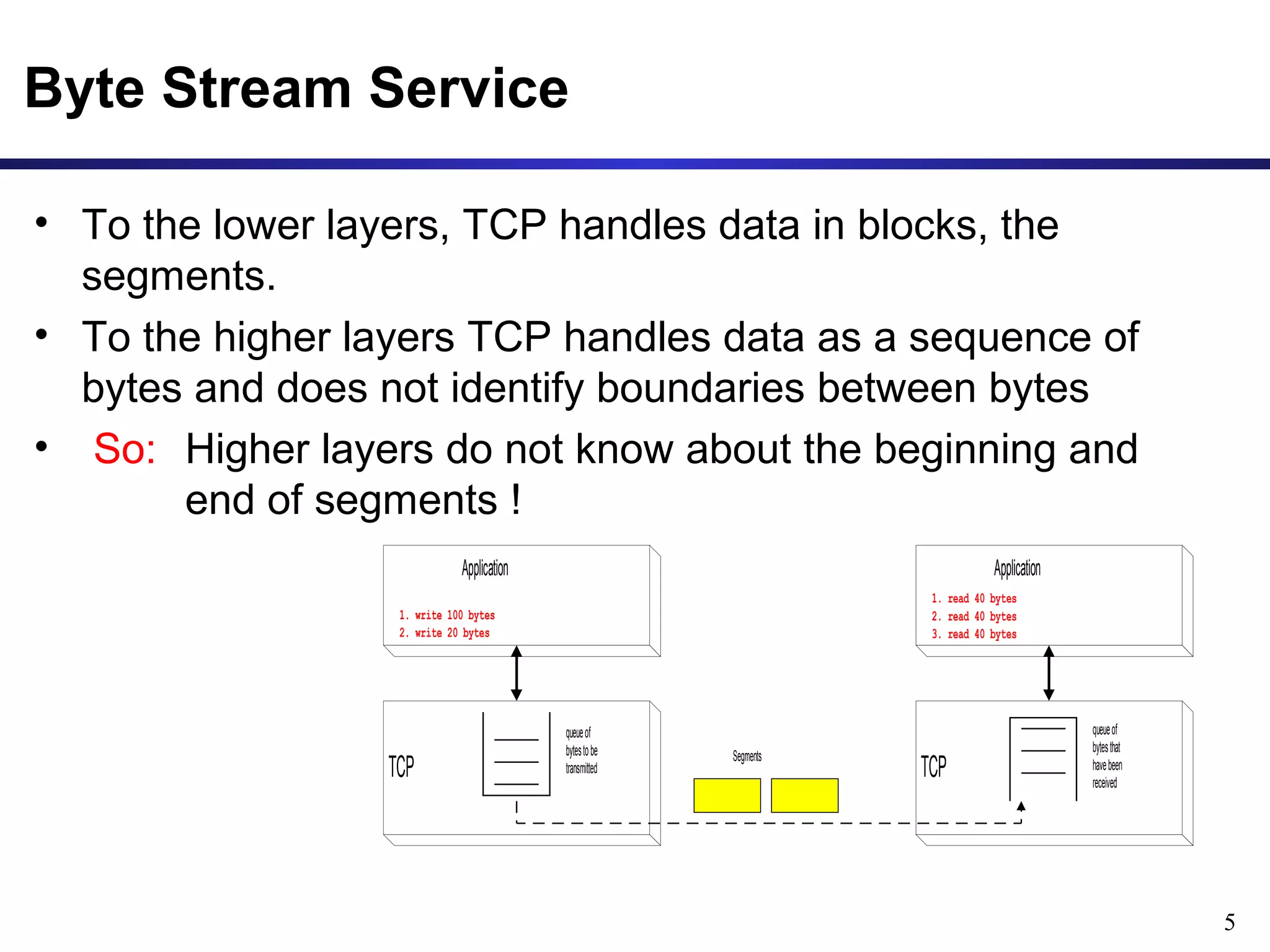
Byte Stream Service 
• To the lower layers, TCP handles data in blocks, the 
segments. 
• To the higher layers TCP handles data as a sequence of 
bytes and does not identify boundaries between bytes 
• So: Higher layers do not know about the beginning and 
end of segments ! 
TCP 
Application 
1. write 100 bytes 
2. write 20 bytes 
queue of 
bytes to be 
transmitted TCP 
queue of 
bytes that 
have been 
received 
Application 
1. read 40 bytes 
2. read 40 bytes 
3. read 40 bytes 
Segments
6 
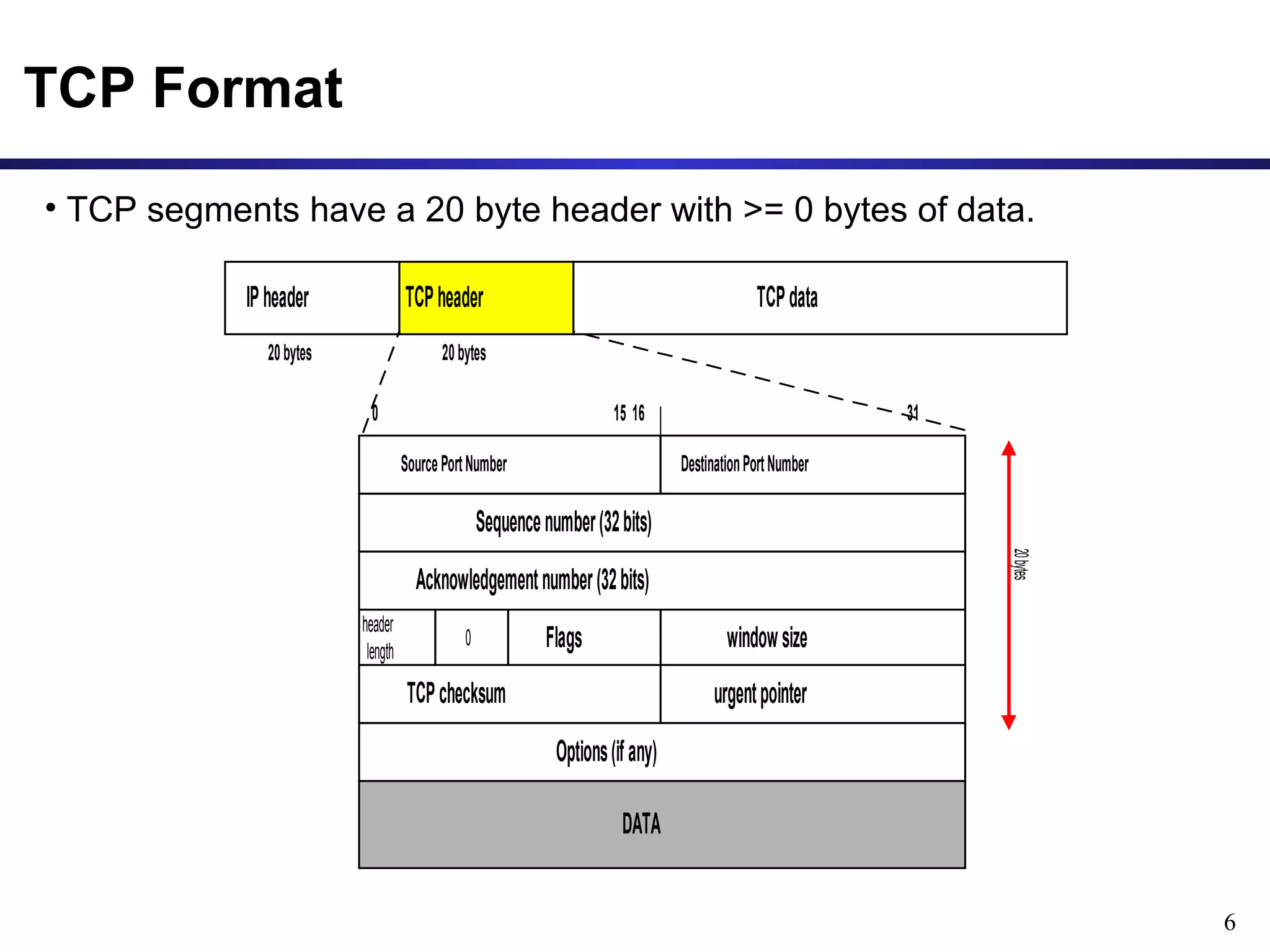
TCP Format 
• TCP segments have a 20 byte header with >= 0 bytes of data. 
IP header TCP header TCP data 
Sequence number (32 bits) 
TCP checksum urgent pointer 
DATA 
20 bytes 20 bytes 
0 15 16 31 
Source Port Number Destination Port Number 
Acknowledgement number (32 bits) 
header window size 
length 0 Flags 
Options (if any) 
20 bytes
7 
TCP header fields 
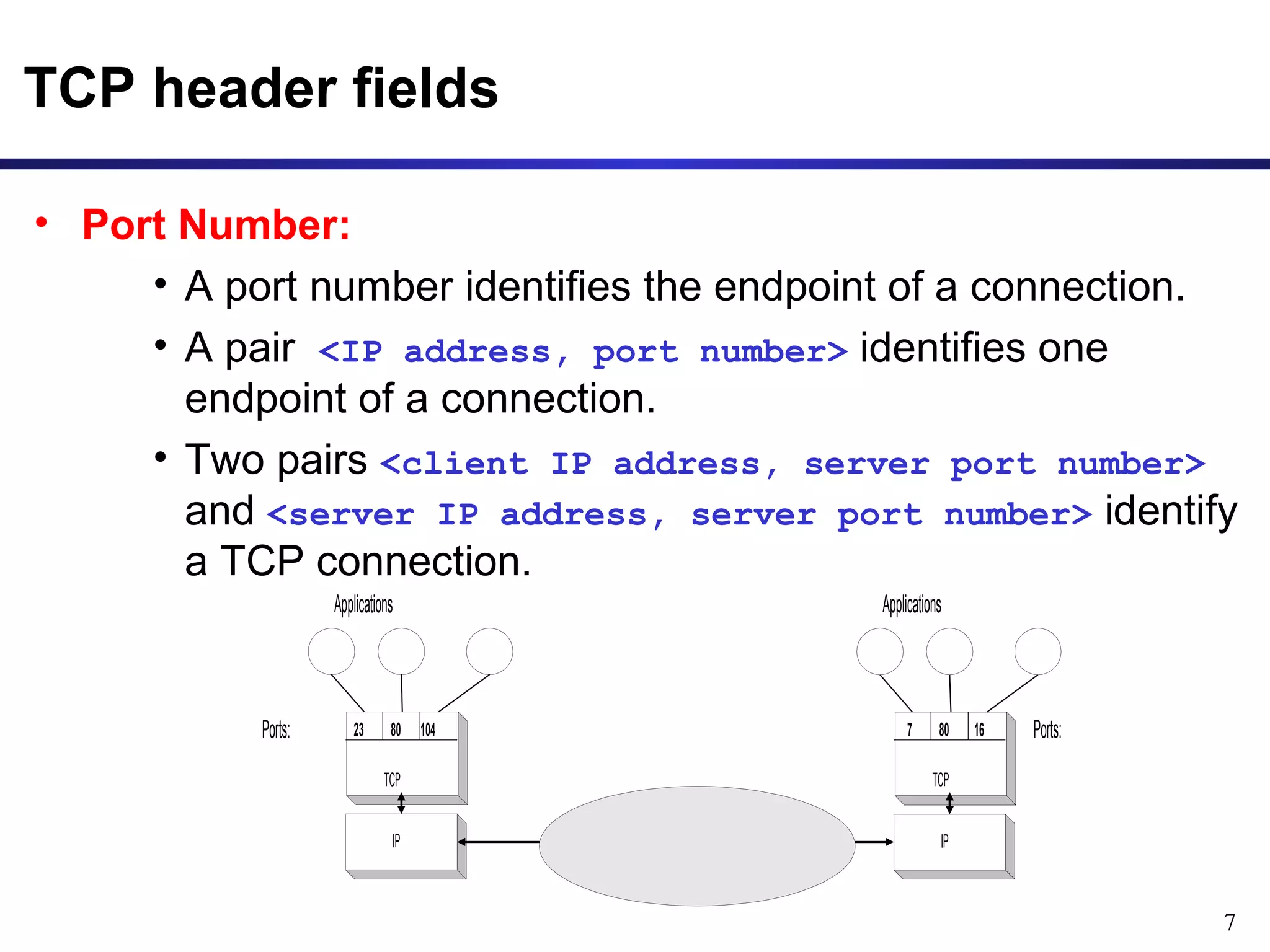
• Port Number: 
• A port number identifies the endpoint of a connection. 
• A pair <IP address, port number> identifies one 
endpoint of a connection. 
• Two pairs <client IP address, server port number> 
and <server IP address, server port number> identify 
a TCP connection. 
Applications 
Ports: 23 80 104 
TCP 
IP 
Applications 
7 80 16 Ports: 
TCP 
IP
8 
TCP header fields 
• Sequence Number (SeqNo): 
– Sequence number is 32 bits long. 
– So the range of SeqNo is 
0 <= SeqNo <= 232 -1 » 4.3 Gbyte 
– Each sequence number identifies a byte in the byte 
stream 
– Initial Sequence Number (ISN) of a connection is set 
during connection establishment 
Q: What are possible requirements for ISN ?
9 
TCP header fields 
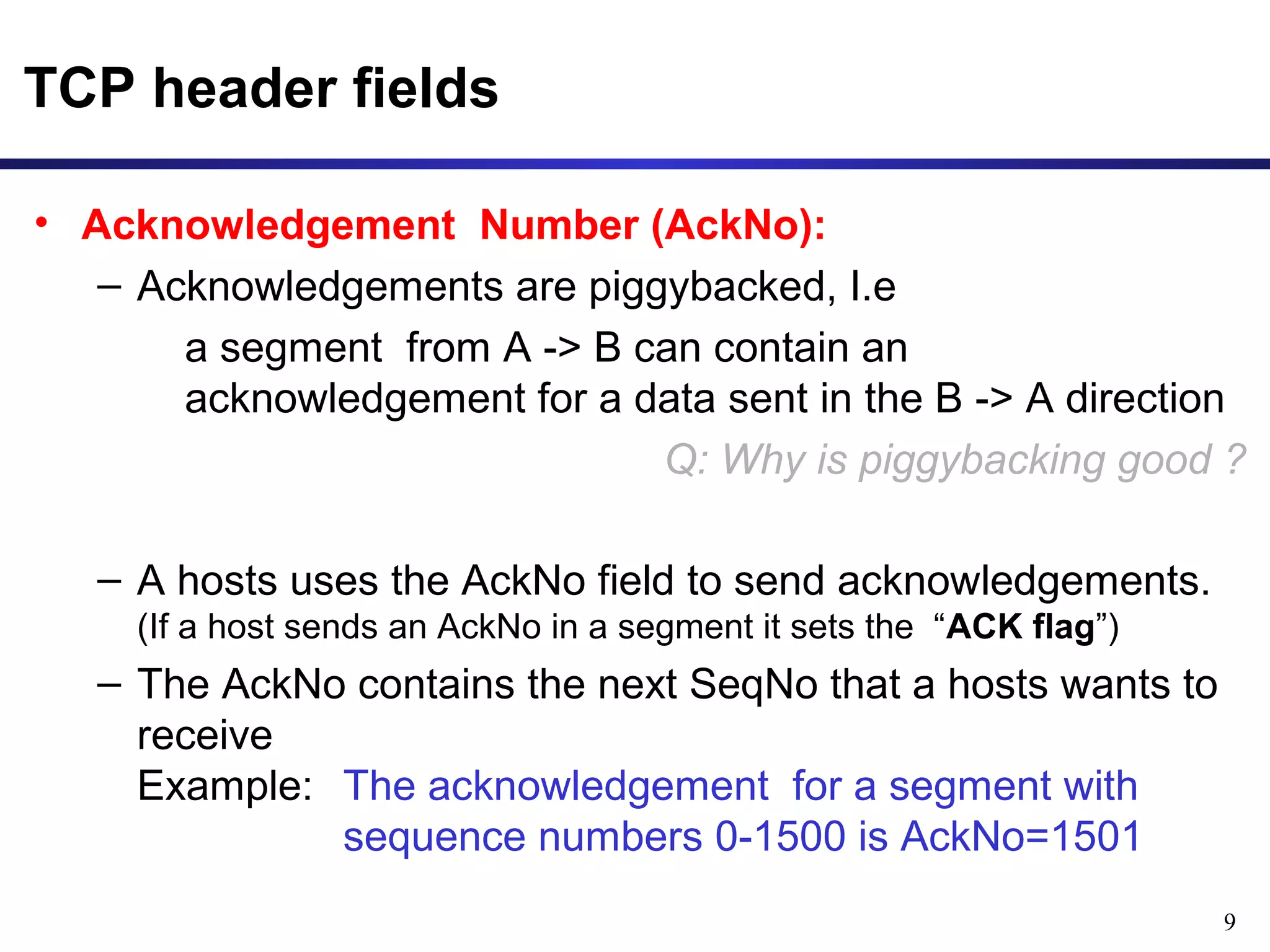
• Acknowledgement Number (AckNo): 
– Acknowledgements are piggybacked, I.e 
a segment from A -> B can contain an 
acknowledgement for a data sent in the B -> A direction 
Q: Why is piggybacking good ? 
– A hosts uses the AckNo field to send acknowledgements. 
(If a host sends an AckNo in a segment it sets the “ACK flag”) 
– The AckNo contains the next SeqNo that a hosts wants to 
receive 
Example: The acknowledgement for a segment with 
sequence numbers 0-1500 is AckNo=1501
10 
TCP header fields 
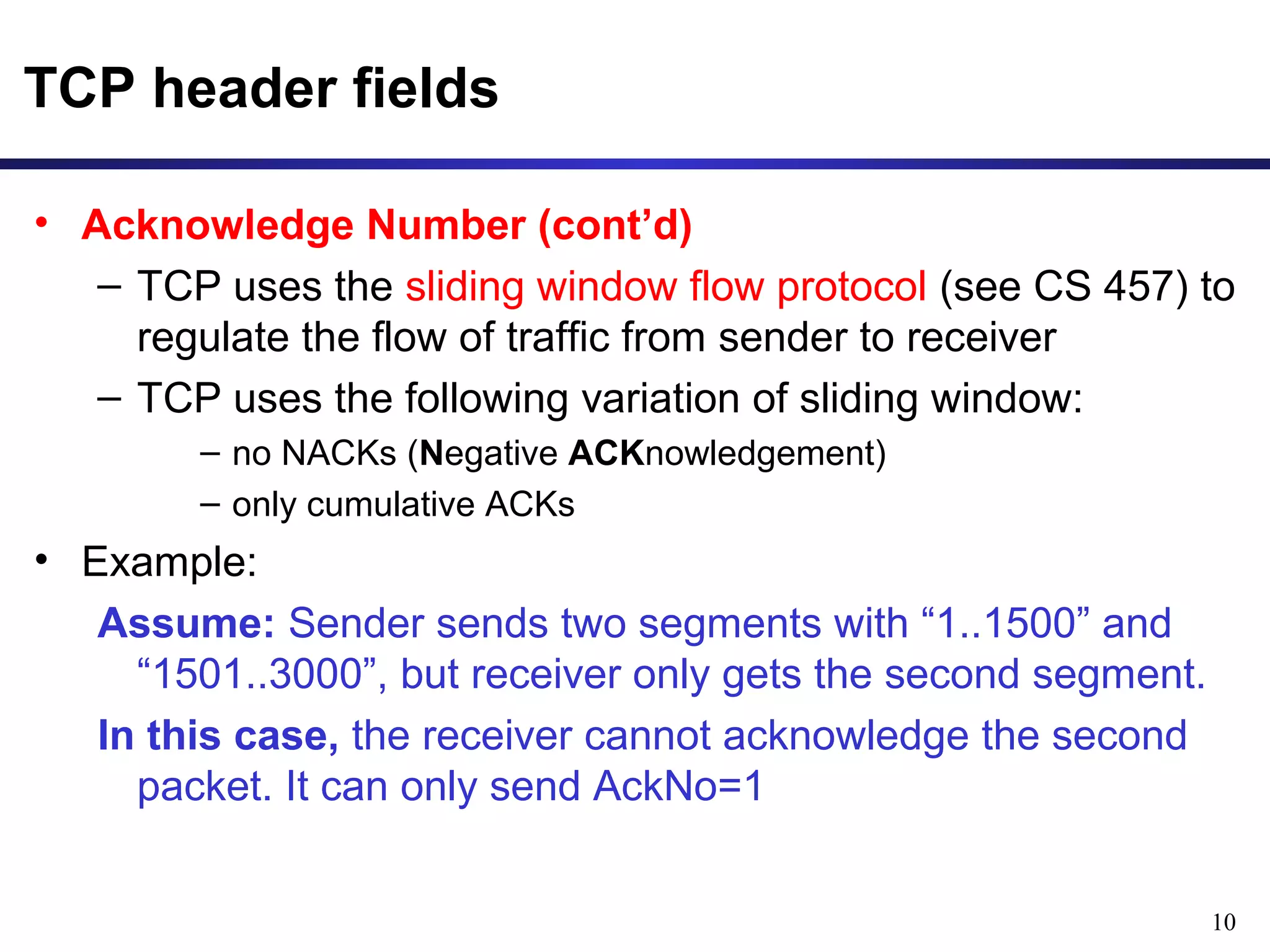
• Acknowledge Number (cont’d) 
– TCP uses the sliding window flow protocol (see CS 457) to 
regulate the flow of traffic from sender to receiver 
– TCP uses the following variation of sliding window: 
– no NACKs (Negative ACKnowledgement) 
– only cumulative ACKs 
• Example: 
Assume: Sender sends two segments with “1..1500” and 
“1501..3000”, but receiver only gets the second segment. 
In this case, the receiver cannot acknowledge the second 
packet. It can only send AckNo=1
11 
TCP header fields 
• Header Length ( 4bits): 
– Length of header in 32-bit words 
– Note that TCP header has variable length (with minimum 
20 bytes)
12 
TCP header fields 
• Flag bits: 
– URG: Urgent pointer is valid 
– If the bit is set, the following bytes contain an urgent message in 
the range: 
SeqNo <= urgent message <= SeqNo+urgent pointer 
– ACK: Acknowledgement Number is valid 
– PSH: PUSH Flag 
– Notification from sender to the receiver that the receiver should 
pass all data that it has to the application. 
– Normally set by sender when the sender’s buffer is empty
13 
TCP header fields 
• Flag bits: 
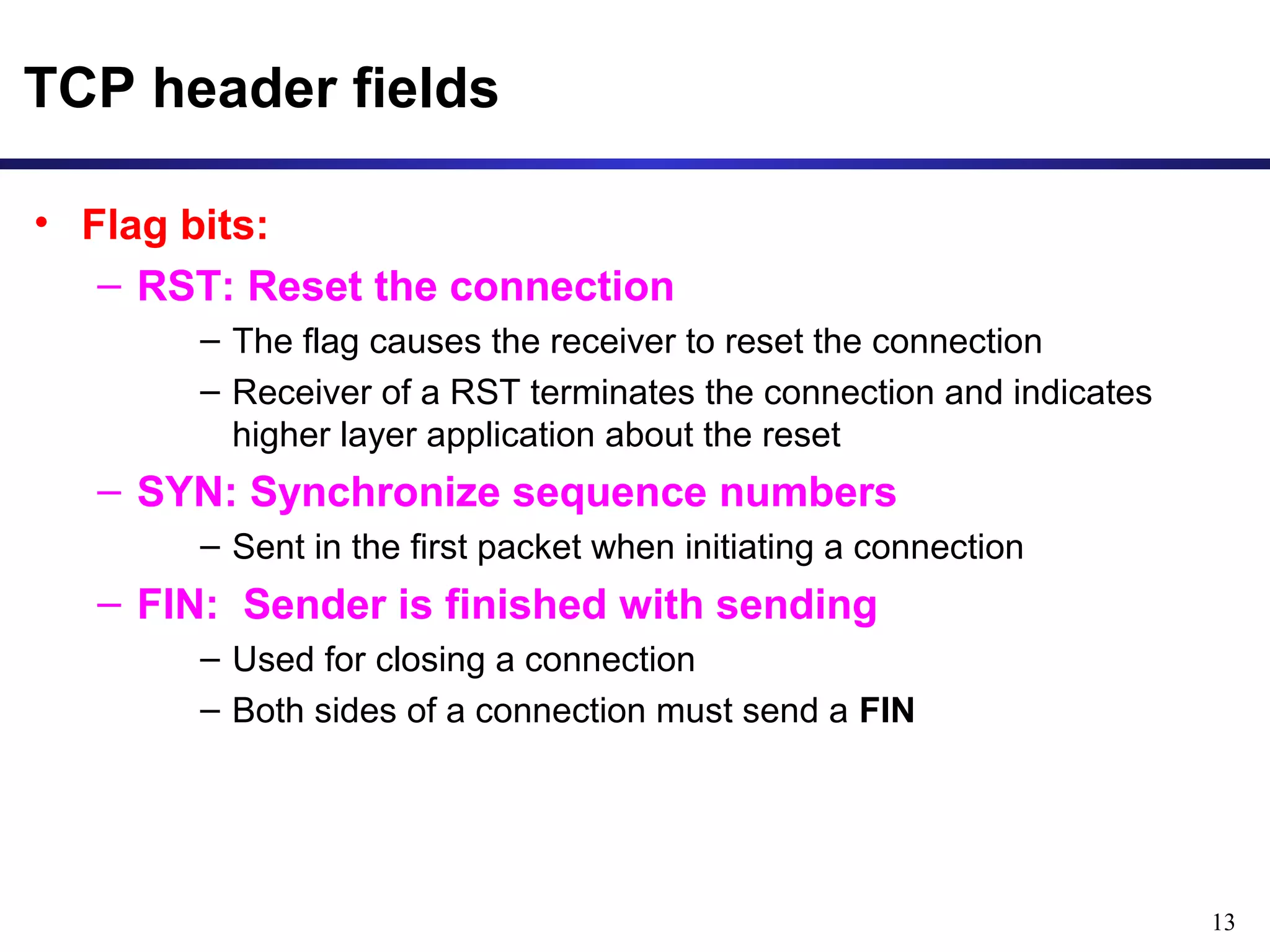
– RST: Reset the connection 
– The flag causes the receiver to reset the connection 
– Receiver of a RST terminates the connection and indicates 
higher layer application about the reset 
– SYN: Synchronize sequence numbers 
– Sent in the first packet when initiating a connection 
– FIN: Sender is finished with sending 
– Used for closing a connection 
– Both sides of a connection must send a FIN
14 
TCP header fields 
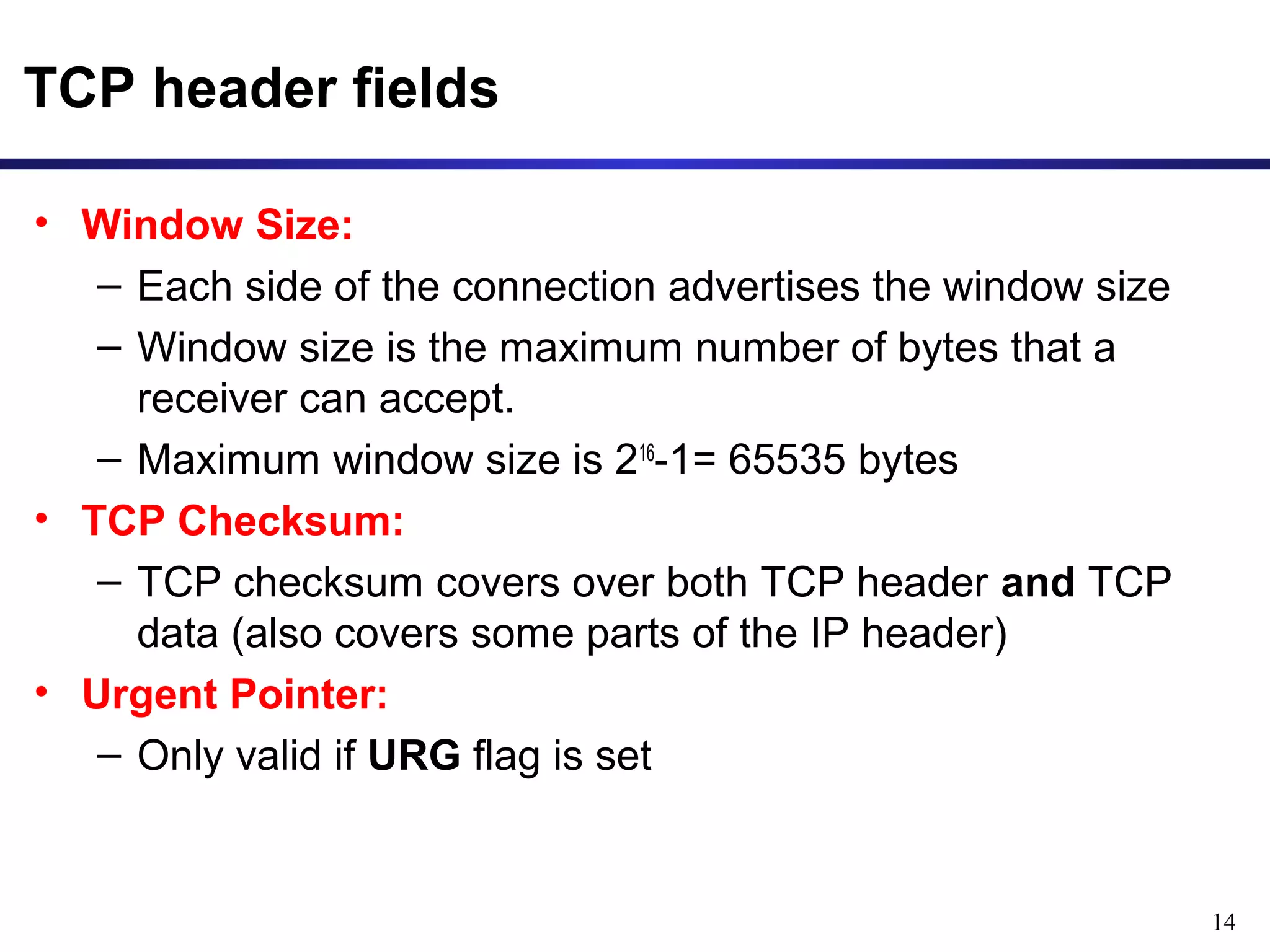
• Window Size: 
– Each side of the connection advertises the window size 
– Window size is the maximum number of bytes that a 
receiver can accept. 
– Maximum window size is 216-1= 65535 bytes 
• TCP Checksum: 
– TCP checksum covers over both TCP header and TCP 
data (also covers some parts of the IP header) 
• Urgent Pointer: 
– Only valid if URG flag is set
15 
TCP header fields 
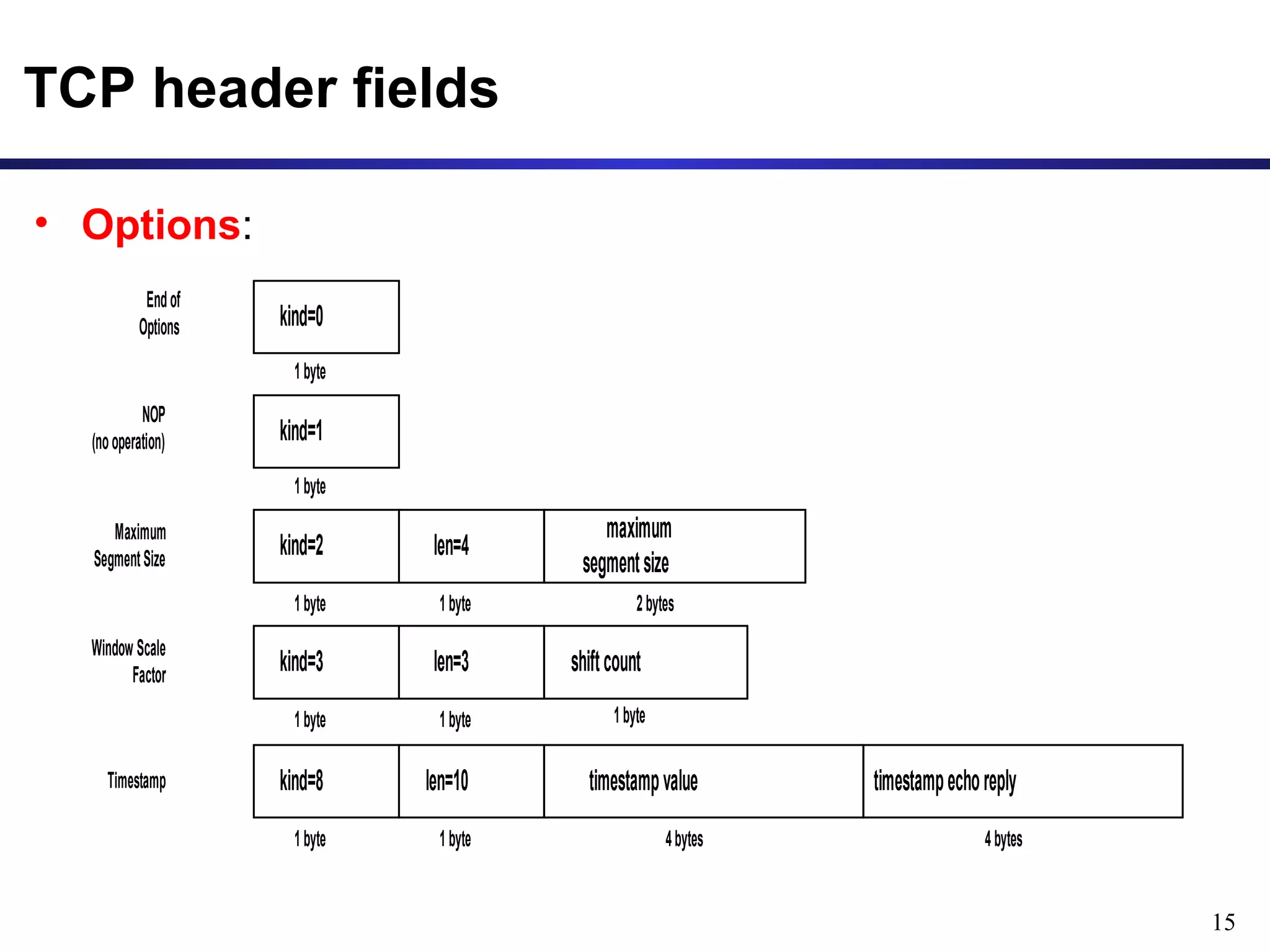
• Options: 
End of 
Options kind=0 
1 byte 
NOP 
(no operation) kind=1 
1 byte 
Maximum 
Segment Size kind=2 
1 byte 
len=4 
1 byte 
maximum 
segment size 
2 bytes 
Window Scale 
Factor kind=3 
1 byte 
len=3 
1 byte 
shift count 
1 byte 
Timestamp kind=8 
1 byte 
len=10 
1 byte 
timestamp value 
4 bytes 
timestamp echo reply 
4 bytes

Olumide pidan b

  • 1.
    1 My FirstPPT This Is my first ppt.
  • 2.
    2 Overview TCP= Transmission Control Protocol • Connection-oriented protocol • Provides a reliable unicast end-to-end byte stream over an unreliable internetwork. TCP IP Internetwork Byte Stream Byte Stream TCP
  • 3.
    3 Connection-Oriented •Before any data transfer, TCP establishes a connection: • One TCP entity is waiting for a connection (“server”) • The other TCP entity (“client”) contacts the server • The actual procedure for setting up connections is more complex. • Each connection is CLIENT SERVER full duplex waiting for connection request Request a connection Accept a connection Disconnect Data Transer
  • 4.
    4 Reliable •Byte stream is broken up into chunks which are called seg-ments • Receiver sends acknowledgements (ACKs) for segments • TCP maintains a timer. If an ACK is not received in time, the segment is retransmitted •Detecting errors: • TCP has checksums for header and data. Segments with invalid checksums are discarded • Each byte that is transmitted has a sequence number
  • 5.
    5 Byte StreamService • To the lower layers, TCP handles data in blocks, the segments. • To the higher layers TCP handles data as a sequence of bytes and does not identify boundaries between bytes • So: Higher layers do not know about the beginning and end of segments ! TCP Application 1. write 100 bytes 2. write 20 bytes queue of bytes to be transmitted TCP queue of bytes that have been received Application 1. read 40 bytes 2. read 40 bytes 3. read 40 bytes Segments
  • 6.
    6 TCP Format • TCP segments have a 20 byte header with >= 0 bytes of data. IP header TCP header TCP data Sequence number (32 bits) TCP checksum urgent pointer DATA 20 bytes 20 bytes 0 15 16 31 Source Port Number Destination Port Number Acknowledgement number (32 bits) header window size length 0 Flags Options (if any) 20 bytes
  • 7.
    7 TCP headerfields • Port Number: • A port number identifies the endpoint of a connection. • A pair <IP address, port number> identifies one endpoint of a connection. • Two pairs <client IP address, server port number> and <server IP address, server port number> identify a TCP connection. Applications Ports: 23 80 104 TCP IP Applications 7 80 16 Ports: TCP IP
  • 8.
    8 TCP headerfields • Sequence Number (SeqNo): – Sequence number is 32 bits long. – So the range of SeqNo is 0 <= SeqNo <= 232 -1 » 4.3 Gbyte – Each sequence number identifies a byte in the byte stream – Initial Sequence Number (ISN) of a connection is set during connection establishment Q: What are possible requirements for ISN ?
  • 9.
    9 TCP headerfields • Acknowledgement Number (AckNo): – Acknowledgements are piggybacked, I.e a segment from A -> B can contain an acknowledgement for a data sent in the B -> A direction Q: Why is piggybacking good ? – A hosts uses the AckNo field to send acknowledgements. (If a host sends an AckNo in a segment it sets the “ACK flag”) – The AckNo contains the next SeqNo that a hosts wants to receive Example: The acknowledgement for a segment with sequence numbers 0-1500 is AckNo=1501
  • 10.
    10 TCP headerfields • Acknowledge Number (cont’d) – TCP uses the sliding window flow protocol (see CS 457) to regulate the flow of traffic from sender to receiver – TCP uses the following variation of sliding window: – no NACKs (Negative ACKnowledgement) – only cumulative ACKs • Example: Assume: Sender sends two segments with “1..1500” and “1501..3000”, but receiver only gets the second segment. In this case, the receiver cannot acknowledge the second packet. It can only send AckNo=1
  • 11.
    11 TCP headerfields • Header Length ( 4bits): – Length of header in 32-bit words – Note that TCP header has variable length (with minimum 20 bytes)
  • 12.
    12 TCP headerfields • Flag bits: – URG: Urgent pointer is valid – If the bit is set, the following bytes contain an urgent message in the range: SeqNo <= urgent message <= SeqNo+urgent pointer – ACK: Acknowledgement Number is valid – PSH: PUSH Flag – Notification from sender to the receiver that the receiver should pass all data that it has to the application. – Normally set by sender when the sender’s buffer is empty
  • 13.
    13 TCP headerfields • Flag bits: – RST: Reset the connection – The flag causes the receiver to reset the connection – Receiver of a RST terminates the connection and indicates higher layer application about the reset – SYN: Synchronize sequence numbers – Sent in the first packet when initiating a connection – FIN: Sender is finished with sending – Used for closing a connection – Both sides of a connection must send a FIN
  • 14.
    14 TCP headerfields • Window Size: – Each side of the connection advertises the window size – Window size is the maximum number of bytes that a receiver can accept. – Maximum window size is 216-1= 65535 bytes • TCP Checksum: – TCP checksum covers over both TCP header and TCP data (also covers some parts of the IP header) • Urgent Pointer: – Only valid if URG flag is set
  • 15.
    15 TCP headerfields • Options: End of Options kind=0 1 byte NOP (no operation) kind=1 1 byte Maximum Segment Size kind=2 1 byte len=4 1 byte maximum segment size 2 bytes Window Scale Factor kind=3 1 byte len=3 1 byte shift count 1 byte Timestamp kind=8 1 byte len=10 1 byte timestamp value 4 bytes timestamp echo reply 4 bytes