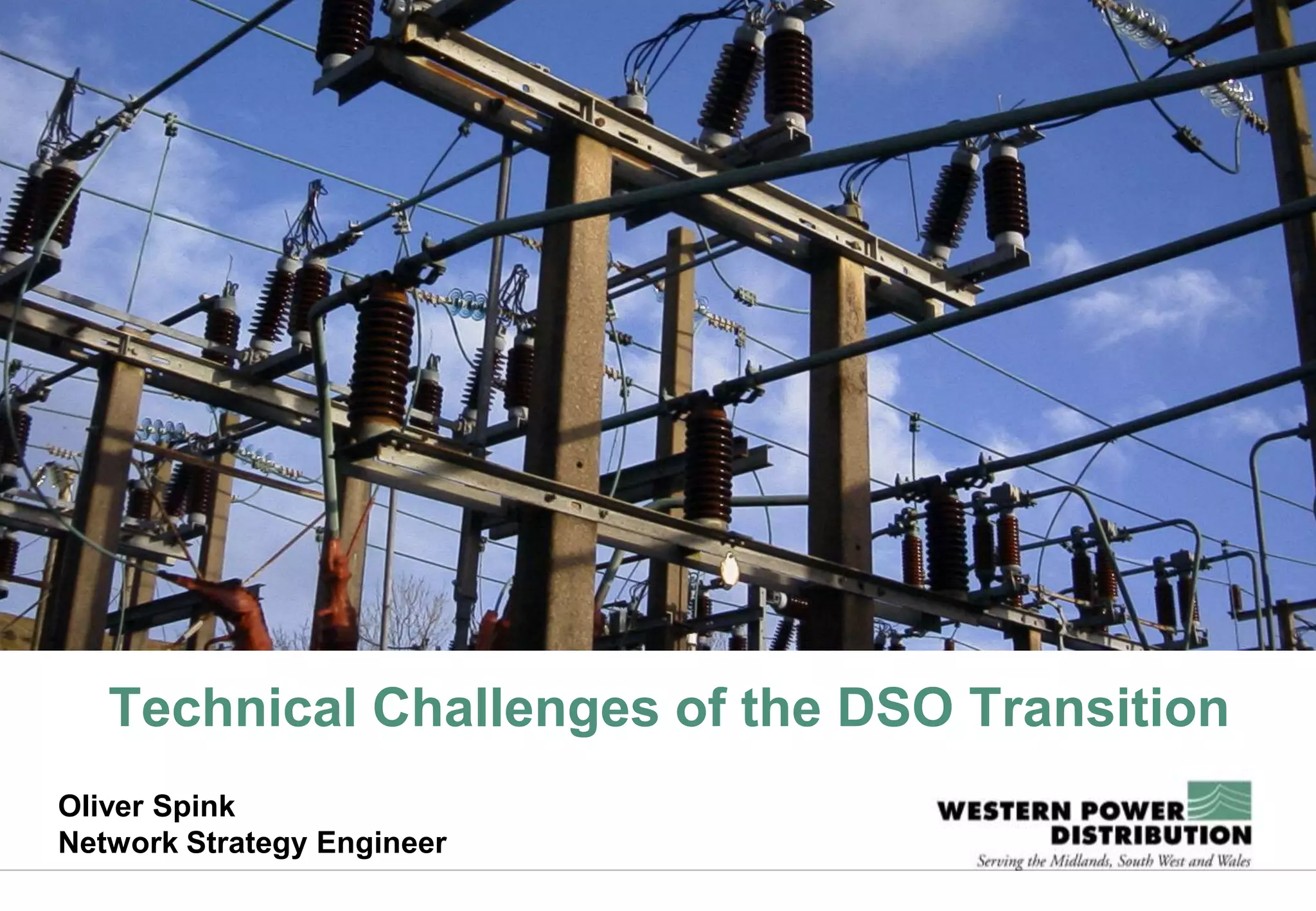
Oliver Spink
Network Strategy Engineer
Technical Challenges of the DSO Transition
• How electricity networks are changing
• DSO Transition
• Our work in the Network Strategy team
• Technical case study: Network monitoring
• Brief Q&A
Focus for today
WPD – Our Area
• 4 of 14 Distribution UK Licence Areas
• 7.8 Million Customers
• Covers 55,500 Sq Km
• 220,000km of Network
• 185,000 Substations
Western Power Distribution is responsible for distributing electricity to
over 25% of the UK. We own, operate and maintain assets between
132kV and 400V.
The way we generate, distribute and consume
electricity is changing.
• Advances in technology are affecting the entire energy system.
• Generation is becoming cleaner and more distributed.
• Networks are becoming smarter and more active.
• Customers are beginning to benefit from an increasingly
efficient and flexible system.
Energy Networks are changing
The Electricity System is changing
More renewables
on the distribution
network will
displace the larger
transmission
connected
generation.
New low carbon
technologies are
changing the way
our customers use
energy, making the
system more
complex and
variable.
A traditional
distribution
network is
designed and built
to accommodate a
single winter peak
demand.
2.1GW
2.8GW
4.6GW
5.1GW
Traditional Distribution Networks
Within ten years, embedded generation has come to dominate the
peak power flows on distribution networks.
Embedded Generation
Solar Photovoltaic
Wind
Energy Storage
Other
3.4GW
2.9GW
3.8GW
5.9GW
2.1GW
2.8GW
4.5GW
5.1GW
Connected &
Accepted Gen
Nov 16
Embedded Generation
Within the last five
years, embedded
generation has
overtaken
maximum demand
and come to
dominate the peak
power flows on
distribution
networks.
Our Shaping
Subtransmission
reports have
highlighted
significant
potential growth
in both demand
and generation,
under the right
political and
economic
environments.
5.5GW
2.8GW
5.4GW
3.2GW
4.0GW
6.4GW
6.6GW
7.8GW
WPD Shaping
Subtransmission
Gone Green 2030
Future Growth Scenarios
Challenges of Passive Networks
Infrastructure
Commission
Smart Power
Report March
2016
Distribution
Network
Operator
Passive networks managing
maximum power flows
DSO Transition
 Facilitate flexibility services
 Improve the resilience and security of the electricity system at a
local level
 Facilitate neutral markets for more efficient whole system outcomes
 Drive competition and efficiency across all aspects of the system
 Promote innovation, flexibility and non-network solutions
 Develop and maintain an efficient, co-ordinated and economical system
of electricity distribution
 Facilitate competition in electricity supply, electricity generation
Existing
New
Roles
Distribution
System
Operator
Active networks managing
real-time energy flows
“If we take advantage of the
opportunities, we can create
new businesses and jobs,
empower consumers and help
people save up to £40bn off
their energy bills in the coming
decades”
What this means for Customers
Network Strategy
WPD’s Network Strategy team is responsible for a number of key outputs,
contributing to the efficient and economic development of the network from five
years out and beyond.
Our main focus topics are:
• Developing advanced modelling techniques to inform strategic studies.
• Alignment of our strategic studies with National Grid’s FES work.
• Progression of a joint WPD/NGET Regional Development Plan for the network in the
South West.
• National work on developing the technical interface between NGET and DNOs
through ENA’s Open Networks programme.
• Delivery of WPD’s Distribution System Operability Framework documents.
• Development of WPD’s strategy to enable transition to a DSO.
• Co-ordination of the responses to Government, regulator and external stakeholder
consultations on DSO vision and strategy.
Strategic Investment Options
Western Power Distribution has been undertaking analysis on long term strategic
studies, to better understand the potential growth in the connection of distributed
generation (DG) and energy demand in all its licence areas, and how that future growth
may impact on the network.
Every 6 months we publish a strategic investment study report on
one of our four licence areas.
Developing Modelling Capability
We have significantly developed our
internal network modelling capabilities over
the past two years.
Solar
dominated
networks
Reactive
power
modelling &
optimisation
Demand
dominated
networks
including
LCT growth
Advanced
contingency
routines for
analysis of
security
Curtailment
calculation
and energy
modelling
Distribution System Operability Framework
(DSOF)
The DSOF aims to highlight some of the
technical and commercial challenges facing
Distribution Network Operators as they
become Distribution System Operators.
Encompasses 9 topics based around 3 core
business areas of Assets, Network
Operations and Customers.
Raises the profile of technical issues facing
DNOs and aims to seek solutions from a
wider audience.
DSOF: Case Study
Network Monitoring and Visibility
Existing Monitoring and Visibility
The type of monitoring that is typically installed on the network:
• Voltage and current measurements
• Real and reactive power flow measurements
• Switchgear status, operations and failures
• Transformer tap positions
• Protection operations
Factors that influence the level of monitoring and visibility:
• Voltage level
• Geographic location
• Network topology
For remote monitoring and control a reliable and secure communication medium is
needed. Typical communication mediums are Microwave, Radio and Fibre.
Drivers For Improved Monitoring
Operational
• Rolling out smart grid network solutions and smart grid alternative connection
solutions
• Higher confidence in pre-fault and post-fault network conditions
• Improve network security and reliability
Design
• Enables accurate modelling of the network
• Ability to assess traditional reinforcement options against non build solutions
• Looking to determine generation and demand coincident and persistence factors
• New systems and innovation projects requiring additional data
Directional Powerflow Example
This example highlight why the type of monitoring installed is becoming
increasingly important to design and operate a network
Method
Precise MVA
value
Direction
available
Real
(MW)
Component
Reactive
(MVAr)
Component
Amps and
assumed
Volts
No No No No
Volts and
Amps
Yes No No No
Derived MW
and MVAr
Yes Yes Yes Yes
Transformer
33kV
132kV
Amps and Assumed Volts
At 13:30 to 14:00 half
hourly averaged power
flows as seen with Amps
monitoring (dummy volts)
No Direction information
No MW and MVAr component
No Power Factor information
132kV
33kV
23.3 MVA
Amps and Volts
At 13:30 to 14:00 half
hourly averaged power
flows as seen with Amps
and Volts monitoring
No Direction information
No MW and MVAr component
No Power Factor information
MW and MVAr
At 13:30 to 14:00
half hourly averaged
power flows as seen
directional MW and
MVAr monitoring
Direction information
MW and MVAr component
Power Factor information
Granularity of Data – Demand Dominated
Granularity of Data – Generation Dominated
Proactively investing in network monitoring
A combination of retrofitting existing monitoring and installing
new monitoring and control
A recent investigation has identified sites across all four WPD
licence areas that are in need of full MW and MVAr monitoring,
due to likely reverse power-flow or faulty equipment
WPD expect this trend to continue, with the rollout of monitoring
and control equipment proliferating down the voltage levels, with
the LV being the last to get detailed monitoring and control
Looking at implementing new systems that have the ability to
record all instantaneous data
Ensure the communication system does not impede network
development, a collaborative approach will be taken when engaging
Office of Communications (Ofcom)
What We Are Doing?
Further Collaboration
All our reports, webinars and presentations are published online at:
http://www.westernpower.co.uk/netstrat
If you have any questions in relation to WPD’s Network Strategy work, please
contact WPD on the details below:
Email: wpdnetworkstrategy@westernpower.co.uk
By post:
Network Strategy Team
Western Power Distribution
Feeder Road
Bristol
BS2 0TB

Oliver Spink

  • 1.
    Oliver Spink Network StrategyEngineer Technical Challenges of the DSO Transition
  • 2.
    • How electricitynetworks are changing • DSO Transition • Our work in the Network Strategy team • Technical case study: Network monitoring • Brief Q&A Focus for today
  • 3.
    WPD – OurArea • 4 of 14 Distribution UK Licence Areas • 7.8 Million Customers • Covers 55,500 Sq Km • 220,000km of Network • 185,000 Substations Western Power Distribution is responsible for distributing electricity to over 25% of the UK. We own, operate and maintain assets between 132kV and 400V.
  • 4.
    The way wegenerate, distribute and consume electricity is changing. • Advances in technology are affecting the entire energy system. • Generation is becoming cleaner and more distributed. • Networks are becoming smarter and more active. • Customers are beginning to benefit from an increasingly efficient and flexible system. Energy Networks are changing
  • 5.
    The Electricity Systemis changing More renewables on the distribution network will displace the larger transmission connected generation. New low carbon technologies are changing the way our customers use energy, making the system more complex and variable.
  • 6.
    A traditional distribution network is designedand built to accommodate a single winter peak demand. 2.1GW 2.8GW 4.6GW 5.1GW Traditional Distribution Networks
  • 7.
    Within ten years,embedded generation has come to dominate the peak power flows on distribution networks. Embedded Generation Solar Photovoltaic Wind Energy Storage Other
  • 8.
    3.4GW 2.9GW 3.8GW 5.9GW 2.1GW 2.8GW 4.5GW 5.1GW Connected & Accepted Gen Nov16 Embedded Generation Within the last five years, embedded generation has overtaken maximum demand and come to dominate the peak power flows on distribution networks.
  • 9.
    Our Shaping Subtransmission reports have highlighted significant potentialgrowth in both demand and generation, under the right political and economic environments. 5.5GW 2.8GW 5.4GW 3.2GW 4.0GW 6.4GW 6.6GW 7.8GW WPD Shaping Subtransmission Gone Green 2030 Future Growth Scenarios
  • 10.
    Challenges of PassiveNetworks Infrastructure Commission Smart Power Report March 2016
  • 11.
    Distribution Network Operator Passive networks managing maximumpower flows DSO Transition  Facilitate flexibility services  Improve the resilience and security of the electricity system at a local level  Facilitate neutral markets for more efficient whole system outcomes  Drive competition and efficiency across all aspects of the system  Promote innovation, flexibility and non-network solutions  Develop and maintain an efficient, co-ordinated and economical system of electricity distribution  Facilitate competition in electricity supply, electricity generation Existing New Roles Distribution System Operator Active networks managing real-time energy flows
  • 12.
    “If we takeadvantage of the opportunities, we can create new businesses and jobs, empower consumers and help people save up to £40bn off their energy bills in the coming decades” What this means for Customers
  • 13.
    Network Strategy WPD’s NetworkStrategy team is responsible for a number of key outputs, contributing to the efficient and economic development of the network from five years out and beyond. Our main focus topics are: • Developing advanced modelling techniques to inform strategic studies. • Alignment of our strategic studies with National Grid’s FES work. • Progression of a joint WPD/NGET Regional Development Plan for the network in the South West. • National work on developing the technical interface between NGET and DNOs through ENA’s Open Networks programme. • Delivery of WPD’s Distribution System Operability Framework documents. • Development of WPD’s strategy to enable transition to a DSO. • Co-ordination of the responses to Government, regulator and external stakeholder consultations on DSO vision and strategy.
  • 14.
    Strategic Investment Options WesternPower Distribution has been undertaking analysis on long term strategic studies, to better understand the potential growth in the connection of distributed generation (DG) and energy demand in all its licence areas, and how that future growth may impact on the network. Every 6 months we publish a strategic investment study report on one of our four licence areas.
  • 15.
    Developing Modelling Capability Wehave significantly developed our internal network modelling capabilities over the past two years. Solar dominated networks Reactive power modelling & optimisation Demand dominated networks including LCT growth Advanced contingency routines for analysis of security Curtailment calculation and energy modelling
  • 16.
    Distribution System OperabilityFramework (DSOF) The DSOF aims to highlight some of the technical and commercial challenges facing Distribution Network Operators as they become Distribution System Operators. Encompasses 9 topics based around 3 core business areas of Assets, Network Operations and Customers. Raises the profile of technical issues facing DNOs and aims to seek solutions from a wider audience.
  • 17.
    DSOF: Case Study NetworkMonitoring and Visibility
  • 18.
    Existing Monitoring andVisibility The type of monitoring that is typically installed on the network: • Voltage and current measurements • Real and reactive power flow measurements • Switchgear status, operations and failures • Transformer tap positions • Protection operations Factors that influence the level of monitoring and visibility: • Voltage level • Geographic location • Network topology For remote monitoring and control a reliable and secure communication medium is needed. Typical communication mediums are Microwave, Radio and Fibre.
  • 19.
    Drivers For ImprovedMonitoring Operational • Rolling out smart grid network solutions and smart grid alternative connection solutions • Higher confidence in pre-fault and post-fault network conditions • Improve network security and reliability Design • Enables accurate modelling of the network • Ability to assess traditional reinforcement options against non build solutions • Looking to determine generation and demand coincident and persistence factors • New systems and innovation projects requiring additional data
  • 20.
    Directional Powerflow Example Thisexample highlight why the type of monitoring installed is becoming increasingly important to design and operate a network Method Precise MVA value Direction available Real (MW) Component Reactive (MVAr) Component Amps and assumed Volts No No No No Volts and Amps Yes No No No Derived MW and MVAr Yes Yes Yes Yes Transformer 33kV 132kV
  • 21.
    Amps and AssumedVolts At 13:30 to 14:00 half hourly averaged power flows as seen with Amps monitoring (dummy volts) No Direction information No MW and MVAr component No Power Factor information 132kV 33kV 23.3 MVA
  • 22.
    Amps and Volts At13:30 to 14:00 half hourly averaged power flows as seen with Amps and Volts monitoring No Direction information No MW and MVAr component No Power Factor information
  • 23.
    MW and MVAr At13:30 to 14:00 half hourly averaged power flows as seen directional MW and MVAr monitoring Direction information MW and MVAr component Power Factor information
  • 24.
    Granularity of Data– Demand Dominated
  • 25.
    Granularity of Data– Generation Dominated
  • 26.
    Proactively investing innetwork monitoring A combination of retrofitting existing monitoring and installing new monitoring and control A recent investigation has identified sites across all four WPD licence areas that are in need of full MW and MVAr monitoring, due to likely reverse power-flow or faulty equipment WPD expect this trend to continue, with the rollout of monitoring and control equipment proliferating down the voltage levels, with the LV being the last to get detailed monitoring and control Looking at implementing new systems that have the ability to record all instantaneous data Ensure the communication system does not impede network development, a collaborative approach will be taken when engaging Office of Communications (Ofcom) What We Are Doing?
  • 27.
    Further Collaboration All ourreports, webinars and presentations are published online at: http://www.westernpower.co.uk/netstrat If you have any questions in relation to WPD’s Network Strategy work, please contact WPD on the details below: Email: wpdnetworkstrategy@westernpower.co.uk By post: Network Strategy Team Western Power Distribution Feeder Road Bristol BS2 0TB