Prof. Andrew Keane
ESRI – UCD Workshop
17th September 2019
Electricity Distribution and Energy
Decarbonisation
Context
 Climate Action Plan places a large emphasis on electrification of energy demand (transport and
heat) and integration of renewables
Increasing penetration of distributed energy resources (DER) at the distribution level
• Distributed Generation
• New loads (Electric vehicles, Solar PV, Heat Pumps)
System Services crucial to further integration of renewables (DS3 programme)
Market Opportunities for Demand response & DER to provide system services
 Particularly aggregators
 Services to support system operation, e.g. manage frequency
Infrastructure and operational challenges to be tackled
Distribution system is central to all of this
2
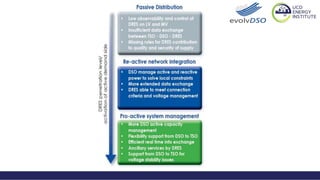
Evolving role of the DSO
3
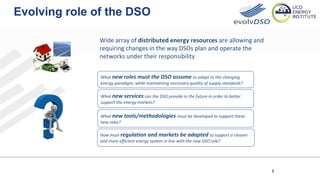
Wide array of distributed energy resources are allowing and
requiring changes in the way DSOs plan and operate the
networks under their responsibility
What new roles must the DSO assume to adapt to the changing
energy paradigm, while maintaining necessary quality of supply standards?
What new services can the DSO provide in the future in order to better
support the energy markets?
What new tools/methodologies must be developed to support these
new roles?
How must regulation and markets be adapted to support a cleaner
and more efficient energy system in line with the new DSO role?
5
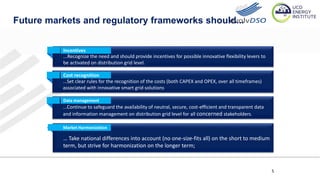
Future markets and regulatory frameworks should...
...Recognize the need and should provide incentives for possible innovative flexibility levers to
be activated on distribution grid level.
...Set clear rules for the recognition of the costs (both CAPEX and OPEX, over all timeframes)
associated with innovative smart grid solutions
...Continue to safeguard the availability of neutral, secure, cost-efficient and transparent data
and information management on distribution grid level for all concerned stakeholders.
Incentives
Cost recognition
Data management
… Take national differences into account (no one-size-fits all) on the short to medium
term, but strive for harmonization on the longer term;
Market Harmonization
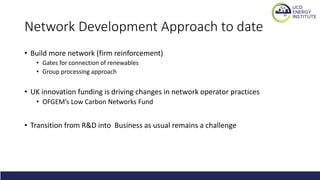
Network Development Approach to date
• Build more network (firm reinforcement)
• Gates for connection of renewables
• Group processing approach
• UK innovation funding is driving changes in network operator practices
• OFGEM’s Low Carbon Networks Fund
• Transition from R&D into Business as usual remains a challenge
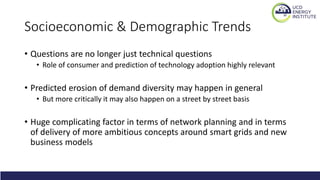
Socioeconomic & Demographic Trends
• Questions are no longer just technical questions
• Role of consumer and prediction of technology adoption highly relevant
• Predicted erosion of demand diversity may happen in general
• But more critically it may also happen on a street by street basis
• Huge complicating factor in terms of network planning and in terms
of delivery of more ambitious concepts around smart grids and new
business models
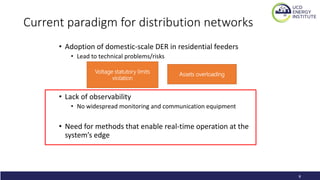
Current paradigm for distribution networks
• Adoption of domestic-scale DER in residential feeders
• Lead to technical problems/risks
• Lack of observability
• No widespread monitoring and communication equipment
• Need for methods that enable real-time operation at the
system’s edge
8
Voltage statutory limits
violation
Assets overloading
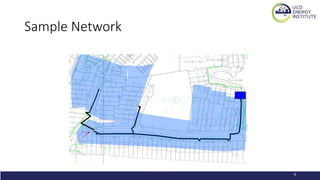
Sample Network
9 9
9
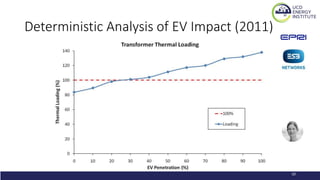
Deterministic Analysis of EV Impact (2011)
10
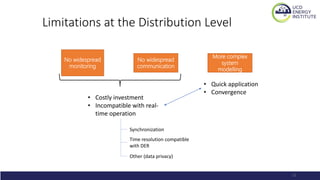
Limitations at the Distribution Level
No widespread
monitoring
No widespread
communication
More complex
system
modelling
• Costly investment
• Incompatible with real-
time operation
Synchronization
Time resolution compatible
with DER
• Quick application
• Convergence
Other (data privacy)
11
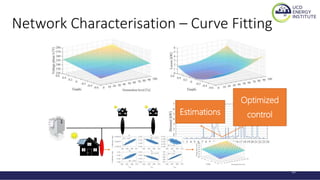
Network Characterisation – Curve Fitting
Estimations
Optimized
control
12
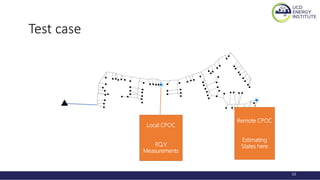
Test case
Local CPOC
P,Q,V
Measurements
Remote CPOC
Estimating
States here
13
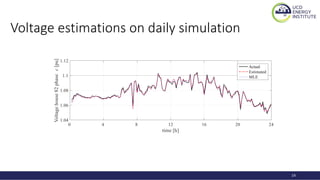
Voltage estimations on daily simulation
Actual
14
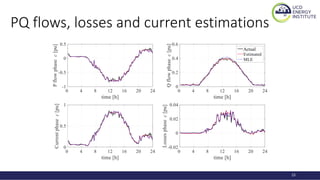
PQ flows, losses and current estimations
Actual
15
Summary
• System characterization at the point of connection of the DER
• Monitoring is limited to local measurements (P, Q and voltage)
• Direct (non-iterative) calculations for real-time operation
• Information can be provided to, for example, demand aggregators,
such that they can dispatch their resources without breaching
network limits
16
Conclusions
• Electrification of energy demand presents challenges to existing infrastructure
• Integration of renewables presents similar challenges
• Reinforcement and new network management techniques required
• Huge data and information gap will not be filled by comprehensive
measurement sets in short term
• Emerging view would be that distribution systems should now facilitate other
stakeholders and business models for benefit of electricity consumer
• For example, role of DSO in demand side services
• Facilitator
• Active management to enable other actors to participate in the market
17
Thank You
andrew.Keane@ucd.ie
www.ucd.ie/energy

The electricity distribution system and energy decarbonisation

  • 1.
    Prof. Andrew Keane ESRI– UCD Workshop 17th September 2019 Electricity Distribution and Energy Decarbonisation
  • 2.
    Context  Climate ActionPlan places a large emphasis on electrification of energy demand (transport and heat) and integration of renewables Increasing penetration of distributed energy resources (DER) at the distribution level • Distributed Generation • New loads (Electric vehicles, Solar PV, Heat Pumps) System Services crucial to further integration of renewables (DS3 programme) Market Opportunities for Demand response & DER to provide system services  Particularly aggregators  Services to support system operation, e.g. manage frequency Infrastructure and operational challenges to be tackled Distribution system is central to all of this 2
  • 3.
    Evolving role ofthe DSO 3 Wide array of distributed energy resources are allowing and requiring changes in the way DSOs plan and operate the networks under their responsibility What new roles must the DSO assume to adapt to the changing energy paradigm, while maintaining necessary quality of supply standards? What new services can the DSO provide in the future in order to better support the energy markets? What new tools/methodologies must be developed to support these new roles? How must regulation and markets be adapted to support a cleaner and more efficient energy system in line with the new DSO role?
  • 5.
    5 Future markets andregulatory frameworks should... ...Recognize the need and should provide incentives for possible innovative flexibility levers to be activated on distribution grid level. ...Set clear rules for the recognition of the costs (both CAPEX and OPEX, over all timeframes) associated with innovative smart grid solutions ...Continue to safeguard the availability of neutral, secure, cost-efficient and transparent data and information management on distribution grid level for all concerned stakeholders. Incentives Cost recognition Data management … Take national differences into account (no one-size-fits all) on the short to medium term, but strive for harmonization on the longer term; Market Harmonization
  • 6.
    Network Development Approachto date • Build more network (firm reinforcement) • Gates for connection of renewables • Group processing approach • UK innovation funding is driving changes in network operator practices • OFGEM’s Low Carbon Networks Fund • Transition from R&D into Business as usual remains a challenge
  • 7.
    Socioeconomic & DemographicTrends • Questions are no longer just technical questions • Role of consumer and prediction of technology adoption highly relevant • Predicted erosion of demand diversity may happen in general • But more critically it may also happen on a street by street basis • Huge complicating factor in terms of network planning and in terms of delivery of more ambitious concepts around smart grids and new business models
  • 8.
    Current paradigm fordistribution networks • Adoption of domestic-scale DER in residential feeders • Lead to technical problems/risks • Lack of observability • No widespread monitoring and communication equipment • Need for methods that enable real-time operation at the system’s edge 8 Voltage statutory limits violation Assets overloading
  • 9.
  • 10.
    Deterministic Analysis ofEV Impact (2011) 10
  • 11.
    Limitations at theDistribution Level No widespread monitoring No widespread communication More complex system modelling • Costly investment • Incompatible with real- time operation Synchronization Time resolution compatible with DER • Quick application • Convergence Other (data privacy) 11
  • 12.
    Network Characterisation –Curve Fitting Estimations Optimized control 12
  • 13.
    Test case Local CPOC P,Q,V Measurements RemoteCPOC Estimating States here 13
  • 14.
    Voltage estimations ondaily simulation Actual 14
  • 15.
    PQ flows, lossesand current estimations Actual 15
  • 16.
    Summary • System characterizationat the point of connection of the DER • Monitoring is limited to local measurements (P, Q and voltage) • Direct (non-iterative) calculations for real-time operation • Information can be provided to, for example, demand aggregators, such that they can dispatch their resources without breaching network limits 16
  • 17.
    Conclusions • Electrification ofenergy demand presents challenges to existing infrastructure • Integration of renewables presents similar challenges • Reinforcement and new network management techniques required • Huge data and information gap will not be filled by comprehensive measurement sets in short term • Emerging view would be that distribution systems should now facilitate other stakeholders and business models for benefit of electricity consumer • For example, role of DSO in demand side services • Facilitator • Active management to enable other actors to participate in the market 17
  • 18.

Editor's Notes