Olfactory NerveOlfactory Nerve
Dr Arun OommenDr Arun Oommen
• Anatomy and physiology
The olfactory nerve is a sensory nerve
with only one function- smell
First order neurons of olfactory
system are bipolar sensory cells
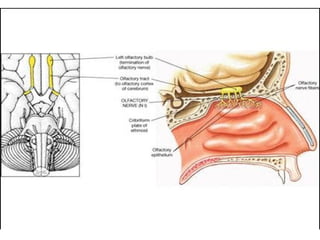
The olfactory receptors are located in
the superior posterior nasal septum and
lateral wall of the nasal cavity
Olfactory receptors have the unique
property to regenerate
Specific odorants stimulate specific
receptor cells and specific cells respond
to particular odorants
Around 20 central processes are given
off from these ciliated cells (filaments
of the 1st
nerve)
These filaments (olfactory nerve)
penetrate the cribriform plate of
ethmoid to enter the olfactory bulb.
They acquire a sheath of myelin
.
 In the bulb the olfactory afferent
fiber synapse with the dendrites of the
2nd
order neurons called the mitral and
tufted cells
At the point of synapse conglomerate of
fibres called the olfactory glomeruli are
formed
• The axons of the mitral and tufted cells
leave the bulb and course posteriorly as
the olfactory tract in the olfactory
sulcus on the orbital surface of the
frontal lobe
• The olfactory tract divide into medial
and lateral olfactory stria on either side
of the anterior perforating substance
 Some of these fibres decussate in the anterior
commissure and join fibres from the opposite olfactory
pathway. Some go to the olfactory trigone and
tuberculum olfactorium (In the APS)
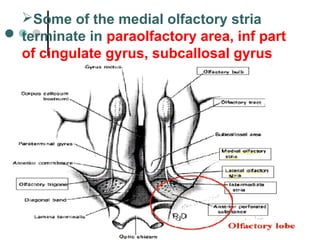
Some of the medial olfactory stria
terminate in paraolfactory area, inf part
of cingulate gyrus, subcallosal gyrus
Other fibres esp the lateral stria
supply the ipsilateral piriform lobe of
the temporal cortex (primary
olfactory cortex) and terminate in the
• uncus,
• anterior hippocampal gyrus,
• pyriform cortex,
• entorhinal cortex,
• amygdaloid nucleus,
• The parahippocampal gyrus sent impulse
to the hippocampus
• The amygdaloid and hippocampal nuclei
(connected on each side thru the ant
commissure) sent projecting fibres to
the ant hypothalamic nuclei, mamillary
body ,tuber cinerum and habenular
nucleus
• This in turn project to the thalamus,
cingulate gyrus,striatum and
mesencephalic reticular formation]
• Olfaction is the only sensation not
directly processed in the thalamus
• Connection with the superior and
inferior salivatory nucleus is important
in reflex salivation
Clinical examination
2 types of deficits
 Conductive deficits
 Sensorineural/Neurogenic
• Proper history
Past head injury
Smoking
Recent UTI
• Systemic illness
• Toxins medications and illicit drugs
Pre requisites
 Ensure nasal cavity is open
 Avoid irritating substances
 Test 1 nostril at a time
Substances used
 Cloves, Coffee ,Cinnamon
 Commercially available
substance like UPSIT (University of
Pennsylvania smell identification test)
 Unilateral loss of smell is more
significant than bilateral
 Perception of odor is more
important than accurate
identification
 Perceiving the presence of an odor
indicate continuity of the olfactory
pathway
Key points

 Identification of odor indicate intact
cortical function
 Since there is bilateral innervations,
lesion central to decussation does not
cause loss of smell and lesion in olfactory
cortex does not produce anosmia
 The appreciation of presence of smell
even without recognition excludes anosmia
Dissorders of olfactory function andDissorders of olfactory function and
localisationlocalisation
Terminologies
• Anosmia -Decreased sense of smell
• Hyperosmia -Increased sense of smell
• Dysosmia -Defective sense of smell
• Parosmia -Pervertion of smell
• Phantosmia -Perception of smell that
is no real
• Presbyosmia -Decresed smell due to
aging
• Cacosmia -Inappropriately
disagreeable odor
• Coprosmia -Faecal scent
• Olfactory agnosia - Inability to identify
detected odors
 Conditions causing disturbed olfactionConditions causing disturbed olfaction
 Congenital-Cleft palate, Downs syn, Turners, Kallmans , Familial
dysautonomia
 Endocrine/metabolic -adrenal insufficiency ,Diabetes, Hypothyroidism
 Iatrogenic-Ethmoidectomy, Hypertelorism, orbitofrontal lobectomy,
Radiotherapy, Rhinoplasty, temporal lobectomy, Repair of ACA anuerysm
 Infections-HIV, Herpes simplex, UTI
 Liver diseases -Cirrhosis, hepatitis
 Local processes -Hansens disease ,Polyps, Rhinitis, Adenoids, tumors
 Neurogenic-Alzheimers disease, Head trauma, Huntingtons disease
Migraines, meningiomas,(Foster kennedy syndrome) ,parkinsonism,
temporal lobe disease
 Psychiatric-Schizophrenia, Hypochondriasis
 Uremia
 Miscellaneous-Cystic fibrosis ,sarcoidosis ,Occupational exposure
,Refsums disease
Most common causes of anosmia
• Upper resp tract infection
• Head injury (15-30%)
1. Local injury to olfactory nerves at
cribriform plate due to coup or contrecoup
forces
2.Temporal/orbito frontal injury
• Nasal and sinus disease
• Idiopathic
• Lesions involving the orbital surface of
brain may cause unilateral anosmia
• In meningiomas of olfactory groove or
cribriform plate areas unilateral anosmias
occur followed by bilateral anosmias
• Parosmias and cacosmias are often due
to Psychiatric diseases or may follow head
injuries
• Olfactory hallucinations are often due to
Psychosis but can result from neoplastic
or vascular lesions of the central olfactory
system or following seizures
• In seizure focus involving medial temporal
lobe structures (uncinate or complex
partial seizures) often preceded by
disagreeable olfactory aura
• Following temporal lobectomy olfactory
discrimination is confined to ipsilateral
nostrils.
• Following right fronto orbital lobectomy
impairment seen in both nostrils
• In olfactory epileptic auras tumors are the
most common cause of seizures and the
amygdyla is the most likely symptomatic
zone
Foster kennedy
syndrome
 Seen in olfactory groove or
sphenoidal ridge meningiomas
or frontal lobe ICSOL
 3 signs-Ipsilateral anosmia
-Ipsilateral optic atrophy
-Contralateral papilledema
Pseudo Foster Kennedy
syndrome
 Seen when increased IC pressure of
any cause occur in patients who
have previous unilateral optic
atrophy
 Most commonly seen due to
sequential anterior ischaemic optic
neuropathy or optic neuritis (optic
disc oedema on one side associated
with optic disc atrophy on other
side)
Kallmann’s syndrome
 X linked dissorder
 Familial syndrome of permanent
anosmia with hypogonadotropic
hypogonadism.
 Hypoplasia or aplasia of olfactory
bulbs and tract
 Can be associated with cerebellar
ataxia and mirror movements of hands

olfactory nerve

  • 1.
    Olfactory NerveOlfactory Nerve DrArun OommenDr Arun Oommen
  • 2.
    • Anatomy andphysiology
  • 3.
    The olfactory nerveis a sensory nerve with only one function- smell First order neurons of olfactory system are bipolar sensory cells The olfactory receptors are located in the superior posterior nasal septum and lateral wall of the nasal cavity
  • 4.
    Olfactory receptors havethe unique property to regenerate Specific odorants stimulate specific receptor cells and specific cells respond to particular odorants Around 20 central processes are given off from these ciliated cells (filaments of the 1st nerve)
  • 6.
    These filaments (olfactorynerve) penetrate the cribriform plate of ethmoid to enter the olfactory bulb. They acquire a sheath of myelin .  In the bulb the olfactory afferent fiber synapse with the dendrites of the 2nd order neurons called the mitral and tufted cells At the point of synapse conglomerate of fibres called the olfactory glomeruli are formed
  • 8.
    • The axonsof the mitral and tufted cells leave the bulb and course posteriorly as the olfactory tract in the olfactory sulcus on the orbital surface of the frontal lobe • The olfactory tract divide into medial and lateral olfactory stria on either side of the anterior perforating substance
  • 10.
     Some ofthese fibres decussate in the anterior commissure and join fibres from the opposite olfactory pathway. Some go to the olfactory trigone and tuberculum olfactorium (In the APS)
  • 11.
    Some of themedial olfactory stria terminate in paraolfactory area, inf part of cingulate gyrus, subcallosal gyrus
  • 12.
    Other fibres espthe lateral stria supply the ipsilateral piriform lobe of the temporal cortex (primary olfactory cortex) and terminate in the • uncus, • anterior hippocampal gyrus, • pyriform cortex, • entorhinal cortex, • amygdaloid nucleus,
  • 18.
    • The parahippocampalgyrus sent impulse to the hippocampus • The amygdaloid and hippocampal nuclei (connected on each side thru the ant commissure) sent projecting fibres to the ant hypothalamic nuclei, mamillary body ,tuber cinerum and habenular nucleus
  • 19.
    • This inturn project to the thalamus, cingulate gyrus,striatum and mesencephalic reticular formation] • Olfaction is the only sensation not directly processed in the thalamus • Connection with the superior and inferior salivatory nucleus is important in reflex salivation
  • 23.
  • 24.
    2 types ofdeficits  Conductive deficits  Sensorineural/Neurogenic
  • 25.
    • Proper history Pasthead injury Smoking Recent UTI • Systemic illness • Toxins medications and illicit drugs
  • 26.
    Pre requisites  Ensurenasal cavity is open  Avoid irritating substances  Test 1 nostril at a time
  • 27.
    Substances used  Cloves,Coffee ,Cinnamon  Commercially available substance like UPSIT (University of Pennsylvania smell identification test)
  • 28.
     Unilateral lossof smell is more significant than bilateral  Perception of odor is more important than accurate identification  Perceiving the presence of an odor indicate continuity of the olfactory pathway Key points
  • 29.
      Identification ofodor indicate intact cortical function  Since there is bilateral innervations, lesion central to decussation does not cause loss of smell and lesion in olfactory cortex does not produce anosmia  The appreciation of presence of smell even without recognition excludes anosmia
  • 30.
    Dissorders of olfactoryfunction andDissorders of olfactory function and localisationlocalisation
  • 31.
    Terminologies • Anosmia -Decreasedsense of smell • Hyperosmia -Increased sense of smell • Dysosmia -Defective sense of smell • Parosmia -Pervertion of smell • Phantosmia -Perception of smell that is no real • Presbyosmia -Decresed smell due to aging • Cacosmia -Inappropriately disagreeable odor • Coprosmia -Faecal scent • Olfactory agnosia - Inability to identify detected odors
  • 32.
     Conditions causingdisturbed olfactionConditions causing disturbed olfaction
  • 33.
     Congenital-Cleft palate,Downs syn, Turners, Kallmans , Familial dysautonomia  Endocrine/metabolic -adrenal insufficiency ,Diabetes, Hypothyroidism  Iatrogenic-Ethmoidectomy, Hypertelorism, orbitofrontal lobectomy, Radiotherapy, Rhinoplasty, temporal lobectomy, Repair of ACA anuerysm  Infections-HIV, Herpes simplex, UTI  Liver diseases -Cirrhosis, hepatitis  Local processes -Hansens disease ,Polyps, Rhinitis, Adenoids, tumors  Neurogenic-Alzheimers disease, Head trauma, Huntingtons disease Migraines, meningiomas,(Foster kennedy syndrome) ,parkinsonism, temporal lobe disease  Psychiatric-Schizophrenia, Hypochondriasis  Uremia  Miscellaneous-Cystic fibrosis ,sarcoidosis ,Occupational exposure ,Refsums disease
  • 34.
    Most common causesof anosmia • Upper resp tract infection • Head injury (15-30%) 1. Local injury to olfactory nerves at cribriform plate due to coup or contrecoup forces 2.Temporal/orbito frontal injury • Nasal and sinus disease • Idiopathic
  • 35.
    • Lesions involvingthe orbital surface of brain may cause unilateral anosmia • In meningiomas of olfactory groove or cribriform plate areas unilateral anosmias occur followed by bilateral anosmias • Parosmias and cacosmias are often due to Psychiatric diseases or may follow head injuries
  • 36.
    • Olfactory hallucinationsare often due to Psychosis but can result from neoplastic or vascular lesions of the central olfactory system or following seizures • In seizure focus involving medial temporal lobe structures (uncinate or complex partial seizures) often preceded by disagreeable olfactory aura
  • 37.
    • Following temporallobectomy olfactory discrimination is confined to ipsilateral nostrils. • Following right fronto orbital lobectomy impairment seen in both nostrils • In olfactory epileptic auras tumors are the most common cause of seizures and the amygdyla is the most likely symptomatic zone
  • 38.
    Foster kennedy syndrome  Seenin olfactory groove or sphenoidal ridge meningiomas or frontal lobe ICSOL  3 signs-Ipsilateral anosmia -Ipsilateral optic atrophy -Contralateral papilledema
  • 39.
    Pseudo Foster Kennedy syndrome Seen when increased IC pressure of any cause occur in patients who have previous unilateral optic atrophy  Most commonly seen due to sequential anterior ischaemic optic neuropathy or optic neuritis (optic disc oedema on one side associated with optic disc atrophy on other side)
  • 40.
    Kallmann’s syndrome  Xlinked dissorder  Familial syndrome of permanent anosmia with hypogonadotropic hypogonadism.  Hypoplasia or aplasia of olfactory bulbs and tract  Can be associated with cerebellar ataxia and mirror movements of hands