Rights, Forests and Climate Change: Introduction, Review of Current Situation, Challenges, Need for Action  Andy White, Coordinator Rights and Resources Initiative   Oslo, 15 October 2008
Rationale – Why This Conference Increasing recognition that must deal with the rights issues : Indigenous People’s/Civil Society statements in Bali, Accra; The Forest Dialogue, Eliasch Review, Etc. Increasing crisis and urgency  – dramatic local threats, Poznan is coming, funds are multiplying! proliferation of “funds” and mechanisms – without adequate coherence, oversight, or accountability built in BUT – not adequate guidance or teeth  – how to ensure effectiveness without undermining rights and livelihoods? We hope this conference will provide specific operational recommendations
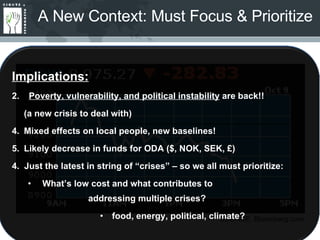
A New Context: Must Focus & Prioritize SOURCE: Bloomberg.com Implications: Poverty, vulnerability, and political instability  are back!! (a new crisis to deal with) Mixed effects on local people, new baselines! Likely decrease in funds for ODA ($, NOK, SEK, £) 4.  Just the latest in string of “crises” – so we all must prioritize: What’s low cost and what contributes to        addressing multiple crises? food, energy, political, climate?
Outline Review: Realities of Forest Areas – Old Problems Past Attempts/Future Challenges New Opportunities: Bases to Build On Realities of (trying to) REDD Ideas about a “Framework for Effectiveness” Hoping for REDD  +
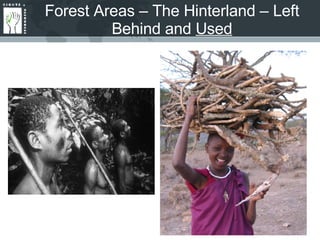
Forest Areas – The Hinterland – Left Behind and  Used High rates of poverty  – at least 1 billion use, depend on forest resources Limited citizenship, respect for customary rights At least 15 million people lack citizenship recognition – all hill tribes of Thailand, most Pygmies of Congo Basin Governments claim 75% of world’s forests – illegal conservation, dispossession, preference for BIG industry Corruption, limited rule of law Limited accountability, judicial redress Lack of basic services:  schools?  Clean water?  Health?
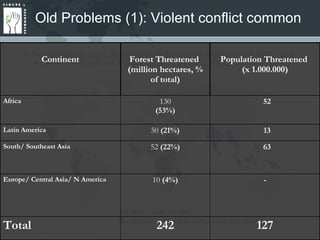
Old Problems (1): Violent conflict common Source: D.Kaimowitz ETFRN NEWS 43/44 In the past twenty years 30 countries in the tropical regions of the world have experienced significant conflict between armed groups in forest areas.  Continent Forest Threatened  (million hectares, % of total) Population Threatened  (x 1.000.000) Africa  130 (53%) 52 Latin America 50  (21%) 13 South/ Southeast Asia  52  (22%) 63 Europe/ Central Asia/ N America 10  (4%) - Total  242 127
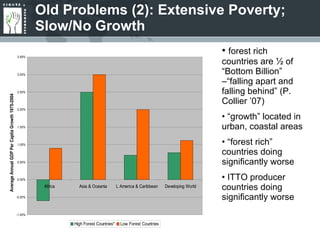
Old Problems (2): Extensive Poverty; Slow/No Growth forest rich countries are ½ of “Bottom Billion” –“falling apart and falling behind” (P. Collier ’07) “ growth” located in urban, coastal areas “ forest rich” countries doing significantly worse ITTO producer countries doing significantly worse
Old Problems (3): Weak Governance
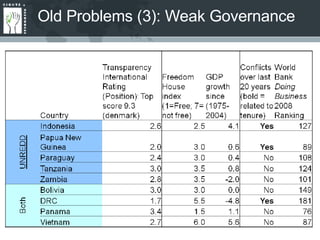
Old Problems (3): Weak Governance Sources:  http://www.transparency.org/news_room/in_focus/2008/cpi2008/cpi_2008_table http://www.freedomhouse.org/template.cfm?page=410&year=2008 Wily, Liz. 2008. Conflicts around the world.
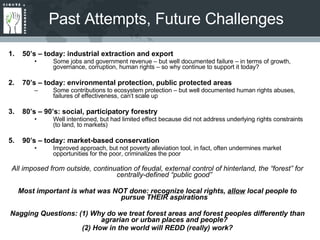
50’s – today: industrial extraction and export Some jobs and government revenue – but well documented failure – in terms of growth, governance, corruption, human rights – so why continue to support it today? 70’s – today: environmental protection, public protected areas Some contributions to ecosystem protection – but well documented human rights abuses, failures of effectiveness, can’t scale up 80’s – 90’s: social, participatory forestry Well intentioned, but had limited effect because did not address underlying rights constraints (to land, to markets) 90’s – today: market-based conservation  Improved approach, but not poverty alleviation tool, in fact, often undermines market opportunities for the poor, criminalizes the poor All imposed from outside, continuation of feudal, external control of hinterland, the “forest” for centrally-defined “public good” Most important is what was NOT done: recognize local rights,  allow  local people to pursue THEIR aspirations Nagging Questions: (1) Why do we treat forest areas and forest peoples differently than agrarian or urban places and people? (2) How in the world will REDD (really) work? Past Attempts, Future Challenges
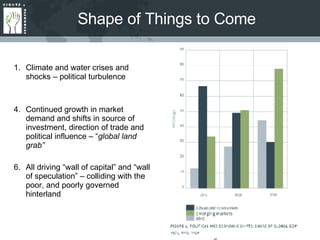
Climate and water crises and shocks – political turbulence Continued growth in market demand and shifts in source of investment, direction of trade and political influence – “ global land grab”   All driving “wall of capital” and “wall of speculation” – colliding with the poor, and poorly governed hinterland Shape of Things to Come
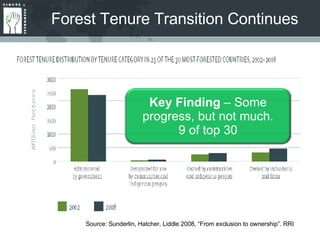
Source: Sunderlin, Hatcher, Liddle 2008, “From exclusion to ownership”. RRI Forest Tenure Transition Continues Key Finding  – Some progress, but not much. 9 of top 30
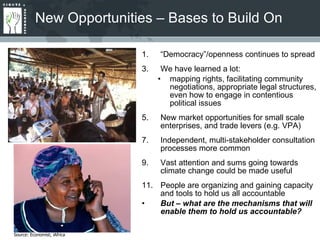
New Opportunities – Bases to Build On “ Democracy”/openness continues to spread We have learned a lot: mapping rights, facilitating community negotiations, appropriate legal structures, even how to engage in contentious political issues New market opportunities for small scale enterprises, and trade levers (e.g. VPA) Independent, multi-stakeholder consultation processes more common Vast attention and sums going towards climate change could be made useful People are organizing and gaining capacity and tools to hold us all accountable But – what are the mechanisms that will enable them to hold us accountable? Source: Economist; iAfrica
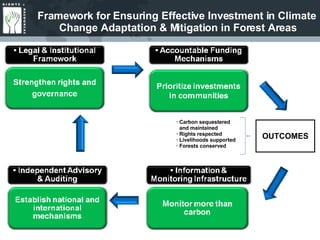
OUTCOMES · Carbon sequestered and maintained · Rights respected · Livelihoods supported · Forests conserved Framework for Ensuring Effective Investment in Climate  Change Adaptation & Mitigation in Forest Areas
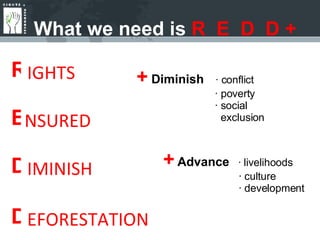
What we need is  R  E  D  D + +   Diminish   · conflict   · poverty   · social    exclusion +   Advance   · livelihoods   · culture   · development   R E D D IGHTS NSURED IMINISH EFORESTATION
Thank You The climate has changed, have we? Substantial opportunity to address underlying problems www.rightsandresources.org

Old models, new threats, great opportunities

  • 1.
    Rights, Forests andClimate Change: Introduction, Review of Current Situation, Challenges, Need for Action Andy White, Coordinator Rights and Resources Initiative Oslo, 15 October 2008
  • 2.
    Rationale – WhyThis Conference Increasing recognition that must deal with the rights issues : Indigenous People’s/Civil Society statements in Bali, Accra; The Forest Dialogue, Eliasch Review, Etc. Increasing crisis and urgency – dramatic local threats, Poznan is coming, funds are multiplying! proliferation of “funds” and mechanisms – without adequate coherence, oversight, or accountability built in BUT – not adequate guidance or teeth – how to ensure effectiveness without undermining rights and livelihoods? We hope this conference will provide specific operational recommendations
  • 3.
    A New Context:Must Focus & Prioritize SOURCE: Bloomberg.com Implications: Poverty, vulnerability, and political instability are back!! (a new crisis to deal with) Mixed effects on local people, new baselines! Likely decrease in funds for ODA ($, NOK, SEK, £) 4. Just the latest in string of “crises” – so we all must prioritize: What’s low cost and what contributes to addressing multiple crises? food, energy, political, climate?
  • 4.
    Outline Review: Realitiesof Forest Areas – Old Problems Past Attempts/Future Challenges New Opportunities: Bases to Build On Realities of (trying to) REDD Ideas about a “Framework for Effectiveness” Hoping for REDD +
  • 5.
    Forest Areas –The Hinterland – Left Behind and Used High rates of poverty – at least 1 billion use, depend on forest resources Limited citizenship, respect for customary rights At least 15 million people lack citizenship recognition – all hill tribes of Thailand, most Pygmies of Congo Basin Governments claim 75% of world’s forests – illegal conservation, dispossession, preference for BIG industry Corruption, limited rule of law Limited accountability, judicial redress Lack of basic services: schools? Clean water? Health?
  • 6.
    Old Problems (1):Violent conflict common Source: D.Kaimowitz ETFRN NEWS 43/44 In the past twenty years 30 countries in the tropical regions of the world have experienced significant conflict between armed groups in forest areas. Continent Forest Threatened (million hectares, % of total) Population Threatened (x 1.000.000) Africa 130 (53%) 52 Latin America 50 (21%) 13 South/ Southeast Asia 52 (22%) 63 Europe/ Central Asia/ N America 10 (4%) - Total 242 127
  • 7.
    Old Problems (2):Extensive Poverty; Slow/No Growth forest rich countries are ½ of “Bottom Billion” –“falling apart and falling behind” (P. Collier ’07) “ growth” located in urban, coastal areas “ forest rich” countries doing significantly worse ITTO producer countries doing significantly worse
  • 8.
    Old Problems (3):Weak Governance
  • 9.
    Old Problems (3):Weak Governance Sources: http://www.transparency.org/news_room/in_focus/2008/cpi2008/cpi_2008_table http://www.freedomhouse.org/template.cfm?page=410&year=2008 Wily, Liz. 2008. Conflicts around the world.
  • 10.
    50’s – today:industrial extraction and export Some jobs and government revenue – but well documented failure – in terms of growth, governance, corruption, human rights – so why continue to support it today? 70’s – today: environmental protection, public protected areas Some contributions to ecosystem protection – but well documented human rights abuses, failures of effectiveness, can’t scale up 80’s – 90’s: social, participatory forestry Well intentioned, but had limited effect because did not address underlying rights constraints (to land, to markets) 90’s – today: market-based conservation Improved approach, but not poverty alleviation tool, in fact, often undermines market opportunities for the poor, criminalizes the poor All imposed from outside, continuation of feudal, external control of hinterland, the “forest” for centrally-defined “public good” Most important is what was NOT done: recognize local rights, allow local people to pursue THEIR aspirations Nagging Questions: (1) Why do we treat forest areas and forest peoples differently than agrarian or urban places and people? (2) How in the world will REDD (really) work? Past Attempts, Future Challenges
  • 11.
    Climate and watercrises and shocks – political turbulence Continued growth in market demand and shifts in source of investment, direction of trade and political influence – “ global land grab” All driving “wall of capital” and “wall of speculation” – colliding with the poor, and poorly governed hinterland Shape of Things to Come
  • 12.
    Source: Sunderlin, Hatcher,Liddle 2008, “From exclusion to ownership”. RRI Forest Tenure Transition Continues Key Finding – Some progress, but not much. 9 of top 30
  • 13.
    New Opportunities –Bases to Build On “ Democracy”/openness continues to spread We have learned a lot: mapping rights, facilitating community negotiations, appropriate legal structures, even how to engage in contentious political issues New market opportunities for small scale enterprises, and trade levers (e.g. VPA) Independent, multi-stakeholder consultation processes more common Vast attention and sums going towards climate change could be made useful People are organizing and gaining capacity and tools to hold us all accountable But – what are the mechanisms that will enable them to hold us accountable? Source: Economist; iAfrica
  • 14.
    OUTCOMES · Carbonsequestered and maintained · Rights respected · Livelihoods supported · Forests conserved Framework for Ensuring Effective Investment in Climate Change Adaptation & Mitigation in Forest Areas
  • 15.
    What we needis R E D D + + Diminish · conflict · poverty · social exclusion + Advance · livelihoods · culture · development R E D D IGHTS NSURED IMINISH EFORESTATION
  • 16.
    Thank You Theclimate has changed, have we? Substantial opportunity to address underlying problems www.rightsandresources.org