Valérie Amato
16 September 2015
How can
the Global Goals for Sustainable Development
be effectively delivered?
Towards new models of
multi-stakeholder collaboration and partnerships
The new Global Goals for
Sustainable Development
Setting the Scene
 Major threats undermine effective action for
development: population growth, increased
inequality, climate change, rapid urbanisation and its
consequences, depletion of natural resources,
conflict and violence
 The landscape of development has also dramatically
changed in view of increased interconnectedness and
the emergence of new actors (particularly with the
increasing presence and expected role of the private
sector in developing countries)
The new development landscape
 In its review of the Millennium Development Goals
(“MDGs”), the High Level Panel appointed by the UN
Secretary General identified the fragmentation of
efforts.
 They reported that “the MDGs fell short by not
integrating the economic, social, and environmental
aspects of sustainable development as envisaged in
the Millennium Declaration” and that “The result was
that environment and development were never
properly brought together. People were working
hard – but often separately – on interlinked
problems.”
Source: http://www.un.org/sg/management/pdf/HLP_P2015_Report.pdf
A call for an integrated approach
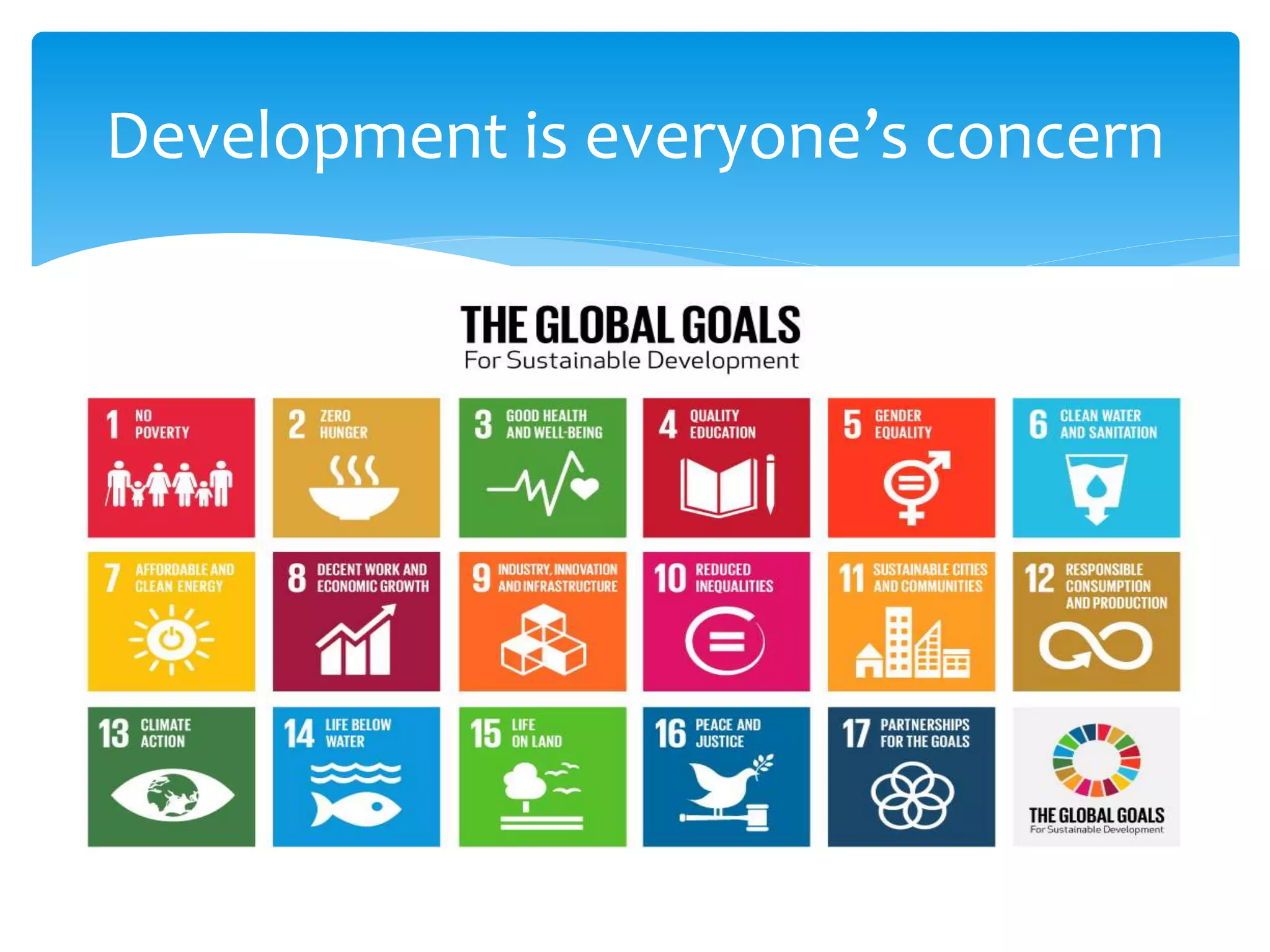
 A new set of Sustainable Development Goals will be
formally adopted on 25 September 2015
 They reflect an ambitious agenda, which:
 is intended to be universal (applying to all countries,
“Leaving no one behind” and “Forging a new global
partnership”) and “transformative” (addressing
sustainability, inclusiveness, institutional change)
 examines sustainable development in its different
dimensions (social, economic, environmental), which
need to be fully integrated
 has been widely consultative in its approach (reflecting
an open and inclusive process)
Post-2015 Development Agenda:
a complicated journey
Development is everyone’s concern
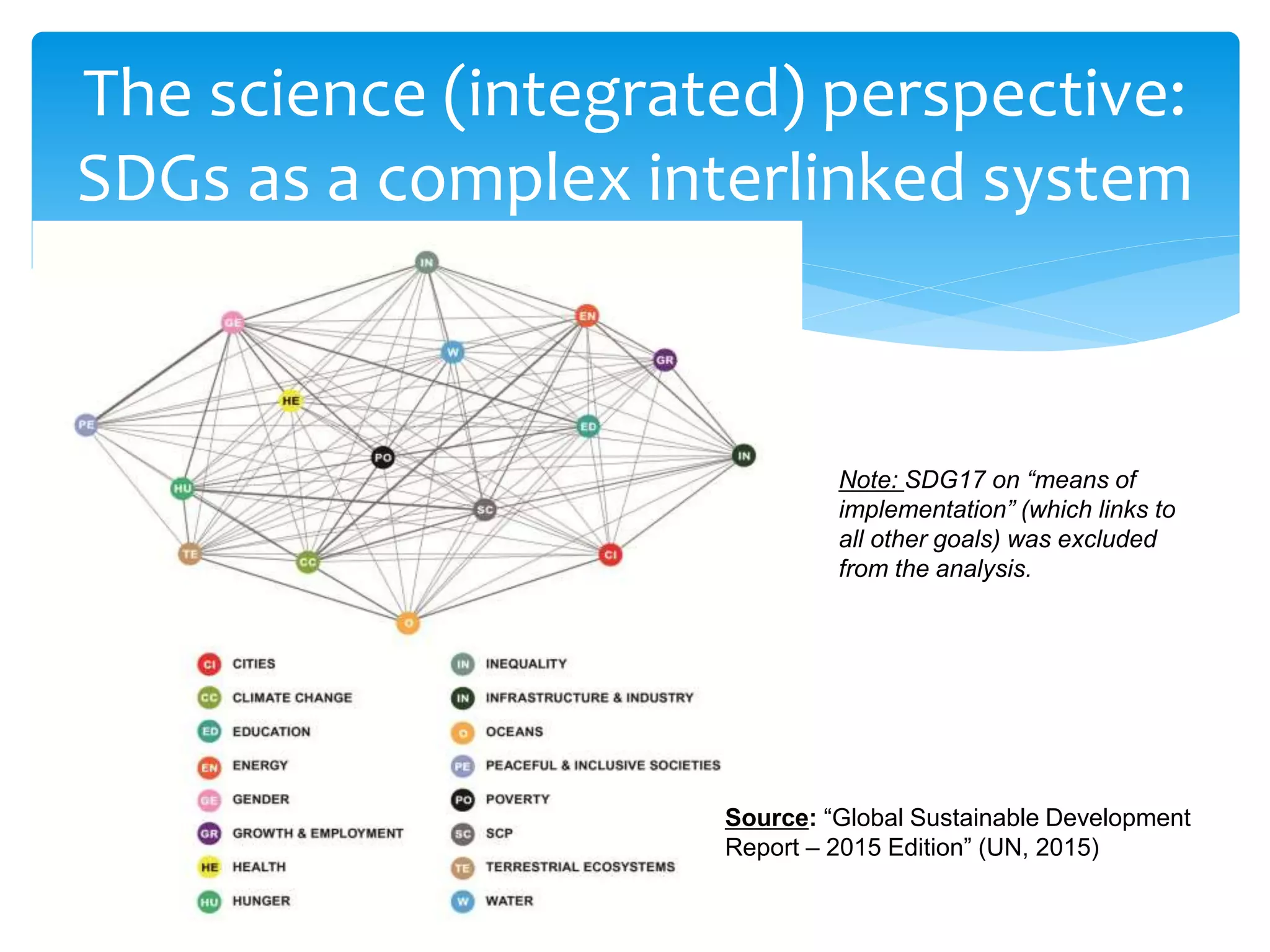
The science (integrated) perspective:
SDGs as a complex interlinked system
Note: SDG17 on “means of
implementation” (which links to
all other goals) was excluded
from the analysis.
Source: “Global Sustainable Development
Report – 2015 Edition” (UN, 2015)
 If goals are universal, transformative and integrated in
intent, this poses key new challenges in terms of
translating these into effective action
 Indeed, the High Level Panel recognized that “The
challenge will be to identify the concrete mechanisms
that will enable the realization of an ambitious and
coherent agenda for development.”
 The means of implementation of this transformative
agenda remains a key concern (and is the focus of this
presentation)
How to manage such diversity
and complexity?
Spotlight on Partnerships
 Goal 17 is linked to and
underpins all other goals
 Attempts to address the “How
to?” question
 Twin goal: (a) to” Strengthen
the means of implementation”
[of the ambitious agenda] and
(b) “revitalize the global
partnership for sustainable
development”
Required competences and skills:
Stakeholder consultative phase
SECTOR 4 FOCUS
The ability to operate effectively in a complex,
interconnected and fast-changing environment requires:
 Strategic and critical thinking
 Capacity-building of local staff and partners
 Contextualising an issue and defining and understanding it
from multiple perspectives
 Working in partnership with a wide range of stakeholders
and across various boundaries (including cultures,
disciplines and sectors)
 Understanding, analysing and using big, complex data
 Adapting to and embracing change: being agile, creative and
innovative
 Key social and emotional skills (open-mindedness, empathy,
listening, influencing, negotiation and brokering)
Key insights
Towards new models of multi-
stakeholder collaboration and
partnerships
Means of implementation
The future role of multi-
stakeholder partnerships
 “Multi-stakeholder partnerships” designate “groupings
of civil society, the private sector, the public sector, the
media and other stakeholders that come together for a
common purpose, pooling their diverse resources,
expertise and experience to achieve common goals.”*
 This cross-boundary collaboration approach is
considered as key to achieving the new Global Goals (to
address scale, scope and interlinkages)
 Innovative models are needed to deliver systemic
change
 The opportunities and barriers of engaging with the
private sector need to be appreciated
* Source: Development Co-operation Report 2015 (OECD, 2015)
The new role of business
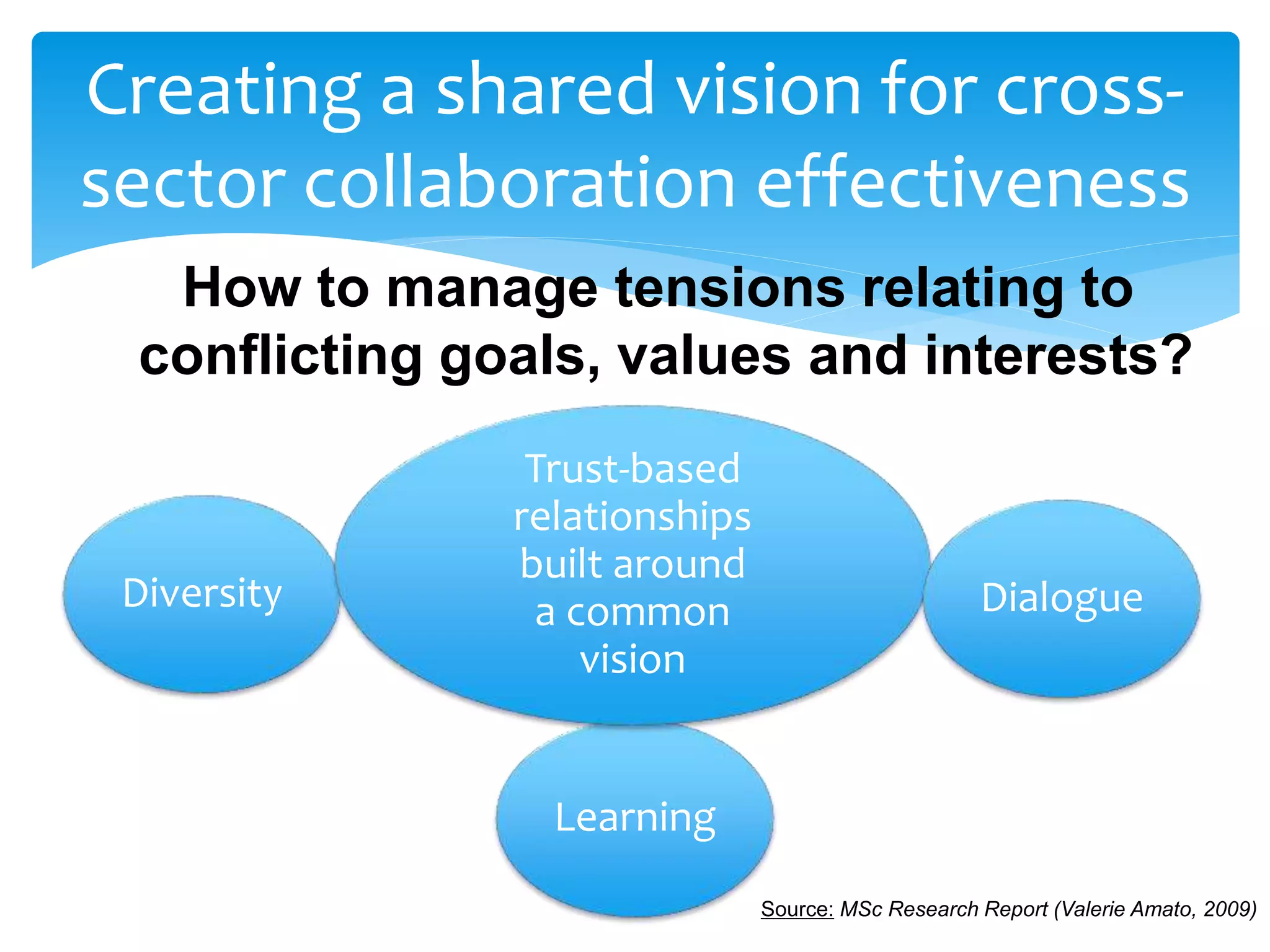
Creating a shared vision for cross-
sector collaboration effectiveness
Learning
Diversity
Trust-based
relationships
built around
a common
vision
Dialogue
Source: MSc Research Report (Valerie Amato, 2009)
How to manage tensions relating to
conflicting goals, values and interests?
Reconciling business and
development goals: collaborative
journeys
Multi-stakeholder partnerships in
practice
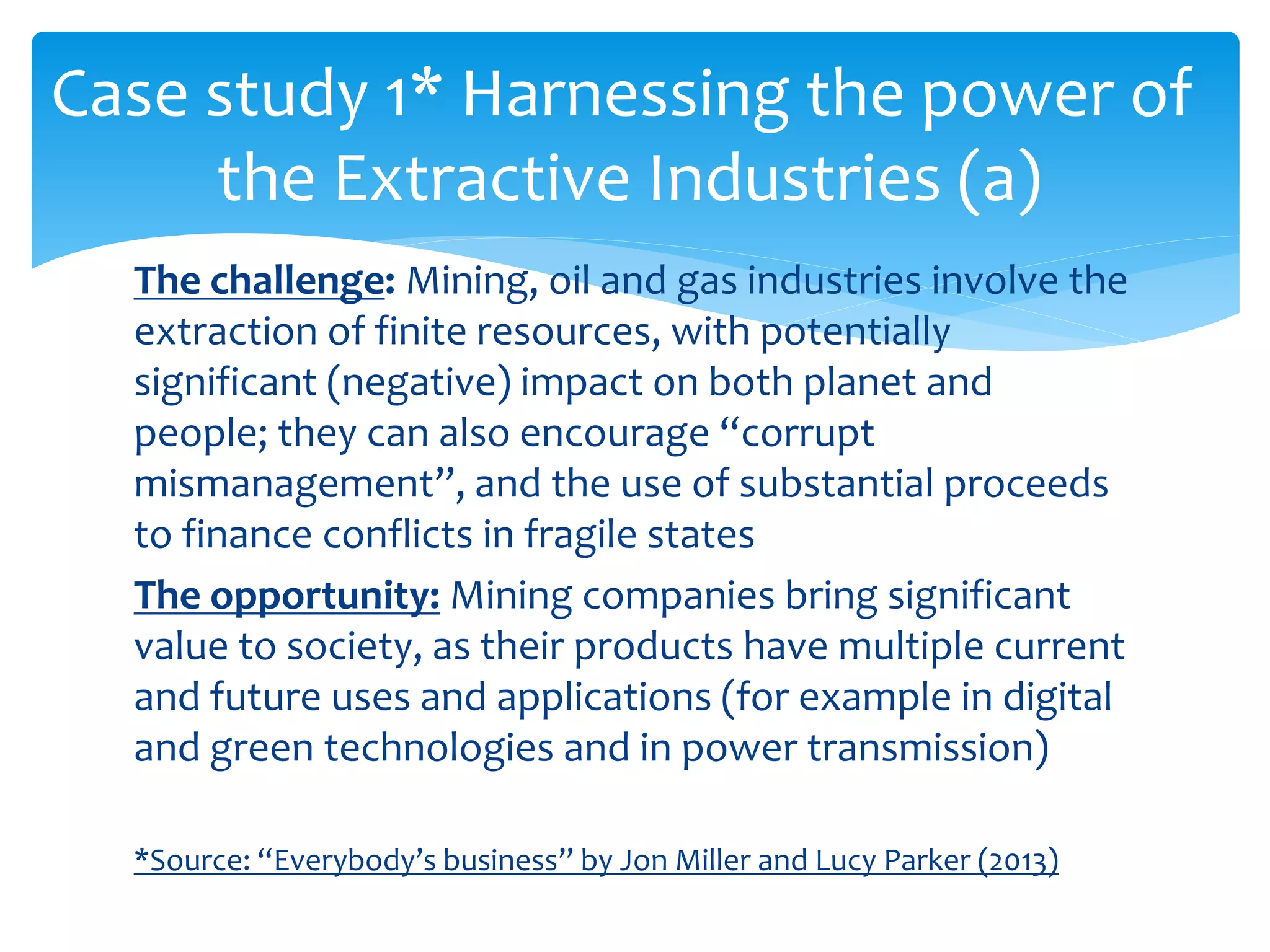
The challenge: Mining, oil and gas industries involve the
extraction of finite resources, with potentially
significant (negative) impact on both planet and
people; they can also encourage “corrupt
mismanagement”, and the use of substantial proceeds
to finance conflicts in fragile states
The opportunity: Mining companies bring significant
value to society, as their products have multiple current
and future uses and applications (for example in digital
and green technologies and in power transmission)
*Source: “Everybody’s business” by Jon Miller and Lucy Parker (2013)
Case study 1* Harnessing the power of
the Extractive Industries (a)
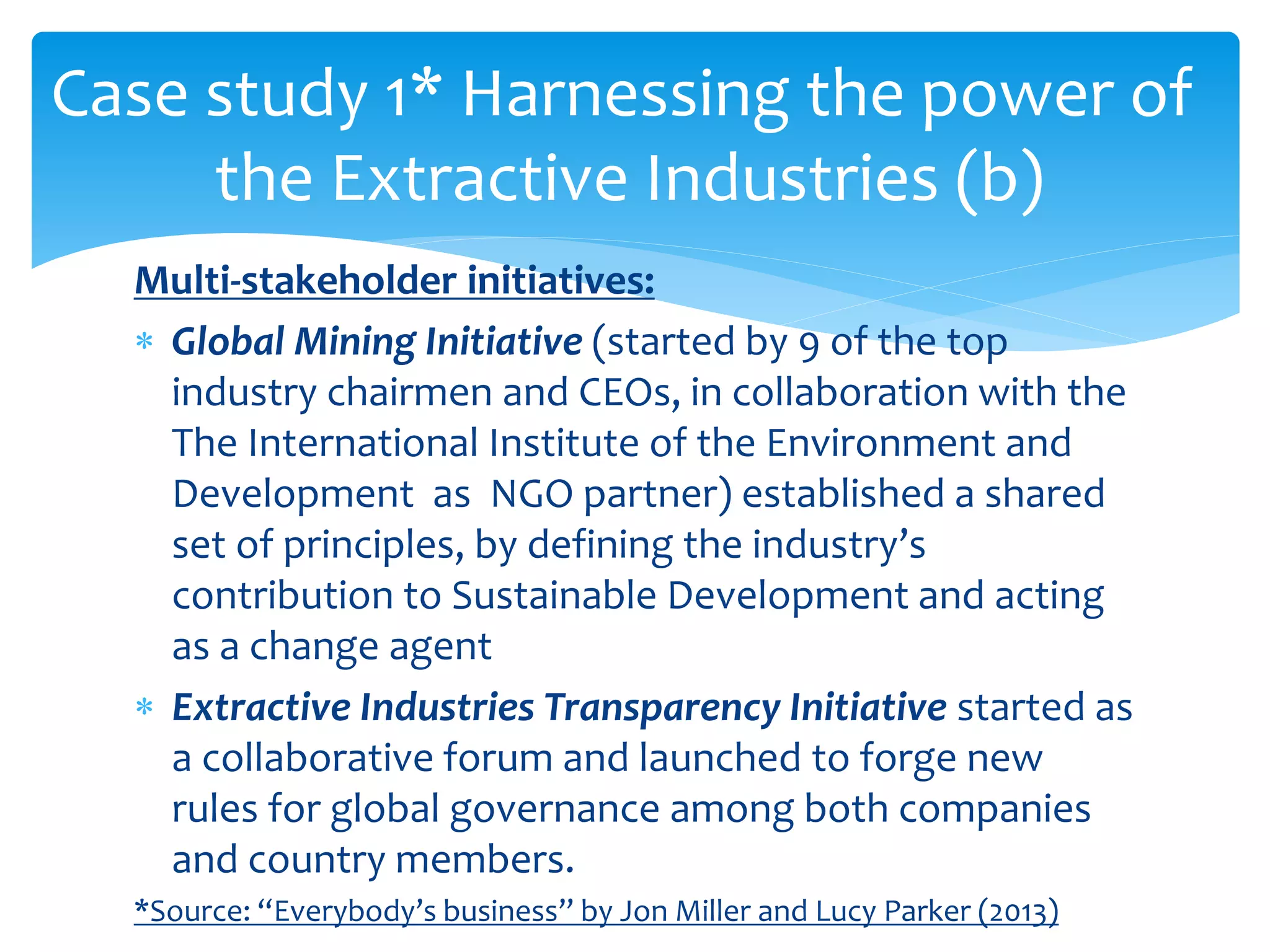
Multi-stakeholder initiatives:
 Global Mining Initiative (started by 9 of the top
industry chairmen and CEOs, in collaboration with the
The International Institute of the Environment and
Development as NGO partner) established a shared
set of principles, by defining the industry’s
contribution to Sustainable Development and acting
as a change agent
 Extractive Industries Transparency Initiative started as
a collaborative forum and launched to forge new
rules for global governance among both companies
and country members.
*Source: “Everybody’s business” by Jon Miller and Lucy Parker (2013)
Case study 1* Harnessing the power of
the Extractive Industries (b)
The challenge: How to give affordable access to
medicines to the poorest patients in the world without
jeopardising the significant investments in research
required from the pharmaceutical industry?
The opportunity: Widening access to medicines in the
poorest countries in the world represents an
investment in future markets. This requires a change in
companies’ business models (with volume, not price
being a driver for growth)
*Source: “Everybody’s business” by Jon Miller and Lucy Parker (2013)
Case study 2* The role of Big Pharma
in reforming the Health System (a)
Multi-stakeholder initiatives:
 The Access to Medicine Index is a sophisticated system
ranking pharmaceutical companies and incentivising
the whole industry to widen affordable access to
medicines
 The Patent Pool initiated by GSK invites the sharing of
intellectual property relating to “neglected diseases”
among academic researchers, charitable foundations
and businesses, to allow the development of
solutions to the health-care challenges of the poorest
countries in the world.
*Source: “Everybody’s business” by Jon Miller and Lucy Parker (2013)
Case study 2* The role of Big Pharma
in reforming the Health System (b)
 The Global Goals call for an urgent rethink of the way
traditional and emerging development actors should
work together and mobilise and align resources
towards the new ambitious goals.
 The transformative shifts need to be driven by an
exchange of perspectives, and a change in mindsets
and attitudes.
 This starts by recognising that development is
everyone’s concern and that business has a key role
to play in driving positive change and addressing
tomorrow’s challenges.
 This also requires systems thinking and strong,
authentic and collaborative leadership
Key Learning: Time to think, act
and behave differently
 Multi-stakeholder engagement underpins all the new Global
Goals. It is an ambitious goal in itself, and yet is absolutely critical
to ensuring effective implementation of the post-2015
development agenda.
 Encouraging dialogue and linkages between and among unusual
suspects, the sharing and learning (of not only successes, but
also failures), will accelerate progress.
 This presentation has asked more questions than it has offered
definitive answers and solutions. It is an invitation to re-think
old paradigms and ways of working.
 This initial reflection has also shown the relevance of systems
thinking and complexity science to effective collective learning
and action for sustainable development.
Concluding remarks

How can the Global Goals for Sustainable Development be effectively delivered? Towards new models of multi-stakeholder collaboration and partnerships

  • 1.
    Valérie Amato 16 September2015 How can the Global Goals for Sustainable Development be effectively delivered? Towards new models of multi-stakeholder collaboration and partnerships
  • 2.
    The new GlobalGoals for Sustainable Development Setting the Scene
  • 3.
     Major threatsundermine effective action for development: population growth, increased inequality, climate change, rapid urbanisation and its consequences, depletion of natural resources, conflict and violence  The landscape of development has also dramatically changed in view of increased interconnectedness and the emergence of new actors (particularly with the increasing presence and expected role of the private sector in developing countries) The new development landscape
  • 4.
     In itsreview of the Millennium Development Goals (“MDGs”), the High Level Panel appointed by the UN Secretary General identified the fragmentation of efforts.  They reported that “the MDGs fell short by not integrating the economic, social, and environmental aspects of sustainable development as envisaged in the Millennium Declaration” and that “The result was that environment and development were never properly brought together. People were working hard – but often separately – on interlinked problems.” Source: http://www.un.org/sg/management/pdf/HLP_P2015_Report.pdf A call for an integrated approach
  • 5.
     A newset of Sustainable Development Goals will be formally adopted on 25 September 2015  They reflect an ambitious agenda, which:  is intended to be universal (applying to all countries, “Leaving no one behind” and “Forging a new global partnership”) and “transformative” (addressing sustainability, inclusiveness, institutional change)  examines sustainable development in its different dimensions (social, economic, environmental), which need to be fully integrated  has been widely consultative in its approach (reflecting an open and inclusive process) Post-2015 Development Agenda: a complicated journey
  • 6.
  • 7.
    The science (integrated)perspective: SDGs as a complex interlinked system Note: SDG17 on “means of implementation” (which links to all other goals) was excluded from the analysis. Source: “Global Sustainable Development Report – 2015 Edition” (UN, 2015)
  • 8.
     If goalsare universal, transformative and integrated in intent, this poses key new challenges in terms of translating these into effective action  Indeed, the High Level Panel recognized that “The challenge will be to identify the concrete mechanisms that will enable the realization of an ambitious and coherent agenda for development.”  The means of implementation of this transformative agenda remains a key concern (and is the focus of this presentation) How to manage such diversity and complexity?
  • 9.
    Spotlight on Partnerships Goal 17 is linked to and underpins all other goals  Attempts to address the “How to?” question  Twin goal: (a) to” Strengthen the means of implementation” [of the ambitious agenda] and (b) “revitalize the global partnership for sustainable development”
  • 10.
    Required competences andskills: Stakeholder consultative phase SECTOR 4 FOCUS
  • 11.
    The ability tooperate effectively in a complex, interconnected and fast-changing environment requires:  Strategic and critical thinking  Capacity-building of local staff and partners  Contextualising an issue and defining and understanding it from multiple perspectives  Working in partnership with a wide range of stakeholders and across various boundaries (including cultures, disciplines and sectors)  Understanding, analysing and using big, complex data  Adapting to and embracing change: being agile, creative and innovative  Key social and emotional skills (open-mindedness, empathy, listening, influencing, negotiation and brokering) Key insights
  • 12.
    Towards new modelsof multi- stakeholder collaboration and partnerships Means of implementation
  • 13.
    The future roleof multi- stakeholder partnerships  “Multi-stakeholder partnerships” designate “groupings of civil society, the private sector, the public sector, the media and other stakeholders that come together for a common purpose, pooling their diverse resources, expertise and experience to achieve common goals.”*  This cross-boundary collaboration approach is considered as key to achieving the new Global Goals (to address scale, scope and interlinkages)  Innovative models are needed to deliver systemic change  The opportunities and barriers of engaging with the private sector need to be appreciated * Source: Development Co-operation Report 2015 (OECD, 2015)
  • 14.
    The new roleof business
  • 15.
    Creating a sharedvision for cross- sector collaboration effectiveness Learning Diversity Trust-based relationships built around a common vision Dialogue Source: MSc Research Report (Valerie Amato, 2009) How to manage tensions relating to conflicting goals, values and interests?
  • 16.
    Reconciling business and developmentgoals: collaborative journeys Multi-stakeholder partnerships in practice
  • 17.
    The challenge: Mining,oil and gas industries involve the extraction of finite resources, with potentially significant (negative) impact on both planet and people; they can also encourage “corrupt mismanagement”, and the use of substantial proceeds to finance conflicts in fragile states The opportunity: Mining companies bring significant value to society, as their products have multiple current and future uses and applications (for example in digital and green technologies and in power transmission) *Source: “Everybody’s business” by Jon Miller and Lucy Parker (2013) Case study 1* Harnessing the power of the Extractive Industries (a)
  • 18.
    Multi-stakeholder initiatives:  GlobalMining Initiative (started by 9 of the top industry chairmen and CEOs, in collaboration with the The International Institute of the Environment and Development as NGO partner) established a shared set of principles, by defining the industry’s contribution to Sustainable Development and acting as a change agent  Extractive Industries Transparency Initiative started as a collaborative forum and launched to forge new rules for global governance among both companies and country members. *Source: “Everybody’s business” by Jon Miller and Lucy Parker (2013) Case study 1* Harnessing the power of the Extractive Industries (b)
  • 19.
    The challenge: Howto give affordable access to medicines to the poorest patients in the world without jeopardising the significant investments in research required from the pharmaceutical industry? The opportunity: Widening access to medicines in the poorest countries in the world represents an investment in future markets. This requires a change in companies’ business models (with volume, not price being a driver for growth) *Source: “Everybody’s business” by Jon Miller and Lucy Parker (2013) Case study 2* The role of Big Pharma in reforming the Health System (a)
  • 20.
    Multi-stakeholder initiatives:  TheAccess to Medicine Index is a sophisticated system ranking pharmaceutical companies and incentivising the whole industry to widen affordable access to medicines  The Patent Pool initiated by GSK invites the sharing of intellectual property relating to “neglected diseases” among academic researchers, charitable foundations and businesses, to allow the development of solutions to the health-care challenges of the poorest countries in the world. *Source: “Everybody’s business” by Jon Miller and Lucy Parker (2013) Case study 2* The role of Big Pharma in reforming the Health System (b)
  • 21.
     The GlobalGoals call for an urgent rethink of the way traditional and emerging development actors should work together and mobilise and align resources towards the new ambitious goals.  The transformative shifts need to be driven by an exchange of perspectives, and a change in mindsets and attitudes.  This starts by recognising that development is everyone’s concern and that business has a key role to play in driving positive change and addressing tomorrow’s challenges.  This also requires systems thinking and strong, authentic and collaborative leadership Key Learning: Time to think, act and behave differently
  • 22.
     Multi-stakeholder engagementunderpins all the new Global Goals. It is an ambitious goal in itself, and yet is absolutely critical to ensuring effective implementation of the post-2015 development agenda.  Encouraging dialogue and linkages between and among unusual suspects, the sharing and learning (of not only successes, but also failures), will accelerate progress.  This presentation has asked more questions than it has offered definitive answers and solutions. It is an invitation to re-think old paradigms and ways of working.  This initial reflection has also shown the relevance of systems thinking and complexity science to effective collective learning and action for sustainable development. Concluding remarks