Notre Dame Case Book
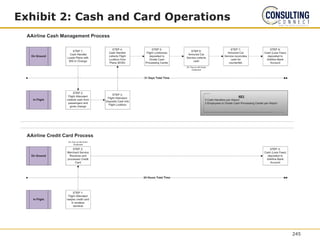
We hope this document results in more Notre Dame students reaching their employment
goals. This book intends to provide insight and share must-knows about the interview
process—from networking to casing. Our success has been in part the result of the support
and guidance of people that went through the process before us, who helped us just as
others helped them. This book is dedicated to our mentors with the intention to share what
we know and what they taught us so others can too.
The following individuals contributed their time and effort to the Notre Dame
Consulting Connect Case Book and without them this would not have been
possible.
● Khesa Borotho - Class of 2021
● Thomas Pero - Class of 2021
● Camila Antelo Iriarte - Class of 2022
● Jack Looney - Class of 2022
● Alex Flor - Class of 2022
● Zac Peurach – Class of 2022
● Kiera Murphy - Class of 2023
● Michael Dillon - Class of 2023
● Nathan Konen - Class of 2023
Acknowledgements
2
1
Introduction
2
Overview of the Firms
3
Recruiting Basics
4
Behavioral Interview Guide
5
Case Interview Guide
6
Practice Cases
7
Table of Contents
3
Overview of the Firms
List of Consulting Firms
5
• 84.51
• Accenture
• Alvarez & Marsal
• Bain & Company
• Beghou Consulting
• Booz Allen Hamilton
• Boston Consulting Group (BCG)
• Capgemini
• Charles River Associates
• CIL Management Consultants
• Claro Healthcare
• Cornerstone Research
• Deloitte Consulting
• EY / Parthenon Group
• FTI Consulting
• GEP
• Guidehouse
This list is quite exhaustive and just gives an overview of the many firms out there!
Click on any link to check out a company ; several are highlighted on ensuing slides
• Huron Consulting Group
• Insight2Profit
• Kaufman Hall
• Kearney
• KPMG
• L.E.K. Consulting
• McKinsey & Company
• Mercer
• Oliver Wyman
• Pariveda
• Protiviti
• PwC / Strategy&
• Roland Berger
• SAP
• Stax
• West Monroe Partners
• ZS Associates
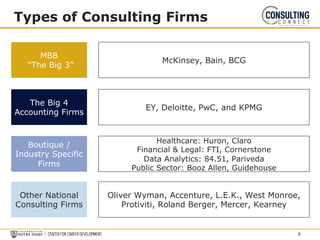
Types of Consulting Firms
MBB
“The Big 3”
The Big 4
Accounting Firms
Boutique /
Industry Specific
Firms
Other National
Consulting Firms
McKinsey, Bain, BCG
6
EY, Deloitte, PwC, and KPMG
Healthcare: Huron, Claro
Financial & Legal: FTI, Cornerstone
Data Analytics: 84.51, Pariveda
Public Sector: Booz Allen, Guidehouse
Oliver Wyman, Accenture, L.E.K., West Monroe,
Protiviti, Roland Berger, Mercer, Kearney
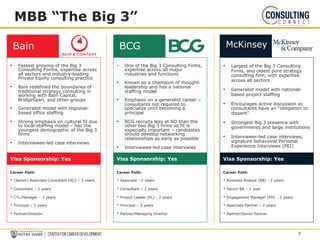
MBB “The Big 3”
• Fastest growing of the Big 3
Consulting Forms, expertise across
all sectors and industry-leading
Private Equity consulting practice
• Bain redefined the boundaries of
traditional strategy consulting in
working with Bain Capital,
BridgeSpan, and other groups
• Generalist model with regional-
based office staffing
• Strong emphasis on cultural fit due
to local-staffing model – has the
youngest demographic of the Big 3
firms
• Interviewee-led case interviews
Bain
Visa Sponsorship: Yes
Career Path:
* (Senior) Associate Consultant (AC) – 3 years
* Consultant – 2 years
* CTL/Manager – 3 years
* Principal – 2 years
* Partner/Director
• One of the Big 3 Consulting Firms,
expertise across all major
industries and functions
• Known as a champion of thought-
leadership and has a national
staffing model
• Emphasis on a generalist career –
consultants not required to
specialize until becoming a
principal
• BCG recruits less at ND than the
other two Big 3 firms so fit is
especially important – candidates
should develop networking
relationships as early as possible
• Interviewee-led case interviews
BCG
Visa Sponsorship: Yes
Career Path:
* Associate - 2 years
* Consultant – 2 years
* Project Leader (PL) - 2 years
* Principal – 2 years
* Partner/Managing Director
• Largest of the Big 3 Consulting
Firms, and oldest pure strategy
consulting firm, with expertise
across all sectors
• Generalist model with national-
based project staffing
• Encourages active discussion as
consultants have an “obligation to
dissent”
• Strongest Big 3 presence with
governments and large institutions
• Interviewer-led case interviews,
signature behavioral Personal
Experience Interviews (PEI)
McKinsey
Visa Sponsorship: Yes
Career Path:
* Business Analyst (BA) - 2 years
* Senior BA – 1 year
* Engagement Manager (EM) - 2 years
* Associate Partner – 2 years
* Partner/Senior Partner
7
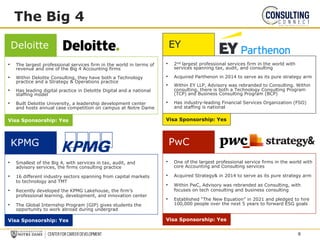
The Big 4
• The largest professional services firm in the world in terms of
revenue and one of the Big 4 Accounting firms
• Within Deloitte Consulting, they have both a Technology
practice and a Strategy & Operations practice
• Has leading digital practice in Deloitte Digital and a national
staffing model
• Built Deloitte University, a leadership development center
and hosts annual case competition on campus at Notre Dame
Deloitte
Visa Sponsorship: Yes
• 2nd largest professional services firm in the world with
services spanning tax, audit, and consulting
• Acquired Parthenon in 2014 to serve as its pure strategy arm
• Within EY LLP, Advisory was rebranded to Consulting. Within
consulting, there is both a Technology Consulting Program
(TCP) and Business Consulting Program (BCP)
• Has industry-leading Financial Services Organization (FSO)
and staffing is national
EY
Visa Sponsorship: Yes
• Smallest of the Big 4, with services in tax, audit, and
advisory services, the firms consulting practice
• 16 different industry sectors spanning from capital markets
to technology and TMT
• Recently developed the KPMG Lakehouse, the firm’s
professional learning, development, and innovation center
• The Global Internship Program (GIP) gives students the
opportunity to work abroad during undergrad
KPMG
Visa Sponsorship: Yes
• One of the largest professional service firms in the world with
core Accounting and Consulting services
• Acquired Strategy& in 2014 to serve as its pure strategy arm
• Within PwC, Advisory was rebranded as Consulting, with
focuses on tech consulting and business consulting
• Established “The New Equation” in 2021 and pledged to hire
100,000 people over the next 5 years to forward ESG goals
PwC
Visa Sponsorship: Yes
8
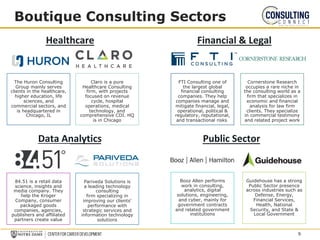
Boutique Consulting Sectors
The Huron Consulting
Group mainly serves
clients in the healthcare,
higher education, life
sciences, and
commercial sectors, and
is headquartered in
Chicago, IL
Healthcare Financial & Legal
Claro is a pure
Healthcare Consulting
firm, with projects
focused on revenue
cycle, hospital
operations, medical
technology, and
comprehensive CDI. HQ
is in Chicago
FTI Consulting one of
the largest global
financial consulting
companies. They help
companies manage and
mitigate financial, legal,
operational, political &
regulatory, reputational,
and transactional risks
Cornerstone Research
occupies a rare niche in
the consulting world as a
firm that specializes in
economic and financial
analysis for law firm
clients. They specialize
in commercial testimony
and related project work
Data Analytics Public Sector
84.51 is a retail data
science, insights and
media company. They
help the Kroger
Company, consumer
packaged goods
companies, agencies,
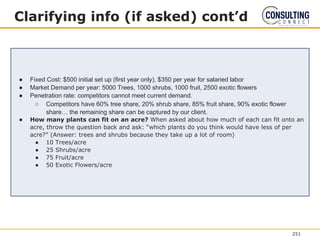
publishers and affiliated
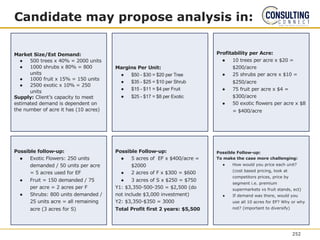
partners create value
Pariveda Solutions is
a leading technology
consulting
firm specializing in
improving our clients'
performance with
strategic services and
information technology
solutions
Guidehouse has a strong
Public Sector presence
across industries such as
Defense, Energy,
Financial Services,
Health, National
Security, and State &
Local Government
Booz Allen performs
work in consulting,
analytics, digital
solutions, engineering,
and cyber, mainly for
government contracts
and related government
institutions
9
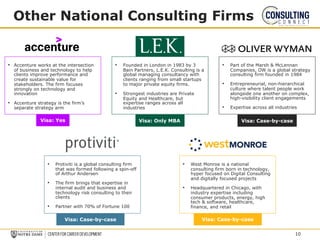
Other National Consulting Firms
• Accenture works at the intersection
of business and technology to help
clients improve performance and
create sustainable value for
stakeholders. The firm focuses
strongly on technology and
innovation
• Accenture strategy is the firm’s
separate strategy arm
Visa: Yes
• Founded in London in 1983 by 3
Bain Partners, L.E.K. Consulting is a
global managing consultancy with
clients ranging from small startups
to major private equity firms.
• Strongest industries are Private
Equity and Healthcare, but
expertise ranges across all
industries
• Part of the Marsh & McLennan
Companies, OW is a global strategy
consulting firm founded in 1984
• Entrepreneurial, non-hierarchical
culture where talent people work
alongside one another on complex,
high-visibility client engagements
• Expertise across all industries
Visa: Only MBA Visa: Case-by-case
• Protiviti is a global consulting firm
that was formed following a spin-off
of Arthur Andersen
• The firm brings that expertise in
internal audit and business and
technology risk consulting to their
clients
• Partner with 70% of Fortune 100
Visa: Case-by-case
• West Monroe is a national
consulting firm born in technology,
hyper focused on Digital Consulting
and digitally focused projects
• Headquartered in Chicago, with
industry expertise including
consumer products, energy, high
tech & software, healthcare,
finance, and retail
Visa: Case-by-case
10
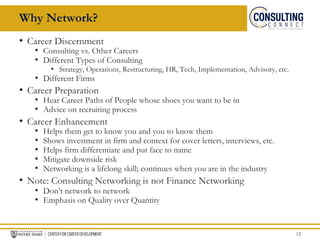
Recruiting Basics
• Career Discernment
• Consulting vs. Other Careers
• Different Types of Consulting
• Strategy, Operations, Restructuring, HR, Tech, Implementation, Advisory, etc.
• Different Firms
• Career Preparation
• Hear Career Paths of People whose shoes you want to be in
• Advice on recruiting process
• Career Enhancement
• Helps them get to know you and you to know them
• Shows investment in firm and context for cover letters, interviews, etc.
• Helps firm differentiate and put face to name
• Mitigate downside risk
• Networking is a lifelong skill; continues when you are in the industry
• Note: Consulting Networking is not Finance Networking
• Don’t network to network
• Emphasis on Quality over Quantity
12
Why Network?
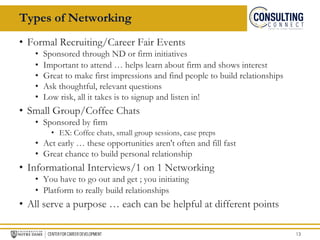
• Formal Recruiting/Career Fair Events
• Sponsored through ND or firm initiatives
• Important to attend … helps learn about firm and shows interest
• Great to make first impressions and find people to build relationships
• Ask thoughtful, relevant questions
• Low risk, all it takes is to signup and listen in!
• Small Group/Coffee Chats
• Sponsored by firm
• EX: Coffee chats, small group sessions, case preps
• Act early … these opportunities aren't often and fill fast
• Great chance to build personal relationship
• Informational Interviews/1 on 1 Networking
• You have to go out and get ; you initiating
• Platform to really build relationships
• All serve a purpose … each can be helpful at different points
13
Types of Networking
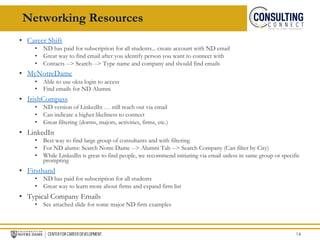
• Career Shift
• ND has paid for subscription for all students... create account with ND email
• Great way to find email after you identify person you want to connect with
• Contacts --> Search --> Type name and company and should find emails
• MyNotreDame
• Able to use okta login to access
• Find emails for ND Alumni
• IrishCompass
• ND version of LinkedIn … still reach out via email
• Can indicate a higher likeliness to connect
• Great filtering (dorms, majors, activities, firms, etc.)
• LinkedIn
• Best way to find large group of consultants and with filtering
• For ND alums: Search Notre Dame --> Alumni Tab --> Search Company (Can filter by City)
• While LinkedIn is great to find people, we recommend initiating via email unless in same group or specific
prompting
• Firsthand
• ND has paid for subscription for all students
• Great way to learn more about firms and expand firm list
• Typical Company Emails
• See attached slide for some major ND firm examples
14
Networking Resources
Follow-up Email
This list serves as a sample outline on how to write an email while recruiting. It should be edited according to
the level of connection previously established with the recipient, if any. i.e. the guide is design for contacting
someone for the first time; if this is a follow-up to reconnect, (4) could be ignored.
Subject line:
• Address an specific request. e.g. “Call at 2:45 PM Friday”, “Interest to talk next week”
Name:
• Use the recipient first name. e.g. “Joe, ”
First Line:
• “I am a [class year denomination e.g. junior] majoring in [major] at Notre Dame with experience in [work] with a
passion in [interest with professional appeal]. A couple ”
“Fun facts”:
• State 3 things you have done; maybe one in the classroom, one in the workplace, and the third of some outside
activity you performed. The purpose is to show variety in activities and highlight your pros.
Specific Ask
• “I am going to apply...”. State you have questions about their office, about specific points of their experience or
application process.
Closing
• “Can we get a 15 minute call the…? - [Name]”
15
“Any questions for me?”
This list represents a non-exhaustive sample. Think of it as a good way to practice talking about
your stories and experiences.
• Why did you choose the [city] office?
• What do you like the most about the [city] office?
• How was the last project you were in? What was something great about it?
• Tell me about a mentor you have?
• What was your favorite project at [firm]? Why?
• What was the hardest part about transitioning into [firm]? How did [firm] help you?
• If it’s a partner or senior employee: Why did you choose to specialize in [area of expertise]?
• If it’s a junior level employee: Do you know where you might want to specialize in the future?
• If you’re interested in working abroad: Does [firm] offer opportunities to work internationally? If so
have you taken advantage of any?
• Does [firm] sponsor any socially-focused initiatives or pro-bono consulting?
16
Behavioral Interview
Guide
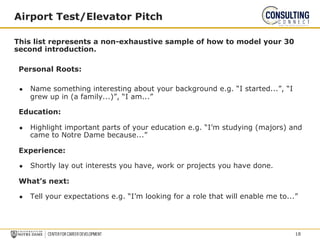
This list represents a non-exhaustive sample of how to model your 30
second introduction.
Personal Roots:
● Name something interesting about your background e.g. “I started...”, “I
grew up in (a family...)”, “I am...”
Education:
● Highlight important parts of your education e.g. “I’m studying (majors) and
came to Notre Dame because...”
Experience:
● Shortly lay out interests you have, work or projects you have done.
What’s next:
● Tell your expectations e.g. “I’m looking for a role that will enable me to...”
Airport Test/Elevator Pitch
18
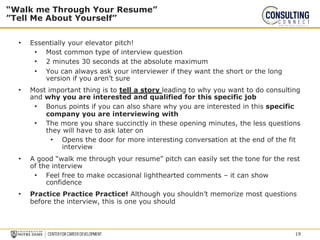
• Essentially your elevator pitch!
• Most common type of interview question
• 2 minutes 30 seconds at the absolute maximum
• You can always ask your interviewer if they want the short or the long
version if you aren’t sure
• Most important thing is to tell a story leading to why you want to do consulting
and why you are interested and qualified for this specific job
• Bonus points if you can also share why you are interested in this specific
company you are interviewing with
• The more you share succinctly in these opening minutes, the less questions
they will have to ask later on
• Opens the door for more interesting conversation at the end of the fit
interview
• A good “walk me through your resume” pitch can easily set the tone for the rest
of the interview
• Feel free to make occasional lighthearted comments – it can show
confidence
• Practice Practice Practice! Although you shouldn’t memorize most questions
before the interview, this is one you should
“Walk me Through Your Resume”
”Tell Me About Yourself”
19
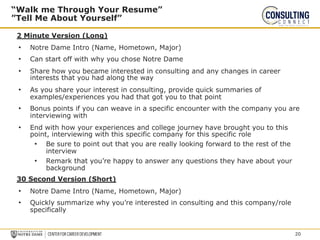
2 Minute Version (Long)
• Notre Dame Intro (Name, Hometown, Major)
• Can start off with why you chose Notre Dame
• Share how you became interested in consulting and any changes in career
interests that you had along the way
• As you share your interest in consulting, provide quick summaries of
examples/experiences you had that got you to that point
• Bonus points if you can weave in a specific encounter with the company you are
interviewing with
• End with how your experiences and college journey have brought you to this
point, interviewing with this specific company for this specific role
• Be sure to point out that you are really looking forward to the rest of the
interview
• Remark that you’re happy to answer any questions they have about your
background
30 Second Version (Short)
• Notre Dame Intro (Name, Hometown, Major)
• Quickly summarize why you’re interested in consulting and this company/role
specifically
“Walk me Through Your Resume”
”Tell Me About Yourself”
20
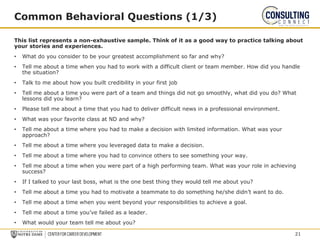
This list represents a non-exhaustive sample. Think of it as a good way to practice talking about
your stories and experiences.
• What do you consider to be your greatest accomplishment so far and why?
• Tell me about a time when you had to work with a difficult client or team member. How did you handle
the situation?
• Talk to me about how you built credibility in your first job
• Tell me about a time you were part of a team and things did not go smoothly, what did you do? What
lessons did you learn?
• Please tell me about a time that you had to deliver difficult news in a professional environment.
• What was your favorite class at ND and why?
• Tell me about a time where you had to make a decision with limited information. What was your
approach?
• Tell me about a time where you leveraged data to make a decision.
• Tell me about a time where you had to convince others to see something your way.
• Tell me about a time when you were part of a high performing team. What was your role in achieving
success?
• If I talked to your last boss, what is the one best thing they would tell me about you?
• Tell me about a time you had to motivate a teammate to do something he/she didn’t want to do.
• Tell me about a time when you went beyond your responsibilities to achieve a goal.
• Tell me about a time you’ve failed as a leader.
• What would your team tell me about you?
Common Behavioral Questions (1/3)
21
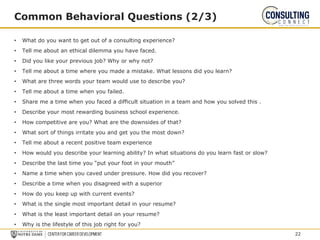
• What do you want to get out of a consulting experience?
• Tell me about an ethical dilemma you have faced.
• Did you like your previous job? Why or why not?
• Tell me about a time where you made a mistake. What lessons did you learn?
• What are three words your team would use to describe you?
• Tell me about a time when you failed.
• Share me a time when you faced a difficult situation in a team and how you solved this .
• Describe your most rewarding business school experience.
• How competitive are you? What are the downsides of that?
• What sort of things irritate you and get you the most down?
• Tell me about a recent positive team experience
• How would you describe your learning ability? In what situations do you learn fast or slow?
• Describe the last time you “put your foot in your mouth”
• Name a time when you caved under pressure. How did you recover?
• Describe a time when you disagreed with a superior
• How do you keep up with current events?
• What is the single most important detail in your resume?
• What is the least important detail on your resume?
• Why is the lifestyle of this job right for you?
Common Behavioral Questions (2/3)
22
• How would you describe your problem-solving skills?
• Do you consider yourself a more visionary or pragmatic thinker?
• What did you like least about your last job?
• What do you see as the most challenging aspect of this job?
• Tell me about your written communication skills
• What are some of the best and worst decisions you’ve made in the last year?
• What do you read?
• What is the most important issue facing the industry of your last job?
• What do you do for fun?
• What did you contribute to your last job that made a difference in the organization?
• Outside of school & work, what is your greatest personal accomplishment?
• Tell me about a time you had to adjust a project schedule because you didn’t have all the resources you
needed?
• Describe a time you had to change your communication style to convince a group of different
stakeholders.
• What skills can you bring to this position?
• Give me an example of a business problem your company faced and tell me how you solved it?
• Tell me about a challenge you set for yourself and then accomplished.
Common Behavioral Questions (3/3)
23
The PEI is McKinsey’s behavioral interview which consists of a 15 minute one-question interview
focused in a particular experienced. It is given prior to the start of every case. You should not
repeat the same story within the same interview round
Types of questions
● A challenge within a certain timeline or group of people
● A problem you overcame with a team (outside conflict) or team member (inside conflict)
● A time you convinced someone of something
Key values to focus on:
● Personal Impact
● Entrepreneurial Drive
● Leadership Abilities
● Problem Solving Skills
Key aspects to look for:
● Defining moments
● Authenticity
● Clear impact
● Clear Lesson learned
Key questions to ask yourself:
● How did the problem turned out?
● What did I took away?
● What did I learned?
● What is the “so what” of me telling this story
How to think about it:
● Focus on your specific role, e.g. “My impact...”
● Speak in first person, e.g. “I said...”, “I did..”, “I thought”
● Make it conversational
PEI (Personal Experience Interview)
24
Case Interview Guide
1
Common Types of Cases
2
Basic Frameworks
3
Structuring
4
Useful Facts
5
Useful Formulas
6
Useful Concepts
7
How to Approach a Case
8
How to Give a Case
Section Table of Contents
26
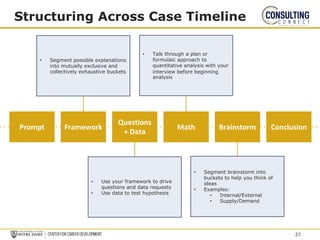
Structuring Across Case Timeline
Prompt Framework
Questions
+ Data
Math Brainstorm Conclusion
• Segment possible explanations
into mutually exclusive and
collectively exhaustive buckets
• Use your framework to drive
questions and data requests
• Use data to test hypothesis
• Talk through a plan or
formulaic approach to
quantitative analysis with your
interview before beginning
analysis
• Segment brainstorm into
buckets to help you think of
ideas
• Examples:
• Internal/External
• Supply/Demand
27
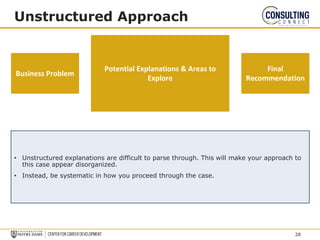
Unstructured Approach
Business Problem
Potential Explanations & Areas to
Explore
Final
Recommendation
• Unstructured explanations are difficult to parse through. This will make your approach to
this case appear disorganized.
• Instead, be systematic in how you proceed through the case.
28
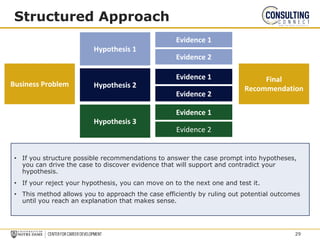
Structured Approach
Business Problem
Hypothesis 1
Hypothesis 2
Hypothesis 3
Evidence 1
Evidence 2
Evidence 1
Evidence 2
Evidence 1
Evidence 2
Final
Recommendation
• If you structure possible recommendations to answer the case prompt into hypotheses,
you can drive the case to discover evidence that will support and contradict your
hypothesis.
• If your reject your hypothesis, you can move on to the next one and test it.
• This method allows you to approach the case efficiently by ruling out potential outcomes
until you reach an explanation that makes sense.
29
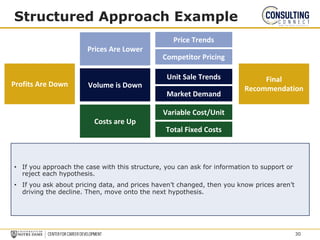
Structured Approach Example
Prices Are Lower
Volume is Down
Costs are Up
Price Trends
Competitor Pricing
Unit Sale Trends
Market Demand
Variable Cost/Unit
Total Fixed Costs
• If you approach the case with this structure, you can ask for information to support or
reject each hypothesis.
• If you ask about pricing data, and prices haven’t changed, then you know prices aren’t
driving the decline. Then, move onto the next hypothesis.
Profits Are Down
Final
Recommendation
30
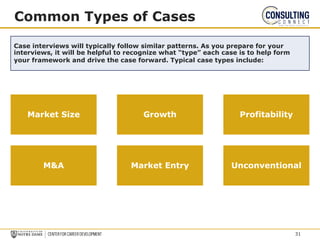
Case interviews will typically follow similar patterns. As you prepare for your
interviews, it will be helpful to recognize what “type” each case is to help form
your framework and drive the case forward. Typical case types include:
Common Types of Cases
Market Size Growth Profitability
M&A Market Entry Unconventional
31
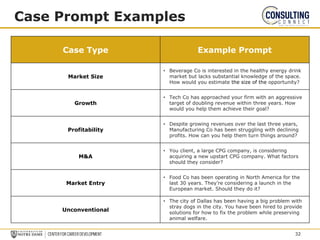
Case Prompt Examples
Case Type Example Prompt
Market Size
• Beverage Co is interested in the healthy energy drink
market but lacks substantial knowledge of the space.
How would you estimate the size of the opportunity?
Growth
• Tech Co has approached your firm with an aggressive
target of doubling revenue within three years. How
would you help them achieve their goal?
Profitability
• Despite growing revenues over the last three years,
Manufacturing Co has been struggling with declining
profits. How can you help them turn things around?
M&A
• You client, a large CPG company, is considering
acquiring a new upstart CPG company. What factors
should they consider?
Market Entry
• Food Co has been operating in North America for the
last 30 years. They’re considering a launch in the
European market. Should they do it?
Unconventional
• The city of Dallas has been having a big problem with
stray dogs in the city. You have been hired to provide
solutions for how to fix the problem while preserving
animal welfare.
32
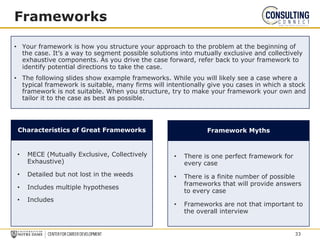
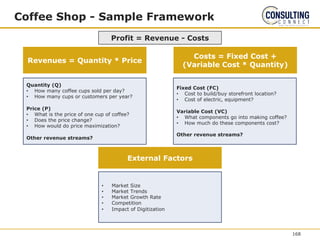
• Your framework is how you structure your approach to the problem at the beginning of
the case. It’s a way to segment possible solutions into mutually exclusive and collectively
exhaustive components. As you drive the case forward, refer back to your framework to
identify potential directions to take the case.
• The following slides show example frameworks. While you will likely see a case where a
typical framework is suitable, many firms will intentionally give you cases in which a stock
framework is not suitable. When you structure, try to make your framework your own and
tailor it to the case as best as possible.
Frameworks
• MECE (Mutually Exclusive, Collectively
Exhaustive)
• Detailed but not lost in the weeds
• Includes multiple hypotheses
• Includes
• There is one perfect framework for
every case
• There is a finite number of possible
frameworks that will provide answers
to every case
• Frameworks are not that important to
the overall interview
Characteristics of Great Frameworks Framework Myths
33
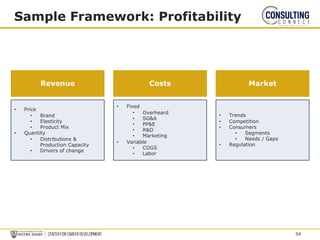
Sample Framework: Profitability
• Price
• Brand
• Elasticity
• Product Mix
• Quantity
• Distributions &
Production Capacity
• Drivers of change
Revenue Costs Market
• Fixed
• Overheard
• SG&A
• PP&E
• R&D
• Marketing
• Variable
• COGS
• Labor
• Trends
• Competition
• Consumers
• Segments
• Needs / Gaps
• Regulation
34
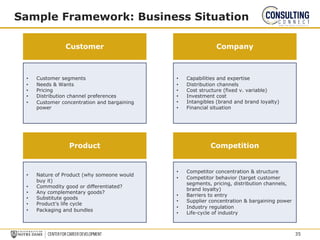
Sample Framework: Business Situation
• Customer segments
• Needs & Wants
• Pricing
• Distribution channel preferences
• Customer concentration and bargaining
power
Customer Company
• Capabilities and expertise
• Distribution channels
• Cost structure (fixed v. variable)
• Investment cost
• Intangibles (brand and brand loyalty)
• Financial situation
• Nature of Product (why someone would
buy it)
• Commodity good or differentiated?
• Any complementary goods?
• Substitute goods
• Product’s life cycle
• Packaging and bundles
Product Competition
• Competitor concentration & structure
• Competitor behavior (target customer
segments, pricing, distribution channels,
brand loyalty)
• Barriers to entry
• Supplier concentration & bargaining power
• Industry regulation
• Life-cycle of industry
35
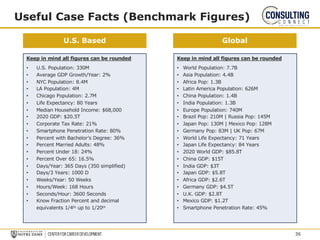
Useful Case Facts (Benchmark Figures)
Keep in mind all figures can be rounded
• U.S. Population: 330M
• Average GDP Growth/Year: 2%
• NYC Population: 8.4M
• LA Population: 4M
• Chicago Population: 2.7M
• Life Expectancy: 80 Years
• Median Household Income: $68,000
• 2020 GDP: $20.5T
• Corporate Tax Rate: 21%
• Smartphone Penetration Rate: 80%
• Percent with Bachelor’s Degree: 36%
• Percent Married Adults: 48%
• Percent Under 18: 24%
• Percent Over 65: 16.5%
• Days/Year: 365 Days (350 simplified)
• Days/3 Years: 1000 D
• Weeks/Year: 50 Weeks
• Hours/Week: 168 Hours
• Seconds/Hour: 3600 Seconds
• Know Fraction Percent and decimal
equivalents 1/4th up to 1/20th
U.S. Based Global
Keep in mind all figures can be rounded
• World Population: 7.7B
• Asia Population: 4.4B
• Africa Pop: 1.3B
• Latin America Population: 626M
• China Population: 1.4B
• India Population: 1.3B
• Europe Population: 740M
• Brazil Pop: 210M | Russia Pop: 145M
• Japan Pop: 130M | Mexico Pop: 128M
• Germany Pop: 83M | UK Pop: 67M
• World Life Expectancy: 71 Years
• Japan Life Expectancy: 84 Years
• 2020 World GDP: $85.8T
• China GDP: $15T
• India GDP: $3T
• Japan GDP: $5.8T
• Africa GDP: $2.6T
• Germany GDP: $4.5T
• U.K. GDP: $2.8T
• Mexico GDP: $1.2T
• Smartphone Penetration Rate: 45%
36
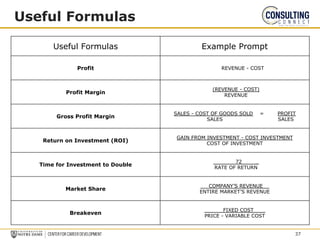
Useful Formulas
Useful Formulas Example Prompt
Profit REVENUE - COST
Profit Margin
(REVENUE - COST)
REVENUE
Gross Profit Margin
SALES - COST OF GOODS SOLD = PROFIT
SALES SALES
Return on Investment (ROI)
GAIN FROM INVESTMENT - COST INVESTMENT
COST OF INVESTMENT
Time for Investment to Double
72 _
RATE OF RETURN
Market Share
COMPANY’S REVENUE _
ENTIRE MARKET’S REVENUE
Breakeven
FIXED COST _
PRICE - VARIABLE COST
37
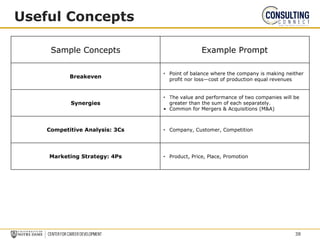
Useful Concepts
Sample Concepts Example Prompt
Breakeven
• Point of balance where the company is making neither
profit nor loss—cost of production equal revenues
Synergies
• The value and performance of two companies will be
greater than the sum of each separately.
• Common for Mergers & Acquisitions (M&A)
Competitive Analysis: 3Cs • Company, Customer, Competition
Marketing Strategy: 4Ps • Product, Price, Place, Promotion
38
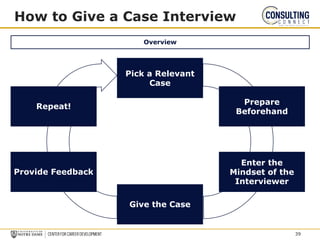
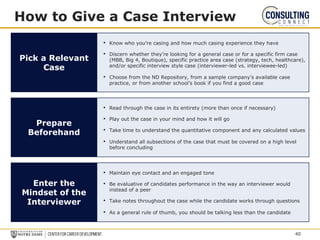
How to Give a Case Interview
Pick a Relevant
Case
Prepare
Beforehand
Give the Case
Enter the
Mindset of the
Interviewer
Overview
Repeat!
Provide Feedback
39
How to Give a Case Interview
Prepare
Beforehand
Enter the
Mindset of the
Interviewer
Pick a Relevant
Case
• Know who you’re casing and how much casing experience they have
• Discern whether they’re looking for a general case or for a specific firm case
(MBB, Big 4, Boutique), specific practice area case (strategy, tech, healthcare),
and/or specific interview style case (interviewer-led vs. interviewee-led)
• Choose from the ND Repository, from a sample company’s available case
practice, or from another school’s book if you find a good case
• Read through the case in its entirety (more than once if necessary)
• Play out the case in your mind and how it will go
• Take time to understand the quantitative component and any calculated values
• Understand all subsections of the case that must be covered on a high level
before concluding
• Maintain eye contact and an engaged tone
• Be evaluative of candidates performance in the way an interviewer would
instead of a peer
• Take notes throughout the case while the candidate works through questions
• As a general rule of thumb, you should be talking less than the candidate
40
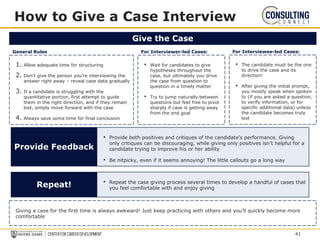
How to Give a Case Interview
Repeat!
Give the Case
1. Allow adequate time for structuring
2. Don’t give the person you’re interviewing the
answer right away – reveal case data gradually
3. If a candidate is struggling with the
quantitative portion, first attempt to guide
them in the right direction, and if they remain
lost, simply move forward with the case
4. Always save some time for final conclusion
• Repeat the case giving process several times to develop a handful of cases that
you feel comfortable with and enjoy giving
Giving a case for the first time is always awkward! Just keep practicing with others and you’ll quickly become more
comfortable
Provide Feedback
• Provide both positives and critiques of the candidate’s performance. Giving
only critiques can be discouraging, while giving only positives isn’t helpful for a
candidate trying to improve his or her ability
• Be nitpicky, even if it seems annoying! The little callouts go a long way
General Rules
• Wait for candidates to give
hypotheses throughout the
case, but ultimately you drive
the case from question to
question in a timely matter
• Try to jump naturally between
questions but feel free to pivot
sharply if case is getting away
from the end goal
For Interviewer-led Cases: For Interviewee-led Cases:
• The candidate must be the one
to drive the case and its
direction!
• After giving the initial prompt,
you mostly speak when spoken
to (if you are asked a question,
to verify information, or for
specific additional data) unless
the candidate becomes truly
lost
41
How to Approach a Case
1. Relax! One of the most important things in any case interview is to show
comfortability with the case material. Make sure to pace yourself during the
case and take deep breaths
2. Ask Questions from the Start. Every case will involve you asking
questions to unlock new relevant pieces of information, some more than
others. A critical time for asking questions is right after the prompt is given.
3. Engage your Interviewer. The last thing you want to do is act like the
case is purely a test instead of a conversation. It’s just as important to many
interviewees for candidates to be conversational during the case as it is to
solve the case. Don’t overlook this hidden fit component of case interviews
4. Structure, Structure, Structure. Be sure to review all relevant
frameworks and structures provided in this repository and look to apply what
you think is the structure of best fit to your case. However, also make sure to
tailor each structure that you do use to your specific case! Cookie cutter
frameworks can be boring to interviewers.
42
How to Approach a Case
5. Recognize Case Archetypes. There really are only a handful of cases that you
can get. The include entering a new market, developing a new product,
acquiring a company, pricing strategies, growth strategies, starting a new
business, and increasing profitability. This goes hand in hand with structuring --
once you recognize a case archetype, you can pick a relevant structure for that type
of case
6. Practice Your Numbers. In pretty much every case, you will be asked to do
mental math in front of your interviewer. This can be a pretty daunting task, but
with a few tips and tricks you can conquer the challenge. This video pretty accurately
sums up various mental math techniques to employ. Once you learn the techniques,
practice practice practice! Lastly, make sure to talk your interviewer through your
calculations as you do them -- this is vital to keep communication flowing
7. Don’t be Afraid to Ask for Time. Undoubtedly there will come a time in the
case where you just need a few seconds, even a minute, to think about a problem,
brainstorm, or do mental math. That’s ok! Just remember to ask your interviewer if
you can have that time instead of immediately going mute.
8. Keep up with Industries. This point, while less important, can still be good for
gaining background knowledge. Subscribe to some morning newsletters (highly
recommend Morning Brew) and pick up little things here and there.
43
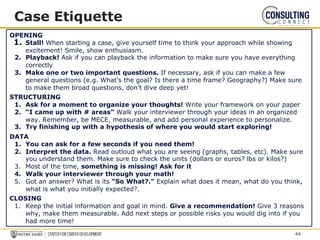
Case Etiquette
OPENING
1. Stall! When starting a case, give yourself time to think your approach while showing
excitement! Smile, show enthusiasm.
2. Playback! Ask if you can playback the information to make sure you have everything
correctly
3. Make one or two important questions. If necessary, ask if you can make a few
general questions (e.g. What’s the goal? Is there a time frame? Geography?) Make sure
to make them broad questions, don’t dive deep yet!
STRUCTURING
1. Ask for a moment to organize your thoughts! Write your framework on your paper
2. “I came up with # areas” Walk your interviewer through your ideas in an organized
way. Remember, be MECE, measurable, and add personal experience to personalize.
3. Try finishing up with a hypothesis of where you would start exploring!
DATA
1. You can ask for a few seconds if you need them!
2. Interpret the data. Read outloud what you are seeing (graphs, tables, etc). Make sure
you understand them. Make sure to check the units (dollars or euros? lbs or kilos?)
3. Most of the time, something is missing! Ask for it
4. Walk your interviewer through your math!
5. Got an answer? What is its “So What?.” Explain what does it mean, what do you think,
what is what you initially expected?.
CLOSING
1. Keep the initial information and goal in mind. Give a recommendation! Give 3 reasons
why, make them measurable. Add next steps or possible risks you would dig into if you
had more time!
44
Practice Cases
Interviewer-led: Easy
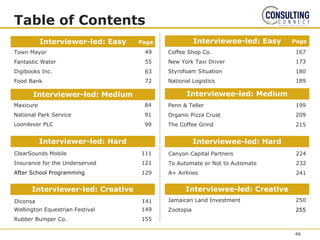
Table of Contents
46
Interviewer-led: Medium
Interviewer-led: Hard
Interviewee-led: Easy
Interviewee-led: Medium
Interviewee-led: Hard
Town Mayor
Fantastic Water
Digibooks Inc.
Food Bank
49
55
63
72
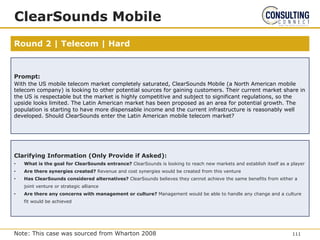
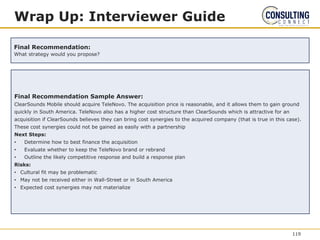
ClearSounds Mobile
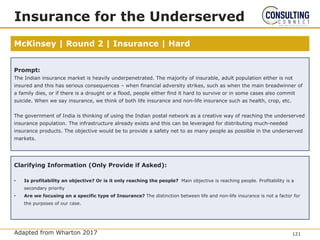
Insurance for the Underserved
After School Programming
Diconsa
111
121
129
141
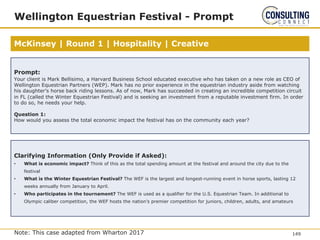
Wellington Equestrian Festival
Rubber Bumper Co.
149
155
Maxicure
National Park Service
Loonilever PLC
84
91
99
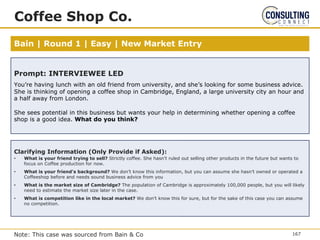
Coffee Shop Co.
New York Taxi Driver
Styrofoam Situation
National Logistics
167
173
180
189
Penn & Teller
Organic Pizza Crust
The Coffee Grind
199
209
215
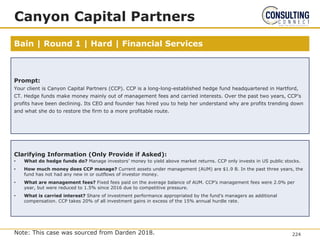
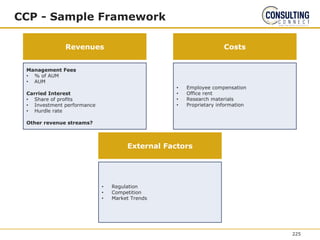
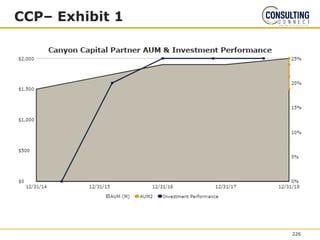
Canyon Capital Partners
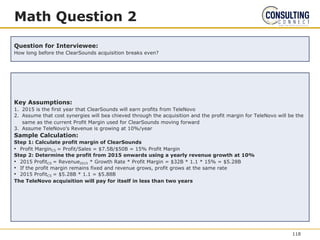
To Automate or Not to Automate
A+ Airlines
224
232
241
Jamaican Land Investment
Zootopia
250
255
Page Page
Interviewer-led: Creative Interviewee-led: Creative
Interviewer-led:
Easy
Town Mayor
Round 1 | Easy | Financial Services
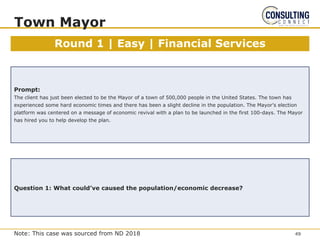
Town Mayor
Prompt:
The client has just been elected to be the Mayor of a town of 500,000 people in the United States. The town has
experienced some hard economic times and there has been a slight decline in the population. The Mayor’s election
platform was centered on a message of economic revival with a plan to be launched in the first 100-days. The Mayor
has hired you to help develop the plan.
Question 1: What could’ve caused the population/economic decrease?
49
Note: This case was sourced from ND 2018
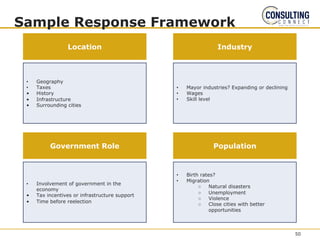
Sample Response Framework
• Geography
• Taxes
• History
• Infrastructure
• Surrounding cities
Location Industry
• Mayor industries? Expanding or declining
• Wages
• Skill level
• Involvement of government in the
economy
• Tax incentives or infrastructure support
• Time before reelection
Government Role Population
• Birth rates?
• Migration
○ Natural disasters
○ Unemployment
○ Violence
○ Close cities with better
opportunities
50
Question2 Interviewer Guidance
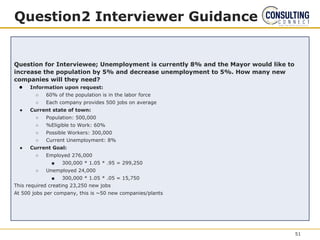
Question for Interviewee; Unemployment is currently 8% and the Mayor would like to
increase the population by 5% and decrease unemployment to 5%. How many new
companies will they need?
● Information upon request:
○ 60% of the population is in the labor force
○ Each company provides 500 jobs on average
● Current state of town:
○ Population: 500,000
○ %Eligible to Work: 60%
○ Possible Workers: 300,000
○ Current Unemployment: 8%
● Current Goal:
○ Employed 276,000
■ 300,000 * 1.05 * .95 = 299,250
○ Unemployed 24,000
■ 300,000 * 1.05 * .05 = 15,750
This required creating 23,250 new jobs
At 500 jobs per company, this is ~50 new companies/plants
51
Question2-3 Interviewer Guidance
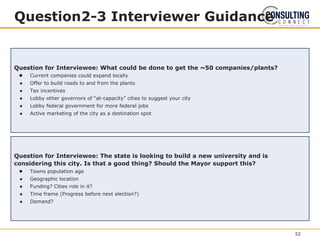
Question for Interviewee: What could be done to get the ~50 companies/plants?
● Current companies could expand locally
● Offer to build roads to and from the plants
● Tax incentives
● Lobby other governors of “at-capacity” cities to suggest your city
● Lobby federal government for more federal jobs
● Active marketing of the city as a destination spot
Question for Interviewee: The state is looking to build a new university and is
considering this city. Is that a good thing? Should the Mayor support this?
● Towns population age
● Geographic location
● Funding? Cities role in it?
● Time frame (Progress before next election?)
● Demand?
52
Wrap Up: Interviewer Guide
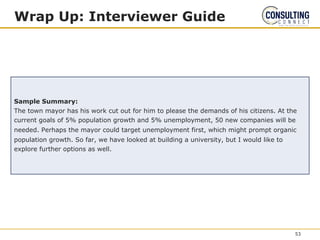
Sample Summary:
The town mayor has his work cut out for him to please the demands of his citizens. At the
current goals of 5% population growth and 5% unemployment, 50 new companies will be
needed. Perhaps the mayor could target unemployment first, which might prompt organic
population growth. So far, we have looked at building a university, but I would like to
explore further options as well.
53
Fantastic Water
Oliver Wyman| Round 1 | Easy | Retail
Oliver Wyman | Round 1 | Retail | Medium
Fantastic Water
Prompt: INTERVIEWER-LED
Your friend is thinking about starting a flavored water company called Fantastic Water. This water would be clear and
not carbonated (so a bit different from Gatorade or La Croix). She has asked you to figure out if she should start
Fantastic Water or not.
Clarifying Information (Only Provide if Asked):
• Where will this be sold? She thinks she will sell it mainly at grocery stores.
• How would the product be packaged? Single portion sizes, not liter bottles
55
Note: This case was created by Alex Muck, Class of 2020
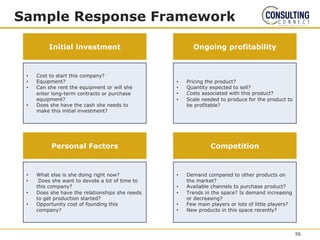
Sample Response Framework
• Cost to start this company?
• Equipment?
• Can she rent the equipment or will she
enter long-term contracts or purchase
equipment?
• Does she have the cash she needs to
make this initial investment?
Initial investment Ongoing profitability
• Pricing the product?
• Quantity expected to sell?
• Costs associated with this product?
• Scale needed to produce for the product to
be profitable?
• What else is she doing right now?
• Does she want to devote a lot of time to
this company?
• Does she have the relationships she needs
to get production started?
• Opportunity cost of founding this
company?
Personal Factors Competition
• Demand compared to other products on
the market?
• Available channels to purchase product?
• Trends in the space? Is demand increasing
or decreasing?
• Few main players or lots of little players?
• New products in this space recently?
56
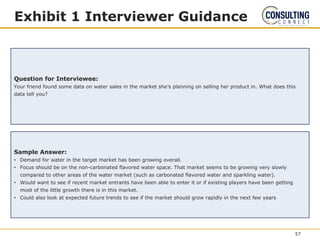
Exhibit 1 Interviewer Guidance
Question for Interviewee:
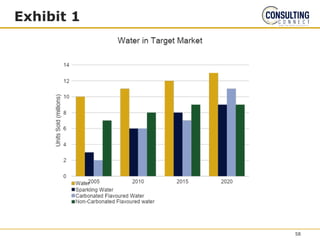
Your friend found some data on water sales in the market she’s planning on selling her product in. What does this
data tell you?
Sample Answer:
• Demand for water in the target market has been growing overall.
• Focus should be on the non-carbonated flavored water space. That market seems to be growing very slowly
compared to other areas of the water market (such as carbonated flavored water and sparkling water).
• Would want to see if recent market entrants have been able to enter it or if existing players have been getting
most of the little growth there is in this market.
• Could also look at expected future trends to see if the market should grow rapidly in the next few years
57
Exhibit 1
58
Question 3 Interviewer Guide
Question 3:
The market is expected to grow by 250,000 units next year and will then remain constant for several years. Fantastic Water can
sell each product for $3, and each unit will cost $2.25 to produce. What percentage of the growth in the market (i.e. of the
250,000) does Fantastic Water need to break even in the first two years?
Sample Answer:
2[X quantity * ($3 revenue - $2.25 cost) - $30,000 overhead] – $50,000 one-time cost = $0
1.5x – 110,000 = 0
X = about 73,000 units
73,000 units / 250,000 market growth = about 30%
• Each year for the first two years, Fantastic Water will need to sell 73,000 units of its product.
• In total over the two years, it will need to sell 146,000 units
• It will need to capture 30% of the new market growth for the first two years
The strongest candidates will give some meaning to this number. If the founder HAS to at least break even in the first two years,
needing 30% of the market growth might be aggressive if the market is made of much more established players.
Information to be given upon request:
• Are there any initial costs for the investment? It will cost $50,000 of one-time cost to get the business started.
• Is there any overhead cost? There will be $30,000 of overhead cost each year for the first two years at least.
59
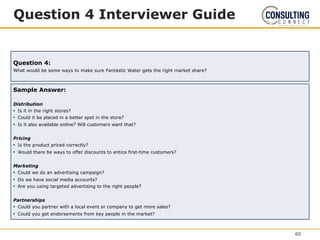
Question 4 Interviewer Guide
Question 4:
What would be some ways to make sure Fantastic Water gets the right market share?
Sample Answer:
Distribution
• Is it in the right stores?
• Could it be placed in a better spot in the store?
• Is it also available online? Will customers want that?
Pricing
• Is the product priced correctly?
• Would there be ways to offer discounts to entice first-time customers?
Marketing
• Could we do an advertising campaign?
• Do we have social media accounts?
• Are you using targeted advertising to the right people?
Partnerships
• Could you partner with a local event or company to get more sales?
• Could you get endorsements from key people in the market?
60
Recommendation Sample Answer:
• We were asked to evaluate whether Fantastic Water would be a good idea in the target market. Based on the information
presented, I think it might be difficult to enter the market, but the founder could go ahead with it if she is passionate about
the idea and thinks she could disrupt the market.
• The market may not be a desirable one to enter since it does not appear to be growing very quickly over recent years.
• We would also need to capture about 30% of this new market growth to break even in the next two years.
• We came up with a few ideas for how to ensure the product gets proper market share.
• For next steps, we could explore some of those ideas a bit more. I would also want to look at data on the market players to
see how feasible it would be for us to capture the necessary market share. Based on the information we learn from this, I
might revise my recommendation on whether she should start Fantastic Water.
Wrap Up: Interviewer Guide
What would you tell your friend to do about Fantastic Water?
61
DigiBooks Inc.
Mckinsey| Round 1 | Easy | Tech/Telecom
McKinsey | Round 1 | Tech/Telecom | Easy
DigiBooks Inc.
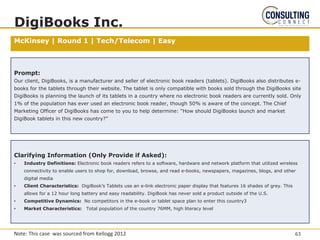
Prompt:
Our client, DigiBooks, is a manufacturer and seller of electronic book readers (tablets). DigiBooks also distributes e-
books for the tablets through their website. The tablet is only compatible with books sold through the DigiBooks site
DigiBooks is planning the launch of its tablets in a country where no electronic book readers are currently sold. Only
1% of the population has ever used an electronic book reader, though 50% is aware of the concept. The Chief
Marketing Officer of DigiBooks has come to you to help determine: “How should DigiBooks launch and market
DigiBook tablets in this new country?”
Clarifying Information (Only Provide if Asked):
• Industry Definitions: Electronic book readers refers to a software, hardware and network platform that utilized wireless
connectivity to enable users to shop for, download, browse, and read e-books, newspapers, magazines, blogs, and other
digital media
• Client Characteristics: DigiBook’s Tablets use an e-link electronic paper display that features 16 shades of grey. This
allows for a 12 hour long battery and easy readability. DigiBook has never sold a product outside of the U.S.
• Competitive Dynamics: No competitors in the e-book or tablet space plan to enter this country3
• Market Characteristics: Total population of the country 76MM, high literacy level
63
Note: This case was sourced from Kellogg 2012
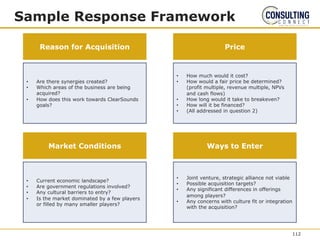
Sample Response Framework
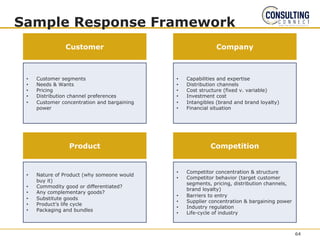
• Customer segments
• Needs & Wants
• Pricing
• Distribution channel preferences
• Customer concentration and bargaining
power
Customer Company
• Capabilities and expertise
• Distribution channels
• Cost structure (fixed v. variable)
• Investment cost
• Intangibles (brand and brand loyalty)
• Financial situation
• Nature of Product (why someone would
buy it)
• Commodity good or differentiated?
• Any complementary goods?
• Substitute goods
• Product’s life cycle
• Packaging and bundles
Product Competition
• Competitor concentration & structure
• Competitor behavior (target customer
segments, pricing, distribution channels,
brand loyalty)
• Barriers to entry
• Supplier concentration & bargaining power
• Industry regulation
• Life-cycle of industry
64
Exhibit 1: Market Segments
$200
$125
$175
E-Readers
Willingness to Pay
65
Exhibit 1 Interviewer Guidance
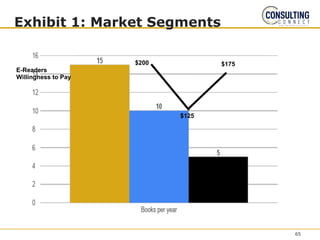
Question for Interviewee: Through research, we found several segments (Hand out
Exhibit1). We are only able to target one segment with our product.
Using a 3-year projection, which segment should DigiBook target?
● If unclear, the interviewee should answer based on Revenue Potential (i.e. ignore probability of
purchase) assuming all tablet sales happen immediately (ignore TVM).
● Missing Data: Average price of an e-book is $10, for each of the segments. E-book and tablets have
the same margin.
Sample Calculation:
● SR Revenue = [(15 books x $10 x 3 years) + ($200 x 1 tablet)] x 8 M People = $5.2B
● OR Revenue = [(10 books x $10 x 3 years) + ($125 x 1 tablet)] x 20 M People = $8.5B
● RR Revenue = [(5 books x $10 x 3 years) + ($175 x 1 tablet)] x 10 M People = $3.25B
● ANSWER: Segment to be targeted = occasional readers (OR) with Revenue potential of
$8.5B
66
Question Interviewer Guidance
Question for Interviewee: DigiBooks is now considering how it should sell its e-books
readers: through retail stores or through the internet.
How would you go about evaluating this decision?
Retail Channel Sample Responses:
● CONS:
○ Lower margin due to value chain expansion
○ Will take time and money to set up, adding training costs
● PROS:
○ Should encourage Trail of the product
○ Retailers can help with joint marketing campaigns
○ Retailers can help with customer service, returns
Internet Channel Sample Responses:
● PROS: Likely cheaper to establish, will result in higher margins
● CONS: Harder to encourage trial
67
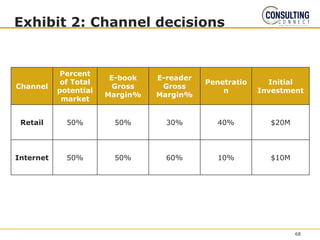
Exhibit 2: Channel decisions
Channel
Percent
of Total
potential
market
E-book
Gross
Margin%
E-reader
Gross
Margin%
Penetratio
n
Initial
Investment
Retail 50% 50% 30% 40% $20M
Internet 50% 50% 60% 10% $10M
68
Exhibit 2 Interviewer Guidance
Question for Interviewee: Based on revised market estimates, we decided to price the e-
reader at $100 and target the Occasional Reader segment.
Using this information and Exhibit 2, can you estimate the profit potential of each of these
sales channels? Which should we choose?
What segment would you recommend to your client?
The interviewer should answer this with a 1-year Gross Profitability calculation for each of the Sales
Channels and back out the Upfront Investment. They should ignore all other costs such as SG&A.
There is no missing data, however, the Market Size (20 M people) in the OR segment
from Exhibit 1 and the price per e-book ($10) is needed.
Sample Calculation:
● Retail Profit = [(10 Books x $10/book x 50%GM) + ($100/tablet x 30%GM)] x (10 M People x
40%Penetration) = $320M - $20M = $300 M
● Internet Profit = [(10 Books x $10/book x 50%GM) + ($100/tablet x 60%GM) x (10M People
x 10%Penetration) = $110M - $10M = $100M
ANSWER: Sales Channel to Use = Retail with a profit of $300 M
69
Wrap Up: Interviewer Guide
Solution & Recommendation:
Ask the interviewee to wrap up the case. The candidate’s answer should include the segment for which DigiBooks
should launch the e-books (Occasional Reader) and the through which channel (Retail Sales).
A good candidate will include quantitative data such as the expected earn $300MM return on initial
investment of $20MM.
To consider::
A great candidate should include further steps such as to consider what advertising mechanisms they
could use? If the company should set up manufacturing facilities in the country or source the products
from our current manufacturing facilities? Are there prospects of competitors entering the market?
Bonus:
An even better interviewee notices key nuances in the case such as: Time Value of Money impacts on
Exhibit 1 and Probability of Purchase or Penetration.
An excellent interviewee will detail various elements of marketing strategy of a new product launch.
70
Food Bank
McKinsey| Round 2 | Easy/Medium |
Social Sector
McKinsey | Round 2 | Easy/Medium| Social Sector
Food Bank
Prompt: INTERVIEWER-LED
Our client is a food bank in a major metropolitan area. The food bank has seen a decrease in donations recently and is worried
about having enough food to meet their commitments to food pantries and other hunger-relief organizations in the area. They
have hired your firm to help them with this problem.
Clarifying Information (Only Provide if Asked):
• What is a food bank? A nonprofit that collects and distributes food to different charities that deal with relieving hunger. They
often give their food to food pantries where people can go to get food for free.
• Where does the food bank get its donations? Mainly companies in the food industry (Restaurants & Grocery stores). It
also receives money from individuals and non-food companies and can use those funds to buy food.
• Do individuals and non-food companies also donate food? (e.g. through a can drive?) Companies outside the food
industry and individuals only give money. Companies in the food industry only give food .
Note: This case was created by Alex Muck, ND Class of 2020 72
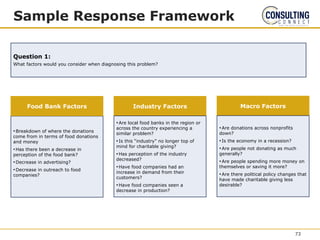
Sample Response Framework
• Breakdown of where the donations
come from in terms of food donations
and money
• Has there been a decrease in
perception of the food bank?
• Decrease in advertising?
• Decrease in outreach to food
companies?
Food Bank Factors Macro Factors
• Are donations across nonprofits
down?
• Is the economy in a recession?
• Are people not donating as much
generally?
• Are people spending more money on
themselves or saving it more?
• Are there political policy changes that
have made charitable giving less
desirable?
Industry Factors
• Are local food banks in the region or
across the country experiencing a
similar problem?
• Is this “industry” no longer top of
mind for charitable giving?
• Has perception of the industry
decreased?
• Have food companies had an
increase in demand from their
customers?
• Have food companies seen a
decrease in production?
Question 1:
What factors would you consider when diagnosing this problem?
73
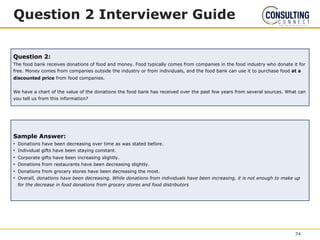
Question 2 Interviewer Guide
Question 2:
The food bank receives donations of food and money. Food typically comes from companies in the food industry who donate it for
free. Money comes from companies outside the industry or from individuals, and the food bank can use it to purchase food at a
discounted price from food companies.
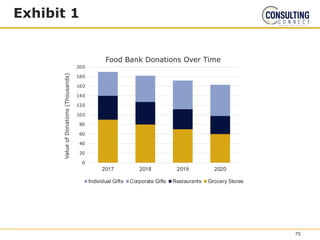
We have a chart of the value of the donations the food bank has received over the past few years from several sources. What can
you tell us from this information?
Sample Answer:
• Donations have been decreasing over time as was stated before.
• Individual gifts have been staying constant.
• Corporate gifts have been increasing slightly.
• Donations from restaurants have been decreasing slightly.
• Donations from grocery stores have been decreasing the most.
• Overall, donations have been decreasing. While donations from individuals have been increasing, it is not enough to make up
for the decrease in food donations from grocery stores and food distributors
74
Exhibit 1
0
20
40
60
80
100
120
140
160
180
200
2017 2018 2019 2020
Value
of
Donations
(Thousands)
Food Bank Donations Over Time
Individual Gifts Corporate Gifts Restaurants Grocery Stores
75
Question 3 Interviewer Guide
Question 3:
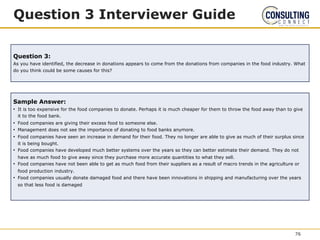
As you have identified, the decrease in donations appears to come from the donations from companies in the food industry. What
do you think could be some causes for this?
Sample Answer:
• It is too expensive for the food companies to donate. Perhaps it is much cheaper for them to throw the food away than to give
it to the food bank.
• Food companies are giving their excess food to someone else.
• Management does not see the importance of donating to food banks anymore.
• Food companies have seen an increase in demand for their food. They no longer are able to give as much of their surplus since
it is being bought.
• Food companies have developed much better systems over the years so they can better estimate their demand. They do not
have as much food to give away since they purchase more accurate quantities to what they sell.
• Food companies have not been able to get as much food from their suppliers as a result of macro trends in the agriculture or
food production industry.
• Food companies usually donate damaged food and there have been innovations in shipping and manufacturing over the years
so that less food is damaged
76
Question 4 Interviewer Guide
Question 4:
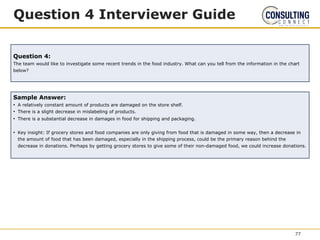
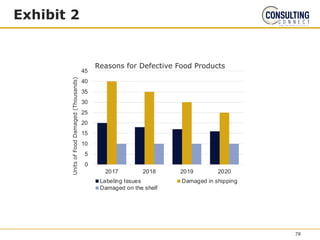
The team would like to investigate some recent trends in the food industry. What can you tell from the information in the chart
below?
Sample Answer:
• A relatively constant amount of products are damaged on the store shelf.
• There is a slight decrease in mislabeling of products.
• There is a substantial decrease in damages in food for shipping and packaging.
• Key insight: If grocery stores and food companies are only giving from food that is damaged in some way, then a decrease in
the amount of food that has been damaged, especially in the shipping process, could be the primary reason behind the
decrease in donations. Perhaps by getting grocery stores to give some of their non-damaged food, we could increase donations.
77
Exhibit 2
0
5
10
15
20
25
30
35
40
45
2017 2018 2019 2020
Units
of
Food
Damaged
(Thousands)
Reasons for Defective Food Products
Labeling Issues Damaged in shipping
Damaged on the shelf
78
Question 5 Interviewer Guide
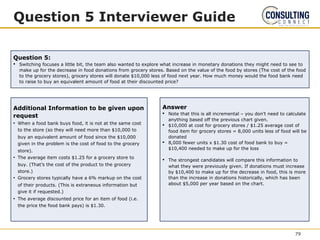
Question 5:
• Switching focuses a little bit, the team also wanted to explore what increase in monetary donations they might need to see to
make up for the decrease in food donations from grocery stores. Based on the value of the food by stores (The cost of the food
to the grocery stores), grocery stores will donate $10,000 less of food next year. How much money would the food bank need
to raise to buy an equivalent amount of food at their discounted price?
Additional Information to be given upon
request
• When a food bank buys food, it is not at the same cost
to the store (so they will need more than $10,000 to
buy an equivalent amount of food since the $10,000
given in the problem is the cost of food to the grocery
store).
• The average item costs $1.25 for a grocery store to
buy. (That’s the cost of the product to the grocery
store.)
• Grocery stores typically have a 6% markup on the cost
of their products. (This is extraneous information but
give it if requested.)
• The average discounted price for an item of food (i.e.
the price the food bank pays) is $1.30.
Answer
• Note that this is all incremental – you don’t need to calculate
anything based off the previous chart given.
• $10,000 at cost for grocery stores / $1.25 average cost of
food item for grocery stores = 8,000 units less of food will be
donated
• 8,000 fewer units x $1.30 cost of food bank to buy =
$10,400 needed to make up for the loss
• The strongest candidates will compare this information to
what they were previously given. If donations must increase
by $10,400 to make up for the decrease in food, this is more
than the increase in donations historically, which has been
about $5,000 per year based on the chart.
79
Question 6 Interviewer Guide
Question 6:
What are some ideas for how the food bank could raise this money from donors?
Sample Answer:
• Go to existing corporate donors and ask them to increase their donations.
• Try to solicit new corporate donors to see if they will donate.
• Target wealthy donors to try to increase individual donations.
• Target new individual donors. If you can get lots of donors to give very small amounts, you could increase individual donations.
• You could host an event to try to raise the money.
• You could offer to add sponsors to a website or in a newsletter.
• You could sell ad space in a newsletter or on the website.
• You could try to negotiate with grocery stores to get a lower cost of food so you don’t have to raise as much money.
80
Recommendation Sample Answer:
• Donations from the food industry have decreased significantly over the past few years. While monetary donations have
increased, they are not enough to make up for the decrease from food donations.
• Some of the decrease in donations appears to come from the fact that there have been fewer shipping damages with products
over the past few years.
• To make up for the decrease in food donations, we would need to substantially increase the amount of corporate and individual
monetary gifts we receive. This would require significant changes in marketing or fundraising.
• As next steps, we might want to look into other ways to get food companies and grocery stores to donate non-damaged
products.
• Another next step could be to further explore the best ways to raise money from donors to close the gap.
Wrap Up: Interviewer Guide
You need to deliver a report to the CEO of the food bank. What will you tell them about the work you’ve done?
81
Interviewer-led:
Medium
Maxicure
McKinsey | Round 1 | Easy/Medium | Manufacturing
McKinsey | Round 1 | Medium | Manufacturing
Maxicure - Prompt
Note: This case was sourced from Darden 2018.
Prompt:
Your client, Maxicure, manufacturers and sells an over-the-counter cough and cold medicine. Their sole plant in
Kentucky is ageing, and its increasing maintenance costs are leading to low margins on their products.
Question 1:
What options does Maxicure have for purposes of tackling this problem, and what factors would you consider in
deciding which options to choose?
Clarifying Information (Only Provide if Asked):
• What is the competitive landscape? There are 2-3 larger players in this over-the-counter business who have distribution
across the country. Maxicure is one of them.
• Where does Maxicure sell? Maxicure sells all of its products in the US.
• Does Maxicure have a specific goal? Maxicure’s objective is to reduce production costs while maintaining product quality
(cost, quality, and brand image all matter to customers).
84
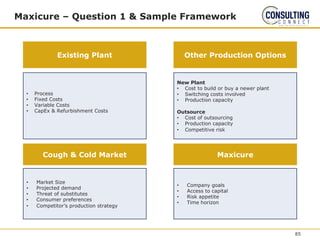
Maxicure – Question 1 & Sample Framework
• Process
• Fixed Costs
• Variable Costs
• CapEx & Refurbishment Costs
Existing Plant Other Production Options
New Plant
• Cost to build or buy a newer plant
• Switching costs involved
• Production capacity
Outsource
• Cost of outsourcing
• Production capacity
• Competitive risk
Cough & Cold Market
• Market Size
• Projected demand
• Threat of substitutes
• Consumer preferences
• Competitor’s production strategy
Maxicure
• Company goals
• Access to capital
• Risk appetite
• Time horizon
85
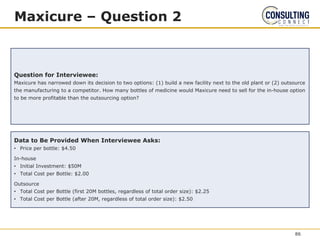
Maxicure – Question 2
Question for Interviewee:
Maxicure has narrowed down its decision to two options: (1) build a new facility next to the old plant or (2) outsource
the manufacturing to a competitor. How many bottles of medicine would Maxicure need to sell for the in-house option
to be more profitable than the outsourcing option?
Data to Be Provided When Interviewee Asks:
• Price per bottle: $4.50
In-house
• Initial Investment: $50M
• Total Cost per Bottle: $2.00
Outsource
• Total Cost per Bottle (first 20M bottles, regardless of total order size): $2.25
• Total Cost per Bottle (after 20M, regardless of total order size): $2.50
86
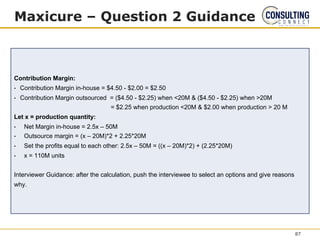
Maxicure – Question 2 Guidance
Contribution Margin:
• Contribution Margin in-house = $4.50 - $2.00 = $2.50
• Contribution Margin outsourced = ($4.50 - $2.25) when <20M & ($4.50 - $2.25) when >20M
= $2.25 when production <20M & $2.00 when production > 20 M
Let x = production quantity:
• Net Margin in-house = 2.5x – 50M
• Outsource margin = (x – 20M)*2 + 2.25*20M
• Set the profits equal to each other: 2.5x – 50M = ((x – 20M)*2) + (2.25*20M)
• x = 110M units
Interviewer Guidance: after the calculation, push the interviewee to select an options and give reasons
why.
87
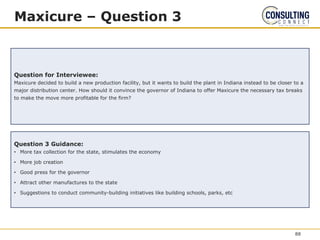
Maxicure – Question 3
Question for Interviewee:
Maxicure decided to build a new production facility, but it wants to build the plant in Indiana instead to be closer to a
major distribution center. How should it convince the governor of Indiana to offer Maxicure the necessary tax breaks
to make the move more profitable for the firm?
Question 3 Guidance:
• More tax collection for the state, stimulates the economy
• More job creation
• Good press for the governor
• Attract other manufactures to the state
• Suggestions to conduct community-building initiatives like building schools, parks, etc
88
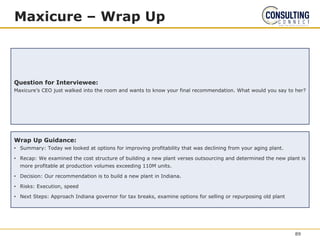
Maxicure – Wrap Up
Question for Interviewee:
Maxicure’s CEO just walked into the room and wants to know your final recommendation. What would you say to her?
Wrap Up Guidance:
• Summary: Today we looked at options for improving profitability that was declining from your aging plant.
• Recap: We examined the cost structure of building a new plant verses outsourcing and determined the new plant is
more profitable at production volumes exceeding 110M units.
• Decision: Our recommendation is to build a new plant in Indiana.
• Risks: Execution, speed
• Next Steps: Approach Indiana governor for tax breaks, examine options for selling or repurposing old plant
89
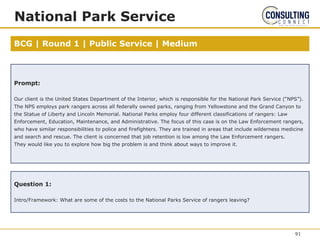
National Park Service
BCG | Round 1 | Medium | Public Service
BCG | Round 1 | Public Service | Medium
National Park Service
Prompt:
Our client is the United States Department of the Interior, which is responsible for the National Park Service (“NPS”).
The NPS employs park rangers across all federally owned parks, ranging from Yellowstone and the Grand Canyon to
the Statue of Liberty and Lincoln Memorial. National Parks employ four different classifications of rangers: Law
Enforcement, Education, Maintenance, and Administrative. The focus of this case is on the Law Enforcement rangers,
who have similar responsibilities to police and firefighters. They are trained in areas that include wilderness medicine
and search and rescue. The client is concerned that job retention is low among the Law Enforcement rangers.
They would like you to explore how big the problem is and think about ways to improve it.
Question 1:
Intro/Framework: What are some of the costs to the National Parks Service of rangers leaving?
91
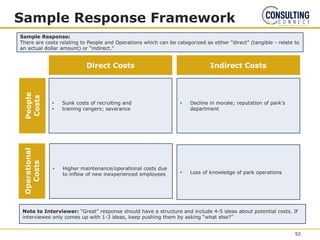
Sample Response Framework
• Sunk costs of recruiting and
• training rangers; severance
Direct Costs Indirect Costs
• Decline in morale; reputation of park’s
department
• Higher maintenance/operational costs due
to inflow of new inexperienced employees
People
Costs
• Loss of knowledge of park operations
Operational
Costs
Note to Interviewer: “Great” response should have a structure and include 4-5 ideas about potential costs. If
interviewee only comes up with 1-3 ideas, keep pushing them by asking “what else?”
Sample Response:
There are costs relating to People and Operations which can be categorized as either “direct” (tangible - relate to
an actual dollar amount) or “indirect."
92
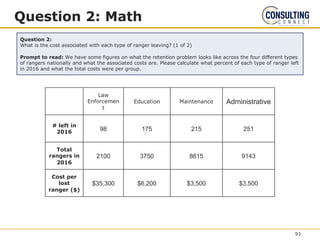
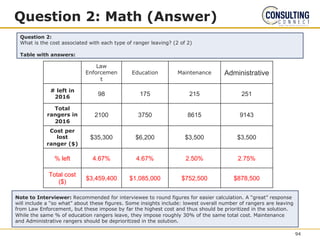
Question 2: Math
Law
Enforcemen
t
Education Maintenance Administrative
# left in
2016 98 175 215 251
Total
rangers in
2016
2100 3750 8615 9143
Cost per
lost
ranger ($)
$35,300 $6,200 $3,500 $3,500
Question 2:
What is the cost associated with each type of ranger leaving? (1 of 2)
Prompt to read: We have some figures on what the retention problem looks like across the four different types
of rangers nationally and what the associated costs are. Please calculate what percent of each type of ranger left
in 2016 and what the total costs were per group.
93
Question 2: Math (Answer)
Law
Enforcemen
t
Education Maintenance Administrative
# left in
2016 98 175 215 251
Total
rangers in
2016
2100 3750 8615 9143
Cost per
lost
ranger ($)
$35,300 $6,200 $3,500 $3,500
% left 4.67% 4.67% 2.50% 2.75%
Total cost
($)
$3,459,400 $1,085,000 $752,500 $878,500
Question 2:
What is the cost associated with each type of ranger leaving? (2 of 2)
Table with answers:
94
Note to Interviewer: Recommended for interviewee to round figures for easier calculation. A “great” response
will include a “so what” about these figures. Some insights include: lowest overall number of rangers are leaving
from Law Enforcement, but these impose by far the highest cost and thus should be prioritized in the solution.
While the same % of education rangers leave, they impose roughly 30% of the same total cost. Maintenance
and Administrative rangers should be deprioritized in the solution.
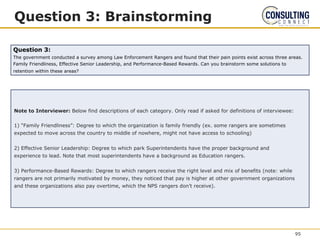
Question 3: Brainstorming
Note to Interviewer: Below find descriptions of each category. Only read if asked for definitions of interviewee:
1) “Family Friendliness”: Degree to which the organization is family friendly (ex. some rangers are sometimes
expected to move across the country to middle of nowhere, might not have access to schooling)
2) Effective Senior Leadership: Degree to which park Superintendents have the proper background and
experience to lead. Note that most superintendents have a background as Education rangers.
3) Performance-Based Rewards: Degree to which rangers receive the right level and mix of benefits (note: while
rangers are not primarily motivated by money, they noticed that pay is higher at other government organizations
and these organizations also pay overtime, which the NPS rangers don’t receive).
Question 3:
The government conducted a survey among Law Enforcement Rangers and found that their pain points exist across three areas.
Family Friendliness, Effective Senior Leadership, and Performance-Based Rewards. Can you brainstorm some solutions to
retention within these areas?
95
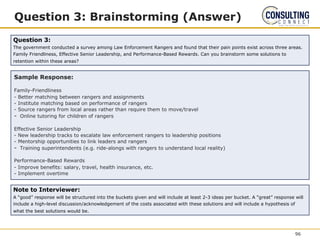
Question 3: Brainstorming (Answer)
Sample Response:
Family-Friendliness
- Better matching between rangers and assignments
- Institute matching based on performance of rangers
- Source rangers from local areas rather than require them to move/travel
- Online tutoring for children of rangers
Effective Senior Leadership
- New leadership tracks to escalate law enforcement rangers to leadership positions
- Mentorship opportunities to link leaders and rangers
- Training superintendents (e.g. ride-alongs with rangers to understand local reality)
Performance-Based Rewards
- Improve benefits: salary, travel, health insurance, etc.
- Implement overtime
Question 3:
The government conducted a survey among Law Enforcement Rangers and found that their pain points exist across three areas.
Family Friendliness, Effective Senior Leadership, and Performance-Based Rewards. Can you brainstorm some solutions to
retention within these areas?
96
Note to Interviewer:
A “good” response will be structured into the buckets given and will include at least 2-3 ideas per bucket. A “great” response will
include a high-level discussion/acknowledgement of the costs associated with these solutions and will include a hypothesis of
what the best solutions would be.
Question 4: Recommendation
Note to Interviewer:
A “great” response will primarily address the main question of retention among Law Enforcement rangers (rather
than get off topic). It will explain the problem (high costs associated with lost Law Enforcement Rangers), include a
potential solution (1-2 ideas to explore), and discuss next steps (e.g. look into associated costs of potential
solutions).
Question 4:
The Director of the National Parks Service just stepped into the room and would like you to summarize what we’ve discussed.
97
Loonilever PLC
McKinsey| Round 1 | Medium-Hard | CPG
McKinsey | Round 1 | CPG | Medium-Hard
Loonilever PLC
Prompt:
Our client (Loonilever) is a major consumer products company with operations in over 80 countries. Loonilever
operates across all categories in the consumer products space – personal wash, hair care, oral care, laundry,
household cleaning, skincare etc. Over the last decade or so, it has been losing share to it’s key competitors,
particularly to B&G. Loonilever is very keen on regaining/building share in key categories, especially in traditional
B&G strongholds. Skincare is the most profitable category for the large consumer products players, with gross
margins of ~75% (vs. 30% for laundry). Loonilever is now evaluating an entry into China‟s skincare market, a
market that B&G has enjoyed market leadership in for over a decade. Though Loonilever is the market leader in
China’s laundry segment, it does not currently operate in the Skincare segment. Loonilever has hired McKinsey to
help them determine what their potential entry strategy into the Chinese skincare market should be.
Clarifying Information (Only Provide if Asked):
• The question to be answered is deliberately worded vaguely, to encourage the interviewee to ask clarifying questions at this
stage.
• What Loonilever is actually interested in is:
○ Can Loonilever achieve (a) revenue of $100 million in two years time (b) in a market that displays significant
potential for future growth? Provide this information if the interviewee asks for it.
• If the interviewee does not ask clarifying questions at this stage, wait to see if s/he gets to this questions after drawing out
the issue tree. If s/he does not, then deduct points from overall case performance and redirect the focus of the discussion.
99
Note: This case was sourced from Wharton 2008
Sample Response Framework
Industry/Market Revenue
• Size of market
• Segmentation of market
• Key players and their share
• Consumer/market trends
within each segment
Guidance for
Interviewer
Can Loonilever achieve a revenue target of $100M in two years in a
market that offers a significant upside?
• Most candidates are likely to start with Industry. Bonus points if the interviewee
addresses all four sub-issues upfront
• Negative points if the candidate draws a Cost bucket. The question is about
revenue, not profit.
• The last bucket gives the interviewee a chance to demonstrate business intuition
– For example, are there reasons why Loonilever should enter even if they don’t
achieve the $100M target?
• Bonus points if the candidate ends the issue tree presentation with a hypothesis
– “I’d like to start with Industry since that will likely provide insight into the most
attractive revenue generating opportunities”
Other Factors
• Volume projections
• Pricing
• Price * Quantity
• Gateway to other markets (SE
Asia)
• Potential global manufacturing
hub
• Bonus points: By challenging
established competitors in the
skincare space, can destabilize
competitors‟ business model (by
making them bleed)
100
Loonilever – Math Question 1
Question for Interviewee:
What is B&G’s current market share? If it maintains the status quo (same marketing expenditures, no dramatic new
product launches etc.), will its market share go up, go down or stay constant in two years time?
Information to Be Provided When Interviewee Asks:
Show Exhibit 1 (proactively) and ask the question listed above - Show Exhibit 2 (only if asked for) - Show Exhibit 3
(only if asked for ): This is not crucial to the solution anyway, but can really impress an interviewer
Approach and Solution
● A strong candidate’s first reaction will be:
○ China’s skincare market is large and growing
○ Given B&G‟s high market share, it could be a challenging market to break into given B&G‟s deep
pockets and the skincare category’s high profitability. B&G will probably guard their share very
aggressively.
● Answer to Math Question 1: See solution on later slide (CANDIDATE SHOULD ROUND INTELLIGENTLY!!)
○ Approach Part 1: B&G Current market share = B&G revenue/current market size
○ Part 2: Project market revenue, B&G revenue, and overall B&G share over two years using growth rates.
● Key insight: B&G’s overall share declines because it has the largest share of a slow-growing market. The
contribution of the sub-segments will change in two years, and therefore, so will B&G’s overall share
● Conclusion: Loonilever should enter the Anti-ageing segment because:
a) It satisfies the $100M criteria b) The AA segment offers a significant upside because it’s growing at 20%
c) The sub-segment also has the highest margins (85%), a clear plus point for Loonilever.
101
Exhibits 1&2
Market
segment
Current market
size (in $
millions)
B&G share
Annual growth
projection (over
next 2 years)
Skin Lightening
Anti Ageing
Moisturizing
Total
1000
700
300
2000
50%
20%
30%
5%
20%
10%
Exhibit 1: China’s skincare market construct
Exhibit 2: Loonilever test market results
Market segment
Projected Market
Share in 2 years
Skin Lightening
Anti Ageing
Moisturizing
5%
10%
20%
102
Exhibits 3
Market
segment
Segment
Contribution*
Gross Margin Weighted Margin
Skin Lightening
Anti Ageing
Moisturizing
Total
50%
35%
15%
75%
85%
50%
38%
30%
8%
74.8%
Exhibit 3: Overall Segment Margins
*Segment Size/Overall Market Size (from Exhibit 1)
103
Math Question 1 - Solutions
Market
segment
Current
Market
Size
Current
B&G
Rev.
Year 1
Market
Size
Year 1
B&G
Rev.
Year 2
Market
Size
Year 2
B&G
Rev.
Skin Lightening
Anti Ageing
Moisturizing
Total
1000
700
300
2000
500
140
90
730
36.50%
1050
840
330
2220
525
168
99
792
1102.5
1008
363
2473.5
551.3
201.6
108.9
861.8
34.84%
Solution to Q1 - What is B&G’s current share and share two years
down the line?
Solution to Q1 - What does this mean for Loonilever’s entry strategy?
Market
segment
Year 2 Market
Size
Expected Year 2
Loonilever Share
Year 2 Loonilever
Revenue ($MM)
Skin Lightening
Anti Ageing
Moisturizing
Total
1102.5
1008
363
2473.5
5%
10%
20%
55
101
73
104
Loonilever – Math Question 2
Question for Interviewee:
What’s the average price point in the Anti-Ageing (AA) market? What do you think is the ideal AA price point that
Loonilever should enter at? (Assume all other information from the earlier question still holds)
Information to Be Provided When Interviewee Asks:
Show Exhibit 4: After interviewee has a chance to digest the information, inform them that the price-point space in
between is largely unoccupied
Approach and Solution
The candidate should hopefully walk through the different pricing options and provide logic for why each of them
would/wouldn’t work
• Solution 1: Take on the MNCs at the top end (@ $25/100gm)
• Solution 2: Compete with 1000+ local brands (@$5/100gm)
• Solution 3: Operate in the middle by being the “bridge‟ that upgrades mass-market consumers to the top-end of
the market (@$10-20/100gms)
• Conclusion: The first two answers are good enough responses if well-argued. If not, probe for
underlying logic. Bonus points for those interviewees who identify solution 3
105
Exhibit 4
Number of
brands
Share of
Rev.
Gross
Margin
Avg.
Price
Point*
Large Multinational Brands
Local Chinese Brands
Total
4
1000+
70%
30%
93%
65%
25
5
Exhibit 4: China’s Anti Ageing Market
*$/100 gms
106
Math Question 2 - Solution
Share
of Rev.
Gross
Margin
Avg.
Margin
Price
Point*
Avg.
Price
Point
Large Multinational Brands
Local Chinese Brands
Total
70%
30%
93%
65%
65%
20%
85%
25
5
17.5
1.5
19
Solution to Q2: Ideal Price Point
*$/100 gms
107
Loonilever - Wrap Up
Sample Recommendation:
1. Loonilever should enter the Chinese skincare market in the Anti-Ageing segment since it can meet the
$100M threshold target that Loonilever had set itself. Moreover, it’s a fast-growing market.
2. Loonilever should enter the Anti-Ageing segment at the bottom/top/middle of the market because: (reasons
from previous page depending on which option the interviewee goes with)
Sample Risks & Consideration
• We have not considered the impact/nature of a competitive response from the major multinational players.
• Bonus points: They are unlikely to allow Loonilever a free run of the market irrespective of which option they
choose
Sample Remaining Questions & Next Steps:
1. Conduct a sensitivity analysis for these revenue projections based on different competitor responses
2. Bonus points: “Now that we’ve proven that the revenue potential does exist, we’d like to understand the
cost side of the business, and do a break-even analysis to identify whether China’s Anti Ageing market can be
a profitable business for Loonilever in the long-run‟
108
Interviewer-led:
Hard
ClearSounds Mobile
Round 2 | Hard | Telecom
Round 2 | Telecom | Hard
ClearSounds Mobile
Prompt:
With the US mobile telecom market completely saturated, ClearSounds Mobile (a North American mobile
telecom company) is looking to other potential sources for gaining customers. Their current market share in
the US is respectable but the market is highly competitive and subject to significant regulations, so the
upside looks limited. The Latin American market has been proposed as an area for potential growth. The
population is starting to have more dispensable income and the current infrastructure is reasonably well
developed. Should ClearSounds enter the Latin American mobile telecom market?
Clarifying Information (Only Provide if Asked):
• What is the goal for ClearSounds entrance? ClearSounds is looking to reach new markets and establish itself as a player
• Are there synergies created? Revenue and cost synergies would be created from this venture
• Has ClearSounds considered alternatives? ClearSounds believes they cannot achieve the same benefits from either a
joint venture or strategic alliance
• Are there any concerns with management or culture? Management would be able to handle any change and a culture
fit would be achieved
111
Note: This case was sourced from Wharton 2008
Sample Response Framework
• Are there synergies created?
• Which areas of the business are being
acquired?
• How does this work towards ClearSounds
goals?
Reason for Acquisition Price
• How much would it cost?
• How would a fair price be determined?
(profit multiple, revenue multiple, NPVs
and cash flows)
• How long would it take to breakeven?
• How will it be financed?
• (All addressed in question 2)
• Current economic landscape?
• Are government regulations involved?
• Any cultural barriers to entry?
• Is the market dominated by a few players
or filled by many smaller players?
Market Conditions Ways to Enter
• Joint venture, strategic alliance not viable
• Possible acquisition targets?
• Any significant differences in offerings
among players?
• Any concerns with culture fit or integration
with the acquisition?
112
Brainstorm 1
Question for Interviewee:
What are the potential entry strategies into the Latin American telecom market and what are the pros and cons of
each?
Sample Answer:
Interviewee should start a structured brainstorm
Examples of entry strategies include:
1. Organic Growth
• Pros: Maybe less capital intensive, more control over labor force and management
• Cons: Slower market penetration, have to develop new relationships in new countries
2. Joint Venture
• Pros: Established market partner helps to grow the business, quick financial gains
• Cons: Profit sharing details must be agreed upon, have to find a willing venture partner
3. Acquisition
• Pros: Quick market penetration, grows revenue base quickly
• Cons: Expensive, cultural integration, IT integration, most often requires a willing acquisition target
113
Math Question 1
Question for Interviewee:
ClearSounds would like to evaluate their acquisition possibilities. They are considering acquiring TeleNovo; can they
afford the acquisition? (Provide Exhibit 1 and Table 1)
Key Assumptions:
1. Assume an all-cash transaction – all of ClearSounds cash could be used for the acquisition
2. ClearSounds is one of two firms who would be bidding on TeleNovo
Sample Calculation:
Step 1: Calculate the 2014 gross profit of ClearSounds to determine how much cash they have
• ProfitCS = Subscriptions + Phone Sales – (PPE + SGA + COGS) = $45B + $5B – ($18.5B + $4B + $20B) = $7.5B
• Cash-On-HandsCS = 2* ProfitCS = 2*$7.5B = $15B
Step 2: Determine the cost of the acquisition - The cost will be determined by the 2014 profit of TeleNovo
and the profit multiple used to calculate the price
• Acquisition CostTN = Profit MultipleTN * ProfitCS
• ProfitTN = Subscriptions + Phone Sales – (PPE + SGA + COGS) = $30B + $2B – ($13B + $2.3B + $14.7B) = $2B
• Profit MultipleTN = The EE should notice that the profit multiple is determined buy the number of firms bidding and
not the current profitability of the firm. ClearSounds is one of two firms bidding so the profit multiple that should
be used is 4.5
• Acquisition CostTN = Profit MultipleTN * ProfitCS = 4.5*$2B = $9B
Yes, ClearSounds can afford the acquisition. They have $22.5B of cash on hand and the acquisition should
cost approximately $9B
114
Exhibit 1: Historical LATM Acquisitions
5.0%
6.0%
7.0%
8.0%
9.0%
10.0%
11.0%
2 2.5 3 3.5 4 4.5 5 5.5 6 6.5 7
Profit
Margin
Profit Multiple
*Label Format: Name of acquired firm, # of companies who bid to acquire
SA Connect, 1
SA Holdings, 1
Telecom Brazil, 2
Vod Phono, 3
115
Table 1: Financials
116
Brainstorm 2
Question for Interviewee:
What risks or considerations should be addressed before moving ahead with the acquisition? How can they address
them?
Sample Answer:
Interviewee should start a structured brainstorm
Examples of risks include:
1. Cultural and People
• The cultures of the two companies may differ greatly
• Management of the two companies may disagree on strategy, causing inefficiencies in integration
2. IT
• IT systems may be difficult and expensive to reconcile or convert to one platform
• Training for employees on new or different IT platforms could be expensive and errors could occur
3. Brand
• Must decide whether to keep brand or rebrand
117
Math Question 2
Question for Interviewee:
How long before the ClearSounds acquisition breaks even?
Key Assumptions:
1. 2015 is the first year that ClearSounds will earn profits from TeleNovo
2. Assume that cost synergies will bea chieved through the acquisition and the profit margin for TeleNovo will be the
same as the current Profit Margin used for ClearSounds moving forward
3. Assume TeleNovo’s Revenue is growing at 10%/year
Sample Calculation:
Step 1: Calculate profit margin of ClearSounds
• Profit MarginCS = Profit/Sales = $7.5B/$50B = 15% Profit Margin
Step 2: Determine the profit from 2015 onwards using a yearly revenue growth at 10%
• 2015 ProfitCS = Revenue2015 * Growth Rate * Profit Margin = $32B * 1.1 * 15% = $5.28B
• If the profit margin remains fixed and revenue grows, profit grows at the same rate
• 2015 ProfitCS = $5.28B * 1.1 = $5.88B
The TeleNovo acquisition will pay for itself in less than two years
118
Final Recommendation Sample Answer:
ClearSounds Mobile should acquire TeleNovo. The acquisition price is reasonable, and it allows them to gain ground
quickly in South America. TeleNovo also has a higher cost structure than ClearSounds which is attractive for an
acquisition if ClearSounds believes they can bring cost synergies to the acquired company (that is true in this case).
These cost synergies could not be gained as easily with a partnership
Next Steps:
• Determine how to best finance the acquisition
• Evaluate whether to keep the TeleNovo brand or rebrand
• Outline the likely competitive response and build a response plan
Risks:
• Cultural fit may be problematic
• May not be received either in Wall-Street or in South America
• Expected cost synergies may not materialize
Wrap Up: Interviewer Guide
Final Recommendation:
What strategy would you propose?
119
Insurance for the
Underserved
McKinsey| Round 2 | Hard |Insurance
McKinsey | Round 2 | Insurance | Hard
Insurance for the Underserved
Adapted from Wharton 2017
Prompt:
The Indian insurance market is heavily underpenetrated. The majority of insurable, adult population either is not
insured and this has serious consequences – when financial adversity strikes, such as when the main breadwinner of
a family dies, or if there is a drought or a flood, people either find it hard to survive or in some cases also commit
suicide. When we say insurance, we think of both life insurance and non-life insurance such as health, crop, etc.
The government of India is thinking of using the Indian postal network as a creative way of reaching the underserved
insurance population. The infrastructure already exists and this can be leveraged for distributing much-needed
insurance products. The objective would be to provide a safety net to as many people as possible in the underserved
markets.
Clarifying Information (Only Provide if Asked):
• Is profitability an objective? Or is it only reaching the people? Main objective is reaching people. Profitability is a
secondary priority
• Are we focusing on a specific type of Insurance? The distinction between life and non-life insurance is not a factor for
the purposes of our case.
121
Question 1: Brainstorm
What considerations should the government think about when considering whether to partner with the postal service?
Market Size of
Underserved Population
Sample Framework
• What are the customer segments
for the insurance market
• Income brackets for underserved
population
• Number of households in the
underserved group
• Willingness to spend on
insurance products
Marketing and Promotion
Profitability
• Are there any profit objectives
with this project?
• Revenue?
• Premiums
• Number of willing customers
• What are the costs associated?
• Agent salaries
• Overhead
• Availability and skill-level of sales
agents
• Capabilities of Indian Postal
Network
• What population can be reached
through IPN?
• What other Outreach channels
are available?
122
Question 2: Exhibit 1 Analysis
Question for Interviewee:
What is the size of the underserved insurance market?
Sample Calculation:
The underserved population is defined as the aspirers and the strugglers
Average annual income for aspirers is 7,500K and strugglers is 2,000K
Solution:
Market Size for Aspirers + Market Size for Strugglers
(Income x Households x Insurance Percent for Aspirers) + (Income x Households x Insurance Percent for Strugglers)
Aspirers: 7500* 55m* 1.5% = 6.188bn
Strugglers: 2000* 33m * 2% = 1.32bn
Rounded Market Size ~ $7.5 billion
123
Exhibit 1
Segment Annual Household
Income
Number of
Households (MM)
% of income willing
to spend on
insurance
Globals >USD 30K 2 1.0%
Consumers USD 10K - 30K 10 1.5%
Aspirers USD 5K - 10K 55 1.5%
Strugglers <USD 5K 33 2.0%
124
Question 3: Penetration
Guidance for Interviewee:
What percent of the overall market can the Indian Postal Network cover?
Sample Calculation:
Serviceable Post Offices (1/3 x
150,000)
50 000
Total Number of Agents 50 000
Annual Premiums Sales to Aspiring
(10 x 12 x Income for Aspirers x %
of income willing to spend on
insurance)
675 000 000
Annual Premiums Sales to
Strugglers
(10 x 12 x Income for Aspirers x %
of income willing to spend on
insurance)
120 000 000
Total Premium Sales 795 000 000
Total Market Size 7, 507, 500,000
% share (Sales / Market Size) 10.5%
Assume what you calculated in the previous questions
represents 100% of the insurance market.
• The dollar value represents the premium amount in
USD.
• There are about 150,000 post offices in the country,
of which the government thinks 1/3 will be able to
provide insurance in the first year of launch to aspirers
and strugglers. Assume there is 1 agent per branch and
each agent can sell insurance to 10 aspiring households
and 5 struggling households every month.
Additional Information:
125
Question 4: Profitability
Guidance for Interviewee:
How much profit will the postal network make in the first year of launch?
Sample Calculation:
Total Premium Sales 795 000 000
Claims cost (85% of Premium) 675 750 000
Commission cost (10% Commission) 79 500 000
Salary costs (USD 100 x 12 mos x 50k agents) 60 000 000
Other costs (USD 100 x 12 mos x 50k branches 60 000 000
Total Costs 875 250 000
Profit (Sales - Costs) (80 250 000) – LOSS
Additional Information:
Assume that the government needs to pay-out 85% of the premium money in claims every year.
• Also assume that 10 percent of premiums (or revenues) is paid as commissions to the agents.
• In addition, they get USD 100 per month as a base salary.
• Finally assume that the cost of operating the branches and travel expenses for agents, etc. is an additional USD
100 per month.
126
Exhibit 2 Recommendation Sample Answer:
No. Using the Postal Service only reaches 10% of the potential market AND incurs a significant loss
Follow up / Brainstorm Sample Answer:
That said, government can think about ways to increase reach and improve profits
● Increase agents at each postal station
● Try to reach more households
● Use more branches
Wrap Up
Question for Interviewee:
Given the economics, should the government pursue with the insurance through Indian Postal Network?
127
After School Programming
McKinsey| Round 2 | Hard | Non-Profit
McKinsey | Round 2 | Non-Profit | Hard
After School Programming
Prompt:
It is 2003, and our client offers after school programming focused on supporting at-risk youth through high school,
enabling them to enter and succeed in college.
The client is trying to identify the best approach to meet its target growth. The client’s goals for expansion are to
most efficiently serve students and 7 new sites, while raising their national profile. We have been hired to help them
vet potential sites to maximize their social and financial impact.
Clarifying Information (Only Provide if Asked):
• What constitutes ”at-risk” youths? “At-risk” youths are those who, due to behavior or grades, are at risk of dropping out
of high school or have already done so.
• How does the program work? The client operates local centers attached to high schools with full time staff. The client
offers tutoring and test prep support to the youth with whom it works, as well as connecting youth to internships and career
opportunities. School districts and state agencies reimburse the client for activities.
• How many centers does the client operate? The client operates 8 sites with 2500 youths served.
• Where are the centers located? All centers are in Massachusetts or southern New Hampshire. The client has a high
national profile and has received calls from high school systems in Florida and California offering to pay for the client to to
establish centers in their districts; the declined these offers to this date.
129
Note: This case was sourced from Kellogg 2012
Question 1: Organizational Changes
What are the client’s options for locating and for opening new sites, and what are some considerations the client
should consider in selecting amongst these options?
Geographic Options for
Sites
Sample Framework
• Adjacent to existing sites (middle
schools, neighboring high
schools)
• New sites in existing states,
separate from existing sites
• New states neighboring existing
states
• New states that have contacted
the client
Selection Criteria
Methods for Opening
New Sites
• Partnerships
• Branching/Licensing
• Wholly-owned sites
Mission Related:
• Number of at-risk youth
• Presence of other youth service
organizations
• Potential to work with high
school
• Knowledge of target market
Finance / Operations Related:
• Potential to attract funding
• Ability to leverage relationships
and engage in political advocacy
• Ability to leverage existing
infrastructure
• Ability to recruit talent
130
Exhibit 1 / Question 2: Additional Central Costs
from Expansion
Current Additional Costs
Staff $750K $600K
IT $110K $80K
Operating Expenses $115K No Change
Training and Support $25K $55K
Total Central Office
Costs
? ?
Cost per Site ? ?
131
Question 2 & Exhibit 1 Interviewer Guidance
Question 2: Capacity Expansion
Let’s look at the financial considerations, particularly at the effect of additional sites on central costs. The client
allocates central office costs to each wholly owned site on a uniform basis, i.e., total central office costs / 8 =
allocation per site. The client wants to understand how expanding sites will affect the per wholly owned site allocation
of central costs. For this analysis, assume that central costs don’t vary depending on the method selected for
expansion. (Show Exhibit 1)
Notes to Interviewer:
• A good interviewee will quickly point out that the 74% increase in costs is less than the 88% increase in the
number of sites, and that central office cost allocation per site should decrease.
• Interviewees should quantify the impacts of growth on costs per site (see next slide for answers)
• Note: From the prompt, the number of current sites is 8 and the future number of sites is 15 (8 + 7 additional
sites).
132
Exhibit 1 / Question 2 : Math Solution
Current Additional Costs
Staff $750K $600K
IT $110K $80K
Operating Expenses $115K No Change
Training and Support $25K $55K
Total Central Office
Costs
$1,000K $735k
Cost per Site $1,000K / 8 = $125K $1,735k / 15 = $115.67K
133
Exhibit 2 / Question 3: Representative Data on at-
risk youth
Average
Enrollment, HS
Annual %
Change in at
risk youth,
2003
# high schools
HS completion
rate, class of
2002
2002, % of
enrolled
students with
GPA of D or
lower
Worcester, MA 1000 -10% 3 70% 30%
Nashua, NH 800 -5% 2 75% 25%
Barrington, CT 800 10% 1 75% 20%
San Mateo, CA 1300 1% 4 85% 20%
134
Question 2 & Exhibit 1 Interviewer Guidance
Question 3: Customer Strategy
From a mission perspective, our client thinks that serving areas with a high density of at-risk youth will best deliver
its mission as well as raise its national profile. As such, it would like to determine which geographic areas show the
most promise for mission fulfillment. They provided some data from representative school districts for an initial
analysis: (Show Exhibit 2)
Notes to Interviewer:
• Worcester, MA neighbors on existing site for the client. Nashua, NH does not have a site
• This is a tough problem to solve. Work actively with the interviewee to get to the answer. Assume that class sizes,
dropout rates and GPA averages are uniform across all grades.
• Math solution on following page
135
Exhibit 2 / Question 3: Math Solution
Column A B C D E
Average
enrollment, HS
Annual % change
in at risk youth,
2003
#high schools
HS completion
rate, class of 2002
2002 % of enrolled
students with GPA
of D or lower
Worcester, MA 1,000 -10% 3 70% 30%
Nashua, NH 800 -5% 2 75% 25%
Barrington, CT 800 10% 1 75% 20%
San Mateo, CA 1,300 1% 4 85% 20%
Column F G H I J K L M
Formula A*C F/4 * (1-D) G*3 G+H F-I*E I+J K * (1 + B) L/F
Total
enrollment
Dropouts,
class of 2002
Dropouts,
other classes
in 2002
Total
dropouts,
2002
Low GPA
students,
2002
Total at risk,
2002
Total at risk,
2003
Total at risk %
of enrolled
students
Worcester,
MA
3000 225 675 900 630 1530 1377 45.90%
Nashua, NH 1600 100 300 400 300 700 665 41.60%
Barrington,
CT
800 50 150 200 120 320 352 44.00%
San Mateo,
CA
5200 195 585 780 884 1664 1681 32.30%
136
Question 4: Market Strategy
Sample Response:
Question 4: Marketing Strategy
Earlier, you listed some additional factors that might help the client screen new locations. What do you think are the
pros and cons of these additional factors in each geographic area? How might this influence the client’s choice of
target geographies?
137
Note to Interviewer:
Good interviewees will draw a table matching geographic options against the screening criteria they listed in question
one, then will give a quick summary of the pros and cons of each criteria in each geography. The interviewer can help
the interviewee set the chart up but should let the interviewee take the lead on walking through the analysis. This
question is highly qualitative and intended to test the interviewees’ judgment and communication skills.
Neighboring Fit
New Site in Existing
Site
Neighboring State New State
Mission Fit
Pro: knowledge of local youth; relationships
with policy makers and school admins
Con: might not spread model
Pro: would spread model
Con: need new relationships, regulations
could differ and affect operations
Financial Fit
Pro: model already approved for funding,
ability to move staff / hire easily
Con: might hit funding limits
Pro: access to new sources of funding, higher
national profile
Con: districts / states might not fund model
Solution and Recommendation:
• The case is designed to indicate that the client should focus on existing states, and perhaps on neighboring states.
The client should not consider expanding outside its existing geographic footprint in New England.
• The interviewee should note that the client benefits financially from scale, but that a financial analysis does not
indicate a geographic area for expansion. From a mission perspective, existing and neighboring geographies
provide the highest density of at-risk youth. New geographies in existing states are also promising from a mission
perspective. Thinking further about non-financial benefits from scale, as should be done in question 4, should also
indicates that growing within existing states or in neighboring states poses fewer risks for the client.
Question 5: Recommendation
Question 5 : Recommendation
Let’s wrap up with a summary of your findings of your findings and recommendation to the client
138
Interviewer-led:
Creative
Diconsa
McKinsey| Round 1 | Creative
McKinsey | Round 1 | Creative
Diconsa Prompt
Prompt:
The majority of Mexico’s rural inhabitants are relatively poor, relying in part on government benefits for their
livelihood. As they tend not to have bank accounts, they usually collect government benefits in cash from a limited
number of state-bank branches. These branches are often a long way from where the recipients live, so it can take a
lot of time and effort for them to collect their benefits. In addition, traveling to the branches can sometimes expose
benefit recipients to crime along the way.
The Mexican government also owns and operates a chain of 22,000 stores, throughout Mexico, called Diconsa, which
provide basic food, clothes, and other essential goods to the rural population. These stores are supplied via a network
of central and regional warehouses and several thousand delivery trucks.
McKinsey Study:
McKinsey has been asked to investigate and assess the possibility of using the Diconsa network to provide a basic set
of financial services to supplement the limited number of state-bank branches. The offer would start with dispensing
government-benefit payments and move progressively to include savings accounts, bill payment, insurance, credit,
and other financial products.
Client Goal:
The Gates Foundation is a private organization with vast ambitions; one of its goals is to reduce extreme poverty
worldwide. The foundation asked McKinsey to design a basic financial-services offering for inhabitants of remote
communities in Mexico.
141
Note: This case is sourced from McKinsey & Company
Question 1: Brainstorm
What should the team investigate to determine whether the Diconsa network could and should be leveraged to
provide a range of basic financial services to Mexico’s rural population?
“Benefits for the Mexican
rural population”
Sample Response:
- How much time, effort, and expense
would the benefit recipient save
through the Diconsa network (for
example, through shorter travel
time)?
- Beyond what was stated in the
summary, what would be the benefits
to the rural population of access to a
broader range of financial services?
(for example, better security for their
money)?
“Risks that could occur
from the venture”
“Benefits for the
government, state bank,
and Diconsa network”
- Would there be benefits for the
government in terms of increased
compliance/collection of benefits (for
example lower administrative costs)?
- Would these financial services result
in better financial management
among the rural population (for
example, more business for Diconsa
stores)?
- Would this alternative model reduce
pressure and increase efficiency for
the bank branches that are currently
distributing benefit payments?
- Does the Diconsa network have the
capacity or ability to deal with
financial payments and products?
- Does the state bank have the
capacity to operate financial services
across a much greater network of
outlets?
- Is there a greater risk of fraud of
theft due to less centralized control of
benefit payments?
142
Question 2: Math
Question for Interviewee:
The team has estimated that it currently costs a family 50 pesos per month in transportation and food to make the
journey to collect their benefit payments. The team also estimates that if benefits were available for collection at local
Diconsa stores, the cost would be reduced by 30 percent. Also:
● Twenty percent of Mexico’s population is rural, and of this number half currently receive state benefits.
● You can assume that Mexico has a population of 100 million.
● You can also assume that families in Mexico have four members, on average, and that this does not differ by
region.
If all families could receive state benefits at their local Diconsa stores, how much in total per year would be saved
across all Mexican rural families receiving state benefits?
Example Approach and Solution (Not the only way)
There are 5 million families in rural Mexico (100m population x 20% rural ÷ 4 per family)
There are 2.5 million families receiving benefits (50% on benefits x 5 million families)
Using Diconsa would save each family 180 pesos per year (50 pesos per month * 30% cost reduction x 12 months)
450 million pesos saved in total per year (180 pesos per family saved * 2.5 million benefit-receiving families)
143
Question 3: Exhibit 1 Analysis
Question for Interviewee:
The team conducted a survey on a sample of the rural population in three different regions of Mexico. These
populations were given a number of statements about the concept of collecting their benefits at the nearest Diconsa
store and asked how much they agreed with each statement. The average response to some of the questions by
region is shown in Exhibit 1 (next slide). What are your observations about this information, and how would you
explain these trends?
Sample Observations:
• There are significant differences by region on how interested people are in collecting their benefits at their
nearest Diconsa.
• All people have a security concern about collecting their benefits at a Diconsa, but this is particularly the case
in Region B.
• People are not so concerned about whether they will receive their benefits, except in Region B.
• Region B is the least convinced that the Diconsa initiative will be a positive one.
• Not everyone is completely convinced that it will cost them less to collect benefits from their nearest Diconsa,
despite the fact that they all agree it will save them time.
• Broadly speaking, security, trust and cost effectiveness all seem to influence whether someone is
interested in collecting their benefits at a Diconsa. People’s perception of these seem to differ by region,
with Region B being a particular issue. One potential explanation for the results of Region B is that this region
has significantly greater levels of crime and corruption, which means that people are less convinced that they
will receive their benefits or that they can keep them secure once received.
144
Exhibit 1
145
Question 4: Risks & Mitigation
Question for Interviewee:
In a meeting with representatives of the state bank, they express concern about how challenging it will be to offer
basic financial products to the rural population. One of the representatives mentions that these are regions where
people are poorly educated and unfamiliar with banking products, and where there is a high degree of crime and
fraud. He asks for the team’s thoughts about how the bank could sell these services effectively to this population
given the challenges.
Sample Observations:
Suggestions for how to overcome the lack of education and familiarity with banking products, for example:
● Pilot some products in certain regions where the population might be more receptive, so that less receptive
people can see that they are already being used by others in similar situations.
● Arrange in-store talks and demonstrations, focusing on educating people on what the products are and how
they can be used, and dispelling common causes of distrust.
● Partner with brands or organizations that are already well known and trusted by the rural poor.
● Advertise using individuals who have benefited from similar products, for example, people who have made
successful insurance claims, or who managed to save money for a specific need.
● Motivate Diconsa employees to encourage take-up of the products.
● Offer promotions to encourage initial take-up, for example, pay 50 pesos when the first savings deposit is
made.
Suggestions to overcome crime and fraud could include the following:
● Increase security in Diconsa stores.
● Impose daily or weekly limits on transactions.
● Introduce technology such as chip cards to reduce fraudulent activity and to discourage crime through less
use of cash.
146
Recommendation Sample Answer Should Include:
● Overall recommendation to move forward with using Diconsa (unless the candidate has
a good argument against moving forward with the initiative)
● Pesos saved per year total by rural families if Diconsa is called upon as evidence
● Attitudes around using Diconsa from the different rural regions as evidence
● Discussion into risks around Diconsa and mitigations
● Quick ideas on next steps McKinsey can take to aid the bank in rolling out the Diconsa
program
Wrap Up: Interviewer Guide
The head of the State Bank wants to have a meeting discussing what you have learned from the
study of Mexican rural populations and the Diconsa Initiative, as well as what should be done next
147
Wellington Equestrian Festival
McKinsey | Round 1 | Creative | Hospitality
McKinsey | Round 1 | Hospitality | Creative
Wellington Equestrian Festival - Prompt
Note: This case adapted from Wharton 2017
Prompt:
Your client is Mark Bellisimo, a Harvard Business School educated executive who has taken on a new role as CEO of
Wellington Equestrian Partners (WEP). Mark has no prior experience in the equestrian industry aside from watching
his daughter’s horse back riding lessons. As of now, Mark has succeeded in creating an incredible competition circuit
in FL (called the Winter Equestrian Festival) and is seeking an investment from a reputable investment firm. In order
to do so, he needs your help.
Question 1:
How would you assess the total economic impact the festival has on the community each year?
Clarifying Information (Only Provide if Asked):
• What is economic impact? Think of this as the total spending amount at the festival and around the city due to the
festival
• What is the Winter Equestrian Festival? The WEF is the largest and longest-running event in horse sports, lasting 12
weeks annually from January to April.
• Who participates in the tournament? The WEF is used as a qualifier for the U.S. Equestrian Team. In additional to
Olympic caliber competition, the WEF hosts the nation’s premier competition for juniors, children, adults, and amateurs
149
Sample Response Framework
• Entry Fees
• Training Costs
• Equipment
• Travel Costs
Competitors Vendors
• Number of vendors
• Average unit sales
• Average price
• Revenue share w/ WEF?
• Fees to WEF?
• Number of Tourists
• Transportation Costs
• Ticket Costs
Tourists Town
• Hotels
• Restaurants
• Bars
150
WEP - Question 1 Interviewer Guidance
After Candidate Presents their framework:
Provide the candidate the following information and have them calculate the total. Note it’s important to remember
the competition lasts 12 weeks or 3 months.
Category Sub-Category Quantity Price Total
Competition
Stabling & Care Fees 3,000 horses $3,000 horses / month $27,000,000
Entry Fees 5 entries / horse / week $75 / entry $13,500,000
Veterinary Fees 1 vet / horse $2000 / horse / 3 months $6,000,000
Vendors
Misc. Vendor Fees 15,0000 vendors $1,000 / exhibitor / 3 months $15,000,000
Vendor Training Fees 1 trainer / vendor $1,000 / vendor / 3 months $15,000,000
Tourists Tourists 200,000 people $15 ticket $3,000,000
Town
Hotel Bookings 120,000 nights $150 / night $18,000,000
Restaurants & Shopping 200,000 people $100 / visit $20,000,000
$117,500,000
151
WEP – Question 2 (Brainstorm)
Question for Interviewee:
Wellington realized a key piece of their pitch to investors is potential growth opportunities. What ideas do you have
for them?
Sample Answer:
• Increase tournament length (>12
weeks)
• Increase number of vendors
• Increase tourist attendance
(marketing campaign, promotion)
Expand Current Operation
• Gambling
• Revenue share w/ vendors
• Use facilities for other events
(concerts, Polo, other sports)
• Sell broadcast rights or streaming
service
• Acquire / start other horse shows in
another geography
New Revenue Streams
152
Question: CEO Mark Bellisimo has walked into the room and would like to know how he should
pitch his business to the investors.
. Mention risks such as competition from other websites, retaliation by retailers, etc.
Sample Conclusion:
Today, we examined Wellington Equestrian Partner’s economic impact and growth opportunities. We determined they
create over $117 million in economic value within their city, primarily from contests, tourists, vendors, and spending
in the city. WEP can grow by expanding their current operation, possibly by extending the competition, and they can
grow by adding new revenue streams, such as hosting a music festival in the competition grounds or selling
broadcast rights. Risks to expansion include compromising the existing business and brands and expanding to
something outside our core competency. As a next step, we could further research growth opportunities.
WEP - Conclusion and Wrap-up
153
Rubber Bumper Co.
McKinsey| Hard/Creative | Manufacturing
McKinsey | Round 1 | Manufacturing| Creative
Rubber Bumper Co.
Clarifying Information (only to be given if the candidate asks):
What type of products do they sell?
The company only sells two products; rubber bands and condoms
Is the company seeing similar declines in topline sales?
Topline sales have remained relatively stable over the last 3 years
What is Rubber Bumper’s market position?
Rubber Bumper is the market leader in both of their product industries
155
Prompt:
Rubber Bumper Co is a small family-owned producer of rubber products. It prides itself on producing a
limited range of products but producing the highest quality on the market. In general, new products are
introduced after much deliberation and careful market study. The company has recently appointed a new
President who noticed decreasing profits over the last couple of years.
Note: This case was sourced from Darden 2018
Question 1 and Framework
Question 1:
Rubber Bumper Co has hired our firm to fix the decline in profits. What are all of the areas that need to be
examined in order to identify any major issues that should be a priority?
How to Move Forward:
To get to the next portion of the case, the interviewee should ask to explore:
Expected Analysis: There are a number of possible frameworks for this question. A good answer will cover
all areas you’d expect within reason:
• Industry trends
• Margins
• Product mix
• Competitors
Generic frameworks are inappropriate.
Framework Guidance
156
Question 2: Exhibit 1 Analysis
Question 2:
The team decided to look at the product mix and their industry wide positions. The company only has two
products: rubber bands and condoms. The analysts on our team compiled these two tables. (Display Ex. 1).
What does this tell you?
Expected Candidate Response:
1. The rubber band market is flat whereas the condom market is showing strong growth in the United
States
2. The dominant player in the rubber band industry is gaining more and more market share
3. While the condom industry is growing (30% from 2005 to 2011) the major competitors are not growing
as fast (~15% each).
4. The condom industry is more fragmented than the rubber band industry, and the smaller players are
getting a larger proportion of the market
Commentary:
The candidate should ultimately start to see that the rubber band industry is becoming less attractive and
the condom industry is showing growth and the major market players are not keeping up with the growth.
A great response will automatically want to see why Rubber Bumper’s condom growth has tapered off
while the industry keeps expanding. If they do not get to that issue, prod them until they do.
157
Exhibit 1
Rubber bands sold each year (millions of pounds of rubber)
2011 2012 2013 2014 2015 2016 2017
Rubber Bumper 4 3 3 2..5 2.5 2.5 2
Max Rubber 17 19 21 21 22 23 24
Other Firms (8) 9 9 8 7.5 6.5 4.5 5
Total 30 31 32 31 31 30 31
Condoms sold each year (millions of condoms)
2011 2012 2013 2014 2015 2016 2017
Rubber Bumper 1 2 5 10 10 10 10
Spartan 100 110 108 115 117 115 115
Durable 150 155 152 158 159 165 170
Other Firms (15) 99 93 105 107 119 130 155
Total 350 360 370 390 405 420 450
158
Question 3: Math
Question 3:
Rubber Bumper Co has two factories, each producing one of their two products. They essentially do not
share any fixed costs and for the most part are run as separate P&L’s. The team would like you to put
together a quick summary and compare the financial profitability of each of the two factories for the most
recent year.
Rubber Band Factory (Info provided to candidate):
• They make boxes of 500 rubber bands that they sell to retailers for $20 a box
• 1 pound of rubber makes approximately 125 rubber bands
• They should already have the amount of rubber they used from the exhibit
• The rubber band factory has an inclusive $4MM in annual overhead
• [ONLY PROVIDE WHEN ASKED] It costs $1 to turn a pound of rubber into a pound of rubber bands
(assume no waste)
Condom Factory (Info provided to candidate):
• They sell 4 packs of condoms to retailers for $3 a pack
• They factory is smaller than the rubber band factory and only costs $2 MM in annual overhead, inclusive
of everything
• [ONLY PROVIDE WHEN ASKED] Each condom costs $0.10 to make
159
Question 3: Math (Answer)
Expected Calculations:
Students may get tripped up because one table in exhibit 1 starts with the number of condoms, and the
other starts with the amount of pure rubber:
2MM lbs of rubber x 125 rubber bands/lb = 250 MM rubber bands
250MM rubber bands / 500 rubber bands/box = 500K boxes x $20 box = $10MM in Revenue
2MM lbs of rubber x $1 = $2MM in variable costs
Rubber Band Profit = $10M revenue - $2M variable costs - $4M fixed costs = $4MM in profit
10 MM condoms / 4 pack = 2.5 MM packs x $3 = $7.5MM in Revenue
10MM condoms x $0.10 = $1MM in variable costs
Condom Profit = $7.5M revenue – $1 variable costs –$2 fixed costs = $4.5MM in profit
Commentary:
A good answer will arrive at the math and note that the two profits are comparable. A great answer will
also note that the margin on the condoms is significantly higher (4.5 MM in profit for 3 MM in costs, rather
than 4MM in profit for 6 MM in costs). Also, a great answer will question why the overhead for the condom
factory is small compared with the rubber band
160
Question 4: Math 2
Question 3:
Rubber Bumper Co has two factories, each producing one of their two products. They essentially do not
share any fixed costs and for the most part are run as separate P&L’s. The team would like you to put
together a quick summary and compare the financial profitability of each of the two factories for the most
recent year. What would you need to know?
Supplementary Info (Give out ONLY WHEN REQUESTED or if candidate gets
completely stuck):
• It will cost $2MM dollars to refurbish the new plant and take 1 year to complete during which time the
factory will be off line. (If asked, assume there are no tax benefits from depreciating the CapEx and no
cost of capital)
• Overhead would remain the same
• During this time, we won’t be able to make any rubber bands
• The bigger plant can produce twice the volume of condoms as the smaller plant.
• Rubber Bumper Co’s payback period for such projects is 4 years.
• Assume that Rubber Bumpers rubber band demand has stabilized at 2MM lbs per year.
• Should be using cost-benefit analysis and payback period to determine project viability
161
Question 4: Math 2 (Answer)
A bad answer will simply look at 4.5MM in profit and 4.0MM and say that Rubber Bumper should make more
condoms. A great answer will look into the costs, the opportunity costs, and the payback period to evaluate
whether this should go forward. Also a great interviewee will recognize the timing of the payments, and
while we don’t have a cost of capital there is a timeline such investments must prove profitable.
Incremental Project Cost:
• 1 year offline they are losing (10MM – 2MM ) = $8MM in contribution
• Capital Expenditures = $2MM
• Total Cost of Project = $8M + $2M = $10MM
* Note: we assume that overhead will be paid while the factory is offline, but it should not count as an
additional cost, since we would pay that anyways.
Incremental Project Benefit:
• The benefit is the difference in profitability between the two products.
• The bigger factory can produce twice as many condoms; 6.5MM x 2 = 13MM
• The bigger factory is currently producing 8MM in contribution (because we are looking for the difference,
the $4MM of overhead is a wash)
• Switching will create an additional $13 – 8 = 5MM in profit.
The interviewee should draw a conclusion towards the end noting that under these assumptions the
project will repay itself in year 3 (1 year offline + 2 years of operation) and that it is within the
required time frame. Additional second level insights are encouraged.
162
Question 5: Brainstorm
Question 5:
What are some of the risks involved with this project?
NOTE: This is a “what else” question. Bad answers will stop at 1-2 ideas, good ones will include 3-4. Great
one will include 5-7. After the candidate answers initially, be sure to ask them “what else” to see how they
think on the fly
Key Risks Examples:
• Assumes that Rubber Bumper can sell 3x the number of condoms it sells today, immediately.
• Assumes that rubber band demand won’t rebound. The bigger plant is equally profitable because it is
being underutilized
• Political parties could kill sex ed.
• Less diversification in products exposes them to increased market risk
• Condoms are not as generic of a product as rubber bands and may require a larger investment in
advertising to compete on a higher level
• Potentially more legal risk in selling contraception than rubber bands
• Employees may not want to make condoms.
163
Final Recommendation
Expected Analysis
The summary should start with a recommendation. “You should convert the plant” and then back track into
the reasoning: industry trends and financial justification. Finally, it should mention which of the risks are
the most problematic and how he would mitigate it. The interviewer should feel free to challenge any part
of the conclusion and expect a well worded response. The standard framework for any recommendation
should be:
1. Recommendation
2. Risks
3. Next Steps
All delivered in under 1 minute maximum
Prompt:
The President is walking in the board room and expects a summary. Please summarize your findings.
164
Interviewee-led:
Easy
Coffee Shop Co.
Bain| Round 1 | Easy | New Market Entry
Bain | Round 1 | Easy | New Market Entry
Coffee Shop Co.
Note: This case was sourced from Bain & Co
Prompt: INTERVIEWEE LED
You’re having lunch with an old friend from university, and she’s looking for some business advice.
She is thinking of opening a coffee shop in Cambridge, England, a large university city an hour and
a half away from London.
She sees potential in this business but wants your help in determining whether opening a coffee
shop is a good idea. What do you think?
Clarifying Information (Only Provide
if Asked)
Clarifying Information (Only Provide if Asked):
• What is your friend trying to sell? Strictly coffee. She hasn’t ruled out selling other products in the future but wants to
focus on Coffee production for now.
• What is your friend's background? We don’t know this information, but you can assume she hasn’t owned or operated a
Coffeeshop before and needs sound business advice from you
• What is the market size of Cambridge? The population of Cambridge is approximately 100,000 people, but you will likely
need to estimate the market size later in the case.
• What is competition like in the local market? We don’t know this for sure, but for the sake of this case you can assume
no competition.
167
Coffee Shop - Sample Framework
Quantity (Q)
• How many coffee cups sold per day?
• How many cups or customers per year?
Price (P)
• What is the price of one cup of coffee?
• Does the price change?
• How would do price maximization?
Other revenue streams?
Revenues = Quantity * Price
Costs = Fixed Cost +
(Variable Cost * Quantity)
Fixed Cost (FC)
• Cost to build/buy storefront location?
• Cost of electric, equipment?
Variable Cost (VC)
• What components go into making coffee?
• How much do these components cost?
Other revenue streams?
External Factors
• Market Size
• Market Trends
• Market Growth Rate
• Competition
• Impact of Digitization
Profit = Revenue - Costs
168
Coffee Shop – Market Sizing
Market Sizing Exercise
*Note: there is no right or wrong answer! Market
sizing is always an assumption*
Top-Down:
100,000 people live in Cambridge
▪ 100,000 * 80% adult pop. Rate = 80,000
▪ 80,000 * 50% of adult coffee drinkers = 40,000
people
▪ 40,000 people * 1 cup per day = 40,000 cups per
day
▪ 40,000 cups * 50% made at home = 20,000 cups
per day bought at coffeeshops
▪ 20,000 cups per day * 350 days/ year =
7,000,000 cups of coffee per year
Total Market Size Approx. 7,000,000 cups/year
Question for Interviewee:
How do you estimate the size of the market? Assume the market is in Cambridge and each person has an average of
1 cup of Coffee a day
Information to give if asked:
• Market Location = Cambridge,
England
• Market Size = Approx. 100,000
• Percent of Adults in Population = 80%
• Percent of Coffee Drinkers = 50%
• Average cups of coffee per day = 1
• Percent of coffee brewed at home =
50%
• Days in a year = Approx. 350
169
Coffee Shop – Breakeven Calculation
Question for interviewee: How much coffee does
your friend need to sell to break even in the first
year?
Additional Information (provided if asked):
• Price per coffee = £3 (£ = pounds)
• Cost to open shop = £245, 610
• Cost to run shop each year = £163,740
• Cost per cup of coffee = £1
Breakeven Calculation (Units)
• (Price * Quantity) - (Fixed Costs + (Variable Costs * Quantity) = £0
• (3*Q) – (163,740 + 245,610 + (1 * Q) = 0
• 2Q – 409,350 = 0
• Q = 204,675 cups to breakeven
Alternative Approach
• FC / Gross Margin (Gross Margin = Price – variable cost)
• (163,740+245,610) / (£3 - £1)
• Q = 204,675 cups to breakeven
170
Coffee Shop - Wrap Up
Sample Recommendation:
• Our friend should definitely move forward with opening her coffee shop in Cambridge! Because there are 7,000,000
cups sold in Cambridge each year and the break-even point is 204,675, which is approximately 3% of total market
share, breaking even is very achievable
Sample Risks & Consideration
• Underestimating the competitive threats in the area
• Residual effect of COVID-19 pandemic and making coffee more frequently at home
• We would want to understand our friend’s investment timeline. Depending on how many years she plans to run the
store, it may be difficult to recover the cost of opening
Sample Remaining Questions & Next Steps:
• Understand our friend’s investment and owner timeline
• Explore go-to-market strategies for CoffeeCo.
• Define how the organization will differentiate itself among its competitiors
• Understand if competitors are smaller or larger players and how competitive dynamics will work
• Understand if our friend has any interest in expanding beyond just her first shop
171
New York Taxi Driver
Round 1 | Easy
Round 1 | Easy
New York Taxi Driver
Prompt:
You are a New York City taxi driver. You have just dropped off a passenger at LaGuardia Airport, 12 miles from
downtown Manhattan. You are now faced with a choice of returning to Manhattan with an empty cab or waiting in a
two-hour line to pick up a passenger at the airport.
Initial Question: How would you decide between your options?:
● Framework should include financial and qualitative factors
173
Note: This case was sourced from ND 2018
Sample Response Framework
• Traffic
• Time to get new client
Time Cost
• Fares
• Toll
• Opportunity Cost
Time Cost
• Drop off place?
Back to
Manhattan
2 Hr Line
External
Considerations
• Weather
• Commitments
174
Question1 Interviewer Guidance
Question for Interviewee: Your cab collects $2 for the first mile and $1 for each additional mile.
When you think about the additional costs and revenues of each option, which option is better
financially?
Information available upon request:
● La Guardia fare data
○ Average tip 10% of fare (rounded up to full dollar)
○ Cost of cab 50% of meter revenue
○ Bridge toll $3.50 (paid by driver if cab is empty)
○ Fuel/gallon $3
○ Cab’s fuel efficiency 24 MPG
● Manhattan fare data
○ Average wait time to find a fare: 20 minutes
○ Average distance to find a fare: 2 miles
○ Average time of a fare: 10 minutes
○ Average distance of a fare: 2 miles
○ Average tip per fare: $2
175
Question1 Calculations
Solution Walkthrough:
● Staying at La Guardia
○ Revenue = Fare $13 + Toll $3.50 + Tip $2 = $18.50
○ Cost: Gas $1.50 (12 miles at 24 MPG = ½ gallon * $3/gallon) + Toll $3.50 + Car $6.50 ($13
fare * 50%) = $11.50
○ Profit = $18.50 revenue - $11.50 cost = $7
● Leaving for Manhattan with an empty cab
○ Revenue once in Manhattan = Fare $3 (average of 2 miles = $2 for first miles + $1 for second
mile) + Tip $2 (average tip in Manhattan) = $5
○ Costs = Gas $0.50 (4 miles at 24 MPG = ⅙ gallon * $3/gal) + Car $1.50 ($3 fare * 50%) = $2
○ Profit = $4 revenue = $2 costs = $3
○ Total Profit $12 (it takes 20 mins to find passenger +10 minutes per ride = 30 minutes) for the
4 taxi rides in Manhattan
○ Include the gas and toll cost to get from La Guardia to Manhattan with an empty cab = Toll
$3.50 + Gas $1.50 = $5.00
○ Therefore, total profit = $12 - $5 = $7
The amount of expected profit fro the two alternatives is the same.
176
Question1 Interviewer Guidance
Question for Interviewee: So how would you decide between staying at LaGuardia and driving to
Manhattan?
Top Answer::
● The decision comes down largely to non-financial factors.
● Hypothesis for non-financial factors that might affect a driver’s decision?
○ La Guardia
■ Sitting in the car listening to the radio or a podcast
■ Calling important people in your life
■ Fewer customers
■ Day-trading or other revenue streams?
○ Manhattan
○ More exciting
○ More customers
177
No need to summarize, unless the candidate diverged too much.
Wrap Up: Interviewer Guide
Follow-up: Given what you would do, what does this mean for people who
need taxis in Manhattan and at LaGuardia? What might you change?
Creativity question.
178
Styrofoam Situation
BCG| Round 2 | Easy | Manufacturing
BCG | Round 2 | Easy | Manufacturing
Styrofoam Situation
Prompt:
Your client is the CEO of Cup Co, a national supplier of Styrofoam cups to restaurants. While profit has been steady,
she is worried about the influx of cheaper products from China by a new competitor (Chalice Inc) and has called you
in to determine how threatening the situation is and to give a recommendation on how to ensure continued
profitability.
Clarifying Information (Only Provide if Asked):
• Who are Cup Co’s customers? Cup Co’s customer base consists only of restaurant chains in the US (McDonald’s, etc)
• What is Cup Co’s product makeup? For the purpose of this case, assume Cup Co only has one product
• Where does Cup Co manufacture and sell its products? Cup Co manufactures and sells its product in the US
• Additional information on Chalice Inc? Chalice Inc is Chinese based company with no other product in the US
180
Note: This case was sourced from Darden 2018
Sample Framework
• Revenue - Number of customers, Average
unit sold to customers
• Cost - Fixed cost of production, variable
cost of production, overhead (shipping,
etc.)
Financial Considerations
Non-Financial
Considerations
• Customers - What matters to them?
• Competition - both new and old
Note: All items should be framed relative to Cup Co. and Chalice Inc. (could be in a table)
181
Exhibit 1
Cup Co. (Cents) Chalice Inc. (Cents)
Price 10 7
Cost
Manufacturing 4 4
Shipping 3 3
Distribution - 2
182
Exhibit 1 Interviewer Guidance
Exhibit Guidance:
The interviewee should notice and verbally acknowledge the following in Exhibit 1:
• Calculate the profitability per unit for both Cup Co and Chalice Inc
• Quickly notice that Cup Co’s net margin is 30% (which is good), while Chalice Inc is running at a loss
• All of Cup Co’s profit will be eroded if they try to match Chalice Inc’s price
How to Move Forward:
To get to the next portion the case, the interviewee should ask to explore:
• Good interviewees will move to brainstorming why Chalice Inc is willing to sell at a low price even though they are
losing money (possible ideas include lower price to gain market share or US market knowledge for other product
launches)
• Next, the interviewee should begin to explore options available to Cup Co. Provide Exhibit 2 when the interviewee
asks for it
183
Exhibit 2
184
Exhibit 2 Interviewer Guidance
Exhibit Guidance:
The interviewee should notice and verbally acknowledge the following in Exhibit 2:
• The most important metric to customers is reliability of service and Cup Co ranks a lot higher than Chalice Inc
• Good interviewee might point out the fact that important products from China adds additional logistics problems
which may be impacting their service reliability score
How to Move Forward:
To get to the next portion the case, the interviewee should ask to explore:
• At this point in the case, the interviewee should move on to brainstorm Cup Co’s possible responses
185
Follow-up Brainstorming Question
Question: Cup Co is currently in a good position relative to Chalice Inc. What are possible
strategies to reinforce this position?
Note: This is just one possible set of categories and answers. Many more are possible, and interviewees should assess both the
volume and relevance of answers.
Offensive Strategies:
• Lower prices a little to send a message to customers
• Negotiate contracts with customers to lock them in
• Improve design (candidates should realize that while this isn’t very important, it is worth exploring)

Defensive Strategies:
• Further identify ways to improve service reliability e.g. optimizing delivery routes
Note: Good interviewees will identify which of the strategies identified above they want to explore first. There are no
right or wrong answers as long as the interviewee justifies their thinking
186
Conclusion
To conclude, the interviewee should provide the following:
Summary:
• Cup Co is better positioned in the market than Chalice Inc. Price is not the customers’ pain point, hence Chalice Inc
does not currently present too much risks
Recommendation:
• Cup Co should not lower its prices
• It should defend and possibly improve its rating in high service reliability
Risks:
• Price may become a pain point e.g. if the economy experiences a downturn
Next Steps:
• Explore ways to improve service reliability e.g. delivery route optimization
187
National Logistics
Bain| Round 1 | Easy | Transportation
Bain | Round 1 | Transportation | Easy
National Logistics
Prompt:
Your client is National Logistics; a large transportation and logistics company that delivers freight to all areas of North
America. Over the last five years, the company has experienced rising costs due to increases in wages resulting from
a shortage of truckers. The client is now looking to reduce operational costs in the business. How would you advise
the client?
Clarifying Information (Only Provide if Asked):
• What is the client’s primary goal? National express is looking to boost profitability by any means
• Are other competitors facing the same issue? Yes, the entire transportation industry is feeling the wage pressure
• Does the client have a profitability target? No, the client just wants to improve profitability from their current state
• Are there other costs that have been influencing profitability? Yes, steadily rising fuel prices have also been
hampering the company’s profits
• Is the company running at full capacity? Yes, the only thing limiting the company’s revenue growth is finding drivers to
drive their trucks
• Has revenue also been in decline? No, revenue has been rising steadily over the last 5 years but is only capped by lack
of drivers to fulfill deliveries
189
Note: This case was sourced from Darden 2018
Sample Response Framework
Revenue:
• Prices: Can we raise them?
• Delivery Mix: Prioritize more expensive freight?
• Use double trailers per delivery instead of single
trailers
Costs:
• Fuel: What are fuel prices? Can we hedge?
• Depreciation: What are the depreciation life-span on
trucks?
• Overhead: Can we reduce admin staff?
• Outsource: Contract labor
• Load per Truck: How full are the loads per
delivery?
Profitability Investments
• Buy new fuel efficient trucks
• Add energy saving technology e.g. spoilers, speed
limiters, drag resistant wheels, etc.
• Purchase a low cost-leader transportation
company
• Develop drone delivery capabilities
• Explore autonomous trucks
Innovate Other
• Explore other high margin markets e.g. airfreight,
shipping, railways, etc.
How to Move Forward: The candidate should mention “more fuel efficient trucks” (or something similar) in
his/her framework. If they don’t, press them until they mention it. Once included in the framework, mention that:
the client was interested in exploring that option. Move on to question 1.
190
Question 1 Interviewer Guidance
Question for Interviewee:
The client is interested in purchasing more fuel efficient hybrid truck fleets that use both batteries and
diesel fuel. What are some of the cost considerations the client should be aware of in making this
decision?
Sample Answer:
The candidate can list any number of factors to consider, but it is crucial for the candidate to list these five cost
considerations below. Press
the candidate if he / she is missing any of the following five factors.
1. Price/cost of truck
2. Maintenance
3. Insurance
4. (Fuel usage) miles per gallon (MPG)
5. Depreciation
Bonus Question:
What costs do you believe would increase if National Express were to use hybrid trucks?
Guidance: This question tests a candidate’s business judgement. The price of the truck, maintenance, and insurance
are good answers because the hybrid models have more technology and are more complex than a standard truck.
Hand the candidate Exhibit 1.
191
Exhibit 1: Cost of Operating Each
Semi
Financial Metrics Standard Truck Hybrid Truck
Purchase Price $100,000 $150,000
Maintenance/year $5,000 $8,000
Insurance/year $2,000 $3,000
Avg. Miles Driven/year 60,000 60,000
MPG 10 20
Vehicle Lifespan 10 years 10 years
*National Express pays an average $3.00 per gallon for fuel
192
Question 2 Interviewer Guidance
Question for Interviewee:
We ran two cost scenarios for the client to compare the cost of operating a hybrid truck vs. a standard diesel truck.
What are the potential cost savings (if any) from switching to a hybrid truck?
Candidate should ask about the depreciation schedule: Answer –National express uses straight-line depreciation for
all of their trucks. All trucks will have a $0 salvage value at the end of their lifespan.
Sample Answer:
Standard Semi:
Maintenance + Insurance = $7,000; Depreciation = $100k / 10 years = $10,000; Fuel = 60,000 Miles / 10 MPG =
6,000 x $3.00 per gallon
= $7,000 + $10,000 + $18,000 = $35,000 Annually per truck
Hybrid Semi:
Maintenance + Insurance = $11,000; Depreciation = $150k / 10 years = $15,000; Fuel = 60,000 Miles / 20 MPG =
3,000 x $3.00 per gallon
= $11,000 + $15,000 + $9,000 = $35,000 Annually per truck
193
Question 3 Interviewer Guidance
Question for Interviewee:
Given the results of the analysis, would you recommend for National Logistics to invest in hybrid trucks? Why or why
not?
Sample Answer:
There is no right or wrong answer (except “I don’t know”). This question is meant to judge how well a candidate can
make a decision and justify their decision during moments of ambiguity.
Possible answers could include:
Yes. Possible rationales: The savings can be even more if gas prices continue to rise; the company can extend the
useful life of the hybrid trucks to reduce depreciation expense; the company can explore negotiating maintenance
costs down; Hybrid trucks are better for the environment and may have tax reduction implications; Switch insurance
providers or negotiate on costs
No. Possible Rationales: Gas prices may fall, this making the standard trucks cheaper to operate; the purchase
doesn’t meet the company’s
primary goal of reducing costs; tying up resources in new trucks creates an opportunity cost against more potentially
profitable projects
Many more sound rationales can be used to explain the candidate’s choice. It is up to the interviewer to judge
whether the candidate’s judgement ia sound
194
Brainstorm
Question for Interviewee:
The client also wants to get our thoughts on how they can reduce their shortage of truckers. Brainstorm some ways
National Logistics can reduce their shortage.
Internal:
Pay & Benefits (call out that these reduce profitability)
• Offer starting bonuses
• Increase salaries
• Offer more vacation
• More Flexible hours
• Better healthcare coverage
Reduce employment restrictions
• Lower education restrictions
• Low work experience
Get help internally
• Have overhead employees drive during peak
seasons
195
External:
• Hire contract drivers part-time during peak seasons
• Sponsor international drivers with visas
• Invest in autonomous truck technology
• Form delivery partnerships with competitors
• Look into heavy duty drones for short routes
Sample Answer:
Conclusion
To conclude, the interviewee should provide the following:
Recommendation:
• Should National Logistics invest in new trucks? (Yes/ No) and why?
• (If not) what other cost saving initiatives can they explore (from framework)?
Risks:
• Fuel prices will impact savings
• Maintenance costs may vary
• Driver wages may continue to rise in strong economy
Next Steps:
• Explore other cost savings alternatives like... (refer to framework)
• Look for ways to reduce hybrid truck insurance or maintenance costs, etc..
196
Interviewee-led:
Medium
Penn & Teller
BCG| Round 1 | Medium | Hospitality & Leisure
BCG | Round 1 | Medium | Hospitality & Leisure
Penn & Teller
Note: This case was sourced from Wharton 2017
Prompt:
Our client is Caesars, one of the largest gaming and resort companies in the world. Penn and Teller have been the headlining
show at the Rio Hotel since 2001, and they are currently the longest-running headlining show in Vegas history. Caesars, who
owns the Rio Hotel where the duo performs in the 1500 seat P&T Theater, is wondering if their act has become stale. Penn &
Teller's annual contract is about to expire, before Caesars has a meeting with the duo they have asked our company's advice on
whether or not to resign the act for another year. What recommendation do you have for Caesars?
Clarifying Information (Only Provide if Asked):
• What goal does Caesars have? As one of the largest entertainment companies on the Strip and around the world, Caesars
solely cares about the company’s total bottom-line profitability.
• How long is a contract for Penn & Teller? As is Vegas standard, all contracts are for a one-year time period.
• Why does Caesars think the show is stale? The show has plateaued, with no change in bottom line profitability in the
past five years.
• Who is Caesars/Penn & Teller’s biggest competitors? Caesar's biggest competitor is MGM Resorts, which operates
about 33% of the Strip. P&T compete against a whole bevy of nighttime entertainment, such as other shows, nightclubs,
and gaming.
199
Penn & Teller - Sample Framework
Price
• Tier Pricing
• Bundles
Unit Ticket Sales
• Ticket Tiers
• Theatre Capacity + Occupancy
Revenues Costs
Fixed
• Marketing
• SG&A
• Annual Contracts
• Insurance
Variable
• Props / Show Supplies
• Utilities
• Stage Crew
Alternative Revenue Sources
• Hotel Stays
• Dining
• Casino / Gaming
• Drinks
• Souvenirs
• Concessions
200
Note: Provide following information only when asked.
Penn & Teller – Additional Info
Question Information
How many seats
are in the theatre?
The theatre has 1500 seats in three categories: A, B & C. There are 300 category A
seats (best seats in the house), 800 Category B seats, and 400 Category C seats
(cheap seats).
Do the seats
always sell out?
On average, 100% of A, 80% of B, and 50% of C are sold.
How much
do seats cost?
Category A costs $120, Category B costs $75, Category C costs $55.
How many shows
does P&T perform?
They perform the Vegas standard 6 shows per week, 40 weeks per year (they have 1
day off per week, and three months per year when they are working on TV
endeavors).
How has
revenue changed?
These numbers have been static over the past 5+ years.
201
Note: Candidate should now calculate total revenue.
Penn & Teller – Revenue Calc
Category # of Seats % Sold
Attendance per
Show
Price
per Ticker
Revenue
A 300 100% 300 $120 $36,000
B 800 80% 640 $75 $48,000
C 400 50% 200 $55 $11,000
Total Revenue
per Show:
$95,000
Shows per Week 6
Weeks per Year 40
Annual
Revenue:
= $95,000 x 6 x 40
= $22.8 M
202
Note: Provide following information only when asked.
Penn & Teller – Cost Info
Question Information
What costs are
involved?
Costs are broken into six main buckets:
1. Both Penn & Teller make $2M each
2. The Crew (stagehands, ushers, etc) in total cost $2k per show
3. Housekeeping costs $1000 per week
4. Props cost $200 per show
5. Utilities (lighting, etc) cost $52,000 each year
6. SG&A (marketing, box office, etc) cost $15k per month
Does housekeeping
clean year round?
No, only the 40 weeks.
Is SG&A paid year
round?
Yes, it is a 12-month expense.
Have costs changed? These costs have been static over the last 5+ years.
203
Note: Candidate should now calculate total revenue.
Penn & Teller – Cost Calc
Cost Item Cost Timeline Annualized
Penn & Teller $2,000,000 Per Person Per Year $4,000,000
Crew $2,000 Per Show $480,000
Housekeeping $1,000 Per Week $40,000
Props $200 Per Show $48,000
Utilities $52,000 Per Year $52,000
SG&A +
Marketing
$15,000 Per Month $180,000
Total Annual
Cost:
$4,800,000
Annual Revenue = $22.8 M
Annual Costs = $4.8 M
Annual Profit = $18 M
Margin ~ 80%
204
Penn & Teller – Brainstorm
Question for Interviewee:
What can Caesars do to make the current show more profitable?
Sample Answer:
Revenue:
• Increase Ticket Price
• Increase Unit Sales Switch some B seats to As, Cs to Bs; offer bundle discounts; advertising campaign
• Other Concessions, gift shop, shorten the show so viewers gamble more
Costs
• Revisit contract with P&T
• Check union v. non-union labor
205
Penn & Teller – AGT Question
Question for Interviewee:
Caesars has the opportunity to switch the P&T show for one featuring the recent winner of America’s Got Talent.
Should they make the switch?
Sample Clarifying Q&A:
• What goals does Caesars have? Total bottom-line profit.
• How long is the contract with the AGT winner? As Vegas standard, 1 year.
• Are there switching costs? Putting in a new show will require a reconfiguration and a one-time marketing blitz.
This would cost $2.4M to do and would occur before the first show.
• What are the revenues of the new show? The new show would bring in $90k in ticket sales per show.
• What are the costs of the new show? The new show would cost less than P&T at $3M per year.
206
Penn & Teller – AGT Sample Answer
• P&T is stale, AGT is fresh and exciting
• AGT is $600k more profitable
Yes - Change No – Don’t Change
• 4 year payback is a long-time in a
competitive market
• AGT may not have long-lasting appeal
Incremental Profits:
∆Revenue = $90k – $95k = -$5k
∆Annual Revenue = -$5k*6*40 = -$1.2 M
∆Annual Costs = ($3M) – ($4.8M) = $1.8 M
∆Annual Profit = $600k
Payback Period = $2.4M / $600k = 4 years
207
Organic Pizza Crust
Bain| Round 1 | Medium | New Product Dev.
Bain | Round 1 | Medium | New Product Development
Organic Pizza Crust
Note: This case was sourced from Wharton 2008.
Prompt:
Our client is a natural
foods company that
has annual sales of
$35M. It makes and
sells a variety of
organic bread mixes
and is thinking about
expanding its product
line to include an
organic pizza crust
mix. The CEO has
engaged our consulting
firm to build the case
on whether this is a
good idea or not.
INTERVIEWEE LED
Information to be Provided Upon Request:
• Estimated Demand: Have candidate size the market.
• Growth Rate: Organic food market growing at 25%
• 10% of the food market is organic
• Competition: We would be the first to enter the organic pizza crust
mix market. Client would compete with regular pizza crust products in
the grocery channel market though.
• Organic market is highly fragmented.
• Price: it is like the current products that the client sells….$3.50
• Variable Costs: $1.20 ingredients, $1.50 sales and marketing, $0.30
labor
• Upfront Investment Cost for New Equipment: $30,000
• Customers seem to be demanding more organic products and more
products for their home bread machines.
• Client has all the value chain capabilities in place
• Product: it’s a pizza crust mix that customers can bake in their home
ovens.
• Distribution: thinking about selling to gourmet, natural foods,
and/or grocery channels.
• Gourmet and natural foods channels will have higher margins and
less competition
• Target Maket: U.S. Population
209
Organic Pizza Crust- Sample Framework
• Size
• Growth Rate
• Penetration Rate
• Price or expected margins
• Costs: Investment and
variable
Market
• Customer segments
• Needs & Wants
• Pricing
• Distribution channel
preferences
• Customer concentration and
bargaining power
• Market share
• Number of players
• Size of players: small or large
• Products and substitutes
Customer Competition
• Product Capabilities
• Distribution Capabilities
• Financial
• Marketing and sales
• Management and organization
Capabilities
• Relationship and access to
suppliers
• Cannibalization of products
• Other considerations
External
Environment
210
Organic Pizza Crust– Market Sizing
Market Sizing Exercise
*Note: there is no right or wrong answer! Market sizing is
always an assumption*
• 300M people in the U.S. / 3 people per household =
100M households in the U.S.
• 2 pizzas a month per household * 12 months = 24
pizza a year
• Approx. 10% of all pizzas made by household a
year 24 * 10% = ~2 pizzas made per household
per year
• 2 pizzas per household * 100M households = 200M
pizzas made per year in U.S.
• 10% organic market * 200M pizzas made = 20M
organic pizzas per year
Candidate should work to estimate the demand for Organic Pizza crust in the U.S.
Assumptions (Guide, do not give
unless candidate stuck):
• U.S. Population – 300M (Can
also use 350M)
• Avg 3 People Per Household
• Number of pizzas consumed a
year per house = 24
• 2 Pizzas made per household a
year
• 10% of the market is organic
211
Pizza Crust – Breakeven Calculation
Candidate should next work to estimate the
breakeven of selling organic pizza crust
Additional Information (provided if asked at beginning of case, make
candidate brainstorm potential cost components before giving them):
• Price per pizza = $3.5
• Variable costs = $1.20 ingredients, $1.50 sales & marketing, and $0.30 labor
• Upfront Investment in New Equipment = $30,000
Breakeven Calculation – Contribution Margin Approach (Units)
• Fixed Costs / Gross Margin -- (Gross Margin = Price – Variable Cost)
• $30,000/($3.50 - $1.20-$1.50-$0.30)
• $30,000/$0.50 = 60,000
• Breakeven = 60,000 organic pizzas
Possible Follow-Up & Additional Analysis
• 20M pizza * $3.50 price per pizza = $70M organic pizza crust market
• Client only needs to sell 60,000 units to break even in a market with 20M units
of demand = 3% of the market (very attainable)
• No known competition in the area
212
Organic Pizza Crust - Wrap Up
Sample Recommendation:
• Our client should move forward with launching the new organic pizza crust product line . The organic foods market
is growing at a healthy 25% rate, no competition exists in the sector for the time being, and the client only needs
to sell 60,000 units to break-even, which represents a very manageable 3% of the 20M demand market. The client
is fully capable of bringing this product to market with its existing capabilities an thus all signs point to a go.
Sample Risks & Consideration
• Underestimating the competitive threats in the area, especially in the long term once more players enter the
market
• Opportunity cost of not taking on other new products as a result of pursuing the introduction of organic pizza crust
• Difficulty finding relevant suppliers that would be willing to sell organic pizza crust
Sample Remaining Questions & Next Steps:
• Look into how well our brand would play out in the pizza crust market as well as what kind of shelf space our
product would get
• Consider launching first in the gourmet or natural food channels where competition is lower and margins higher.
• Explore go-to-market strategies for Organic Pizza Crust.
• Define how the organization will differentiate itself among its future competitiors
213
The Coffee Grind
Bain| Round 1 | Medium | Retail
Bain | Round 1 | Retail | Medium
The Coffee Grind
Prompt:
The CEO of a major has requested a short-term study examining a small part of the client’s product portfolio. The
company has a small division that manufactures automatic drip coffeemakers for the U.S. and Canadian market. The
division has been steadily producing the coffeemaker division, and annual volumes have been steady. Recently,
however, the coffeemaker division’s profits have been declining. The CEO wants to understand what is going on.
What broader insights would you want to explore first to answer the CEO’s question?
The point here is to push the interviewee to develop a framework beyond the standard profitability setup.
Clarifying Information (Only Provide if Asked):
• Regarding changes in fixed or variable cost: the production lines and facilities are mature, the business has been
steady, overall production is rather efficient given the advantages of a long-term steady state. No major changes to fixed or
variable cost inputs have occurred.
• Production: All production occurs at a facility in Michigan. The pant is operating at about 90-95% capacity/
• Volume: Relatively constant
• Product Mix: The division produces 4-cup, 10-cup, and 12-cup coffeemakers. The overall mix between these categories has
been fairly consistent.
215
Note: This case was sourced from Wharton 2010
Sample Response Framework
• Performance
• Competitors
• New substitutes?
• Technological developments?
• Prices relative to competitors
Market Customer
• Changing preferences?
• Product mix?
• Price sensitive change?
• Concentration of customers?
• Customers shopping in new channels?
• Change distribution?
• Change retail outlets
• How are prices established
Channel X
• X
216
Exhibit 1
Number of coffeemakers Sold (in thousands of units) by Retailer Category
217
Exhibit 1: Questions
Question 1: What conclusions can you make from this data?
- The candidate should identify that National chains increasingly make up a greater share of the client’s sales
A strong candidate would be able to note that one retailer, Wal-Mart, buys 25% of their coffeemakers
Question 2: What are implications for this shift towards National retailers?
- Large chains have more bargaining power, and are putting more pressure on the division to provide discounts
on its products based on volume, which is squeezing the company’s margins
What Percent of the market do you think the client has?
- The candidate needs to start by estimating the number of coffeemakers sold in the U.S. and Canada annually:
- Any logical approach is acceptable. A recommended approach would be to start with population in U.S.
and Canada, divide it by households, estimate the percentage that have electric coffeemakers (it’s about
65%), and that coffeemakers are replaced about every 5-10 years (can use an average).
- A strong candidate would add other places (offices, hotels, ect) and explain all its assumptions.
- At the end, the candidate should estimate around 10-15 million coffeemakers sold annually. Therefore,
the client has about 5-8% market share, and is a relatively small player, so the company has little
bargaining leverage with retailers.
218
Follow-up Questions
Question: During a brief meeting with the CEO, you shared your early insights. He states that the
dishwashers and cooking appliances divisions recently launched a website to sell its products.
He wants to know if a website would also work for coffeemakers. Do you think it will work?
Any answer is acceptable if the candidate can provide a logically structure argument to support his or her answer, although
the candidate should at a minimum identify a couple of risks. Additionally, the candidate should want to know more about
the possible profitability of a website.
Possible reasons or a website:
Profitability: allows client to capture the margi that presently goes to the retailers.
Channel:reduces client’s dependency on national retailers, could add additional value.
Company: the company has a website already so capabilities may exist
Possible reasons against a website:
Profitability: need to understand fixed costs
Customer: coffeemakers are more of an immediate purchase decision than dishwashers or ovens, customers may not want
to wait for shipping times
Competition: may face increased competition online from website such as Amazon
Channel: risk of retailers retaliating by pulling products from their selves
Company: the division may not have the experside or skill needed for online marketing, shipping, sales, etc
219
Math Question #2
Question: Given the following information we’ve collected, what percent of the
company’s sales would the client need to achieve for the website to break-even?
The interviwiewer should tell the candidate the following:
- Annual website costs: $500k
- Additional marketing costs: $300k
- Average retail price of coffee makers: $60
- Am additional $4 per coffee maker wil be required for handling sales through the website
- The customers pays for the cost of the shipping
The interviewee should only provide the following when asked:
- The Margin on the coffee makers is 40%
Answer
With a margin of 40%, the cost of producing the coffee maker is $36 ( 40% = ($60-COGS)/$60)
tHEREFORE THE PROFIT PER COFFEE MAKER IS $24 BEFORE THE $4 extra handling cost, and $20 after the extra cost
is included.
The total cost of the website is $800k/
Breakeven volume= = $800,000/$20 = 40,000 coffee makers
The client sells approximately 800k coffee makers annually, so about 5% of the clients volume
220
Question: The CEO really appreciated all of work you’ve done so for on identifying the issue with national
retailers squeezing margins and the breakeven analysis on the website. He would also like your insight
on other possible ideas. What other solutions might you suggest?
Anything is acceptable as long as it is reasonable. The idea id to push the candidate’s creativity. After the candidate
has provided a few options, continue to ask “What else” until the candidate cannot produce any more ideas.
Sample answers:
- Investigate selling the division to another coffeemaker
- Move production overseas to increase margins
- Investigate purchasing other coffee maker manufacturers to gain leverage with retailers
- Consider exclusive retailing rights to one distributor
- Increase marketing efforts to create a pull-strategy from customers to increase leverage with suppliers
- Seek other channels (Starbucks, hotel chains, ect…)
- Consider international expansion or producing overseas
- Increasing focus and attention on small to medium retailers
- Consider raising prices to offset margin loss (with investigation of customer price sensitivity)
Final Question: Ask the candidate to wrap up the case
The candidate should provide a recommendation, include points discussed before. Mention risks such as competition
from other websites, retaliation by retailers, etc.
Conclusion and Wrap-up
221
Interviewee-led:
Hard
Canyon Capital Partners
Bain | Round 1 | Hard | Financial Services
Canyon Capital Partners
Note: This case was sourced from Darden 2018.
Prompt:
Your client is Canyon Capital Partners (CCP). CCP is a long-long-established hedge fund headquartered in Hartford,
CT. Hedge funds make money mainly out of management fees and carried interests. Over the past two years, CCP’s
profits have been declining. Its CEO and founder has hired you to help her understand why are profits trending down
and what she do to restore the firm to a more profitable route.
Clarifying Information (Only Provide if Asked):
• What do hedge funds do? Manage investors’ money to yield above market returns. CCP only invests in US public stocks.
• How much money does CCP manage? Current assets under management (AUM) are $1.9 B. In the past three years, the
fund has not had any new in or outflows of investor money.
• What are management fees? Fixed fees paid on the average balance of AUM. CCP’s management fees were 2.0% per
year, but were reduced to 1.5% since 2016 due to competitive pressure.
• What is carried interest? Share of investment performance appropriated by the fund’s managers as additional
compensation. CCP takes 20% of all investment gains in excess of the 15% annual hurdle rate.
224
CCP - Sample Framework
Management Fees
• % of AUM
• AUM
Carried Interest
• Share of profits
• Investment performance
• Hurdle rate
Other revenue streams?
Revenues Costs
• Employee compensation
• Office rent
• Research materials
• Proprietary information
External Factors
• Regulation
• Competition
• Market Trends
225
CCP– Exhibit 1
226
CCP - Exhibit 1 Interviewer Guidance
Guidance to Provide Interviewee:
The interviewee should interpret AUM and investment performance from the chart to drive towards a revenue
calculation. If they struggle to interpret it, coach them to find average AUM at year end (2014 AUM + 2015 AUM / 2
= Average 2015 year end AUM). Candidates should also remember investment performance is cumulative.
2015 2016 2017
Average AUM
=(1,500 + 1,700)/2
=1,600
=(1,700 + 1,900)/2
=1,800
=(1,900 + 1,900)/2
=1,900
Management Fee (%) 2.0% 1.5% 1.5%
Management Fee
Revenue
32.0 27.0 28.5
Cumulative
Performance
20% 25% 25%
Cumulative Hurdle
Rate
15% 30% 45%
Excess Return 5% 0% 0%
Carried Interest
Revenue
=Excess Return * Initial
AUM * Share of Profits
= 5%*1,500*20%
= 15.0
0 0
Total Revenue 47.0 27.0 28.5
227
CCP - Exhibit 2: Employee Headcount
2015 2016 2017
C-Suite 3 3 3
Portfolio
Managers
3 3 4
Associates 7 10 16
Analysts 13 11 9
Traders 3 3 3
Support Staff 7 8 9
228
Exhibit 2 Interviewer Guidance
Exhibit Guidance:
The candidate should notice the increasing headcount and how the number of associates has been increasing rapidly
while the number of analysts has decreased in the same period.
• When asked about compensation structure, provide information from the salary column from the following table:
• Only C-Suite and Portfolio Managers receive variable compensation. It is directly tied to fund profitability, so it’s
not relevant to profitability analysis.
Salary ($) 2015 2016 2017
C-Suite 1,500,000
= 3 * 1,500,00
= 4,500,00
= 3 * 1,500,00
= 4,500,00
= 3 * 1,500,00
= 4,500,00
Portfolio
Managers
500,000
=3*500,000
=1,500,00
3*500,000
=1,500,00
4*500,000
=2,00,000
Associates 250,000
=7*250,00
=1,750,000
=10*250,000
=2,500,00
=16*250,000
=4,000,000
Analysts 100,000
=13*100,000
=1,300,000
=11*100,000
=1,100,000
=9*100,00
=900,000
Traders 200,000
=3*200,000
=600,000
=3*200,000
=600,000
=3*200,000
=600,000
Support Staff 75,000
=7*75,000
=525,000
=8*75,000
=600,000
=9*75,000
=675,000
Total
Salary Cost ($M)
10.175 10.8 12.675
229
CCP - Wrap Up
Sample Conclusion:
CCP’s revenues have trended down because of lower management fees and poor investment performance relative to
its benchmark. Costs have been up because of increasing headcount, especially as the ratio of associates to analysts
has increased.
Sample Recommendation:
• Revenues: Increase management fee. Increase AUM. Explore new investment strategies. Launch new products
(Crypto, Venture, etc)
• Costs: Promote employee turnover through meritocracy. Reduce number of associates and increase number of
analysts
Risks
• Increasing management fee could scare off investors
• Employee moral could be hurt by letting go of associates and fund performance could be stalled by decreasing
headcount
Next Steps:
• Create strategy for new round of fund raising
• Determine which associates to let go. Set rules for turnover and promotion.
• Explore new fund strategies
230
To Automate or Not to Automate
BCG | Round 2 | Hard | Operations
To Automate or Not to Automate - Prompt
Note: This case was sourced from Darden 2018.
Prompt:
After returning from a trade show, the CEO of a large grocery distribution center calls you. He enthusiastically
describes a new technology which could be used to automate part of his company’s process. He asks whether you
think this would be a good idea for his business. Knowing this CEO is a tech-enthusiast who loves innovation for the
novelty of it, you ponder the implications. How would you tackle this problem?
Clarifying Information (Only Provide if Asked):
• What does a grocery distribution center do? The company’s distribution centers receive and pack grocery items before
shipping finished goods to roughly 50 grocery stores in the immediate area. The company does 1M shipments each year.
• Does the company have a specific goal? No specific goal. The CEO trusts our expertise and business judgement.
• How much does it cost to automate? (1) One-time outlay of $4M, plus recurring overhead, training, and (2) additional
maintenance costs totally $1.0M annually (make candidate request both pieces of information).
232
To Automate or Not to Automate - Sample Framework
• Effect of technology on production capacity
• Ability to charge higher prices through
higher quality service
Revenues Costs
Existing
• Fixed Costs: Rent, mortgage, lease,
overhead, salaries
• Variable Costs: Hourly employees, repairs
& maintenance, inventory, holding,
shipping
Incremental
• One-time: initial investment costs
• Recurring: Savings from efficiency, new
servicing / repair costs
External Factors
• Competitors’ technical capabilities
• Customer preferences
• Other new technologies
233
To Automate or Not to Automate – Exhibit 1
* All units are in hours per week
Receiving:
2,000 hours*
Holding & Packing:
10,000 hours*
Shipping:
3,000 hours*
234
Sample Calculation:
To Automate or Not to Automate – Exhibit 1 Guidance
Guidance for Interviewee:
• Help the interviewee visualize the process flow of goods entering the center, being processed, and leaving to be
shipped out
• Candidates should convert the hours of time into total cost in dollars
Info to provide upon request:
• Each employee works 40 hours per week
• Employee pay = $12/hr for Receiving; $17/hr for Holding & packing; $14/hr for Shipping
Once information is provided, ask candidate to calculate total number of employees required in each
function and the annual cost of labor.
Process
Total
Hours
Employees Required Cost per Hour Cost per Week Annualized
Receiving 2,000
=2,000 / 40
= 50
$12
= $12 x 2,000
= $24,000
Holding &
Packing
10,000
=10,000 / 40
= 250
$17
= $17 x 10,000
= $170,000
Shipping 3,000
=3,000 / 40
= 75
$14
= $14 x 3,000
= $42,000
Total $236,000
= $236,000 x 52
= $12,272,000
Provide Exhibit 2 when candidates ask to compare current costs to the effect of the new technology
235
To Automate or Not to Automate – Exhibit 2
* All units are in hours per week
Receiving:
2,000 hours*
Holding & Packing:
5,250 hours*
Shipping:
6,000 hours*
236
To Automate or Not to Automate – Exhibit 2 Guidance
Guidance for Interviewee:
• Ask the candidate to calculate the change in # of employees requires in each function and the change in annual
labor cost
Process
Total
Hours
Employees Required Cost per Hour Cost per Week Annualized
Receiving 2,000
=2,000 / 40
= 50
$12
= $12 x 2,000
= $24,000
Holding &
Packing
5,250
= 5,250 / 40
= 131
$17
= $17 x 5,250
= $84,000
Shipping 6,000
=6,000 / 40
= 150
$14
= $14 x 6,000
= $84,000
Total $197,250
= $197,250 x 52
= $10,257,000
Process Change in Employees
Receiving
= 50 - 50
= 0
Holding & Packing
= 250 – 131
= 119
Shipping
= 15 – 150
= -75
Total Employee Reduction 44
Process Annual Cost
Existing $12,272,000
With New Technology $10,257,000
Total Cost Saving $2,015,000
237
To Automate or Not to Automate – Question 3
Question for Interviewee:
• Strong candidates should drive the case towards a breakeven calculation.
• Ask the interviewee to calculate a breakeven period in years for this investment.
Additional Information to be Given Upon Request:
• Up-front cost of implanting technology = $4.0M
• Recurring annual costs of technology = $1.0<
• Ask the candidate if a 5 year breakeven period is attractive
• Note: there’s no correct answer and the company does not have a
specific period they look for.
Annual Savings $2,015,000
Annual Incremental Costs $1,000,000
Annual Incremental Margin $1,015,000
Upfront Cost $4,000,000
Breakeven Period (Years) 3.9
238
To Automate or Not to Automate – Wrap Up
Question for Interviewee:
Tech-Enthusiast CEO just walked into the room and wants to know your final recommendation. What would you say
to him?
Wrap Up Guidance:
• Summary
• Recap
• Decision
• Risks
• Next Steps
239
A+ Airline Co.
Bain| Round 1 | Hard | Airlines
Bain | Round 1 | Airlines | Hard
A+ Airline Co.
Prompt:
Our client is A+ Airline Co., the third largest airline in the United States by passengers carried. This week, we have
been flying on our primary competitor, Gamma airline, and we noticed something interesting; they stopped accepting
cash for in-flight food and beverage services and they now only accept major credit cards.
The CEO of A+ Airline Co. wants to know, why did Gamma Airline switch from a Cash & Card system to a credit card
only system, and should we follow them?
Clarifying Information (Only Provide if Asked):
Industry Characteristics/Market Economics
• Card Use: Roughly 99% of all consumers purchase their airline tickets using a credit card, i.e. all consumers on an airplane
have a credit card available to them
Client Characteristics
• Items Sold: Only food and alcoholic beverages are sold on A+ Airline flights
• Locations: This is a US Domestic decision only. Ignore international
Competitive Dynamics
• Gamma is the only airline that has made the switch; however, all other airlines are evaluating the switch
• For the purposes of this case, Gamma and A+ Airline should be considered to be exactly the same in all regards
241
Note: This case was sourced from Kellogg 2012
Sample Response Framework
• Current breakdown of
customers who pay cash
vs card
• Current capture on food
and drink for passengers
Firm Revenues Firm Costs
• Current transaction
process and associated
workers
• Storage, transportation of
cash/credit info, labor
Before
After
Next Steps: The interviewee should initially ask questions about consumer purchase behavior and subsequent
financial data associated with it. Once you feel they have identified the need for market sizing, show Exhibit 1.
Sample Response:
The interviewee should focus on the change from before to after the switch from CASH & CARD to CARD ONLY
242
• Percentage of income that
cannot be accessed until
deposited
• Hassle of payment options
for customers and flight
attendants
TVM and Working
Capital
• Loss of Cash Only
customers
• Increase in Credit Card
customers
• Benefits of Cash
Management Costs
Removed
• Incremental Fee of Credit
Card
• Interest and Time Value of
Money
• Working Capital increase
due to an increase in
collection speed
Exhibit 1: An Average Flight
A+ Airline Boeing 737-800 Vers. 2 (738)
Total Seats
First Class
Economy
Business
Leisure
Cash
Card
200
% of Seats Load Factor % Business % Leisure
25.0% 100% 100% 0%
75.0% 80% 50% 50%
75.0% $10
25.0% $5
% that Purchase Avg. Spend
20%
80%
% of In-flight Purchases
*Note: First Class Passengers Receive Free Food & Beverage
243
Exhibit 1 Interviewer Guidance
Question for Interviewee:
Determine the Total Market Size in ($) for food and beverage purchases of an average flight.
Exhibit 1 Calculation:
The interviewee should calculate the CURRENT allocation of purchases (Cash vs Card) for an average flight:
Total Number of Passengers per Plane
Total Number that Purchase & Total Spend ($)
The Interviewee should identify that they will lose some Cash customers. Tell them we will lose 1/3
Cash vs Card Spend + LOSS
First Class
Economy
TOTAL
Seats Occupants Business Leisure
50 50 50 0
150 120 60 60
200 170 110 60
Business
Leisure
TOTAL
45 $450
15 $75
60 $525
# that Purchase Total Purchase $
Business
Leisure
3 ($30) $420
1 ($5) $70
# $ New Total
Inflight $ $105 $420 $525
Cash Card Total
244
Exhibit 2: Cash and Card Operations
245
Exhibit 2 Interviewer Guidance
Question for Interviewee:
1. Ask the interviewee to detail the types of costs that might be involved before handing out Exhibit 2
2. ask the interviewee to qualitatively explain the impact this time savings will have once Exhibit 2 is analyzed
Sample Answer:
Question 1:
The interviewee should notice the following information:
• Cash Management and Card Management both have 2% fees associated, so this is a “wash” in terms of savings
• Cash Management requires additional overhead, 7 total employees per airport, that could be eliminated for further
savings
When asked, explain that the total, per flight savings from eliminating overhead due to Cash Management Operations
is $35/flight
Interviewee should notice that the &35 savings offsets the $35 loss in Revenue
Question 2:
The interviewee should qualitatively mention that there are benefits to eliminating the longer cash management
process
• Time Value of Money: A+ Airline will receive their money 30 days sooner, and this money could be used to invest
in interest, pay off suppliers, or pay down lines of credit faster
• Working Capital Improvement: $50 per flight in change can be eliminated, thus freeing up cash flow. Additionally,.
There will be a reduction in loss of cash due to theft and damage
• Happier Customers: The majority of customers will be able to place and receive their order faster on the plane
which will also increase sales
246
Bonus/Guide to an Excellent Case:
An excellent interviewee will note:
• Due to the increased transaction speed, probability of purchase for both Business and Economy passengers in the
AFTER state should go up due to a reduction in frustration. The people on the back of the airplane often abandon a
purchase if it takes too long to place an order. Making change takes a lot of time!
• Average purchase amount should also increase. There is a proven psychological phenomenon that shows how
consumers who do not carry cash purchase less when a cash option is offered because they feel guilty using their
card. A card-only option eliminates this guilt and consumers don’t mind using the card.
• Business Acumen: The fact that Gamma Airline has already switched is a clear indication that this is a logical idea.
Wrap Up: Interviewer Guide
Solution and Recommendation:
Overall, our client, A+ Airline, should switch to a Credit Card only system for in-flight food and beverage because:
• Quantitative Benefits: We calculated that there would be a loss of 3 business customers and 1 economy customer
per flight which amounted toa Revenue loss of $35. We also found that we could save $35 in overhead expenses
by eliminating the Cash Management process. In sum, the decision to switch is in favor because the savings are
to the bottom line and the revenue losses are to the top line
• Qualitative Benefits: We also found that we will receive payment 30 days sooner by only accepting credit cards.
This improves our cash flow and could allow us to earn interest, pay down creditors, or invest in projects.
Additionally, by reducing cash losses and eliminating ”Change” tied up on airplanes, we can improve our Working
Capital and also put this money to work for us. Finally It appears as though customers, in general, might actually
be happier because the speed of transactions on the airplane will improve
247
Interviewee-led:
Creative
Jamaican Land
Investment
BCG | Round 1 | Creative | Industry
BCG | Round 1 | Industry | Creative
Jamaican Land Investment
Prompt:
Our client is thinking about buying a piece of land in Jamaica for $3000 and has asked us to
determine whether or not this is a good idea.
Clarifying Information (Only Provide if Asked):
● Total Acreage: 10 acres
● Financial Target: $4,500 profit within first 2 years, excluding $3000 purchase price
When prompted about use of land, ask candidate to brainstorm possibilities before giving him/her the
answer: real estate development (factory, building, hotel), farming, hold and sell it once it appreciates, etc)
● Land will be used for agriculture
○ Trees, Shrubs, Fruit, Exotic Flowers
Cannot mix products (trees and shrubs) on same acre. Only one type of plant allowed per acre.
● Price per plant: Tree $50, Shrub $35, Fruit $15, Exotic $25
● Variable Cost per plant: Tree $30, Shrub $25, Fruit $11, Exotic $17
250
Note: This case was sourced from Management Consulted
Clarifying info (if asked) cont’d
● Fixed Cost: $500 initial set up (first year only), $350 per year for salaried labor
● Market Demand per year: 5000 Trees, 1000 shrubs, 1000 fruit, 2500 exotic flowers
● Penetration rate: competitors cannot meet current demand.
○ Competitors have 60% tree share, 20% shrub share, 85% fruit share, 90% exotic flower
share… the remaining share can be captured by our client.
● How many plants can fit on an acre? When asked about how much of each can fit onto an
acre, throw the question back and ask: “which plants do you think would have less of per
acre?” (Answer: trees and shrubs because they take up a lot of room)
● 10 Trees/acre
● 25 Shrubs/acre
● 75 Fruit/acre
● 50 Exotic Flowers/acre
251
Candidate may propose analysis in:
Market Size/Est Demand:
● 500 trees x 40% = 2000 units
● 1000 shrubs x 80% = 800
units
● 1000 fruit x 15% = 150 units
● 2500 exotic x 10% = 250
units
Supply: Client’s capacity to meet
estimated demand is dependent on
the number of acre it has (10 acres)
Margins Per Unit:
● $50 - $30 = $20 per Tree
● $35 - $25 = $10 per Shrub
● $15 - $11 = $4 per Fruit
● $25 - $17 = $8 per Exotic
Possible follow-up:
● Exotic Flowers: 250 units
demanded / 50 units per acre
= 5 acres used for EF
● Fruit = 150 demanded / 75
per acre = 2 acres per F
● Shrubs: 800 units demanded /
25 units acre = all remaining
acre (3 acres for S)
Possible Follow-up:
● 5 acres of EF x $400/acre =
$2000
● 2 acres of F x $300 = $600
● 3 acres of S x $250 = $750
Y1: $3,350-500-350 = $2,500 (do
not include $3,000 investment)
Y2: $3,350-$350 = 3000
Total Profit first 2 years: $5,500
Possible Follow-up:
To make the case more challenging:
● How would you price each unit?
(cost based pricing, look at
competitors prices, price by
segment i.e. premium
supermarkets vs fruit stands, ect)
● If demand was there, would you
use all 10 acres for EF? Why or why
not? (important to diversify)
Profitability per Acre:
● 10 trees per acre x $20 =
$200/acre
● 25 shrubs per acre x $10 =
$250/acre
● 75 fruit per acre x $4 =
$300/acre
● 50 exotic flowers per acre x $8
= $400/acre
252
Wrap Up: Interviewer Guide
Ask the interviewee to wrap-up the case:
Interviewee should talk about the profitability of the land and determine if the investment would meet client’s
financial target.
Sample Recommendation:
“My recommendation to our client is to invest in the Jamaican property. My calculations show that we would achieve
$5,500 in profit within the first two years, exceeding out client’s financial target by $1,000”
Risks: “Before making a final decision, however, I would look into the growth rate and expected demand for these
agricultural products, and any risks from natural disasters such as hurricanes, drought, plant diseases, ect”
Next Steps: “At this point in time though, given my calculations, investing in this land looks like a great idea”
253
Zootopia
Round 1 | Creative
Round 1 | Creative
Zootopia
Prompt:
Your client is the National Zoo in Washington, D.C. The Zoo is part of the
Smithsonian Institute and thus funded by the federal government.
The zoo has been thinking about getting a panda bear. Should they?
Key Insights (unprompted is best):
1. Two or more panda bears that can procreate is a longer-term solution, and aligns better with the
“endangered species” theme.
2. Profitability is not a concern, because this is government. The key driver of success for our client is
foot traffic.
3. Greater foot traffic is possible due to panda bears.
4. Marketing will be essential to the success of adding panda bears.
5. Something Creative (example): There are spillover effects that could be generated such as a better
U.S.-China relationship.
Note: This case was created by Scott Moore, ND Class of 2017 255
Sample Response Framework
Reasons/Goals of Investment
Conditions
● Endangered species
○ Right climate
○ Room for exhibit
○ Training on taking
care of a panda
○ Proper food
○ Survival rate
(Yes, zoo can take care of it)
● Pandas increase visitor
traffic? (attendance is down
slightly)
● Compare with engagement
with other animals
(“A few years back the zoo added
flamingos and saw higher
traffic. If pandas had the same
effect, the zoo would meet its
goals, yet a panda is a bigger
deal”)
Attendance Profits
● Affordability?
○ Zoo has free
admission
○ Cost of living
○ Cost of transportation
(Yes, Zoo can Afford it)
Question: What would you like to investigate?
256
Exhibit 1 Interviewer Guidance
Move on to logistics, let the interviewee ask questions.
A good interviewee should ask:
1. Where is the zoo getting the panda?
The panda would come from China through government negotiation. The zoo believes negotiations
would be successful.
1. What is the lifespan of a panda? Or Why just one panda?
Giant pandas live between 14 and 20 years in the wild and up to 35 years in captivity. The
particular pandas we would purchase are 25-30 years old.
A good candidate should notice that the lifespan of a panda is not long and suggest we should get
multiple pandas.
257
Wrap Up: Interviewer Guide
“The Zoo agreed and set up a contract with the Chinese government that they could have
both 1 male and 1 female panda. Baby pandas will go back to China”
Ask for ideas on marketing so that the zoo achieves its goals of higher traffic (and less so endangered species
awareness). Push for multiple ideas.
1. Newspaper ads and billboards
2. Direct mail to the zoo’s donors and subscribers
3. Email marketing or direct text message marketing
4. Social media
5. Live video feed of the panda
6. “Sign up for updates on the panda’s path from China to the U.S.”
7. Social media posts on what pandas need to stay healthy in the zoo, which trainers can film as they prepare
them
8. Panda blog
258

official_notre_dame_case_book_2022-1.pdf

  • 1.
  • 2.
    We hope thisdocument results in more Notre Dame students reaching their employment goals. This book intends to provide insight and share must-knows about the interview process—from networking to casing. Our success has been in part the result of the support and guidance of people that went through the process before us, who helped us just as others helped them. This book is dedicated to our mentors with the intention to share what we know and what they taught us so others can too. The following individuals contributed their time and effort to the Notre Dame Consulting Connect Case Book and without them this would not have been possible. ● Khesa Borotho - Class of 2021 ● Thomas Pero - Class of 2021 ● Camila Antelo Iriarte - Class of 2022 ● Jack Looney - Class of 2022 ● Alex Flor - Class of 2022 ● Zac Peurach – Class of 2022 ● Kiera Murphy - Class of 2023 ● Michael Dillon - Class of 2023 ● Nathan Konen - Class of 2023 Acknowledgements 2
  • 3.
    1 Introduction 2 Overview of theFirms 3 Recruiting Basics 4 Behavioral Interview Guide 5 Case Interview Guide 6 Practice Cases 7 Table of Contents 3
  • 4.
  • 5.
    List of ConsultingFirms 5 • 84.51 • Accenture • Alvarez & Marsal • Bain & Company • Beghou Consulting • Booz Allen Hamilton • Boston Consulting Group (BCG) • Capgemini • Charles River Associates • CIL Management Consultants • Claro Healthcare • Cornerstone Research • Deloitte Consulting • EY / Parthenon Group • FTI Consulting • GEP • Guidehouse This list is quite exhaustive and just gives an overview of the many firms out there! Click on any link to check out a company ; several are highlighted on ensuing slides • Huron Consulting Group • Insight2Profit • Kaufman Hall • Kearney • KPMG • L.E.K. Consulting • McKinsey & Company • Mercer • Oliver Wyman • Pariveda • Protiviti • PwC / Strategy& • Roland Berger • SAP • Stax • West Monroe Partners • ZS Associates
  • 6.
    Types of ConsultingFirms MBB “The Big 3” The Big 4 Accounting Firms Boutique / Industry Specific Firms Other National Consulting Firms McKinsey, Bain, BCG 6 EY, Deloitte, PwC, and KPMG Healthcare: Huron, Claro Financial & Legal: FTI, Cornerstone Data Analytics: 84.51, Pariveda Public Sector: Booz Allen, Guidehouse Oliver Wyman, Accenture, L.E.K., West Monroe, Protiviti, Roland Berger, Mercer, Kearney
  • 7.
    MBB “The Big3” • Fastest growing of the Big 3 Consulting Forms, expertise across all sectors and industry-leading Private Equity consulting practice • Bain redefined the boundaries of traditional strategy consulting in working with Bain Capital, BridgeSpan, and other groups • Generalist model with regional- based office staffing • Strong emphasis on cultural fit due to local-staffing model – has the youngest demographic of the Big 3 firms • Interviewee-led case interviews Bain Visa Sponsorship: Yes Career Path: * (Senior) Associate Consultant (AC) – 3 years * Consultant – 2 years * CTL/Manager – 3 years * Principal – 2 years * Partner/Director • One of the Big 3 Consulting Firms, expertise across all major industries and functions • Known as a champion of thought- leadership and has a national staffing model • Emphasis on a generalist career – consultants not required to specialize until becoming a principal • BCG recruits less at ND than the other two Big 3 firms so fit is especially important – candidates should develop networking relationships as early as possible • Interviewee-led case interviews BCG Visa Sponsorship: Yes Career Path: * Associate - 2 years * Consultant – 2 years * Project Leader (PL) - 2 years * Principal – 2 years * Partner/Managing Director • Largest of the Big 3 Consulting Firms, and oldest pure strategy consulting firm, with expertise across all sectors • Generalist model with national- based project staffing • Encourages active discussion as consultants have an “obligation to dissent” • Strongest Big 3 presence with governments and large institutions • Interviewer-led case interviews, signature behavioral Personal Experience Interviews (PEI) McKinsey Visa Sponsorship: Yes Career Path: * Business Analyst (BA) - 2 years * Senior BA – 1 year * Engagement Manager (EM) - 2 years * Associate Partner – 2 years * Partner/Senior Partner 7
  • 8.
    The Big 4 •The largest professional services firm in the world in terms of revenue and one of the Big 4 Accounting firms • Within Deloitte Consulting, they have both a Technology practice and a Strategy & Operations practice • Has leading digital practice in Deloitte Digital and a national staffing model • Built Deloitte University, a leadership development center and hosts annual case competition on campus at Notre Dame Deloitte Visa Sponsorship: Yes • 2nd largest professional services firm in the world with services spanning tax, audit, and consulting • Acquired Parthenon in 2014 to serve as its pure strategy arm • Within EY LLP, Advisory was rebranded to Consulting. Within consulting, there is both a Technology Consulting Program (TCP) and Business Consulting Program (BCP) • Has industry-leading Financial Services Organization (FSO) and staffing is national EY Visa Sponsorship: Yes • Smallest of the Big 4, with services in tax, audit, and advisory services, the firms consulting practice • 16 different industry sectors spanning from capital markets to technology and TMT • Recently developed the KPMG Lakehouse, the firm’s professional learning, development, and innovation center • The Global Internship Program (GIP) gives students the opportunity to work abroad during undergrad KPMG Visa Sponsorship: Yes • One of the largest professional service firms in the world with core Accounting and Consulting services • Acquired Strategy& in 2014 to serve as its pure strategy arm • Within PwC, Advisory was rebranded as Consulting, with focuses on tech consulting and business consulting • Established “The New Equation” in 2021 and pledged to hire 100,000 people over the next 5 years to forward ESG goals PwC Visa Sponsorship: Yes 8
  • 9.
    Boutique Consulting Sectors TheHuron Consulting Group mainly serves clients in the healthcare, higher education, life sciences, and commercial sectors, and is headquartered in Chicago, IL Healthcare Financial & Legal Claro is a pure Healthcare Consulting firm, with projects focused on revenue cycle, hospital operations, medical technology, and comprehensive CDI. HQ is in Chicago FTI Consulting one of the largest global financial consulting companies. They help companies manage and mitigate financial, legal, operational, political & regulatory, reputational, and transactional risks Cornerstone Research occupies a rare niche in the consulting world as a firm that specializes in economic and financial analysis for law firm clients. They specialize in commercial testimony and related project work Data Analytics Public Sector 84.51 is a retail data science, insights and media company. They help the Kroger Company, consumer packaged goods companies, agencies, publishers and affiliated partners create value Pariveda Solutions is a leading technology consulting firm specializing in improving our clients' performance with strategic services and information technology solutions Guidehouse has a strong Public Sector presence across industries such as Defense, Energy, Financial Services, Health, National Security, and State & Local Government Booz Allen performs work in consulting, analytics, digital solutions, engineering, and cyber, mainly for government contracts and related government institutions 9
  • 10.
    Other National ConsultingFirms • Accenture works at the intersection of business and technology to help clients improve performance and create sustainable value for stakeholders. The firm focuses strongly on technology and innovation • Accenture strategy is the firm’s separate strategy arm Visa: Yes • Founded in London in 1983 by 3 Bain Partners, L.E.K. Consulting is a global managing consultancy with clients ranging from small startups to major private equity firms. • Strongest industries are Private Equity and Healthcare, but expertise ranges across all industries • Part of the Marsh & McLennan Companies, OW is a global strategy consulting firm founded in 1984 • Entrepreneurial, non-hierarchical culture where talent people work alongside one another on complex, high-visibility client engagements • Expertise across all industries Visa: Only MBA Visa: Case-by-case • Protiviti is a global consulting firm that was formed following a spin-off of Arthur Andersen • The firm brings that expertise in internal audit and business and technology risk consulting to their clients • Partner with 70% of Fortune 100 Visa: Case-by-case • West Monroe is a national consulting firm born in technology, hyper focused on Digital Consulting and digitally focused projects • Headquartered in Chicago, with industry expertise including consumer products, energy, high tech & software, healthcare, finance, and retail Visa: Case-by-case 10
  • 11.
  • 12.
    • Career Discernment •Consulting vs. Other Careers • Different Types of Consulting • Strategy, Operations, Restructuring, HR, Tech, Implementation, Advisory, etc. • Different Firms • Career Preparation • Hear Career Paths of People whose shoes you want to be in • Advice on recruiting process • Career Enhancement • Helps them get to know you and you to know them • Shows investment in firm and context for cover letters, interviews, etc. • Helps firm differentiate and put face to name • Mitigate downside risk • Networking is a lifelong skill; continues when you are in the industry • Note: Consulting Networking is not Finance Networking • Don’t network to network • Emphasis on Quality over Quantity 12 Why Network?
  • 13.
    • Formal Recruiting/CareerFair Events • Sponsored through ND or firm initiatives • Important to attend … helps learn about firm and shows interest • Great to make first impressions and find people to build relationships • Ask thoughtful, relevant questions • Low risk, all it takes is to signup and listen in! • Small Group/Coffee Chats • Sponsored by firm • EX: Coffee chats, small group sessions, case preps • Act early … these opportunities aren't often and fill fast • Great chance to build personal relationship • Informational Interviews/1 on 1 Networking • You have to go out and get ; you initiating • Platform to really build relationships • All serve a purpose … each can be helpful at different points 13 Types of Networking
  • 14.
    • Career Shift •ND has paid for subscription for all students... create account with ND email • Great way to find email after you identify person you want to connect with • Contacts --> Search --> Type name and company and should find emails • MyNotreDame • Able to use okta login to access • Find emails for ND Alumni • IrishCompass • ND version of LinkedIn … still reach out via email • Can indicate a higher likeliness to connect • Great filtering (dorms, majors, activities, firms, etc.) • LinkedIn • Best way to find large group of consultants and with filtering • For ND alums: Search Notre Dame --> Alumni Tab --> Search Company (Can filter by City) • While LinkedIn is great to find people, we recommend initiating via email unless in same group or specific prompting • Firsthand • ND has paid for subscription for all students • Great way to learn more about firms and expand firm list • Typical Company Emails • See attached slide for some major ND firm examples 14 Networking Resources
  • 15.
    Follow-up Email This listserves as a sample outline on how to write an email while recruiting. It should be edited according to the level of connection previously established with the recipient, if any. i.e. the guide is design for contacting someone for the first time; if this is a follow-up to reconnect, (4) could be ignored. Subject line: • Address an specific request. e.g. “Call at 2:45 PM Friday”, “Interest to talk next week” Name: • Use the recipient first name. e.g. “Joe, ” First Line: • “I am a [class year denomination e.g. junior] majoring in [major] at Notre Dame with experience in [work] with a passion in [interest with professional appeal]. A couple ” “Fun facts”: • State 3 things you have done; maybe one in the classroom, one in the workplace, and the third of some outside activity you performed. The purpose is to show variety in activities and highlight your pros. Specific Ask • “I am going to apply...”. State you have questions about their office, about specific points of their experience or application process. Closing • “Can we get a 15 minute call the…? - [Name]” 15
  • 16.
    “Any questions forme?” This list represents a non-exhaustive sample. Think of it as a good way to practice talking about your stories and experiences. • Why did you choose the [city] office? • What do you like the most about the [city] office? • How was the last project you were in? What was something great about it? • Tell me about a mentor you have? • What was your favorite project at [firm]? Why? • What was the hardest part about transitioning into [firm]? How did [firm] help you? • If it’s a partner or senior employee: Why did you choose to specialize in [area of expertise]? • If it’s a junior level employee: Do you know where you might want to specialize in the future? • If you’re interested in working abroad: Does [firm] offer opportunities to work internationally? If so have you taken advantage of any? • Does [firm] sponsor any socially-focused initiatives or pro-bono consulting? 16
  • 17.
  • 18.
    This list representsa non-exhaustive sample of how to model your 30 second introduction. Personal Roots: ● Name something interesting about your background e.g. “I started...”, “I grew up in (a family...)”, “I am...” Education: ● Highlight important parts of your education e.g. “I’m studying (majors) and came to Notre Dame because...” Experience: ● Shortly lay out interests you have, work or projects you have done. What’s next: ● Tell your expectations e.g. “I’m looking for a role that will enable me to...” Airport Test/Elevator Pitch 18
  • 19.
    • Essentially yourelevator pitch! • Most common type of interview question • 2 minutes 30 seconds at the absolute maximum • You can always ask your interviewer if they want the short or the long version if you aren’t sure • Most important thing is to tell a story leading to why you want to do consulting and why you are interested and qualified for this specific job • Bonus points if you can also share why you are interested in this specific company you are interviewing with • The more you share succinctly in these opening minutes, the less questions they will have to ask later on • Opens the door for more interesting conversation at the end of the fit interview • A good “walk me through your resume” pitch can easily set the tone for the rest of the interview • Feel free to make occasional lighthearted comments – it can show confidence • Practice Practice Practice! Although you shouldn’t memorize most questions before the interview, this is one you should “Walk me Through Your Resume” ”Tell Me About Yourself” 19
  • 20.
    2 Minute Version(Long) • Notre Dame Intro (Name, Hometown, Major) • Can start off with why you chose Notre Dame • Share how you became interested in consulting and any changes in career interests that you had along the way • As you share your interest in consulting, provide quick summaries of examples/experiences you had that got you to that point • Bonus points if you can weave in a specific encounter with the company you are interviewing with • End with how your experiences and college journey have brought you to this point, interviewing with this specific company for this specific role • Be sure to point out that you are really looking forward to the rest of the interview • Remark that you’re happy to answer any questions they have about your background 30 Second Version (Short) • Notre Dame Intro (Name, Hometown, Major) • Quickly summarize why you’re interested in consulting and this company/role specifically “Walk me Through Your Resume” ”Tell Me About Yourself” 20
  • 21.
    This list representsa non-exhaustive sample. Think of it as a good way to practice talking about your stories and experiences. • What do you consider to be your greatest accomplishment so far and why? • Tell me about a time when you had to work with a difficult client or team member. How did you handle the situation? • Talk to me about how you built credibility in your first job • Tell me about a time you were part of a team and things did not go smoothly, what did you do? What lessons did you learn? • Please tell me about a time that you had to deliver difficult news in a professional environment. • What was your favorite class at ND and why? • Tell me about a time where you had to make a decision with limited information. What was your approach? • Tell me about a time where you leveraged data to make a decision. • Tell me about a time where you had to convince others to see something your way. • Tell me about a time when you were part of a high performing team. What was your role in achieving success? • If I talked to your last boss, what is the one best thing they would tell me about you? • Tell me about a time you had to motivate a teammate to do something he/she didn’t want to do. • Tell me about a time when you went beyond your responsibilities to achieve a goal. • Tell me about a time you’ve failed as a leader. • What would your team tell me about you? Common Behavioral Questions (1/3) 21
  • 22.
    • What doyou want to get out of a consulting experience? • Tell me about an ethical dilemma you have faced. • Did you like your previous job? Why or why not? • Tell me about a time where you made a mistake. What lessons did you learn? • What are three words your team would use to describe you? • Tell me about a time when you failed. • Share me a time when you faced a difficult situation in a team and how you solved this . • Describe your most rewarding business school experience. • How competitive are you? What are the downsides of that? • What sort of things irritate you and get you the most down? • Tell me about a recent positive team experience • How would you describe your learning ability? In what situations do you learn fast or slow? • Describe the last time you “put your foot in your mouth” • Name a time when you caved under pressure. How did you recover? • Describe a time when you disagreed with a superior • How do you keep up with current events? • What is the single most important detail in your resume? • What is the least important detail on your resume? • Why is the lifestyle of this job right for you? Common Behavioral Questions (2/3) 22
  • 23.
    • How wouldyou describe your problem-solving skills? • Do you consider yourself a more visionary or pragmatic thinker? • What did you like least about your last job? • What do you see as the most challenging aspect of this job? • Tell me about your written communication skills • What are some of the best and worst decisions you’ve made in the last year? • What do you read? • What is the most important issue facing the industry of your last job? • What do you do for fun? • What did you contribute to your last job that made a difference in the organization? • Outside of school & work, what is your greatest personal accomplishment? • Tell me about a time you had to adjust a project schedule because you didn’t have all the resources you needed? • Describe a time you had to change your communication style to convince a group of different stakeholders. • What skills can you bring to this position? • Give me an example of a business problem your company faced and tell me how you solved it? • Tell me about a challenge you set for yourself and then accomplished. Common Behavioral Questions (3/3) 23
  • 24.
    The PEI isMcKinsey’s behavioral interview which consists of a 15 minute one-question interview focused in a particular experienced. It is given prior to the start of every case. You should not repeat the same story within the same interview round Types of questions ● A challenge within a certain timeline or group of people ● A problem you overcame with a team (outside conflict) or team member (inside conflict) ● A time you convinced someone of something Key values to focus on: ● Personal Impact ● Entrepreneurial Drive ● Leadership Abilities ● Problem Solving Skills Key aspects to look for: ● Defining moments ● Authenticity ● Clear impact ● Clear Lesson learned Key questions to ask yourself: ● How did the problem turned out? ● What did I took away? ● What did I learned? ● What is the “so what” of me telling this story How to think about it: ● Focus on your specific role, e.g. “My impact...” ● Speak in first person, e.g. “I said...”, “I did..”, “I thought” ● Make it conversational PEI (Personal Experience Interview) 24
  • 25.
  • 26.
    1 Common Types ofCases 2 Basic Frameworks 3 Structuring 4 Useful Facts 5 Useful Formulas 6 Useful Concepts 7 How to Approach a Case 8 How to Give a Case Section Table of Contents 26
  • 27.
    Structuring Across CaseTimeline Prompt Framework Questions + Data Math Brainstorm Conclusion • Segment possible explanations into mutually exclusive and collectively exhaustive buckets • Use your framework to drive questions and data requests • Use data to test hypothesis • Talk through a plan or formulaic approach to quantitative analysis with your interview before beginning analysis • Segment brainstorm into buckets to help you think of ideas • Examples: • Internal/External • Supply/Demand 27
  • 28.
    Unstructured Approach Business Problem PotentialExplanations & Areas to Explore Final Recommendation • Unstructured explanations are difficult to parse through. This will make your approach to this case appear disorganized. • Instead, be systematic in how you proceed through the case. 28
  • 29.
    Structured Approach Business Problem Hypothesis1 Hypothesis 2 Hypothesis 3 Evidence 1 Evidence 2 Evidence 1 Evidence 2 Evidence 1 Evidence 2 Final Recommendation • If you structure possible recommendations to answer the case prompt into hypotheses, you can drive the case to discover evidence that will support and contradict your hypothesis. • If your reject your hypothesis, you can move on to the next one and test it. • This method allows you to approach the case efficiently by ruling out potential outcomes until you reach an explanation that makes sense. 29
  • 30.
    Structured Approach Example PricesAre Lower Volume is Down Costs are Up Price Trends Competitor Pricing Unit Sale Trends Market Demand Variable Cost/Unit Total Fixed Costs • If you approach the case with this structure, you can ask for information to support or reject each hypothesis. • If you ask about pricing data, and prices haven’t changed, then you know prices aren’t driving the decline. Then, move onto the next hypothesis. Profits Are Down Final Recommendation 30
  • 31.
    Case interviews willtypically follow similar patterns. As you prepare for your interviews, it will be helpful to recognize what “type” each case is to help form your framework and drive the case forward. Typical case types include: Common Types of Cases Market Size Growth Profitability M&A Market Entry Unconventional 31
  • 32.
    Case Prompt Examples CaseType Example Prompt Market Size • Beverage Co is interested in the healthy energy drink market but lacks substantial knowledge of the space. How would you estimate the size of the opportunity? Growth • Tech Co has approached your firm with an aggressive target of doubling revenue within three years. How would you help them achieve their goal? Profitability • Despite growing revenues over the last three years, Manufacturing Co has been struggling with declining profits. How can you help them turn things around? M&A • You client, a large CPG company, is considering acquiring a new upstart CPG company. What factors should they consider? Market Entry • Food Co has been operating in North America for the last 30 years. They’re considering a launch in the European market. Should they do it? Unconventional • The city of Dallas has been having a big problem with stray dogs in the city. You have been hired to provide solutions for how to fix the problem while preserving animal welfare. 32
  • 33.
    • Your frameworkis how you structure your approach to the problem at the beginning of the case. It’s a way to segment possible solutions into mutually exclusive and collectively exhaustive components. As you drive the case forward, refer back to your framework to identify potential directions to take the case. • The following slides show example frameworks. While you will likely see a case where a typical framework is suitable, many firms will intentionally give you cases in which a stock framework is not suitable. When you structure, try to make your framework your own and tailor it to the case as best as possible. Frameworks • MECE (Mutually Exclusive, Collectively Exhaustive) • Detailed but not lost in the weeds • Includes multiple hypotheses • Includes • There is one perfect framework for every case • There is a finite number of possible frameworks that will provide answers to every case • Frameworks are not that important to the overall interview Characteristics of Great Frameworks Framework Myths 33
  • 34.
    Sample Framework: Profitability •Price • Brand • Elasticity • Product Mix • Quantity • Distributions & Production Capacity • Drivers of change Revenue Costs Market • Fixed • Overheard • SG&A • PP&E • R&D • Marketing • Variable • COGS • Labor • Trends • Competition • Consumers • Segments • Needs / Gaps • Regulation 34
  • 35.
    Sample Framework: BusinessSituation • Customer segments • Needs & Wants • Pricing • Distribution channel preferences • Customer concentration and bargaining power Customer Company • Capabilities and expertise • Distribution channels • Cost structure (fixed v. variable) • Investment cost • Intangibles (brand and brand loyalty) • Financial situation • Nature of Product (why someone would buy it) • Commodity good or differentiated? • Any complementary goods? • Substitute goods • Product’s life cycle • Packaging and bundles Product Competition • Competitor concentration & structure • Competitor behavior (target customer segments, pricing, distribution channels, brand loyalty) • Barriers to entry • Supplier concentration & bargaining power • Industry regulation • Life-cycle of industry 35
  • 36.
    Useful Case Facts(Benchmark Figures) Keep in mind all figures can be rounded • U.S. Population: 330M • Average GDP Growth/Year: 2% • NYC Population: 8.4M • LA Population: 4M • Chicago Population: 2.7M • Life Expectancy: 80 Years • Median Household Income: $68,000 • 2020 GDP: $20.5T • Corporate Tax Rate: 21% • Smartphone Penetration Rate: 80% • Percent with Bachelor’s Degree: 36% • Percent Married Adults: 48% • Percent Under 18: 24% • Percent Over 65: 16.5% • Days/Year: 365 Days (350 simplified) • Days/3 Years: 1000 D • Weeks/Year: 50 Weeks • Hours/Week: 168 Hours • Seconds/Hour: 3600 Seconds • Know Fraction Percent and decimal equivalents 1/4th up to 1/20th U.S. Based Global Keep in mind all figures can be rounded • World Population: 7.7B • Asia Population: 4.4B • Africa Pop: 1.3B • Latin America Population: 626M • China Population: 1.4B • India Population: 1.3B • Europe Population: 740M • Brazil Pop: 210M | Russia Pop: 145M • Japan Pop: 130M | Mexico Pop: 128M • Germany Pop: 83M | UK Pop: 67M • World Life Expectancy: 71 Years • Japan Life Expectancy: 84 Years • 2020 World GDP: $85.8T • China GDP: $15T • India GDP: $3T • Japan GDP: $5.8T • Africa GDP: $2.6T • Germany GDP: $4.5T • U.K. GDP: $2.8T • Mexico GDP: $1.2T • Smartphone Penetration Rate: 45% 36
  • 37.
    Useful Formulas Useful FormulasExample Prompt Profit REVENUE - COST Profit Margin (REVENUE - COST) REVENUE Gross Profit Margin SALES - COST OF GOODS SOLD = PROFIT SALES SALES Return on Investment (ROI) GAIN FROM INVESTMENT - COST INVESTMENT COST OF INVESTMENT Time for Investment to Double 72 _ RATE OF RETURN Market Share COMPANY’S REVENUE _ ENTIRE MARKET’S REVENUE Breakeven FIXED COST _ PRICE - VARIABLE COST 37
  • 38.
    Useful Concepts Sample ConceptsExample Prompt Breakeven • Point of balance where the company is making neither profit nor loss—cost of production equal revenues Synergies • The value and performance of two companies will be greater than the sum of each separately. • Common for Mergers & Acquisitions (M&A) Competitive Analysis: 3Cs • Company, Customer, Competition Marketing Strategy: 4Ps • Product, Price, Place, Promotion 38
  • 39.
    How to Givea Case Interview Pick a Relevant Case Prepare Beforehand Give the Case Enter the Mindset of the Interviewer Overview Repeat! Provide Feedback 39
  • 40.
    How to Givea Case Interview Prepare Beforehand Enter the Mindset of the Interviewer Pick a Relevant Case • Know who you’re casing and how much casing experience they have • Discern whether they’re looking for a general case or for a specific firm case (MBB, Big 4, Boutique), specific practice area case (strategy, tech, healthcare), and/or specific interview style case (interviewer-led vs. interviewee-led) • Choose from the ND Repository, from a sample company’s available case practice, or from another school’s book if you find a good case • Read through the case in its entirety (more than once if necessary) • Play out the case in your mind and how it will go • Take time to understand the quantitative component and any calculated values • Understand all subsections of the case that must be covered on a high level before concluding • Maintain eye contact and an engaged tone • Be evaluative of candidates performance in the way an interviewer would instead of a peer • Take notes throughout the case while the candidate works through questions • As a general rule of thumb, you should be talking less than the candidate 40
  • 41.
    How to Givea Case Interview Repeat! Give the Case 1. Allow adequate time for structuring 2. Don’t give the person you’re interviewing the answer right away – reveal case data gradually 3. If a candidate is struggling with the quantitative portion, first attempt to guide them in the right direction, and if they remain lost, simply move forward with the case 4. Always save some time for final conclusion • Repeat the case giving process several times to develop a handful of cases that you feel comfortable with and enjoy giving Giving a case for the first time is always awkward! Just keep practicing with others and you’ll quickly become more comfortable Provide Feedback • Provide both positives and critiques of the candidate’s performance. Giving only critiques can be discouraging, while giving only positives isn’t helpful for a candidate trying to improve his or her ability • Be nitpicky, even if it seems annoying! The little callouts go a long way General Rules • Wait for candidates to give hypotheses throughout the case, but ultimately you drive the case from question to question in a timely matter • Try to jump naturally between questions but feel free to pivot sharply if case is getting away from the end goal For Interviewer-led Cases: For Interviewee-led Cases: • The candidate must be the one to drive the case and its direction! • After giving the initial prompt, you mostly speak when spoken to (if you are asked a question, to verify information, or for specific additional data) unless the candidate becomes truly lost 41
  • 42.
    How to Approacha Case 1. Relax! One of the most important things in any case interview is to show comfortability with the case material. Make sure to pace yourself during the case and take deep breaths 2. Ask Questions from the Start. Every case will involve you asking questions to unlock new relevant pieces of information, some more than others. A critical time for asking questions is right after the prompt is given. 3. Engage your Interviewer. The last thing you want to do is act like the case is purely a test instead of a conversation. It’s just as important to many interviewees for candidates to be conversational during the case as it is to solve the case. Don’t overlook this hidden fit component of case interviews 4. Structure, Structure, Structure. Be sure to review all relevant frameworks and structures provided in this repository and look to apply what you think is the structure of best fit to your case. However, also make sure to tailor each structure that you do use to your specific case! Cookie cutter frameworks can be boring to interviewers. 42
  • 43.
    How to Approacha Case 5. Recognize Case Archetypes. There really are only a handful of cases that you can get. The include entering a new market, developing a new product, acquiring a company, pricing strategies, growth strategies, starting a new business, and increasing profitability. This goes hand in hand with structuring -- once you recognize a case archetype, you can pick a relevant structure for that type of case 6. Practice Your Numbers. In pretty much every case, you will be asked to do mental math in front of your interviewer. This can be a pretty daunting task, but with a few tips and tricks you can conquer the challenge. This video pretty accurately sums up various mental math techniques to employ. Once you learn the techniques, practice practice practice! Lastly, make sure to talk your interviewer through your calculations as you do them -- this is vital to keep communication flowing 7. Don’t be Afraid to Ask for Time. Undoubtedly there will come a time in the case where you just need a few seconds, even a minute, to think about a problem, brainstorm, or do mental math. That’s ok! Just remember to ask your interviewer if you can have that time instead of immediately going mute. 8. Keep up with Industries. This point, while less important, can still be good for gaining background knowledge. Subscribe to some morning newsletters (highly recommend Morning Brew) and pick up little things here and there. 43
  • 44.
    Case Etiquette OPENING 1. Stall!When starting a case, give yourself time to think your approach while showing excitement! Smile, show enthusiasm. 2. Playback! Ask if you can playback the information to make sure you have everything correctly 3. Make one or two important questions. If necessary, ask if you can make a few general questions (e.g. What’s the goal? Is there a time frame? Geography?) Make sure to make them broad questions, don’t dive deep yet! STRUCTURING 1. Ask for a moment to organize your thoughts! Write your framework on your paper 2. “I came up with # areas” Walk your interviewer through your ideas in an organized way. Remember, be MECE, measurable, and add personal experience to personalize. 3. Try finishing up with a hypothesis of where you would start exploring! DATA 1. You can ask for a few seconds if you need them! 2. Interpret the data. Read outloud what you are seeing (graphs, tables, etc). Make sure you understand them. Make sure to check the units (dollars or euros? lbs or kilos?) 3. Most of the time, something is missing! Ask for it 4. Walk your interviewer through your math! 5. Got an answer? What is its “So What?.” Explain what does it mean, what do you think, what is what you initially expected?. CLOSING 1. Keep the initial information and goal in mind. Give a recommendation! Give 3 reasons why, make them measurable. Add next steps or possible risks you would dig into if you had more time! 44
  • 45.
  • 46.
    Interviewer-led: Easy Table ofContents 46 Interviewer-led: Medium Interviewer-led: Hard Interviewee-led: Easy Interviewee-led: Medium Interviewee-led: Hard Town Mayor Fantastic Water Digibooks Inc. Food Bank 49 55 63 72 ClearSounds Mobile Insurance for the Underserved After School Programming Diconsa 111 121 129 141 Wellington Equestrian Festival Rubber Bumper Co. 149 155 Maxicure National Park Service Loonilever PLC 84 91 99 Coffee Shop Co. New York Taxi Driver Styrofoam Situation National Logistics 167 173 180 189 Penn & Teller Organic Pizza Crust The Coffee Grind 199 209 215 Canyon Capital Partners To Automate or Not to Automate A+ Airlines 224 232 241 Jamaican Land Investment Zootopia 250 255 Page Page Interviewer-led: Creative Interviewee-led: Creative
  • 47.
  • 48.
    Town Mayor Round 1| Easy | Financial Services
  • 49.
    Round 1 |Easy | Financial Services Town Mayor Prompt: The client has just been elected to be the Mayor of a town of 500,000 people in the United States. The town has experienced some hard economic times and there has been a slight decline in the population. The Mayor’s election platform was centered on a message of economic revival with a plan to be launched in the first 100-days. The Mayor has hired you to help develop the plan. Question 1: What could’ve caused the population/economic decrease? 49 Note: This case was sourced from ND 2018
  • 50.
    Sample Response Framework •Geography • Taxes • History • Infrastructure • Surrounding cities Location Industry • Mayor industries? Expanding or declining • Wages • Skill level • Involvement of government in the economy • Tax incentives or infrastructure support • Time before reelection Government Role Population • Birth rates? • Migration ○ Natural disasters ○ Unemployment ○ Violence ○ Close cities with better opportunities 50
  • 51.
    Question2 Interviewer Guidance Questionfor Interviewee; Unemployment is currently 8% and the Mayor would like to increase the population by 5% and decrease unemployment to 5%. How many new companies will they need? ● Information upon request: ○ 60% of the population is in the labor force ○ Each company provides 500 jobs on average ● Current state of town: ○ Population: 500,000 ○ %Eligible to Work: 60% ○ Possible Workers: 300,000 ○ Current Unemployment: 8% ● Current Goal: ○ Employed 276,000 ■ 300,000 * 1.05 * .95 = 299,250 ○ Unemployed 24,000 ■ 300,000 * 1.05 * .05 = 15,750 This required creating 23,250 new jobs At 500 jobs per company, this is ~50 new companies/plants 51
  • 52.
    Question2-3 Interviewer Guidance Questionfor Interviewee: What could be done to get the ~50 companies/plants? ● Current companies could expand locally ● Offer to build roads to and from the plants ● Tax incentives ● Lobby other governors of “at-capacity” cities to suggest your city ● Lobby federal government for more federal jobs ● Active marketing of the city as a destination spot Question for Interviewee: The state is looking to build a new university and is considering this city. Is that a good thing? Should the Mayor support this? ● Towns population age ● Geographic location ● Funding? Cities role in it? ● Time frame (Progress before next election?) ● Demand? 52
  • 53.
    Wrap Up: InterviewerGuide Sample Summary: The town mayor has his work cut out for him to please the demands of his citizens. At the current goals of 5% population growth and 5% unemployment, 50 new companies will be needed. Perhaps the mayor could target unemployment first, which might prompt organic population growth. So far, we have looked at building a university, but I would like to explore further options as well. 53
  • 54.
    Fantastic Water Oliver Wyman|Round 1 | Easy | Retail
  • 55.
    Oliver Wyman |Round 1 | Retail | Medium Fantastic Water Prompt: INTERVIEWER-LED Your friend is thinking about starting a flavored water company called Fantastic Water. This water would be clear and not carbonated (so a bit different from Gatorade or La Croix). She has asked you to figure out if she should start Fantastic Water or not. Clarifying Information (Only Provide if Asked): • Where will this be sold? She thinks she will sell it mainly at grocery stores. • How would the product be packaged? Single portion sizes, not liter bottles 55 Note: This case was created by Alex Muck, Class of 2020
  • 56.
    Sample Response Framework •Cost to start this company? • Equipment? • Can she rent the equipment or will she enter long-term contracts or purchase equipment? • Does she have the cash she needs to make this initial investment? Initial investment Ongoing profitability • Pricing the product? • Quantity expected to sell? • Costs associated with this product? • Scale needed to produce for the product to be profitable? • What else is she doing right now? • Does she want to devote a lot of time to this company? • Does she have the relationships she needs to get production started? • Opportunity cost of founding this company? Personal Factors Competition • Demand compared to other products on the market? • Available channels to purchase product? • Trends in the space? Is demand increasing or decreasing? • Few main players or lots of little players? • New products in this space recently? 56
  • 57.
    Exhibit 1 InterviewerGuidance Question for Interviewee: Your friend found some data on water sales in the market she’s planning on selling her product in. What does this data tell you? Sample Answer: • Demand for water in the target market has been growing overall. • Focus should be on the non-carbonated flavored water space. That market seems to be growing very slowly compared to other areas of the water market (such as carbonated flavored water and sparkling water). • Would want to see if recent market entrants have been able to enter it or if existing players have been getting most of the little growth there is in this market. • Could also look at expected future trends to see if the market should grow rapidly in the next few years 57
  • 58.
  • 59.
    Question 3 InterviewerGuide Question 3: The market is expected to grow by 250,000 units next year and will then remain constant for several years. Fantastic Water can sell each product for $3, and each unit will cost $2.25 to produce. What percentage of the growth in the market (i.e. of the 250,000) does Fantastic Water need to break even in the first two years? Sample Answer: 2[X quantity * ($3 revenue - $2.25 cost) - $30,000 overhead] – $50,000 one-time cost = $0 1.5x – 110,000 = 0 X = about 73,000 units 73,000 units / 250,000 market growth = about 30% • Each year for the first two years, Fantastic Water will need to sell 73,000 units of its product. • In total over the two years, it will need to sell 146,000 units • It will need to capture 30% of the new market growth for the first two years The strongest candidates will give some meaning to this number. If the founder HAS to at least break even in the first two years, needing 30% of the market growth might be aggressive if the market is made of much more established players. Information to be given upon request: • Are there any initial costs for the investment? It will cost $50,000 of one-time cost to get the business started. • Is there any overhead cost? There will be $30,000 of overhead cost each year for the first two years at least. 59
  • 60.
    Question 4 InterviewerGuide Question 4: What would be some ways to make sure Fantastic Water gets the right market share? Sample Answer: Distribution • Is it in the right stores? • Could it be placed in a better spot in the store? • Is it also available online? Will customers want that? Pricing • Is the product priced correctly? • Would there be ways to offer discounts to entice first-time customers? Marketing • Could we do an advertising campaign? • Do we have social media accounts? • Are you using targeted advertising to the right people? Partnerships • Could you partner with a local event or company to get more sales? • Could you get endorsements from key people in the market? 60
  • 61.
    Recommendation Sample Answer: •We were asked to evaluate whether Fantastic Water would be a good idea in the target market. Based on the information presented, I think it might be difficult to enter the market, but the founder could go ahead with it if she is passionate about the idea and thinks she could disrupt the market. • The market may not be a desirable one to enter since it does not appear to be growing very quickly over recent years. • We would also need to capture about 30% of this new market growth to break even in the next two years. • We came up with a few ideas for how to ensure the product gets proper market share. • For next steps, we could explore some of those ideas a bit more. I would also want to look at data on the market players to see how feasible it would be for us to capture the necessary market share. Based on the information we learn from this, I might revise my recommendation on whether she should start Fantastic Water. Wrap Up: Interviewer Guide What would you tell your friend to do about Fantastic Water? 61
  • 62.
    DigiBooks Inc. Mckinsey| Round1 | Easy | Tech/Telecom
  • 63.
    McKinsey | Round1 | Tech/Telecom | Easy DigiBooks Inc. Prompt: Our client, DigiBooks, is a manufacturer and seller of electronic book readers (tablets). DigiBooks also distributes e- books for the tablets through their website. The tablet is only compatible with books sold through the DigiBooks site DigiBooks is planning the launch of its tablets in a country where no electronic book readers are currently sold. Only 1% of the population has ever used an electronic book reader, though 50% is aware of the concept. The Chief Marketing Officer of DigiBooks has come to you to help determine: “How should DigiBooks launch and market DigiBook tablets in this new country?” Clarifying Information (Only Provide if Asked): • Industry Definitions: Electronic book readers refers to a software, hardware and network platform that utilized wireless connectivity to enable users to shop for, download, browse, and read e-books, newspapers, magazines, blogs, and other digital media • Client Characteristics: DigiBook’s Tablets use an e-link electronic paper display that features 16 shades of grey. This allows for a 12 hour long battery and easy readability. DigiBook has never sold a product outside of the U.S. • Competitive Dynamics: No competitors in the e-book or tablet space plan to enter this country3 • Market Characteristics: Total population of the country 76MM, high literacy level 63 Note: This case was sourced from Kellogg 2012
  • 64.
    Sample Response Framework •Customer segments • Needs & Wants • Pricing • Distribution channel preferences • Customer concentration and bargaining power Customer Company • Capabilities and expertise • Distribution channels • Cost structure (fixed v. variable) • Investment cost • Intangibles (brand and brand loyalty) • Financial situation • Nature of Product (why someone would buy it) • Commodity good or differentiated? • Any complementary goods? • Substitute goods • Product’s life cycle • Packaging and bundles Product Competition • Competitor concentration & structure • Competitor behavior (target customer segments, pricing, distribution channels, brand loyalty) • Barriers to entry • Supplier concentration & bargaining power • Industry regulation • Life-cycle of industry 64
  • 65.
    Exhibit 1: MarketSegments $200 $125 $175 E-Readers Willingness to Pay 65
  • 66.
    Exhibit 1 InterviewerGuidance Question for Interviewee: Through research, we found several segments (Hand out Exhibit1). We are only able to target one segment with our product. Using a 3-year projection, which segment should DigiBook target? ● If unclear, the interviewee should answer based on Revenue Potential (i.e. ignore probability of purchase) assuming all tablet sales happen immediately (ignore TVM). ● Missing Data: Average price of an e-book is $10, for each of the segments. E-book and tablets have the same margin. Sample Calculation: ● SR Revenue = [(15 books x $10 x 3 years) + ($200 x 1 tablet)] x 8 M People = $5.2B ● OR Revenue = [(10 books x $10 x 3 years) + ($125 x 1 tablet)] x 20 M People = $8.5B ● RR Revenue = [(5 books x $10 x 3 years) + ($175 x 1 tablet)] x 10 M People = $3.25B ● ANSWER: Segment to be targeted = occasional readers (OR) with Revenue potential of $8.5B 66
  • 67.
    Question Interviewer Guidance Questionfor Interviewee: DigiBooks is now considering how it should sell its e-books readers: through retail stores or through the internet. How would you go about evaluating this decision? Retail Channel Sample Responses: ● CONS: ○ Lower margin due to value chain expansion ○ Will take time and money to set up, adding training costs ● PROS: ○ Should encourage Trail of the product ○ Retailers can help with joint marketing campaigns ○ Retailers can help with customer service, returns Internet Channel Sample Responses: ● PROS: Likely cheaper to establish, will result in higher margins ● CONS: Harder to encourage trial 67
  • 68.
    Exhibit 2: Channeldecisions Channel Percent of Total potential market E-book Gross Margin% E-reader Gross Margin% Penetratio n Initial Investment Retail 50% 50% 30% 40% $20M Internet 50% 50% 60% 10% $10M 68
  • 69.
    Exhibit 2 InterviewerGuidance Question for Interviewee: Based on revised market estimates, we decided to price the e- reader at $100 and target the Occasional Reader segment. Using this information and Exhibit 2, can you estimate the profit potential of each of these sales channels? Which should we choose? What segment would you recommend to your client? The interviewer should answer this with a 1-year Gross Profitability calculation for each of the Sales Channels and back out the Upfront Investment. They should ignore all other costs such as SG&A. There is no missing data, however, the Market Size (20 M people) in the OR segment from Exhibit 1 and the price per e-book ($10) is needed. Sample Calculation: ● Retail Profit = [(10 Books x $10/book x 50%GM) + ($100/tablet x 30%GM)] x (10 M People x 40%Penetration) = $320M - $20M = $300 M ● Internet Profit = [(10 Books x $10/book x 50%GM) + ($100/tablet x 60%GM) x (10M People x 10%Penetration) = $110M - $10M = $100M ANSWER: Sales Channel to Use = Retail with a profit of $300 M 69
  • 70.
    Wrap Up: InterviewerGuide Solution & Recommendation: Ask the interviewee to wrap up the case. The candidate’s answer should include the segment for which DigiBooks should launch the e-books (Occasional Reader) and the through which channel (Retail Sales). A good candidate will include quantitative data such as the expected earn $300MM return on initial investment of $20MM. To consider:: A great candidate should include further steps such as to consider what advertising mechanisms they could use? If the company should set up manufacturing facilities in the country or source the products from our current manufacturing facilities? Are there prospects of competitors entering the market? Bonus: An even better interviewee notices key nuances in the case such as: Time Value of Money impacts on Exhibit 1 and Probability of Purchase or Penetration. An excellent interviewee will detail various elements of marketing strategy of a new product launch. 70
  • 71.
    Food Bank McKinsey| Round2 | Easy/Medium | Social Sector
  • 72.
    McKinsey | Round2 | Easy/Medium| Social Sector Food Bank Prompt: INTERVIEWER-LED Our client is a food bank in a major metropolitan area. The food bank has seen a decrease in donations recently and is worried about having enough food to meet their commitments to food pantries and other hunger-relief organizations in the area. They have hired your firm to help them with this problem. Clarifying Information (Only Provide if Asked): • What is a food bank? A nonprofit that collects and distributes food to different charities that deal with relieving hunger. They often give their food to food pantries where people can go to get food for free. • Where does the food bank get its donations? Mainly companies in the food industry (Restaurants & Grocery stores). It also receives money from individuals and non-food companies and can use those funds to buy food. • Do individuals and non-food companies also donate food? (e.g. through a can drive?) Companies outside the food industry and individuals only give money. Companies in the food industry only give food . Note: This case was created by Alex Muck, ND Class of 2020 72
  • 73.
    Sample Response Framework •Breakdown of where the donations come from in terms of food donations and money • Has there been a decrease in perception of the food bank? • Decrease in advertising? • Decrease in outreach to food companies? Food Bank Factors Macro Factors • Are donations across nonprofits down? • Is the economy in a recession? • Are people not donating as much generally? • Are people spending more money on themselves or saving it more? • Are there political policy changes that have made charitable giving less desirable? Industry Factors • Are local food banks in the region or across the country experiencing a similar problem? • Is this “industry” no longer top of mind for charitable giving? • Has perception of the industry decreased? • Have food companies had an increase in demand from their customers? • Have food companies seen a decrease in production? Question 1: What factors would you consider when diagnosing this problem? 73
  • 74.
    Question 2 InterviewerGuide Question 2: The food bank receives donations of food and money. Food typically comes from companies in the food industry who donate it for free. Money comes from companies outside the industry or from individuals, and the food bank can use it to purchase food at a discounted price from food companies. We have a chart of the value of the donations the food bank has received over the past few years from several sources. What can you tell us from this information? Sample Answer: • Donations have been decreasing over time as was stated before. • Individual gifts have been staying constant. • Corporate gifts have been increasing slightly. • Donations from restaurants have been decreasing slightly. • Donations from grocery stores have been decreasing the most. • Overall, donations have been decreasing. While donations from individuals have been increasing, it is not enough to make up for the decrease in food donations from grocery stores and food distributors 74
  • 75.
    Exhibit 1 0 20 40 60 80 100 120 140 160 180 200 2017 20182019 2020 Value of Donations (Thousands) Food Bank Donations Over Time Individual Gifts Corporate Gifts Restaurants Grocery Stores 75
  • 76.
    Question 3 InterviewerGuide Question 3: As you have identified, the decrease in donations appears to come from the donations from companies in the food industry. What do you think could be some causes for this? Sample Answer: • It is too expensive for the food companies to donate. Perhaps it is much cheaper for them to throw the food away than to give it to the food bank. • Food companies are giving their excess food to someone else. • Management does not see the importance of donating to food banks anymore. • Food companies have seen an increase in demand for their food. They no longer are able to give as much of their surplus since it is being bought. • Food companies have developed much better systems over the years so they can better estimate their demand. They do not have as much food to give away since they purchase more accurate quantities to what they sell. • Food companies have not been able to get as much food from their suppliers as a result of macro trends in the agriculture or food production industry. • Food companies usually donate damaged food and there have been innovations in shipping and manufacturing over the years so that less food is damaged 76
  • 77.
    Question 4 InterviewerGuide Question 4: The team would like to investigate some recent trends in the food industry. What can you tell from the information in the chart below? Sample Answer: • A relatively constant amount of products are damaged on the store shelf. • There is a slight decrease in mislabeling of products. • There is a substantial decrease in damages in food for shipping and packaging. • Key insight: If grocery stores and food companies are only giving from food that is damaged in some way, then a decrease in the amount of food that has been damaged, especially in the shipping process, could be the primary reason behind the decrease in donations. Perhaps by getting grocery stores to give some of their non-damaged food, we could increase donations. 77
  • 78.
    Exhibit 2 0 5 10 15 20 25 30 35 40 45 2017 20182019 2020 Units of Food Damaged (Thousands) Reasons for Defective Food Products Labeling Issues Damaged in shipping Damaged on the shelf 78
  • 79.
    Question 5 InterviewerGuide Question 5: • Switching focuses a little bit, the team also wanted to explore what increase in monetary donations they might need to see to make up for the decrease in food donations from grocery stores. Based on the value of the food by stores (The cost of the food to the grocery stores), grocery stores will donate $10,000 less of food next year. How much money would the food bank need to raise to buy an equivalent amount of food at their discounted price? Additional Information to be given upon request • When a food bank buys food, it is not at the same cost to the store (so they will need more than $10,000 to buy an equivalent amount of food since the $10,000 given in the problem is the cost of food to the grocery store). • The average item costs $1.25 for a grocery store to buy. (That’s the cost of the product to the grocery store.) • Grocery stores typically have a 6% markup on the cost of their products. (This is extraneous information but give it if requested.) • The average discounted price for an item of food (i.e. the price the food bank pays) is $1.30. Answer • Note that this is all incremental – you don’t need to calculate anything based off the previous chart given. • $10,000 at cost for grocery stores / $1.25 average cost of food item for grocery stores = 8,000 units less of food will be donated • 8,000 fewer units x $1.30 cost of food bank to buy = $10,400 needed to make up for the loss • The strongest candidates will compare this information to what they were previously given. If donations must increase by $10,400 to make up for the decrease in food, this is more than the increase in donations historically, which has been about $5,000 per year based on the chart. 79
  • 80.
    Question 6 InterviewerGuide Question 6: What are some ideas for how the food bank could raise this money from donors? Sample Answer: • Go to existing corporate donors and ask them to increase their donations. • Try to solicit new corporate donors to see if they will donate. • Target wealthy donors to try to increase individual donations. • Target new individual donors. If you can get lots of donors to give very small amounts, you could increase individual donations. • You could host an event to try to raise the money. • You could offer to add sponsors to a website or in a newsletter. • You could sell ad space in a newsletter or on the website. • You could try to negotiate with grocery stores to get a lower cost of food so you don’t have to raise as much money. 80
  • 81.
    Recommendation Sample Answer: •Donations from the food industry have decreased significantly over the past few years. While monetary donations have increased, they are not enough to make up for the decrease from food donations. • Some of the decrease in donations appears to come from the fact that there have been fewer shipping damages with products over the past few years. • To make up for the decrease in food donations, we would need to substantially increase the amount of corporate and individual monetary gifts we receive. This would require significant changes in marketing or fundraising. • As next steps, we might want to look into other ways to get food companies and grocery stores to donate non-damaged products. • Another next step could be to further explore the best ways to raise money from donors to close the gap. Wrap Up: Interviewer Guide You need to deliver a report to the CEO of the food bank. What will you tell them about the work you’ve done? 81
  • 82.
  • 83.
    Maxicure McKinsey | Round1 | Easy/Medium | Manufacturing
  • 84.
    McKinsey | Round1 | Medium | Manufacturing Maxicure - Prompt Note: This case was sourced from Darden 2018. Prompt: Your client, Maxicure, manufacturers and sells an over-the-counter cough and cold medicine. Their sole plant in Kentucky is ageing, and its increasing maintenance costs are leading to low margins on their products. Question 1: What options does Maxicure have for purposes of tackling this problem, and what factors would you consider in deciding which options to choose? Clarifying Information (Only Provide if Asked): • What is the competitive landscape? There are 2-3 larger players in this over-the-counter business who have distribution across the country. Maxicure is one of them. • Where does Maxicure sell? Maxicure sells all of its products in the US. • Does Maxicure have a specific goal? Maxicure’s objective is to reduce production costs while maintaining product quality (cost, quality, and brand image all matter to customers). 84
  • 85.
    Maxicure – Question1 & Sample Framework • Process • Fixed Costs • Variable Costs • CapEx & Refurbishment Costs Existing Plant Other Production Options New Plant • Cost to build or buy a newer plant • Switching costs involved • Production capacity Outsource • Cost of outsourcing • Production capacity • Competitive risk Cough & Cold Market • Market Size • Projected demand • Threat of substitutes • Consumer preferences • Competitor’s production strategy Maxicure • Company goals • Access to capital • Risk appetite • Time horizon 85
  • 86.
    Maxicure – Question2 Question for Interviewee: Maxicure has narrowed down its decision to two options: (1) build a new facility next to the old plant or (2) outsource the manufacturing to a competitor. How many bottles of medicine would Maxicure need to sell for the in-house option to be more profitable than the outsourcing option? Data to Be Provided When Interviewee Asks: • Price per bottle: $4.50 In-house • Initial Investment: $50M • Total Cost per Bottle: $2.00 Outsource • Total Cost per Bottle (first 20M bottles, regardless of total order size): $2.25 • Total Cost per Bottle (after 20M, regardless of total order size): $2.50 86
  • 87.
    Maxicure – Question2 Guidance Contribution Margin: • Contribution Margin in-house = $4.50 - $2.00 = $2.50 • Contribution Margin outsourced = ($4.50 - $2.25) when <20M & ($4.50 - $2.25) when >20M = $2.25 when production <20M & $2.00 when production > 20 M Let x = production quantity: • Net Margin in-house = 2.5x – 50M • Outsource margin = (x – 20M)*2 + 2.25*20M • Set the profits equal to each other: 2.5x – 50M = ((x – 20M)*2) + (2.25*20M) • x = 110M units Interviewer Guidance: after the calculation, push the interviewee to select an options and give reasons why. 87
  • 88.
    Maxicure – Question3 Question for Interviewee: Maxicure decided to build a new production facility, but it wants to build the plant in Indiana instead to be closer to a major distribution center. How should it convince the governor of Indiana to offer Maxicure the necessary tax breaks to make the move more profitable for the firm? Question 3 Guidance: • More tax collection for the state, stimulates the economy • More job creation • Good press for the governor • Attract other manufactures to the state • Suggestions to conduct community-building initiatives like building schools, parks, etc 88
  • 89.
    Maxicure – WrapUp Question for Interviewee: Maxicure’s CEO just walked into the room and wants to know your final recommendation. What would you say to her? Wrap Up Guidance: • Summary: Today we looked at options for improving profitability that was declining from your aging plant. • Recap: We examined the cost structure of building a new plant verses outsourcing and determined the new plant is more profitable at production volumes exceeding 110M units. • Decision: Our recommendation is to build a new plant in Indiana. • Risks: Execution, speed • Next Steps: Approach Indiana governor for tax breaks, examine options for selling or repurposing old plant 89
  • 90.
    National Park Service BCG| Round 1 | Medium | Public Service
  • 91.
    BCG | Round1 | Public Service | Medium National Park Service Prompt: Our client is the United States Department of the Interior, which is responsible for the National Park Service (“NPS”). The NPS employs park rangers across all federally owned parks, ranging from Yellowstone and the Grand Canyon to the Statue of Liberty and Lincoln Memorial. National Parks employ four different classifications of rangers: Law Enforcement, Education, Maintenance, and Administrative. The focus of this case is on the Law Enforcement rangers, who have similar responsibilities to police and firefighters. They are trained in areas that include wilderness medicine and search and rescue. The client is concerned that job retention is low among the Law Enforcement rangers. They would like you to explore how big the problem is and think about ways to improve it. Question 1: Intro/Framework: What are some of the costs to the National Parks Service of rangers leaving? 91
  • 92.
    Sample Response Framework •Sunk costs of recruiting and • training rangers; severance Direct Costs Indirect Costs • Decline in morale; reputation of park’s department • Higher maintenance/operational costs due to inflow of new inexperienced employees People Costs • Loss of knowledge of park operations Operational Costs Note to Interviewer: “Great” response should have a structure and include 4-5 ideas about potential costs. If interviewee only comes up with 1-3 ideas, keep pushing them by asking “what else?” Sample Response: There are costs relating to People and Operations which can be categorized as either “direct” (tangible - relate to an actual dollar amount) or “indirect." 92
  • 93.
    Question 2: Math Law Enforcemen t EducationMaintenance Administrative # left in 2016 98 175 215 251 Total rangers in 2016 2100 3750 8615 9143 Cost per lost ranger ($) $35,300 $6,200 $3,500 $3,500 Question 2: What is the cost associated with each type of ranger leaving? (1 of 2) Prompt to read: We have some figures on what the retention problem looks like across the four different types of rangers nationally and what the associated costs are. Please calculate what percent of each type of ranger left in 2016 and what the total costs were per group. 93
  • 94.
    Question 2: Math(Answer) Law Enforcemen t Education Maintenance Administrative # left in 2016 98 175 215 251 Total rangers in 2016 2100 3750 8615 9143 Cost per lost ranger ($) $35,300 $6,200 $3,500 $3,500 % left 4.67% 4.67% 2.50% 2.75% Total cost ($) $3,459,400 $1,085,000 $752,500 $878,500 Question 2: What is the cost associated with each type of ranger leaving? (2 of 2) Table with answers: 94 Note to Interviewer: Recommended for interviewee to round figures for easier calculation. A “great” response will include a “so what” about these figures. Some insights include: lowest overall number of rangers are leaving from Law Enforcement, but these impose by far the highest cost and thus should be prioritized in the solution. While the same % of education rangers leave, they impose roughly 30% of the same total cost. Maintenance and Administrative rangers should be deprioritized in the solution.
  • 95.
    Question 3: Brainstorming Noteto Interviewer: Below find descriptions of each category. Only read if asked for definitions of interviewee: 1) “Family Friendliness”: Degree to which the organization is family friendly (ex. some rangers are sometimes expected to move across the country to middle of nowhere, might not have access to schooling) 2) Effective Senior Leadership: Degree to which park Superintendents have the proper background and experience to lead. Note that most superintendents have a background as Education rangers. 3) Performance-Based Rewards: Degree to which rangers receive the right level and mix of benefits (note: while rangers are not primarily motivated by money, they noticed that pay is higher at other government organizations and these organizations also pay overtime, which the NPS rangers don’t receive). Question 3: The government conducted a survey among Law Enforcement Rangers and found that their pain points exist across three areas. Family Friendliness, Effective Senior Leadership, and Performance-Based Rewards. Can you brainstorm some solutions to retention within these areas? 95
  • 96.
    Question 3: Brainstorming(Answer) Sample Response: Family-Friendliness - Better matching between rangers and assignments - Institute matching based on performance of rangers - Source rangers from local areas rather than require them to move/travel - Online tutoring for children of rangers Effective Senior Leadership - New leadership tracks to escalate law enforcement rangers to leadership positions - Mentorship opportunities to link leaders and rangers - Training superintendents (e.g. ride-alongs with rangers to understand local reality) Performance-Based Rewards - Improve benefits: salary, travel, health insurance, etc. - Implement overtime Question 3: The government conducted a survey among Law Enforcement Rangers and found that their pain points exist across three areas. Family Friendliness, Effective Senior Leadership, and Performance-Based Rewards. Can you brainstorm some solutions to retention within these areas? 96 Note to Interviewer: A “good” response will be structured into the buckets given and will include at least 2-3 ideas per bucket. A “great” response will include a high-level discussion/acknowledgement of the costs associated with these solutions and will include a hypothesis of what the best solutions would be.
  • 97.
    Question 4: Recommendation Noteto Interviewer: A “great” response will primarily address the main question of retention among Law Enforcement rangers (rather than get off topic). It will explain the problem (high costs associated with lost Law Enforcement Rangers), include a potential solution (1-2 ideas to explore), and discuss next steps (e.g. look into associated costs of potential solutions). Question 4: The Director of the National Parks Service just stepped into the room and would like you to summarize what we’ve discussed. 97
  • 98.
    Loonilever PLC McKinsey| Round1 | Medium-Hard | CPG
  • 99.
    McKinsey | Round1 | CPG | Medium-Hard Loonilever PLC Prompt: Our client (Loonilever) is a major consumer products company with operations in over 80 countries. Loonilever operates across all categories in the consumer products space – personal wash, hair care, oral care, laundry, household cleaning, skincare etc. Over the last decade or so, it has been losing share to it’s key competitors, particularly to B&G. Loonilever is very keen on regaining/building share in key categories, especially in traditional B&G strongholds. Skincare is the most profitable category for the large consumer products players, with gross margins of ~75% (vs. 30% for laundry). Loonilever is now evaluating an entry into China‟s skincare market, a market that B&G has enjoyed market leadership in for over a decade. Though Loonilever is the market leader in China’s laundry segment, it does not currently operate in the Skincare segment. Loonilever has hired McKinsey to help them determine what their potential entry strategy into the Chinese skincare market should be. Clarifying Information (Only Provide if Asked): • The question to be answered is deliberately worded vaguely, to encourage the interviewee to ask clarifying questions at this stage. • What Loonilever is actually interested in is: ○ Can Loonilever achieve (a) revenue of $100 million in two years time (b) in a market that displays significant potential for future growth? Provide this information if the interviewee asks for it. • If the interviewee does not ask clarifying questions at this stage, wait to see if s/he gets to this questions after drawing out the issue tree. If s/he does not, then deduct points from overall case performance and redirect the focus of the discussion. 99 Note: This case was sourced from Wharton 2008
  • 100.
    Sample Response Framework Industry/MarketRevenue • Size of market • Segmentation of market • Key players and their share • Consumer/market trends within each segment Guidance for Interviewer Can Loonilever achieve a revenue target of $100M in two years in a market that offers a significant upside? • Most candidates are likely to start with Industry. Bonus points if the interviewee addresses all four sub-issues upfront • Negative points if the candidate draws a Cost bucket. The question is about revenue, not profit. • The last bucket gives the interviewee a chance to demonstrate business intuition – For example, are there reasons why Loonilever should enter even if they don’t achieve the $100M target? • Bonus points if the candidate ends the issue tree presentation with a hypothesis – “I’d like to start with Industry since that will likely provide insight into the most attractive revenue generating opportunities” Other Factors • Volume projections • Pricing • Price * Quantity • Gateway to other markets (SE Asia) • Potential global manufacturing hub • Bonus points: By challenging established competitors in the skincare space, can destabilize competitors‟ business model (by making them bleed) 100
  • 101.
    Loonilever – MathQuestion 1 Question for Interviewee: What is B&G’s current market share? If it maintains the status quo (same marketing expenditures, no dramatic new product launches etc.), will its market share go up, go down or stay constant in two years time? Information to Be Provided When Interviewee Asks: Show Exhibit 1 (proactively) and ask the question listed above - Show Exhibit 2 (only if asked for) - Show Exhibit 3 (only if asked for ): This is not crucial to the solution anyway, but can really impress an interviewer Approach and Solution ● A strong candidate’s first reaction will be: ○ China’s skincare market is large and growing ○ Given B&G‟s high market share, it could be a challenging market to break into given B&G‟s deep pockets and the skincare category’s high profitability. B&G will probably guard their share very aggressively. ● Answer to Math Question 1: See solution on later slide (CANDIDATE SHOULD ROUND INTELLIGENTLY!!) ○ Approach Part 1: B&G Current market share = B&G revenue/current market size ○ Part 2: Project market revenue, B&G revenue, and overall B&G share over two years using growth rates. ● Key insight: B&G’s overall share declines because it has the largest share of a slow-growing market. The contribution of the sub-segments will change in two years, and therefore, so will B&G’s overall share ● Conclusion: Loonilever should enter the Anti-ageing segment because: a) It satisfies the $100M criteria b) The AA segment offers a significant upside because it’s growing at 20% c) The sub-segment also has the highest margins (85%), a clear plus point for Loonilever. 101
  • 102.
    Exhibits 1&2 Market segment Current market size(in $ millions) B&G share Annual growth projection (over next 2 years) Skin Lightening Anti Ageing Moisturizing Total 1000 700 300 2000 50% 20% 30% 5% 20% 10% Exhibit 1: China’s skincare market construct Exhibit 2: Loonilever test market results Market segment Projected Market Share in 2 years Skin Lightening Anti Ageing Moisturizing 5% 10% 20% 102
  • 103.
    Exhibits 3 Market segment Segment Contribution* Gross MarginWeighted Margin Skin Lightening Anti Ageing Moisturizing Total 50% 35% 15% 75% 85% 50% 38% 30% 8% 74.8% Exhibit 3: Overall Segment Margins *Segment Size/Overall Market Size (from Exhibit 1) 103
  • 104.
    Math Question 1- Solutions Market segment Current Market Size Current B&G Rev. Year 1 Market Size Year 1 B&G Rev. Year 2 Market Size Year 2 B&G Rev. Skin Lightening Anti Ageing Moisturizing Total 1000 700 300 2000 500 140 90 730 36.50% 1050 840 330 2220 525 168 99 792 1102.5 1008 363 2473.5 551.3 201.6 108.9 861.8 34.84% Solution to Q1 - What is B&G’s current share and share two years down the line? Solution to Q1 - What does this mean for Loonilever’s entry strategy? Market segment Year 2 Market Size Expected Year 2 Loonilever Share Year 2 Loonilever Revenue ($MM) Skin Lightening Anti Ageing Moisturizing Total 1102.5 1008 363 2473.5 5% 10% 20% 55 101 73 104
  • 105.
    Loonilever – MathQuestion 2 Question for Interviewee: What’s the average price point in the Anti-Ageing (AA) market? What do you think is the ideal AA price point that Loonilever should enter at? (Assume all other information from the earlier question still holds) Information to Be Provided When Interviewee Asks: Show Exhibit 4: After interviewee has a chance to digest the information, inform them that the price-point space in between is largely unoccupied Approach and Solution The candidate should hopefully walk through the different pricing options and provide logic for why each of them would/wouldn’t work • Solution 1: Take on the MNCs at the top end (@ $25/100gm) • Solution 2: Compete with 1000+ local brands (@$5/100gm) • Solution 3: Operate in the middle by being the “bridge‟ that upgrades mass-market consumers to the top-end of the market (@$10-20/100gms) • Conclusion: The first two answers are good enough responses if well-argued. If not, probe for underlying logic. Bonus points for those interviewees who identify solution 3 105
  • 106.
    Exhibit 4 Number of brands Shareof Rev. Gross Margin Avg. Price Point* Large Multinational Brands Local Chinese Brands Total 4 1000+ 70% 30% 93% 65% 25 5 Exhibit 4: China’s Anti Ageing Market *$/100 gms 106
  • 107.
    Math Question 2- Solution Share of Rev. Gross Margin Avg. Margin Price Point* Avg. Price Point Large Multinational Brands Local Chinese Brands Total 70% 30% 93% 65% 65% 20% 85% 25 5 17.5 1.5 19 Solution to Q2: Ideal Price Point *$/100 gms 107
  • 108.
    Loonilever - WrapUp Sample Recommendation: 1. Loonilever should enter the Chinese skincare market in the Anti-Ageing segment since it can meet the $100M threshold target that Loonilever had set itself. Moreover, it’s a fast-growing market. 2. Loonilever should enter the Anti-Ageing segment at the bottom/top/middle of the market because: (reasons from previous page depending on which option the interviewee goes with) Sample Risks & Consideration • We have not considered the impact/nature of a competitive response from the major multinational players. • Bonus points: They are unlikely to allow Loonilever a free run of the market irrespective of which option they choose Sample Remaining Questions & Next Steps: 1. Conduct a sensitivity analysis for these revenue projections based on different competitor responses 2. Bonus points: “Now that we’ve proven that the revenue potential does exist, we’d like to understand the cost side of the business, and do a break-even analysis to identify whether China’s Anti Ageing market can be a profitable business for Loonilever in the long-run‟ 108
  • 109.
  • 110.
  • 111.
    Round 2 |Telecom | Hard ClearSounds Mobile Prompt: With the US mobile telecom market completely saturated, ClearSounds Mobile (a North American mobile telecom company) is looking to other potential sources for gaining customers. Their current market share in the US is respectable but the market is highly competitive and subject to significant regulations, so the upside looks limited. The Latin American market has been proposed as an area for potential growth. The population is starting to have more dispensable income and the current infrastructure is reasonably well developed. Should ClearSounds enter the Latin American mobile telecom market? Clarifying Information (Only Provide if Asked): • What is the goal for ClearSounds entrance? ClearSounds is looking to reach new markets and establish itself as a player • Are there synergies created? Revenue and cost synergies would be created from this venture • Has ClearSounds considered alternatives? ClearSounds believes they cannot achieve the same benefits from either a joint venture or strategic alliance • Are there any concerns with management or culture? Management would be able to handle any change and a culture fit would be achieved 111 Note: This case was sourced from Wharton 2008
  • 112.
    Sample Response Framework •Are there synergies created? • Which areas of the business are being acquired? • How does this work towards ClearSounds goals? Reason for Acquisition Price • How much would it cost? • How would a fair price be determined? (profit multiple, revenue multiple, NPVs and cash flows) • How long would it take to breakeven? • How will it be financed? • (All addressed in question 2) • Current economic landscape? • Are government regulations involved? • Any cultural barriers to entry? • Is the market dominated by a few players or filled by many smaller players? Market Conditions Ways to Enter • Joint venture, strategic alliance not viable • Possible acquisition targets? • Any significant differences in offerings among players? • Any concerns with culture fit or integration with the acquisition? 112
  • 113.
    Brainstorm 1 Question forInterviewee: What are the potential entry strategies into the Latin American telecom market and what are the pros and cons of each? Sample Answer: Interviewee should start a structured brainstorm Examples of entry strategies include: 1. Organic Growth • Pros: Maybe less capital intensive, more control over labor force and management • Cons: Slower market penetration, have to develop new relationships in new countries 2. Joint Venture • Pros: Established market partner helps to grow the business, quick financial gains • Cons: Profit sharing details must be agreed upon, have to find a willing venture partner 3. Acquisition • Pros: Quick market penetration, grows revenue base quickly • Cons: Expensive, cultural integration, IT integration, most often requires a willing acquisition target 113
  • 114.
    Math Question 1 Questionfor Interviewee: ClearSounds would like to evaluate their acquisition possibilities. They are considering acquiring TeleNovo; can they afford the acquisition? (Provide Exhibit 1 and Table 1) Key Assumptions: 1. Assume an all-cash transaction – all of ClearSounds cash could be used for the acquisition 2. ClearSounds is one of two firms who would be bidding on TeleNovo Sample Calculation: Step 1: Calculate the 2014 gross profit of ClearSounds to determine how much cash they have • ProfitCS = Subscriptions + Phone Sales – (PPE + SGA + COGS) = $45B + $5B – ($18.5B + $4B + $20B) = $7.5B • Cash-On-HandsCS = 2* ProfitCS = 2*$7.5B = $15B Step 2: Determine the cost of the acquisition - The cost will be determined by the 2014 profit of TeleNovo and the profit multiple used to calculate the price • Acquisition CostTN = Profit MultipleTN * ProfitCS • ProfitTN = Subscriptions + Phone Sales – (PPE + SGA + COGS) = $30B + $2B – ($13B + $2.3B + $14.7B) = $2B • Profit MultipleTN = The EE should notice that the profit multiple is determined buy the number of firms bidding and not the current profitability of the firm. ClearSounds is one of two firms bidding so the profit multiple that should be used is 4.5 • Acquisition CostTN = Profit MultipleTN * ProfitCS = 4.5*$2B = $9B Yes, ClearSounds can afford the acquisition. They have $22.5B of cash on hand and the acquisition should cost approximately $9B 114
  • 115.
    Exhibit 1: HistoricalLATM Acquisitions 5.0% 6.0% 7.0% 8.0% 9.0% 10.0% 11.0% 2 2.5 3 3.5 4 4.5 5 5.5 6 6.5 7 Profit Margin Profit Multiple *Label Format: Name of acquired firm, # of companies who bid to acquire SA Connect, 1 SA Holdings, 1 Telecom Brazil, 2 Vod Phono, 3 115
  • 116.
  • 117.
    Brainstorm 2 Question forInterviewee: What risks or considerations should be addressed before moving ahead with the acquisition? How can they address them? Sample Answer: Interviewee should start a structured brainstorm Examples of risks include: 1. Cultural and People • The cultures of the two companies may differ greatly • Management of the two companies may disagree on strategy, causing inefficiencies in integration 2. IT • IT systems may be difficult and expensive to reconcile or convert to one platform • Training for employees on new or different IT platforms could be expensive and errors could occur 3. Brand • Must decide whether to keep brand or rebrand 117
  • 118.
    Math Question 2 Questionfor Interviewee: How long before the ClearSounds acquisition breaks even? Key Assumptions: 1. 2015 is the first year that ClearSounds will earn profits from TeleNovo 2. Assume that cost synergies will bea chieved through the acquisition and the profit margin for TeleNovo will be the same as the current Profit Margin used for ClearSounds moving forward 3. Assume TeleNovo’s Revenue is growing at 10%/year Sample Calculation: Step 1: Calculate profit margin of ClearSounds • Profit MarginCS = Profit/Sales = $7.5B/$50B = 15% Profit Margin Step 2: Determine the profit from 2015 onwards using a yearly revenue growth at 10% • 2015 ProfitCS = Revenue2015 * Growth Rate * Profit Margin = $32B * 1.1 * 15% = $5.28B • If the profit margin remains fixed and revenue grows, profit grows at the same rate • 2015 ProfitCS = $5.28B * 1.1 = $5.88B The TeleNovo acquisition will pay for itself in less than two years 118
  • 119.
    Final Recommendation SampleAnswer: ClearSounds Mobile should acquire TeleNovo. The acquisition price is reasonable, and it allows them to gain ground quickly in South America. TeleNovo also has a higher cost structure than ClearSounds which is attractive for an acquisition if ClearSounds believes they can bring cost synergies to the acquired company (that is true in this case). These cost synergies could not be gained as easily with a partnership Next Steps: • Determine how to best finance the acquisition • Evaluate whether to keep the TeleNovo brand or rebrand • Outline the likely competitive response and build a response plan Risks: • Cultural fit may be problematic • May not be received either in Wall-Street or in South America • Expected cost synergies may not materialize Wrap Up: Interviewer Guide Final Recommendation: What strategy would you propose? 119
  • 120.
    Insurance for the Underserved McKinsey|Round 2 | Hard |Insurance
  • 121.
    McKinsey | Round2 | Insurance | Hard Insurance for the Underserved Adapted from Wharton 2017 Prompt: The Indian insurance market is heavily underpenetrated. The majority of insurable, adult population either is not insured and this has serious consequences – when financial adversity strikes, such as when the main breadwinner of a family dies, or if there is a drought or a flood, people either find it hard to survive or in some cases also commit suicide. When we say insurance, we think of both life insurance and non-life insurance such as health, crop, etc. The government of India is thinking of using the Indian postal network as a creative way of reaching the underserved insurance population. The infrastructure already exists and this can be leveraged for distributing much-needed insurance products. The objective would be to provide a safety net to as many people as possible in the underserved markets. Clarifying Information (Only Provide if Asked): • Is profitability an objective? Or is it only reaching the people? Main objective is reaching people. Profitability is a secondary priority • Are we focusing on a specific type of Insurance? The distinction between life and non-life insurance is not a factor for the purposes of our case. 121
  • 122.
    Question 1: Brainstorm Question1: Brainstorm What considerations should the government think about when considering whether to partner with the postal service? Market Size of Underserved Population Sample Framework • What are the customer segments for the insurance market • Income brackets for underserved population • Number of households in the underserved group • Willingness to spend on insurance products Marketing and Promotion Profitability • Are there any profit objectives with this project? • Revenue? • Premiums • Number of willing customers • What are the costs associated? • Agent salaries • Overhead • Availability and skill-level of sales agents • Capabilities of Indian Postal Network • What population can be reached through IPN? • What other Outreach channels are available? 122
  • 123.
    Question 2: Exhibit1 Analysis Question for Interviewee: What is the size of the underserved insurance market? Sample Calculation: The underserved population is defined as the aspirers and the strugglers Average annual income for aspirers is 7,500K and strugglers is 2,000K Solution: Market Size for Aspirers + Market Size for Strugglers (Income x Households x Insurance Percent for Aspirers) + (Income x Households x Insurance Percent for Strugglers) Aspirers: 7500* 55m* 1.5% = 6.188bn Strugglers: 2000* 33m * 2% = 1.32bn Rounded Market Size ~ $7.5 billion 123
  • 124.
    Exhibit 1 Segment AnnualHousehold Income Number of Households (MM) % of income willing to spend on insurance Globals >USD 30K 2 1.0% Consumers USD 10K - 30K 10 1.5% Aspirers USD 5K - 10K 55 1.5% Strugglers <USD 5K 33 2.0% 124
  • 125.
    Question 3: Penetration Guidancefor Interviewee: What percent of the overall market can the Indian Postal Network cover? Sample Calculation: Serviceable Post Offices (1/3 x 150,000) 50 000 Total Number of Agents 50 000 Annual Premiums Sales to Aspiring (10 x 12 x Income for Aspirers x % of income willing to spend on insurance) 675 000 000 Annual Premiums Sales to Strugglers (10 x 12 x Income for Aspirers x % of income willing to spend on insurance) 120 000 000 Total Premium Sales 795 000 000 Total Market Size 7, 507, 500,000 % share (Sales / Market Size) 10.5% Assume what you calculated in the previous questions represents 100% of the insurance market. • The dollar value represents the premium amount in USD. • There are about 150,000 post offices in the country, of which the government thinks 1/3 will be able to provide insurance in the first year of launch to aspirers and strugglers. Assume there is 1 agent per branch and each agent can sell insurance to 10 aspiring households and 5 struggling households every month. Additional Information: 125
  • 126.
    Question 4: Profitability Guidancefor Interviewee: How much profit will the postal network make in the first year of launch? Sample Calculation: Total Premium Sales 795 000 000 Claims cost (85% of Premium) 675 750 000 Commission cost (10% Commission) 79 500 000 Salary costs (USD 100 x 12 mos x 50k agents) 60 000 000 Other costs (USD 100 x 12 mos x 50k branches 60 000 000 Total Costs 875 250 000 Profit (Sales - Costs) (80 250 000) – LOSS Additional Information: Assume that the government needs to pay-out 85% of the premium money in claims every year. • Also assume that 10 percent of premiums (or revenues) is paid as commissions to the agents. • In addition, they get USD 100 per month as a base salary. • Finally assume that the cost of operating the branches and travel expenses for agents, etc. is an additional USD 100 per month. 126
  • 127.
    Exhibit 2 RecommendationSample Answer: No. Using the Postal Service only reaches 10% of the potential market AND incurs a significant loss Follow up / Brainstorm Sample Answer: That said, government can think about ways to increase reach and improve profits ● Increase agents at each postal station ● Try to reach more households ● Use more branches Wrap Up Question for Interviewee: Given the economics, should the government pursue with the insurance through Indian Postal Network? 127
  • 128.
    After School Programming McKinsey|Round 2 | Hard | Non-Profit
  • 129.
    McKinsey | Round2 | Non-Profit | Hard After School Programming Prompt: It is 2003, and our client offers after school programming focused on supporting at-risk youth through high school, enabling them to enter and succeed in college. The client is trying to identify the best approach to meet its target growth. The client’s goals for expansion are to most efficiently serve students and 7 new sites, while raising their national profile. We have been hired to help them vet potential sites to maximize their social and financial impact. Clarifying Information (Only Provide if Asked): • What constitutes ”at-risk” youths? “At-risk” youths are those who, due to behavior or grades, are at risk of dropping out of high school or have already done so. • How does the program work? The client operates local centers attached to high schools with full time staff. The client offers tutoring and test prep support to the youth with whom it works, as well as connecting youth to internships and career opportunities. School districts and state agencies reimburse the client for activities. • How many centers does the client operate? The client operates 8 sites with 2500 youths served. • Where are the centers located? All centers are in Massachusetts or southern New Hampshire. The client has a high national profile and has received calls from high school systems in Florida and California offering to pay for the client to to establish centers in their districts; the declined these offers to this date. 129 Note: This case was sourced from Kellogg 2012
  • 130.
    Question 1: OrganizationalChanges Question 1: Organizational Changes What are the client’s options for locating and for opening new sites, and what are some considerations the client should consider in selecting amongst these options? Geographic Options for Sites Sample Framework • Adjacent to existing sites (middle schools, neighboring high schools) • New sites in existing states, separate from existing sites • New states neighboring existing states • New states that have contacted the client Selection Criteria Methods for Opening New Sites • Partnerships • Branching/Licensing • Wholly-owned sites Mission Related: • Number of at-risk youth • Presence of other youth service organizations • Potential to work with high school • Knowledge of target market Finance / Operations Related: • Potential to attract funding • Ability to leverage relationships and engage in political advocacy • Ability to leverage existing infrastructure • Ability to recruit talent 130
  • 131.
    Exhibit 1 /Question 2: Additional Central Costs from Expansion Current Additional Costs Staff $750K $600K IT $110K $80K Operating Expenses $115K No Change Training and Support $25K $55K Total Central Office Costs ? ? Cost per Site ? ? 131
  • 132.
    Question 2 &Exhibit 1 Interviewer Guidance Question 2: Capacity Expansion Let’s look at the financial considerations, particularly at the effect of additional sites on central costs. The client allocates central office costs to each wholly owned site on a uniform basis, i.e., total central office costs / 8 = allocation per site. The client wants to understand how expanding sites will affect the per wholly owned site allocation of central costs. For this analysis, assume that central costs don’t vary depending on the method selected for expansion. (Show Exhibit 1) Notes to Interviewer: • A good interviewee will quickly point out that the 74% increase in costs is less than the 88% increase in the number of sites, and that central office cost allocation per site should decrease. • Interviewees should quantify the impacts of growth on costs per site (see next slide for answers) • Note: From the prompt, the number of current sites is 8 and the future number of sites is 15 (8 + 7 additional sites). 132
  • 133.
    Exhibit 1 /Question 2 : Math Solution Current Additional Costs Staff $750K $600K IT $110K $80K Operating Expenses $115K No Change Training and Support $25K $55K Total Central Office Costs $1,000K $735k Cost per Site $1,000K / 8 = $125K $1,735k / 15 = $115.67K 133
  • 134.
    Exhibit 2 /Question 3: Representative Data on at- risk youth Average Enrollment, HS Annual % Change in at risk youth, 2003 # high schools HS completion rate, class of 2002 2002, % of enrolled students with GPA of D or lower Worcester, MA 1000 -10% 3 70% 30% Nashua, NH 800 -5% 2 75% 25% Barrington, CT 800 10% 1 75% 20% San Mateo, CA 1300 1% 4 85% 20% 134
  • 135.
    Question 2 &Exhibit 1 Interviewer Guidance Question 3: Customer Strategy From a mission perspective, our client thinks that serving areas with a high density of at-risk youth will best deliver its mission as well as raise its national profile. As such, it would like to determine which geographic areas show the most promise for mission fulfillment. They provided some data from representative school districts for an initial analysis: (Show Exhibit 2) Notes to Interviewer: • Worcester, MA neighbors on existing site for the client. Nashua, NH does not have a site • This is a tough problem to solve. Work actively with the interviewee to get to the answer. Assume that class sizes, dropout rates and GPA averages are uniform across all grades. • Math solution on following page 135
  • 136.
    Exhibit 2 /Question 3: Math Solution Column A B C D E Average enrollment, HS Annual % change in at risk youth, 2003 #high schools HS completion rate, class of 2002 2002 % of enrolled students with GPA of D or lower Worcester, MA 1,000 -10% 3 70% 30% Nashua, NH 800 -5% 2 75% 25% Barrington, CT 800 10% 1 75% 20% San Mateo, CA 1,300 1% 4 85% 20% Column F G H I J K L M Formula A*C F/4 * (1-D) G*3 G+H F-I*E I+J K * (1 + B) L/F Total enrollment Dropouts, class of 2002 Dropouts, other classes in 2002 Total dropouts, 2002 Low GPA students, 2002 Total at risk, 2002 Total at risk, 2003 Total at risk % of enrolled students Worcester, MA 3000 225 675 900 630 1530 1377 45.90% Nashua, NH 1600 100 300 400 300 700 665 41.60% Barrington, CT 800 50 150 200 120 320 352 44.00% San Mateo, CA 5200 195 585 780 884 1664 1681 32.30% 136
  • 137.
    Question 4: MarketStrategy Sample Response: Question 4: Marketing Strategy Earlier, you listed some additional factors that might help the client screen new locations. What do you think are the pros and cons of these additional factors in each geographic area? How might this influence the client’s choice of target geographies? 137 Note to Interviewer: Good interviewees will draw a table matching geographic options against the screening criteria they listed in question one, then will give a quick summary of the pros and cons of each criteria in each geography. The interviewer can help the interviewee set the chart up but should let the interviewee take the lead on walking through the analysis. This question is highly qualitative and intended to test the interviewees’ judgment and communication skills. Neighboring Fit New Site in Existing Site Neighboring State New State Mission Fit Pro: knowledge of local youth; relationships with policy makers and school admins Con: might not spread model Pro: would spread model Con: need new relationships, regulations could differ and affect operations Financial Fit Pro: model already approved for funding, ability to move staff / hire easily Con: might hit funding limits Pro: access to new sources of funding, higher national profile Con: districts / states might not fund model
  • 138.
    Solution and Recommendation: •The case is designed to indicate that the client should focus on existing states, and perhaps on neighboring states. The client should not consider expanding outside its existing geographic footprint in New England. • The interviewee should note that the client benefits financially from scale, but that a financial analysis does not indicate a geographic area for expansion. From a mission perspective, existing and neighboring geographies provide the highest density of at-risk youth. New geographies in existing states are also promising from a mission perspective. Thinking further about non-financial benefits from scale, as should be done in question 4, should also indicates that growing within existing states or in neighboring states poses fewer risks for the client. Question 5: Recommendation Question 5 : Recommendation Let’s wrap up with a summary of your findings of your findings and recommendation to the client 138
  • 139.
  • 140.
  • 141.
    McKinsey | Round1 | Creative Diconsa Prompt Prompt: The majority of Mexico’s rural inhabitants are relatively poor, relying in part on government benefits for their livelihood. As they tend not to have bank accounts, they usually collect government benefits in cash from a limited number of state-bank branches. These branches are often a long way from where the recipients live, so it can take a lot of time and effort for them to collect their benefits. In addition, traveling to the branches can sometimes expose benefit recipients to crime along the way. The Mexican government also owns and operates a chain of 22,000 stores, throughout Mexico, called Diconsa, which provide basic food, clothes, and other essential goods to the rural population. These stores are supplied via a network of central and regional warehouses and several thousand delivery trucks. McKinsey Study: McKinsey has been asked to investigate and assess the possibility of using the Diconsa network to provide a basic set of financial services to supplement the limited number of state-bank branches. The offer would start with dispensing government-benefit payments and move progressively to include savings accounts, bill payment, insurance, credit, and other financial products. Client Goal: The Gates Foundation is a private organization with vast ambitions; one of its goals is to reduce extreme poverty worldwide. The foundation asked McKinsey to design a basic financial-services offering for inhabitants of remote communities in Mexico. 141 Note: This case is sourced from McKinsey & Company
  • 142.
    Question 1: Brainstorm Question1: Brainstorm What should the team investigate to determine whether the Diconsa network could and should be leveraged to provide a range of basic financial services to Mexico’s rural population? “Benefits for the Mexican rural population” Sample Response: - How much time, effort, and expense would the benefit recipient save through the Diconsa network (for example, through shorter travel time)? - Beyond what was stated in the summary, what would be the benefits to the rural population of access to a broader range of financial services? (for example, better security for their money)? “Risks that could occur from the venture” “Benefits for the government, state bank, and Diconsa network” - Would there be benefits for the government in terms of increased compliance/collection of benefits (for example lower administrative costs)? - Would these financial services result in better financial management among the rural population (for example, more business for Diconsa stores)? - Would this alternative model reduce pressure and increase efficiency for the bank branches that are currently distributing benefit payments? - Does the Diconsa network have the capacity or ability to deal with financial payments and products? - Does the state bank have the capacity to operate financial services across a much greater network of outlets? - Is there a greater risk of fraud of theft due to less centralized control of benefit payments? 142
  • 143.
    Question 2: Math Questionfor Interviewee: The team has estimated that it currently costs a family 50 pesos per month in transportation and food to make the journey to collect their benefit payments. The team also estimates that if benefits were available for collection at local Diconsa stores, the cost would be reduced by 30 percent. Also: ● Twenty percent of Mexico’s population is rural, and of this number half currently receive state benefits. ● You can assume that Mexico has a population of 100 million. ● You can also assume that families in Mexico have four members, on average, and that this does not differ by region. If all families could receive state benefits at their local Diconsa stores, how much in total per year would be saved across all Mexican rural families receiving state benefits? Example Approach and Solution (Not the only way) There are 5 million families in rural Mexico (100m population x 20% rural ÷ 4 per family) There are 2.5 million families receiving benefits (50% on benefits x 5 million families) Using Diconsa would save each family 180 pesos per year (50 pesos per month * 30% cost reduction x 12 months) 450 million pesos saved in total per year (180 pesos per family saved * 2.5 million benefit-receiving families) 143
  • 144.
    Question 3: Exhibit1 Analysis Question for Interviewee: The team conducted a survey on a sample of the rural population in three different regions of Mexico. These populations were given a number of statements about the concept of collecting their benefits at the nearest Diconsa store and asked how much they agreed with each statement. The average response to some of the questions by region is shown in Exhibit 1 (next slide). What are your observations about this information, and how would you explain these trends? Sample Observations: • There are significant differences by region on how interested people are in collecting their benefits at their nearest Diconsa. • All people have a security concern about collecting their benefits at a Diconsa, but this is particularly the case in Region B. • People are not so concerned about whether they will receive their benefits, except in Region B. • Region B is the least convinced that the Diconsa initiative will be a positive one. • Not everyone is completely convinced that it will cost them less to collect benefits from their nearest Diconsa, despite the fact that they all agree it will save them time. • Broadly speaking, security, trust and cost effectiveness all seem to influence whether someone is interested in collecting their benefits at a Diconsa. People’s perception of these seem to differ by region, with Region B being a particular issue. One potential explanation for the results of Region B is that this region has significantly greater levels of crime and corruption, which means that people are less convinced that they will receive their benefits or that they can keep them secure once received. 144
  • 145.
  • 146.
    Question 4: Risks& Mitigation Question for Interviewee: In a meeting with representatives of the state bank, they express concern about how challenging it will be to offer basic financial products to the rural population. One of the representatives mentions that these are regions where people are poorly educated and unfamiliar with banking products, and where there is a high degree of crime and fraud. He asks for the team’s thoughts about how the bank could sell these services effectively to this population given the challenges. Sample Observations: Suggestions for how to overcome the lack of education and familiarity with banking products, for example: ● Pilot some products in certain regions where the population might be more receptive, so that less receptive people can see that they are already being used by others in similar situations. ● Arrange in-store talks and demonstrations, focusing on educating people on what the products are and how they can be used, and dispelling common causes of distrust. ● Partner with brands or organizations that are already well known and trusted by the rural poor. ● Advertise using individuals who have benefited from similar products, for example, people who have made successful insurance claims, or who managed to save money for a specific need. ● Motivate Diconsa employees to encourage take-up of the products. ● Offer promotions to encourage initial take-up, for example, pay 50 pesos when the first savings deposit is made. Suggestions to overcome crime and fraud could include the following: ● Increase security in Diconsa stores. ● Impose daily or weekly limits on transactions. ● Introduce technology such as chip cards to reduce fraudulent activity and to discourage crime through less use of cash. 146
  • 147.
    Recommendation Sample AnswerShould Include: ● Overall recommendation to move forward with using Diconsa (unless the candidate has a good argument against moving forward with the initiative) ● Pesos saved per year total by rural families if Diconsa is called upon as evidence ● Attitudes around using Diconsa from the different rural regions as evidence ● Discussion into risks around Diconsa and mitigations ● Quick ideas on next steps McKinsey can take to aid the bank in rolling out the Diconsa program Wrap Up: Interviewer Guide The head of the State Bank wants to have a meeting discussing what you have learned from the study of Mexican rural populations and the Diconsa Initiative, as well as what should be done next 147
  • 148.
    Wellington Equestrian Festival McKinsey| Round 1 | Creative | Hospitality
  • 149.
    McKinsey | Round1 | Hospitality | Creative Wellington Equestrian Festival - Prompt Note: This case adapted from Wharton 2017 Prompt: Your client is Mark Bellisimo, a Harvard Business School educated executive who has taken on a new role as CEO of Wellington Equestrian Partners (WEP). Mark has no prior experience in the equestrian industry aside from watching his daughter’s horse back riding lessons. As of now, Mark has succeeded in creating an incredible competition circuit in FL (called the Winter Equestrian Festival) and is seeking an investment from a reputable investment firm. In order to do so, he needs your help. Question 1: How would you assess the total economic impact the festival has on the community each year? Clarifying Information (Only Provide if Asked): • What is economic impact? Think of this as the total spending amount at the festival and around the city due to the festival • What is the Winter Equestrian Festival? The WEF is the largest and longest-running event in horse sports, lasting 12 weeks annually from January to April. • Who participates in the tournament? The WEF is used as a qualifier for the U.S. Equestrian Team. In additional to Olympic caliber competition, the WEF hosts the nation’s premier competition for juniors, children, adults, and amateurs 149
  • 150.
    Sample Response Framework •Entry Fees • Training Costs • Equipment • Travel Costs Competitors Vendors • Number of vendors • Average unit sales • Average price • Revenue share w/ WEF? • Fees to WEF? • Number of Tourists • Transportation Costs • Ticket Costs Tourists Town • Hotels • Restaurants • Bars 150
  • 151.
    WEP - Question1 Interviewer Guidance After Candidate Presents their framework: Provide the candidate the following information and have them calculate the total. Note it’s important to remember the competition lasts 12 weeks or 3 months. Category Sub-Category Quantity Price Total Competition Stabling & Care Fees 3,000 horses $3,000 horses / month $27,000,000 Entry Fees 5 entries / horse / week $75 / entry $13,500,000 Veterinary Fees 1 vet / horse $2000 / horse / 3 months $6,000,000 Vendors Misc. Vendor Fees 15,0000 vendors $1,000 / exhibitor / 3 months $15,000,000 Vendor Training Fees 1 trainer / vendor $1,000 / vendor / 3 months $15,000,000 Tourists Tourists 200,000 people $15 ticket $3,000,000 Town Hotel Bookings 120,000 nights $150 / night $18,000,000 Restaurants & Shopping 200,000 people $100 / visit $20,000,000 $117,500,000 151
  • 152.
    WEP – Question2 (Brainstorm) Question for Interviewee: Wellington realized a key piece of their pitch to investors is potential growth opportunities. What ideas do you have for them? Sample Answer: • Increase tournament length (>12 weeks) • Increase number of vendors • Increase tourist attendance (marketing campaign, promotion) Expand Current Operation • Gambling • Revenue share w/ vendors • Use facilities for other events (concerts, Polo, other sports) • Sell broadcast rights or streaming service • Acquire / start other horse shows in another geography New Revenue Streams 152
  • 153.
    Question: CEO MarkBellisimo has walked into the room and would like to know how he should pitch his business to the investors. . Mention risks such as competition from other websites, retaliation by retailers, etc. Sample Conclusion: Today, we examined Wellington Equestrian Partner’s economic impact and growth opportunities. We determined they create over $117 million in economic value within their city, primarily from contests, tourists, vendors, and spending in the city. WEP can grow by expanding their current operation, possibly by extending the competition, and they can grow by adding new revenue streams, such as hosting a music festival in the competition grounds or selling broadcast rights. Risks to expansion include compromising the existing business and brands and expanding to something outside our core competency. As a next step, we could further research growth opportunities. WEP - Conclusion and Wrap-up 153
  • 154.
    Rubber Bumper Co. McKinsey|Hard/Creative | Manufacturing
  • 155.
    McKinsey | Round1 | Manufacturing| Creative Rubber Bumper Co. Clarifying Information (only to be given if the candidate asks): What type of products do they sell? The company only sells two products; rubber bands and condoms Is the company seeing similar declines in topline sales? Topline sales have remained relatively stable over the last 3 years What is Rubber Bumper’s market position? Rubber Bumper is the market leader in both of their product industries 155 Prompt: Rubber Bumper Co is a small family-owned producer of rubber products. It prides itself on producing a limited range of products but producing the highest quality on the market. In general, new products are introduced after much deliberation and careful market study. The company has recently appointed a new President who noticed decreasing profits over the last couple of years. Note: This case was sourced from Darden 2018
  • 156.
    Question 1 andFramework Question 1: Rubber Bumper Co has hired our firm to fix the decline in profits. What are all of the areas that need to be examined in order to identify any major issues that should be a priority? How to Move Forward: To get to the next portion of the case, the interviewee should ask to explore: Expected Analysis: There are a number of possible frameworks for this question. A good answer will cover all areas you’d expect within reason: • Industry trends • Margins • Product mix • Competitors Generic frameworks are inappropriate. Framework Guidance 156
  • 157.
    Question 2: Exhibit1 Analysis Question 2: The team decided to look at the product mix and their industry wide positions. The company only has two products: rubber bands and condoms. The analysts on our team compiled these two tables. (Display Ex. 1). What does this tell you? Expected Candidate Response: 1. The rubber band market is flat whereas the condom market is showing strong growth in the United States 2. The dominant player in the rubber band industry is gaining more and more market share 3. While the condom industry is growing (30% from 2005 to 2011) the major competitors are not growing as fast (~15% each). 4. The condom industry is more fragmented than the rubber band industry, and the smaller players are getting a larger proportion of the market Commentary: The candidate should ultimately start to see that the rubber band industry is becoming less attractive and the condom industry is showing growth and the major market players are not keeping up with the growth. A great response will automatically want to see why Rubber Bumper’s condom growth has tapered off while the industry keeps expanding. If they do not get to that issue, prod them until they do. 157
  • 158.
    Exhibit 1 Rubber bandssold each year (millions of pounds of rubber) 2011 2012 2013 2014 2015 2016 2017 Rubber Bumper 4 3 3 2..5 2.5 2.5 2 Max Rubber 17 19 21 21 22 23 24 Other Firms (8) 9 9 8 7.5 6.5 4.5 5 Total 30 31 32 31 31 30 31 Condoms sold each year (millions of condoms) 2011 2012 2013 2014 2015 2016 2017 Rubber Bumper 1 2 5 10 10 10 10 Spartan 100 110 108 115 117 115 115 Durable 150 155 152 158 159 165 170 Other Firms (15) 99 93 105 107 119 130 155 Total 350 360 370 390 405 420 450 158
  • 159.
    Question 3: Math Question3: Rubber Bumper Co has two factories, each producing one of their two products. They essentially do not share any fixed costs and for the most part are run as separate P&L’s. The team would like you to put together a quick summary and compare the financial profitability of each of the two factories for the most recent year. Rubber Band Factory (Info provided to candidate): • They make boxes of 500 rubber bands that they sell to retailers for $20 a box • 1 pound of rubber makes approximately 125 rubber bands • They should already have the amount of rubber they used from the exhibit • The rubber band factory has an inclusive $4MM in annual overhead • [ONLY PROVIDE WHEN ASKED] It costs $1 to turn a pound of rubber into a pound of rubber bands (assume no waste) Condom Factory (Info provided to candidate): • They sell 4 packs of condoms to retailers for $3 a pack • They factory is smaller than the rubber band factory and only costs $2 MM in annual overhead, inclusive of everything • [ONLY PROVIDE WHEN ASKED] Each condom costs $0.10 to make 159
  • 160.
    Question 3: Math(Answer) Expected Calculations: Students may get tripped up because one table in exhibit 1 starts with the number of condoms, and the other starts with the amount of pure rubber: 2MM lbs of rubber x 125 rubber bands/lb = 250 MM rubber bands 250MM rubber bands / 500 rubber bands/box = 500K boxes x $20 box = $10MM in Revenue 2MM lbs of rubber x $1 = $2MM in variable costs Rubber Band Profit = $10M revenue - $2M variable costs - $4M fixed costs = $4MM in profit 10 MM condoms / 4 pack = 2.5 MM packs x $3 = $7.5MM in Revenue 10MM condoms x $0.10 = $1MM in variable costs Condom Profit = $7.5M revenue – $1 variable costs –$2 fixed costs = $4.5MM in profit Commentary: A good answer will arrive at the math and note that the two profits are comparable. A great answer will also note that the margin on the condoms is significantly higher (4.5 MM in profit for 3 MM in costs, rather than 4MM in profit for 6 MM in costs). Also, a great answer will question why the overhead for the condom factory is small compared with the rubber band 160
  • 161.
    Question 4: Math2 Question 3: Rubber Bumper Co has two factories, each producing one of their two products. They essentially do not share any fixed costs and for the most part are run as separate P&L’s. The team would like you to put together a quick summary and compare the financial profitability of each of the two factories for the most recent year. What would you need to know? Supplementary Info (Give out ONLY WHEN REQUESTED or if candidate gets completely stuck): • It will cost $2MM dollars to refurbish the new plant and take 1 year to complete during which time the factory will be off line. (If asked, assume there are no tax benefits from depreciating the CapEx and no cost of capital) • Overhead would remain the same • During this time, we won’t be able to make any rubber bands • The bigger plant can produce twice the volume of condoms as the smaller plant. • Rubber Bumper Co’s payback period for such projects is 4 years. • Assume that Rubber Bumpers rubber band demand has stabilized at 2MM lbs per year. • Should be using cost-benefit analysis and payback period to determine project viability 161
  • 162.
    Question 4: Math2 (Answer) A bad answer will simply look at 4.5MM in profit and 4.0MM and say that Rubber Bumper should make more condoms. A great answer will look into the costs, the opportunity costs, and the payback period to evaluate whether this should go forward. Also a great interviewee will recognize the timing of the payments, and while we don’t have a cost of capital there is a timeline such investments must prove profitable. Incremental Project Cost: • 1 year offline they are losing (10MM – 2MM ) = $8MM in contribution • Capital Expenditures = $2MM • Total Cost of Project = $8M + $2M = $10MM * Note: we assume that overhead will be paid while the factory is offline, but it should not count as an additional cost, since we would pay that anyways. Incremental Project Benefit: • The benefit is the difference in profitability between the two products. • The bigger factory can produce twice as many condoms; 6.5MM x 2 = 13MM • The bigger factory is currently producing 8MM in contribution (because we are looking for the difference, the $4MM of overhead is a wash) • Switching will create an additional $13 – 8 = 5MM in profit. The interviewee should draw a conclusion towards the end noting that under these assumptions the project will repay itself in year 3 (1 year offline + 2 years of operation) and that it is within the required time frame. Additional second level insights are encouraged. 162
  • 163.
    Question 5: Brainstorm Question5: What are some of the risks involved with this project? NOTE: This is a “what else” question. Bad answers will stop at 1-2 ideas, good ones will include 3-4. Great one will include 5-7. After the candidate answers initially, be sure to ask them “what else” to see how they think on the fly Key Risks Examples: • Assumes that Rubber Bumper can sell 3x the number of condoms it sells today, immediately. • Assumes that rubber band demand won’t rebound. The bigger plant is equally profitable because it is being underutilized • Political parties could kill sex ed. • Less diversification in products exposes them to increased market risk • Condoms are not as generic of a product as rubber bands and may require a larger investment in advertising to compete on a higher level • Potentially more legal risk in selling contraception than rubber bands • Employees may not want to make condoms. 163
  • 164.
    Final Recommendation Expected Analysis Thesummary should start with a recommendation. “You should convert the plant” and then back track into the reasoning: industry trends and financial justification. Finally, it should mention which of the risks are the most problematic and how he would mitigate it. The interviewer should feel free to challenge any part of the conclusion and expect a well worded response. The standard framework for any recommendation should be: 1. Recommendation 2. Risks 3. Next Steps All delivered in under 1 minute maximum Prompt: The President is walking in the board room and expects a summary. Please summarize your findings. 164
  • 165.
  • 166.
    Coffee Shop Co. Bain|Round 1 | Easy | New Market Entry
  • 167.
    Bain | Round1 | Easy | New Market Entry Coffee Shop Co. Note: This case was sourced from Bain & Co Prompt: INTERVIEWEE LED You’re having lunch with an old friend from university, and she’s looking for some business advice. She is thinking of opening a coffee shop in Cambridge, England, a large university city an hour and a half away from London. She sees potential in this business but wants your help in determining whether opening a coffee shop is a good idea. What do you think? Clarifying Information (Only Provide if Asked) Clarifying Information (Only Provide if Asked): • What is your friend trying to sell? Strictly coffee. She hasn’t ruled out selling other products in the future but wants to focus on Coffee production for now. • What is your friend's background? We don’t know this information, but you can assume she hasn’t owned or operated a Coffeeshop before and needs sound business advice from you • What is the market size of Cambridge? The population of Cambridge is approximately 100,000 people, but you will likely need to estimate the market size later in the case. • What is competition like in the local market? We don’t know this for sure, but for the sake of this case you can assume no competition. 167
  • 168.
    Coffee Shop -Sample Framework Quantity (Q) • How many coffee cups sold per day? • How many cups or customers per year? Price (P) • What is the price of one cup of coffee? • Does the price change? • How would do price maximization? Other revenue streams? Revenues = Quantity * Price Costs = Fixed Cost + (Variable Cost * Quantity) Fixed Cost (FC) • Cost to build/buy storefront location? • Cost of electric, equipment? Variable Cost (VC) • What components go into making coffee? • How much do these components cost? Other revenue streams? External Factors • Market Size • Market Trends • Market Growth Rate • Competition • Impact of Digitization Profit = Revenue - Costs 168
  • 169.
    Coffee Shop –Market Sizing Market Sizing Exercise *Note: there is no right or wrong answer! Market sizing is always an assumption* Top-Down: 100,000 people live in Cambridge ▪ 100,000 * 80% adult pop. Rate = 80,000 ▪ 80,000 * 50% of adult coffee drinkers = 40,000 people ▪ 40,000 people * 1 cup per day = 40,000 cups per day ▪ 40,000 cups * 50% made at home = 20,000 cups per day bought at coffeeshops ▪ 20,000 cups per day * 350 days/ year = 7,000,000 cups of coffee per year Total Market Size Approx. 7,000,000 cups/year Question for Interviewee: How do you estimate the size of the market? Assume the market is in Cambridge and each person has an average of 1 cup of Coffee a day Information to give if asked: • Market Location = Cambridge, England • Market Size = Approx. 100,000 • Percent of Adults in Population = 80% • Percent of Coffee Drinkers = 50% • Average cups of coffee per day = 1 • Percent of coffee brewed at home = 50% • Days in a year = Approx. 350 169
  • 170.
    Coffee Shop –Breakeven Calculation Question for interviewee: How much coffee does your friend need to sell to break even in the first year? Additional Information (provided if asked): • Price per coffee = £3 (£ = pounds) • Cost to open shop = £245, 610 • Cost to run shop each year = £163,740 • Cost per cup of coffee = £1 Breakeven Calculation (Units) • (Price * Quantity) - (Fixed Costs + (Variable Costs * Quantity) = £0 • (3*Q) – (163,740 + 245,610 + (1 * Q) = 0 • 2Q – 409,350 = 0 • Q = 204,675 cups to breakeven Alternative Approach • FC / Gross Margin (Gross Margin = Price – variable cost) • (163,740+245,610) / (£3 - £1) • Q = 204,675 cups to breakeven 170
  • 171.
    Coffee Shop -Wrap Up Sample Recommendation: • Our friend should definitely move forward with opening her coffee shop in Cambridge! Because there are 7,000,000 cups sold in Cambridge each year and the break-even point is 204,675, which is approximately 3% of total market share, breaking even is very achievable Sample Risks & Consideration • Underestimating the competitive threats in the area • Residual effect of COVID-19 pandemic and making coffee more frequently at home • We would want to understand our friend’s investment timeline. Depending on how many years she plans to run the store, it may be difficult to recover the cost of opening Sample Remaining Questions & Next Steps: • Understand our friend’s investment and owner timeline • Explore go-to-market strategies for CoffeeCo. • Define how the organization will differentiate itself among its competitiors • Understand if competitors are smaller or larger players and how competitive dynamics will work • Understand if our friend has any interest in expanding beyond just her first shop 171
  • 172.
    New York TaxiDriver Round 1 | Easy
  • 173.
    Round 1 |Easy New York Taxi Driver Prompt: You are a New York City taxi driver. You have just dropped off a passenger at LaGuardia Airport, 12 miles from downtown Manhattan. You are now faced with a choice of returning to Manhattan with an empty cab or waiting in a two-hour line to pick up a passenger at the airport. Initial Question: How would you decide between your options?: ● Framework should include financial and qualitative factors 173 Note: This case was sourced from ND 2018
  • 174.
    Sample Response Framework •Traffic • Time to get new client Time Cost • Fares • Toll • Opportunity Cost Time Cost • Drop off place? Back to Manhattan 2 Hr Line External Considerations • Weather • Commitments 174
  • 175.
    Question1 Interviewer Guidance Questionfor Interviewee: Your cab collects $2 for the first mile and $1 for each additional mile. When you think about the additional costs and revenues of each option, which option is better financially? Information available upon request: ● La Guardia fare data ○ Average tip 10% of fare (rounded up to full dollar) ○ Cost of cab 50% of meter revenue ○ Bridge toll $3.50 (paid by driver if cab is empty) ○ Fuel/gallon $3 ○ Cab’s fuel efficiency 24 MPG ● Manhattan fare data ○ Average wait time to find a fare: 20 minutes ○ Average distance to find a fare: 2 miles ○ Average time of a fare: 10 minutes ○ Average distance of a fare: 2 miles ○ Average tip per fare: $2 175
  • 176.
    Question1 Calculations Solution Walkthrough: ●Staying at La Guardia ○ Revenue = Fare $13 + Toll $3.50 + Tip $2 = $18.50 ○ Cost: Gas $1.50 (12 miles at 24 MPG = ½ gallon * $3/gallon) + Toll $3.50 + Car $6.50 ($13 fare * 50%) = $11.50 ○ Profit = $18.50 revenue - $11.50 cost = $7 ● Leaving for Manhattan with an empty cab ○ Revenue once in Manhattan = Fare $3 (average of 2 miles = $2 for first miles + $1 for second mile) + Tip $2 (average tip in Manhattan) = $5 ○ Costs = Gas $0.50 (4 miles at 24 MPG = ⅙ gallon * $3/gal) + Car $1.50 ($3 fare * 50%) = $2 ○ Profit = $4 revenue = $2 costs = $3 ○ Total Profit $12 (it takes 20 mins to find passenger +10 minutes per ride = 30 minutes) for the 4 taxi rides in Manhattan ○ Include the gas and toll cost to get from La Guardia to Manhattan with an empty cab = Toll $3.50 + Gas $1.50 = $5.00 ○ Therefore, total profit = $12 - $5 = $7 The amount of expected profit fro the two alternatives is the same. 176
  • 177.
    Question1 Interviewer Guidance Questionfor Interviewee: So how would you decide between staying at LaGuardia and driving to Manhattan? Top Answer:: ● The decision comes down largely to non-financial factors. ● Hypothesis for non-financial factors that might affect a driver’s decision? ○ La Guardia ■ Sitting in the car listening to the radio or a podcast ■ Calling important people in your life ■ Fewer customers ■ Day-trading or other revenue streams? ○ Manhattan ○ More exciting ○ More customers 177
  • 178.
    No need tosummarize, unless the candidate diverged too much. Wrap Up: Interviewer Guide Follow-up: Given what you would do, what does this mean for people who need taxis in Manhattan and at LaGuardia? What might you change? Creativity question. 178
  • 179.
    Styrofoam Situation BCG| Round2 | Easy | Manufacturing
  • 180.
    BCG | Round2 | Easy | Manufacturing Styrofoam Situation Prompt: Your client is the CEO of Cup Co, a national supplier of Styrofoam cups to restaurants. While profit has been steady, she is worried about the influx of cheaper products from China by a new competitor (Chalice Inc) and has called you in to determine how threatening the situation is and to give a recommendation on how to ensure continued profitability. Clarifying Information (Only Provide if Asked): • Who are Cup Co’s customers? Cup Co’s customer base consists only of restaurant chains in the US (McDonald’s, etc) • What is Cup Co’s product makeup? For the purpose of this case, assume Cup Co only has one product • Where does Cup Co manufacture and sell its products? Cup Co manufactures and sells its product in the US • Additional information on Chalice Inc? Chalice Inc is Chinese based company with no other product in the US 180 Note: This case was sourced from Darden 2018
  • 181.
    Sample Framework • Revenue- Number of customers, Average unit sold to customers • Cost - Fixed cost of production, variable cost of production, overhead (shipping, etc.) Financial Considerations Non-Financial Considerations • Customers - What matters to them? • Competition - both new and old Note: All items should be framed relative to Cup Co. and Chalice Inc. (could be in a table) 181
  • 182.
    Exhibit 1 Cup Co.(Cents) Chalice Inc. (Cents) Price 10 7 Cost Manufacturing 4 4 Shipping 3 3 Distribution - 2 182
  • 183.
    Exhibit 1 InterviewerGuidance Exhibit Guidance: The interviewee should notice and verbally acknowledge the following in Exhibit 1: • Calculate the profitability per unit for both Cup Co and Chalice Inc • Quickly notice that Cup Co’s net margin is 30% (which is good), while Chalice Inc is running at a loss • All of Cup Co’s profit will be eroded if they try to match Chalice Inc’s price How to Move Forward: To get to the next portion the case, the interviewee should ask to explore: • Good interviewees will move to brainstorming why Chalice Inc is willing to sell at a low price even though they are losing money (possible ideas include lower price to gain market share or US market knowledge for other product launches) • Next, the interviewee should begin to explore options available to Cup Co. Provide Exhibit 2 when the interviewee asks for it 183
  • 184.
  • 185.
    Exhibit 2 InterviewerGuidance Exhibit Guidance: The interviewee should notice and verbally acknowledge the following in Exhibit 2: • The most important metric to customers is reliability of service and Cup Co ranks a lot higher than Chalice Inc • Good interviewee might point out the fact that important products from China adds additional logistics problems which may be impacting their service reliability score How to Move Forward: To get to the next portion the case, the interviewee should ask to explore: • At this point in the case, the interviewee should move on to brainstorm Cup Co’s possible responses 185
  • 186.
    Follow-up Brainstorming Question Question:Cup Co is currently in a good position relative to Chalice Inc. What are possible strategies to reinforce this position? Note: This is just one possible set of categories and answers. Many more are possible, and interviewees should assess both the volume and relevance of answers. Offensive Strategies: • Lower prices a little to send a message to customers • Negotiate contracts with customers to lock them in • Improve design (candidates should realize that while this isn’t very important, it is worth exploring) Defensive Strategies: • Further identify ways to improve service reliability e.g. optimizing delivery routes Note: Good interviewees will identify which of the strategies identified above they want to explore first. There are no right or wrong answers as long as the interviewee justifies their thinking 186
  • 187.
    Conclusion To conclude, theinterviewee should provide the following: Summary: • Cup Co is better positioned in the market than Chalice Inc. Price is not the customers’ pain point, hence Chalice Inc does not currently present too much risks Recommendation: • Cup Co should not lower its prices • It should defend and possibly improve its rating in high service reliability Risks: • Price may become a pain point e.g. if the economy experiences a downturn Next Steps: • Explore ways to improve service reliability e.g. delivery route optimization 187
  • 188.
    National Logistics Bain| Round1 | Easy | Transportation
  • 189.
    Bain | Round1 | Transportation | Easy National Logistics Prompt: Your client is National Logistics; a large transportation and logistics company that delivers freight to all areas of North America. Over the last five years, the company has experienced rising costs due to increases in wages resulting from a shortage of truckers. The client is now looking to reduce operational costs in the business. How would you advise the client? Clarifying Information (Only Provide if Asked): • What is the client’s primary goal? National express is looking to boost profitability by any means • Are other competitors facing the same issue? Yes, the entire transportation industry is feeling the wage pressure • Does the client have a profitability target? No, the client just wants to improve profitability from their current state • Are there other costs that have been influencing profitability? Yes, steadily rising fuel prices have also been hampering the company’s profits • Is the company running at full capacity? Yes, the only thing limiting the company’s revenue growth is finding drivers to drive their trucks • Has revenue also been in decline? No, revenue has been rising steadily over the last 5 years but is only capped by lack of drivers to fulfill deliveries 189 Note: This case was sourced from Darden 2018
  • 190.
    Sample Response Framework Revenue: •Prices: Can we raise them? • Delivery Mix: Prioritize more expensive freight? • Use double trailers per delivery instead of single trailers Costs: • Fuel: What are fuel prices? Can we hedge? • Depreciation: What are the depreciation life-span on trucks? • Overhead: Can we reduce admin staff? • Outsource: Contract labor • Load per Truck: How full are the loads per delivery? Profitability Investments • Buy new fuel efficient trucks • Add energy saving technology e.g. spoilers, speed limiters, drag resistant wheels, etc. • Purchase a low cost-leader transportation company • Develop drone delivery capabilities • Explore autonomous trucks Innovate Other • Explore other high margin markets e.g. airfreight, shipping, railways, etc. How to Move Forward: The candidate should mention “more fuel efficient trucks” (or something similar) in his/her framework. If they don’t, press them until they mention it. Once included in the framework, mention that: the client was interested in exploring that option. Move on to question 1. 190
  • 191.
    Question 1 InterviewerGuidance Question for Interviewee: The client is interested in purchasing more fuel efficient hybrid truck fleets that use both batteries and diesel fuel. What are some of the cost considerations the client should be aware of in making this decision? Sample Answer: The candidate can list any number of factors to consider, but it is crucial for the candidate to list these five cost considerations below. Press the candidate if he / she is missing any of the following five factors. 1. Price/cost of truck 2. Maintenance 3. Insurance 4. (Fuel usage) miles per gallon (MPG) 5. Depreciation Bonus Question: What costs do you believe would increase if National Express were to use hybrid trucks? Guidance: This question tests a candidate’s business judgement. The price of the truck, maintenance, and insurance are good answers because the hybrid models have more technology and are more complex than a standard truck. Hand the candidate Exhibit 1. 191
  • 192.
    Exhibit 1: Costof Operating Each Semi Financial Metrics Standard Truck Hybrid Truck Purchase Price $100,000 $150,000 Maintenance/year $5,000 $8,000 Insurance/year $2,000 $3,000 Avg. Miles Driven/year 60,000 60,000 MPG 10 20 Vehicle Lifespan 10 years 10 years *National Express pays an average $3.00 per gallon for fuel 192
  • 193.
    Question 2 InterviewerGuidance Question for Interviewee: We ran two cost scenarios for the client to compare the cost of operating a hybrid truck vs. a standard diesel truck. What are the potential cost savings (if any) from switching to a hybrid truck? Candidate should ask about the depreciation schedule: Answer –National express uses straight-line depreciation for all of their trucks. All trucks will have a $0 salvage value at the end of their lifespan. Sample Answer: Standard Semi: Maintenance + Insurance = $7,000; Depreciation = $100k / 10 years = $10,000; Fuel = 60,000 Miles / 10 MPG = 6,000 x $3.00 per gallon = $7,000 + $10,000 + $18,000 = $35,000 Annually per truck Hybrid Semi: Maintenance + Insurance = $11,000; Depreciation = $150k / 10 years = $15,000; Fuel = 60,000 Miles / 20 MPG = 3,000 x $3.00 per gallon = $11,000 + $15,000 + $9,000 = $35,000 Annually per truck 193
  • 194.
    Question 3 InterviewerGuidance Question for Interviewee: Given the results of the analysis, would you recommend for National Logistics to invest in hybrid trucks? Why or why not? Sample Answer: There is no right or wrong answer (except “I don’t know”). This question is meant to judge how well a candidate can make a decision and justify their decision during moments of ambiguity. Possible answers could include: Yes. Possible rationales: The savings can be even more if gas prices continue to rise; the company can extend the useful life of the hybrid trucks to reduce depreciation expense; the company can explore negotiating maintenance costs down; Hybrid trucks are better for the environment and may have tax reduction implications; Switch insurance providers or negotiate on costs No. Possible Rationales: Gas prices may fall, this making the standard trucks cheaper to operate; the purchase doesn’t meet the company’s primary goal of reducing costs; tying up resources in new trucks creates an opportunity cost against more potentially profitable projects Many more sound rationales can be used to explain the candidate’s choice. It is up to the interviewer to judge whether the candidate’s judgement ia sound 194
  • 195.
    Brainstorm Question for Interviewee: Theclient also wants to get our thoughts on how they can reduce their shortage of truckers. Brainstorm some ways National Logistics can reduce their shortage. Internal: Pay & Benefits (call out that these reduce profitability) • Offer starting bonuses • Increase salaries • Offer more vacation • More Flexible hours • Better healthcare coverage Reduce employment restrictions • Lower education restrictions • Low work experience Get help internally • Have overhead employees drive during peak seasons 195 External: • Hire contract drivers part-time during peak seasons • Sponsor international drivers with visas • Invest in autonomous truck technology • Form delivery partnerships with competitors • Look into heavy duty drones for short routes Sample Answer:
  • 196.
    Conclusion To conclude, theinterviewee should provide the following: Recommendation: • Should National Logistics invest in new trucks? (Yes/ No) and why? • (If not) what other cost saving initiatives can they explore (from framework)? Risks: • Fuel prices will impact savings • Maintenance costs may vary • Driver wages may continue to rise in strong economy Next Steps: • Explore other cost savings alternatives like... (refer to framework) • Look for ways to reduce hybrid truck insurance or maintenance costs, etc.. 196
  • 197.
  • 198.
    Penn & Teller BCG|Round 1 | Medium | Hospitality & Leisure
  • 199.
    BCG | Round1 | Medium | Hospitality & Leisure Penn & Teller Note: This case was sourced from Wharton 2017 Prompt: Our client is Caesars, one of the largest gaming and resort companies in the world. Penn and Teller have been the headlining show at the Rio Hotel since 2001, and they are currently the longest-running headlining show in Vegas history. Caesars, who owns the Rio Hotel where the duo performs in the 1500 seat P&T Theater, is wondering if their act has become stale. Penn & Teller's annual contract is about to expire, before Caesars has a meeting with the duo they have asked our company's advice on whether or not to resign the act for another year. What recommendation do you have for Caesars? Clarifying Information (Only Provide if Asked): • What goal does Caesars have? As one of the largest entertainment companies on the Strip and around the world, Caesars solely cares about the company’s total bottom-line profitability. • How long is a contract for Penn & Teller? As is Vegas standard, all contracts are for a one-year time period. • Why does Caesars think the show is stale? The show has plateaued, with no change in bottom line profitability in the past five years. • Who is Caesars/Penn & Teller’s biggest competitors? Caesar's biggest competitor is MGM Resorts, which operates about 33% of the Strip. P&T compete against a whole bevy of nighttime entertainment, such as other shows, nightclubs, and gaming. 199
  • 200.
    Penn & Teller- Sample Framework Price • Tier Pricing • Bundles Unit Ticket Sales • Ticket Tiers • Theatre Capacity + Occupancy Revenues Costs Fixed • Marketing • SG&A • Annual Contracts • Insurance Variable • Props / Show Supplies • Utilities • Stage Crew Alternative Revenue Sources • Hotel Stays • Dining • Casino / Gaming • Drinks • Souvenirs • Concessions 200
  • 201.
    Note: Provide followinginformation only when asked. Penn & Teller – Additional Info Question Information How many seats are in the theatre? The theatre has 1500 seats in three categories: A, B & C. There are 300 category A seats (best seats in the house), 800 Category B seats, and 400 Category C seats (cheap seats). Do the seats always sell out? On average, 100% of A, 80% of B, and 50% of C are sold. How much do seats cost? Category A costs $120, Category B costs $75, Category C costs $55. How many shows does P&T perform? They perform the Vegas standard 6 shows per week, 40 weeks per year (they have 1 day off per week, and three months per year when they are working on TV endeavors). How has revenue changed? These numbers have been static over the past 5+ years. 201
  • 202.
    Note: Candidate shouldnow calculate total revenue. Penn & Teller – Revenue Calc Category # of Seats % Sold Attendance per Show Price per Ticker Revenue A 300 100% 300 $120 $36,000 B 800 80% 640 $75 $48,000 C 400 50% 200 $55 $11,000 Total Revenue per Show: $95,000 Shows per Week 6 Weeks per Year 40 Annual Revenue: = $95,000 x 6 x 40 = $22.8 M 202
  • 203.
    Note: Provide followinginformation only when asked. Penn & Teller – Cost Info Question Information What costs are involved? Costs are broken into six main buckets: 1. Both Penn & Teller make $2M each 2. The Crew (stagehands, ushers, etc) in total cost $2k per show 3. Housekeeping costs $1000 per week 4. Props cost $200 per show 5. Utilities (lighting, etc) cost $52,000 each year 6. SG&A (marketing, box office, etc) cost $15k per month Does housekeeping clean year round? No, only the 40 weeks. Is SG&A paid year round? Yes, it is a 12-month expense. Have costs changed? These costs have been static over the last 5+ years. 203
  • 204.
    Note: Candidate shouldnow calculate total revenue. Penn & Teller – Cost Calc Cost Item Cost Timeline Annualized Penn & Teller $2,000,000 Per Person Per Year $4,000,000 Crew $2,000 Per Show $480,000 Housekeeping $1,000 Per Week $40,000 Props $200 Per Show $48,000 Utilities $52,000 Per Year $52,000 SG&A + Marketing $15,000 Per Month $180,000 Total Annual Cost: $4,800,000 Annual Revenue = $22.8 M Annual Costs = $4.8 M Annual Profit = $18 M Margin ~ 80% 204
  • 205.
    Penn & Teller– Brainstorm Question for Interviewee: What can Caesars do to make the current show more profitable? Sample Answer: Revenue: • Increase Ticket Price • Increase Unit Sales Switch some B seats to As, Cs to Bs; offer bundle discounts; advertising campaign • Other Concessions, gift shop, shorten the show so viewers gamble more Costs • Revisit contract with P&T • Check union v. non-union labor 205
  • 206.
    Penn & Teller– AGT Question Question for Interviewee: Caesars has the opportunity to switch the P&T show for one featuring the recent winner of America’s Got Talent. Should they make the switch? Sample Clarifying Q&A: • What goals does Caesars have? Total bottom-line profit. • How long is the contract with the AGT winner? As Vegas standard, 1 year. • Are there switching costs? Putting in a new show will require a reconfiguration and a one-time marketing blitz. This would cost $2.4M to do and would occur before the first show. • What are the revenues of the new show? The new show would bring in $90k in ticket sales per show. • What are the costs of the new show? The new show would cost less than P&T at $3M per year. 206
  • 207.
    Penn & Teller– AGT Sample Answer • P&T is stale, AGT is fresh and exciting • AGT is $600k more profitable Yes - Change No – Don’t Change • 4 year payback is a long-time in a competitive market • AGT may not have long-lasting appeal Incremental Profits: ∆Revenue = $90k – $95k = -$5k ∆Annual Revenue = -$5k*6*40 = -$1.2 M ∆Annual Costs = ($3M) – ($4.8M) = $1.8 M ∆Annual Profit = $600k Payback Period = $2.4M / $600k = 4 years 207
  • 208.
    Organic Pizza Crust Bain|Round 1 | Medium | New Product Dev.
  • 209.
    Bain | Round1 | Medium | New Product Development Organic Pizza Crust Note: This case was sourced from Wharton 2008. Prompt: Our client is a natural foods company that has annual sales of $35M. It makes and sells a variety of organic bread mixes and is thinking about expanding its product line to include an organic pizza crust mix. The CEO has engaged our consulting firm to build the case on whether this is a good idea or not. INTERVIEWEE LED Information to be Provided Upon Request: • Estimated Demand: Have candidate size the market. • Growth Rate: Organic food market growing at 25% • 10% of the food market is organic • Competition: We would be the first to enter the organic pizza crust mix market. Client would compete with regular pizza crust products in the grocery channel market though. • Organic market is highly fragmented. • Price: it is like the current products that the client sells….$3.50 • Variable Costs: $1.20 ingredients, $1.50 sales and marketing, $0.30 labor • Upfront Investment Cost for New Equipment: $30,000 • Customers seem to be demanding more organic products and more products for their home bread machines. • Client has all the value chain capabilities in place • Product: it’s a pizza crust mix that customers can bake in their home ovens. • Distribution: thinking about selling to gourmet, natural foods, and/or grocery channels. • Gourmet and natural foods channels will have higher margins and less competition • Target Maket: U.S. Population 209
  • 210.
    Organic Pizza Crust-Sample Framework • Size • Growth Rate • Penetration Rate • Price or expected margins • Costs: Investment and variable Market • Customer segments • Needs & Wants • Pricing • Distribution channel preferences • Customer concentration and bargaining power • Market share • Number of players • Size of players: small or large • Products and substitutes Customer Competition • Product Capabilities • Distribution Capabilities • Financial • Marketing and sales • Management and organization Capabilities • Relationship and access to suppliers • Cannibalization of products • Other considerations External Environment 210
  • 211.
    Organic Pizza Crust–Market Sizing Market Sizing Exercise *Note: there is no right or wrong answer! Market sizing is always an assumption* • 300M people in the U.S. / 3 people per household = 100M households in the U.S. • 2 pizzas a month per household * 12 months = 24 pizza a year • Approx. 10% of all pizzas made by household a year 24 * 10% = ~2 pizzas made per household per year • 2 pizzas per household * 100M households = 200M pizzas made per year in U.S. • 10% organic market * 200M pizzas made = 20M organic pizzas per year Candidate should work to estimate the demand for Organic Pizza crust in the U.S. Assumptions (Guide, do not give unless candidate stuck): • U.S. Population – 300M (Can also use 350M) • Avg 3 People Per Household • Number of pizzas consumed a year per house = 24 • 2 Pizzas made per household a year • 10% of the market is organic 211
  • 212.
    Pizza Crust –Breakeven Calculation Candidate should next work to estimate the breakeven of selling organic pizza crust Additional Information (provided if asked at beginning of case, make candidate brainstorm potential cost components before giving them): • Price per pizza = $3.5 • Variable costs = $1.20 ingredients, $1.50 sales & marketing, and $0.30 labor • Upfront Investment in New Equipment = $30,000 Breakeven Calculation – Contribution Margin Approach (Units) • Fixed Costs / Gross Margin -- (Gross Margin = Price – Variable Cost) • $30,000/($3.50 - $1.20-$1.50-$0.30) • $30,000/$0.50 = 60,000 • Breakeven = 60,000 organic pizzas Possible Follow-Up & Additional Analysis • 20M pizza * $3.50 price per pizza = $70M organic pizza crust market • Client only needs to sell 60,000 units to break even in a market with 20M units of demand = 3% of the market (very attainable) • No known competition in the area 212
  • 213.
    Organic Pizza Crust- Wrap Up Sample Recommendation: • Our client should move forward with launching the new organic pizza crust product line . The organic foods market is growing at a healthy 25% rate, no competition exists in the sector for the time being, and the client only needs to sell 60,000 units to break-even, which represents a very manageable 3% of the 20M demand market. The client is fully capable of bringing this product to market with its existing capabilities an thus all signs point to a go. Sample Risks & Consideration • Underestimating the competitive threats in the area, especially in the long term once more players enter the market • Opportunity cost of not taking on other new products as a result of pursuing the introduction of organic pizza crust • Difficulty finding relevant suppliers that would be willing to sell organic pizza crust Sample Remaining Questions & Next Steps: • Look into how well our brand would play out in the pizza crust market as well as what kind of shelf space our product would get • Consider launching first in the gourmet or natural food channels where competition is lower and margins higher. • Explore go-to-market strategies for Organic Pizza Crust. • Define how the organization will differentiate itself among its future competitiors 213
  • 214.
    The Coffee Grind Bain|Round 1 | Medium | Retail
  • 215.
    Bain | Round1 | Retail | Medium The Coffee Grind Prompt: The CEO of a major has requested a short-term study examining a small part of the client’s product portfolio. The company has a small division that manufactures automatic drip coffeemakers for the U.S. and Canadian market. The division has been steadily producing the coffeemaker division, and annual volumes have been steady. Recently, however, the coffeemaker division’s profits have been declining. The CEO wants to understand what is going on. What broader insights would you want to explore first to answer the CEO’s question? The point here is to push the interviewee to develop a framework beyond the standard profitability setup. Clarifying Information (Only Provide if Asked): • Regarding changes in fixed or variable cost: the production lines and facilities are mature, the business has been steady, overall production is rather efficient given the advantages of a long-term steady state. No major changes to fixed or variable cost inputs have occurred. • Production: All production occurs at a facility in Michigan. The pant is operating at about 90-95% capacity/ • Volume: Relatively constant • Product Mix: The division produces 4-cup, 10-cup, and 12-cup coffeemakers. The overall mix between these categories has been fairly consistent. 215 Note: This case was sourced from Wharton 2010
  • 216.
    Sample Response Framework •Performance • Competitors • New substitutes? • Technological developments? • Prices relative to competitors Market Customer • Changing preferences? • Product mix? • Price sensitive change? • Concentration of customers? • Customers shopping in new channels? • Change distribution? • Change retail outlets • How are prices established Channel X • X 216
  • 217.
    Exhibit 1 Number ofcoffeemakers Sold (in thousands of units) by Retailer Category 217
  • 218.
    Exhibit 1: Questions Question1: What conclusions can you make from this data? - The candidate should identify that National chains increasingly make up a greater share of the client’s sales A strong candidate would be able to note that one retailer, Wal-Mart, buys 25% of their coffeemakers Question 2: What are implications for this shift towards National retailers? - Large chains have more bargaining power, and are putting more pressure on the division to provide discounts on its products based on volume, which is squeezing the company’s margins What Percent of the market do you think the client has? - The candidate needs to start by estimating the number of coffeemakers sold in the U.S. and Canada annually: - Any logical approach is acceptable. A recommended approach would be to start with population in U.S. and Canada, divide it by households, estimate the percentage that have electric coffeemakers (it’s about 65%), and that coffeemakers are replaced about every 5-10 years (can use an average). - A strong candidate would add other places (offices, hotels, ect) and explain all its assumptions. - At the end, the candidate should estimate around 10-15 million coffeemakers sold annually. Therefore, the client has about 5-8% market share, and is a relatively small player, so the company has little bargaining leverage with retailers. 218
  • 219.
    Follow-up Questions Question: Duringa brief meeting with the CEO, you shared your early insights. He states that the dishwashers and cooking appliances divisions recently launched a website to sell its products. He wants to know if a website would also work for coffeemakers. Do you think it will work? Any answer is acceptable if the candidate can provide a logically structure argument to support his or her answer, although the candidate should at a minimum identify a couple of risks. Additionally, the candidate should want to know more about the possible profitability of a website. Possible reasons or a website: Profitability: allows client to capture the margi that presently goes to the retailers. Channel:reduces client’s dependency on national retailers, could add additional value. Company: the company has a website already so capabilities may exist Possible reasons against a website: Profitability: need to understand fixed costs Customer: coffeemakers are more of an immediate purchase decision than dishwashers or ovens, customers may not want to wait for shipping times Competition: may face increased competition online from website such as Amazon Channel: risk of retailers retaliating by pulling products from their selves Company: the division may not have the experside or skill needed for online marketing, shipping, sales, etc 219
  • 220.
    Math Question #2 Question:Given the following information we’ve collected, what percent of the company’s sales would the client need to achieve for the website to break-even? The interviwiewer should tell the candidate the following: - Annual website costs: $500k - Additional marketing costs: $300k - Average retail price of coffee makers: $60 - Am additional $4 per coffee maker wil be required for handling sales through the website - The customers pays for the cost of the shipping The interviewee should only provide the following when asked: - The Margin on the coffee makers is 40% Answer With a margin of 40%, the cost of producing the coffee maker is $36 ( 40% = ($60-COGS)/$60) tHEREFORE THE PROFIT PER COFFEE MAKER IS $24 BEFORE THE $4 extra handling cost, and $20 after the extra cost is included. The total cost of the website is $800k/ Breakeven volume= = $800,000/$20 = 40,000 coffee makers The client sells approximately 800k coffee makers annually, so about 5% of the clients volume 220
  • 221.
    Question: The CEOreally appreciated all of work you’ve done so for on identifying the issue with national retailers squeezing margins and the breakeven analysis on the website. He would also like your insight on other possible ideas. What other solutions might you suggest? Anything is acceptable as long as it is reasonable. The idea id to push the candidate’s creativity. After the candidate has provided a few options, continue to ask “What else” until the candidate cannot produce any more ideas. Sample answers: - Investigate selling the division to another coffeemaker - Move production overseas to increase margins - Investigate purchasing other coffee maker manufacturers to gain leverage with retailers - Consider exclusive retailing rights to one distributor - Increase marketing efforts to create a pull-strategy from customers to increase leverage with suppliers - Seek other channels (Starbucks, hotel chains, ect…) - Consider international expansion or producing overseas - Increasing focus and attention on small to medium retailers - Consider raising prices to offset margin loss (with investigation of customer price sensitivity) Final Question: Ask the candidate to wrap up the case The candidate should provide a recommendation, include points discussed before. Mention risks such as competition from other websites, retaliation by retailers, etc. Conclusion and Wrap-up 221
  • 222.
  • 223.
    Canyon Capital Partners Bain| Round 1 | Hard | Financial Services
  • 224.
    Bain | Round1 | Hard | Financial Services Canyon Capital Partners Note: This case was sourced from Darden 2018. Prompt: Your client is Canyon Capital Partners (CCP). CCP is a long-long-established hedge fund headquartered in Hartford, CT. Hedge funds make money mainly out of management fees and carried interests. Over the past two years, CCP’s profits have been declining. Its CEO and founder has hired you to help her understand why are profits trending down and what she do to restore the firm to a more profitable route. Clarifying Information (Only Provide if Asked): • What do hedge funds do? Manage investors’ money to yield above market returns. CCP only invests in US public stocks. • How much money does CCP manage? Current assets under management (AUM) are $1.9 B. In the past three years, the fund has not had any new in or outflows of investor money. • What are management fees? Fixed fees paid on the average balance of AUM. CCP’s management fees were 2.0% per year, but were reduced to 1.5% since 2016 due to competitive pressure. • What is carried interest? Share of investment performance appropriated by the fund’s managers as additional compensation. CCP takes 20% of all investment gains in excess of the 15% annual hurdle rate. 224
  • 225.
    CCP - SampleFramework Management Fees • % of AUM • AUM Carried Interest • Share of profits • Investment performance • Hurdle rate Other revenue streams? Revenues Costs • Employee compensation • Office rent • Research materials • Proprietary information External Factors • Regulation • Competition • Market Trends 225
  • 226.
  • 227.
    CCP - Exhibit1 Interviewer Guidance Guidance to Provide Interviewee: The interviewee should interpret AUM and investment performance from the chart to drive towards a revenue calculation. If they struggle to interpret it, coach them to find average AUM at year end (2014 AUM + 2015 AUM / 2 = Average 2015 year end AUM). Candidates should also remember investment performance is cumulative. 2015 2016 2017 Average AUM =(1,500 + 1,700)/2 =1,600 =(1,700 + 1,900)/2 =1,800 =(1,900 + 1,900)/2 =1,900 Management Fee (%) 2.0% 1.5% 1.5% Management Fee Revenue 32.0 27.0 28.5 Cumulative Performance 20% 25% 25% Cumulative Hurdle Rate 15% 30% 45% Excess Return 5% 0% 0% Carried Interest Revenue =Excess Return * Initial AUM * Share of Profits = 5%*1,500*20% = 15.0 0 0 Total Revenue 47.0 27.0 28.5 227
  • 228.
    CCP - Exhibit2: Employee Headcount 2015 2016 2017 C-Suite 3 3 3 Portfolio Managers 3 3 4 Associates 7 10 16 Analysts 13 11 9 Traders 3 3 3 Support Staff 7 8 9 228
  • 229.
    Exhibit 2 InterviewerGuidance Exhibit Guidance: The candidate should notice the increasing headcount and how the number of associates has been increasing rapidly while the number of analysts has decreased in the same period. • When asked about compensation structure, provide information from the salary column from the following table: • Only C-Suite and Portfolio Managers receive variable compensation. It is directly tied to fund profitability, so it’s not relevant to profitability analysis. Salary ($) 2015 2016 2017 C-Suite 1,500,000 = 3 * 1,500,00 = 4,500,00 = 3 * 1,500,00 = 4,500,00 = 3 * 1,500,00 = 4,500,00 Portfolio Managers 500,000 =3*500,000 =1,500,00 3*500,000 =1,500,00 4*500,000 =2,00,000 Associates 250,000 =7*250,00 =1,750,000 =10*250,000 =2,500,00 =16*250,000 =4,000,000 Analysts 100,000 =13*100,000 =1,300,000 =11*100,000 =1,100,000 =9*100,00 =900,000 Traders 200,000 =3*200,000 =600,000 =3*200,000 =600,000 =3*200,000 =600,000 Support Staff 75,000 =7*75,000 =525,000 =8*75,000 =600,000 =9*75,000 =675,000 Total Salary Cost ($M) 10.175 10.8 12.675 229
  • 230.
    CCP - WrapUp Sample Conclusion: CCP’s revenues have trended down because of lower management fees and poor investment performance relative to its benchmark. Costs have been up because of increasing headcount, especially as the ratio of associates to analysts has increased. Sample Recommendation: • Revenues: Increase management fee. Increase AUM. Explore new investment strategies. Launch new products (Crypto, Venture, etc) • Costs: Promote employee turnover through meritocracy. Reduce number of associates and increase number of analysts Risks • Increasing management fee could scare off investors • Employee moral could be hurt by letting go of associates and fund performance could be stalled by decreasing headcount Next Steps: • Create strategy for new round of fund raising • Determine which associates to let go. Set rules for turnover and promotion. • Explore new fund strategies 230
  • 231.
    To Automate orNot to Automate BCG | Round 2 | Hard | Operations
  • 232.
    BCG | Round2 | Hard | Operations To Automate or Not to Automate - Prompt Note: This case was sourced from Darden 2018. Prompt: After returning from a trade show, the CEO of a large grocery distribution center calls you. He enthusiastically describes a new technology which could be used to automate part of his company’s process. He asks whether you think this would be a good idea for his business. Knowing this CEO is a tech-enthusiast who loves innovation for the novelty of it, you ponder the implications. How would you tackle this problem? Clarifying Information (Only Provide if Asked): • What does a grocery distribution center do? The company’s distribution centers receive and pack grocery items before shipping finished goods to roughly 50 grocery stores in the immediate area. The company does 1M shipments each year. • Does the company have a specific goal? No specific goal. The CEO trusts our expertise and business judgement. • How much does it cost to automate? (1) One-time outlay of $4M, plus recurring overhead, training, and (2) additional maintenance costs totally $1.0M annually (make candidate request both pieces of information). 232
  • 233.
    To Automate orNot to Automate - Sample Framework • Effect of technology on production capacity • Ability to charge higher prices through higher quality service Revenues Costs Existing • Fixed Costs: Rent, mortgage, lease, overhead, salaries • Variable Costs: Hourly employees, repairs & maintenance, inventory, holding, shipping Incremental • One-time: initial investment costs • Recurring: Savings from efficiency, new servicing / repair costs External Factors • Competitors’ technical capabilities • Customer preferences • Other new technologies 233
  • 234.
    To Automate orNot to Automate – Exhibit 1 * All units are in hours per week Receiving: 2,000 hours* Holding & Packing: 10,000 hours* Shipping: 3,000 hours* 234
  • 235.
    Sample Calculation: To Automateor Not to Automate – Exhibit 1 Guidance Guidance for Interviewee: • Help the interviewee visualize the process flow of goods entering the center, being processed, and leaving to be shipped out • Candidates should convert the hours of time into total cost in dollars Info to provide upon request: • Each employee works 40 hours per week • Employee pay = $12/hr for Receiving; $17/hr for Holding & packing; $14/hr for Shipping Once information is provided, ask candidate to calculate total number of employees required in each function and the annual cost of labor. Process Total Hours Employees Required Cost per Hour Cost per Week Annualized Receiving 2,000 =2,000 / 40 = 50 $12 = $12 x 2,000 = $24,000 Holding & Packing 10,000 =10,000 / 40 = 250 $17 = $17 x 10,000 = $170,000 Shipping 3,000 =3,000 / 40 = 75 $14 = $14 x 3,000 = $42,000 Total $236,000 = $236,000 x 52 = $12,272,000 Provide Exhibit 2 when candidates ask to compare current costs to the effect of the new technology 235
  • 236.
    To Automate orNot to Automate – Exhibit 2 * All units are in hours per week Receiving: 2,000 hours* Holding & Packing: 5,250 hours* Shipping: 6,000 hours* 236
  • 237.
    To Automate orNot to Automate – Exhibit 2 Guidance Guidance for Interviewee: • Ask the candidate to calculate the change in # of employees requires in each function and the change in annual labor cost Process Total Hours Employees Required Cost per Hour Cost per Week Annualized Receiving 2,000 =2,000 / 40 = 50 $12 = $12 x 2,000 = $24,000 Holding & Packing 5,250 = 5,250 / 40 = 131 $17 = $17 x 5,250 = $84,000 Shipping 6,000 =6,000 / 40 = 150 $14 = $14 x 6,000 = $84,000 Total $197,250 = $197,250 x 52 = $10,257,000 Process Change in Employees Receiving = 50 - 50 = 0 Holding & Packing = 250 – 131 = 119 Shipping = 15 – 150 = -75 Total Employee Reduction 44 Process Annual Cost Existing $12,272,000 With New Technology $10,257,000 Total Cost Saving $2,015,000 237
  • 238.
    To Automate orNot to Automate – Question 3 Question for Interviewee: • Strong candidates should drive the case towards a breakeven calculation. • Ask the interviewee to calculate a breakeven period in years for this investment. Additional Information to be Given Upon Request: • Up-front cost of implanting technology = $4.0M • Recurring annual costs of technology = $1.0< • Ask the candidate if a 5 year breakeven period is attractive • Note: there’s no correct answer and the company does not have a specific period they look for. Annual Savings $2,015,000 Annual Incremental Costs $1,000,000 Annual Incremental Margin $1,015,000 Upfront Cost $4,000,000 Breakeven Period (Years) 3.9 238
  • 239.
    To Automate orNot to Automate – Wrap Up Question for Interviewee: Tech-Enthusiast CEO just walked into the room and wants to know your final recommendation. What would you say to him? Wrap Up Guidance: • Summary • Recap • Decision • Risks • Next Steps 239
  • 240.
    A+ Airline Co. Bain|Round 1 | Hard | Airlines
  • 241.
    Bain | Round1 | Airlines | Hard A+ Airline Co. Prompt: Our client is A+ Airline Co., the third largest airline in the United States by passengers carried. This week, we have been flying on our primary competitor, Gamma airline, and we noticed something interesting; they stopped accepting cash for in-flight food and beverage services and they now only accept major credit cards. The CEO of A+ Airline Co. wants to know, why did Gamma Airline switch from a Cash & Card system to a credit card only system, and should we follow them? Clarifying Information (Only Provide if Asked): Industry Characteristics/Market Economics • Card Use: Roughly 99% of all consumers purchase their airline tickets using a credit card, i.e. all consumers on an airplane have a credit card available to them Client Characteristics • Items Sold: Only food and alcoholic beverages are sold on A+ Airline flights • Locations: This is a US Domestic decision only. Ignore international Competitive Dynamics • Gamma is the only airline that has made the switch; however, all other airlines are evaluating the switch • For the purposes of this case, Gamma and A+ Airline should be considered to be exactly the same in all regards 241 Note: This case was sourced from Kellogg 2012
  • 242.
    Sample Response Framework •Current breakdown of customers who pay cash vs card • Current capture on food and drink for passengers Firm Revenues Firm Costs • Current transaction process and associated workers • Storage, transportation of cash/credit info, labor Before After Next Steps: The interviewee should initially ask questions about consumer purchase behavior and subsequent financial data associated with it. Once you feel they have identified the need for market sizing, show Exhibit 1. Sample Response: The interviewee should focus on the change from before to after the switch from CASH & CARD to CARD ONLY 242 • Percentage of income that cannot be accessed until deposited • Hassle of payment options for customers and flight attendants TVM and Working Capital • Loss of Cash Only customers • Increase in Credit Card customers • Benefits of Cash Management Costs Removed • Incremental Fee of Credit Card • Interest and Time Value of Money • Working Capital increase due to an increase in collection speed
  • 243.
    Exhibit 1: AnAverage Flight A+ Airline Boeing 737-800 Vers. 2 (738) Total Seats First Class Economy Business Leisure Cash Card 200 % of Seats Load Factor % Business % Leisure 25.0% 100% 100% 0% 75.0% 80% 50% 50% 75.0% $10 25.0% $5 % that Purchase Avg. Spend 20% 80% % of In-flight Purchases *Note: First Class Passengers Receive Free Food & Beverage 243
  • 244.
    Exhibit 1 InterviewerGuidance Question for Interviewee: Determine the Total Market Size in ($) for food and beverage purchases of an average flight. Exhibit 1 Calculation: The interviewee should calculate the CURRENT allocation of purchases (Cash vs Card) for an average flight: Total Number of Passengers per Plane Total Number that Purchase & Total Spend ($) The Interviewee should identify that they will lose some Cash customers. Tell them we will lose 1/3 Cash vs Card Spend + LOSS First Class Economy TOTAL Seats Occupants Business Leisure 50 50 50 0 150 120 60 60 200 170 110 60 Business Leisure TOTAL 45 $450 15 $75 60 $525 # that Purchase Total Purchase $ Business Leisure 3 ($30) $420 1 ($5) $70 # $ New Total Inflight $ $105 $420 $525 Cash Card Total 244
  • 245.
    Exhibit 2: Cashand Card Operations 245
  • 246.
    Exhibit 2 InterviewerGuidance Question for Interviewee: 1. Ask the interviewee to detail the types of costs that might be involved before handing out Exhibit 2 2. ask the interviewee to qualitatively explain the impact this time savings will have once Exhibit 2 is analyzed Sample Answer: Question 1: The interviewee should notice the following information: • Cash Management and Card Management both have 2% fees associated, so this is a “wash” in terms of savings • Cash Management requires additional overhead, 7 total employees per airport, that could be eliminated for further savings When asked, explain that the total, per flight savings from eliminating overhead due to Cash Management Operations is $35/flight Interviewee should notice that the &35 savings offsets the $35 loss in Revenue Question 2: The interviewee should qualitatively mention that there are benefits to eliminating the longer cash management process • Time Value of Money: A+ Airline will receive their money 30 days sooner, and this money could be used to invest in interest, pay off suppliers, or pay down lines of credit faster • Working Capital Improvement: $50 per flight in change can be eliminated, thus freeing up cash flow. Additionally,. There will be a reduction in loss of cash due to theft and damage • Happier Customers: The majority of customers will be able to place and receive their order faster on the plane which will also increase sales 246
  • 247.
    Bonus/Guide to anExcellent Case: An excellent interviewee will note: • Due to the increased transaction speed, probability of purchase for both Business and Economy passengers in the AFTER state should go up due to a reduction in frustration. The people on the back of the airplane often abandon a purchase if it takes too long to place an order. Making change takes a lot of time! • Average purchase amount should also increase. There is a proven psychological phenomenon that shows how consumers who do not carry cash purchase less when a cash option is offered because they feel guilty using their card. A card-only option eliminates this guilt and consumers don’t mind using the card. • Business Acumen: The fact that Gamma Airline has already switched is a clear indication that this is a logical idea. Wrap Up: Interviewer Guide Solution and Recommendation: Overall, our client, A+ Airline, should switch to a Credit Card only system for in-flight food and beverage because: • Quantitative Benefits: We calculated that there would be a loss of 3 business customers and 1 economy customer per flight which amounted toa Revenue loss of $35. We also found that we could save $35 in overhead expenses by eliminating the Cash Management process. In sum, the decision to switch is in favor because the savings are to the bottom line and the revenue losses are to the top line • Qualitative Benefits: We also found that we will receive payment 30 days sooner by only accepting credit cards. This improves our cash flow and could allow us to earn interest, pay down creditors, or invest in projects. Additionally, by reducing cash losses and eliminating ”Change” tied up on airplanes, we can improve our Working Capital and also put this money to work for us. Finally It appears as though customers, in general, might actually be happier because the speed of transactions on the airplane will improve 247
  • 248.
  • 249.
    Jamaican Land Investment BCG |Round 1 | Creative | Industry
  • 250.
    BCG | Round1 | Industry | Creative Jamaican Land Investment Prompt: Our client is thinking about buying a piece of land in Jamaica for $3000 and has asked us to determine whether or not this is a good idea. Clarifying Information (Only Provide if Asked): ● Total Acreage: 10 acres ● Financial Target: $4,500 profit within first 2 years, excluding $3000 purchase price When prompted about use of land, ask candidate to brainstorm possibilities before giving him/her the answer: real estate development (factory, building, hotel), farming, hold and sell it once it appreciates, etc) ● Land will be used for agriculture ○ Trees, Shrubs, Fruit, Exotic Flowers Cannot mix products (trees and shrubs) on same acre. Only one type of plant allowed per acre. ● Price per plant: Tree $50, Shrub $35, Fruit $15, Exotic $25 ● Variable Cost per plant: Tree $30, Shrub $25, Fruit $11, Exotic $17 250 Note: This case was sourced from Management Consulted
  • 251.
    Clarifying info (ifasked) cont’d ● Fixed Cost: $500 initial set up (first year only), $350 per year for salaried labor ● Market Demand per year: 5000 Trees, 1000 shrubs, 1000 fruit, 2500 exotic flowers ● Penetration rate: competitors cannot meet current demand. ○ Competitors have 60% tree share, 20% shrub share, 85% fruit share, 90% exotic flower share… the remaining share can be captured by our client. ● How many plants can fit on an acre? When asked about how much of each can fit onto an acre, throw the question back and ask: “which plants do you think would have less of per acre?” (Answer: trees and shrubs because they take up a lot of room) ● 10 Trees/acre ● 25 Shrubs/acre ● 75 Fruit/acre ● 50 Exotic Flowers/acre 251
  • 252.
    Candidate may proposeanalysis in: Market Size/Est Demand: ● 500 trees x 40% = 2000 units ● 1000 shrubs x 80% = 800 units ● 1000 fruit x 15% = 150 units ● 2500 exotic x 10% = 250 units Supply: Client’s capacity to meet estimated demand is dependent on the number of acre it has (10 acres) Margins Per Unit: ● $50 - $30 = $20 per Tree ● $35 - $25 = $10 per Shrub ● $15 - $11 = $4 per Fruit ● $25 - $17 = $8 per Exotic Possible follow-up: ● Exotic Flowers: 250 units demanded / 50 units per acre = 5 acres used for EF ● Fruit = 150 demanded / 75 per acre = 2 acres per F ● Shrubs: 800 units demanded / 25 units acre = all remaining acre (3 acres for S) Possible Follow-up: ● 5 acres of EF x $400/acre = $2000 ● 2 acres of F x $300 = $600 ● 3 acres of S x $250 = $750 Y1: $3,350-500-350 = $2,500 (do not include $3,000 investment) Y2: $3,350-$350 = 3000 Total Profit first 2 years: $5,500 Possible Follow-up: To make the case more challenging: ● How would you price each unit? (cost based pricing, look at competitors prices, price by segment i.e. premium supermarkets vs fruit stands, ect) ● If demand was there, would you use all 10 acres for EF? Why or why not? (important to diversify) Profitability per Acre: ● 10 trees per acre x $20 = $200/acre ● 25 shrubs per acre x $10 = $250/acre ● 75 fruit per acre x $4 = $300/acre ● 50 exotic flowers per acre x $8 = $400/acre 252
  • 253.
    Wrap Up: InterviewerGuide Ask the interviewee to wrap-up the case: Interviewee should talk about the profitability of the land and determine if the investment would meet client’s financial target. Sample Recommendation: “My recommendation to our client is to invest in the Jamaican property. My calculations show that we would achieve $5,500 in profit within the first two years, exceeding out client’s financial target by $1,000” Risks: “Before making a final decision, however, I would look into the growth rate and expected demand for these agricultural products, and any risks from natural disasters such as hurricanes, drought, plant diseases, ect” Next Steps: “At this point in time though, given my calculations, investing in this land looks like a great idea” 253
  • 254.
  • 255.
    Round 1 |Creative Zootopia Prompt: Your client is the National Zoo in Washington, D.C. The Zoo is part of the Smithsonian Institute and thus funded by the federal government. The zoo has been thinking about getting a panda bear. Should they? Key Insights (unprompted is best): 1. Two or more panda bears that can procreate is a longer-term solution, and aligns better with the “endangered species” theme. 2. Profitability is not a concern, because this is government. The key driver of success for our client is foot traffic. 3. Greater foot traffic is possible due to panda bears. 4. Marketing will be essential to the success of adding panda bears. 5. Something Creative (example): There are spillover effects that could be generated such as a better U.S.-China relationship. Note: This case was created by Scott Moore, ND Class of 2017 255
  • 256.
    Sample Response Framework Reasons/Goalsof Investment Conditions ● Endangered species ○ Right climate ○ Room for exhibit ○ Training on taking care of a panda ○ Proper food ○ Survival rate (Yes, zoo can take care of it) ● Pandas increase visitor traffic? (attendance is down slightly) ● Compare with engagement with other animals (“A few years back the zoo added flamingos and saw higher traffic. If pandas had the same effect, the zoo would meet its goals, yet a panda is a bigger deal”) Attendance Profits ● Affordability? ○ Zoo has free admission ○ Cost of living ○ Cost of transportation (Yes, Zoo can Afford it) Question: What would you like to investigate? 256
  • 257.
    Exhibit 1 InterviewerGuidance Move on to logistics, let the interviewee ask questions. A good interviewee should ask: 1. Where is the zoo getting the panda? The panda would come from China through government negotiation. The zoo believes negotiations would be successful. 1. What is the lifespan of a panda? Or Why just one panda? Giant pandas live between 14 and 20 years in the wild and up to 35 years in captivity. The particular pandas we would purchase are 25-30 years old. A good candidate should notice that the lifespan of a panda is not long and suggest we should get multiple pandas. 257
  • 258.
    Wrap Up: InterviewerGuide “The Zoo agreed and set up a contract with the Chinese government that they could have both 1 male and 1 female panda. Baby pandas will go back to China” Ask for ideas on marketing so that the zoo achieves its goals of higher traffic (and less so endangered species awareness). Push for multiple ideas. 1. Newspaper ads and billboards 2. Direct mail to the zoo’s donors and subscribers 3. Email marketing or direct text message marketing 4. Social media 5. Live video feed of the panda 6. “Sign up for updates on the panda’s path from China to the U.S.” 7. Social media posts on what pandas need to stay healthy in the zoo, which trainers can film as they prepare them 8. Panda blog 258