Regulation- standards of taste and decency 
Who regulates the content of soaps in the UK? 
The Broadcasting Standards Regulation- Ofcom 
How does the process of regulation work? 
The process works initially by the use of the watershed. The watershed is the set 
time of 9 o’clock in the evening where before this no inappropriate language or 
content should be shown. Programmes displayed before the watershed are trusted 
to not contain any offensive content that is not suitable for children under the age of 
15. The process of regulation is reviewed by ofcom frequently where opinions from 
the public are gathered. This information is then analysed and discussed. 
http://www.ofcom.org.uk/static/archive/itc/uploads/BROADCASTING_STANDARDS_ 
REGULATION.pdf
Regulation- standards of taste and decency 
Violence 
The extend of violence shown on television was seen as the most controversial issue 
and was strongly debated in the primary research task. For example some said that 
children are more influenced by ‘cartoon’ violence rather than real life violence. By 
cartoon violence they were suggesting vicious fighting with lots of blood whereas some 
said that realistic violence was more influential as this demonstrates the ease of 
violence in real life. 
Real life violent situations such as war and terrorist attacks were additionally disputed. 
Some members of the audience said that the news is the news and therefore should 
be shown regardless of its content. Others said there should be boundaries as to not 
expose children to the harsh reality of the world such as dead bodies and gore. 
The conclusion most people came to was that there should be more than one edit of 
the news. For instance before 9pm the news should be restricted and more ‘family 
friendly’ whereas after 9pm the news should be a realistic representation of the events 
within the world. 
Some people asked additionally stated that broadcasters have taken issues such as 
domestic violence too far and have become too explicit.
Regulation- standards of taste and decency 
Sexual content 
some people worry about how sexual content is expressed on television through the 
use of soaps, dramas and reality shows. Many people would support the idea that the 
content in these programmes is too explicit and is not suitable for all ages when it is 
shown before the 9pm watershed. Some say the portrayal of this behaviour leads young 
people under the age of 15 to think this behaviour e.g. Regular, promiscuous, un-thinking 
sexual relations is normal and acceptable within society. 
On the other hand others argue that the use of situations such as: teenage pregnancy, 
unmarried mothers and AIDS is really important to show on television. Many argue this 
point of view as this can be a good way to teach younger people about these situations 
and therefore can be seen as educational. 
Lastly many people (in particular men) have stated that they do not believe it 
appropriate for any homosexual behaviour to be shown at any time on the television. 
Women were more tolerant however when surveyed the general consensus was that a 
passionate homosexual kiss should only be shown after 9pm.
Regulation- standards of taste and decency 
Language 
The use of language on television was additionally disputed by members of the public 
that were interviewed by ‘ofcom’. For example tolerance had risen for ‘soft’ swears 
words such as ‘crap’, ‘piss’ and ‘bugger’. Most participants suggested that these words 
were acceptable in the early evening for example between 7:30 and 9pm however they 
were not to be heard often or repetitively. 
Harsher swear words were still frowned upon in particularly by parents and the elderly 
as they stated ‘there is no need for them’. It was discussed that harsh swear words 
shouldn’t really be used before 9pm as many of the target audience for shows before 
9pm are young people under the age of 15. However it was suggested that harsh swear 
words would be tolerated after 10pm in situations where they’re not used with 
aggression. 
It was agreed that young children are more influenced by what they hear in the 
playground rather than what they learn from television. Parents and some other 
interviewed groups mainly said that they would rather their child and children in society 
did not hear this language before 9pm.
Regulation- standards of taste and decency 
Imitative behaviour 
This was another area discussed when researching the opinions of audiences. 
However this subject was more one sided. For example the majority of people when 
asked about imitative behaviour had a negative opinion of how it was represented 
through television. 
Most people said that subjects such as: drug abuse, alcohol abuse, casual sex and crime 
are too widely broadcast and don’t portray as much negativity as they should. 
Role models were additionally commented on. For example many people think that 
children are far too easily influenced by bad role models. These role models are found 
in both reality TV shows and soaps. It was discussed that young girls are the most 
vulnerable in this situation as they often want to style themselves on their role model 
and this is inappropriate for their age and in society.
Regulation- standards of taste and decency 
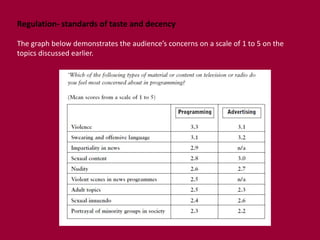
The graph below demonstrates the audience’s concerns on a scale of 1 to 5 on the 
topics discussed earlier.
Regulations- standards of taste and decency 
Why do some members of society worry? 
Some members of society worry about the content shown on our TVs as they do not 
want to hear bad language and additionally don’t want to children to be influenced in 
a negative way e.g. Through the use of indecent images. Young children watching 
soaps with their family will be influenced by the lives of characters as they are likely to 
be older than them and should be deemed role models. 
On the other hand some view censorship as an over-reaction as a lot of content found 
in soap opera could be seen as educational e.g. Homosexuality and teenage 
pregnancy. Soaps offer the perfect opportunity for young children to be taught about 
our society today by their parents. Additionally this up to the parents of the child how 
in depth they explain the situation shown on screen and therefore doesn’t pressure 
them into telling the child anything they don’t want them to know. Statistics have also 
shown that children are more influenced by the school playground than they are 
situations within soaps.
Regulation- standards of taste and decency 
Theories 
In terms of regulations most are made based upon the welfare of children under the 
age of 15. This suggests that children under the age of 15 are passive. We could apply 
the hypodermic needle theory here as this theory states that its audience are passive 
and therefore believe everything they are seeing to be true. This is why a lot of 
people say content should be regulated. Some storylines e.g. Teenage pregnancy and 
drug abuse could cause moral panic within young people and this is what many 
adults fear for children in society. 
Adults are usually subconsciously stronger when they view media for example what 
they are watching doesn’t usually affect them to a large extent. The ‘uses and 
gratification’ theory is relevant here as the media in particular soaps tends to just 
provide the adult audience with aspects of ‘personal relationships’ where they can 
meet with others to discuss their chosen media product. Additionally the adult 
audience are usually able to relate to the characters to a greater extent however they 
are aware of the difference between the soap and reality and therefore are not 
influenced as heavily by content as a child would be.
Regulations- standards of taste and decency 
Conclusion 
Researching into standards of taste and decency has really made me think about what I 
need to be aware of when producing my own soap. For example as not to cause offense 
to any audience members we must ensure that if we are to use any type of violence we 
do not exploit characters and must ensure the violence is weak/mild in order to 
represent reality however not to encourage such behaviour. 
When preparing costumes and props we need to make sure they are all deemed 
appropriate for our target audience as we wouldn’t want to portray our characters as 
bad role models or to influence anyone watching in a negative way. 
We need to make sure we comply with the regulations I have just researched in order 
for our soap opera trailer to look professional and represent our characters in the way 
we intend. 
Our audience have stated that they would prefer our Soap Opera to be broadcast 
everyday from between 7pm and 9pm. As this would be before the watershed we would 
have to regulate what we include as our soap may be viewed by young people who are 
younger than our proposed target audience. 
We intend for our soap trailer to be shown after the soap or after a programme with a 
similar target audience on the same channel so it attracts our intended audience. On the 
whole this is likely to be before the watershed and this is another reason as to why we 
need to regulate what we broadcast so it is appropriate for our audience and any other 
person that may be watching before the watershed.

Ofcom Regulations

  • 1.
    Regulation- standards oftaste and decency Who regulates the content of soaps in the UK? The Broadcasting Standards Regulation- Ofcom How does the process of regulation work? The process works initially by the use of the watershed. The watershed is the set time of 9 o’clock in the evening where before this no inappropriate language or content should be shown. Programmes displayed before the watershed are trusted to not contain any offensive content that is not suitable for children under the age of 15. The process of regulation is reviewed by ofcom frequently where opinions from the public are gathered. This information is then analysed and discussed. http://www.ofcom.org.uk/static/archive/itc/uploads/BROADCASTING_STANDARDS_ REGULATION.pdf
  • 2.
    Regulation- standards oftaste and decency Violence The extend of violence shown on television was seen as the most controversial issue and was strongly debated in the primary research task. For example some said that children are more influenced by ‘cartoon’ violence rather than real life violence. By cartoon violence they were suggesting vicious fighting with lots of blood whereas some said that realistic violence was more influential as this demonstrates the ease of violence in real life. Real life violent situations such as war and terrorist attacks were additionally disputed. Some members of the audience said that the news is the news and therefore should be shown regardless of its content. Others said there should be boundaries as to not expose children to the harsh reality of the world such as dead bodies and gore. The conclusion most people came to was that there should be more than one edit of the news. For instance before 9pm the news should be restricted and more ‘family friendly’ whereas after 9pm the news should be a realistic representation of the events within the world. Some people asked additionally stated that broadcasters have taken issues such as domestic violence too far and have become too explicit.
  • 3.
    Regulation- standards oftaste and decency Sexual content some people worry about how sexual content is expressed on television through the use of soaps, dramas and reality shows. Many people would support the idea that the content in these programmes is too explicit and is not suitable for all ages when it is shown before the 9pm watershed. Some say the portrayal of this behaviour leads young people under the age of 15 to think this behaviour e.g. Regular, promiscuous, un-thinking sexual relations is normal and acceptable within society. On the other hand others argue that the use of situations such as: teenage pregnancy, unmarried mothers and AIDS is really important to show on television. Many argue this point of view as this can be a good way to teach younger people about these situations and therefore can be seen as educational. Lastly many people (in particular men) have stated that they do not believe it appropriate for any homosexual behaviour to be shown at any time on the television. Women were more tolerant however when surveyed the general consensus was that a passionate homosexual kiss should only be shown after 9pm.
  • 4.
    Regulation- standards oftaste and decency Language The use of language on television was additionally disputed by members of the public that were interviewed by ‘ofcom’. For example tolerance had risen for ‘soft’ swears words such as ‘crap’, ‘piss’ and ‘bugger’. Most participants suggested that these words were acceptable in the early evening for example between 7:30 and 9pm however they were not to be heard often or repetitively. Harsher swear words were still frowned upon in particularly by parents and the elderly as they stated ‘there is no need for them’. It was discussed that harsh swear words shouldn’t really be used before 9pm as many of the target audience for shows before 9pm are young people under the age of 15. However it was suggested that harsh swear words would be tolerated after 10pm in situations where they’re not used with aggression. It was agreed that young children are more influenced by what they hear in the playground rather than what they learn from television. Parents and some other interviewed groups mainly said that they would rather their child and children in society did not hear this language before 9pm.
  • 5.
    Regulation- standards oftaste and decency Imitative behaviour This was another area discussed when researching the opinions of audiences. However this subject was more one sided. For example the majority of people when asked about imitative behaviour had a negative opinion of how it was represented through television. Most people said that subjects such as: drug abuse, alcohol abuse, casual sex and crime are too widely broadcast and don’t portray as much negativity as they should. Role models were additionally commented on. For example many people think that children are far too easily influenced by bad role models. These role models are found in both reality TV shows and soaps. It was discussed that young girls are the most vulnerable in this situation as they often want to style themselves on their role model and this is inappropriate for their age and in society.
  • 6.
    Regulation- standards oftaste and decency The graph below demonstrates the audience’s concerns on a scale of 1 to 5 on the topics discussed earlier.
  • 7.
    Regulations- standards oftaste and decency Why do some members of society worry? Some members of society worry about the content shown on our TVs as they do not want to hear bad language and additionally don’t want to children to be influenced in a negative way e.g. Through the use of indecent images. Young children watching soaps with their family will be influenced by the lives of characters as they are likely to be older than them and should be deemed role models. On the other hand some view censorship as an over-reaction as a lot of content found in soap opera could be seen as educational e.g. Homosexuality and teenage pregnancy. Soaps offer the perfect opportunity for young children to be taught about our society today by their parents. Additionally this up to the parents of the child how in depth they explain the situation shown on screen and therefore doesn’t pressure them into telling the child anything they don’t want them to know. Statistics have also shown that children are more influenced by the school playground than they are situations within soaps.
  • 8.
    Regulation- standards oftaste and decency Theories In terms of regulations most are made based upon the welfare of children under the age of 15. This suggests that children under the age of 15 are passive. We could apply the hypodermic needle theory here as this theory states that its audience are passive and therefore believe everything they are seeing to be true. This is why a lot of people say content should be regulated. Some storylines e.g. Teenage pregnancy and drug abuse could cause moral panic within young people and this is what many adults fear for children in society. Adults are usually subconsciously stronger when they view media for example what they are watching doesn’t usually affect them to a large extent. The ‘uses and gratification’ theory is relevant here as the media in particular soaps tends to just provide the adult audience with aspects of ‘personal relationships’ where they can meet with others to discuss their chosen media product. Additionally the adult audience are usually able to relate to the characters to a greater extent however they are aware of the difference between the soap and reality and therefore are not influenced as heavily by content as a child would be.
  • 9.
    Regulations- standards oftaste and decency Conclusion Researching into standards of taste and decency has really made me think about what I need to be aware of when producing my own soap. For example as not to cause offense to any audience members we must ensure that if we are to use any type of violence we do not exploit characters and must ensure the violence is weak/mild in order to represent reality however not to encourage such behaviour. When preparing costumes and props we need to make sure they are all deemed appropriate for our target audience as we wouldn’t want to portray our characters as bad role models or to influence anyone watching in a negative way. We need to make sure we comply with the regulations I have just researched in order for our soap opera trailer to look professional and represent our characters in the way we intend. Our audience have stated that they would prefer our Soap Opera to be broadcast everyday from between 7pm and 9pm. As this would be before the watershed we would have to regulate what we include as our soap may be viewed by young people who are younger than our proposed target audience. We intend for our soap trailer to be shown after the soap or after a programme with a similar target audience on the same channel so it attracts our intended audience. On the whole this is likely to be before the watershed and this is another reason as to why we need to regulate what we broadcast so it is appropriate for our audience and any other person that may be watching before the watershed.