1
KNOU
ASIA 2014
KNOU
Tae Rim Lee In Sung Jung
Dept. of Information Statistics, Dept. of Education
KNOU International Christian University
Dean of Natural Science Japan
Vice President of KSS
trlee@knou.ac.kr insung_jung@hotmail.com
June 27 2014 Penang
Quality Assurance Standards for
e-ASEM OER in ODL
ASIA 2014
KNOU
Transforming Statistical Education through ICT Application
ISIKNOU ISI
KNOU
ASIA 2014
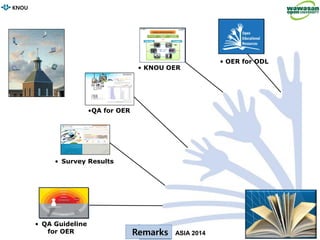
•QA for OER
• Survey Results
• QA Guideline
for OER
• KNOU OER
Remarks
• OER for ODL
3
KNOU
ASIA 2014
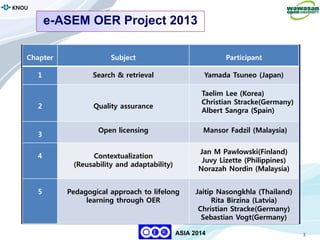
e-ASEM OER Project 2013
Chapter Subject Participant
1 Search & retrieval Yamada Tsuneo (Japan)
2 Quality assurance
Taelim Lee (Korea)
Christian Stracke(Germany)
Albert Sangra (Spain)
3
Open licensing Mansor Fadzil (Malaysia)
4 Contextualization
(Reusability and adaptability)
Jan M Pawlowski(Finland)
Juvy Lizette (Philippines)
Norazah Nordin (Malaysia)
5 Pedagogical approach to lifelong
learning through OER
Jaitip Nasongkhla (Thailand)
Rita Birzina (Latvia)
Christian Stracke(Germany)
Sebastian Vogt(Germany)
4
KNOU
ASIA 2014
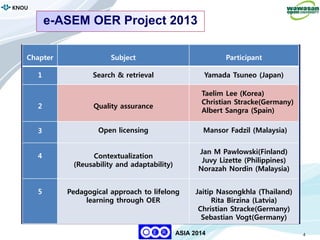
Chapter Subject Participant
1 Search & retrieval Yamada Tsuneo (Japan)
2 Quality assurance
Taelim Lee (Korea)
Christian Stracke(Germany)
Albert Sangra (Spain)
3 Open licensing Mansor Fadzil (Malaysia)
4 Contextualization
(Reusability and adaptability)
Jan M Pawlowski(Finland)
Juvy Lizette (Philippines)
Norazah Nordin (Malaysia)
5 Pedagogical approach to lifelong
learning through OER
Jaitip Nasongkhla (Thailand)
Rita Birzina (Latvia)
Christian Stracke(Germany)
Sebastian Vogt(Germany)
e-ASEM OER Project 2013
5
KNOU
ASIA 2014
1. OER for ODL
KNOU
ASIA 2014
6
KNOU
ASIA 2014
 Widening access to education in various region including Asia & Europe and
at various levels
 Over the past years tremendous growth and diversity in ODL & wide spread of
e-Learning have been observed in the Asia-Europe Meeting countries
 Asia : 70 OUs are engaged in open access to education serving over 6 million
distance learners
Growing number of dual mode universities that serve both conventional
campus based students and distance learners
Several virtual universities that offer online education to mainly working
adults
 Europe : Since the launch of the OU UK in 1969 several OUs were established in
Netherlands, Germany, Spain, Turkey, Greece, Italy, Norway and Cyprus
Since the inception of the Bologna Process in 1999, e-Learning programs
have been created as well and serving millions of students located in
Europe and other region
 AAOU(Asia Association of Open University)
 SEAMEO_SEMOLEC(South East Asian Ministers of Education
Organization Regional Open Learning Center)
 SAARC(The South Asian Association for Regional Cooperation)
 SACODiL(Consortium on Open and Distance Learning)
 EDEN(The European Distance and e-Learning Network)
 EADLC(The European Association for Distance Learning)
Development of ODL
7
KNOU
ASIA 2014
ODL Technologies & OER
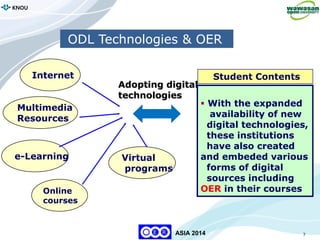
Internet
Multimedia
Resources
e-Learning Virtual
programs
Online
courses
Adopting digital
technologies
 With the expanded
availability of new
digital technologies,
these institutions
have also created
and embeded various
forms of digital
sources including
OER in their courses
Student Contents
8
KNOU
ASIA 2014
OPEN EDUCATIONAL RESOURCES
educational materials that may be freely
accessed, reused, modified and shared.
OER
9
KNOU
ASIA 2014
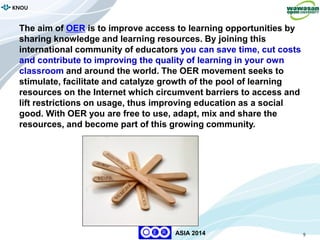
The aim of OER is to improve access to learning opportunities by
sharing knowledge and learning resources. By joining this
international community of educators you can save time, cut costs
and contribute to improving the quality of learning in your own
classroom and around the world. The OER movement seeks to
stimulate, facilitate and catalyze growth of the pool of learning
resources on the Internet which circumvent barriers to access and
lift restrictions on usage, thus improving education as a social
good. With OER you are free to use, adapt, mix and share the
resources, and become part of this growing community.
10
KNOU
ASIA 2014
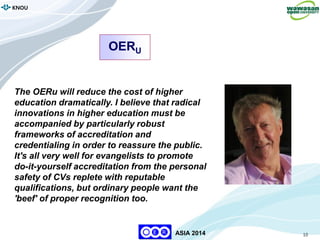
The OERu will reduce the cost of higher
education dramatically. I believe that radical
innovations in higher education must be
accompanied by particularly robust
frameworks of accreditation and
credentialing in order to reassure the public.
It's all very well for evangelists to promote
do-it-yourself accreditation from the personal
safety of CVs replete with reputable
qualifications, but ordinary people want the
'beef' of proper recognition too.
OERU
11
KNOU
ASIA 2014
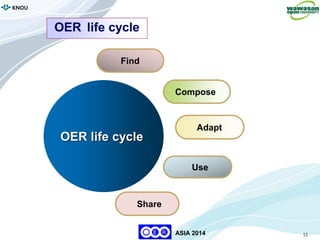
Compose
Adapt
Use
Share
Find
OER life cycle
OER life cycle
12
KNOU
ASIA 2014
Compose
Adapt
Use
Share
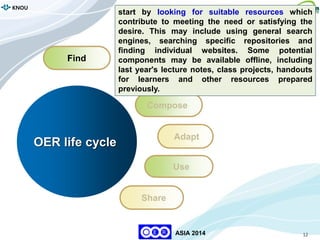
Find
OER life cycle
start by looking for suitable resources which
contribute to meeting the need or satisfying the
desire. This may include using general search
engines, searching specific repositories and
finding individual websites. Some potential
components may be available offline, including
last year's lecture notes, class projects, handouts
for learners and other resources prepared
previously.
13
KNOU
ASIA 2014
Compose
Adapt
Use
Share
Find
OER life cycle
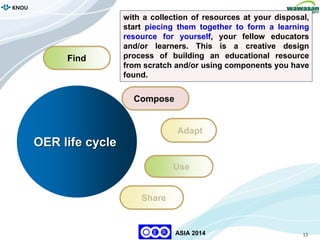
with a collection of resources at your disposal,
start piecing them together to form a learning
resource for yourself, your fellow educators
and/or learners. This is a creative design
process of building an educational resource
from scratch and/or using components you have
found.
14
KNOU
ASIA 2014
Compose
Adapt
Use
Share
Find
OER life cycle
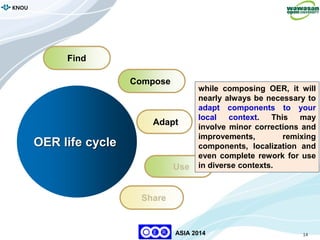
while composing OER, it will
nearly always be necessary to
adapt components to your
local context. This may
involve minor corrections and
improvements, remixing
components, localization and
even complete rework for use
in diverse contexts.
15
KNOU
ASIA 2014
Compose
Adapt
Use
Share
Find
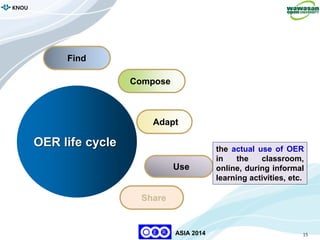
OER life cycle the actual use of OER
in the classroom,
online, during informal
learning activities, etc.
16
KNOU
ASIA 2014
Compose
Adapt
Use
Share
Find
OER life cycle
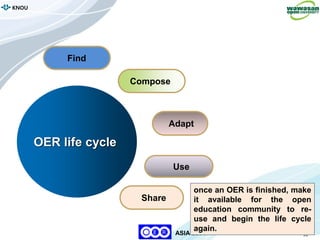
once an OER is finished, make
it available for the open
education community to re-
use and begin the life cycle
again.
17
KNOU
ASIA 2014
18
KNOU
ASIA 2014
19
KNOU
ASIA 2014
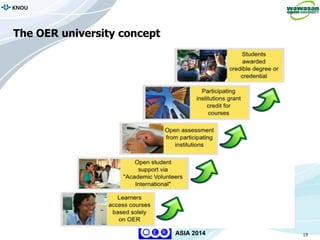
The OER university concept
KNOU
Transforming Statistical Education through ICT Application
ISIKNOU ISI
KNOU
ASIA 2014
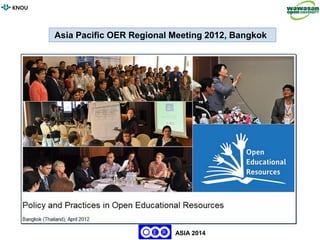
Asia Pacific OER Regional Meeting 2012, Bangkok
KNOU ISIKNOU ISI
KNOU
ASIA 2014
World OER Congress
Paris UNESCO Meeting 2012
KNOU
Transforming Statistical Education through ICT Application
ISIKNOU ISI
KNOU
ASIA 2014
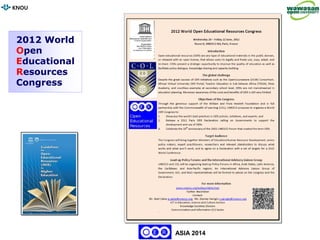
2012 World
Open
Educational
Resources
Congress
23
KNOU
ASIA 2014
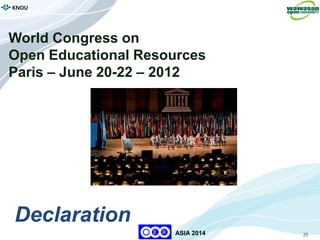
World Congress on
Open Educational Resources
Paris – June 20-22 – 2012
Declaration
24
KNOU
ASIA 2014
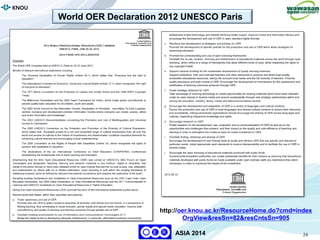
http://oer.knou.ac.kr/ResourceHome.do?cmd=index
OrgView&resSn=82&resCntsSn=905
World OER Declaration 2012 UNESCO Paris
25
KNOU
ASIA 2014
Government Initiative
in Developing OER:
the Case of KNOU
26
KNOU
ASIA 2014
I. International Trends of OER
II. Outline of KNOU’s New Project
III.KNOU OER Content
IV.KNOU OER Services
Contents
27
KNOU
ASIA 2014
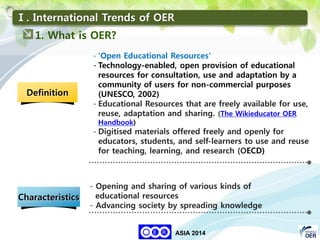
- Opening and sharing of various kinds of
educational resources
- Advancing society by spreading knowledge
Definition
Characteristics
- ‘Open Educational Resources’
- Technology-enabled, open provision of educational
resources for consultation, use and adaptation by a
community of users for non-commercial purposes
(UNESCO, 2002)
- Educational Resources that are freely available for use,
reuse, adaptation and sharing. (The Wikieducator OER
Handbook)
- Digitised materials offered freely and openly for
educators, students, and self-learners to use and reuse
for teaching, learning, and research (OECD)
1. What is OER?
Ⅰ. International Trends of OER
28
KNOU
ASIA 2014
2. Benefits of OER
Ⅰ. International Trends of OER
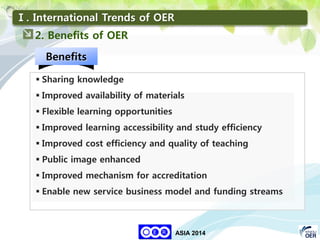
 Sharing knowledge
 Improved availability of materials
 Flexible learning opportunities
 Improved learning accessibility and study efficiency
 Improved cost efficiency and quality of teaching
 Public image enhanced
 Improved mechanism for accreditation
 Enable new service business model and funding streams
Benefits
29
KNOU
ASIA 2014
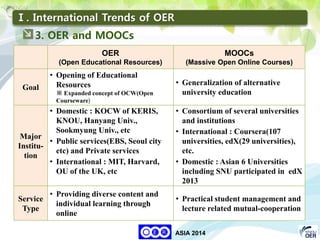
OER
(Open Educational Resources)
MOOCs
(Massive Open Online Courses)
Goal
• Opening of Educational
Resources
※ Expanded concept of OCW(Open
Courseware)
• Generalization of alternative
university education
Major
Institu-
tion
• Domestic : KOCW of KERIS,
KNOU, Hanyang Univ.,
Sookmyung Univ., etc
• Public services(EBS, Seoul city
etc) and Private services
• International : MIT, Harvard,
OU of the UK, etc
• Consortium of several universities
and institutions
• International : Coursera(107
universities, edX(29 universities),
etc.
• Domestic : Asian 6 Universities
including SNU participated in edX
2013
Service
Type
• Providing diverse content and
individual learning through
online
• Practical student management and
lecture related mutual-cooperation
Ⅰ. International Trends of OER
3. OER and MOOCs
30
KNOU
ASIA 2014
Ⅰ. International Trends of OER
4. International OER Services
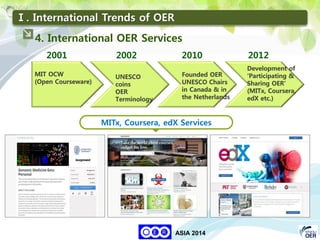
MITx, Coursera, edX Services
2001 2002 2010 2012
MIT OCW
(Open Courseware)
UNESCO
coins
OER
Terminology
Founded OER
UNESCO Chairs
in Canada & in
the Netherlands
Development of
‘Participating &
Sharing OER’
(MITx, Coursera,
edX etc.)
31
KNOU
ASIA 2014
Ⅰ. International Trends of OER
5. Major International OER Services
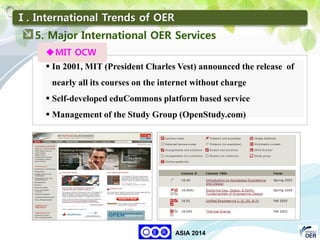
 In 2001, MIT (President Charles Vest) announced the release of
nearly all its courses on the internet without charge
 Self-developed eduCommons platform based service
 Management of the Study Group (OpenStudy.com)
MIT OCW
32
KNOU
ASIA 2014
Ⅰ. International Trends of OER
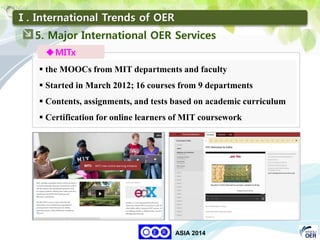
 the MOOCs from MIT departments and faculty
 Started in March 2012; 16 courses from 9 departments
 Contents, assignments, and tests based on academic curriculum
 Certification for online learners of MIT coursework
MITx
5. Major International OER Services
33
KNOU
ASIA 2014
Ⅰ. International Trends of OER
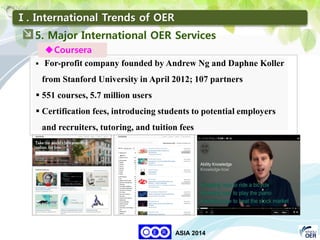
 For-profit company founded by Andrew Ng and Daphne Koller
from Stanford University in April 2012; 107 partners
 551 courses, 5.7 million users
 Certification fees, introducing students to potential employers
and recruiters, tutoring, and tuition fees
Coursera
5. Major International OER Services
34
KNOU
ASIA 2014
Ⅰ. International Trends of OER

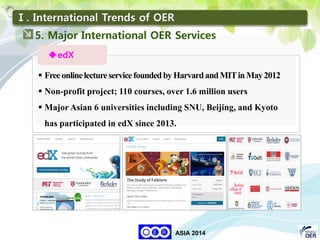
 FreeonlinelectureservicefoundedbyHarvardandMITin May2012
 Non-profit project; 110 courses, over 1.6 million users
 Major Asian 6 universities including SNU, Beijing, and Kyoto
has participated in edX since 2013.
edX
5. Major International OER Services
35
KNOU
ASIA 2014
Ⅰ. International Trends of OER
OpenupEd
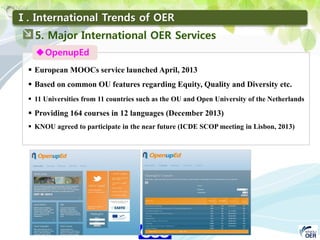
 European MOOCs service launched April, 2013
 Based on common OU features regarding Equity, Quality and Diversity etc.
 11 Universities from 11 countries such as the OU and Open University of the Netherlands
 Providing 164 courses in 12 languages (December 2013)
 KNOU agreed to participate in the near future (ICDE SCOP meeting in Lisbon, 2013)
5. Major International OER Services
36
KNOU
ASIA 2014
Ⅰ. International Trends of OER
6. Korean OER Services
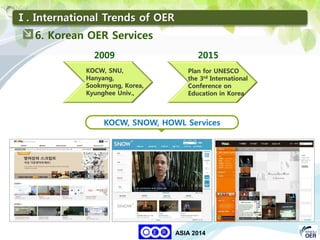
KOCW, SNOW, HOWL Services
2009 2015
KOCW, SNU,
Hanyang,
Sookmyung, Korea,
Kyunghee Univ.,
Plan for UNESCO
the 3rd International
Conference on
Education in Korea
37
KNOU
ASIA 2014
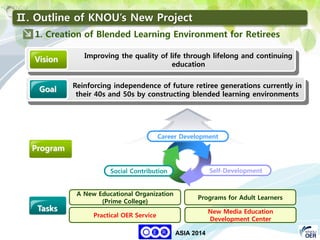
Vision Improving the quality of life through lifelong and continuing
education
Goal Reinforcing independence of future retiree generations currently in
their 40s and 50s by constructing blended learning environments
Career Development
Social Contribution Self-Development
Program
A New Educational Organization
(Prime College)
Tasks
Practical OER Service
Programs for Adult Learners
New Media Education
Development Center
Ⅱ. Outline of KNOU’s New Project
1. Creation of Blended Learning Environment for Retirees
38
KNOU
ASIA 2014
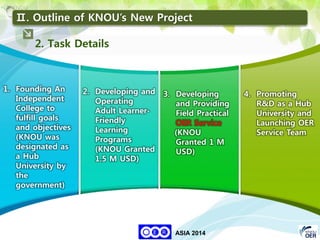
1. Founding An
Independent
College to
fulfill goals
and objectives
(KNOU was
designated as
a Hub
University by
the
government)
2. Developing and
Operating
Adult Learner-
Friendly
Learning
Programs
(KNOU Granted
1.5 M USD)
3. Developing
and Providing
Field Practical
OER Service
(KNOU
Granted 1 M
USD)
4. Promoting
R&D as a Hub
University and
Launching OER
Service Team
2. Task Details
Ⅱ. Outline of KNOU’s New Project
39
KNOU
ASIA 2014
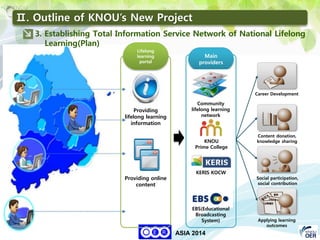
Ⅱ. Outline of KNOU’s New Project
3. Establishing Total Information Service Network of National Lifelong
Learning(Plan)
Career Development
Content donation,
knowledge sharing
Social participation,
social contribution
Applying learning
outcomes
Lifelong
learning
portal
Providing
lifelong learning
information
Providing online
content
Main
providers
Community
lifelong learning
network
KERIS KOCW
EBS(Educational
Broadcasting
System)
KNOU
Prime College
40
KNOU
ASIA 2014
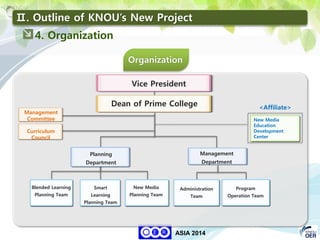
Blended Learning
Planning Team
Smart
Learning
Planning Team
New Media
Planning Team
Vice President
New Media
Education
Development
Center
Administration
Team
Program
Operation Team
<Affiliate>
Dean of Prime College
Management
Committee
Curriculum
Council
Planning
Department
Ⅱ. Outline of KNOU’s New Project
4. Organization
Management
Department
41
KNOU
ASIA 2014
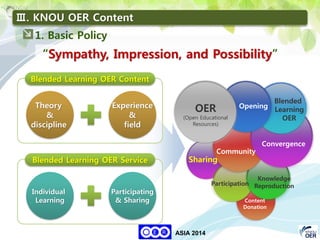
“Sympathy, Impression, and Possibility”
OER
(Open Educational
Resources)
Blended
Learning
OER
Opening
Convergence
Sharing
Participation
Community
Knowledge
Reproduction
Content
Donation
Ⅲ. KNOU OER Content
1. Basic Policy
Blended Learning OER Content
Theory
&
discipline
Experience
&
field
Blended Learning OER Service
Individual
Learning
Participating
& Sharing
42
KNOU
ASIA 2014
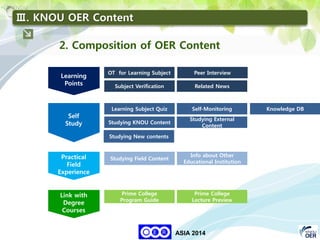
OT for Learning Subject Peer Interview
Subject Verification Related News
Learning
Points
Learning Subject Quiz Self-Monitoring Knowledge DB
Studying KNOU Content
Studying External
Content
Self
Study
Studying Field Content
Info about Other
Educational Institution
Practical
Field
Experience
Prime College
Program Guide
Prime College
Lecture Preview
Link with
Degree
Courses
Studying New contents
Ⅲ. KNOU OER Content
2. Composition of OER Content
43
KNOU
ASIA 2014
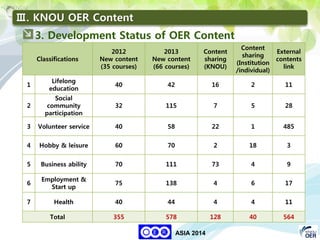
Classifications
2012
New content
(35 courses)
2013
New content
(66 courses)
Content
sharing
(KNOU)
Content
sharing
(Institution
/individual)
External
contents
link
1
Lifelong
education
40 42 16 2 11
2
Social
community
participation
32 115 7 5 28
3 Volunteer service 40 58 22 1 485
4 Hobby & leisure 60 70 2 18 3
5 Business ability 70 111 73 4 9
6
Employment &
Start up
75 138 4 6 17
7 Health 40 44 4 4 11
Total 355 578 128 40 564
Ⅲ. KNOU OER Content
3. Development Status of OER Content
44
KNOU
ASIA 2014
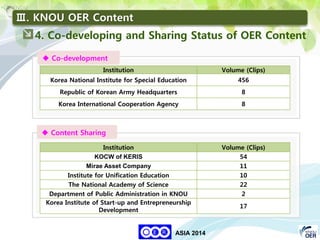
Institution Volume (Clips)
Korea National Institute for Special Education 456
Republic of Korean Army Headquarters 8
Korea International Cooperation Agency 8
Institution Volume (Clips)
KOCW of KERIS 54
Mirae Asset Company 11
Institute for Unification Education 10
The National Academy of Science 22
Department of Public Administration in KNOU 2
Korea Institute of Start-up and Entrepreneurship
Development
17
4. Co-developing and Sharing Status of OER Content
Ⅲ. KNOU OER Content
 Co-development
 Content Sharing
45
KNOU
ASIA 2014
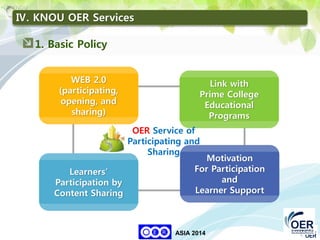
1. Basic Policy
WEB 2.0
(participating,
opening, and
sharing)
Learners’
Participation by
Content Sharing
Motivation
For Participation
and
Learner Support
Link with
Prime College
Educational
Programs
OER Service of
Participating and
Sharing
Ⅳ. KNOU OER Services
46
KNOU
ASIA 2014
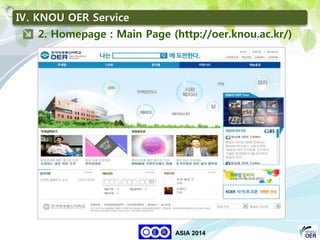
2. Homepage : Main Page (http://oer.knou.ac.kr/)
Ⅳ. KNOU OER Service
47
KNOU
ASIA 2014
Ⅳ. KNOU OER Services
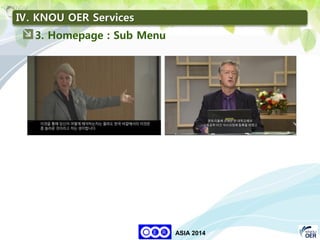
3. Homepage : Sub Menu
48
KNOU
ASIA 2014
Ⅳ. KNOU OER Services
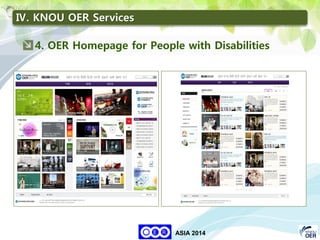
4. OER Homepage for People with Disabilities
49
KNOU
ASIA 2014
QA for OER
50
KNOU
ASIA 2014
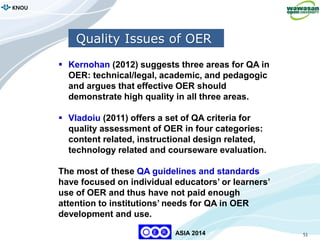
Quality Issues of OER
 Quality assessment of OER is indicated as one of the major
barriers to OER development and implementation.
 Ehlers (2011) discloses high level of quality concerns over
freely available OER in a large scale survey with adult
education institutions as well as HEIs in Europe, and strongly
argues for the promotion of QA standards for OER creation
and use and the establishment of a QA process.
 Dhanarajan and Abeywardena (2013), in a survey with HEIs in
Asia, reveal that the lack of technical skills in evaluating the
quality of OER and the anxiety about the quality of OER are
important factors inhibiting OER adoption in Asia.
 Hylén (2005) and Yuan, MacNeill, and Kraan (2008) also
indicate problems of judging the quality and relevance of OER
from the view point of educators and learners.
51
KNOU
ASIA 2014
 Kernohan (2012) suggests three areas for QA in
OER: technical/legal, academic, and pedagogic
and argues that effective OER should
demonstrate high quality in all three areas.
 Vladoiu (2011) offers a set of QA criteria for
quality assessment of OER in four categories:
content related, instructional design related,
technology related and courseware evaluation.
The most of these QA guidelines and standards
have focused on individual educators’ or learners’
use of OER and thus have not paid enough
attention to institutions’ needs for QA in OER
development and use.
Quality Issues of OER
52
KNOU
ASIA 2014
3. OER QA Models
KNOU
ASIA 2014
53
KNOU
ASIA 2014
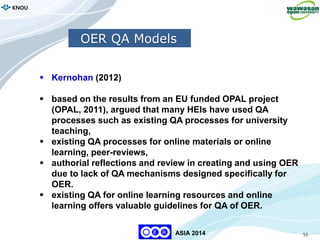
 Kernohan (2012)
 based on the results from an EU funded OPAL project
(OPAL, 2011), argued that many HEIs have used QA
processes such as existing QA processes for university
teaching,
 existing QA processes for online materials or online
learning, peer-reviews,
 authorial reflections and review in creating and using OER
due to lack of QA mechanisms designed specifically for
OER.
 existing QA for online learning resources and online
learning offers valuable guidelines for QA of OER.
OER QA Models
54
KNOU
ASIA 2014
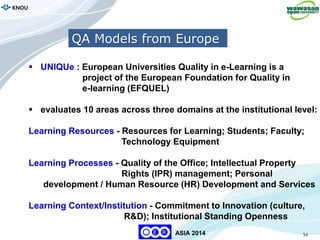
QA Models from Europe
 UNIQUe : European Universities Quality in e-Learning is a
project of the European Foundation for Quality in
e-learning (EFQUEL)
 evaluates 10 areas across three domains at the institutional level:
Learning Resources - Resources for Learning; Students; Faculty;
Technology Equipment
Learning Processes - Quality of the Office; Intellectual Property
Rights (IPR) management; Personal
development / Human Resource (HR) Development and Services
Learning Context/Institution - Commitment to Innovation (culture,
R&D); Institutional Standing Openness
55
KNOU
ASIA 2014
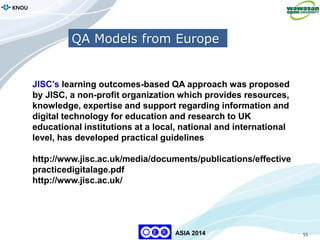
QA Models from Europe
JISC’s learning outcomes-based QA approach was proposed
by JISC, a non-profit organization which provides resources,
knowledge, expertise and support regarding information and
digital technology for education and research to UK
educational institutions at a local, national and international
level, has developed practical guidelines
http://www.jisc.ac.uk/media/documents/publications/effective
practicedigitalage.pdf
http://www.jisc.ac.uk/
56
KNOU
ASIA 2014
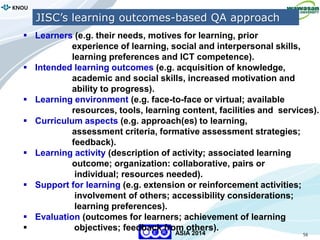
 Learners (e.g. their needs, motives for learning, prior
experience of learning, social and interpersonal skills,
learning preferences and ICT competence).
 Intended learning outcomes (e.g. acquisition of knowledge,
academic and social skills, increased motivation and
ability to progress).
 Learning environment (e.g. face-to-face or virtual; available
resources, tools, learning content, facilities and services).
 Curriculum aspects (e.g. approach(es) to learning,
assessment criteria, formative assessment strategies;
feedback).
 Learning activity (description of activity; associated learning
outcome; organization: collaborative, pairs or
individual; resources needed).
 Support for learning (e.g. extension or reinforcement activities;
involvement of others; accessibility considerations;
learning preferences).
 Evaluation (outcomes for learners; achievement of learning
 objectives; feedback from others).
JISC’s learning outcomes-based QA approach
57
KNOU
ASIA 2014
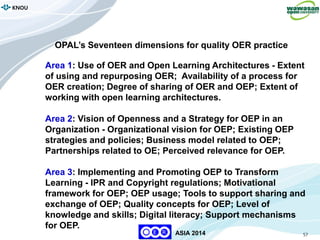
OPAL’s Seventeen dimensions for quality OER practice
Area 1: Use of OER and Open Learning Architectures - Extent
of using and repurposing OER; Availability of a process for
OER creation; Degree of sharing of OER and OEP; Extent of
working with open learning architectures.
Area 2: Vision of Openness and a Strategy for OEP in an
Organization - Organizational vision for OEP; Existing OEP
strategies and policies; Business model related to OEP;
Partnerships related to OE; Perceived relevance for OEP.
Area 3: Implementing and Promoting OEP to Transform
Learning - IPR and Copyright regulations; Motivational
framework for OEP; OEP usage; Tools to support sharing and
exchange of OEP; Quality concepts for OEP; Level of
knowledge and skills; Digital literacy; Support mechanisms
for OEP.
58
KNOU
ASIA 2014
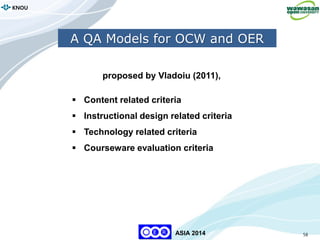
A QA Models for OCW and OER
proposed by Vladoiu (2011),
 Content related criteria
 Instructional design related criteria
 Technology related criteria
 Courseware evaluation criteria
59
KNOU
ASIA 2014
QA Models from Asia & Pacific
ACODE :The Australasian Council on Open, Distance and e-Learning
 Institution policy and governance for technology supported
learning and teaching.
 Planning for, and quality improvement of the integration of
technologies for learning and teaching.
 Information technology infrastructure to support learning and
teaching.
 Pedagogical application of information and communication
technology.
 Professional/staff development for the effective use of
technologies for learning and teaching.
 Staff support for the use of technologies for learning and teaching.
 Student training for the effective use of technologies for learning.
 Student support for the use of technologies for learning.
60
KNOU
ASIA 2014
Jung’s Asian Learner-Centred QA Framework is
proposed by Jung (2012)
 Supportive domain
 Pedagogical domain
 Environmental domain
The ASEAN Cyber University QA Framework
developed by Jung and Latchem (2012)
 Learning Contexts domain
 Learning Resources domain
 Learning Processes domain
 Evaluation and Assessment domain
 Learning Outcomes domain
61
KNOU
ASIA 2014
QA Models from North America
The Quality Matters Rubric for Higher Education, created by
Quality Matters (QM), is designed to certify the quality of
online courses and online components in the USA.
The Rubric has 8 general standards:
 Course Overview and Introduction.
 Learning Objectives (Competencies).
 Assessment and Measurement.
 Instructional Materials.
 Learner Interaction and Engagement.
 Course Technology.
 Learner Support.
 Accessibility.
https://www.qualitymatters.org/rubric
https://www.qualitymatters.org/
62
KNOU
ASIA 2014
The Best Practices for Electronically Offered
Degree and Certificate Programs
The QA guidelines are divided into five components:
 Institutional Context and Commitment.
 Curriculum and Instruction.
 Faculty Support.
 Student Support.
 Evaluation and Assessment.
63
KNOU
ASIA 2014
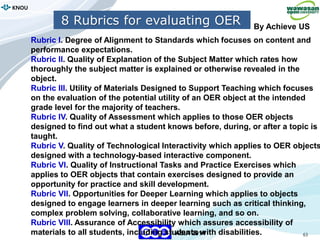
8 Rubrics for evaluating OER
Rubric I. Degree of Alignment to Standards which focuses on content and
performance expectations.
Rubric II. Quality of Explanation of the Subject Matter which rates how
thoroughly the subject matter is explained or otherwise revealed in the
object.
Rubric III. Utility of Materials Designed to Support Teaching which focuses
on the evaluation of the potential utility of an OER object at the intended
grade level for the majority of teachers.
Rubric IV. Quality of Assessment which applies to those OER objects
designed to find out what a student knows before, during, or after a topic is
taught.
Rubric V. Quality of Technological Interactivity which applies to OER objects
designed with a technology-based interactive component.
Rubric VI. Quality of Instructional Tasks and Practice Exercises which
applies to OER objects that contain exercises designed to provide an
opportunity for practice and skill development.
Rubric VII. Opportunities for Deeper Learning which applies to objects
designed to engage learners in deeper learning such as critical thinking,
complex problem solving, collaborative learning, and so on.
Rubric VIII. Assurance of Accessibility which assures accessibility of
materials to all students, including students with disabilities.
By Achieve US
64
KNOU
ASIA 2014
4. Survey Results
KNOU
65
KNOU
ASIA 2014
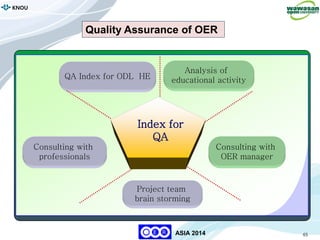
QA Index for ODL HE
Analysis of
educational activity
Consulting with
professionals
Project team
brain storming
Consulting with
OER manager
Index for
QA
Quality Assurance of OER
66
KNOU
ASIA 2014
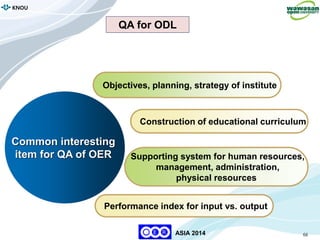
Common interesting
item for QA of OER
Objectives, planning, strategy of institute
Construction of educational curriculum
Supporting system for human resources,
management, administration,
physical resources
Performance index for input vs. output
QA for ODL
67
KNOU
ASIA 2014
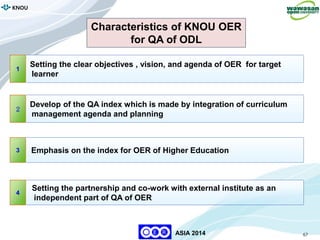
Setting the clear objectives , vision, and agenda of OER for target
learner
1
Develop of the QA index which is made by integration of curriculum
management agenda and planning
Emphasis on the index for OER of Higher Education3
Setting the partnership and co-work with external institute as an
independent part of QA of OER
4
2
Characteristics of KNOU OER
for QA of ODL
68
KNOU
ASIA 2014
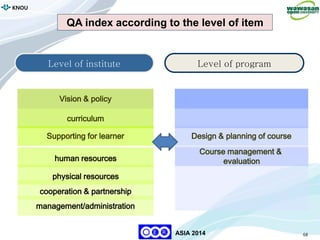
Level of institute Level of program
Vision & policy
curriculum
Supporting for learner Design & planning of course
human resources
physical resources
cooperation & partnership
management/administration
Course management &
evaluation
QA index according to the level of item
69
KNOU
ASIA 2014
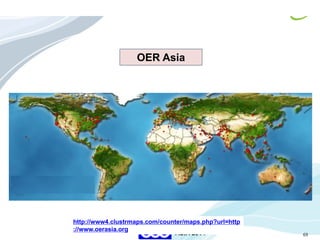
http://www4.clustrmaps.com/counter/maps.php?url=http
://www.oerasia.org
OER Asia
70
KNOU
ASIA 2014
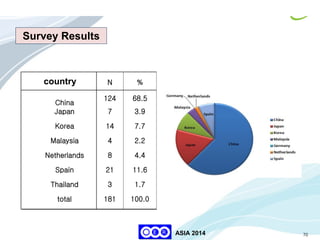
country N %
China
124 68.5
Japan 7 3.9
Korea 14 7.7
Malaysia 4 2.2
Netherlands 8 4.4
Spain 21 11.6
Thailand 3 1.7
total 181 100.0
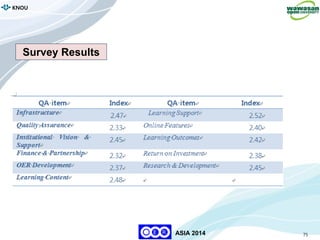
Survey Results
71
KNOU
ASIA 2014
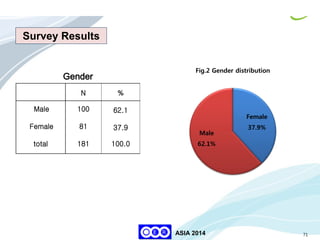
Survey Results
Gender
N %
Male 100 62.1
Female 81 37.9
total 181 100.0
Female
37.9%
Male
62.1%
Fig.2 Gender distribution
72
KNOU
ASIA 2014
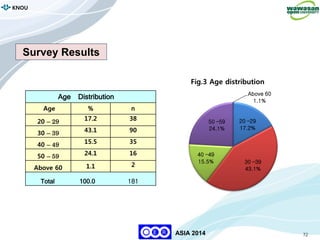
Survey Results
20 –29
17.2%
30 –39
43.1%
40 –49
15.5%
50 –59
24.1%
Above 60
1.1%
Fig.3 Age distribution
Age Distribution
Age % n
20 – 29 17.2 38
30 – 39 43.1 90
40 – 49 15.5 35
50 – 59 24.1 16
Above 60 1.1 2
Total 100.0 181
73
KNOU
ASIA 2014
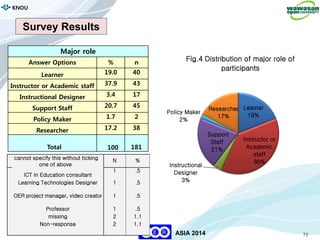
Survey Results
cannot specify this without ticking
one of above
N %
ICT in Education consultant
1 .5
Learning Technologies Designer 1 .5
OER project manager, video creator 1 .5
Professor 1 .5
missing 2 1.1
Non-response 2 1.1
Major role
Answer Options % n
Learner 19.0 40
Instructor or Academic staff 37.9 43
Instructional Designer 3.4 17
Support Staff 20.7 45
Policy Maker 1.7 2
Researcher 17.2 38
Total 100 181
Learner
19%
Instructor or
Academic
staff
38%
Instructional
Designer
3%
Support
Staff
21%
Policy Maker
2%
Researcher
17%
Fig.4 Distribution of major role of
participants
74
KNOU
ASIA 2014
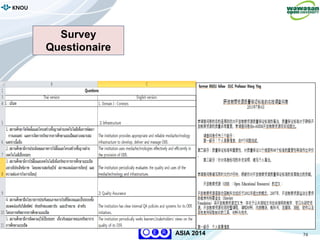
Survey
Questionaire
75
KNOU
ASIA 2014
Survey Results
76
KNOU
ASIA 2014
Survey Results
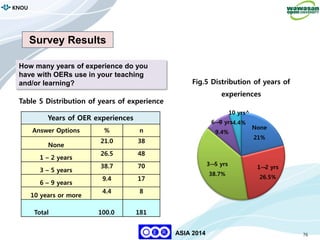
How many years of experience do you
have with OERs use in your teaching
and/or learning?
Years of OER experiences
Answer Options % n
None
21.0 38
1 – 2 years
26.5 48
3 – 5 years
38.7 70
6 – 9 years
9.4 17
10 years or more
4.4 8
Total 100.0 181
None
21%
1-–2 yrs
26.5%
3-–5 yrs
38.7%
6-–9 yrs
9.4%
10 yrs^
4.4%
Fig.5 Distribution of years of
experiences
Table 5 Distribution of years of experience
77
KNOU
ASIA 2014
Survey Results
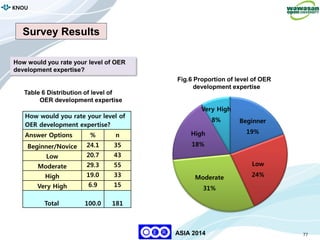
How would you rate your level of OER
development expertise?
How would you rate your level of
OER development expertise?
Answer Options % n
Beginner/Novice 24.1 35
Low 20.7 43
Moderate 29.3 55
High 19.0 33
Very High 6.9 15
Total 100.0 181
Table 6 Distribution of level of
OER development expertise
Fig.6 Proportion of level of OER
development expertise
Beginner
19%
Low
24%Moderate
31%
High
18%
Very High
8%
78
KNOU
ASIA 2014
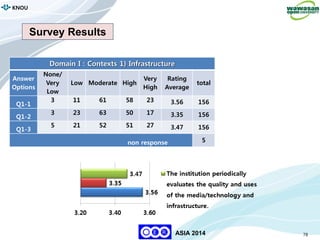
Domain I : Contexts 1) Infrastructure
Answer
Options
None/
Very
Low
Low Moderate High
Very
High
Rating
Average
total
Q1-1
3 11 61 58 23 3.56 156
Q1-2
3 23 63 50 17 3.35 156
Q1-3
5 21 52 51 27 3.47 156
non response 5
Survey Results
79
KNOU
ASIA 2014
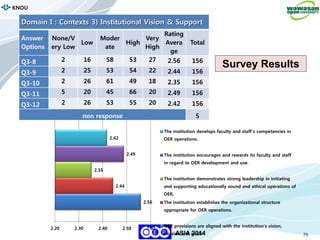
Domain I : Contexts 3) Institutional Vision & Support
Answer
Options
None/V
ery Low
Low
Moder
ate
High
Very
High
Rating
Avera
ge
Total
Q3-8 2 16 58 53 27 2.56 156
Q3-9 2 25 53 54 22 2.44 156
Q3-10 2 26 61 49 18 2.35 156
Q3-11 5 20 45 66 20 2.49 156
Q3-12 2 26 53 55 20 2.42 156
non response 5
2.56
2.44
2.35
2.49
2.42
2.20 2.30 2.40 2.50 2.60
The institution develops faculty and staff’s competencies in
OER operations.
The institution encourages and rewards its faculty and staff
in regard to OER development and use.
The institution demonstrates strong leadership in initiating
and supporting educationally sound and ethical operations of
OER.
The institution establishes the organizational structure
appropriate for OER operations.
OER provisions are aligned with the institution's vision,
mission and goals
Survey Results
80
KNOU
ASIA 2014
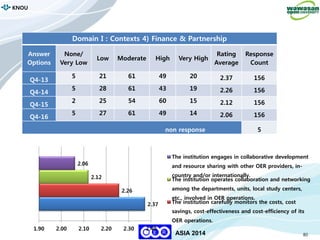
Domain I : Contexts 4) Finance & Partnership
Answer
Options
None/
Very Low
Low Moderate High Very High
Rating
Average
Response
Count
Q4-13
5 21 61 49 20 2.37 156
Q4-14
5 28 61 43 19 2.26 156
Q4-15
2 25 54 60 15 2.12 156
Q4-16
5 27 61 49 14 2.06 156
non response 5
2.37
2.26
2.12
2.06
1.90 2.00 2.10 2.20 2.30 2.40
The institution engages in collaborative development
and resource sharing with other OER providers, in-
country and/or internationally.
The institution operates collaboration and networking
among the departments, units, local study centers,
etc., involved in OER operations.
The institution carefully monitors the costs, cost
savings, cost-effectiveness and cost-efficiency of its
OER operations.
81
KNOU
ASIA 2014
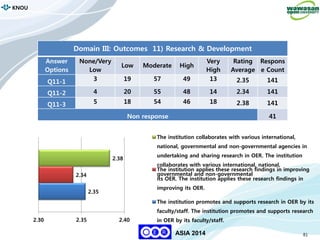
Domain III: Outcomes 11) Research & Development
Answer
Options
None/Very
Low
Low Moderate High
Very
High
Rating
Average
Respons
e Count
Q11-1 3 19 57 49 13 2.35 141
Q11-2 4 20 55 48 14 2.34 141
Q11-3 5 18 54 46 18 2.38 141
Non response 41
2.35
2.34
2.38
2.30 2.35 2.40
The institution collaborates with various international,
national, governmental and non-governmental agencies in
undertaking and sharing research in OER. The institution
collaborates with various international, national,
governmental and non-governmental
The institution applies these research findings in improving
its OER. The institution applies these research findings in
improving its OER.
The institution promotes and supports research in OER by its
faculty/staff. The institution promotes and supports research
in OER by its faculty/staff.
82
KNOU
ASIA 2014
Survey Results
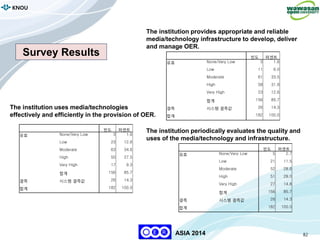
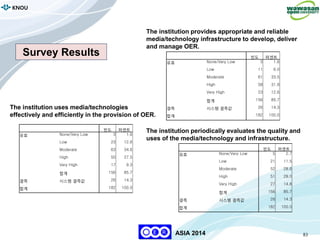
The institution provides appropriate and reliable
media/technology infrastructure to develop, deliver
and manage OER.
빈도 퍼센트
유효 None/Very Low 3 1.6
Low 11 6.0
Moderate 61 33.5
High 58 31.9
Very High 23 12.6
합계 156 85.7
결측 시스템 결측값 26 14.3
합계 182 100.0
The institution uses media/technologies
effectively and efficiently in the provision of OER.
빈도 퍼센트
유효 None/Very Low 3 1.6
Low 23 12.6
Moderate 63 34.6
High 50 27.5
Very High 17 9.3
합계 156 85.7
결측 시스템 결측값 26 14.3
합계 182 100.0
The institution periodically evaluates the quality and
uses of the media/technology and infrastructure.
빈도 퍼센트
유효 None/Very Low 5 2.7
Low 21 11.5
Moderate 52 28.6
High 51 28.0
Very High 27 14.8
합계 156 85.7
결측 시스템 결측값 26 14.3
합계 182 100.0
83
KNOU
ASIA 2014
Survey Results
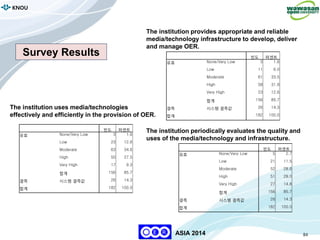
The institution provides appropriate and reliable
media/technology infrastructure to develop, deliver
and manage OER.
빈도 퍼센트
유효 None/Very Low 3 1.6
Low 11 6.0
Moderate 61 33.5
High 58 31.9
Very High 23 12.6
합계 156 85.7
결측 시스템 결측값 26 14.3
합계 182 100.0
The institution uses media/technologies
effectively and efficiently in the provision of OER.
빈도 퍼센트
유효 None/Very Low 3 1.6
Low 23 12.6
Moderate 63 34.6
High 50 27.5
Very High 17 9.3
합계 156 85.7
결측 시스템 결측값 26 14.3
합계 182 100.0
The institution periodically evaluates the quality and
uses of the media/technology and infrastructure.
빈도 퍼센트
유효 None/Very Low 5 2.7
Low 21 11.5
Moderate 52 28.6
High 51 28.0
Very High 27 14.8
합계 156 85.7
결측 시스템 결측값 26 14.3
합계 182 100.0
84
KNOU
ASIA 2014
Survey Results
The institution provides appropriate and reliable
media/technology infrastructure to develop, deliver
and manage OER.
빈도 퍼센트
유효 None/Very Low 3 1.6
Low 11 6.0
Moderate 61 33.5
High 58 31.9
Very High 23 12.6
합계 156 85.7
결측 시스템 결측값 26 14.3
합계 182 100.0
The institution uses media/technologies
effectively and efficiently in the provision of OER.
빈도 퍼센트
유효 None/Very Low 3 1.6
Low 23 12.6
Moderate 63 34.6
High 50 27.5
Very High 17 9.3
합계 156 85.7
결측 시스템 결측값 26 14.3
합계 182 100.0
The institution periodically evaluates the quality and
uses of the media/technology and infrastructure.
빈도 퍼센트
유효 None/Very Low 5 2.7
Low 21 11.5
Moderate 52 28.6
High 51 28.0
Very High 27 14.8
합계 156 85.7
결측 시스템 결측값 26 14.3
합계 182 100.0
85
KNOU
ASIA 2014
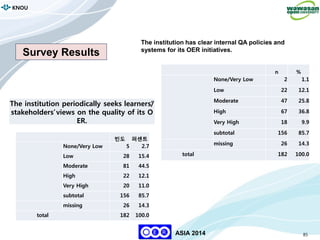
The institution has clear internal QA policies and
systems for its OER initiatives.
Survey Results
n %
None/Very Low 2 1.1
Low 22 12.1
Moderate 47 25.8
High 67 36.8
Very High 18 9.9
subtotal 156 85.7
missing 26 14.3
total 182 100.0
The institution periodically seeks learners’/
stakeholders’views on the quality of its O
ER.
빈도 퍼센트
None/Very Low 5 2.7
Low 28 15.4
Moderate 81 44.5
High 22 12.1
Very High 20 11.0
subtotal 156 85.7
missing 26 14.3
total 182 100.0
86
KNOU
ASIA 2014
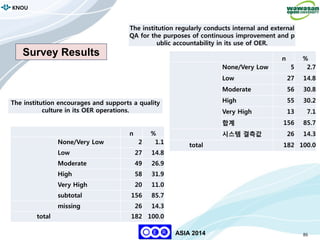
The institution regularly conducts internal and external
QA for the purposes of continuous improvement and p
ublic accountability in its use of OER.
n %
None/Very Low 5 2.7
Low 27 14.8
Moderate 56 30.8
High 55 30.2
Very High 13 7.1
합계 156 85.7
시스템 결측값 26 14.3
total 182 100.0
The institution encourages and supports a quality
culture in its OER operations.
n %
None/Very Low 2 1.1
Low 27 14.8
Moderate 49 26.9
High 58 31.9
Very High 20 11.0
subtotal 156 85.7
missing 26 14.3
total 182 100.0
Survey Results
87
KNOU
ASIA 2014
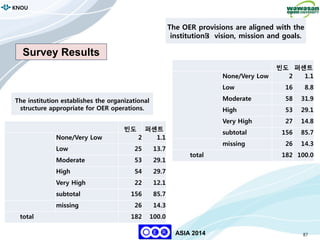
Survey Results
The OER provisions are aligned with the
institution’’s vision, mission and goals.
빈도 퍼센트
None/Very Low 2 1.1
Low 16 8.8
Moderate 58 31.9
High 53 29.1
Very High 27 14.8
subtotal 156 85.7
missing 26 14.3
total 182 100.0
The institution establishes the organizational
structure appropriate for OER operations.
빈도 퍼센트
None/Very Low 2 1.1
Low 25 13.7
Moderate 53 29.1
High 54 29.7
Very High 22 12.1
subtotal 156 85.7
missing 26 14.3
total 182 100.0
88
KNOU
ASIA 2014
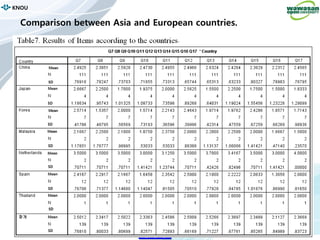
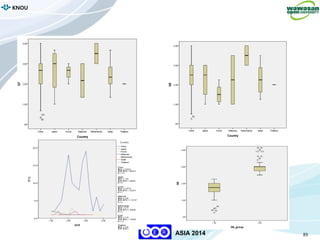
Comparison between Asia and European countries.
89
KNOU
ASIA 2014
90
KNOU
ASIA 2014
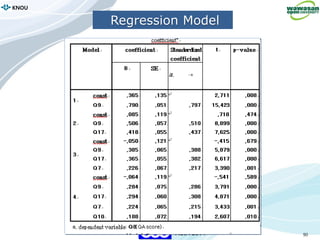
Regression Model
91
KNOU
ASIA 2014
Regression Model
92
KNOU
ASIA 2014
Regression Model
93
KNOU
ASIA 2014
Regression Model
94
KNOU
ASIA 2014
Discriminant Analysis
95
KNOU
ASIA 2014
5. QA guideline for OER
KNOU
96
KNOU
ASIA 2014
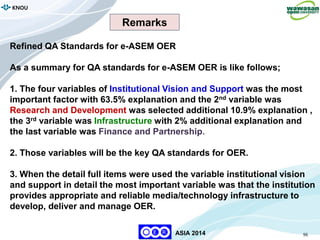
Refined QA Standards for e-ASEM OER
As a summary for QA standards for e-ASEM OER is like follows;
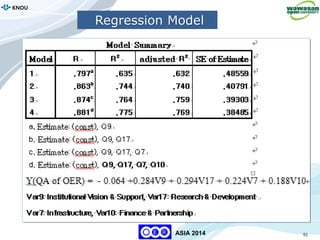
1. The four variables of Institutional Vision and Support was the most
important factor with 63.5% explanation and the 2nd variable was
Research and Development was selected additional 10.9% explanation ,
the 3rd variable was Infrastructure with 2% additional explanation and
the last variable was Finance and Partnership.
2. Those variables will be the key QA standards for OER.
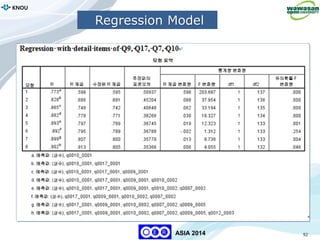
3. When the detail full items were used the variable institutional vision
and support in detail the most important variable was that the institution
provides appropriate and reliable media/technology infrastructure to
develop, deliver and manage OER.
Remarks
97
KNOU
ASIA 2014
Refined QA Standards for e-ASEM OER
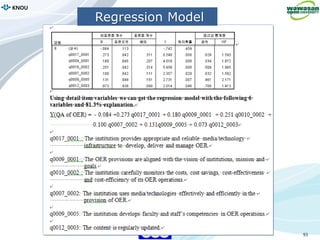
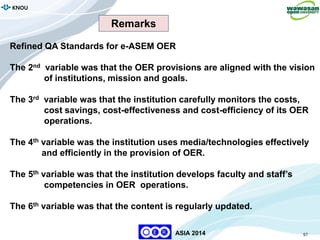
The 2nd variable was that the OER provisions are aligned with the vision
of institutions, mission and goals.
The 3rd variable was that the institution carefully monitors the costs,
cost savings, cost-effectiveness and cost-efficiency of its OER
operations.
The 4th variable was the institution uses media/technologies effectively
and efficiently in the provision of OER.
The 5th variable was that the institution develops faculty and staff’s
competencies in OER operations.
The 6th variable was that the content is regularly updated.
Remarks
98
KNOU
ASIA 2014
Refined QA Standards for e-ASEM OER
4. When the detail items of significant category variables the
following 3 variables was detected with 79.2% explanation.
The 1st variable was that the institution provides appropriate and
reliable media/technology Infra-structure to develop, deliver and
manage OER
The 2nd variable was that the institution develops faculty and staff’s
competencies in OER operations
The 3rd variable was that the institution uses media/technologies
effectively and efficiently in the provision of OER.
Remarks
99
KNOU
ASIA 2014
Q & A
100
KNOU
ASIA 2014
Thank You!
Terima Kasih!

#oersymposium2014 S5 P2 Taerim Lee

  • 1.
    1 KNOU ASIA 2014 KNOU Tae RimLee In Sung Jung Dept. of Information Statistics, Dept. of Education KNOU International Christian University Dean of Natural Science Japan Vice President of KSS trlee@knou.ac.kr insung_jung@hotmail.com June 27 2014 Penang Quality Assurance Standards for e-ASEM OER in ODL ASIA 2014
  • 2.
    KNOU Transforming Statistical Educationthrough ICT Application ISIKNOU ISI KNOU ASIA 2014 •QA for OER • Survey Results • QA Guideline for OER • KNOU OER Remarks • OER for ODL
  • 3.
    3 KNOU ASIA 2014 e-ASEM OERProject 2013 Chapter Subject Participant 1 Search & retrieval Yamada Tsuneo (Japan) 2 Quality assurance Taelim Lee (Korea) Christian Stracke(Germany) Albert Sangra (Spain) 3 Open licensing Mansor Fadzil (Malaysia) 4 Contextualization (Reusability and adaptability) Jan M Pawlowski(Finland) Juvy Lizette (Philippines) Norazah Nordin (Malaysia) 5 Pedagogical approach to lifelong learning through OER Jaitip Nasongkhla (Thailand) Rita Birzina (Latvia) Christian Stracke(Germany) Sebastian Vogt(Germany)
  • 4.
    4 KNOU ASIA 2014 Chapter SubjectParticipant 1 Search & retrieval Yamada Tsuneo (Japan) 2 Quality assurance Taelim Lee (Korea) Christian Stracke(Germany) Albert Sangra (Spain) 3 Open licensing Mansor Fadzil (Malaysia) 4 Contextualization (Reusability and adaptability) Jan M Pawlowski(Finland) Juvy Lizette (Philippines) Norazah Nordin (Malaysia) 5 Pedagogical approach to lifelong learning through OER Jaitip Nasongkhla (Thailand) Rita Birzina (Latvia) Christian Stracke(Germany) Sebastian Vogt(Germany) e-ASEM OER Project 2013
  • 5.
    5 KNOU ASIA 2014 1. OERfor ODL KNOU ASIA 2014
  • 6.
    6 KNOU ASIA 2014  Wideningaccess to education in various region including Asia & Europe and at various levels  Over the past years tremendous growth and diversity in ODL & wide spread of e-Learning have been observed in the Asia-Europe Meeting countries  Asia : 70 OUs are engaged in open access to education serving over 6 million distance learners Growing number of dual mode universities that serve both conventional campus based students and distance learners Several virtual universities that offer online education to mainly working adults  Europe : Since the launch of the OU UK in 1969 several OUs were established in Netherlands, Germany, Spain, Turkey, Greece, Italy, Norway and Cyprus Since the inception of the Bologna Process in 1999, e-Learning programs have been created as well and serving millions of students located in Europe and other region  AAOU(Asia Association of Open University)  SEAMEO_SEMOLEC(South East Asian Ministers of Education Organization Regional Open Learning Center)  SAARC(The South Asian Association for Regional Cooperation)  SACODiL(Consortium on Open and Distance Learning)  EDEN(The European Distance and e-Learning Network)  EADLC(The European Association for Distance Learning) Development of ODL
  • 7.
    7 KNOU ASIA 2014 ODL Technologies& OER Internet Multimedia Resources e-Learning Virtual programs Online courses Adopting digital technologies  With the expanded availability of new digital technologies, these institutions have also created and embeded various forms of digital sources including OER in their courses Student Contents
  • 8.
    8 KNOU ASIA 2014 OPEN EDUCATIONALRESOURCES educational materials that may be freely accessed, reused, modified and shared. OER
  • 9.
    9 KNOU ASIA 2014 The aimof OER is to improve access to learning opportunities by sharing knowledge and learning resources. By joining this international community of educators you can save time, cut costs and contribute to improving the quality of learning in your own classroom and around the world. The OER movement seeks to stimulate, facilitate and catalyze growth of the pool of learning resources on the Internet which circumvent barriers to access and lift restrictions on usage, thus improving education as a social good. With OER you are free to use, adapt, mix and share the resources, and become part of this growing community.
  • 10.
    10 KNOU ASIA 2014 The OERuwill reduce the cost of higher education dramatically. I believe that radical innovations in higher education must be accompanied by particularly robust frameworks of accreditation and credentialing in order to reassure the public. It's all very well for evangelists to promote do-it-yourself accreditation from the personal safety of CVs replete with reputable qualifications, but ordinary people want the 'beef' of proper recognition too. OERU
  • 11.
  • 12.
    12 KNOU ASIA 2014 Compose Adapt Use Share Find OER lifecycle start by looking for suitable resources which contribute to meeting the need or satisfying the desire. This may include using general search engines, searching specific repositories and finding individual websites. Some potential components may be available offline, including last year's lecture notes, class projects, handouts for learners and other resources prepared previously.
  • 13.
    13 KNOU ASIA 2014 Compose Adapt Use Share Find OER lifecycle with a collection of resources at your disposal, start piecing them together to form a learning resource for yourself, your fellow educators and/or learners. This is a creative design process of building an educational resource from scratch and/or using components you have found.
  • 14.
    14 KNOU ASIA 2014 Compose Adapt Use Share Find OER lifecycle while composing OER, it will nearly always be necessary to adapt components to your local context. This may involve minor corrections and improvements, remixing components, localization and even complete rework for use in diverse contexts.
  • 15.
    15 KNOU ASIA 2014 Compose Adapt Use Share Find OER lifecycle the actual use of OER in the classroom, online, during informal learning activities, etc.
  • 16.
    16 KNOU ASIA 2014 Compose Adapt Use Share Find OER lifecycle once an OER is finished, make it available for the open education community to re- use and begin the life cycle again.
  • 17.
  • 18.
  • 19.
    19 KNOU ASIA 2014 The OERuniversity concept
  • 20.
    KNOU Transforming Statistical Educationthrough ICT Application ISIKNOU ISI KNOU ASIA 2014 Asia Pacific OER Regional Meeting 2012, Bangkok
  • 21.
    KNOU ISIKNOU ISI KNOU ASIA2014 World OER Congress Paris UNESCO Meeting 2012
  • 22.
    KNOU Transforming Statistical Educationthrough ICT Application ISIKNOU ISI KNOU ASIA 2014 2012 World Open Educational Resources Congress
  • 23.
    23 KNOU ASIA 2014 World Congresson Open Educational Resources Paris – June 20-22 – 2012 Declaration
  • 24.
  • 25.
    25 KNOU ASIA 2014 Government Initiative inDeveloping OER: the Case of KNOU
  • 26.
    26 KNOU ASIA 2014 I. InternationalTrends of OER II. Outline of KNOU’s New Project III.KNOU OER Content IV.KNOU OER Services Contents
  • 27.
    27 KNOU ASIA 2014 - Openingand sharing of various kinds of educational resources - Advancing society by spreading knowledge Definition Characteristics - ‘Open Educational Resources’ - Technology-enabled, open provision of educational resources for consultation, use and adaptation by a community of users for non-commercial purposes (UNESCO, 2002) - Educational Resources that are freely available for use, reuse, adaptation and sharing. (The Wikieducator OER Handbook) - Digitised materials offered freely and openly for educators, students, and self-learners to use and reuse for teaching, learning, and research (OECD) 1. What is OER? Ⅰ. International Trends of OER
  • 28.
    28 KNOU ASIA 2014 2. Benefitsof OER Ⅰ. International Trends of OER  Sharing knowledge  Improved availability of materials  Flexible learning opportunities  Improved learning accessibility and study efficiency  Improved cost efficiency and quality of teaching  Public image enhanced  Improved mechanism for accreditation  Enable new service business model and funding streams Benefits
  • 29.
    29 KNOU ASIA 2014 OER (Open EducationalResources) MOOCs (Massive Open Online Courses) Goal • Opening of Educational Resources ※ Expanded concept of OCW(Open Courseware) • Generalization of alternative university education Major Institu- tion • Domestic : KOCW of KERIS, KNOU, Hanyang Univ., Sookmyung Univ., etc • Public services(EBS, Seoul city etc) and Private services • International : MIT, Harvard, OU of the UK, etc • Consortium of several universities and institutions • International : Coursera(107 universities, edX(29 universities), etc. • Domestic : Asian 6 Universities including SNU participated in edX 2013 Service Type • Providing diverse content and individual learning through online • Practical student management and lecture related mutual-cooperation Ⅰ. International Trends of OER 3. OER and MOOCs
  • 30.
    30 KNOU ASIA 2014 Ⅰ. InternationalTrends of OER 4. International OER Services MITx, Coursera, edX Services 2001 2002 2010 2012 MIT OCW (Open Courseware) UNESCO coins OER Terminology Founded OER UNESCO Chairs in Canada & in the Netherlands Development of ‘Participating & Sharing OER’ (MITx, Coursera, edX etc.)
  • 31.
    31 KNOU ASIA 2014 Ⅰ. InternationalTrends of OER 5. Major International OER Services  In 2001, MIT (President Charles Vest) announced the release of nearly all its courses on the internet without charge  Self-developed eduCommons platform based service  Management of the Study Group (OpenStudy.com) MIT OCW
  • 32.
    32 KNOU ASIA 2014 Ⅰ. InternationalTrends of OER  the MOOCs from MIT departments and faculty  Started in March 2012; 16 courses from 9 departments  Contents, assignments, and tests based on academic curriculum  Certification for online learners of MIT coursework MITx 5. Major International OER Services
  • 33.
    33 KNOU ASIA 2014 Ⅰ. InternationalTrends of OER  For-profit company founded by Andrew Ng and Daphne Koller from Stanford University in April 2012; 107 partners  551 courses, 5.7 million users  Certification fees, introducing students to potential employers and recruiters, tutoring, and tuition fees Coursera 5. Major International OER Services
  • 34.
    34 KNOU ASIA 2014 Ⅰ. InternationalTrends of OER   FreeonlinelectureservicefoundedbyHarvardandMITin May2012  Non-profit project; 110 courses, over 1.6 million users  Major Asian 6 universities including SNU, Beijing, and Kyoto has participated in edX since 2013. edX 5. Major International OER Services
  • 35.
    35 KNOU ASIA 2014 Ⅰ. InternationalTrends of OER OpenupEd  European MOOCs service launched April, 2013  Based on common OU features regarding Equity, Quality and Diversity etc.  11 Universities from 11 countries such as the OU and Open University of the Netherlands  Providing 164 courses in 12 languages (December 2013)  KNOU agreed to participate in the near future (ICDE SCOP meeting in Lisbon, 2013) 5. Major International OER Services
  • 36.
    36 KNOU ASIA 2014 Ⅰ. InternationalTrends of OER 6. Korean OER Services KOCW, SNOW, HOWL Services 2009 2015 KOCW, SNU, Hanyang, Sookmyung, Korea, Kyunghee Univ., Plan for UNESCO the 3rd International Conference on Education in Korea
  • 37.
    37 KNOU ASIA 2014 Vision Improvingthe quality of life through lifelong and continuing education Goal Reinforcing independence of future retiree generations currently in their 40s and 50s by constructing blended learning environments Career Development Social Contribution Self-Development Program A New Educational Organization (Prime College) Tasks Practical OER Service Programs for Adult Learners New Media Education Development Center Ⅱ. Outline of KNOU’s New Project 1. Creation of Blended Learning Environment for Retirees
  • 38.
    38 KNOU ASIA 2014 1. FoundingAn Independent College to fulfill goals and objectives (KNOU was designated as a Hub University by the government) 2. Developing and Operating Adult Learner- Friendly Learning Programs (KNOU Granted 1.5 M USD) 3. Developing and Providing Field Practical OER Service (KNOU Granted 1 M USD) 4. Promoting R&D as a Hub University and Launching OER Service Team 2. Task Details Ⅱ. Outline of KNOU’s New Project
  • 39.
    39 KNOU ASIA 2014 Ⅱ. Outlineof KNOU’s New Project 3. Establishing Total Information Service Network of National Lifelong Learning(Plan) Career Development Content donation, knowledge sharing Social participation, social contribution Applying learning outcomes Lifelong learning portal Providing lifelong learning information Providing online content Main providers Community lifelong learning network KERIS KOCW EBS(Educational Broadcasting System) KNOU Prime College
  • 40.
    40 KNOU ASIA 2014 Blended Learning PlanningTeam Smart Learning Planning Team New Media Planning Team Vice President New Media Education Development Center Administration Team Program Operation Team <Affiliate> Dean of Prime College Management Committee Curriculum Council Planning Department Ⅱ. Outline of KNOU’s New Project 4. Organization Management Department
  • 41.
    41 KNOU ASIA 2014 “Sympathy, Impression,and Possibility” OER (Open Educational Resources) Blended Learning OER Opening Convergence Sharing Participation Community Knowledge Reproduction Content Donation Ⅲ. KNOU OER Content 1. Basic Policy Blended Learning OER Content Theory & discipline Experience & field Blended Learning OER Service Individual Learning Participating & Sharing
  • 42.
    42 KNOU ASIA 2014 OT forLearning Subject Peer Interview Subject Verification Related News Learning Points Learning Subject Quiz Self-Monitoring Knowledge DB Studying KNOU Content Studying External Content Self Study Studying Field Content Info about Other Educational Institution Practical Field Experience Prime College Program Guide Prime College Lecture Preview Link with Degree Courses Studying New contents Ⅲ. KNOU OER Content 2. Composition of OER Content
  • 43.
    43 KNOU ASIA 2014 Classifications 2012 New content (35courses) 2013 New content (66 courses) Content sharing (KNOU) Content sharing (Institution /individual) External contents link 1 Lifelong education 40 42 16 2 11 2 Social community participation 32 115 7 5 28 3 Volunteer service 40 58 22 1 485 4 Hobby & leisure 60 70 2 18 3 5 Business ability 70 111 73 4 9 6 Employment & Start up 75 138 4 6 17 7 Health 40 44 4 4 11 Total 355 578 128 40 564 Ⅲ. KNOU OER Content 3. Development Status of OER Content
  • 44.
    44 KNOU ASIA 2014 Institution Volume(Clips) Korea National Institute for Special Education 456 Republic of Korean Army Headquarters 8 Korea International Cooperation Agency 8 Institution Volume (Clips) KOCW of KERIS 54 Mirae Asset Company 11 Institute for Unification Education 10 The National Academy of Science 22 Department of Public Administration in KNOU 2 Korea Institute of Start-up and Entrepreneurship Development 17 4. Co-developing and Sharing Status of OER Content Ⅲ. KNOU OER Content  Co-development  Content Sharing
  • 45.
    45 KNOU ASIA 2014 1. BasicPolicy WEB 2.0 (participating, opening, and sharing) Learners’ Participation by Content Sharing Motivation For Participation and Learner Support Link with Prime College Educational Programs OER Service of Participating and Sharing Ⅳ. KNOU OER Services
  • 46.
    46 KNOU ASIA 2014 2. Homepage: Main Page (http://oer.knou.ac.kr/) Ⅳ. KNOU OER Service
  • 47.
    47 KNOU ASIA 2014 Ⅳ. KNOUOER Services 3. Homepage : Sub Menu
  • 48.
    48 KNOU ASIA 2014 Ⅳ. KNOUOER Services 4. OER Homepage for People with Disabilities
  • 49.
  • 50.
    50 KNOU ASIA 2014 Quality Issuesof OER  Quality assessment of OER is indicated as one of the major barriers to OER development and implementation.  Ehlers (2011) discloses high level of quality concerns over freely available OER in a large scale survey with adult education institutions as well as HEIs in Europe, and strongly argues for the promotion of QA standards for OER creation and use and the establishment of a QA process.  Dhanarajan and Abeywardena (2013), in a survey with HEIs in Asia, reveal that the lack of technical skills in evaluating the quality of OER and the anxiety about the quality of OER are important factors inhibiting OER adoption in Asia.  Hylén (2005) and Yuan, MacNeill, and Kraan (2008) also indicate problems of judging the quality and relevance of OER from the view point of educators and learners.
  • 51.
    51 KNOU ASIA 2014  Kernohan(2012) suggests three areas for QA in OER: technical/legal, academic, and pedagogic and argues that effective OER should demonstrate high quality in all three areas.  Vladoiu (2011) offers a set of QA criteria for quality assessment of OER in four categories: content related, instructional design related, technology related and courseware evaluation. The most of these QA guidelines and standards have focused on individual educators’ or learners’ use of OER and thus have not paid enough attention to institutions’ needs for QA in OER development and use. Quality Issues of OER
  • 52.
    52 KNOU ASIA 2014 3. OERQA Models KNOU ASIA 2014
  • 53.
    53 KNOU ASIA 2014  Kernohan(2012)  based on the results from an EU funded OPAL project (OPAL, 2011), argued that many HEIs have used QA processes such as existing QA processes for university teaching,  existing QA processes for online materials or online learning, peer-reviews,  authorial reflections and review in creating and using OER due to lack of QA mechanisms designed specifically for OER.  existing QA for online learning resources and online learning offers valuable guidelines for QA of OER. OER QA Models
  • 54.
    54 KNOU ASIA 2014 QA Modelsfrom Europe  UNIQUe : European Universities Quality in e-Learning is a project of the European Foundation for Quality in e-learning (EFQUEL)  evaluates 10 areas across three domains at the institutional level: Learning Resources - Resources for Learning; Students; Faculty; Technology Equipment Learning Processes - Quality of the Office; Intellectual Property Rights (IPR) management; Personal development / Human Resource (HR) Development and Services Learning Context/Institution - Commitment to Innovation (culture, R&D); Institutional Standing Openness
  • 55.
    55 KNOU ASIA 2014 QA Modelsfrom Europe JISC’s learning outcomes-based QA approach was proposed by JISC, a non-profit organization which provides resources, knowledge, expertise and support regarding information and digital technology for education and research to UK educational institutions at a local, national and international level, has developed practical guidelines http://www.jisc.ac.uk/media/documents/publications/effective practicedigitalage.pdf http://www.jisc.ac.uk/
  • 56.
    56 KNOU ASIA 2014  Learners(e.g. their needs, motives for learning, prior experience of learning, social and interpersonal skills, learning preferences and ICT competence).  Intended learning outcomes (e.g. acquisition of knowledge, academic and social skills, increased motivation and ability to progress).  Learning environment (e.g. face-to-face or virtual; available resources, tools, learning content, facilities and services).  Curriculum aspects (e.g. approach(es) to learning, assessment criteria, formative assessment strategies; feedback).  Learning activity (description of activity; associated learning outcome; organization: collaborative, pairs or individual; resources needed).  Support for learning (e.g. extension or reinforcement activities; involvement of others; accessibility considerations; learning preferences).  Evaluation (outcomes for learners; achievement of learning  objectives; feedback from others). JISC’s learning outcomes-based QA approach
  • 57.
    57 KNOU ASIA 2014 OPAL’s Seventeendimensions for quality OER practice Area 1: Use of OER and Open Learning Architectures - Extent of using and repurposing OER; Availability of a process for OER creation; Degree of sharing of OER and OEP; Extent of working with open learning architectures. Area 2: Vision of Openness and a Strategy for OEP in an Organization - Organizational vision for OEP; Existing OEP strategies and policies; Business model related to OEP; Partnerships related to OE; Perceived relevance for OEP. Area 3: Implementing and Promoting OEP to Transform Learning - IPR and Copyright regulations; Motivational framework for OEP; OEP usage; Tools to support sharing and exchange of OEP; Quality concepts for OEP; Level of knowledge and skills; Digital literacy; Support mechanisms for OEP.
  • 58.
    58 KNOU ASIA 2014 A QAModels for OCW and OER proposed by Vladoiu (2011),  Content related criteria  Instructional design related criteria  Technology related criteria  Courseware evaluation criteria
  • 59.
    59 KNOU ASIA 2014 QA Modelsfrom Asia & Pacific ACODE :The Australasian Council on Open, Distance and e-Learning  Institution policy and governance for technology supported learning and teaching.  Planning for, and quality improvement of the integration of technologies for learning and teaching.  Information technology infrastructure to support learning and teaching.  Pedagogical application of information and communication technology.  Professional/staff development for the effective use of technologies for learning and teaching.  Staff support for the use of technologies for learning and teaching.  Student training for the effective use of technologies for learning.  Student support for the use of technologies for learning.
  • 60.
    60 KNOU ASIA 2014 Jung’s AsianLearner-Centred QA Framework is proposed by Jung (2012)  Supportive domain  Pedagogical domain  Environmental domain The ASEAN Cyber University QA Framework developed by Jung and Latchem (2012)  Learning Contexts domain  Learning Resources domain  Learning Processes domain  Evaluation and Assessment domain  Learning Outcomes domain
  • 61.
    61 KNOU ASIA 2014 QA Modelsfrom North America The Quality Matters Rubric for Higher Education, created by Quality Matters (QM), is designed to certify the quality of online courses and online components in the USA. The Rubric has 8 general standards:  Course Overview and Introduction.  Learning Objectives (Competencies).  Assessment and Measurement.  Instructional Materials.  Learner Interaction and Engagement.  Course Technology.  Learner Support.  Accessibility. https://www.qualitymatters.org/rubric https://www.qualitymatters.org/
  • 62.
    62 KNOU ASIA 2014 The BestPractices for Electronically Offered Degree and Certificate Programs The QA guidelines are divided into five components:  Institutional Context and Commitment.  Curriculum and Instruction.  Faculty Support.  Student Support.  Evaluation and Assessment.
  • 63.
    63 KNOU ASIA 2014 8 Rubricsfor evaluating OER Rubric I. Degree of Alignment to Standards which focuses on content and performance expectations. Rubric II. Quality of Explanation of the Subject Matter which rates how thoroughly the subject matter is explained or otherwise revealed in the object. Rubric III. Utility of Materials Designed to Support Teaching which focuses on the evaluation of the potential utility of an OER object at the intended grade level for the majority of teachers. Rubric IV. Quality of Assessment which applies to those OER objects designed to find out what a student knows before, during, or after a topic is taught. Rubric V. Quality of Technological Interactivity which applies to OER objects designed with a technology-based interactive component. Rubric VI. Quality of Instructional Tasks and Practice Exercises which applies to OER objects that contain exercises designed to provide an opportunity for practice and skill development. Rubric VII. Opportunities for Deeper Learning which applies to objects designed to engage learners in deeper learning such as critical thinking, complex problem solving, collaborative learning, and so on. Rubric VIII. Assurance of Accessibility which assures accessibility of materials to all students, including students with disabilities. By Achieve US
  • 64.
  • 65.
    65 KNOU ASIA 2014 QA Indexfor ODL HE Analysis of educational activity Consulting with professionals Project team brain storming Consulting with OER manager Index for QA Quality Assurance of OER
  • 66.
    66 KNOU ASIA 2014 Common interesting itemfor QA of OER Objectives, planning, strategy of institute Construction of educational curriculum Supporting system for human resources, management, administration, physical resources Performance index for input vs. output QA for ODL
  • 67.
    67 KNOU ASIA 2014 Setting theclear objectives , vision, and agenda of OER for target learner 1 Develop of the QA index which is made by integration of curriculum management agenda and planning Emphasis on the index for OER of Higher Education3 Setting the partnership and co-work with external institute as an independent part of QA of OER 4 2 Characteristics of KNOU OER for QA of ODL
  • 68.
    68 KNOU ASIA 2014 Level ofinstitute Level of program Vision & policy curriculum Supporting for learner Design & planning of course human resources physical resources cooperation & partnership management/administration Course management & evaluation QA index according to the level of item
  • 69.
  • 70.
    70 KNOU ASIA 2014 country N% China 124 68.5 Japan 7 3.9 Korea 14 7.7 Malaysia 4 2.2 Netherlands 8 4.4 Spain 21 11.6 Thailand 3 1.7 total 181 100.0 Survey Results
  • 71.
    71 KNOU ASIA 2014 Survey Results Gender N% Male 100 62.1 Female 81 37.9 total 181 100.0 Female 37.9% Male 62.1% Fig.2 Gender distribution
  • 72.
    72 KNOU ASIA 2014 Survey Results 20–29 17.2% 30 –39 43.1% 40 –49 15.5% 50 –59 24.1% Above 60 1.1% Fig.3 Age distribution Age Distribution Age % n 20 – 29 17.2 38 30 – 39 43.1 90 40 – 49 15.5 35 50 – 59 24.1 16 Above 60 1.1 2 Total 100.0 181
  • 73.
    73 KNOU ASIA 2014 Survey Results cannotspecify this without ticking one of above N % ICT in Education consultant 1 .5 Learning Technologies Designer 1 .5 OER project manager, video creator 1 .5 Professor 1 .5 missing 2 1.1 Non-response 2 1.1 Major role Answer Options % n Learner 19.0 40 Instructor or Academic staff 37.9 43 Instructional Designer 3.4 17 Support Staff 20.7 45 Policy Maker 1.7 2 Researcher 17.2 38 Total 100 181 Learner 19% Instructor or Academic staff 38% Instructional Designer 3% Support Staff 21% Policy Maker 2% Researcher 17% Fig.4 Distribution of major role of participants
  • 74.
  • 75.
  • 76.
    76 KNOU ASIA 2014 Survey Results Howmany years of experience do you have with OERs use in your teaching and/or learning? Years of OER experiences Answer Options % n None 21.0 38 1 – 2 years 26.5 48 3 – 5 years 38.7 70 6 – 9 years 9.4 17 10 years or more 4.4 8 Total 100.0 181 None 21% 1-–2 yrs 26.5% 3-–5 yrs 38.7% 6-–9 yrs 9.4% 10 yrs^ 4.4% Fig.5 Distribution of years of experiences Table 5 Distribution of years of experience
  • 77.
    77 KNOU ASIA 2014 Survey Results Howwould you rate your level of OER development expertise? How would you rate your level of OER development expertise? Answer Options % n Beginner/Novice 24.1 35 Low 20.7 43 Moderate 29.3 55 High 19.0 33 Very High 6.9 15 Total 100.0 181 Table 6 Distribution of level of OER development expertise Fig.6 Proportion of level of OER development expertise Beginner 19% Low 24%Moderate 31% High 18% Very High 8%
  • 78.
    78 KNOU ASIA 2014 Domain I: Contexts 1) Infrastructure Answer Options None/ Very Low Low Moderate High Very High Rating Average total Q1-1 3 11 61 58 23 3.56 156 Q1-2 3 23 63 50 17 3.35 156 Q1-3 5 21 52 51 27 3.47 156 non response 5 Survey Results
  • 79.
    79 KNOU ASIA 2014 Domain I: Contexts 3) Institutional Vision & Support Answer Options None/V ery Low Low Moder ate High Very High Rating Avera ge Total Q3-8 2 16 58 53 27 2.56 156 Q3-9 2 25 53 54 22 2.44 156 Q3-10 2 26 61 49 18 2.35 156 Q3-11 5 20 45 66 20 2.49 156 Q3-12 2 26 53 55 20 2.42 156 non response 5 2.56 2.44 2.35 2.49 2.42 2.20 2.30 2.40 2.50 2.60 The institution develops faculty and staff’s competencies in OER operations. The institution encourages and rewards its faculty and staff in regard to OER development and use. The institution demonstrates strong leadership in initiating and supporting educationally sound and ethical operations of OER. The institution establishes the organizational structure appropriate for OER operations. OER provisions are aligned with the institution's vision, mission and goals Survey Results
  • 80.
    80 KNOU ASIA 2014 Domain I: Contexts 4) Finance & Partnership Answer Options None/ Very Low Low Moderate High Very High Rating Average Response Count Q4-13 5 21 61 49 20 2.37 156 Q4-14 5 28 61 43 19 2.26 156 Q4-15 2 25 54 60 15 2.12 156 Q4-16 5 27 61 49 14 2.06 156 non response 5 2.37 2.26 2.12 2.06 1.90 2.00 2.10 2.20 2.30 2.40 The institution engages in collaborative development and resource sharing with other OER providers, in- country and/or internationally. The institution operates collaboration and networking among the departments, units, local study centers, etc., involved in OER operations. The institution carefully monitors the costs, cost savings, cost-effectiveness and cost-efficiency of its OER operations.
  • 81.
    81 KNOU ASIA 2014 Domain III:Outcomes 11) Research & Development Answer Options None/Very Low Low Moderate High Very High Rating Average Respons e Count Q11-1 3 19 57 49 13 2.35 141 Q11-2 4 20 55 48 14 2.34 141 Q11-3 5 18 54 46 18 2.38 141 Non response 41 2.35 2.34 2.38 2.30 2.35 2.40 The institution collaborates with various international, national, governmental and non-governmental agencies in undertaking and sharing research in OER. The institution collaborates with various international, national, governmental and non-governmental The institution applies these research findings in improving its OER. The institution applies these research findings in improving its OER. The institution promotes and supports research in OER by its faculty/staff. The institution promotes and supports research in OER by its faculty/staff.
  • 82.
    82 KNOU ASIA 2014 Survey Results Theinstitution provides appropriate and reliable media/technology infrastructure to develop, deliver and manage OER. 빈도 퍼센트 유효 None/Very Low 3 1.6 Low 11 6.0 Moderate 61 33.5 High 58 31.9 Very High 23 12.6 합계 156 85.7 결측 시스템 결측값 26 14.3 합계 182 100.0 The institution uses media/technologies effectively and efficiently in the provision of OER. 빈도 퍼센트 유효 None/Very Low 3 1.6 Low 23 12.6 Moderate 63 34.6 High 50 27.5 Very High 17 9.3 합계 156 85.7 결측 시스템 결측값 26 14.3 합계 182 100.0 The institution periodically evaluates the quality and uses of the media/technology and infrastructure. 빈도 퍼센트 유효 None/Very Low 5 2.7 Low 21 11.5 Moderate 52 28.6 High 51 28.0 Very High 27 14.8 합계 156 85.7 결측 시스템 결측값 26 14.3 합계 182 100.0
  • 83.
    83 KNOU ASIA 2014 Survey Results Theinstitution provides appropriate and reliable media/technology infrastructure to develop, deliver and manage OER. 빈도 퍼센트 유효 None/Very Low 3 1.6 Low 11 6.0 Moderate 61 33.5 High 58 31.9 Very High 23 12.6 합계 156 85.7 결측 시스템 결측값 26 14.3 합계 182 100.0 The institution uses media/technologies effectively and efficiently in the provision of OER. 빈도 퍼센트 유효 None/Very Low 3 1.6 Low 23 12.6 Moderate 63 34.6 High 50 27.5 Very High 17 9.3 합계 156 85.7 결측 시스템 결측값 26 14.3 합계 182 100.0 The institution periodically evaluates the quality and uses of the media/technology and infrastructure. 빈도 퍼센트 유효 None/Very Low 5 2.7 Low 21 11.5 Moderate 52 28.6 High 51 28.0 Very High 27 14.8 합계 156 85.7 결측 시스템 결측값 26 14.3 합계 182 100.0
  • 84.
    84 KNOU ASIA 2014 Survey Results Theinstitution provides appropriate and reliable media/technology infrastructure to develop, deliver and manage OER. 빈도 퍼센트 유효 None/Very Low 3 1.6 Low 11 6.0 Moderate 61 33.5 High 58 31.9 Very High 23 12.6 합계 156 85.7 결측 시스템 결측값 26 14.3 합계 182 100.0 The institution uses media/technologies effectively and efficiently in the provision of OER. 빈도 퍼센트 유효 None/Very Low 3 1.6 Low 23 12.6 Moderate 63 34.6 High 50 27.5 Very High 17 9.3 합계 156 85.7 결측 시스템 결측값 26 14.3 합계 182 100.0 The institution periodically evaluates the quality and uses of the media/technology and infrastructure. 빈도 퍼센트 유효 None/Very Low 5 2.7 Low 21 11.5 Moderate 52 28.6 High 51 28.0 Very High 27 14.8 합계 156 85.7 결측 시스템 결측값 26 14.3 합계 182 100.0
  • 85.
    85 KNOU ASIA 2014 The institutionhas clear internal QA policies and systems for its OER initiatives. Survey Results n % None/Very Low 2 1.1 Low 22 12.1 Moderate 47 25.8 High 67 36.8 Very High 18 9.9 subtotal 156 85.7 missing 26 14.3 total 182 100.0 The institution periodically seeks learners’/ stakeholders’views on the quality of its O ER. 빈도 퍼센트 None/Very Low 5 2.7 Low 28 15.4 Moderate 81 44.5 High 22 12.1 Very High 20 11.0 subtotal 156 85.7 missing 26 14.3 total 182 100.0
  • 86.
    86 KNOU ASIA 2014 The institutionregularly conducts internal and external QA for the purposes of continuous improvement and p ublic accountability in its use of OER. n % None/Very Low 5 2.7 Low 27 14.8 Moderate 56 30.8 High 55 30.2 Very High 13 7.1 합계 156 85.7 시스템 결측값 26 14.3 total 182 100.0 The institution encourages and supports a quality culture in its OER operations. n % None/Very Low 2 1.1 Low 27 14.8 Moderate 49 26.9 High 58 31.9 Very High 20 11.0 subtotal 156 85.7 missing 26 14.3 total 182 100.0 Survey Results
  • 87.
    87 KNOU ASIA 2014 Survey Results TheOER provisions are aligned with the institution’’s vision, mission and goals. 빈도 퍼센트 None/Very Low 2 1.1 Low 16 8.8 Moderate 58 31.9 High 53 29.1 Very High 27 14.8 subtotal 156 85.7 missing 26 14.3 total 182 100.0 The institution establishes the organizational structure appropriate for OER operations. 빈도 퍼센트 None/Very Low 2 1.1 Low 25 13.7 Moderate 53 29.1 High 54 29.7 Very High 22 12.1 subtotal 156 85.7 missing 26 14.3 total 182 100.0
  • 88.
    88 KNOU ASIA 2014 Comparison betweenAsia and European countries.
  • 89.
  • 90.
  • 91.
  • 92.
  • 93.
  • 94.
  • 95.
    95 KNOU ASIA 2014 5. QAguideline for OER KNOU
  • 96.
    96 KNOU ASIA 2014 Refined QAStandards for e-ASEM OER As a summary for QA standards for e-ASEM OER is like follows; 1. The four variables of Institutional Vision and Support was the most important factor with 63.5% explanation and the 2nd variable was Research and Development was selected additional 10.9% explanation , the 3rd variable was Infrastructure with 2% additional explanation and the last variable was Finance and Partnership. 2. Those variables will be the key QA standards for OER. 3. When the detail full items were used the variable institutional vision and support in detail the most important variable was that the institution provides appropriate and reliable media/technology infrastructure to develop, deliver and manage OER. Remarks
  • 97.
    97 KNOU ASIA 2014 Refined QAStandards for e-ASEM OER The 2nd variable was that the OER provisions are aligned with the vision of institutions, mission and goals. The 3rd variable was that the institution carefully monitors the costs, cost savings, cost-effectiveness and cost-efficiency of its OER operations. The 4th variable was the institution uses media/technologies effectively and efficiently in the provision of OER. The 5th variable was that the institution develops faculty and staff’s competencies in OER operations. The 6th variable was that the content is regularly updated. Remarks
  • 98.
    98 KNOU ASIA 2014 Refined QAStandards for e-ASEM OER 4. When the detail items of significant category variables the following 3 variables was detected with 79.2% explanation. The 1st variable was that the institution provides appropriate and reliable media/technology Infra-structure to develop, deliver and manage OER The 2nd variable was that the institution develops faculty and staff’s competencies in OER operations The 3rd variable was that the institution uses media/technologies effectively and efficiently in the provision of OER. Remarks
  • 99.
  • 100.