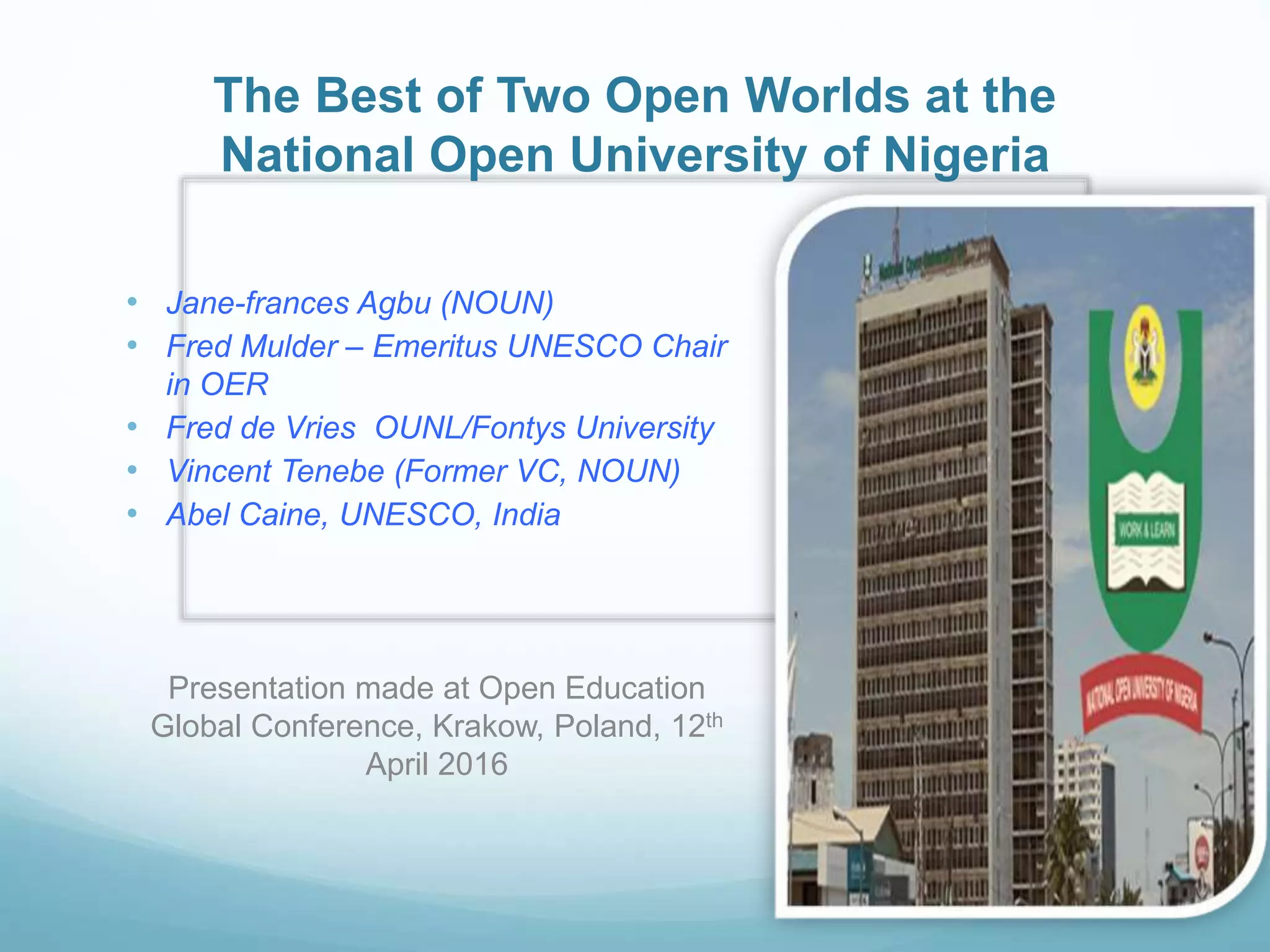
The Best of Two Open Worlds at the
National Open University of Nigeria
• Jane-frances Agbu (NOUN)
• Fred Mulder – Emeritus UNESCO Chair
in OER
• Fred de Vries OUNL/Fontys University
• Vincent Tenebe (Former VC, NOUN)
• Abel Caine, UNESCO, India
Presentation made at Open Education
Global Conference, Krakow, Poland, 12th
April 2016
Presentation Structure
 Classical openness
 Digital openness (OCW, OER, MOOCs)
 Responses of OUs to the digital openness
 NOUN’s response to OER and MOOCs
A bit of NOUN
 Established in 2002 (1983)
 Headquarters, Abuja, Nigeria
 VC: Prof Abdalla Adamu
 Student Pop. 186,000+ (Active) (2015) (400,000 enrolment)
 70+ study centres
 Website: www.nou.edu.ng
 Online Course materials: 1600+
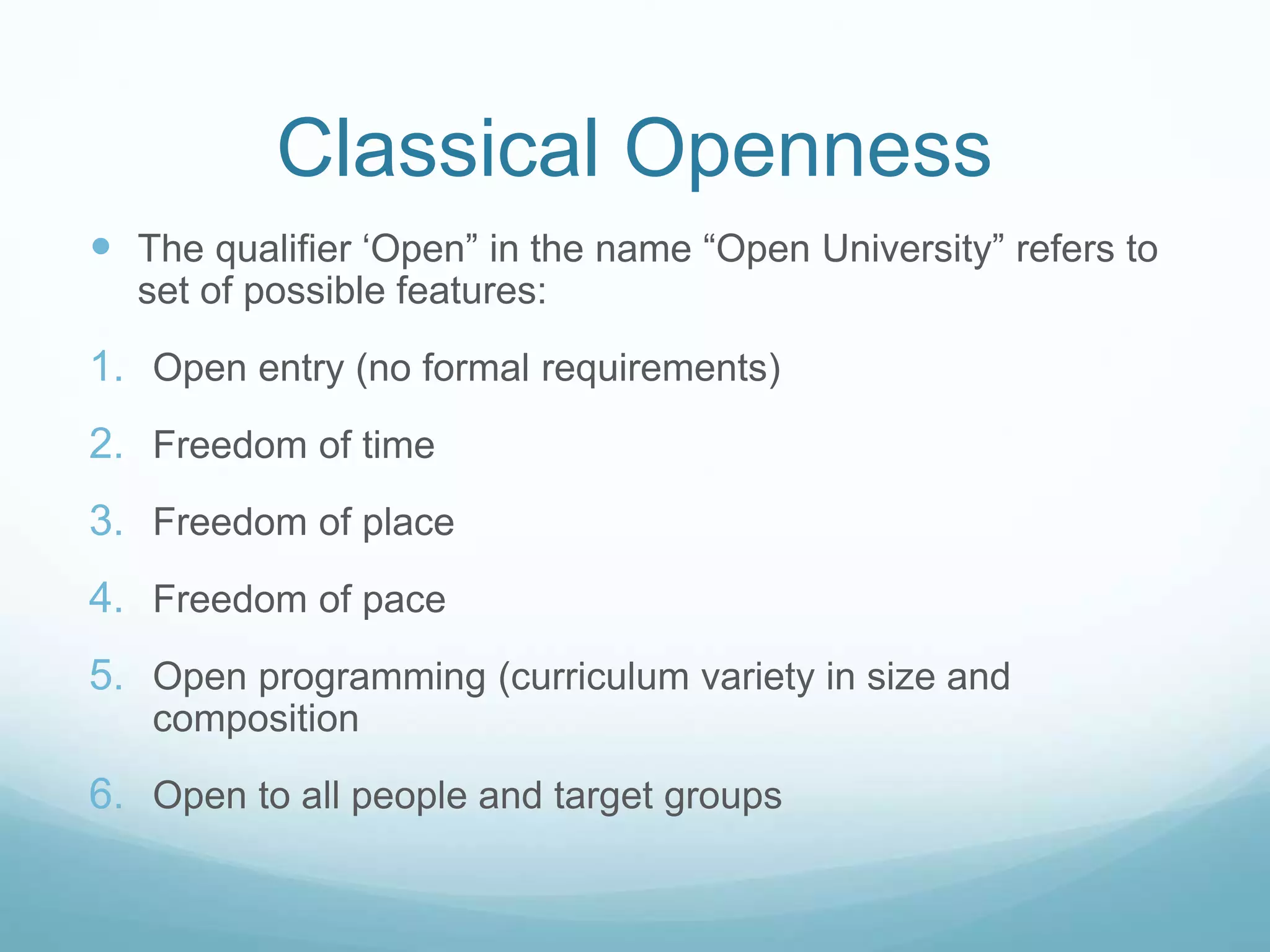
Classical Openness
 The qualifier ‘Open” in the name “Open University” refers to
set of possible features:
1. Open entry (no formal requirements)
2. Freedom of time
3. Freedom of place
4. Freedom of pace
5. Open programming (curriculum variety in size and
composition
6. Open to all people and target groups
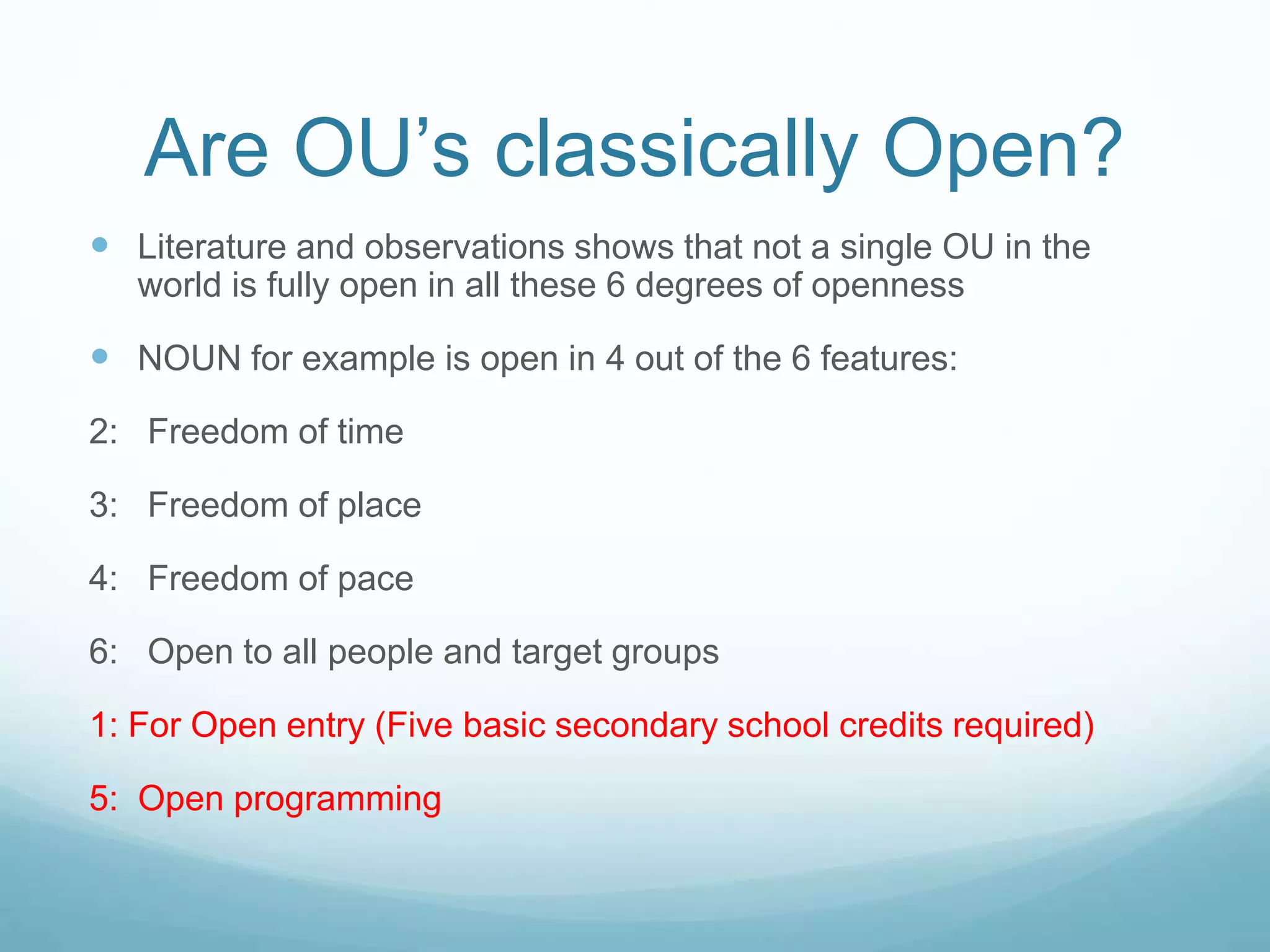
Are OU’s classically Open?
 Literature and observations shows that not a single OU in the
world is fully open in all these 6 degrees of openness
 NOUN for example is open in 4 out of the 6 features:
2: Freedom of time
3: Freedom of place
4: Freedom of pace
6: Open to all people and target groups
1: For Open entry (Five basic secondary school credits required)
5: Open programming
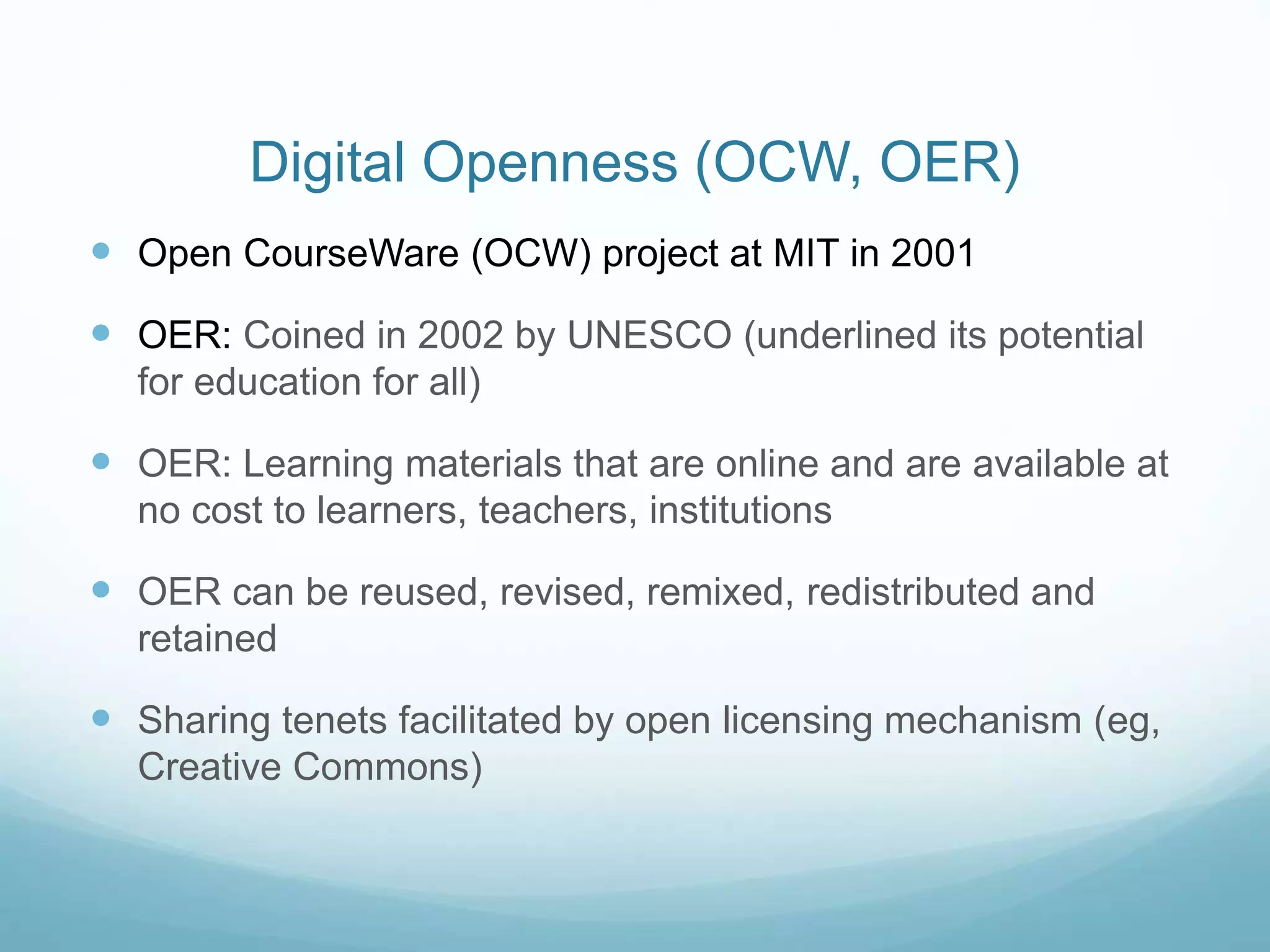
Digital Openness (OCW, OER)
 Open CourseWare (OCW) project at MIT in 2001
 OER: Coined in 2002 by UNESCO (underlined its potential
for education for all)
 OER: Learning materials that are online and are available at
no cost to learners, teachers, institutions
 OER can be reused, revised, remixed, redistributed and
retained
 Sharing tenets facilitated by open licensing mechanism (eg,
Creative Commons)
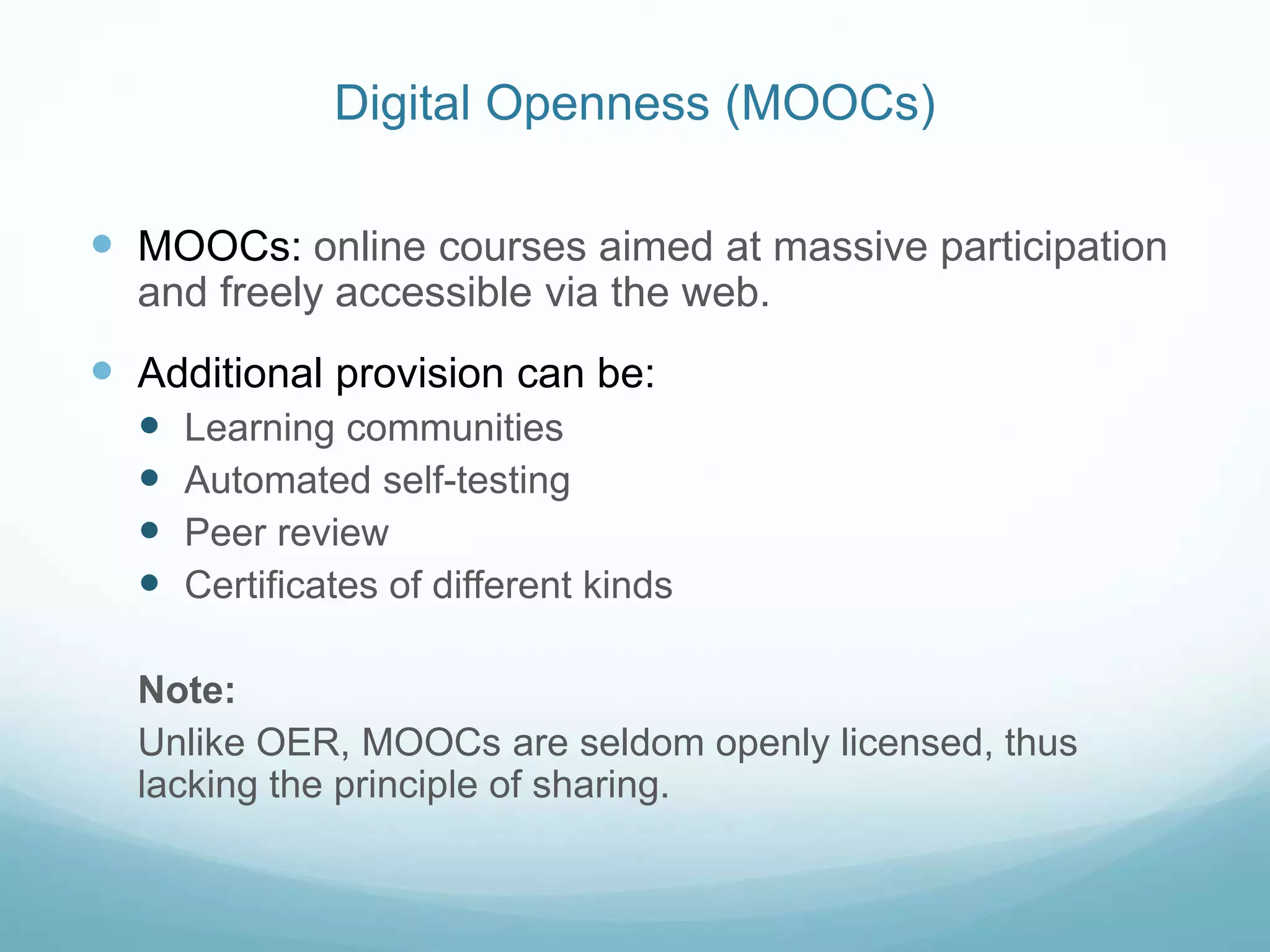
Digital Openness (MOOCs)
 MOOCs: online courses aimed at massive participation
and freely accessible via the web.
 Additional provision can be:
 Learning communities
 Automated self-testing
 Peer review
 Certificates of different kinds
Note:
Unlike OER, MOOCs are seldom openly licensed, thus
lacking the principle of sharing.
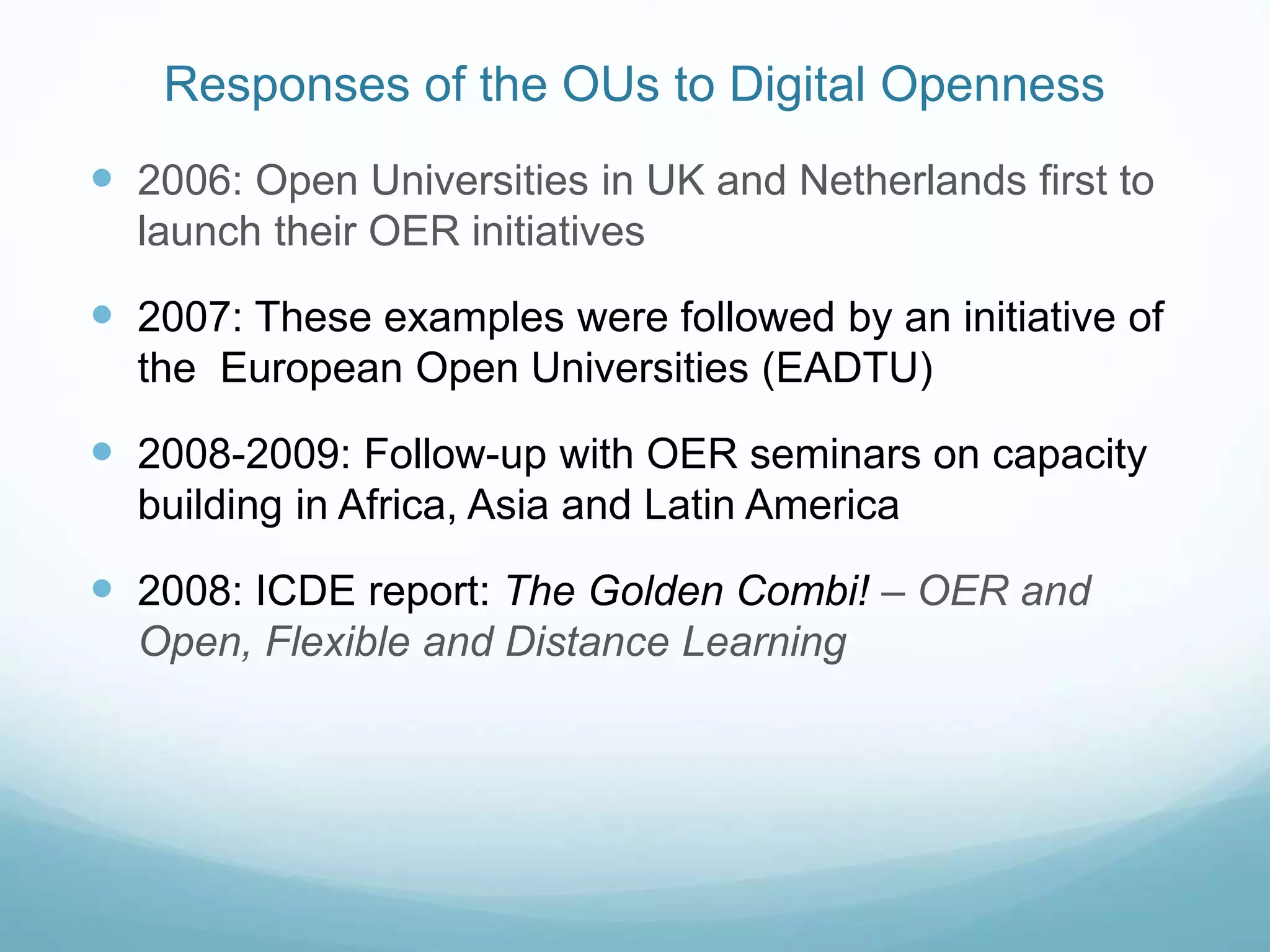
Responses of the OUs to Digital Openness
 2006: Open Universities in UK and Netherlands first to
launch their OER initiatives
 2007: These examples were followed by an initiative of
the European Open Universities (EADTU)
 2008-2009: Follow-up with OER seminars on capacity
building in Africa, Asia and Latin America
 2008: ICDE report: The Golden Combi! – OER and
Open, Flexible and Distance Learning
Responses of the OUs
 2009: UNESCO World Congress on Higher Education
Communiqué stated: “ODL approaches and ICTs
particularly OER presents opportunities to widen
access to quality education”
 2012: An EADTU conference keynote encouraged OUs
to consider becoming the European OER Universities
 2012: An ICDE Leadership meeting keynote expressed
that OER is fundamental to the Ous
 Despite all these calls, large number of OUs are
hesitant or cautions to embracing OER movement
Hesitance with OER
 Concern: Fear of negative effects for enrolment
 Anticipation: Will I get incentive for creating, using and
adapting OER
 Complacency: Fear of change
 However:
 OER and MOOCs are relevant change agents in higher
education
 New and highly innovative players have embraced
OER and MOOCs
NOUN’s Strategic Response
2013
 March 2013 – COL-ECOWAS-UNESCO Workshop on OER
 December 2013 (Dec. 6th) – PCF7 meeting (VC announced
NOUN’s intention to embrace OER) (COL)
2014
 June 2014 – NOUN participated in the high-level Executive
workshop in OER/MOOCs in Victoria Falls, Zimbabwe (UNESCO,
UNESCO Chair in OER at OUNL and ACDE)
 August 2014 – NOUN established an OER Unit (under the VC”s
office)
 September 2014 – OER/MOOCs sensitization workshop for Deans
and Directors of NOUN (146 participants)
NOUN’s Strategic Response
 February 2015 – OER/MOOCs sensitization workshop for senior staff
of NOUN (315 participants)
 July 2015 – OER technical workshop for course writers/owners
 October 28th 2015 - NOUN OER Unit officially commissioned by VC
 November 2015 – MOOCs design meeting (GST courses for
University admission seekers)
 9-11th December 2015 – official launch of NOUN OER/MOOCs project
to Federal Government of Nigeria/Stakeholders
Note: All these were facilitated by UNESCO/UNESCO Chair in OER at
OUNL
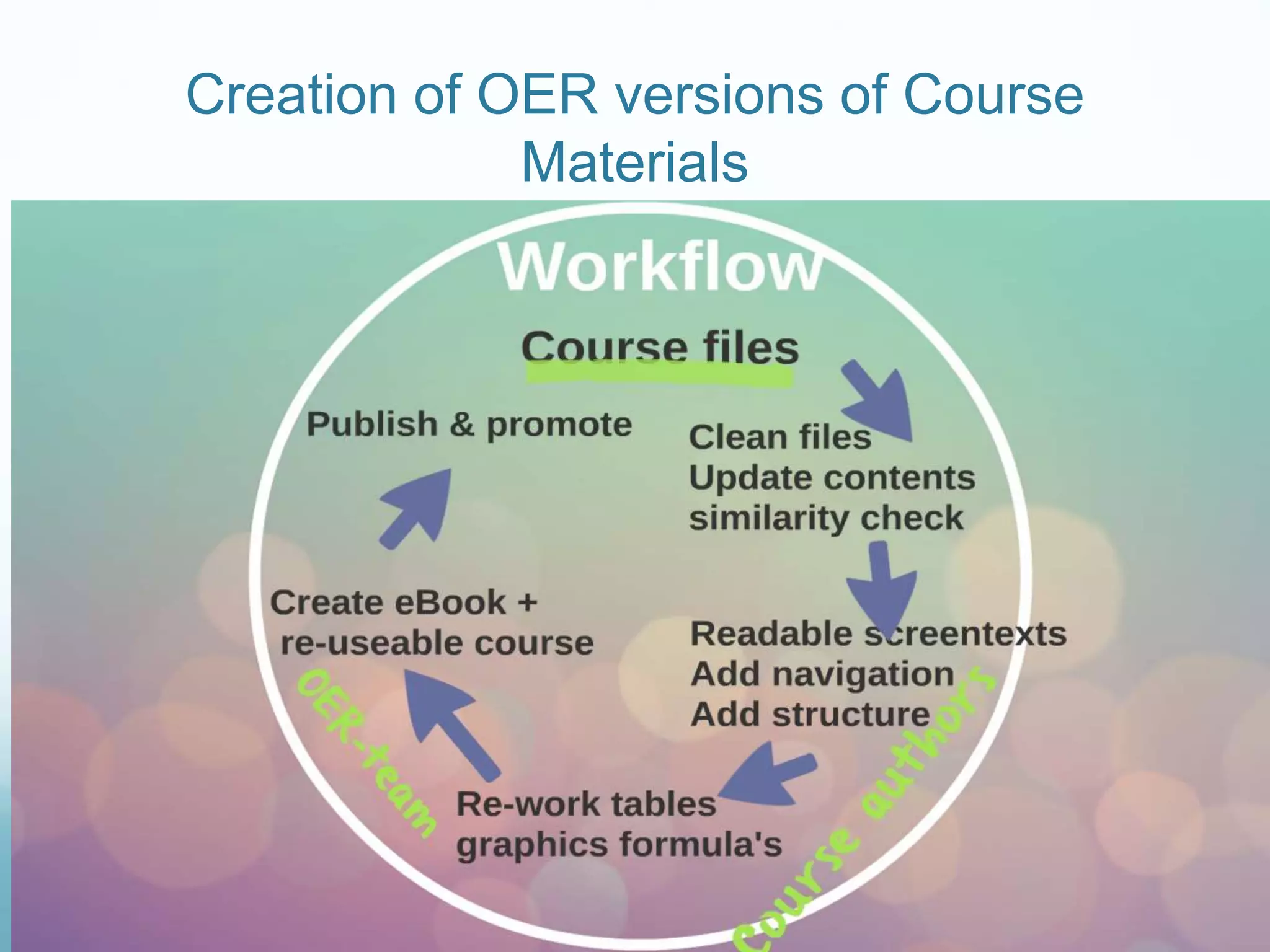
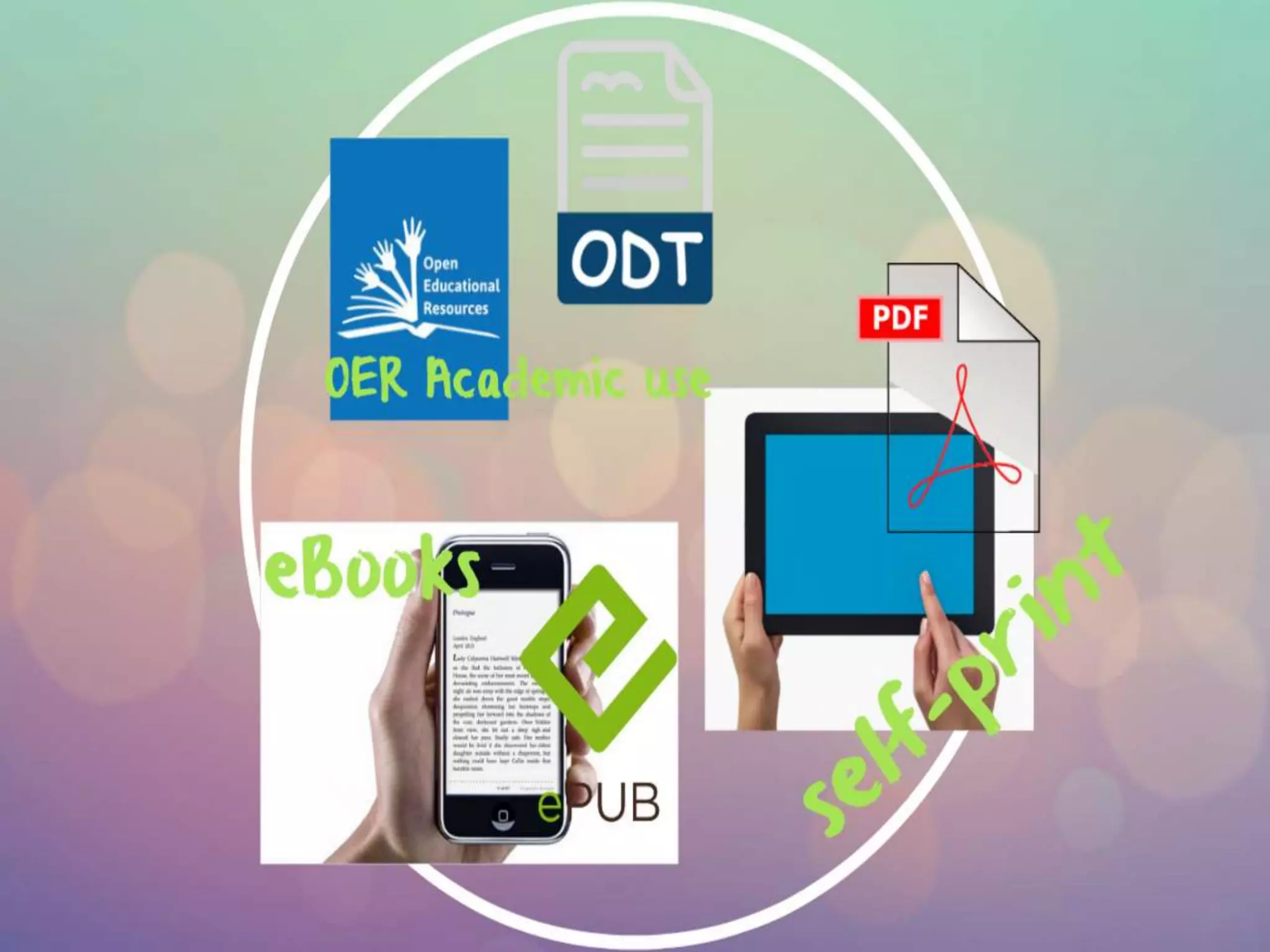
Creation of OER versions of Course
Materials
Creation of OER versions of Course
Materials
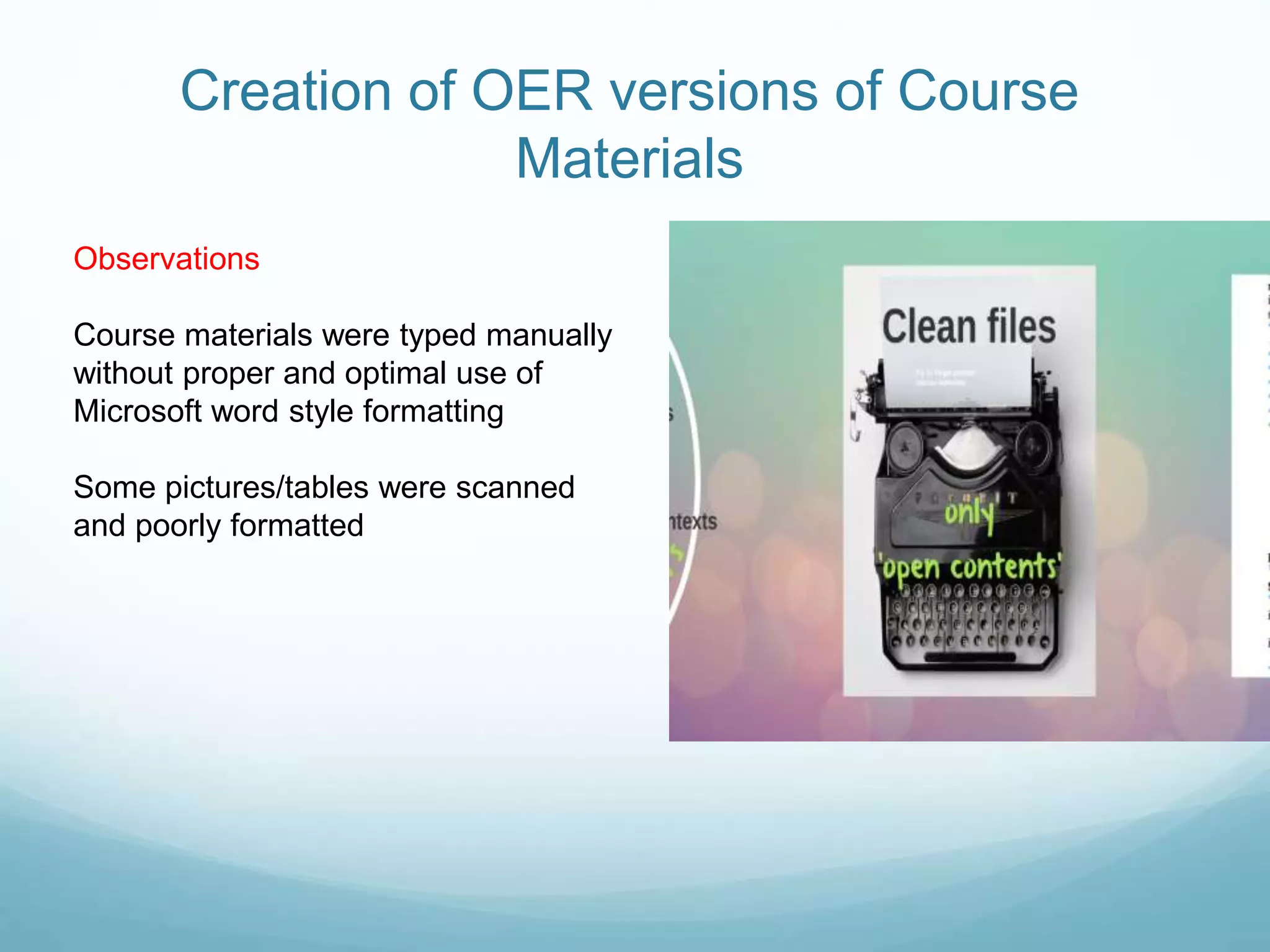
Observations
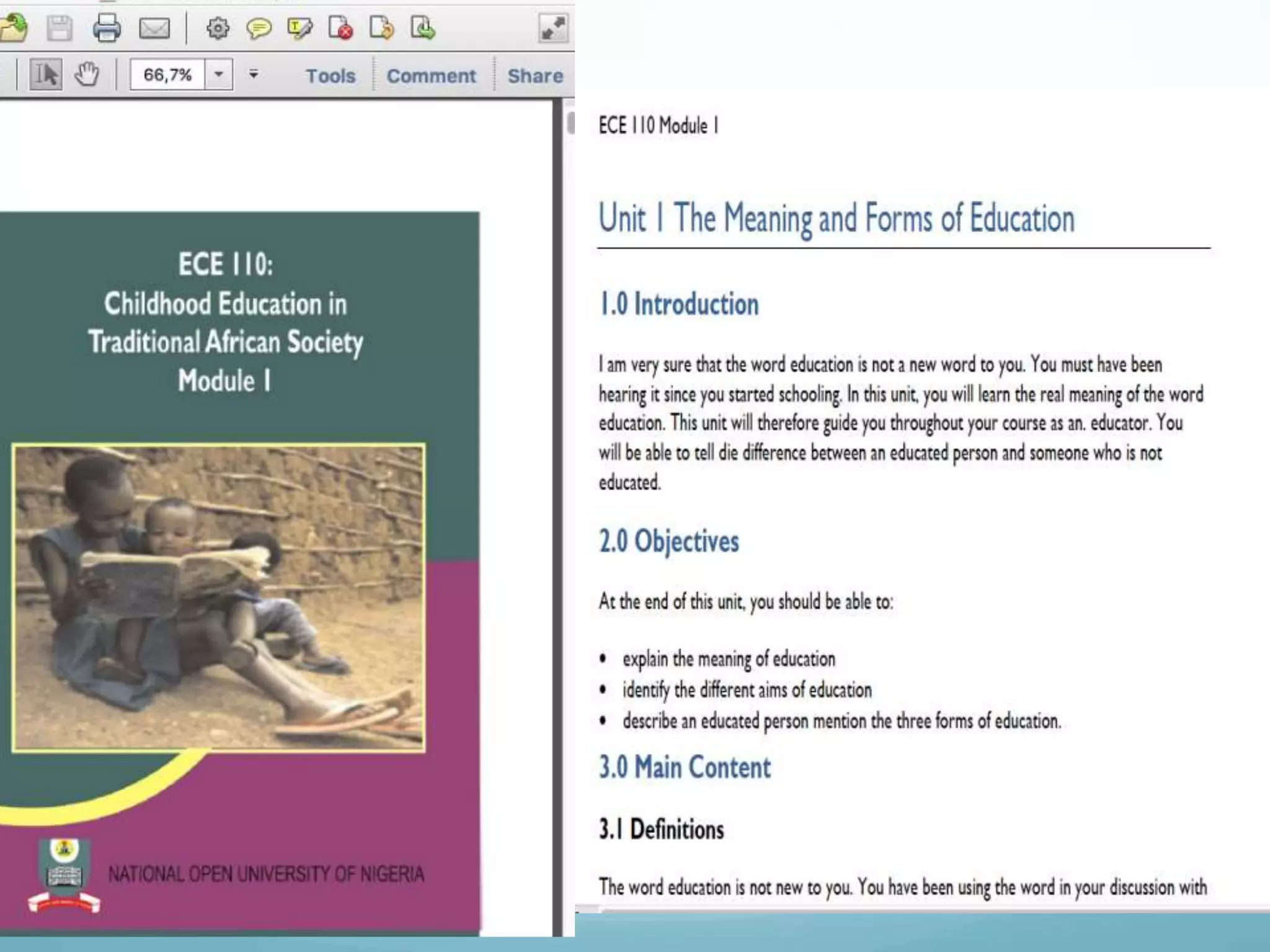
Course materials were typed manually
without proper and optimal use of
Microsoft word style formatting
Some pictures/tables were scanned
and poorly formatted
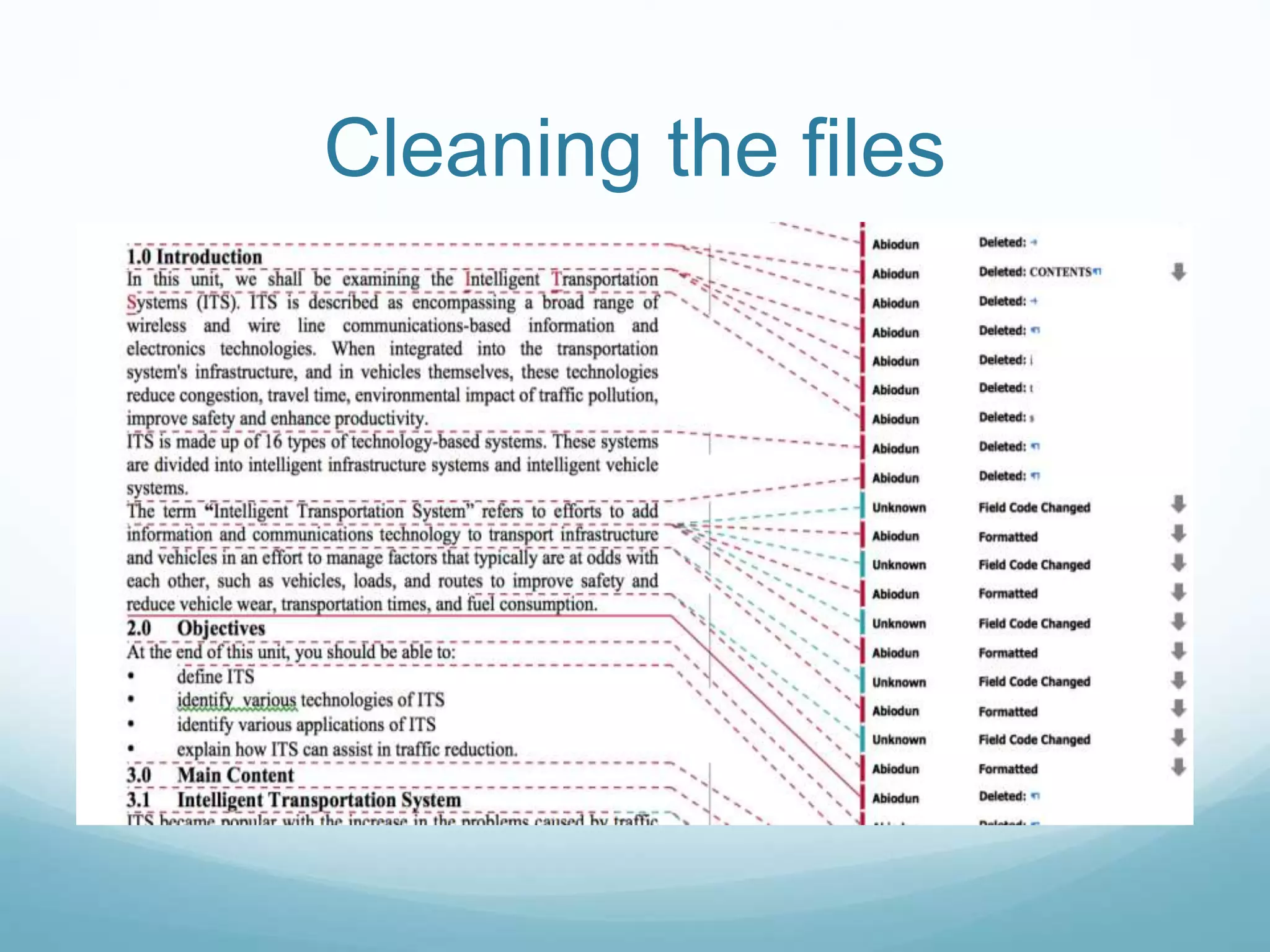
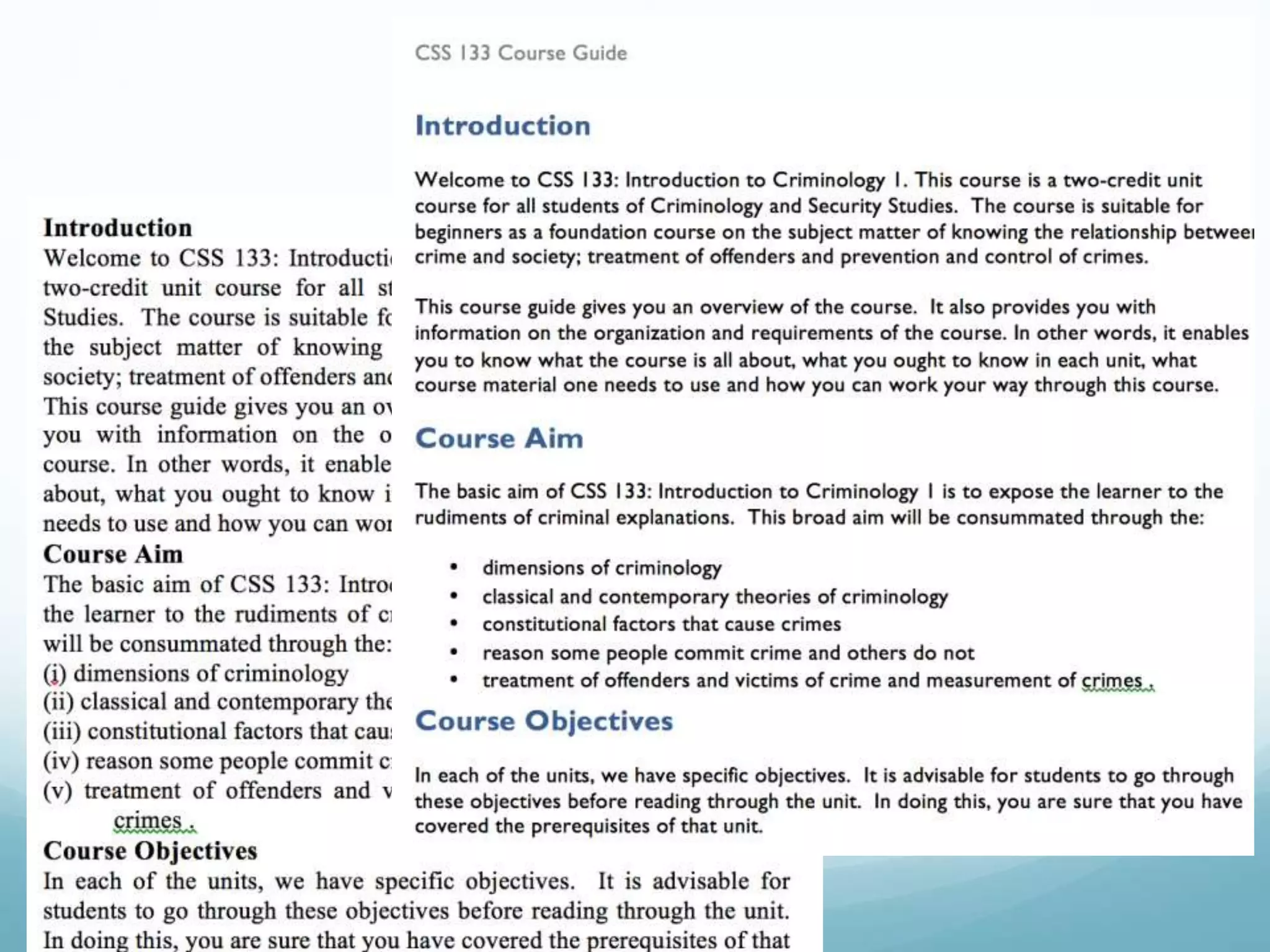
Cleaning the files
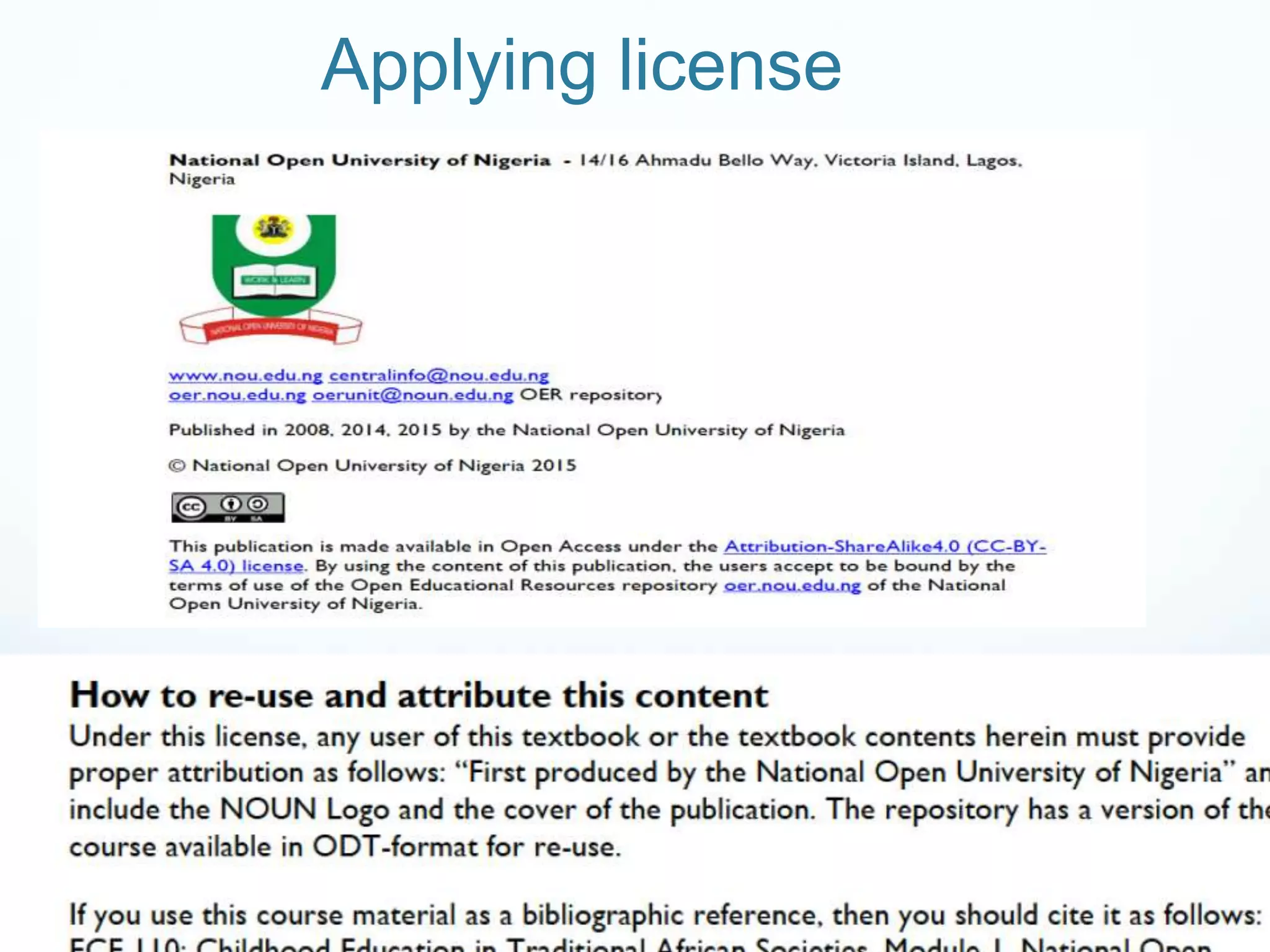
Applying license
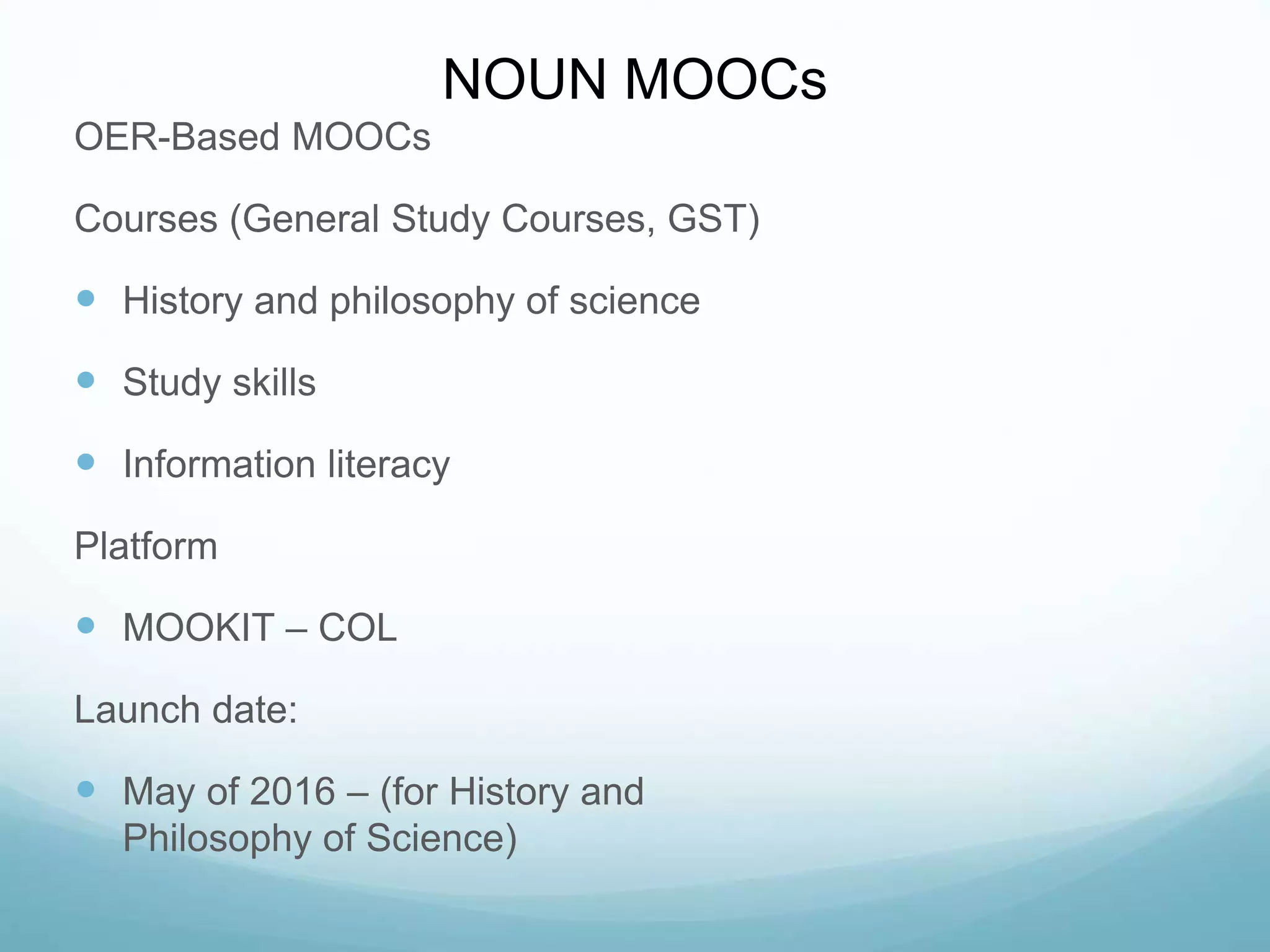
NOUN MOOCs
OER-Based MOOCs
Courses (General Study Courses, GST)
 History and philosophy of science
 Study skills
 Information literacy
Platform
 MOOKIT – COL
Launch date:
 May of 2016 – (for History and
Philosophy of Science)
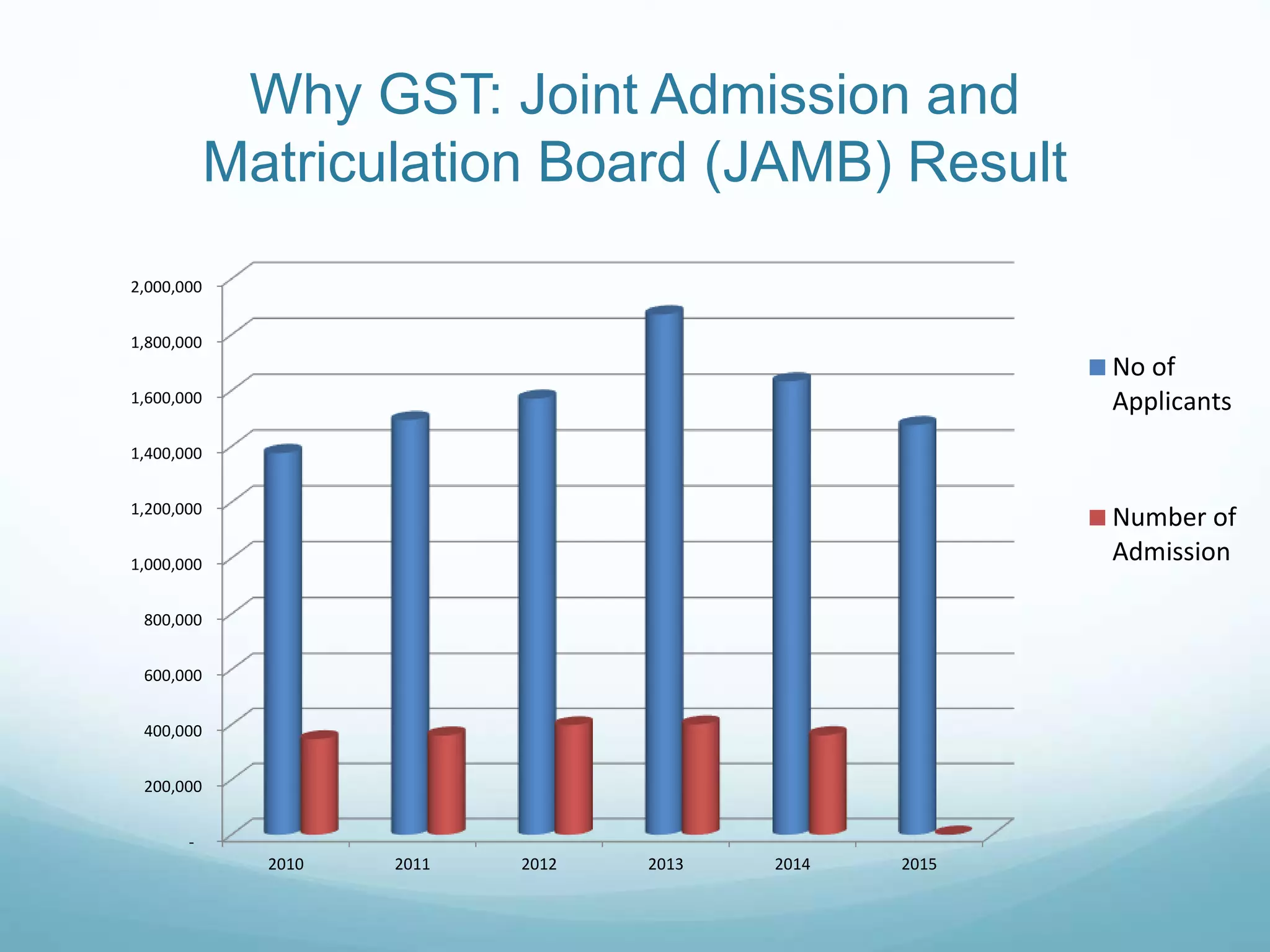
Why GST: Joint Admission and
Matriculation Board (JAMB) Result
-
200,000
400,000
600,000
800,000
1,000,000
1,200,000
1,400,000
1,600,000
1,800,000
2,000,000
2010 2011 2012 2013 2014 2015
No of
Applicants
Number of
Admission
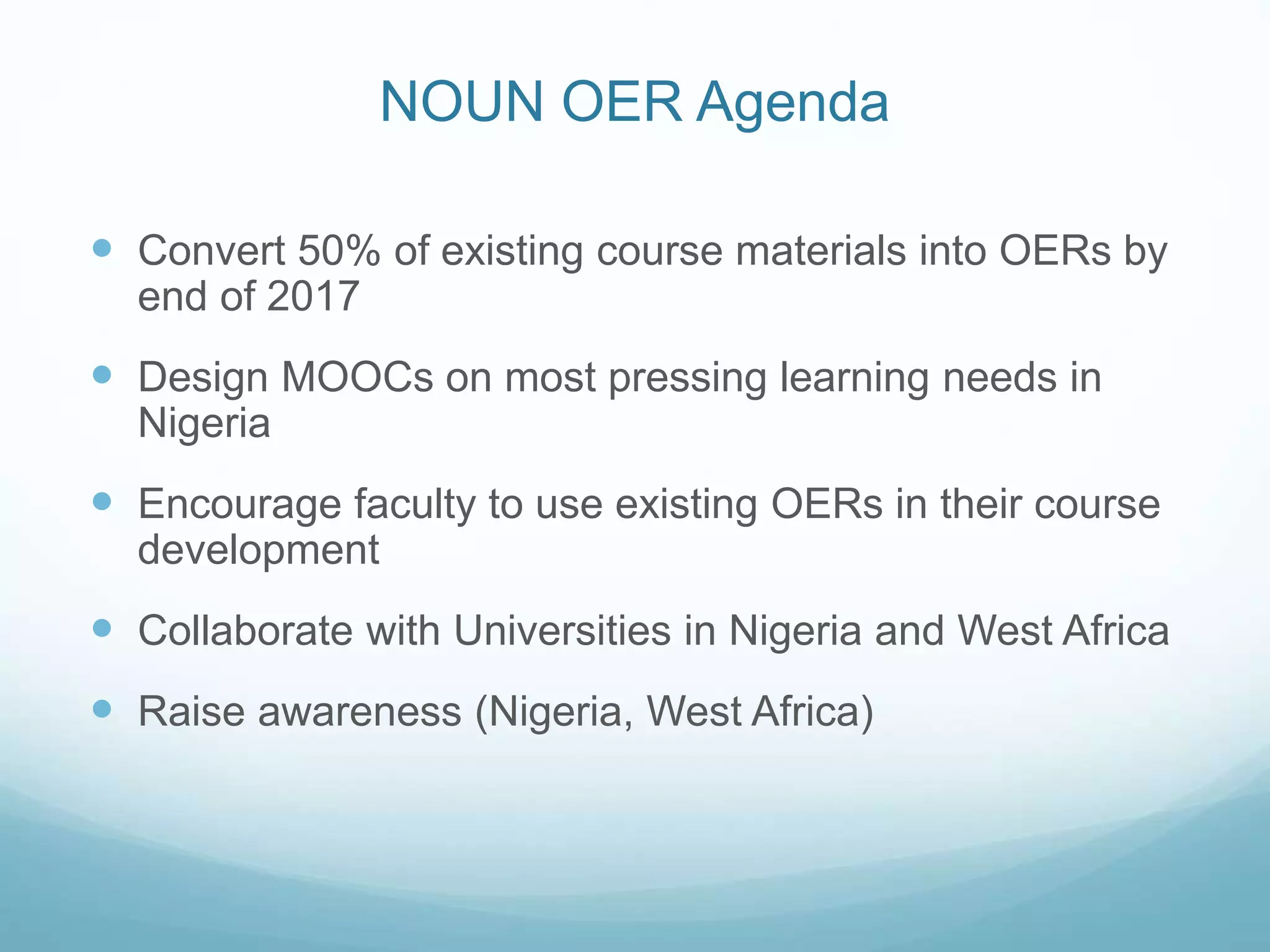
NOUN OER Agenda
 Convert 50% of existing course materials into OERs by
end of 2017
 Design MOOCs on most pressing learning needs in
Nigeria
 Encourage faculty to use existing OERs in their course
development
 Collaborate with Universities in Nigeria and West Africa
 Raise awareness (Nigeria, West Africa)
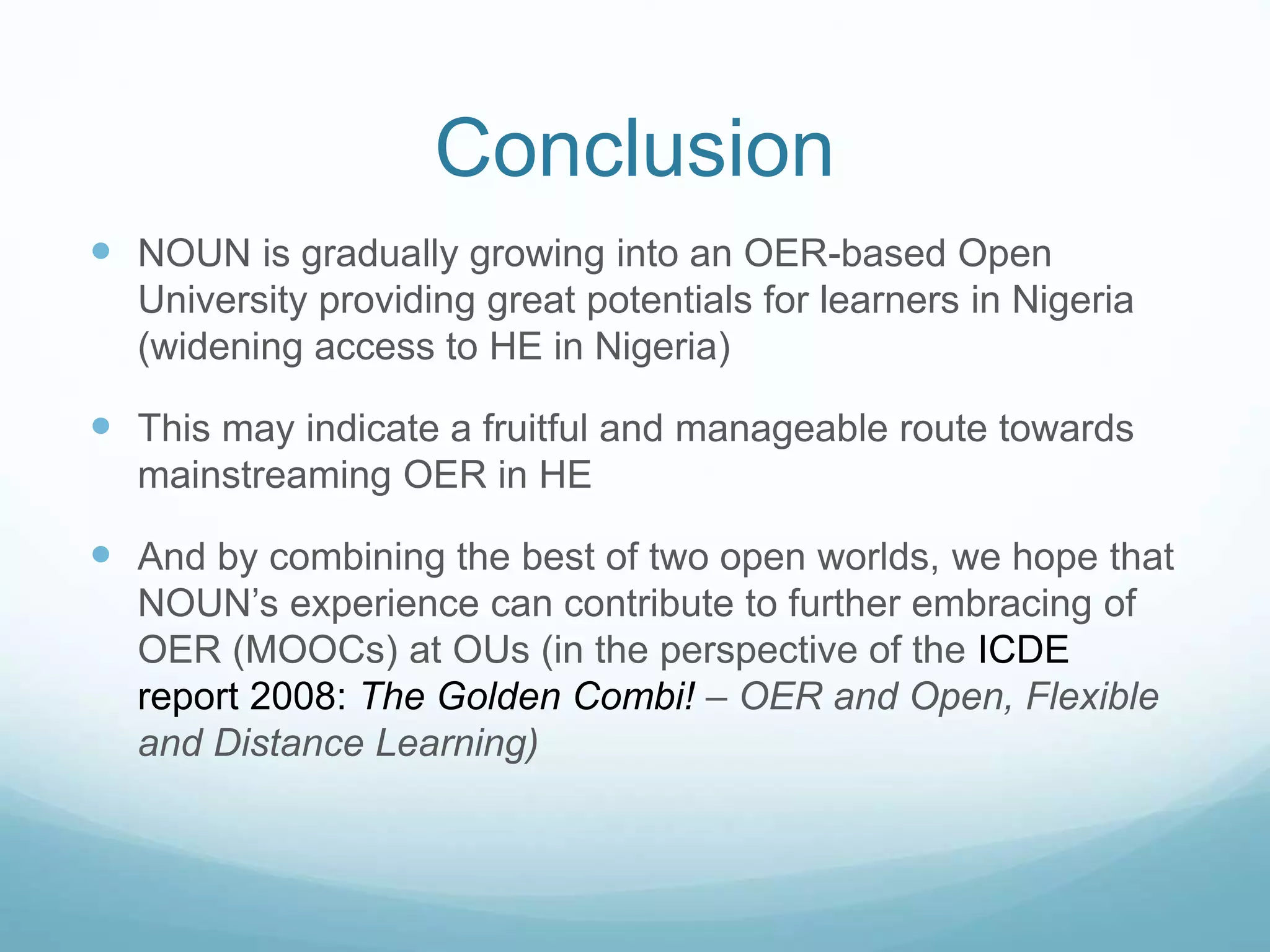
Conclusion
 NOUN is gradually growing into an OER-based Open
University providing great potentials for learners in Nigeria
(widening access to HE in Nigeria)
 This may indicate a fruitful and manageable route towards
mainstreaming OER in HE
 And by combining the best of two open worlds, we hope that
NOUN’s experience can contribute to further embracing of
OER (MOOCs) at OUs (in the perspective of the ICDE
report 2008: The Golden Combi! – OER and Open, Flexible
and Distance Learning)
Thank you

The Best of Two Open Worlds at the National Open University of Nigeria

  • 1.
    The Best ofTwo Open Worlds at the National Open University of Nigeria • Jane-frances Agbu (NOUN) • Fred Mulder – Emeritus UNESCO Chair in OER • Fred de Vries OUNL/Fontys University • Vincent Tenebe (Former VC, NOUN) • Abel Caine, UNESCO, India Presentation made at Open Education Global Conference, Krakow, Poland, 12th April 2016
  • 2.
    Presentation Structure  Classicalopenness  Digital openness (OCW, OER, MOOCs)  Responses of OUs to the digital openness  NOUN’s response to OER and MOOCs
  • 3.
    A bit ofNOUN  Established in 2002 (1983)  Headquarters, Abuja, Nigeria  VC: Prof Abdalla Adamu  Student Pop. 186,000+ (Active) (2015) (400,000 enrolment)  70+ study centres  Website: www.nou.edu.ng  Online Course materials: 1600+
  • 4.
    Classical Openness  Thequalifier ‘Open” in the name “Open University” refers to set of possible features: 1. Open entry (no formal requirements) 2. Freedom of time 3. Freedom of place 4. Freedom of pace 5. Open programming (curriculum variety in size and composition 6. Open to all people and target groups
  • 5.
    Are OU’s classicallyOpen?  Literature and observations shows that not a single OU in the world is fully open in all these 6 degrees of openness  NOUN for example is open in 4 out of the 6 features: 2: Freedom of time 3: Freedom of place 4: Freedom of pace 6: Open to all people and target groups 1: For Open entry (Five basic secondary school credits required) 5: Open programming
  • 6.
    Digital Openness (OCW,OER)  Open CourseWare (OCW) project at MIT in 2001  OER: Coined in 2002 by UNESCO (underlined its potential for education for all)  OER: Learning materials that are online and are available at no cost to learners, teachers, institutions  OER can be reused, revised, remixed, redistributed and retained  Sharing tenets facilitated by open licensing mechanism (eg, Creative Commons)
  • 7.
    Digital Openness (MOOCs) MOOCs: online courses aimed at massive participation and freely accessible via the web.  Additional provision can be:  Learning communities  Automated self-testing  Peer review  Certificates of different kinds Note: Unlike OER, MOOCs are seldom openly licensed, thus lacking the principle of sharing.
  • 8.
    Responses of theOUs to Digital Openness  2006: Open Universities in UK and Netherlands first to launch their OER initiatives  2007: These examples were followed by an initiative of the European Open Universities (EADTU)  2008-2009: Follow-up with OER seminars on capacity building in Africa, Asia and Latin America  2008: ICDE report: The Golden Combi! – OER and Open, Flexible and Distance Learning
  • 9.
    Responses of theOUs  2009: UNESCO World Congress on Higher Education Communiqué stated: “ODL approaches and ICTs particularly OER presents opportunities to widen access to quality education”  2012: An EADTU conference keynote encouraged OUs to consider becoming the European OER Universities  2012: An ICDE Leadership meeting keynote expressed that OER is fundamental to the Ous  Despite all these calls, large number of OUs are hesitant or cautions to embracing OER movement
  • 10.
    Hesitance with OER Concern: Fear of negative effects for enrolment  Anticipation: Will I get incentive for creating, using and adapting OER  Complacency: Fear of change  However:  OER and MOOCs are relevant change agents in higher education  New and highly innovative players have embraced OER and MOOCs
  • 11.
    NOUN’s Strategic Response 2013 March 2013 – COL-ECOWAS-UNESCO Workshop on OER  December 2013 (Dec. 6th) – PCF7 meeting (VC announced NOUN’s intention to embrace OER) (COL) 2014  June 2014 – NOUN participated in the high-level Executive workshop in OER/MOOCs in Victoria Falls, Zimbabwe (UNESCO, UNESCO Chair in OER at OUNL and ACDE)  August 2014 – NOUN established an OER Unit (under the VC”s office)  September 2014 – OER/MOOCs sensitization workshop for Deans and Directors of NOUN (146 participants)
  • 12.
    NOUN’s Strategic Response February 2015 – OER/MOOCs sensitization workshop for senior staff of NOUN (315 participants)  July 2015 – OER technical workshop for course writers/owners  October 28th 2015 - NOUN OER Unit officially commissioned by VC  November 2015 – MOOCs design meeting (GST courses for University admission seekers)  9-11th December 2015 – official launch of NOUN OER/MOOCs project to Federal Government of Nigeria/Stakeholders Note: All these were facilitated by UNESCO/UNESCO Chair in OER at OUNL
  • 13.
    Creation of OERversions of Course Materials
  • 14.
    Creation of OERversions of Course Materials Observations Course materials were typed manually without proper and optimal use of Microsoft word style formatting Some pictures/tables were scanned and poorly formatted
  • 15.
  • 18.
  • 20.
    NOUN MOOCs OER-Based MOOCs Courses(General Study Courses, GST)  History and philosophy of science  Study skills  Information literacy Platform  MOOKIT – COL Launch date:  May of 2016 – (for History and Philosophy of Science)
  • 21.
    Why GST: JointAdmission and Matriculation Board (JAMB) Result - 200,000 400,000 600,000 800,000 1,000,000 1,200,000 1,400,000 1,600,000 1,800,000 2,000,000 2010 2011 2012 2013 2014 2015 No of Applicants Number of Admission
  • 22.
    NOUN OER Agenda Convert 50% of existing course materials into OERs by end of 2017  Design MOOCs on most pressing learning needs in Nigeria  Encourage faculty to use existing OERs in their course development  Collaborate with Universities in Nigeria and West Africa  Raise awareness (Nigeria, West Africa)
  • 23.
    Conclusion  NOUN isgradually growing into an OER-based Open University providing great potentials for learners in Nigeria (widening access to HE in Nigeria)  This may indicate a fruitful and manageable route towards mainstreaming OER in HE  And by combining the best of two open worlds, we hope that NOUN’s experience can contribute to further embracing of OER (MOOCs) at OUs (in the perspective of the ICDE report 2008: The Golden Combi! – OER and Open, Flexible and Distance Learning)
  • 24.