OER World Map
Prototypes
• UNICAMP & Open Knowledge Foundation Brasil
• The Institute for the Study of Knowledge Management in Education
(ISKME)
• North Rhine-Westphalian Library Service Center (hbz)
Panel Facilitator: Kathy Nicholson, Hewlett Foundation
April 24, 2014
Project Background
• Extensive online discussion re: OER mapping
• Need for seeing & connecting OER projects
• Experiment: Open RFP, 3 awards of $25k each
• Today: OER community comments and feedback
• To inform next open RFP, to be issued in Q3 2014
Please comment by April 30!
• #oermap
• hfknicholson@gmail.com
RATIONALE
Content
K-12
Latin America
Portuguese/
Spanish
Sources
OER experts
Literature
Sites
Analyses
OER maps
Mapping
systems
System
Open-source
Open-map
Open-content
Distributed
DATA SOURCES
70+ specialists, 30% return rate (so far) and growing
Latin America (especially) but also beyond
Publications and sites (Gov’t/Ministries)
Previous inventories (OER Brazil, EdAberta)
Well-known resources (TEMOA, RELPE, OEI, Dictalia)
Academic publications and reports (UNESCO, COL)
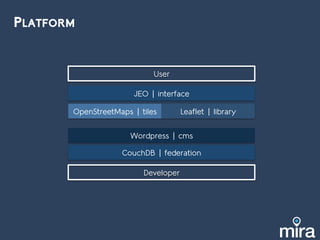
PLATFORM
OpenStreetMaps | tiles Leaflet | library
JEO | interface
CouchDB | federation
Wordpress | cms
User
Developer
TOP FEATURES
Facile open source throughout
Replicate content and system, decentralization
Complex searches
Among the whole scheme of metadata
Navigate through text searches or countries
Multilingual
Support for multiple languages in interface and content
User interaction
Complete user form for suggestions, easy comments and demonstration of user-
created collections
Novel content
LatAm, and especially K-12 were an area of limited exposure in OER
SCALABILITY
Steal this map!
All data is downloadable through a simple link in standard JSON format
Resource-based data
Interface already permits resource-metadata content
Extensible system
CMS-based system allows for multiple new apps and widgets
Data inclusion
Easily include new data through user recommendations and admin interface
Standards defined
Metadata standard shared among projects (eMundus/POERUP) and aligned with
Dublin Core
NEXT STEPS
Expand the scope of the initiatives
Expand on the decentralization scheme
Expand the application interface to incorporate
harvested resource-metadata
Make use of linked data/URIs
Disconnect the system from its Wordpress-
dependency
Dynamically organize and present content and allow
interaction with users
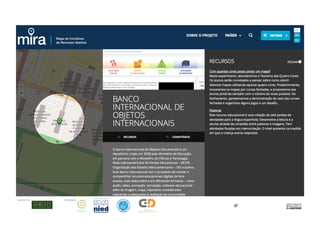
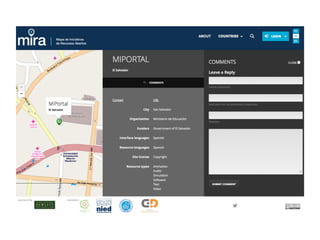
www.mira.org.br
Tel Amiel UNICAMP/Brasil
Everton Alvarenga Open Knowledge - Brasil
Priscila Gonsales IED/Brasil
Xavier Ochoa ESPOL/Ecuador
Tiago Soares
Carlos Villavicencio
Andre Deak
Felipe Lavignatti
Gabriel Fedel
OER World Map Project:
Approach, Design, and Next Steps
Kate Katz, Product Manager, ISKME
Hewlett OER Grantee Meeting 2014
April 24, 2014
ISKME 2014:
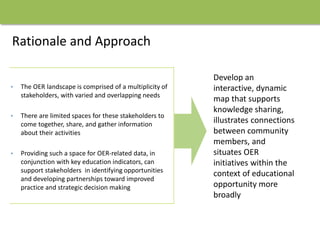
Rationale and Approach
• The OER landscape is comprised of a multiplicity of
stakeholders, with varied and overlapping needs
• There are limited spaces for these stakeholders to
come together, share, and gather information
about their activities
• Providing such a space for OER-related data, in
conjunction with key education indicators, can
support stakeholders in identifying opportunities
and developing partnerships toward improved
practice and strategic decision making
Develop an
interactive, dynamic
map that supports
knowledge sharing,
illustrates connections
between community
members, and
situates OER
initiatives within the
context of educational
opportunity more
broadly
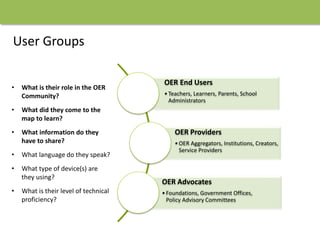
User Groups
OER End Users
Teachers, Learners, Parents, School
Administrators
OER Providers
OER Aggregators, Institutions, Creators,
Service Providers
OER Advocates
Foundations, Government Offices,
Policy Advisory Committees
• What is their role in the OER
Community?
• What did they come to the
map to learn?
• What information do they
have to share?
• What language do they speak?
• What type of device(s) are
they using?
• What is their level of technical
proficiency?
Data Sources
Category Source Description
Resources OER Commons
Resource metadata (language, grade level,
etc.) and evaluations
Providers
OLnet Evidence Hub
OER Commons
Provider name, contact information, goals,
description, primary language, page views
by region
OER Policy TAACCCT
Information about institutions supported by
TAACCCT policy funding
Education Indicators
World Bank
UNESCO
Multiple education indicators by
country/year, including enrollment rates by
school level, by education program and
institution, literacy rates, expenditure per
student, etc.
Features
Multi-Dimensional View
Use multiple layers and distinct icons
to create a single view of data across
several parameters
Share My Map
Share a direct link to a version of
the map
Easy-to-Use Filters
Filter the map by resource
language, institution type,
educational indicator, etc.
Timeline Tool
View changes over time across
specific map parameters
Data Export Tool
Download education data,
resource data, and OER
policy data
Example Use Case
OER Advocate | Partnerships
User: Program officer
at a foundation
Goal: Identify new
geographic areas for K-
12 OER investment in
the MENA region
Example Use Case
Provider | Collaboration
User: OER Provider in
Brazil creating college-
level social science
resources in Portuguese
Goal: Expand its user
base to all of South
America by partnering
with organizations with
a significant number of
users in the region, and
who can help translate
its resources from
Portuguese to Spanish
Next Steps: Building Scale
Conduct outreach and build community
Expand API integrations Enable user-generated reports
Develop new input and output features
Develop mechanisms
to capture user input
Develop direct record creation
and editing interface
Iterate on and improve the interface
Gather user feedback Conduct user tests
kate@iskme.org
Institute for the Study of Knowledge
Management in Education
Developing an OER World
Map prototype
OER Grantees Meeting. Sausalito, 24.04.2014.
Felix Ostrowski & Adrian Pohl
Rationale
2
A map is only one of many possible expositions of
data
Possibly not even the best one in some cases
It’s all about the data!
That is why we built the OER Data Hub...
… and the OER World Map on top of it.
Ostrowski/Pohl: OER World Map Prototype
Data Sources
3
OCWC membership data
Global list of OER initiatives from UNESCO`s WSIS
Knowledge Communities
… and a handful of manual entries
Ostrowski/Pohl: OER World Map Prototype
Technology
4
Data Hub
Play: “The High Velocity Web Framework For Java
and Scala”
Elasticsearch: “a flexible and powerful open source,
distributed, real-time search and analytics engine”
World Map
Drupal: “an open source content management
platform”
Leaflet.js: “a modern open-source JavaScript library
for mobile-friendly interactive maps”
Ostrowski/Pohl: OER World Map Prototype
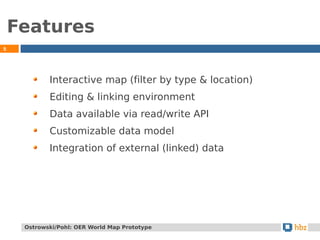
Features
5
Interactive map (filter by type & location)
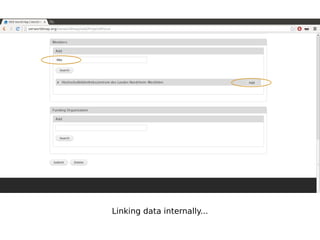
Editing & linking environment
Data available via read/write API
Customizable data model
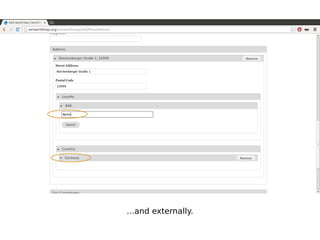
Integration of external (linked) data
Ostrowski/Pohl: OER World Map Prototype
Data Model
OER World Map
Creating a new entry
Entry web page
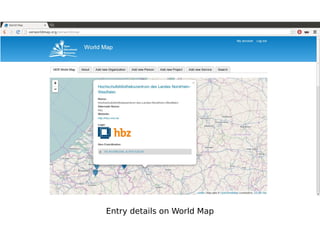
Entry details on World Map
Entry details in the Data Hub
Linking data internally...
...and externally.
Links yield additional data
Scalability
15
The approach of a decoupled frontend
& backend scales well organisationally
(many stakeholders can use the Data
Hub) and technically (additional
hardware & software components can be
added as the dataset & its use grows).
Ostrowski/Pohl: OER World Map Prototype
Next Steps – Technical
16
Improve world map presentation & interaction
possibilities
Validate data based on application profile
Refine data model & application profile
Improve resource presentation & web form
Add provenance, administrative metadata and
versioning
Ostrowski/Pohl: OER World Map Prototype
Next Steps – Organisational
17
Motivate community to participate
Initiate cooperations with other data curators
Discuss and implement editorial process
Enrich data (add missing information, subject
classification etc.)
Ostrowski/Pohl: OER World Map Prototype
Take a look!
18
http://oerworldmap.org
http://api.lobid.org/oer
Ostrowski/Pohl: OER World Map Prototype
Thanks for your attention!
These slides are licensed under a CC-BY 4.0 license.

OER World Map Prototypes

  • 1.
    OER World Map Prototypes •UNICAMP & Open Knowledge Foundation Brasil • The Institute for the Study of Knowledge Management in Education (ISKME) • North Rhine-Westphalian Library Service Center (hbz) Panel Facilitator: Kathy Nicholson, Hewlett Foundation April 24, 2014
  • 2.
    Project Background • Extensiveonline discussion re: OER mapping • Need for seeing & connecting OER projects • Experiment: Open RFP, 3 awards of $25k each • Today: OER community comments and feedback • To inform next open RFP, to be issued in Q3 2014
  • 3.
    Please comment byApril 30! • #oermap • hfknicholson@gmail.com
  • 5.
    RATIONALE Content K-12 Latin America Portuguese/ Spanish Sources OER experts Literature Sites Analyses OERmaps Mapping systems System Open-source Open-map Open-content Distributed
  • 6.
    DATA SOURCES 70+ specialists,30% return rate (so far) and growing Latin America (especially) but also beyond Publications and sites (Gov’t/Ministries) Previous inventories (OER Brazil, EdAberta) Well-known resources (TEMOA, RELPE, OEI, Dictalia) Academic publications and reports (UNESCO, COL)
  • 7.
    PLATFORM OpenStreetMaps | tilesLeaflet | library JEO | interface CouchDB | federation Wordpress | cms User Developer
  • 8.
    TOP FEATURES Facile opensource throughout Replicate content and system, decentralization Complex searches Among the whole scheme of metadata Navigate through text searches or countries Multilingual Support for multiple languages in interface and content User interaction Complete user form for suggestions, easy comments and demonstration of user- created collections Novel content LatAm, and especially K-12 were an area of limited exposure in OER
  • 12.
    SCALABILITY Steal this map! Alldata is downloadable through a simple link in standard JSON format Resource-based data Interface already permits resource-metadata content Extensible system CMS-based system allows for multiple new apps and widgets Data inclusion Easily include new data through user recommendations and admin interface Standards defined Metadata standard shared among projects (eMundus/POERUP) and aligned with Dublin Core
  • 13.
    NEXT STEPS Expand thescope of the initiatives Expand on the decentralization scheme Expand the application interface to incorporate harvested resource-metadata Make use of linked data/URIs Disconnect the system from its Wordpress- dependency Dynamically organize and present content and allow interaction with users
  • 14.
    www.mira.org.br Tel Amiel UNICAMP/Brasil EvertonAlvarenga Open Knowledge - Brasil Priscila Gonsales IED/Brasil Xavier Ochoa ESPOL/Ecuador Tiago Soares Carlos Villavicencio Andre Deak Felipe Lavignatti Gabriel Fedel
  • 15.
    OER World MapProject: Approach, Design, and Next Steps Kate Katz, Product Manager, ISKME Hewlett OER Grantee Meeting 2014 April 24, 2014 ISKME 2014:
  • 16.
    Rationale and Approach •The OER landscape is comprised of a multiplicity of stakeholders, with varied and overlapping needs • There are limited spaces for these stakeholders to come together, share, and gather information about their activities • Providing such a space for OER-related data, in conjunction with key education indicators, can support stakeholders in identifying opportunities and developing partnerships toward improved practice and strategic decision making Develop an interactive, dynamic map that supports knowledge sharing, illustrates connections between community members, and situates OER initiatives within the context of educational opportunity more broadly
  • 17.
    User Groups OER EndUsers Teachers, Learners, Parents, School Administrators OER Providers OER Aggregators, Institutions, Creators, Service Providers OER Advocates Foundations, Government Offices, Policy Advisory Committees • What is their role in the OER Community? • What did they come to the map to learn? • What information do they have to share? • What language do they speak? • What type of device(s) are they using? • What is their level of technical proficiency?
  • 18.
    Data Sources Category SourceDescription Resources OER Commons Resource metadata (language, grade level, etc.) and evaluations Providers OLnet Evidence Hub OER Commons Provider name, contact information, goals, description, primary language, page views by region OER Policy TAACCCT Information about institutions supported by TAACCCT policy funding Education Indicators World Bank UNESCO Multiple education indicators by country/year, including enrollment rates by school level, by education program and institution, literacy rates, expenditure per student, etc.
  • 19.
    Features Multi-Dimensional View Use multiplelayers and distinct icons to create a single view of data across several parameters Share My Map Share a direct link to a version of the map Easy-to-Use Filters Filter the map by resource language, institution type, educational indicator, etc. Timeline Tool View changes over time across specific map parameters Data Export Tool Download education data, resource data, and OER policy data
  • 20.
    Example Use Case OERAdvocate | Partnerships User: Program officer at a foundation Goal: Identify new geographic areas for K- 12 OER investment in the MENA region
  • 21.
    Example Use Case Provider| Collaboration User: OER Provider in Brazil creating college- level social science resources in Portuguese Goal: Expand its user base to all of South America by partnering with organizations with a significant number of users in the region, and who can help translate its resources from Portuguese to Spanish
  • 22.
    Next Steps: BuildingScale Conduct outreach and build community Expand API integrations Enable user-generated reports Develop new input and output features Develop mechanisms to capture user input Develop direct record creation and editing interface Iterate on and improve the interface Gather user feedback Conduct user tests
  • 23.
    kate@iskme.org Institute for theStudy of Knowledge Management in Education
  • 24.
    Developing an OERWorld Map prototype OER Grantees Meeting. Sausalito, 24.04.2014. Felix Ostrowski & Adrian Pohl
  • 25.
    Rationale 2 A map isonly one of many possible expositions of data Possibly not even the best one in some cases It’s all about the data! That is why we built the OER Data Hub... … and the OER World Map on top of it. Ostrowski/Pohl: OER World Map Prototype
  • 26.
    Data Sources 3 OCWC membershipdata Global list of OER initiatives from UNESCO`s WSIS Knowledge Communities … and a handful of manual entries Ostrowski/Pohl: OER World Map Prototype
  • 27.
    Technology 4 Data Hub Play: “TheHigh Velocity Web Framework For Java and Scala” Elasticsearch: “a flexible and powerful open source, distributed, real-time search and analytics engine” World Map Drupal: “an open source content management platform” Leaflet.js: “a modern open-source JavaScript library for mobile-friendly interactive maps” Ostrowski/Pohl: OER World Map Prototype
  • 28.
    Features 5 Interactive map (filterby type & location) Editing & linking environment Data available via read/write API Customizable data model Integration of external (linked) data Ostrowski/Pohl: OER World Map Prototype
  • 29.
  • 30.
  • 31.
  • 32.
  • 33.
  • 34.
    Entry details inthe Data Hub
  • 35.
  • 36.
  • 37.
  • 38.
    Scalability 15 The approach ofa decoupled frontend & backend scales well organisationally (many stakeholders can use the Data Hub) and technically (additional hardware & software components can be added as the dataset & its use grows). Ostrowski/Pohl: OER World Map Prototype
  • 39.
    Next Steps –Technical 16 Improve world map presentation & interaction possibilities Validate data based on application profile Refine data model & application profile Improve resource presentation & web form Add provenance, administrative metadata and versioning Ostrowski/Pohl: OER World Map Prototype
  • 40.
    Next Steps –Organisational 17 Motivate community to participate Initiate cooperations with other data curators Discuss and implement editorial process Enrich data (add missing information, subject classification etc.) Ostrowski/Pohl: OER World Map Prototype
  • 41.
  • 42.
    Thanks for yourattention! These slides are licensed under a CC-BY 4.0 license.