Uganda’s PPP Experience
David Ssebabi
Director Privatization Unit
Ministry of Finance, Planning and Econ Dev’t
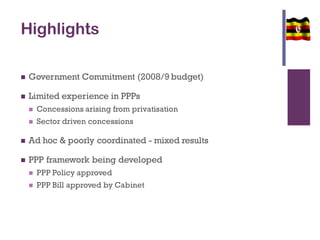
Highlights
 Government Commitment (2008/9 budget)
 Limited experience in PPPs
 Concessions arising from privatisation
 Sector driven concessions
 Ad hoc & poorly coordinated - mixed results
 PPP framework being developed
 PPP Policy approved
 PPP Bill approved by Cabinet
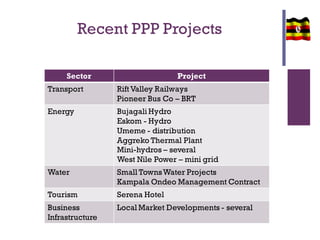
Recent PPP Projects
Sector Project
Transport Rift Valley Railways
Pioneer Bus Co – BRT
Energy Bujagali Hydro
Eskom - Hydro
Umeme - distribution
Aggreko Thermal Plant
Mini-hydros – several
West Nile Power – mini grid
Water Small TownsWater Projects
Kampala Ondeo Management Contract
Tourism Serena Hotel
Business
Infrastructure
Local Market Developments - several
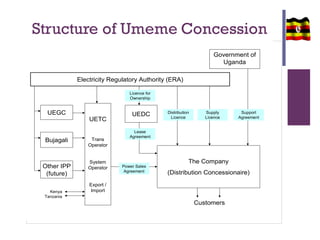
Structure of Umeme Concession
This image cannot currently be displayed.
Electricity Regulatory Authority (ERA)
Government of
Uganda
UEGC
Bujagali
Other IPP
(future)
UETC
Trans
Operator
System
Operator
Export /
Import
UEDC
The Company
(Distribution Concessionaire)
Licence for
Ownership
Power Sales
Agreement
Lease
Agreement
Supply
Licence
Distribution
Licence
Support
Agreement
Kenya
Tanzania
Customers
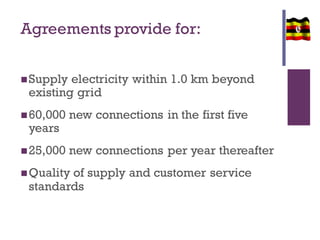
Agreements provide for:
Supply electricity within 1.0 km beyond
existing grid
60,000 new connections in the first five
years
25,000 new connections per year thereafter
Quality of supply and customer service
standards
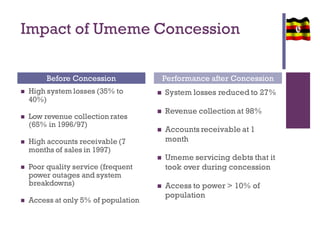
Impact of Umeme Concession
 High system losses (35% to
40%)
 Low revenue collection rates
(65% in 1996/97)
 High accounts receivable (7
months of sales in 1997)
 Poor quality service (frequent
power outages and system
breakdowns)
 Access at only 5% of population
 System losses reduced to 27%
 Revenue collection at 98%
 Accounts receivable at 1
month
 Umeme servicing debts that it
took over during concession
 Access to power > 10% of
population
Before Concession Performance after Concession
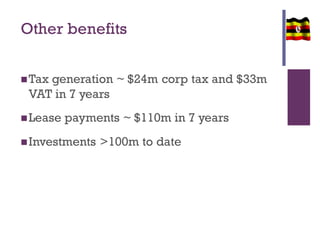
Other benefits
Tax generation ~ $24m corp tax and $33m
VAT in 7 years
Lease payments ~ $110m in 7 years
Investments >100m to date
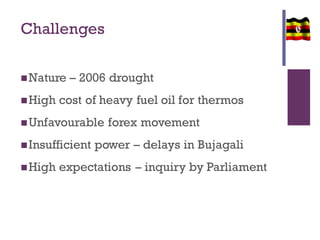
Challenges
Nature – 2006 drought
High cost of heavy fuel oil for thermos
Unfavourable forex movement
Insufficient power – delays in Bujagali
High expectations – inquiry by Parliament
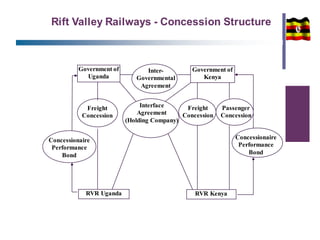
Rift Valley Railways - Concession Structure
Inter-
Governmental
Agreement
Interface
Agreement
(Holding Company)
Freight
Concession
Freight
Concession
Passenger
Concession
Concessionaire
Performance
Bond
RVR Uganda RVR Kenya
Government of
Uganda
Government of
Kenya
Concessionaire
Performance
Bond
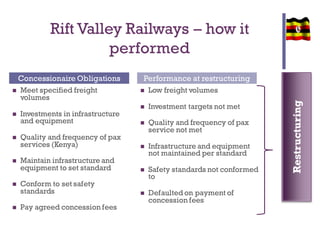
Rift Valley Railways – how it
performed
 Meet specified freight
volumes
 Investments in infrastructure
and equipment
 Quality and frequency of pax
services (Kenya)
 Maintain infrastructure and
equipment to set standard
 Conform to set safety
standards
 Pay agreed concession fees
 Low freight volumes
 Investment targets not met
 Quality and frequency of pax
service not met
 Infrastructure and equipment
not maintained per standard
 Safety standards not conformed
to
 Defaulted on payment of
concession fees
Concessionaire Obligations Performance at restructuring
Restructuring
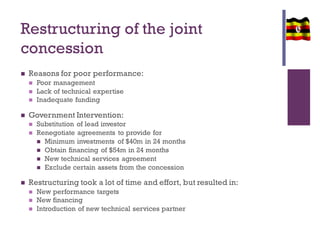
Restructuring of the joint
concession
 Reasons for poor performance:
 Poor management
 Lack of technical expertise
 Inadequate funding
 Government Intervention:
 Substitution of lead investor
 Renegotiate agreements to provide for
 Minimum investments of $40m in 24 months
 Obtain financing of $54m in 24 months
 New technical services agreement
 Exclude certain assets from the concession
 Restructuring took a lot of time and effort, but resulted in:
 New performance targets
 New financing
 Introduction of new technical services partner
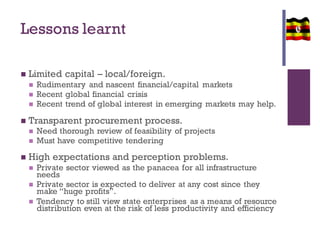
Lessons learnt
 Limited capital – local/foreign.
 Rudimentary and nascent financial/capital markets
 Recent global financial crisis
 Recent trend of global interest in emerging markets may help.
 Transparent procurement process.
 Need thorough review of feasibility of projects
 Must have competitive tendering
 High expectations and perception problems.
 Private sector viewed as the panacea for all infrastructure
needs
 Private sector is expected to deliver at any cost since they
make “huge profits”.
 Tendency to still view state enterprises as a means of resource
distribution even at the risk of less productivity and efficiency
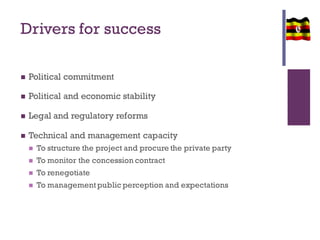
Drivers for success
 Political commitment
 Political and economic stability
 Legal and regulatory reforms
 Technical and management capacity
 To structure the project and procure the private party
 To monitor the concession contract
 To renegotiate
 To management public perception and expectations
When the going gets tough!
 Temptation for government to to take back the project – but
beware:
 Cost of restarting the project under government may be too high
 Set precedent and drive away foreign investors leading to
reduction of private sector investments
 Immediate burden on the national budget to meet capital and
operating costs of the enterprise
 Lack of credibility of government policies and programs
 Litigation which may not enable government to immediately take
over the project
 Cost of buy out payments which may be large depending on
when government proposes to takeover the project
The tough gets going,otherwise???
 Lost opportunity to realize investments
 Increase in political risk profile of the country
 Downgrading of credit rating
 Investors will demand guarantees for future projects
 Higher return on investment demanded by investors
 Drop in doing business index, hence discourage FDI
 Erosion of public confidence in contracting with government
Examples of attempted policy
reversals in Africa:
 Zambia
 Following democratic reforms in 1991, Zambia embarked on several
economic reform programmes. However,from mid-1995 onwards
Zambia began to reverse a number of its reforms and deferred
implementation of earlier commitments.Trade and foreign exchange
reforms were affected and FDI plummeted. The outcome was that by
1999 poverty in Zambia had intensified
 Ghana
 Ghana began implementing a comprehensive economic reform
program in 1983. Despite major improvements in the economic
situation for several years,reversal of several policies led progress to
come to a grinding halt in 1991 and 1992 with spiraling inflation and
runaway depreciation of the Cede. Despite efforts to resuscitate the
economy,the government has since failed to vigorously promote the
economic reforms
Way forward?
 PPP Policy in place, however need
 Legal reforms to streamline PPP implementation – enact PPP
Law
 Establish PPP unit to coordinate implementation of PPP
program
 Build capacity of government departments and agencies to
develop, procure and monitor PPP projects
 Ensure extensive stakeholder consultations during PPP
project development, procurement and delivery
 Public awareness
ThankYou
dssebabi@perds.go.ug

PPP in Uganda - by David Ssebabi

  • 1.
    Uganda’s PPP Experience DavidSsebabi Director Privatization Unit Ministry of Finance, Planning and Econ Dev’t
  • 2.
    Highlights  Government Commitment(2008/9 budget)  Limited experience in PPPs  Concessions arising from privatisation  Sector driven concessions  Ad hoc & poorly coordinated - mixed results  PPP framework being developed  PPP Policy approved  PPP Bill approved by Cabinet
  • 3.
    Recent PPP Projects SectorProject Transport Rift Valley Railways Pioneer Bus Co – BRT Energy Bujagali Hydro Eskom - Hydro Umeme - distribution Aggreko Thermal Plant Mini-hydros – several West Nile Power – mini grid Water Small TownsWater Projects Kampala Ondeo Management Contract Tourism Serena Hotel Business Infrastructure Local Market Developments - several
  • 4.
    Structure of UmemeConcession This image cannot currently be displayed. Electricity Regulatory Authority (ERA) Government of Uganda UEGC Bujagali Other IPP (future) UETC Trans Operator System Operator Export / Import UEDC The Company (Distribution Concessionaire) Licence for Ownership Power Sales Agreement Lease Agreement Supply Licence Distribution Licence Support Agreement Kenya Tanzania Customers
  • 5.
    Agreements provide for: Supplyelectricity within 1.0 km beyond existing grid 60,000 new connections in the first five years 25,000 new connections per year thereafter Quality of supply and customer service standards
  • 6.
    Impact of UmemeConcession  High system losses (35% to 40%)  Low revenue collection rates (65% in 1996/97)  High accounts receivable (7 months of sales in 1997)  Poor quality service (frequent power outages and system breakdowns)  Access at only 5% of population  System losses reduced to 27%  Revenue collection at 98%  Accounts receivable at 1 month  Umeme servicing debts that it took over during concession  Access to power > 10% of population Before Concession Performance after Concession
  • 7.
    Other benefits Tax generation~ $24m corp tax and $33m VAT in 7 years Lease payments ~ $110m in 7 years Investments >100m to date
  • 8.
    Challenges Nature – 2006drought High cost of heavy fuel oil for thermos Unfavourable forex movement Insufficient power – delays in Bujagali High expectations – inquiry by Parliament
  • 9.
    Rift Valley Railways- Concession Structure Inter- Governmental Agreement Interface Agreement (Holding Company) Freight Concession Freight Concession Passenger Concession Concessionaire Performance Bond RVR Uganda RVR Kenya Government of Uganda Government of Kenya Concessionaire Performance Bond
  • 10.
    Rift Valley Railways– how it performed  Meet specified freight volumes  Investments in infrastructure and equipment  Quality and frequency of pax services (Kenya)  Maintain infrastructure and equipment to set standard  Conform to set safety standards  Pay agreed concession fees  Low freight volumes  Investment targets not met  Quality and frequency of pax service not met  Infrastructure and equipment not maintained per standard  Safety standards not conformed to  Defaulted on payment of concession fees Concessionaire Obligations Performance at restructuring Restructuring
  • 11.
    Restructuring of thejoint concession  Reasons for poor performance:  Poor management  Lack of technical expertise  Inadequate funding  Government Intervention:  Substitution of lead investor  Renegotiate agreements to provide for  Minimum investments of $40m in 24 months  Obtain financing of $54m in 24 months  New technical services agreement  Exclude certain assets from the concession  Restructuring took a lot of time and effort, but resulted in:  New performance targets  New financing  Introduction of new technical services partner
  • 12.
    Lessons learnt  Limitedcapital – local/foreign.  Rudimentary and nascent financial/capital markets  Recent global financial crisis  Recent trend of global interest in emerging markets may help.  Transparent procurement process.  Need thorough review of feasibility of projects  Must have competitive tendering  High expectations and perception problems.  Private sector viewed as the panacea for all infrastructure needs  Private sector is expected to deliver at any cost since they make “huge profits”.  Tendency to still view state enterprises as a means of resource distribution even at the risk of less productivity and efficiency
  • 13.
    Drivers for success Political commitment  Political and economic stability  Legal and regulatory reforms  Technical and management capacity  To structure the project and procure the private party  To monitor the concession contract  To renegotiate  To management public perception and expectations
  • 14.
    When the goinggets tough!  Temptation for government to to take back the project – but beware:  Cost of restarting the project under government may be too high  Set precedent and drive away foreign investors leading to reduction of private sector investments  Immediate burden on the national budget to meet capital and operating costs of the enterprise  Lack of credibility of government policies and programs  Litigation which may not enable government to immediately take over the project  Cost of buy out payments which may be large depending on when government proposes to takeover the project
  • 15.
    The tough getsgoing,otherwise???  Lost opportunity to realize investments  Increase in political risk profile of the country  Downgrading of credit rating  Investors will demand guarantees for future projects  Higher return on investment demanded by investors  Drop in doing business index, hence discourage FDI  Erosion of public confidence in contracting with government
  • 16.
    Examples of attemptedpolicy reversals in Africa:  Zambia  Following democratic reforms in 1991, Zambia embarked on several economic reform programmes. However,from mid-1995 onwards Zambia began to reverse a number of its reforms and deferred implementation of earlier commitments.Trade and foreign exchange reforms were affected and FDI plummeted. The outcome was that by 1999 poverty in Zambia had intensified  Ghana  Ghana began implementing a comprehensive economic reform program in 1983. Despite major improvements in the economic situation for several years,reversal of several policies led progress to come to a grinding halt in 1991 and 1992 with spiraling inflation and runaway depreciation of the Cede. Despite efforts to resuscitate the economy,the government has since failed to vigorously promote the economic reforms
  • 17.
    Way forward?  PPPPolicy in place, however need  Legal reforms to streamline PPP implementation – enact PPP Law  Establish PPP unit to coordinate implementation of PPP program  Build capacity of government departments and agencies to develop, procure and monitor PPP projects  Ensure extensive stakeholder consultations during PPP project development, procurement and delivery  Public awareness
  • 18.