International Business Strategy --------------..."62
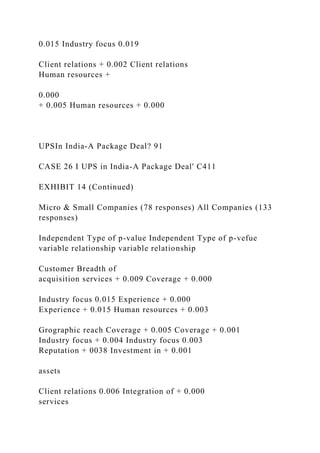
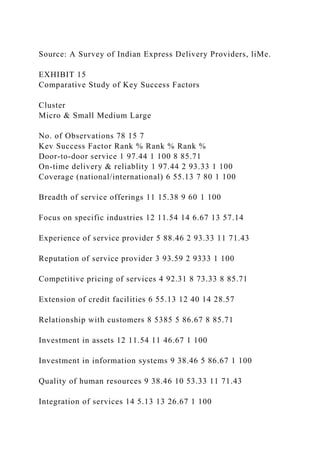
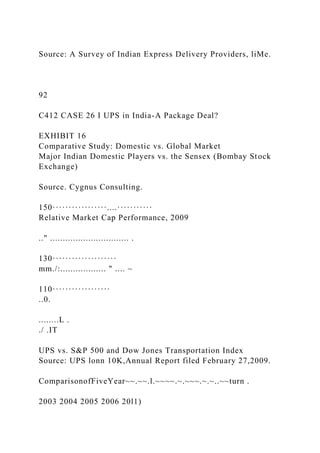
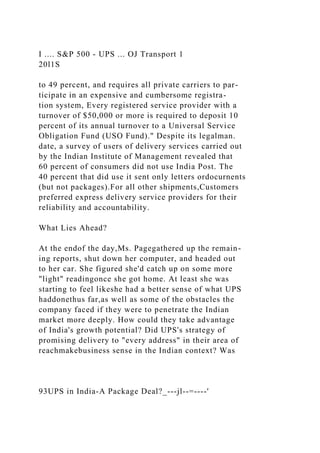
:(~,
- .:~,
CAS E 25 I Embraer: Shaking Up the Aircraft Manufacturing
Market ';:~:'"
Fabiano Lopes. Alexandre Zimath, Andrea Maat,
and Cel. Nivaldo Silva
W
HILE TRAVELING TO an investor
conference in Montreal, Canada,
on Embraer's Legacy business jet,
Mauricio Botelho, CEO of Embraer,
reflected on his company's dramatic
ascent to its position as the world's leading regional
aircraft manufacturer. Since becoming a private com-
pany, Embraer had successfully introduced seven
commercial aircraft models to the market, including its
latest, the 118-seat EMBRAER 195. As the jet began its
runway approach just a few miles from the headquar-
ters of rival company Bombardier, Botelho pondered
the potential competitive response to his company's
recent attacks on the commercial aircraft market.
The U,S, Airline Industry
With the passing of the Airline Deregulation Act of 1978
by the U.S. Congress, government control of routes
and fare pricing were eliminated, resulting in growth,
increased competition, and the emergence of three new
business models: major, regional, and low-cost carriers.
MAJOR CARRIERS. The distinguishing feature in the
business model of a major carrier (or a "major") was the
hub-and-spoke system. This system was based all centra!
hubs to which feeder flights were directed. Passengers
from the feeder nights transferred to numerous other
flights provided at the hub to their final destinations.'
The enormous capital required to expand geo-
graphically was a substantial barrier to entry for new
airlines. As low-cost and regional carriers primarily
competed on price and local market convenience, the
rationale for the majors' costly model lay largely on
the improved customer loyalty generated by the eon-
venience and reach of these airlines.
To further enhance breadth of service and increase
the number of CUStomers while limiting capital out-
lays, most majors turned to code-sharing and global
alliances with other major and regional airlines. The
major global allinnees included Star Alliance, Sky
Team, and One World.
DARDEN.
~rN~ PUBLISHING
1JNJw.'W"W'/I1lCINIA
REGIONAL CARRIERS. Regional airlines (or "region-
als") operated short- and medium-haul ~eheduled
airline service connecting smaller cornmumues wah
larger eities and with the hubs of the major airlines.
Although most were independently owned, several of
the largest regional carriers were actually subsidiaries
of the major airlines, including Atlantie Southwest,
Comair (Delta), and AMR Eagle (American Airlines).
Many regionals benefited from arrangements with
the majors, ineiuding code-sharing arrangements,
scheduling assistance to ensure flight connections in
majors' hubs, and the branding of a major airline.
With low-cost structure and improved service levels,
regionals as a whole beeame the most profitable seg-
ment in the air carrier business. Regionals continued to
replaee turboprops on low-density routes and developed
new routes that extended airline networks, enabling
those carriers to serve unserved or underserved mar-
kets more east-efficiently. Regionals were able to do
that because newer, smaller jets were significantly faster
than existing fleets of turboprop planes, had greater range,
and burned less fuel (a major per-flight fixed cost). The
regionals were the fastest-growing segment of cornmer-
cial aviation and continued to serve a valuable segment
of travelers unaddressed by low-cost and major carriers.
LOW-COST CARRIERS. Low-cost carriers (LCCs)
offered airfares at a lower price than major and
regional carriers. The largest LCCs ineluded JetElue,
AirTran, Southwest Airlines, and America West, as
well as new upstarts Song and Ted, which were owned
by Delta and United, respeetively.
Many of the LLCs started off as regionals, offering
short-haul service connecting business and leisure trav-
elers between high-volume destinations. By operating
This case was prepared by Fabiano Lopes,
Alexandre Zimath, Andrea Maar. and revised
by eel. Nivaldc Silva, EADS Representative
to Embraer, under the supervision of Mlng-
Jer .Chen, Leslie E. Grayson Professor of
a basis for cla . . BUSiness Administration. It was written ns
h dll f ss dl~Cusslonrather than to illustrate effective or
Ineffective
o~ Vilr~~n~~ a~m1lli~ative situation. COPyright e 2007 by the
University
reserved ~o = en . hoo! Foundation, Charlottesville. VA. All
rights
N'f}{m~ifrilisap"b',f. ca,~les,Send an e-mail
[email protected]:!enpublishing.com.
lCalOlllllayberep_" ...~ d i d
in a spreudsheel Of tran' . ''''''1/(=, slore III a retrteval system,
lise
mechanical pha; ,. Smmed '? any form or by any means-
setectranic.
of the Dard~1IS'f''',P~1II8, rt~ordmg, or otherwise-without Ihe
permission
100 roundarlOll.
C382
Embreer: Shaking Up the Aircraft Manufacturing Market 63
CASE 25 , Ernbraer: Shaking Up the Aircraft Manufacturing
Market C383
outofunderutilized airports in those markets, the LLCs
were able to keep a low profile. The largest LCCs were
already operating nonstop transcontinental flights.
Contrary to the major airlines' hub-and-spoke sys-
tem, LCCs generally operated a point-to-point route
system. This feature was credited in the air carrier
industry with providing higher levels in the quality of
passenger service in terms of on-time departures and
arrivals, limited lost luggage, etc. Inorder to effectively
utilize the point-to-point system, LeCs offered service
to the same general destinations as majors and region-
als but used satellite airports, which were typically less
congested than hub airports and charged lower fees.
LCCs limited their fleet of planes to one or two
midsize, more fuel-efficient models, thus reducing
training and maintenance costs. Moreover, by avoid-
ing congested airports, LCCs were able to achieve
faster turnaround times. The net effect was that planes
were kept in the air longer, increasing the asset utiliza-
tion. Additionally, LCCs tended to have lower labor
costs because of the nonunion work force.
U.S. Market Conditions
The airline industry experienced uninterrupted growth
in revenues throughout the 1990s.A weakening global
economy, however, coupled with the September I I,
2001, terrorist attacks, had drastically reduced air-
line traffic by the end of 200 I.As a result, the indus-
try posted unprecedented losses of $7.7 billion for
the year, as revenues dropped 13.5% from a record
high of $93.6 billion in 2000. The slowdown contin-
ued into 2002 and 2003 as major airlines, faced with
reduced sales, continued to reduce capacity and trim
ranks. United Airlines, the second-largest airline in the
world, filed for bankruptcy at the end of 20022 The
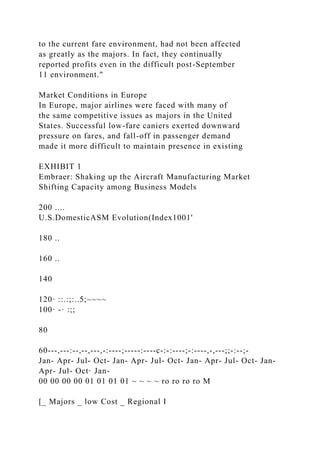
U.S. domestic available seat miles (ASM)J evolution
(Exhibit I) demonstrates the shift in capacity from
majors to regionals and LCCs.
LCes, whose cost structures were already tailored
to the current fare environment, had not been affected
as greatly as the majors. In fact, they continually
reported profits even in the difficult post-September
11 environment."
Market Conditions in Europe
In Europe, major airlines were faced with many of
the same competitive issues as majors in the United
States. Successful low-fare caniers exerted downward
pressure on fares, and fall-off in passenger demand
made it more difficult to maintain presence in existing
EXHIBIT 1
Embraer: Shaking up the Aircraft Manufacturing Market
Shifting Capacity among Business Models
200 ....
U.S.DomesticASM Evolution(Index1001'
180 ..
160 ..
140
120· ::.:;:..5;~~~~
100· -· :;;
80
60---,---:--,--,---,-:----;-----:----c-:-:----;-:----,-,---;;-:--;-
Jan- Apr- Jul- Oct- Jan- Apr- Jul- Oct- Jan- Apr- Jul- Oct- Jan-
Apr- Jul- Oct· Jan-
00 00 00 00 01 01 01 01 ~ ~ ~ ~ ro ro ro ro M
[_ Majors _ low Cost _ Regional I
1 "tommerclet Jets Market Assessment,"
http://www.embraer.com.br(accessed 10 November 2006),
64 International Business Strategy
C384 CASE 25 ) Embraer: Shaking Up the Aircraft
Manufacturing Market
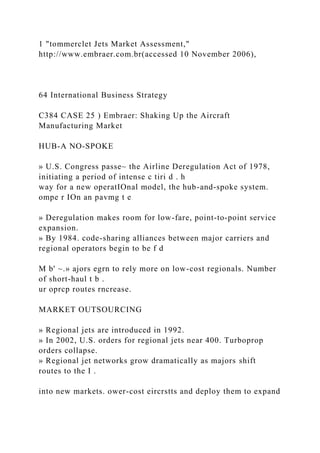
HUB-A NO-SPOKE
» U.S. Congress passe~ the Airline Deregulation Act of 1978,
initiating a period of intense c tiri d . h
way for a new operatIOnal model, the hub-and-spoke system.
ompe r IOn an pavmg t e
» Deregulation makes room for low-fare, point-to-point service
expansion.
» By 1984. code-sharing alliances between major carriers and
regional operators begin to be f d
M b' ~.» ajors egrn to rely more on low-cost regionals. Number
of short-haul t b .
ur oprcp routes rncrease.
MARKET OUTSOURCING
» Regional jets are introduced in 1992.
» In 2002, U.S. orders for regional jets near 400. Turboprop
orders collapse.
» Regional jet networks grow dramatically as majors shift
routes to the I .
into new markets. ower-cost eircrstts and deploy them to expand
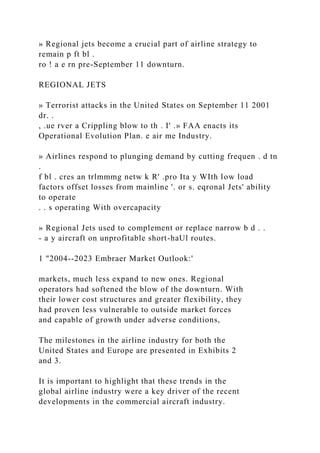
» Regional jets become a crucial part of airline strategy to
remain p ft bl .
ro ! a e rn pre-September 11 downturn.
REGIONAL JETS
» Terrorist attacks in the United States on September 11 2001
dr. .
, .ue rver a Crippling blow to th . I' .» FAA enacts its
Operational Evolution Plan. e air me Industry.
» Airlines respond to plunging demand by cutting frequen . d tn
.
f bl . cres an trlmmmg netw k R' .pro Ita y WIth low load
factors offset losses from mainline '. or s. eqronal Jets' ability
to operate
. . s operating With overcapacity
» Regional Jets used to complement or replace narrow b d . .
- a y aircraft on unprofitable short-haUl routes.
1 "2004--2023 Embraer Market Outlook:'
markets, much less expand to new ones. Regional
operators had softened the blow of the downturn. With
their lower cost structures and greater flexibility, they
had proven less vulnerable to outside market forces
and capable of growth under adverse conditions,
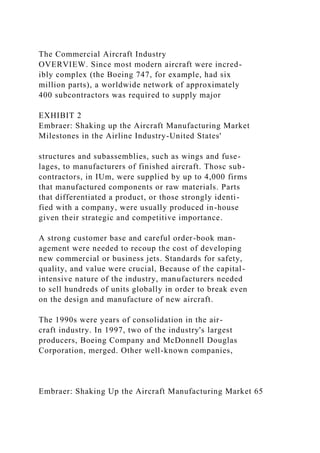
The milestones in the airline industry for both the
United States and Europe are presented in Exhibits 2
and 3.
It is important to highlight that these trends in the
global airline industry were a key driver of the recent
developments in the commercial aircraft industry.
The Commercial Aircraft Industry
OVERVIEW. Since most modern aircraft were incred-
ibly complex (the Boeing 747, for example, had six
million parts), a worldwide network of approximately
400 subcontractors was required to supply major
EXHIBIT 2
Embraer: Shaking up the Aircraft Manufacturing Market
Milestones in the Airline Industry-United States'
structures and subassemblies, such as wings and fuse-
lages, to manufacturers of finished aircraft. Thosc sub-
contractors, in IUm, were supplied by up to 4,000 firms
that manufactured components or raw materials. Parts
that differentiated a product, or those strongly identi-
fied with a company, were usually produced in-house
given their strategic and competitive importance.
A strong customer base and careful order-book man-
agement were needed to recoup the cost of developing
new commercial or business jets. Standards for safety,
quality, and value were crucial, Because of the capital-
intensive nature of the industry, manufacturers needed
to sell hundreds of units globally in order to break even
on the design and manufacture of new aircraft.
The 1990s were years of consolidation in the air-
craft industry. In 1997, two of the industry's largest
producers, Boeing Company and McDonnell Douglas
Corporation, merged. Other well-known companies,
Embraer: Shaking Up the Aircraft Manufacturing Market 65
CASE 25 I Embraer: Shaking Up the Aircraft Manufacturing
Market C385
EXHIBIT 3
Embraer: Shaking up the Aircraft Manufacturing Market
Milestones in the Airline lndustrv-c-Europe'
LIBERALIZATION IN EUROPE
» European airlines evolved a hub-and-spoke system
independently, primarily operating from each nation's capital
city.
» Europe takes a four-step approach to liberalization. The first
phase is implemented in 1988,
» Airlines begin to be restructured and privatized.
» High labor costs in a competitive, deregulated environment
force airlines to take drastic measures.
MARKET EXPANSION
» Regional jets are introduced in 1992.
» European airlines successfully deploy regional jets in the
current established air transport system.
» Regional jets replace many turboprops, but turboprops
witt140-plus seats remain in service.
» Low-tare carriers such as Ryanair and EasyJet see dramatic
growth in RPK from 1995 to 2001.
REGIONAL JETS
» The regional airline market in Europe averages 12% growth
during the period from 1995 to 2002.
» Terrorist attacks in the United States on September 11, 2001,
deliver a crippling blow to the airline industry.
» As in the United States, the regional jets' ability to adapt to
different demand environments helps sustain allied
majors through crisis.
1 "2004-2023EmbraerMarketOutlook."
such as Piper Aircraft Corporation and Fairchild
Aircraft in the United States, as well as FolckerN.Y. of
the Netherlands, filed for bankruptcy during that period.
The market for commercial aircraft was typically
divided into two product categories: narrow-body and
wide-body aircraft. Narrow-body aircraft were single-
aisle, short-range aircraft (up to 6,000 km or roughly
3,700 miles) that typically carried up to 200 passen-
gers. Leading aircraft in that category were the Boeing
737, the Boeing 757, and the Airbus A-320. Wide-body
aircraft were double-aisle, medium- to long-range air-
craft (up to 14,000 km or roughly 8,700 miles) that
could carry from 200 to 450 passengers. Leading air-
craft in that category were the Boeing 747, the Boeing
777, and the Airbus A-300. Boeing and Airbus were
the industry leaders in these segments.
REGIONAL JETS, The regional jets segment, which
was included within the narrow-body category, was
traditionally composed of aircraft that carried between
20 and 70 passengers. Bombardier and Embraer
were the market leaders in this segment, which had
consistently expanded since 1992, when Bombardier
introduced the first regional jet as a replacement for
turboprop planes.
Even before regional jets became widely available,
growth among regional airlines was consistently robust.
Between 1971 and 1993, regional carriers outgrew the
majors virtually every year. The expansion could be
traced to two contributing factors. First, in the years
leading up to 1978, many cities previously unserved
had been introduced to air service, mainly on turboprop
aircraft. Second, regional carriers in the years after the
Deregulation Act of 1978 began to fill gaps in the ever-
expanding hub-and-spoke networks of the majors.
By 1989, the majors changed their airline operations
to increase the number of passengers flowing into
the networks by adding capacity on its feeder routes,
offering more destinations, and increasing frequency.
It was a strategy that played against the strengths of
regional turboprops, whose shorter range made them
ineffective in reaching new markets.
The net effect was a surge in regional jet adoption
and deployment, largely because of the replacement
I
I
..
Intematlonat Business Strategy
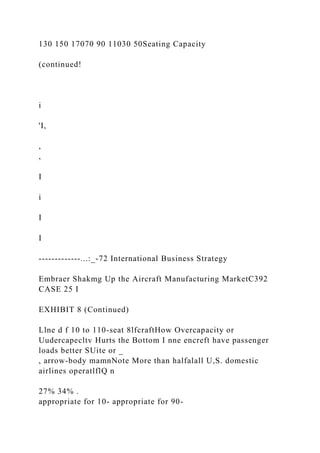
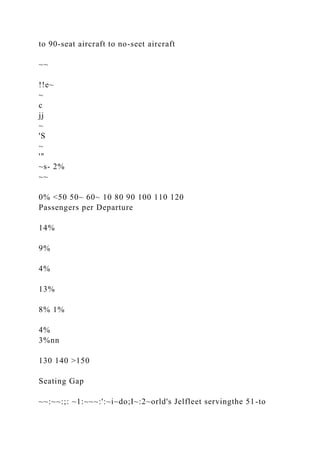
THE 70- TO 120-SEAT MARKET. Several reasons moti-
vated Embraer to manufacture 70- to 120-seat planes.
First, Embraer identified a gap between capacity and
demand for this range of planes. The absence of a true
70- to 120-seat jet family had forced airlines to deploy
planes that were either too large or too small to operate
efficiently in the intermediate-demand market. In 2002,
61% of flights in the United States departed the airport
with loads appropriate for 70- to II O-seat aircraft.
Several trends in the airline industry also contrib-
uted, to Embraer's interest in this segment. First, the
contmued growth of LCCs had created a shift in air-
craft demand toward smaller, more efficient planes.
In addition, the downturn in the airline industry
that began with September II, 200 I along with the
res It . ,
u mg pnce wars, had highlighted the fact that the
majors required a high-load factor to compete effec-
tively against the LCCs. Furthermore the increased
volatility of pas d '
f ' . . senger emand created a greater needOr flexibility amo . li
.ng air nes. As a result, the majors
I
I
i
66
C386 CASE 25 I Embraer Shakmg Up the Aircraft
Manufacturing Market
--------t------
of turboprops on low-density routes and the develop-
ment of new routes that extended airline networks. As
the regional jets segment expanded, the capability of
the jets themselves expanded to comprise roomy and
cost-effective modem aircraft that flew up to 4,000
km (3,700 miles), enough to operate within most
continents.
Based on expected growth of LCCs and regional
carriers, as well as the aging of aircraft currently in usc,
the market for regional planes appeared to be poised
For significant growth, Embraer had projected deliver-
ies of 30- to 120-seat planes to total nearly 8,500 units
over the next 20 years, representing a US$175 billion
business. The United States was expected to gener-
ate 56% of this demand, while 19% of demand would
come from Europe (Exhibit 4).
Ernbraer was privatized in December 1994 as part
of President Fernando Henrique Cardoso's privati-
zation program, Cia, Bozano, Simonsen (CBS), the
leader of the consortium that took Embraer private,
was a conglomerate with diversified investments in
financial services, agriculture, real estate, and indus-
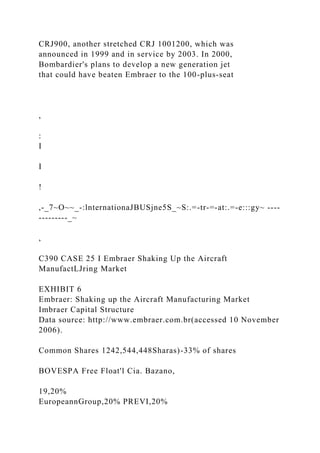
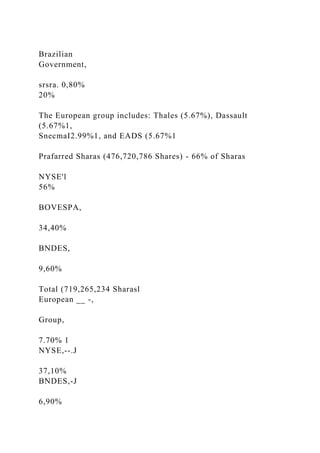
trial products (see Exhibit 6 for Embraer's ownership
structure).
In 1995, Embraer entered the commercial jet mar-
ket with the introduction of its ERJ family. The ERJ
145 (introduced in 1995), ERJ 135 (introduced in
1998) and ERJ 140 (introduced in 2000) had a seating
capacity of 50, 37, and 44 seats, respectively. Those
planes were developed in accordance with Embraer's
strategy of entering the 30- to 50-seat market to com-
pete against Bombardier's Q-Series turboprop planes
as well as its CRJ family of regional jets,
In 1999, while still celebrating the successful intro-
duction of the ERJ family, Embraer began develop-
ing a new aircraft family that would serve the 70- to
120-seat market. In February 2002, the 70- to 78-seat
EMBRAER 170 completed its first flight, taking off
from Sao Jose dos Campos, In the following two
years, Embraer completed the maiden flights of its
78- to 86-seat EMBRAER 175 as well as the 98- to
I06-seat EMBRAER 190. To complete the family, in
December 2004, the 108- to 118-seat EMBRAER 195
accomplished its first successful flight (see Exhibit 7
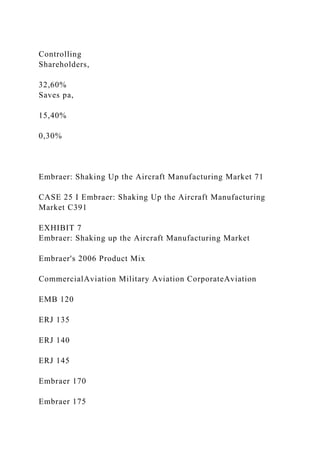
for a list of Embraer's products as of 2006).
EMBRAER. In 2004, Embraer was the fourth-largest
commercial airplane manufacturer in the world in terms
of volume, behind Boeing, Airbus, and Bombardier.
Airbus and Boeing led the market with deliveries of
320 and 285 commercial airplanes. respectively. In
the regional market, Bombardier and Embraer demon-
strated a close rivalry by achieving 158 and 148 deliver-
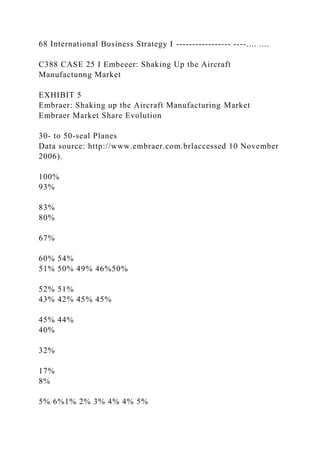
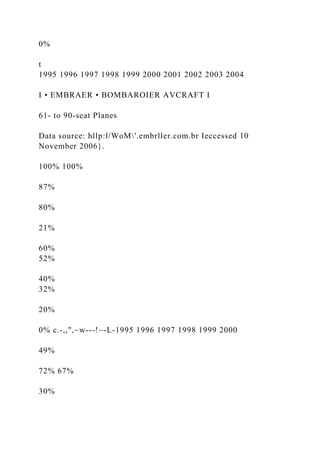
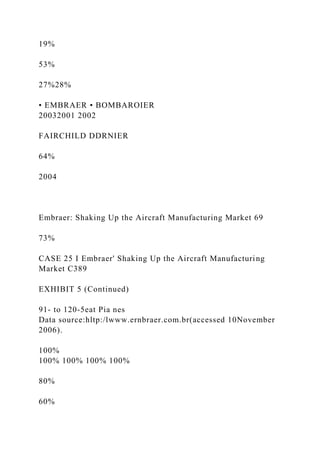
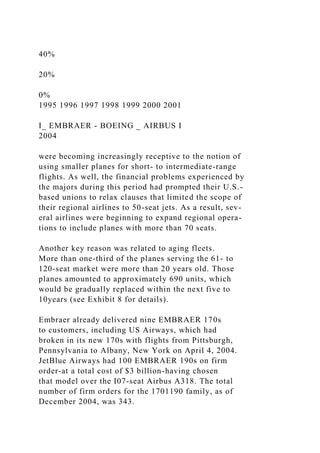
ies, respectively (see Exhibit 5 for Ernbraer market share
evolution).
Ernbraer, founded in 1969, was the product of
an aeronautical technology center (CTA) that had
been established in 1945 by Brazil's Ministry of
Aeronautics, Together with Ernbraer, the CTA also
generated one of the world's leading aeronautical
engineering schools, the Aeronautical Technological
Institute (ITA). Most of Embraer's aeronautical engi-
neers had been hired out of ITA,
Moreover, Embraer's first great commercial sue-
cess was the Bandeirante, a 15~seat plane with a
design based on an eight-scat prototype assembled
inside the CTA. Overall, 500 Bandeirantes were sold
over a 10-year period. The first 80 were sold to the
Brazilian military, as an indirect government support
to the new enterprise.
From 1972 to 1983, Embraer introduced sev-
eral small turboprop planes. Embraer's first inter-
national success, introduced in 1983, was the EMB
120 Brasilia, a 30~seatpressurized twin turboprop. In
2006, the Brasilia was still in production, with more
than 350 planes operating worldwide, Embraer's jet
era began in 1985 with the introduction of the AMX, a
military jet developed in partnership with Aermacchi
an Italian aircraft manufacturer. '
Embraer: Shaking Up the Aircraft Manufacturing Market 67
CASE 25 I Embreer: Shaking Up the Aircraft Manufacturing
Market C387
EXHIBIT 4
Embraer: Shaking up the Aircraft Manufacturing Market
Market Outlook
Delivery Forecast by Segmenl and Region'
30-10 120-seat Commercial Jet Calegory, World Deliveries
bVSeat Segment
Segment 2004-13 2014-23 2004-23
3D-60 1,150 1,450 2,600
61-90 1,300 1,600 2,900
91-120 1,250 1,700 2,950
Total 3,700 4,750 8,450
Deliveries by Region, 30- to 120-seat Segment
Regions 2004-13 2014-23 2094-23
North America 2,245 2,495 4,740
Latin America 255 370 625
Europe 636 944 1.580
Africa & Middle East 154 236 390
China 240 395 635
Asia Pacific 170 310 480
TOlal 3,700 4,750 8,450
Deliveries by Region and Segment
30- to 60-seat Segment 61- to 90-soat Segment 91- to 120-seat
Segment
Regions 2004-13 2014-23 2004-23 2004-13 2014-23 2004-23
2004-13 2014-23 2004-23
North America 840 1,030 1,870 715 650 1,365 690 815 1,505
Latin America 25 70 95 90 130 220 140 170 310
Europe 85 152 237 263 424 687 288 368 656
Africa & Middle
East 80 38 118 52 106 158 22 92 114
China 100 100 200 90 160 250 50 135 185
Asia Pacific 20 60 80 90 130 220 60 120 180
Total 1,150 1,450 2,600 1,300 1,600 2,900 1,250 1,700 2,950
1"2004-2023 Embraer Market Outlcuk."
68 International Business Strategy I ----------------- ----.... ....
C388 CASE 25 I Embeeer: Shaking Up the Aircraft
Manufactunng Market
EXHIBIT 5
Embraer: Shaking up the Aircraft Manufacturing Market
Embraer Market Share Evolution
30- to 50-seal Planes
Data source: http://www.embraer.com.brlaccessed 10 November
2006).
100%
93%
83%
80%
67%
60% 54%
51% 50% 49% 46%50%
52% 51%
43% 42% 45% 45%
45% 44%
40%
32%
17%
8%
5% 6%1% 2% 3% 4% 4% 5%
0%
t
1995 1996 1997 1998 1999 2000 2001 2002 2003 2004
I • EMBRAER • BOMBAROIER AVCRAFT I
61- to 90-seat Planes
Data source: hllp:l/WoM'.embrller.com.br Ieccessed 10
November 2006}.
100% 100%
87%
80%
21%
60%
52%
40%
32%
20%
0% c.-,,",~w---!~-L-1995 1996 1997 1998 1999 2000
49%
72% 67%
30%
19%
53%
27%28%
• EMBRAER • BOMBAROIER
20032001 2002
FAIRCHILD DDRNIER
64%
2004
Embraer: Shaking Up the Aircraft Manufacturing Market 69
73%
CASE 25 I Embraer' Shaking Up the Aircraft Manufacturing
Market C389
EXHIBIT 5 (Continued)
91- to 120-5eat Pia nes
Data source:hltp:/lwww.ernbraer.com.br(accessed 10November
2006).
100%
100% 100% 100% 100%
80%
60%
40%
20%
0%
1995 1996 1997 1998 1999 2000 2001
I_ EMBRAER - BOEING _ AIRBUS I
2004
were becoming increasingly receptive to the notion of
using smaller planes for short- to intermediate-range
flights. As well, the financial problems experienced by
the majors during this period had prompted their U.S.-
based unions to relax clauses that limited the scope of
their regional airlines to 50-seat jets. As a result, sev-
eral airlines were beginning to expand regional opera-
tions to include planes with more than 70 seats.
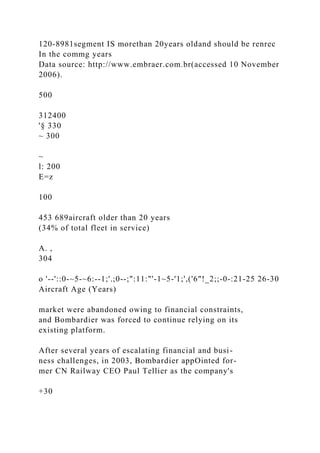
Another key reason was related to aging fleets.
More than one-third of the planes serving the 61- to
120-seat market were more than 20 years old. Those
planes amounted to approximately 690 units, which
would be gradually replaced within the next five to
10years (see Exhibit 8 for details).
Embraer already delivered nine EMBRAER 170s
to customers, including US Airways, which had
broken in its new 170s with flights from Pittsburgh,
Pennsylvania to Albany, New York on April 4, 2004.
JetBlue Airways had 100 EMBRAER 190s on firm
order-at a total cost of $3 billion-having chosen
that model over the I07-seat Airbus A318. The total
number of firm orders for the 1701190 family, as of
December 2004, was 343.
BOMBARDIER. Founded in 1942 by Armand Bombar-
dier as a snowmobile manufacturer, Bombardier has
been publicly listedon the Toronto StockExchange since
67% 66%
55%
61% 59%
2002 2003
1969, yet has remained under the majority control of ~
the Bombardier family throughout the company's his-
tory. In the 1970s, Bombardier began to diversify into
other transportation industries through acquisitions
of various train, plane, bus, and boat manufacturers.
Notable aerospace acquisitions included the purchases
of Canadian aircraft manufacturer Canadair in 1986,
business jet manufacturer Learjet Corporation in 1990,
and de Havilland, manufacturer of the Dash-8 turbo-
prop, in 1992.
In 1992, Bombardier entered the regional jet mar-
ket with the launch of its SO-seat CRJl00I200. After
Embraer's entry into that market in 1995, Bombardier
began to face a significant erosion of its competitive
position. Financial problems compounded the chal-
lenges posed by Ernbraer; they prevented Bombardier
from launching major development projects outside of
the CRJ family of jets. Instead, Bombardier raced to
beat Embraer to the emerging 70- to 90-seat regional
jet market by announcing in 1997 its plans to intro-
duce the 64- to 7S-seat CRJ700170S, a stretched
version of the CRJ 100/200. The CRJ700170S, first
delivered in 200 I, was followed by the 86- to 90-seat
CRJ900, another stretched CRJ 1001200, which was
announced in 1999 and in service by 2003. In 2000,
Bombardier's plans to develop a new generation jet
that could have beaten Embraer to the 100-plus-seat
,
:
I
I
!
,-_7~O~~_-:lnternationaJBUSjne5S_~S:.=-tr-=-at:.=-e:::gy~ ----
---------_~
,
C390 CASE 25 I Embraer Shaking Up the Aircraft
ManufactLJring Market
EXHIBIT 6
Embraer: Shaking up the Aircraft Manufacturing Market
Imbraer Capital Structure
Data source: http://www.embraer.com.br(accessed 10 November
2006).
Common Shares 1242,544,448Sharas)-33% of shares
BOVESPA Free Float'l Cia. Bazano,
19,20%
EuropeannGroup,20% PREVI,20%
Brazilian
Government,
srsra. 0,80%
20%
The European group includes: Thales (5.67%), Dassault
(5.67%1,
SnecmaI2.99%1, and EADS (5.67%1
Prafarred Sharas (476,720,786 Shares) - 66% of Sharas
NYSE'l
56%
BOVESPA,
34,40%
BNDES,
9,60%
Total (719,265,234 Sharasl
European __ -,
Group,
7.70% 1
NYSE,--.J
37,10%
BNDES,-J
6,90%
Controlling
Shareholders,
32,60%
Saves pa,
15,40%
0,30%
Embraer: Shaking Up the Aircraft Manufacturing Market 71
CASE 25 I Embraer: Shaking Up the Aircraft Manufacturing
Market C391
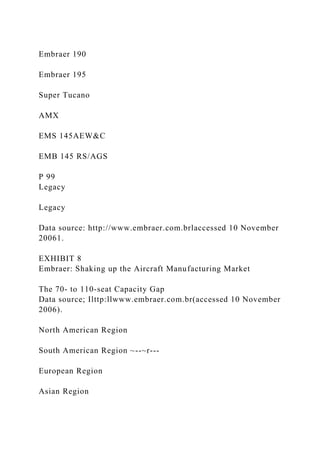
EXHIBIT 7
Embraer: Shaking up the Aircraft Manufacturing Market
Embraer's 2006 Product Mix
CommercialAviation Military Aviation CorporateAviation
EMB 120
ERJ 135
ERJ 140
ERJ 145
Embraer 170
Embraer 175
Embraer 190
Embraer 195
Super Tucano
AMX
EMS 145AEW&C
EMB 145 RS/AGS
P 99
Legacy
Legacy
Data source: http://www.embraer.com.brlaccessed 10 November
20061.
EXHIBIT 8
Embraer: Shaking up the Aircraft Manufacturing Market
The 70- to 110-seat Capacity Gap
Data source; Ilttp:llwww.embraer.com.br(accessed 10 November
2006).
North American Region
South American Region ~--~r---
European Region
Asian Region
130 150 17070 90 11030 50Seating Capacity
(continued!
i
'I,
,
,
I
i
I
I
-------------...:_-72 International Business Strategy
Embraer Shakmg Up the Aircraft Manufacturing MarketC392
CASE 25 I
EXHIBIT 8 (Continued)
Llne d f 10 to 110-seat 8lfcraftHow Overcapacity or
Uudercapecltv Hurts the Bottom I nne encreft have passenger
loads better SUite or _
, arrow-body mamnNote More than halfalall U,S. domestic
airlines operatlflQ n
27% 34% .
appropriate for 10- appropriate for 90-
to 90-seat aircraft to no-seet aircraft
~~
!!e~
~
c
jj
~
'S
~
'"
~s- 2%
~~
0% <50 50~ 60~ 10 80 90 100 110 120
Passengers per Departure
14%
9%
4%
13%
8% 1%
4%
3%nn
130 140 >150
Seating Gap
~~:~~:;: ~1:~~~:':~i~do;I~:2~orld's Jelfleet servingthe 51-to
120-8981segment IS morethan 20years oldand should be renrec
In the commg years
Data source: http://www.embraer.com.br(accessed 10 November
2006).
500
312400
'§ 330
~ 300
~
l: 200
E=z
100
453 689aircraft older than 20 years
(34% of total fleet in service)
A. ,
304
o '--'::0-~5-~6:--1;'.;0--;":11:"'-1~5-'1;',('6"!_2;;-0-:21-25 26-30
Aircraft Age (Years)
market were abandoned owing to financial constraints,
and Bombardier was forced to continue relying on its
existing platform.
After several years of escalating financial and busi-
ness challenges, in 2003, Bombardier appOinted for-
mer CN Railway CEO Paul Tellier as the company's
+30
president and CEO. Tellier quickly implemented a
recapitalizalion program, featuring an equity issue
and asset divestitures, to strengthen Bombardier's
balance sheet and refocus on its aerospace and rail-
car businesses. The aerospace business continued to
struggle, however, with 2005 production estimates
Embraer: Shaking Up the Aircraft Manufacturing Market 73
CASE 25 I Embraer: Shaking Up the Aircraft Manufacturing
Market C393
for the 50-seat CRJ200 reduced from 98 to 54, as the
market continued to migrate toward larger regional
planes. Furthermore, the financial strength of airlines
still interested in 50-seat jets, such as US Airways and
Delta Airlines, continued to decline. In November
2004, Standard & Poor's and Moody's Investor
Service downgraded Bombardier's credit rating to
junk status. One month later, after less than two years
on the job, Tellier was removed from his position as
president and CEO of Bombardier. Replacing Tellier
was Laurent Beaudoin, a member of Bombardier's
founding family, chairman of Bombardier since 1979,
and previously CEO of the company from 1979-1999.
Beaudoin had reportedly pushed Tellier aside after dis-
agreeing with his long-term vision for Bombardier.
The CSeries: The entrepreneurial Beaudoin was
believed to be an enthusiastic supporter of the CSeries
development project that began feasibility studies at
Bombardier in 2004. The CSeries, a new family of
three jets ranging from 110 to 135 seats, would serve
as Bombardier's entry vehicle into the commercial jet
market. Bombardier's board of directors was expected
to decide in early 2005 whether to proceed with devel-
opment efforts, with the objective of launching the proj-
ect in spring of 2006 and delivering the firstjet in 2010.
The Canadian government, attracted to the opportunity
to replace the thousands of jobs that had been lost
because of the scaled-back production of Bombardier's
CRJ200, had reportedly agreed to finance one-third of
the expected $2 billion of capital costs associated with
the prototype development. In exchange, Bombardier
would commit to locating the CSeries manufacturing
and development facilities in Canada.
The CSeries jets were expected to compete directly
with Embraer's EMBRAER 190, Airbus's A318, and
Boeing's 737-600. Bombardier claimed the CSeries
would be the only jet specifically designed for the
110- to I35-seat market, as Embraer's 190 was
an upward stretch from the 170, and Airbus's and
Boeing's jets were downsized versions of their larger
narrowbody jets. As a result, Bombardier claimed the
CSeries would outperform each competing jet with
respect to weight, size, or range. Bombardier expected
the CSeries to achieve unmatched operating efficiency,
reducing costs to 15% to 20% below the cost of oper-
ating competing planes.
Bombardier's recent hiring of former Boeing
executive Gary Scott, who had previously worked on
Boeing's development of the 737,to direct the CSeries
program sparked conjecture in the Canadian press of a
Bombardier plan to create ajoirn venture with Boeing.
Bombardier called the reports "pure speculation;' but
Boeing Commercial Airplanes President Alan Mulally
confirmed that his company had served as a "consul-
tant" to Bombardier. A relationship with Boeing could
add significant value to the CSeries, particularly if it
allowed Bombardier to create cockpit commonality
with Boeing's 737.
BOEING, Boeing was the world's second-largest
manufacturer of large commercial jets behind Airbus,
as well as the world's largest aerospace company,
focusing on military aircraft, satellites, missile de-
fense, human space flight, and launch systems and
services. Since 2001, Boeing's commercial airplane
sales had plummeted from 60% to 40% of Boeing
sales. Boeing responded to that downturn by cutting
costs, curtailing product development, and placing
more emphasis on its rni litary and space operations.
In 2005, Boeing's commercial development efforts
were primarily focused on the 787 Drearnliner, a super-
efficient, long-range (9,500 km to 11,000 krn, or 7,000
to 8,000 miles), 200- to 250-seat aircraft that was t
expected to be in service by 2008.
The smallest Boeing airplane in full-scale produc-
tion as of 2005 was the 162- to I89-seat 737. Boeing
announced in January 2005 that the 106- to 1l4-seat
717, which was inherited in Boeing's 1997 acquisition
of McDonnell Douglas, would be taken out of produc-
tion as soon as its existing orders were filled. Boeing
cited insufficient demand as the reason for the deci-
sion, adding that the 717's market niche was simply
too small for Boeing to continue serving. The 717
was considered by market analysts to be too big and
heavy to operate efficiently relative to smaller regional
jets such as Bombardier's CRJ900 and Embraer's
EMBRAER 190. Furthermore, the 717 was an orphan
product, with no cockpit or engine commonality with
other Boeing jets, and had not received a great deal of
marketing and development support from Boeing dur-
ing its six years of production.
AIRBUS S.A.S. The world's largest commercial
aircraft maker, Airbus, was 80% owned by the
European Aeronautic Defense and Space Company
(EADS), with U.K.-based BAE Systems controlling
the remaining 20%. Airbus was founded in 1970 to
address several European governments' wishes to
have a European competitor in the aerospace industry.
In 2005, Airbus was the manufacturer of the world's
74 International Business Strategg~y~ _
Shak',ngUp the Aircraft Manufacturing MarketC394 CASE 25 I
Embraer
largest, lowest-cost, and longest-range aircraft. The
company had recently been focused on the super-
jumbo market, with the development of the 550-seat
A380. In December 2004, however, Airbus announced
plans to develop a midsized plane, the A350, to corn-
pete directly against Boeing's 787, seating 245 to 285
passengers. . .
Airbus's product line comprised four families: the
single-aisle A320 family, the widebody A300/310
family, the long-range A330/340 family, and the new
super-jumbo A380 family. Airbus's smallest airplane,
the 318, was a 107- to 132-seat short-haul jet launched
in 1999 to compete with Boeing's 717. The A318 ben-
efited from a high degree of commonality with the
entire A320 family in terms of airframes, on-board
systems, cockpits, and handling characteristics, which
meant that the entire family could be flown by the same
pilots and maintained by the same engineers. Still, as
a downsized version of the I50-seal A320, detractors
considered the A318 to be larger and heavier than is
desirable for jets in the IOO-seat market.
Competitive History (1989-2005)
1989 Embraer began development of the ERJ 145.
1992 Bombardier entered the regional jet market
with the 50-seat CRJ I00/200, developed from
the CL-60 I Challenger business jet.
1993 Airbus launched development of the 120-seat
A319.
1996 Ernbraer began delivering the ERJ 145.
1997 Embraer launched the 37-seat ERJ 135.
Bombardier announced plans ro develop the
64- to 75-seat CRJ7001705.
1998 Ernbraer began delivering the ERJ 135.
1999 Bombardier began development of the 86- to
90-seat CRJ900.
Embraer launched development of the 44-seat
ERJ 140 and launched its EMBRAER 170/190
family beginning with the development of the
70-seat EMBRAER 170.
Airbus launched development of the 107- to
I32-seat A318.
After two years of discussion about government
subsidies, Canada challenged the Brazilian
subsidy program PROEX before the WTO.
The WTO decided that the Brazilian PROEX
The Decision
was a prohibitive export program that had to be
withdrawn. The value of the PROEX SUbsidy
to Embraer was worth $1.4 billion. FollOWing
that, Canada chose 10 retaliate by imposing tar-
iffs on the Brazilian exports including a tempo.
rary ban on Brazilian beef.
2000 Bombardier abandoned plans for development
of a new 100-seat jet, the BRJ-X.
200 I Bombardier's CRJ7001705 began service.
2003 Bombardier's CRJ900 began service.
Embraer's EMBRAER 170 began service.
2004 Bombardier announced that it was studying
the feasibility of a new jet family, the CSeries,
which would serve the I IO-to I35-seat market.
Embraer began delivery of the EMBRAER
J 75 and EMBRAER 190.
2005 Boeing announced plans to stop production of
the 717 beeause of insufficient market demand.
As he made final preparations for his upcoming inves-
tor presentation, Mauricio Botelho was concerned
that Embraer still did not know what to expect from
Bombardier, Boeing, and Airbus. How would they
respond to Embraer's successful launch of Its recent
family of jets? Would Bombardier really follow through
with its launch of the eSeries? Would Airbus and
Boeing perceive the latest attacks by Embraer and
Bombardier as attacks on their own families of jets?
Most importantly, given Botelho's expectations of
rivals' future competitive moves, what should Embraer
do next to protect its position and influence its com.
petitors' actions?
Endnotes
I. "Air Transponation," Encyclopedia of Global Industries.
online edition, Thomson Gale, 2005. Reproduced in Business
and Company Resource Center (Michigan: Gale Group. 2005).
http://galeneLgalegroup.com/servletlBCRC.
2. "Air TranspOrtation," Encyclopedia of Gtobal tndustries,
Gale Research International Ltd. Pub ID: GE66 (1 December
2002). '
3. AV,ailable seal miles (ASM) measure available passenger
capacity.
4. "Airli~e,lndust]'Y: A Business in Transition," Optimizing Air
Travel MIni-Conference Presentation Boston Massachusets,
24 March 2004. "
_______________________________ U:.-P...:S_i_n_ln.;d .;ia_-
_A_Package Deal? 7§
/I'S challenging. Bill UPS is all about global trade. Global
Trade is going to
pull us out of this recession.
-UPS CEO SCOTT DAVIS IN A 2009 CNBC INTERVIEW
Marne L. Arthaud·Day
Kansas State University
Shreyasi Banerjee
Intel Corporation
Frank T. Rothaermel
Georgia Institute o!Technology
I
THAD BEEN six months since Robin Page first
walked into the Sandy Springs headquarters of
United Parcel Service (UPS) and assumed her
role as Chief Strategy Officer. Though she had
been doing strategic analysis and planning for
years, she felt an unusual amount of pressure to prove
herself in this new position. Chief Executive Officer
{CEOI Scott Davis had made it clear when he offered
her the job that he had high expectations of what she
could do for the company, and that he wanted to see
concrete results by the end of the first year.
Ms. Page glanced at the pile of reports sitting on
her desk, many of them describing recent international
acquisitions and alliances. She knew that one of the rea-
sons she had been Mr. Davis's top choice for the posi-
tion was her extensive international experience. UPS
already had a presence in more than 200 countries,
but they wanted to penetrate those markets more
deeply. especially the rapidly growing economies of
Southeast Asia. Ms. Page had traveled extensively
around the region both for work and for pleasure, and
Mr. Davis was counting on her insights to help the
company with its Asian expansion.
First and foremost on her mind was India. She
remembered fondly a vacation she had taken there
just a year or so ago, and how the city marketplaces
had struck her as a unique mix of the modern and the
ancient. People milled around everywhere, pushing
their way through crowded streets, families piled on
motor bikes weaving in and out of lanes of standstill traf-
fie. Yet everywhere she looked, someone was talking
on a cell phone, and modern buildings lined the horizon
with names of multinational corporations from allover
the world. An entrepreneurial spirit seemed to fill the
air, with new businesses coming to life on a daily basis;
for every venture that failed, two more sprouted up
to claim its space. The country was awash with busi-
ness opportunities amidst the clamor, congestion, and
complexity that typified modern life in India's major cit-
ies like Mumbai, Delhi, and Bangalore. The sheer vol-
ume of people promised seemingly unlimited market
potential.
Although UPS had established a footprint in India,
it had yet to penetrate the market on the scale that
Ms. Page and other UPS managers hoped for. They
formed an alliance with Jet Air in 2005. which led
to the opening of the first" UPS Store" in Mumbai
and several other major cities. In 2008, UPS estab-
lished a second alliance with AFL Private Ltd, gain-
ing access to the logistics company's field stocking
locations and significantly increasing its access points
for international delivery. Since then, however, UPS's
attention had shifted to other Asian markets like China
and Malaysia, leaving India wide open to invading
competitors. Sure enough, in UPS's absence. DHL
acquired the Indian delivery company Blue Dart and
had become the clear market leader in both the inter-
national and domestic segments. Today. DHL,81ue
Dart had a combined market share three times higher
than the next largest company.' Clearly, it was to time
to reformulate UPS's India strategy.
In many ways, the India situation reminded Ms.
Page of when UPS first began to offer overnight
delivery back in the 19BOs A major competitor (the
U.S. Postal Service) dominated the marketplace, and
Professor Marne L. Arthaud-Day, Research Associate Shreyasi
Banerjee
(Industrial Engineer and SYStems Analyst, Intel), and Professor
Frank T.
Rothaennel prepared this case from public sources. This case is
developed for
the purpose of class discussion. lr is not Imended to be used for
any kind of
endorsement, source of data. or depiction of efficient or
inefficient manage-
ment. C Arthaud-Day, Banerjee. and Roibaermcr. 2013.
C39S
7
i1
I
I
I
I
76 International BUSlne~ss~S::t::ra:::te~9:y -----,
C396 CASE 26 I UPS In India-A Package Deal?
EARLY HISTORY. Claude Ryan and Jim Casey had a
big idea and a small amount of debt capital. Working
from a Seattle basement, they began running errands
and carrying notes on foot, as well as making home
deliveries fordrugstore customers. As the arrival of new
technologies such as the telephone and automobile led
to a decrease in demand for messaging services, the
company shifted its emphasis to delivering packages
for retail stores. "Merchants Parcel Delivery" quickly
built a strong reputation based on its personalized cus-
lamer service and the care with which it handled every
package.' The young enterprise changed its name to
United Parcel Service in 1919 as it entered a golden
period of domestic expansion. The word "United" was
chosen to reflect that even as the company expanded
into other cities like Oakland and Los Angeles, they
still belonged to the same organization.
Throughout its early history, UPS functioned pri-
marily as an intra-city delivery service, innovating in
response to consumers' changing lifestyles and shop-
ping patterns' In the 1920s, UPS added several unique
service features such as daily pick-ups. acceptance
of C.O.D. payments, and multiple delivery attempts.
It also developed a new conveyor belt system for
handling packages.l When fuel shortages leading up
to World War II caused retailers to curtail their deliv-
ery activities and encourage customers to carry their
parcels home, UPS stepped up and expanded its retail
. 6
store service, After the war, as people migrated to the
suburbs and bought cars that could hold their goods,
UPS shifted its focus to the business-to-business
segment.'
COMMON CARRIER RIGHTS. In the next phase of
its expansion, UPS decided to pursue common carrier
rights, meaning that it could deliver packages between
both pnvate and commercial customers. This was tra-
ditionally the domain of the U.S. Postal Service, as
stipulated by the Interstate Commerce Commission
and multiple state regulatory bodies. A series of legal
battles ensued as UPS fought to expand its operat-
IIlgauthority to all 48 states, a goal which it finally
achieved III 1975. By 1978, UPS also provided nation-
Wide air transport services, flying packages in the
cargobaysof commercial airlines.!
UPS AIRLINES I .. n response to the deregulation of
the airline industr . .,. y, many established earners trimmed
flights during the 1980s, leading to reduced air freight
capacuy UPS s hi. aw t IS as an opportunity to enter the
while UPS had strongholds in all of the major loca-
tions. the challenge was to figure out how to con-
nect rural America to its major transportation hubs.
UPS had promised overnight delivery between any
two addresses in the United States, and they weren't
joking. If a package needed to get to the base of the
Grand Canyon, the plan was to drive the package on
a dirt road for 50 miles from Valentine, Arizona, to
the rim of the Canyon. A mule train operator would
then take the letter over to the rocky final leg for a
$35 charge to UPS. UPS would deliver the letter at a
loss in order to maintain its commitment to overnight
delivery. Ms. Page knew that vast regions of rural India
still lacked adequate roadways, and she chuckled think-
ing that mule trains might not be such a far-fetched
idea after all. Delivery at the local level was still very
much a small business, especially in developing coun-
tries. It's like Kent Nelson, UPS's senior vice president
for finance and customer service. said in a 1985 inter-
view, "When you are in the package-delivery business,
you are really in the pennies business. The trick is to
have the pennies build up to be profitable:"
If UPS was to be a major player in the current" India
Mania," the company would have to figure out the
answers to several difficult questions. How unique
was the Indian situation compared to other develop-
ing countries? UPS had been in business for over 100
years and had experience in over 200 worldwide mar-
ketplaces. Surely some of the lessons learned would
transfer to India, but how could they determine which
ones? Competitors already had a head start, so UPS
could not afford to experiment based simply on trial
and error. How should they go about tapping the exten-
sive potential of one of the world's largest economies?
How difficult would it be to streamline their supply and
distribution chain given the lack of infrastructure devel-
opment? With the size of India's population and the
econom.y's rapid ~rowth, the rewards for successfully
acdressino these Issues were sizeable to say the least.
Ms. Page sat down and started reviewing the pile of
documents sitting on her desk, hoping the deals of the
past would help her figure out the right path for UPS's
future in India.
The UPS Story
The UPS saga has all the elements of a remarkable
success story. Two teenage entrepreneurs in 1907
started what would one day become the world's lar _
est package delivery company. g
UPS in India-A Package Deal? 77
CASE 26 I UPS In Indla-A Package Deal? C397
air delivery business and began to acquire cargo jets.
It offered next-day air service to 48 states by 1985,
and in 1988, UPS Airlines was formally recognized
by the Federal Aviation Administration. It was the
fastest airline startup in FAA history, taking just over
one year to get all systems into place." Building on
the success of its airline service, the company shifted
from a national delivery company to a global foot-
print throughout the 1990s. UPS now provides deliv-
ery services to more than four billion people in over
200 countries."
GOING PUBLIC. The latter half of the 1990s brought
both major challenges and new business opportuni-
ties. In August 1997, the Teamsters Union led about
185,000 UPS workers on a strike. They wanted more
union control of employee pension funds and objected
to UPS's increasing use of part-time workers. UPS
controlled about 80 percent of all package deliver-
ies in the United States, so the repercussions of the
IS-day strike for both the company and its customers
were severe. UPS lost $650 million in business over a
disagreement that then CEO James Kelly commented
could have been worked out "without a strike."!' UPS
recovered quickly, however, and went public in 1999,
almost I00 years after its conception. A report in The
New York Times said, "Investors have greeted the new
stock with an enthusiasm usually reserved for dot-com
ventures whose founders' parents had not even been
born by 1907.,,12 In fact, the UPS !PO was the largest
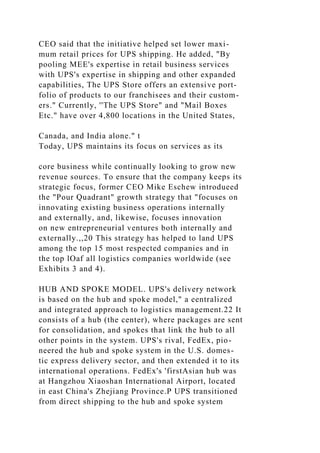
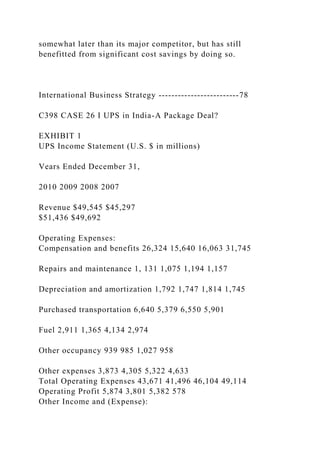
public offering to date. (See Exhibits I and 2 for UPS
financial data.)
SYNCHRONIZED COMMERCE. In the meantime,
UPS continued to redefine itself in response to changes
in its external environment. No longer restricting its
activities to delivery services, UPS sought to become
a "solutions company" that offered services tailored to
its customers' business process value chain. 13 It formed
the UPS Logistics Group in 1995 to streamline service
operations over its customer base, and UPS Capital in
1998 to provide finaneial products and serviees to help
small businesses grow." The company made about
30 acquisitions in total, including freight forwarders,
customer clearers, and a bank for the efficient move-
ment of goods, information, and financing along their
supply and distribution network." When a study by
FutureBrand concluded that UPS had no terminology
to explain their expanded business model to custom-
ers, they coined the term "Synchronized Commercet'l''
By modifying its supply chain to streamline the now
between buyers and sellers, UPS was able to "synchro-
nize" goods, information, and funds to deliver more
products and services to its customers.
By the start of the new millennium, UPS was well
on its way to becoming a full-service business.!? In
2001, UPS acquired Mail Boxes Etc., then the world's
largest franchisor of retail shipping, postal, and busi-
ness service centers.P'This strategic move enabled the
company to target smaller businesses and increased
its accessibility to residential and home-office cus-
tomers. Over 3,000 Mail Boxes Etc. locations were
re-branded as "The UPS Store," in the largest re-
branding campaign in history. Mail Boxes Ete.'s
CEO said that the initiative helped set lower maxi-
mum retail prices for UPS shipping. He added, "By
pooling MEE's expertise in retail business services
with UPS's expertise in shipping and other expanded
capabilities, The UPS Store offers an extensive port-
folio of products to our franchisees and their custom-
ers." Currently, ''The UPS Store" and "Mail Boxes
Etc." have over 4,800 locations in the United States,
Canada, and India alone." t
Today, UPS maintains its focus on services as its
core business while continually looking to grow new
revenue sources. To ensure that the company keeps its
strategic focus, former CEO Mike Eschew introdueed
the "Pour Quadrant" growth strategy that "focuses on
innovating existing business operations internally
and externally, and, likewise, focuses innovation
on new entrepreneurial ventures both internally and
externally.,,20 This strategy has helped to land UPS
among the top 15 most respected companies and in
the top lOaf all logistics companies worldwide (see
Exhibits 3 and 4).
HUB AND SPOKE MODEL. UPS's delivery network
is based on the hub and spoke model," a eentralized
and integrated approach to logistics management.22 It
consists of a hub (the center), where packages are sent
for consolidation, and spokes that link the hub to all
other points in the system. UPS's rival, FedEx, pio-
neered the hub and spoke system in the U.S. domes-
tic express delivery sector, and then extended it to its
international operations. FedEx's 'firstAsian hub was
at Hangzhou Xiaoshan International Airport, located
in east China's Zhejiang Province.P UPS transitioned
from direct shipping to the hub and spoke system
somewhat later than its major competitor, but has still
benefitted from significant cost savings by doing so.
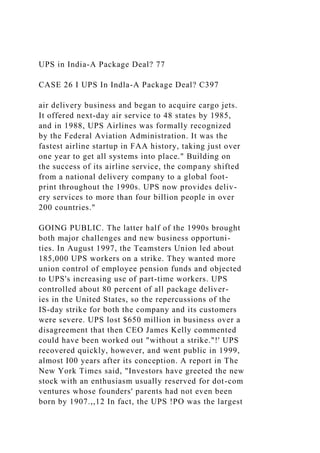
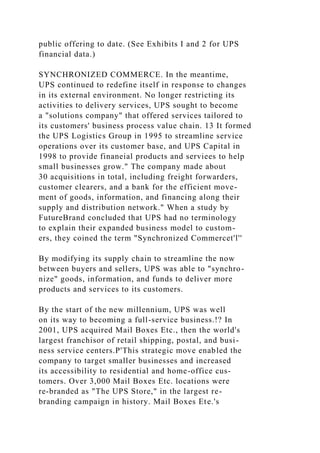
International Business Strategy -------------------------78
C398 CASE 26 I UPS in India-A Package Deal?
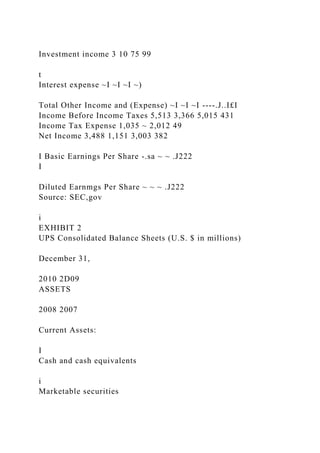
EXHIBIT 1
UPS Income Statement (U.S. $ in millions)
Vears Ended December 31,
2010 2009 2008 2007
Revenue $49,545 $45,297
$51,436 $49,692
Operating Expenses:
Compensation and benefits 26,324 15,640 16,063 31,745
Repairs and maintenance 1, 131 1,075 1,194 1,157
Depreciation and amortization 1,792 1,747 1,814 1,745
Purchased transportation 6,640 5,379 6,550 5,901
Fuel 2,911 1,365 4,134 2,974
Other occupancy 939 985 1,027 958
Other expenses 3,873 4,305 5,322 4,633
Total Operating Expenses 43,671 41,496 46,104 49,114
Operating Profit 5,874 3,801 5,382 578
Other Income and (Expense):
Investment income 3 10 75 99
t
Interest expense ~I ~I ~I ~)
Total Other Income and (Expense) ~I ~I ~I ----.J..I£I
Income Before Income Taxes 5,513 3,366 5,015 431
Income Tax Expense 1,035 ~ 2,012 49
Net Income 3,488 1,151 3,003 382
I Basic Earnings Per Share -.sa ~ ~ .J222
I
Diluted Earnmgs Per Share ~ ~ ~ .J222
Source: SEC,gov
i
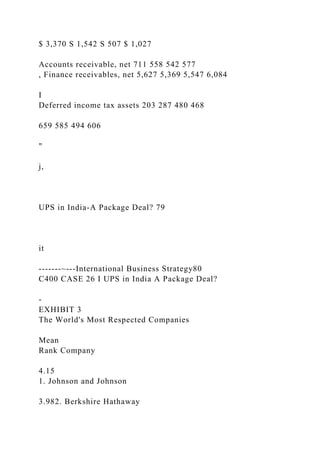
EXHIBIT 2
UPS Consolidated Balance Sheets (U.S. $ in millions)
December 31,
2010 2D09
ASSETS
2008 2007
Current Assets:
I
Cash and cash equivalents
i
Marketable securities
$ 3,370 S 1,542 S 507 $ 1,027
Accounts receivable, net 711 558 542 577
, Finance receivables, net 5,627 5,369 5,547 6,084
I
Deferred income tax assets 203 287 480 468
659 585 494 606
"
j,
UPS in India-A Package Deal? 79
it
-------~---International Business Strategy80
C400 CASE 26 I UPS in India A Package Deal?
-
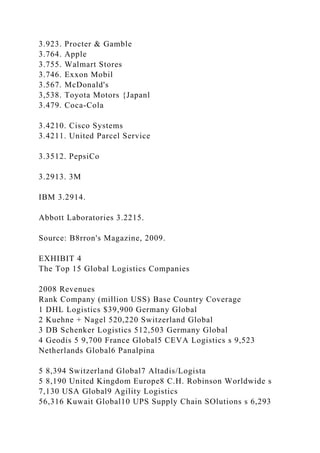
EXHIBIT 3
The World's Most Respected Companies
Mean
Rank Company
4.15
1. Johnson and Johnson
3.982. Berkshire Hathaway
3.923. Procter & Gamble
3.764. Apple
3.755. Walmart Stores
3.746. Exxon Mobil
3.567. McDonald's
3,538. Toyota Motors {Japanl
3.479. Coca-Cola
3.4210. Cisco Systems
3.4211. United Parcel Service
3.3512. PepsiCo
3.2913. 3M
IBM 3.2914.
Abbott Laboratories 3.2215.
Source: B8rron's Magazine, 2009.
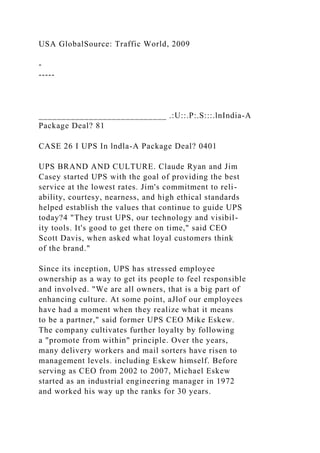
EXHIBIT 4
The Top 15 Global Logistics Companies
2008 Revenues
Rank Company (million USS) Base Country Coverage
1 DHL Logistics $39,900 Germany Global
2 Kuehne + Nagel 520,220 Switzerland Global
3 DB Schenker Logistics 512,503 Germany Global
4 Geodis 5 9,700 France Global5 CEVA Logistics s 9,523
Netherlands Global6 Panalpina
5 8,394 Switzerland Global7 Altadis/Logista
5 8,190 United Kingdom Europe8 C.H. Robinson Worldwide s
7,130 USA Global9 Agility Logistics
56,316 Kuwait Global10 UPS Supply Chain SOlutions s 6,293
USA GlobalSource: Traffic World, 2009
-
-----
____________________________ .:U::.P:.S:::.lnIndia-A
Package Deal? 81
CASE 26 I UPS In lndla-A Package Deal? 0401
UPS BRAND AND CULTURE. Claude Ryan and Jim
Casey started UPS with the goal of providing the best
service at the lowest rates. Jim's commitment to reli-
ability, courtesy, nearness, and high ethical standards
helped establish the values that continue to guide UPS
today?4 "They trust UPS, our technology and visibil-
ity tools. It's good to get there on time," said CEO
Scott Davis, when asked what loyal customers think
of the brand."
Since its inception, UPS has stressed employee
ownership as a way to get its people to feel responsible
and involved. "We are all owners, that is a big part of
enhancing culture. At some point, aJlof our employees
have had a moment when they realize what it means
to be a partner," said former UPS CEO Mike Eskew.
The company cultivates further loyalty by following
a "promote from within" principle. Over the years,
many delivery workers and mail sorters have risen to
management levels. including Eskew himself. Before
serving as CEO from 2002 to 2007, Michael Eskew
started as an industrial engineering manager in 1972
and worked his way up the ranks for 30 years.
India Mania
In a 2006 address, Dr. Manmohan Singh, the Prime
Minister of India, declared, "We believe that India
is now on a sustained path of high growth. We have
developed anew model for service-led and technology-
driven integration with the global economy.,,26 As ifon
cue, India's GDP topped the $1 trillion mark in early
April 2007, making it the 12th wealthiest nation in
the world according to Swiss investment finn Credit
Suisse27 Jndia's GOP now stands at $1. J 6 trillion,
with an annual growth rate of 7.9 percent even dur-
ing the global financial crisis.'s When asked about
the biggest benefit of doing business in India, Steve
Hochradel, Assistant VP of distribution for PBD
Worldwide said, "India offers great growth opportuni-
ties, and it is easier to do business there than in many
other international markets. India has a high popula-
tion of English speakers, which makes it easy to enter
the market, negotiate with vendors and partners, and
set up operations.v?
ECONOMIC REFORM. However, prosperity did not
follow immediately after India's emergence from
British control and establishment as an independent
nation in 1947. For the first 40 years or so, the new
socialist government took an extreme protectionist
stance, structuring society on the basis of collective
action as opposed to capitalist acquisitiveness. The
License Raj represented the state's efforts to con-
trol all aspects of the economy. Elaborate permits
and regulations were required to set up or run busi-
nesses, severely limiting their growth. Though there
was economic discipline at the macro level and infla-
tion was low compared to other developing countries,
the Indian economy dragged along at a subsistence
level with a low GOP per capita. Basic industries
such as steel and textiles were conspicuous by their
absence.t"
The UPA (United Progressive Alliance), a coalition
of political parties that constitutes the Government
of India still today, is credited with opening up the
economy. An economic crisis during the 1991 general
election triggered the beginning of micro-economic
liberalization. To rectify the situation, then-finance
minister Dr. Manmohan Singh proposed changes such
as repealing the "License Raj" and lifting a ban on for-
eign direct investment. The economy grew by 9 percent
the following year as a result of these changes. The
Manmohan Singh government showed further sup- t
port for international trade through the achievement
of two key foreign trade policy objectives in 2004:
(I) to double India's percentage share of global mer-
chandize trade in a five-year period; and (2) to use
trade expansion for both employment generation and
economic growth." To expand upon these objectives,
the government established several Special Economic
Zones (SEZ Act, 2005) in 2006 to attract foreign and
domestic investment. Companies operating in these
zones receive significant tax benefits and face much
simpler clearance and compliance procedures. India's
worldwide trade is linked to the world economy. For
example, with the recession hitting most of India's
major trading partners like the United States, United
Arab Emirates, and Singapore, export demand from
India declined by 16percent in January 2009.32
KEY INDUSTRIES. India boasts a technical work
force of 4 million and trains 60,000 software engineers
every year.33 Combined with lower wages, these fac-
tors make India a prime source for information tech-
nology (IT) services and a choice business process
outsourcing (BPO) destination. In tum, large-scale
employment in the IT and BPO sectors has helped
to create an upwardly mobile working class, driv-
ing increased purchasing/spending power for India's
younger generations.
82
zarion of resources from the private sector to cornpls.
ment government efforts.
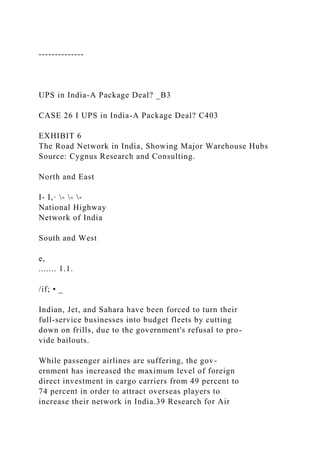
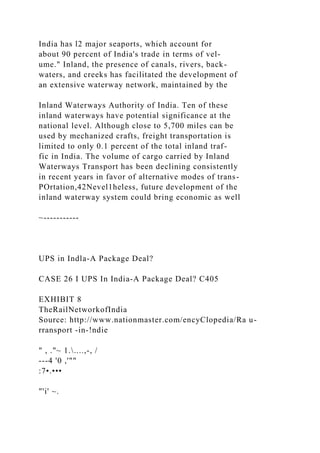
India has 2.1 million miles of roadways thai carry
80 percent of its total passengers and 65 percent of
India's freight (see Exhibit 6). As of 2000, roughly
74 percent oFIndia's rural population lacked adequate
road access, while 40 percent of the existing roads
lacked all-weather capability. As a result, the govern-
ment plans 10 invest $70 billion in India's road infra-
structure over the next few years;J<; $33 million has
been dedicated to providing rural connectivity?' De-
velopmental projects such as the Golden Quadrilateral
Project are helping link India's four major metropo-
lises (Delhi, Mumbai, Kolkata, and Chennai), while the
Prime Minister's Rural Roads Program (pMGSY) aims
to provide increasedaccess to agricultural communities.
India's civil aviation industry was born in 1912
with the first air flight between Karachi and Delhi (see
Exhibit 7). The government monopolized the industry
for most of the 20lh century through the state-owned
Air India and Indian Airlines Corporation, until the
passage of the "open sky" policy in April 1990 (effec-
tive as of 1994). Under "open sky," airlines could
receive foreign direct investment of up to 49 percent,
opening the market to a host of new players like Jet
Airways and Sahara. Deccan Airlines was started by
Captain Gopinath in August 2003 as a no-frills bud-
gel air service, becoming the first in the industry 10 fly
to second-tier cities from major metropolitan areas."
However, after an initial period of rapid growth, the
Indian airline industry fizzled around 2007. Today,
the industry operates at fares below its costs and is
weighed down by huge debt. When oil prices hit $75
a barrel in early 2009, the industry as a whole was
expected to post a $9 billion loss. Major carriers like
International BUSjneS~s~5~tra~t~eg~y~ 1------
C402 CASE 26 I UPS In India-A Package Deal?
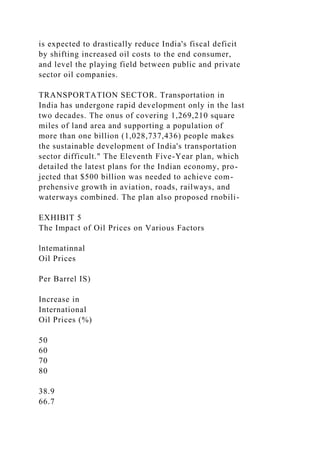
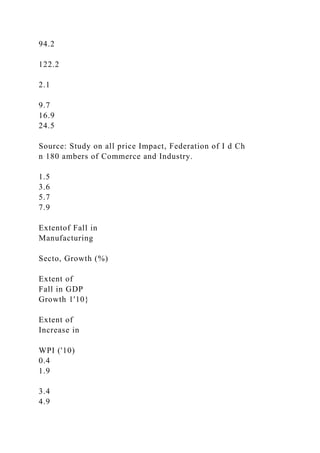
India's economic climate is highly dependent
on the oil industry, which until recently has been
closely regulated by the national government. An
RCCI (Federation of Indian Chambers of Commerce
and Industry) report found a strong positive correla-
lion between the price of oil and commodity prices
across different sectors of the Indian economy (with
tile exception of manufacturing, see Exhibit 5). This
was largely due to the fact that political pressures
ensured that the government absorbed a large part of
the increase in oil prices. Public sector oil companies
reported losses of approximately US$ 28 mi Ilion per
day on the sale of petroleum products at government-
mandated prices. The government offset these losses
by selling oil bonds, providing crude oil to state-owned
oil retailers at discounted rates, and making periodic
adjustments in retail oil prices." In June 2010, the
Indian government made a surprising announcement
that it plans to deregulate the oil industry. This move
is expected to drastically reduce India's fiscal deficit
by shifting increased oil costs to the end consumer,
and level the playing field between public and private
sector oil companies.
TRANSPORTATION SECTOR. Transportation in
India has undergone rapid development only in the last
two decades. The onus of covering 1,269,210 square
miles of land area and supporting a population of
more than one billion (1,028,737,436) people makes
the sustainable development of India's transportation
sector difficult." The Eleventh Five-Year plan, which
detailed the latest plans for the Indian economy, pro-
jected that $500 billion was needed to achieve com-
prehensive growth in aviation, roads, railways, and
waterways combined. The plan also proposed rnobili-
EXHIBIT 5
The Impact of Oil Prices on Various Factors
lntematinnal
Oil Prices
Per Barrel IS)
Increase in
International
Oil Prices (%)
50
60
70
80
38.9
66.7
94.2
122.2
2.1
9.7
16.9
24.5
Source: Study on all price Impact, Federation of I d Ch
n 180 ambers of Commerce and Industry.
1.5
3.6
5.7
7.9
Extentof Fall in
Manufacturing
Secto, Growth (%)
Extent of
Fall in GDP
Growth 1'10}
Extent of
Increase in
WPI ('10)
0.4
1.9
3.4
4.9
--------------
UPS in India-A Package Deal? _B3
CASE 26 I UPS in India-A Package Deal? C403
EXHIBIT 6
The Road Network in India, Showing Major Warehouse Hubs
Source: Cygnus Research and Consulting.
North and East
I- I,· - - -
National Highway
Network of India
South and West
e,
....... 1.1.
/if; • _
Indian, Jet, and Sahara have been forced to turn their
full-service businesses into budget fleets by cutting
down on frills, due to the government's refusal to pro-
vide bailouts.
While passenger airlines are suffering, the gov-
ernment has increased the maximum level of foreign
direct investment in cargo carriers from 49 percent to
74 percent in order to attract overseas players to
increase their network in India.39 Research for Air
Cargo India 2010 indicates that air cargo now com-
prises 19 percent of the total freight in India-the
same amount as ocean and rail freight combined.
Overall, aviation is expected to grow at a rate close to
25 percent in the next decade. Air cargo is expected
to post a CAGR of 11.2 percent, expanding to more
than three times its present size by 2025. Currently,
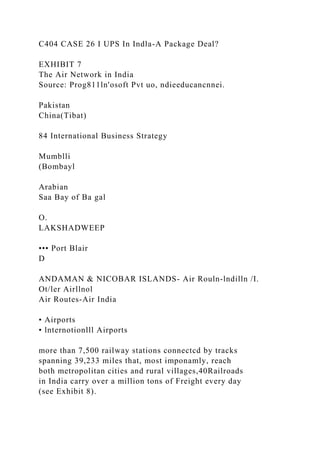
India has 126 functional airports, 12 of which are
international and are managed by the Airport Authority
of India (5 of these have been privatized for develop-
ment). Pricing in the industry is directly dependent on
high sales taxes on aviation turbine fuel (ATF)and high
airport charges. Players in the industry also face major
challenges in acquiring land, developing infrastruc-
ture, and other issues such as environmental clearance.
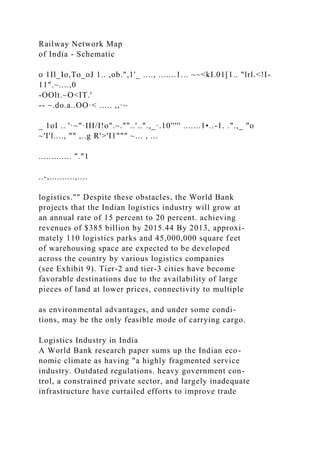
India's first rail line was set up as an experimental
line during the Madras Presidency in 1836. Later, the
British government encouraged development of a rail-
way system to haul construction materials around the
country, securing 9 million pounds from British com-
panies in guarantees. In 1951, the Indian Railway was
nationalized and integrated into one unit to form one
of the largest rail networks in the world. Today, it has
--------....... -
N
f
-
C404 CASE 26 I UPS In Indla-A Package Deal?
EXHIBIT 7
The Air Network in India
Source: Prog811ln'osoft Pvt uo, ndieeducancnnei.
Pakistan
China(Tibat)
84 International Business Strategy
Mumblli
(Bombayl
Arabian
Saa Bay of Ba gal
O.
LAKSHADWEEP
••• Port Blair
D
ANDAMAN & NICOBAR ISLANDS- Air Rouln-lndilln /I.
Ot/ler Airllnol
Air Routes-Air India
• Airports
• lnternotionlll Airports
more than 7,500 railway stations connectcd by tracks
spanning 39,233 miles that, most imponamly, reach
both metropolitan cities and rural villages,40Railroads
in India carry over a million tons of Freight every day
(see Exhibit 8).
India has l2 major seaports, which account for
about 90 percent of India's trade in terms of vel-
ume." Inland, the presence of canals, rivers, back-
waters, and creeks has facilitated the development of
an extensive waterway network, maintained by the
Inland Waterways Authority of India. Ten of these
inland waterways have potential significance at the
national level. Although close to 5,700 miles can be
used by mechanized crafts, freight transportation is
limited to only 0.1 percent of the total inland traf-
fic in India. The volume of cargo carried by Inland
Waterways Transport has been declining consistently
in recent years in favor of alternative modes of trans-
POrtation,42Nevel1heless, future development of the
inland waterway system could bring economic as well
~-----------
UPS in Indla-A Package Deal?
CASE 26 I UPS In India-A Package Deal? C405
EXHIBIT 8
TheRailNetworkofIndia
Source: http://www.nationmaster.com/encyClopedia/Ra u-
rransport -in-!ndie
" , ."~ 1.....,-, /
---4 '0 ,'""
:7•.•••
"'i' ~.
Railway Network Map
of India - Schematic
o 1Il_Io,To_oJ 1.. ,ob.",1'_ ...., .......1... ~~<kI.01[1.. "lrl.<!I-
11".~....,0
-OOlt.~O<IT.'
-- ~.do.a..OO·< ..... ,,·~
_ 1oI .. '·~"·III/I!o".~.""..'..".,_·.10''''' .......1•..-1. .".,_ "o
~'I'l...., "" ,..g R'>'I1""" ~... , ...
............. "."1
..-,..........,....
logistics."" Despite these obstacles, the World Bank
projects that the Indian logistics industry will grow at
an annual rate of 15 percent to 20 percent. achieving
revenues of $385 billion by 2015.44 By 2013, approxi-
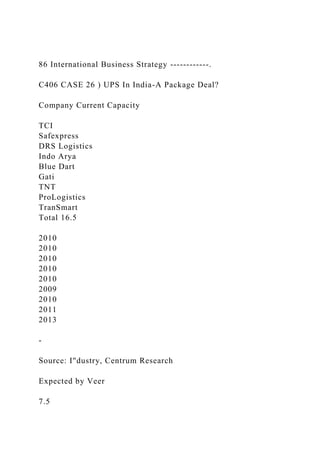
mately 110 logistics parks and 45,000,000 square feet
of warehousing space are expected to be developed
across the country by various logistics companies
(see Exhibit 9). Tier-2 and tier-3 cities have become
favorable destinations due to the availability of large
pieces of land at lower prices, connectivity to multiple
as environmental advantages, and under some condi-
tions, may be the only feasible mode of carrying cargo.
Logistics Industry in India
A World Bank research paper sums up the Indian eco-
nomic climate as having "a highly fragmented service
industry. Outdated regulations. heavy government con-
trol, a constrained private sector, and largely inadequate
infrastructure have curtailed efforts to improve trade
86 International Business Strategy ------------.
C406 CASE 26 ) UPS In India-A Package Deal?
Company Current Capacity
TCI
Safexpress
DRS Logistics
Indo Arya
Blue Dart
Gati
TNT
ProLogistics
TranSmart
Total 16.5
2010
2010
2010
2010
2010
2009
2010
2011
2013
-
Source: I"dustry, Centrum Research
Expected by Veer
7.5
3.0
1.5
2.0
1.0
1.0
0.5
10.0
10.0
5.0
3.5
2.0
1.0
2.0
7.5
10.5
51.5
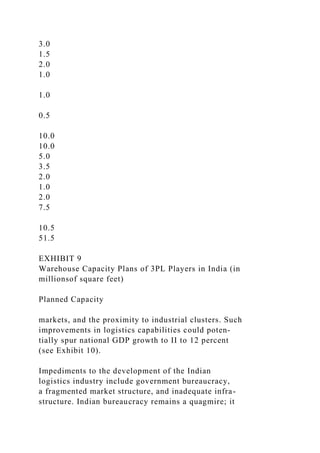
EXHIBIT 9
Warehouse Capacity Plans of 3PL Players in India (in
millionsof square feet)
Planned Capacity
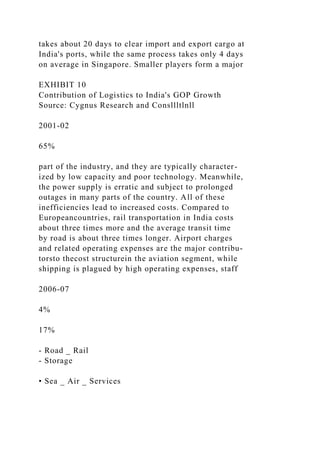
markets, and the proximity to industrial clusters. Such
improvements in logistics capabilities could poten-
tially spur national GDP growth to II to 12 percent
(see Exhibit 10).
Impediments to the development of the Indian
logistics industry include government bureaucracy,
a fragmented market structure, and inadequate infra-
structure. Indian bureaucracy remains a quagmire; it
takes about 20 days to clear import and export cargo at
India's ports, while the same process takes only 4 days
on average in Singapore. Smaller players form a major
EXHIBIT 10
Contribution of Logistics to India's GOP Growth
Source: Cygnus Research and Consllltlnll
2001-02
65%
part of the industry, and they are typically character-
ized by low capacity and poor technology. Meanwhile,
the power supply is erratic and subject to prolonged
outages in many parts of the country. All of these
inefficiencies lead to increased costs. Compared to
Europeancountries, rail transportation in India costs
about three times more and the average transit time
by road is about three times longer. Airport charges
and related operating expenses are the major contribu-
torsto thecost structurein the aviation segment, while
shipping is plagued by high operating expenses, staff
2006-07
4%
17%
- Road _ Rail
- Storage
• Sea _ Air _ Services
UPSin India-A Package Deal? 87
CASE 26 I UPS In Indla-A Package Deall C407
cost and depreciation." In the Indian context, operat-
ing expenses generally exceed the costs of raw materi-
als (see Exhibit 11).
A study by Cygnus Business Consulting and
Research listed three main growth drivers for the
Indian logistics industry in the near future. Since
transportation accounts for over 40 percent of the
total cost of production in India, growth in quality
physical infrastructure is essential for improving the
efficiency of the indusrry." Secondly, the introduction
of a Value Addcd Tax (VAT), a consumption tax lev-
ied on any value that is added to a product, has led to
increased demand for integrated logistics solutions."?
Manufacturers are seeking to reduce the number of
independent warehouses spread over various regions
to minimize unnecessary handling and processing
(and thus their VAT burden). Lastly, globalization in
the manufacturing sector has highlighted the need to
o 40
m
"i 30..
t; 20
z
'Ci 10
#. ol-.~-
-10
g' ~ ~
'::l '" .... .a
~8. £~
g~ 0 ~
JlI.JFM 1009 0 JFM 200s1
0
'" •
~
0 e I".~
'"'u .E~~
m
C
EXHIBIT 11
Cost Structure Analysis for Supply Chain Management
(SCMICompanies
Source: BSE India; Cygnus Research.
Cost Structure Analysis of SCM companies
SCM Industry Cost Structure for Otr Ended JFM 09 vs JFM 08
so
Shipping Industry Cost Structure for
Otr Ended JFM D9 vs JFM 08
35
o 30
~ 25
.. 20
~ 15
'5 10
#. 5
o
I. JFM 200S 0 JFM 10091
Aviation Industry Cost Structure for Otr Ended JFM09 ve JFM
08
40
35
!'! 30
- 25
~ 20
t; 15
z 10
'5 5
#. 0
-5
-10 •I"
I·JFM20090JFM200sl
.... _;::8::8~_4-.-::ln::te::rnational BUSjn~e=ss~S~t~ra~te~g~y
________
C408 CASE 26 I UPS In India-A Package Deal?
UPS in the Asia-Pacific Region
UPS entered the Asia-Pacific market in 1986, by set-
ting up a regional headquarters in Singapore. Today, the
company's presence in the Asia-Paci fie region spans
more than 40 countries and territories, and employs
more than 13,300 people. Additional air hubs are
located in Hong Kong, Shenzhen, and Shanghai, China.
UPS's initial foray into India was its 2005 partner-
ship with Jet Air. This agreement led to the opening of
the first "UPS Store" in Mumbai, which also marked
the brand's first expansion outside North America. The
UPS Store was India's first full-service retail outlet
to offer shipping, packaging, and other business ser-
vices under one roof. Speaking at the official opening
of a UPS Store in New Delhi in 2007, David Abney,
then President of UPS International said, "India's
role in the global economy continues to grow impres-
sively ... 'The UPS Store' will provide businesses
as well as consumers a convenient channel to markets
throughout the world.,,50
To better consolidate business processes and gain
faster, more cost-effective outputs in India, UPS
established a second alliance with AFL Private Ltd in
2008. AFL is a logistics service provider with a sig-
nificant footprint in India. The alliance was mutually
beneficial: UPS gained access to 130 of AFL's field
stocking locations and increased its number of
access points for international delivery custom-
ers from 26 to 200, while AFL gained access to
UPS's export capabilities. UPS's penetration into
the Asian markets deepened further with the incor-
poration of 101 additional field stocking loca-
nons In China into UPS's service parts logistics
network.". 52 Globally, UPS maintains I 000 such
distribution centers to provide customer inventory
and order management services in addition to core
packaging services. Some of those facilities also
house specialized contract services such as techni-
cal diagnostics and repair.
UPS continues to form alliances and collabo-
rations with other local Asian companies to target
:erent segments. For example, in May 2010,
. S formed an alliance with AliExpress, a subsid-
iary of the China-based Alibaba group. AliExpress
IS the world leader in e-commerce for small busi-
nesses .and hosts the world's largest base of sup-
pliers In the segment." Jordan Colletta, VP of
E-commerce and Marketing at UPS, explained the
purpose of the agreement as follows: "Through our
--------------
integrate fragmented and independently operated func-
tions (for example, transportation, warehousing, freight
forwarding, and so on) in order to achieve greater
efficiency (see Exhibit 12).48 Despite strong poten-
tial, the Indian logistics sector currently comprises
only about 2 percent of the estimated $5,000 billion
global logistics industry.
Another potential growth driver is e-cornrnerce
and the associated increase in demand for shipping
larger volumes of small packages direct to consumers.
Online retailing has been somewhat slow to develop
in India due to the lack of infrastructure. Many of the
country's rural population of 700 million still lack
Internet access, though Comat Technologies is actively
working to establish Internet centers in villages with
populations of more than 5,000. Other project col-
laborators include ICiCI Bank, India's second-largest
private bank, and Wyse Technologies, a manufacturer
of computer terminal equipment." Another barrier
is that Indians value a personalized shopping experi-
ence and are not as discount-driven as the American
consumer. Credit card transactions in India are not as
secure as they are in other countries. Nevertheless,
many analysts expect that India will warm up to the
idea oflntemet shopping as the technology infrastruc-
ture improves.
EXHIBIT 12
Trend Shift Toward "Integrated Supply Chain Models"
Source: Cygnus Research afld Consuhmg,
Enhanced value proposition
---• •
Overall supply chain visibility and optimization forthe customer
1"
Traditional3Pl value proposition
---. . .-...
Cost
reduction
Cost
reduction
7
UPS in lndia-A Package Deal? 89
CASE 26 I UPS In India-A Package Deal? C409
alliance with Alibaba, we hope to partner with more
small and mid-sized Chinese businesses to simplify
their logistics processes and connect them with new
buyers and sellers worldwide.v" Less than one month
later, UPS formed another alliance with PosLaju, the
leader in the Malaysian domestic courier business with
a 27 percent market share. Together, the companies
created Posl.aju International Premium, which boasts
money-back guaranteed overnight international deliv-
ery service (Q 215 Asian Iocations."
Competition in India
India was proving to be one of the more difficult
Asian markets to penetrate due to the sheer number
of competitors. Currently, the subcontinent boasts
more than 2,500 parcel carriers and courier services,
all competing to differentiate themselves based on
cost, speed, and territorial coverage. Larger players
have a clear advantage with respect to infrastructure,
business-consumer interface, and speed of delivery.
Smaller or more local firms tend to have better access
to local information and ease of penetration at the
domestic level (see Exhibit 13for market share data,
Exhibit 14 for performance metrics, and Exhibit 15
for key success factors, respectively). These different
approaches are reflected in their respective invest-
ments in information systems: larger firms devote
close to 20 percent of their development funds to in-
formation technology, compared to just over 7 percent
for smaller firms.
Bille Dart-DH L Express is the clear market leader
in both the international and domestic segments, with
a combined market share three times higher than
that of the nearest competitor.j'' Prior to its acquisi-
tion by DHL, Blue Dart had an 8 percent share in
the non-document cargo and road freight sector. The
next largest competitor in the international segment
is TNT, which has double the market share of FedEx
and UPS.57 AFL, GAT!, and First Flight are Blue Dart-
DHL's main challengers in the domestic sector. See
Exhibit 16 for a comparison of the stock performance
of some of these key competitors.
Started in 1989, GAT! has become a leader in
express cargo delivery. With operations touching 603
out of 611 districts in India, GAT! is one of the most
sought-after freight carriers in the country.58The com-
pany covers 200,000 miles every day and claims to
have brought India and the world closer by virtue of
their "deeply entrenched network and domain knowl-
edge." In recent years, GATI has diversified both its
services and its geographic reach, GATI now offers
distribution and supply chain management
solutions as well as delivery services, and
has spread across the Asian subcontinent
While expanding its international pres-
ence through the establishment of offices
in Singapore, Hong Kong, China, and
Sri Lanka, GAT! continues to develop
highly focused expertise in India-centric
operations.
Of course, all of these private companies
alsocompeteagainst the Indian Department
of Posts, the government-run postal ser-
vice. The Department of Posts has the larg-
est network of post boxes in the world, and
close to 90 percent of this network spans
rural India. The Department also offers
express delivery through its Emergency
Mail Service (EMS), which comprises
13 percent of the express market share in
India.59 The Post Office (Amendment) Bill
of 2006 gives the Department a monopoly
in the delivery of small letters and pack-
ages (weighing less than 0.66 lbs), limits
foreign direct investment in the industry
EXHIBIT 13
Non-document Cargo and Road Freight,
Comprising 40 Percent of the Express Delivery Market
Source: Author's interview with logistics sector expert.
Market Share-India
29%
'a:.,~- 6%
12%
_ Safex (270 Crl _ XPS(150Cr) _ Speedage(70Cr) _ AFL(130Crl
Bluedart (100 Crl _ Gat; 1350Cr) _ OM, TVS etc 1130Crl
International Business Strategy ----------------------- ,90
C410 CASE 26 I UPS in India-A Package Deal?
EXHIBIT 14
Significant Dependency Relationships among Performance
Metrics end Key Success Factors
Micro & Small Companies (78 responses) All Companies 1133
responses)
Independent Type of p-value Independent
Type of p-valus
variable relationship variable
relationship
Revenue growth Pricing of services 0.013 Coverage
+ 0.007
Breadth of services + 0.028
Client relations + 0.034
Integration of + 0.005
services
Profit growth Experience 0.012 On-time delivery 0.029
Coverage + 0.029
Breadth of services + 0.027
Integration of + 0.008 Integration of + 0.000
services services
Shipment volume Door-to-door + 0.039 Breadth of services +
0.001
growth service
t
Integration of 0.019 Investment in
services information systems + 0.002
Shipment value Dcor-to-door 0.007 Breadth of services + 0.024
growth service
Breadth of 0.006 Client relations + 0.001
services
Human resources + 0.003
Return on Door-to-door
investments (ROn service + 0.010 Coverage + 0.000
Coverage + 0.025
Breadth of Integration of
services 0045 services + 0.001
Return on assets On-time delivery + 0048 Coverage
(ROA) +
0.001
Integration of + 0.002
Customer
services
Client relations + 0006 Reputation
satisfaction + 0.015
Credit facilities + 0.021
Investment in
CHent relations + 0.039
assets 0.030
Investment in
information systems 0.046
Business Industry focus
Human resources + 0.023
relationship
0.015 Industry focus 0.019
Client relations + 0.002 Client relations
Human resources +
0.000
+ 0.005 Human resources + 0.000
UPSIn India-A Package Deal? 91
CASE 26 I UPS in India-A Package Deal' C411
EXHIBIT 14 (Continued)
Micro & Small Companies (78 responses) All Companies (133
responses)
Independent Type of p-value Independent Type of p-vefue
variable relationship variable relationship
Customer Breadth of
acquisition services + 0.009 Coverage + 0.000
Industry focus 0.015 Experience + 0.000
Experience + 0.015 Human resources + 0.003
Grographic reach Coverage + 0.005 Coverage + 0.001
Industry focus + 0.004 Industry focus 0.003
Reputation + 0038 Investment in + 0.001
assets
Client relations 0.006 Integration of + 0.000
services
Source: A Survey of Indian Express Delivery Providers, liMe.
EXHIBIT 15
Comparative Study of Key Success Factors
Cluster
Micro & Small Medium Large
No. of Observations 78 15 7
Kev Success Factor Rank % Rank % Rank %
Door-to-door service 1 97.44 1 100 8 85.71
On-time delivery & reliablity 1 97.44 2 93.33 1 100
Coverage (national/international) 6 55.13 7 80 1 100
Breadth of service offerings 11 15.38 9 60 1 100
Focus on specific industries 12 11.54 14 6.67 13 57.14
Experience of service provider 5 88.46 2 93.33 11 71.43
Reputation of service provider 3 93.59 2 9333 1 100
Competitive pricing of services 4 92.31 8 73.33 8 85.71
Extension of credit facilities 6 55.13 12 40 14 28.57
Relationship with customers 8 5385 5 86.67 8 85.71
Investment in assets 12 11.54 11 46.67 1 100
Investment in information systems 9 38.46 5 86.67 1 100
Quality of human resources 9 38.46 10 53.33 11 71.43
Integration of services 14 5.13 13 26.67 1 100
Source: A Survey of Indian Express Delivery Providers, liMe.
92
C412 CASE 26 I UPS in India-A Package Deal?
EXHIBIT 16
Comparative Study: Domestic vs. Global Market
Major Indian Domestic Players vs. the Sensex (Bombay Stock
Exchange)
Source. Cygnus Consulting.
150·················....···········
Relative Market Cap Performance, 2009
.." ............................... .
130····················
mm./:.................. " .... ~
110··················
..0.
........L .
./ .IT
UPS vs. S&P 500 and Dow Jones Transportation Index
Source: UPS lonn 10K,Annual Report filed February 27,2009.
ComparisonofFiveYear~~.~~.l.~~~~.~.~~~.~.~..~~turn .
2003 2004 2005 2006 20l1)
I .... S&P 500 - UPS ... OJ Transport 1
20l1S
to 49 percent, and requires all private carriers to par-
ticipate in an expensive and cumbersome registra-
tion system, Every registered service provider with a
turnover of $50,000 or more is required to deposit 10
percent of its annual turnover to a Universal Service
Obligation Fund (USO Fund)." Despite its legalman.
date, a survey of users of delivery services carried out
by the Indian Institute of Management revealed that
60 percent of consumers did not use India Post. The
40 percent that did use it sent only letters ordocurnents
(but not packages).For all other shipments,Customers
preferred express delivery service providers for their
reliability and accountability.
What Lies Ahead?
At the endof the day,Ms. Pagegathered up the remain-
ing reports, shut down her computer, and headed out
to her car. She figured she'd catch up on some more
"light" readingonce she got home. At least she was
starting to feel likeshe had a better sense of what UPS
haddonethus far,as well as some of the obstacles the
company faced if they were to penetrate the Indian
market more deeply. How could they take advantage
of India's growth potential? Did UPS's strategy of
promising delivery to "every address" in their area of
reachmakebusiness sense in the Indian context? Was
93UPS in India-A Package Deal?_---jl--=----'
CASE 26 I UPS in Jndia-A Package DeaP C413
it possible to overcome the numerous challenges that
this highly regulated yet underdeveloped economy
presented?
Which global strategy should they apply? Could they
decentralize decision making and adopt a strategy that
would make it easier to incorporate the diverse local
conditions of India? Which segment would prove to
be most profitable: business-to-business, consumer-
to-consumer, or the emerging business-to-consumer
channel? How quickly would the advent of the new
"credit-card generation" change the scope of a-com-
merce in the country? Once they decided what activities
to pursue, what was the best means of accomplishing
UPS's business objectives? Could they use their current
strongholds to grow organically, or would additional
alliances be a better way to go? Perhaps they should
follow the model of DHL and pursue an acquisition
instead. The dynamic business environment in India
surely needed a dynamic strategy, and it was up to Ms.
Page to figure out how to proceed from here
Endnotes
1. Mitra, S. (2009), "A survey of Indian express delivery ser-
vice providers." Indian Institute of Management Calcutta, May.
2. Berg, Eric N. (1985), "United Parcel extends its reach," The
New York Times, June 9.
3. www.ups.comlcomentlcorp/aboutlhistory/1929.html.
4. Hess, E. D., and R. Kazanjian (2006), The search for
organic growth. Cambridge, UK: Cambridge University Press.
5. www.ups.com/content/corp/aboutlhislory/1929.html.
6. "Company history; About UPS," UPS. com, www.ups.com/
content/corp/abou t/history I I 980.html ?WT.sv1=8 ubN av.
7. www.pressroom.ups.comlAbout+UPS/Company+History/.
8. www.ups.com/comentlcorp/aboutlhistory/1980.html.
9. "Company history; About UPS," UPS.com, www.ups.coml
comenllcorpl abou lIhistory/1990. html ?WT,sv 1=8ubNav.
10. Ibid.
11. "Teamsters end UPS strike," CNN.com, www.cnn.com/
USI970BI20/u ps.update.earl yI,
12. Leonhardt, D. (1999), "Returns to senders: Snail
mail: It's alive! And it's mutating!" The New York Times,
November 14, www.nytimes.comlI999/111l4/weekinreview/
relums-to~senders-snai1-mail-it+alive-and-it-s-mutating.
html?ref=tlnited~parcel_service_inc,
13. Hess, E. D., and R. Kazanjian (2006), "The search for
organic growth."
14. www.ups.comlcontentlcorp/aboutlhistory/1999 .hunl?WT.
svl=SubNav.
IS, Hess, E. D., and R. Kazanjian (2006), "The search for
organic growth."
16. UPS Media Kit, www.underconsideration.comlspeakup_
v2lups_media_kiLpdf,
17. Hesseldahl, A. (2004), "Toshiba will have UPS fix its
laptops," Forbes.com, www.forbes.com/2004104127/cx_
ah_0427ups.html.
18. "Company history; About UPS," UPS.com, www.ups.com/
contenticorpiaboutlhistoryJ2002.html?WT.svl=SubNav.
19. "The UPS store debuts more than 3,000 strong;' The
UPSStore.com Pressroom, www.theupsstore.com/about/press-
roomlpages/040703_pressJelease.aspx.
20. Hess. E. D., and R. Kazanjian (2006), "The search for
organic growth."
21. "United Parcel Service," Wikipedia.org, hnp:/1
en.wiki pedia.orglwiki/U nited_Parcel_Service.
22. Hudson, S., "Success with hub and spoke distribution,"
Supply Chain Management, NCSU. http://scm.ncsu.eduJpub-
lic/lessonslless031014.html.
23. "FedEx announces domestic express services in China,"
2007 Press Releases, Fedex.com, hrtp.Zfedex.ccm/cnenglish/
abou lIpressreleases/20070320 _507 .hrm I.
24. "Company history; About UPS," UPs'com, www.ups.com/
contentlcorplaboutlhistory/.
25. UPS CEO Scott Davis in a 2009 CNBC interview, http://
video.msn.com/?mkt=en-us&brand=money&vid=372a9fb9-
I I95-4alc-93aa-! ad61 bd526e4&playlist=videoByTag:tag:mo
ney_top_investing:ns:MSNmoney _Gallery:mk:us:vs: I&from=
MSNmoney_ticker&tab=s216. t
26. PM's address to Joint Session of the DIET, Press
Information Bureau (India), December 14,2006, www.pib.nic.
inlrelease/release.asp?relid=23318.
27. Balogh, M., (2007). "Significant growth is crucial for
India's economy:' January 10, Credit Suisse, htlp:llemagazine.
credil-suisse.comJapp/articleJindex,cfm?fuseaclion=OpenArtiel
e&aoid=20021 O&lang=EN.
28. "India GOP growth rate," Tradingliconomics, July 5,
2010, www.tradingeconomics.comlEconomics/GDP·Orowth.
aspx?Symbol=fNR.
29. "UPS snapshot for small businesses: Doing business in
India," http://pressroom.ups.com!pressroomlstaticfilesfpdrJ
fact jsheets/I ndia_Snapshot_focSmall_B usinesses. pdf
30. Williamson, J., "The Rise of The Indian Economy,"
wwwunc.edu, May II, 2006, www.unc.edu/depts/diplomat/
ilem/2006/0406/wiIVwiliiamsonjndia.hunl.
31. Sharma, A. (2009), "India's Foreign Trade Policy
2009-2014," November 2. The Metropolitan Corporate
Counsel. www.metrocorpcounsel.comlcurrem.
php?art'T'ype=view&EntryNo::: I0306,
32. ENAM Securities Logistics Update, March 2009,
33. "India information," Embassy of India, www.indianern-
bass y.orglindiai nfo/i ndi a_it. hun.
34. "Deregulation of oil prices-c. Yet another endeavor,"
IndiQuesr, http://indiquest.wordpress.coml20091061301
deregu Iaticn-of-oi I-prices- yet-ancther-endeavor/,
35. "Transport in India," Wikipedia.org, hup:/len.wikipedia.
org/wiki/Transportjnjndia.
36. "Indian road network," Wikipedia.org, http://en.wikipedia.
orglwikillndian_Road_Network.
94
International Business; '5~t~ra~te~g~y~ _
- ------.,
C414 CASE 26 I UPS in India-A Package Deal?
37. "Rural roads-A lifeline for villages in India," World Bank
Publicmion. http://web.worldbank.orgfWBSITFJEXTERNAU
COUNTRIESISOUTHASIAEXTIEXTSARREGTOPTRANSP
ORTI0"contentMDK:21755700-pagePK:34004173-piPK:340
03707 -lheS itePK:579598.00. h[mi.
38. "Kingfisher Red," wikipeaia.org, http://en.wikipedia,org!
wiki/Kingfisher.Red.
39. "Research for Aircargo India 2010." www.staltimes.com/
aci20 I01.
40. "Indian Railways Information System," www.indianrail.
gov.in/abir.hrml.
41. "India: Transport and communications," The Economist.
June 24, 2008. www.eiu.com/index.
asp?layout= vwpriru VW3&arliclc_id= [ I 13483696&printcr=
printer&rf=O,
42. "Inland waterway transport," United Nations Economic
and Social Commission for Asia and the Pacific,
www.unescap,orgludw/PubJicationsITPTS_pubs/pub_2307/
pUb_2307_ch Il.pdr.
43. Peters, H, J,. "India's growing conflict between trade
and transport," Infrastructure and Urban Development
Department. The World Bank, January 1990, www-wds.
worldban k.orglextemal/defau ItfW DSCon tentServerllW3 PI
IBI2ooo/02l24/000009265 _39609291534 37lRenderedIPDF/
multi_page.pdf.
44. www.tciLcom/pdfiifrrrCILar09JJ9_07_09.pdf.
45. Hesseldahl, A. (2004), "Toshiba will have UPS fix its
laptops."
46. Cygnus Business Consulting and Research Pvt Limited
Quarterly Performance Anaiysis of Companies (January- '
March 2009), Indian Logistics Industry,
47. "Value added tax," Wikipedia.org, hup:llen.wikipedia.orgl
wiki/valuejrddedjax.
48. www.lCil.comlpdfiifrrrCILartl9_09_07_09.pdf.
49. Markoff, 1. (2005), "Plan to connect rural India to the
Internet," The New York Times, June 16, www.nytimes.
coml2005/06116Itechnology / l6compu re.html.
50. "First of its kind, one-stop retail outlet offers full range
of business services to North India," press release, UPS.com,
www.ups.comicontentlinlenlaboutlnewslpressJeleaseslnew_
delhUlps_store,hllnl,
51. Peters, H, J" "India's growing conflict between trade and
transport," January 1990.
52, "UPS increases FSL presence in China," POSI
and Parcel, http://postandparcel.infol3094I/marketsl
ups-increases~ fs l-presence-in-chi naf.
53. Home page, Alibaba.com, http://news.alibaba.comlspe-
ci alsJaboulalibabalindex .htm I,
54. "UPS teams with AliExpress," Atlanta Business Chronicle.
May 3, 2010, http://atlanta.bizjoumals.comlatlantafslo-
ri esl20 I0/05/03/dai Iy23.h unl.
55. "PosLaju and UPS form alliance, The New York Times,
July 5, 2010, http://markets.on.nytimes.comlresearchlstocksl
news/presarelease.asp'idoc'Iageztl I 006031 0008 IZWIRE
USPRX_BW5289&feedJD=600&presuymboJ=277628.
56. Mirra, S, (2009), "A survey of Indian express delivery ser-
vice providers."
57. "Fast-growing Indian express market set for further con-
solidation," press release, CEP Research, hups:llwww.cep~
research,comlexportlsitesfdefaultlcepresearchlpageslcuslom!
press_release_artie lesIP U>6-09- 21-CEP~ Research. pdf.
58. These facts were collected in an author's interview with
logistics industry expert, Suprarem Ganguly.
5? Mitr~, S, (2009), "A survey of Indian express delivery ser-
vrce providers."
60. "India together," www.indiatogether,org/20061aug/law-
poffice.htm.
Creative Inst. I need to answer this question to the professor by
tomorrow. Please help. I will post it today. At this time.
Elizabeth,
In your perspective, which is more in demand when searching
for relevant literature and resources - electronic sources or
printed sources? Which of the two makes conducting the
literature review much easier?
Cheers,
Dr. D

International Business Strategy --------------...62(~,.docx

  • 1.
    International Business Strategy--------------..."62 :(~, - .:~, CAS E 25 I Embraer: Shaking Up the Aircraft Manufacturing Market ';:~:'" Fabiano Lopes. Alexandre Zimath, Andrea Maat, and Cel. Nivaldo Silva W HILE TRAVELING TO an investor conference in Montreal, Canada, on Embraer's Legacy business jet, Mauricio Botelho, CEO of Embraer, reflected on his company's dramatic ascent to its position as the world's leading regional aircraft manufacturer. Since becoming a private com- pany, Embraer had successfully introduced seven commercial aircraft models to the market, including its latest, the 118-seat EMBRAER 195. As the jet began its runway approach just a few miles from the headquar- ters of rival company Bombardier, Botelho pondered the potential competitive response to his company's recent attacks on the commercial aircraft market. The U,S, Airline Industry With the passing of the Airline Deregulation Act of 1978 by the U.S. Congress, government control of routes and fare pricing were eliminated, resulting in growth, increased competition, and the emergence of three new
  • 2.
    business models: major,regional, and low-cost carriers. MAJOR CARRIERS. The distinguishing feature in the business model of a major carrier (or a "major") was the hub-and-spoke system. This system was based all centra! hubs to which feeder flights were directed. Passengers from the feeder nights transferred to numerous other flights provided at the hub to their final destinations.' The enormous capital required to expand geo- graphically was a substantial barrier to entry for new airlines. As low-cost and regional carriers primarily competed on price and local market convenience, the rationale for the majors' costly model lay largely on the improved customer loyalty generated by the eon- venience and reach of these airlines. To further enhance breadth of service and increase the number of CUStomers while limiting capital out- lays, most majors turned to code-sharing and global alliances with other major and regional airlines. The major global allinnees included Star Alliance, Sky Team, and One World. DARDEN. ~rN~ PUBLISHING 1JNJw.'W"W'/I1lCINIA REGIONAL CARRIERS. Regional airlines (or "region- als") operated short- and medium-haul ~eheduled airline service connecting smaller cornmumues wah larger eities and with the hubs of the major airlines. Although most were independently owned, several of the largest regional carriers were actually subsidiaries of the major airlines, including Atlantie Southwest, Comair (Delta), and AMR Eagle (American Airlines).
  • 3.
    Many regionals benefitedfrom arrangements with the majors, ineiuding code-sharing arrangements, scheduling assistance to ensure flight connections in majors' hubs, and the branding of a major airline. With low-cost structure and improved service levels, regionals as a whole beeame the most profitable seg- ment in the air carrier business. Regionals continued to replaee turboprops on low-density routes and developed new routes that extended airline networks, enabling those carriers to serve unserved or underserved mar- kets more east-efficiently. Regionals were able to do that because newer, smaller jets were significantly faster than existing fleets of turboprop planes, had greater range, and burned less fuel (a major per-flight fixed cost). The regionals were the fastest-growing segment of cornmer- cial aviation and continued to serve a valuable segment of travelers unaddressed by low-cost and major carriers. LOW-COST CARRIERS. Low-cost carriers (LCCs) offered airfares at a lower price than major and regional carriers. The largest LCCs ineluded JetElue, AirTran, Southwest Airlines, and America West, as well as new upstarts Song and Ted, which were owned by Delta and United, respeetively. Many of the LLCs started off as regionals, offering short-haul service connecting business and leisure trav- elers between high-volume destinations. By operating This case was prepared by Fabiano Lopes, Alexandre Zimath, Andrea Maar. and revised by eel. Nivaldc Silva, EADS Representative to Embraer, under the supervision of Mlng- Jer .Chen, Leslie E. Grayson Professor of
  • 4.
    a basis forcla . . BUSiness Administration. It was written ns h dll f ss dl~Cusslonrather than to illustrate effective or Ineffective o~ Vilr~~n~~ a~m1lli~ative situation. COPyright e 2007 by the University reserved ~o = en . hoo! Foundation, Charlottesville. VA. All rights N'f}{m~ifrilisap"b',f. ca,~les,Send an e-mail [email protected]:!enpublishing.com. lCalOlllllayberep_" ...~ d i d in a spreudsheel Of tran' . ''''''1/(=, slore III a retrteval system, lise mechanical pha; ,. Smmed '? any form or by any means- setectranic. of the Dard~1IS'f''',P~1II8, rt~ordmg, or otherwise-without Ihe permission 100 roundarlOll. C382 Embreer: Shaking Up the Aircraft Manufacturing Market 63 CASE 25 , Ernbraer: Shaking Up the Aircraft Manufacturing Market C383 outofunderutilized airports in those markets, the LLCs were able to keep a low profile. The largest LCCs were already operating nonstop transcontinental flights. Contrary to the major airlines' hub-and-spoke sys- tem, LCCs generally operated a point-to-point route system. This feature was credited in the air carrier
  • 5.
    industry with providinghigher levels in the quality of passenger service in terms of on-time departures and arrivals, limited lost luggage, etc. Inorder to effectively utilize the point-to-point system, LeCs offered service to the same general destinations as majors and region- als but used satellite airports, which were typically less congested than hub airports and charged lower fees. LCCs limited their fleet of planes to one or two midsize, more fuel-efficient models, thus reducing training and maintenance costs. Moreover, by avoid- ing congested airports, LCCs were able to achieve faster turnaround times. The net effect was that planes were kept in the air longer, increasing the asset utiliza- tion. Additionally, LCCs tended to have lower labor costs because of the nonunion work force. U.S. Market Conditions The airline industry experienced uninterrupted growth in revenues throughout the 1990s.A weakening global economy, however, coupled with the September I I, 2001, terrorist attacks, had drastically reduced air- line traffic by the end of 200 I.As a result, the indus- try posted unprecedented losses of $7.7 billion for the year, as revenues dropped 13.5% from a record high of $93.6 billion in 2000. The slowdown contin- ued into 2002 and 2003 as major airlines, faced with reduced sales, continued to reduce capacity and trim ranks. United Airlines, the second-largest airline in the world, filed for bankruptcy at the end of 20022 The U.S. domestic available seat miles (ASM)J evolution (Exhibit I) demonstrates the shift in capacity from majors to regionals and LCCs. LCes, whose cost structures were already tailored
  • 6.
    to the currentfare environment, had not been affected as greatly as the majors. In fact, they continually reported profits even in the difficult post-September 11 environment." Market Conditions in Europe In Europe, major airlines were faced with many of the same competitive issues as majors in the United States. Successful low-fare caniers exerted downward pressure on fares, and fall-off in passenger demand made it more difficult to maintain presence in existing EXHIBIT 1 Embraer: Shaking up the Aircraft Manufacturing Market Shifting Capacity among Business Models 200 .... U.S.DomesticASM Evolution(Index1001' 180 .. 160 .. 140 120· ::.:;:..5;~~~~ 100· -· :;; 80 60---,---:--,--,---,-:----;-----:----c-:-:----;-:----,-,---;;-:--;- Jan- Apr- Jul- Oct- Jan- Apr- Jul- Oct- Jan- Apr- Jul- Oct- Jan- Apr- Jul- Oct· Jan- 00 00 00 00 01 01 01 01 ~ ~ ~ ~ ro ro ro ro M [_ Majors _ low Cost _ Regional I
  • 7.
    1 "tommerclet JetsMarket Assessment," http://www.embraer.com.br(accessed 10 November 2006), 64 International Business Strategy C384 CASE 25 ) Embraer: Shaking Up the Aircraft Manufacturing Market HUB-A NO-SPOKE » U.S. Congress passe~ the Airline Deregulation Act of 1978, initiating a period of intense c tiri d . h way for a new operatIOnal model, the hub-and-spoke system. ompe r IOn an pavmg t e » Deregulation makes room for low-fare, point-to-point service expansion. » By 1984. code-sharing alliances between major carriers and regional operators begin to be f d M b' ~.» ajors egrn to rely more on low-cost regionals. Number of short-haul t b . ur oprcp routes rncrease. MARKET OUTSOURCING » Regional jets are introduced in 1992. » In 2002, U.S. orders for regional jets near 400. Turboprop orders collapse. » Regional jet networks grow dramatically as majors shift routes to the I . into new markets. ower-cost eircrstts and deploy them to expand
  • 8.
    » Regional jetsbecome a crucial part of airline strategy to remain p ft bl . ro ! a e rn pre-September 11 downturn. REGIONAL JETS » Terrorist attacks in the United States on September 11 2001 dr. . , .ue rver a Crippling blow to th . I' .» FAA enacts its Operational Evolution Plan. e air me Industry. » Airlines respond to plunging demand by cutting frequen . d tn . f bl . cres an trlmmmg netw k R' .pro Ita y WIth low load factors offset losses from mainline '. or s. eqronal Jets' ability to operate . . s operating With overcapacity » Regional Jets used to complement or replace narrow b d . . - a y aircraft on unprofitable short-haUl routes. 1 "2004--2023 Embraer Market Outlook:' markets, much less expand to new ones. Regional operators had softened the blow of the downturn. With their lower cost structures and greater flexibility, they had proven less vulnerable to outside market forces and capable of growth under adverse conditions, The milestones in the airline industry for both the United States and Europe are presented in Exhibits 2 and 3. It is important to highlight that these trends in the global airline industry were a key driver of the recent developments in the commercial aircraft industry.
  • 9.
    The Commercial AircraftIndustry OVERVIEW. Since most modern aircraft were incred- ibly complex (the Boeing 747, for example, had six million parts), a worldwide network of approximately 400 subcontractors was required to supply major EXHIBIT 2 Embraer: Shaking up the Aircraft Manufacturing Market Milestones in the Airline Industry-United States' structures and subassemblies, such as wings and fuse- lages, to manufacturers of finished aircraft. Thosc sub- contractors, in IUm, were supplied by up to 4,000 firms that manufactured components or raw materials. Parts that differentiated a product, or those strongly identi- fied with a company, were usually produced in-house given their strategic and competitive importance. A strong customer base and careful order-book man- agement were needed to recoup the cost of developing new commercial or business jets. Standards for safety, quality, and value were crucial, Because of the capital- intensive nature of the industry, manufacturers needed to sell hundreds of units globally in order to break even on the design and manufacture of new aircraft. The 1990s were years of consolidation in the air- craft industry. In 1997, two of the industry's largest producers, Boeing Company and McDonnell Douglas Corporation, merged. Other well-known companies, Embraer: Shaking Up the Aircraft Manufacturing Market 65
  • 10.
    CASE 25 IEmbraer: Shaking Up the Aircraft Manufacturing Market C385 EXHIBIT 3 Embraer: Shaking up the Aircraft Manufacturing Market Milestones in the Airline lndustrv-c-Europe' LIBERALIZATION IN EUROPE » European airlines evolved a hub-and-spoke system independently, primarily operating from each nation's capital city. » Europe takes a four-step approach to liberalization. The first phase is implemented in 1988, » Airlines begin to be restructured and privatized. » High labor costs in a competitive, deregulated environment force airlines to take drastic measures. MARKET EXPANSION » Regional jets are introduced in 1992. » European airlines successfully deploy regional jets in the current established air transport system. » Regional jets replace many turboprops, but turboprops witt140-plus seats remain in service. » Low-tare carriers such as Ryanair and EasyJet see dramatic growth in RPK from 1995 to 2001. REGIONAL JETS » The regional airline market in Europe averages 12% growth during the period from 1995 to 2002. » Terrorist attacks in the United States on September 11, 2001, deliver a crippling blow to the airline industry. » As in the United States, the regional jets' ability to adapt to different demand environments helps sustain allied
  • 11.
    majors through crisis. 1"2004-2023EmbraerMarketOutlook." such as Piper Aircraft Corporation and Fairchild Aircraft in the United States, as well as FolckerN.Y. of the Netherlands, filed for bankruptcy during that period. The market for commercial aircraft was typically divided into two product categories: narrow-body and wide-body aircraft. Narrow-body aircraft were single- aisle, short-range aircraft (up to 6,000 km or roughly 3,700 miles) that typically carried up to 200 passen- gers. Leading aircraft in that category were the Boeing 737, the Boeing 757, and the Airbus A-320. Wide-body aircraft were double-aisle, medium- to long-range air- craft (up to 14,000 km or roughly 8,700 miles) that could carry from 200 to 450 passengers. Leading air- craft in that category were the Boeing 747, the Boeing 777, and the Airbus A-300. Boeing and Airbus were the industry leaders in these segments. REGIONAL JETS, The regional jets segment, which was included within the narrow-body category, was traditionally composed of aircraft that carried between 20 and 70 passengers. Bombardier and Embraer were the market leaders in this segment, which had consistently expanded since 1992, when Bombardier introduced the first regional jet as a replacement for turboprop planes. Even before regional jets became widely available, growth among regional airlines was consistently robust. Between 1971 and 1993, regional carriers outgrew the
  • 12.
    majors virtually everyyear. The expansion could be traced to two contributing factors. First, in the years leading up to 1978, many cities previously unserved had been introduced to air service, mainly on turboprop aircraft. Second, regional carriers in the years after the Deregulation Act of 1978 began to fill gaps in the ever- expanding hub-and-spoke networks of the majors. By 1989, the majors changed their airline operations to increase the number of passengers flowing into the networks by adding capacity on its feeder routes, offering more destinations, and increasing frequency. It was a strategy that played against the strengths of regional turboprops, whose shorter range made them ineffective in reaching new markets. The net effect was a surge in regional jet adoption and deployment, largely because of the replacement I I .. Intematlonat Business Strategy THE 70- TO 120-SEAT MARKET. Several reasons moti- vated Embraer to manufacture 70- to 120-seat planes. First, Embraer identified a gap between capacity and demand for this range of planes. The absence of a true 70- to 120-seat jet family had forced airlines to deploy planes that were either too large or too small to operate efficiently in the intermediate-demand market. In 2002,
  • 13.
    61% of flightsin the United States departed the airport with loads appropriate for 70- to II O-seat aircraft. Several trends in the airline industry also contrib- uted, to Embraer's interest in this segment. First, the contmued growth of LCCs had created a shift in air- craft demand toward smaller, more efficient planes. In addition, the downturn in the airline industry that began with September II, 200 I along with the res It . , u mg pnce wars, had highlighted the fact that the majors required a high-load factor to compete effec- tively against the LCCs. Furthermore the increased volatility of pas d ' f ' . . senger emand created a greater needOr flexibility amo . li .ng air nes. As a result, the majors I I i 66 C386 CASE 25 I Embraer Shakmg Up the Aircraft Manufacturing Market --------t------ of turboprops on low-density routes and the develop- ment of new routes that extended airline networks. As the regional jets segment expanded, the capability of the jets themselves expanded to comprise roomy and cost-effective modem aircraft that flew up to 4,000 km (3,700 miles), enough to operate within most
  • 14.
    continents. Based on expectedgrowth of LCCs and regional carriers, as well as the aging of aircraft currently in usc, the market for regional planes appeared to be poised For significant growth, Embraer had projected deliver- ies of 30- to 120-seat planes to total nearly 8,500 units over the next 20 years, representing a US$175 billion business. The United States was expected to gener- ate 56% of this demand, while 19% of demand would come from Europe (Exhibit 4). Ernbraer was privatized in December 1994 as part of President Fernando Henrique Cardoso's privati- zation program, Cia, Bozano, Simonsen (CBS), the leader of the consortium that took Embraer private, was a conglomerate with diversified investments in financial services, agriculture, real estate, and indus- trial products (see Exhibit 6 for Embraer's ownership structure). In 1995, Embraer entered the commercial jet mar- ket with the introduction of its ERJ family. The ERJ 145 (introduced in 1995), ERJ 135 (introduced in 1998) and ERJ 140 (introduced in 2000) had a seating capacity of 50, 37, and 44 seats, respectively. Those planes were developed in accordance with Embraer's strategy of entering the 30- to 50-seat market to com- pete against Bombardier's Q-Series turboprop planes as well as its CRJ family of regional jets, In 1999, while still celebrating the successful intro- duction of the ERJ family, Embraer began develop- ing a new aircraft family that would serve the 70- to 120-seat market. In February 2002, the 70- to 78-seat EMBRAER 170 completed its first flight, taking off
  • 15.
    from Sao Josedos Campos, In the following two years, Embraer completed the maiden flights of its 78- to 86-seat EMBRAER 175 as well as the 98- to I06-seat EMBRAER 190. To complete the family, in December 2004, the 108- to 118-seat EMBRAER 195 accomplished its first successful flight (see Exhibit 7 for a list of Embraer's products as of 2006). EMBRAER. In 2004, Embraer was the fourth-largest commercial airplane manufacturer in the world in terms of volume, behind Boeing, Airbus, and Bombardier. Airbus and Boeing led the market with deliveries of 320 and 285 commercial airplanes. respectively. In the regional market, Bombardier and Embraer demon- strated a close rivalry by achieving 158 and 148 deliver- ies, respectively (see Exhibit 5 for Ernbraer market share evolution). Ernbraer, founded in 1969, was the product of an aeronautical technology center (CTA) that had been established in 1945 by Brazil's Ministry of Aeronautics, Together with Ernbraer, the CTA also generated one of the world's leading aeronautical engineering schools, the Aeronautical Technological Institute (ITA). Most of Embraer's aeronautical engi- neers had been hired out of ITA, Moreover, Embraer's first great commercial sue- cess was the Bandeirante, a 15~seat plane with a design based on an eight-scat prototype assembled inside the CTA. Overall, 500 Bandeirantes were sold over a 10-year period. The first 80 were sold to the Brazilian military, as an indirect government support to the new enterprise. From 1972 to 1983, Embraer introduced sev-
  • 16.
    eral small turbopropplanes. Embraer's first inter- national success, introduced in 1983, was the EMB 120 Brasilia, a 30~seatpressurized twin turboprop. In 2006, the Brasilia was still in production, with more than 350 planes operating worldwide, Embraer's jet era began in 1985 with the introduction of the AMX, a military jet developed in partnership with Aermacchi an Italian aircraft manufacturer. ' Embraer: Shaking Up the Aircraft Manufacturing Market 67 CASE 25 I Embreer: Shaking Up the Aircraft Manufacturing Market C387 EXHIBIT 4 Embraer: Shaking up the Aircraft Manufacturing Market Market Outlook Delivery Forecast by Segmenl and Region' 30-10 120-seat Commercial Jet Calegory, World Deliveries bVSeat Segment Segment 2004-13 2014-23 2004-23 3D-60 1,150 1,450 2,600 61-90 1,300 1,600 2,900 91-120 1,250 1,700 2,950 Total 3,700 4,750 8,450 Deliveries by Region, 30- to 120-seat Segment Regions 2004-13 2014-23 2094-23
  • 17.
    North America 2,2452,495 4,740 Latin America 255 370 625 Europe 636 944 1.580 Africa & Middle East 154 236 390 China 240 395 635 Asia Pacific 170 310 480 TOlal 3,700 4,750 8,450 Deliveries by Region and Segment 30- to 60-seat Segment 61- to 90-soat Segment 91- to 120-seat Segment Regions 2004-13 2014-23 2004-23 2004-13 2014-23 2004-23 2004-13 2014-23 2004-23 North America 840 1,030 1,870 715 650 1,365 690 815 1,505 Latin America 25 70 95 90 130 220 140 170 310 Europe 85 152 237 263 424 687 288 368 656 Africa & Middle East 80 38 118 52 106 158 22 92 114 China 100 100 200 90 160 250 50 135 185 Asia Pacific 20 60 80 90 130 220 60 120 180 Total 1,150 1,450 2,600 1,300 1,600 2,900 1,250 1,700 2,950 1"2004-2023 Embraer Market Outlcuk."
  • 18.
    68 International BusinessStrategy I ----------------- ----.... .... C388 CASE 25 I Embeeer: Shaking Up the Aircraft Manufactunng Market EXHIBIT 5 Embraer: Shaking up the Aircraft Manufacturing Market Embraer Market Share Evolution 30- to 50-seal Planes Data source: http://www.embraer.com.brlaccessed 10 November 2006). 100% 93% 83% 80% 67% 60% 54% 51% 50% 49% 46%50% 52% 51% 43% 42% 45% 45% 45% 44% 40% 32% 17% 8% 5% 6%1% 2% 3% 4% 4% 5%
  • 19.
    0% t 1995 1996 19971998 1999 2000 2001 2002 2003 2004 I • EMBRAER • BOMBAROIER AVCRAFT I 61- to 90-seat Planes Data source: hllp:l/WoM'.embrller.com.br Ieccessed 10 November 2006}. 100% 100% 87% 80% 21% 60% 52% 40% 32% 20% 0% c.-,,",~w---!~-L-1995 1996 1997 1998 1999 2000 49% 72% 67% 30%
  • 20.
    19% 53% 27%28% • EMBRAER •BOMBAROIER 20032001 2002 FAIRCHILD DDRNIER 64% 2004 Embraer: Shaking Up the Aircraft Manufacturing Market 69 73% CASE 25 I Embraer' Shaking Up the Aircraft Manufacturing Market C389 EXHIBIT 5 (Continued) 91- to 120-5eat Pia nes Data source:hltp:/lwww.ernbraer.com.br(accessed 10November 2006). 100% 100% 100% 100% 100% 80% 60%
  • 21.
    40% 20% 0% 1995 1996 19971998 1999 2000 2001 I_ EMBRAER - BOEING _ AIRBUS I 2004 were becoming increasingly receptive to the notion of using smaller planes for short- to intermediate-range flights. As well, the financial problems experienced by the majors during this period had prompted their U.S.- based unions to relax clauses that limited the scope of their regional airlines to 50-seat jets. As a result, sev- eral airlines were beginning to expand regional opera- tions to include planes with more than 70 seats. Another key reason was related to aging fleets. More than one-third of the planes serving the 61- to 120-seat market were more than 20 years old. Those planes amounted to approximately 690 units, which would be gradually replaced within the next five to 10years (see Exhibit 8 for details). Embraer already delivered nine EMBRAER 170s to customers, including US Airways, which had broken in its new 170s with flights from Pittsburgh, Pennsylvania to Albany, New York on April 4, 2004. JetBlue Airways had 100 EMBRAER 190s on firm order-at a total cost of $3 billion-having chosen that model over the I07-seat Airbus A318. The total number of firm orders for the 1701190 family, as of December 2004, was 343.
  • 22.
    BOMBARDIER. Founded in1942 by Armand Bombar- dier as a snowmobile manufacturer, Bombardier has been publicly listedon the Toronto StockExchange since 67% 66% 55% 61% 59% 2002 2003 1969, yet has remained under the majority control of ~ the Bombardier family throughout the company's his- tory. In the 1970s, Bombardier began to diversify into other transportation industries through acquisitions of various train, plane, bus, and boat manufacturers. Notable aerospace acquisitions included the purchases of Canadian aircraft manufacturer Canadair in 1986, business jet manufacturer Learjet Corporation in 1990, and de Havilland, manufacturer of the Dash-8 turbo- prop, in 1992. In 1992, Bombardier entered the regional jet mar- ket with the launch of its SO-seat CRJl00I200. After Embraer's entry into that market in 1995, Bombardier began to face a significant erosion of its competitive position. Financial problems compounded the chal- lenges posed by Ernbraer; they prevented Bombardier from launching major development projects outside of the CRJ family of jets. Instead, Bombardier raced to beat Embraer to the emerging 70- to 90-seat regional jet market by announcing in 1997 its plans to intro- duce the 64- to 7S-seat CRJ700170S, a stretched version of the CRJ 100/200. The CRJ700170S, first delivered in 200 I, was followed by the 86- to 90-seat
  • 23.
    CRJ900, another stretchedCRJ 1001200, which was announced in 1999 and in service by 2003. In 2000, Bombardier's plans to develop a new generation jet that could have beaten Embraer to the 100-plus-seat , : I I ! ,-_7~O~~_-:lnternationaJBUSjne5S_~S:.=-tr-=-at:.=-e:::gy~ ---- ---------_~ , C390 CASE 25 I Embraer Shaking Up the Aircraft ManufactLJring Market EXHIBIT 6 Embraer: Shaking up the Aircraft Manufacturing Market Imbraer Capital Structure Data source: http://www.embraer.com.br(accessed 10 November 2006). Common Shares 1242,544,448Sharas)-33% of shares BOVESPA Free Float'l Cia. Bazano, 19,20% EuropeannGroup,20% PREVI,20%
  • 24.
    Brazilian Government, srsra. 0,80% 20% The Europeangroup includes: Thales (5.67%), Dassault (5.67%1, SnecmaI2.99%1, and EADS (5.67%1 Prafarred Sharas (476,720,786 Shares) - 66% of Sharas NYSE'l 56% BOVESPA, 34,40% BNDES, 9,60% Total (719,265,234 Sharasl European __ -, Group, 7.70% 1 NYSE,--.J 37,10% BNDES,-J 6,90%
  • 25.
    Controlling Shareholders, 32,60% Saves pa, 15,40% 0,30% Embraer: ShakingUp the Aircraft Manufacturing Market 71 CASE 25 I Embraer: Shaking Up the Aircraft Manufacturing Market C391 EXHIBIT 7 Embraer: Shaking up the Aircraft Manufacturing Market Embraer's 2006 Product Mix CommercialAviation Military Aviation CorporateAviation EMB 120 ERJ 135 ERJ 140 ERJ 145 Embraer 170 Embraer 175
  • 26.
    Embraer 190 Embraer 195 SuperTucano AMX EMS 145AEW&C EMB 145 RS/AGS P 99 Legacy Legacy Data source: http://www.embraer.com.brlaccessed 10 November 20061. EXHIBIT 8 Embraer: Shaking up the Aircraft Manufacturing Market The 70- to 110-seat Capacity Gap Data source; Ilttp:llwww.embraer.com.br(accessed 10 November 2006). North American Region South American Region ~--~r--- European Region Asian Region
  • 27.
    130 150 1707090 11030 50Seating Capacity (continued! i 'I, , , I i I I -------------...:_-72 International Business Strategy Embraer Shakmg Up the Aircraft Manufacturing MarketC392 CASE 25 I EXHIBIT 8 (Continued) Llne d f 10 to 110-seat 8lfcraftHow Overcapacity or Uudercapecltv Hurts the Bottom I nne encreft have passenger loads better SUite or _ , arrow-body mamnNote More than halfalall U,S. domestic airlines operatlflQ n 27% 34% . appropriate for 10- appropriate for 90-
  • 28.
    to 90-seat aircraftto no-seet aircraft ~~ !!e~ ~ c jj ~ 'S ~ '" ~s- 2% ~~ 0% <50 50~ 60~ 10 80 90 100 110 120 Passengers per Departure 14% 9% 4% 13% 8% 1% 4% 3%nn 130 140 >150 Seating Gap ~~:~~:;: ~1:~~~:':~i~do;I~:2~orld's Jelfleet servingthe 51-to
  • 29.
    120-8981segment IS morethan20years oldand should be renrec In the commg years Data source: http://www.embraer.com.br(accessed 10 November 2006). 500 312400 '§ 330 ~ 300 ~ l: 200 E=z 100 453 689aircraft older than 20 years (34% of total fleet in service) A. , 304 o '--'::0-~5-~6:--1;'.;0--;":11:"'-1~5-'1;',('6"!_2;;-0-:21-25 26-30 Aircraft Age (Years) market were abandoned owing to financial constraints, and Bombardier was forced to continue relying on its existing platform. After several years of escalating financial and busi- ness challenges, in 2003, Bombardier appOinted for- mer CN Railway CEO Paul Tellier as the company's +30
  • 30.
    president and CEO.Tellier quickly implemented a recapitalizalion program, featuring an equity issue and asset divestitures, to strengthen Bombardier's balance sheet and refocus on its aerospace and rail- car businesses. The aerospace business continued to struggle, however, with 2005 production estimates Embraer: Shaking Up the Aircraft Manufacturing Market 73 CASE 25 I Embraer: Shaking Up the Aircraft Manufacturing Market C393 for the 50-seat CRJ200 reduced from 98 to 54, as the market continued to migrate toward larger regional planes. Furthermore, the financial strength of airlines still interested in 50-seat jets, such as US Airways and Delta Airlines, continued to decline. In November 2004, Standard & Poor's and Moody's Investor Service downgraded Bombardier's credit rating to junk status. One month later, after less than two years on the job, Tellier was removed from his position as president and CEO of Bombardier. Replacing Tellier was Laurent Beaudoin, a member of Bombardier's founding family, chairman of Bombardier since 1979, and previously CEO of the company from 1979-1999. Beaudoin had reportedly pushed Tellier aside after dis- agreeing with his long-term vision for Bombardier. The CSeries: The entrepreneurial Beaudoin was believed to be an enthusiastic supporter of the CSeries development project that began feasibility studies at Bombardier in 2004. The CSeries, a new family of three jets ranging from 110 to 135 seats, would serve as Bombardier's entry vehicle into the commercial jet
  • 31.
    market. Bombardier's boardof directors was expected to decide in early 2005 whether to proceed with devel- opment efforts, with the objective of launching the proj- ect in spring of 2006 and delivering the firstjet in 2010. The Canadian government, attracted to the opportunity to replace the thousands of jobs that had been lost because of the scaled-back production of Bombardier's CRJ200, had reportedly agreed to finance one-third of the expected $2 billion of capital costs associated with the prototype development. In exchange, Bombardier would commit to locating the CSeries manufacturing and development facilities in Canada. The CSeries jets were expected to compete directly with Embraer's EMBRAER 190, Airbus's A318, and Boeing's 737-600. Bombardier claimed the CSeries would be the only jet specifically designed for the 110- to I35-seat market, as Embraer's 190 was an upward stretch from the 170, and Airbus's and Boeing's jets were downsized versions of their larger narrowbody jets. As a result, Bombardier claimed the CSeries would outperform each competing jet with respect to weight, size, or range. Bombardier expected the CSeries to achieve unmatched operating efficiency, reducing costs to 15% to 20% below the cost of oper- ating competing planes. Bombardier's recent hiring of former Boeing executive Gary Scott, who had previously worked on Boeing's development of the 737,to direct the CSeries program sparked conjecture in the Canadian press of a Bombardier plan to create ajoirn venture with Boeing. Bombardier called the reports "pure speculation;' but Boeing Commercial Airplanes President Alan Mulally confirmed that his company had served as a "consul-
  • 32.
    tant" to Bombardier.A relationship with Boeing could add significant value to the CSeries, particularly if it allowed Bombardier to create cockpit commonality with Boeing's 737. BOEING, Boeing was the world's second-largest manufacturer of large commercial jets behind Airbus, as well as the world's largest aerospace company, focusing on military aircraft, satellites, missile de- fense, human space flight, and launch systems and services. Since 2001, Boeing's commercial airplane sales had plummeted from 60% to 40% of Boeing sales. Boeing responded to that downturn by cutting costs, curtailing product development, and placing more emphasis on its rni litary and space operations. In 2005, Boeing's commercial development efforts were primarily focused on the 787 Drearnliner, a super- efficient, long-range (9,500 km to 11,000 krn, or 7,000 to 8,000 miles), 200- to 250-seat aircraft that was t expected to be in service by 2008. The smallest Boeing airplane in full-scale produc- tion as of 2005 was the 162- to I89-seat 737. Boeing announced in January 2005 that the 106- to 1l4-seat 717, which was inherited in Boeing's 1997 acquisition of McDonnell Douglas, would be taken out of produc- tion as soon as its existing orders were filled. Boeing cited insufficient demand as the reason for the deci- sion, adding that the 717's market niche was simply too small for Boeing to continue serving. The 717 was considered by market analysts to be too big and heavy to operate efficiently relative to smaller regional jets such as Bombardier's CRJ900 and Embraer's EMBRAER 190. Furthermore, the 717 was an orphan product, with no cockpit or engine commonality with other Boeing jets, and had not received a great deal of
  • 33.
    marketing and developmentsupport from Boeing dur- ing its six years of production. AIRBUS S.A.S. The world's largest commercial aircraft maker, Airbus, was 80% owned by the European Aeronautic Defense and Space Company (EADS), with U.K.-based BAE Systems controlling the remaining 20%. Airbus was founded in 1970 to address several European governments' wishes to have a European competitor in the aerospace industry. In 2005, Airbus was the manufacturer of the world's 74 International Business Strategg~y~ _ Shak',ngUp the Aircraft Manufacturing MarketC394 CASE 25 I Embraer largest, lowest-cost, and longest-range aircraft. The company had recently been focused on the super- jumbo market, with the development of the 550-seat A380. In December 2004, however, Airbus announced plans to develop a midsized plane, the A350, to corn- pete directly against Boeing's 787, seating 245 to 285 passengers. . . Airbus's product line comprised four families: the single-aisle A320 family, the widebody A300/310 family, the long-range A330/340 family, and the new super-jumbo A380 family. Airbus's smallest airplane, the 318, was a 107- to 132-seat short-haul jet launched in 1999 to compete with Boeing's 717. The A318 ben- efited from a high degree of commonality with the entire A320 family in terms of airframes, on-board systems, cockpits, and handling characteristics, which
  • 34.
    meant that theentire family could be flown by the same pilots and maintained by the same engineers. Still, as a downsized version of the I50-seal A320, detractors considered the A318 to be larger and heavier than is desirable for jets in the IOO-seat market. Competitive History (1989-2005) 1989 Embraer began development of the ERJ 145. 1992 Bombardier entered the regional jet market with the 50-seat CRJ I00/200, developed from the CL-60 I Challenger business jet. 1993 Airbus launched development of the 120-seat A319. 1996 Ernbraer began delivering the ERJ 145. 1997 Embraer launched the 37-seat ERJ 135. Bombardier announced plans ro develop the 64- to 75-seat CRJ7001705. 1998 Ernbraer began delivering the ERJ 135. 1999 Bombardier began development of the 86- to 90-seat CRJ900. Embraer launched development of the 44-seat ERJ 140 and launched its EMBRAER 170/190 family beginning with the development of the 70-seat EMBRAER 170. Airbus launched development of the 107- to I32-seat A318. After two years of discussion about government subsidies, Canada challenged the Brazilian subsidy program PROEX before the WTO. The WTO decided that the Brazilian PROEX
  • 35.
    The Decision was aprohibitive export program that had to be withdrawn. The value of the PROEX SUbsidy to Embraer was worth $1.4 billion. FollOWing that, Canada chose 10 retaliate by imposing tar- iffs on the Brazilian exports including a tempo. rary ban on Brazilian beef. 2000 Bombardier abandoned plans for development of a new 100-seat jet, the BRJ-X. 200 I Bombardier's CRJ7001705 began service. 2003 Bombardier's CRJ900 began service. Embraer's EMBRAER 170 began service. 2004 Bombardier announced that it was studying the feasibility of a new jet family, the CSeries, which would serve the I IO-to I35-seat market. Embraer began delivery of the EMBRAER J 75 and EMBRAER 190. 2005 Boeing announced plans to stop production of the 717 beeause of insufficient market demand. As he made final preparations for his upcoming inves- tor presentation, Mauricio Botelho was concerned that Embraer still did not know what to expect from Bombardier, Boeing, and Airbus. How would they respond to Embraer's successful launch of Its recent family of jets? Would Bombardier really follow through with its launch of the eSeries? Would Airbus and Boeing perceive the latest attacks by Embraer and Bombardier as attacks on their own families of jets?
  • 36.
    Most importantly, givenBotelho's expectations of rivals' future competitive moves, what should Embraer do next to protect its position and influence its com. petitors' actions? Endnotes I. "Air Transponation," Encyclopedia of Global Industries. online edition, Thomson Gale, 2005. Reproduced in Business and Company Resource Center (Michigan: Gale Group. 2005). http://galeneLgalegroup.com/servletlBCRC. 2. "Air TranspOrtation," Encyclopedia of Gtobal tndustries, Gale Research International Ltd. Pub ID: GE66 (1 December 2002). ' 3. AV,ailable seal miles (ASM) measure available passenger capacity. 4. "Airli~e,lndust]'Y: A Business in Transition," Optimizing Air Travel MIni-Conference Presentation Boston Massachusets, 24 March 2004. " _______________________________ U:.-P...:S_i_n_ln.;d .;ia_- _A_Package Deal? 7§ /I'S challenging. Bill UPS is all about global trade. Global Trade is going to pull us out of this recession. -UPS CEO SCOTT DAVIS IN A 2009 CNBC INTERVIEW Marne L. Arthaud·Day Kansas State University
  • 37.
    Shreyasi Banerjee Intel Corporation FrankT. Rothaermel Georgia Institute o!Technology I THAD BEEN six months since Robin Page first walked into the Sandy Springs headquarters of United Parcel Service (UPS) and assumed her role as Chief Strategy Officer. Though she had been doing strategic analysis and planning for years, she felt an unusual amount of pressure to prove herself in this new position. Chief Executive Officer {CEOI Scott Davis had made it clear when he offered her the job that he had high expectations of what she could do for the company, and that he wanted to see concrete results by the end of the first year. Ms. Page glanced at the pile of reports sitting on her desk, many of them describing recent international acquisitions and alliances. She knew that one of the rea- sons she had been Mr. Davis's top choice for the posi- tion was her extensive international experience. UPS already had a presence in more than 200 countries, but they wanted to penetrate those markets more deeply. especially the rapidly growing economies of Southeast Asia. Ms. Page had traveled extensively around the region both for work and for pleasure, and Mr. Davis was counting on her insights to help the company with its Asian expansion. First and foremost on her mind was India. She remembered fondly a vacation she had taken there just a year or so ago, and how the city marketplaces
  • 38.
    had struck heras a unique mix of the modern and the ancient. People milled around everywhere, pushing their way through crowded streets, families piled on motor bikes weaving in and out of lanes of standstill traf- fie. Yet everywhere she looked, someone was talking on a cell phone, and modern buildings lined the horizon with names of multinational corporations from allover the world. An entrepreneurial spirit seemed to fill the air, with new businesses coming to life on a daily basis; for every venture that failed, two more sprouted up to claim its space. The country was awash with busi- ness opportunities amidst the clamor, congestion, and complexity that typified modern life in India's major cit- ies like Mumbai, Delhi, and Bangalore. The sheer vol- ume of people promised seemingly unlimited market potential. Although UPS had established a footprint in India, it had yet to penetrate the market on the scale that Ms. Page and other UPS managers hoped for. They formed an alliance with Jet Air in 2005. which led to the opening of the first" UPS Store" in Mumbai and several other major cities. In 2008, UPS estab- lished a second alliance with AFL Private Ltd, gain- ing access to the logistics company's field stocking locations and significantly increasing its access points for international delivery. Since then, however, UPS's attention had shifted to other Asian markets like China and Malaysia, leaving India wide open to invading competitors. Sure enough, in UPS's absence. DHL acquired the Indian delivery company Blue Dart and had become the clear market leader in both the inter- national and domestic segments. Today. DHL,81ue Dart had a combined market share three times higher than the next largest company.' Clearly, it was to time
  • 39.
    to reformulate UPS'sIndia strategy. In many ways, the India situation reminded Ms. Page of when UPS first began to offer overnight delivery back in the 19BOs A major competitor (the U.S. Postal Service) dominated the marketplace, and Professor Marne L. Arthaud-Day, Research Associate Shreyasi Banerjee (Industrial Engineer and SYStems Analyst, Intel), and Professor Frank T. Rothaennel prepared this case from public sources. This case is developed for the purpose of class discussion. lr is not Imended to be used for any kind of endorsement, source of data. or depiction of efficient or inefficient manage- ment. C Arthaud-Day, Banerjee. and Roibaermcr. 2013. C39S 7 i1 I I I I 76 International BUSlne~ss~S::t::ra:::te~9:y -----,
  • 40.
    C396 CASE 26I UPS In India-A Package Deal? EARLY HISTORY. Claude Ryan and Jim Casey had a big idea and a small amount of debt capital. Working from a Seattle basement, they began running errands and carrying notes on foot, as well as making home deliveries fordrugstore customers. As the arrival of new technologies such as the telephone and automobile led to a decrease in demand for messaging services, the company shifted its emphasis to delivering packages for retail stores. "Merchants Parcel Delivery" quickly built a strong reputation based on its personalized cus- lamer service and the care with which it handled every package.' The young enterprise changed its name to United Parcel Service in 1919 as it entered a golden period of domestic expansion. The word "United" was chosen to reflect that even as the company expanded into other cities like Oakland and Los Angeles, they still belonged to the same organization. Throughout its early history, UPS functioned pri- marily as an intra-city delivery service, innovating in response to consumers' changing lifestyles and shop- ping patterns' In the 1920s, UPS added several unique service features such as daily pick-ups. acceptance of C.O.D. payments, and multiple delivery attempts. It also developed a new conveyor belt system for handling packages.l When fuel shortages leading up to World War II caused retailers to curtail their deliv- ery activities and encourage customers to carry their parcels home, UPS stepped up and expanded its retail . 6 store service, After the war, as people migrated to the suburbs and bought cars that could hold their goods,
  • 41.
    UPS shifted itsfocus to the business-to-business segment.' COMMON CARRIER RIGHTS. In the next phase of its expansion, UPS decided to pursue common carrier rights, meaning that it could deliver packages between both pnvate and commercial customers. This was tra- ditionally the domain of the U.S. Postal Service, as stipulated by the Interstate Commerce Commission and multiple state regulatory bodies. A series of legal battles ensued as UPS fought to expand its operat- IIlgauthority to all 48 states, a goal which it finally achieved III 1975. By 1978, UPS also provided nation- Wide air transport services, flying packages in the cargobaysof commercial airlines.! UPS AIRLINES I .. n response to the deregulation of the airline industr . .,. y, many established earners trimmed flights during the 1980s, leading to reduced air freight capacuy UPS s hi. aw t IS as an opportunity to enter the while UPS had strongholds in all of the major loca- tions. the challenge was to figure out how to con- nect rural America to its major transportation hubs. UPS had promised overnight delivery between any two addresses in the United States, and they weren't joking. If a package needed to get to the base of the Grand Canyon, the plan was to drive the package on a dirt road for 50 miles from Valentine, Arizona, to the rim of the Canyon. A mule train operator would then take the letter over to the rocky final leg for a $35 charge to UPS. UPS would deliver the letter at a loss in order to maintain its commitment to overnight delivery. Ms. Page knew that vast regions of rural India still lacked adequate roadways, and she chuckled think- ing that mule trains might not be such a far-fetched
  • 42.
    idea after all.Delivery at the local level was still very much a small business, especially in developing coun- tries. It's like Kent Nelson, UPS's senior vice president for finance and customer service. said in a 1985 inter- view, "When you are in the package-delivery business, you are really in the pennies business. The trick is to have the pennies build up to be profitable:" If UPS was to be a major player in the current" India Mania," the company would have to figure out the answers to several difficult questions. How unique was the Indian situation compared to other develop- ing countries? UPS had been in business for over 100 years and had experience in over 200 worldwide mar- ketplaces. Surely some of the lessons learned would transfer to India, but how could they determine which ones? Competitors already had a head start, so UPS could not afford to experiment based simply on trial and error. How should they go about tapping the exten- sive potential of one of the world's largest economies? How difficult would it be to streamline their supply and distribution chain given the lack of infrastructure devel- opment? With the size of India's population and the econom.y's rapid ~rowth, the rewards for successfully acdressino these Issues were sizeable to say the least. Ms. Page sat down and started reviewing the pile of documents sitting on her desk, hoping the deals of the past would help her figure out the right path for UPS's future in India. The UPS Story The UPS saga has all the elements of a remarkable success story. Two teenage entrepreneurs in 1907 started what would one day become the world's lar _ est package delivery company. g
  • 43.
    UPS in India-APackage Deal? 77 CASE 26 I UPS In Indla-A Package Deal? C397 air delivery business and began to acquire cargo jets. It offered next-day air service to 48 states by 1985, and in 1988, UPS Airlines was formally recognized by the Federal Aviation Administration. It was the fastest airline startup in FAA history, taking just over one year to get all systems into place." Building on the success of its airline service, the company shifted from a national delivery company to a global foot- print throughout the 1990s. UPS now provides deliv- ery services to more than four billion people in over 200 countries." GOING PUBLIC. The latter half of the 1990s brought both major challenges and new business opportuni- ties. In August 1997, the Teamsters Union led about 185,000 UPS workers on a strike. They wanted more union control of employee pension funds and objected to UPS's increasing use of part-time workers. UPS controlled about 80 percent of all package deliver- ies in the United States, so the repercussions of the IS-day strike for both the company and its customers were severe. UPS lost $650 million in business over a disagreement that then CEO James Kelly commented could have been worked out "without a strike."!' UPS recovered quickly, however, and went public in 1999, almost I00 years after its conception. A report in The New York Times said, "Investors have greeted the new stock with an enthusiasm usually reserved for dot-com ventures whose founders' parents had not even been born by 1907.,,12 In fact, the UPS !PO was the largest
  • 44.
    public offering todate. (See Exhibits I and 2 for UPS financial data.) SYNCHRONIZED COMMERCE. In the meantime, UPS continued to redefine itself in response to changes in its external environment. No longer restricting its activities to delivery services, UPS sought to become a "solutions company" that offered services tailored to its customers' business process value chain. 13 It formed the UPS Logistics Group in 1995 to streamline service operations over its customer base, and UPS Capital in 1998 to provide finaneial products and serviees to help small businesses grow." The company made about 30 acquisitions in total, including freight forwarders, customer clearers, and a bank for the efficient move- ment of goods, information, and financing along their supply and distribution network." When a study by FutureBrand concluded that UPS had no terminology to explain their expanded business model to custom- ers, they coined the term "Synchronized Commercet'l'' By modifying its supply chain to streamline the now between buyers and sellers, UPS was able to "synchro- nize" goods, information, and funds to deliver more products and services to its customers. By the start of the new millennium, UPS was well on its way to becoming a full-service business.!? In 2001, UPS acquired Mail Boxes Etc., then the world's largest franchisor of retail shipping, postal, and busi- ness service centers.P'This strategic move enabled the company to target smaller businesses and increased its accessibility to residential and home-office cus- tomers. Over 3,000 Mail Boxes Etc. locations were re-branded as "The UPS Store," in the largest re- branding campaign in history. Mail Boxes Ete.'s
  • 45.
    CEO said thatthe initiative helped set lower maxi- mum retail prices for UPS shipping. He added, "By pooling MEE's expertise in retail business services with UPS's expertise in shipping and other expanded capabilities, The UPS Store offers an extensive port- folio of products to our franchisees and their custom- ers." Currently, ''The UPS Store" and "Mail Boxes Etc." have over 4,800 locations in the United States, Canada, and India alone." t Today, UPS maintains its focus on services as its core business while continually looking to grow new revenue sources. To ensure that the company keeps its strategic focus, former CEO Mike Eschew introdueed the "Pour Quadrant" growth strategy that "focuses on innovating existing business operations internally and externally, and, likewise, focuses innovation on new entrepreneurial ventures both internally and externally.,,20 This strategy has helped to land UPS among the top 15 most respected companies and in the top lOaf all logistics companies worldwide (see Exhibits 3 and 4). HUB AND SPOKE MODEL. UPS's delivery network is based on the hub and spoke model," a eentralized and integrated approach to logistics management.22 It consists of a hub (the center), where packages are sent for consolidation, and spokes that link the hub to all other points in the system. UPS's rival, FedEx, pio- neered the hub and spoke system in the U.S. domes- tic express delivery sector, and then extended it to its international operations. FedEx's 'firstAsian hub was at Hangzhou Xiaoshan International Airport, located in east China's Zhejiang Province.P UPS transitioned from direct shipping to the hub and spoke system
  • 46.
    somewhat later thanits major competitor, but has still benefitted from significant cost savings by doing so. International Business Strategy -------------------------78 C398 CASE 26 I UPS in India-A Package Deal? EXHIBIT 1 UPS Income Statement (U.S. $ in millions) Vears Ended December 31, 2010 2009 2008 2007 Revenue $49,545 $45,297 $51,436 $49,692 Operating Expenses: Compensation and benefits 26,324 15,640 16,063 31,745 Repairs and maintenance 1, 131 1,075 1,194 1,157 Depreciation and amortization 1,792 1,747 1,814 1,745 Purchased transportation 6,640 5,379 6,550 5,901 Fuel 2,911 1,365 4,134 2,974 Other occupancy 939 985 1,027 958 Other expenses 3,873 4,305 5,322 4,633 Total Operating Expenses 43,671 41,496 46,104 49,114 Operating Profit 5,874 3,801 5,382 578 Other Income and (Expense):
  • 47.
    Investment income 310 75 99 t Interest expense ~I ~I ~I ~) Total Other Income and (Expense) ~I ~I ~I ----.J..I£I Income Before Income Taxes 5,513 3,366 5,015 431 Income Tax Expense 1,035 ~ 2,012 49 Net Income 3,488 1,151 3,003 382 I Basic Earnings Per Share -.sa ~ ~ .J222 I Diluted Earnmgs Per Share ~ ~ ~ .J222 Source: SEC,gov i EXHIBIT 2 UPS Consolidated Balance Sheets (U.S. $ in millions) December 31, 2010 2D09 ASSETS 2008 2007 Current Assets: I Cash and cash equivalents i Marketable securities
  • 48.
    $ 3,370 S1,542 S 507 $ 1,027 Accounts receivable, net 711 558 542 577 , Finance receivables, net 5,627 5,369 5,547 6,084 I Deferred income tax assets 203 287 480 468 659 585 494 606 " j, UPS in India-A Package Deal? 79 it -------~---International Business Strategy80 C400 CASE 26 I UPS in India A Package Deal? - EXHIBIT 3 The World's Most Respected Companies Mean Rank Company 4.15 1. Johnson and Johnson 3.982. Berkshire Hathaway
  • 49.
    3.923. Procter &Gamble 3.764. Apple 3.755. Walmart Stores 3.746. Exxon Mobil 3.567. McDonald's 3,538. Toyota Motors {Japanl 3.479. Coca-Cola 3.4210. Cisco Systems 3.4211. United Parcel Service 3.3512. PepsiCo 3.2913. 3M IBM 3.2914. Abbott Laboratories 3.2215. Source: B8rron's Magazine, 2009. EXHIBIT 4 The Top 15 Global Logistics Companies 2008 Revenues Rank Company (million USS) Base Country Coverage 1 DHL Logistics $39,900 Germany Global 2 Kuehne + Nagel 520,220 Switzerland Global 3 DB Schenker Logistics 512,503 Germany Global 4 Geodis 5 9,700 France Global5 CEVA Logistics s 9,523 Netherlands Global6 Panalpina 5 8,394 Switzerland Global7 Altadis/Logista 5 8,190 United Kingdom Europe8 C.H. Robinson Worldwide s 7,130 USA Global9 Agility Logistics 56,316 Kuwait Global10 UPS Supply Chain SOlutions s 6,293
  • 50.
    USA GlobalSource: TrafficWorld, 2009 - ----- ____________________________ .:U::.P:.S:::.lnIndia-A Package Deal? 81 CASE 26 I UPS In lndla-A Package Deal? 0401 UPS BRAND AND CULTURE. Claude Ryan and Jim Casey started UPS with the goal of providing the best service at the lowest rates. Jim's commitment to reli- ability, courtesy, nearness, and high ethical standards helped establish the values that continue to guide UPS today?4 "They trust UPS, our technology and visibil- ity tools. It's good to get there on time," said CEO Scott Davis, when asked what loyal customers think of the brand." Since its inception, UPS has stressed employee ownership as a way to get its people to feel responsible and involved. "We are all owners, that is a big part of enhancing culture. At some point, aJlof our employees have had a moment when they realize what it means to be a partner," said former UPS CEO Mike Eskew. The company cultivates further loyalty by following a "promote from within" principle. Over the years, many delivery workers and mail sorters have risen to management levels. including Eskew himself. Before serving as CEO from 2002 to 2007, Michael Eskew started as an industrial engineering manager in 1972 and worked his way up the ranks for 30 years.
  • 51.
    India Mania In a2006 address, Dr. Manmohan Singh, the Prime Minister of India, declared, "We believe that India is now on a sustained path of high growth. We have developed anew model for service-led and technology- driven integration with the global economy.,,26 As ifon cue, India's GDP topped the $1 trillion mark in early April 2007, making it the 12th wealthiest nation in the world according to Swiss investment finn Credit Suisse27 Jndia's GOP now stands at $1. J 6 trillion, with an annual growth rate of 7.9 percent even dur- ing the global financial crisis.'s When asked about the biggest benefit of doing business in India, Steve Hochradel, Assistant VP of distribution for PBD Worldwide said, "India offers great growth opportuni- ties, and it is easier to do business there than in many other international markets. India has a high popula- tion of English speakers, which makes it easy to enter the market, negotiate with vendors and partners, and set up operations.v? ECONOMIC REFORM. However, prosperity did not follow immediately after India's emergence from British control and establishment as an independent nation in 1947. For the first 40 years or so, the new socialist government took an extreme protectionist stance, structuring society on the basis of collective action as opposed to capitalist acquisitiveness. The License Raj represented the state's efforts to con- trol all aspects of the economy. Elaborate permits and regulations were required to set up or run busi- nesses, severely limiting their growth. Though there was economic discipline at the macro level and infla- tion was low compared to other developing countries, the Indian economy dragged along at a subsistence
  • 52.
    level with alow GOP per capita. Basic industries such as steel and textiles were conspicuous by their absence.t" The UPA (United Progressive Alliance), a coalition of political parties that constitutes the Government of India still today, is credited with opening up the economy. An economic crisis during the 1991 general election triggered the beginning of micro-economic liberalization. To rectify the situation, then-finance minister Dr. Manmohan Singh proposed changes such as repealing the "License Raj" and lifting a ban on for- eign direct investment. The economy grew by 9 percent the following year as a result of these changes. The Manmohan Singh government showed further sup- t port for international trade through the achievement of two key foreign trade policy objectives in 2004: (I) to double India's percentage share of global mer- chandize trade in a five-year period; and (2) to use trade expansion for both employment generation and economic growth." To expand upon these objectives, the government established several Special Economic Zones (SEZ Act, 2005) in 2006 to attract foreign and domestic investment. Companies operating in these zones receive significant tax benefits and face much simpler clearance and compliance procedures. India's worldwide trade is linked to the world economy. For example, with the recession hitting most of India's major trading partners like the United States, United Arab Emirates, and Singapore, export demand from India declined by 16percent in January 2009.32 KEY INDUSTRIES. India boasts a technical work force of 4 million and trains 60,000 software engineers every year.33 Combined with lower wages, these fac- tors make India a prime source for information tech-
  • 53.
    nology (IT) servicesand a choice business process outsourcing (BPO) destination. In tum, large-scale employment in the IT and BPO sectors has helped to create an upwardly mobile working class, driv- ing increased purchasing/spending power for India's younger generations. 82 zarion of resources from the private sector to cornpls. ment government efforts. India has 2.1 million miles of roadways thai carry 80 percent of its total passengers and 65 percent of India's freight (see Exhibit 6). As of 2000, roughly 74 percent oFIndia's rural population lacked adequate road access, while 40 percent of the existing roads lacked all-weather capability. As a result, the govern- ment plans 10 invest $70 billion in India's road infra- structure over the next few years;J<; $33 million has been dedicated to providing rural connectivity?' De- velopmental projects such as the Golden Quadrilateral Project are helping link India's four major metropo- lises (Delhi, Mumbai, Kolkata, and Chennai), while the Prime Minister's Rural Roads Program (pMGSY) aims to provide increasedaccess to agricultural communities. India's civil aviation industry was born in 1912 with the first air flight between Karachi and Delhi (see Exhibit 7). The government monopolized the industry for most of the 20lh century through the state-owned Air India and Indian Airlines Corporation, until the passage of the "open sky" policy in April 1990 (effec- tive as of 1994). Under "open sky," airlines could
  • 54.
    receive foreign directinvestment of up to 49 percent, opening the market to a host of new players like Jet Airways and Sahara. Deccan Airlines was started by Captain Gopinath in August 2003 as a no-frills bud- gel air service, becoming the first in the industry 10 fly to second-tier cities from major metropolitan areas." However, after an initial period of rapid growth, the Indian airline industry fizzled around 2007. Today, the industry operates at fares below its costs and is weighed down by huge debt. When oil prices hit $75 a barrel in early 2009, the industry as a whole was expected to post a $9 billion loss. Major carriers like International BUSjneS~s~5~tra~t~eg~y~ 1------ C402 CASE 26 I UPS In India-A Package Deal? India's economic climate is highly dependent on the oil industry, which until recently has been closely regulated by the national government. An RCCI (Federation of Indian Chambers of Commerce and Industry) report found a strong positive correla- lion between the price of oil and commodity prices across different sectors of the Indian economy (with tile exception of manufacturing, see Exhibit 5). This was largely due to the fact that political pressures ensured that the government absorbed a large part of the increase in oil prices. Public sector oil companies reported losses of approximately US$ 28 mi Ilion per day on the sale of petroleum products at government- mandated prices. The government offset these losses by selling oil bonds, providing crude oil to state-owned oil retailers at discounted rates, and making periodic adjustments in retail oil prices." In June 2010, the Indian government made a surprising announcement that it plans to deregulate the oil industry. This move
  • 55.
    is expected todrastically reduce India's fiscal deficit by shifting increased oil costs to the end consumer, and level the playing field between public and private sector oil companies. TRANSPORTATION SECTOR. Transportation in India has undergone rapid development only in the last two decades. The onus of covering 1,269,210 square miles of land area and supporting a population of more than one billion (1,028,737,436) people makes the sustainable development of India's transportation sector difficult." The Eleventh Five-Year plan, which detailed the latest plans for the Indian economy, pro- jected that $500 billion was needed to achieve com- prehensive growth in aviation, roads, railways, and waterways combined. The plan also proposed rnobili- EXHIBIT 5 The Impact of Oil Prices on Various Factors lntematinnal Oil Prices Per Barrel IS) Increase in International Oil Prices (%) 50 60 70 80 38.9 66.7
  • 56.
    94.2 122.2 2.1 9.7 16.9 24.5 Source: Study onall price Impact, Federation of I d Ch n 180 ambers of Commerce and Industry. 1.5 3.6 5.7 7.9 Extentof Fall in Manufacturing Secto, Growth (%) Extent of Fall in GDP Growth 1'10} Extent of Increase in WPI ('10) 0.4 1.9 3.4 4.9
  • 57.
    -------------- UPS in India-APackage Deal? _B3 CASE 26 I UPS in India-A Package Deal? C403 EXHIBIT 6 The Road Network in India, Showing Major Warehouse Hubs Source: Cygnus Research and Consulting. North and East I- I,· - - - National Highway Network of India South and West e, ....... 1.1. /if; • _ Indian, Jet, and Sahara have been forced to turn their full-service businesses into budget fleets by cutting down on frills, due to the government's refusal to pro- vide bailouts. While passenger airlines are suffering, the gov- ernment has increased the maximum level of foreign direct investment in cargo carriers from 49 percent to 74 percent in order to attract overseas players to increase their network in India.39 Research for Air
  • 58.
    Cargo India 2010indicates that air cargo now com- prises 19 percent of the total freight in India-the same amount as ocean and rail freight combined. Overall, aviation is expected to grow at a rate close to 25 percent in the next decade. Air cargo is expected to post a CAGR of 11.2 percent, expanding to more than three times its present size by 2025. Currently, India has 126 functional airports, 12 of which are international and are managed by the Airport Authority of India (5 of these have been privatized for develop- ment). Pricing in the industry is directly dependent on high sales taxes on aviation turbine fuel (ATF)and high airport charges. Players in the industry also face major challenges in acquiring land, developing infrastruc- ture, and other issues such as environmental clearance. India's first rail line was set up as an experimental line during the Madras Presidency in 1836. Later, the British government encouraged development of a rail- way system to haul construction materials around the country, securing 9 million pounds from British com- panies in guarantees. In 1951, the Indian Railway was nationalized and integrated into one unit to form one of the largest rail networks in the world. Today, it has --------....... - N f -
  • 59.
    C404 CASE 26I UPS In Indla-A Package Deal? EXHIBIT 7 The Air Network in India Source: Prog811ln'osoft Pvt uo, ndieeducancnnei. Pakistan China(Tibat) 84 International Business Strategy Mumblli (Bombayl Arabian Saa Bay of Ba gal O. LAKSHADWEEP ••• Port Blair D ANDAMAN & NICOBAR ISLANDS- Air Rouln-lndilln /I. Ot/ler Airllnol Air Routes-Air India • Airports • lnternotionlll Airports more than 7,500 railway stations connectcd by tracks spanning 39,233 miles that, most imponamly, reach both metropolitan cities and rural villages,40Railroads in India carry over a million tons of Freight every day (see Exhibit 8).
  • 60.
    India has l2major seaports, which account for about 90 percent of India's trade in terms of vel- ume." Inland, the presence of canals, rivers, back- waters, and creeks has facilitated the development of an extensive waterway network, maintained by the Inland Waterways Authority of India. Ten of these inland waterways have potential significance at the national level. Although close to 5,700 miles can be used by mechanized crafts, freight transportation is limited to only 0.1 percent of the total inland traf- fic in India. The volume of cargo carried by Inland Waterways Transport has been declining consistently in recent years in favor of alternative modes of trans- POrtation,42Nevel1heless, future development of the inland waterway system could bring economic as well ~----------- UPS in Indla-A Package Deal? CASE 26 I UPS In India-A Package Deal? C405 EXHIBIT 8 TheRailNetworkofIndia Source: http://www.nationmaster.com/encyClopedia/Ra u- rransport -in-!ndie " , ."~ 1.....,-, / ---4 '0 ,'"" :7•.••• "'i' ~.
  • 61.
    Railway Network Map ofIndia - Schematic o 1Il_Io,To_oJ 1.. ,ob.",1'_ ...., .......1... ~~<kI.01[1.. "lrl.<!I- 11".~....,0 -OOlt.~O<IT.' -- ~.do.a..OO·< ..... ,,·~ _ 1oI .. '·~"·III/I!o".~.""..'..".,_·.10''''' .......1•..-1. .".,_ "o ~'I'l...., "" ,..g R'>'I1""" ~... , ... ............. "."1 ..-,..........,.... logistics."" Despite these obstacles, the World Bank projects that the Indian logistics industry will grow at an annual rate of 15 percent to 20 percent. achieving revenues of $385 billion by 2015.44 By 2013, approxi- mately 110 logistics parks and 45,000,000 square feet of warehousing space are expected to be developed across the country by various logistics companies (see Exhibit 9). Tier-2 and tier-3 cities have become favorable destinations due to the availability of large pieces of land at lower prices, connectivity to multiple as environmental advantages, and under some condi- tions, may be the only feasible mode of carrying cargo. Logistics Industry in India A World Bank research paper sums up the Indian eco- nomic climate as having "a highly fragmented service industry. Outdated regulations. heavy government con- trol, a constrained private sector, and largely inadequate infrastructure have curtailed efforts to improve trade
  • 62.
    86 International BusinessStrategy ------------. C406 CASE 26 ) UPS In India-A Package Deal? Company Current Capacity TCI Safexpress DRS Logistics Indo Arya Blue Dart Gati TNT ProLogistics TranSmart Total 16.5 2010 2010 2010 2010 2010 2009 2010 2011 2013 - Source: I"dustry, Centrum Research Expected by Veer 7.5
  • 63.
    3.0 1.5 2.0 1.0 1.0 0.5 10.0 10.0 5.0 3.5 2.0 1.0 2.0 7.5 10.5 51.5 EXHIBIT 9 Warehouse CapacityPlans of 3PL Players in India (in millionsof square feet) Planned Capacity markets, and the proximity to industrial clusters. Such improvements in logistics capabilities could poten- tially spur national GDP growth to II to 12 percent (see Exhibit 10). Impediments to the development of the Indian logistics industry include government bureaucracy, a fragmented market structure, and inadequate infra- structure. Indian bureaucracy remains a quagmire; it
  • 64.
    takes about 20days to clear import and export cargo at India's ports, while the same process takes only 4 days on average in Singapore. Smaller players form a major EXHIBIT 10 Contribution of Logistics to India's GOP Growth Source: Cygnus Research and Consllltlnll 2001-02 65% part of the industry, and they are typically character- ized by low capacity and poor technology. Meanwhile, the power supply is erratic and subject to prolonged outages in many parts of the country. All of these inefficiencies lead to increased costs. Compared to Europeancountries, rail transportation in India costs about three times more and the average transit time by road is about three times longer. Airport charges and related operating expenses are the major contribu- torsto thecost structurein the aviation segment, while shipping is plagued by high operating expenses, staff 2006-07 4% 17% - Road _ Rail - Storage • Sea _ Air _ Services
  • 65.
    UPSin India-A PackageDeal? 87 CASE 26 I UPS In Indla-A Package Deall C407 cost and depreciation." In the Indian context, operat- ing expenses generally exceed the costs of raw materi- als (see Exhibit 11). A study by Cygnus Business Consulting and Research listed three main growth drivers for the Indian logistics industry in the near future. Since transportation accounts for over 40 percent of the total cost of production in India, growth in quality physical infrastructure is essential for improving the efficiency of the indusrry." Secondly, the introduction of a Value Addcd Tax (VAT), a consumption tax lev- ied on any value that is added to a product, has led to increased demand for integrated logistics solutions."? Manufacturers are seeking to reduce the number of independent warehouses spread over various regions to minimize unnecessary handling and processing (and thus their VAT burden). Lastly, globalization in the manufacturing sector has highlighted the need to o 40 m "i 30.. t; 20 z 'Ci 10 #. ol-.~- -10 g' ~ ~
  • 66.
    '::l '" .....a ~8. £~ g~ 0 ~ JlI.JFM 1009 0 JFM 200s1 0 '" • ~ 0 e I".~ '"'u .E~~ m C EXHIBIT 11 Cost Structure Analysis for Supply Chain Management (SCMICompanies Source: BSE India; Cygnus Research. Cost Structure Analysis of SCM companies SCM Industry Cost Structure for Otr Ended JFM 09 vs JFM 08 so Shipping Industry Cost Structure for Otr Ended JFM D9 vs JFM 08 35 o 30 ~ 25 .. 20 ~ 15
  • 67.
    '5 10 #. 5 o I.JFM 200S 0 JFM 10091 Aviation Industry Cost Structure for Otr Ended JFM09 ve JFM 08 40 35 !'! 30 - 25 ~ 20 t; 15 z 10 '5 5 #. 0 -5 -10 •I" I·JFM20090JFM200sl .... _;::8::8~_4-.-::ln::te::rnational BUSjn~e=ss~S~t~ra~te~g~y ________ C408 CASE 26 I UPS In India-A Package Deal? UPS in the Asia-Pacific Region UPS entered the Asia-Pacific market in 1986, by set- ting up a regional headquarters in Singapore. Today, the company's presence in the Asia-Paci fie region spans more than 40 countries and territories, and employs
  • 68.
    more than 13,300people. Additional air hubs are located in Hong Kong, Shenzhen, and Shanghai, China. UPS's initial foray into India was its 2005 partner- ship with Jet Air. This agreement led to the opening of the first "UPS Store" in Mumbai, which also marked the brand's first expansion outside North America. The UPS Store was India's first full-service retail outlet to offer shipping, packaging, and other business ser- vices under one roof. Speaking at the official opening of a UPS Store in New Delhi in 2007, David Abney, then President of UPS International said, "India's role in the global economy continues to grow impres- sively ... 'The UPS Store' will provide businesses as well as consumers a convenient channel to markets throughout the world.,,50 To better consolidate business processes and gain faster, more cost-effective outputs in India, UPS established a second alliance with AFL Private Ltd in 2008. AFL is a logistics service provider with a sig- nificant footprint in India. The alliance was mutually beneficial: UPS gained access to 130 of AFL's field stocking locations and increased its number of access points for international delivery custom- ers from 26 to 200, while AFL gained access to UPS's export capabilities. UPS's penetration into the Asian markets deepened further with the incor- poration of 101 additional field stocking loca- nons In China into UPS's service parts logistics network.". 52 Globally, UPS maintains I 000 such distribution centers to provide customer inventory and order management services in addition to core packaging services. Some of those facilities also house specialized contract services such as techni-
  • 69.
    cal diagnostics andrepair. UPS continues to form alliances and collabo- rations with other local Asian companies to target :erent segments. For example, in May 2010, . S formed an alliance with AliExpress, a subsid- iary of the China-based Alibaba group. AliExpress IS the world leader in e-commerce for small busi- nesses .and hosts the world's largest base of sup- pliers In the segment." Jordan Colletta, VP of E-commerce and Marketing at UPS, explained the purpose of the agreement as follows: "Through our -------------- integrate fragmented and independently operated func- tions (for example, transportation, warehousing, freight forwarding, and so on) in order to achieve greater efficiency (see Exhibit 12).48 Despite strong poten- tial, the Indian logistics sector currently comprises only about 2 percent of the estimated $5,000 billion global logistics industry. Another potential growth driver is e-cornrnerce and the associated increase in demand for shipping larger volumes of small packages direct to consumers. Online retailing has been somewhat slow to develop in India due to the lack of infrastructure. Many of the country's rural population of 700 million still lack Internet access, though Comat Technologies is actively working to establish Internet centers in villages with populations of more than 5,000. Other project col- laborators include ICiCI Bank, India's second-largest private bank, and Wyse Technologies, a manufacturer of computer terminal equipment." Another barrier is that Indians value a personalized shopping experi-
  • 70.
    ence and arenot as discount-driven as the American consumer. Credit card transactions in India are not as secure as they are in other countries. Nevertheless, many analysts expect that India will warm up to the idea oflntemet shopping as the technology infrastruc- ture improves. EXHIBIT 12 Trend Shift Toward "Integrated Supply Chain Models" Source: Cygnus Research afld Consuhmg, Enhanced value proposition ---• • Overall supply chain visibility and optimization forthe customer 1" Traditional3Pl value proposition ---. . .-... Cost reduction Cost reduction 7 UPS in lndia-A Package Deal? 89 CASE 26 I UPS In India-A Package Deal? C409 alliance with Alibaba, we hope to partner with more
  • 71.
    small and mid-sizedChinese businesses to simplify their logistics processes and connect them with new buyers and sellers worldwide.v" Less than one month later, UPS formed another alliance with PosLaju, the leader in the Malaysian domestic courier business with a 27 percent market share. Together, the companies created Posl.aju International Premium, which boasts money-back guaranteed overnight international deliv- ery service (Q 215 Asian Iocations." Competition in India India was proving to be one of the more difficult Asian markets to penetrate due to the sheer number of competitors. Currently, the subcontinent boasts more than 2,500 parcel carriers and courier services, all competing to differentiate themselves based on cost, speed, and territorial coverage. Larger players have a clear advantage with respect to infrastructure, business-consumer interface, and speed of delivery. Smaller or more local firms tend to have better access to local information and ease of penetration at the domestic level (see Exhibit 13for market share data, Exhibit 14 for performance metrics, and Exhibit 15 for key success factors, respectively). These different approaches are reflected in their respective invest- ments in information systems: larger firms devote close to 20 percent of their development funds to in- formation technology, compared to just over 7 percent for smaller firms. Bille Dart-DH L Express is the clear market leader in both the international and domestic segments, with a combined market share three times higher than that of the nearest competitor.j'' Prior to its acquisi- tion by DHL, Blue Dart had an 8 percent share in
  • 72.
    the non-document cargoand road freight sector. The next largest competitor in the international segment is TNT, which has double the market share of FedEx and UPS.57 AFL, GAT!, and First Flight are Blue Dart- DHL's main challengers in the domestic sector. See Exhibit 16 for a comparison of the stock performance of some of these key competitors. Started in 1989, GAT! has become a leader in express cargo delivery. With operations touching 603 out of 611 districts in India, GAT! is one of the most sought-after freight carriers in the country.58The com- pany covers 200,000 miles every day and claims to have brought India and the world closer by virtue of their "deeply entrenched network and domain knowl- edge." In recent years, GATI has diversified both its services and its geographic reach, GATI now offers distribution and supply chain management solutions as well as delivery services, and has spread across the Asian subcontinent While expanding its international pres- ence through the establishment of offices in Singapore, Hong Kong, China, and Sri Lanka, GAT! continues to develop highly focused expertise in India-centric operations. Of course, all of these private companies alsocompeteagainst the Indian Department of Posts, the government-run postal ser- vice. The Department of Posts has the larg- est network of post boxes in the world, and close to 90 percent of this network spans rural India. The Department also offers express delivery through its Emergency
  • 73.
    Mail Service (EMS),which comprises 13 percent of the express market share in India.59 The Post Office (Amendment) Bill of 2006 gives the Department a monopoly in the delivery of small letters and pack- ages (weighing less than 0.66 lbs), limits foreign direct investment in the industry EXHIBIT 13 Non-document Cargo and Road Freight, Comprising 40 Percent of the Express Delivery Market Source: Author's interview with logistics sector expert. Market Share-India 29% 'a:.,~- 6% 12% _ Safex (270 Crl _ XPS(150Cr) _ Speedage(70Cr) _ AFL(130Crl Bluedart (100 Crl _ Gat; 1350Cr) _ OM, TVS etc 1130Crl International Business Strategy ----------------------- ,90 C410 CASE 26 I UPS in India-A Package Deal? EXHIBIT 14 Significant Dependency Relationships among Performance Metrics end Key Success Factors
  • 74.
    Micro & SmallCompanies (78 responses) All Companies 1133 responses) Independent Type of p-value Independent Type of p-valus variable relationship variable relationship Revenue growth Pricing of services 0.013 Coverage + 0.007 Breadth of services + 0.028 Client relations + 0.034 Integration of + 0.005 services Profit growth Experience 0.012 On-time delivery 0.029 Coverage + 0.029 Breadth of services + 0.027 Integration of + 0.008 Integration of + 0.000 services services Shipment volume Door-to-door + 0.039 Breadth of services + 0.001 growth service t Integration of 0.019 Investment in services information systems + 0.002 Shipment value Dcor-to-door 0.007 Breadth of services + 0.024 growth service Breadth of 0.006 Client relations + 0.001
  • 75.
    services Human resources +0.003 Return on Door-to-door investments (ROn service + 0.010 Coverage + 0.000 Coverage + 0.025 Breadth of Integration of services 0045 services + 0.001 Return on assets On-time delivery + 0048 Coverage (ROA) + 0.001 Integration of + 0.002 Customer services Client relations + 0006 Reputation satisfaction + 0.015 Credit facilities + 0.021 Investment in CHent relations + 0.039 assets 0.030 Investment in information systems 0.046 Business Industry focus Human resources + 0.023 relationship
  • 76.
    0.015 Industry focus0.019 Client relations + 0.002 Client relations Human resources + 0.000 + 0.005 Human resources + 0.000 UPSIn India-A Package Deal? 91 CASE 26 I UPS in India-A Package Deal' C411 EXHIBIT 14 (Continued) Micro & Small Companies (78 responses) All Companies (133 responses) Independent Type of p-value Independent Type of p-vefue variable relationship variable relationship Customer Breadth of acquisition services + 0.009 Coverage + 0.000 Industry focus 0.015 Experience + 0.000 Experience + 0.015 Human resources + 0.003 Grographic reach Coverage + 0.005 Coverage + 0.001 Industry focus + 0.004 Industry focus 0.003 Reputation + 0038 Investment in + 0.001 assets Client relations 0.006 Integration of + 0.000 services
  • 77.
    Source: A Surveyof Indian Express Delivery Providers, liMe. EXHIBIT 15 Comparative Study of Key Success Factors Cluster Micro & Small Medium Large No. of Observations 78 15 7 Kev Success Factor Rank % Rank % Rank % Door-to-door service 1 97.44 1 100 8 85.71 On-time delivery & reliablity 1 97.44 2 93.33 1 100 Coverage (national/international) 6 55.13 7 80 1 100 Breadth of service offerings 11 15.38 9 60 1 100 Focus on specific industries 12 11.54 14 6.67 13 57.14 Experience of service provider 5 88.46 2 93.33 11 71.43 Reputation of service provider 3 93.59 2 9333 1 100 Competitive pricing of services 4 92.31 8 73.33 8 85.71 Extension of credit facilities 6 55.13 12 40 14 28.57 Relationship with customers 8 5385 5 86.67 8 85.71 Investment in assets 12 11.54 11 46.67 1 100 Investment in information systems 9 38.46 5 86.67 1 100 Quality of human resources 9 38.46 10 53.33 11 71.43 Integration of services 14 5.13 13 26.67 1 100
  • 78.
    Source: A Surveyof Indian Express Delivery Providers, liMe. 92 C412 CASE 26 I UPS in India-A Package Deal? EXHIBIT 16 Comparative Study: Domestic vs. Global Market Major Indian Domestic Players vs. the Sensex (Bombay Stock Exchange) Source. Cygnus Consulting. 150·················....··········· Relative Market Cap Performance, 2009 .." ............................... . 130···················· mm./:.................. " .... ~ 110·················· ..0. ........L . ./ .IT UPS vs. S&P 500 and Dow Jones Transportation Index Source: UPS lonn 10K,Annual Report filed February 27,2009. ComparisonofFiveYear~~.~~.l.~~~~.~.~~~.~.~..~~turn . 2003 2004 2005 2006 20l1)
  • 79.
    I .... S&P500 - UPS ... OJ Transport 1 20l1S to 49 percent, and requires all private carriers to par- ticipate in an expensive and cumbersome registra- tion system, Every registered service provider with a turnover of $50,000 or more is required to deposit 10 percent of its annual turnover to a Universal Service Obligation Fund (USO Fund)." Despite its legalman. date, a survey of users of delivery services carried out by the Indian Institute of Management revealed that 60 percent of consumers did not use India Post. The 40 percent that did use it sent only letters ordocurnents (but not packages).For all other shipments,Customers preferred express delivery service providers for their reliability and accountability. What Lies Ahead? At the endof the day,Ms. Pagegathered up the remain- ing reports, shut down her computer, and headed out to her car. She figured she'd catch up on some more "light" readingonce she got home. At least she was starting to feel likeshe had a better sense of what UPS haddonethus far,as well as some of the obstacles the company faced if they were to penetrate the Indian market more deeply. How could they take advantage of India's growth potential? Did UPS's strategy of promising delivery to "every address" in their area of reachmakebusiness sense in the Indian context? Was 93UPS in India-A Package Deal?_---jl--=----'
  • 80.
    CASE 26 IUPS in Jndia-A Package DeaP C413 it possible to overcome the numerous challenges that this highly regulated yet underdeveloped economy presented? Which global strategy should they apply? Could they decentralize decision making and adopt a strategy that would make it easier to incorporate the diverse local conditions of India? Which segment would prove to be most profitable: business-to-business, consumer- to-consumer, or the emerging business-to-consumer channel? How quickly would the advent of the new "credit-card generation" change the scope of a-com- merce in the country? Once they decided what activities to pursue, what was the best means of accomplishing UPS's business objectives? Could they use their current strongholds to grow organically, or would additional alliances be a better way to go? Perhaps they should follow the model of DHL and pursue an acquisition instead. The dynamic business environment in India surely needed a dynamic strategy, and it was up to Ms. Page to figure out how to proceed from here Endnotes 1. Mitra, S. (2009), "A survey of Indian express delivery ser- vice providers." Indian Institute of Management Calcutta, May. 2. Berg, Eric N. (1985), "United Parcel extends its reach," The New York Times, June 9. 3. www.ups.comlcomentlcorp/aboutlhistory/1929.html. 4. Hess, E. D., and R. Kazanjian (2006), The search for organic growth. Cambridge, UK: Cambridge University Press. 5. www.ups.com/content/corp/aboutlhislory/1929.html. 6. "Company history; About UPS," UPS. com, www.ups.com/ content/corp/abou t/history I I 980.html ?WT.sv1=8 ubN av. 7. www.pressroom.ups.comlAbout+UPS/Company+History/.
  • 81.
    8. www.ups.com/comentlcorp/aboutlhistory/1980.html. 9. "Companyhistory; About UPS," UPS.com, www.ups.coml comenllcorpl abou lIhistory/1990. html ?WT,sv 1=8ubNav. 10. Ibid. 11. "Teamsters end UPS strike," CNN.com, www.cnn.com/ USI970BI20/u ps.update.earl yI, 12. Leonhardt, D. (1999), "Returns to senders: Snail mail: It's alive! And it's mutating!" The New York Times, November 14, www.nytimes.comlI999/111l4/weekinreview/ relums-to~senders-snai1-mail-it+alive-and-it-s-mutating. html?ref=tlnited~parcel_service_inc, 13. Hess, E. D., and R. Kazanjian (2006), "The search for organic growth." 14. www.ups.comlcontentlcorp/aboutlhistory/1999 .hunl?WT. svl=SubNav. IS, Hess, E. D., and R. Kazanjian (2006), "The search for organic growth." 16. UPS Media Kit, www.underconsideration.comlspeakup_ v2lups_media_kiLpdf, 17. Hesseldahl, A. (2004), "Toshiba will have UPS fix its laptops," Forbes.com, www.forbes.com/2004104127/cx_ ah_0427ups.html. 18. "Company history; About UPS," UPS.com, www.ups.com/ contenticorpiaboutlhistoryJ2002.html?WT.svl=SubNav. 19. "The UPS store debuts more than 3,000 strong;' The UPSStore.com Pressroom, www.theupsstore.com/about/press- roomlpages/040703_pressJelease.aspx. 20. Hess. E. D., and R. Kazanjian (2006), "The search for organic growth." 21. "United Parcel Service," Wikipedia.org, hnp:/1 en.wiki pedia.orglwiki/U nited_Parcel_Service. 22. Hudson, S., "Success with hub and spoke distribution," Supply Chain Management, NCSU. http://scm.ncsu.eduJpub- lic/lessonslless031014.html. 23. "FedEx announces domestic express services in China,"
  • 82.
    2007 Press Releases,Fedex.com, hrtp.Zfedex.ccm/cnenglish/ abou lIpressreleases/20070320 _507 .hrm I. 24. "Company history; About UPS," UPs'com, www.ups.com/ contentlcorplaboutlhistory/. 25. UPS CEO Scott Davis in a 2009 CNBC interview, http:// video.msn.com/?mkt=en-us&brand=money&vid=372a9fb9- I I95-4alc-93aa-! ad61 bd526e4&playlist=videoByTag:tag:mo ney_top_investing:ns:MSNmoney _Gallery:mk:us:vs: I&from= MSNmoney_ticker&tab=s216. t 26. PM's address to Joint Session of the DIET, Press Information Bureau (India), December 14,2006, www.pib.nic. inlrelease/release.asp?relid=23318. 27. Balogh, M., (2007). "Significant growth is crucial for India's economy:' January 10, Credit Suisse, htlp:llemagazine. credil-suisse.comJapp/articleJindex,cfm?fuseaclion=OpenArtiel e&aoid=20021 O&lang=EN. 28. "India GOP growth rate," Tradingliconomics, July 5, 2010, www.tradingeconomics.comlEconomics/GDP·Orowth. aspx?Symbol=fNR. 29. "UPS snapshot for small businesses: Doing business in India," http://pressroom.ups.com!pressroomlstaticfilesfpdrJ fact jsheets/I ndia_Snapshot_focSmall_B usinesses. pdf 30. Williamson, J., "The Rise of The Indian Economy," wwwunc.edu, May II, 2006, www.unc.edu/depts/diplomat/ ilem/2006/0406/wiIVwiliiamsonjndia.hunl. 31. Sharma, A. (2009), "India's Foreign Trade Policy 2009-2014," November 2. The Metropolitan Corporate Counsel. www.metrocorpcounsel.comlcurrem. php?art'T'ype=view&EntryNo::: I0306, 32. ENAM Securities Logistics Update, March 2009, 33. "India information," Embassy of India, www.indianern- bass y.orglindiai nfo/i ndi a_it. hun. 34. "Deregulation of oil prices-c. Yet another endeavor," IndiQuesr, http://indiquest.wordpress.coml20091061301 deregu Iaticn-of-oi I-prices- yet-ancther-endeavor/, 35. "Transport in India," Wikipedia.org, hup:/len.wikipedia.
  • 83.
    org/wiki/Transportjnjndia. 36. "Indian roadnetwork," Wikipedia.org, http://en.wikipedia. orglwikillndian_Road_Network. 94 International Business; '5~t~ra~te~g~y~ _ - ------., C414 CASE 26 I UPS in India-A Package Deal? 37. "Rural roads-A lifeline for villages in India," World Bank Publicmion. http://web.worldbank.orgfWBSITFJEXTERNAU COUNTRIESISOUTHASIAEXTIEXTSARREGTOPTRANSP ORTI0"contentMDK:21755700-pagePK:34004173-piPK:340 03707 -lheS itePK:579598.00. h[mi. 38. "Kingfisher Red," wikipeaia.org, http://en.wikipedia,org! wiki/Kingfisher.Red. 39. "Research for Aircargo India 2010." www.staltimes.com/ aci20 I01. 40. "Indian Railways Information System," www.indianrail. gov.in/abir.hrml. 41. "India: Transport and communications," The Economist. June 24, 2008. www.eiu.com/index. asp?layout= vwpriru VW3&arliclc_id= [ I 13483696&printcr= printer&rf=O, 42. "Inland waterway transport," United Nations Economic and Social Commission for Asia and the Pacific, www.unescap,orgludw/PubJicationsITPTS_pubs/pub_2307/ pUb_2307_ch Il.pdr. 43. Peters, H, J,. "India's growing conflict between trade and transport," Infrastructure and Urban Development Department. The World Bank, January 1990, www-wds. worldban k.orglextemal/defau ItfW DSCon tentServerllW3 PI
  • 84.
    IBI2ooo/02l24/000009265 _39609291534 37lRenderedIPDF/ multi_page.pdf. 44.www.tciLcom/pdfiifrrrCILar09JJ9_07_09.pdf. 45. Hesseldahl, A. (2004), "Toshiba will have UPS fix its laptops." 46. Cygnus Business Consulting and Research Pvt Limited Quarterly Performance Anaiysis of Companies (January- ' March 2009), Indian Logistics Industry, 47. "Value added tax," Wikipedia.org, hup:llen.wikipedia.orgl wiki/valuejrddedjax. 48. www.lCil.comlpdfiifrrrCILartl9_09_07_09.pdf. 49. Markoff, 1. (2005), "Plan to connect rural India to the Internet," The New York Times, June 16, www.nytimes. coml2005/06116Itechnology / l6compu re.html. 50. "First of its kind, one-stop retail outlet offers full range of business services to North India," press release, UPS.com, www.ups.comicontentlinlenlaboutlnewslpressJeleaseslnew_ delhUlps_store,hllnl, 51. Peters, H, J" "India's growing conflict between trade and transport," January 1990. 52, "UPS increases FSL presence in China," POSI and Parcel, http://postandparcel.infol3094I/marketsl ups-increases~ fs l-presence-in-chi naf. 53. Home page, Alibaba.com, http://news.alibaba.comlspe- ci alsJaboulalibabalindex .htm I, 54. "UPS teams with AliExpress," Atlanta Business Chronicle. May 3, 2010, http://atlanta.bizjoumals.comlatlantafslo- ri esl20 I0/05/03/dai Iy23.h unl. 55. "PosLaju and UPS form alliance, The New York Times, July 5, 2010, http://markets.on.nytimes.comlresearchlstocksl news/presarelease.asp'idoc'Iageztl I 006031 0008 IZWIRE USPRX_BW5289&feedJD=600&presuymboJ=277628. 56. Mirra, S, (2009), "A survey of Indian express delivery ser- vice providers." 57. "Fast-growing Indian express market set for further con-
  • 85.
    solidation," press release,CEP Research, hups:llwww.cep~ research,comlexportlsitesfdefaultlcepresearchlpageslcuslom! press_release_artie lesIP U>6-09- 21-CEP~ Research. pdf. 58. These facts were collected in an author's interview with logistics industry expert, Suprarem Ganguly. 5? Mitr~, S, (2009), "A survey of Indian express delivery ser- vrce providers." 60. "India together," www.indiatogether,org/20061aug/law- poffice.htm. Creative Inst. I need to answer this question to the professor by tomorrow. Please help. I will post it today. At this time. Elizabeth, In your perspective, which is more in demand when searching for relevant literature and resources - electronic sources or printed sources? Which of the two makes conducting the literature review much easier? Cheers, Dr. D