Shot List
Location: St Paul’s Catholic College
Name of Production: Meadows End
Cast Crew:
Liam De costa as Hayden
Liam Quinn as Ace
Syan as Lilly
Meet Time: N/A
Place: Room N6
Shot Number - 1
Type: Establishing Shot
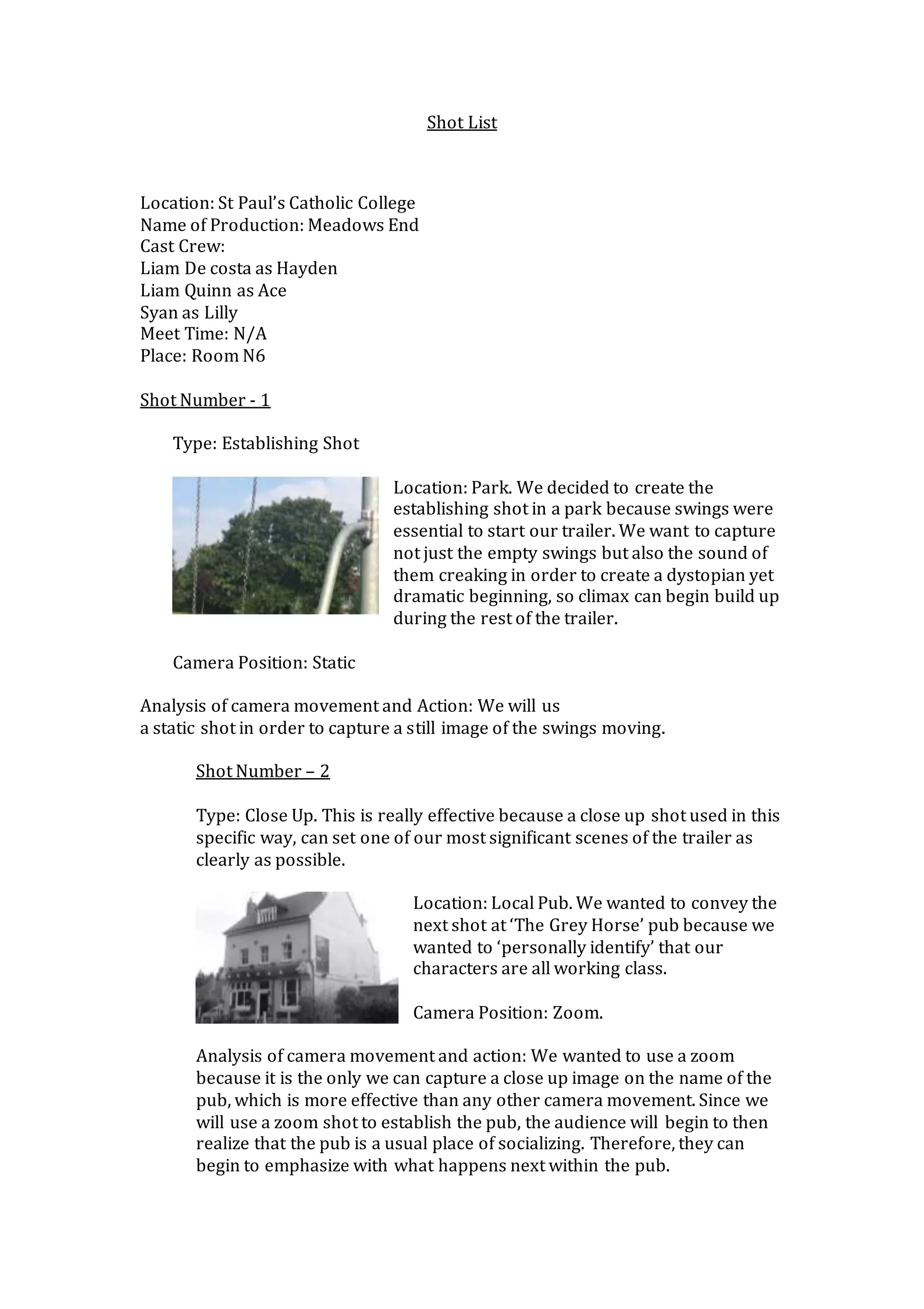
Location: Park. We decided to create the
establishing shot in a park because swings were
essential to start our trailer. We want to capture
not just the empty swings but also the sound of
them creaking in order to create a dystopian yet
dramatic beginning, so climax can begin build up
during the rest of the trailer.
Camera Position: Static
Analysis of camera movement and Action: We will us
a static shot in order to capture a still image of the swings moving.
Shot Number – 2
Type: Close Up. This is really effective because a close up shot used in this
specific way, can set one of our most significant scenes of the trailer as
clearly as possible.
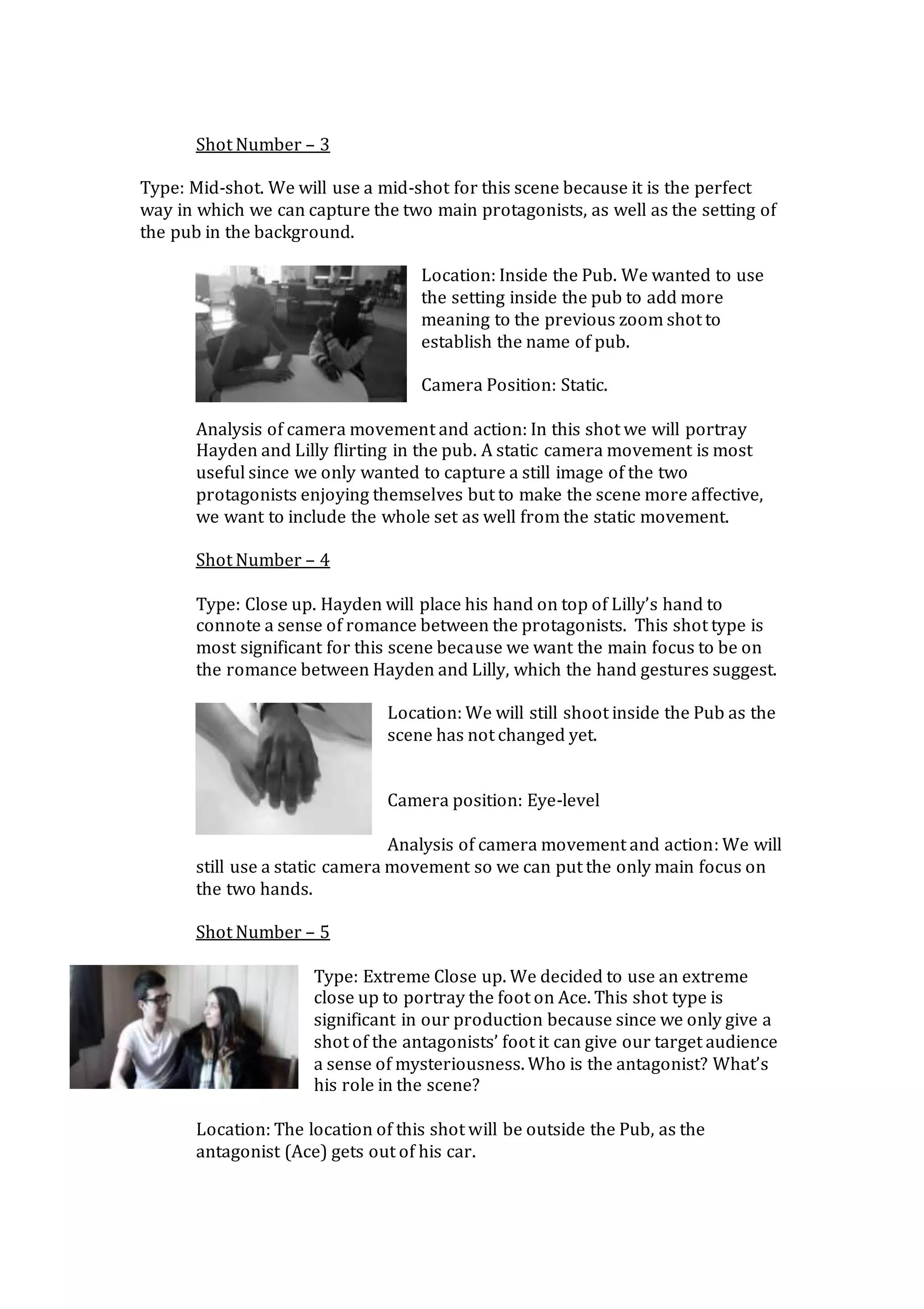
Location: Local Pub. We wanted to convey the
next shot at ‘The Grey Horse’ pub because we
wanted to ‘personally identify’ that our
characters are all working class.
Camera Position: Zoom.
Analysis of camera movement and action: We wanted to use a zoom
because it is the only we can capture a close up image on the name of the
pub, which is more effective than any other camera movement. Since we
will use a zoom shot to establish the pub, the audience will begin to then
realize that the pub is a usual place of socializing. Therefore, they can
begin to emphasize with what happens next within the pub.
Shot Number – 3
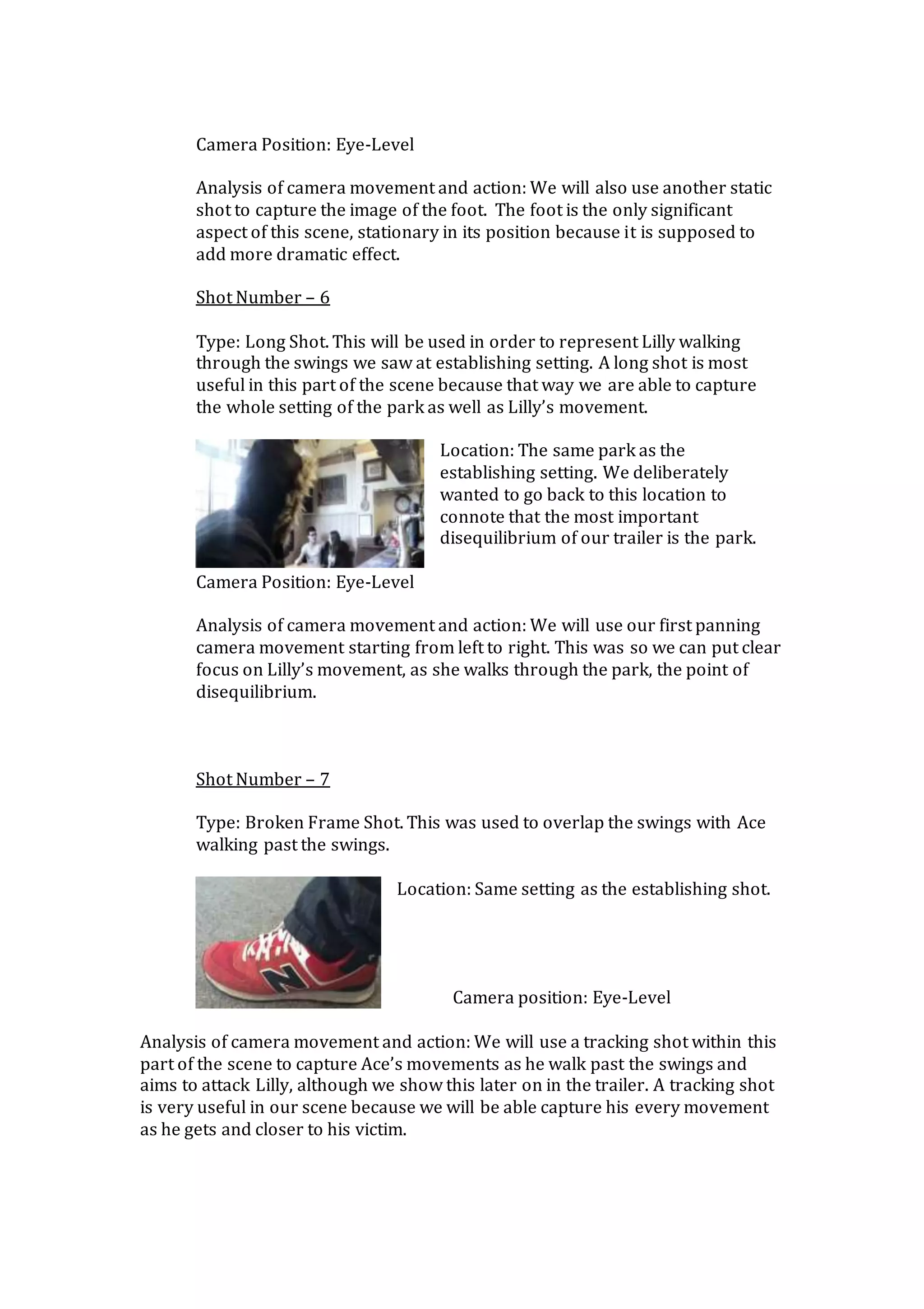
Type: Mid-shot. We will use a mid-shot for this scene because it is the perfect
way in which we can capture the two main protagonists, as well as the setting of
the pub in the background.
Location: Inside the Pub. We wanted to use
the setting inside the pub to add more
meaning to the previous zoom shot to
establish the name of pub.
Camera Position: Static.
Analysis of camera movement and action: In this shot we will portray
Hayden and Lilly flirting in the pub. A static camera movement is most
useful since we only wanted to capture a still image of the two
protagonists enjoying themselves but to make the scene more affective,
we want to include the whole set as well from the static movement.
Shot Number – 4
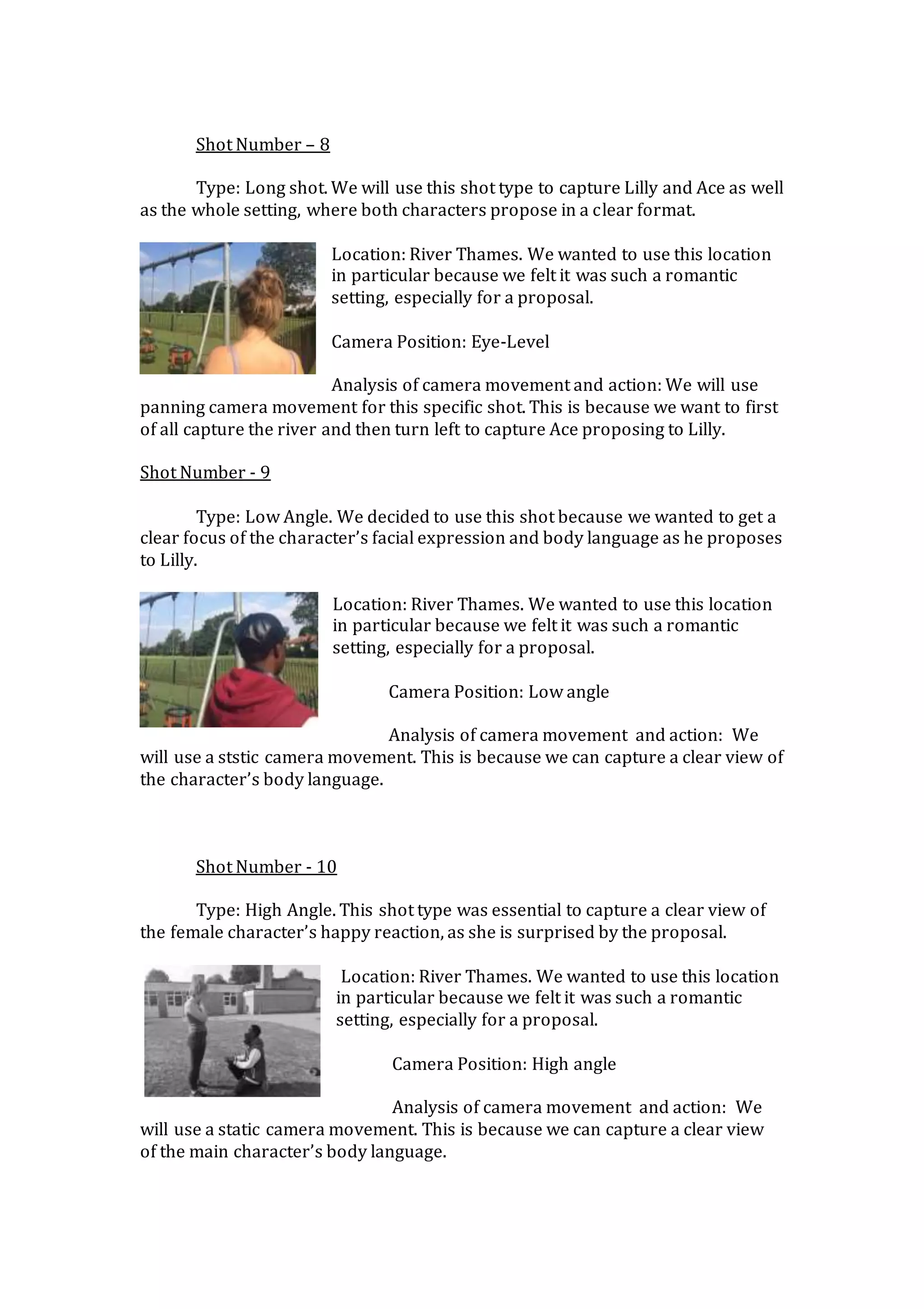
Type: Close up. Hayden will place his hand on top of Lilly’s hand to
connote a sense of romance between the protagonists. This shot type is
most significant for this scene because we want the main focus to be on
the romance between Hayden and Lilly, which the hand gestures suggest.
Location: We will still shoot inside the Pub as the
scene has not changed yet.
Camera position: Eye-level
Analysis of camera movement and action: We will
still use a static camera movement so we can put the only main focus on
the two hands.
Shot Number – 5
Type: Extreme Close up. We decided to use an extreme
close up to portray the foot on Ace. This shot type is
significant in our production because since we only give a
shot of the antagonists’ foot it can give our target audience
a sense of mysteriousness. Who is the antagonist? What’s
his role in the scene?
Location: The location of this shot will be outside the Pub, as the
antagonist (Ace) gets out of his car.
Camera Position: Eye-Level
Analysis of camera movement and action: We will also use another static
shot to capture the image of the foot. The foot is the only significant
aspect of this scene, stationary in its position because it is supposed to
add more dramatic effect.
Shot Number – 6
Type: Long Shot. This will be used in order to represent Lilly walking
through the swings we saw at establishing setting. A long shot is most
useful in this part of the scene because that way we are able to capture
the whole setting of the park as well as Lilly’s movement.
Location: The same park as the
establishing setting. We deliberately
wanted to go back to this location to
connote that the most important
disequilibrium of our trailer is the park.
Camera Position: Eye-Level
Analysis of camera movement and action: We will use our first panning
camera movement starting from left to right. This was so we can put clear
focus on Lilly’s movement, as she walks through the park, the point of
disequilibrium.
Shot Number – 7
Type: Broken Frame Shot. This was used to overlap the swings with Ace
walking past the swings.
Location: Same setting as the establishing shot.
Camera position: Eye-Level
Analysis of camera movement and action: We will use a tracking shot within this
part of the scene to capture Ace’s movements as he walk past the swings and
aims to attack Lilly, although we show this later on in the trailer. A tracking shot
is very useful in our scene because we will be able capture his every movement
as he gets and closer to his victim.
Shot Number – 8
Type: Long shot. We will use this shot type to capture Lilly and Ace as well
as the whole setting, where both characters propose in a clear format.
Location: River Thames. We wanted to use this location
in particular because we felt it was such a romantic
setting, especially for a proposal.
Camera Position: Eye-Level
Analysis of camera movement and action: We will use
panning camera movement for this specific shot. This is because we want to first
of all capture the river and then turn left to capture Ace proposing to Lilly.
Shot Number - 9
Type: Low Angle. We decided to use this shot because we wanted to get a
clear focus of the character’s facial expression and body language as he proposes
to Lilly.
Location: River Thames. We wanted to use this location
in particular because we felt it was such a romantic
setting, especially for a proposal.
Camera Position: Low angle
Analysis of camera movement and action: We
will use a ststic camera movement. This is because we can capture a clear view of
the character’s body language.
Shot Number - 10
Type: High Angle. This shot type was essential to capture a clear view of
the female character’s happy reaction, as she is surprised by the proposal.
Location: River Thames. We wanted to use this location
in particular because we felt it was such a romantic
setting, especially for a proposal.
Camera Position: High angle
Analysis of camera movement and action: We
will use a static camera movement. This is because we can capture a clear view
of the main character’s body language.
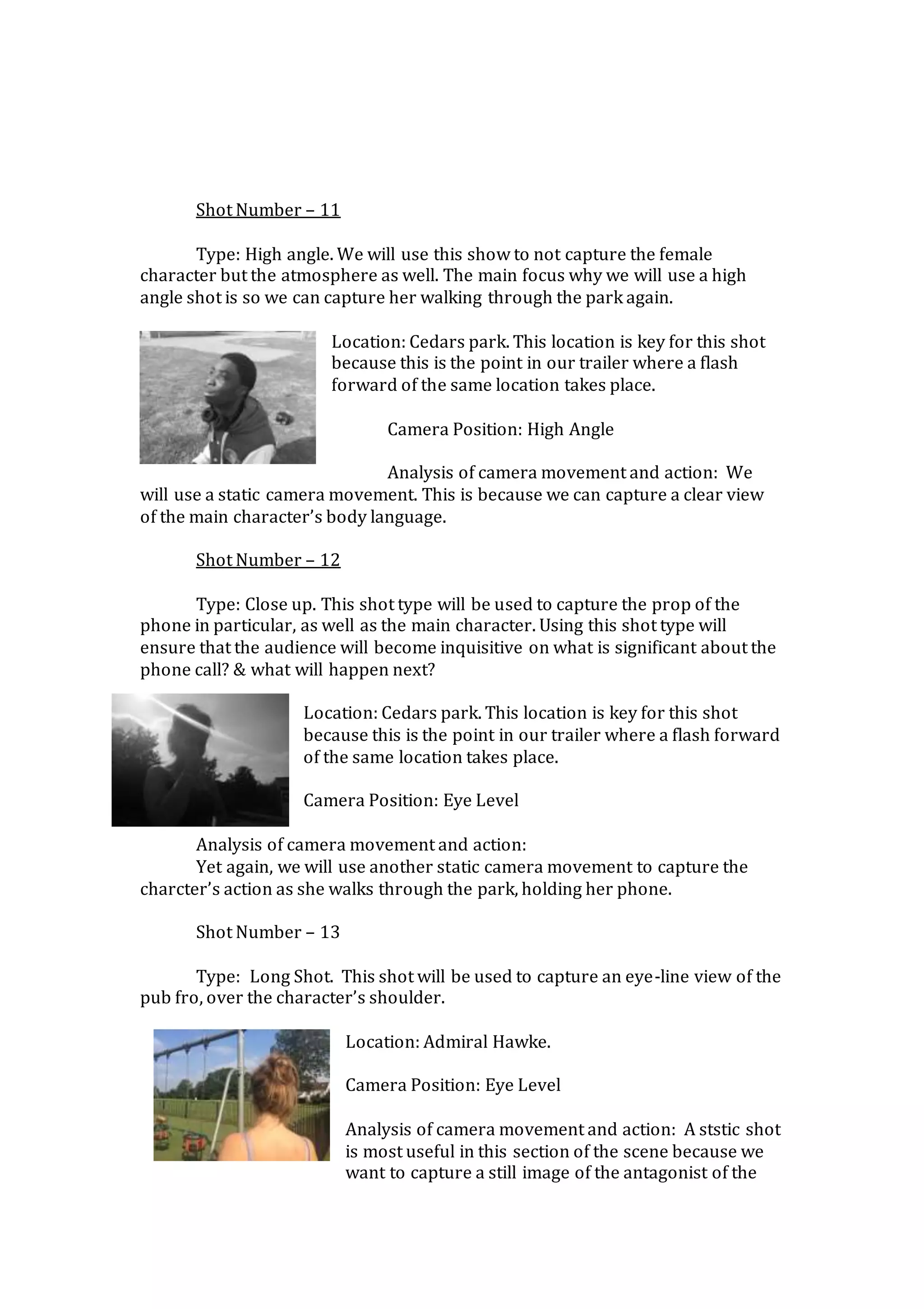
Shot Number – 11
Type: High angle. We will use this show to not capture the female
character but the atmosphere as well. The main focus why we will use a high
angle shot is so we can capture her walking through the park again.
Location: Cedars park. This location is key for this shot
because this is the point in our trailer where a flash
forward of the same location takes place.
Camera Position: High Angle
Analysis of camera movement and action: We
will use a static camera movement. This is because we can capture a clear view
of the main character’s body language.
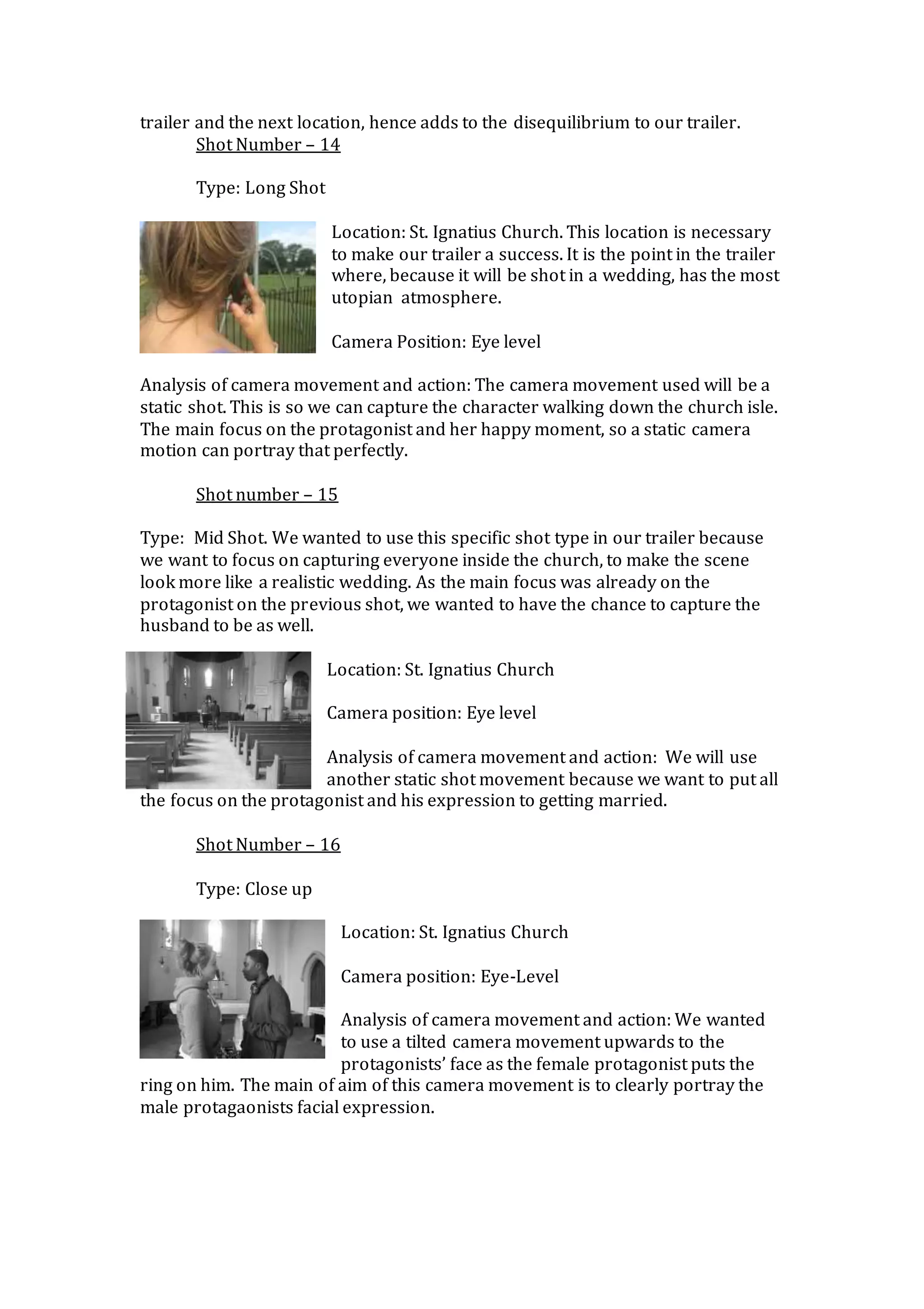
Shot Number – 12
Type: Close up. This shot type will be used to capture the prop of the
phone in particular, as well as the main character. Using this shot type will
ensure that the audience will become inquisitive on what is significant about the
phone call? & what will happen next?
Location: Cedars park. This location is key for this shot
because this is the point in our trailer where a flash forward
of the same location takes place.
Camera Position: Eye Level
Analysis of camera movement and action:
Yet again, we will use another static camera movement to capture the
charcter’s action as she walks through the park, holding her phone.
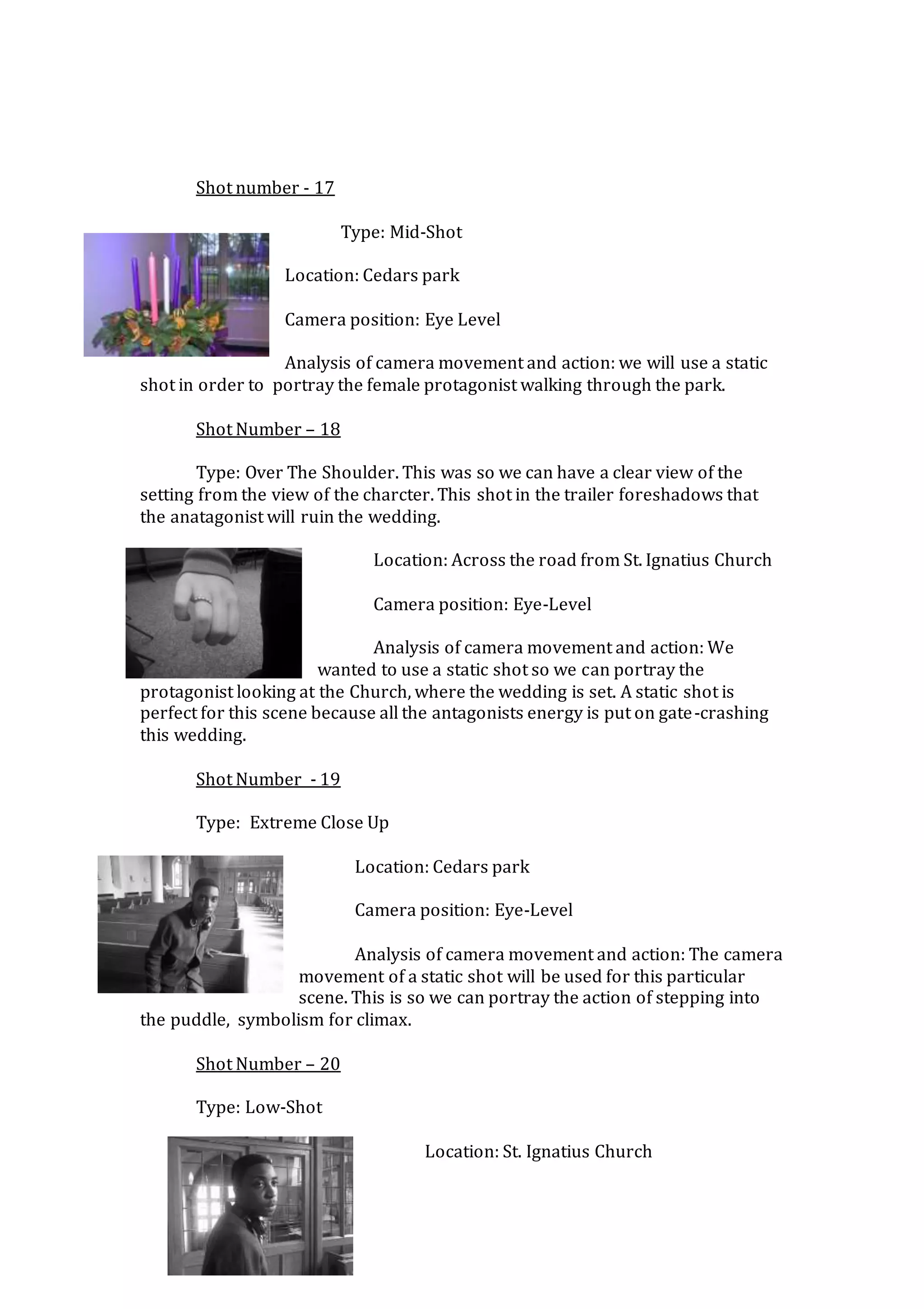
Shot Number – 13
Type: Long Shot. This shot will be used to capture an eye-line view of the
pub fro, over the character’s shoulder.
Location: Admiral Hawke.
Camera Position: Eye Level
Analysis of camera movement and action: A ststic shot
is most useful in this section of the scene because we
want to capture a still image of the antagonist of the
trailer and the next location, hence adds to the disequilibrium to our trailer.
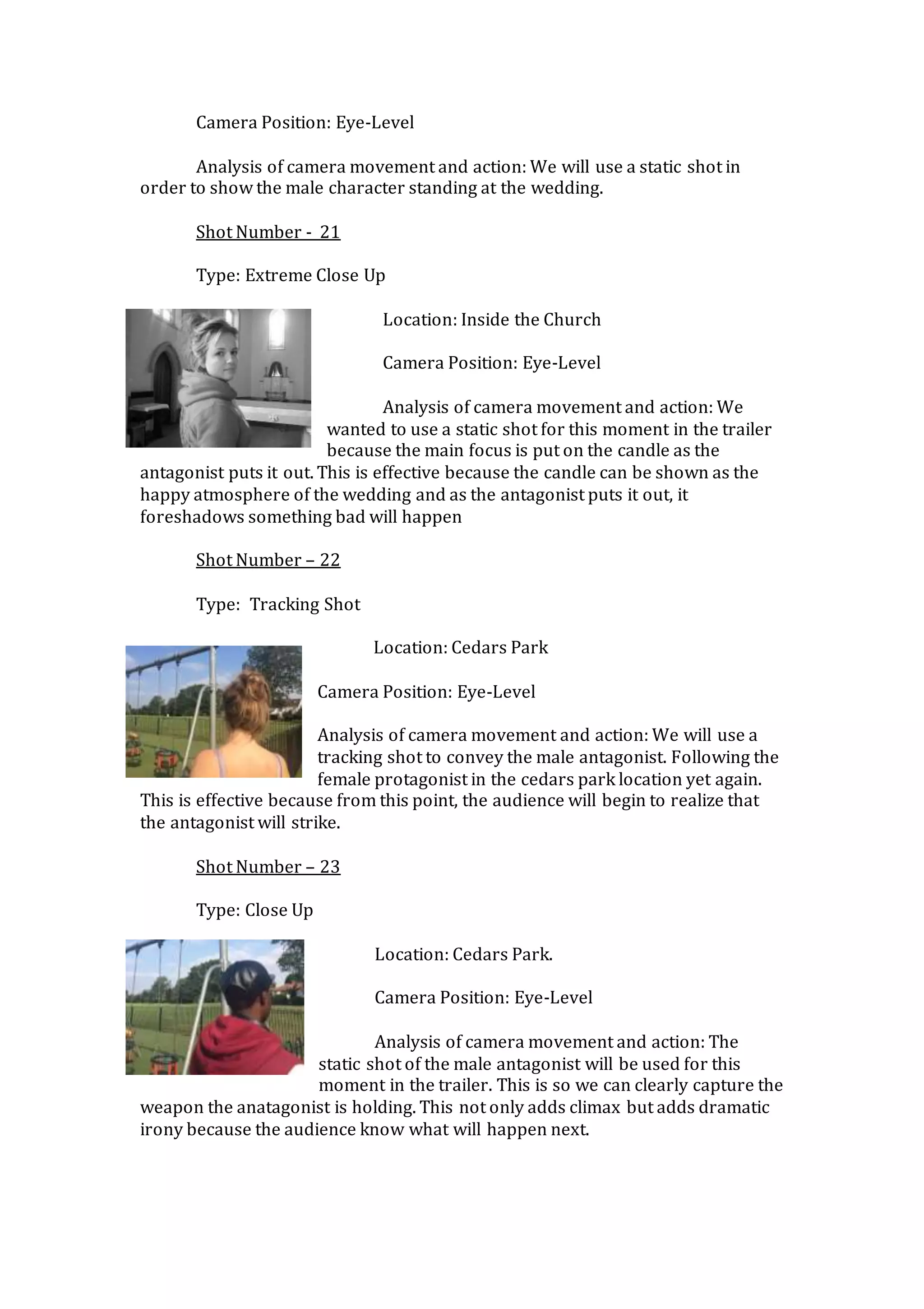
Shot Number – 14
Type: Long Shot
Location: St. Ignatius Church. This location is necessary
to make our trailer a success. It is the point in the trailer
where, because it will be shot in a wedding, has the most
utopian atmosphere.
Camera Position: Eye level
Analysis of camera movement and action: The camera movement used will be a
static shot. This is so we can capture the character walking down the church isle.
The main focus on the protagonist and her happy moment, so a static camera
motion can portray that perfectly.
Shot number – 15
Type: Mid Shot. We wanted to use this specific shot type in our trailer because
we want to focus on capturing everyone inside the church, to make the scene
look more like a realistic wedding. As the main focus was already on the
protagonist on the previous shot, we wanted to have the chance to capture the
husband to be as well.
Location: St. Ignatius Church
Camera position: Eye level
Analysis of camera movement and action: We will use
another static shot movement because we want to put all
the focus on the protagonist and his expression to getting married.
Shot Number – 16
Type: Close up
Location: St. Ignatius Church
Camera position: Eye-Level
Analysis of camera movement and action: We wanted
to use a tilted camera movement upwards to the
protagonists’ face as the female protagonist puts the
ring on him. The main of aim of this camera movement is to clearly portray the
male protagaonists facial expression.
Shot number - 17
Type: Mid-Shot
Location: Cedars park
Camera position: Eye Level
Analysis of camera movement and action: we will use a static
shot in order to portray the female protagonist walking through the park.
Shot Number – 18
Type: Over The Shoulder. This was so we can have a clear view of the
setting from the view of the charcter. This shot in the trailer foreshadows that
the anatagonist will ruin the wedding.
Location: Across the road from St. Ignatius Church
Camera position: Eye-Level
Analysis of camera movement and action: We
wanted to use a static shot so we can portray the
protagonist looking at the Church, where the wedding is set. A static shot is
perfect for this scene because all the antagonists energy is put on gate-crashing
this wedding.
Shot Number - 19
Type: Extreme Close Up
Location: Cedars park
Camera position: Eye-Level
Analysis of camera movement and action: The camera
movement of a static shot will be used for this particular
scene. This is so we can portray the action of stepping into
the puddle, symbolism for climax.
Shot Number – 20
Type: Low-Shot
Location: St. Ignatius Church
Camera Position: Eye-Level
Analysis of camera movement and action: We will use a static shot in
order to show the male character standing at the wedding.
Shot Number - 21
Type: Extreme Close Up
Location: Inside the Church
Camera Position: Eye-Level
Analysis of camera movement and action: We
wanted to use a static shot for this moment in the trailer
because the main focus is put on the candle as the
antagonist puts it out. This is effective because the candle can be shown as the
happy atmosphere of the wedding and as the antagonist puts it out, it
foreshadows something bad will happen
Shot Number – 22
Type: Tracking Shot
Location: Cedars Park
Camera Position: Eye-Level
Analysis of camera movement and action: We will use a
tracking shot to convey the male antagonist. Following the
female protagonist in the cedars park location yet again.
This is effective because from this point, the audience will begin to realize that
the antagonist will strike.
Shot Number – 23
Type: Close Up
Location: Cedars Park.
Camera Position: Eye-Level
Analysis of camera movement and action: The
static shot of the male antagonist will be used for this
moment in the trailer. This is so we can clearly capture the
weapon the anatagonist is holding. This not only adds climax but adds dramatic
irony because the audience know what will happen next.
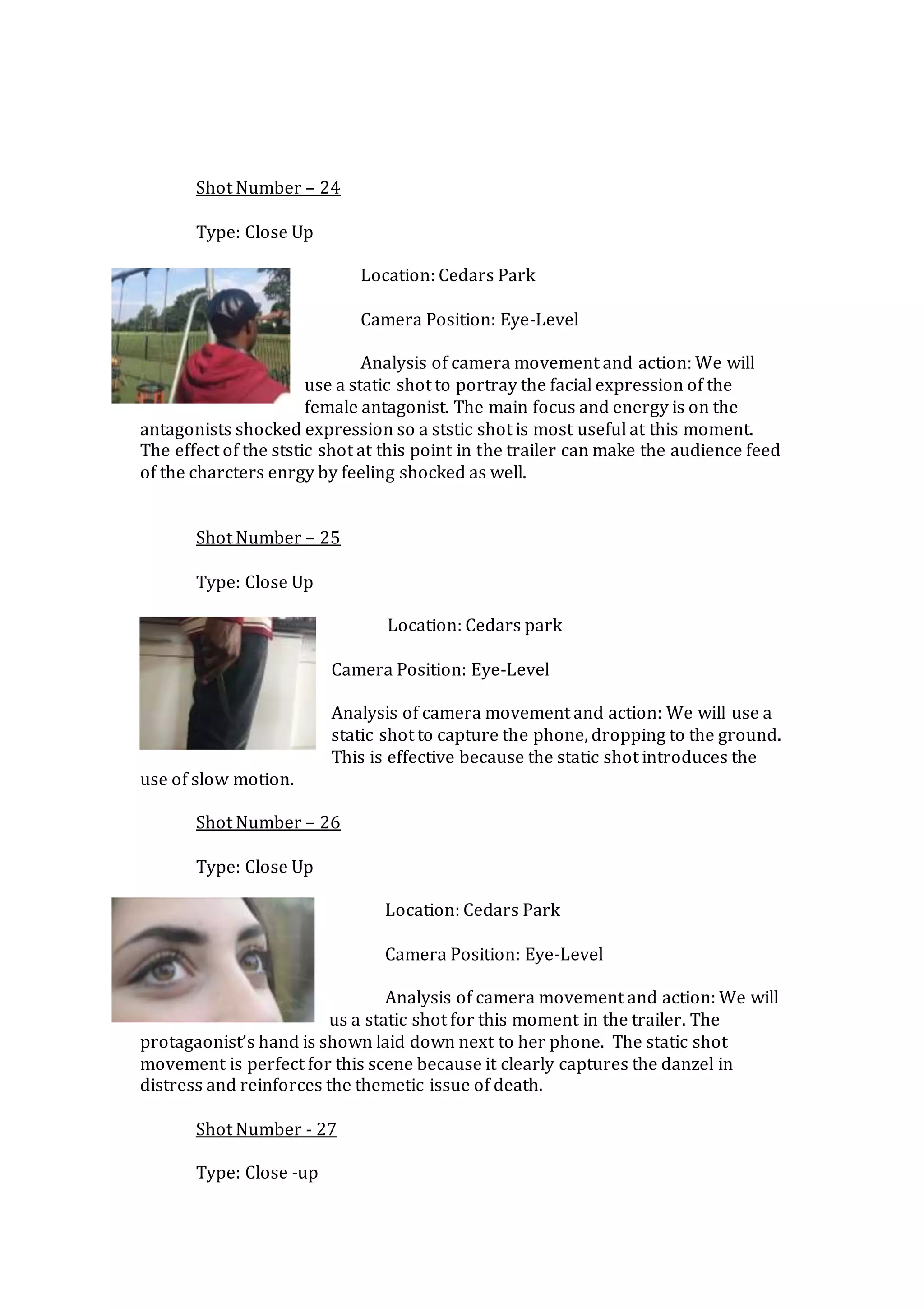
Shot Number – 24
Type: Close Up
Location: Cedars Park
Camera Position: Eye-Level
Analysis of camera movement and action: We will
use a static shot to portray the facial expression of the
female antagonist. The main focus and energy is on the
antagonists shocked expression so a ststic shot is most useful at this moment.
The effect of the ststic shot at this point in the trailer can make the audience feed
of the charcters enrgy by feeling shocked as well.
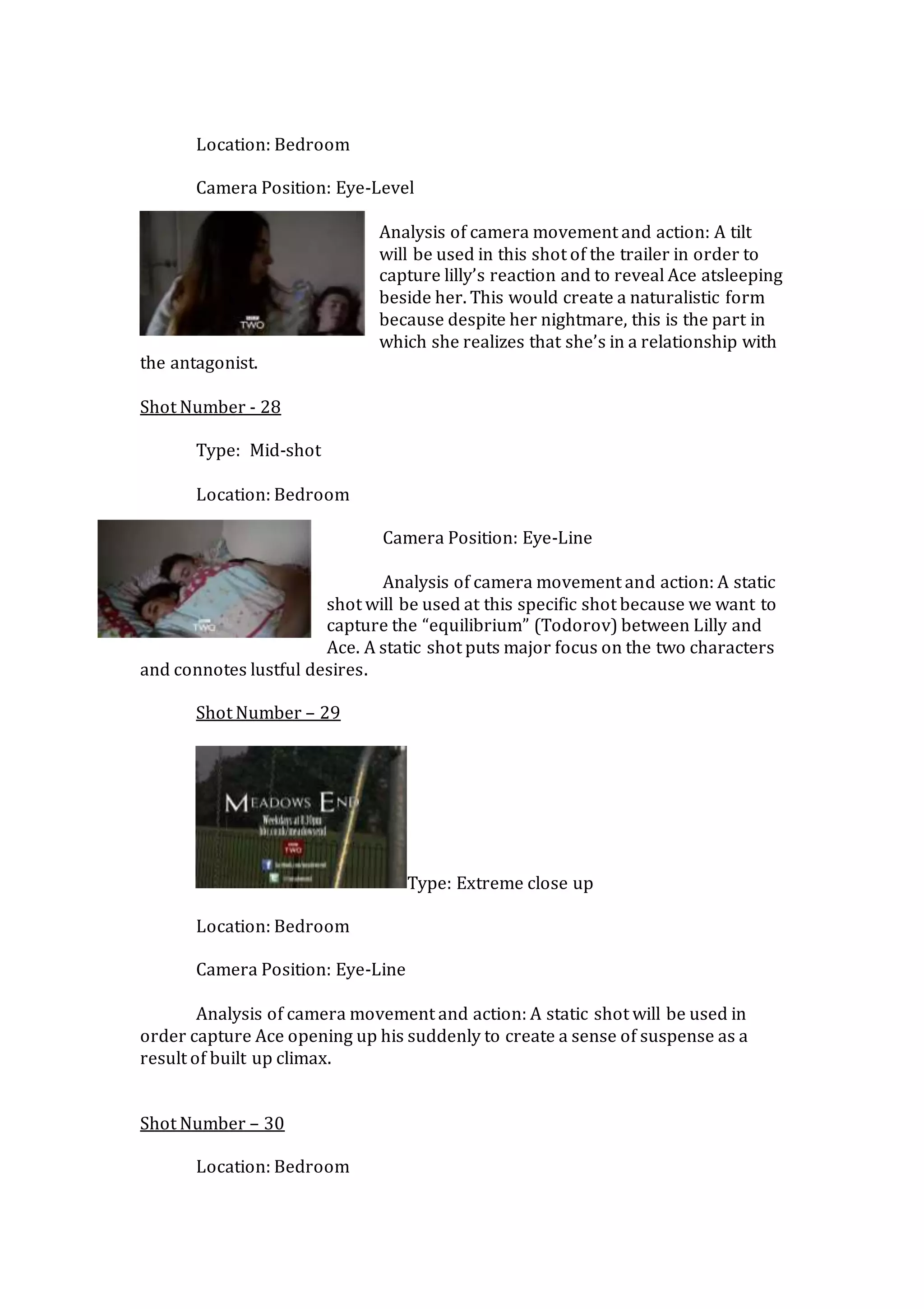
Shot Number – 25
Type: Close Up
Location: Cedars park
Camera Position: Eye-Level
Analysis of camera movement and action: We will use a
static shot to capture the phone, dropping to the ground.
This is effective because the static shot introduces the
use of slow motion.
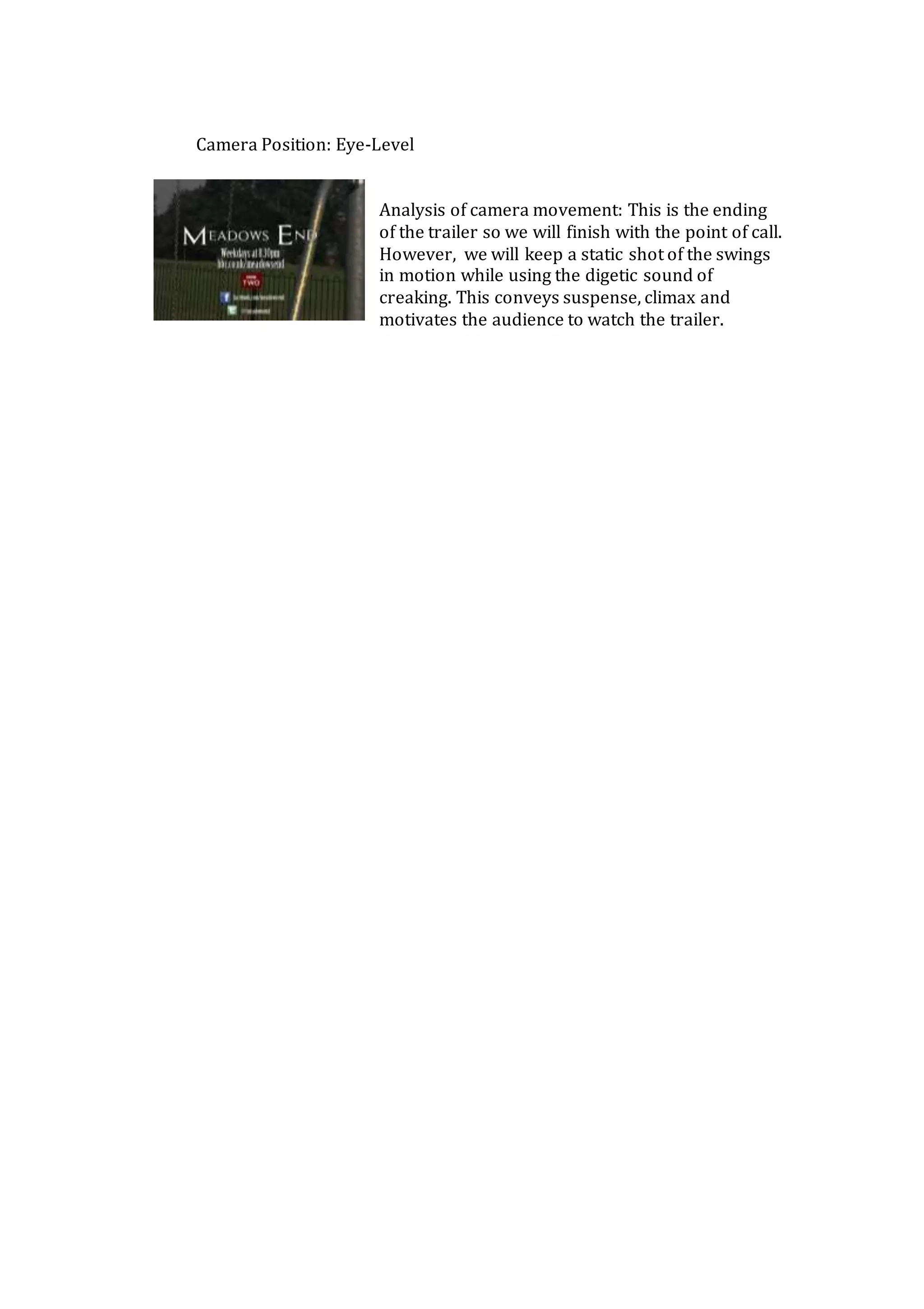
Shot Number – 26
Type: Close Up
Location: Cedars Park
Camera Position: Eye-Level
Analysis of camera movement and action: We will
us a static shot for this moment in the trailer. The
protagaonist’s hand is shown laid down next to her phone. The static shot
movement is perfect for this scene because it clearly captures the danzel in
distress and reinforces the themetic issue of death.
Shot Number - 27
Type: Close -up
Location: Bedroom
Camera Position: Eye-Level
Analysis of camera movement and action: A tilt
will be used in this shot of the trailer in order to
capture lilly’s reaction and to reveal Ace atsleeping
beside her. This would create a naturalistic form
because despite her nightmare, this is the part in
which she realizes that she’s in a relationship with
the antagonist.
Shot Number - 28
Type: Mid-shot
Location: Bedroom
Camera Position: Eye-Line
Analysis of camera movement and action: A static
shot will be used at this specific shot because we want to
capture the “equilibrium” (Todorov) between Lilly and
Ace. A static shot puts major focus on the two characters
and connotes lustful desires.
Shot Number – 29
Type: Extreme close up
Location: Bedroom
Camera Position: Eye-Line
Analysis of camera movement and action: A static shot will be used in
order capture Ace opening up his suddenly to create a sense of suspense as a
result of built up climax.
Shot Number – 30
Location: Bedroom
Camera Position: Eye-Level
Analysis of camera movement: This is the ending
of the trailer so we will finish with the point of call.
However, we will keep a static shot of the swings
in motion while using the digetic sound of
creaking. This conveys suspense, climax and
motivates the audience to watch the trailer.

OCR A2 Media Studies - Unit G324 - Shot List

  • 1.
    Shot List Location: StPaul’s Catholic College Name of Production: Meadows End Cast Crew: Liam De costa as Hayden Liam Quinn as Ace Syan as Lilly Meet Time: N/A Place: Room N6 Shot Number - 1 Type: Establishing Shot Location: Park. We decided to create the establishing shot in a park because swings were essential to start our trailer. We want to capture not just the empty swings but also the sound of them creaking in order to create a dystopian yet dramatic beginning, so climax can begin build up during the rest of the trailer. Camera Position: Static Analysis of camera movement and Action: We will us a static shot in order to capture a still image of the swings moving. Shot Number – 2 Type: Close Up. This is really effective because a close up shot used in this specific way, can set one of our most significant scenes of the trailer as clearly as possible. Location: Local Pub. We wanted to convey the next shot at ‘The Grey Horse’ pub because we wanted to ‘personally identify’ that our characters are all working class. Camera Position: Zoom. Analysis of camera movement and action: We wanted to use a zoom because it is the only we can capture a close up image on the name of the pub, which is more effective than any other camera movement. Since we will use a zoom shot to establish the pub, the audience will begin to then realize that the pub is a usual place of socializing. Therefore, they can begin to emphasize with what happens next within the pub.
  • 2.
    Shot Number –3 Type: Mid-shot. We will use a mid-shot for this scene because it is the perfect way in which we can capture the two main protagonists, as well as the setting of the pub in the background. Location: Inside the Pub. We wanted to use the setting inside the pub to add more meaning to the previous zoom shot to establish the name of pub. Camera Position: Static. Analysis of camera movement and action: In this shot we will portray Hayden and Lilly flirting in the pub. A static camera movement is most useful since we only wanted to capture a still image of the two protagonists enjoying themselves but to make the scene more affective, we want to include the whole set as well from the static movement. Shot Number – 4 Type: Close up. Hayden will place his hand on top of Lilly’s hand to connote a sense of romance between the protagonists. This shot type is most significant for this scene because we want the main focus to be on the romance between Hayden and Lilly, which the hand gestures suggest. Location: We will still shoot inside the Pub as the scene has not changed yet. Camera position: Eye-level Analysis of camera movement and action: We will still use a static camera movement so we can put the only main focus on the two hands. Shot Number – 5 Type: Extreme Close up. We decided to use an extreme close up to portray the foot on Ace. This shot type is significant in our production because since we only give a shot of the antagonists’ foot it can give our target audience a sense of mysteriousness. Who is the antagonist? What’s his role in the scene? Location: The location of this shot will be outside the Pub, as the antagonist (Ace) gets out of his car.
  • 3.
    Camera Position: Eye-Level Analysisof camera movement and action: We will also use another static shot to capture the image of the foot. The foot is the only significant aspect of this scene, stationary in its position because it is supposed to add more dramatic effect. Shot Number – 6 Type: Long Shot. This will be used in order to represent Lilly walking through the swings we saw at establishing setting. A long shot is most useful in this part of the scene because that way we are able to capture the whole setting of the park as well as Lilly’s movement. Location: The same park as the establishing setting. We deliberately wanted to go back to this location to connote that the most important disequilibrium of our trailer is the park. Camera Position: Eye-Level Analysis of camera movement and action: We will use our first panning camera movement starting from left to right. This was so we can put clear focus on Lilly’s movement, as she walks through the park, the point of disequilibrium. Shot Number – 7 Type: Broken Frame Shot. This was used to overlap the swings with Ace walking past the swings. Location: Same setting as the establishing shot. Camera position: Eye-Level Analysis of camera movement and action: We will use a tracking shot within this part of the scene to capture Ace’s movements as he walk past the swings and aims to attack Lilly, although we show this later on in the trailer. A tracking shot is very useful in our scene because we will be able capture his every movement as he gets and closer to his victim.
  • 4.
    Shot Number –8 Type: Long shot. We will use this shot type to capture Lilly and Ace as well as the whole setting, where both characters propose in a clear format. Location: River Thames. We wanted to use this location in particular because we felt it was such a romantic setting, especially for a proposal. Camera Position: Eye-Level Analysis of camera movement and action: We will use panning camera movement for this specific shot. This is because we want to first of all capture the river and then turn left to capture Ace proposing to Lilly. Shot Number - 9 Type: Low Angle. We decided to use this shot because we wanted to get a clear focus of the character’s facial expression and body language as he proposes to Lilly. Location: River Thames. We wanted to use this location in particular because we felt it was such a romantic setting, especially for a proposal. Camera Position: Low angle Analysis of camera movement and action: We will use a ststic camera movement. This is because we can capture a clear view of the character’s body language. Shot Number - 10 Type: High Angle. This shot type was essential to capture a clear view of the female character’s happy reaction, as she is surprised by the proposal. Location: River Thames. We wanted to use this location in particular because we felt it was such a romantic setting, especially for a proposal. Camera Position: High angle Analysis of camera movement and action: We will use a static camera movement. This is because we can capture a clear view of the main character’s body language.
  • 5.
    Shot Number –11 Type: High angle. We will use this show to not capture the female character but the atmosphere as well. The main focus why we will use a high angle shot is so we can capture her walking through the park again. Location: Cedars park. This location is key for this shot because this is the point in our trailer where a flash forward of the same location takes place. Camera Position: High Angle Analysis of camera movement and action: We will use a static camera movement. This is because we can capture a clear view of the main character’s body language. Shot Number – 12 Type: Close up. This shot type will be used to capture the prop of the phone in particular, as well as the main character. Using this shot type will ensure that the audience will become inquisitive on what is significant about the phone call? & what will happen next? Location: Cedars park. This location is key for this shot because this is the point in our trailer where a flash forward of the same location takes place. Camera Position: Eye Level Analysis of camera movement and action: Yet again, we will use another static camera movement to capture the charcter’s action as she walks through the park, holding her phone. Shot Number – 13 Type: Long Shot. This shot will be used to capture an eye-line view of the pub fro, over the character’s shoulder. Location: Admiral Hawke. Camera Position: Eye Level Analysis of camera movement and action: A ststic shot is most useful in this section of the scene because we want to capture a still image of the antagonist of the
  • 6.
    trailer and thenext location, hence adds to the disequilibrium to our trailer. Shot Number – 14 Type: Long Shot Location: St. Ignatius Church. This location is necessary to make our trailer a success. It is the point in the trailer where, because it will be shot in a wedding, has the most utopian atmosphere. Camera Position: Eye level Analysis of camera movement and action: The camera movement used will be a static shot. This is so we can capture the character walking down the church isle. The main focus on the protagonist and her happy moment, so a static camera motion can portray that perfectly. Shot number – 15 Type: Mid Shot. We wanted to use this specific shot type in our trailer because we want to focus on capturing everyone inside the church, to make the scene look more like a realistic wedding. As the main focus was already on the protagonist on the previous shot, we wanted to have the chance to capture the husband to be as well. Location: St. Ignatius Church Camera position: Eye level Analysis of camera movement and action: We will use another static shot movement because we want to put all the focus on the protagonist and his expression to getting married. Shot Number – 16 Type: Close up Location: St. Ignatius Church Camera position: Eye-Level Analysis of camera movement and action: We wanted to use a tilted camera movement upwards to the protagonists’ face as the female protagonist puts the ring on him. The main of aim of this camera movement is to clearly portray the male protagaonists facial expression.
  • 7.
    Shot number -17 Type: Mid-Shot Location: Cedars park Camera position: Eye Level Analysis of camera movement and action: we will use a static shot in order to portray the female protagonist walking through the park. Shot Number – 18 Type: Over The Shoulder. This was so we can have a clear view of the setting from the view of the charcter. This shot in the trailer foreshadows that the anatagonist will ruin the wedding. Location: Across the road from St. Ignatius Church Camera position: Eye-Level Analysis of camera movement and action: We wanted to use a static shot so we can portray the protagonist looking at the Church, where the wedding is set. A static shot is perfect for this scene because all the antagonists energy is put on gate-crashing this wedding. Shot Number - 19 Type: Extreme Close Up Location: Cedars park Camera position: Eye-Level Analysis of camera movement and action: The camera movement of a static shot will be used for this particular scene. This is so we can portray the action of stepping into the puddle, symbolism for climax. Shot Number – 20 Type: Low-Shot Location: St. Ignatius Church
  • 8.
    Camera Position: Eye-Level Analysisof camera movement and action: We will use a static shot in order to show the male character standing at the wedding. Shot Number - 21 Type: Extreme Close Up Location: Inside the Church Camera Position: Eye-Level Analysis of camera movement and action: We wanted to use a static shot for this moment in the trailer because the main focus is put on the candle as the antagonist puts it out. This is effective because the candle can be shown as the happy atmosphere of the wedding and as the antagonist puts it out, it foreshadows something bad will happen Shot Number – 22 Type: Tracking Shot Location: Cedars Park Camera Position: Eye-Level Analysis of camera movement and action: We will use a tracking shot to convey the male antagonist. Following the female protagonist in the cedars park location yet again. This is effective because from this point, the audience will begin to realize that the antagonist will strike. Shot Number – 23 Type: Close Up Location: Cedars Park. Camera Position: Eye-Level Analysis of camera movement and action: The static shot of the male antagonist will be used for this moment in the trailer. This is so we can clearly capture the weapon the anatagonist is holding. This not only adds climax but adds dramatic irony because the audience know what will happen next.
  • 9.
    Shot Number –24 Type: Close Up Location: Cedars Park Camera Position: Eye-Level Analysis of camera movement and action: We will use a static shot to portray the facial expression of the female antagonist. The main focus and energy is on the antagonists shocked expression so a ststic shot is most useful at this moment. The effect of the ststic shot at this point in the trailer can make the audience feed of the charcters enrgy by feeling shocked as well. Shot Number – 25 Type: Close Up Location: Cedars park Camera Position: Eye-Level Analysis of camera movement and action: We will use a static shot to capture the phone, dropping to the ground. This is effective because the static shot introduces the use of slow motion. Shot Number – 26 Type: Close Up Location: Cedars Park Camera Position: Eye-Level Analysis of camera movement and action: We will us a static shot for this moment in the trailer. The protagaonist’s hand is shown laid down next to her phone. The static shot movement is perfect for this scene because it clearly captures the danzel in distress and reinforces the themetic issue of death. Shot Number - 27 Type: Close -up
  • 10.
    Location: Bedroom Camera Position:Eye-Level Analysis of camera movement and action: A tilt will be used in this shot of the trailer in order to capture lilly’s reaction and to reveal Ace atsleeping beside her. This would create a naturalistic form because despite her nightmare, this is the part in which she realizes that she’s in a relationship with the antagonist. Shot Number - 28 Type: Mid-shot Location: Bedroom Camera Position: Eye-Line Analysis of camera movement and action: A static shot will be used at this specific shot because we want to capture the “equilibrium” (Todorov) between Lilly and Ace. A static shot puts major focus on the two characters and connotes lustful desires. Shot Number – 29 Type: Extreme close up Location: Bedroom Camera Position: Eye-Line Analysis of camera movement and action: A static shot will be used in order capture Ace opening up his suddenly to create a sense of suspense as a result of built up climax. Shot Number – 30 Location: Bedroom
  • 11.
    Camera Position: Eye-Level Analysisof camera movement: This is the ending of the trailer so we will finish with the point of call. However, we will keep a static shot of the swings in motion while using the digetic sound of creaking. This conveys suspense, climax and motivates the audience to watch the trailer.