Occupational Therapy
Sensory Testing & Assessment
- The hands are an extension of the brain in connection with the
surrounding world and are together with the face the most visible
and socially used parts of the body.
- The interaction between brain, sensibility and motor function is
essential in hand function.
- By using fine movement skills and sensation in the hand, a person
can explore and use objects in the environment, which strongly
contribute to the ability to perform personal care, work and leisure
activities.
- The human hands are not only working tools but also delicate
instruments of great importance for our daily activities and
wellbeing.
- Performing daily occupations is influenced by a dynamic
interaction between person, environment and occupation.
- People need to be active and develop their personal roles and habits
in interplay with other people
- Health and wellbeing is achieved when there is a balance between
self-care, productivity and leisure.
- After surgery or injury, complications such as pain and
hyperaesthesia may occur. This state often recovers slowly and is
sometimes resistant to treatment.
- When a patient is not using the hand normally and avoids using
grip areas in the affected hand, this should be taken as an
indication that there may be a sensitivity problem
- Hyperesthesia can according to the International Association for
the Study of Pain (IASP), mean both a lower threshold to stimuli
and a higher response to stimuli.
- The term can refer to perception of touch as well as warm or cold
stimuli and can be with or without pain.
- The term hyperesthesia includes allodynia (perception of pain from
stimuli that normally are not painful) and hyperalgesia (increased
response from stimuli that normally are painful).
- Pain is a complex, multidimensional experience where sensory,
emotional and cognitive factors interplay with expectations and
past experiences of pain
- Acute pain is most often related to tissue damage while recurrent or
chronic pain may be present even when there are no longer
detectable signs of tissue damage.
- The subjective experience of intensity, localization and duration is
the discriminative sensory component of the pain.
- The emotional or affective component is the discomfort or painful
experience the pain gives rise to
- The third dimension of pain relates to the way patients conduct
themselves to the pain and its origin, which depend on different
psychological and cognitive factors.
- Assessment of pain in the hands can be complicated because of the
complex nature of the hands themselves and their
multidimensional functions.
- A drawing of the extent of the pain and some descriptors of the
pain are considered fundamental.
- It is also desirable that the patients describe how the hand function
is affected by the pain in their own words.
- If a visual analogue scale (VAS) is used, it is recommended that it
be without steps or graduated from 0 to 100 mm.
- Desensitization is the gradually increase tolerance by massage
(rub, stroke or massage) of a sensitive skin area using textures
- The method of desensitization to reduce symptoms of hyperesthesia.
- The program used three types of modalities: dowel textures, contact
particles and vibration, each at 10 levels of difficulty (with level 1
the most gentle and level 10 the most irritating stimulation).
- Each modality was used for 10 minutes two or three times a day
Hyperesthesia was not preventing any of the patients from
returning to work after treatment and the average treatment period
was seven week.
Touch is a developed capacity that supports abilities and skills such as
gasping and releasing objects.
These abilities and skills are necessary for competence in self-
maintenance, self-enhancement, and self-advancement.
Handling and manipulating objects enhances learning and help
human beings appreciate the world
Without sensation in the hand, there is a greater risk of injury to the
hand and decreased ability to manipulate small objects.
There is a tendency not to use the hand in functional activities, loss of
function that result from not using the hand.
The choice of interventions for sensation is based on the diagnosis,
prognosis, and evaluation findings.
Diminished or lost protective sensation, the inability to feel pain in
response to pain to stimuli that are damaging, suggest a need for
teaching the patient compensatory strategies to prevent injury.
Findings of discomfort associated with touch (hypersensitivity)
suggest a need for desensitization.
Passive sensory training is provided for patients who have lost
sensation but are expected to regain some sensory ability.
Sensory reeducation (active sensory training) is provided for patients
who have some sensation and potential for better interpretation of
sensory information.
Protective sensations are sensations of pain and temperature extremes
that signal the threat of tissue damage.
When the brain receives this message, the normal response is to move
the body part away from the source of the stimulus. Without this
message, tissue damage can quickly occur.
The goal of treatment for the patient with diminished or absent
protective sensation is to avoid injury.
Treatment consists of teaching the patient precautions necessary to
prevent injury to any body part with compromised protective
sensation.
The loss of sensation could be due to diagnoses such as stroke, head
injury, spinal cord injury, peripheral nerve injury, or nerve
reconstruction.
Damage or injury to an insensitive limb is the result of external forces
that are normally avoided by people who are able to feel pain, which
acts as a warning mechanism.
Based on the five mechanism of damage to insensitive skin.
 Skin areas over bony prominences are particularly prone to
pressure ulcers because the cutaneous tissue is trapped between the
unyielding bone and the external pressure.
 Frequent position changes are necessary for patients with
decreased or absent protective sensation to avoid damage caused by
continuous low pressure.
 Cushions for seating and shoe insoles help to distribute forces over
larger areas
 Instruct patients to avoid concentrated high pressure by careful
handling of sharp tools and by using enlarged handles on
suitcases, drawers, tools and keys.
 Patients may need to become consciously aware to use only as
much force as necessary to grasp objects
 Excessive pressure can also result from splint straps that are too
narrow and splints that are too tight: therefore, therapist must
carefully construct splints to prevent injury.
 Teach patients to increase their awareness of potential sources of
extreme heat or cold and to protect themselves from contact with
them.
- Insulated coffee mugs are recommended.
- Oven mitss or quality pot holders are necessary for cooking
- Utensils with wooden or plastic handles are better than metal ones.
- Patients using wheelchairs should insulate exposed hot water pipes
under sinks
- In cold weather, gloves or mittens are necessary protection for
insensate hands.
 Instruct patients to avoid repetitive motions and excessive friction
between skin and objects.
 Decrease repetitions by working for shorter periods, resting, using
a variety of tools, or alternating hands or type of grip.
 Methods to reduce friction include wearing well-fitting gloves and
using enlarged or padded handles on tool.
 Educate patients who have lost protective sensation regarding
special care for blisters, cuts and bruises necessary to avoid
infection.
 If infection occurs, in conjunction with treatment for the infection,
the infected part should be completely rested to keep it free from
pressure and overuse, allowing healing to occur
 Vision may be used to prevent contract with sharp objects.
 Using a body part with intact sensation to test water temperature
before immersion of any body part without sensation is
recommended.
 Auditory cues may also help to prevent injury.
 Patients should be instructed in good skin care.
Well-hydrated skin is more elastic and pliant and less prone to
injury.
 Skin needs to be visually inspected everyday.
 A warm or reddened area indicates a possible site of tissue
breakdown, which lead to a decubitus ulcer, and extreme care must
be taken to relieve pressure totally from this area until the color
returns to normal
 Desensitization is chosen when the sensory evaluation reveals an
area of hypersensitivity, in which ordinary stimuli produce
exaggerated or unpleasant sensations.
 Hypersensitivity includes allodynia, which is the perception of pain
as a result of non-painful sensitivity to tactile stimuli.
 Desensitization is an intervention designed to decrease the discomfort
associated with touch in the hypersensitivity area.
 A program of desensitization generally includes repetitive stimulation
of the hypersensitive skin with items that provide a variety of sensory
experiences, such as textures ranging from soft to coarse
 Hypersensitivity is observed in some but not all patients following
nerve trauma, soft tissue injuries, burns, and amputation.
 Patients with hypersensitivity tend to avoid using the affected part in
functional activities and typically hold the affected part in functional
activities and typically hold the affected part protectively.
 Hypersensitivity can lead to disability through nonuse of the involved
body part
 Desensitization is based on the idea that progressive stimulation will
allow progressive tolerance.
 Desensitization can be considered relearning to interpret sensory
stimuli as nonnoxious, and therefore learning principles and
methods apply
Hierarchy includes five levels:
 Level 1. Turning fork, paraffin, massage
 Level 2. Battery-operated vibrator, deep massage, touch pressure with
pencil eraser
 Level 3. Electric vibrator, texture identification
 Level 4. Electric vibrator, object identification
 Desensitization begins outside the area of hypersensitivity and
progresses toward the area of greatest sensitivity.
 Constant contact of the stimulus is preferable to intermittent contact,
which my be harmful.
 Patients advance to the next level after they demonstrate tolerance of
the current level without signs of irritation.
 Mirror visual feedback in conjunction with a desensitization
program.
 In Mirror Visual Feedback, the mirror is positioned at the patient’s
midsagittal plane so that the affected arm is hidden from view behind
the mirror and the reflected image of the unaffected limb is in the
perceive position of the affected one, thereby giving the impression of
the patient have two “normal” limbs.
 The patient observes the unaffected limb in the mirror as it is touched
with various textures.
 The touch is perceived to be applied to the affected limb and found
tolerable.
 Then the mirror is removed, and the affected limb is actually
touched.
 Other interventions thought to decrease hypersensitivity include
weight-bearing pressure, twice daily massage of a surgical scar less
than 6 months old with steroid-containing cream, transcutaneous
nerve stimulation (TENS), fluidotherapy, and home shower-
massager.
 Use of the affected body part in leisure work and daily occupations is
believed to facilitate desensitization; the activities must be tailored to
the patient’s interests and occupations to promote compliance.
Fluidotherapy
 The microprocessor controlled Fluidotherapy units utilize a stream of
heated air flowing over and through finely granulated CellexÂŽ Dry
Heat Media, causing them to levitate.
 This air stream creates air pockets and “bubbles” to provide a
powerful massaging action that transmits heat and tactile stimulation
to achieve many physiological and therapeutic benefits.
 Cellex particles are made of natural cellulose, making disposal of the
media from the unit simple and environmentally safe.
Fluidotherapy
 Single Extremity and Double Extremity Fluidotherapy units
 Continuous and Pulse modes of operation
 Treatment times can be set from 1-99 minutes
 Operating temperatures to 52° C
 Adjustable air speeds of 0-100%
 Units are provided with a wake-up pre-heat timer to warm up the unit
prior to use
Key Effects of Fluidotherapy:
 Dry Heat increases circulation and assists in pain relief
 Limb buoyancy allows patients to freely perform a variety of resistive
exercises with increased mobility and decreased pain. The fluidized
Cellex particles act like a low viscosity fluid, allowing limbs to be
suspended much like in a liquid state
 Massaging action provides warmth, increased local circulation and
pain diminishing effects to help increase joint range of motion
 Commercial dowel and immersion textures are similar to this
hierarchy.
 Patients arrange the dowel textures and immersion textures
according to their own perception, in the order of least to most
irritating.
 They select the dowel texture, immersion texture, and vibration level
that are uncomfortable but tolerable for 10 minutes three or four
times daily.
 Advancing to the next level of treatment depends on the tolerance of
lower levels.
 Documentation should include the patient’s initial hierarchy and
progress for each of the three modalities (dowel texture, immersion
texture, and vibration level.
Hierarchy of Texture and Vibration Used in Desensitization
Level 1
- Dowel Texture: Moleskin
- Immersion Texture: Cotton
- Vibration: 83 cps near area
Level 2
- Dowel Texture: Felt
- Immersion Texture: Terry Cloth Pieces
- Vibration: 83 cps near area, 23 cps intermittent
Level 3
- Dowel Texture: Quickstick
- Immersion Texture: Dry Rice
- Vibration: 83 cps near area, 23 cps intermittent
Hierarchy of Texture and Vibration Used in Desensitization
Level 4
- Dowel Texture: Velvet
- Immersion Texture: Popcorn
- Vibration: 83 cps intermittent, 23 cps intermittent
Level 5
- Dowel Texture: Semirough Cloth
- Immersion Texture: Pinto beans
- Vibration: 83 intermittent, 23 cps continuous
Level 6
- Dowel Texture: Velcro loop
- Immersion Texture: Macaroni
- Vibration: 83 continuous, 53 cps intermittent
Hierarchy of Texture and Vibration Used in Desensitization
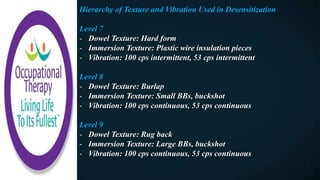
Level 7
- Dowel Texture: Hard form
- Immersion Texture: Plastic wire insulation pieces
- Vibration: 100 cps intermittent, 53 cps intermittent
Level 8
- Dowel Texture: Burlap
- Immersion Texture: Small BBs, buckshot
- Vibration: 100 cps continuous, 53 cps continuous
Level 9
- Dowel Texture: Rug back
- Immersion Texture: Large BBs, buckshot
- Vibration: 100 cps continuous, 53 cps continuous
Hierarchy of Texture and Vibration Used in Desensitization
Level 10
- Dowel Texture: Velcro hook
- Immersion Texture: Plastic squares
- Vibration: No problem with vibration
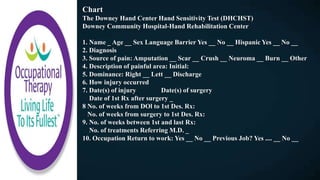
Chart
The Downey Hand Center Hand Sensitivity Test (DHCHST)
Downey Community Hospital-Hand Rehabilitation Center
1. Name _ Age __ Sex Language Barrier Yes __ No __ Hispanic Yes __ No __
2. Diagnosis
3. Source of pain: Amputation __ Scar __ Crush __ Neuroma __ Burn __ Other
4. Description of painful area: Initial:
5. Dominance: Right __ Lett __ Discharge
6. How injury occurred
7. Date(s) of injury Date(s) of surgery
Date of 1st Rx after surgery _
8 No. of weeks from DOl to 1st Des. Rx:
No. of weeks from surgery to 1st Des. Rx:
9. No. of weeks between 1st and last Rx:
No. of treatments Referring M.D. _
10. Occupation Return to work: Yes __ No __ Previous Job? Yes .... __ No __
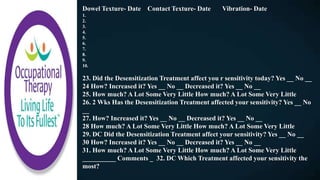
Dowel Texture- Date Contact Texture- Date Vibration- Date
1.
2.
3.
4.
5.
6.
7.
8.
9.
10.
23. Did the Desensitization Treatment affect you r sensitivity today? Yes __ No __
24 How? Increased it? Yes __ No __ Decreased it? Yes __ No __
25. How much? A Lot Some Very Little How much? A Lot Some Very Little
26. 2 Wks Has the Desensitization Treatment affected your sensitivity? Yes __ No
__
27. How? Increased it? Yes __ No __ Decreased it? Yes __ No __
28 How much? A Lot Some Very Little How much? A Lot Some Very Little
29. DC Did the Desensitization Treatment affect your sensitivity? Yes __ No __
30 How? Increased it? Yes __ No __ Decreased it? Yes __ No __
31. How much? A Lot Some Very Little How much? A Lot Some Very Little
__________ Comments _ 32. DC Which Treatment affected your sensitivity the
most?
- The goals of sensory training are to maintain or restore the cortical
hand representation and to regain the use of sensation of the hand
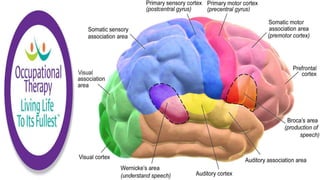
- Therefore, treatment must address both the brain and the peripheral
nerve?
- Passive sensory training involves use of repetitive stimulation of the
denervated part to maintain the cortical representation of that part.
- Passive sensory training requires no attention on the part of the
patient but improves sensation through long-term highly repetitive
stimulation of the patient's skin.
- Active sensory training, or sensory reeducation, combines
techniques of attention, learning, repeated practice, and use of
alternative senses such as vision or hearing to help the patient learn
to reinterpret sensation
- The return of sensation following hand injury extremely complex
process.
- Recovery is not just a process of altering the cortical representation;
it also depends re-innervation. Following nerve laceration and
surgical repair, some sensory fibers, given sufficient time,
regenerate.
- Peripheral nerve regenerates at a rate of 1 mm per day inch per
month .
- No surgical repair technique can ensure recovery of tactile
discrimination after nerve damage in adults
- Sensory return is limited by malalignment of axonal sheaths that all
misdirection of re-growing fibers, meaning that not usually regrow
to innervate the same sensory receptors that they innervated before
the injury
- Return of sensation is further limited by scar tissue that blocks
sensory fiber regrowth atrophy of sensory receptors prior to re-
innervation
- As a result of scar tissue, atrophy of sensory receptors and the
misdirection of fibers, there is an inevitable change in the profile of
neural impulses reaching the sensor cortex.
- A previously well-known stimulus initiates a different set of neural
impulses from that elicited by the same stimulus before the injury.
- When this altered profile reaches the sensory cortex, the patient
cannot match it with terns previously encountered and remembered
and hence cannot identify recognize the stimulus.
- The purpose of active sensory reeducation in patients with
peripheral injuries is to help learn to recognize the new sensory
patterns from the and associate the new sensation to current tactile
experiences
- Phase 1 of sensory reeducation immediately after never repair to
preserve the cortical representation of the denervated part and has
been found effective in improving tactile gnosis.
- Phase 2 of sensory reeducation begins when the patient first can
appreciate deep, moving touch. At first, in phase 2 of reeducation,
the patient concentrates on learning to match the sensory perception
of stimuli with the visual or auditory perception.
- The alternative sense, vision or hearing, is used to train the new
sensation and thereby improve tactile discrimination.
- After time, when reinnervation allows for perception of light
nonmoving touch with good touch localization, the focus of
intervention changes to more functional tasks, such as object
identification through touch.
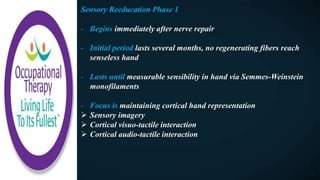
Sensory Reeducation Phase 1
- Begins immediately after nerve repair
- Initial period lasts several months, no regenerating fibers reach
senseless hand
- Lasts until measurable sensibility in hand via Semmes-Weinstein
monofilaments
- Focus is maintaining cortical hand representation
 Sensory imagery
 Cortical visuo-tactile interaction
 Cortical audio-tactile interaction
Sensory Reeducation Phase 2
- Begins with measurable sensibility in palm
- via Semmes-Weinstein monofilament (6.65)
- • Once “some” protective sensibility localized
- correctly in fingertips, touch discrimination
- and identification is initiated
- • Classic Wynn-Parry and Dellon training used
- • Focus is re-establishing functional
- reinnervation of hand via cortical
- reorganization
Sensory Reeducation Principles
 Choose a quiet environment that will maximize concentration
 Sessions in the clinic should be minutes, two or three times a week.
 Because in-clinic training is brief, homework practice sessions are
important. Three or four 5-minute sessions per day are
recommended.
 Instruct the patient and/or family in techniques to be used during
practice.
 Monitor patient's home program and progress during therapy
sessions.
 Allow frequent rest breaks during which the patient can open his
eyes. This reduces feelings of disorientation and anxiety.
Prerequisites for Early-Phase 2 Sensory Reeducation
 Patient must be able to perceive 30 cycles per second vibration and
moving touch in the area.
 Patient must be motivated and able to follow through with the
program.
Techniques for Early-Phase 2 Sensory Reeducation
 Use the eraser end of a pencil.
 Apply moving strokes to the area.
 Use enough pressure for the patient to perceive the stimulus but not
so much that it causes pain.
 Ask the patient to observe what is happening first and then to close
the eyes and concentrate on what is being felt.
 Instruct the patient to put into words (silently) what is being felt
 Instruct the patient to observe the stimulus again to confirm the
sensory experience with perception
 When perception of constant touch returns to the area, use a similar
process for constant touch stimuli
 Test the patient by requiring localization of moving and constant
touch without seeing the stimulus
The reeducation program five stages
Stage 1
 Object recognition using feature detection strategies.
- The patient was encouraged to handle each object, pay attention to
the object, and identify the characteristics of the object.
Stage 2
 Prehension of various objects with refinement of prehension
patterns.
- In this stage, grasping objects that varied in size and shape was
emphasized.
- The patient needed to maximize the contact between the object and
the hand to develop the ability of the hand to closely contour to
objects, which is seen in normal grasp.
The reeducation program five stages
Stage 3
 Control of prehension force while holding objects.
- Feedback regarding excessive force that was used to maintain grasp
was provided through the use of a strain gauge and the therapy
putty
Stage 4
 Maintenance of prehension force during transport of objects
- While holding an object, the patient moved the shoulder, elbow, and
wrist into varying positions of flexion and extension.
Stage 5
 Object manipulation
- The patient practiced grasp and release of objects and moved objects
in the hand into various positons
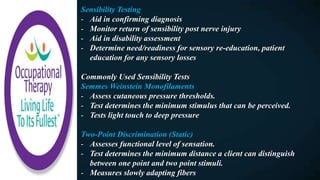
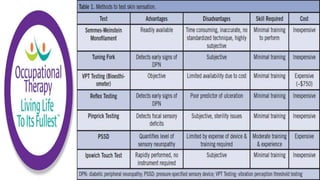
Sensibility Testing
- Aid in confirming diagnosis
- Monitor return of sensibility post nerve injury
- Aid in disability assessment
- Determine need/readiness for sensory re-education, patient
education for any sensory losses
Commonly Used Sensibility Tests
Semmes Weinstein Monofilaments
- Assess cutaneous pressure thresholds.
- Test determines the minimum stimulus that can be perceived.
- Tests light touch to deep pressure
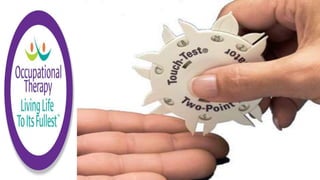
Two-Point Discrimination (Static)
- Assesses functional level of sensation.
- Test determines the minimum distance a client can distinguish
between one point and two point stimuli.
- Measures slowly adapting fibers
General Sensibility Testing Procedures
- Client’s vision is occluded
 Ask client to close eyes or look away
 Or use a visual barrier
- Test in a distraction free area of the clinic
- Follow standardized testing procedures
- + / - Use of putty or other support for hand
- Ideally, the same therapist should always re-test the same client on
subsequent therapy visits
- Make sure client understands directions for examination
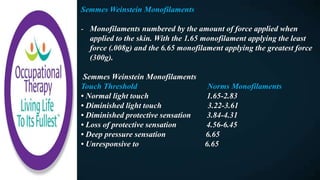
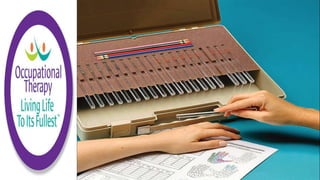
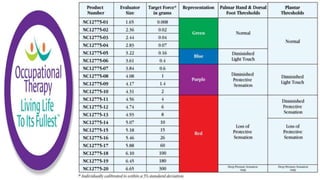
Semmes Weinstein Monofilaments
- Monofilaments numbered by the amount of force applied when
applied to the skin. With the 1.65 monofilament applying the least
force (.008g) and the 6.65 monofilament applying the greatest force
(300g).
Semmes Weinstein Monofilaments
Touch Threshold Norms Monofilaments
• Normal light touch 1.65-2.83
• Diminished light touch 3.22-3.61
• Diminished protective sensation 3.84-4.31
• Loss of protective sensation 4.56-6.45
• Deep pressure sensation 6.65
• Unresponsive to 6.65
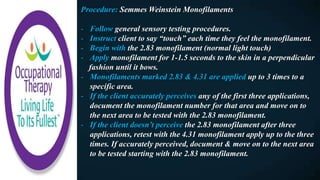
Procedure: Semmes Weinstein Monofilaments
- Follow general sensory testing procedures.
- Instruct client to say “touch” each time they feel the monofilament.
- Begin with the 2.83 monofilament (normal light touch)
- Apply monofilament for 1-1.5 seconds to the skin in a perpendicular
fashion until it bows.
- Monofilaments marked 2.83 & 4.31 are applied up to 3 times to a
specific area.
- If the client accurately perceives any of the first three applications,
document the monofilament number for that area and move on to
the next area to be tested with the 2.83 monofilament.
- If the client doesn’t perceive the 2.83 monofilament after three
applications, retest with the 4.31 monofilament apply up to the three
times. If accurately perceived, document & move on to the next area
to be tested starting with the 2.83 monofilament.
Procedure: Semmes Weinstein Monofilaments
- If the client doesn’t perceive the 4.31 monofilament after three
applications, test the area one time only with the 4.56 monofilament.
If accurately perceived document 4.56. If not accurately perceived,
follow the procedure testing only once for monofilament 6.65.
- Document “unable to be tested-does not perceive 6.65” for clients
who do not perceive the 6.65 monofilament
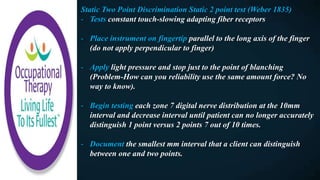
Static Two Point Discrimination Static 2 point test (Weber 1835)
- Tests constant touch-slowing adapting fiber receptors
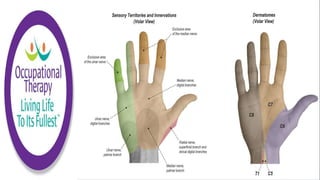
- Place instrument on fingertip parallel to the long axis of the finger
(do not apply perpendicular to finger)
- Apply light pressure and stop just to the point of blanching
(Problem-How can you reliability use the same amount force? No
way to know).
- Begin testing each zone 7 digital nerve distribution at the 10mm
interval and decrease interval until patient can no longer accurately
distinguish 1 point versus 2 points 7 out of 10 times.
- Document the smallest mm interval that a client can distinguish
between one and two points.
Static Two Point Discrimination Static 2 point test (Weber 1835)
- Tests constant touch-slowing adapting fiber receptors
- Place instrument on fingertip parallel to the long axis of the finger
(do not apply perpendicular to finger)
- Apply light pressure and stop just to the point of blanching
(Problem-How can you reliability use the same amount force? No
way to know).
- Begin testing each zone 7 digital nerve distribution at the 10mm
interval and decrease interval until patient can no longer accurately
distinguish 1 point versus 2 points 7 out of 10 times.
- Document the smallest mm interval that a client can distinguish
between one and two points.
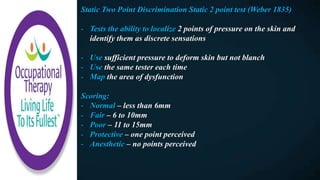
Static Two Point Discrimination Static 2 point test (Weber 1835)
- Tests the ability to localize 2 points of pressure on the skin and
identify them as discrete sensations
- Use sufficient pressure to deform skin but not blanch
- Use the same tester each time
- Map the area of dysfunction
Scoring:
- Normal – less than 6mm
- Fair – 6 to 10mm
- Poor – 11 to 15mm
- Protective – one point perceived
- Anesthetic – no points perceived
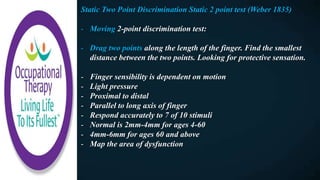
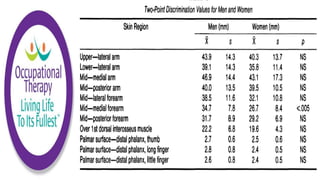
Static Two Point Discrimination Static 2 point test (Weber 1835)
- Moving 2-point discrimination test:
- Drag two points along the length of the finger. Find the smallest
distance between the two points. Looking for protective sensation.
- Finger sensibility is dependent on motion
- Light pressure
- Proximal to distal
- Parallel to long axis of finger
- Respond accurately to 7 of 10 stimuli
- Normal is 2mm-4mm for ages 4-60
- 4mm-6mm for ages 60 and above
- Map the area of dysfunction
Occupational Therapy Sensory Testing and Intervention

Occupational Therapy Sensory Testing and Intervention

  • 1.
  • 2.
    - The handsare an extension of the brain in connection with the surrounding world and are together with the face the most visible and socially used parts of the body. - The interaction between brain, sensibility and motor function is essential in hand function. - By using fine movement skills and sensation in the hand, a person can explore and use objects in the environment, which strongly contribute to the ability to perform personal care, work and leisure activities. - The human hands are not only working tools but also delicate instruments of great importance for our daily activities and wellbeing.
  • 3.
    - Performing dailyoccupations is influenced by a dynamic interaction between person, environment and occupation. - People need to be active and develop their personal roles and habits in interplay with other people - Health and wellbeing is achieved when there is a balance between self-care, productivity and leisure. - After surgery or injury, complications such as pain and hyperaesthesia may occur. This state often recovers slowly and is sometimes resistant to treatment. - When a patient is not using the hand normally and avoids using grip areas in the affected hand, this should be taken as an indication that there may be a sensitivity problem
  • 4.
    - Hyperesthesia canaccording to the International Association for the Study of Pain (IASP), mean both a lower threshold to stimuli and a higher response to stimuli. - The term can refer to perception of touch as well as warm or cold stimuli and can be with or without pain. - The term hyperesthesia includes allodynia (perception of pain from stimuli that normally are not painful) and hyperalgesia (increased response from stimuli that normally are painful).
  • 5.
    - Pain isa complex, multidimensional experience where sensory, emotional and cognitive factors interplay with expectations and past experiences of pain - Acute pain is most often related to tissue damage while recurrent or chronic pain may be present even when there are no longer detectable signs of tissue damage. - The subjective experience of intensity, localization and duration is the discriminative sensory component of the pain. - The emotional or affective component is the discomfort or painful experience the pain gives rise to - The third dimension of pain relates to the way patients conduct themselves to the pain and its origin, which depend on different psychological and cognitive factors.

  • 6.
    - Assessment ofpain in the hands can be complicated because of the complex nature of the hands themselves and their multidimensional functions. - A drawing of the extent of the pain and some descriptors of the pain are considered fundamental. - It is also desirable that the patients describe how the hand function is affected by the pain in their own words. - If a visual analogue scale (VAS) is used, it is recommended that it be without steps or graduated from 0 to 100 mm.
  • 7.
    - Desensitization isthe gradually increase tolerance by massage (rub, stroke or massage) of a sensitive skin area using textures - The method of desensitization to reduce symptoms of hyperesthesia. - The program used three types of modalities: dowel textures, contact particles and vibration, each at 10 levels of difficulty (with level 1 the most gentle and level 10 the most irritating stimulation). - Each modality was used for 10 minutes two or three times a day Hyperesthesia was not preventing any of the patients from returning to work after treatment and the average treatment period was seven week.
  • 8.
    Touch is adeveloped capacity that supports abilities and skills such as gasping and releasing objects. These abilities and skills are necessary for competence in self- maintenance, self-enhancement, and self-advancement. Handling and manipulating objects enhances learning and help human beings appreciate the world Without sensation in the hand, there is a greater risk of injury to the hand and decreased ability to manipulate small objects. There is a tendency not to use the hand in functional activities, loss of function that result from not using the hand.
  • 9.
    The choice ofinterventions for sensation is based on the diagnosis, prognosis, and evaluation findings. Diminished or lost protective sensation, the inability to feel pain in response to pain to stimuli that are damaging, suggest a need for teaching the patient compensatory strategies to prevent injury. Findings of discomfort associated with touch (hypersensitivity) suggest a need for desensitization. Passive sensory training is provided for patients who have lost sensation but are expected to regain some sensory ability. Sensory reeducation (active sensory training) is provided for patients who have some sensation and potential for better interpretation of sensory information.
  • 10.
    Protective sensations aresensations of pain and temperature extremes that signal the threat of tissue damage. When the brain receives this message, the normal response is to move the body part away from the source of the stimulus. Without this message, tissue damage can quickly occur. The goal of treatment for the patient with diminished or absent protective sensation is to avoid injury. Treatment consists of teaching the patient precautions necessary to prevent injury to any body part with compromised protective sensation. The loss of sensation could be due to diagnoses such as stroke, head injury, spinal cord injury, peripheral nerve injury, or nerve reconstruction.
  • 11.
    Damage or injuryto an insensitive limb is the result of external forces that are normally avoided by people who are able to feel pain, which acts as a warning mechanism. Based on the five mechanism of damage to insensitive skin.  Skin areas over bony prominences are particularly prone to pressure ulcers because the cutaneous tissue is trapped between the unyielding bone and the external pressure.  Frequent position changes are necessary for patients with decreased or absent protective sensation to avoid damage caused by continuous low pressure.  Cushions for seating and shoe insoles help to distribute forces over larger areas  Instruct patients to avoid concentrated high pressure by careful handling of sharp tools and by using enlarged handles on suitcases, drawers, tools and keys.
  • 12.
     Patients mayneed to become consciously aware to use only as much force as necessary to grasp objects  Excessive pressure can also result from splint straps that are too narrow and splints that are too tight: therefore, therapist must carefully construct splints to prevent injury.  Teach patients to increase their awareness of potential sources of extreme heat or cold and to protect themselves from contact with them. - Insulated coffee mugs are recommended. - Oven mitss or quality pot holders are necessary for cooking - Utensils with wooden or plastic handles are better than metal ones. - Patients using wheelchairs should insulate exposed hot water pipes under sinks - In cold weather, gloves or mittens are necessary protection for insensate hands.
  • 13.
     Instruct patientsto avoid repetitive motions and excessive friction between skin and objects.  Decrease repetitions by working for shorter periods, resting, using a variety of tools, or alternating hands or type of grip.  Methods to reduce friction include wearing well-fitting gloves and using enlarged or padded handles on tool.  Educate patients who have lost protective sensation regarding special care for blisters, cuts and bruises necessary to avoid infection.  If infection occurs, in conjunction with treatment for the infection, the infected part should be completely rested to keep it free from pressure and overuse, allowing healing to occur
  • 14.
     Vision maybe used to prevent contract with sharp objects.  Using a body part with intact sensation to test water temperature before immersion of any body part without sensation is recommended.  Auditory cues may also help to prevent injury.  Patients should be instructed in good skin care. Well-hydrated skin is more elastic and pliant and less prone to injury.  Skin needs to be visually inspected everyday.  A warm or reddened area indicates a possible site of tissue breakdown, which lead to a decubitus ulcer, and extreme care must be taken to relieve pressure totally from this area until the color returns to normal
  • 15.
     Desensitization ischosen when the sensory evaluation reveals an area of hypersensitivity, in which ordinary stimuli produce exaggerated or unpleasant sensations.  Hypersensitivity includes allodynia, which is the perception of pain as a result of non-painful sensitivity to tactile stimuli.  Desensitization is an intervention designed to decrease the discomfort associated with touch in the hypersensitivity area.  A program of desensitization generally includes repetitive stimulation of the hypersensitive skin with items that provide a variety of sensory experiences, such as textures ranging from soft to coarse
  • 16.
     Hypersensitivity isobserved in some but not all patients following nerve trauma, soft tissue injuries, burns, and amputation.  Patients with hypersensitivity tend to avoid using the affected part in functional activities and typically hold the affected part in functional activities and typically hold the affected part protectively.  Hypersensitivity can lead to disability through nonuse of the involved body part  Desensitization is based on the idea that progressive stimulation will allow progressive tolerance.  Desensitization can be considered relearning to interpret sensory stimuli as nonnoxious, and therefore learning principles and methods apply
  • 17.
    Hierarchy includes fivelevels:  Level 1. Turning fork, paraffin, massage  Level 2. Battery-operated vibrator, deep massage, touch pressure with pencil eraser  Level 3. Electric vibrator, texture identification  Level 4. Electric vibrator, object identification  Desensitization begins outside the area of hypersensitivity and progresses toward the area of greatest sensitivity.  Constant contact of the stimulus is preferable to intermittent contact, which my be harmful.  Patients advance to the next level after they demonstrate tolerance of the current level without signs of irritation.
  • 18.
     Mirror visualfeedback in conjunction with a desensitization program.  In Mirror Visual Feedback, the mirror is positioned at the patient’s midsagittal plane so that the affected arm is hidden from view behind the mirror and the reflected image of the unaffected limb is in the perceive position of the affected one, thereby giving the impression of the patient have two “normal” limbs.  The patient observes the unaffected limb in the mirror as it is touched with various textures.  The touch is perceived to be applied to the affected limb and found tolerable.  Then the mirror is removed, and the affected limb is actually touched.
  • 19.
     Other interventionsthought to decrease hypersensitivity include weight-bearing pressure, twice daily massage of a surgical scar less than 6 months old with steroid-containing cream, transcutaneous nerve stimulation (TENS), fluidotherapy, and home shower- massager.  Use of the affected body part in leisure work and daily occupations is believed to facilitate desensitization; the activities must be tailored to the patient’s interests and occupations to promote compliance.
  • 20.
    Fluidotherapy  The microprocessorcontrolled Fluidotherapy units utilize a stream of heated air flowing over and through finely granulated Cellex® Dry Heat Media, causing them to levitate.  This air stream creates air pockets and “bubbles” to provide a powerful massaging action that transmits heat and tactile stimulation to achieve many physiological and therapeutic benefits.  Cellex particles are made of natural cellulose, making disposal of the media from the unit simple and environmentally safe.
  • 21.
    Fluidotherapy  Single Extremityand Double Extremity Fluidotherapy units  Continuous and Pulse modes of operation  Treatment times can be set from 1-99 minutes  Operating temperatures to 52° C  Adjustable air speeds of 0-100%  Units are provided with a wake-up pre-heat timer to warm up the unit prior to use Key Effects of Fluidotherapy:  Dry Heat increases circulation and assists in pain relief  Limb buoyancy allows patients to freely perform a variety of resistive exercises with increased mobility and decreased pain. The fluidized Cellex particles act like a low viscosity fluid, allowing limbs to be suspended much like in a liquid state  Massaging action provides warmth, increased local circulation and pain diminishing effects to help increase joint range of motion
  • 22.
     Commercial doweland immersion textures are similar to this hierarchy.  Patients arrange the dowel textures and immersion textures according to their own perception, in the order of least to most irritating.  They select the dowel texture, immersion texture, and vibration level that are uncomfortable but tolerable for 10 minutes three or four times daily.  Advancing to the next level of treatment depends on the tolerance of lower levels.  Documentation should include the patient’s initial hierarchy and progress for each of the three modalities (dowel texture, immersion texture, and vibration level.
  • 23.
    Hierarchy of Textureand Vibration Used in Desensitization Level 1 - Dowel Texture: Moleskin - Immersion Texture: Cotton - Vibration: 83 cps near area Level 2 - Dowel Texture: Felt - Immersion Texture: Terry Cloth Pieces - Vibration: 83 cps near area, 23 cps intermittent Level 3 - Dowel Texture: Quickstick - Immersion Texture: Dry Rice - Vibration: 83 cps near area, 23 cps intermittent
  • 24.
    Hierarchy of Textureand Vibration Used in Desensitization Level 4 - Dowel Texture: Velvet - Immersion Texture: Popcorn - Vibration: 83 cps intermittent, 23 cps intermittent Level 5 - Dowel Texture: Semirough Cloth - Immersion Texture: Pinto beans - Vibration: 83 intermittent, 23 cps continuous Level 6 - Dowel Texture: Velcro loop - Immersion Texture: Macaroni - Vibration: 83 continuous, 53 cps intermittent
  • 25.
    Hierarchy of Textureand Vibration Used in Desensitization Level 7 - Dowel Texture: Hard form - Immersion Texture: Plastic wire insulation pieces - Vibration: 100 cps intermittent, 53 cps intermittent Level 8 - Dowel Texture: Burlap - Immersion Texture: Small BBs, buckshot - Vibration: 100 cps continuous, 53 cps continuous Level 9 - Dowel Texture: Rug back - Immersion Texture: Large BBs, buckshot - Vibration: 100 cps continuous, 53 cps continuous
  • 26.
    Hierarchy of Textureand Vibration Used in Desensitization Level 10 - Dowel Texture: Velcro hook - Immersion Texture: Plastic squares - Vibration: No problem with vibration
  • 27.
    Chart The Downey HandCenter Hand Sensitivity Test (DHCHST) Downey Community Hospital-Hand Rehabilitation Center 1. Name _ Age __ Sex Language Barrier Yes __ No __ Hispanic Yes __ No __ 2. Diagnosis 3. Source of pain: Amputation __ Scar __ Crush __ Neuroma __ Burn __ Other 4. Description of painful area: Initial: 5. Dominance: Right __ Lett __ Discharge 6. How injury occurred 7. Date(s) of injury Date(s) of surgery Date of 1st Rx after surgery _ 8 No. of weeks from DOl to 1st Des. Rx: No. of weeks from surgery to 1st Des. Rx: 9. No. of weeks between 1st and last Rx: No. of treatments Referring M.D. _ 10. Occupation Return to work: Yes __ No __ Previous Job? Yes .... __ No __
  • 28.
    Dowel Texture- DateContact Texture- Date Vibration- Date 1. 2. 3. 4. 5. 6. 7. 8. 9. 10. 23. Did the Desensitization Treatment affect you r sensitivity today? Yes __ No __ 24 How? Increased it? Yes __ No __ Decreased it? Yes __ No __ 25. How much? A Lot Some Very Little How much? A Lot Some Very Little 26. 2 Wks Has the Desensitization Treatment affected your sensitivity? Yes __ No __ 27. How? Increased it? Yes __ No __ Decreased it? Yes __ No __ 28 How much? A Lot Some Very Little How much? A Lot Some Very Little 29. DC Did the Desensitization Treatment affect your sensitivity? Yes __ No __ 30 How? Increased it? Yes __ No __ Decreased it? Yes __ No __ 31. How much? A Lot Some Very Little How much? A Lot Some Very Little __________ Comments _ 32. DC Which Treatment affected your sensitivity the most?
  • 30.
    - The goalsof sensory training are to maintain or restore the cortical hand representation and to regain the use of sensation of the hand - Therefore, treatment must address both the brain and the peripheral nerve? - Passive sensory training involves use of repetitive stimulation of the denervated part to maintain the cortical representation of that part. - Passive sensory training requires no attention on the part of the patient but improves sensation through long-term highly repetitive stimulation of the patient's skin. - Active sensory training, or sensory reeducation, combines techniques of attention, learning, repeated practice, and use of alternative senses such as vision or hearing to help the patient learn to reinterpret sensation
  • 31.
    - The returnof sensation following hand injury extremely complex process. - Recovery is not just a process of altering the cortical representation; it also depends re-innervation. Following nerve laceration and surgical repair, some sensory fibers, given sufficient time, regenerate. - Peripheral nerve regenerates at a rate of 1 mm per day inch per month . - No surgical repair technique can ensure recovery of tactile discrimination after nerve damage in adults - Sensory return is limited by malalignment of axonal sheaths that all misdirection of re-growing fibers, meaning that not usually regrow to innervate the same sensory receptors that they innervated before the injury
  • 32.
    - Return ofsensation is further limited by scar tissue that blocks sensory fiber regrowth atrophy of sensory receptors prior to re- innervation - As a result of scar tissue, atrophy of sensory receptors and the misdirection of fibers, there is an inevitable change in the profile of neural impulses reaching the sensor cortex. - A previously well-known stimulus initiates a different set of neural impulses from that elicited by the same stimulus before the injury. - When this altered profile reaches the sensory cortex, the patient cannot match it with terns previously encountered and remembered and hence cannot identify recognize the stimulus. - The purpose of active sensory reeducation in patients with peripheral injuries is to help learn to recognize the new sensory patterns from the and associate the new sensation to current tactile experiences
  • 33.
    - Phase 1of sensory reeducation immediately after never repair to preserve the cortical representation of the denervated part and has been found effective in improving tactile gnosis. - Phase 2 of sensory reeducation begins when the patient first can appreciate deep, moving touch. At first, in phase 2 of reeducation, the patient concentrates on learning to match the sensory perception of stimuli with the visual or auditory perception. - The alternative sense, vision or hearing, is used to train the new sensation and thereby improve tactile discrimination. - After time, when reinnervation allows for perception of light nonmoving touch with good touch localization, the focus of intervention changes to more functional tasks, such as object identification through touch.
  • 34.
    Sensory Reeducation Phase1 - Begins immediately after nerve repair - Initial period lasts several months, no regenerating fibers reach senseless hand - Lasts until measurable sensibility in hand via Semmes-Weinstein monofilaments - Focus is maintaining cortical hand representation  Sensory imagery  Cortical visuo-tactile interaction  Cortical audio-tactile interaction
  • 35.
    Sensory Reeducation Phase2 - Begins with measurable sensibility in palm - via Semmes-Weinstein monofilament (6.65) - • Once “some” protective sensibility localized - correctly in fingertips, touch discrimination - and identification is initiated - • Classic Wynn-Parry and Dellon training used - • Focus is re-establishing functional - reinnervation of hand via cortical - reorganization
  • 36.
    Sensory Reeducation Principles Choose a quiet environment that will maximize concentration  Sessions in the clinic should be minutes, two or three times a week.  Because in-clinic training is brief, homework practice sessions are important. Three or four 5-minute sessions per day are recommended.  Instruct the patient and/or family in techniques to be used during practice.  Monitor patient's home program and progress during therapy sessions.  Allow frequent rest breaks during which the patient can open his eyes. This reduces feelings of disorientation and anxiety.
  • 37.
    Prerequisites for Early-Phase2 Sensory Reeducation  Patient must be able to perceive 30 cycles per second vibration and moving touch in the area.  Patient must be motivated and able to follow through with the program.
  • 38.
    Techniques for Early-Phase2 Sensory Reeducation  Use the eraser end of a pencil.  Apply moving strokes to the area.  Use enough pressure for the patient to perceive the stimulus but not so much that it causes pain.  Ask the patient to observe what is happening first and then to close the eyes and concentrate on what is being felt.  Instruct the patient to put into words (silently) what is being felt  Instruct the patient to observe the stimulus again to confirm the sensory experience with perception  When perception of constant touch returns to the area, use a similar process for constant touch stimuli  Test the patient by requiring localization of moving and constant touch without seeing the stimulus
  • 39.
    The reeducation programfive stages Stage 1  Object recognition using feature detection strategies. - The patient was encouraged to handle each object, pay attention to the object, and identify the characteristics of the object. Stage 2  Prehension of various objects with refinement of prehension patterns. - In this stage, grasping objects that varied in size and shape was emphasized. - The patient needed to maximize the contact between the object and the hand to develop the ability of the hand to closely contour to objects, which is seen in normal grasp.
  • 40.
    The reeducation programfive stages Stage 3  Control of prehension force while holding objects. - Feedback regarding excessive force that was used to maintain grasp was provided through the use of a strain gauge and the therapy putty Stage 4  Maintenance of prehension force during transport of objects - While holding an object, the patient moved the shoulder, elbow, and wrist into varying positions of flexion and extension. Stage 5  Object manipulation - The patient practiced grasp and release of objects and moved objects in the hand into various positons
  • 41.
    Sensibility Testing - Aidin confirming diagnosis - Monitor return of sensibility post nerve injury - Aid in disability assessment - Determine need/readiness for sensory re-education, patient education for any sensory losses Commonly Used Sensibility Tests Semmes Weinstein Monofilaments - Assess cutaneous pressure thresholds. - Test determines the minimum stimulus that can be perceived. - Tests light touch to deep pressure Two-Point Discrimination (Static) - Assesses functional level of sensation. - Test determines the minimum distance a client can distinguish between one point and two point stimuli. - Measures slowly adapting fibers
  • 45.
    General Sensibility TestingProcedures - Client’s vision is occluded  Ask client to close eyes or look away  Or use a visual barrier - Test in a distraction free area of the clinic - Follow standardized testing procedures - + / - Use of putty or other support for hand - Ideally, the same therapist should always re-test the same client on subsequent therapy visits - Make sure client understands directions for examination
  • 47.
    Semmes Weinstein Monofilaments -Monofilaments numbered by the amount of force applied when applied to the skin. With the 1.65 monofilament applying the least force (.008g) and the 6.65 monofilament applying the greatest force (300g). Semmes Weinstein Monofilaments Touch Threshold Norms Monofilaments • Normal light touch 1.65-2.83 • Diminished light touch 3.22-3.61 • Diminished protective sensation 3.84-4.31 • Loss of protective sensation 4.56-6.45 • Deep pressure sensation 6.65 • Unresponsive to 6.65
  • 48.
    Procedure: Semmes WeinsteinMonofilaments - Follow general sensory testing procedures. - Instruct client to say “touch” each time they feel the monofilament. - Begin with the 2.83 monofilament (normal light touch) - Apply monofilament for 1-1.5 seconds to the skin in a perpendicular fashion until it bows. - Monofilaments marked 2.83 & 4.31 are applied up to 3 times to a specific area. - If the client accurately perceives any of the first three applications, document the monofilament number for that area and move on to the next area to be tested with the 2.83 monofilament. - If the client doesn’t perceive the 2.83 monofilament after three applications, retest with the 4.31 monofilament apply up to the three times. If accurately perceived, document & move on to the next area to be tested starting with the 2.83 monofilament.
  • 49.
    Procedure: Semmes WeinsteinMonofilaments - If the client doesn’t perceive the 4.31 monofilament after three applications, test the area one time only with the 4.56 monofilament. If accurately perceived document 4.56. If not accurately perceived, follow the procedure testing only once for monofilament 6.65. - Document “unable to be tested-does not perceive 6.65” for clients who do not perceive the 6.65 monofilament
  • 53.
    Static Two PointDiscrimination Static 2 point test (Weber 1835) - Tests constant touch-slowing adapting fiber receptors - Place instrument on fingertip parallel to the long axis of the finger (do not apply perpendicular to finger) - Apply light pressure and stop just to the point of blanching (Problem-How can you reliability use the same amount force? No way to know). - Begin testing each zone 7 digital nerve distribution at the 10mm interval and decrease interval until patient can no longer accurately distinguish 1 point versus 2 points 7 out of 10 times. - Document the smallest mm interval that a client can distinguish between one and two points.
  • 54.
    Static Two PointDiscrimination Static 2 point test (Weber 1835) - Tests constant touch-slowing adapting fiber receptors - Place instrument on fingertip parallel to the long axis of the finger (do not apply perpendicular to finger) - Apply light pressure and stop just to the point of blanching (Problem-How can you reliability use the same amount force? No way to know). - Begin testing each zone 7 digital nerve distribution at the 10mm interval and decrease interval until patient can no longer accurately distinguish 1 point versus 2 points 7 out of 10 times. - Document the smallest mm interval that a client can distinguish between one and two points.
  • 55.
    Static Two PointDiscrimination Static 2 point test (Weber 1835) - Tests the ability to localize 2 points of pressure on the skin and identify them as discrete sensations - Use sufficient pressure to deform skin but not blanch - Use the same tester each time - Map the area of dysfunction Scoring: - Normal – less than 6mm - Fair – 6 to 10mm - Poor – 11 to 15mm - Protective – one point perceived - Anesthetic – no points perceived
  • 56.
    Static Two PointDiscrimination Static 2 point test (Weber 1835) - Moving 2-point discrimination test: - Drag two points along the length of the finger. Find the smallest distance between the two points. Looking for protective sensation. - Finger sensibility is dependent on motion - Light pressure - Proximal to distal - Parallel to long axis of finger - Respond accurately to 7 of 10 stimuli - Normal is 2mm-4mm for ages 4-60 - 4mm-6mm for ages 60 and above - Map the area of dysfunction