Nature & Process
of Communication
EN11/12OC-Ia-2
Objectives:
•defines communication;
{
•explains the nature and process of
communication.
● identify the various elements of communication.
Activity # 01 Word Cloud
Defining Communication:
The word communication is
derived from the Latin terms cum
munis (to make common) and
communicare (to share). Hence,
communication is defined as the
exchange of information, thoughts,
ideas, feeling and the like.
Defining Communication:
Communication is sending and
receiving information between two
or more people.
Communication is said to
be “the creation and exchange
of meaning.
Defining Communication:
Communication is dynamic. It is
always changing.
Communication is systematic.
A simple speech communication
occurs within a larger system.
Defining Communication:
Communication is adaptive. It
adjust to the other person, to the
topic, and to the situation.
Communication is continuous.
It has no beginning and no end.
The Nature of Communication:
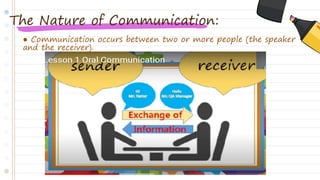
● Communication occurs between two or more people (the speaker
and the receiver).
The Nature of Communication:
● Communication can be expressed through words (verbal), actions
(nonverbal) or both a the same time.
● Communication is a skill.
● Communication is a process.
The Nature of Communication:
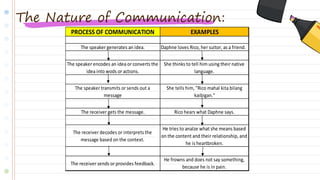
PROCESS OF COMMUNICATION EXAMPLES
The speaker generates an idea. Daphne loves Rico, her suitor, as a friend.
The speaker encodes an idea or converts the
idea into wods or actions.
She thinks to tell him using their native
language.
The speaker transmits or sends out a
message
She tells him, "Rico mahal kita bilang
kaibigan."
The receiver gets the message. Rico hears what Daphne says.
The receiver decodes or interprets the
message based on the context.
He tries to analze what she means based
on the content and their relationship, and
he is heartbroken.
The receiver sends or provides feedback.
He frowns and does not say something,
because he is in pain.
There are 4 situations in the table identify the sender, message, receiver, and feedback
in each given situation:
SITUATION MESSAGE RECEIVER FEEDBACK
A parishioner confesses
his sins to the priest.
enumeration of sins priest The penance is to be
done by the
parishioner.
1. A weatherman
reports the coming of
a strong typhoon.
2. A radio host
announces the winners’
names.
3. A researcher calls
one of her pupils to
answer the question
raised
Activity 2: The HOW of Communication
CREDITS: This presentation template was created by
Slidesgo, including icons by Flaticon, and infographics &
images by Freepik.
●Write a conversation chunks and identify the sender,
message, receiver, and feedback.
● These chunks should be taken from one of the following
settings:
─ home
─ school
─ office
Activity 3: What’s with the Conversation?

Nature-and-Process-of-Communication1.pptx

  • 1.
    Nature & Process ofCommunication EN11/12OC-Ia-2
  • 2.
    Objectives: •defines communication; { •explains thenature and process of communication. ● identify the various elements of communication.
  • 3.
    Activity # 01Word Cloud
  • 4.
    Defining Communication: The wordcommunication is derived from the Latin terms cum munis (to make common) and communicare (to share). Hence, communication is defined as the exchange of information, thoughts, ideas, feeling and the like.
  • 5.
    Defining Communication: Communication issending and receiving information between two or more people. Communication is said to be “the creation and exchange of meaning.
  • 6.
    Defining Communication: Communication isdynamic. It is always changing. Communication is systematic. A simple speech communication occurs within a larger system.
  • 7.
    Defining Communication: Communication isadaptive. It adjust to the other person, to the topic, and to the situation. Communication is continuous. It has no beginning and no end.
  • 8.
    The Nature ofCommunication: ● Communication occurs between two or more people (the speaker and the receiver).
  • 9.
    The Nature ofCommunication: ● Communication can be expressed through words (verbal), actions (nonverbal) or both a the same time. ● Communication is a skill. ● Communication is a process.
  • 11.
    The Nature ofCommunication: PROCESS OF COMMUNICATION EXAMPLES The speaker generates an idea. Daphne loves Rico, her suitor, as a friend. The speaker encodes an idea or converts the idea into wods or actions. She thinks to tell him using their native language. The speaker transmits or sends out a message She tells him, "Rico mahal kita bilang kaibigan." The receiver gets the message. Rico hears what Daphne says. The receiver decodes or interprets the message based on the context. He tries to analze what she means based on the content and their relationship, and he is heartbroken. The receiver sends or provides feedback. He frowns and does not say something, because he is in pain.
  • 12.
    There are 4situations in the table identify the sender, message, receiver, and feedback in each given situation: SITUATION MESSAGE RECEIVER FEEDBACK A parishioner confesses his sins to the priest. enumeration of sins priest The penance is to be done by the parishioner. 1. A weatherman reports the coming of a strong typhoon. 2. A radio host announces the winners’ names. 3. A researcher calls one of her pupils to answer the question raised Activity 2: The HOW of Communication
  • 13.
    CREDITS: This presentationtemplate was created by Slidesgo, including icons by Flaticon, and infographics & images by Freepik.
  • 14.
    ●Write a conversationchunks and identify the sender, message, receiver, and feedback. ● These chunks should be taken from one of the following settings: ─ home ─ school ─ office Activity 3: What’s with the Conversation?