OBTAINING INFORMATION
FROM VARIOUS SOURCES
Information may come from two
sources:
Primary sources
&
Secondary sources
PRIMARY SOURCES
•Are documents and original artifacts
from people who participated and
witnessed an actual event in history
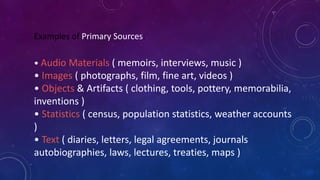
Examples of Primary Sources:
• Audio Materials ( memoirs, interviews, music )
• Images ( photographs, film, fine art, videos )
• Objects & Artifacts ( clothing, tools, pottery, memorabilia,
inventions )
• Statistics ( census, population statistics, weather accounts
)
• Text ( diaries, letters, legal agreements, journals
autobiographies, laws, lectures, treaties, maps )
SECONDARY SOURCES
• Are documents, images, texts, and objects
that are created by someone who
referenced primary sources through
analysis, synthesis, interpretation and
evaluation
Example of Secondary Sources:
• Journal articles
• Analyze research
• Textbooks
• Dictionaries
• Encyclopedias
• Political
• Commentary
• Biographies
• Dissertation
• Newspaper Editorial
• Opinion Columns
• Criticism of Literature
From these sources are necessary skill-in research and communication.
Obtaining information from various sources does not stop
with the gathering of information. It is also the
responsibility of the researcher to critically evaluate each
source of information to ensure the use of quality
information to ensure the use of quality information. This
purpose is the CRAAP Test. Stands for Currency , Relevance ,
Authority , Accuracy and Purpose.
IS THE SOURCE CURRENT TO THE TOPIC?
• When was the information published, posted or publicized?
• Has the information undergone any revision, updating, or
improvement?
• Is it up to date?
• Does it contain the latest and most recent information for your
topic?
• Are the links where the information is found working or
functional?
IS IT RELEVANT TO YOUR RESEARCH?
• Is the information related and connected to your topic?
• Does it answer your research problem?
• Does it help you achieve your goal?
• Does it serve your purpose?
• Is this information the best from among all the information you
referred to?
• Do you feel confident and convinced using this resources for your
paper?
DOES THE SOURCE HAVE AUTHORITY BEHIND IT?
• Who is the author and source of the information?
• What are the author’s credentials and qualifications to write on the topic?
• Is the author connected or affiliated with an academic institution or a
reputable professional organizations as an associate, partner or colleague?
• Is there contact information, such as a publisher or an e-mail address?
• What impression does the URL reveal about the author or source?
• Is the author acknowledge or cited by other authors in their writings?
IS THE INFORMATION ACCURATE?
• From where is the information?
• Is there a way of validating the information or verifying it in another source?
• Are the author’s claims validated by way of citations or references?
• Are there comments or evaluations about this information?
• Was it peer-reviewed, referred, or examined?
• Is the language or tone slanted as to suggest bias?
• Are there errors in grammar, usage and diction and other conventions in the
use of the language?
WHAT IS THE PURPOSE OF THE SOURCE OF THE
INFORMATION?
• Does the information intend to explain, to inform, to text, to
reinforce an existing belief, to sell an idea, to convince and
persuade?
• Is the author clear and honest about his intentions or view
objective, impartial, and balanced?
• Or is the information biased, prejudiced or narrow-minded?

Obtaining-information-from-various-sources.pptx

  • 1.
  • 2.
    Information may comefrom two sources: Primary sources & Secondary sources
  • 3.
    PRIMARY SOURCES •Are documentsand original artifacts from people who participated and witnessed an actual event in history
  • 4.
    Examples of PrimarySources: • Audio Materials ( memoirs, interviews, music ) • Images ( photographs, film, fine art, videos ) • Objects & Artifacts ( clothing, tools, pottery, memorabilia, inventions ) • Statistics ( census, population statistics, weather accounts ) • Text ( diaries, letters, legal agreements, journals autobiographies, laws, lectures, treaties, maps )
  • 5.
    SECONDARY SOURCES • Aredocuments, images, texts, and objects that are created by someone who referenced primary sources through analysis, synthesis, interpretation and evaluation
  • 6.
    Example of SecondarySources: • Journal articles • Analyze research • Textbooks • Dictionaries • Encyclopedias • Political • Commentary • Biographies • Dissertation • Newspaper Editorial • Opinion Columns • Criticism of Literature From these sources are necessary skill-in research and communication.
  • 7.
    Obtaining information fromvarious sources does not stop with the gathering of information. It is also the responsibility of the researcher to critically evaluate each source of information to ensure the use of quality information to ensure the use of quality information. This purpose is the CRAAP Test. Stands for Currency , Relevance , Authority , Accuracy and Purpose.
  • 8.
    IS THE SOURCECURRENT TO THE TOPIC? • When was the information published, posted or publicized? • Has the information undergone any revision, updating, or improvement? • Is it up to date? • Does it contain the latest and most recent information for your topic? • Are the links where the information is found working or functional?
  • 9.
    IS IT RELEVANTTO YOUR RESEARCH? • Is the information related and connected to your topic? • Does it answer your research problem? • Does it help you achieve your goal? • Does it serve your purpose? • Is this information the best from among all the information you referred to? • Do you feel confident and convinced using this resources for your paper?
  • 10.
    DOES THE SOURCEHAVE AUTHORITY BEHIND IT? • Who is the author and source of the information? • What are the author’s credentials and qualifications to write on the topic? • Is the author connected or affiliated with an academic institution or a reputable professional organizations as an associate, partner or colleague? • Is there contact information, such as a publisher or an e-mail address? • What impression does the URL reveal about the author or source? • Is the author acknowledge or cited by other authors in their writings?
  • 11.
    IS THE INFORMATIONACCURATE? • From where is the information? • Is there a way of validating the information or verifying it in another source? • Are the author’s claims validated by way of citations or references? • Are there comments or evaluations about this information? • Was it peer-reviewed, referred, or examined? • Is the language or tone slanted as to suggest bias? • Are there errors in grammar, usage and diction and other conventions in the use of the language?
  • 12.
    WHAT IS THEPURPOSE OF THE SOURCE OF THE INFORMATION? • Does the information intend to explain, to inform, to text, to reinforce an existing belief, to sell an idea, to convince and persuade? • Is the author clear and honest about his intentions or view objective, impartial, and balanced? • Or is the information biased, prejudiced or narrow-minded?