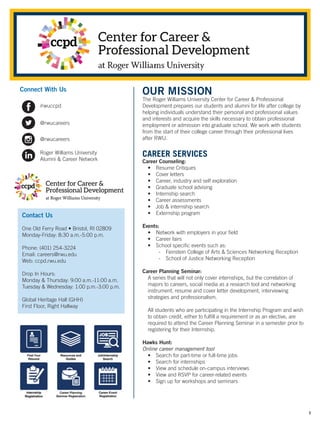
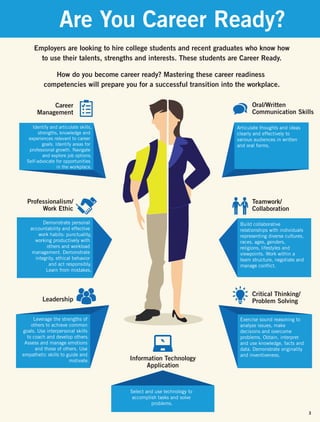
OUR MISSION
The Roger Williams University Center for Career & Professional
Development prepares our students and alumni for life after college by
helping individuals understand their personal and professional values
and interests and acquire the skills necessary to obtain professional
employment or admission into graduate school. We work with students
from the start of their college career through their professional lives
after RWU.
CAREER SERVICES
Career Counseling:
 • Resume Critiques
 • Cover letters
  • Career, industry and self exploration
  • Graduate school advising
 • Internship search
 • Career assessments
  • Job  internship search
 • Externship program
Events:
  • Network with employers in your field
 • Career fairs
  • School specific events such as:
    - Feinstein College of Arts  Sciences Networking Reception
    - School of Justice Networking Reception
Career Planning Seminar:
 A series that will not only cover internships, but the correlation of
majors to careers, social media as a research tool and networking
instrument, resume and cover letter development, interviewing
strategies and professionalism.
 All students who are participating in the Internship Program and wish
to obtain credit, either to fulfill a requirement or as an elective, are
required to attend the Career Planning Seminar in a semester prior to
registering for their Internship.
Hawks Hunt:
Online career management tool
  • Search for part-time or full-time jobs
  • Search for internships
  • View and schedule on-campus interviews
  • View and RSVP for career-related events
  • Sign up for workshops and seminars
Contact Us
One Old Ferry Road • Bristol, RI 02809
Monday-Friday: 8:30 a.m.-5:00 p.m.
Phone: (401) 254-3224
Email: careers@rwu.edu
Web: ccpd.rwu.edu
Drop In Hours:
Monday  Thursday: 9:00 a.m.-11:00 a.m.
Tuesday  Wednesday: 1:00 p.m.-3:00 p.m.
Global Heritage Hall (GHH)
First Floor, Right Hallway
Connect With Us
/rwuccpd
@rwucareers
@rwucareers
Roger Williams University
Alumni  Career Network
1
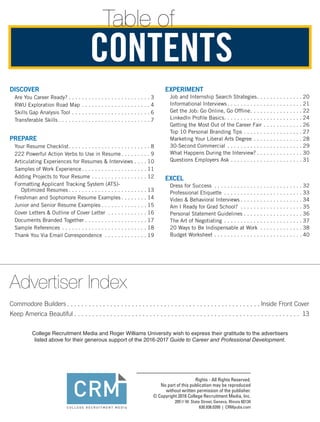
Table of
DISCOVER
Are You Career Ready?.  .  .  .  .  .  .  .  .  .  .  .  .  .  .  .  .  .  .  .  .  .  .  .  . 3
RWU Exploration Road Map.  .  .  .  .  .  .  .  .  .  .  .  .  .  .  .  .  .  .  .  . 4
Skills Gap Analysis Tool.  .  .  .  .  .  .  .  .  .  .  .  .  .  .  .  .  .  .  .  .  .  .  . 6
Transferable Skills.  .  .  .  .  .  .  .  .  .  .  .  .  .  .  .  .  .  .  .  .  .  .  .  .  .  .  . 7
PREPARE
Your Resume Checklist. .  .  .  .  .  .  .  .  .  .  .  .  .  .  .  .  .  .  .  .  .  .  .  . 8
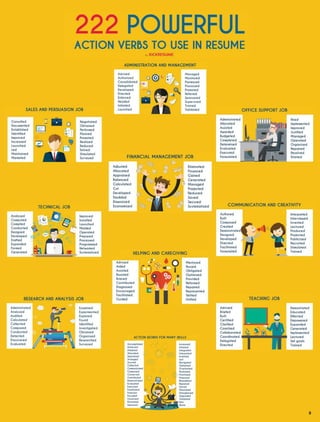
222 Powerful Action Verbs to Use in Resume. .  .  .  .  .  .  .  . 9
Articulating Experiences for Resumes  Interviews.  .  .  . 10
Samples of Work Experience. .  .  .  .  .  .  .  .  .  .  .  .  .  .  .  .  .  .  . 11
Adding Projects to Your Resume.  .  .  .  .  .  .  .  .  .  .  .  .  .  .  .  . 12
Formatting Applicant Tracking System (ATS)-
Optimized Resumes.  .  .  .  .  .  .  .  .  .  .  .  .  .  .  .  .  .  .  .  .  .  .  . 13
Freshman and Sophomore Resume Examples.  .  .  .  .  .  .  . 14
Junior and Senior Resume Examples.  .  .  .  .  .  .  .  .  .  .  .  .  . 15
Cover Letters  Outline of Cover Letter .  .  .  .  .  .  .  .  .  .  .  . 16
Documents Branded Together.  .  .  .  .  .  .  .  .  .  .  .  .  .  .  .  .  .  . 17
Sample References.  .  .  .  .  .  .  .  .  .  .  .  .  .  .  .  .  .  .  .  .  .  .  .  .  . 18
Thank You Via Email Correspondence .  .  .  .  .  .  .  .  .  .  .  .  . 19
EXPERIMENT
Job and Internship Search Strategies. .  .  .  .  .  .  .  .  .  .  .  .  . 20
Informational Interviews.  .  .  .  .  .  .  .  .  .  .  .  .  .  .  .  .  .  .  .  .  .  . 21
Get the Job: Go Online, Go Offline. .  .  .  .  .  .  .  .  .  .  .  .  .  .  . 22
LinkedIn Profile Basics. .  .  .  .  .  .  .  .  .  .  .  .  .  .  .  .  .  .  .  .  .  .  . 24
Getting the Most Out of the Career Fair.  .  .  .  .  .  .  .  .  .  .  . 26
Top 10 Personal Branding Tips.  .  .  .  .  .  .  .  .  .  .  .  .  .  .  .  .  . 27
Marketing Your Liberal Arts Degree.  .  .  .  .  .  .  .  .  .  .  .  .  .  . 28
30-Second Commercial.  .  .  .  .  .  .  .  .  .  .  .  .  .  .  .  .  .  .  .  .  .  . 29
What Happens During the Interview?.  .  .  .  .  .  .  .  .  .  .  .  .  . 30
Questions Employers Ask.  .  .  .  .  .  .  .  .  .  .  .  .  .  .  .  .  .  .  .  .  . 31
EXCEL
Dress for Success .  .  .  .  .  .  .  .  .  .  .  .  .  .  .  .  .  .  .  .  .  .  .  .  .  .  . 32
Professional Etiquette .  .  .  .  .  .  .  .  .  .  .  .  .  .  .  .  .  .  .  .  .  .  .  . 33
Video  Behavioral Interviews.  .  .  .  .  .  .  .  .  .  .  .  .  .  .  .  .  .  . 34
Am I Ready for Grad School? .  .  .  .  .  .  .  .  .  .  .  .  .  .  .  .  .  .  . 35
Personal Statement Guidelines.  .  .  .  .  .  .  .  .  .  .  .  .  .  .  .  .  . 36
The Art of Negotiating.  .  .  .  .  .  .  .  .  .  .  .  .  .  .  .  .  .  .  .  .  .  .  . 37
20 Ways to Be Indispensable at Work .  .  .  .  .  .  .  .  .  .  .  .  . 38
Budget Worksheet.  .  .  .  .  .  .  .  .  .  .  .  .  .  .  .  .  .  .  .  .  .  .  .  .  .  . 40
CONTENTS
Advertiser Index
Commodore Builders. . . . . . . . . . . . . . . . . . . . . . . . . . . . . . . . . . . . . . . . . . . . . . . . . . . . . .  Inside Front Cover
Keep America Beautiful. . . . . . . . . . . . . . . . . . . . . . . . . . . . . . . . . . . . . . . . . . . . . . . . . . . . . . . . . . . . . . . . 13
College Recruitment Media and Roger Williams University wish to express their gratitude to the advertisers
listed above for their generous support of the 2016-2017 Guide to Career and Professional Development.
3
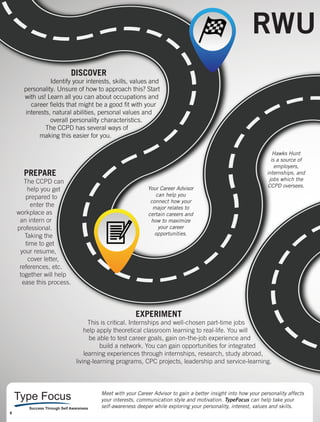
RWU
DISCOVER
Identify your interests, skills, values and
personality. Unsure of how to approach this? Start
with us! Learn all you can about occupations and
career fields that might be a good fit with your
interests, natural abilities, personal values and
overall personality characteristics.
The CCPD has several ways of
making this easier for you.
Your Career Advisor
can help you
connect how your
major relates to
certain careers and
how to maximize
your career
opportunities.
Hawks Hunt
is a source of
employers,
internships, and
jobs which the
CCPD oversees.
PREPARE
The CCPD can
help you get
prepared to
enter the
workplace as
an intern or
professional.
Taking the
time to get
your resume,
cover letter,
references, etc.
together will help
ease this process.
EXPERIMENT
This is critical. Internships and well-chosen part-time jobs
help apply theoretical classroom learning to real-life. You will
be able to test career goals, gain on-the-job experience and
build a network. You can gain opportunities for integrated
learning experiences through internships, research, study abroad,
living-learning programs, CPC projects, leadership and service-learning.
Meet with your Career Advisor to gain a better insight into how your personality affects
your interests, communication style and motivation. TypeFocus can help take your
self-awareness deeper while exploring your personality, interest, values and skills.
Type Focus
Success Through Self Awareness
4
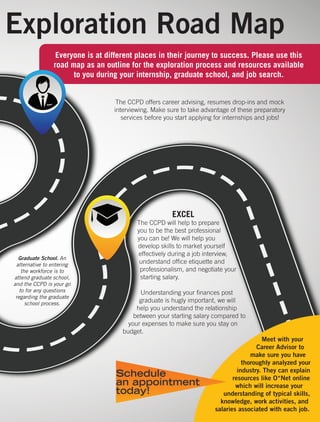
Exploration Road Map
Everyone is at different places in their journey to success. Please use this
road map as an outline for the exploration process and resources available
to you during your internship, graduate school, and job search.
The CCPD offers career advising, resumes drop-ins and mock
interviewing. Make sure to take advantage of these preparatory
services before you start applying for internships and jobs!
Meet with your
Career Advisor to
make sure you have
thoroughly analyzed your
industry. They can explain
resources like O*Net online
which will increase your
understanding of typical skills,
knowledge, work activities, and
salaries associated with each job.
Schedule
an appointment
today!
EXCEL
The CCPD will help to prepare
you to be the best professional
you can be! We will help you
develop skills to market yourself
effectively during a job interview,
understand office etiquette and
professionalism, and negotiate your
starting salary.
Understanding your finances post
graduate is hugly important, we will
help you understand the relationship
between your starting salary compared to
your expenses to make sure you stay on
budget.
Graduate School. An
alternative to entering
the workforce is to
attend graduate school,
and the CCPD is your go
to for any questions
regarding the graduate
school process.
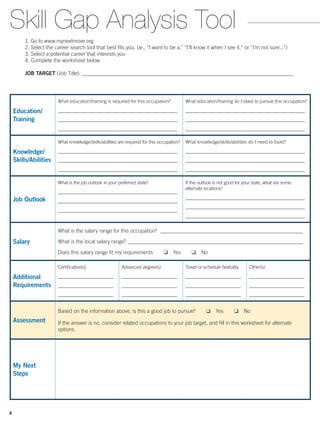
Skill Gap Analysis Tool
1. Go to www.mynextmove.org
2. Select the career search tool that best fits you. (ie., “I want to be a,” “I’ll know it when I see it,” or “I’m not sure...”)
3. Select a potential career that interests you
4. Complete the worksheet below
JOB TARGET (Job Title): _____________________________________________________________________________________________
Education/
Training
What education/training is required for this occupation?
____________________________________________________
____________________________________________________
____________________________________________________
What education/training do I need to pursue this occupation?
____________________________________________________
____________________________________________________
____________________________________________________
Knowledge/
Skills/Abilities
What knowledge/skills/abilities are required for this occupation?
____________________________________________________
____________________________________________________
____________________________________________________
What knowledge/skills/abilities do I need to build?
____________________________________________________
____________________________________________________
____________________________________________________
Job Outlook
What is the job outlook in your preferred state?
____________________________________________________
____________________________________________________
____________________________________________________
If the outlook is not good for your state, what are some
alternate locations?
____________________________________________________
____________________________________________________
____________________________________________________
Salary
What is the salary range for this occupation? ______________________________________________________
What is the local salary range? __________________________________________________________________
Does this salary range fit my requirements   ❑ Yes  ❑ No
Additional
Requirements
Certification(s)
________________________
________________________
________________________
Advanced degree(s)
________________________
________________________
________________________
Travel or schedule flexibility
________________________
________________________
________________________
Other(s)
________________________
________________________
________________________
Assessment
Based on the information above, is this a good job to pursue?   ❑ Yes  ❑ No
If the answer is no, consider related occupations to your job target, and fill in this worksheet for alternate
options.
My Next
Steps
6
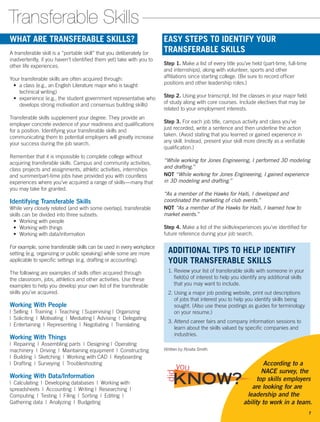
EASY STEPS TO IDENTIFY YOUR
TRANSFERABLE SKILLS
Step 1. Make a list of every title you’ve held (part-time, full-time
and internships), along with volunteer, sports and other
affiliations since starting college. (Be sure to record officer
positions and other leadership roles.)
Step 2. Using your transcript, list the classes in your major field
of study along with core courses. Include ­electives that may be
related to your employment interests.
Step 3. For each job title, campus activity and class you’ve
just recorded, write a sentence and then underline the action
taken. (Avoid stating that you learned or gained experience in
any skill. Instead, present your skill more directly as a verifiable
qualification.)
“While working for Jones Engineering, I performed 3D ­modeling
and drafting.”
NOT “While working for Jones Engineering, I gained experience
in 3D modeling and drafting.”
“As a member of the Hawks for Haiti, I developed and
coordinated the marketing of club events.”
NOT “As a member of the Hawks for Haiti, I learned how to
market events.”
Step 4. Make a list of the skills/experiences you’ve identified for
future reference during your job search.
Transferable Skills
WHAT ARE TRANSFERABLE SKILLS?
A transferable skill is a “portable skill” that you deliberately (or
inadvertently, if you haven’t identified them yet) take with you to
other life experiences.
Your transferable skills are often acquired through:
•	 a class (e.g., an English Literature major who is taught
technical writing)
•	 experience (e.g., the student government representative who
develops strong motivation and consensus building skills)
Transferable skills supplement your degree. They provide an
employer concrete evidence of your readiness and qualifications
for a position. Identifying your transferable skills and
communicating them to potential employers will greatly increase
your success during the job search.
Remember that it is impossible to complete college without
acquiring transferable skills. Campus and community activities,
class projects and assignments, athletic activities, internships
and summer/part-time jobs have provided you with countless
experiences where you’ve acquired a range of skills—many that
you may take for granted.
Identifying Transferable Skills
While very closely related (and with some overlap), transferable
skills can be divided into three subsets:
•	 Working with people 
•	 Working with things
•	 Working with data/information
For example, some transferable skills can be used in every workplace
setting (e.g. organizing or public speaking) while some are more
applicable to specific settings (e.g. drafting or accounting).
The following are examples of skills often acquired through
the classroom, jobs, athletics and other activities. Use these
examples to help you develop your own list of the transferable
skills you’ve acquired.
Working With People
| Selling | Training | Teaching | Supervising | Organizing 
| Soliciting | Motivating | Mediating | Advising | Delegating 
| Entertaining | Representing | Negotiating | Translating
Working With Things
| Repairing | Assembling parts | Designing | Operating
machinery | Driving | Maintaining equipment | Constructing 
| Building | Sketching | Working with CAD | Keyboarding
| Drafting | Surveying | Troubleshooting
Working With Data/Information
| Calculating | Developing databases | Working with
spreadsheets | Accounting | Writing | Researching | 
Computing | Testing | Filing | Sorting | Editing | 
Gathering data | Analyzing | Budgeting
Written by Rosita Smith.
ADDITIONAL TIPS TO HELP IDENTIFY
YOUR TRANSFERABLE SKILLS
1. Review your list of transferable skills with someone in your
field(s) of interest to help you identify any ­additional skills
that you may want to include.
2. Using a major job posting website, print out descriptions
of jobs that interest you to help you identify skills being
sought. (Also use these postings as guides for terminology
on your resume.)
3. Attend career fairs and company information sessions to
learn about the skills valued by specific companies and
industries.
According to a
NACE survey, the
top skills employers
are looking for are
leadership and the
ability to work in a team.
KNOW?
did
you
7
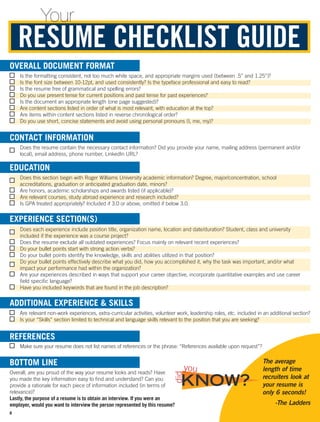
  Is the formatting consistent, not too much white space, and appropriate margins used (between .5” and 1.25”)?
  Is the font size between 10-12pt, and used consistently? Is the typeface professional and easy to read?
  Is the resume free of grammatical and spelling errors?
  Do you use present tense for current positions and past tense for past experiences?
  Is the document an appropriate length (one page suggested)?
  Are content sections listed in order of what is most relevant, with education at the top?
  Are items within content sections listed in reverse chronological order?
  Do you use short, concise statements and avoid using personal pronouns (I, me, my)?
RESUME CHECKLIST GUIDE
Your
OVERALL DOCUMENT FORMAT
EDUCATION
EXPERIENCE SECTION(S)
ADDITIONAL EXPERIENCE  SKILLS
BOTTOM LINE
 Does the resume contain the necessary contact information? Did you provide your name, mailing address (permanent and/or
local), email address, phone number, LinkedIn URL?
 Does this section begin with Roger Williams University academic information? Degree, major/concentration, school
accreditations, graduation or anticipated graduation date, minors?
  Are honors, academic scholarships and awards listed (if applicable)?
  Are relevant courses, study abroad experience and research included?
  Is GPA treated appropriately? Included if 3.0 or above, omitted if below 3.0.
 Does each experience include position title, organization name, location and date/duration? Student, class and university
included if the experience was a course project?
  Does the resume exclude all outdated experiences? Focus mainly on relevant recent experiences?
  Do your bullet points start with strong action verbs?
 Do your bullet points identify the knowledge, skills and abilities utilized in that position?
 Do your bullet points effectively describe what you did, how you accomplished it, why the task was important, and/or what
impact your performance had within the organization?
 Are your experiences described in ways that support your career objective, incorporate quantitative examples and use career
field specific language?
 Have you included keywords that are found in the job description?
CONTACT INFORMATION
 Are relevant non-work experiences, extra-curricular activities, volunteer work, leadership roles, etc. included in an additional section?
  Is your “Skills” section limited to technical and language skills relevant to the position that you are seeking?
 Make sure your resume does not list names of references or the phrase: “References available upon request”?
Overall, are you proud of the way your resume looks and reads? Have
you made the key information easy to find and understand? Can you
provide a rationale for each piece of information included (in terms of
relevance)?
Lastly, the purpose of a resume is to obtain an interview. If you were an
employer, would you want to interview the person represented by this resume?
REFERENCES
The average
length of time
recruiters look at
your resume is
only 6 seconds!
-The Ladders
KNOW?
did
you
8
9
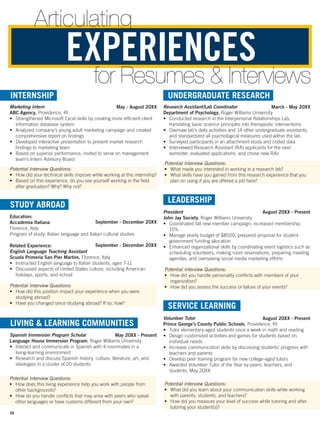
Articulating
for Resumes  Interviews
INTERNSHIP
Marketing Intern
ABC Agency, Providence, RI
•	 Strengthened Microsoft Excel skills by creating more efficient client
information database system
•	 Analyzed company’s young adult marketing campaign and created
comprehensive report on findings
•	 Developed interactive presentation to present market research
findings to marketing team
•	 Based on superior performance, invited to serve on management
team’s Intern Advisory Board
UNDERGRADUATE RESEARCH
May - August 20XX Research Assistant/Lab Coordinator
Department of Psychology, Roger Williams University
•	 Conducted research in the Interpersonal Relationships Lab,
translating basic science principles into therapeutic interventions
•	 Oversaw lab’s daily activities and 14 other undergraduate assistants,
and standardized all psychological measures used within the lab
•	 Surveyed participants in an attachment study and coded data
•	 Interviewed Research Assistant (RA) applicants for the next
semester, evaluated applications, and chose new RAs
March - May 20XX
STUDY ABROAD
Education:
Accademia Italiana
Florence, Italy
Program of study: Italian language and Italian cultural studies
Related Experience:
English Language Teaching Assistant
Scuola Primeria San Pier Martire, Florence, Italy
•	 Instructed English language to Italian students, ages 7-11
•	 Discussed aspects of United States culture, including American
holidays, sports, and school
September - December 20XX
LEADERSHIP
President
John Jay Society, Roger Williams University
•	 Coordinated fall new member campaign; increased membership
15%
•	 Manage yearly budget of $8500; prepared proposal for student
government funding allocation
•	 Enhanced organizational skills by coordinating event logistics such as
scheduling volunteers, making room reservations, preparing meeting
agendas, and overseeing social media marketing efforts
August 20XX - Present
September - December 20XX
LIVING  LEARNING COMMUNITIES
Spanish Immersion Program Scholar
Language House Immersion Program, Roger Williams University
•	 Interact and communicate in Spanish with 4 roommates in a
living-learning environment
•	 Research and discuss Spanish history, culture, literature, art, and
ideologies in a cluster of 20 students
May 20XX - Present
SERVICE LEARNING
Volunteer Tutor
Prince George’s County Public Schools, Providence, RI
•	 Tutor elementary-aged students once a week in math and reading
•	 Design customized activities and games for students based on
individual needs
•	 Increase communication skills by discussing students’ progress with
teachers and parents
•	 Develop peer training program for new college-aged tutors
•	 Awarded Volunteer Tutor of the Year by peers, teachers, and
students, May 20XX
August 20XX - Present
Potential Interview Questions:
•	 How did your technical skills improve while working at this internship?
•	 Based on this experience, do you see yourself working in the field
after graduation? Why? Why not?
Potential Interview Questions:
•	 What made you interested in working in a research lab?
•	 What skills have you gained from this research experience that you
plan on using if you are offered a job here?
Potential Interview Questions:
•	 How did this position impact your experience when you were
studying abroad?
•	 Have you changed since studying abroad? If so, how?
Potential Interview Questions:
•	 How did you handle personality conflicts with members of your
organization?
•	 How did you assess the success or failure of your events?
Potential Interview Questions:
•	 How does this living experience help you work with people from
other backgrounds?
•	 How do you handle conflicts that may arise with peers who speak
other languages or have customs different from your own?
Potential Interview Questions:
•	 What did you learn about your communication skills while working
with parents, students, and teachers?
•	 How did you measure your level of success while tutoring and after
tutoring your student(s)?
EXPERIENCES
10
ADMISSIONS REPRESENTATIVE
•	 Promote University to prospective students and their
families; answer any and all questions
•	 Provide administrative support to 10 counselors by assisting with
mailings, checking office voice mail, and responding to inquires
•	 Represent University in a professional manner at Open
Houses and Accepted Student days
•	 Honed public speaking skills leading campus tours to
upwards of 75 person groups
SALES ASSOCIATE/VISUALS COORDINATOR
•	 Aided customers in finding proper sizes, assembling outfits
and finalizing purchases
•	 Represented the brand through personal presentation and
positive interactions
•	 Designed and constructed visual layouts including bust
forms, window displays, floor sets and lighting
SERVER
•	 Implemented and maintained a system of cost effective
operations to keep expenses at a minimum
•	 Provided quality customer service in a fast-paced
environment (at least five tables per hour)
RESIDENT ASSISTANT
•	 Planned community development programs for 150
residents
•	 Referred residents to campus services and programs
•	 Gained crisis management and conflict mediation skills
•	 Served as liaison between University residents and Resident
Life administrators
•	 Logged judiciary, maintenance and program evaluation
paperwork
STUDENT OFFICE ASSISTANT
•	 Provided administrative and programmatic support to office
events
•	 Designed print and electronic promotional materials for
direct distribution and Twitter posts
•	 Coordinated AV and room set up for workshops and panels
•	 Greeted program attendees and processed event
registrations
•	 Responded to phone and email inquired regarding events
and services
•	 Performed data management including evaluation
compilation and report generation
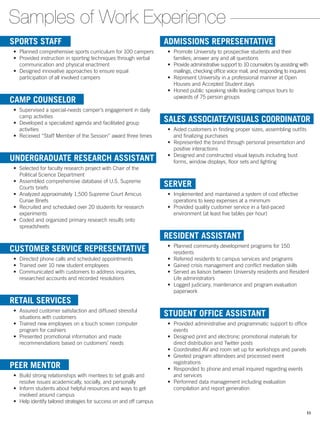
Samples of Work Experience
SPORTS STAFF
•	 Planned comprehensive sports curriculum for 100 campers
•	 Provided instruction in sporting techniques through verbal
communication and physical enactment
•	 Designed innovative approaches to ensure equal
participation of all involved campers
CAMP COUNSELOR
•	 Supervised a special-needs camper’s engagement in daily
camp activities
•	 Developed a specialized agenda and facilitated group
activities
•	 Received “Staff Member of the Session” award three times
UNDERGRADUATE RESEARCH ASSISTANT
•	 Selected for faculty research project with Chair of the
Political Science Department
•	 Assembled comprehensive database of U.S. Supreme
Courts briefs
•	 Analyzed approximately 1,500 Supreme Court Amicus
Curiae Briefs
•	 Recruited and scheduled over 20 students for research
experiments
•	 Coded and organized primary research results onto
spreadsheets
CUSTOMER SERVICE REPRESENTATIVE
•	 Directed phone calls and scheduled appointments
•	 Trained over 10 new student employees
•	 Communicated with customers to address inquiries,
researched accounts and recorded resolutions
RETAIL SERVICES
•	 Assured customer satisfaction and diffused stressful
situations with customers
•	 Trained new employees on a touch screen computer
program for cashiers
•	 Presented promotional information and made
recommendations based on customers’ needs
PEER MENTOR
•	 Build strong relationships with mentees to set goals and
resolve issues academically, socially, and personally
•	 Inform students about helpful resources and ways to get
involved around campus
•	 Help identify tailored strategies for success on and off campus
11
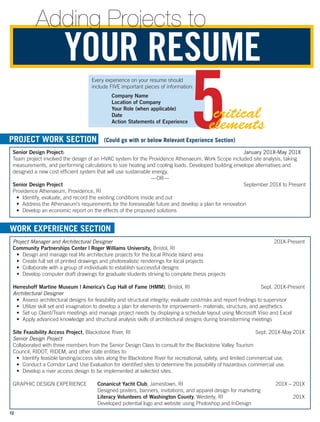
Senior Design Project:	 January 201X-May 201X
Team project involved the design of an HVAC system for the Providence Athenaeum. Work Scope included site analysis, taking
measurements, and performing calculations to size heating and cooling loads. Developed building envelope alternatives and
designed a new cost efficient system that will use sustainable energy.
—OR—
Senior Design Project	 September 201X to Present
Providence Athenaeum, Providence, RI
•	 Identify, evaluate, and record the existing conditions inside and out
•	 Address the Athenaeum’s requirements for the foreseeable future and develop a plan for renovation
•	 Develop an economic report on the effects of the proposed solutions
Project Manager and Architectural Designer	201X-Present
Community Partnerships Center | Roger Williams University, Bristol, RI
•	 Design and manage real life architecture projects for the local Rhode Island area
•	 Create full set of printed drawings and photorealistic renderings for local projects
•	 Collaborate with a group of individuals to establish successful designs
•	 Develop computer draft drawings for graduate students striving to complete thesis projects
Herreshoff Martine Museum | America’s Cup Hall of Fame (HMM), Bristol, RI	 Sept. 201X-Present
Architectural Designer
•	 Assess architectural designs for feasibility and structural integrity; evaluate cost/risks and report findings to supervisor
•	 Utilize skill set and imagination to develop a plan for elements for improvement– materials, structure, and aesthetics
•	 Set up Client/Team meetings and manage project needs by displaying a schedule layout using Microsoft Visio and Excel
•	 Apply advanced knowledge and structural analysis skills of architectural designs during brainstorming meetings
Site Feasibility Access Project, Blackstone River, RI	 Sept. 201X-May 201X
Senior Design Project
Collaborated with three members from the Senior Design Class to consult for the Blackstone Valley Tourism
Council, RIDOT, RIDEM, and other state entities to:
•	 Identify feasible landing/access sites along the Blackstone River for recreational, safety, and limited commercial use.
•	 Conduct a Corridor Land Use Evaluation for identified sites to determine the possibility of hazardous commercial use.
•	 Develop a river access design to be implemented at selected sites.
GRAPHIC DESIGN EXPERIENCE	 Conanicut Yacht Club, Jamestown, RI	 201X – 201X
	 Designed posters, banners, invitations, and apparel design for marketing
	 Literacy Volunteers of Washington County, Westerly, RI	 201X
	 Developed potential logo and website using Photoshop and InDesign
PROJECT WORK SECTION (Could go with or below Relevant Experience Section)
WORK EXPERIENCE SECTION
Adding Projects to
YOUR RESUME
Every experience on your resume should
include FIVE important pieces of information:
Company Name
Location of Company
Your Role (when applicable)
Date
Action Statements of Experience
5critical
elements
12
13
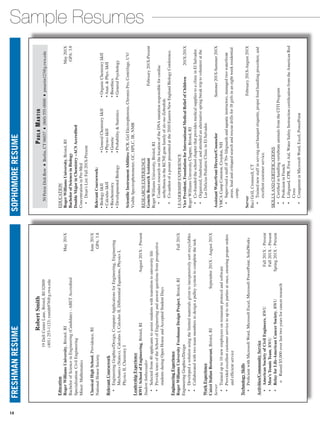
Sample ResumesFRESHMANRESUMESOPHOMORERESUME
PaulaMartin
50PetrieDishRow ♦ Berlin,CT06037 ♦ (860)555-0000 ♦ pmartin123@g.rwu.edu
EDUCATION
RogerWilliamsUniversity,Bristol,RI	May201X
BachelorofScienceinBiology	GPA:3.8
DoubleMajorinChemistry–ACSAccredited
ConcentrationinPre-Med
 • Dean’sList:Fall201X-Present
RelevantCoursework:
•BiologyIII
•CalculusIII
•Biochemistry
•DevelopmentalBiology
•GeneralChemistryIII
•PhysicsIII
•Genetic
•ProbabilityStatistics
•OrganicChemistryIII
•Anat.Phys.III
•Bioethics
•GeneralPsychology
ScientificInstrumentAbilities:PCR,GelElectrophoresis,ChromisPro,Centrifuge,UV/
VisibleSpectrophotometer,GC,HPLC,IR,NMR
RESEARCHEXPERIENCE
GeneticResearchAssistant	February201X-Present
RogerWilliamsUniversity,Bristol,RI
 • ConductresearchonthelocationoftheDNAmutationresponsibleforcardiac
arrhythmiaintheKCNEgenefamilyofslo-moZebrafish.
 • Co-authorofaposterpresentedatthe2010EasternNewEnglandBiologyConference.
LEADERSHIPEXPERIENCE
VicePresident,FoundationforInternationalMedicalReliefofChildren	201X-201X
RogerWilliamsUniversityChapter,Bristol,RI
 • Co-foundedtheschoolchapterthatprovidesmedicalsuppliestoaclinicinElSalvador.
 • Organized,fundraised,andattendedanalternativespringbreaktriptovolunteeratthe
LasDeliciasPediatricClinicinElSalvador.
AssistantWaterfrontDirector/Counselor	Summer201X-Summer201X
YMCACampConiston,Croydon,NH
 • Supervisedastaffof70+lifeguardsandaquaticinstructors,managedtwowaterfront
areas,leadandcritiquedsearchandrescuedrillsfor18girlsinaneightweekresidential
camp.
Server	February201X-August201X
BaciGrill,Cromwell,CT
 • Trainednewstaffinservingandbanquetetiquette,properfoodhandlingprocedure,and
excellentcustomerservice.
SKILLSANDCERTIFICATIONS
 • CertifiedinhandlingvertebrateanimalsfromtheCITIProgram
 • ProficientinFrench
 • Lifeguard,CPR,FirstAid,WaterSafetyInstructioncertificationfromtheAmericanRed
Cross
 • CompetentinMicrosoftWord,Excel,PowerPoint
RobertSmith
19DellCenterLane,Bristol,RI02809
(401)253-1123;rsmith976@g.rwu.edu
Education
RogerWilliamsUniversity,Bristol,RI	May201X
BachelorofScienceinEngineering(Candidate)-ABETAccredited
Specialization:CivilEngineering
Minor:Mathematics
ClassicalHighSchool,Providence,RI	June201X
NationalHonorSociety	GPA:3.8
RelevantCoursework
 • EngineeringGraphics/Design,ComputerApplicationsforEngineering,Engineering
Mechanics(Statics),CalculusI,CalculusII,DifferentialEquations,PhysicsI,
PhysicsII,ChemistryI
LeadershipExperience
RWUSchoolofEngineering,Bristol,RI	August201X-Present
StudentAmbassador
 • Selectedfrom40applicantstoassiststudentswithtransitiontouniversitylife
 • ProvidetoursoftheSchoolofEngineeringandanswerquestionsfromprospective
studentsduringOpenHouseandAcceptedStudentDays
EngineeringExperience
RogerWilliamsUniversityFreshmanDesignProject,Bristol,RI	Fall201X
EngineeringGraphics/Design
 • Developedasolutionusingthelimitedmaterialsgiventoinexpensivelysortrecyclables
 • Collaboratedwithtwoteammemberstodesignapulleysystemtocompletethetask
WorkExperience
CaizziItalianRestaurant,Bristol,RI	September201X-August201X
Server
 • Trainedupto10newemployeesonrestaurantprotocolandsoftware
 • Providedexcellentcustomerservicetouptosixpartiesatonce,ensuringproperorders
andefficientservice
TechnologySkills
 • ProficientwithMicrosoftWord,MicrosoftExcel,MicrosoftPowerPoint;SolidWorks
Activities/CommunityService
 • AmericanSocietyofCivilEngineers,RWU	Fall201X-Present
 • Men’sTennisTeam,RWU	Fall201X-Present
 • RelayforLife-AmericanCancerSociety,RWU	Spring201X-Present
   o Raised$5,000overlasttwoyearsforcancerresearch
14
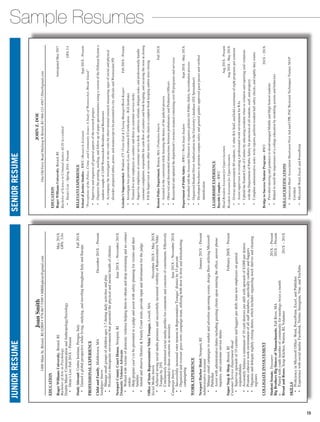
Sample ResumesJUNIORRESUMESENIORRESUME
JOHNZ.DOE
OneOldFerryRoadMailstop#,Bristol,RI|866-123-4567|JDoe@gmail.com
EDUCATION
RogerWilliamsUniversity,Bristol,RI	AnticipatedMay2017
BachelorofScienceinCriminalJustice-ACJSAccredited
 • Dean’sList–Spring2014-Present	GPA3.4
RELEVANTEXPERIENCE
SchoolofJusticeStudies–RWU|ResearchAssistant	Sept201X-Present
“PerceptionsofthePolice,Crime,andCommunityIssues:AStudyofWoonsocket,RhodeIsland”
 • Superviseandorganizeallgeneralaspectsoftheresearchproject
 • Organizetheprinting,mailing,andfollow-upofpaperquestionnairesusingaversionoftheDillmanSystema
randomsampleof2,000WoonsocketResidentsandBusinesses
 • Accompanytheinvestigatoronsitevisitsforobservationalresearchmeasuringsignsofsocialandphysical
disorder;preparedtables,poster,andmanuscripttobepresentedtocityofficialsandWoonsocketPD
Geissler’sSupermarket,Windsor,CT|FrontEndClosingManager/BookKeeper	Feb201X-Present
 • Investigatelossprevention(LossPreventionIICertification–IGAInstitute)
 • Trainedfivenewemployeesascashiersandthreeascustomerserviceclerks
 • Superviseemployeesatcustomerservicedesk–authorizerefunds,delegatetasks,andprofessionallyhandle
customercomplaints;responsibleforcash-flowofcashiersandbookkeeping,andsecuringthestoreatclosing
 • Fill-InSupervisoratvariousotherstoresinthechaintocompletebookkeepingand/orstoreclosing
BostonPoliceDepartment,Boston,MA|ProbationIntern	Fall201X
 • Assistedinthecourtroomwhilelearningthebasicsofthejudicialprocess
 • ObservedanddocumentedinteractionsbetweenprobationersandProbationOfficers
 • Researchedandupdatedthedepartment’sresourcemanualcontainingover50programsandservices
DepartmentofPublicSafety–RWU|WorkStudyStudent	Sept201X-May201X
 • ConsultedwiththeAssociateDirectortoorganizepoliciesforPublicSafetyAccreditationprocess
 • OrganizedStudentDriverAuthorizationintheUniversity’sdatabase(IIXSpreadsheet)
 • Developedbrochurestopromotecampussafetyandgeneralguides;approvedguestpassesandverified
identification
LEADERSHIPEXPERIENCE
BaysideComplex–RWU
HeadResidentAssistantforUpperclassmen	Aug201X-Present
ResidentAssistantforUpperclassmen	Aug201X-May201X
 • Overseeapproximately80residents,11otherRAStaff,andholdaminimumofeightprogramspersemester
 • AssistsupervisorincreatingaprofessionalworkenvironmentforRAs
 • UpholdtheStudentCodeofConductbyeducatingresidentswheninviolationandreportingsaidviolations
withtheDepartmentofPublicSafetyforprotectionofallstudents,staff,andproperty
 • Completeadministrativetasks:writereports,performresidenthallsafetychecks,andnightlydutyroams
BridgetoSuccessMentorProgram–RWU	201X–201X
 • ProvidedtutoringandguidancetodisadvantagedMiddleandHighSchoolstudents
 • Helpedtoinstilltheimportanceofacollegeeducationbymodelingactionsandbehaviors
SKILLS/CERTIFICATIONS
 • AmericanHeartAssociationHeartsaverFirstAidandCPR;PACRestraintTechniquesTrainer;MAP
Certified
 • MicrosoftWord,Excel,andPowerPoint
JoanSmith
1400MainSt,Bristol,RI02809•978-867-5309•MBHopkins@gmail.com
EDUCATION
RogerWilliamsUniversity,Bristol,RI	May201X
BachelorofArtsinPsychology	GPA:3.0+
DoubleMinor:CommunicationandAnthropology/Sociology
 • Dean’sList:Fall201X–Present
StudyAbroad:UmbraInstitute,Perugia,Italy	Fall201X
 • Gainedaglobalperspectivewhileliving,studying,andtravelingthroughoutItalyandEurope.
PROFESSIONALEXPERIENCE
ChildandFamily,Middletown,MA	December201X–Present
SandpiperIntern
 • Managesmallgroupsofchildrenages3-7duringdailyactivitiesandplay
 • Providedatherapeuticenvironmentthatpromotedthephysicalandmentalhealthofchildren
NewportCountyCourtHouse,Newport,RI	June201X–November201X
DomesticViolenceAdvocate
 • Workedwithvictimsofdomesticviolencehelpingthemtoobtainanddroprestrainingandnocontact
orders
 • Helppreparecase’stobepresentedtoajudgeandassistwithsafetyplanningforvictimsandtheir
families
 • AttendandobserveDistrictFamilyCourttrials;provideinputandinformationforthejudge
OfficeofStateRepresentativeNikkiTsongas,Lowell,MA
SocialMediaIntern	November201X–May201X
 • AchievedstrongsocialmediapresenceandsuccessfullyincreasedvisibilityofRepresentativeNikki
Tsongasby25%
 • Continuouslymonitoredsocialmediaprofilesforcommentsandconcernsofconstituents.Effectively
respondedtothoseconcernsasnecessary
CampaignIntern	June201X–November201X
 • SuccessfullyincreasedvoterturnoutinRepresentativeTsongas’districtby15percent
 • Organizedandoversawgrassrootscampaignteam,utilizingbothdoortodoorandtelemarketing
campaigning
WORKEXPERIENCE
NewportHarborHotel,Newport,RI	January201X–Present
AdministrativeAssistant
 • Manageemailcampaignstomarketandadvertiseupcomingevents,designfliersutilizingMicrosoft
Publisher
 • Assistwithadministrativedutiesincludinggreetingclientsuponenteringtheoffice,answerphone
inquiries,andcustomerserviceduties
SuperStopShop,Bristol,RI	February200X–Present
CustomerServiceDepartmentHead
 • Superviseupwardsof10cashiersandbaggerspershift;trainnewemployeesongeneral
responsibilities
 • Accuratelybalanceaminimumof10cashdrawerspershiftwithupwardsof$1000perdrawer
 • Promotecohesiveworkenvironmentofallstaffmembers,specificallycashiersandbaggers
 • Organizeanddelegatenightlyclosingduties,whichincludesorganizingstockshelvesandcleaning
registers
COLLIGIATEINVOLVEMENT
StudentSenate,Treasurer	201X–Present
BigBrothersBigSistersofMassachusetts,FallRiver,MA	201X–Present
o	Pairedwithyouthmemberofcommunityformeetingstwiceamonth
BreadandRoses,SoupKitchen,Warren,RI,Volunteer	201X–201X
SKILLS
 • ProficiencyinMicrosoftOffice:Word,PowerPoint,Excel,andPublisher
 • Experiencewithsocialmedia:Facebook,Twitter,Instagram,Vine,andYouTube
15
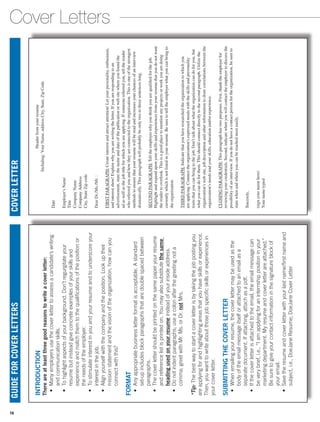
Cover LettersGUIDEFORCOVERLETTERSCOVERLETTER
Headerfromyourresume
Including:YourName,addressCity,State,ZipCode
Date
Employer’sName
Title
CompanyName
CompanyAddress
City,StateZipcode
DearDr./Ms./Mr.:
FIRSTPARAGRAPH:Createinterestandattractattention!Letyourpersonality,enthusiasm,
andinterestshow!Explainwhyyouarewritingtheletter.Ifyouarerespondingtoan
advertisement,statethenameanddateofthepublicationorwebsitewhereyoufoundthe
adaswellasthejobtitleforwhichyouareapplying.Ifsomeonereferredyou,tellthereader
whoreferredyouandhowtheyareconnectedtotheorganization.Thisisoneofthestrongest
methodstoensurethatyourresumewillbereadandincreasesyourchancesofaninterview
dramatically.Thisparagraphwillprobablybeonlytwotothreesentenceslong.
SECONDPARAGRAPH:Telltheemployerwhyyouthinkyouarequalifiedforthejob.
Highlightandexpanduponyourskillsandexperiencesfromyourresumethatyoudonotwant
thereadertooverlook.Thisisagoodplacetomentionanyprojectsorworkyouaredoing
currentlywhichisnotlistedinyourresume.Besuretotelltheemployerwhatyoucanbringto
theorganization.
THIRDPARAGRAPH:Indicatethatyouhaveresearchedtheorganizationtowhichyou
areapplying.Connecttheorganization’sexpressedneedswiththeskillsandpersonality
traitsthatyoucanbringtothejob.Don’ttalkaboutwhattheorganizationcandoforyou,but
whatyoucandoforthem.Thisshouldconnectdirectlytothesecondparagraph.Utilizethe
organization’swebsite,jobdescriptionandotherinformationtodrawcorrelationsbetweenthe
organization’sneedsandyourskills,educationand/orexperience.
CLOSINGPARAGRAPH:Thisparagraphhastwopurposes.First,thanktheemployerfor
reviewingyourcredentials.Second,indicatewhenyouwillcontacttheemployertodiscussthe
possibilityofaninterview.Ifyoudonothaveacontactpersonfortheorganization,besureto
statewhenandwhereyoucanbereachedmosteasily.
Sincerely,
(signyournamehere)
Yournametyped
INTRODUCTION
Thereareatleastthreegoodreasonstowriteacoverletter:
•	Manyemployersusethecoverlettertoassessacandidate’swriting
andcommunicationskills.
•	Tohighlightaspectsofyourbackground.Don’tregurgitateyour
resumebutinsteadgiveconcreteexamplesofyourskillsand
experienceandmatchthemtothequalificationsofthepositionor
theneedsoftheemployer.
•	Tostimulateinterestinyouandyourresumeandtounderscoreyour
interestinthejob.
•	Alignyourselfwiththecompanyandtheposition.Lookuptheir
missionstatementandthevisionoftheorganization,howcanyou
connectwiththis?
FORMAT
•	Anyappropriatebusinessletterformatisacceptable.Astandard
set-upincludesblockparagraphsthataredoublespacedbetween
paragraphs.
•	Thecoverlettershouldbeprintedonthesamepaperyourresume
andreferencelistisprintedon.Youmayalsosubstitutethesame
headingusedonyourresumeinsteadofyourinsideaddress.
•	Donotindentparagraphs;useacolonafterthegreetingnota
comma;greetwithMr.Ms.orDr.notMrs.
*Tip:Thebestwaytostartacoverletterisbytakingthejobpostingyou
areapplyingforandhighlightingareasthatyouhaveskillsorexperience.
Then,youwanttowriteaboutthosejobspecificskillsorexperiencesin
yourcoverletter.
SUBMITTINGTHECOVERLETTER
•	Whenemailingyourresume,thecoverlettermaybeusedasthe
bodyoftheemailmessageitselforattachedtoanemailasa
separatedocument.Ifattaching,attachasapdf.
•	Ifthecoverletterisattachedtotheemail,theemailmessagecan
beverybrief,i.e.,“Iamapplyingforaninternshippositioninyour
marketingdepartment.Myresumeandcoverletterareattached.”
Besuretogiveyourcontactinformationinthesignatureblockof
youremail.
•	Savetheresumeandcoverletterwithyourlastname/firstnameand
subject,i.e.,DoeJaneResume;DoeJaneCoverLetter
16
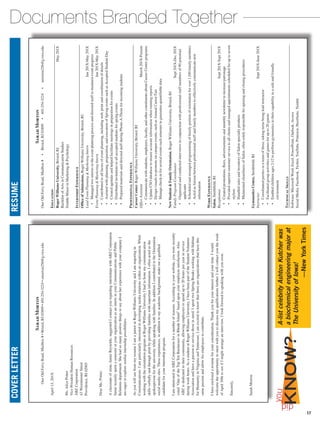
Documents Branded TogetherCOVERLETTERRESUME
SarahMorton
OneOldFerryRoad,Mailbox# • Bristol,RI02809 • 401-254-3224 • smorton256@g.rwu.edu
Education
RogerWilliamsUniversity,Bristol,RI	May201X
BachelorofArtsinCommunicationStudies
DoubleMinorinMarketingPsychology
InternshipExperience
OfficeofAdmissions,RogerWilliamsUniversity,Bristol,RI
LeadEventPlanningMarketingIntern	Jan201X-May201X
 • Managedtwointernsintheeventplanningprocessanddirectedstafftomaintaineventprogress
EventPlanningMarketingIntern	Jan201X-May201X
 • Contributedtoallfacetsofeventplanning,includingweb,printandcoordinationofdetails
 • Assistedwithplanning,preparation,andexecutionofSpringeventssuchasAcceptedStudentDay
 • Createdagendasandhelpedfacilitatemeetingsinpreparationforevents
 • Distributedinvitationstoallacceptedstudentsforspringevents
 • PreparedmaterialsanddirectedstaffduringPhone-A-Thonsforincomingstudents
ProfessionalExperience
CareerCenter,RogerWilliamsUniversity,Bristol,RI
OfficeAssistant	March201X-Present
 • Communicatewithstudents,employers,faculty,andotherconstituentsaboutCareerCenterprograms
 • UpdateCSOdatabasetoensureaccurateinformationwhenrunningreports
 • Designvisualstopromoteoncampusevents,suchasAnnualCareerFair
 • Managecheck-inforseveraleventseachsemestertoguaranteequantifiabledata
NewStudentFamilyOrientation,RogerWilliamsUniversity,Bristol,RI
FamilyProgramCoordinator	Sept201X-Dec201X
 • Organizedandconductedinterviewsinconjunctionwithprofessionalstaffmembersof90potential
applicants
 • Scheduledandarrangedprogrammingoffamilyportionoforientationforover1,100familymembers
 • Actedasliaisonbetweenprofessionalstaffandfamilymemberstoeffectivelycommunicatenew
information
WorkExperience
Salon,Smithfield,RI
Receptionist	Sept201X-Sept201X
 • Createdpromotions,fliers,advertisementsandmonthlynewslettertoincreasepatronage
 • Providedsuperiorcustomerservicetoallclientsandmanagedappointmentsscheduledforuptoseven
stylists
 • HandledsalesandinventoryofSalonspecialtyproducts
 • MaintainedcleanlinessofSalon,oftensolelyresponsibleforopeningandclosingprocedures
GymnasticsCenter,Smithfield,RI
Instructor	Sept201X-June201X
 • Coordinatedpartiesinateamofthree,takingturnsbeingleadinstructor
 • Facilitatedgroupactivitiesandgamesforupto20guests
 • Enabledchildrenages2-12toperformgymnasticstotheircapabilityinasafeandfriendly
environment
TechnicalSkills
Software:MicrosoftWord,Excel,PowerPoint,Outlook,Access
SocialMedia:Facebook,Twitter,YouTube,Pinterest,HootSuite,Tumblr
SarahMorton
OneOldFerryRoad,Mailbox#•Bristol,RI02809•401-254-3224•smorton256@g.rwu.edu
April13,201X
Ms.AlicePotter
VicePresidentHumanResources
ABZCorporation
43WestminsterStreet
Providence,RI02903
DearMs.Potter:
Aclassmateofmine,JamieReynolds,suggestedIcontactyouregardinginternshipswithABZCorporation.
JamierecentlyspentasemesteratyourorganizationasaninterninyourCommunicationsandPublic
Relationsdepartment.ShehadsomanypositivethingstosayaboutherexperiencewithyourcompanyI
ameagertoexploresimilarinternshippossibilities.
AsyouwillseefrommyresumeIamajunioratRogerWilliamsUniversityandIammajoringin
Communications.Iamparticularlyinterestedindevelopingmediarelationswithinanorganization.While
workingwiththeorientationprogramatRogerWilliamsUniversityIhadtohonemycommunication
skillsverballyandthroughprintbyprovidingfamilieswithimportantinformation.Ioftenactedasthe
spokespersonfortheuniversitywhilespeakingwithfamilies.InadditionIcontributedtotheOrientation
socialmediasites.Theseexperiences,inadditiontomyacademicbackground,makemeaqualified
candidateforyourinternshipprogram.
IaminterestedinABZCorporationforanumberofreasons.Accordingtoyourwebsite,youwererecently
voted“OneoftheTopTenBusinessesinRhodeIsland”baseduponyouremployeesatisfaction.Also,
ABZisdedicatedtotheircommunity,allowingemployeestospendupto20hoursperyearinservice
duringworkhours.AsastudentatRogerWilliamsUniversity,IhavebeenpartoftheStudentVolunteer
Associationandhaveapassiontoservicethoseinneed.IspenttwoSpringBreaksworkingwithHabitat
forHumanityinVirginiaandTennessee.Iamexcitedtoknowthatthereareorganizationsthathavethis
samepassionandallowforemployeestocontribute.
Ihaveenclosedaresumeforyourconsideration.Thankyouforyourinterestandyourtime.Iwould
welcometheopportunitytomeetwithyoutodiscussmyqualificationsfurther.Iwillcontactyoutheweek
ofApril30thtoseeifImightarrangeaninterview.Ilookforwardtospeakingwithyousoon.
Sincerely,
SarahMorton
A-listcelebrityAshtonKutcherwas
abiochemicalengineeringmajorat
TheUniversityofIowa!
—NewYorkTimes
KNOW?
did
you
17
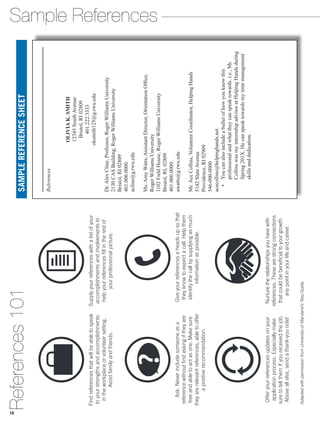
Sample ReferencesReferences101
Giveyourreferencesaheadsupsothat
theyknowtoexpectacall.Helpthem
identifythecallbysupplyingasmuch
informationaspossible.
Supplyyourreferenceswithalistofyour
accomplishmentsandinvolvementsto
helpyourreferencesfillintherestof
yourprofessionalpicture.
Offeryourreferencesupdatesonyour
applicationprocess.Especiallymake
suretotellthemifyoureceivedthejob.
Aboveallelse,sendathank-younote!
Ask.Neverincludesomeoneasa
referencewithoutfirstaskingiftheyare
freeandabletoactasone.Makesure
theyarerelevantreferences,abletooffer
apositiverecommendation.
?
Nurturetherelationshipsyouhavewith
references.Thesearestrongconnections
thatcouldbebeneficialtoyourgrowth
anypointinyourlifeandcareer.
Findreferencesthatwillbeabletospeak
toyourstrengthsandaccomplishments
intheworkplaceorvolunteersetting.
Avoidfamilyandfriends.
References
OLIVIAK.SMITH
12345SouthAvenue
Bristol,RI02809
401.222.3333
oksmith125@g.rwu.edu
Dr.AlexCline,Professor,RogerWilliamsUniversity
2130CASBuilding,RogerWilliamsUniversity
Bristol,RI02809
401.000.0000
acline@g.rwu.edu
Ms.AmyWatts,AssistantDirector,OrientationOffice,
RogerWilliamsUniversity
1102FieldHouse,RogerWilliamsUniversity
Bristol,RI,02809
401.000.0000
awatts@g.rwu.edu
Mr.AceCollins,VolunteerCoordinator,HelpingHands
5142SlateAvenue
Providence,RI02909
546-000-0000
acecollins@helpinghands.net
 • Youcanalsoincludeabulletofhowyouknowthis
professionalandwhattheycanspeaktowards.i.e.,Mr.
CollinswasmyinternshipadvisoratHelpingHandsduring
Spring201X.Hecanspeaktowardsmytimemanagement
skillsanddedication.
SAMPLEREFERENCESHEET
AdaptedwithpermissionfromUniversityofMaryland’sTerpGuide.
18
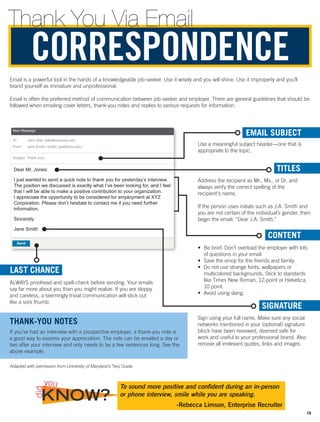
Email is a powerful tool in the hands of a knowledgeable job-seeker. Use it wisely and you will shine. Use it improperly and you’ll
brand yourself as immature and unprofessional.
Email is often the preferred method of communication between job-seeker and employer. There are general guidelines that should be
followed when emailing cover letters, thank-you notes and replies to various requests for information.
Send
New Message
To John Doe jdoe@xyzcorp.net
From Jane Smith smith_jane@rwu.edu
Subject Thank you!
Dear Mr. Jones:
I just wanted to send a quick note to thank you for yesterday’s interview.
The position we discussed is exactly what I’ve been looking for, and I feel
that I will be able to make a positive contribution to your organization.
I appreciate the opportunity to be considered for employment at XYZ
Corporation. Please don’t hesitate to contact me if you need further
information.
Sincerely,
Jane Smith
EMAIL SUBJECT
Use a meaningful subject header—one that is
appropriate to the topic.
TITLES
Address the recipient as Mr., Ms., or Dr. and
always verify the correct spelling of the
recipient’s name.
If the person uses initials such as J.A. Smith and
you are not certain of the individual’s gender, then
begin the email: “Dear J.A. Smith.”
CONTENT
•	 Be brief. Don’t overload the employer with lots
of questions in your email.
•	 Save the emoji for the friends and family.
•	 Do not use strange fonts, wallpapers or
multicolored backgrounds. Stick to standards
like Times New Roman, 12-point or Helvetica,
10 point.
•	 Avoid using slang.
LAST CHANCE
ALWAYS proofread and spell-check before sending. Your emails
say far more about you than you might realize. If you are sloppy
and careless, a seemingly trivial communication will stick out
like a sore thumb.
SIGNATURE
Sign using your full name. Make sure any social
networks mentioned in your (optional) signature
block have been reviewed, deemed safe for
work and useful to your professional brand. Also
remove all irrelevant quotes, links and images.
THANK-YOU NOTES
If you’ve had an interview with a prospective employer, a thank-you note is
a good way to express your appreciation. The note can be emailed a day or
two after your interview and only needs to be a few sentences long. See the
above example.
CORRESPONDENCE
Adapted with permission from University of Maryland’s Terp Guide.
To sound more positive and confident during an in-person
or phone interview, smile while you are speaking.
-Rebecca Limson, Enterprise Recruiter
KNOW?
did
you
Thank You Via Email
19
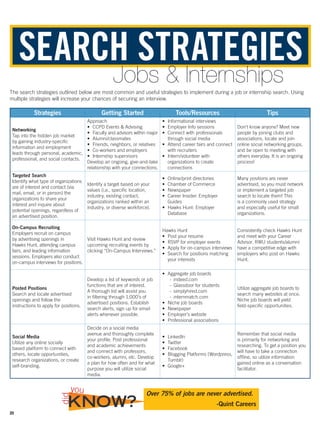
Strategies Getting Started Tools/Resources Tips
Networking
Tap into the hidden job market
by gaining industry-specific
information and employment
leads through personal, academic,
professional, and social contacts.
Approach
•	 CCPD Events  Advising
•	 Faculty and advisors within major
•	 Alumni/classmates
•	 Friends, neighbors, or relatives
•	 Co-workers and employers
•	 Internship supervisors
Develop an ongoing, give-and-take
relationship with your connections.
•	 Informational interviews
•	 Employer Info sessions
•	 Connect with professionals
through social media
•	 Attend career fairs and connect
with recruiters
•	 Intern/volunteer with
organizations to create
connections
Don’t know anyone? Meet new
people by joining clubs and
associations, locate and join
online social networking groups,
and be open to meeting with
others everyday. It is an ongoing
process!
Targeted Search
Identify what type of organizations
are of interest and contact (via
mail, email, or in person) the
organizations to share your
interest and inquire about
potential openings, regardless of
an advertised position.
Identify a target based on your
values (i.e., specific location,
industry, existing contact,
organizations ranked within an
industry, or diverse workforce).
•	 Online/print directories
•	 Chamber of Commerce
•	 Newspaper
•	 Career Insider: Employer
Guides
•	 Hawks Hunt: Employer
Database
Many positions are never
advertised, so you must network
or implement a targeted job
search to locate them! This
is a commonly used strategy
and especially useful for small
organizations.
On-Campus Recruiting
Employers recruit on campus
by advertising openings in
Hawks Hunt, attending campus
fairs, and leading information
sessions. Employers also conduct
on-campus interviews for positions.
Visit Hawks Hunt and review
upcoming recruiting events by
clicking “On-Campus Interviews.”
Hawks Hunt
•	 Post your resume
•	 RSVP for employer events
•	 Apply for on-campus interviews
•	 Search for positions matching
your interests
Consistently check Hawks Hunt
and meet with your Career
Advisor. RWU students/alumni
have a competitive edge with
employers who post on Hawks
Hunt.
Posted Positions
Search and locate advertised
openings and follow the
instructions to apply for positions.
Develop a list of keywords or job
functions that are of interest.
A thorough list will assist you
in filtering through 1,000’s of
advertised positions. Establish
search alerts, sign up for email
alerts whenever possible.
•	 Aggregate job boards
  - indeed.com
   -  Glassdoor for students
  - simplyhired.com
  - internmatch.com
•	 Niche job boards
•	 Newspaper
•	 Employer’s website
•	 Professional associations
Utilize aggregate job boards to
search many websites at once.
Niche job boards will yield
field-specific opportunities.
Social Media
Utilize any online socially
based platform to connect with
others, locate opportunities,
research organizations, or create
self-branding.
Decide on a social media
avenue and thoroughly complete
your profile. Post professional
and academic achievements
and connect with professors,
co-workers, alumni, etc. Develop
a plan for how often and for what
purpose you will utilize social
media.
•	 LinkedIn
•	 Twitter
•	 Facebook
•	 Blogging Platforms (Wordpress,
Tumblr)
•	 Google+
Remember that social media
is primarily for networking and
researching. To get a position you
will have to take a connection
offline, so utilize information
gained online as a conversation
facilitator.
The search strategies outlined below are most common and useful strategies to implement during a job or internship search. Using
multiple strategies will increase your chances of securing an interview.
SEARCH STRATEGIES
Jobs  Internships
Over 75% of jobs are never advertised.
-Quint CareersKNOW?
did
you
20
Can you tell me about your
career path and how you got
where you are?
What aspects of this
career field do you
like/dislike?
How competitive is
the job market?
What other
organizations or
people in the field
would you suggest I
talk with, and may I
use your name when
I contact them?
What do
you do
on a
typical
day?
What are the
different entry-level
jobs in this career
field?
What
background or
experience is
required
or helpful?
What courses
might be
helpful for me
to enhance my
chances for
employment in
the field?
What is the
salary range at the
entry-level and higher
levels?
What is
the typical
career
progression
in the field?
What related fields are
available for people with
backgrounds such as yours?
What is the
future of the field
in terms of new
and expanding
opportunities?
What would
you suggest for
someone who is
just beginning in
the field?
Are there resource books,
articles, online sources,
or professional associations
that you would suggest I use?
information from Megan Lee in the Center for Career  Professional
Development. I am currently a senior at Roger Williams University
majoring in public relations. I admire your career path in PR and am
wondering if you might have time to meet with me or have a quick
phone call to answer some questions I have about the field. Thank
you in advance!” Julie Jones
Always remember to send a thank-you letter to every person
who grants you time and to every individual who refers you to
someone.
JOB MARKET QUESTIONS
If you are preparing to enter the job market, you may wish to
ask questions such as:
1. What experiences would make an entry-level job seeker
competitive?
2. What are the major challenges/problems that your
organization is facing and would like solutions for?
Adapted with permission from University of Maryland’s Terp Guide.
What motivates professionals to grant ­informational interviews?
Most people enjoy sharing information about themselves and
their jobs and, particularly, love giving advice. If someone from
your high school reached out to you for advice on attending
Roger Williams University, you would most likely be more than
willing to answer questions and give advice. Some may simply
believe in encouraging newcomers to their profession and others
may be scoping out prospects for anticipated vacancies. It is
common for professionals to exchange favors and information, so
don’t hesitate to call upon people.
How do you set up informational interviews?
You can set up an informational interview through email,
phone call or LinkedIn. The best way to obtain an informational
interview is by being referred to someone, so make sure to ask
your network if they know of anyone in your field of interest and
research LinkedIn to find individuals of interest.
What do I say to someone to ask for an informational
interview?
Example message to send through LinkedIn or email:
“Dear Andrew, My name is Julie Jones and I received your contact
INTERVIEWS
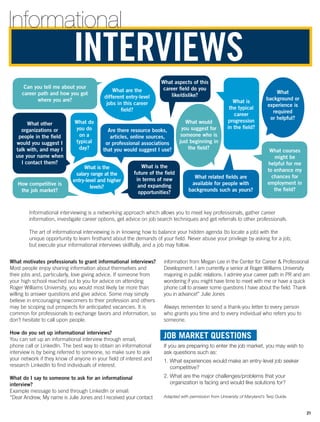
Informational interviewing is a networking approach which allows you to meet key professionals, gather career
information, investigate career options, get advice on job search techniques and get referrals to other professionals.
The art of informational interviewing is in knowing how to balance your hidden agenda (to locate a job) with the
unique opportunity to learn firsthand about the demands of your field. Never abuse your privilege by asking for a job,
but execute your informational interviews skillfully, and a job may follow.
Informational
21
HH
@!$*
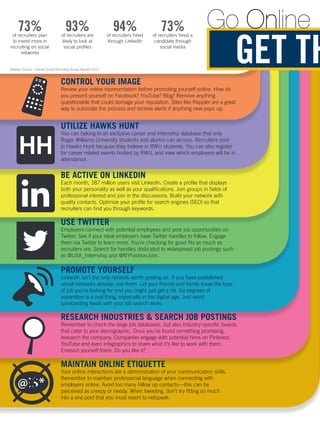
CONTROL YOUR IMAGE
Review your online representation before promoting yourself online. How do
you present yourself on Facebook? YouTube? Blog? Remove anything
questionable that could damage your reputation. Sites like Reppler are a great
way to automate the process and receive alerts if anything new pops up.
UTILIZE HAWKS HUNT
You can belong to an exclusive career and internship database that only
Roger Williams University students and alumni can access. Recruiters post
to Hawks Hunt because they believe in RWU students. You can also register
for career related events hosted by RWU, and view which employers will be in
attendance.
BE ACTIVE ON LINKEDIN
Each month, 187 million users visit LinkedIn. Create a profile that displays
both your personality as well as your qualifications. Join groups in fields of
professional interest and join in the discussions. Build your network with
quality contacts. Optimize your profile for search engines (SEO) so that
recruiters can find you through keywords.
USE TWITTER
Employers connect with potential employees and post job opportunities on
Twitter. See if your ideal employers have Twitter handles to follow. Engage
them via Twitter to learn more. You’re checking for good fits as much as
recruiters are. Search for handles dedicated to widespread job postings such
as @USA_Internship and @NYFashionJobs.
PROMOTE YOURSELF
LinkedIn isn’t the only network worth posting on. If you have established
social networks already, use them. Let your friends and family know the type
of job you’re looking for and you might just get a hit. Six degrees of
separation is a real thing, especially in the digital age. Just avoid
bombarding feeds with your job search woes.
RESEARCH INDUSTRIES  SEARCH JOB POSTINGS
Remember to check the large job databases, but also industry-specific boards
that cater to your demographic. Once you’ve found something promising,
research the company. Companies engage with potential hires on Pinterest,
YouTube and even infographics to share what it’s like to work with them.
Envision yourself there. Do you like it?
MAINTAIN ONLINE ETIQUETTE
Your online interactions are a demonstration of your communication skills.
Remember to maintain professional language when connecting with
employers online. Avoid too many follow up contacts—this can be
perceived as creepy or needy. When tweeting, don’t try fitting so much
into a one post that you must resort to netspeak.
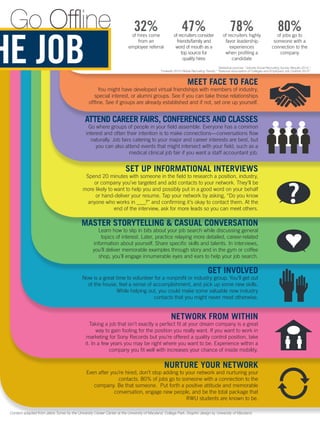
73%of recruiters plan
to invest more in
recruiting on social
networks
Statistic Source: “Jobvite Social Recruiting Survey Results 2014”
93%of recruiters are
likely to look at
social profiles
94%of recruiters hired
through LinkedIn
73%of recruiters hired a
candidate through
social media
GET TH
Go Online
?
MEET FACE TO FACE
You might have developed virtual friendships with members of industry,
special interest, or alumni groups. See if you can take those relationships
offline. See if groups are already established and if not, set one up yourself.
ATTEND CAREER FAIRS, CONFERENCES AND CLASSES
Go where groups of people in your field assemble. Everyone has a common
interest and often their intention is to make connections—conversations flow
naturally. Job fairs catering to your major and career interests are best, but
you can also attend events that might intersect with your field, such as a
medical clinical job fair if you want a staff accountant job.
SET UP INFORMATIONAL INTERVIEWS
Spend 20 minutes with someone in the field to research a position, industry,
or company you’ve targeted and add contacts to your network. They’ll be
more likely to want to help you and possibly put in a good word on your behalf
or hand-deliver your resume. Tap your network by asking, “Do you know
anyone who works in ___?” and confirming it’s okay to contact them. At the
end of the interview, ask for more leads so you can meet others.
MASTER STORYTELLING  CASUAL CONVERSATION
Learn how to slip in bits about your job search while discussing general
topics of interest. Later, practice relaying more detailed, career-related
information about yourself. Share specific skills and talents. In interviews,
you’ll deliver memorable examples through story and in the gym or coffee
shop, you’ll engage innumerable eyes and ears to help your job search.
GET INVOLVED
Now is a great time to volunteer for a nonprofit or industry group. You’ll get out
of the house, feel a sense of accomplishment, and pick up some new skills.
While helping out, you could make some valuable new industry
contacts that you might never meet otherwise.
NETWORK FROM WITHIN
Taking a job that isn’t exactly a perfect fit at your dream company is a great
way to gain footing for the position you really want. If you want to work in
marketing for Sony Records but you’re offered a quality control position, take
it. In a few years you may be right where you want to be. Experience within a
company you fit well with increases your chance of inside mobility.
NURTURE YOUR NETWORK
Even after you’re hired, don’t stop adding to your network and nurturing your
contacts. 80% of jobs go to someone with a connection to the
company. Be that someone. Put forth a positive attitude and memorable
conversation, engage new people, and be the total package that
RWU students are known to be.
Statistical sources: “Jobvite Social Recruiting Survey Results 2014,”
“LinkedIn 2015 Global Recruiting Trends,” “National Association of Colleges and Employers Job Outlook 2015”
Content adapted from Jebra Turner by the University Career Center at the University of Maryland, College Park. Graphic design by University of Maryland.
32%of hires come
from an
employee referral
47%of recruiters consider
friends/family and
word of mouth as a
top source for
quality hires
78%of recruiters highly
favor leadership
experiences
when profiling a
candidate
80%of jobs go to
someone with a
connection to the
company
HE JOB
Go Offline
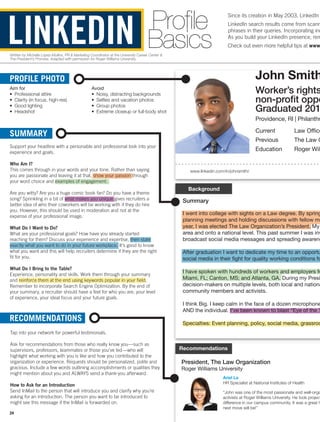
John SmithPROFILE PHOTO
Aim for
•	 Professional attire
•	 Clarity (in focus, high-res)
•	 Good lighting
•	 Headshot
Avoid
•	 Noisy, distracting backgrounds
•	 Selfies and vacation photos
•	 Group photos
•	 Extreme closeup or full-body shot
Profile
Basics
www.linkedin.com/in/johnsmith/
Background
SUMMARY
Support your headline with a personable and professional look into your
experience and goals.
Who Am I?
This comes through in your words and your tone. Rather than saying
you are passionate and leaving it at that, show your passion through
your word choice and examples of engagement.
Are you witty? Are you a huge comic book fan? Do you have a theme
song? Sprinkling in a bit of what makes you unique gives recruiters a
better idea of who their coworkers will be working with if they do hire
you. However, this should be used in moderation and not at the
expense of your professional image.
What Do I Want to Do?
What are your professional goals? How have you already started
reaching for them? Discuss your experience and expertise, then state
exactly what you want to do in your future workplace. It’s good to know
what you want and this will help recruiters determine if they are the right
fit for you.
What Do I Bring to the Table?
Experience, personality and skills. Work them through your summary
and reinforce them at the end using keywords popular in your field.
Remember to incorporate Search Engine Optimization. By the end of
your summary, a recruiter should have a feel for who you are, your level
of experience, your ideal focus and your future goals.
Recommendations
President, The Law Organization
Roger Williams University
RECOMMENDATIONS
Tap into your network for powerful testimonials.
Ask for recommendations from those who really know you—such as
supervisors, professors, teammates or those you’ve led—who will
highlight what working with you is like and how you contributed to the
organization or experience. Requests should be personalized, polite and
gracious. Include a few words outlining accomplishments or qualities they
might mention about you and ALWAYS send a thank-you afterward.
How to Ask for an Introduction
Send InMail to the person that will introduce you and clarify why you’re
asking for an introduction. The person you want to be introduced to
might see this message if the InMail is forwarded on.
Written by Michelle López-Mullins, PR  Marketing Coordinator at the University Career Center 
The President’s Promise. Adapted with permission for Roger Williams University.
Summary
I went into college with sights on a Law degree. By spring
planning meetings and holding discussions with fellow me
year, I was elected The Law Organization’s President. My
area and onto a national level. This past summer I was inv
broadcast social media messages and spreading awarene
After graduation I want to dedicate my time to an opportu
social media in their fight for quality working conditions fo
I have spoken with hundreds of workers and employers fr
Miami, FL; Canton, MS; and Atlanta, GA. During my Presi
decision-makers on multiple levels, both local and nationa
community members and activists.
I think Big. I keep calm in the face of a dozen microphone
AND the individual. I’ve been known to blast “Eye of the T
Specialties: Event planning, policy, social media, grassroo
Worker’s rights
non-profit oppo
Graduated 201
Providence, RI | Philanthr
Current	 Law Office
Previous	 The Law O
Education	 Roger Wil
Since its creation in May 2003, LinkedIn
LinkedIn search results come from scann
phrases in their queries. Incorporating ind
As you build your LinkedIn presence, rem
Check out even more helpful tips at www.
Ariel La
HR Specialist at National Institutes of Health
“John was one of the most passionate and well-orga
activists at Roger Williams University. He took project
difference in our campus community. It was a great h
next move will be!”
LINKEDIN
24
h
g semester my sophomore year, I was staying up late
embers of the RWU Law Organization. By my junior
interest expanded from campus to the surrounding
volved with the United Auto Workers Union, helping
ess of auto workers’ rights issues in five major cities.
unity that understands the value of public image and
or our nation’s workforce.
rom varying backgrounds in Providence, RI;
idency in the Law Organization, I also spoke with
al media outlets, and rooms of 100+ engaged
es (or those who disagree). I’m all about the group
Tiger” before a rally or two.
ots marketing, Spanish.
s advocate seeking
ortunities in Providence, RI |
16
ropy
e of Joe Smith
Organization, Roger Williams University
lliams University
HEADLINE
Reinforce your brand with a succinct, memorable professional slogan.
Search Engine Optimization (SEO)
No matter what, include keywords/phrases that describe your skill sets/goals in
terms that your field’s recruiters will search for. Your field’s trending topics can
fluctuate, so look over the field’s job postings for ideas of what to use.
Suggested Formulas
Seeking [industry] position.
ex. “Currently seeking social media position.”
[Major] major seeking opportunities in [location/industry] | Graduating from
[University] in [Year].
ex. “Criminal Justice major seeking opportunities in Providence, RI |
Graduating from Roger Williams University in 2018.”
[Student affiliation] seeking [industry] position.
ex. “Honors student seeking human resources position.”
has changed the shape of recruiting. According to a 2015 study, 95% of recruiters use LinkedIn to source and vet candidates.
ning the user’s 1st, 2nd and 3rd degree connections for the search query. Recruiters often use trending, industry-specific keywords and
dustry-specific keywords and phrases into your profile can increase your visibility. This is called Search Engine Optimization (SEO).
member that SEO is a major contributor to LinkedIn success.
w.University.LinkedIn.com.
anized student leaders I encountered during my time advising student
t ideas and transformed them into amazing events that made a real
honor to know and work with John and I can only imagine what his
133
connections
CONNECTIONS
Build your professional network.
To start, you can sync your email contacts with LinkedIn to create a list
of“Suggested” connections. Only connect with those you’re comfortable
associating with professionally. Some great additions would be friends and
coworkers of your parents, those you’ve worked with, classmates and professors.
Etiquette
When requesting a connection, do NOT send the generic LinkedIn message.
It leaves the requestee with little to no context and may cause them to think
you’re just fishing for superficial connections.
If someone hasn’t accepted after a few weeks, it’s okay to send an email to say
you’ve reached out and would like to connect. If that doesn’t work, move on to
more interested, responsive LinkedIn users.
Groups
Active memberships in relevant groups shows your serious interest in the field.
It also gives you a place to discuss relevant topics and expand your network.
EXPERIENCE, PROJECTS, ETC.
Format experience and project sections the same way that you present them
on your hard copy resume. Include portfolios, photos and/or videos if you
feel they enhance the viewer’s understanding.
Honors  Awards
Include 1-2 sentences explaining criterion and how/why you were selected.
Skills  Endorsements
Choose self-descriptive keywords used by professionals in your interest field.
Example: For PR/Marketing, you could use “event planning,” “social media”
and “public speaking.”
25
CAREER FAIR ETIQUETTE
1.	Don’t interrupt the employer reps or your fellow
job-seekers. If someone else is monopolizing the employer’s
time, try to make eye contact with the rep to let him or her
know that you’re interested in speaking. You may be doing
a favor by giving the recruiter an out. If all else fails, move to
the next exhibit and plan to come back later.
2.	If you have a real interest in an employer, find out the
procedures required to secure an interview. At some
career fairs, initial screening interviews may be done on
the spot. Other times, the career fair is used to pre-screen
applicants for interviews to be conducted later (either on
campus or at the employer’s site).
3.	Sincerity always wins. Don’t lay it on too thick, but don’t
be too blasé either. Virtually all employers are looking for
candidates with good communication skills. Be ready to
make conversation and ask intelligent questions- this will
make you a much more interesting candidate than those
who ask, “So, what do you guys do?”
4.	Don’t just drop your resume on employers’ display
tables. Try to get it into a person’s hands and at least
say a few words. If the scene is too busy and you can’t
get a word in edgewise, jot a note on your resume to the
effect of, “You were so busy that we didn’t get a chance to
meet. I’m very interested in talking to you.” Look around
the display for the recruiter’s business card (or at the very
least, write down his or her name and get some literature
with the company’s address) and send a follow-up note
and another copy of your resume.
5.	Know ahead of time what companies will be at the fair.
Do some prior research (at minimum, visit their website).
Prioritize the list of employers you want to speak with
and go directly to their tables.
YOU’RE A PROSPECTOR—START DIGGING
The questions you ask at a career fair depend upon your goals.
Are you interested in finding out about an internship or full-time
job? Then focus your questions on the application and interview
process, and ask for specific information about that employer.
FAIR THEE WELL
By all means, try to attend at least one career fair before
beginning your formal job interviewing process. For new entrants
into the professional career marketplace, this is a good way
to make the transition into “self-marketing mode” without the
formality and possible intimidation of a one-on-one job interview.
It’s an opportunity that’s too valuable to miss.
Getting the Most Out of the Career Fair
Many employers use career fairs—both on and off campus—
to promote their opportunities and to pre-screen applicants.
Career fairs come in all shapes and sizes, from small
­­community-sponsored events to giant regional career expositions
held at major ­convention centers.
Most career fairs consist of booths and/or tables staffed by
recruiters and other representatives from each organization.
For on-campus events, some employers also send alumni
representatives. Large corporations and some government
­agencies have staffs who work the career fair “circuit” nationwide.
An employer’s display area is also subject to wide variance. It could
be a simple table with a stack of brochures and business cards and
a lone representative or an elaborate multimedia extravaganza with
interactive displays, videos, posters and a team of recruiters.
FASHIONS AND ACCESSORIES
Generally, the appropriate attire for career fair attendees is more
relaxed than what you’d wear to an actual job interview. However,
“professional dress” is still the norm. If you’re unsure of the
dress code ­(particularly for off-­campus events), it would be wise
to err on the overdressed side—you’ll make a better impression
if you appear professional. Think of it as a dress rehearsal for
your real interviews!
Remember to bring copies of your resume (or resumes, if
you have several versions tailored to different career choices),
a few pens and pencils (have backups—they have a way of
disappear­­ing), a folder or portfolio and some sort of note-taking
device (paper or pad). Keep track of the recruiters with whom
you speak and send follow-up notes to the ones who interest
you. Don’t bring your backpack; it’s cumbersome for you and it
gets in the way of others.
STOP, LOOK AND LISTEN
Keep your eyes and ears open—there’s nothing wrong with
subtly eavesdropping on the questions asked and answers
received by your fellow career fair attendees. You might pick
up some valuable information, in addition to witnessing some
real-life career search “do’s and don’ts.”
In order to maximize your career fair experience, you must
be an active participant and not just a browser. If all you do
is stroll around, take company literature and load up on the
ubiquitous freebies, you really haven’t accomplished anything
worthwhile (unless you’re a collector of key chains, mousepads
and pocket flashlights). It is essential to chat with the company
representatives and ask meaningful questions.
Create a “30-second commercial” as a way to sell ­yourself to an
employer. This is a great way to introduce yourself. The goal is
to connect your background to the organization’s need. In one
minute or less, you need to introduce yourself, demonstrate your
knowledge of the company, express enthusiasm and interest and
relate your background to the ­company’s need.
Check with
the CCPD for
a complete list
of events and the
employers attending.
MORE?
want
26
Top 10 Personal Branding Tips
6. DRESS FOR SUCCESS
Make sure your personal appearance matches the image you
want to project. Find out what kind of clothes are appropriate for
your desired industry and invest in the best you can reasonably
afford. When in doubt, err on the side of formality.
7. BUILD A PROFESSIONAL ONLINE IMAGE
Everyone is Googling everyone else these days, so be vigilant
about your online identity. Even if your social network
settings
are tight, take down any photos of partying, drinking or
“unprofessional” behavior just in case.
Then, enhance your
brand online by creating a strong profile and becoming active on
LinkedIn, the professional social network.
8. TAKE A WRITING CLASS
Guess why the “I Judge You When You Use Poor Grammar”
group on Facebook has over 400,000 members? Even in the
days of IM, texting and Twitter, writing and speaking skills still
matter. Use proper grammar, capitalization and spelling in all
professional communications (that means no LOLs, BRBs or
ROTFLs!).
9. ASK FOR FEEDBACK
Find a professional you trust—a friend, relative, professor,
etc.—who will be candid with you and ask this person to tell
you if there are any areas where you’re getting in your own way.
For instance, do you say “like” or “you know” too much? Do you
come across as hyper, entitled or uninformed? If necessary, take
a class or get some coaching in any area where you could use
some polish.
10. REASSESS YOUR PERSONAL
BRAND REGULARLY
Your experience, ideas and ambitions are going to evolve as your
career develops, so make sure your personal brand is keeping
up. Just as you should regularly update your resume, remember
to regularly revisit your self-introduction , wardrobe, online
profiles and other elements of your personal brand every few
months. Be flexible.
Used with permission from PWC.
1. BE AUTHENTIC
Who are you and what do you want? What have you
accomplished so
far? What are you passionate about? What
are your 
goals? Ask friends or relatives to describe your best
qualities and greatest achievements or take a self-assessment
test online or through your college career center.
2. LEARN HOW TO INTRODUCE YOURSELF
Once you know who you are, the next step is being able to
communicate that to others. “Tell me about yourself” is a much
harder assignment than it seems, especially in professional
situations. Learn how to concisely, confidently say your name,
your recent history and your goals, then practice, practice,
practice until you’re comfortable telling your own story.
3. SHOW YOUR CONFIDENCE
While it’s never a good idea to project arrogance, many students
err on the side of self-deprecation. Even if you feel inexperienced
or
 awkward in professional situations, never make fun of
yourself or put yourself down. If you project confidence 
and
comfort with yourself, others will be comfortable with you.
4. DEVELOP THE TOOLS OF THE TRADE
Just as a company or product needs marketing materials,
you need various
 items to “market” yourself to recruiters,
networking
 contacts, grad school admissions committees
and 
others. These materials include your resume, cover
letters, email address, voicemail message, online profiles and
website or blog. Every representation helps to reinforce the
brand you want to present, so be professional and consistent
across each medium.
5. SHOW YOUR CARDS
Business cards are a great way to show your professionalism
and desire to keep in touch with the people you meet, and they
are increasingly popular among career-minded students. Don’t
worry if you don’t have a title or company; just print simple,
professional-looking cards with your name, phone number
and email address and, if you’d like, your college and major.
VistaPrint is a good resource for free or inexpensive business
cards.
Hello, my name is
27
Marketing Your Liberal Arts Degree
As liberal arts graduates enter the job market, their direction
may not be as obvious as that of their technically trained
counterparts. For the most part, engineering or computer
science majors know exactly where to target their efforts. Liberal
arts majors are less fortunate in that regard—such a heading
cannot be found in the want ads. Yet if they learn to target
their aptitudes, they have as good a chance as anyone to find
meaningful work.
What you need to do, explains one career advisor, is to find out
what you really want to do—regardless of your major. Students
often ask, “What can I do with a major in philosophy?” That’s the
wrong question. The real questions are, “What fascinates me?
How can I connect my interests with a job? What do I really want
to be doing in 20 years?”
Once you have answered those questions, look at possibilities
for matching your interests with a job. There are more options
than you might think. Don’t get stuck on titles. As a liberal arts
major, you have to do much more work in terms of researching
different job markets and finding out where there is a demand.
Conduct in-depth research on any companies that appeal to
you, and try to match their needs to your wants. You must be
specific, however. It is possible to be too general, too open and
too flexible.
To be successful, you should combine your long-term vision
with short-term specificity. Present yourself to your potential
employer as someone who both understands the broad goals
of the company and has the ability to grow and contribute in
the long run. But most importantly, show how you can excel in
that specific job. As you will see below, many of the top skills
employers seek can be found in your liberal arts major.
Once you’ve taken the time to determine your real interests
and have set some long-term goals, map out a plan—long- and
short-term—on how to get there.
Your liberal arts education has equipped you to take a broad
topic and research it. Use those skills to make the connection
between what you want and what companies need. Once you
find job descriptions that match your long-term interests, set
about shaping your resume and, if need be, getting the additional
specific skills, training or certification to get that first job.
Your first job may not match your long-term goal. But it’s the first
step. And that, at this point, is the all-important one.
Adapted with permission from University of Maryland’s Terp Guide.
WHAT LIBERAL ARTS
GRADUATES ARE DOING
Accountant
Administrative assistant
Advertising account
executive
Air traffic controller
Artist
Auditor
Bank manager
Business systems analyst
Buyer
Child support enforcement
officer
Claims examiner
Communications specialist
Computer specialist
Copywriter
Counselor
Customer service
representative
Editor
Employee relations
specialist
Engineering planner
Financial consultant
Graphic designer
Hotel manager
Human resource specialist
Industrial designer
Interpreter/translator
Journalist
Librarian
Management consultant
Marketing representative
Medical/dental assistant
Museum coordinator
Office administrator
Outpatient therapist
Paralegal
Photographer
Probation officer
Product specialist
Psychologist
Public relations specialist
Quality engineer
Recreation administrator
Research analyst
Restaurant manager
Retail manager
Sales representative
Social worker
Speech pathologist
Stockbroker
Systems analyst
Tax consultant
Teacher
Technical writer
Transportation specialist
Underwriter
Urban planner
Writer
A sampling of the wide range of positions filled by
liberal arts graduates:
Only 7% of job
applicants get an
employee referral,
yet referrals account
for 40% of all hires!
-Daily Muse
KNOW?
did
you
28
NAME
MAJOR AND CLASS YEAR
SKILLS GAINED FROM EXPERIENCE(S)
(i.e. work, volunteer, internship, study abroad or on-campus leadership)
CAREER INTEREST(S)
customized depending on the field the employer/networking contact represents
ENDING QUESTION
to gain more information
“Hi, my name is ____. I’m a (graduate student, junior, etc.) at Roger Williams
University majoring in _____. My interest in _____ has developed through ____
(i.e., describe internships, in-class projects, part-time work experiences, etc.).”
Continue by answering the recruiter’s questions. Ex. “What type of job are
you seeking?” Do NOT answer “Anything” or “It doesn’t matter.”
End with a question or request: “When do you anticipate
accepting applications for your summer internship?”
or “May I contact you if I have additional
questions?”
Networking Scenario
“Hi! My name is John Doe. I’m a
senior psychology major at the Roger Williams
University. I’ve completed a broad range of psychology
courses, my focus being on interpersonal relationships and
cross-cultural psychology. My interests led me to complete a
135-hour practicum related to Human Resources, researching
discrimination claims, assisting payroll with paperwork and developing
questions for employee interviews. The internship strengthened my analytical,
problem-solving and communication skills and confirmed that I’m very interested
in going into the field post-graduation. Can you tell me more about your Human
Resource Department or suggest a colleague I may speak more with?”
Career Fair Scenario
“Hello, I’m Raina Raptor. I’m a junior English major. I’m hoping to work in public relations.
I noticed that you posted a PR internship on Hawks Hunt. Currently I work as a part-time
sales associate at a large department store. I love working in retail. Now I’m hoping to move
into the corporate side in a PR role. Would you tell me a little more about your internship?”
Also known as an elevator pitch, this is your prepared 30-second introduction. It is used when networking, attending career fairs
or during internship/job interviews. Well-thought-out commercials demonstrate that you are well spoken, qualified and prepared.
COMMERCIAL
30-Second
KNOW?
did
you
It takes 52
days on
average to
fill a job
opening.
-Daily Muse
Adapted with permission from University of Maryland’s Terp Guide.
29
power to offer a job, your demeanor during the entire interview
process gives you a great deal of power, too.
EXPECT THE UNEXPECTED
During the interview, you may be asked some unusual questions.
Don’t be too surprised. Many times questions are asked simply to
gauge your reaction. For example, a recruiter may ask, “Tell me a
joke” or “What time period would you like to have lived in?” While
these questions are not always used, they are intended to force
you to react under some stress and pressure. The best advice is
to think and give a natural response.
TYPES/METHODS
Types
Behavioral
Technical
Case-style
Methods
Phone
Virtual (video/Skype)
Group/Panel
On-site
THE SITE VISIT/INTERVIEW
After an on-campus interview, strong candidates may be invited to
visit the employer’s facility. An invitation to an on-site interview is
NOT a guarantee of a job offer, but a chance to examine whether or
not you will be a good match for the job and organization. If invited,
respond promptly if you are sincerely interested. Decline politely if
you are not. Never go on an on-site interview for the sake of the trip.
Document the name and phone number of the person
coordinating your trip in case your plans change unexpectedly.
Verify who will be handling trip expenses. Most medium- and
large-size companies (as well as many smaller ones) will pay
your expenses, but some will not.
Bring extra copies of your resume and any paperwork you may have
forwarded to the employer; names, addresses, phone numbers and
email addresses of your references; an updated college transcript;
a copy of your best paper as a writing sample; a notebook; a black
and/or blue pen for taking notes; and names and addresses of past
employers. Bring extra money and a change of clothes. Anything can
happen and you need to be ready for emergencies.
Soon after the site visit, review the business cards of those you
met or write the information in your notebook before leaving
the facility. A thank-you letter should be written to the person(s)
who will be making the hiring decision. Stay in touch with the
employer if you want to pursue a career with them.
An interview is a two-way street. You are there to evaluate the
employer and determine if your expectations are met for job
content, company culture and values, organizational structure, and
lifestyles (both at work and leisure). Take note of how the employees
interact, and also assess the physical work environment.
Partially adapted from Roseanne R. Bensley, Career Services,
New Mexico State University.
What Happens During the Interview?
IT STARTS BEFORE YOU EVEN SAY HELLO
Arrive 15-20 minutes early and prepare to meet people who
are not part of your formal agenda. Be courteous to everyone
regardless of his or her position; you never know who might be
watching you and your actions once you arrive.
Typical interviews start before you enter the interview room. The
recruiter begins evaluating you the minute you are identified.
Shake the recruiter’s hand upon being introduced. Don’t be
afraid to extend your hand first. This shows assertiveness.
THE RECRUITER HAS THE FLOOR
The main part of the interview starts when the recruiter discusses the
organization. Ask questions if the recruiter uses vague generalities
about the position and you want more specific information. Have a
clear understanding of the job and the company.
As the interview turns to talk about your qualifications, be
prepared to deal with aspects of your background that could
be construed as negative, i.e., low grade point average, no
participation in outside activities, no related work experience.
Convince the recruiter that although these points appear
negative, positive attributes can be found in them. A low GPA
could stem from having to fully support yourself through college;
you might have no related work experience, but plenty of
experience that shows you to be a loyal and valued employee or
that you possess related transferable skills.
IT’S YOUR TURN TO ASK QUESTIONS
When the recruiter asks, “Now do you have any questions?”
it’s important to have a few ready. Questions should bring out
your interest in and knowledge of the organization. Don’t ask
questions with answers easily be found online.
By asking intelligent, well-thought-out questions, you show the
employer you are serious about the organization, want more
information and you have done your homework. Prepare some
questions ahead of time, but feel free to ask any questions that
come up during the interview as well.
THE CLOSE COUNTS, TOO
The interview isn’t over until you walk out the door. During the
conclusion the recruiter is assessing your overall performance to
be sure that not only can you do the job, but you want to do the
job and would fit in with their organization’s office culture.
Remain enthusiastic and courteous. Shake the recruiter’s hand
and thank him or her for considering you. Being forthright is a
quality that most employers will respect. Let the employer know
you are still interested in the position and why.
Just as any good salesperson would never leave a ­customer
without attempting to close the sale, never leave an interview
without some sort of closure. Although the employer has the final
30
Questions Employers Ask
CAREER GOALS
38.	Do you prefer to work under supervision or on your own?
39.	What kind of boss do you prefer?
40.	Would you be successful working with a team?
41.	 Do you prefer large or small organizations? Why?
42.	What other types of positions are you considering?
43.	How do you feel about working in a structured ­environment?
44.	Are you able to work on several assignments at once?
45.	How do you feel about working overtime?
46.	How do you feel about travel?
47.	 How do you feel about the possibility of relocating?
48.	Are you willing to work flextime?
Before you begin interviewing, think about these questions
and possible responses and discuss them with a career
advisor. Conduct mock interviews and be sure you are able to
communicate clear, unrehearsed answers to interviewers.
PERSONAL
1.	 Tell me about yourself.
2.	 What are your hobbies?
3.	 Why did you choose to interview with our ­organization?
4.	 Describe your ideal job.
5.	 What can you offer us?
6.	 What do you consider to be your greatest strengths?
7.	 What are areas of growth for you?
8.	 Have you ever had any failures? What did you learn?
9.	 Of which three accomplishments are you most proud?
10.	Who are your role models? Why?
11.	 How does your college education or work experience relate
to this job?
12.	What motivates you most in a job?
13.	Have you had difficulty getting along with a former professor/
supervisor/co-worker and how did you ­handle it?
14.	Have you ever spoken to a group of people? How large?
15.	Why should we hire you rather than another ­candidate?
16.	What do you know about our organization (products or
­services)?
17.	 Where do you want to be in five years? Ten years?
18.	Do you plan to return to school for further ­education?
EDUCATION
19.	 Why did you choose your major?
20.	Why did you choose to attend your college or university?
21.	 Do you think you received a good education? How?
22.	In which campus activities did you participate?
23.	Which classes in your major did you like best? Least?
24.	Which elective classes did you like best? Least? Why?
25.	If you were to start over, what would you change about your
education?
26.	Do your grades accurately reflect your ability?
27.	Were you financially responsible for any portion of your
college education?
28.	What has been the most influential aspect of your college
experience?
EXPERIENCE
29.	What job-related skills have you developed?
30.	Did you work while going to school? In what ­positions?
31.	 What did you learn from these work experiences?
32.	What did you enjoy most about your last employment?
Least?
33.	Have you ever quit a job? Why?
34.	Give an example of a situation in which you provided a
solution to an employer.
35.	Give an example of a time in which you worked under
deadline pressure.
36.	Have you ever done any volunteer work? What kind?
37.	 How do you think a former supervisor would describe your
work?
Practice your responses by coming into the Center for
Career  Professional Development, for a Mock Interview.
Call 401-254-3224 for more info.
QUESTIONS YOU ASK EMPLOYERS
1.	 What is the top priority for the person in this position
over the next three months?
2.	 What is the biggest challenge in your department?
3.	 What have you enjoyed most about working here?
4.	 How would you describe a typical week/day in this
position?
5.	 Can you explain the organizational structure? Who
would I report to? Who would be on my team?
6.	 If I am extended a job offer, how soon would you like
me to start?
7.	 Can you describe your ideal employee?
8.	 How will my performance be measured? By whom?
9.	 Who is your biggest competitor for your products/
services? How is what you offer different from your
competitor?
10.	Are there any other questions I can answer for you?
11.	 What are the next steps in the process?
The questions above are designed to help you gather more
information, and possibly find a way to provide additional
valuable information to the employer that did not come out
while you were answering their questions.
Adapted with permission from University of Maryland’s Terp Guide.
31
OFFICE CASUAL
“Office casual” is becoming the accepted mode of dress at more and more organizations. The rules for casual attire, however,
are subject to each organization. The safest fashion rule for new employees to follow is to dress about the same as your most
conservatively dressed co-worker. As a new hire, don’t try to “push the boundaries” of casual attire.
Fashion Arrests
•	 Never wear denim jeans or shorts unless the vast majority of
others do
•	 Don’t dress too provocatively—you’re at work, not a club
•	 “Casual” doesn’t mean “sloppy”—clothes should be free of
stains and holes
•	 Workout wear belongs at the
gym
Play it Safe
•	 Khaki or black pants are usually a safe bet
•	 As for formal business attire, buy the best that your budget will
allow
•	 If you will be seeing clients, dress appropriately for their
workplace, not yours
•	 Go to the mall—most department and specialty stores have
sections devoted to this style of office attire
•	 When in doubt, stick with “neutral” colors, such as black,
khaki, dark navy, or grey
•	 Avoid visible body piercings or tattoos until you learn about
what the organization’s formal (or informal) policies may be
FOR THE JOB
After you ace the interview and accept the job offer, what happens? You start your professional career—and you have to look the part!
For recent graduates just entering professional life, additions to wardrobes or complete overhauls, are likely needed. Limited funds,
however, can be an obstacle. Image consultants suggest “capsule wardrobing”. By mixing and matching, an eight-piece capsule
wardrobe can generate up to 28 ensembles.
•	 Establish a professional wardrobe budget
•	 Allot 50% of your budget to accessories
•	 Purchase a suit jacket that is versatile and can work with a
number of other pieces
•	 Buy fashion basics that you can build on
•	 Don’t overlook the importance of nice briefcase or leather
portfolio
FOR THE INTERVIEW
You want to present the most appropriate professional impression for your interviews. When it comes to your appearance,
conservatism and conformity are in order in most business and technical job interviews. However, this can vary by industry. When in
doubt, it is better to be too conservative than to be too flashy.
$$$
Two-piece suits (solid
colors, tighter-
woven fabric
Wrinkled clothing
Conservative with
makeup and jewelry
Missing buttons,
crooked ties and lint
Neatly trimmed or
shaved hair
Tags and labels on new
clothing
Shoes that are polished
or in good condition
Runs in your
stockings
Tailored, collared shirts
or blouses under your
suit jacket
Ties with wild or ornate
designs
SUCCESS
Dress for
In a survey of over 2,000
bosses, 33% claimed
they know within 90
seconds of an interview
if they will hire the
candidate.
-Pro Resume Center, LLC
KNOW?
did
you
Adapted with permission from University of Maryland’s Terp Guide.
32
EATING
DINING
MEETING  GREETING
MS
DR
MR
Maintain eye contact.
Rise when introducing or being
introduced.
Provide information when making
introductions—you are responsible
for keeping the conversation going.
Unless given permission, always
address someone by his or her title
and last name.
Arrive on time, if not early.
Wait to sit until the host/hostess
indicates seating arrangement.
JANE
Napkins
•	 On lap before eating or drinking
•	 On chair seat if excusing yourself
•	 Beside plate at meal’s end
This will be a talking business lunch.
Order something easy to eat, like
boneless chicken or fish and don’t
hold the order up with indecision.
Interviewers usually take care of the
bill and tip, but bring small bills for
your part just in case.
Keep hands in lap unless you are
using them to eat.
Eating
•	 Wait to eat until everyone is served
•	 Eat at the same pace as everyone else
•	 Bring food to your mouth, not your
head to the plate
Practice proper posture; sit up as
straight as you can with your arms
close to your body.
Passing
•	 Salt and pepper together
•	 Pass to the right
•	 Handles toward next person
•	 Spoon toward next person
•	 Pass before serving yourself
Don’t chew with your mouth
open or blow on your food. Place
utensils on plate before speaking.
Dip soup away from you; sip from
the side of the spoon.
Firm handshake
Push chair under
table when excusing
yourself.
When speaking, cross
utensils with all prongs
downward.
Utensils
•	 Work from the outside in
•	 Soup spoon is farthest from plate
•	 Salad fork is second from plate
•	 Tiny third fork is for seafood/appetizer
•	 Dessert fork/spoon is above plate
Adapted from article by Jennie Hunter, a professor at Western California University
$
ETIQUETTE
Professional
Schedule an
appointment with the
Center for Career
 Professional
Development.
MORE?
want
33
How to Prepare for Video Interviews
AMBIANCE
Dress professionally,
silence distractions (i.e. cell
phones, pets, roommates,
etc.), and avoid situating
yourself in front of any
noisy backgrounds. Also
avoid harsh backlight
that will turn you into a
silhouette.
KNOW THE
PROGRAM
Oovoo, Skype, iChat,
Yugma. The list goes on and
on. Before your interview,
make sure you’ve played
around with the program
enough to know how it works.
TEST THE CONNECTION
Do you have a readily available power
source? Is the wifi signal strong? Do you
have access to a phone, and if it’s a cell
phone, strong service? Even if everything
is checked beforehand, technology can
still fail you. Make sure you have the
interviewer’s phone number, just in case!
!
BRAND YOURSELF
Just like the email address on
your resume or the message on
your voicemail—be professional.
Be sure the username used for
your virtual Interview represents
you as a mature and polished
candidate.
POSITION  POSTURE
Do you look at yourself on the
screen, or talk directly into the
camera? Does your posture
present you as casual and relaxed,
or confident and poised? Be sure
to practice your positioning and
posture prior to the interview with
your Career Advisor!
Are You Ready for a Behavioral Interview?
Today more than ever, each hiring decision is critical. Behavioral interviewing is designed to minimize personal impressions that
might cloud the hiring decision. By focusing on the applicant’s actions and behaviors, rather than subjective impressions that can
sometimes be misleading, interviewers can make more accurate hiring decisions. You can practice your interview skills by scheduling
a mock appointment with the CCPD.
How to Prepare for a Behavioral Interview
 Recall recent situations that show favorable behaviors or actions, especially those involving coursework, work experience, leadership,
initiative, planning and customer service.
  Prepare short descriptions of each situation; be ready to give details if asked.
 Be sure each story has a beginning, a middle, and an end; i.e., be ready to describe the situation, your action and the outcome or result.
  Be sure the outcome or result reflects positively on you (even if the result itself was not favorable).
  Be honest. Don’t embellish or omit any part of the story. The interviewer will find out if your story is built on a weak foundation.
  Be specific. Don’t generalize about several events; give a detailed accounting of one event.
USING THE STAR TECHNIQUE TO ANSWER BEHAVIORAL QUESTIONS
Think of 4-6 situations you have been faced with in the past. Vary your examples so they are from all areas of your past
(including internships, volunteering, class projects, part-time jobs, school activities, etc.). Describe your stories using the
following STAR method. Practice telling the story using the STAR method, but do not memorize them word for word.
S – Situation or (T) Task: Describe a specific situation or task (i.e., “Assigned to a team and team member wasn’t pulling their weight.”)
A – Action: What action did you take? (“I met with the team member in private and explained the frustration of the rest of the
team ask asked if there was anything I could do to help.”)
R – Result: What happened as a result? What was the outcome? (“We finished our project on time and got a B on the assignment.”)
34
GRAD SCHOOL?
Am I Ready for
SCORING (Add up the number of A, B, C and Ds you selected):  A  _________  B  ________  C  _________  D  _________
Mostly A: Graduate school is
likely the best choice for you!
Having done your research,
you have found out that
graduate school will benefit
your career by making you
a stronger candidate in your
field. It’s recommended that
you begin to look into the next
steps that will prepare you to
be the best candidate possible
for the programs you’re
interested in.
Mostly B: It is unclear whether
graduate school is the right fit
for you. If you conduct some
more research, you should
be able to find out. Consider
everything from whether you
have the commitment to your
subject to be in school for 2-7
more years to whether you can
afford graduate school right
now. You may consider taking
a few years off before graduate
school to get some hands-on
experience in your field.
Mostly C: Graduate school
may not be the best fit for
you. Consider your other
options. Have you looked
into internships or full-time
positions in your field? Take the
time to plot out your possible
career routes, both with and
without graduate school, to
determine which path will be
the best fit for you.
Mostly D: You likely do not
have enough information at
this point to decide whether
graduate school is right for
you. Because you have not
yet done much research into
graduate school, that may
be a good place to start.
You should consider looking
more into the requirements
for your ideal career field,
as well as information about
specific graduate programs
you may be interested in.
Upon doing some additional
research, reflect on what
you’ve learned about yourself
and again assess whether or
not graduate school will be
beneficial for you.
1.  Do I know what I want to do?
A.  Yes, I’m pretty sure!
B. Somewhat
C.  Not really
D.  I don’t know
2. Does my ideal career require an advanced degree?
A.  In most cases
B. Sometimes
C.  Not really
D.  I don’t know
3. What are my plans for financing graduate school?
A.  I have already developed a plan
B. I don’t have a plan, but I have done some research into
fellowships, scholarships and loans
C. I know that it will be expensive, but don’t know how I
will pay for it
D. I haven’t thought about finances at all
4  Am I prepared for 2-7 more years of schooling?
A. Absolutely!
B. Maybe
C.  No way!
D.  I haven’t thought about it
5. Does my field or program prefer work experience before
getting an advanced degree?
A. Yes, and I do have experience OR No, people tend to go
straight from undergrad to graduate school in my field
B.  It is preferred, but I don’t have experience
C.  It is required, but I don’t have experience
D.  I’m not sure
6. How would I describe my time-management skills?
A.  I always work ahead
B.  I tend to manage my time well, sometimes I get off track
C.  I’m a bit of a procrastinator
D.  What time management skills?
7.  What are my motivations for going to grad school?
A. I know what I want to do, and getting an advanced
degree will help me achieve my goals
B.  It might help me in achieving my career goals
C.  I’m not ready to enter the workforce
D.  I don’t know what else to do
8.  Have I researched the degree I want?
A. Yes
B.  Just a little
C.  Not really
D. No
9.  How do I feel about the subject I am going to study?
A.  I can’t get enough of it!
B.  It’s okay
C.  It’s pretty dull
D.  I don’t know
10. Can I afford to give up a full-time working salary to
attend graduate school?
A.  Yes, probably
B. Maybe
C.  Probably not
D.  I don’t know
Whether you are on the grad school track or still deciding, check out these resources:
•	 Browse www.Petersons.com to look into potential schools, programs, and scholarships.
•	 Visit your Career Advisors to discuss the pros and cons of attending graduate school
•	 Research the application process for your programs
•	 Visit the Writing Center to discuss your writing sample and personal statement
•	 Take the appropriate graduate school exam
•	 Polish your resume and consider getting some work experience
From DePaul University Career Center
35
3.	 Explain your weaknesses in positive ways. For example,
refer to them not as weaknesses but as areas for
improvement or growth.
4.	 Paint pictures and tell stories about what makes you special.
In this way the admissions readers will remember you. The
story can be happy or sad. The more feeling you can inject
into your statement, the more you will stand out.
5.	 Find out the specific orientation and philosophy of the
graduate program. Adapt and refine your statement to fit.
This will make you stand out from other applicants who
recycle the same personal statement with each application.
Suggested Outline
Your personal statement will likely range from 250-1200 words
or 1-6 pages. The typical personal statement should be 2-3
double-spaced pages or 500-700 words. Here is a suggested
outline. You should adjust the main point of each paragraph and
number of paragraphs depending on the desired length of your
personal statement and the areas in your background that you
choose to emphasize.
  Paragraph 1   A personal human-interest story
   Paragraph 2    Your academic interests and achievements
   Paragraph 3    Your relevant work and/or research
		 experiences
  Paragraph 4   Your career interests
   Paragraph 5   Why you are interested in this particular
school
   Paragraph 6    The qualities you will bring to this school
REFERENCES
Write for Success: Preparing a Successful Professional School
Application, Third Edition, October 2005 by Evelyn W. Jackson,
PhD and Harold R. Bardo, PhD. NAAHP, National Association of
Advisors for the Health Professions, Inc.
“Perfect Personal Statements” by Mark Alan Stewart. Peterson’s
Guide 2004
PERSONAL STATEMENT CRITIQUES
Contact your campus career office and make an appointment
with a career counselor to have your personal statement
critiqued. Ask a professor if they would review it as well. Having
feedback from professionals with different points of view can
only make for a stronger personal statement overall.
Adapted with permission from the Office of Career Services
at Rutgers University, New Brunswick Campus.
STEP 1: BRAINSTORMING
Actions
•	 Devote time to reflect on the following questions.
•	 Discuss them with friends or family members.
•	 Jot down notes. In some cases write sentences.
•	 Think about the flip side of each question. For example,
why are you really committed to the field of biology despite
pressure from your parents to become a lawyer or to get a
job?
Your answers to some of these questions will form the heart of
your personal statement.
1. How did your pre-college education influence your decision
to pursue graduate study in your field?
Think about: High school courses, teachers, special,
programs, student organizations, and community or
volunteer work.
2. How has your college experience influenced your decision?
Think about: College courses, professors, academic
interests, research, special programs, student
organizations, and the decision-making process you went
through to choose your major.
3. How has your work experience influenced your decision?
Think about: Internships, externships, part-time jobs,
summer jobs, and volunteer or community work.
4. Who has had the most influence on your decision to pursue
graduate study? In what ways?
Think about: Parents, relatives, teachers, professors,
clergy, friends of the family, college friends, parents of
friends, local merchants, supervisors, coaches, doctors,
dentists, lawyers, etc.
5. What situation has had the most influence on your ­decision?
Think about: Family, academic, work or athletic situations.
Think about happy, sad, traumatic, moving, or memorable
situations.
6. What personally motivates you to pursue graduate study in
this field?
Think about: Your personal skills, interests, and values.
STEP 2: WRITING YOUR
PERSONAL STATEMENT
Actions
Incorporate your responses to the above questions. Begin writing
your first draft:
1.	 Develop an outline of your statement prior to writing. It
doesn’t have to be detailed. It can be three or four main
points in the order you want to make them.
2.	 Accentuate your strengths and what makes you unique.
Personal Statement Guidelines
Prospective graduate
students should
take at least a year to
research programs and
do prep work before they
submit applications.
-Don Martin, U.S. News
KNOW?
did
you
36
1.	 Buy time. After receiving an offer ask how soon the
employer will need a response. Hopefully you will have more
than a few days. This will give you a chance to fully evaluate
the job and decide if you want to negotiate.
2.	 Find out if it’s possible to negotiate. It’s a good idea to
allow a day to pass before posing this question back to the
employer. Why? You’ll want the employer to know you’ve
thoroughly reviewed the offer before taking this step.
Otherwise it may seem like you’re just haggling to get as
much as you can. If the employer is open to negotiating,
explain that you will respond quickly with some thoughts.
3.	 Research the offer. Find out more about the entry-level
salary norms for your field (multiple sources:
www.naceweb.org, www.salary.com, www.glassdoor.com).
Also find out the cost of living index (www.money.cnn.com/
calculator/pf/cost-of-living). The career center may have
salary data pertinent to your interest area. Keep in mind
that more substantial benefits packages counter-balance a
slightly lower salary.
4.	 Determine a strategy. Under what terms would you accept
the offer? As stated, which means you would still accept if
the employer doesn’t budge (and suggests you might not
want to negotiate at all)? With some incremental increase
(which might be less than you actually ask for)? Know where
you stand for every possible response.
5.	 Compose a thoughtful counter offer. In an email, spell out
your thinking on why you are asking for a higher salary or
other allowance. Share the calculations for how you arrived
at the figure and the sources for your reasoning. “Bookend”
the note with affirmations of the opportunity; that is, begin
the note with words that express how excited you were to
get the offer and finish with how great it’s going to be joining
the team. Frame the negotiation as the only item you need
to resolve in order to say “yes.” IMPORTANT: send the email
before the deadline you were originally given.
6.	 Follow up with a phone call. A few hours later or the next
morning. Negotiations are personal and need to be done
with lots of sensitivity. Your emailed counter offer gave
the employer a chance to understand your priorities and
concerns before a conversation occurs. But you will talk
through the negotiation.
7.	 Conclude with poise and tact. If the employer agrees to your
terms, express excitement and gratitude. If the employer meets
you halfway—and that’s enough for you to say yes—express
excitement and gratitude. If the employer doesn’t move far
enough or says no, express gratitude and indicate that you still
need some time to consider the offer. Follow up the next day
with a phone call and politely decline. Again, express gratitude
for the offer. [You never know when your paths will cross again.]
As stated above, don’t tackle the negotiation process on your
own. Get advice from a career professional so that you can make
informed, objective decisions.
Written by Kelley Bishop, Director, University Career Center  The President’s
Promise, University of Maryland, College Park
The Art of Negotiating
NEGOTIATING A JOB OFFER
An area of the job search that receives too little attention is
negotiating. Once you have been offered a job you have an
opportunity to discuss the terms of employment. Negotiating
doesn’t have to be an uncomfortable experience. Rather
than a win-lose proposition, negotiating is about each party
understanding what’s most important to the other and finding
common ground.
WHAT’S NEGOTIABLE
For an entry-level position there are limits on what’s negotiable.
Benefits packages are usually fixed according to a position’s
classification level. That includes health care and other insurance
options, retirement plans, the number of days allotted for vacation
and the rate of accrual. The terms aren’t usually negotiable.
Advancement opportunities may also be structured so that
employees must first complete trainings, rotational programs, or a
series of benchmarks before being considered for the next level.
But the following items may be open for discussion.
Start date. This is usually the most negotiable issue with
the exception of training program requirements. Employers
understand that you are transitioning into a new life stage and
need time to wrap up commitments. Even if there is a mandatory
start date for training, it may be possible to arrange unpaid leave
time after training concludes.
Support for professional development. This is sometimes
included in the hiring package. But if it’s not, inquire about
it. Membership in professional associations, conference
attendance, and certifications related to the job are perquisites
an employer may be willing to cover, especially if it’s clear how it
will enhance performance.
Signing bonus. A signing bonus is one-time money paid
to a recent hire to help offset moving expenses, wardrobe,
transportation, or other necessities of a new job. Not all
employers award them, but it doesn’t hurt to ask.
Base salary. This is the most difficult item to negotiate over and
the most important for the candidate. Raises are calculated on
base salaries, so small increments add up significantly over time.
As with signing bonuses, not all employers are willing to negotiate
on starting salaries. Those that do will probably not budge more
than 5% from the original offer. But if your own estimates suggest
a higher offer, you need to consider negotiating. Once hired you
will have significantly less latitude to alter your base salary.
HOW TO NEGOTIATE
Negotiating requires a deliberate process and a strategy. Each
step needs to be executed with sensitivity to how the employer
may respond. The best advice: Don’t negotiate without talking to
someone. Call the Center and ask for an individual appointment.
If they know you’re on a tight timeframe they will often slot you in
quickly.
37
38
39
WHAT’S MY INCOME?
INCOME
Salary (after taxes/Benefits)
Other income (after taxes)
Total monthly income
Monthly Total
$
$
$
Expenses Monthly Total
Home
Housing Cost (Rent/Mortgage/Taxes) $
Utilities (Electric/Gas/Water/Sewage, etc.) $
Internet/Home Phone/Cable/Netflix $
Home Repairs/Maintenance $
Groceries $
Laundry/Cleaning $
Transportation
Public Transportation $
Car Loan $
Insurance $
Parking/Tolls $
Car Repair/Maintenance $
Gas $
Bills
Student Loans $
Credit Cards $
Cell Phone $
Subscriptions $
Health
Doctor Appointments/Co-pay $
Prescriptions $
Gym Memberships $
Over-the-counter Medication $
Entertainment
 Personal
Movies/Concerts $
Dining Out (coffee, snacks, etc.) $
Travel/Vacation $
Clothing $
Personal Hygiene $
Gifts $
Miscellaneous
(charity, pets,
church,
childcare, etc.)
$
$
$
$
Total Monthly Expenses $
-Total Monthly Income $
+Total Monthly Expenses $
=Total Savings $
RECOMMENDED
BUDGET STRATEGY
Personal Debt
(credit card, loan, etc.)	 10%-20%
Housing	20%-35%
Food	15%-30%
Transportation	6%-20%
Utilities	4%-7%
Clothing	3%-10%
Miscellaneous (travel,
entertainment, etc.)	 1%-4%
Personal Care	 2%-4%
NOTES
BUDGET
Worksheet
By not negotiating salary, you stand to lose
more than $500,000 by the time you reach 60!
-Executive Unlimited
KNOW?
did
you
40
630.938.0200 • CRMpubs.com

Final RWU Career Guide

  • 3.
    OUR MISSION The RogerWilliams University Center for Career & Professional Development prepares our students and alumni for life after college by helping individuals understand their personal and professional values and interests and acquire the skills necessary to obtain professional employment or admission into graduate school. We work with students from the start of their college career through their professional lives after RWU. CAREER SERVICES Career Counseling:  • Resume Critiques  • Cover letters   • Career, industry and self exploration   • Graduate school advising  • Internship search  • Career assessments   • Job internship search  • Externship program Events:   • Network with employers in your field  • Career fairs   • School specific events such as:     - Feinstein College of Arts Sciences Networking Reception     - School of Justice Networking Reception Career Planning Seminar:  A series that will not only cover internships, but the correlation of majors to careers, social media as a research tool and networking instrument, resume and cover letter development, interviewing strategies and professionalism.  All students who are participating in the Internship Program and wish to obtain credit, either to fulfill a requirement or as an elective, are required to attend the Career Planning Seminar in a semester prior to registering for their Internship. Hawks Hunt: Online career management tool   • Search for part-time or full-time jobs   • Search for internships   • View and schedule on-campus interviews   • View and RSVP for career-related events   • Sign up for workshops and seminars Contact Us One Old Ferry Road • Bristol, RI 02809 Monday-Friday: 8:30 a.m.-5:00 p.m. Phone: (401) 254-3224 Email: careers@rwu.edu Web: ccpd.rwu.edu Drop In Hours: Monday Thursday: 9:00 a.m.-11:00 a.m. Tuesday Wednesday: 1:00 p.m.-3:00 p.m. Global Heritage Hall (GHH) First Floor, Right Hallway Connect With Us /rwuccpd @rwucareers @rwucareers Roger Williams University Alumni Career Network 1
  • 4.
    Table of DISCOVER Are YouCareer Ready?. . . . . . . . . . . . . . . . . . . . . . . . . 3 RWU Exploration Road Map. . . . . . . . . . . . . . . . . . . . . 4 Skills Gap Analysis Tool. . . . . . . . . . . . . . . . . . . . . . . . 6 Transferable Skills. . . . . . . . . . . . . . . . . . . . . . . . . . . . 7 PREPARE Your Resume Checklist. . . . . . . . . . . . . . . . . . . . . . . . . 8 222 Powerful Action Verbs to Use in Resume. . . . . . . . . 9 Articulating Experiences for Resumes Interviews. . . . 10 Samples of Work Experience. . . . . . . . . . . . . . . . . . . . 11 Adding Projects to Your Resume. . . . . . . . . . . . . . . . . 12 Formatting Applicant Tracking System (ATS)- Optimized Resumes. . . . . . . . . . . . . . . . . . . . . . . . 13 Freshman and Sophomore Resume Examples. . . . . . . . 14 Junior and Senior Resume Examples. . . . . . . . . . . . . . 15 Cover Letters Outline of Cover Letter . . . . . . . . . . . . 16 Documents Branded Together. . . . . . . . . . . . . . . . . . . 17 Sample References. . . . . . . . . . . . . . . . . . . . . . . . . . 18 Thank You Via Email Correspondence . . . . . . . . . . . . . 19 EXPERIMENT Job and Internship Search Strategies. . . . . . . . . . . . . . 20 Informational Interviews. . . . . . . . . . . . . . . . . . . . . . . 21 Get the Job: Go Online, Go Offline. . . . . . . . . . . . . . . . 22 LinkedIn Profile Basics. . . . . . . . . . . . . . . . . . . . . . . . 24 Getting the Most Out of the Career Fair. . . . . . . . . . . . 26 Top 10 Personal Branding Tips. . . . . . . . . . . . . . . . . . 27 Marketing Your Liberal Arts Degree. . . . . . . . . . . . . . . 28 30-Second Commercial. . . . . . . . . . . . . . . . . . . . . . . 29 What Happens During the Interview?. . . . . . . . . . . . . . 30 Questions Employers Ask. . . . . . . . . . . . . . . . . . . . . . 31 EXCEL Dress for Success . . . . . . . . . . . . . . . . . . . . . . . . . . . 32 Professional Etiquette . . . . . . . . . . . . . . . . . . . . . . . . 33 Video Behavioral Interviews. . . . . . . . . . . . . . . . . . . 34 Am I Ready for Grad School? . . . . . . . . . . . . . . . . . . . 35 Personal Statement Guidelines. . . . . . . . . . . . . . . . . . 36 The Art of Negotiating. . . . . . . . . . . . . . . . . . . . . . . . 37 20 Ways to Be Indispensable at Work . . . . . . . . . . . . . 38 Budget Worksheet. . . . . . . . . . . . . . . . . . . . . . . . . . . 40 CONTENTS Advertiser Index Commodore Builders. . . . . . . . . . . . . . . . . . . . . . . . . . . . . . . . . . . . . . . . . . . . . . . . . . . . . . Inside Front Cover Keep America Beautiful. . . . . . . . . . . . . . . . . . . . . . . . . . . . . . . . . . . . . . . . . . . . . . . . . . . . . . . . . . . . . . . . 13 College Recruitment Media and Roger Williams University wish to express their gratitude to the advertisers listed above for their generous support of the 2016-2017 Guide to Career and Professional Development.
  • 5.
  • 6.
    RWU DISCOVER Identify your interests,skills, values and personality. Unsure of how to approach this? Start with us! Learn all you can about occupations and career fields that might be a good fit with your interests, natural abilities, personal values and overall personality characteristics. The CCPD has several ways of making this easier for you. Your Career Advisor can help you connect how your major relates to certain careers and how to maximize your career opportunities. Hawks Hunt is a source of employers, internships, and jobs which the CCPD oversees. PREPARE The CCPD can help you get prepared to enter the workplace as an intern or professional. Taking the time to get your resume, cover letter, references, etc. together will help ease this process. EXPERIMENT This is critical. Internships and well-chosen part-time jobs help apply theoretical classroom learning to real-life. You will be able to test career goals, gain on-the-job experience and build a network. You can gain opportunities for integrated learning experiences through internships, research, study abroad, living-learning programs, CPC projects, leadership and service-learning. Meet with your Career Advisor to gain a better insight into how your personality affects your interests, communication style and motivation. TypeFocus can help take your self-awareness deeper while exploring your personality, interest, values and skills. Type Focus Success Through Self Awareness 4
  • 7.
    Exploration Road Map Everyoneis at different places in their journey to success. Please use this road map as an outline for the exploration process and resources available to you during your internship, graduate school, and job search. The CCPD offers career advising, resumes drop-ins and mock interviewing. Make sure to take advantage of these preparatory services before you start applying for internships and jobs! Meet with your Career Advisor to make sure you have thoroughly analyzed your industry. They can explain resources like O*Net online which will increase your understanding of typical skills, knowledge, work activities, and salaries associated with each job. Schedule an appointment today! EXCEL The CCPD will help to prepare you to be the best professional you can be! We will help you develop skills to market yourself effectively during a job interview, understand office etiquette and professionalism, and negotiate your starting salary. Understanding your finances post graduate is hugly important, we will help you understand the relationship between your starting salary compared to your expenses to make sure you stay on budget. Graduate School. An alternative to entering the workforce is to attend graduate school, and the CCPD is your go to for any questions regarding the graduate school process.
  • 8.
    Skill Gap AnalysisTool 1. Go to www.mynextmove.org 2. Select the career search tool that best fits you. (ie., “I want to be a,” “I’ll know it when I see it,” or “I’m not sure...”) 3. Select a potential career that interests you 4. Complete the worksheet below JOB TARGET (Job Title): _____________________________________________________________________________________________ Education/ Training What education/training is required for this occupation? ____________________________________________________ ____________________________________________________ ____________________________________________________ What education/training do I need to pursue this occupation? ____________________________________________________ ____________________________________________________ ____________________________________________________ Knowledge/ Skills/Abilities What knowledge/skills/abilities are required for this occupation? ____________________________________________________ ____________________________________________________ ____________________________________________________ What knowledge/skills/abilities do I need to build? ____________________________________________________ ____________________________________________________ ____________________________________________________ Job Outlook What is the job outlook in your preferred state? ____________________________________________________ ____________________________________________________ ____________________________________________________ If the outlook is not good for your state, what are some alternate locations? ____________________________________________________ ____________________________________________________ ____________________________________________________ Salary What is the salary range for this occupation? ______________________________________________________ What is the local salary range? __________________________________________________________________ Does this salary range fit my requirements   ❑ Yes  ❑ No Additional Requirements Certification(s) ________________________ ________________________ ________________________ Advanced degree(s) ________________________ ________________________ ________________________ Travel or schedule flexibility ________________________ ________________________ ________________________ Other(s) ________________________ ________________________ ________________________ Assessment Based on the information above, is this a good job to pursue?   ❑ Yes  ❑ No If the answer is no, consider related occupations to your job target, and fill in this worksheet for alternate options. My Next Steps 6
  • 9.
    EASY STEPS TOIDENTIFY YOUR TRANSFERABLE SKILLS Step 1. Make a list of every title you’ve held (part-time, full-time and internships), along with volunteer, sports and other affiliations since starting college. (Be sure to record officer positions and other leadership roles.) Step 2. Using your transcript, list the classes in your major field of study along with core courses. Include ­electives that may be related to your employment interests. Step 3. For each job title, campus activity and class you’ve just recorded, write a sentence and then underline the action taken. (Avoid stating that you learned or gained experience in any skill. Instead, present your skill more directly as a verifiable qualification.) “While working for Jones Engineering, I performed 3D ­modeling and drafting.” NOT “While working for Jones Engineering, I gained experience in 3D modeling and drafting.” “As a member of the Hawks for Haiti, I developed and coordinated the marketing of club events.” NOT “As a member of the Hawks for Haiti, I learned how to market events.” Step 4. Make a list of the skills/experiences you’ve identified for future reference during your job search. Transferable Skills WHAT ARE TRANSFERABLE SKILLS? A transferable skill is a “portable skill” that you deliberately (or inadvertently, if you haven’t identified them yet) take with you to other life experiences. Your transferable skills are often acquired through: • a class (e.g., an English Literature major who is taught technical writing) • experience (e.g., the student government representative who develops strong motivation and consensus building skills) Transferable skills supplement your degree. They provide an employer concrete evidence of your readiness and qualifications for a position. Identifying your transferable skills and communicating them to potential employers will greatly increase your success during the job search. Remember that it is impossible to complete college without acquiring transferable skills. Campus and community activities, class projects and assignments, athletic activities, internships and summer/part-time jobs have provided you with countless experiences where you’ve acquired a range of skills—many that you may take for granted. Identifying Transferable Skills While very closely related (and with some overlap), transferable skills can be divided into three subsets: • Working with people  • Working with things • Working with data/information For example, some transferable skills can be used in every workplace setting (e.g. organizing or public speaking) while some are more applicable to specific settings (e.g. drafting or accounting). The following are examples of skills often acquired through the classroom, jobs, athletics and other activities. Use these examples to help you develop your own list of the transferable skills you’ve acquired. Working With People | Selling | Training | Teaching | Supervising | Organizing  | Soliciting | Motivating | Mediating | Advising | Delegating  | Entertaining | Representing | Negotiating | Translating Working With Things | Repairing | Assembling parts | Designing | Operating machinery | Driving | Maintaining equipment | Constructing  | Building | Sketching | Working with CAD | Keyboarding | Drafting | Surveying | Troubleshooting Working With Data/Information | Calculating | Developing databases | Working with spreadsheets | Accounting | Writing | Researching |  Computing | Testing | Filing | Sorting | Editing |  Gathering data | Analyzing | Budgeting Written by Rosita Smith. ADDITIONAL TIPS TO HELP IDENTIFY YOUR TRANSFERABLE SKILLS 1. Review your list of transferable skills with someone in your field(s) of interest to help you identify any ­additional skills that you may want to include. 2. Using a major job posting website, print out descriptions of jobs that interest you to help you identify skills being sought. (Also use these postings as guides for terminology on your resume.) 3. Attend career fairs and company information sessions to learn about the skills valued by specific companies and industries. According to a NACE survey, the top skills employers are looking for are leadership and the ability to work in a team. KNOW? did you 7
  • 10.
      Is theformatting consistent, not too much white space, and appropriate margins used (between .5” and 1.25”)?   Is the font size between 10-12pt, and used consistently? Is the typeface professional and easy to read?   Is the resume free of grammatical and spelling errors?   Do you use present tense for current positions and past tense for past experiences?   Is the document an appropriate length (one page suggested)?   Are content sections listed in order of what is most relevant, with education at the top?   Are items within content sections listed in reverse chronological order?   Do you use short, concise statements and avoid using personal pronouns (I, me, my)? RESUME CHECKLIST GUIDE Your OVERALL DOCUMENT FORMAT EDUCATION EXPERIENCE SECTION(S) ADDITIONAL EXPERIENCE SKILLS BOTTOM LINE  Does the resume contain the necessary contact information? Did you provide your name, mailing address (permanent and/or local), email address, phone number, LinkedIn URL?  Does this section begin with Roger Williams University academic information? Degree, major/concentration, school accreditations, graduation or anticipated graduation date, minors?   Are honors, academic scholarships and awards listed (if applicable)?   Are relevant courses, study abroad experience and research included?   Is GPA treated appropriately? Included if 3.0 or above, omitted if below 3.0.  Does each experience include position title, organization name, location and date/duration? Student, class and university included if the experience was a course project?   Does the resume exclude all outdated experiences? Focus mainly on relevant recent experiences?   Do your bullet points start with strong action verbs?  Do your bullet points identify the knowledge, skills and abilities utilized in that position?  Do your bullet points effectively describe what you did, how you accomplished it, why the task was important, and/or what impact your performance had within the organization?  Are your experiences described in ways that support your career objective, incorporate quantitative examples and use career field specific language?  Have you included keywords that are found in the job description? CONTACT INFORMATION  Are relevant non-work experiences, extra-curricular activities, volunteer work, leadership roles, etc. included in an additional section?   Is your “Skills” section limited to technical and language skills relevant to the position that you are seeking?  Make sure your resume does not list names of references or the phrase: “References available upon request”? Overall, are you proud of the way your resume looks and reads? Have you made the key information easy to find and understand? Can you provide a rationale for each piece of information included (in terms of relevance)? Lastly, the purpose of a resume is to obtain an interview. If you were an employer, would you want to interview the person represented by this resume? REFERENCES The average length of time recruiters look at your resume is only 6 seconds! -The Ladders KNOW? did you 8
  • 11.
  • 12.
    Articulating for Resumes Interviews INTERNSHIP Marketing Intern ABC Agency, Providence, RI • Strengthened Microsoft Excel skills by creating more efficient client information database system • Analyzed company’s young adult marketing campaign and created comprehensive report on findings • Developed interactive presentation to present market research findings to marketing team • Based on superior performance, invited to serve on management team’s Intern Advisory Board UNDERGRADUATE RESEARCH May - August 20XX Research Assistant/Lab Coordinator Department of Psychology, Roger Williams University • Conducted research in the Interpersonal Relationships Lab, translating basic science principles into therapeutic interventions • Oversaw lab’s daily activities and 14 other undergraduate assistants, and standardized all psychological measures used within the lab • Surveyed participants in an attachment study and coded data • Interviewed Research Assistant (RA) applicants for the next semester, evaluated applications, and chose new RAs March - May 20XX STUDY ABROAD Education: Accademia Italiana Florence, Italy Program of study: Italian language and Italian cultural studies Related Experience: English Language Teaching Assistant Scuola Primeria San Pier Martire, Florence, Italy • Instructed English language to Italian students, ages 7-11 • Discussed aspects of United States culture, including American holidays, sports, and school September - December 20XX LEADERSHIP President John Jay Society, Roger Williams University • Coordinated fall new member campaign; increased membership 15% • Manage yearly budget of $8500; prepared proposal for student government funding allocation • Enhanced organizational skills by coordinating event logistics such as scheduling volunteers, making room reservations, preparing meeting agendas, and overseeing social media marketing efforts August 20XX - Present September - December 20XX LIVING LEARNING COMMUNITIES Spanish Immersion Program Scholar Language House Immersion Program, Roger Williams University • Interact and communicate in Spanish with 4 roommates in a living-learning environment • Research and discuss Spanish history, culture, literature, art, and ideologies in a cluster of 20 students May 20XX - Present SERVICE LEARNING Volunteer Tutor Prince George’s County Public Schools, Providence, RI • Tutor elementary-aged students once a week in math and reading • Design customized activities and games for students based on individual needs • Increase communication skills by discussing students’ progress with teachers and parents • Develop peer training program for new college-aged tutors • Awarded Volunteer Tutor of the Year by peers, teachers, and students, May 20XX August 20XX - Present Potential Interview Questions: • How did your technical skills improve while working at this internship? • Based on this experience, do you see yourself working in the field after graduation? Why? Why not? Potential Interview Questions: • What made you interested in working in a research lab? • What skills have you gained from this research experience that you plan on using if you are offered a job here? Potential Interview Questions: • How did this position impact your experience when you were studying abroad? • Have you changed since studying abroad? If so, how? Potential Interview Questions: • How did you handle personality conflicts with members of your organization? • How did you assess the success or failure of your events? Potential Interview Questions: • How does this living experience help you work with people from other backgrounds? • How do you handle conflicts that may arise with peers who speak other languages or have customs different from your own? Potential Interview Questions: • What did you learn about your communication skills while working with parents, students, and teachers? • How did you measure your level of success while tutoring and after tutoring your student(s)? EXPERIENCES 10
  • 13.
    ADMISSIONS REPRESENTATIVE • PromoteUniversity to prospective students and their families; answer any and all questions • Provide administrative support to 10 counselors by assisting with mailings, checking office voice mail, and responding to inquires • Represent University in a professional manner at Open Houses and Accepted Student days • Honed public speaking skills leading campus tours to upwards of 75 person groups SALES ASSOCIATE/VISUALS COORDINATOR • Aided customers in finding proper sizes, assembling outfits and finalizing purchases • Represented the brand through personal presentation and positive interactions • Designed and constructed visual layouts including bust forms, window displays, floor sets and lighting SERVER • Implemented and maintained a system of cost effective operations to keep expenses at a minimum • Provided quality customer service in a fast-paced environment (at least five tables per hour) RESIDENT ASSISTANT • Planned community development programs for 150 residents • Referred residents to campus services and programs • Gained crisis management and conflict mediation skills • Served as liaison between University residents and Resident Life administrators • Logged judiciary, maintenance and program evaluation paperwork STUDENT OFFICE ASSISTANT • Provided administrative and programmatic support to office events • Designed print and electronic promotional materials for direct distribution and Twitter posts • Coordinated AV and room set up for workshops and panels • Greeted program attendees and processed event registrations • Responded to phone and email inquired regarding events and services • Performed data management including evaluation compilation and report generation Samples of Work Experience SPORTS STAFF • Planned comprehensive sports curriculum for 100 campers • Provided instruction in sporting techniques through verbal communication and physical enactment • Designed innovative approaches to ensure equal participation of all involved campers CAMP COUNSELOR • Supervised a special-needs camper’s engagement in daily camp activities • Developed a specialized agenda and facilitated group activities • Received “Staff Member of the Session” award three times UNDERGRADUATE RESEARCH ASSISTANT • Selected for faculty research project with Chair of the Political Science Department • Assembled comprehensive database of U.S. Supreme Courts briefs • Analyzed approximately 1,500 Supreme Court Amicus Curiae Briefs • Recruited and scheduled over 20 students for research experiments • Coded and organized primary research results onto spreadsheets CUSTOMER SERVICE REPRESENTATIVE • Directed phone calls and scheduled appointments • Trained over 10 new student employees • Communicated with customers to address inquiries, researched accounts and recorded resolutions RETAIL SERVICES • Assured customer satisfaction and diffused stressful situations with customers • Trained new employees on a touch screen computer program for cashiers • Presented promotional information and made recommendations based on customers’ needs PEER MENTOR • Build strong relationships with mentees to set goals and resolve issues academically, socially, and personally • Inform students about helpful resources and ways to get involved around campus • Help identify tailored strategies for success on and off campus 11
  • 14.
    Senior Design Project: January 201X-May 201X Team project involved the design of an HVAC system for the Providence Athenaeum. Work Scope included site analysis, taking measurements, and performing calculations to size heating and cooling loads. Developed building envelope alternatives and designed a new cost efficient system that will use sustainable energy. —OR— Senior Design Project September 201X to Present Providence Athenaeum, Providence, RI • Identify, evaluate, and record the existing conditions inside and out • Address the Athenaeum’s requirements for the foreseeable future and develop a plan for renovation • Develop an economic report on the effects of the proposed solutions Project Manager and Architectural Designer 201X-Present Community Partnerships Center | Roger Williams University, Bristol, RI • Design and manage real life architecture projects for the local Rhode Island area • Create full set of printed drawings and photorealistic renderings for local projects • Collaborate with a group of individuals to establish successful designs • Develop computer draft drawings for graduate students striving to complete thesis projects Herreshoff Martine Museum | America’s Cup Hall of Fame (HMM), Bristol, RI Sept. 201X-Present Architectural Designer • Assess architectural designs for feasibility and structural integrity; evaluate cost/risks and report findings to supervisor • Utilize skill set and imagination to develop a plan for elements for improvement– materials, structure, and aesthetics • Set up Client/Team meetings and manage project needs by displaying a schedule layout using Microsoft Visio and Excel • Apply advanced knowledge and structural analysis skills of architectural designs during brainstorming meetings Site Feasibility Access Project, Blackstone River, RI Sept. 201X-May 201X Senior Design Project Collaborated with three members from the Senior Design Class to consult for the Blackstone Valley Tourism Council, RIDOT, RIDEM, and other state entities to: • Identify feasible landing/access sites along the Blackstone River for recreational, safety, and limited commercial use. • Conduct a Corridor Land Use Evaluation for identified sites to determine the possibility of hazardous commercial use. • Develop a river access design to be implemented at selected sites. GRAPHIC DESIGN EXPERIENCE Conanicut Yacht Club, Jamestown, RI 201X – 201X Designed posters, banners, invitations, and apparel design for marketing Literacy Volunteers of Washington County, Westerly, RI 201X Developed potential logo and website using Photoshop and InDesign PROJECT WORK SECTION (Could go with or below Relevant Experience Section) WORK EXPERIENCE SECTION Adding Projects to YOUR RESUME Every experience on your resume should include FIVE important pieces of information: Company Name Location of Company Your Role (when applicable) Date Action Statements of Experience 5critical elements 12
  • 15.
  • 16.
    Sample ResumesFRESHMANRESUMESOPHOMORERESUME PaulaMartin 50PetrieDishRow ♦ Berlin,CT06037 ♦ (860)555-0000 ♦ pmartin123@g.rwu.edu EDUCATION RogerWilliamsUniversity,Bristol,RI May201X BachelorofScienceinBiology GPA:3.8 DoubleMajorinChemistry–ACSAccredited ConcentrationinPre-Med  • Dean’sList:Fall201X-Present RelevantCoursework: •BiologyIII •CalculusIII •Biochemistry •DevelopmentalBiology •GeneralChemistryIII •PhysicsIII •Genetic •ProbabilityStatistics •OrganicChemistryIII •Anat.Phys.III •Bioethics •GeneralPsychology ScientificInstrumentAbilities:PCR,GelElectrophoresis,ChromisPro,Centrifuge,UV/ VisibleSpectrophotometer,GC,HPLC,IR,NMR RESEARCHEXPERIENCE GeneticResearchAssistant February201X-Present RogerWilliamsUniversity,Bristol,RI  • ConductresearchonthelocationoftheDNAmutationresponsibleforcardiac arrhythmiaintheKCNEgenefamilyofslo-moZebrafish.  • Co-authorofaposterpresentedatthe2010EasternNewEnglandBiologyConference. LEADERSHIPEXPERIENCE VicePresident,FoundationforInternationalMedicalReliefofChildren 201X-201X RogerWilliamsUniversityChapter,Bristol,RI  • Co-foundedtheschoolchapterthatprovidesmedicalsuppliestoaclinicinElSalvador.  • Organized,fundraised,andattendedanalternativespringbreaktriptovolunteeratthe LasDeliciasPediatricClinicinElSalvador. AssistantWaterfrontDirector/Counselor Summer201X-Summer201X YMCACampConiston,Croydon,NH  • Supervisedastaffof70+lifeguardsandaquaticinstructors,managedtwowaterfront areas,leadandcritiquedsearchandrescuedrillsfor18girlsinaneightweekresidential camp. Server February201X-August201X BaciGrill,Cromwell,CT  • Trainednewstaffinservingandbanquetetiquette,properfoodhandlingprocedure,and excellentcustomerservice. SKILLSANDCERTIFICATIONS  • CertifiedinhandlingvertebrateanimalsfromtheCITIProgram  • ProficientinFrench  • Lifeguard,CPR,FirstAid,WaterSafetyInstructioncertificationfromtheAmericanRed Cross  • CompetentinMicrosoftWord,Excel,PowerPoint RobertSmith 19DellCenterLane,Bristol,RI02809 (401)253-1123;rsmith976@g.rwu.edu Education RogerWilliamsUniversity,Bristol,RI May201X BachelorofScienceinEngineering(Candidate)-ABETAccredited Specialization:CivilEngineering Minor:Mathematics ClassicalHighSchool,Providence,RI June201X NationalHonorSociety GPA:3.8 RelevantCoursework  • EngineeringGraphics/Design,ComputerApplicationsforEngineering,Engineering Mechanics(Statics),CalculusI,CalculusII,DifferentialEquations,PhysicsI, PhysicsII,ChemistryI LeadershipExperience RWUSchoolofEngineering,Bristol,RI August201X-Present StudentAmbassador  • Selectedfrom40applicantstoassiststudentswithtransitiontouniversitylife  • ProvidetoursoftheSchoolofEngineeringandanswerquestionsfromprospective studentsduringOpenHouseandAcceptedStudentDays EngineeringExperience RogerWilliamsUniversityFreshmanDesignProject,Bristol,RI Fall201X EngineeringGraphics/Design  • Developedasolutionusingthelimitedmaterialsgiventoinexpensivelysortrecyclables  • Collaboratedwithtwoteammemberstodesignapulleysystemtocompletethetask WorkExperience CaizziItalianRestaurant,Bristol,RI September201X-August201X Server  • Trainedupto10newemployeesonrestaurantprotocolandsoftware  • Providedexcellentcustomerservicetouptosixpartiesatonce,ensuringproperorders andefficientservice TechnologySkills  • ProficientwithMicrosoftWord,MicrosoftExcel,MicrosoftPowerPoint;SolidWorks Activities/CommunityService  • AmericanSocietyofCivilEngineers,RWU Fall201X-Present  • Men’sTennisTeam,RWU Fall201X-Present  • RelayforLife-AmericanCancerSociety,RWU Spring201X-Present    o Raised$5,000overlasttwoyearsforcancerresearch 14
  • 17.
    Sample ResumesJUNIORRESUMESENIORRESUME JOHNZ.DOE OneOldFerryRoadMailstop#,Bristol,RI|866-123-4567|JDoe@gmail.com EDUCATION RogerWilliamsUniversity,Bristol,RI AnticipatedMay2017 BachelorofScienceinCriminalJustice-ACJSAccredited  • Dean’sList–Spring2014-Present GPA3.4 RELEVANTEXPERIENCE SchoolofJusticeStudies–RWU|ResearchAssistant Sept201X-Present “PerceptionsofthePolice,Crime,andCommunityIssues:AStudyofWoonsocket,RhodeIsland”  • Superviseandorganizeallgeneralaspectsoftheresearchproject  • Organizetheprinting,mailing,andfollow-upofpaperquestionnairesusingaversionoftheDillmanSystema randomsampleof2,000WoonsocketResidentsandBusinesses  • Accompanytheinvestigatoronsitevisitsforobservationalresearchmeasuringsignsofsocialandphysical disorder;preparedtables,poster,andmanuscripttobepresentedtocityofficialsandWoonsocketPD Geissler’sSupermarket,Windsor,CT|FrontEndClosingManager/BookKeeper Feb201X-Present  • Investigatelossprevention(LossPreventionIICertification–IGAInstitute)  • Trainedfivenewemployeesascashiersandthreeascustomerserviceclerks  • Superviseemployeesatcustomerservicedesk–authorizerefunds,delegatetasks,andprofessionallyhandle customercomplaints;responsibleforcash-flowofcashiersandbookkeeping,andsecuringthestoreatclosing  • Fill-InSupervisoratvariousotherstoresinthechaintocompletebookkeepingand/orstoreclosing BostonPoliceDepartment,Boston,MA|ProbationIntern Fall201X  • Assistedinthecourtroomwhilelearningthebasicsofthejudicialprocess  • ObservedanddocumentedinteractionsbetweenprobationersandProbationOfficers  • Researchedandupdatedthedepartment’sresourcemanualcontainingover50programsandservices DepartmentofPublicSafety–RWU|WorkStudyStudent Sept201X-May201X  • ConsultedwiththeAssociateDirectortoorganizepoliciesforPublicSafetyAccreditationprocess  • OrganizedStudentDriverAuthorizationintheUniversity’sdatabase(IIXSpreadsheet)  • Developedbrochurestopromotecampussafetyandgeneralguides;approvedguestpassesandverified identification LEADERSHIPEXPERIENCE BaysideComplex–RWU HeadResidentAssistantforUpperclassmen Aug201X-Present ResidentAssistantforUpperclassmen Aug201X-May201X  • Overseeapproximately80residents,11otherRAStaff,andholdaminimumofeightprogramspersemester  • AssistsupervisorincreatingaprofessionalworkenvironmentforRAs  • UpholdtheStudentCodeofConductbyeducatingresidentswheninviolationandreportingsaidviolations withtheDepartmentofPublicSafetyforprotectionofallstudents,staff,andproperty  • Completeadministrativetasks:writereports,performresidenthallsafetychecks,andnightlydutyroams BridgetoSuccessMentorProgram–RWU 201X–201X  • ProvidedtutoringandguidancetodisadvantagedMiddleandHighSchoolstudents  • Helpedtoinstilltheimportanceofacollegeeducationbymodelingactionsandbehaviors SKILLS/CERTIFICATIONS  • AmericanHeartAssociationHeartsaverFirstAidandCPR;PACRestraintTechniquesTrainer;MAP Certified  • MicrosoftWord,Excel,andPowerPoint JoanSmith 1400MainSt,Bristol,RI02809•978-867-5309•MBHopkins@gmail.com EDUCATION RogerWilliamsUniversity,Bristol,RI May201X BachelorofArtsinPsychology GPA:3.0+ DoubleMinor:CommunicationandAnthropology/Sociology  • Dean’sList:Fall201X–Present StudyAbroad:UmbraInstitute,Perugia,Italy Fall201X  • Gainedaglobalperspectivewhileliving,studying,andtravelingthroughoutItalyandEurope. PROFESSIONALEXPERIENCE ChildandFamily,Middletown,MA December201X–Present SandpiperIntern  • Managesmallgroupsofchildrenages3-7duringdailyactivitiesandplay  • Providedatherapeuticenvironmentthatpromotedthephysicalandmentalhealthofchildren NewportCountyCourtHouse,Newport,RI June201X–November201X DomesticViolenceAdvocate  • Workedwithvictimsofdomesticviolencehelpingthemtoobtainanddroprestrainingandnocontact orders  • Helppreparecase’stobepresentedtoajudgeandassistwithsafetyplanningforvictimsandtheir families  • AttendandobserveDistrictFamilyCourttrials;provideinputandinformationforthejudge OfficeofStateRepresentativeNikkiTsongas,Lowell,MA SocialMediaIntern November201X–May201X  • AchievedstrongsocialmediapresenceandsuccessfullyincreasedvisibilityofRepresentativeNikki Tsongasby25%  • Continuouslymonitoredsocialmediaprofilesforcommentsandconcernsofconstituents.Effectively respondedtothoseconcernsasnecessary CampaignIntern June201X–November201X  • SuccessfullyincreasedvoterturnoutinRepresentativeTsongas’districtby15percent  • Organizedandoversawgrassrootscampaignteam,utilizingbothdoortodoorandtelemarketing campaigning WORKEXPERIENCE NewportHarborHotel,Newport,RI January201X–Present AdministrativeAssistant  • Manageemailcampaignstomarketandadvertiseupcomingevents,designfliersutilizingMicrosoft Publisher  • Assistwithadministrativedutiesincludinggreetingclientsuponenteringtheoffice,answerphone inquiries,andcustomerserviceduties SuperStopShop,Bristol,RI February200X–Present CustomerServiceDepartmentHead  • Superviseupwardsof10cashiersandbaggerspershift;trainnewemployeesongeneral responsibilities  • Accuratelybalanceaminimumof10cashdrawerspershiftwithupwardsof$1000perdrawer  • Promotecohesiveworkenvironmentofallstaffmembers,specificallycashiersandbaggers  • Organizeanddelegatenightlyclosingduties,whichincludesorganizingstockshelvesandcleaning registers COLLIGIATEINVOLVEMENT StudentSenate,Treasurer 201X–Present BigBrothersBigSistersofMassachusetts,FallRiver,MA 201X–Present o Pairedwithyouthmemberofcommunityformeetingstwiceamonth BreadandRoses,SoupKitchen,Warren,RI,Volunteer 201X–201X SKILLS  • ProficiencyinMicrosoftOffice:Word,PowerPoint,Excel,andPublisher  • Experiencewithsocialmedia:Facebook,Twitter,Instagram,Vine,andYouTube 15
  • 18.
    Cover LettersGUIDEFORCOVERLETTERSCOVERLETTER Headerfromyourresume Including:YourName,addressCity,State,ZipCode Date Employer’sName Title CompanyName CompanyAddress City,StateZipcode DearDr./Ms./Mr.: FIRSTPARAGRAPH:Createinterestandattractattention!Letyourpersonality,enthusiasm, andinterestshow!Explainwhyyouarewritingtheletter.Ifyouarerespondingtoan advertisement,statethenameanddateofthepublicationorwebsitewhereyoufoundthe adaswellasthejobtitleforwhichyouareapplying.Ifsomeonereferredyou,tellthereader whoreferredyouandhowtheyareconnectedtotheorganization.Thisisoneofthestrongest methodstoensurethatyourresumewillbereadandincreasesyourchancesofaninterview dramatically.Thisparagraphwillprobablybeonlytwotothreesentenceslong. SECONDPARAGRAPH:Telltheemployerwhyyouthinkyouarequalifiedforthejob. Highlightandexpanduponyourskillsandexperiencesfromyourresumethatyoudonotwant thereadertooverlook.Thisisagoodplacetomentionanyprojectsorworkyouaredoing currentlywhichisnotlistedinyourresume.Besuretotelltheemployerwhatyoucanbringto theorganization. THIRDPARAGRAPH:Indicatethatyouhaveresearchedtheorganizationtowhichyou areapplying.Connecttheorganization’sexpressedneedswiththeskillsandpersonality traitsthatyoucanbringtothejob.Don’ttalkaboutwhattheorganizationcandoforyou,but whatyoucandoforthem.Thisshouldconnectdirectlytothesecondparagraph.Utilizethe organization’swebsite,jobdescriptionandotherinformationtodrawcorrelationsbetweenthe organization’sneedsandyourskills,educationand/orexperience. CLOSINGPARAGRAPH:Thisparagraphhastwopurposes.First,thanktheemployerfor reviewingyourcredentials.Second,indicatewhenyouwillcontacttheemployertodiscussthe possibilityofaninterview.Ifyoudonothaveacontactpersonfortheorganization,besureto statewhenandwhereyoucanbereachedmosteasily. Sincerely, (signyournamehere) Yournametyped INTRODUCTION Thereareatleastthreegoodreasonstowriteacoverletter: • Manyemployersusethecoverlettertoassessacandidate’swriting andcommunicationskills. • Tohighlightaspectsofyourbackground.Don’tregurgitateyour resumebutinsteadgiveconcreteexamplesofyourskillsand experienceandmatchthemtothequalificationsofthepositionor theneedsoftheemployer. • Tostimulateinterestinyouandyourresumeandtounderscoreyour interestinthejob. • Alignyourselfwiththecompanyandtheposition.Lookuptheir missionstatementandthevisionoftheorganization,howcanyou connectwiththis? FORMAT • Anyappropriatebusinessletterformatisacceptable.Astandard set-upincludesblockparagraphsthataredoublespacedbetween paragraphs. • Thecoverlettershouldbeprintedonthesamepaperyourresume andreferencelistisprintedon.Youmayalsosubstitutethesame headingusedonyourresumeinsteadofyourinsideaddress. • Donotindentparagraphs;useacolonafterthegreetingnota comma;greetwithMr.Ms.orDr.notMrs. *Tip:Thebestwaytostartacoverletterisbytakingthejobpostingyou areapplyingforandhighlightingareasthatyouhaveskillsorexperience. Then,youwanttowriteaboutthosejobspecificskillsorexperiencesin yourcoverletter. SUBMITTINGTHECOVERLETTER • Whenemailingyourresume,thecoverlettermaybeusedasthe bodyoftheemailmessageitselforattachedtoanemailasa separatedocument.Ifattaching,attachasapdf. • Ifthecoverletterisattachedtotheemail,theemailmessagecan beverybrief,i.e.,“Iamapplyingforaninternshippositioninyour marketingdepartment.Myresumeandcoverletterareattached.” Besuretogiveyourcontactinformationinthesignatureblockof youremail. • Savetheresumeandcoverletterwithyourlastname/firstnameand subject,i.e.,DoeJaneResume;DoeJaneCoverLetter 16
  • 19.
    Documents Branded TogetherCOVERLETTERRESUME SarahMorton OneOldFerryRoad,Mailbox# • Bristol,RI02809 • 401-254-3224 • smorton256@g.rwu.edu Education RogerWilliamsUniversity,Bristol,RI May201X BachelorofArtsinCommunicationStudies DoubleMinorinMarketingPsychology InternshipExperience OfficeofAdmissions,RogerWilliamsUniversity,Bristol,RI LeadEventPlanningMarketingIntern Jan201X-May201X  • Managedtwointernsintheeventplanningprocessanddirectedstafftomaintaineventprogress EventPlanningMarketingIntern Jan201X-May201X  • Contributedtoallfacetsofeventplanning,includingweb,printandcoordinationofdetails  • Assistedwithplanning,preparation,andexecutionofSpringeventssuchasAcceptedStudentDay  • Createdagendasandhelpedfacilitatemeetingsinpreparationforevents  • Distributedinvitationstoallacceptedstudentsforspringevents  • PreparedmaterialsanddirectedstaffduringPhone-A-Thonsforincomingstudents ProfessionalExperience CareerCenter,RogerWilliamsUniversity,Bristol,RI OfficeAssistant March201X-Present  • Communicatewithstudents,employers,faculty,andotherconstituentsaboutCareerCenterprograms  • UpdateCSOdatabasetoensureaccurateinformationwhenrunningreports  • Designvisualstopromoteoncampusevents,suchasAnnualCareerFair  • Managecheck-inforseveraleventseachsemestertoguaranteequantifiabledata NewStudentFamilyOrientation,RogerWilliamsUniversity,Bristol,RI FamilyProgramCoordinator Sept201X-Dec201X  • Organizedandconductedinterviewsinconjunctionwithprofessionalstaffmembersof90potential applicants  • Scheduledandarrangedprogrammingoffamilyportionoforientationforover1,100familymembers  • Actedasliaisonbetweenprofessionalstaffandfamilymemberstoeffectivelycommunicatenew information WorkExperience Salon,Smithfield,RI Receptionist Sept201X-Sept201X  • Createdpromotions,fliers,advertisementsandmonthlynewslettertoincreasepatronage  • Providedsuperiorcustomerservicetoallclientsandmanagedappointmentsscheduledforuptoseven stylists  • HandledsalesandinventoryofSalonspecialtyproducts  • MaintainedcleanlinessofSalon,oftensolelyresponsibleforopeningandclosingprocedures GymnasticsCenter,Smithfield,RI Instructor Sept201X-June201X  • Coordinatedpartiesinateamofthree,takingturnsbeingleadinstructor  • Facilitatedgroupactivitiesandgamesforupto20guests  • Enabledchildrenages2-12toperformgymnasticstotheircapabilityinasafeandfriendly environment TechnicalSkills Software:MicrosoftWord,Excel,PowerPoint,Outlook,Access SocialMedia:Facebook,Twitter,YouTube,Pinterest,HootSuite,Tumblr SarahMorton OneOldFerryRoad,Mailbox#•Bristol,RI02809•401-254-3224•smorton256@g.rwu.edu April13,201X Ms.AlicePotter VicePresidentHumanResources ABZCorporation 43WestminsterStreet Providence,RI02903 DearMs.Potter: Aclassmateofmine,JamieReynolds,suggestedIcontactyouregardinginternshipswithABZCorporation. JamierecentlyspentasemesteratyourorganizationasaninterninyourCommunicationsandPublic Relationsdepartment.ShehadsomanypositivethingstosayaboutherexperiencewithyourcompanyI ameagertoexploresimilarinternshippossibilities. AsyouwillseefrommyresumeIamajunioratRogerWilliamsUniversityandIammajoringin Communications.Iamparticularlyinterestedindevelopingmediarelationswithinanorganization.While workingwiththeorientationprogramatRogerWilliamsUniversityIhadtohonemycommunication skillsverballyandthroughprintbyprovidingfamilieswithimportantinformation.Ioftenactedasthe spokespersonfortheuniversitywhilespeakingwithfamilies.InadditionIcontributedtotheOrientation socialmediasites.Theseexperiences,inadditiontomyacademicbackground,makemeaqualified candidateforyourinternshipprogram. IaminterestedinABZCorporationforanumberofreasons.Accordingtoyourwebsite,youwererecently voted“OneoftheTopTenBusinessesinRhodeIsland”baseduponyouremployeesatisfaction.Also, ABZisdedicatedtotheircommunity,allowingemployeestospendupto20hoursperyearinservice duringworkhours.AsastudentatRogerWilliamsUniversity,IhavebeenpartoftheStudentVolunteer Associationandhaveapassiontoservicethoseinneed.IspenttwoSpringBreaksworkingwithHabitat forHumanityinVirginiaandTennessee.Iamexcitedtoknowthatthereareorganizationsthathavethis samepassionandallowforemployeestocontribute. Ihaveenclosedaresumeforyourconsideration.Thankyouforyourinterestandyourtime.Iwould welcometheopportunitytomeetwithyoutodiscussmyqualificationsfurther.Iwillcontactyoutheweek ofApril30thtoseeifImightarrangeaninterview.Ilookforwardtospeakingwithyousoon. Sincerely, SarahMorton A-listcelebrityAshtonKutcherwas abiochemicalengineeringmajorat TheUniversityofIowa! —NewYorkTimes KNOW? did you 17
  • 20.
    Sample ReferencesReferences101 Giveyourreferencesaheadsupsothat theyknowtoexpectacall.Helpthem identifythecallbysupplyingasmuch informationaspossible. Supplyyourreferenceswithalistofyour accomplishmentsandinvolvementsto helpyourreferencesfillintherestof yourprofessionalpicture. Offeryourreferencesupdatesonyour applicationprocess.Especiallymake suretotellthemifyoureceivedthejob. Aboveallelse,sendathank-younote! Ask.Neverincludesomeoneasa referencewithoutfirstaskingiftheyare freeandabletoactasone.Makesure theyarerelevantreferences,abletooffer apositiverecommendation. ? Nurturetherelationshipsyouhavewith references.Thesearestrongconnections thatcouldbebeneficialtoyourgrowth anypointinyourlifeandcareer. Findreferencesthatwillbeabletospeak toyourstrengthsandaccomplishments intheworkplaceorvolunteersetting. Avoidfamilyandfriends. References OLIVIAK.SMITH 12345SouthAvenue Bristol,RI02809 401.222.3333 oksmith125@g.rwu.edu Dr.AlexCline,Professor,RogerWilliamsUniversity 2130CASBuilding,RogerWilliamsUniversity Bristol,RI02809 401.000.0000 acline@g.rwu.edu Ms.AmyWatts,AssistantDirector,OrientationOffice, RogerWilliamsUniversity 1102FieldHouse,RogerWilliamsUniversity Bristol,RI,02809 401.000.0000 awatts@g.rwu.edu Mr.AceCollins,VolunteerCoordinator,HelpingHands 5142SlateAvenue Providence,RI02909 546-000-0000 acecollins@helpinghands.net  • Youcanalsoincludeabulletofhowyouknowthis professionalandwhattheycanspeaktowards.i.e.,Mr. CollinswasmyinternshipadvisoratHelpingHandsduring Spring201X.Hecanspeaktowardsmytimemanagement skillsanddedication. SAMPLEREFERENCESHEET AdaptedwithpermissionfromUniversityofMaryland’sTerpGuide. 18
  • 21.
    Email is apowerful tool in the hands of a knowledgeable job-seeker. Use it wisely and you will shine. Use it improperly and you’ll brand yourself as immature and unprofessional. Email is often the preferred method of communication between job-seeker and employer. There are general guidelines that should be followed when emailing cover letters, thank-you notes and replies to various requests for information. Send New Message To John Doe jdoe@xyzcorp.net From Jane Smith smith_jane@rwu.edu Subject Thank you! Dear Mr. Jones: I just wanted to send a quick note to thank you for yesterday’s interview. The position we discussed is exactly what I’ve been looking for, and I feel that I will be able to make a positive contribution to your organization. I appreciate the opportunity to be considered for employment at XYZ Corporation. Please don’t hesitate to contact me if you need further information. Sincerely, Jane Smith EMAIL SUBJECT Use a meaningful subject header—one that is appropriate to the topic. TITLES Address the recipient as Mr., Ms., or Dr. and always verify the correct spelling of the recipient’s name. If the person uses initials such as J.A. Smith and you are not certain of the individual’s gender, then begin the email: “Dear J.A. Smith.” CONTENT • Be brief. Don’t overload the employer with lots of questions in your email. • Save the emoji for the friends and family. • Do not use strange fonts, wallpapers or multicolored backgrounds. Stick to standards like Times New Roman, 12-point or Helvetica, 10 point. • Avoid using slang. LAST CHANCE ALWAYS proofread and spell-check before sending. Your emails say far more about you than you might realize. If you are sloppy and careless, a seemingly trivial communication will stick out like a sore thumb. SIGNATURE Sign using your full name. Make sure any social networks mentioned in your (optional) signature block have been reviewed, deemed safe for work and useful to your professional brand. Also remove all irrelevant quotes, links and images. THANK-YOU NOTES If you’ve had an interview with a prospective employer, a thank-you note is a good way to express your appreciation. The note can be emailed a day or two after your interview and only needs to be a few sentences long. See the above example. CORRESPONDENCE Adapted with permission from University of Maryland’s Terp Guide. To sound more positive and confident during an in-person or phone interview, smile while you are speaking. -Rebecca Limson, Enterprise Recruiter KNOW? did you Thank You Via Email 19
  • 22.
    Strategies Getting StartedTools/Resources Tips Networking Tap into the hidden job market by gaining industry-specific information and employment leads through personal, academic, professional, and social contacts. Approach • CCPD Events Advising • Faculty and advisors within major • Alumni/classmates • Friends, neighbors, or relatives • Co-workers and employers • Internship supervisors Develop an ongoing, give-and-take relationship with your connections. • Informational interviews • Employer Info sessions • Connect with professionals through social media • Attend career fairs and connect with recruiters • Intern/volunteer with organizations to create connections Don’t know anyone? Meet new people by joining clubs and associations, locate and join online social networking groups, and be open to meeting with others everyday. It is an ongoing process! Targeted Search Identify what type of organizations are of interest and contact (via mail, email, or in person) the organizations to share your interest and inquire about potential openings, regardless of an advertised position. Identify a target based on your values (i.e., specific location, industry, existing contact, organizations ranked within an industry, or diverse workforce). • Online/print directories • Chamber of Commerce • Newspaper • Career Insider: Employer Guides • Hawks Hunt: Employer Database Many positions are never advertised, so you must network or implement a targeted job search to locate them! This is a commonly used strategy and especially useful for small organizations. On-Campus Recruiting Employers recruit on campus by advertising openings in Hawks Hunt, attending campus fairs, and leading information sessions. Employers also conduct on-campus interviews for positions. Visit Hawks Hunt and review upcoming recruiting events by clicking “On-Campus Interviews.” Hawks Hunt • Post your resume • RSVP for employer events • Apply for on-campus interviews • Search for positions matching your interests Consistently check Hawks Hunt and meet with your Career Advisor. RWU students/alumni have a competitive edge with employers who post on Hawks Hunt. Posted Positions Search and locate advertised openings and follow the instructions to apply for positions. Develop a list of keywords or job functions that are of interest. A thorough list will assist you in filtering through 1,000’s of advertised positions. Establish search alerts, sign up for email alerts whenever possible. • Aggregate job boards   - indeed.com    -  Glassdoor for students   - simplyhired.com   - internmatch.com • Niche job boards • Newspaper • Employer’s website • Professional associations Utilize aggregate job boards to search many websites at once. Niche job boards will yield field-specific opportunities. Social Media Utilize any online socially based platform to connect with others, locate opportunities, research organizations, or create self-branding. Decide on a social media avenue and thoroughly complete your profile. Post professional and academic achievements and connect with professors, co-workers, alumni, etc. Develop a plan for how often and for what purpose you will utilize social media. • LinkedIn • Twitter • Facebook • Blogging Platforms (Wordpress, Tumblr) • Google+ Remember that social media is primarily for networking and researching. To get a position you will have to take a connection offline, so utilize information gained online as a conversation facilitator. The search strategies outlined below are most common and useful strategies to implement during a job or internship search. Using multiple strategies will increase your chances of securing an interview. SEARCH STRATEGIES Jobs Internships Over 75% of jobs are never advertised. -Quint CareersKNOW? did you 20
  • 23.
    Can you tellme about your career path and how you got where you are? What aspects of this career field do you like/dislike? How competitive is the job market? What other organizations or people in the field would you suggest I talk with, and may I use your name when I contact them? What do you do on a typical day? What are the different entry-level jobs in this career field? What background or experience is required or helpful? What courses might be helpful for me to enhance my chances for employment in the field? What is the salary range at the entry-level and higher levels? What is the typical career progression in the field? What related fields are available for people with backgrounds such as yours? What is the future of the field in terms of new and expanding opportunities? What would you suggest for someone who is just beginning in the field? Are there resource books, articles, online sources, or professional associations that you would suggest I use? information from Megan Lee in the Center for Career Professional Development. I am currently a senior at Roger Williams University majoring in public relations. I admire your career path in PR and am wondering if you might have time to meet with me or have a quick phone call to answer some questions I have about the field. Thank you in advance!” Julie Jones Always remember to send a thank-you letter to every person who grants you time and to every individual who refers you to someone. JOB MARKET QUESTIONS If you are preparing to enter the job market, you may wish to ask questions such as: 1. What experiences would make an entry-level job seeker competitive? 2. What are the major challenges/problems that your organization is facing and would like solutions for? Adapted with permission from University of Maryland’s Terp Guide. What motivates professionals to grant ­informational interviews? Most people enjoy sharing information about themselves and their jobs and, particularly, love giving advice. If someone from your high school reached out to you for advice on attending Roger Williams University, you would most likely be more than willing to answer questions and give advice. Some may simply believe in encouraging newcomers to their profession and others may be scoping out prospects for anticipated vacancies. It is common for professionals to exchange favors and information, so don’t hesitate to call upon people. How do you set up informational interviews? You can set up an informational interview through email, phone call or LinkedIn. The best way to obtain an informational interview is by being referred to someone, so make sure to ask your network if they know of anyone in your field of interest and research LinkedIn to find individuals of interest. What do I say to someone to ask for an informational interview? Example message to send through LinkedIn or email: “Dear Andrew, My name is Julie Jones and I received your contact INTERVIEWS Informational interviewing is a networking approach which allows you to meet key professionals, gather career information, investigate career options, get advice on job search techniques and get referrals to other professionals. The art of informational interviewing is in knowing how to balance your hidden agenda (to locate a job) with the unique opportunity to learn firsthand about the demands of your field. Never abuse your privilege by asking for a job, but execute your informational interviews skillfully, and a job may follow. Informational 21
  • 24.
    HH @!$* CONTROL YOUR IMAGE Reviewyour online representation before promoting yourself online. How do you present yourself on Facebook? YouTube? Blog? Remove anything questionable that could damage your reputation. Sites like Reppler are a great way to automate the process and receive alerts if anything new pops up. UTILIZE HAWKS HUNT You can belong to an exclusive career and internship database that only Roger Williams University students and alumni can access. Recruiters post to Hawks Hunt because they believe in RWU students. You can also register for career related events hosted by RWU, and view which employers will be in attendance. BE ACTIVE ON LINKEDIN Each month, 187 million users visit LinkedIn. Create a profile that displays both your personality as well as your qualifications. Join groups in fields of professional interest and join in the discussions. Build your network with quality contacts. Optimize your profile for search engines (SEO) so that recruiters can find you through keywords. USE TWITTER Employers connect with potential employees and post job opportunities on Twitter. See if your ideal employers have Twitter handles to follow. Engage them via Twitter to learn more. You’re checking for good fits as much as recruiters are. Search for handles dedicated to widespread job postings such as @USA_Internship and @NYFashionJobs. PROMOTE YOURSELF LinkedIn isn’t the only network worth posting on. If you have established social networks already, use them. Let your friends and family know the type of job you’re looking for and you might just get a hit. Six degrees of separation is a real thing, especially in the digital age. Just avoid bombarding feeds with your job search woes. RESEARCH INDUSTRIES SEARCH JOB POSTINGS Remember to check the large job databases, but also industry-specific boards that cater to your demographic. Once you’ve found something promising, research the company. Companies engage with potential hires on Pinterest, YouTube and even infographics to share what it’s like to work with them. Envision yourself there. Do you like it? MAINTAIN ONLINE ETIQUETTE Your online interactions are a demonstration of your communication skills. Remember to maintain professional language when connecting with employers online. Avoid too many follow up contacts—this can be perceived as creepy or needy. When tweeting, don’t try fitting so much into a one post that you must resort to netspeak. 73%of recruiters plan to invest more in recruiting on social networks Statistic Source: “Jobvite Social Recruiting Survey Results 2014” 93%of recruiters are likely to look at social profiles 94%of recruiters hired through LinkedIn 73%of recruiters hired a candidate through social media GET TH Go Online
  • 25.
    ? MEET FACE TOFACE You might have developed virtual friendships with members of industry, special interest, or alumni groups. See if you can take those relationships offline. See if groups are already established and if not, set one up yourself. ATTEND CAREER FAIRS, CONFERENCES AND CLASSES Go where groups of people in your field assemble. Everyone has a common interest and often their intention is to make connections—conversations flow naturally. Job fairs catering to your major and career interests are best, but you can also attend events that might intersect with your field, such as a medical clinical job fair if you want a staff accountant job. SET UP INFORMATIONAL INTERVIEWS Spend 20 minutes with someone in the field to research a position, industry, or company you’ve targeted and add contacts to your network. They’ll be more likely to want to help you and possibly put in a good word on your behalf or hand-deliver your resume. Tap your network by asking, “Do you know anyone who works in ___?” and confirming it’s okay to contact them. At the end of the interview, ask for more leads so you can meet others. MASTER STORYTELLING CASUAL CONVERSATION Learn how to slip in bits about your job search while discussing general topics of interest. Later, practice relaying more detailed, career-related information about yourself. Share specific skills and talents. In interviews, you’ll deliver memorable examples through story and in the gym or coffee shop, you’ll engage innumerable eyes and ears to help your job search. GET INVOLVED Now is a great time to volunteer for a nonprofit or industry group. You’ll get out of the house, feel a sense of accomplishment, and pick up some new skills. While helping out, you could make some valuable new industry contacts that you might never meet otherwise. NETWORK FROM WITHIN Taking a job that isn’t exactly a perfect fit at your dream company is a great way to gain footing for the position you really want. If you want to work in marketing for Sony Records but you’re offered a quality control position, take it. In a few years you may be right where you want to be. Experience within a company you fit well with increases your chance of inside mobility. NURTURE YOUR NETWORK Even after you’re hired, don’t stop adding to your network and nurturing your contacts. 80% of jobs go to someone with a connection to the company. Be that someone. Put forth a positive attitude and memorable conversation, engage new people, and be the total package that RWU students are known to be. Statistical sources: “Jobvite Social Recruiting Survey Results 2014,” “LinkedIn 2015 Global Recruiting Trends,” “National Association of Colleges and Employers Job Outlook 2015” Content adapted from Jebra Turner by the University Career Center at the University of Maryland, College Park. Graphic design by University of Maryland. 32%of hires come from an employee referral 47%of recruiters consider friends/family and word of mouth as a top source for quality hires 78%of recruiters highly favor leadership experiences when profiling a candidate 80%of jobs go to someone with a connection to the company HE JOB Go Offline
  • 26.
    John SmithPROFILE PHOTO Aimfor • Professional attire • Clarity (in focus, high-res) • Good lighting • Headshot Avoid • Noisy, distracting backgrounds • Selfies and vacation photos • Group photos • Extreme closeup or full-body shot Profile Basics www.linkedin.com/in/johnsmith/ Background SUMMARY Support your headline with a personable and professional look into your experience and goals. Who Am I? This comes through in your words and your tone. Rather than saying you are passionate and leaving it at that, show your passion through your word choice and examples of engagement. Are you witty? Are you a huge comic book fan? Do you have a theme song? Sprinkling in a bit of what makes you unique gives recruiters a better idea of who their coworkers will be working with if they do hire you. However, this should be used in moderation and not at the expense of your professional image. What Do I Want to Do? What are your professional goals? How have you already started reaching for them? Discuss your experience and expertise, then state exactly what you want to do in your future workplace. It’s good to know what you want and this will help recruiters determine if they are the right fit for you. What Do I Bring to the Table? Experience, personality and skills. Work them through your summary and reinforce them at the end using keywords popular in your field. Remember to incorporate Search Engine Optimization. By the end of your summary, a recruiter should have a feel for who you are, your level of experience, your ideal focus and your future goals. Recommendations President, The Law Organization Roger Williams University RECOMMENDATIONS Tap into your network for powerful testimonials. Ask for recommendations from those who really know you—such as supervisors, professors, teammates or those you’ve led—who will highlight what working with you is like and how you contributed to the organization or experience. Requests should be personalized, polite and gracious. Include a few words outlining accomplishments or qualities they might mention about you and ALWAYS send a thank-you afterward. How to Ask for an Introduction Send InMail to the person that will introduce you and clarify why you’re asking for an introduction. The person you want to be introduced to might see this message if the InMail is forwarded on. Written by Michelle López-Mullins, PR Marketing Coordinator at the University Career Center The President’s Promise. Adapted with permission for Roger Williams University. Summary I went into college with sights on a Law degree. By spring planning meetings and holding discussions with fellow me year, I was elected The Law Organization’s President. My area and onto a national level. This past summer I was inv broadcast social media messages and spreading awarene After graduation I want to dedicate my time to an opportu social media in their fight for quality working conditions fo I have spoken with hundreds of workers and employers fr Miami, FL; Canton, MS; and Atlanta, GA. During my Presi decision-makers on multiple levels, both local and nationa community members and activists. I think Big. I keep calm in the face of a dozen microphone AND the individual. I’ve been known to blast “Eye of the T Specialties: Event planning, policy, social media, grassroo Worker’s rights non-profit oppo Graduated 201 Providence, RI | Philanthr Current Law Office Previous The Law O Education Roger Wil Since its creation in May 2003, LinkedIn LinkedIn search results come from scann phrases in their queries. Incorporating ind As you build your LinkedIn presence, rem Check out even more helpful tips at www. Ariel La HR Specialist at National Institutes of Health “John was one of the most passionate and well-orga activists at Roger Williams University. He took project difference in our campus community. It was a great h next move will be!” LINKEDIN 24
  • 27.
    h g semester mysophomore year, I was staying up late embers of the RWU Law Organization. By my junior interest expanded from campus to the surrounding volved with the United Auto Workers Union, helping ess of auto workers’ rights issues in five major cities. unity that understands the value of public image and or our nation’s workforce. rom varying backgrounds in Providence, RI; idency in the Law Organization, I also spoke with al media outlets, and rooms of 100+ engaged es (or those who disagree). I’m all about the group Tiger” before a rally or two. ots marketing, Spanish. s advocate seeking ortunities in Providence, RI | 16 ropy e of Joe Smith Organization, Roger Williams University lliams University HEADLINE Reinforce your brand with a succinct, memorable professional slogan. Search Engine Optimization (SEO) No matter what, include keywords/phrases that describe your skill sets/goals in terms that your field’s recruiters will search for. Your field’s trending topics can fluctuate, so look over the field’s job postings for ideas of what to use. Suggested Formulas Seeking [industry] position. ex. “Currently seeking social media position.” [Major] major seeking opportunities in [location/industry] | Graduating from [University] in [Year]. ex. “Criminal Justice major seeking opportunities in Providence, RI | Graduating from Roger Williams University in 2018.” [Student affiliation] seeking [industry] position. ex. “Honors student seeking human resources position.” has changed the shape of recruiting. According to a 2015 study, 95% of recruiters use LinkedIn to source and vet candidates. ning the user’s 1st, 2nd and 3rd degree connections for the search query. Recruiters often use trending, industry-specific keywords and dustry-specific keywords and phrases into your profile can increase your visibility. This is called Search Engine Optimization (SEO). member that SEO is a major contributor to LinkedIn success. w.University.LinkedIn.com. anized student leaders I encountered during my time advising student t ideas and transformed them into amazing events that made a real honor to know and work with John and I can only imagine what his 133 connections CONNECTIONS Build your professional network. To start, you can sync your email contacts with LinkedIn to create a list of“Suggested” connections. Only connect with those you’re comfortable associating with professionally. Some great additions would be friends and coworkers of your parents, those you’ve worked with, classmates and professors. Etiquette When requesting a connection, do NOT send the generic LinkedIn message. It leaves the requestee with little to no context and may cause them to think you’re just fishing for superficial connections. If someone hasn’t accepted after a few weeks, it’s okay to send an email to say you’ve reached out and would like to connect. If that doesn’t work, move on to more interested, responsive LinkedIn users. Groups Active memberships in relevant groups shows your serious interest in the field. It also gives you a place to discuss relevant topics and expand your network. EXPERIENCE, PROJECTS, ETC. Format experience and project sections the same way that you present them on your hard copy resume. Include portfolios, photos and/or videos if you feel they enhance the viewer’s understanding. Honors Awards Include 1-2 sentences explaining criterion and how/why you were selected. Skills Endorsements Choose self-descriptive keywords used by professionals in your interest field. Example: For PR/Marketing, you could use “event planning,” “social media” and “public speaking.” 25
  • 28.
    CAREER FAIR ETIQUETTE 1. Don’tinterrupt the employer reps or your fellow job-seekers. If someone else is monopolizing the employer’s time, try to make eye contact with the rep to let him or her know that you’re interested in speaking. You may be doing a favor by giving the recruiter an out. If all else fails, move to the next exhibit and plan to come back later. 2. If you have a real interest in an employer, find out the procedures required to secure an interview. At some career fairs, initial screening interviews may be done on the spot. Other times, the career fair is used to pre-screen applicants for interviews to be conducted later (either on campus or at the employer’s site). 3. Sincerity always wins. Don’t lay it on too thick, but don’t be too blasé either. Virtually all employers are looking for candidates with good communication skills. Be ready to make conversation and ask intelligent questions- this will make you a much more interesting candidate than those who ask, “So, what do you guys do?” 4. Don’t just drop your resume on employers’ display tables. Try to get it into a person’s hands and at least say a few words. If the scene is too busy and you can’t get a word in edgewise, jot a note on your resume to the effect of, “You were so busy that we didn’t get a chance to meet. I’m very interested in talking to you.” Look around the display for the recruiter’s business card (or at the very least, write down his or her name and get some literature with the company’s address) and send a follow-up note and another copy of your resume. 5. Know ahead of time what companies will be at the fair. Do some prior research (at minimum, visit their website). Prioritize the list of employers you want to speak with and go directly to their tables. YOU’RE A PROSPECTOR—START DIGGING The questions you ask at a career fair depend upon your goals. Are you interested in finding out about an internship or full-time job? Then focus your questions on the application and interview process, and ask for specific information about that employer. FAIR THEE WELL By all means, try to attend at least one career fair before beginning your formal job interviewing process. For new entrants into the professional career marketplace, this is a good way to make the transition into “self-marketing mode” without the formality and possible intimidation of a one-on-one job interview. It’s an opportunity that’s too valuable to miss. Getting the Most Out of the Career Fair Many employers use career fairs—both on and off campus— to promote their opportunities and to pre-screen applicants. Career fairs come in all shapes and sizes, from small ­­community-sponsored events to giant regional career expositions held at major ­convention centers. Most career fairs consist of booths and/or tables staffed by recruiters and other representatives from each organization. For on-campus events, some employers also send alumni representatives. Large corporations and some government ­agencies have staffs who work the career fair “circuit” nationwide. An employer’s display area is also subject to wide variance. It could be a simple table with a stack of brochures and business cards and a lone representative or an elaborate multimedia extravaganza with interactive displays, videos, posters and a team of recruiters. FASHIONS AND ACCESSORIES Generally, the appropriate attire for career fair attendees is more relaxed than what you’d wear to an actual job interview. However, “professional dress” is still the norm. If you’re unsure of the dress code ­(particularly for off-­campus events), it would be wise to err on the overdressed side—you’ll make a better impression if you appear professional. Think of it as a dress rehearsal for your real interviews! Remember to bring copies of your resume (or resumes, if you have several versions tailored to different career choices), a few pens and pencils (have backups—they have a way of disappear­­ing), a folder or portfolio and some sort of note-taking device (paper or pad). Keep track of the recruiters with whom you speak and send follow-up notes to the ones who interest you. Don’t bring your backpack; it’s cumbersome for you and it gets in the way of others. STOP, LOOK AND LISTEN Keep your eyes and ears open—there’s nothing wrong with subtly eavesdropping on the questions asked and answers received by your fellow career fair attendees. You might pick up some valuable information, in addition to witnessing some real-life career search “do’s and don’ts.” In order to maximize your career fair experience, you must be an active participant and not just a browser. If all you do is stroll around, take company literature and load up on the ubiquitous freebies, you really haven’t accomplished anything worthwhile (unless you’re a collector of key chains, mousepads and pocket flashlights). It is essential to chat with the company representatives and ask meaningful questions. Create a “30-second commercial” as a way to sell ­yourself to an employer. This is a great way to introduce yourself. The goal is to connect your background to the organization’s need. In one minute or less, you need to introduce yourself, demonstrate your knowledge of the company, express enthusiasm and interest and relate your background to the ­company’s need. Check with the CCPD for a complete list of events and the employers attending. MORE? want 26
  • 29.
    Top 10 PersonalBranding Tips 6. DRESS FOR SUCCESS Make sure your personal appearance matches the image you want to project. Find out what kind of clothes are appropriate for your desired industry and invest in the best you can reasonably afford. When in doubt, err on the side of formality. 7. BUILD A PROFESSIONAL ONLINE IMAGE Everyone is Googling everyone else these days, so be vigilant about your online identity. Even if your social network
settings are tight, take down any photos of partying, drinking or “unprofessional” behavior just in case.
Then, enhance your brand online by creating a strong profile and becoming active on LinkedIn, the professional social network. 8. TAKE A WRITING CLASS Guess why the “I Judge You When You Use Poor Grammar” group on Facebook has over 400,000 members? Even in the days of IM, texting and Twitter, writing and speaking skills still matter. Use proper grammar, capitalization and spelling in all professional communications (that means no LOLs, BRBs or ROTFLs!). 9. ASK FOR FEEDBACK Find a professional you trust—a friend, relative, professor, etc.—who will be candid with you and ask this person to tell you if there are any areas where you’re getting in your own way. For instance, do you say “like” or “you know” too much? Do you come across as hyper, entitled or uninformed? If necessary, take a class or get some coaching in any area where you could use some polish. 10. REASSESS YOUR PERSONAL BRAND REGULARLY Your experience, ideas and ambitions are going to evolve as your career develops, so make sure your personal brand is keeping up. Just as you should regularly update your resume, remember to regularly revisit your self-introduction , wardrobe, online profiles and other elements of your personal brand every few months. Be flexible. Used with permission from PWC. 1. BE AUTHENTIC Who are you and what do you want? What have you accomplished so
far? What are you passionate about? What are your 
goals? Ask friends or relatives to describe your best qualities and greatest achievements or take a self-assessment test online or through your college career center. 2. LEARN HOW TO INTRODUCE YOURSELF Once you know who you are, the next step is being able to communicate that to others. “Tell me about yourself” is a much harder assignment than it seems, especially in professional situations. Learn how to concisely, confidently say your name, your recent history and your goals, then practice, practice, practice until you’re comfortable telling your own story. 3. SHOW YOUR CONFIDENCE While it’s never a good idea to project arrogance, many students err on the side of self-deprecation. Even if you feel inexperienced or
 awkward in professional situations, never make fun of yourself or put yourself down. If you project confidence 
and comfort with yourself, others will be comfortable with you. 4. DEVELOP THE TOOLS OF THE TRADE Just as a company or product needs marketing materials, you need various
 items to “market” yourself to recruiters, networking
 contacts, grad school admissions committees and 
others. These materials include your resume, cover letters, email address, voicemail message, online profiles and website or blog. Every representation helps to reinforce the brand you want to present, so be professional and consistent across each medium. 5. SHOW YOUR CARDS Business cards are a great way to show your professionalism and desire to keep in touch with the people you meet, and they are increasingly popular among career-minded students. Don’t worry if you don’t have a title or company; just print simple, professional-looking cards with your name, phone number and email address and, if you’d like, your college and major. VistaPrint is a good resource for free or inexpensive business cards. Hello, my name is 27
  • 30.
    Marketing Your LiberalArts Degree As liberal arts graduates enter the job market, their direction may not be as obvious as that of their technically trained counterparts. For the most part, engineering or computer science majors know exactly where to target their efforts. Liberal arts majors are less fortunate in that regard—such a heading cannot be found in the want ads. Yet if they learn to target their aptitudes, they have as good a chance as anyone to find meaningful work. What you need to do, explains one career advisor, is to find out what you really want to do—regardless of your major. Students often ask, “What can I do with a major in philosophy?” That’s the wrong question. The real questions are, “What fascinates me? How can I connect my interests with a job? What do I really want to be doing in 20 years?” Once you have answered those questions, look at possibilities for matching your interests with a job. There are more options than you might think. Don’t get stuck on titles. As a liberal arts major, you have to do much more work in terms of researching different job markets and finding out where there is a demand. Conduct in-depth research on any companies that appeal to you, and try to match their needs to your wants. You must be specific, however. It is possible to be too general, too open and too flexible. To be successful, you should combine your long-term vision with short-term specificity. Present yourself to your potential employer as someone who both understands the broad goals of the company and has the ability to grow and contribute in the long run. But most importantly, show how you can excel in that specific job. As you will see below, many of the top skills employers seek can be found in your liberal arts major. Once you’ve taken the time to determine your real interests and have set some long-term goals, map out a plan—long- and short-term—on how to get there. Your liberal arts education has equipped you to take a broad topic and research it. Use those skills to make the connection between what you want and what companies need. Once you find job descriptions that match your long-term interests, set about shaping your resume and, if need be, getting the additional specific skills, training or certification to get that first job. Your first job may not match your long-term goal. But it’s the first step. And that, at this point, is the all-important one. Adapted with permission from University of Maryland’s Terp Guide. WHAT LIBERAL ARTS GRADUATES ARE DOING Accountant Administrative assistant Advertising account executive Air traffic controller Artist Auditor Bank manager Business systems analyst Buyer Child support enforcement officer Claims examiner Communications specialist Computer specialist Copywriter Counselor Customer service representative Editor Employee relations specialist Engineering planner Financial consultant Graphic designer Hotel manager Human resource specialist Industrial designer Interpreter/translator Journalist Librarian Management consultant Marketing representative Medical/dental assistant Museum coordinator Office administrator Outpatient therapist Paralegal Photographer Probation officer Product specialist Psychologist Public relations specialist Quality engineer Recreation administrator Research analyst Restaurant manager Retail manager Sales representative Social worker Speech pathologist Stockbroker Systems analyst Tax consultant Teacher Technical writer Transportation specialist Underwriter Urban planner Writer A sampling of the wide range of positions filled by liberal arts graduates: Only 7% of job applicants get an employee referral, yet referrals account for 40% of all hires! -Daily Muse KNOW? did you 28
  • 31.
    NAME MAJOR AND CLASSYEAR SKILLS GAINED FROM EXPERIENCE(S) (i.e. work, volunteer, internship, study abroad or on-campus leadership) CAREER INTEREST(S) customized depending on the field the employer/networking contact represents ENDING QUESTION to gain more information “Hi, my name is ____. I’m a (graduate student, junior, etc.) at Roger Williams University majoring in _____. My interest in _____ has developed through ____ (i.e., describe internships, in-class projects, part-time work experiences, etc.).” Continue by answering the recruiter’s questions. Ex. “What type of job are you seeking?” Do NOT answer “Anything” or “It doesn’t matter.” End with a question or request: “When do you anticipate accepting applications for your summer internship?” or “May I contact you if I have additional questions?” Networking Scenario “Hi! My name is John Doe. I’m a senior psychology major at the Roger Williams University. I’ve completed a broad range of psychology courses, my focus being on interpersonal relationships and cross-cultural psychology. My interests led me to complete a 135-hour practicum related to Human Resources, researching discrimination claims, assisting payroll with paperwork and developing questions for employee interviews. The internship strengthened my analytical, problem-solving and communication skills and confirmed that I’m very interested in going into the field post-graduation. Can you tell me more about your Human Resource Department or suggest a colleague I may speak more with?” Career Fair Scenario “Hello, I’m Raina Raptor. I’m a junior English major. I’m hoping to work in public relations. I noticed that you posted a PR internship on Hawks Hunt. Currently I work as a part-time sales associate at a large department store. I love working in retail. Now I’m hoping to move into the corporate side in a PR role. Would you tell me a little more about your internship?” Also known as an elevator pitch, this is your prepared 30-second introduction. It is used when networking, attending career fairs or during internship/job interviews. Well-thought-out commercials demonstrate that you are well spoken, qualified and prepared. COMMERCIAL 30-Second KNOW? did you It takes 52 days on average to fill a job opening. -Daily Muse Adapted with permission from University of Maryland’s Terp Guide. 29
  • 32.
    power to offera job, your demeanor during the entire interview process gives you a great deal of power, too. EXPECT THE UNEXPECTED During the interview, you may be asked some unusual questions. Don’t be too surprised. Many times questions are asked simply to gauge your reaction. For example, a recruiter may ask, “Tell me a joke” or “What time period would you like to have lived in?” While these questions are not always used, they are intended to force you to react under some stress and pressure. The best advice is to think and give a natural response. TYPES/METHODS Types Behavioral Technical Case-style Methods Phone Virtual (video/Skype) Group/Panel On-site THE SITE VISIT/INTERVIEW After an on-campus interview, strong candidates may be invited to visit the employer’s facility. An invitation to an on-site interview is NOT a guarantee of a job offer, but a chance to examine whether or not you will be a good match for the job and organization. If invited, respond promptly if you are sincerely interested. Decline politely if you are not. Never go on an on-site interview for the sake of the trip. Document the name and phone number of the person coordinating your trip in case your plans change unexpectedly. Verify who will be handling trip expenses. Most medium- and large-size companies (as well as many smaller ones) will pay your expenses, but some will not. Bring extra copies of your resume and any paperwork you may have forwarded to the employer; names, addresses, phone numbers and email addresses of your references; an updated college transcript; a copy of your best paper as a writing sample; a notebook; a black and/or blue pen for taking notes; and names and addresses of past employers. Bring extra money and a change of clothes. Anything can happen and you need to be ready for emergencies. Soon after the site visit, review the business cards of those you met or write the information in your notebook before leaving the facility. A thank-you letter should be written to the person(s) who will be making the hiring decision. Stay in touch with the employer if you want to pursue a career with them. An interview is a two-way street. You are there to evaluate the employer and determine if your expectations are met for job content, company culture and values, organizational structure, and lifestyles (both at work and leisure). Take note of how the employees interact, and also assess the physical work environment. Partially adapted from Roseanne R. Bensley, Career Services, New Mexico State University. What Happens During the Interview? IT STARTS BEFORE YOU EVEN SAY HELLO Arrive 15-20 minutes early and prepare to meet people who are not part of your formal agenda. Be courteous to everyone regardless of his or her position; you never know who might be watching you and your actions once you arrive. Typical interviews start before you enter the interview room. The recruiter begins evaluating you the minute you are identified. Shake the recruiter’s hand upon being introduced. Don’t be afraid to extend your hand first. This shows assertiveness. THE RECRUITER HAS THE FLOOR The main part of the interview starts when the recruiter discusses the organization. Ask questions if the recruiter uses vague generalities about the position and you want more specific information. Have a clear understanding of the job and the company. As the interview turns to talk about your qualifications, be prepared to deal with aspects of your background that could be construed as negative, i.e., low grade point average, no participation in outside activities, no related work experience. Convince the recruiter that although these points appear negative, positive attributes can be found in them. A low GPA could stem from having to fully support yourself through college; you might have no related work experience, but plenty of experience that shows you to be a loyal and valued employee or that you possess related transferable skills. IT’S YOUR TURN TO ASK QUESTIONS When the recruiter asks, “Now do you have any questions?” it’s important to have a few ready. Questions should bring out your interest in and knowledge of the organization. Don’t ask questions with answers easily be found online. By asking intelligent, well-thought-out questions, you show the employer you are serious about the organization, want more information and you have done your homework. Prepare some questions ahead of time, but feel free to ask any questions that come up during the interview as well. THE CLOSE COUNTS, TOO The interview isn’t over until you walk out the door. During the conclusion the recruiter is assessing your overall performance to be sure that not only can you do the job, but you want to do the job and would fit in with their organization’s office culture. Remain enthusiastic and courteous. Shake the recruiter’s hand and thank him or her for considering you. Being forthright is a quality that most employers will respect. Let the employer know you are still interested in the position and why. Just as any good salesperson would never leave a ­customer without attempting to close the sale, never leave an interview without some sort of closure. Although the employer has the final 30
  • 33.
    Questions Employers Ask CAREERGOALS 38. Do you prefer to work under supervision or on your own? 39. What kind of boss do you prefer? 40. Would you be successful working with a team? 41. Do you prefer large or small organizations? Why? 42. What other types of positions are you considering? 43. How do you feel about working in a structured ­environment? 44. Are you able to work on several assignments at once? 45. How do you feel about working overtime? 46. How do you feel about travel? 47. How do you feel about the possibility of relocating? 48. Are you willing to work flextime? Before you begin interviewing, think about these questions and possible responses and discuss them with a career advisor. Conduct mock interviews and be sure you are able to communicate clear, unrehearsed answers to interviewers. PERSONAL 1. Tell me about yourself. 2. What are your hobbies? 3. Why did you choose to interview with our ­organization? 4. Describe your ideal job. 5. What can you offer us? 6. What do you consider to be your greatest strengths? 7. What are areas of growth for you? 8. Have you ever had any failures? What did you learn? 9. Of which three accomplishments are you most proud? 10. Who are your role models? Why? 11. How does your college education or work experience relate to this job? 12. What motivates you most in a job? 13. Have you had difficulty getting along with a former professor/ supervisor/co-worker and how did you ­handle it? 14. Have you ever spoken to a group of people? How large? 15. Why should we hire you rather than another ­candidate? 16. What do you know about our organization (products or ­services)? 17. Where do you want to be in five years? Ten years? 18. Do you plan to return to school for further ­education? EDUCATION 19. Why did you choose your major? 20. Why did you choose to attend your college or university? 21. Do you think you received a good education? How? 22. In which campus activities did you participate? 23. Which classes in your major did you like best? Least? 24. Which elective classes did you like best? Least? Why? 25. If you were to start over, what would you change about your education? 26. Do your grades accurately reflect your ability? 27. Were you financially responsible for any portion of your college education? 28. What has been the most influential aspect of your college experience? EXPERIENCE 29. What job-related skills have you developed? 30. Did you work while going to school? In what ­positions? 31. What did you learn from these work experiences? 32. What did you enjoy most about your last employment? Least? 33. Have you ever quit a job? Why? 34. Give an example of a situation in which you provided a solution to an employer. 35. Give an example of a time in which you worked under deadline pressure. 36. Have you ever done any volunteer work? What kind? 37. How do you think a former supervisor would describe your work? Practice your responses by coming into the Center for Career Professional Development, for a Mock Interview. Call 401-254-3224 for more info. QUESTIONS YOU ASK EMPLOYERS 1. What is the top priority for the person in this position over the next three months? 2. What is the biggest challenge in your department? 3. What have you enjoyed most about working here? 4. How would you describe a typical week/day in this position? 5. Can you explain the organizational structure? Who would I report to? Who would be on my team? 6. If I am extended a job offer, how soon would you like me to start? 7. Can you describe your ideal employee? 8. How will my performance be measured? By whom? 9. Who is your biggest competitor for your products/ services? How is what you offer different from your competitor? 10. Are there any other questions I can answer for you? 11. What are the next steps in the process? The questions above are designed to help you gather more information, and possibly find a way to provide additional valuable information to the employer that did not come out while you were answering their questions. Adapted with permission from University of Maryland’s Terp Guide. 31
  • 34.
    OFFICE CASUAL “Office casual”is becoming the accepted mode of dress at more and more organizations. The rules for casual attire, however, are subject to each organization. The safest fashion rule for new employees to follow is to dress about the same as your most conservatively dressed co-worker. As a new hire, don’t try to “push the boundaries” of casual attire. Fashion Arrests • Never wear denim jeans or shorts unless the vast majority of others do • Don’t dress too provocatively—you’re at work, not a club • “Casual” doesn’t mean “sloppy”—clothes should be free of stains and holes • Workout wear belongs at the gym Play it Safe • Khaki or black pants are usually a safe bet • As for formal business attire, buy the best that your budget will allow • If you will be seeing clients, dress appropriately for their workplace, not yours • Go to the mall—most department and specialty stores have sections devoted to this style of office attire • When in doubt, stick with “neutral” colors, such as black, khaki, dark navy, or grey • Avoid visible body piercings or tattoos until you learn about what the organization’s formal (or informal) policies may be FOR THE JOB After you ace the interview and accept the job offer, what happens? You start your professional career—and you have to look the part! For recent graduates just entering professional life, additions to wardrobes or complete overhauls, are likely needed. Limited funds, however, can be an obstacle. Image consultants suggest “capsule wardrobing”. By mixing and matching, an eight-piece capsule wardrobe can generate up to 28 ensembles. • Establish a professional wardrobe budget • Allot 50% of your budget to accessories • Purchase a suit jacket that is versatile and can work with a number of other pieces • Buy fashion basics that you can build on • Don’t overlook the importance of nice briefcase or leather portfolio FOR THE INTERVIEW You want to present the most appropriate professional impression for your interviews. When it comes to your appearance, conservatism and conformity are in order in most business and technical job interviews. However, this can vary by industry. When in doubt, it is better to be too conservative than to be too flashy. $$$ Two-piece suits (solid colors, tighter- woven fabric Wrinkled clothing Conservative with makeup and jewelry Missing buttons, crooked ties and lint Neatly trimmed or shaved hair Tags and labels on new clothing Shoes that are polished or in good condition Runs in your stockings Tailored, collared shirts or blouses under your suit jacket Ties with wild or ornate designs SUCCESS Dress for In a survey of over 2,000 bosses, 33% claimed they know within 90 seconds of an interview if they will hire the candidate. -Pro Resume Center, LLC KNOW? did you Adapted with permission from University of Maryland’s Terp Guide. 32
  • 35.
    EATING DINING MEETING GREETING MS DR MR Maintaineye contact. Rise when introducing or being introduced. Provide information when making introductions—you are responsible for keeping the conversation going. Unless given permission, always address someone by his or her title and last name. Arrive on time, if not early. Wait to sit until the host/hostess indicates seating arrangement. JANE Napkins • On lap before eating or drinking • On chair seat if excusing yourself • Beside plate at meal’s end This will be a talking business lunch. Order something easy to eat, like boneless chicken or fish and don’t hold the order up with indecision. Interviewers usually take care of the bill and tip, but bring small bills for your part just in case. Keep hands in lap unless you are using them to eat. Eating • Wait to eat until everyone is served • Eat at the same pace as everyone else • Bring food to your mouth, not your head to the plate Practice proper posture; sit up as straight as you can with your arms close to your body. Passing • Salt and pepper together • Pass to the right • Handles toward next person • Spoon toward next person • Pass before serving yourself Don’t chew with your mouth open or blow on your food. Place utensils on plate before speaking. Dip soup away from you; sip from the side of the spoon. Firm handshake Push chair under table when excusing yourself. When speaking, cross utensils with all prongs downward. Utensils • Work from the outside in • Soup spoon is farthest from plate • Salad fork is second from plate • Tiny third fork is for seafood/appetizer • Dessert fork/spoon is above plate Adapted from article by Jennie Hunter, a professor at Western California University $ ETIQUETTE Professional Schedule an appointment with the Center for Career Professional Development. MORE? want 33
  • 36.
    How to Preparefor Video Interviews AMBIANCE Dress professionally, silence distractions (i.e. cell phones, pets, roommates, etc.), and avoid situating yourself in front of any noisy backgrounds. Also avoid harsh backlight that will turn you into a silhouette. KNOW THE PROGRAM Oovoo, Skype, iChat, Yugma. The list goes on and on. Before your interview, make sure you’ve played around with the program enough to know how it works. TEST THE CONNECTION Do you have a readily available power source? Is the wifi signal strong? Do you have access to a phone, and if it’s a cell phone, strong service? Even if everything is checked beforehand, technology can still fail you. Make sure you have the interviewer’s phone number, just in case! ! BRAND YOURSELF Just like the email address on your resume or the message on your voicemail—be professional. Be sure the username used for your virtual Interview represents you as a mature and polished candidate. POSITION POSTURE Do you look at yourself on the screen, or talk directly into the camera? Does your posture present you as casual and relaxed, or confident and poised? Be sure to practice your positioning and posture prior to the interview with your Career Advisor! Are You Ready for a Behavioral Interview? Today more than ever, each hiring decision is critical. Behavioral interviewing is designed to minimize personal impressions that might cloud the hiring decision. By focusing on the applicant’s actions and behaviors, rather than subjective impressions that can sometimes be misleading, interviewers can make more accurate hiring decisions. You can practice your interview skills by scheduling a mock appointment with the CCPD. How to Prepare for a Behavioral Interview  Recall recent situations that show favorable behaviors or actions, especially those involving coursework, work experience, leadership, initiative, planning and customer service.   Prepare short descriptions of each situation; be ready to give details if asked.  Be sure each story has a beginning, a middle, and an end; i.e., be ready to describe the situation, your action and the outcome or result.   Be sure the outcome or result reflects positively on you (even if the result itself was not favorable).   Be honest. Don’t embellish or omit any part of the story. The interviewer will find out if your story is built on a weak foundation.   Be specific. Don’t generalize about several events; give a detailed accounting of one event. USING THE STAR TECHNIQUE TO ANSWER BEHAVIORAL QUESTIONS Think of 4-6 situations you have been faced with in the past. Vary your examples so they are from all areas of your past (including internships, volunteering, class projects, part-time jobs, school activities, etc.). Describe your stories using the following STAR method. Practice telling the story using the STAR method, but do not memorize them word for word. S – Situation or (T) Task: Describe a specific situation or task (i.e., “Assigned to a team and team member wasn’t pulling their weight.”) A – Action: What action did you take? (“I met with the team member in private and explained the frustration of the rest of the team ask asked if there was anything I could do to help.”) R – Result: What happened as a result? What was the outcome? (“We finished our project on time and got a B on the assignment.”) 34
  • 37.
    GRAD SCHOOL? Am IReady for SCORING (Add up the number of A, B, C and Ds you selected):  A  _________  B  ________  C  _________  D  _________ Mostly A: Graduate school is likely the best choice for you! Having done your research, you have found out that graduate school will benefit your career by making you a stronger candidate in your field. It’s recommended that you begin to look into the next steps that will prepare you to be the best candidate possible for the programs you’re interested in. Mostly B: It is unclear whether graduate school is the right fit for you. If you conduct some more research, you should be able to find out. Consider everything from whether you have the commitment to your subject to be in school for 2-7 more years to whether you can afford graduate school right now. You may consider taking a few years off before graduate school to get some hands-on experience in your field. Mostly C: Graduate school may not be the best fit for you. Consider your other options. Have you looked into internships or full-time positions in your field? Take the time to plot out your possible career routes, both with and without graduate school, to determine which path will be the best fit for you. Mostly D: You likely do not have enough information at this point to decide whether graduate school is right for you. Because you have not yet done much research into graduate school, that may be a good place to start. You should consider looking more into the requirements for your ideal career field, as well as information about specific graduate programs you may be interested in. Upon doing some additional research, reflect on what you’ve learned about yourself and again assess whether or not graduate school will be beneficial for you. 1.  Do I know what I want to do? A.  Yes, I’m pretty sure! B. Somewhat C.  Not really D.  I don’t know 2. Does my ideal career require an advanced degree? A.  In most cases B. Sometimes C.  Not really D.  I don’t know 3. What are my plans for financing graduate school? A.  I have already developed a plan B. I don’t have a plan, but I have done some research into fellowships, scholarships and loans C. I know that it will be expensive, but don’t know how I will pay for it D. I haven’t thought about finances at all 4  Am I prepared for 2-7 more years of schooling? A. Absolutely! B. Maybe C.  No way! D.  I haven’t thought about it 5. Does my field or program prefer work experience before getting an advanced degree? A. Yes, and I do have experience OR No, people tend to go straight from undergrad to graduate school in my field B.  It is preferred, but I don’t have experience C.  It is required, but I don’t have experience D.  I’m not sure 6. How would I describe my time-management skills? A.  I always work ahead B.  I tend to manage my time well, sometimes I get off track C.  I’m a bit of a procrastinator D.  What time management skills? 7.  What are my motivations for going to grad school? A. I know what I want to do, and getting an advanced degree will help me achieve my goals B.  It might help me in achieving my career goals C.  I’m not ready to enter the workforce D.  I don’t know what else to do 8.  Have I researched the degree I want? A. Yes B.  Just a little C.  Not really D. No 9.  How do I feel about the subject I am going to study? A.  I can’t get enough of it! B.  It’s okay C.  It’s pretty dull D.  I don’t know 10. Can I afford to give up a full-time working salary to attend graduate school? A.  Yes, probably B. Maybe C.  Probably not D.  I don’t know Whether you are on the grad school track or still deciding, check out these resources: • Browse www.Petersons.com to look into potential schools, programs, and scholarships. • Visit your Career Advisors to discuss the pros and cons of attending graduate school • Research the application process for your programs • Visit the Writing Center to discuss your writing sample and personal statement • Take the appropriate graduate school exam • Polish your resume and consider getting some work experience From DePaul University Career Center 35
  • 38.
    3. Explain yourweaknesses in positive ways. For example, refer to them not as weaknesses but as areas for improvement or growth. 4. Paint pictures and tell stories about what makes you special. In this way the admissions readers will remember you. The story can be happy or sad. The more feeling you can inject into your statement, the more you will stand out. 5. Find out the specific orientation and philosophy of the graduate program. Adapt and refine your statement to fit. This will make you stand out from other applicants who recycle the same personal statement with each application. Suggested Outline Your personal statement will likely range from 250-1200 words or 1-6 pages. The typical personal statement should be 2-3 double-spaced pages or 500-700 words. Here is a suggested outline. You should adjust the main point of each paragraph and number of paragraphs depending on the desired length of your personal statement and the areas in your background that you choose to emphasize.   Paragraph 1   A personal human-interest story    Paragraph 2    Your academic interests and achievements    Paragraph 3    Your relevant work and/or research experiences   Paragraph 4   Your career interests    Paragraph 5   Why you are interested in this particular school    Paragraph 6    The qualities you will bring to this school REFERENCES Write for Success: Preparing a Successful Professional School Application, Third Edition, October 2005 by Evelyn W. Jackson, PhD and Harold R. Bardo, PhD. NAAHP, National Association of Advisors for the Health Professions, Inc. “Perfect Personal Statements” by Mark Alan Stewart. Peterson’s Guide 2004 PERSONAL STATEMENT CRITIQUES Contact your campus career office and make an appointment with a career counselor to have your personal statement critiqued. Ask a professor if they would review it as well. Having feedback from professionals with different points of view can only make for a stronger personal statement overall. Adapted with permission from the Office of Career Services at Rutgers University, New Brunswick Campus. STEP 1: BRAINSTORMING Actions • Devote time to reflect on the following questions. • Discuss them with friends or family members. • Jot down notes. In some cases write sentences. • Think about the flip side of each question. For example, why are you really committed to the field of biology despite pressure from your parents to become a lawyer or to get a job? Your answers to some of these questions will form the heart of your personal statement. 1. How did your pre-college education influence your decision to pursue graduate study in your field? Think about: High school courses, teachers, special, programs, student organizations, and community or volunteer work. 2. How has your college experience influenced your decision? Think about: College courses, professors, academic interests, research, special programs, student organizations, and the decision-making process you went through to choose your major. 3. How has your work experience influenced your decision? Think about: Internships, externships, part-time jobs, summer jobs, and volunteer or community work. 4. Who has had the most influence on your decision to pursue graduate study? In what ways? Think about: Parents, relatives, teachers, professors, clergy, friends of the family, college friends, parents of friends, local merchants, supervisors, coaches, doctors, dentists, lawyers, etc. 5. What situation has had the most influence on your ­decision? Think about: Family, academic, work or athletic situations. Think about happy, sad, traumatic, moving, or memorable situations. 6. What personally motivates you to pursue graduate study in this field? Think about: Your personal skills, interests, and values. STEP 2: WRITING YOUR PERSONAL STATEMENT Actions Incorporate your responses to the above questions. Begin writing your first draft: 1. Develop an outline of your statement prior to writing. It doesn’t have to be detailed. It can be three or four main points in the order you want to make them. 2. Accentuate your strengths and what makes you unique. Personal Statement Guidelines Prospective graduate students should take at least a year to research programs and do prep work before they submit applications. -Don Martin, U.S. News KNOW? did you 36
  • 39.
    1. Buy time.After receiving an offer ask how soon the employer will need a response. Hopefully you will have more than a few days. This will give you a chance to fully evaluate the job and decide if you want to negotiate. 2. Find out if it’s possible to negotiate. It’s a good idea to allow a day to pass before posing this question back to the employer. Why? You’ll want the employer to know you’ve thoroughly reviewed the offer before taking this step. Otherwise it may seem like you’re just haggling to get as much as you can. If the employer is open to negotiating, explain that you will respond quickly with some thoughts. 3. Research the offer. Find out more about the entry-level salary norms for your field (multiple sources: www.naceweb.org, www.salary.com, www.glassdoor.com). Also find out the cost of living index (www.money.cnn.com/ calculator/pf/cost-of-living). The career center may have salary data pertinent to your interest area. Keep in mind that more substantial benefits packages counter-balance a slightly lower salary. 4. Determine a strategy. Under what terms would you accept the offer? As stated, which means you would still accept if the employer doesn’t budge (and suggests you might not want to negotiate at all)? With some incremental increase (which might be less than you actually ask for)? Know where you stand for every possible response. 5. Compose a thoughtful counter offer. In an email, spell out your thinking on why you are asking for a higher salary or other allowance. Share the calculations for how you arrived at the figure and the sources for your reasoning. “Bookend” the note with affirmations of the opportunity; that is, begin the note with words that express how excited you were to get the offer and finish with how great it’s going to be joining the team. Frame the negotiation as the only item you need to resolve in order to say “yes.” IMPORTANT: send the email before the deadline you were originally given. 6. Follow up with a phone call. A few hours later or the next morning. Negotiations are personal and need to be done with lots of sensitivity. Your emailed counter offer gave the employer a chance to understand your priorities and concerns before a conversation occurs. But you will talk through the negotiation. 7. Conclude with poise and tact. If the employer agrees to your terms, express excitement and gratitude. If the employer meets you halfway—and that’s enough for you to say yes—express excitement and gratitude. If the employer doesn’t move far enough or says no, express gratitude and indicate that you still need some time to consider the offer. Follow up the next day with a phone call and politely decline. Again, express gratitude for the offer. [You never know when your paths will cross again.] As stated above, don’t tackle the negotiation process on your own. Get advice from a career professional so that you can make informed, objective decisions. Written by Kelley Bishop, Director, University Career Center The President’s Promise, University of Maryland, College Park The Art of Negotiating NEGOTIATING A JOB OFFER An area of the job search that receives too little attention is negotiating. Once you have been offered a job you have an opportunity to discuss the terms of employment. Negotiating doesn’t have to be an uncomfortable experience. Rather than a win-lose proposition, negotiating is about each party understanding what’s most important to the other and finding common ground. WHAT’S NEGOTIABLE For an entry-level position there are limits on what’s negotiable. Benefits packages are usually fixed according to a position’s classification level. That includes health care and other insurance options, retirement plans, the number of days allotted for vacation and the rate of accrual. The terms aren’t usually negotiable. Advancement opportunities may also be structured so that employees must first complete trainings, rotational programs, or a series of benchmarks before being considered for the next level. But the following items may be open for discussion. Start date. This is usually the most negotiable issue with the exception of training program requirements. Employers understand that you are transitioning into a new life stage and need time to wrap up commitments. Even if there is a mandatory start date for training, it may be possible to arrange unpaid leave time after training concludes. Support for professional development. This is sometimes included in the hiring package. But if it’s not, inquire about it. Membership in professional associations, conference attendance, and certifications related to the job are perquisites an employer may be willing to cover, especially if it’s clear how it will enhance performance. Signing bonus. A signing bonus is one-time money paid to a recent hire to help offset moving expenses, wardrobe, transportation, or other necessities of a new job. Not all employers award them, but it doesn’t hurt to ask. Base salary. This is the most difficult item to negotiate over and the most important for the candidate. Raises are calculated on base salaries, so small increments add up significantly over time. As with signing bonuses, not all employers are willing to negotiate on starting salaries. Those that do will probably not budge more than 5% from the original offer. But if your own estimates suggest a higher offer, you need to consider negotiating. Once hired you will have significantly less latitude to alter your base salary. HOW TO NEGOTIATE Negotiating requires a deliberate process and a strategy. Each step needs to be executed with sensitivity to how the employer may respond. The best advice: Don’t negotiate without talking to someone. Call the Center and ask for an individual appointment. If they know you’re on a tight timeframe they will often slot you in quickly. 37
  • 40.
  • 41.
  • 42.
    WHAT’S MY INCOME? INCOME Salary(after taxes/Benefits) Other income (after taxes) Total monthly income Monthly Total $ $ $ Expenses Monthly Total Home Housing Cost (Rent/Mortgage/Taxes) $ Utilities (Electric/Gas/Water/Sewage, etc.) $ Internet/Home Phone/Cable/Netflix $ Home Repairs/Maintenance $ Groceries $ Laundry/Cleaning $ Transportation Public Transportation $ Car Loan $ Insurance $ Parking/Tolls $ Car Repair/Maintenance $ Gas $ Bills Student Loans $ Credit Cards $ Cell Phone $ Subscriptions $ Health Doctor Appointments/Co-pay $ Prescriptions $ Gym Memberships $ Over-the-counter Medication $ Entertainment Personal Movies/Concerts $ Dining Out (coffee, snacks, etc.) $ Travel/Vacation $ Clothing $ Personal Hygiene $ Gifts $ Miscellaneous (charity, pets, church, childcare, etc.) $ $ $ $ Total Monthly Expenses $ -Total Monthly Income $ +Total Monthly Expenses $ =Total Savings $ RECOMMENDED BUDGET STRATEGY Personal Debt (credit card, loan, etc.) 10%-20% Housing 20%-35% Food 15%-30% Transportation 6%-20% Utilities 4%-7% Clothing 3%-10% Miscellaneous (travel, entertainment, etc.) 1%-4% Personal Care 2%-4% NOTES BUDGET Worksheet By not negotiating salary, you stand to lose more than $500,000 by the time you reach 60! -Executive Unlimited KNOW? did you 40
  • 44.