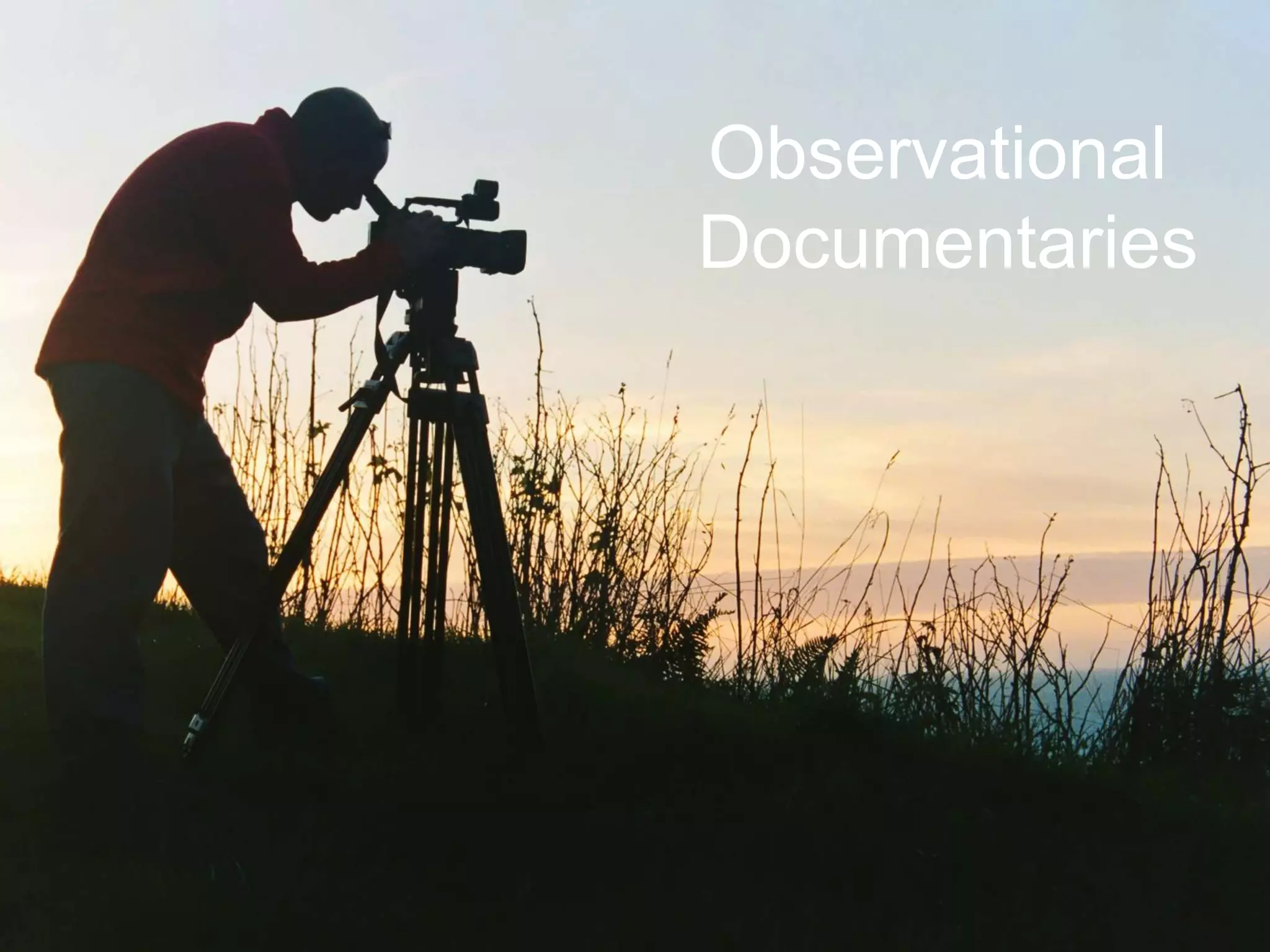
Observational
Documentaries
D E F I N I T O N
This is the mode associated with ‘fly-on-the-wall’ type documentaries.
They appear to have been filmed in ‘real time’, as if the camera has
happened upon events while those involved are seemingly unaware of
the filming going on. The filmmakers correspondingly attempt not to
interfere in what is underway. We do not hear their questions and we do
not see them. There is no voiceover telling us what to think or what
conclusions we should draw, leaving the audience to make their own
conclusions
In observational documentaries the camera follows the person as the
events unfold, you watch it as it happens showing the audience exactly
what is happening. This passive way of obtaining facts, creates a more
intimate connection between the audience, by them actually witnessing real
events can cause an emotional response
from the viewer. The conventions used in observational documentaries
are as followed:
• Hand held cameras are used for location shots
• No interviews
• No voiceover
• Diegetic sound incorporated
• Long shots dominate
H O W I T ’ S D O N E
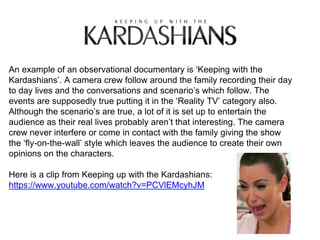
An example of an observational documentary is ‘Keeping with the
Kardashians’. A camera crew follow around the family recording their day
to day lives and the conversations and scenario’s which follow. The
events are supposedly true putting it in the ‘Reality TV’ category also.
Although the scenario’s are true, a lot of it is set up to entertain the
audience as their real lives probably aren’t that interesting. The camera
crew never interfere or come in contact with the family giving the show
the ‘fly-on-the-wall’ style which leaves the audience to create their own
opinions on the characters.
Here is a clip from Keeping up with the Kardashians:
https://www.youtube.com/watch?v=PCVlEMcyhJM

Observational documentaries

  • 1.
  • 2.
    D E FI N I T O N This is the mode associated with ‘fly-on-the-wall’ type documentaries. They appear to have been filmed in ‘real time’, as if the camera has happened upon events while those involved are seemingly unaware of the filming going on. The filmmakers correspondingly attempt not to interfere in what is underway. We do not hear their questions and we do not see them. There is no voiceover telling us what to think or what conclusions we should draw, leaving the audience to make their own conclusions
  • 3.
    In observational documentariesthe camera follows the person as the events unfold, you watch it as it happens showing the audience exactly what is happening. This passive way of obtaining facts, creates a more intimate connection between the audience, by them actually witnessing real events can cause an emotional response from the viewer. The conventions used in observational documentaries are as followed: • Hand held cameras are used for location shots • No interviews • No voiceover • Diegetic sound incorporated • Long shots dominate H O W I T ’ S D O N E
  • 4.
    An example ofan observational documentary is ‘Keeping with the Kardashians’. A camera crew follow around the family recording their day to day lives and the conversations and scenario’s which follow. The events are supposedly true putting it in the ‘Reality TV’ category also. Although the scenario’s are true, a lot of it is set up to entertain the audience as their real lives probably aren’t that interesting. The camera crew never interfere or come in contact with the family giving the show the ‘fly-on-the-wall’ style which leaves the audience to create their own opinions on the characters. Here is a clip from Keeping up with the Kardashians: https://www.youtube.com/watch?v=PCVlEMcyhJM