OBSERVATIONAL 
DOCUMENTARIES 
Charlotte Martin
Observational Documentary 
◦ An observational documentary is filmed in ‘real time’, meaning the cameras record the 
action whilst the characters pretend they are alone. This type of documentary can be 
referred to a ‘fly on the wall’ documentary, this is due to the reality of the situation. 
◦ Normally in observational documentaries there are no voice overs as it only shows the 
action however we do not see the film makers or the camera crew. 
◦ Examples of observational documentaries are Made in Chelsea and TOWIE, however 
other TV documentaries have the conventions of an observational documentary as well as 
others such as expository, with voice overs and interviews. These are examples such as 
Big Brother, 24 hours in A&E and Geordie Shore.
Institutions 
◦ Endemol is an international television production and distribution company. 
◦ It is controlled by Apollo Global Management and headquartered in the Netherlands, with around 
90 companies in over 30 countries. 
◦ Endemol created and runs reality and talent game show franchises worldwide, including Big 
Brother. 
◦ Endemol is linked with Observational Documentaries as it is the institution for many of these types 
of documentaries such as Deal or No Deal, Wipeout, The Money Drop and Your Face Sounds 
Familiar. These TV shows are all shows that are observant of the current surroundings on the show, 
that in fact are real life situations or games.
What are they known for? 
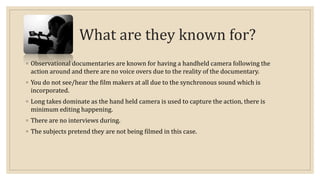
◦ Observational documentaries are known for having a handheld camera following the 
action around and there are no voice overs due to the reality of the documentary. 
◦ You do not see/hear the film makers at all due to the synchronous sound which is 
incorporated. 
◦ Long takes dominate as the hand held camera is used to capture the action, there is 
minimum editing happening. 
◦ There are no interviews during. 
◦ The subjects pretend they are not being filmed in this case.
How successful are observational 
documentaries? 
◦ These documentaries are very successful due to the reality side of the documentary. 
Reality TV is very popular at the moment due to TV shows such as Made in Chelsea and 
The Only Way is Essex. These observational documentaries are popular due to their 
relationship drama, the scenery and the whole purpose of the show, to become a favourite 
show and believe what is happening. 
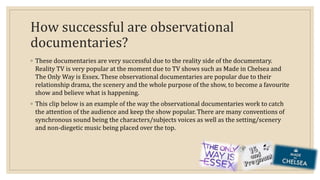
◦ This clip below is an example of the way the observational documentaries work to catch 
the attention of the audience and keep the show popular. There are many conventions of 
synchronous sound being the characters/subjects voices as well as the setting/scenery 
and non-diegetic music being placed over the top.
The target audience 
◦ The target audience are the people who enjoy watching other peoples lives and enjoying 
the reality of their lives. Reality shows such as 16 and pregnant (following pregnant girls 
around and learning how they handle it) are targeted at people who are interested in 
watching real life and the reality of others. 
◦ These shows do get negative comments as well as positive ones, but these shows target in 
particular the people who like to see people being filmed in ‘real time’. These shows are 
seen as a guilty pleasure as they aren’t always greatly shown on TV. 
◦ The audience are targeted by the use of drama, possibly arguments, the personalities of 
the characters/subjects and the music used over the top. If a popular song, for that genre 
of documentary, is used then the audience are more likely to be interested in the show as 
it can make something a little tedious a lot more interesting.
Combined Documentary? 
◦ My first initial thoughts for my coursework is to mix the conventions of an Interactive 
documentary with the common conventions of an Observational documentary. Due to this 
thought, an interactive documentary has the conventions of being filmed responding to questions 
which are edited, and also voice overs sometimes being over the top of the action. Similarly to an 
Observational documentary, there are subjects/characters pretending they don’t know the cameras 
are recording so this is why I would like to combine the two. 
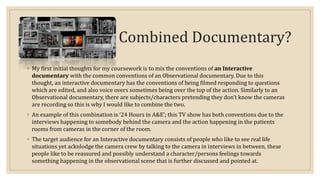
◦ An example of this combination is ‘24 Hours in A&E’; this TV show has both conventions due to the 
interviews happening to somebody behind the camera and the action happening in the patients 
rooms from cameras in the corner of the room. 
◦ The target audience for an Interactive documentary consists of people who like to see real life 
situations yet acknlodge the camera crew by talking to the camera in interviews in between, these 
people like to be reassured and possibly understand a character/persons feelings towards 
something happening in the observational scene that is further discussed and pointed at.

Observaional documentaries

  • 1.
  • 2.
    Observational Documentary ◦An observational documentary is filmed in ‘real time’, meaning the cameras record the action whilst the characters pretend they are alone. This type of documentary can be referred to a ‘fly on the wall’ documentary, this is due to the reality of the situation. ◦ Normally in observational documentaries there are no voice overs as it only shows the action however we do not see the film makers or the camera crew. ◦ Examples of observational documentaries are Made in Chelsea and TOWIE, however other TV documentaries have the conventions of an observational documentary as well as others such as expository, with voice overs and interviews. These are examples such as Big Brother, 24 hours in A&E and Geordie Shore.
  • 3.
    Institutions ◦ Endemolis an international television production and distribution company. ◦ It is controlled by Apollo Global Management and headquartered in the Netherlands, with around 90 companies in over 30 countries. ◦ Endemol created and runs reality and talent game show franchises worldwide, including Big Brother. ◦ Endemol is linked with Observational Documentaries as it is the institution for many of these types of documentaries such as Deal or No Deal, Wipeout, The Money Drop and Your Face Sounds Familiar. These TV shows are all shows that are observant of the current surroundings on the show, that in fact are real life situations or games.
  • 4.
    What are theyknown for? ◦ Observational documentaries are known for having a handheld camera following the action around and there are no voice overs due to the reality of the documentary. ◦ You do not see/hear the film makers at all due to the synchronous sound which is incorporated. ◦ Long takes dominate as the hand held camera is used to capture the action, there is minimum editing happening. ◦ There are no interviews during. ◦ The subjects pretend they are not being filmed in this case.
  • 5.
    How successful areobservational documentaries? ◦ These documentaries are very successful due to the reality side of the documentary. Reality TV is very popular at the moment due to TV shows such as Made in Chelsea and The Only Way is Essex. These observational documentaries are popular due to their relationship drama, the scenery and the whole purpose of the show, to become a favourite show and believe what is happening. ◦ This clip below is an example of the way the observational documentaries work to catch the attention of the audience and keep the show popular. There are many conventions of synchronous sound being the characters/subjects voices as well as the setting/scenery and non-diegetic music being placed over the top.
  • 6.
    The target audience ◦ The target audience are the people who enjoy watching other peoples lives and enjoying the reality of their lives. Reality shows such as 16 and pregnant (following pregnant girls around and learning how they handle it) are targeted at people who are interested in watching real life and the reality of others. ◦ These shows do get negative comments as well as positive ones, but these shows target in particular the people who like to see people being filmed in ‘real time’. These shows are seen as a guilty pleasure as they aren’t always greatly shown on TV. ◦ The audience are targeted by the use of drama, possibly arguments, the personalities of the characters/subjects and the music used over the top. If a popular song, for that genre of documentary, is used then the audience are more likely to be interested in the show as it can make something a little tedious a lot more interesting.
  • 7.
    Combined Documentary? ◦My first initial thoughts for my coursework is to mix the conventions of an Interactive documentary with the common conventions of an Observational documentary. Due to this thought, an interactive documentary has the conventions of being filmed responding to questions which are edited, and also voice overs sometimes being over the top of the action. Similarly to an Observational documentary, there are subjects/characters pretending they don’t know the cameras are recording so this is why I would like to combine the two. ◦ An example of this combination is ‘24 Hours in A&E’; this TV show has both conventions due to the interviews happening to somebody behind the camera and the action happening in the patients rooms from cameras in the corner of the room. ◦ The target audience for an Interactive documentary consists of people who like to see real life situations yet acknlodge the camera crew by talking to the camera in interviews in between, these people like to be reassured and possibly understand a character/persons feelings towards something happening in the observational scene that is further discussed and pointed at.