Part III. The Research Problem,
Objectives and Its Background
6. The Research
Objectives
7. Major
Classifications
8. Good Research
Objectives
9. The Theoretical and
the Conceptual Framework
10. Characteristics of Variables
11. Types of Variables
12. Classification of variables
The Research Objectives
Research objectives
describe what your
research is trying to
achieve and explain why
you are pursuing it. They
summarize the approach
and purpose of your
project and help to focus
your research.
Your objectives should appear in the introduction of
your research paper, at the end of your problem statement. They
should:
 Establish the scope and depth of your project
 Contribute to your research design
 Indicate how your project will contribute to existing
knowledge
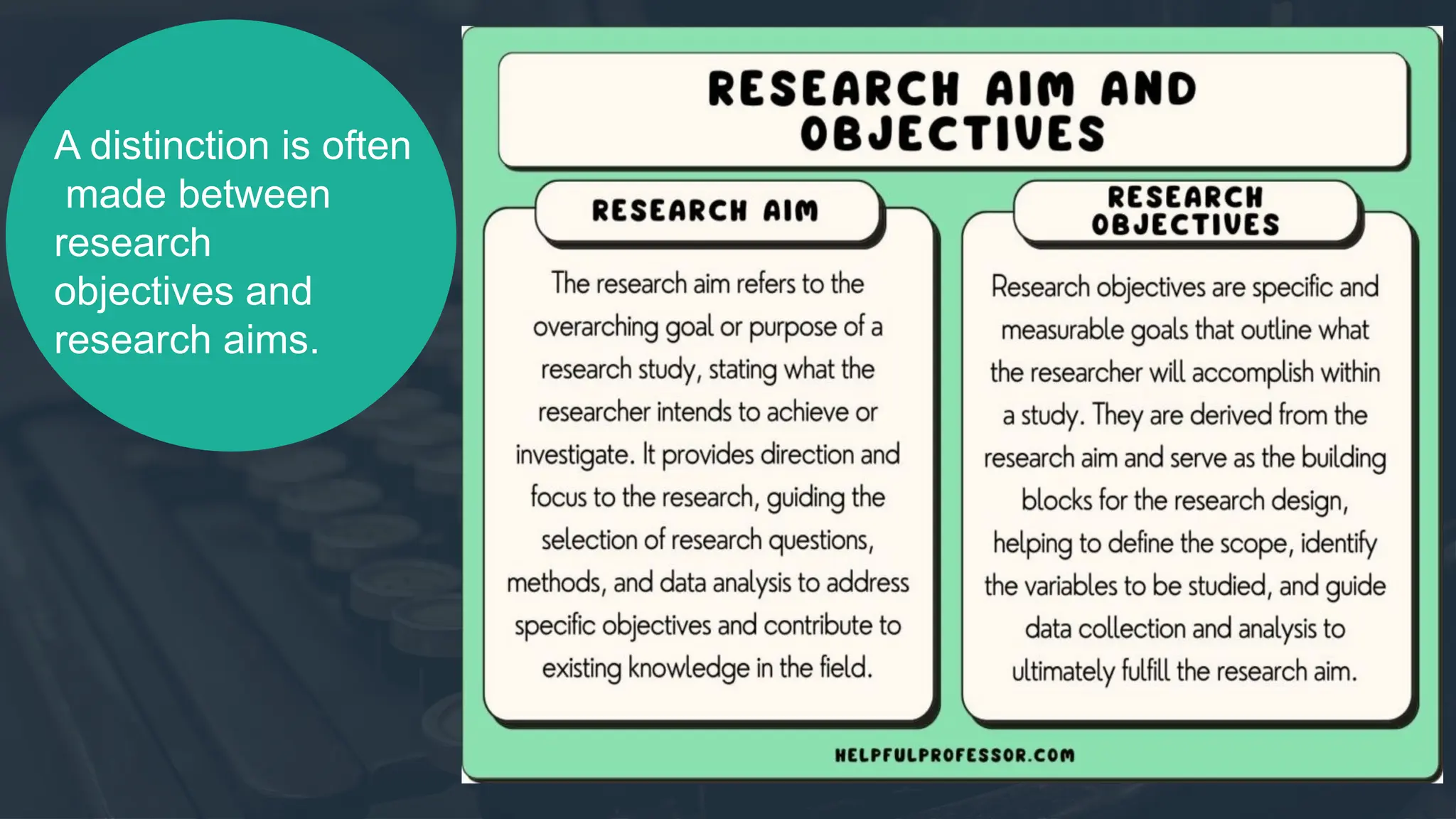
A distinction is often
made between
research
objectives and
research aims.
Research Objectives Vs Research Aims
Research aim and research objectives
are fundamental constituents of any
study, fitting together like two pieces
of the same puzzle.
The ‘research aim’ describes the
overarching goal or purpose of the
study (Kumar, 2019). This is usually
a broad, high-level purpose statement,
summing up the central question that
the research intends to answer.
Example of an Overarching
Research Aim:
“The aim of this study is to explore
the impact of climate change on
crop productivity.”
Research Objectives Vs Research Aims
Comparatively, ‘research objectives’
are concrete goals that underpin the
research aim, providing stepwise
actions to achieve the aim.
Objectives break the primary aim into
manageable, focused pieces, and
are usually characterized as being
more specific, measurable,
achievable, relevant,
and time-bound (SMART).
Examples of Specific
Research Objectives:
1. “To examine the effects of rising
temperatures on the yield of rice
crops during the upcoming growth season.”
2. “To assess changes in rainfall patterns in
major agricultural regions over the first
decade of the twenty-first century
(2000-2010).”
3. “To analyze the impact of changing
weather patterns on crop diseases within the
same timeframe.”
How To Write Research Objectives
Once you’ve established a research
problem you want to address, you
need to decide how you will address
it. This is where your research aim
and objectives come in.
The acronym “SMART” is commonly
used in relation to research
objectives. It states that your
objectives should be:
SMART is an acronym standing for Specific,
Measurable, Achievable, Relevant, and
Time-bound. It provides a clear method of
defining solid research objectives and helps
students know where to start in writing their
objectives (Locke & Latham, 2013).
Each element of this acronym adds a
distinct dimension to the framework, aiding
in the creation of comprehensive,
well-delineated objectives.
Here is each step:
Specific: We need to avoid
ambiguity in our objectives. They
need to be clear and precise
(Doran, 1981). For instance, rather
than stating the objective as
“to study the effects of social media,”
a more focused detail would be
“to examine the effects of social
media use (Facebook, Instagram,
and Twitter) on the academic
performance of college students.”
Measurable: The measurable attribute
provides a clear criterion to determine if the
objective has been met (Locke & Latham,
2013). A quantifiable element, such as a
percentage or a number, adds a measurable
quality. For example, “to increase response
rate to the annual customer survey by 10%,”
makes it easier to ascertain achievement.
Here is each step:
Achievable: The achievable aspect
encourages researchers to craft r
ealistic objectives, resembling a
self-check mechanism to ensure
the objectives align with the scope
and resources at disposal
(Doran, 1981). For example,
“to interview 25 participants
selected randomly from a population
of 100” is an attainable objective as
long as the researcher has access
to these participants.
Relevance: Relevance, the fourth element,
compels the researcher to tailor the
objectives in alignment with overarching
goals of the study (Locke & Latham, 2013).
This is extremely important – each objective
must help you meet your overall
one-sentence ‘aim’ in your study.
Here is each step:
Time-Bound: Lastly, the time-bound
element fosters a sense of urgency
and prioritization, preventing
procrastination and enhancing
productivity (Doran, 1981).
“To analyze the effect of laptop use
in lectures on student engagement
over the course of two semesters
this year” expresses a clear deadline,
thus serving as a motivator for timely
completion.
Research Objectives Examples
1. Field: Psychology
Aim: To explore the impact of sleep deprivation on cognitive performance
in college students.
Objective 1: To compare cognitive test scores of students with less
than six hours of sleep and those with 8 or more hours of sleep.
Objective 2: To investigate the relationship between class grades and
reported sleep duration.
Objective 3: To survey student perceptions and experiences on how
sleep deprivation affects their cognitive capabilities.
Research Objectives Examples
2. Field: Technology
Aim: To investigate the influence of using social media on productivity in the wo
Objective 1: To measure the amount of time spent on social media during
work hours.
Objective 2: To evaluate the perceived impact of social media use on task
completion and work efficiency.
Objective 3: To explore whether company policies on social media usage
correlate with different patterns of productivity.
Research Objectives Examples
3. Field: Education
Aim: To examine the effectiveness of online vs traditional face-to-face learning o
Objective 1: To compare student grades between the groups exposed to
online and traditional face-to-face learning.
Objective 2: To assess student engagement levels in both learning
environments.
Objective 3: To collate student perceptions and preferences regarding
both learning methods.
Research Objectives Examples
4. Field: Economics
Aim: To evaluate the effects of minimum wage increases on small businesses.
Objective 1: To analyze cost structures, pricing changes, and profitability
of small businesses before and after minimum wage increases.
Objective 2: To survey small business owners on the strategies they
employ to navigate minimum wage increases.
Objective 3: To examine employment trends in small businesses in
response to wage increase legislation.
The Importance Of Research Objectives
The importance of research objectives
cannot be overstated. In essence,
these guideposts articulate what the
researcher aims to discover,
understand, or examine (Kothari, 2014).
When drafting research objectives,
it’s essential to make them simple and
comprehensible, specific to the point
of being quantifiable where possible,
achievable in a practical sense, relevant
to the chosen research question, and
time-constrained to ensure efficient
progress (Kumar, 2019).
Remember that a good research
objective is integral to the success
of your project, offering a clear path
forward for setting out a research
design, and serving as the bedrock
of your study plan. Each objective
must distinctly address a different
dimension of your research
question or problem (Kothari, 2014).
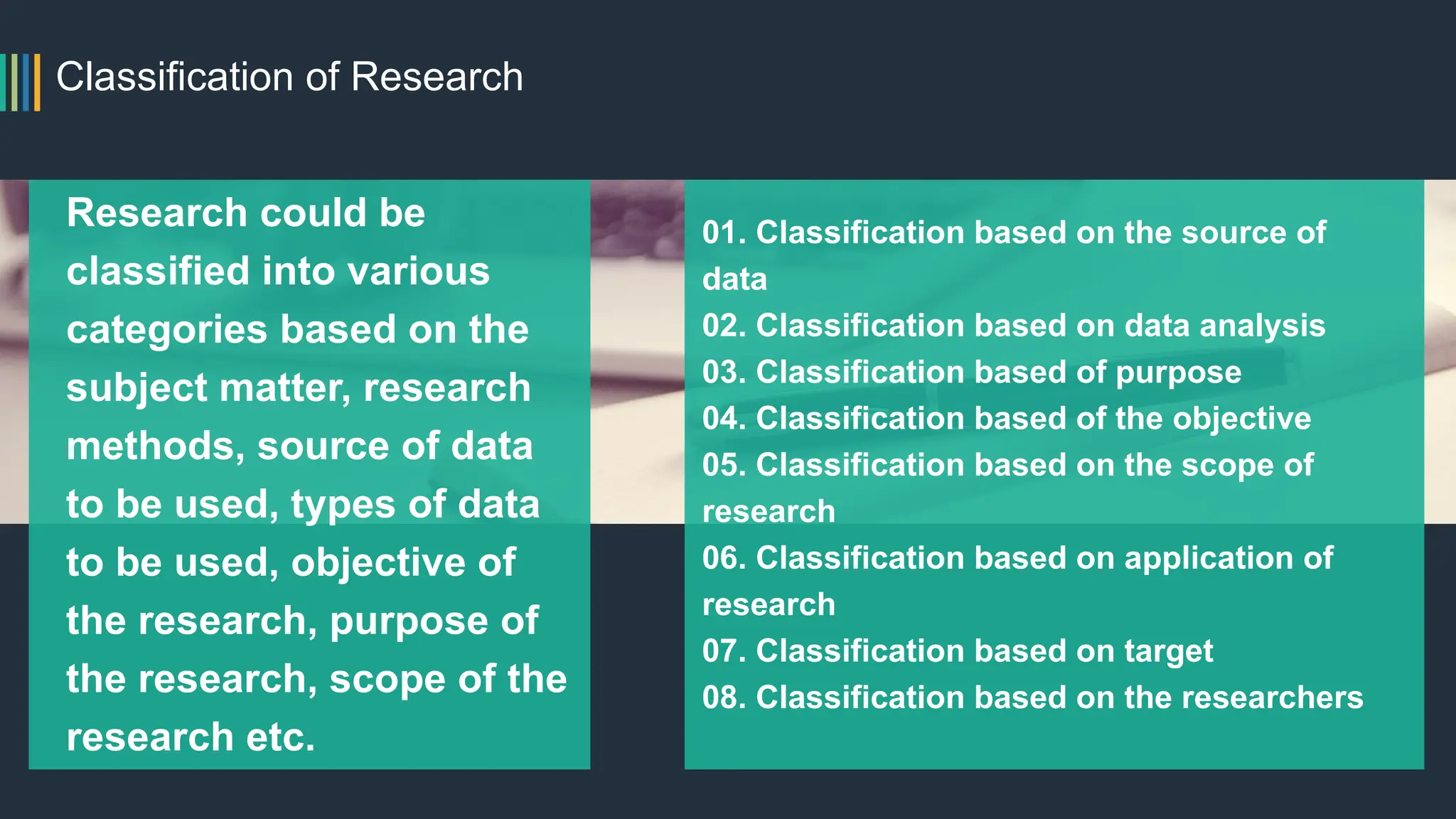
Classification of Research
Research could be
classified into various
categories based on the
subject matter, research
methods, source of data
to be used, types of data
to be used, objective of
the research, purpose of
the research, scope of the
research etc.
01. Classification based on the source of
data
02. Classification based on data analysis
03. Classification based of purpose
04. Classification based of the objective
05. Classification based on the scope of
research
06. Classification based on application of
research
07. Classification based on target
08. Classification based on the researchers
01. Classification based on the source of data:
i. Primary Research:
is defined as factual, firsthand
study written by a person who
was part of the study. The
methods vary on how
researchers run an experiment
or study, but it typically follows
the scientific method. In other
words primary research is the
original research.
ii. Secondary Research:
defined as an analysis and interpretation of
primary research. The method of writing
secondary research is to collect primary
research that is relevant to a writing topic and
interpret what the primary research found. For
instance, secondary research often takes the
form of the results from two or more primary
research articles and explains what the two
separate findings are telling us. In other words
secondary research is conducted to explain or
refer or come up a concluding decision by
explain a primary research.
02. Classification based on data analysis:
i. Qualitative Research:
primarily exploratory research. It
is used to gain an understanding
of underlying reasons, opinions,
and motivations. It provides
insights into the problem or helps
to develop ideas or hypotheses
for potential quantitative
research. Qualitative Research
is also used to uncover trends in
thought and opinions, and dive
ii. Quantitative Research:
is used to quantify the problem by way of
generating numerical data or data that can be
transformed into useable statistics. It is used to
quantify attitudes, opinions, behaviors, and other
defined variables – and generalize results from a
larger sample population. Quantitative Research
uses measurable data to formulate facts and
uncover patterns in research. Quantitative data
collection methods are much more structured
than Qualitative data collection methods.
03. Classification based of purpose:
i. Theoretical Research:
A non-empirical approach to research,
this usually involves perusal of mostly
published works like researching through
archives of public libraries, court rooms
and published academic journals. In
other words we could state that, a
theoretical research is research driven by
curiosity or interest in a scientific
question. The main motivation is to

expand man’s knowledge, not to create
or invent something.
ii. Applied Research:
The practical approach consists of the empirical
(based on testing or experience) study of the
topic under research and chiefly consists of
hands on approach. This involves first hand
research in the form of questionnaires, surveys,
interviews, observations and discussion groups.
In other form we could describe that, an applied
research is designed to solve practical problems
of the modern world.
04. Classification based of the objective:
i. Exploratory Research:
Research conducted for formulating a
problem for more clear investigation is
known as exploratory research. The
primary objective of exploratory research
is to explore a problem to provide insights
into and comprehension for more precise
investigation. It focuses on the discovery
of ideas and thoughts. The exploratory

research design is suitable for studies
which are flexible enough to provide an
opportunity for considering all the aspects
of the problem.
ii. Descriptive Research:
Research that explore and explains an
individual, group or a situation, is known as
descriptive or concluding research. It is
concerned with describing the characteristics of
a particular individual or group. It includes
research related to specific predictions, features
or functions of person or group, the narration of
facts, etc.
05. Classification based on the scope of research:
i. Diagnostic Study:
refers to studies that aim to quantify a
test’s added contribution beyond test
results readily available to the physician
in determining the presence or absence
of a particular disease.
ii. Evaluation Study:
the systematic acquisition and assessment of
information to provide useful feedback about the
outcome of a project or intervention.
06. Classification based on application of research:
i. Action Research:
is either research initiated to solve an
immediate problem or a reflective
process of progressive problem solving
led by individuals working with others in
teams or as part of a "community of
practice" to improve the way they
address issues and solve problems. It is
conducted to find solutions to problems in
a specific context.
ii. Educational Research:
refers to a variety of methods, in which
individuals evaluate different aspects of
education including: "student learning, teaching
methods, teacher training, and classroom
dynamics". It is conducted to develop and test
educational theory and derive generalizations.
07. Classification based on target:
i. Problem Oriented Research:
Research conducted by the apex private
sector institutions / development
agencies to identify development barriers
of any particular sector is known as
problem oriented research.
ii. Problem Solving Research:
esearch conducted by individual organization to
solve a problem faced by it is known as problem
solving research.
08. Classification based on the researchers:
i. Collaborative Research:
Research conducted with cross faculty /
cross disciplinary issues is known as
collaborative research. This type of
research team generally includes more
than one academic faculties / disciplines
to get the study done. Biomedical physics
could be an example of such research
field.
ii. Practitioner Research:
addresses the investigator, the setting and the
purpose. The investigator is the practitioner, in
workplace settings ranging from hospitals, to schools
and communities. The general purpose is to better
align the practitioner’s purpose with their actions.
There are those who argue that practitioner research
stems from a larger social justice movement within
qualitative research. Even when social justice is not
the sole motivating principle, an underlying
commonality of purpose is the desire to improve upon
and develop deeper insights into one’s practice.
Practitioner research by its nature offers practitioners a
voice in the research conversation.
Other types of research include the followings:
i. Experimental Research
ii. Ex Post Facto Research
iii. Comparative Research
iv. Historical Research
v. Ethnographic Research
vi. Correlational Research
vii. Grounded Theory Research
viii. Phenomenological Research
ix. Explanatory Research
x. Predictive Research
LET US PRAY!
LET US PUT OUR SELF
IN THE HOLY PRESENCE OF GOD
Part III. The Research Problem,
Objectives and Its Background
 The Theoretical and the Conceptual Framework
 Characteristics of Variables
 Types of Variables
 Classification of variables
The Theoretical and
the Conceptual Framework
Theoretical framework
refers to a set of
concepts, theories, ideas,
and assumptions that
serve as a foundation for
understanding a
particular phenomenon or
problem.
In research, a theoretical
framework explains the
relationship between various
variables, identifies gaps in
existing knowledge, and guides the
development of research
questions, hypotheses, and
methodologies.
Theoretical framework
 it’s usually presented fairly
early within the literature
review section of a
dissertation, thesis or
research paper.
The word “literature review”
can refer to two related things
that are part of the broader
literature review process.
 sourcing and reading
 actual chapter
Components of Theoretical Framework
 Concepts
 Variables
 Assumptions
 Propositions
 Hypotheses
 Constructs
 Models
Components of Theoretical Framework
 Concepts
 Variables
 Assumptions
 Propositions
 Hypotheses
 Constructs
 Models
 The basic building
blocks of a theoretical
framework. Concepts are
abstract ideas or
generalizations that
represent objects, events,
or phenomena.
Components of Theoretical Framework
 Concepts
 Variables
 Assumptions
 Propositions
 Hypotheses
 Constructs
 Models
 These are measurable
and observable aspects
of a concept.
Components of Theoretical Framework
 Concepts
 Variables
 Assumptions
 Propositions
 Hypotheses
 Constructs
 Models
 These are beliefs or
statements that are taken
for granted and are not
tested in a study.
Components of Theoretical Framework
 Concepts
 Variables
 Assumptions
 Propositions
 Hypotheses
 Constructs
 Models
 These are statements that
explain the relationships
between concepts and
variables in a theoretical
framework.
Components of Theoretical Framework
 Concepts
 Variables
 Assumptions
 Propositions
 Hypotheses
 Constructs
 Models
 These are testable
predictions that are
derived from the
theoretical framework.
Components of Theoretical Framework
 Concepts
 Variables
 Assumptions
 Propositions
 Hypotheses
 Constructs
 Models
 These are abstract
concepts that cannot be
directly measured but are
inferred from observable
variables.
Components of Theoretical Framework
 Concepts
 Variables
 Assumptions
 Propositions
 Hypotheses
 Constructs
 Models
 These are simplified
representations of reality
that are used to explain,
predict, or control a
phenomenon.
Theoretical Framework Examples
 Social Learning Theory
 Maslow’s Hierarchy of NeedsAssumptions
 Ecological Systems Theory
 Feminist Theory
 Cognitive Behavioral Theory
 Attachment Theory
 Critical Race Theory
Theoretical Framework Examples
 Social Learning Theory
This framework, developed by Albert
Bandura, suggests that people learn from
their environment, including the behaviors
of others, and that behavior is influenced by
both external and internal factors.
Theoretical Framework Examples
 Maslow’s Hierarchy of Needs
Abraham Maslow proposed that human
needs are arranged in a hierarchy, with
basic physiological needs at the bottom,
followed by safety, love and belonging,
esteem, and self-actualization at the top.
Theoretical Framework Examples
 Ecological Systems Theory
This framework, developed by Urie
Bronfenbrenner, suggests that a person’s
development is influenced by the interaction
between the individual and the various
environments in which they live, such as
family, school, and community.
Theoretical Framework Examples
 Feminist Theory
This framework examines how gender
and power intersect to influence social,
cultural, and political issues.
Theoretical Framework Examples
 Cognitive Behavioral Theory
This framework suggests that our
thoughts, beliefs, and attitudes influence
our behavior, and that changing our thought
patterns can lead to changes in behavior
and emotional responses.
Theoretical Framework Examples
 Attachment Theory
This framework examines the ways in
which early relationships with caregivers
shape our later relationships and
attachment styles.
Theoretical Framework Examples
 Critical Race Theory
This framework examines how race
intersects with other forms of social
stratification and oppression to perpetuate
inequality and discrimination.
Purposes of Theoretical Framework
 Providing a conceptual framework for the
study
 Guiding the research design
 Supporting the interpretation of research
findings
 Enhancing the credibility of the research
 Facilitating communication and collaboration
Purpose of Theoretical Framework
 Providing a conceptual framework for
the study
 Guiding the research design
 Supporting the interpretation of research
findings
 Enhancing the credibility of the research
 Facilitating communication and collaboration
Purpose of Theoretical Framework
 Providing a conceptual framework for the
study
 Guiding the research design
 Supporting the interpretation of research
findings
 Enhancing the credibility of the research
 Facilitating communication and collaboration
Purpose of Theoretical Framework
 Providing a conceptual framework for the
study
 Guiding the research design
 Supporting the interpretation of research
findings
 Enhancing the credibility of the research
 Facilitating communication and collaboration
Purpose of Theoretical Framework
 Providing a conceptual framework for the
study
 Guiding the research design
 Supporting the interpretation of research
findings
 Enhancing the credibility of the research
 Facilitating communication and collaboration
Purpose of Theoretical Framework
 Providing a conceptual framework for the
study
 Guiding the research design
 Supporting the interpretation of research
findings
 Enhancing the credibility of the research
 Facilitating communication and collaboration
Advantages of Theoretical Framework
 Provides a clear direction
 Increases the validity of the research
 Enables comparisons between studies
 Helps to generate hypotheses
 Facilitates communication
Advantages of Theoretical Framework
 Provides a clear direction
 Increases the validity of the research
 Enables comparisons between studies
 Helps to generate hypotheses
 Facilitates communication
Advantages of Theoretical Framework
 Provides a clear direction
 Increases the validity of the research
 Enables comparisons between studies
 Helps to generate hypotheses
 Facilitates communication
Advantages of Theoretical Framework
 Provides a clear direction
 Increases the validity of the research
 Enables comparisons between studies
 Helps to generate hypotheses
 Facilitates communication
Advantages of Theoretical Framework
 Provides a clear direction
 Increases the validity of the research
 Enables comparisons between studies
 Helps to generate hypotheses
 Facilitates communication
What is a Conceptual Framework
A conceptual framework includes key
concepts, variables, relationships, and
assumptions that guide the academic
inquiry.
What is a Conceptual Framework
It draws upon existing theories, models, or
established bodies of knowledge to provide a
structure for understanding the research
problem.
Purpose and Importance of a Conceptual
Framework in Research
 It clarifies the context of the study.
 It justifies the study to the reader
 It helps you check your own understanding of
the problem and the need for the study.
Purpose and Importance of a Conceptual
Framework in Research
 It clarifies the context of the study.
 It justifies the study to the reader
 It helps you check your own understanding of
the problem and the need for the study.
Purpose and Importance of a Conceptual
Framework in Research
 It clarifies the context of the study.
 It justifies the study to the reader
 It helps you check your own understanding of
the problem and the need for the study.
Purpose and Importance of a Conceptual
Framework in Research
 It helps you check your own understanding of
the problem and the need for the study.
 It illustrates the expected relationship between
the variables and defines the objectives for the
research.
Purpose and Importance of a Conceptual
Framework in Research
 It illustrates the expected relationship between
the variables and defines the objectives for the
research.
 It helps further refine the study objectives and
choose the methods appropriate to meet them.
Developing a Conceptual Framework
1. Identify a research question
2. Choose independent and dependent variables
3. Consider cause-and-effect relationships
Developing a Conceptual Framework
1. Identify a research question
• Choose a broad topic of interest
• Conduct background research
• Narrow down the focus
• Define your goals
• Make it specific and answerable
• Consider significance and novelty
• Seek feedback.
Developing a Conceptual Framework
1. Identify a research question
2. Choose independent and dependent
variables
3. Consider cause-and-effect relationships
Developing a Conceptual Framework
2. Choose independent and dependent
variables
 dependent variable is the main outcome you want to
measure, explain, or predict in your study
 Independent variables are the factors or variables that
may influence, explain, or predict changes in the
dependent variable.
Developing a Conceptual Framework
1. Identify a research question
2. Choose independent and dependent variables
3. Consider cause-and-effect relationships
Developing a Conceptual Framework
3. Consider cause-and-effect relationships
 To better understand and communicate the
relationships between variables in your study,
cause-and-effect relationships need to be
visualized.
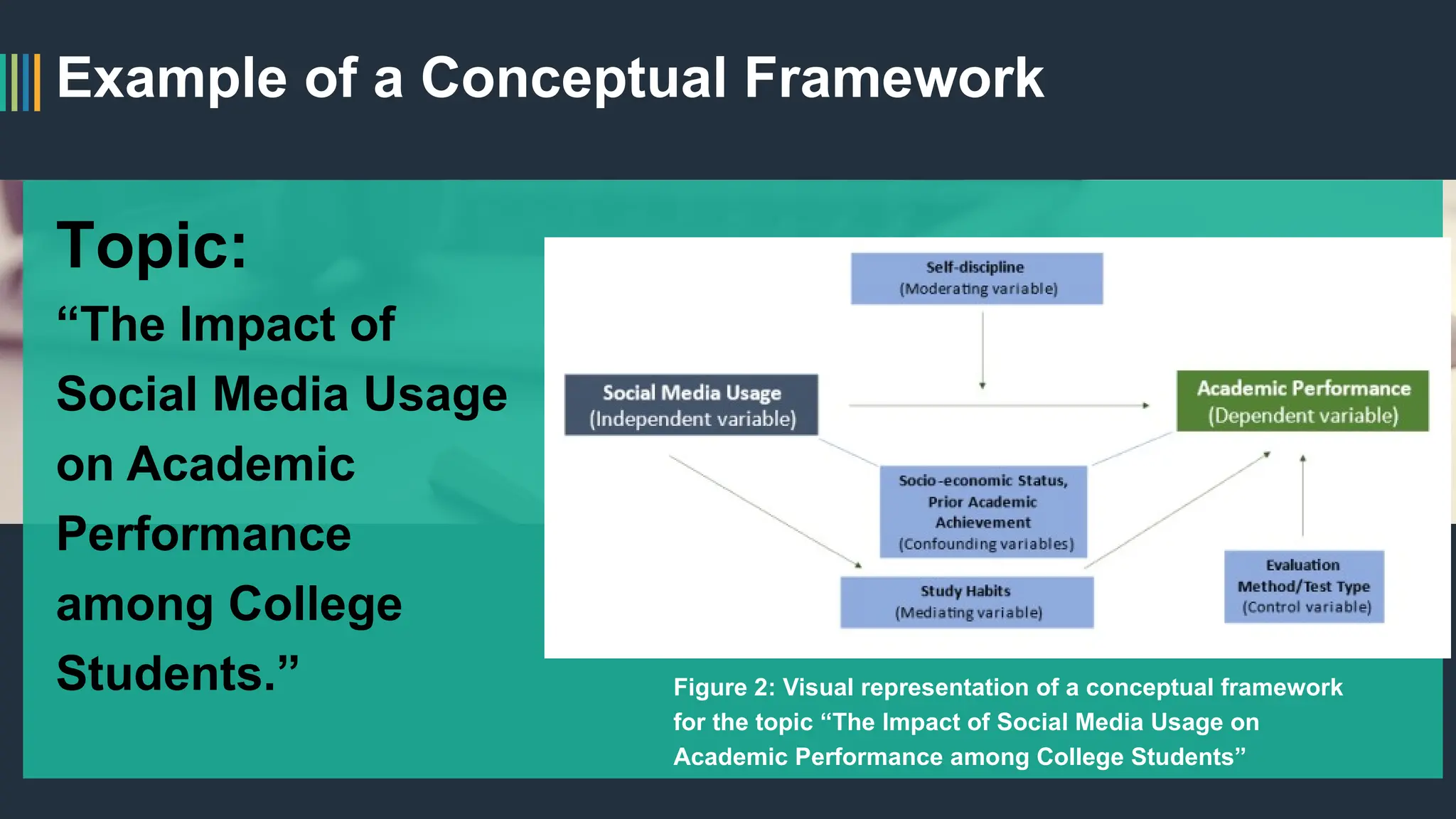
Example of a Conceptual Framework
Topic:
“The Impact of
Social Media Usage
on Academic
Performance
among College
Students.” Figure 2: Visual representation of a conceptual framework
for the topic “The Impact of Social Media Usage on
Academic Performance among College Students”
Theoretical framework vs conceptual framework
The theoretical framework is used to lay down
a foundation of theory on which your study will be built,
whereas the conceptual framework visualises what you
anticipate the relationships between concepts, constructs
and variables may be, based on your understanding of the
existing literature and the specific context and focus of
your research.
What is Variables?
A variable is a concept or abstract idea that can be
described in measurable terms.
In research, this term refers to the measurable
characteristics, qualities,
traits, or attributes of a particular individual, object,
or situation being studied.
What is Variables?
For instance, age can be considered a variable because
age can take different values for different people or for
the same person at different times.
Similarly, Income can be considered a variable because a
person's Income can be assigned a value.
What is Variables?
A variable is not only something that we
measure, but also something that we can
manipulate and something we can control for.
TYPES OF VARIABLES
 Dependent and Independent
Variables
 Moderator Variable
 Quantitative and Qualitative
Variables
 Dichotomous (Binary) Variables
 Confounding Variables
 Control Variable
TYPES OF VARIABLES
 Dependent and Independent
Variables
 Moderator Variable
 Quantitative and Qualitative
Variables
 Dichotomous (Binary) Variables
 Confounding Variables
 Control Variable
TYPES OF VARIABLES
 Dependent and Independent
Variables
 Moderator Variable
 Quantitative and Qualitative
Variables
 Dichotomous (Binary) Variables
 Confounding Variables
 Control Variable
TYPES OF VARIABLES
 Dependent and Independent
Variables
 Moderator Variable
 Quantitative and Qualitative
Variables
 Dichotomous (Binary) Variables
 Confounding Variables
 Control Variable
TYPES OF VARIABLES
 Dependent and Independent
Variables
 Moderator Variable
 Quantitative and Qualitative
Variables
 Dichotomous (Binary) Variables
 Confounding Variables
 Control Variable
TYPES OF VARIABLES
 Dependent and Independent
Variables
 Moderator Variable
 Quantitative and Qualitative
Variables
 Dichotomous (Binary) Variables
 Confounding Variables
 Control Variable
TYPES OF VARIABLES
 Dependent and Independent
Variables
 Moderator Variable
 Quantitative and Qualitative
Variables
 Dichotomous (Binary) Variables
 Confounding Variables
 Control Variable
Dependent and Independent
Variables
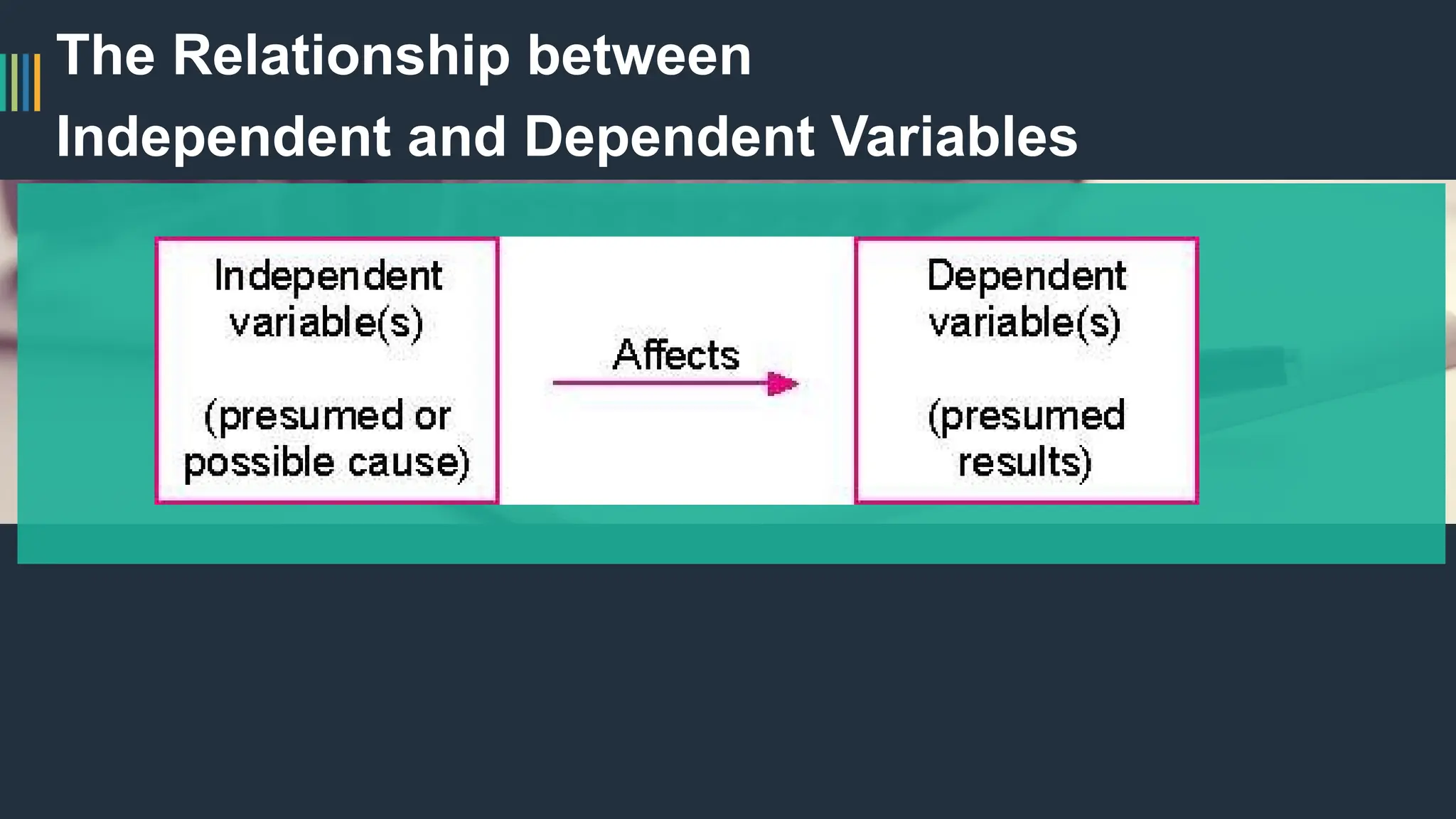
Independent variables or the predictor variable, is what the researcher
manipulates to test its effect on the dependent variable.
• It can often be thought of as the cause in a cause-and-effect
relationship.
Dependent variables the outcome or effect that the researcher wants
to study.
• In a research study, the dependent variable is the phenomenon or
behavior that may be affected by manipulations in the independent
variable.
The Relationship between
Independent and Dependent Variables
Example:
Imagine that a tutor asks 100 students to complete a maths test. The
tutor wants to know why some students perform better than others.
Whilst the tutor does not know the answer to this, she thinks that it
might be because of two reasons: (1) some students spend more time
revising for their test; and (2) some students are naturally more
intelligent than others. As such, the tutor decides to investigate the
effect of revision time and intelligence on the test performance
of the 100 students. What are the dependent and
independent variables for the study ?
Solution
Independent Variables: Revision time (measured in hours)
Intelligence (measured using IQ score)
Dependent Variable: Test Mark (measured from 0 to 100)
Another Example:
Independent Variable Example: In a study looking at how different
dosages of a medication affect the severity of symptoms, the
medication dosage is an independent variable. Researchers will adjust
the dosage to see what effect it has on the symptoms (the dependent
variable).
Dependent Variable Example: Suppose you want to study the impact
of exercise frequency on weight loss. In this case, the dependent
variable is weight loss, which changes based on how often the subject
exercises (the independent variable).
Moderator Variable
• are variables that can affect the strength or direction of
the association between the predictor (independent) and
response (dependent) variable.
• The role of a moderator is to illustrate “how” or “when”
an independent variable’s effect on a dependent variable
changes.
Moderator Variable Example:
If you are studying the effect of a training program on job
performance, a potential moderator variable could be the
employee’s education level.
The influence of the training program on job performance
could depend on the employee’s initial level of education.
Quantitative and Qualitative Variables
Quantitative variables, also known as numerical variables,
are quantifiable in nature and represented in numbers,
allowing the data collected to be measured on a scale or
range (Moodie & Johnson, 2021).
• organized
• ranked
• measured
• subjected to mathematical operations.
Quantitative and Qualitative Variables
Quantitative variables, also known as numerical variables,
are quantifiable in nature and represented in numbers,
allowing the data collected to be measured on a scale or
range (Moodie & Johnson, 2021).
• organized
• ranked
• measured
• subjected to mathematical operations.
Quantitative and Qualitative Variables
Quantitative variables, also known as numerical variables,
are quantifiable in nature and represented in numbers,
allowing the data collected to be measured on a scale or
range (Moodie & Johnson, 2021).
• organized
• ranked
• measured
• subjected to mathematical operations.
Quantitative and Qualitative Variables
Quantitative variables, also known as numerical variables,
are quantifiable in nature and represented in numbers,
allowing the data collected to be measured on a scale or
range (Moodie & Johnson, 2021).
• organized
• ranked
• measured
• subjected to mathematical operations.
Quantitative and Qualitative Variables
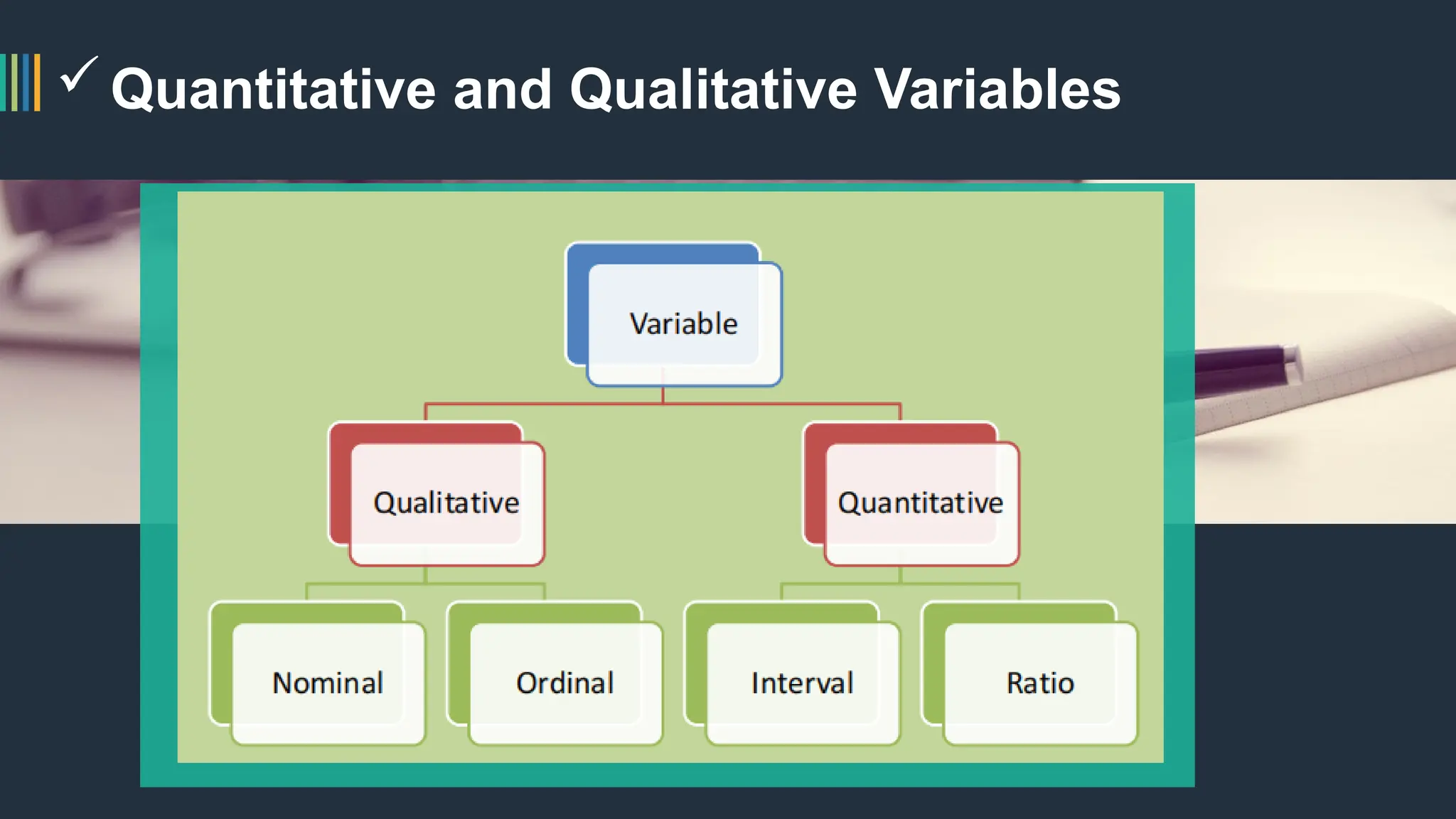
Interval, and ratio variables are quantitative.
Quantitative and Qualitative Variables
Qualitative, or categorical variables, are non-numerical
data points that categorize or group data entities based on
shared features or qualities (Moodie & Johnson, 2021).
• They are often used in research to classify particular
traits, characteristics, or properties of subjects that are
not easily quantifiable, such as colors, textures, tastes,
or smells.
Quantitative and Qualitative Variables
Ordinal, Nominal variables are qualititative
Quantitative Variable Example:
Consider a marketing survey where you ask respondents
to rate their satisfaction with your product on a scale of 1
to 10. The satisfaction score here represents a quantitative
variable. The data can be quantified and used to calculate
average satisfaction scores, identify the scope for product
improvement, or compare satisfaction levels across
different demographic groups.
Qualitative Variable Example:
Consider a survey that asks respondents to identify their
favorite color from a list of choices. The color preference
would be a qualitative variable as it categorizes data into
different categories corresponding to different colors.
Quantitative and Qualitative Variables
Measurement Scale
Nominal scale, a subtype of qualitative variables,
represent categories without any inherent order or ranking
(Norman & Streiner, 2008).
Nominal scale are often used to label or categorize
particular sets of items or individuals, with no intention of
giving numerical value or order.
For example: race, gender, or religion.
Measurement Scale
For instance, the type of car someone owns (sedan, SUV,
truck, etc.) is a nominal variable.
Measurement Scale
Ordinal scale are a subtype of categorical (qualitative)
variables with a key feature of having a clear, distinct, and
meaningful order or ranking to the categories (De Vaus,
2001).
• represent categories that can be logically arranged in a
specific order or sequence but the difference between
categories is unknown or doesn’t matter, such as
satisfaction rating scale (unsatisfied, neutral, satisfied).
Measurement Scale
A classic example of an ordinal scale is asking survey
respondents how strongly they agree or disagree with a
statement (strongly disagree, disagree, neither agree nor
disagree, agree, strongly agree).
Measurement Scale
Ratio scale are the highest level of quantitative variables
that contain a zero point or absolute zero, which
represents a complete absence of the quantity (Norman &
Streiner, 2008).
• income
• height
• weight
• temperature (in Kelvin)
Measurement Scale
Ratio scale are the highest level of quantitative variables
that contain a zero point or absolute zero, which
represents a complete absence of the quantity (Norman &
Streiner, 2008).
• income
• height
• weight
• temperature (in Kelvin)
Measurement Scale
Ratio scale are the highest level of quantitative variables
that contain a zero point or absolute zero, which
represents a complete absence of the quantity (Norman &
Streiner, 2008).
• income
• height
• weight
• temperature (in Kelvin)
Measurement Scale
Ratio scale are the highest level of quantitative variables
that contain a zero point or absolute zero, which
represents a complete absence of the quantity (Norman &
Streiner, 2008).
• income
• height
• weight
• temperature (in Kelvin)
Measurement Scale
Ratio Scale Example:
An individual’s annual income is a ratio variable. You
can say someone earning $50,000 earns twice as much as
someone making $25,000. The zero point in this case
would be an income of $0, which indicates that no income
is being earned.
Measurement Scale
Interval scale are quantitative variables that have equal,
predictable differences between values, but they do not
have a true zero point (Norman & Streiner, 2008).
• similar to ratio variables; both provide a clear ordering
of categories and have equal intervals between
successive values. The primary difference is the
absence of an absolute zero.
Measurement Scale
Interval Variable Example:
The classic example of an interval variable is the
temperature in Fahrenheit or Celsius. The difference
between 20 degrees and 30 degrees is the same as the
difference between 70 degrees and 80 degrees, but there
isn’t a true zero because the scale doesn’t start from
absolute nonexistence of the quantity being measured.
Dichotomous (Binary) Variables
Dichotomous or binary variables are a type of categorical
variable that consist of only two opposing categories like
true/false, yes/no, success/failure, and so on (Adams &
McGuire, 2022).
Example: Whether a customer completed a transaction
(Yes or No) is a binary variable. Either they completed the
purchase (yes) or they did not (no).
Confounding Variables
Confounding variables—also known as confounders—are
variables that might distort, confuse or interfere with the
relationship between an independent variable and a
dependent variable, leading to a false correlation
(Boniface, 2019).
Confounding Variables
Example:
If you’re studying the relationship between physical
activity and heart health, diet could potentially act as a
confounding variable. People who are physically active
often also eat healthier diets, which could independently
improve heart health [National Heart, Lung, and Blood
Institute].
 Control Variables
• are variables in a research study that the researcher
keeps constant to prevent them from interfering with the
relationship between the independent and dependent
variables (Sproull, 2002).
• isolate the effects of the independent variable on the
dependent variable, ensuring that any changes
observed are solely due to the manipulation of the
independent variable and not an external factor.
 Control Variables
Example:
In a study evaluating the impact of a tutoring program
on student performance, some control variables could
include the teacher’s experience, the type of test used to
measure performance, and the student’s previous grades.
CONCLUSION:
Variables play a crucial role in data analysis.
Knowing your variables will make you a better researcher.
always need to be in the backs of our minds.
You need to think about during study design, matching the
research design to the research objectives.
references:
https://helpfulprofessor.com/research-objectives-examples/
https://www.scribbr.com/research-process/research-objectives/
https://www.slideshare.net/shaziazamir3/classification-of-research-by-purpose-method?from_action=save
https://www.linkedin.com/pulse/definition-classification-research-md-joynal-abdin#:~:text=It%20is%20divided%20into
%20two,processes%2C%20products%2C%20or%20techniques.
https://researchmethod.net/theoretical-framework/
https://researcher.life/blog/article/what-is-a-conceptual-framework-and-how-to-make-it-with-examples/
https://myperfectwords.com/blog/research-paper-examples/theoretical-framework-examples-research-paper.pdf
https://www.slideshare.net/xharmaine116/sample-thesis-77906645
https://helpfulprofessor.com/types-of-variables/
https://www.slideshare.net/ankitachaturvedi2360/types-of-variables-in-research
THANK YOU
End of my report

Research Problem. objectives and its bac

  • 1.
    Part III. TheResearch Problem, Objectives and Its Background 6. The Research Objectives 7. Major Classifications 8. Good Research Objectives 9. The Theoretical and the Conceptual Framework 10. Characteristics of Variables 11. Types of Variables 12. Classification of variables
  • 2.
    The Research Objectives Researchobjectives describe what your research is trying to achieve and explain why you are pursuing it. They summarize the approach and purpose of your project and help to focus your research. Your objectives should appear in the introduction of your research paper, at the end of your problem statement. They should:  Establish the scope and depth of your project  Contribute to your research design  Indicate how your project will contribute to existing knowledge
  • 3.
    A distinction isoften made between research objectives and research aims.
  • 4.
    Research Objectives VsResearch Aims Research aim and research objectives are fundamental constituents of any study, fitting together like two pieces of the same puzzle. The ‘research aim’ describes the overarching goal or purpose of the study (Kumar, 2019). This is usually a broad, high-level purpose statement, summing up the central question that the research intends to answer. Example of an Overarching Research Aim: “The aim of this study is to explore the impact of climate change on crop productivity.”
  • 5.
    Research Objectives VsResearch Aims Comparatively, ‘research objectives’ are concrete goals that underpin the research aim, providing stepwise actions to achieve the aim. Objectives break the primary aim into manageable, focused pieces, and are usually characterized as being more specific, measurable, achievable, relevant, and time-bound (SMART). Examples of Specific Research Objectives: 1. “To examine the effects of rising temperatures on the yield of rice crops during the upcoming growth season.” 2. “To assess changes in rainfall patterns in major agricultural regions over the first decade of the twenty-first century (2000-2010).” 3. “To analyze the impact of changing weather patterns on crop diseases within the same timeframe.”
  • 6.
    How To WriteResearch Objectives Once you’ve established a research problem you want to address, you need to decide how you will address it. This is where your research aim and objectives come in. The acronym “SMART” is commonly used in relation to research objectives. It states that your objectives should be: SMART is an acronym standing for Specific, Measurable, Achievable, Relevant, and Time-bound. It provides a clear method of defining solid research objectives and helps students know where to start in writing their objectives (Locke & Latham, 2013). Each element of this acronym adds a distinct dimension to the framework, aiding in the creation of comprehensive, well-delineated objectives.
  • 7.
    Here is eachstep: Specific: We need to avoid ambiguity in our objectives. They need to be clear and precise (Doran, 1981). For instance, rather than stating the objective as “to study the effects of social media,” a more focused detail would be “to examine the effects of social media use (Facebook, Instagram, and Twitter) on the academic performance of college students.” Measurable: The measurable attribute provides a clear criterion to determine if the objective has been met (Locke & Latham, 2013). A quantifiable element, such as a percentage or a number, adds a measurable quality. For example, “to increase response rate to the annual customer survey by 10%,” makes it easier to ascertain achievement.
  • 8.
    Here is eachstep: Achievable: The achievable aspect encourages researchers to craft r ealistic objectives, resembling a self-check mechanism to ensure the objectives align with the scope and resources at disposal (Doran, 1981). For example, “to interview 25 participants selected randomly from a population of 100” is an attainable objective as long as the researcher has access to these participants. Relevance: Relevance, the fourth element, compels the researcher to tailor the objectives in alignment with overarching goals of the study (Locke & Latham, 2013). This is extremely important – each objective must help you meet your overall one-sentence ‘aim’ in your study.
  • 9.
    Here is eachstep: Time-Bound: Lastly, the time-bound element fosters a sense of urgency and prioritization, preventing procrastination and enhancing productivity (Doran, 1981). “To analyze the effect of laptop use in lectures on student engagement over the course of two semesters this year” expresses a clear deadline, thus serving as a motivator for timely completion.
  • 10.
    Research Objectives Examples 1.Field: Psychology Aim: To explore the impact of sleep deprivation on cognitive performance in college students. Objective 1: To compare cognitive test scores of students with less than six hours of sleep and those with 8 or more hours of sleep. Objective 2: To investigate the relationship between class grades and reported sleep duration. Objective 3: To survey student perceptions and experiences on how sleep deprivation affects their cognitive capabilities.
  • 11.
    Research Objectives Examples 2.Field: Technology Aim: To investigate the influence of using social media on productivity in the wo Objective 1: To measure the amount of time spent on social media during work hours. Objective 2: To evaluate the perceived impact of social media use on task completion and work efficiency. Objective 3: To explore whether company policies on social media usage correlate with different patterns of productivity.
  • 12.
    Research Objectives Examples 3.Field: Education Aim: To examine the effectiveness of online vs traditional face-to-face learning o Objective 1: To compare student grades between the groups exposed to online and traditional face-to-face learning. Objective 2: To assess student engagement levels in both learning environments. Objective 3: To collate student perceptions and preferences regarding both learning methods.
  • 13.
    Research Objectives Examples 4.Field: Economics Aim: To evaluate the effects of minimum wage increases on small businesses. Objective 1: To analyze cost structures, pricing changes, and profitability of small businesses before and after minimum wage increases. Objective 2: To survey small business owners on the strategies they employ to navigate minimum wage increases. Objective 3: To examine employment trends in small businesses in response to wage increase legislation.
  • 14.
    The Importance OfResearch Objectives The importance of research objectives cannot be overstated. In essence, these guideposts articulate what the researcher aims to discover, understand, or examine (Kothari, 2014). When drafting research objectives, it’s essential to make them simple and comprehensible, specific to the point of being quantifiable where possible, achievable in a practical sense, relevant to the chosen research question, and time-constrained to ensure efficient progress (Kumar, 2019). Remember that a good research objective is integral to the success of your project, offering a clear path forward for setting out a research design, and serving as the bedrock of your study plan. Each objective must distinctly address a different dimension of your research question or problem (Kothari, 2014).
  • 15.
    Classification of Research Researchcould be classified into various categories based on the subject matter, research methods, source of data to be used, types of data to be used, objective of the research, purpose of the research, scope of the research etc. 01. Classification based on the source of data 02. Classification based on data analysis 03. Classification based of purpose 04. Classification based of the objective 05. Classification based on the scope of research 06. Classification based on application of research 07. Classification based on target 08. Classification based on the researchers
  • 16.
    01. Classification basedon the source of data: i. Primary Research: is defined as factual, firsthand study written by a person who was part of the study. The methods vary on how researchers run an experiment or study, but it typically follows the scientific method. In other words primary research is the original research. ii. Secondary Research: defined as an analysis and interpretation of primary research. The method of writing secondary research is to collect primary research that is relevant to a writing topic and interpret what the primary research found. For instance, secondary research often takes the form of the results from two or more primary research articles and explains what the two separate findings are telling us. In other words secondary research is conducted to explain or refer or come up a concluding decision by explain a primary research.
  • 17.
    02. Classification basedon data analysis: i. Qualitative Research: primarily exploratory research. It is used to gain an understanding of underlying reasons, opinions, and motivations. It provides insights into the problem or helps to develop ideas or hypotheses for potential quantitative research. Qualitative Research is also used to uncover trends in thought and opinions, and dive ii. Quantitative Research: is used to quantify the problem by way of generating numerical data or data that can be transformed into useable statistics. It is used to quantify attitudes, opinions, behaviors, and other defined variables – and generalize results from a larger sample population. Quantitative Research uses measurable data to formulate facts and uncover patterns in research. Quantitative data collection methods are much more structured than Qualitative data collection methods.
  • 18.
    03. Classification basedof purpose: i. Theoretical Research: A non-empirical approach to research, this usually involves perusal of mostly published works like researching through archives of public libraries, court rooms and published academic journals. In other words we could state that, a theoretical research is research driven by curiosity or interest in a scientific question. The main motivation is to expand man’s knowledge, not to create or invent something. ii. Applied Research: The practical approach consists of the empirical (based on testing or experience) study of the topic under research and chiefly consists of hands on approach. This involves first hand research in the form of questionnaires, surveys, interviews, observations and discussion groups. In other form we could describe that, an applied research is designed to solve practical problems of the modern world.
  • 19.
    04. Classification basedof the objective: i. Exploratory Research: Research conducted for formulating a problem for more clear investigation is known as exploratory research. The primary objective of exploratory research is to explore a problem to provide insights into and comprehension for more precise investigation. It focuses on the discovery of ideas and thoughts. The exploratory research design is suitable for studies which are flexible enough to provide an opportunity for considering all the aspects of the problem. ii. Descriptive Research: Research that explore and explains an individual, group or a situation, is known as descriptive or concluding research. It is concerned with describing the characteristics of a particular individual or group. It includes research related to specific predictions, features or functions of person or group, the narration of facts, etc.
  • 20.
    05. Classification basedon the scope of research: i. Diagnostic Study: refers to studies that aim to quantify a test’s added contribution beyond test results readily available to the physician in determining the presence or absence of a particular disease. ii. Evaluation Study: the systematic acquisition and assessment of information to provide useful feedback about the outcome of a project or intervention.
  • 21.
    06. Classification basedon application of research: i. Action Research: is either research initiated to solve an immediate problem or a reflective process of progressive problem solving led by individuals working with others in teams or as part of a "community of practice" to improve the way they address issues and solve problems. It is conducted to find solutions to problems in a specific context. ii. Educational Research: refers to a variety of methods, in which individuals evaluate different aspects of education including: "student learning, teaching methods, teacher training, and classroom dynamics". It is conducted to develop and test educational theory and derive generalizations.
  • 22.
    07. Classification basedon target: i. Problem Oriented Research: Research conducted by the apex private sector institutions / development agencies to identify development barriers of any particular sector is known as problem oriented research. ii. Problem Solving Research: esearch conducted by individual organization to solve a problem faced by it is known as problem solving research.
  • 23.
    08. Classification basedon the researchers: i. Collaborative Research: Research conducted with cross faculty / cross disciplinary issues is known as collaborative research. This type of research team generally includes more than one academic faculties / disciplines to get the study done. Biomedical physics could be an example of such research field. ii. Practitioner Research: addresses the investigator, the setting and the purpose. The investigator is the practitioner, in workplace settings ranging from hospitals, to schools and communities. The general purpose is to better align the practitioner’s purpose with their actions. There are those who argue that practitioner research stems from a larger social justice movement within qualitative research. Even when social justice is not the sole motivating principle, an underlying commonality of purpose is the desire to improve upon and develop deeper insights into one’s practice. Practitioner research by its nature offers practitioners a voice in the research conversation.
  • 24.
    Other types ofresearch include the followings: i. Experimental Research ii. Ex Post Facto Research iii. Comparative Research iv. Historical Research v. Ethnographic Research vi. Correlational Research vii. Grounded Theory Research viii. Phenomenological Research ix. Explanatory Research x. Predictive Research
  • 25.
    LET US PRAY! LETUS PUT OUR SELF IN THE HOLY PRESENCE OF GOD
  • 26.
    Part III. TheResearch Problem, Objectives and Its Background  The Theoretical and the Conceptual Framework  Characteristics of Variables  Types of Variables  Classification of variables
  • 27.
    The Theoretical and theConceptual Framework Theoretical framework refers to a set of concepts, theories, ideas, and assumptions that serve as a foundation for understanding a particular phenomenon or problem. In research, a theoretical framework explains the relationship between various variables, identifies gaps in existing knowledge, and guides the development of research questions, hypotheses, and methodologies.
  • 28.
    Theoretical framework  it’susually presented fairly early within the literature review section of a dissertation, thesis or research paper. The word “literature review” can refer to two related things that are part of the broader literature review process.  sourcing and reading  actual chapter
  • 29.
    Components of TheoreticalFramework  Concepts  Variables  Assumptions  Propositions  Hypotheses  Constructs  Models
  • 30.
    Components of TheoreticalFramework  Concepts  Variables  Assumptions  Propositions  Hypotheses  Constructs  Models  The basic building blocks of a theoretical framework. Concepts are abstract ideas or generalizations that represent objects, events, or phenomena.
  • 31.
    Components of TheoreticalFramework  Concepts  Variables  Assumptions  Propositions  Hypotheses  Constructs  Models  These are measurable and observable aspects of a concept.
  • 32.
    Components of TheoreticalFramework  Concepts  Variables  Assumptions  Propositions  Hypotheses  Constructs  Models  These are beliefs or statements that are taken for granted and are not tested in a study.
  • 33.
    Components of TheoreticalFramework  Concepts  Variables  Assumptions  Propositions  Hypotheses  Constructs  Models  These are statements that explain the relationships between concepts and variables in a theoretical framework.
  • 34.
    Components of TheoreticalFramework  Concepts  Variables  Assumptions  Propositions  Hypotheses  Constructs  Models  These are testable predictions that are derived from the theoretical framework.
  • 35.
    Components of TheoreticalFramework  Concepts  Variables  Assumptions  Propositions  Hypotheses  Constructs  Models  These are abstract concepts that cannot be directly measured but are inferred from observable variables.
  • 36.
    Components of TheoreticalFramework  Concepts  Variables  Assumptions  Propositions  Hypotheses  Constructs  Models  These are simplified representations of reality that are used to explain, predict, or control a phenomenon.
  • 37.
    Theoretical Framework Examples Social Learning Theory  Maslow’s Hierarchy of NeedsAssumptions  Ecological Systems Theory  Feminist Theory  Cognitive Behavioral Theory  Attachment Theory  Critical Race Theory
  • 38.
    Theoretical Framework Examples Social Learning Theory This framework, developed by Albert Bandura, suggests that people learn from their environment, including the behaviors of others, and that behavior is influenced by both external and internal factors.
  • 39.
    Theoretical Framework Examples Maslow’s Hierarchy of Needs Abraham Maslow proposed that human needs are arranged in a hierarchy, with basic physiological needs at the bottom, followed by safety, love and belonging, esteem, and self-actualization at the top.
  • 40.
    Theoretical Framework Examples Ecological Systems Theory This framework, developed by Urie Bronfenbrenner, suggests that a person’s development is influenced by the interaction between the individual and the various environments in which they live, such as family, school, and community.
  • 41.
    Theoretical Framework Examples Feminist Theory This framework examines how gender and power intersect to influence social, cultural, and political issues.
  • 42.
    Theoretical Framework Examples Cognitive Behavioral Theory This framework suggests that our thoughts, beliefs, and attitudes influence our behavior, and that changing our thought patterns can lead to changes in behavior and emotional responses.
  • 43.
    Theoretical Framework Examples Attachment Theory This framework examines the ways in which early relationships with caregivers shape our later relationships and attachment styles.
  • 44.
    Theoretical Framework Examples Critical Race Theory This framework examines how race intersects with other forms of social stratification and oppression to perpetuate inequality and discrimination.
  • 45.
    Purposes of TheoreticalFramework  Providing a conceptual framework for the study  Guiding the research design  Supporting the interpretation of research findings  Enhancing the credibility of the research  Facilitating communication and collaboration
  • 46.
    Purpose of TheoreticalFramework  Providing a conceptual framework for the study  Guiding the research design  Supporting the interpretation of research findings  Enhancing the credibility of the research  Facilitating communication and collaboration
  • 47.
    Purpose of TheoreticalFramework  Providing a conceptual framework for the study  Guiding the research design  Supporting the interpretation of research findings  Enhancing the credibility of the research  Facilitating communication and collaboration
  • 48.
    Purpose of TheoreticalFramework  Providing a conceptual framework for the study  Guiding the research design  Supporting the interpretation of research findings  Enhancing the credibility of the research  Facilitating communication and collaboration
  • 49.
    Purpose of TheoreticalFramework  Providing a conceptual framework for the study  Guiding the research design  Supporting the interpretation of research findings  Enhancing the credibility of the research  Facilitating communication and collaboration
  • 50.
    Purpose of TheoreticalFramework  Providing a conceptual framework for the study  Guiding the research design  Supporting the interpretation of research findings  Enhancing the credibility of the research  Facilitating communication and collaboration
  • 51.
    Advantages of TheoreticalFramework  Provides a clear direction  Increases the validity of the research  Enables comparisons between studies  Helps to generate hypotheses  Facilitates communication
  • 52.
    Advantages of TheoreticalFramework  Provides a clear direction  Increases the validity of the research  Enables comparisons between studies  Helps to generate hypotheses  Facilitates communication
  • 53.
    Advantages of TheoreticalFramework  Provides a clear direction  Increases the validity of the research  Enables comparisons between studies  Helps to generate hypotheses  Facilitates communication
  • 54.
    Advantages of TheoreticalFramework  Provides a clear direction  Increases the validity of the research  Enables comparisons between studies  Helps to generate hypotheses  Facilitates communication
  • 55.
    Advantages of TheoreticalFramework  Provides a clear direction  Increases the validity of the research  Enables comparisons between studies  Helps to generate hypotheses  Facilitates communication
  • 56.
    What is aConceptual Framework A conceptual framework includes key concepts, variables, relationships, and assumptions that guide the academic inquiry.
  • 57.
    What is aConceptual Framework It draws upon existing theories, models, or established bodies of knowledge to provide a structure for understanding the research problem.
  • 58.
    Purpose and Importanceof a Conceptual Framework in Research  It clarifies the context of the study.  It justifies the study to the reader  It helps you check your own understanding of the problem and the need for the study.
  • 59.
    Purpose and Importanceof a Conceptual Framework in Research  It clarifies the context of the study.  It justifies the study to the reader  It helps you check your own understanding of the problem and the need for the study.
  • 60.
    Purpose and Importanceof a Conceptual Framework in Research  It clarifies the context of the study.  It justifies the study to the reader  It helps you check your own understanding of the problem and the need for the study.
  • 61.
    Purpose and Importanceof a Conceptual Framework in Research  It helps you check your own understanding of the problem and the need for the study.  It illustrates the expected relationship between the variables and defines the objectives for the research.
  • 62.
    Purpose and Importanceof a Conceptual Framework in Research  It illustrates the expected relationship between the variables and defines the objectives for the research.  It helps further refine the study objectives and choose the methods appropriate to meet them.
  • 63.
    Developing a ConceptualFramework 1. Identify a research question 2. Choose independent and dependent variables 3. Consider cause-and-effect relationships
  • 64.
    Developing a ConceptualFramework 1. Identify a research question • Choose a broad topic of interest • Conduct background research • Narrow down the focus • Define your goals • Make it specific and answerable • Consider significance and novelty • Seek feedback.
  • 65.
    Developing a ConceptualFramework 1. Identify a research question 2. Choose independent and dependent variables 3. Consider cause-and-effect relationships
  • 66.
    Developing a ConceptualFramework 2. Choose independent and dependent variables  dependent variable is the main outcome you want to measure, explain, or predict in your study  Independent variables are the factors or variables that may influence, explain, or predict changes in the dependent variable.
  • 67.
    Developing a ConceptualFramework 1. Identify a research question 2. Choose independent and dependent variables 3. Consider cause-and-effect relationships
  • 68.
    Developing a ConceptualFramework 3. Consider cause-and-effect relationships  To better understand and communicate the relationships between variables in your study, cause-and-effect relationships need to be visualized.
  • 69.
    Example of aConceptual Framework Topic: “The Impact of Social Media Usage on Academic Performance among College Students.” Figure 2: Visual representation of a conceptual framework for the topic “The Impact of Social Media Usage on Academic Performance among College Students”
  • 70.
    Theoretical framework vsconceptual framework The theoretical framework is used to lay down a foundation of theory on which your study will be built, whereas the conceptual framework visualises what you anticipate the relationships between concepts, constructs and variables may be, based on your understanding of the existing literature and the specific context and focus of your research.
  • 71.
    What is Variables? Avariable is a concept or abstract idea that can be described in measurable terms. In research, this term refers to the measurable characteristics, qualities, traits, or attributes of a particular individual, object, or situation being studied.
  • 72.
    What is Variables? Forinstance, age can be considered a variable because age can take different values for different people or for the same person at different times. Similarly, Income can be considered a variable because a person's Income can be assigned a value.
  • 73.
    What is Variables? Avariable is not only something that we measure, but also something that we can manipulate and something we can control for.
  • 74.
    TYPES OF VARIABLES Dependent and Independent Variables  Moderator Variable  Quantitative and Qualitative Variables  Dichotomous (Binary) Variables  Confounding Variables  Control Variable
  • 75.
    TYPES OF VARIABLES Dependent and Independent Variables  Moderator Variable  Quantitative and Qualitative Variables  Dichotomous (Binary) Variables  Confounding Variables  Control Variable
  • 76.
    TYPES OF VARIABLES Dependent and Independent Variables  Moderator Variable  Quantitative and Qualitative Variables  Dichotomous (Binary) Variables  Confounding Variables  Control Variable
  • 77.
    TYPES OF VARIABLES Dependent and Independent Variables  Moderator Variable  Quantitative and Qualitative Variables  Dichotomous (Binary) Variables  Confounding Variables  Control Variable
  • 78.
    TYPES OF VARIABLES Dependent and Independent Variables  Moderator Variable  Quantitative and Qualitative Variables  Dichotomous (Binary) Variables  Confounding Variables  Control Variable
  • 79.
    TYPES OF VARIABLES Dependent and Independent Variables  Moderator Variable  Quantitative and Qualitative Variables  Dichotomous (Binary) Variables  Confounding Variables  Control Variable
  • 80.
    TYPES OF VARIABLES Dependent and Independent Variables  Moderator Variable  Quantitative and Qualitative Variables  Dichotomous (Binary) Variables  Confounding Variables  Control Variable
  • 81.
    Dependent and Independent Variables Independentvariables or the predictor variable, is what the researcher manipulates to test its effect on the dependent variable. • It can often be thought of as the cause in a cause-and-effect relationship. Dependent variables the outcome or effect that the researcher wants to study. • In a research study, the dependent variable is the phenomenon or behavior that may be affected by manipulations in the independent variable.
  • 82.
    The Relationship between Independentand Dependent Variables
  • 83.
    Example: Imagine that atutor asks 100 students to complete a maths test. The tutor wants to know why some students perform better than others. Whilst the tutor does not know the answer to this, she thinks that it might be because of two reasons: (1) some students spend more time revising for their test; and (2) some students are naturally more intelligent than others. As such, the tutor decides to investigate the effect of revision time and intelligence on the test performance of the 100 students. What are the dependent and independent variables for the study ?
  • 84.
    Solution Independent Variables: Revisiontime (measured in hours) Intelligence (measured using IQ score) Dependent Variable: Test Mark (measured from 0 to 100)
  • 85.
    Another Example: Independent VariableExample: In a study looking at how different dosages of a medication affect the severity of symptoms, the medication dosage is an independent variable. Researchers will adjust the dosage to see what effect it has on the symptoms (the dependent variable). Dependent Variable Example: Suppose you want to study the impact of exercise frequency on weight loss. In this case, the dependent variable is weight loss, which changes based on how often the subject exercises (the independent variable).
  • 86.
    Moderator Variable • arevariables that can affect the strength or direction of the association between the predictor (independent) and response (dependent) variable. • The role of a moderator is to illustrate “how” or “when” an independent variable’s effect on a dependent variable changes.
  • 87.
    Moderator Variable Example: Ifyou are studying the effect of a training program on job performance, a potential moderator variable could be the employee’s education level. The influence of the training program on job performance could depend on the employee’s initial level of education.
  • 88.
    Quantitative and QualitativeVariables Quantitative variables, also known as numerical variables, are quantifiable in nature and represented in numbers, allowing the data collected to be measured on a scale or range (Moodie & Johnson, 2021). • organized • ranked • measured • subjected to mathematical operations.
  • 89.
    Quantitative and QualitativeVariables Quantitative variables, also known as numerical variables, are quantifiable in nature and represented in numbers, allowing the data collected to be measured on a scale or range (Moodie & Johnson, 2021). • organized • ranked • measured • subjected to mathematical operations.
  • 90.
    Quantitative and QualitativeVariables Quantitative variables, also known as numerical variables, are quantifiable in nature and represented in numbers, allowing the data collected to be measured on a scale or range (Moodie & Johnson, 2021). • organized • ranked • measured • subjected to mathematical operations.
  • 91.
    Quantitative and QualitativeVariables Quantitative variables, also known as numerical variables, are quantifiable in nature and represented in numbers, allowing the data collected to be measured on a scale or range (Moodie & Johnson, 2021). • organized • ranked • measured • subjected to mathematical operations.
  • 92.
    Quantitative and QualitativeVariables Interval, and ratio variables are quantitative.
  • 93.
    Quantitative and QualitativeVariables Qualitative, or categorical variables, are non-numerical data points that categorize or group data entities based on shared features or qualities (Moodie & Johnson, 2021). • They are often used in research to classify particular traits, characteristics, or properties of subjects that are not easily quantifiable, such as colors, textures, tastes, or smells.
  • 94.
    Quantitative and QualitativeVariables Ordinal, Nominal variables are qualititative
  • 95.
    Quantitative Variable Example: Considera marketing survey where you ask respondents to rate their satisfaction with your product on a scale of 1 to 10. The satisfaction score here represents a quantitative variable. The data can be quantified and used to calculate average satisfaction scores, identify the scope for product improvement, or compare satisfaction levels across different demographic groups.
  • 96.
    Qualitative Variable Example: Considera survey that asks respondents to identify their favorite color from a list of choices. The color preference would be a qualitative variable as it categorizes data into different categories corresponding to different colors.
  • 97.
  • 98.
  • 99.
    Measurement Scale Nominal scale,a subtype of qualitative variables, represent categories without any inherent order or ranking (Norman & Streiner, 2008). Nominal scale are often used to label or categorize particular sets of items or individuals, with no intention of giving numerical value or order. For example: race, gender, or religion.
  • 100.
    Measurement Scale For instance,the type of car someone owns (sedan, SUV, truck, etc.) is a nominal variable.
  • 101.
    Measurement Scale Ordinal scaleare a subtype of categorical (qualitative) variables with a key feature of having a clear, distinct, and meaningful order or ranking to the categories (De Vaus, 2001). • represent categories that can be logically arranged in a specific order or sequence but the difference between categories is unknown or doesn’t matter, such as satisfaction rating scale (unsatisfied, neutral, satisfied).
  • 102.
    Measurement Scale A classicexample of an ordinal scale is asking survey respondents how strongly they agree or disagree with a statement (strongly disagree, disagree, neither agree nor disagree, agree, strongly agree).
  • 103.
    Measurement Scale Ratio scaleare the highest level of quantitative variables that contain a zero point or absolute zero, which represents a complete absence of the quantity (Norman & Streiner, 2008). • income • height • weight • temperature (in Kelvin)
  • 104.
    Measurement Scale Ratio scaleare the highest level of quantitative variables that contain a zero point or absolute zero, which represents a complete absence of the quantity (Norman & Streiner, 2008). • income • height • weight • temperature (in Kelvin)
  • 105.
    Measurement Scale Ratio scaleare the highest level of quantitative variables that contain a zero point or absolute zero, which represents a complete absence of the quantity (Norman & Streiner, 2008). • income • height • weight • temperature (in Kelvin)
  • 106.
    Measurement Scale Ratio scaleare the highest level of quantitative variables that contain a zero point or absolute zero, which represents a complete absence of the quantity (Norman & Streiner, 2008). • income • height • weight • temperature (in Kelvin)
  • 107.
    Measurement Scale Ratio ScaleExample: An individual’s annual income is a ratio variable. You can say someone earning $50,000 earns twice as much as someone making $25,000. The zero point in this case would be an income of $0, which indicates that no income is being earned.
  • 108.
    Measurement Scale Interval scaleare quantitative variables that have equal, predictable differences between values, but they do not have a true zero point (Norman & Streiner, 2008). • similar to ratio variables; both provide a clear ordering of categories and have equal intervals between successive values. The primary difference is the absence of an absolute zero.
  • 109.
    Measurement Scale Interval VariableExample: The classic example of an interval variable is the temperature in Fahrenheit or Celsius. The difference between 20 degrees and 30 degrees is the same as the difference between 70 degrees and 80 degrees, but there isn’t a true zero because the scale doesn’t start from absolute nonexistence of the quantity being measured.
  • 110.
    Dichotomous (Binary) Variables Dichotomousor binary variables are a type of categorical variable that consist of only two opposing categories like true/false, yes/no, success/failure, and so on (Adams & McGuire, 2022). Example: Whether a customer completed a transaction (Yes or No) is a binary variable. Either they completed the purchase (yes) or they did not (no).
  • 111.
    Confounding Variables Confounding variables—alsoknown as confounders—are variables that might distort, confuse or interfere with the relationship between an independent variable and a dependent variable, leading to a false correlation (Boniface, 2019).
  • 112.
    Confounding Variables Example: If you’restudying the relationship between physical activity and heart health, diet could potentially act as a confounding variable. People who are physically active often also eat healthier diets, which could independently improve heart health [National Heart, Lung, and Blood Institute].
  • 113.
     Control Variables •are variables in a research study that the researcher keeps constant to prevent them from interfering with the relationship between the independent and dependent variables (Sproull, 2002). • isolate the effects of the independent variable on the dependent variable, ensuring that any changes observed are solely due to the manipulation of the independent variable and not an external factor.
  • 114.
     Control Variables Example: Ina study evaluating the impact of a tutoring program on student performance, some control variables could include the teacher’s experience, the type of test used to measure performance, and the student’s previous grades.
  • 115.
    CONCLUSION: Variables play acrucial role in data analysis. Knowing your variables will make you a better researcher. always need to be in the backs of our minds. You need to think about during study design, matching the research design to the research objectives.
  • 116.
    references: https://helpfulprofessor.com/research-objectives-examples/ https://www.scribbr.com/research-process/research-objectives/ https://www.slideshare.net/shaziazamir3/classification-of-research-by-purpose-method?from_action=save https://www.linkedin.com/pulse/definition-classification-research-md-joynal-abdin#:~:text=It%20is%20divided%20into %20two,processes%2C%20products%2C%20or%20techniques. https://researchmethod.net/theoretical-framework/ https://researcher.life/blog/article/what-is-a-conceptual-framework-and-how-to-make-it-with-examples/ https://myperfectwords.com/blog/research-paper-examples/theoretical-framework-examples-research-paper.pdf https://www.slideshare.net/xharmaine116/sample-thesis-77906645 https://helpfulprofessor.com/types-of-variables/ https://www.slideshare.net/ankitachaturvedi2360/types-of-variables-in-research
  • 117.