Obesity Health Ms. Engel
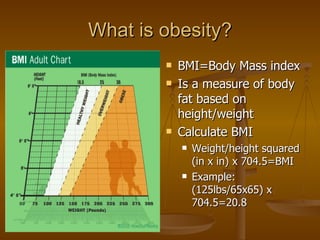
What is obesity? BMI=Body Mass index Is a measure of body fat based on height/weight Calculate BMI Weight/height squared (in x in) x 704.5=BMI Example: (125lbs/65x65) x 704.5=20.8
BMI Interpretation: under 18.5 = underweight 18.5-24 = normal weight 25-30 = overweight over 30 = obese
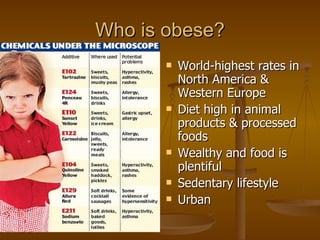
Who is obese? World-highest rates in North America & Western Europe Diet high in animal products & processed foods Wealthy and food is plentiful Sedentary lifestyle Urban
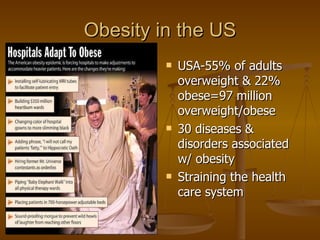
Obesity in the US USA-55% of adults overweight & 22% obese=97 million overweight/obese 30 diseases & disorders associated w/ obesity Straining the health care system
Obesity by Gender % of male and female about equal w/ women being slightly higher Men are getting heavier at a faster rate than women though
Obesity by Age, Race & Education Level Age -most obese=50-59, next 40-49/60-69, next 30-39 & then 18-29 Group that is getting heaviest, fastest=18-29 Racial  groups from most to least obese=Black, Hispanic, Native Am, White then Asian Education =not completed HS highest with advanced college degree least
Obesity by Geographic Area States w/ highest levels=W. Virginia, Mississippi, Alabama, Alaska, Michigan, S. Carolina and Florida 20% of population obese States w/ lowest=Arizona, Mass, Colorado, Vermont, New Hampshire, Montana & New Mexico Why?
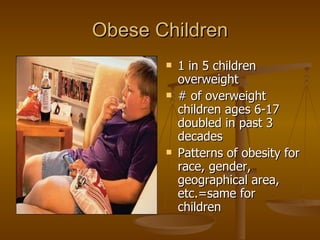
Obese Children 1 in 5 children overweight # of overweight children ages 6-17 doubled in past 3 decades Patterns of obesity for race, gender, geographical area, etc.=same for children
Health Problems Associated w/ Obesity Arthritis Hypertension (High Blood Pressure) Impaired Immune Response Birth Defects Impaired Respiratory Function Cancers Infections Cardiovascular Disease Infertility Carpal Tunnel Syndrome Liver Disease Chronic Venous Insufficiency Low Back Pain   Daytime Sleepiness Obstetric/Gynecological Complications  Deep Vein Thrombosis Pain End Stage Renal Disease Kidneys)  Gallbladder Disease Diabetes Pancreatitis Gout Heat Disorders Urinary Stress Incontinence Sleep Apnea  Surgical Complications Stroke Other
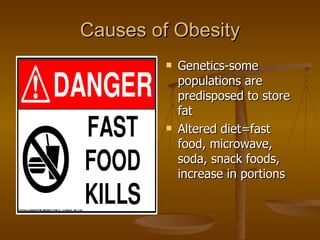
Causes of Obesity Genetics-some populations are predisposed to store fat Altered diet=fast food, microwave, soda, snack foods, increase in portions
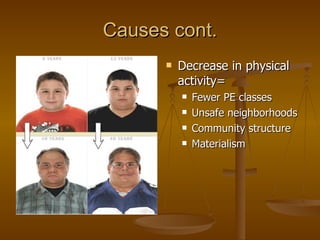
Causes cont. Decrease in physical activity= Fewer PE classes Unsafe neighborhoods Community structure Materialism
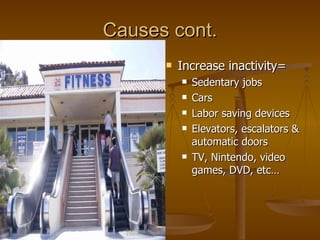
Causes cont. Increase inactivity= Sedentary jobs Cars Labor saving devices Elevators, escalators & automatic doors TV, Nintendo, video games, DVD, etc…
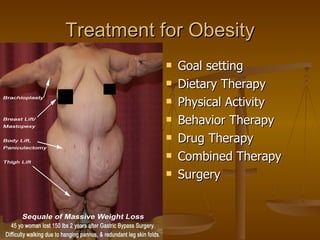
Treatment for Obesity Goal setting Dietary Therapy Physical Activity Behavior Therapy Drug Therapy Combined Therapy Surgery
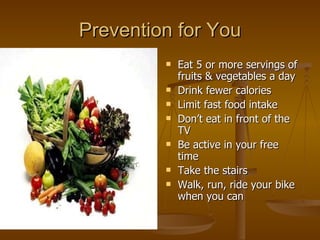
Prevention for You Eat 5 or more servings of fruits & vegetables a day Drink fewer calories Limit fast food intake Don’t eat in front of the TV Be active in your free time Take the stairs Walk, run, ride your bike when you can
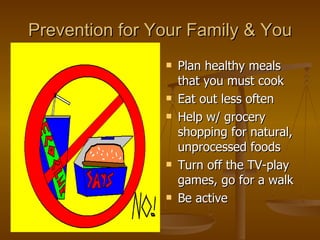
Prevention for Your Family & You Plan healthy meals that you must cook Eat out less often Help w/ grocery shopping for natural, unprocessed foods Turn off the TV-play games, go for a walk Be active
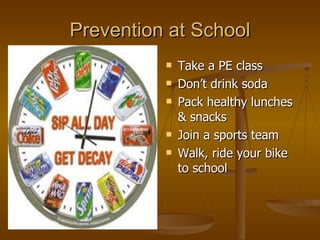
Prevention at School Take a PE class Don’t drink soda Pack healthy lunches & snacks Join a sports team Walk, ride your bike to school
In Your Community and Country Walk whenever you can Make healthy choices Vote for officials that encourage the development of parks, education, health care, etc…
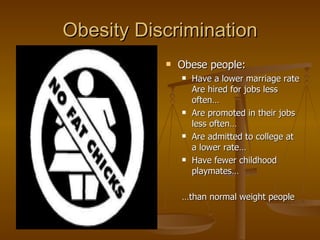
Obesity Discrimination Obese people: Have a lower marriage rate Are hired for jobs less often…  Are promoted in their jobs less often… Are admitted to college at a lower rate… Have fewer childhood playmates… … than normal weight people

Obesity

  • 1.
  • 2.
    What is obesity?BMI=Body Mass index Is a measure of body fat based on height/weight Calculate BMI Weight/height squared (in x in) x 704.5=BMI Example: (125lbs/65x65) x 704.5=20.8
  • 3.
    BMI Interpretation: under18.5 = underweight 18.5-24 = normal weight 25-30 = overweight over 30 = obese
  • 4.
    Who is obese?World-highest rates in North America & Western Europe Diet high in animal products & processed foods Wealthy and food is plentiful Sedentary lifestyle Urban
  • 5.
    Obesity in theUS USA-55% of adults overweight & 22% obese=97 million overweight/obese 30 diseases & disorders associated w/ obesity Straining the health care system
  • 6.
    Obesity by Gender% of male and female about equal w/ women being slightly higher Men are getting heavier at a faster rate than women though
  • 7.
    Obesity by Age,Race & Education Level Age -most obese=50-59, next 40-49/60-69, next 30-39 & then 18-29 Group that is getting heaviest, fastest=18-29 Racial groups from most to least obese=Black, Hispanic, Native Am, White then Asian Education =not completed HS highest with advanced college degree least
  • 8.
    Obesity by GeographicArea States w/ highest levels=W. Virginia, Mississippi, Alabama, Alaska, Michigan, S. Carolina and Florida 20% of population obese States w/ lowest=Arizona, Mass, Colorado, Vermont, New Hampshire, Montana & New Mexico Why?
  • 9.
    Obese Children 1in 5 children overweight # of overweight children ages 6-17 doubled in past 3 decades Patterns of obesity for race, gender, geographical area, etc.=same for children
  • 10.
    Health Problems Associatedw/ Obesity Arthritis Hypertension (High Blood Pressure) Impaired Immune Response Birth Defects Impaired Respiratory Function Cancers Infections Cardiovascular Disease Infertility Carpal Tunnel Syndrome Liver Disease Chronic Venous Insufficiency Low Back Pain Daytime Sleepiness Obstetric/Gynecological Complications Deep Vein Thrombosis Pain End Stage Renal Disease Kidneys) Gallbladder Disease Diabetes Pancreatitis Gout Heat Disorders Urinary Stress Incontinence Sleep Apnea Surgical Complications Stroke Other
  • 11.
    Causes of ObesityGenetics-some populations are predisposed to store fat Altered diet=fast food, microwave, soda, snack foods, increase in portions
  • 12.
    Causes cont. Decreasein physical activity= Fewer PE classes Unsafe neighborhoods Community structure Materialism
  • 13.
    Causes cont. Increaseinactivity= Sedentary jobs Cars Labor saving devices Elevators, escalators & automatic doors TV, Nintendo, video games, DVD, etc…
  • 14.
    Treatment for ObesityGoal setting Dietary Therapy Physical Activity Behavior Therapy Drug Therapy Combined Therapy Surgery
  • 15.
    Prevention for YouEat 5 or more servings of fruits & vegetables a day Drink fewer calories Limit fast food intake Don’t eat in front of the TV Be active in your free time Take the stairs Walk, run, ride your bike when you can
  • 16.
    Prevention for YourFamily & You Plan healthy meals that you must cook Eat out less often Help w/ grocery shopping for natural, unprocessed foods Turn off the TV-play games, go for a walk Be active
  • 17.
    Prevention at SchoolTake a PE class Don’t drink soda Pack healthy lunches & snacks Join a sports team Walk, ride your bike to school
  • 18.
    In Your Communityand Country Walk whenever you can Make healthy choices Vote for officials that encourage the development of parks, education, health care, etc…
  • 19.
    Obesity Discrimination Obesepeople: Have a lower marriage rate Are hired for jobs less often… Are promoted in their jobs less often… Are admitted to college at a lower rate… Have fewer childhood playmates… … than normal weight people