Quiz covers 1.3 - Up to Moral
     Management , plus Chapter 13,
             Opener, 13.1 and 13.2

                           (Wks. 4 – 5)

The slides after 13-32 in this presentation
     are optional and not on the quiz

        Copyright © 2010 John Wiley & Sons, Inc.
                                                   1-1
Manager
  › Someone whose job it is to directly support
   the work efforts of others.

Effective manager
  › One whose team consistently achieves its
   goals while members remain capable,
   committed, and enthusiastic.
         Copyright © 2010 John Wiley & Sons, Inc.
                                                    1-2
Task performance
  › Quality and quantity of the work produced
    by the work unit as a whole.

Job satisfaction
  › How people feel about their work and the
    work setting.

         Copyright © 2010 John Wiley & Sons, Inc.
                                                    1-3
The management process.
  › Planning

  › Organizing

  › Leading

  › Controlling


         Copyright © 2010 John Wiley & Sons, Inc.
                                                    1-4
Copyright © 2010 John Wiley & Sons, Inc.
                                           1-5
The nature of managerial work.
  › Managers work long hours.

  › Managers are busy people.

  › Managers are often interrupted.

  › Managerial work is fragmented and variable.

  › Managers work mostly with other people.

  › Managers spend a lot of time communicating.
         Copyright © 2010 John Wiley & Sons, Inc.
                                                    1-6
Copyright © 2010 John Wiley & Sons, Inc.
                                           1-7
Managerial skills and competencies
  (Robert Katz)

Skill
   › An ability to translate knowledge into action
        that results in a desired performance.


             Copyright © 2010 John Wiley & Sons, Inc.
                                                        1-8
There are three managerial skill areas according to
  Robert Katz:
Technical skill
   › Ability to perform specialized tasks.

Human skill
   › Ability to work well with other people.

Conceptual skill
   › Capacity to analyze and solve complex and interrelated
     problems.

              Copyright © 2010 John Wiley & Sons, Inc.
                                                         1-9
What are leadership and management?

What are situational contingency
 approaches to leadership?


        Copyright © 2010 John Wiley & Sons, Inc.
                                                   13-11
Role of management is to promote stability
  or to enable the organization to run
  smoothly.

Role of leadership is to promote adaptive
  or useful changes.


         Copyright © 2010 John Wiley & Sons, Inc.
                                                    13-12
Leadership
  › Process of influencing others to understand
   and agree on what needs to be done and
   how to do it; and

  › Process of facilitating individual and group
   efforts to accomplish shared objectives.


         Copyright © 2010 John Wiley & Sons, Inc.
                                                    13-13
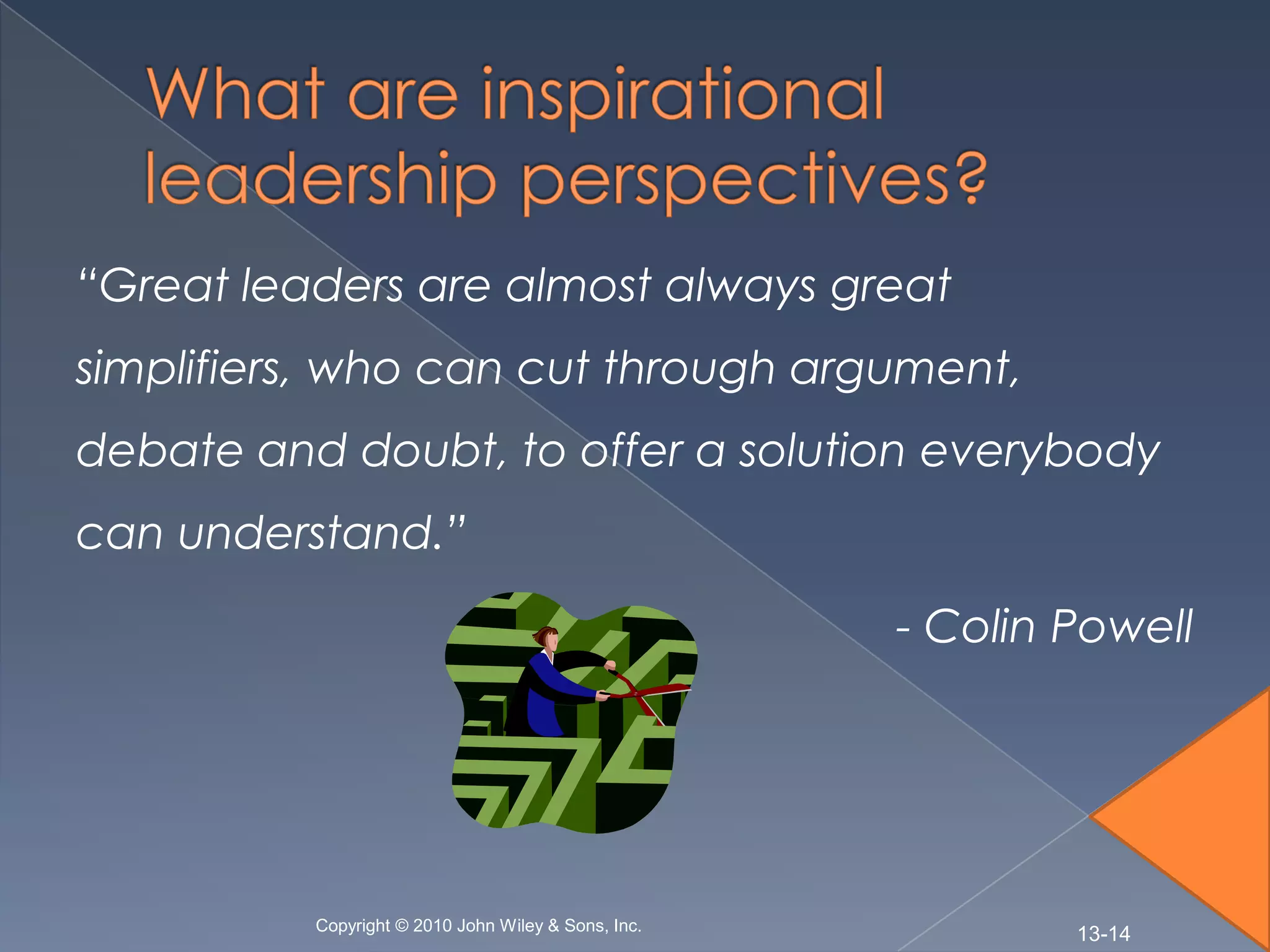
“Great leaders are almost always great
simplifiers, who can cut through argument,
debate and doubt, to offer a solution everybody
can understand.”

                                                     - Colin Powell


          Copyright © 2010 John Wiley & Sons, Inc.
                                                             13-14
Formal leadership                 Informal leadership
 Exerted by persons                    Exerted by persons who

 appointed (or elected) to             become influential

 positions of formal                   because they have
                                       special skills that meet
 authority in organizations.
                                       the resource needs of
                                       others.


                                  Copyright © 2010 John Wiley &
                          13-15   Sons, Inc.
Approaches to leadership
  1. Trait theory perspectives.

  2. Behavioral perspectives.

  3. Situational perspectives


         Copyright © 2010 John Wiley & Sons, Inc.
                                                    13-16
Trait theories of leadership
  › Assume that personality traits play a central
    role in differentiating between leaders and
    non-leaders, or in predicting leader or
    organizational outcomes.


         Copyright © 2010 John Wiley & Sons, Inc.
                                                    13-17
Copyright © 2010 John Wiley & Sons, Inc.
                                           13-18
Behavioral theories
  › Assumes that leadership is central to
    performance and other outcomes.

  › Focuses on leader behaviors rather than
    traits.


              Copyright © 2010 John Wiley & Sons, Inc.   13-19
Michigan leadership studies
  › Employee-centered supervisors:

     Place strong emphasis on subordinate’s
     welfare.

  › Production-centered supervisors:

     Place strong emphasis on getting the work
     done.
         Copyright © 2010 John Wiley & Sons, Inc.   13-20
Ohio State leadership studies
  › Consideration
       Sensitive to people’s feelings and making things
       pleasant for the followers.

  › Initiating structure
       Concerned with spelling out the task requirements
       and clarifying other aspects of the work agenda.


          Copyright © 2010 John Wiley & Sons, Inc.     13-21
Situational Contingency Leadership
  › The effects of leader traits and behaviors are
   enhanced by their relevance to the situation.


          Copyright © 2010 John Wiley & Sons, Inc.   13-22
Fiedler’s contingency model
  › Situational control

     The extent to which a leader can determine
     what his or her group is going to do, as well as
     the outcomes of the group’s actions and
     decisions.


         Copyright © 2010 John Wiley & Sons, Inc.   13-23
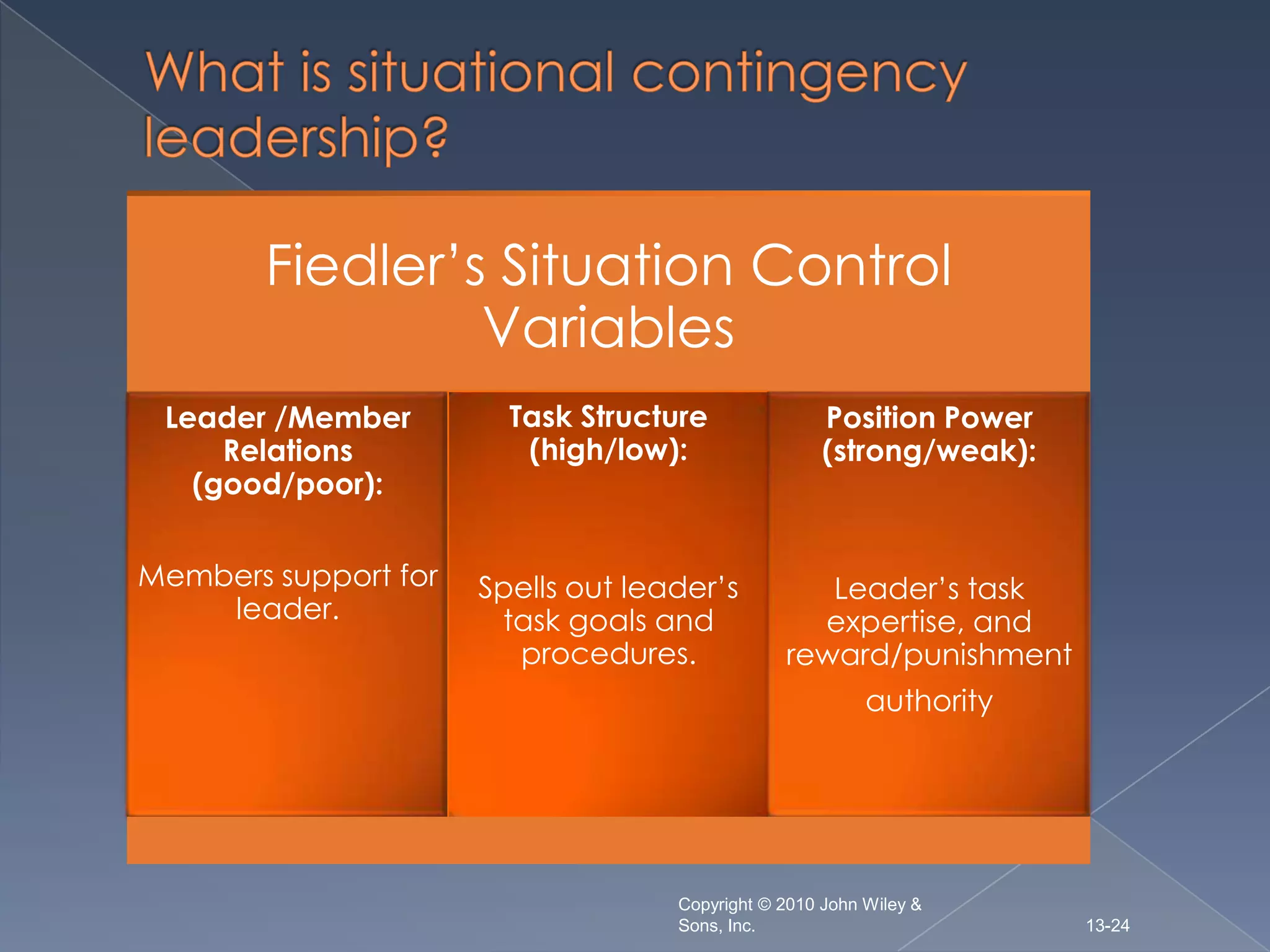
Fiedler’s Situation Control
                 Variables
 Leader /Member         Task Structure               Position Power
     Relations           (high/low):                 (strong/weak):
   (good/poor):


Members support for   Spells out leader’s          Leader’s task
    leader.            task goals and             expertise, and
                        procedures.             reward/punishment
                                                          authority


                                    Copyright © 2010 John Wiley &
                                    Sons, Inc.                        13-24
Fiedler’s model requires a match on several
parameters before leader’s effectiveness can
be predicted.
              Copyright © 2010 John Wiley & Sons, Inc.   13-25
House’s path-goal theory of leadership
  › Assumes that a leader’s key function is to
    adjust his or her behaviors to complement
    situational contingencies.


         Copyright © 2010 John Wiley & Sons, Inc.   13-26
Copyright © 2010 John Wiley & Sons, Inc.   13-27
Directive leadership
  › Informing subordinates what should be done
    and how to do it.

Supportive leadership
  › Showing care and concern for the
    subordinates’ well being.

         Copyright © 2010 John Wiley & Sons, Inc.   13-28
Achievement oriented leadership
   › Emphasizing challenging goals,
     stressing excellence in performance
     and showing confidence in
     people’s ability to achieve goals


                 Participative leadership
                           Seeking, and seriously considering
                               subordinates’ input in before making
                               decisions.


             Copyright © 2010 John Wiley & Sons, Inc.                 13-29
Hersey and Blanchard Situational
  Leadership Theory
  › Diagnose demands of the situation

  › Assess Readiness
     The extent to which the follower has the ability
     and willingness to complete a task.

  › Implement appropriate leadership response.
         Copyright © 2010 John Wiley & Sons, Inc.   13-30
Copyright © 2010 John Wiley & Sons, Inc.   13-31
Transactional leadership
 ›Involves leader-follower exchanges
  (communication) necessary for meeting routine
  performance that is agreed upon by leaders and
  followers.
   •Uses contingent rewards to motivate followers.
   •Identifies what must be done to accomplish the
    desired results.
   •Uses corrective action only when goals not met.
   •LaissezCopyright © 2010 John Wileyavoids making decisions.
            faire style – & Sons, Inc.                           13-32
Transformational leadership
  › Leaders broaden and elevate followers’
    interests, generate awareness and acceptance
    of the group’s mission, and stir followers to look
    beyond self-interests.


          Copyright © 2010 John Wiley & Sons, Inc.   13-33
Dimensions of transformational leadership
  › Charisma

  › Inspiration

  › Intellectual stimulation

  › Individualized consideration


          Copyright © 2010 John Wiley & Sons, Inc.   13-34
Charismatic/transformational leadership is
  not uniformly better
  › Dark-side charismatics can have negative
    effects on followers.

  › Effectiveness can be maximized when used
    in conjunction with traditional leadership.


         Copyright © 2010 John Wiley & Sons, Inc.   13-35
In your current or former job, did your manager
  behave the same way with each of the people
  he/she managed?
  › A=Yes, B=No

If no, what was different about the relationships
  between the manager and each employee?


          Copyright © 2010 John Wiley & Sons, Inc.   13-36
   Are decisions self serving?        Will decision stand up to
   Who wins and loses?                 CEO scrutiny?
   Have stakeholders been             Is the decision legal?
    considered?
                                       Would you want your
   What is long-term impact?
                                        family or friends to know?
   Is there enough information?
                                       Could you explain your
   Will this decision set a
                                        decision in a courtroom?
    standard for all situations?


                                   Copyright © 2010 John Wiley &
                                   Sons, Inc.                      13-37

Ob & management

  • 1.
    Quiz covers 1.3- Up to Moral Management , plus Chapter 13, Opener, 13.1 and 13.2 (Wks. 4 – 5) The slides after 13-32 in this presentation are optional and not on the quiz Copyright © 2010 John Wiley & Sons, Inc. 1-1
  • 2.
    Manager ›Someone whose job it is to directly support the work efforts of others. Effective manager › One whose team consistently achieves its goals while members remain capable, committed, and enthusiastic. Copyright © 2010 John Wiley & Sons, Inc. 1-2
  • 3.
    Task performance › Quality and quantity of the work produced by the work unit as a whole. Job satisfaction › How people feel about their work and the work setting. Copyright © 2010 John Wiley & Sons, Inc. 1-3
  • 4.
    The management process. › Planning › Organizing › Leading › Controlling Copyright © 2010 John Wiley & Sons, Inc. 1-4
  • 5.
    Copyright © 2010John Wiley & Sons, Inc. 1-5
  • 6.
    The nature ofmanagerial work. › Managers work long hours. › Managers are busy people. › Managers are often interrupted. › Managerial work is fragmented and variable. › Managers work mostly with other people. › Managers spend a lot of time communicating. Copyright © 2010 John Wiley & Sons, Inc. 1-6
  • 7.
    Copyright © 2010John Wiley & Sons, Inc. 1-7
  • 8.
    Managerial skills andcompetencies (Robert Katz) Skill › An ability to translate knowledge into action that results in a desired performance. Copyright © 2010 John Wiley & Sons, Inc. 1-8
  • 9.
    There are threemanagerial skill areas according to Robert Katz: Technical skill › Ability to perform specialized tasks. Human skill › Ability to work well with other people. Conceptual skill › Capacity to analyze and solve complex and interrelated problems. Copyright © 2010 John Wiley & Sons, Inc. 1-9
  • 11.
    What are leadershipand management? What are situational contingency approaches to leadership? Copyright © 2010 John Wiley & Sons, Inc. 13-11
  • 12.
    Role of managementis to promote stability or to enable the organization to run smoothly. Role of leadership is to promote adaptive or useful changes. Copyright © 2010 John Wiley & Sons, Inc. 13-12
  • 13.
    Leadership ›Process of influencing others to understand and agree on what needs to be done and how to do it; and › Process of facilitating individual and group efforts to accomplish shared objectives. Copyright © 2010 John Wiley & Sons, Inc. 13-13
  • 14.
    “Great leaders arealmost always great simplifiers, who can cut through argument, debate and doubt, to offer a solution everybody can understand.” - Colin Powell Copyright © 2010 John Wiley & Sons, Inc. 13-14
  • 15.
    Formal leadership Informal leadership Exerted by persons Exerted by persons who appointed (or elected) to become influential positions of formal because they have special skills that meet authority in organizations. the resource needs of others. Copyright © 2010 John Wiley & 13-15 Sons, Inc.
  • 16.
    Approaches to leadership 1. Trait theory perspectives. 2. Behavioral perspectives. 3. Situational perspectives Copyright © 2010 John Wiley & Sons, Inc. 13-16
  • 17.
    Trait theories ofleadership › Assume that personality traits play a central role in differentiating between leaders and non-leaders, or in predicting leader or organizational outcomes. Copyright © 2010 John Wiley & Sons, Inc. 13-17
  • 18.
    Copyright © 2010John Wiley & Sons, Inc. 13-18
  • 19.
    Behavioral theories › Assumes that leadership is central to performance and other outcomes. › Focuses on leader behaviors rather than traits. Copyright © 2010 John Wiley & Sons, Inc. 13-19
  • 20.
    Michigan leadership studies › Employee-centered supervisors:  Place strong emphasis on subordinate’s welfare. › Production-centered supervisors:  Place strong emphasis on getting the work done. Copyright © 2010 John Wiley & Sons, Inc. 13-20
  • 21.
    Ohio State leadershipstudies › Consideration  Sensitive to people’s feelings and making things pleasant for the followers. › Initiating structure  Concerned with spelling out the task requirements and clarifying other aspects of the work agenda. Copyright © 2010 John Wiley & Sons, Inc. 13-21
  • 22.
    Situational Contingency Leadership › The effects of leader traits and behaviors are enhanced by their relevance to the situation. Copyright © 2010 John Wiley & Sons, Inc. 13-22
  • 23.
    Fiedler’s contingency model › Situational control  The extent to which a leader can determine what his or her group is going to do, as well as the outcomes of the group’s actions and decisions. Copyright © 2010 John Wiley & Sons, Inc. 13-23
  • 24.
    Fiedler’s Situation Control Variables Leader /Member Task Structure Position Power Relations (high/low): (strong/weak): (good/poor): Members support for Spells out leader’s Leader’s task leader. task goals and expertise, and procedures. reward/punishment authority Copyright © 2010 John Wiley & Sons, Inc. 13-24
  • 25.
    Fiedler’s model requiresa match on several parameters before leader’s effectiveness can be predicted. Copyright © 2010 John Wiley & Sons, Inc. 13-25
  • 26.
    House’s path-goal theoryof leadership › Assumes that a leader’s key function is to adjust his or her behaviors to complement situational contingencies. Copyright © 2010 John Wiley & Sons, Inc. 13-26
  • 27.
    Copyright © 2010John Wiley & Sons, Inc. 13-27
  • 28.
    Directive leadership › Informing subordinates what should be done and how to do it. Supportive leadership › Showing care and concern for the subordinates’ well being. Copyright © 2010 John Wiley & Sons, Inc. 13-28
  • 29.
    Achievement oriented leadership › Emphasizing challenging goals, stressing excellence in performance and showing confidence in people’s ability to achieve goals Participative leadership  Seeking, and seriously considering subordinates’ input in before making decisions. Copyright © 2010 John Wiley & Sons, Inc. 13-29
  • 30.
    Hersey and BlanchardSituational Leadership Theory › Diagnose demands of the situation › Assess Readiness  The extent to which the follower has the ability and willingness to complete a task. › Implement appropriate leadership response. Copyright © 2010 John Wiley & Sons, Inc. 13-30
  • 31.
    Copyright © 2010John Wiley & Sons, Inc. 13-31
  • 32.
    Transactional leadership ›Involvesleader-follower exchanges (communication) necessary for meeting routine performance that is agreed upon by leaders and followers. •Uses contingent rewards to motivate followers. •Identifies what must be done to accomplish the desired results. •Uses corrective action only when goals not met. •LaissezCopyright © 2010 John Wileyavoids making decisions. faire style – & Sons, Inc. 13-32
  • 33.
    Transformational leadership › Leaders broaden and elevate followers’ interests, generate awareness and acceptance of the group’s mission, and stir followers to look beyond self-interests. Copyright © 2010 John Wiley & Sons, Inc. 13-33
  • 34.
    Dimensions of transformationalleadership › Charisma › Inspiration › Intellectual stimulation › Individualized consideration Copyright © 2010 John Wiley & Sons, Inc. 13-34
  • 35.
    Charismatic/transformational leadership is not uniformly better › Dark-side charismatics can have negative effects on followers. › Effectiveness can be maximized when used in conjunction with traditional leadership. Copyright © 2010 John Wiley & Sons, Inc. 13-35
  • 36.
    In your currentor former job, did your manager behave the same way with each of the people he/she managed? › A=Yes, B=No If no, what was different about the relationships between the manager and each employee? Copyright © 2010 John Wiley & Sons, Inc. 13-36
  • 37.
    Are decisions self serving?  Will decision stand up to  Who wins and loses? CEO scrutiny?  Have stakeholders been  Is the decision legal? considered?  Would you want your  What is long-term impact? family or friends to know?  Is there enough information?  Could you explain your  Will this decision set a decision in a courtroom? standard for all situations? Copyright © 2010 John Wiley & Sons, Inc. 13-37

Editor's Notes

  • #8 Based on Henry Mintzberg’s classic study on the ten key roles of a manager.
  • #19 Ambition, motivation, honesty, self confidence and a high need for achievement are key traits that leaders have.Personality tests that are administered to job applicants as part of the interview process for key managerial positions are a direct application of trait theories of leadership.
  • #25 For example, consider an experienced and well-trained supervisor of a group manufacturing a part for a personal computer. The leader is highly supported by his group members and can grant raises and make hiring and firing decisions. This supervisor has very high situational control and is operating in situation 1 in Figure 13.2.Those leaders operating in situations 2 and 3 would have high situational control, though lower than the production supervisor.
  • #26 Each situation in the model is a unique combination of leader-member relations, task structure, and position power.The task-motivated leader has greater group effectiveness whether situational control is very high or very low.
  • #28 House proposed four types of leadership behavior: directive, supportive, achievement oriented, and participative.Contingency situations are focused on either the subordinates attributes or the work-setting attributed.
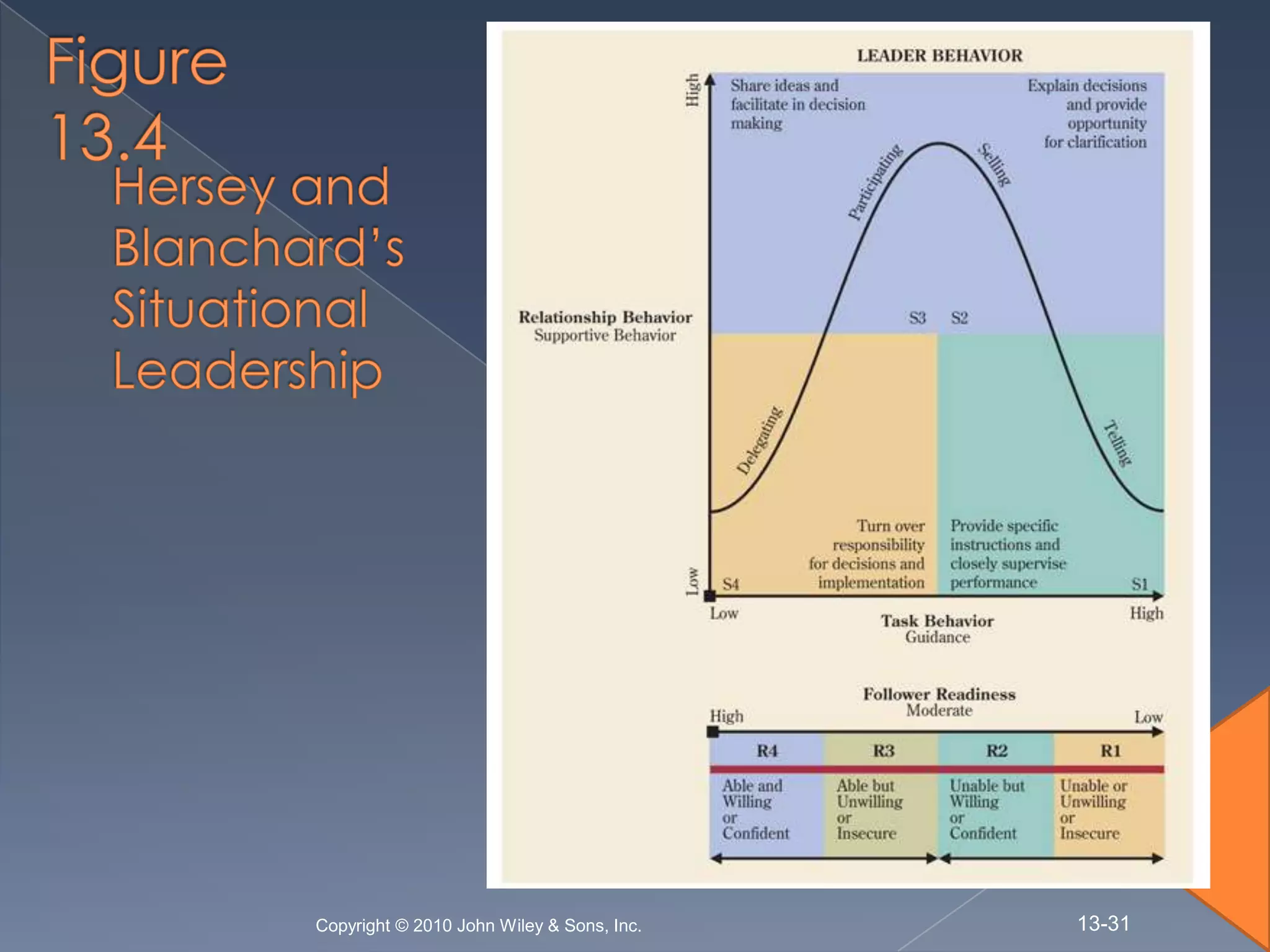
  • #31 Leader adjusts either the task behaviors, such providing more direction, or relationship behavior, providing socio-emotional support.Suggests that there is no single, best way to lead.
  • #32 The model requires the leader to diagnose the demands of the situation implement the response that is most effective in the situation. A ‘telling’ style is advisable for followers with low readiness. Includes providing more instruction and close supervision.As readiness increases, leaders should move to a ‘selling’ style, ‘participating’, and ‘delegating’ style. Delegating is most appropriate for followers who are able and willing to take responsibility for what needs to be done.
  • #38 This slide is optional and good for discussions.rhh