PEOPLE MATTERS                               BY TOM HUGHES, KEITH OWEN, AND TIM GOHMANN


     Stop dysfunction, start analyzing the “true
     influences” for boardroom success


     This is an example of a board of direc-        involves throwing out the old “linear” way       is possible to understand which issues are
     tors which pulled themselves out of the        of thinking and starting to think in a “full     causing the board to not reach their goals.
     doldrums of mediocrity by their “own           dimensional” way. A “full dimensional”           Were issues looked at in isolation, as is typi-
     bootstraps.” The board was engaged in a        way of thinking is like putting on a pair of     cally the case, their true cause and effect
     never-ending struggle to achieve their orga-   glasses that enables someone, finally, to see    relationships would not be understood, and
     nization’s mission and goals. However, they    more clearly why the organization “be-           efforts to improve performance would fail.
     had not been making significant improve-       haves” as it does.
     ment against their goals for the past three                                                     Approach
     years.                                         Case Study                                       Following a two-hour, in-person session with
                                                    Recently the incoming president of an            a dozen board members, individual issues
     New Way of Thinking                            association of business professionals was        were isolated and their causal relationships
     The success of any board is highly depen-      preparing for their strategic planning           established. The goal of the session was to
     dent on a complex system of influences         process. The president felt the organization     build a clear and simple picture of the com-
     (issues) that help or hinder its ability to    needed to get to a higher level of perfor-       plex system of true influences that current-
     succeed (for example: direction, structure,    mance and the board was holding it back in       ly “runs” the board, the Systems Influence
     roles, communication processes, level of       three specific areas. The president needed       Diagram (SID).
     commitment and ways of working togeth-         to step back from these specific issues and
     er). Because board members seldom think        look at the bigger picture (i.e., system) in     Results
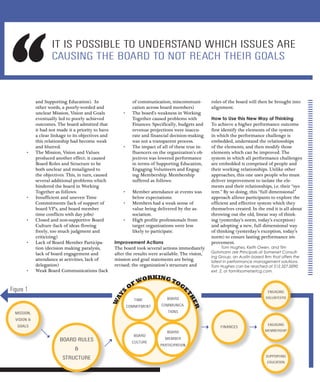
     about the complete system of “true influ-      which these issues occur. This would allow       The SID for our board of directors is shown
     ences” that produces success, their effects    the president to understand their causes         in Figure 1.
     are rarely understood. Without knowing         and thereby be able to deal effectively with          The SID explained the reasons for the
     these true influences, board functioning ap-   these issues and others.                         problems the board was experiencing in
     pears to be governed by a set of seemingly          Any system can be fully described           terms they understood and with which they
     “mysterious” and unmanageable forces.          in terms of just two concepts: (1) its parts     agreed. Reading from left (causes) to right
     Without a way to see and manage these in-      and (2) the relationship among the parts.        (effects):
     fluences, the board truly is “unmanageable”    Relationships are of two basic types: causes          •     Mission, Vision and Goals are
     and runs the risk of never fully succeeding    and effects. By looking beneath the surface                 the primary drivers (causes) of
     in accomplishing its mission and goals.        at all of the parts (issues that influence the              the outcomes that determine the
          There is a new way for boards to both     board’s ability to achieve their goals) and                 organization’s success (Engaging
     see and manage this system of influences. It   the relationships between these parts, it                   Volunteers, Engaging Membership

20   Texas CEO Magazine            Discuss. Learn. Lead.
IT IS POSSIBLE TO UNDERSTAND WHICH ISSUES ARE
                   CAUSING THE BOARD TO NOT REACH THEIR GOALS


           and Supporting Education). In                       of communication, miscommuni-         roles of the board will then be brought into
           other words, a poorly-worded and                    cation across board members)          alignment.
           unclear Mission, Vision and Goals             •     The board’s weakness in Working
           eventually led to poorly achieved                   Together caused problems with         How to Use this New Way of Thinking
           outcomes. The board admitted that                   Finances. Specifically, budgets and   To achieve a higher performance outcome
           it had not made it a priority to have               revenue projections were inaccu-      first identify the elements of the system
           a clear linkage to its objectives and               rate and financial decision-making    in which the performance challenge is
           this relationship had become weak                   was not a transparent process.        embedded, understand the relationships
           and blurred.                                  •     The impact of all of these true in-   of the elements, and then modify those
       •   The Mission, Vision and Values                      fluencers on the organization’s ob-   elements which can be improved. The
           produced another effect; it caused                  jectives was lowered performance      system in which all performance challenges
           Board Roles and Structure to be                     in terms of Supporting Education,     are embedded is comprised of people and
           both unclear and misaligned to                      Engaging Volunteers and Engag-        their working relationships. Unlike other
           the objectives. This, in turn, caused               ing Membership. Membership            approaches, this one uses people who must
           several additional problems which                   suffered as follows:                  deliver improvement to isolate the ele-
           hindered the board in Working                                                             ments and their relationships, i.e. their “sys-
           Together as follows:                          •     Member attendance at events was       tem.” By so doing, this “full dimensional”
       •   Insufficient and uneven Time                        below expectations.                   approach allows participants to explore the
           Commitments (lack of support of               •     Members had a weak sense of           efficient and effective system which they
           board VP’s, and board member                        value being delivered by the as-      themselves created. In the end it is all about
           time conflicts with day jobs)                       sociation.                            throwing out the old, linear way of think-
       •   Closed and non-supportive Board               •     High profile professionals from       ing (yesterday’s norm, today’s exception)
           Culture (lack of ideas flowing                      target organizations were less        and adopting a new, full dimensional way
           freely, too much judgment and                       likely to participate.                of thinking (yesterday’s exception, today’s
           criticizing)                                                                              norm) to ensure lasting performance im-
       •   Lack of Board Member Participa-         Improvement Actions                               provement.
           tion (decision making paralysis,        The board took several actions immediately              Tom Hughes, Keith Owen, and Tim
           lack of board engagement and            after the results were available. The vision,     Gohmann are Principals at Somerset Consult-
                                                                                                     ing Group, an Austin based firm that offers the
           attendance at activities, lack of       mission and goal statements are being             latest in performance management solutions.
           delegation)                             revised; the organization’s structure and         Tom Hughes can be reached at 512.327.0090
       •   Weak Board Communications (lack                                                           ext. 2, or tom@somersetcg.com.

                                                                 ORKING TO
                                                               FW         G
Figure 1                                                     O             E
                                                         S                                                                         ENGAGING
                                                                                          TH
                                                     Y


                                                                                                                                  VOLUNTEERS
                                                   WA


                                                                TIME            BOARD
                                                                                             ER


                                                             COMMITMENT      COMMUNICA-
                                                                                TIONS


                                                                                                                                   ENGAGING

                                                                                BOARD                                            MEMBERSHIP
                                                                BOARD
                                                                               MEMBER
                                                               CULTURE
                                                                            PARTICIPATION

                                                                                                                                  SUPPORTING
                                                                                                                                  EDUCATION

Sharks

  • 1.
    PEOPLE MATTERS BY TOM HUGHES, KEITH OWEN, AND TIM GOHMANN Stop dysfunction, start analyzing the “true influences” for boardroom success This is an example of a board of direc- involves throwing out the old “linear” way is possible to understand which issues are tors which pulled themselves out of the of thinking and starting to think in a “full causing the board to not reach their goals. doldrums of mediocrity by their “own dimensional” way. A “full dimensional” Were issues looked at in isolation, as is typi- bootstraps.” The board was engaged in a way of thinking is like putting on a pair of cally the case, their true cause and effect never-ending struggle to achieve their orga- glasses that enables someone, finally, to see relationships would not be understood, and nization’s mission and goals. However, they more clearly why the organization “be- efforts to improve performance would fail. had not been making significant improve- haves” as it does. ment against their goals for the past three Approach years. Case Study Following a two-hour, in-person session with Recently the incoming president of an a dozen board members, individual issues New Way of Thinking association of business professionals was were isolated and their causal relationships The success of any board is highly depen- preparing for their strategic planning established. The goal of the session was to dent on a complex system of influences process. The president felt the organization build a clear and simple picture of the com- (issues) that help or hinder its ability to needed to get to a higher level of perfor- plex system of true influences that current- succeed (for example: direction, structure, mance and the board was holding it back in ly “runs” the board, the Systems Influence roles, communication processes, level of three specific areas. The president needed Diagram (SID). commitment and ways of working togeth- to step back from these specific issues and er). Because board members seldom think look at the bigger picture (i.e., system) in Results about the complete system of “true influ- which these issues occur. This would allow The SID for our board of directors is shown ences” that produces success, their effects the president to understand their causes in Figure 1. are rarely understood. Without knowing and thereby be able to deal effectively with The SID explained the reasons for the these true influences, board functioning ap- these issues and others. problems the board was experiencing in pears to be governed by a set of seemingly Any system can be fully described terms they understood and with which they “mysterious” and unmanageable forces. in terms of just two concepts: (1) its parts agreed. Reading from left (causes) to right Without a way to see and manage these in- and (2) the relationship among the parts. (effects): fluences, the board truly is “unmanageable” Relationships are of two basic types: causes • Mission, Vision and Goals are and runs the risk of never fully succeeding and effects. By looking beneath the surface the primary drivers (causes) of in accomplishing its mission and goals. at all of the parts (issues that influence the the outcomes that determine the There is a new way for boards to both board’s ability to achieve their goals) and organization’s success (Engaging see and manage this system of influences. It the relationships between these parts, it Volunteers, Engaging Membership 20 Texas CEO Magazine Discuss. Learn. Lead.
  • 2.
    IT IS POSSIBLETO UNDERSTAND WHICH ISSUES ARE CAUSING THE BOARD TO NOT REACH THEIR GOALS and Supporting Education). In of communication, miscommuni- roles of the board will then be brought into other words, a poorly-worded and cation across board members) alignment. unclear Mission, Vision and Goals • The board’s weakness in Working eventually led to poorly achieved Together caused problems with How to Use this New Way of Thinking outcomes. The board admitted that Finances. Specifically, budgets and To achieve a higher performance outcome it had not made it a priority to have revenue projections were inaccu- first identify the elements of the system a clear linkage to its objectives and rate and financial decision-making in which the performance challenge is this relationship had become weak was not a transparent process. embedded, understand the relationships and blurred. • The impact of all of these true in- of the elements, and then modify those • The Mission, Vision and Values fluencers on the organization’s ob- elements which can be improved. The produced another effect; it caused jectives was lowered performance system in which all performance challenges Board Roles and Structure to be in terms of Supporting Education, are embedded is comprised of people and both unclear and misaligned to Engaging Volunteers and Engag- their working relationships. Unlike other the objectives. This, in turn, caused ing Membership. Membership approaches, this one uses people who must several additional problems which suffered as follows: deliver improvement to isolate the ele- hindered the board in Working ments and their relationships, i.e. their “sys- Together as follows: • Member attendance at events was tem.” By so doing, this “full dimensional” • Insufficient and uneven Time below expectations. approach allows participants to explore the Commitments (lack of support of • Members had a weak sense of efficient and effective system which they board VP’s, and board member value being delivered by the as- themselves created. In the end it is all about time conflicts with day jobs) sociation. throwing out the old, linear way of think- • Closed and non-supportive Board • High profile professionals from ing (yesterday’s norm, today’s exception) Culture (lack of ideas flowing target organizations were less and adopting a new, full dimensional way freely, too much judgment and likely to participate. of thinking (yesterday’s exception, today’s criticizing) norm) to ensure lasting performance im- • Lack of Board Member Participa- Improvement Actions provement. tion (decision making paralysis, The board took several actions immediately Tom Hughes, Keith Owen, and Tim lack of board engagement and after the results were available. The vision, Gohmann are Principals at Somerset Consult- ing Group, an Austin based firm that offers the attendance at activities, lack of mission and goal statements are being latest in performance management solutions. delegation) revised; the organization’s structure and Tom Hughes can be reached at 512.327.0090 • Weak Board Communications (lack ext. 2, or tom@somersetcg.com. ORKING TO FW G Figure 1 O E S ENGAGING TH Y VOLUNTEERS WA TIME BOARD ER COMMITMENT COMMUNICA- TIONS ENGAGING BOARD MEMBERSHIP BOARD MEMBER CULTURE PARTICIPATION SUPPORTING EDUCATION