Introduction
to
Organizational
Behavior
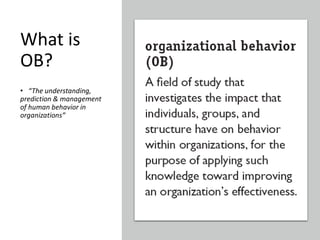
What is
OB?
• “The understanding,
prediction & management
of human behavior in
organizations”
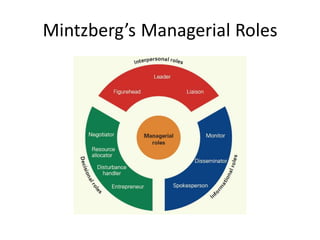
Mintzberg’s Managerial Roles
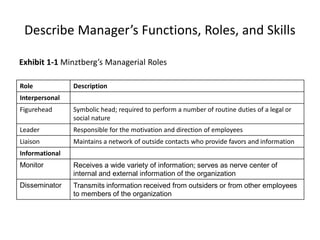
Describe Manager’s Functions, Roles, and Skills
Exhibit 1-1 Minztberg’s Managerial Roles
Role Description
Interpersonal Blank
Figurehead Symbolic head; required to perform a number of routine duties of a legal or
social nature
Leader Responsible for the motivation and direction of employees
Liaison Maintains a network of outside contacts who provide favors and information
Informational Blank
Monitor Receives a wide variety of information; serves as nerve center of
internal and external information of the organization
Disseminator Transmits information received from outsiders or from other employees
to members of the organization
Describe Manager’s Functions, Roles, and Skills
[Exhibit 1-1 Continued]
Role Description
Spokesperson Transmits information to outsiders on organization’s plans, policies,
actions, and results; serves as expert on organization’s industry
Decisional Searches organization and its environment for opportunities and
initiates projects to bring about change
Entrepreneur Responsible for corrective action when organization faces important,
unexpected disturbances
Resource allocator Makes or approves significant organizational decisions
Negotiator Responsible for representing the organization at major negotiations
Source: H. Mintzberg, The Nature of Managerial Work, 1st ed., © 1973, pp. 92–93. Reprinted and electronically reproduced
by permission of Pearson Education, Inc., New York, NY.
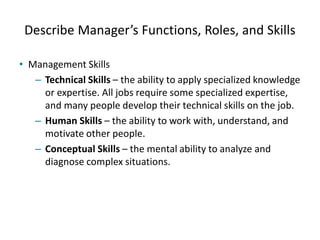
Describe Manager’s Functions, Roles, and Skills
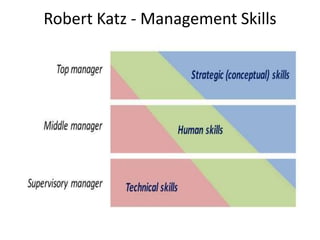
• Management Skills
– Technical Skills – the ability to apply specialized knowledge
or expertise. All jobs require some specialized expertise,
and many people develop their technical skills on the job.
– Human Skills – the ability to work with, understand, and
motivate other people.
– Conceptual Skills – the mental ability to analyze and
diagnose complex situations.
Robert Katz - Management Skills
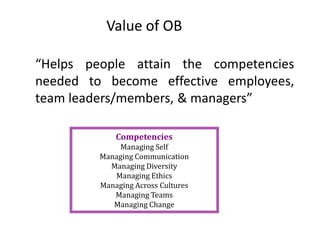
Value of OB
“Helps people attain the competencies
needed to become effective employees,
team leaders/members, & managers”
Competencies
Managing Self
Managing Communication
Managing Diversity
Managing Ethics
Managing Across Cultures
Managing Teams
Managing Change
Complementing Intuition with Systematic Study
• Systematic Study of Behavior
– Behavior generally is predictable if we know how the person
perceived the situation and what is important to him or her.
• Evidence-Based Management (EBM)
– Complements systematic study.
– Argues for managers to make decisions based on evidence.
• Intuition
– Systematic study and EBM add to intuition, or those “gut
feelings” about “why I do what I do” and “what makes others
tick.”
– If we make all decisions with intuition or gut instinct, we’re likely
working with incomplete information.
Key points
• OB deals with human
behavior
• Humanistic orientation
• Interdisciplinary
• Performance Oriented
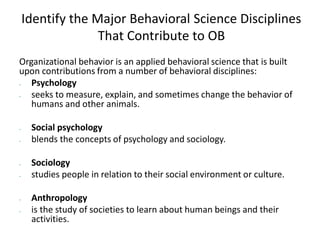
Identify the Major Behavioral Science Disciplines
That Contribute to OB
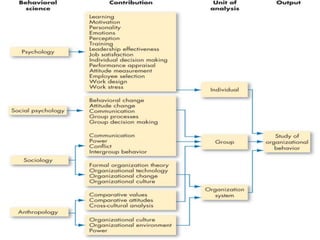
Organizational behavior is an applied behavioral science that is built
upon contributions from a number of behavioral disciplines:
 Psychology
 seeks to measure, explain, and sometimes change the behavior of
humans and other animals.
 Social psychology
 blends the concepts of psychology and sociology.
 Sociology
 studies people in relation to their social environment or culture.
 Anthropology
 is the study of societies to learn about human beings and their
activities.
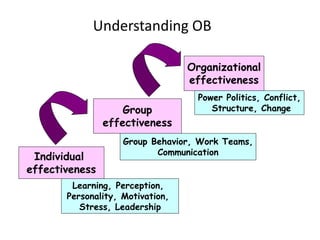
Understanding OB
Individual
effectiveness
Group
effectiveness
Organizational
effectiveness
Learning, Perception,
Personality, Motivation,
Stress, Leadership
Group Behavior, Work Teams,
Communication
Power Politics, Conflict,
Structure, Change
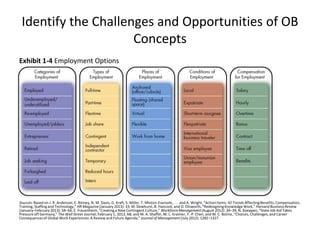
Identify the Challenges and Opportunities of OB
Concepts
Exhibit 1-4 Employment Options
Sources: Based on J. R. Anderson, E. Binney, N. M. Davis, G. Kraft, S. Miller, T. Minton-Eversole,. . . and A. Wright, “Action Items: 42 Trends AffectingBenefits,Compensation,
Training, Staffing and Technology,” HR Magazine(January 2013): 33; M. Dewhurst, B. Hancock, and D. Ellsworth,“RedesigningKnowledge Work,” Harvard BusinessReview
(January–February 2013): 58–64; E. Frauenheim, “Creating a New Contingent Culture,” WorkforceManagement(August 2012): 34–39; N. Koeppen,“State Job Aid Takes
Pressure off Germany,” The Wall Street Journal,February 1, 2013, A8; and M. A. Shaffer, M. L. Kraimer, Y.-P.Chen, and M. C. Bolino, “Choices, Challenges,and Career
Consequencesof Global Work Experiences: A Review and Future Agenda,” Journalof Management (July 2012): 1282–1327.
Identify the Challenges and Opportunities of OB
Concepts
• Responding to economic pressure
– In tough economic times, effective management is an
asset.
– In good times, understanding how to reward, satisfy, and
retain employees is at a premium.
– In bad times, issues like stress, decision making, and
coping come to the forefront.
Identify the Challenges and Opportunities of OB
Concepts
• Responding to globalization
– Increased foreign assignments.
– Working with people from different cultures.
– Overseeing movement of jobs to countries with low-cost
labor.
– Adapting to differing cultural and regulatory norms.
Identify the Challenges and Opportunities of OB
Concepts
• Managing workforce diversity
– Workforce diversity – organizations are becoming more
heterogeneous in terms of gender, age, race, ethnicity,
sexual orientation, and inclusion of Workforce other
diverse groups.
Identify the Challenges and Opportunities of OB
Concepts
• Improving customer service
– Service employees have substantial interaction with
customers.
– Employee attitudes and behavior are associated with
customer satisfaction.
– Need a customer-responsive culture.
Identify the Challenges and Opportunities of OB
Concepts
• Improving people skills
– People skills are essential to managerial effectiveness.
– OB provides the concepts and theories that allow
managers to predict employee behavior in given situations.
Identify the Challenges and Opportunities of OB
Concepts
• Working in networked organizations
– Networked organizations are becoming more pronounced.
– A manager’s job is fundamentally different in networked
organizations.
– Challenges of motivating and leading “online” require
different techniques.
Identify the Challenges and Opportunities of OB
Concepts
• Using social media at work
– Policies on accessing social media at work.
• When, where, and for what purpose.
– Impact of social media on employee well-being.
Identify the Challenges and Opportunities of OB
Concepts
• Enhancing employee well-being at work
– The creation of the global workforce means work no
longer sleeps.
– Communication technology has provided a vehicle for
working at any time or any place.
– Employees are working longer hours per week.
– The lifestyles of families have changed—creating conflict.
– Balancing work and life demands now surpasses job
security as an employee priority.
Identify the Challenges and Opportunities of OB
Concepts
• Creating a positive work environment
– Positive organizational scholarship is concerned with how
organizations develop human strength, foster vitality and
resilience, and unlock potential.
– This field of study focuses on employees’ strengths versus
their limitations, as employees share situations in which
they performed at their personal best.
Identify the Challenges and Opportunities of OB
Concepts
• Improving ethical behavior
– Ethical dilemmas and ethical choices are situations in
which an individual is required to define right and wrong
conduct.
– Good ethical behavior is not so easily defined.
– Organizations distribute codes of ethics to guide
employees through ethical dilemmas.
– Managers need to create an ethically healthy climate.
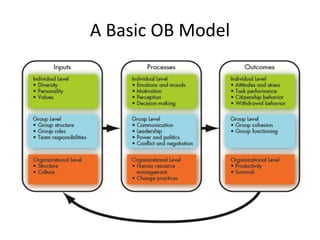
A Basic OB Model
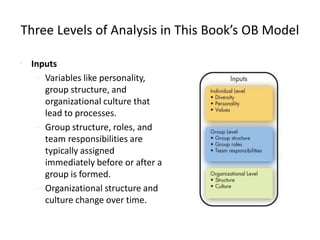
Three Levels of Analysis in This Book’s OB Model
• Inputs
– Variables like personality,
group structure, and
organizational culture that
lead to processes.
– Group structure, roles, and
team responsibilities are
typically assigned
immediately before or after a
group is formed.
– Organizational structure and
culture change over time.
Three Levels of Analysis in This Book’s OB Model
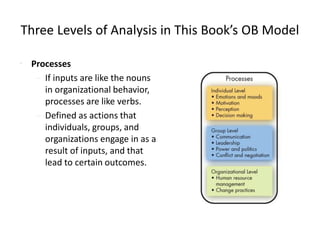
• Processes
– If inputs are like the nouns
in organizational behavior,
processes are like verbs.
– Defined as actions that
individuals, groups, and
organizations engage in as a
result of inputs, and that
lead to certain outcomes.
Three Levels of Analysis in This Book’s OB Model
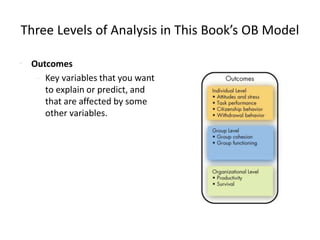
• Outcomes
– Key variables that you want
to explain or predict, and
that are affected by some
other variables.
Outcome Variables
• Attitudes and stress
– Employee attitudes are the evaluations employees make, ranging from
positive to negative, about objects, people, or events.
– Stress is an unpleasant psychological process that occurs in response to
environmental pressures.
• Task performance
– The combination of effectiveness and efficiency at doing your core job tasks is
a reflection of your level of task performance.
• Organizational citizenship behavior
– The discretionary behavior that is not part of an employee’s formal job
requirements, and that contributes to the psychological and social
environment of the workplace, is called organizational citizenship behavior.
• Withdrawal behavior
– Withdrawal behavior is the set of actions that employees take to separate
themselves from the organization.
Outcome Variables
• Group cohesion
– Group cohesion is the extent to which members of a group support and
validate one another at work.
• Group functioning
– Group functioning refers to the quantity and quality of a group’s work output.
• Productivity
– An organization is productive if it achieves its goals by transforming inputs into
outputs at the lowest cost. This requires both effectiveness and efficiency.
• Survival
– The final outcome is organizational survival, which is simply evidence that the
organization is able to exist and grow over the long term.
1 - Introduction to Organizational Behavior

  • 1.
  • 2.
    What is OB? • “Theunderstanding, prediction & management of human behavior in organizations”
  • 3.
  • 4.
    Describe Manager’s Functions,Roles, and Skills Exhibit 1-1 Minztberg’s Managerial Roles Role Description Interpersonal Blank Figurehead Symbolic head; required to perform a number of routine duties of a legal or social nature Leader Responsible for the motivation and direction of employees Liaison Maintains a network of outside contacts who provide favors and information Informational Blank Monitor Receives a wide variety of information; serves as nerve center of internal and external information of the organization Disseminator Transmits information received from outsiders or from other employees to members of the organization
  • 5.
    Describe Manager’s Functions,Roles, and Skills [Exhibit 1-1 Continued] Role Description Spokesperson Transmits information to outsiders on organization’s plans, policies, actions, and results; serves as expert on organization’s industry Decisional Searches organization and its environment for opportunities and initiates projects to bring about change Entrepreneur Responsible for corrective action when organization faces important, unexpected disturbances Resource allocator Makes or approves significant organizational decisions Negotiator Responsible for representing the organization at major negotiations Source: H. Mintzberg, The Nature of Managerial Work, 1st ed., © 1973, pp. 92–93. Reprinted and electronically reproduced by permission of Pearson Education, Inc., New York, NY.
  • 6.
    Describe Manager’s Functions,Roles, and Skills • Management Skills – Technical Skills – the ability to apply specialized knowledge or expertise. All jobs require some specialized expertise, and many people develop their technical skills on the job. – Human Skills – the ability to work with, understand, and motivate other people. – Conceptual Skills – the mental ability to analyze and diagnose complex situations.
  • 7.
    Robert Katz -Management Skills
  • 8.
    Value of OB “Helpspeople attain the competencies needed to become effective employees, team leaders/members, & managers” Competencies Managing Self Managing Communication Managing Diversity Managing Ethics Managing Across Cultures Managing Teams Managing Change
  • 9.
    Complementing Intuition withSystematic Study • Systematic Study of Behavior – Behavior generally is predictable if we know how the person perceived the situation and what is important to him or her. • Evidence-Based Management (EBM) – Complements systematic study. – Argues for managers to make decisions based on evidence. • Intuition – Systematic study and EBM add to intuition, or those “gut feelings” about “why I do what I do” and “what makes others tick.” – If we make all decisions with intuition or gut instinct, we’re likely working with incomplete information.
  • 10.
    Key points • OBdeals with human behavior • Humanistic orientation • Interdisciplinary • Performance Oriented
  • 11.
    Identify the MajorBehavioral Science Disciplines That Contribute to OB Organizational behavior is an applied behavioral science that is built upon contributions from a number of behavioral disciplines:  Psychology  seeks to measure, explain, and sometimes change the behavior of humans and other animals.  Social psychology  blends the concepts of psychology and sociology.  Sociology  studies people in relation to their social environment or culture.  Anthropology  is the study of societies to learn about human beings and their activities.
  • 13.
    Understanding OB Individual effectiveness Group effectiveness Organizational effectiveness Learning, Perception, Personality,Motivation, Stress, Leadership Group Behavior, Work Teams, Communication Power Politics, Conflict, Structure, Change
  • 14.
    Identify the Challengesand Opportunities of OB Concepts Exhibit 1-4 Employment Options Sources: Based on J. R. Anderson, E. Binney, N. M. Davis, G. Kraft, S. Miller, T. Minton-Eversole,. . . and A. Wright, “Action Items: 42 Trends AffectingBenefits,Compensation, Training, Staffing and Technology,” HR Magazine(January 2013): 33; M. Dewhurst, B. Hancock, and D. Ellsworth,“RedesigningKnowledge Work,” Harvard BusinessReview (January–February 2013): 58–64; E. Frauenheim, “Creating a New Contingent Culture,” WorkforceManagement(August 2012): 34–39; N. Koeppen,“State Job Aid Takes Pressure off Germany,” The Wall Street Journal,February 1, 2013, A8; and M. A. Shaffer, M. L. Kraimer, Y.-P.Chen, and M. C. Bolino, “Choices, Challenges,and Career Consequencesof Global Work Experiences: A Review and Future Agenda,” Journalof Management (July 2012): 1282–1327.
  • 15.
    Identify the Challengesand Opportunities of OB Concepts • Responding to economic pressure – In tough economic times, effective management is an asset. – In good times, understanding how to reward, satisfy, and retain employees is at a premium. – In bad times, issues like stress, decision making, and coping come to the forefront.
  • 16.
    Identify the Challengesand Opportunities of OB Concepts • Responding to globalization – Increased foreign assignments. – Working with people from different cultures. – Overseeing movement of jobs to countries with low-cost labor. – Adapting to differing cultural and regulatory norms.
  • 17.
    Identify the Challengesand Opportunities of OB Concepts • Managing workforce diversity – Workforce diversity – organizations are becoming more heterogeneous in terms of gender, age, race, ethnicity, sexual orientation, and inclusion of Workforce other diverse groups.
  • 18.
    Identify the Challengesand Opportunities of OB Concepts • Improving customer service – Service employees have substantial interaction with customers. – Employee attitudes and behavior are associated with customer satisfaction. – Need a customer-responsive culture.
  • 19.
    Identify the Challengesand Opportunities of OB Concepts • Improving people skills – People skills are essential to managerial effectiveness. – OB provides the concepts and theories that allow managers to predict employee behavior in given situations.
  • 20.
    Identify the Challengesand Opportunities of OB Concepts • Working in networked organizations – Networked organizations are becoming more pronounced. – A manager’s job is fundamentally different in networked organizations. – Challenges of motivating and leading “online” require different techniques.
  • 21.
    Identify the Challengesand Opportunities of OB Concepts • Using social media at work – Policies on accessing social media at work. • When, where, and for what purpose. – Impact of social media on employee well-being.
  • 22.
    Identify the Challengesand Opportunities of OB Concepts • Enhancing employee well-being at work – The creation of the global workforce means work no longer sleeps. – Communication technology has provided a vehicle for working at any time or any place. – Employees are working longer hours per week. – The lifestyles of families have changed—creating conflict. – Balancing work and life demands now surpasses job security as an employee priority.
  • 23.
    Identify the Challengesand Opportunities of OB Concepts • Creating a positive work environment – Positive organizational scholarship is concerned with how organizations develop human strength, foster vitality and resilience, and unlock potential. – This field of study focuses on employees’ strengths versus their limitations, as employees share situations in which they performed at their personal best.
  • 24.
    Identify the Challengesand Opportunities of OB Concepts • Improving ethical behavior – Ethical dilemmas and ethical choices are situations in which an individual is required to define right and wrong conduct. – Good ethical behavior is not so easily defined. – Organizations distribute codes of ethics to guide employees through ethical dilemmas. – Managers need to create an ethically healthy climate.
  • 25.
  • 26.
    Three Levels ofAnalysis in This Book’s OB Model • Inputs – Variables like personality, group structure, and organizational culture that lead to processes. – Group structure, roles, and team responsibilities are typically assigned immediately before or after a group is formed. – Organizational structure and culture change over time.
  • 27.
    Three Levels ofAnalysis in This Book’s OB Model • Processes – If inputs are like the nouns in organizational behavior, processes are like verbs. – Defined as actions that individuals, groups, and organizations engage in as a result of inputs, and that lead to certain outcomes.
  • 28.
    Three Levels ofAnalysis in This Book’s OB Model • Outcomes – Key variables that you want to explain or predict, and that are affected by some other variables.
  • 29.
    Outcome Variables • Attitudesand stress – Employee attitudes are the evaluations employees make, ranging from positive to negative, about objects, people, or events. – Stress is an unpleasant psychological process that occurs in response to environmental pressures. • Task performance – The combination of effectiveness and efficiency at doing your core job tasks is a reflection of your level of task performance. • Organizational citizenship behavior – The discretionary behavior that is not part of an employee’s formal job requirements, and that contributes to the psychological and social environment of the workplace, is called organizational citizenship behavior. • Withdrawal behavior – Withdrawal behavior is the set of actions that employees take to separate themselves from the organization.
  • 30.
    Outcome Variables • Groupcohesion – Group cohesion is the extent to which members of a group support and validate one another at work. • Group functioning – Group functioning refers to the quantity and quality of a group’s work output. • Productivity – An organization is productive if it achieves its goals by transforming inputs into outputs at the lowest cost. This requires both effectiveness and efficiency. • Survival – The final outcome is organizational survival, which is simply evidence that the organization is able to exist and grow over the long term.