Organizational
Behavior
Book Recommended: 15th Edition
By: Stephen P. Robbins
—San Diego State University
Timothy A. Judge
—University of Notre Dame
Chapter 1 : Learning Objective
After studying this chapter you should be able to:
1. Demonstrate the importance of interpersonal skills in the workplace.
2. Describe the manager’s functions, roles, and skills.
3. Define organizational behavior (OB).
4. Show the value to OB of systematic study.
5. Identify the major behavioral science disciplines that contribute to OB.
6. Demonstrate why few absolutes apply to OB.
7. Identify the challenges and opportunities managers have in applying OB
concepts.
8. Compare the three levels of analysis in this book’s OB model.
Demonstrate the importance of
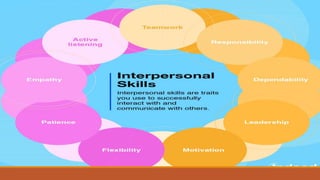
interpersonal skills in the workplace
oUnderstanding OB helping to determine manager effectiveness.
o Leadership and communication skills that are critical as a person progresses in a career.
o Lower turnover of the quality employees.
o Higher quality applications for the recruitment
o Better financial performance.
What Manager Do?
Describe the Manager’s functions, role and skills
Managers: get things done through other people in an organization
(They make decisions, allocate resources, and direct the activities of others to attain goals)
Organization A deliberately coordinated social unit, composed of two or more people, that
functions on a relatively continuous basis to achieve a common goal or set of goals.
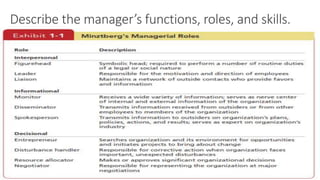
Mintzberg concluded that managers perform ten different, highly interrelated roles or sets of
behaviors attributable to their jobs.
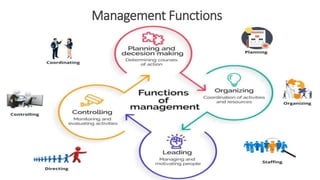
Management Functions
Describe the manager’s functions, roles, and skills.
Management Skills
Technical Skills:
The ability to apply Specialized knowledge or expertise
Human Skills:
Ability to work with, understand , and to motivate other people, both individually and in group,.
Conceptual Skills:
The mental ability to analyze and diagnose complex situations.
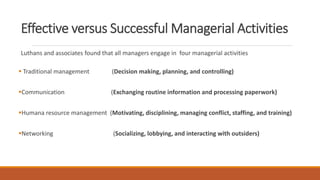
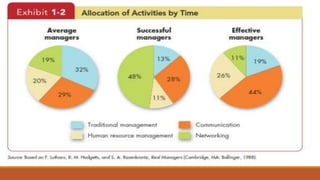
Effective versus Successful Managerial Activities
Luthans and associates found that all managers engage in four managerial activities
 Traditional management (Decision making, planning, and controlling)
Communication (Exchanging routine information and processing paperwork)
Humana resource management (Motivating, disciplining, managing conflict, staffing, and training)
Networking (Socializing, lobbying, and interacting with outsiders)
Define “Organizational Behavior” (OB)
OB is a field of study that investigate the impact that individuals, groups, and
structure have on behavior within organizations for the purpose of applying such
knowledge toward improving an organization’s effectiveness.
Or
To sum up , OB is the study of what people do in an organization and how their behavior affects
the organization’s performance
Identify the Major Behavioral Science Disciplines
that Contributes To OB
Organizational Behavior is an applied behavioral science
that is built upon contribution from a number of behavioral
disciplines.
Behavioral Science Disciplines
Psychology : Psychology seeks to measure, explain, and sometimes change the behavior of
humans and other animals.
Social psychology : generally considered a branch of psychology, blends concepts
from both psychology and sociology to focus on peoples’ influence on one another
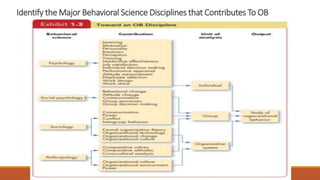
Identify the Major Behavioral Science Disciplines
that Contributes To OB
Sociology : Studies people in relation to their social environment or culture. Sociologists have
contributed to OB through their study of group behavior in organizations
Anthropology : The study of societies to learn about human beings and their activities.
Identify the Major Behavioral Science Disciplines that Contributes To OB
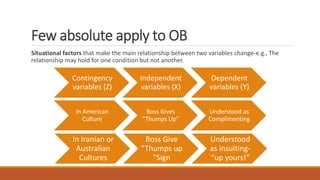
Few absolute apply to OB
Situational factors that make the main relationship between two variables change-e.g., The
relationship may hold for one condition but not another.
Contingency
variables (Z)
Independent
variables (X)
Dependent
variables (Y)
In American
Culture
Boss Gives
“Thumps Up”
Understood as
Complimenting
In Iranian or
Australian
Cultures
Boss Give
“Thumps up
"Sign
Understood
as insulting-
“up yours!”
Identify the Challenges and Opportunities of
OB Concept
Responding to economic pressure
o In economic tough times, effective management is an asset
o In good time , understanding how to reward , satisfy, and retain employees is at premium
o In bad times, issues like stress and decision making come to the fore
Identify the Challenges and Opportunities of
OB Concept
Responding to Globalization
o Increased foreign Assignments
o Working with people from different cultures
Identify the Challenges and Opportunities of
OB Concept
Managing workforce diversity
o Workforce diversity acknowledges
o Workforce of women and men
o Many racial and ethnic groups
o And people who differ in age and sexual orientation.
Identify the Challenges and Opportunities of
OB Concept
Improving customer service
o Today the majority of employees in developed countries work in service jobs.
o Employee attitude and behavior are associated with customer satisfaction.
Identify the Challenges and Opportunities of
OB Concept
Improving people skills
o People skills are essential to managerial effectiveness.
o OB provides the concepts and theories that allow managers to predict employee behavior in given
situations
Identify the Challenges and Opportunities of
OB Concept
Stimulating innovation and change
o Successful organizations must foster innovation and master the art of change..
o Managers must stimulate employees creativity and tolerance for the change.
Identify the Challenges and Opportunities of
OB Concept
Helping Employees Balance work-life Conflicts
o The creation of the global workforce means work no longer sleeps.
o Communication technology has provided a vehicle for working at any time oar any place.
o Employees are working longer hours per week.
o The lifestyles of family have changes- creating conflict.
o Balancing work and life demands now suppresses job security as an employee priority.
Identify the Challenges and Opportunities of
OB Concept
Creating positive work environment
 Organizations have realized creating a positive work environment can be a competitive advantage
 This field of study focuses on employees strengths versus their limitation as employees share situations
in which they performed at their personal best..
Identify the Challenges and Opportunities of
OB Concept
Improving Ethical Behavior
 Ethical dilemmas are situations in which an individual is required to define right and wrong conduct.
 Good ethical behavior is not so easily defined.
 Organizations are distributing codes of ethics to guide employees through ethical dilemmas.
 Managers need to create an ethically healthy climate.
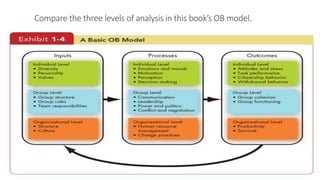
Compare the three levels of analysis in this book’s OB model.
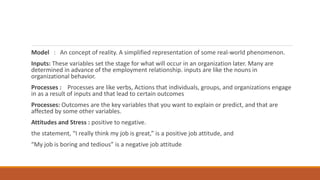
Model : An concept of reality. A simplified representation of some real-world phenomenon.
Inputs: These variables set the stage for what will occur in an organization later. Many are
determined in advance of the employment relationship. inputs are like the nouns in
organizational behavior.
Processes : Processes are like verbs, Actions that individuals, groups, and organizations engage
in as a result of inputs and that lead to certain outcomes
Processes: Outcomes are the key variables that you want to explain or predict, and that are
affected by some other variables.
Attitudes and Stress : positive to negative.
the statement, “I really think my job is great,” is a positive job attitude, and
“My job is boring and tedious” is a negative job attitude
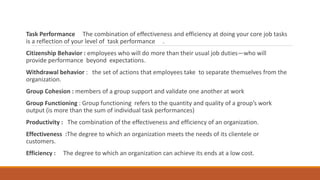
Task Performance The combination of effectiveness and efficiency at doing your core job tasks
is a reflection of your level of task performance .
Citizenship Behavior : employees who will do more than their usual job duties—who will
provide performance beyond expectations.
Withdrawal behavior : the set of actions that employees take to separate themselves from the
organization.
Group Cohesion : members of a group support and validate one another at work
Group Functioning : Group functioning refers to the quantity and quality of a group’s work
output (is more than the sum of individual task performances)
Productivity : The combination of the effectiveness and efficiency of an organization.
Effectiveness :The degree to which an organization meets the needs of its clientele or
customers.
Efficiency : The degree to which an organization can achieve its ends at a low cost.

Organizational Beahavior Ch1.pptx

  • 1.
    Organizational Behavior Book Recommended: 15thEdition By: Stephen P. Robbins —San Diego State University Timothy A. Judge —University of Notre Dame
  • 2.
    Chapter 1 :Learning Objective After studying this chapter you should be able to: 1. Demonstrate the importance of interpersonal skills in the workplace. 2. Describe the manager’s functions, roles, and skills. 3. Define organizational behavior (OB). 4. Show the value to OB of systematic study. 5. Identify the major behavioral science disciplines that contribute to OB. 6. Demonstrate why few absolutes apply to OB. 7. Identify the challenges and opportunities managers have in applying OB concepts. 8. Compare the three levels of analysis in this book’s OB model.
  • 3.
    Demonstrate the importanceof interpersonal skills in the workplace oUnderstanding OB helping to determine manager effectiveness. o Leadership and communication skills that are critical as a person progresses in a career. o Lower turnover of the quality employees. o Higher quality applications for the recruitment o Better financial performance.
  • 5.
    What Manager Do? Describethe Manager’s functions, role and skills Managers: get things done through other people in an organization (They make decisions, allocate resources, and direct the activities of others to attain goals) Organization A deliberately coordinated social unit, composed of two or more people, that functions on a relatively continuous basis to achieve a common goal or set of goals. Mintzberg concluded that managers perform ten different, highly interrelated roles or sets of behaviors attributable to their jobs.
  • 6.
  • 7.
    Describe the manager’sfunctions, roles, and skills.
  • 8.
    Management Skills Technical Skills: Theability to apply Specialized knowledge or expertise Human Skills: Ability to work with, understand , and to motivate other people, both individually and in group,. Conceptual Skills: The mental ability to analyze and diagnose complex situations.
  • 9.
    Effective versus SuccessfulManagerial Activities Luthans and associates found that all managers engage in four managerial activities  Traditional management (Decision making, planning, and controlling) Communication (Exchanging routine information and processing paperwork) Humana resource management (Motivating, disciplining, managing conflict, staffing, and training) Networking (Socializing, lobbying, and interacting with outsiders)
  • 11.
    Define “Organizational Behavior”(OB) OB is a field of study that investigate the impact that individuals, groups, and structure have on behavior within organizations for the purpose of applying such knowledge toward improving an organization’s effectiveness. Or To sum up , OB is the study of what people do in an organization and how their behavior affects the organization’s performance
  • 12.
    Identify the MajorBehavioral Science Disciplines that Contributes To OB Organizational Behavior is an applied behavioral science that is built upon contribution from a number of behavioral disciplines.
  • 13.
    Behavioral Science Disciplines Psychology: Psychology seeks to measure, explain, and sometimes change the behavior of humans and other animals. Social psychology : generally considered a branch of psychology, blends concepts from both psychology and sociology to focus on peoples’ influence on one another
  • 14.
    Identify the MajorBehavioral Science Disciplines that Contributes To OB Sociology : Studies people in relation to their social environment or culture. Sociologists have contributed to OB through their study of group behavior in organizations Anthropology : The study of societies to learn about human beings and their activities.
  • 15.
    Identify the MajorBehavioral Science Disciplines that Contributes To OB
  • 16.
    Few absolute applyto OB Situational factors that make the main relationship between two variables change-e.g., The relationship may hold for one condition but not another. Contingency variables (Z) Independent variables (X) Dependent variables (Y) In American Culture Boss Gives “Thumps Up” Understood as Complimenting In Iranian or Australian Cultures Boss Give “Thumps up "Sign Understood as insulting- “up yours!”
  • 17.
    Identify the Challengesand Opportunities of OB Concept Responding to economic pressure o In economic tough times, effective management is an asset o In good time , understanding how to reward , satisfy, and retain employees is at premium o In bad times, issues like stress and decision making come to the fore
  • 18.
    Identify the Challengesand Opportunities of OB Concept Responding to Globalization o Increased foreign Assignments o Working with people from different cultures
  • 19.
    Identify the Challengesand Opportunities of OB Concept Managing workforce diversity o Workforce diversity acknowledges o Workforce of women and men o Many racial and ethnic groups o And people who differ in age and sexual orientation.
  • 20.
    Identify the Challengesand Opportunities of OB Concept Improving customer service o Today the majority of employees in developed countries work in service jobs. o Employee attitude and behavior are associated with customer satisfaction.
  • 21.
    Identify the Challengesand Opportunities of OB Concept Improving people skills o People skills are essential to managerial effectiveness. o OB provides the concepts and theories that allow managers to predict employee behavior in given situations
  • 22.
    Identify the Challengesand Opportunities of OB Concept Stimulating innovation and change o Successful organizations must foster innovation and master the art of change.. o Managers must stimulate employees creativity and tolerance for the change.
  • 23.
    Identify the Challengesand Opportunities of OB Concept Helping Employees Balance work-life Conflicts o The creation of the global workforce means work no longer sleeps. o Communication technology has provided a vehicle for working at any time oar any place. o Employees are working longer hours per week. o The lifestyles of family have changes- creating conflict. o Balancing work and life demands now suppresses job security as an employee priority.
  • 24.
    Identify the Challengesand Opportunities of OB Concept Creating positive work environment  Organizations have realized creating a positive work environment can be a competitive advantage  This field of study focuses on employees strengths versus their limitation as employees share situations in which they performed at their personal best..
  • 25.
    Identify the Challengesand Opportunities of OB Concept Improving Ethical Behavior  Ethical dilemmas are situations in which an individual is required to define right and wrong conduct.  Good ethical behavior is not so easily defined.  Organizations are distributing codes of ethics to guide employees through ethical dilemmas.  Managers need to create an ethically healthy climate.
  • 26.
    Compare the threelevels of analysis in this book’s OB model.
  • 27.
    Model : Anconcept of reality. A simplified representation of some real-world phenomenon. Inputs: These variables set the stage for what will occur in an organization later. Many are determined in advance of the employment relationship. inputs are like the nouns in organizational behavior. Processes : Processes are like verbs, Actions that individuals, groups, and organizations engage in as a result of inputs and that lead to certain outcomes Processes: Outcomes are the key variables that you want to explain or predict, and that are affected by some other variables. Attitudes and Stress : positive to negative. the statement, “I really think my job is great,” is a positive job attitude, and “My job is boring and tedious” is a negative job attitude
  • 28.
    Task Performance Thecombination of effectiveness and efficiency at doing your core job tasks is a reflection of your level of task performance . Citizenship Behavior : employees who will do more than their usual job duties—who will provide performance beyond expectations. Withdrawal behavior : the set of actions that employees take to separate themselves from the organization. Group Cohesion : members of a group support and validate one another at work Group Functioning : Group functioning refers to the quantity and quality of a group’s work output (is more than the sum of individual task performances) Productivity : The combination of the effectiveness and efficiency of an organization. Effectiveness :The degree to which an organization meets the needs of its clientele or customers. Efficiency : The degree to which an organization can achieve its ends at a low cost.