Michael Noel
CCO
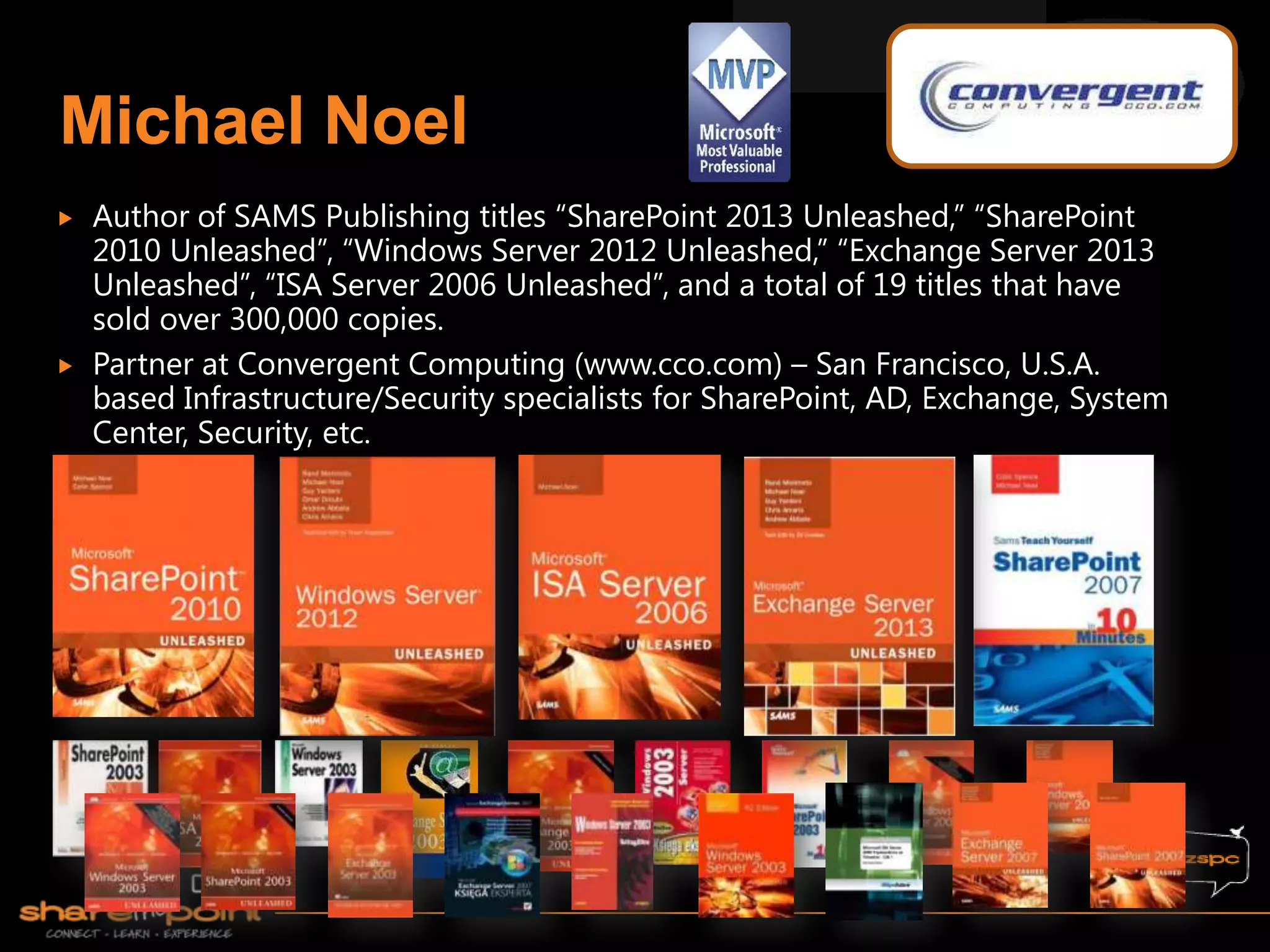
 Author of SAMS Publishing titles “SharePoint 2013 Unleashed,” “SharePoint
2010 Unleashed”, “Windows Server 2012 Unleashed,” “Exchange Server 2013
Unleashed”, “ISA Server 2006 Unleashed”, and a total of 19 titles that have
sold over 300,000 copies.
 Partner at Convergent Computing (www.cco.com) – San Francisco, U.S.A.
based Infrastructure/Security specialists for SharePoint, AD, Exchange, System
Center, Security, etc.
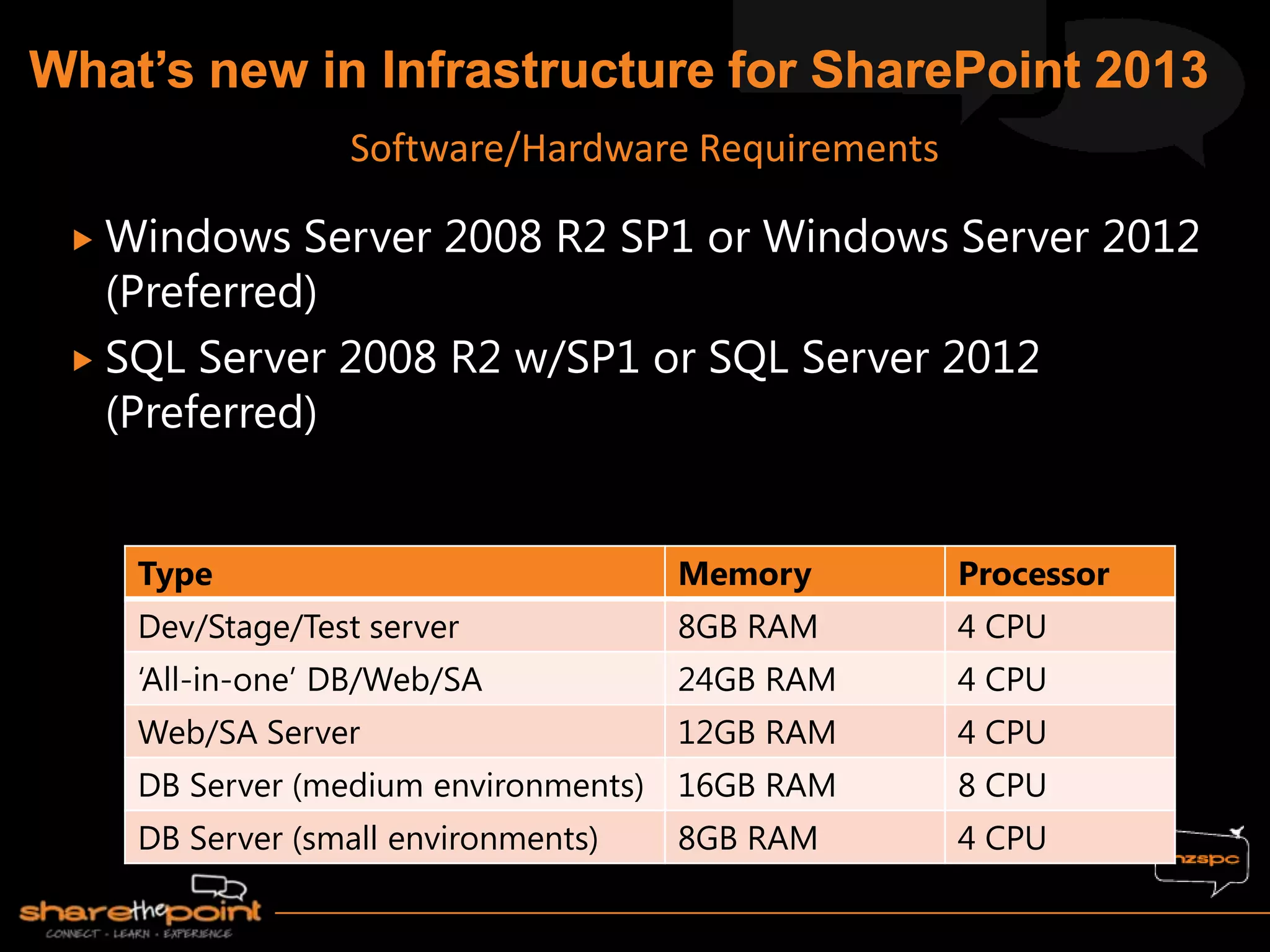
 Windows Server 2008 R2 SP1 or Windows Server 2012
(Preferred)
 SQL Server 2008 R2 w/SP1 or SQL Server 2012
(Preferred)
Type Memory Processor
Dev/Stage/Test server 8GB RAM 4 CPU
„All-in-one‟ DB/Web/SA 24GB RAM 4 CPU
Web/SA Server 12GB RAM 4 CPU
DB Server (medium environments) 16GB RAM 8 CPU
DB Server (small environments) 8GB RAM 4 CPU
Software/Hardware Requirements
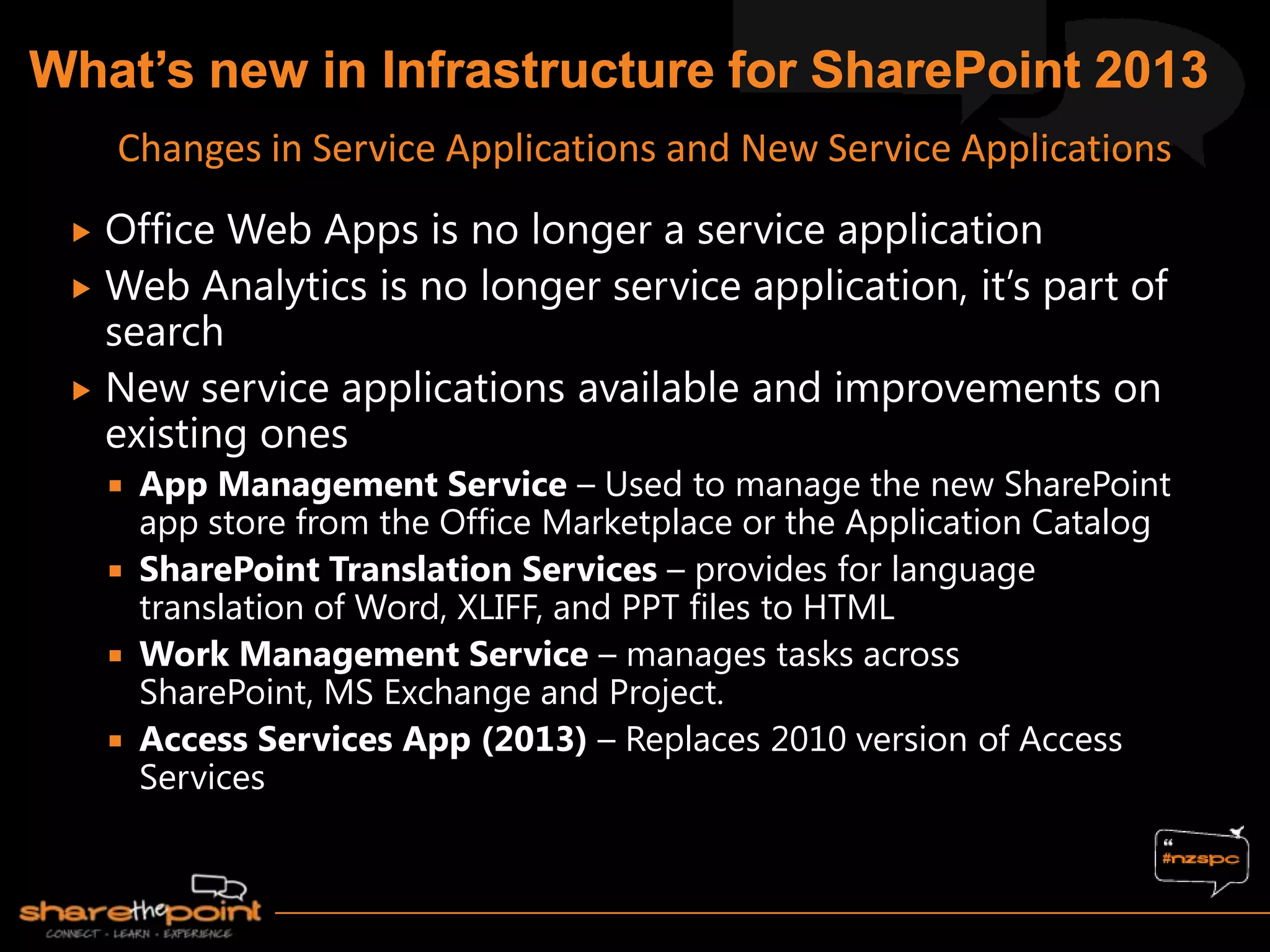
 Office Web Apps is no longer a service application
 Web Analytics is no longer service application, it‟s part of
search
 New service applications available and improvements on
existing ones
 App Management Service – Used to manage the new SharePoint
app store from the Office Marketplace or the Application Catalog
 SharePoint Translation Services – provides for language
translation of Word, XLIFF, and PPT files to HTML
 Work Management Service – manages tasks across
SharePoint, MS Exchange and Project.
 Access Services App (2013) – Replaces 2010 version of Access
Services
Changes in Service Applications and New Service Applications
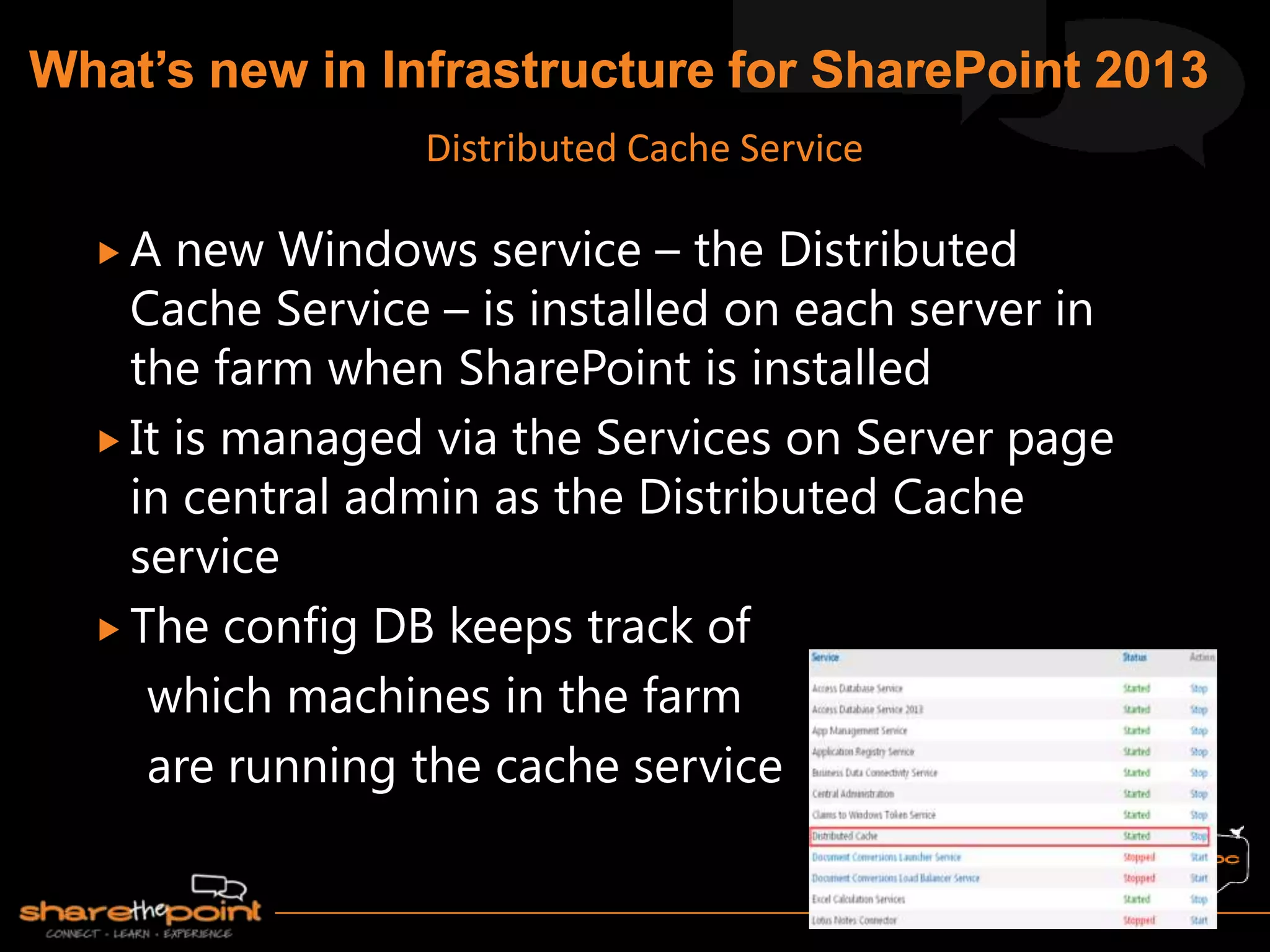
 A new Windows service – the Distributed
Cache Service – is installed on each server in
the farm when SharePoint is installed
 It is managed via the Services on Server page
in central admin as the Distributed Cache
service
 The config DB keeps track of
which machines in the farm
are running the cache service
Distributed Cache Service
 The purpose of the Request Management feature is to
give SharePoint knowledge of and more control over
incoming requests
 Having knowledge over the nature of incoming requests
– for example, the user agent, requested URL, or source
IP – allows SharePoint to customize the response to
each request
 RM is applied per web app, just like throttling is done in
SharePoint 2010
Request Management (RM)
 Option 1 (AD Import): Simple one-way Sync (a la
SharePoint 2007)
 Option 2 (SharePoint Profile Sync): Two-
way, possible write-back to AD options using small
FIM service on UPA server (a la 2010)
 Option 3: (Enable External Identity Manager): Full
Forefront Identity Manager (FIM)
Synchronisation, allows for complex scenarios –
Larger clients will appreciate this
User Profile Sync – Three Options for Deployment
 SharePoint 2013 continues to offer support for
both claims and classic authentication modes
 However claims authentication is THE default
authentication option now
 Classic authentication mode is still there, but can only
be managed in PowerShell – it‟s gone from the UI
 Support for classic mode is deprecated and will go
away in a future release
 There also a new process to migrate accounts
from Windows classic to Windows claims – the
Convert-SPWebApplication cmdlet
Claims-based Authentication - Default
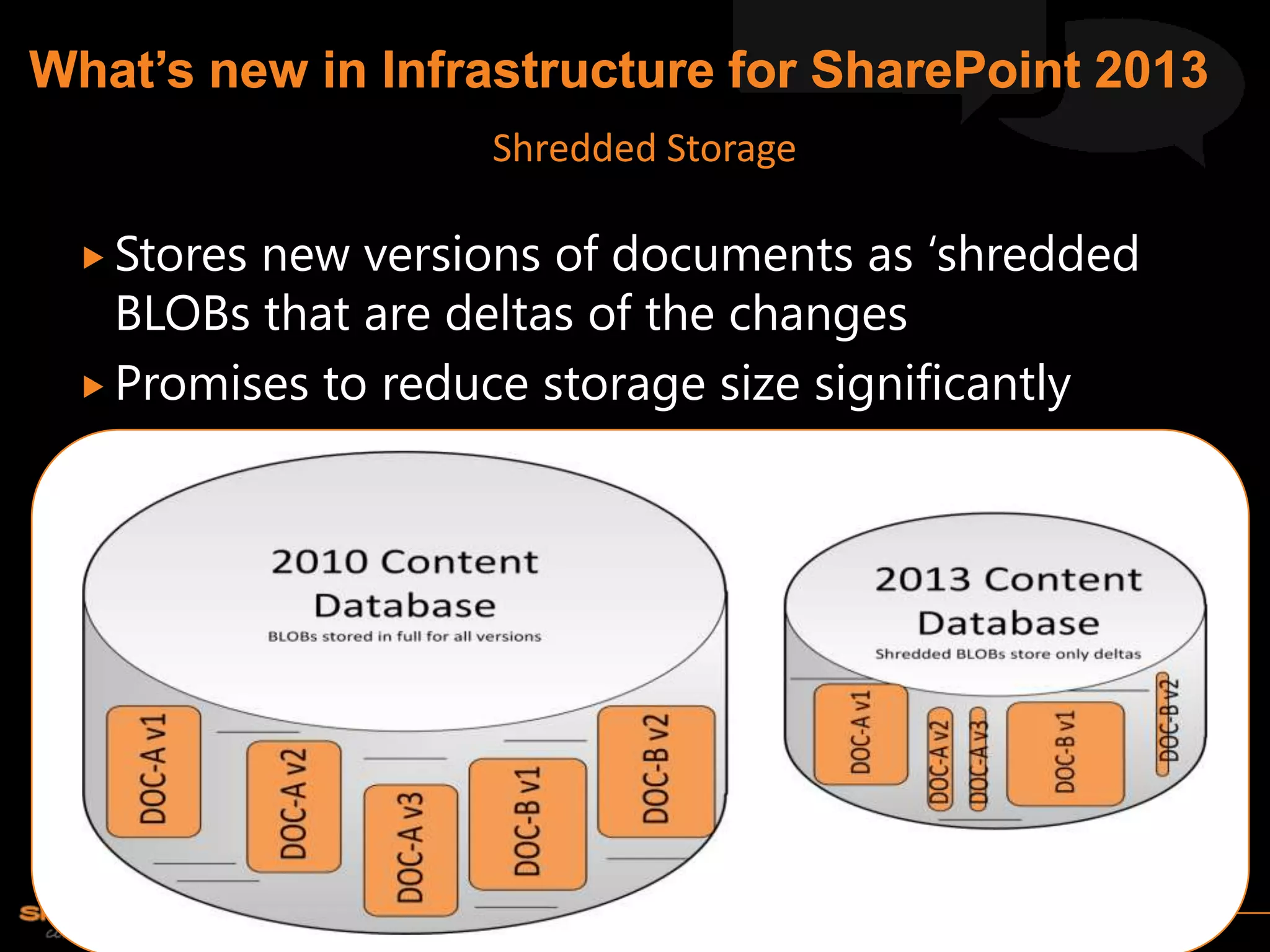
 Stores new versions of documents as „shredded
BLOBs that are deltas of the changes
 Promises to reduce storage size significantly
Shredded Storage
 New Search
architecture (FAST
based) with one
unified search
 Personalised search
results based on
search history
 Rich contextual
previews
Search – FAST Search now included
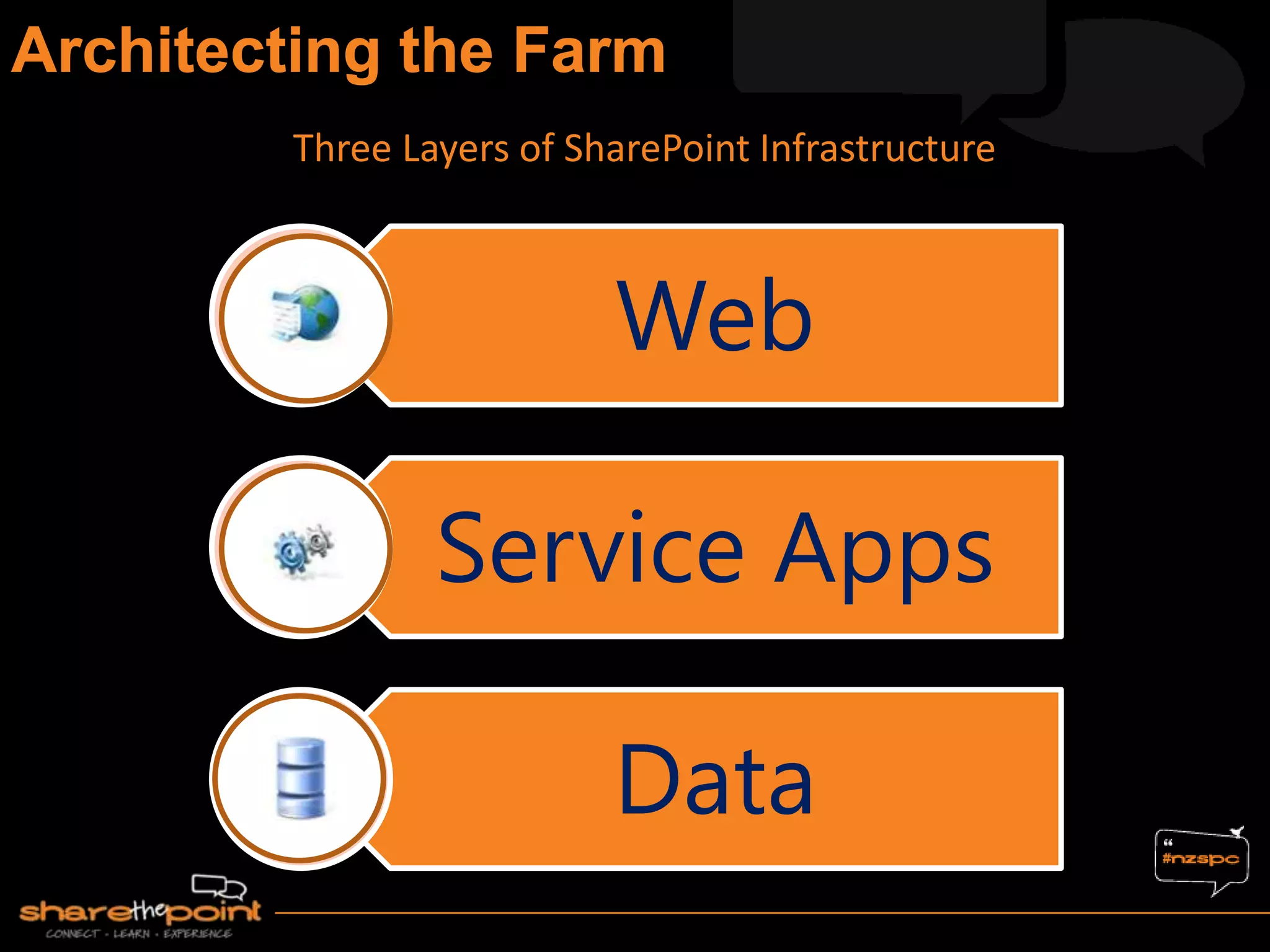
Web
Service Apps
Data
Three Layers of SharePoint Infrastructure
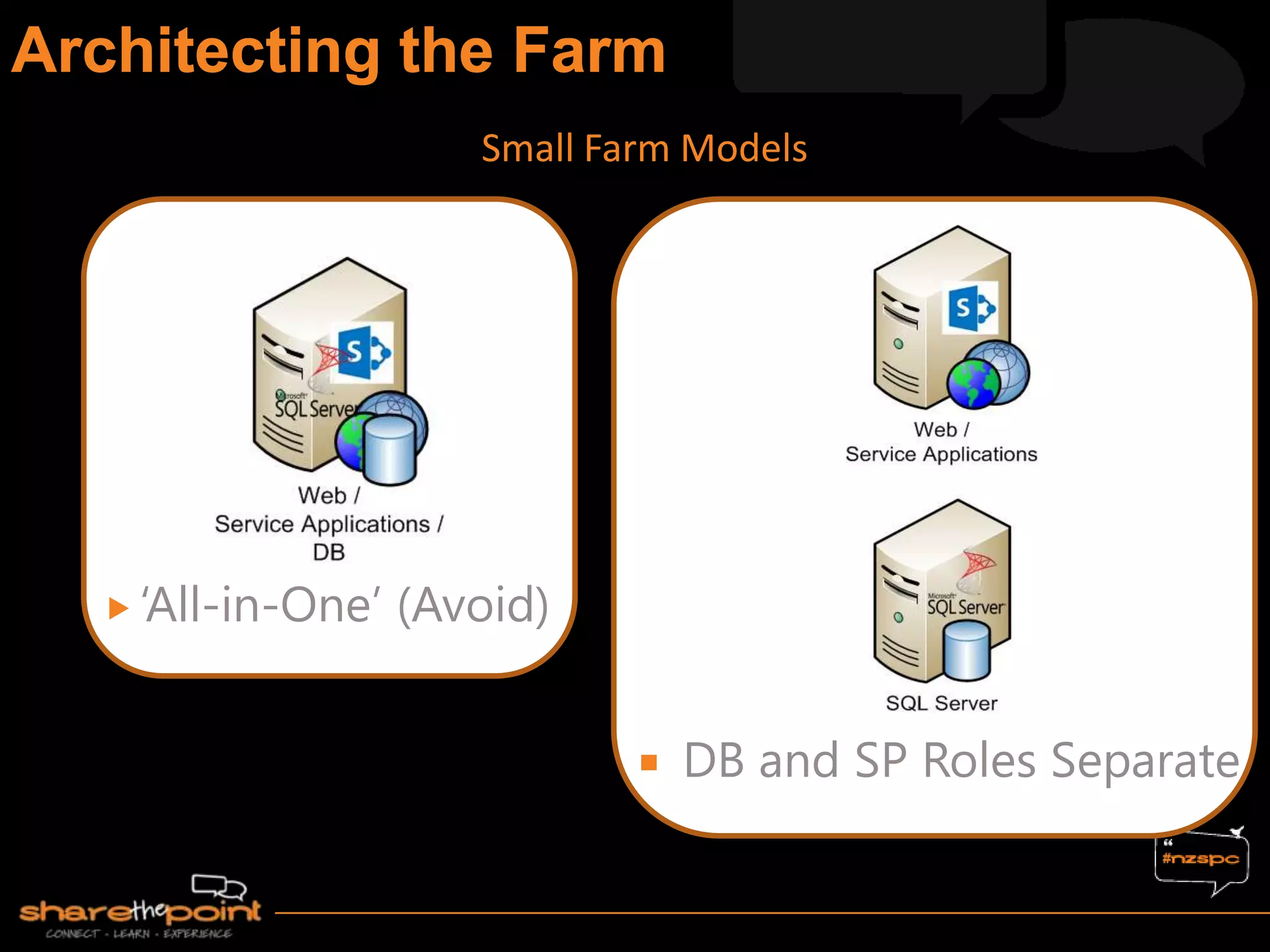
 „All-in-One‟ (Avoid)
 DB and SP Roles Separate
Small Farm Models
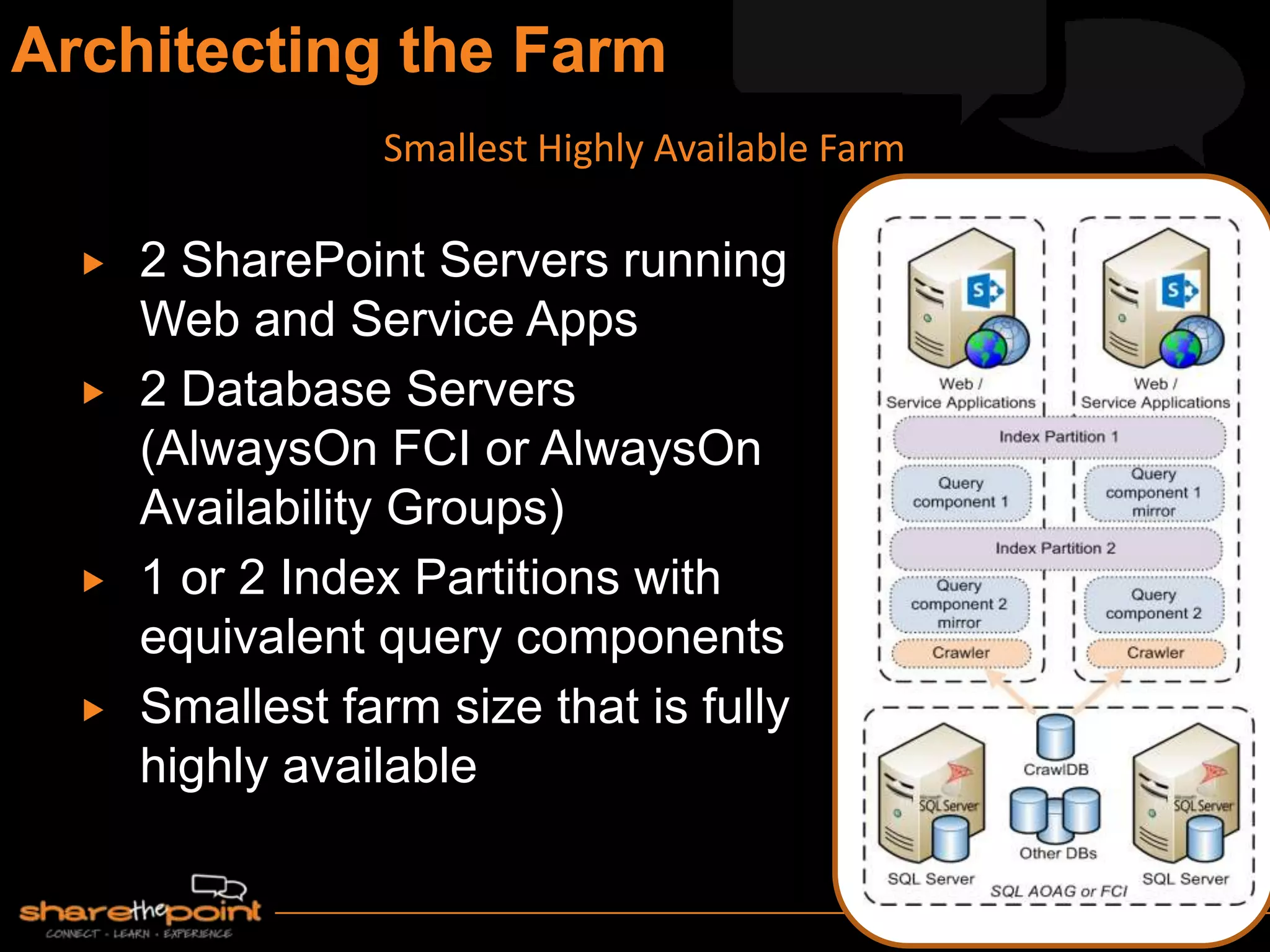
 2 SharePoint Servers running
Web and Service Apps
 2 Database Servers
(AlwaysOn FCI or AlwaysOn
Availability Groups)
 1 or 2 Index Partitions with
equivalent query components
 Smallest farm size that is fully
highly available
Smallest Highly Available Farm
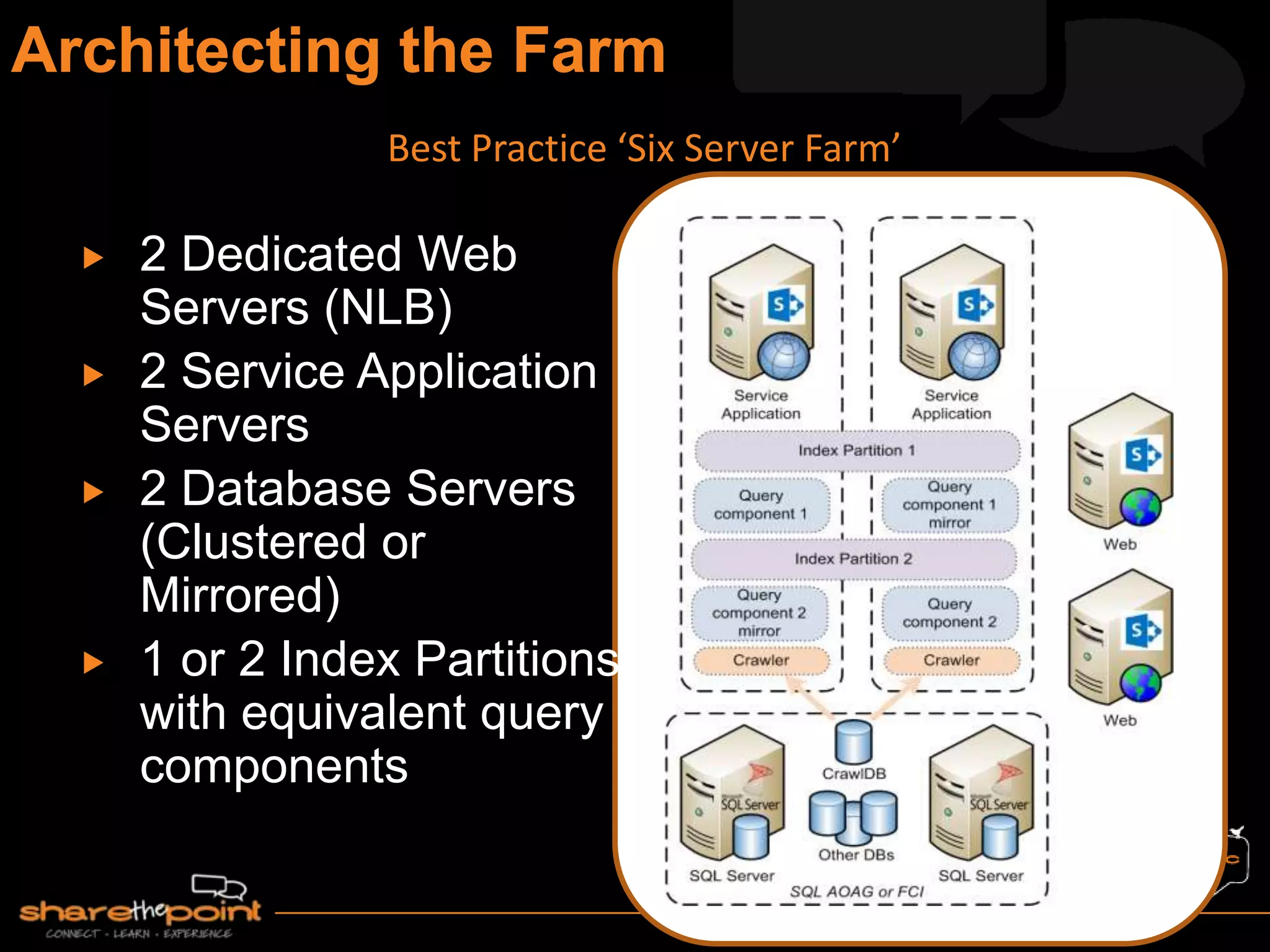
 2 Dedicated Web
Servers (NLB)
 2 Service Application
Servers
 2 Database Servers
(Clustered or
Mirrored)
 1 or 2 Index Partitions
with equivalent query
components
Best Practice ‘Six Server Farm’
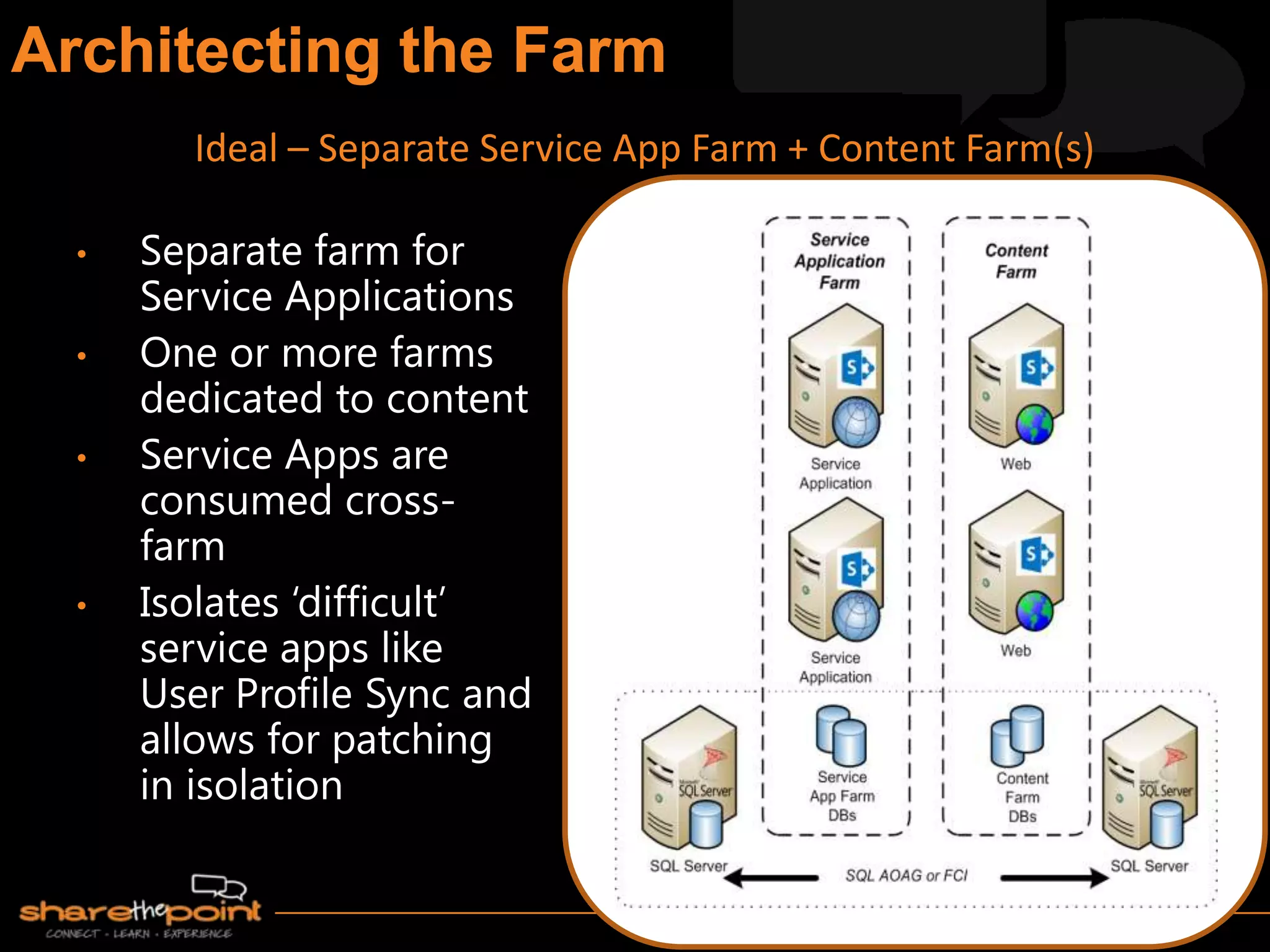
• Separate farm for
Service Applications
• One or more farms
dedicated to content
• Service Apps are
consumed cross-
farm
• Isolates „difficult‟
service apps like
User Profile Sync and
allows for patching
in isolation
Ideal – Separate Service App Farm + Content Farm(s)
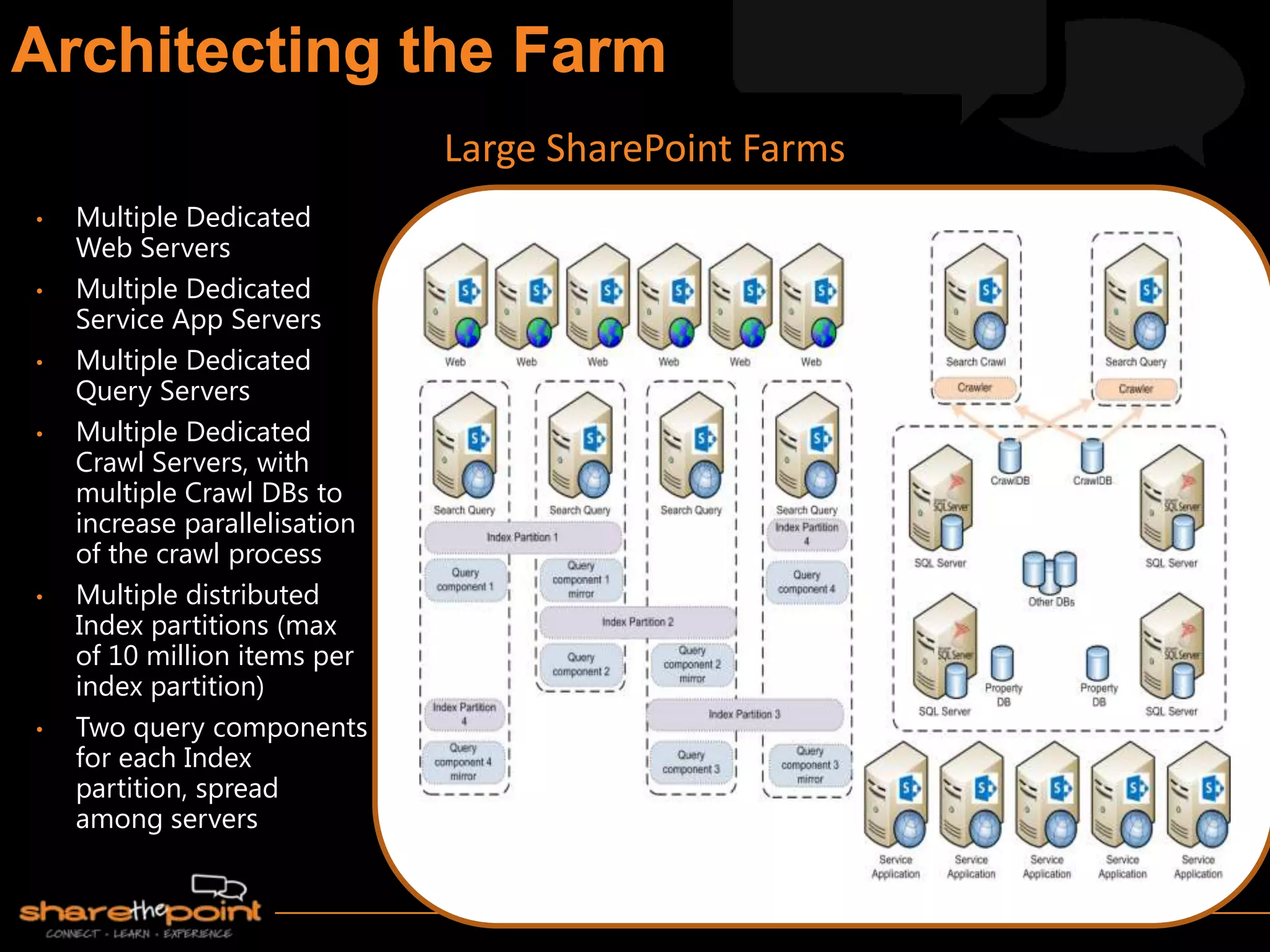
• Multiple Dedicated
Web Servers
• Multiple Dedicated
Service App Servers
• Multiple Dedicated
Query Servers
• Multiple Dedicated
Crawl Servers, with
multiple Crawl DBs to
increase parallelisation
of the crawl process
• Multiple distributed
Index partitions (max
of 10 million items per
index partition)
• Two query components
for each Index
partition, spread
among servers
Large SharePoint Farms
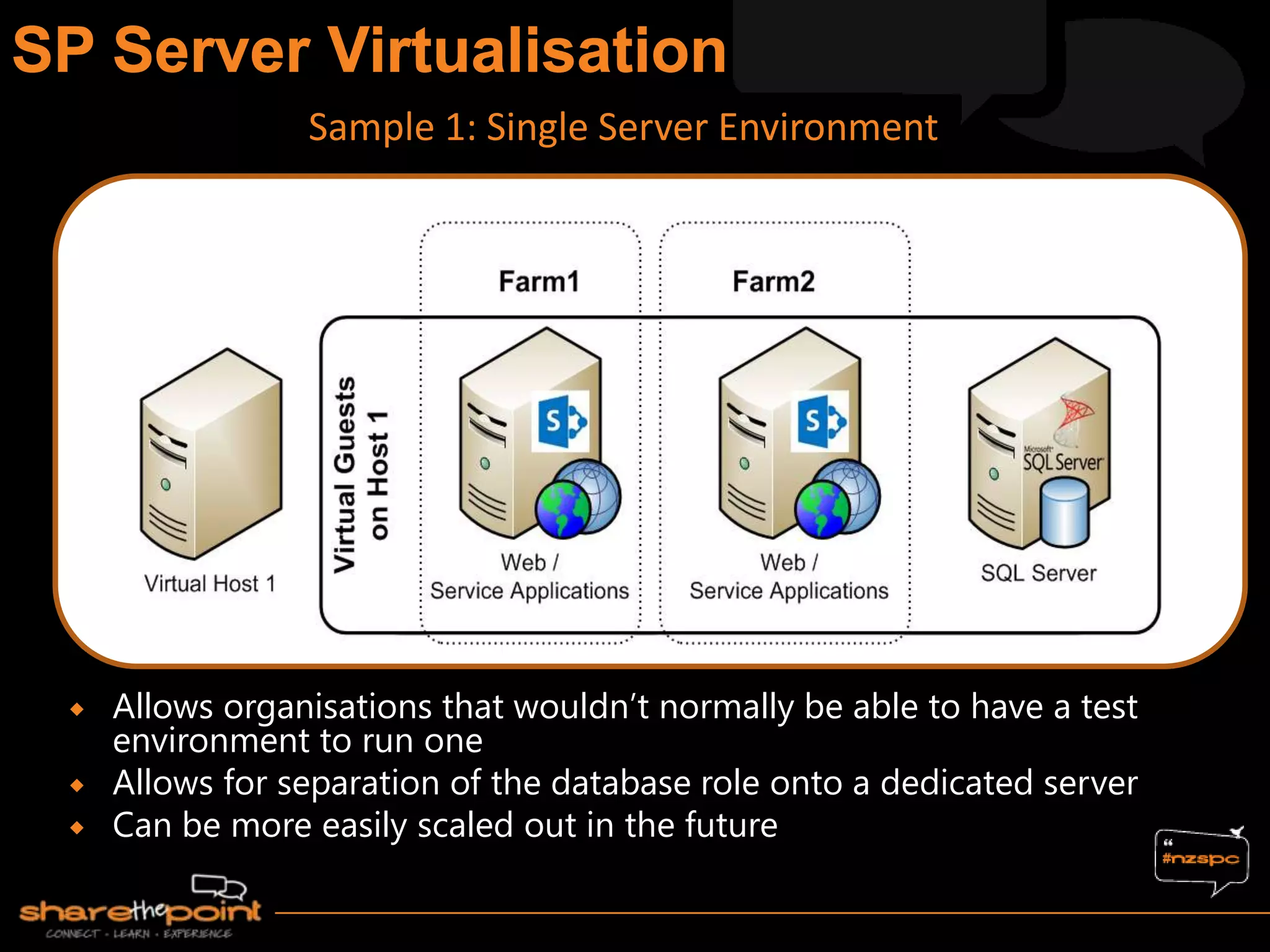
 Allows organisations that wouldn‟t normally be able to have a test
environment to run one
 Allows for separation of the database role onto a dedicated server
 Can be more easily scaled out in the future
Sample 1: Single Server Environment
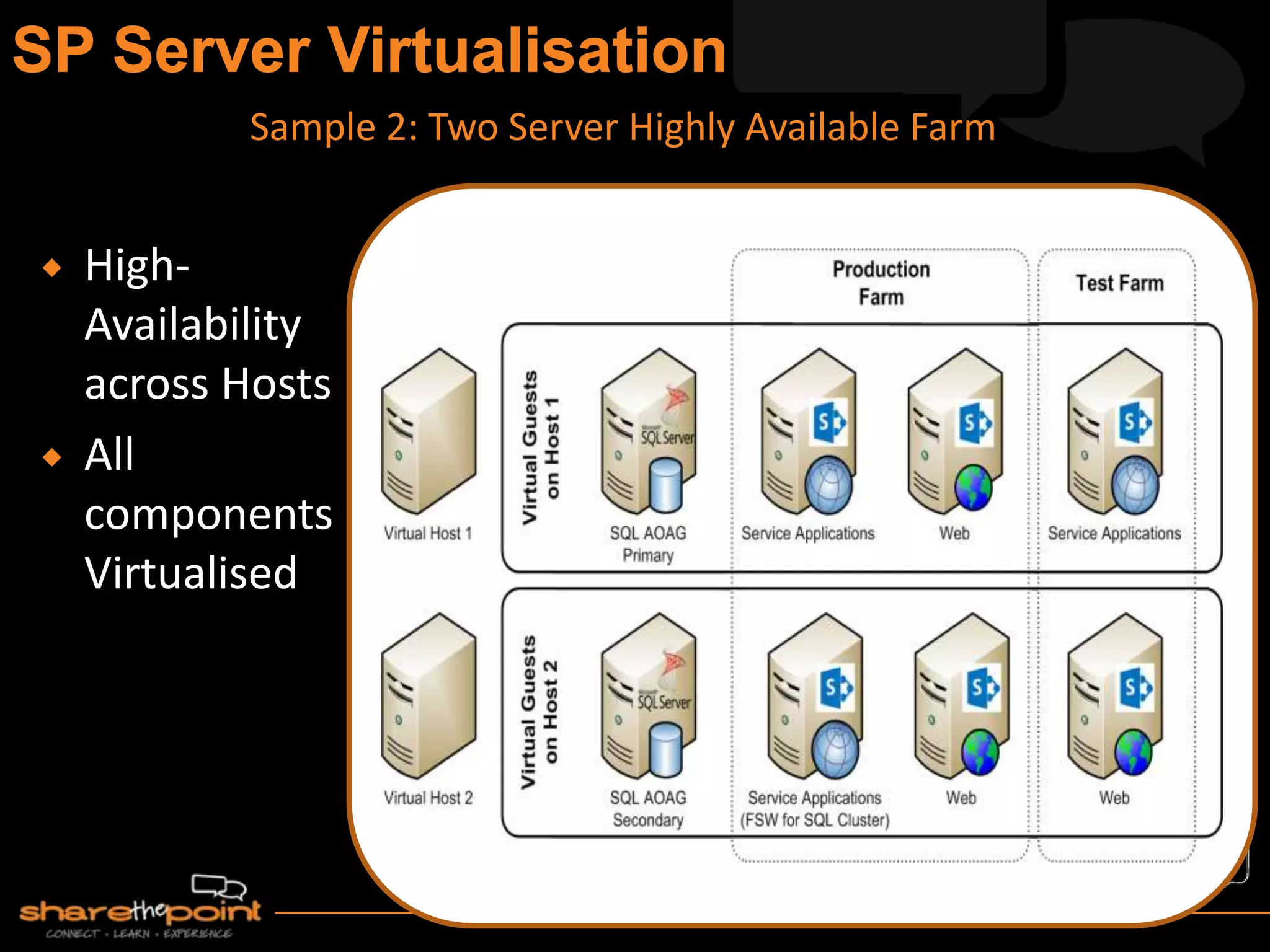
 High-
Availability
across Hosts
 All
components
Virtualised
Sample 2: Two Server Highly Available Farm
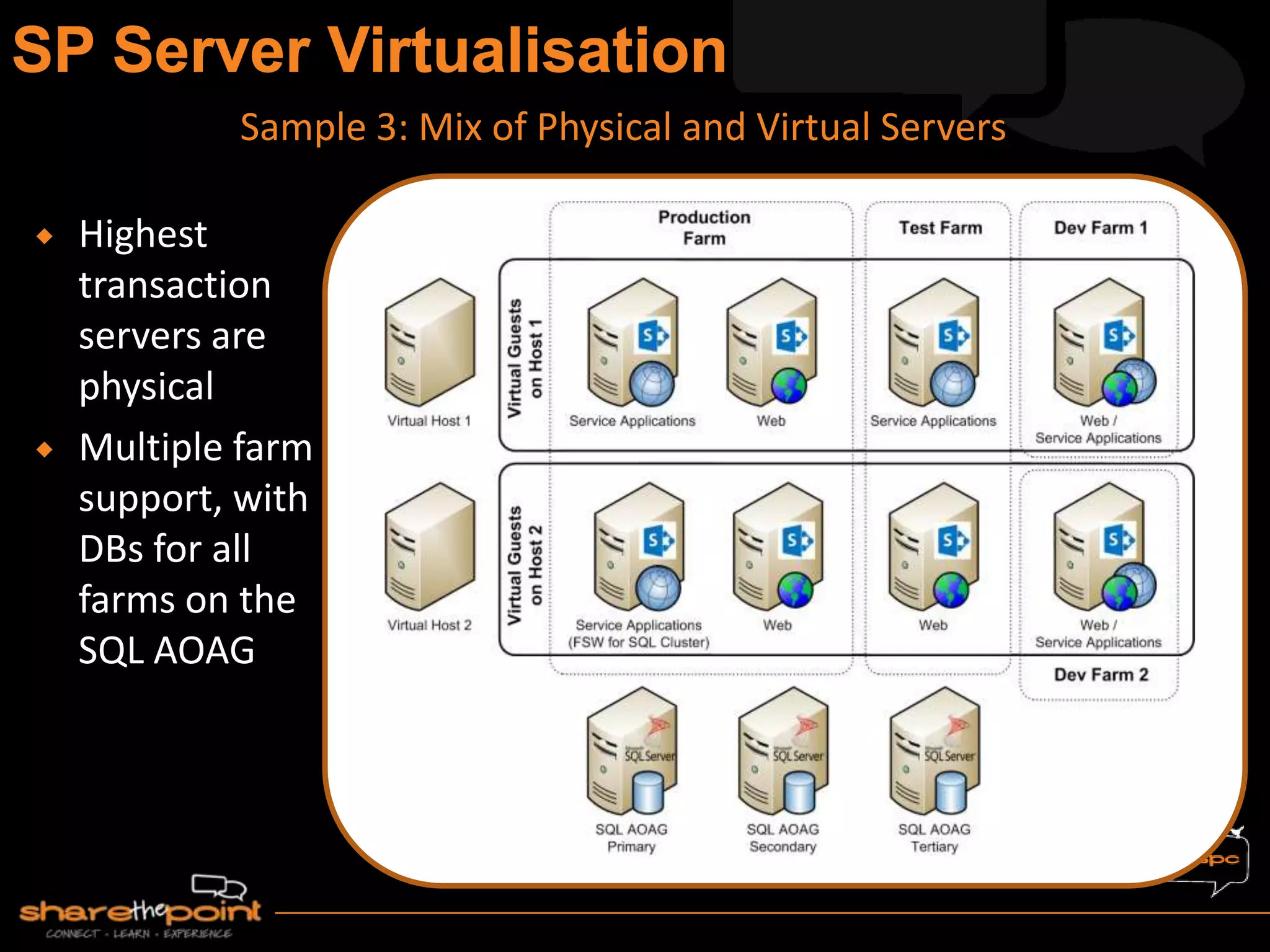
 Highest
transaction
servers are
physical
 Multiple farm
support, with
DBs for all
farms on the
SQL AOAG
Sample 3: Mix of Physical and Virtual Servers
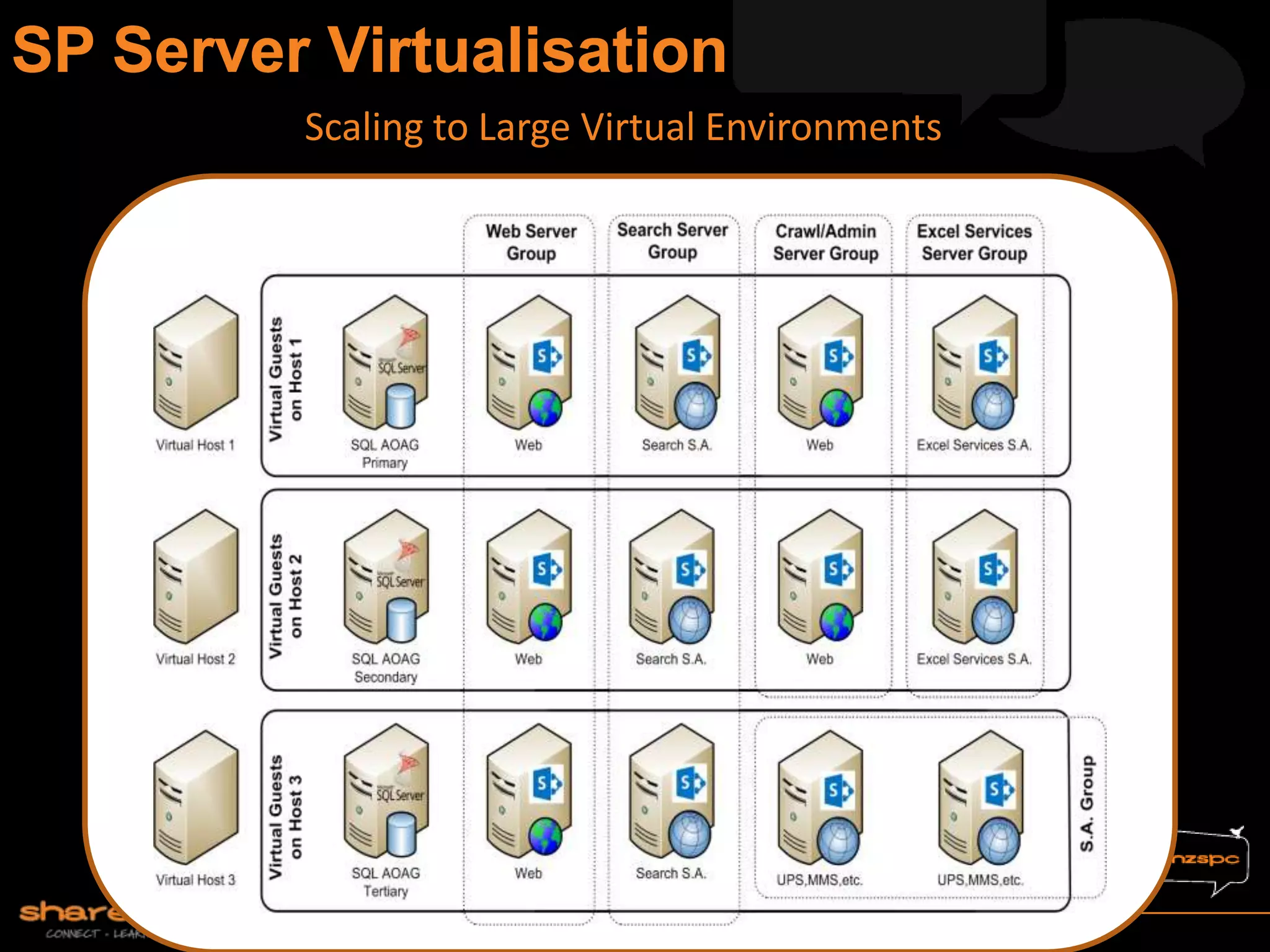
Scaling to Large Virtual Environments
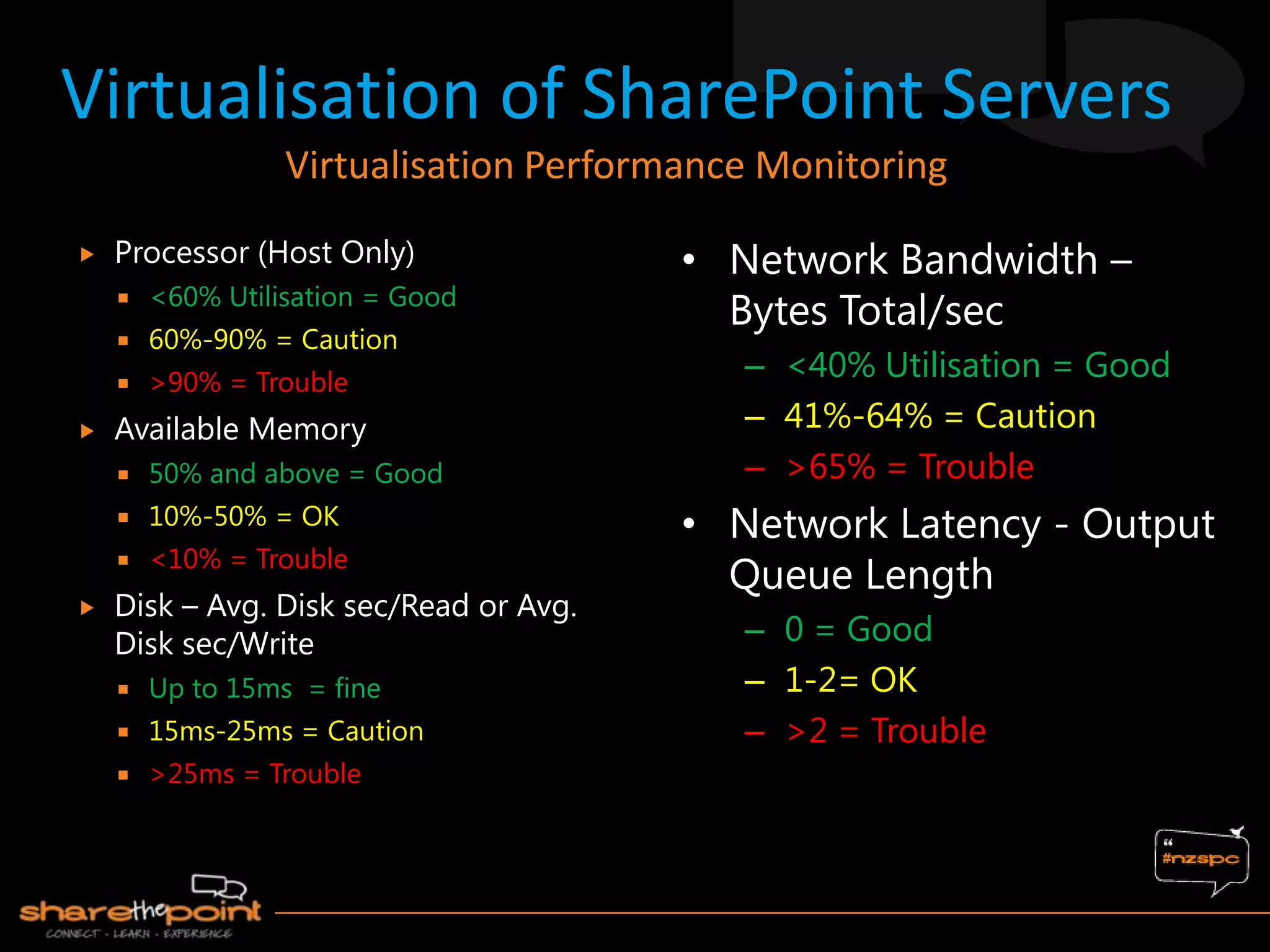
 Processor (Host Only)
 <60% Utilisation = Good
 60%-90% = Caution
 >90% = Trouble
 Available Memory
 50% and above = Good
 10%-50% = OK
 <10% = Trouble
 Disk – Avg. Disk sec/Read or Avg.
Disk sec/Write
 Up to 15ms = fine
 15ms-25ms = Caution
 >25ms = Trouble
• Network Bandwidth –
Bytes Total/sec
– <40% Utilisation = Good
– 41%-64% = Caution
– >65% = Trouble
• Network Latency - Output
Queue Length
– 0 = Good
– 1-2= OK
– >2 = Trouble
Virtualisation of SharePoint Servers
Virtualisation Performance Monitoring
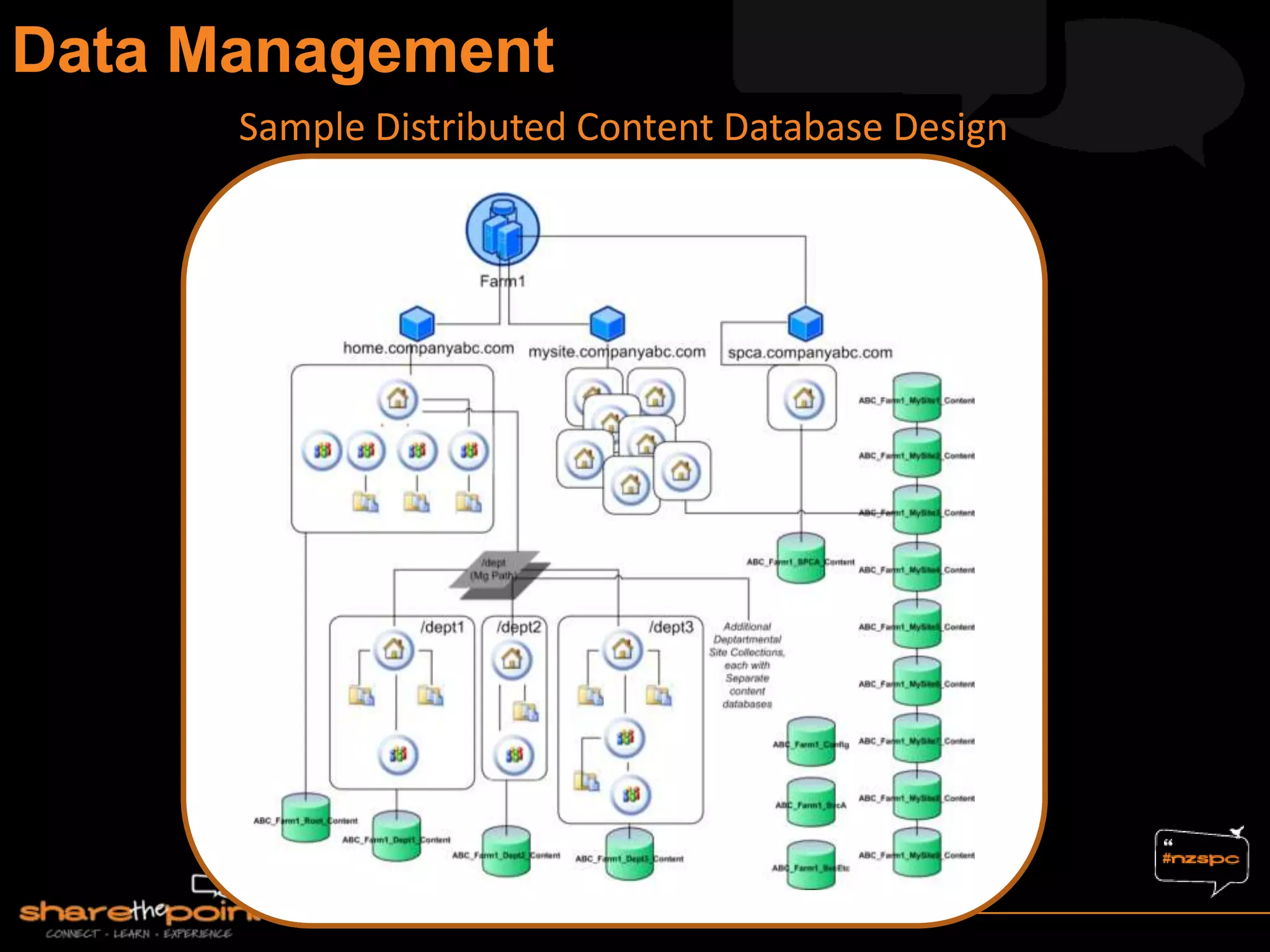
Sample Distributed Content Database Design
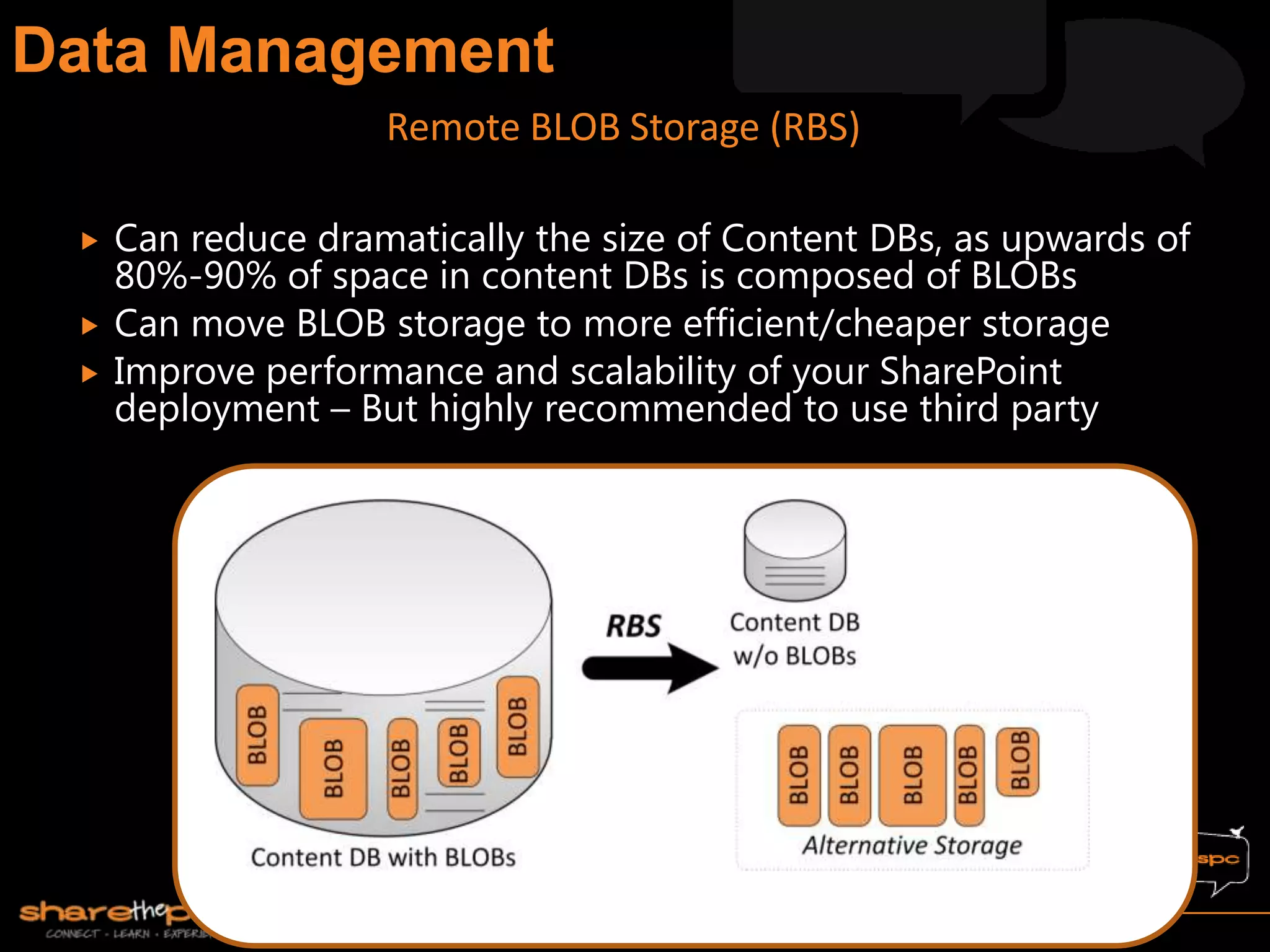
 Can reduce dramatically the size of Content DBs, as upwards of
80%-90% of space in content DBs is composed of BLOBs
 Can move BLOB storage to more efficient/cheaper storage
 Improve performance and scalability of your SharePoint
deployment – But highly recommended to use third party
Remote BLOB Storage (RBS)
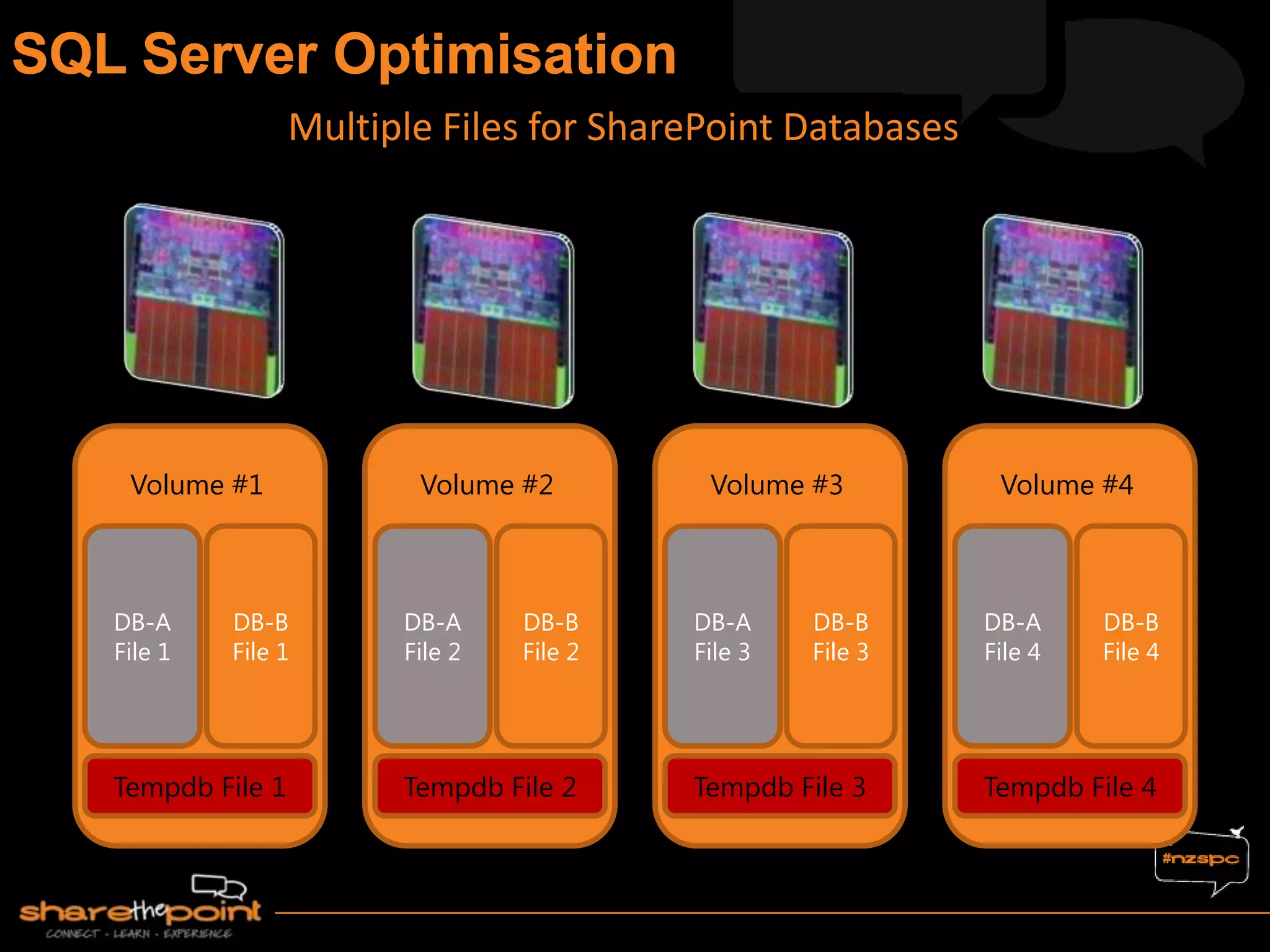
DB-A
File 1
DB-B
File 1
Volume #1
DB-A
File 2
DB-B
File 2
Volume #2
DB-A
File 3
DB-B
File 3
Volume #3
DB-A
File 4
DB-B
File 4
Volume #4
Tempdb File 1 Tempdb File 2 Tempdb File 3 Tempdb File 4
Multiple Files for SharePoint Databases
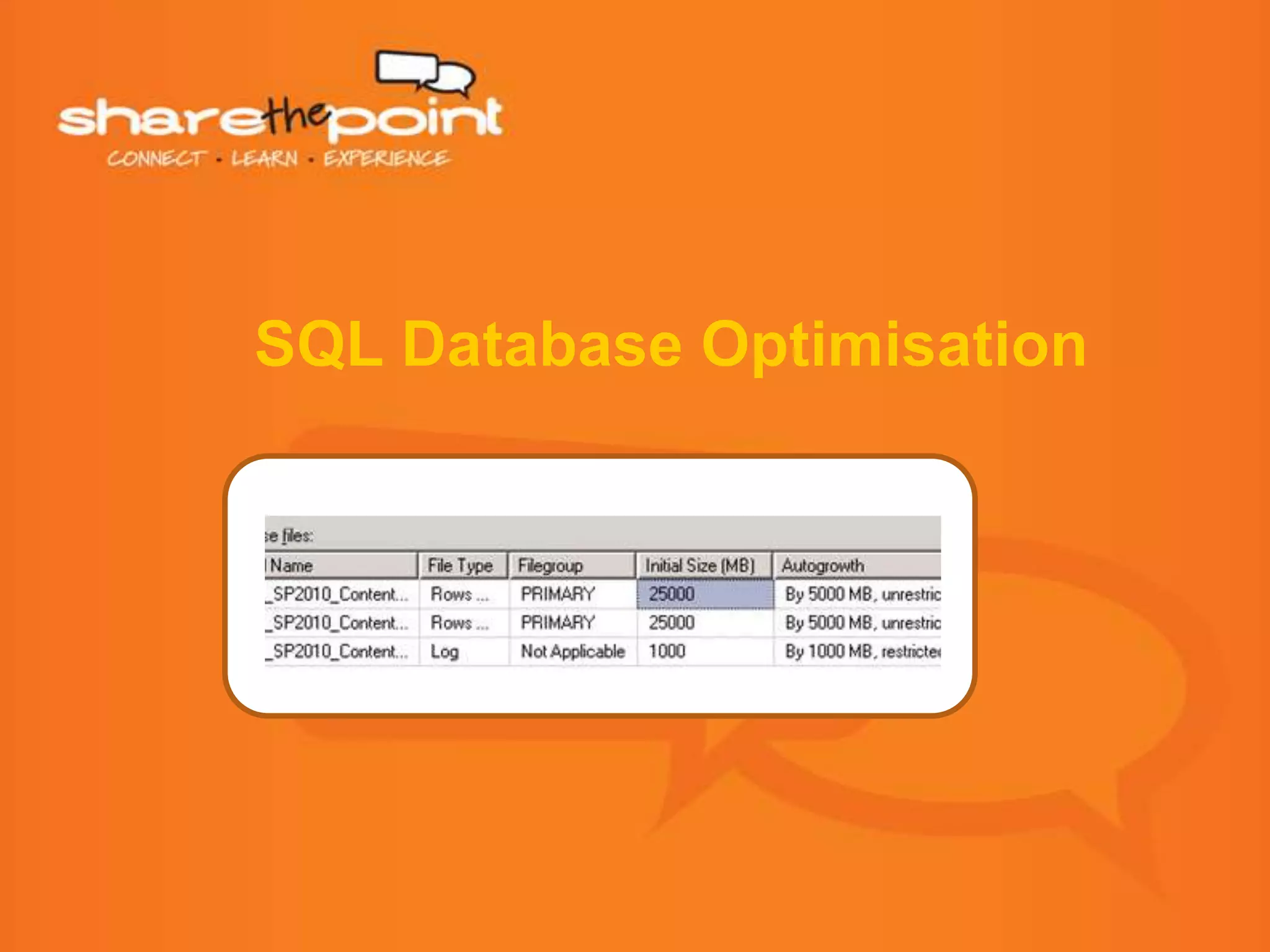
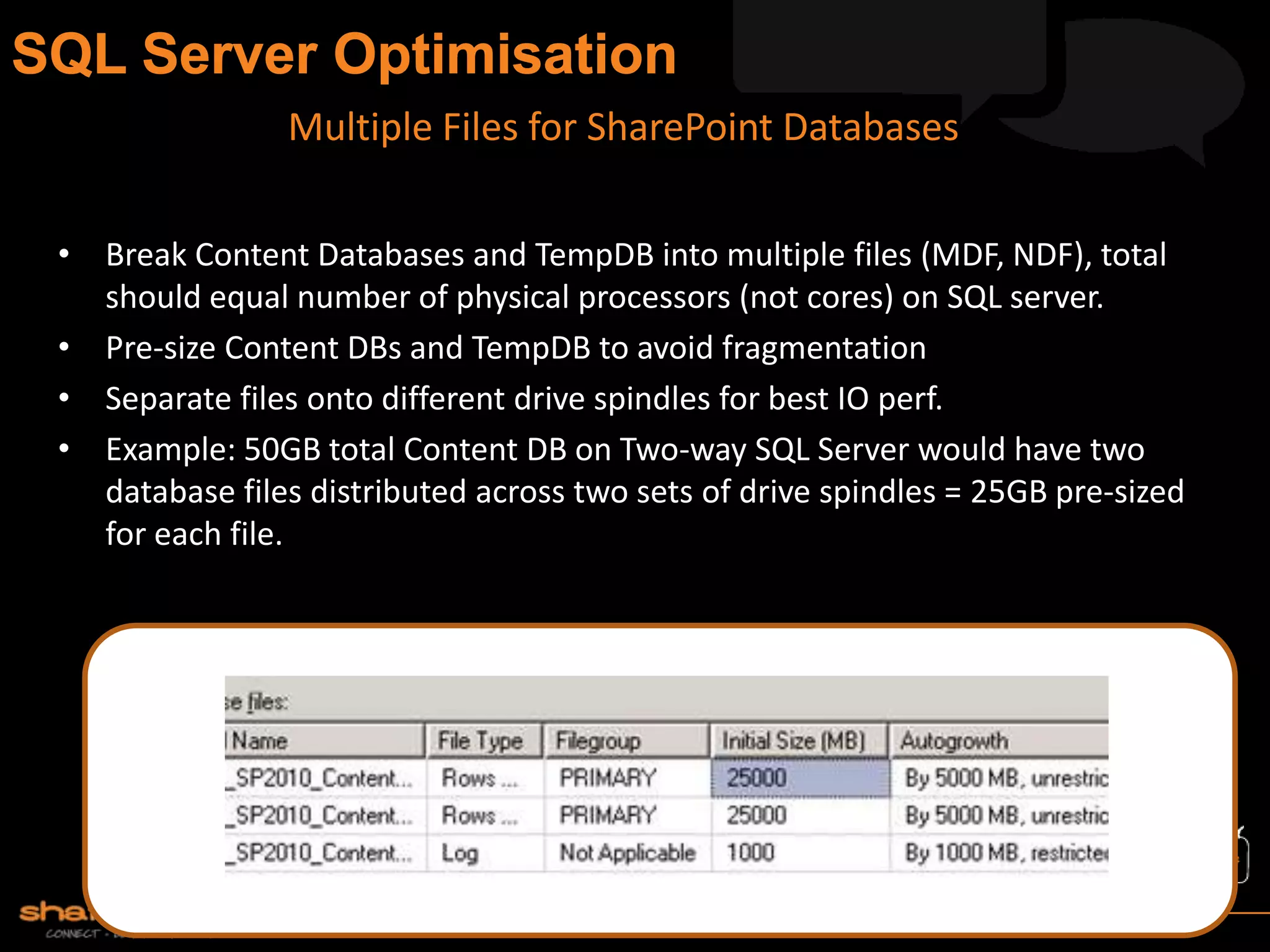
• Break Content Databases and TempDB into multiple files (MDF, NDF), total
should equal number of physical processors (not cores) on SQL server.
• Pre-size Content DBs and TempDB to avoid fragmentation
• Separate files onto different drive spindles for best IO perf.
• Example: 50GB total Content DB on Two-way SQL Server would have two
database files distributed across two sets of drive spindles = 25GB pre-sized
for each file.
Multiple Files for SharePoint Databases
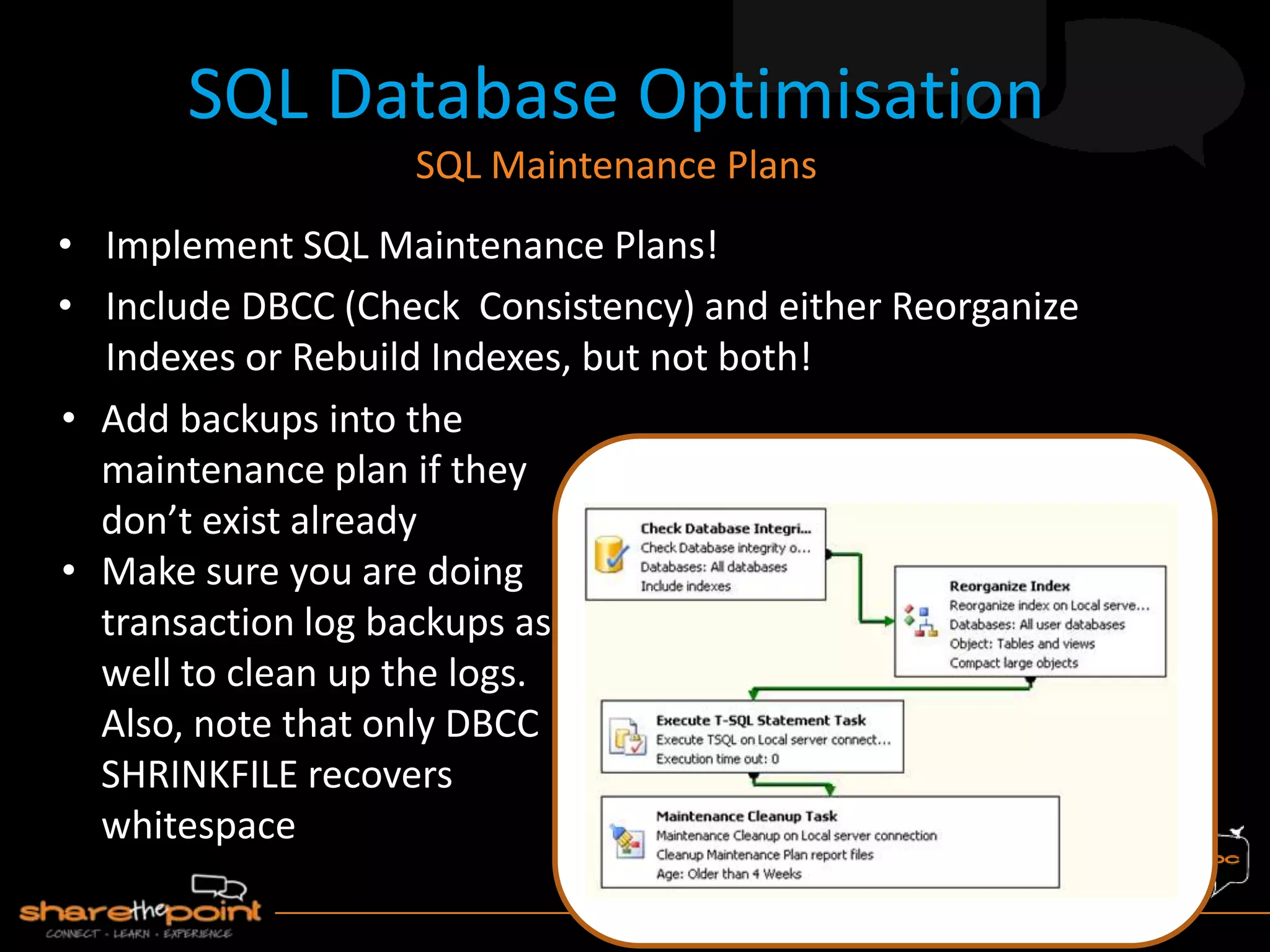
• Implement SQL Maintenance Plans!
• Include DBCC (Check Consistency) and either Reorganize
Indexes or Rebuild Indexes, but not both!
SQL Database Optimisation
SQL Maintenance Plans
• Add backups into the
maintenance plan if they
don’t exist already
• Make sure you are doing
transaction log backups as
well to clean up the logs.
Also, note that only DBCC
SHRINKFILE recovers
whitespace
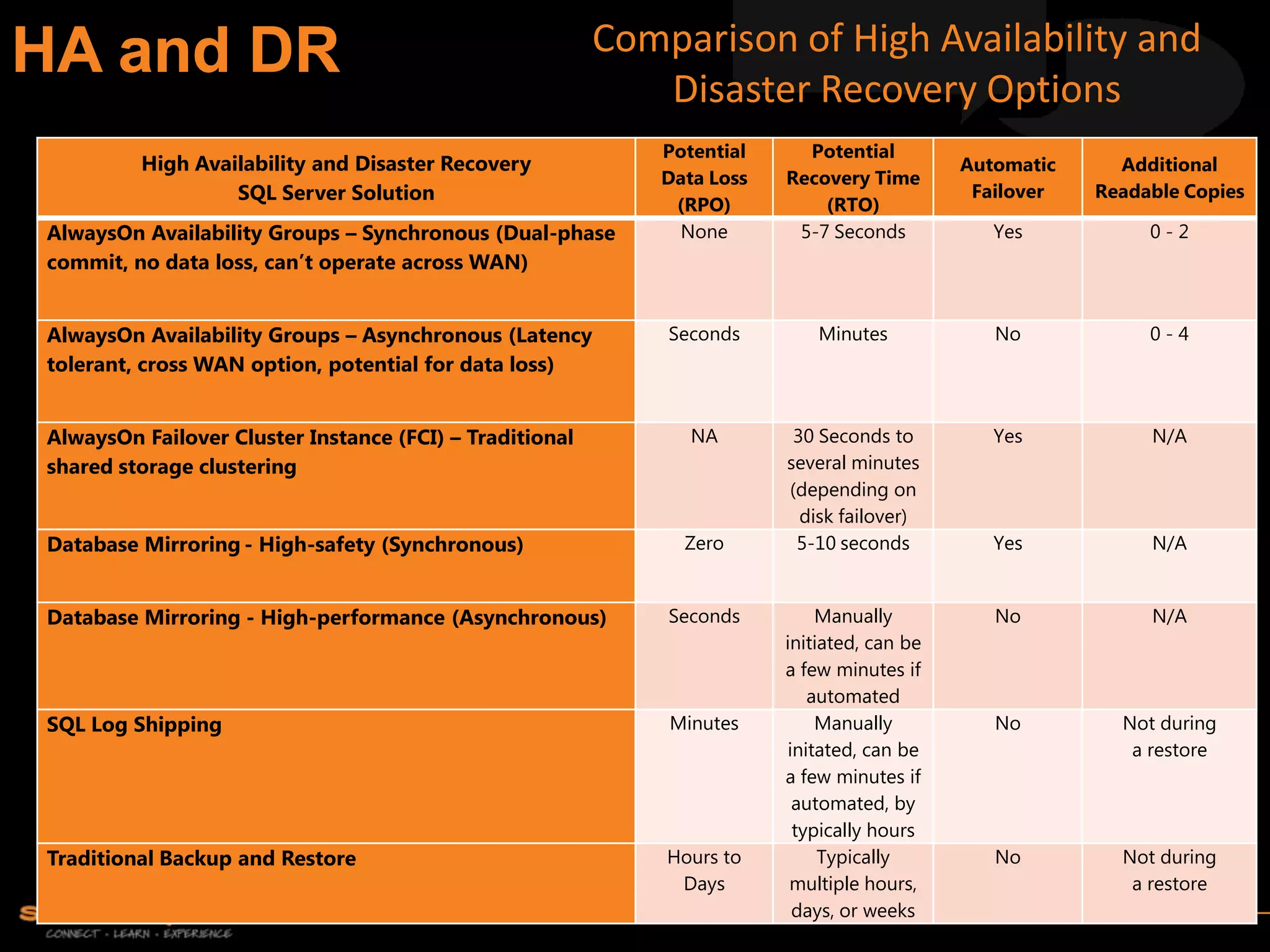
High Availability and Disaster Recovery
SQL Server Solution
Potential
Data Loss
(RPO)
Potential
Recovery Time
(RTO)
Automatic
Failover
Additional
Readable Copies
AlwaysOn Availability Groups – Synchronous (Dual-phase
commit, no data loss, can’t operate across WAN)
None 5-7 Seconds Yes 0 - 2
AlwaysOn Availability Groups – Asynchronous (Latency
tolerant, cross WAN option, potential for data loss)
Seconds Minutes No 0 - 4
AlwaysOn Failover Cluster Instance (FCI) – Traditional
shared storage clustering
NA 30 Seconds to
several minutes
(depending on
disk failover)
Yes N/A
Database Mirroring - High-safety (Synchronous) Zero 5-10 seconds Yes N/A
Database Mirroring - High-performance (Asynchronous) Seconds Manually
initiated, can be
a few minutes if
automated
No N/A
SQL Log Shipping Minutes Manually
initated, can be
a few minutes if
automated, by
typically hours
No Not during
a restore
Traditional Backup and Restore Hours to
Days
Typically
multiple hours,
days, or weeks
No Not during
a restore
Comparison of High Availability and
Disaster Recovery Options
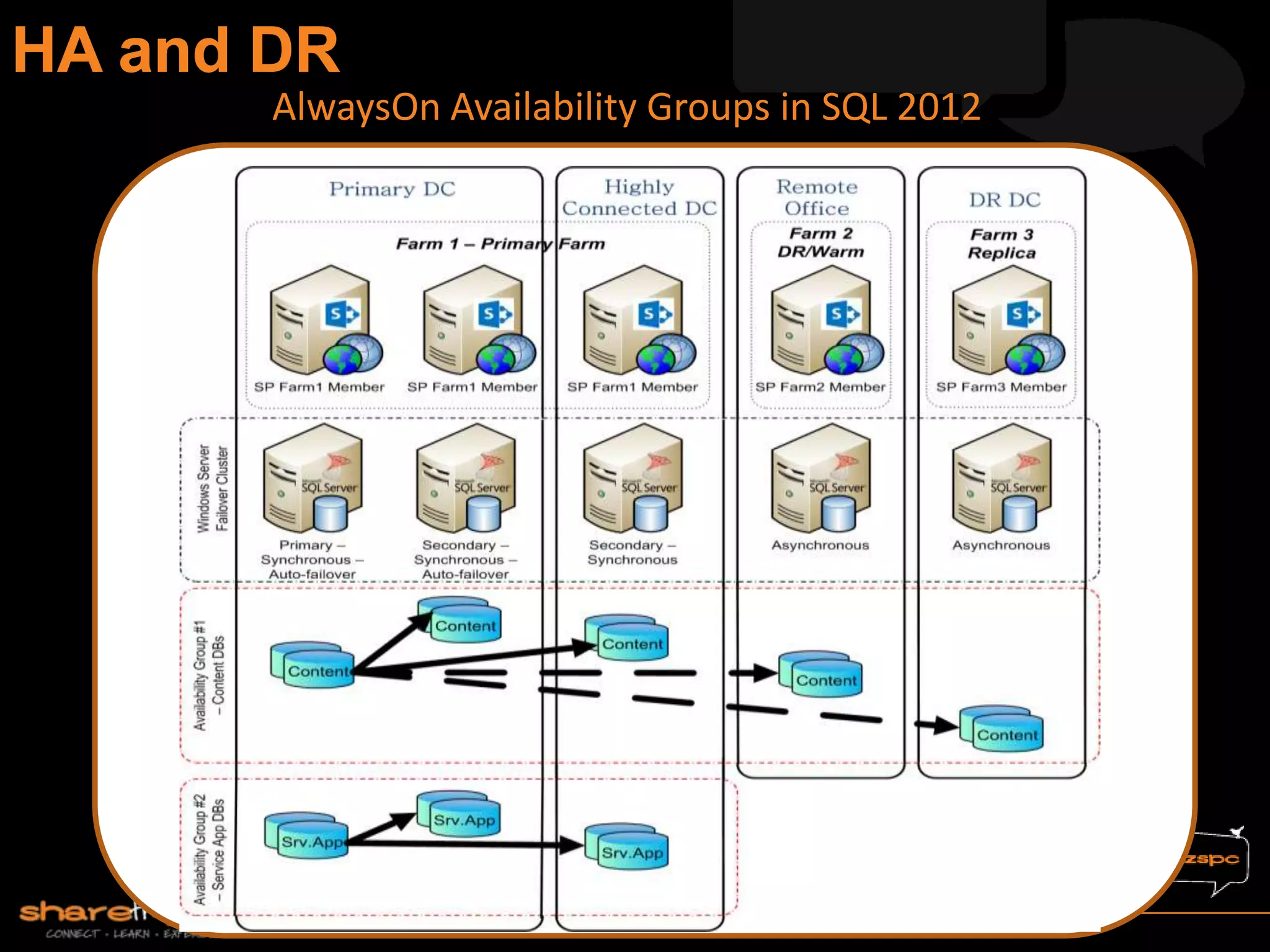
AlwaysOn Availability Groups in SQL 2012
Creating SQL 2012 AOAGs
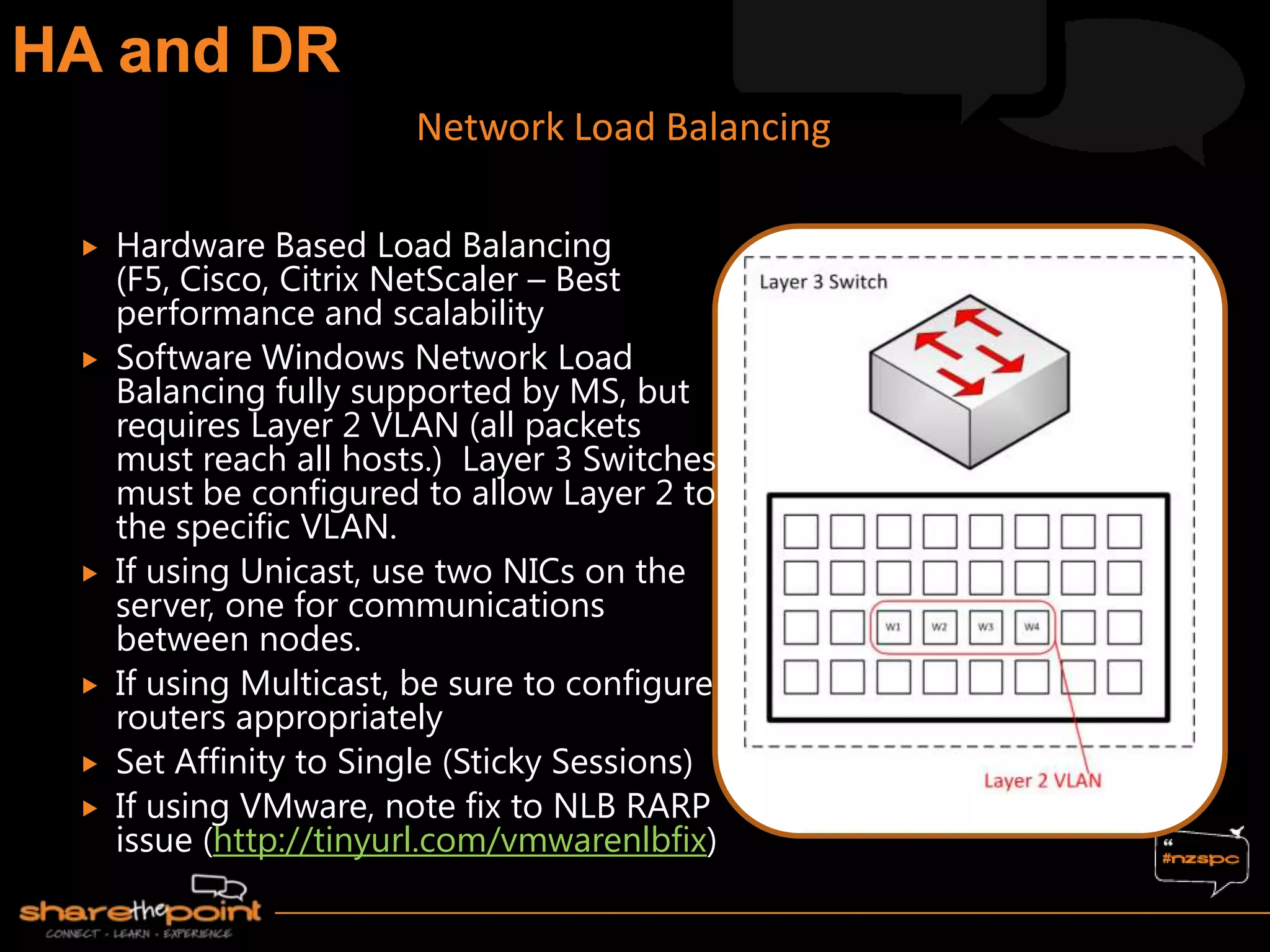
 Hardware Based Load Balancing
(F5, Cisco, Citrix NetScaler – Best
performance and scalability
 Software Windows Network Load
Balancing fully supported by MS, but
requires Layer 2 VLAN (all packets
must reach all hosts.) Layer 3 Switches
must be configured to allow Layer 2 to
the specific VLAN.
 If using Unicast, use two NICs on the
server, one for communications
between nodes.
 If using Multicast, be sure to configure
routers appropriately
 Set Affinity to Single (Sticky Sessions)
 If using VMware, note fix to NLB RARP
issue (http://tinyurl.com/vmwarenlbfix)
Network Load Balancing
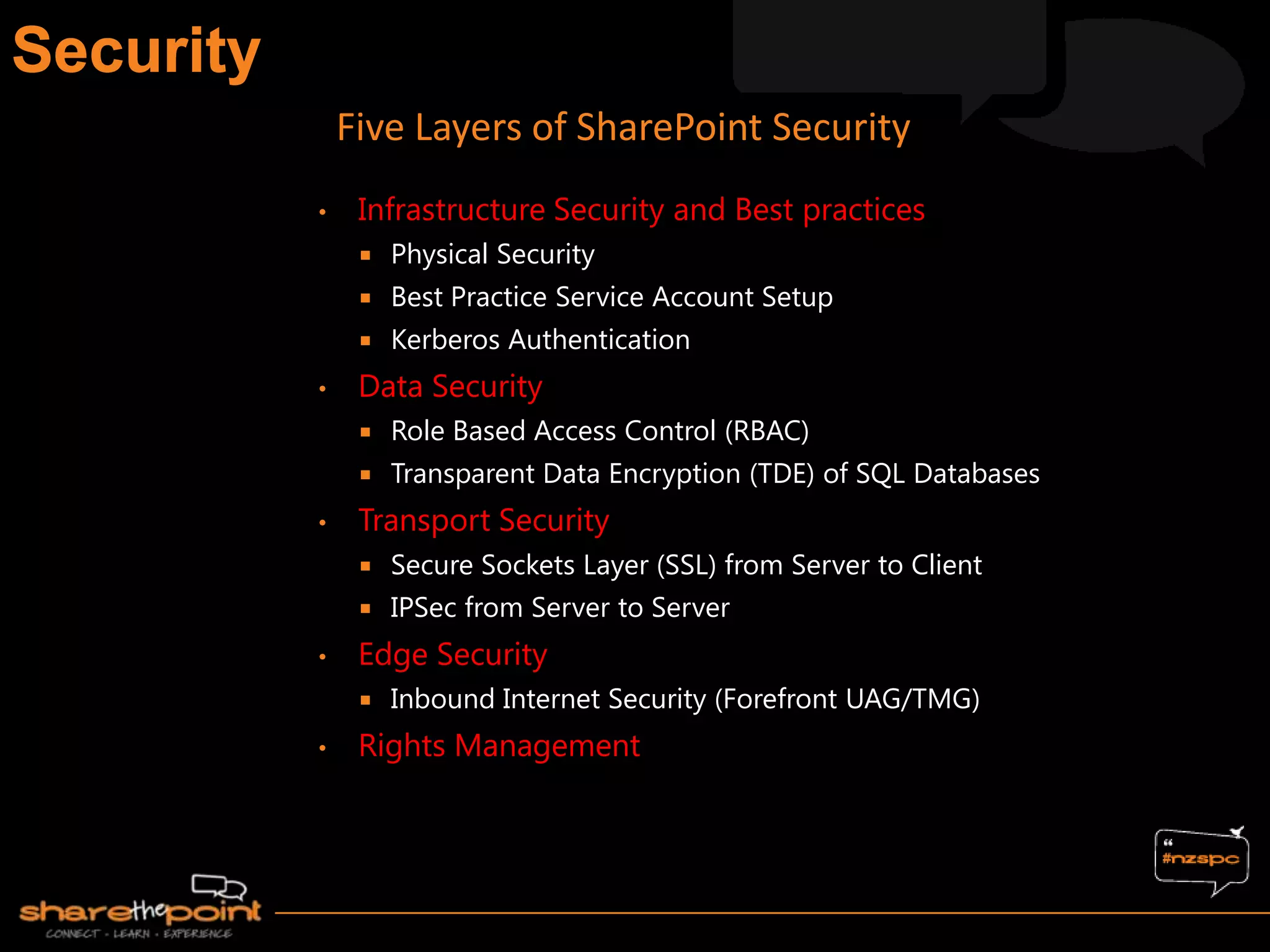
• Infrastructure Security and Best practices
 Physical Security
 Best Practice Service Account Setup
 Kerberos Authentication
• Data Security
 Role Based Access Control (RBAC)
 Transparent Data Encryption (TDE) of SQL Databases
• Transport Security
 Secure Sockets Layer (SSL) from Server to Client
 IPSec from Server to Server
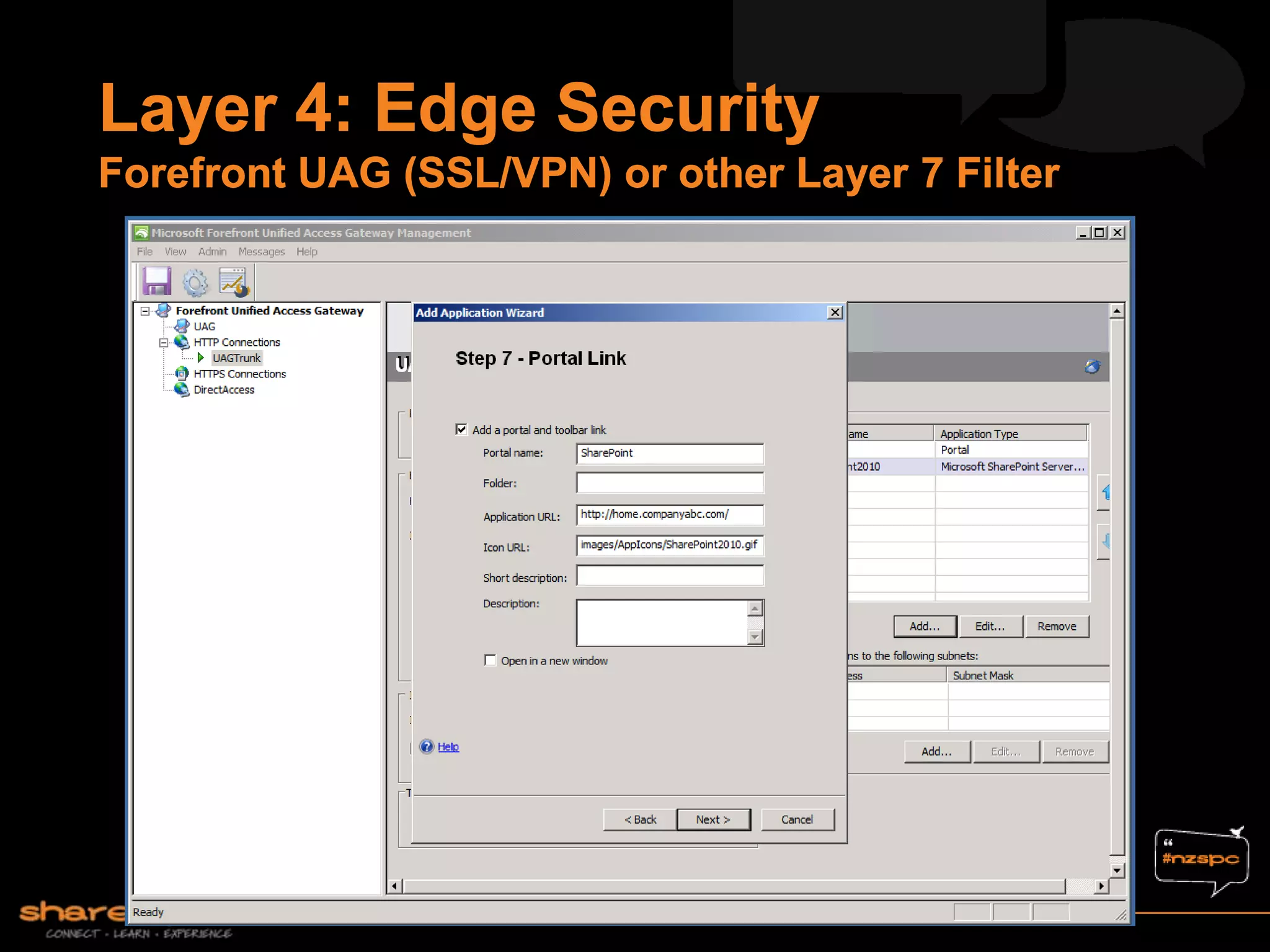
• Edge Security
 Inbound Internet Security (Forefront UAG/TMG)
• Rights Management
Five Layers of SharePoint Security
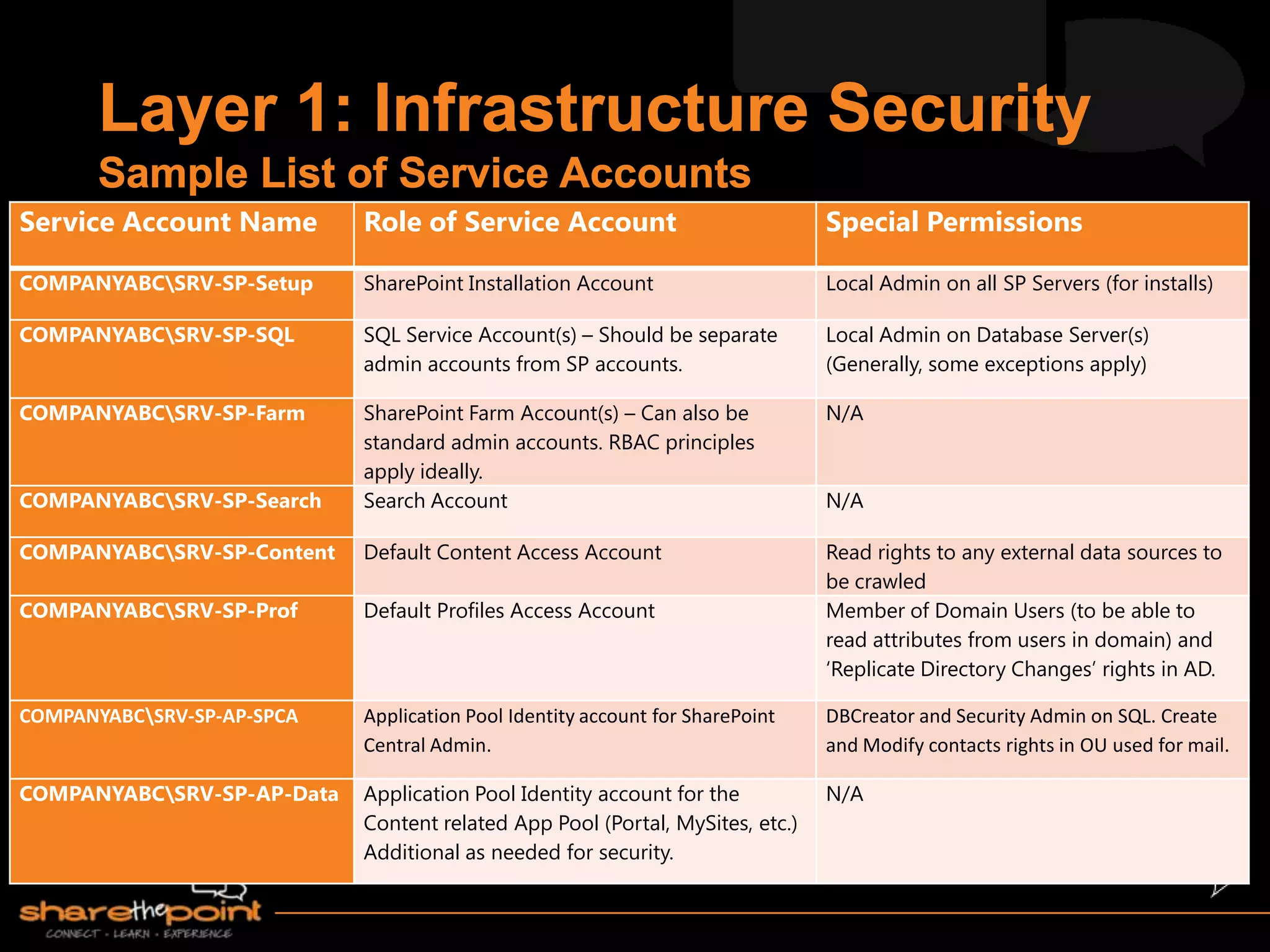
Service Account Name Role of Service Account Special Permissions
COMPANYABCSRV-SP-Setup SharePoint Installation Account Local Admin on all SP Servers (for installs)
COMPANYABCSRV-SP-SQL SQL Service Account(s) – Should be separate
admin accounts from SP accounts.
Local Admin on Database Server(s)
(Generally, some exceptions apply)
COMPANYABCSRV-SP-Farm SharePoint Farm Account(s) – Can also be
standard admin accounts. RBAC principles
apply ideally.
N/A
COMPANYABCSRV-SP-Search Search Account N/A
COMPANYABCSRV-SP-Content Default Content Access Account Read rights to any external data sources to
be crawled
COMPANYABCSRV-SP-Prof Default Profiles Access Account Member of Domain Users (to be able to
read attributes from users in domain) and
„Replicate Directory Changes‟ rights in AD.
COMPANYABCSRV-SP-AP-SPCA Application Pool Identity account for SharePoint
Central Admin.
DBCreator and Security Admin on SQL. Create
and Modify contacts rights in OU used for mail.
COMPANYABCSRV-SP-AP-Data Application Pool Identity account for the
Content related App Pool (Portal, MySites, etc.)
Additional as needed for security.
N/A
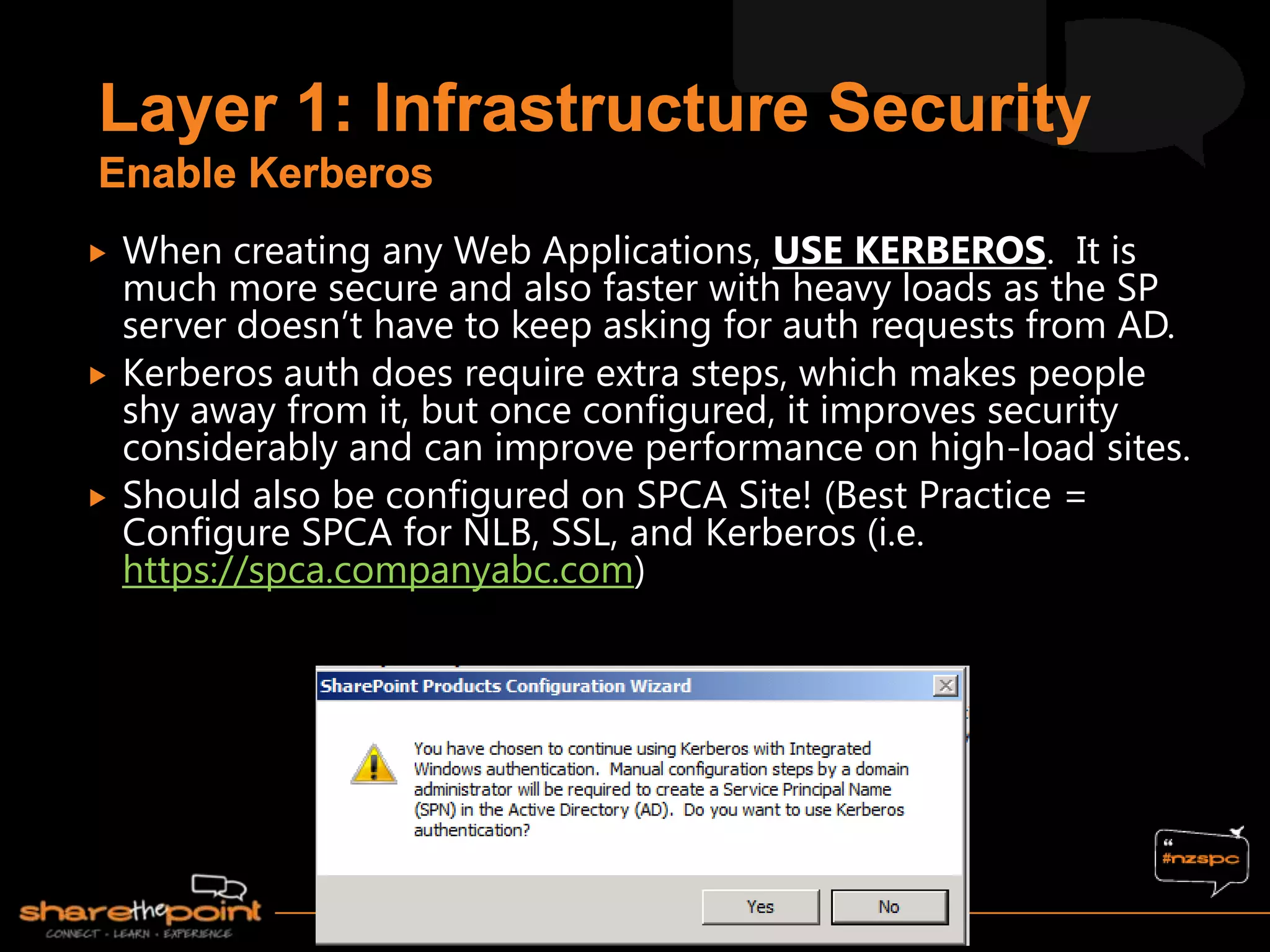
 When creating any Web Applications, USE KERBEROS. It is
much more secure and also faster with heavy loads as the SP
server doesn‟t have to keep asking for auth requests from AD.
 Kerberos auth does require extra steps, which makes people
shy away from it, but once configured, it improves security
considerably and can improve performance on high-load sites.
 Should also be configured on SPCA Site! (Best Practice =
Configure SPCA for NLB, SSL, and Kerberos (i.e.
https://spca.companyabc.com)
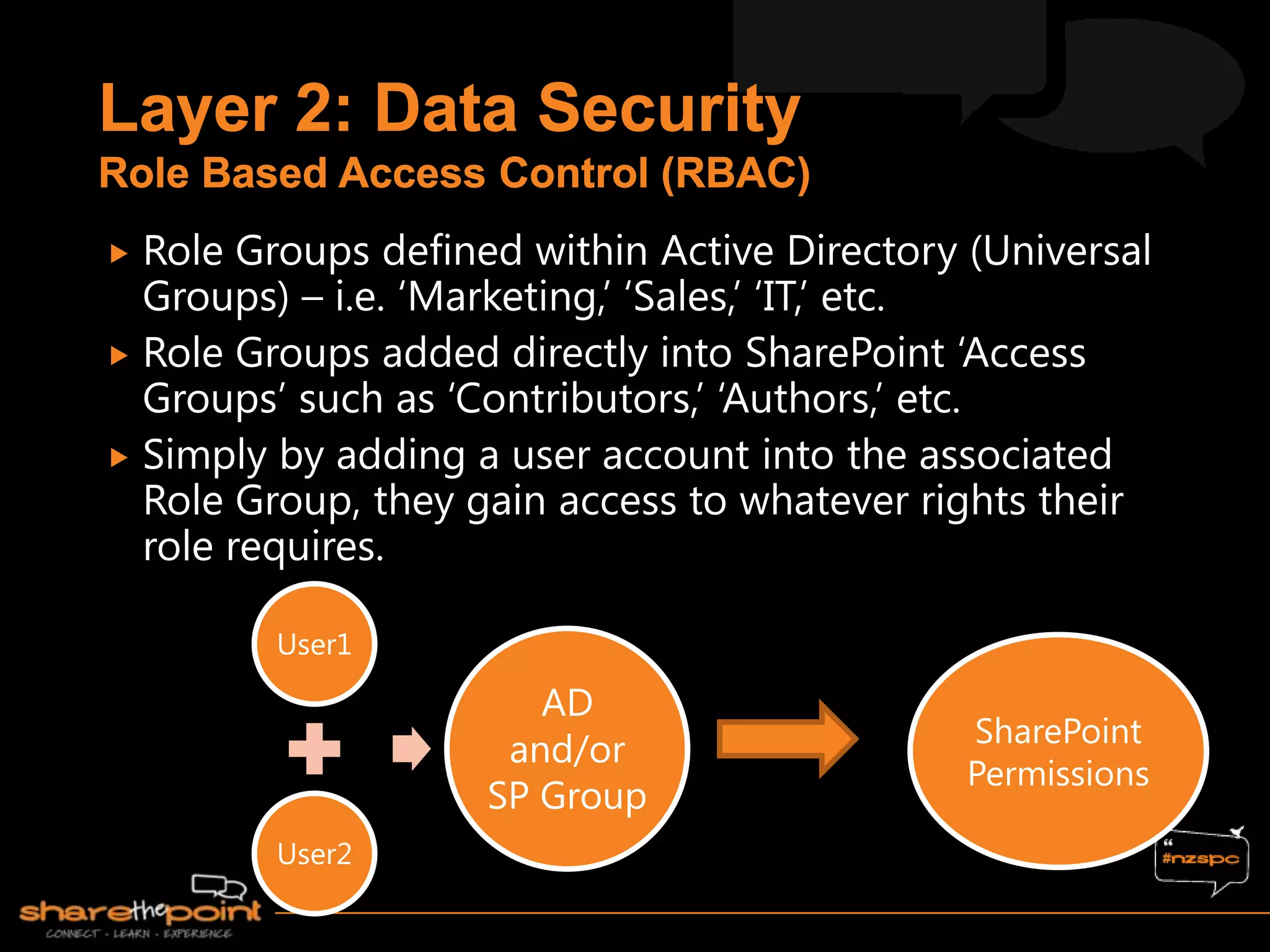
 Role Groups defined within Active Directory (Universal
Groups) – i.e. „Marketing,‟ „Sales,‟ „IT,‟ etc.
 Role Groups added directly into SharePoint „Access
Groups‟ such as „Contributors,‟ „Authors,‟ etc.
 Simply by adding a user account into the associated
Role Group, they gain access to whatever rights their
role requires.
User1
User2
AD
and/or
SP Group
SharePoint
Permissions
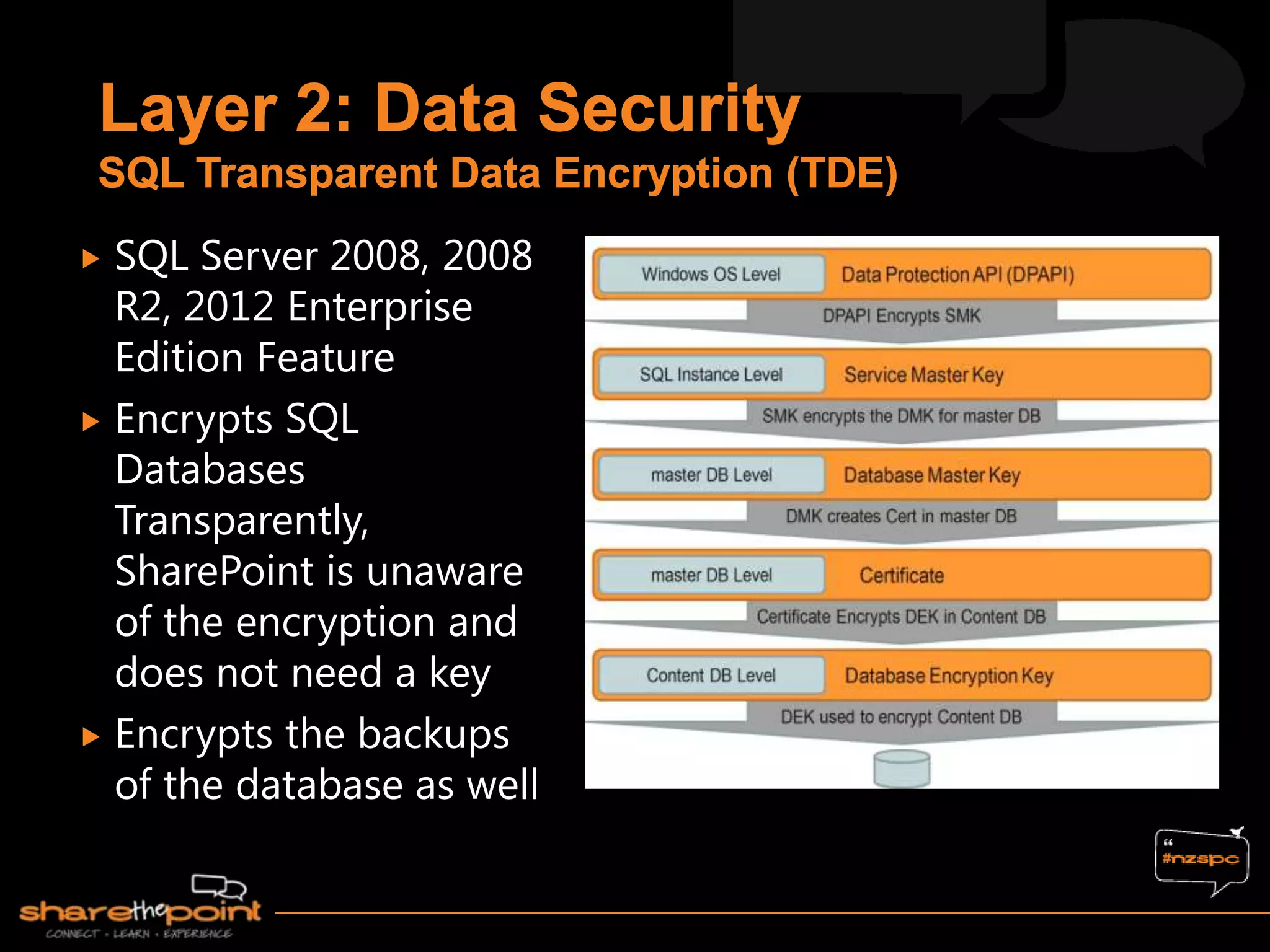
 SQL Server 2008, 2008
R2, 2012 Enterprise
Edition Feature
 Encrypts SQL
Databases
Transparently,
SharePoint is unaware
of the encryption and
does not need a key
 Encrypts the backups
of the database as well
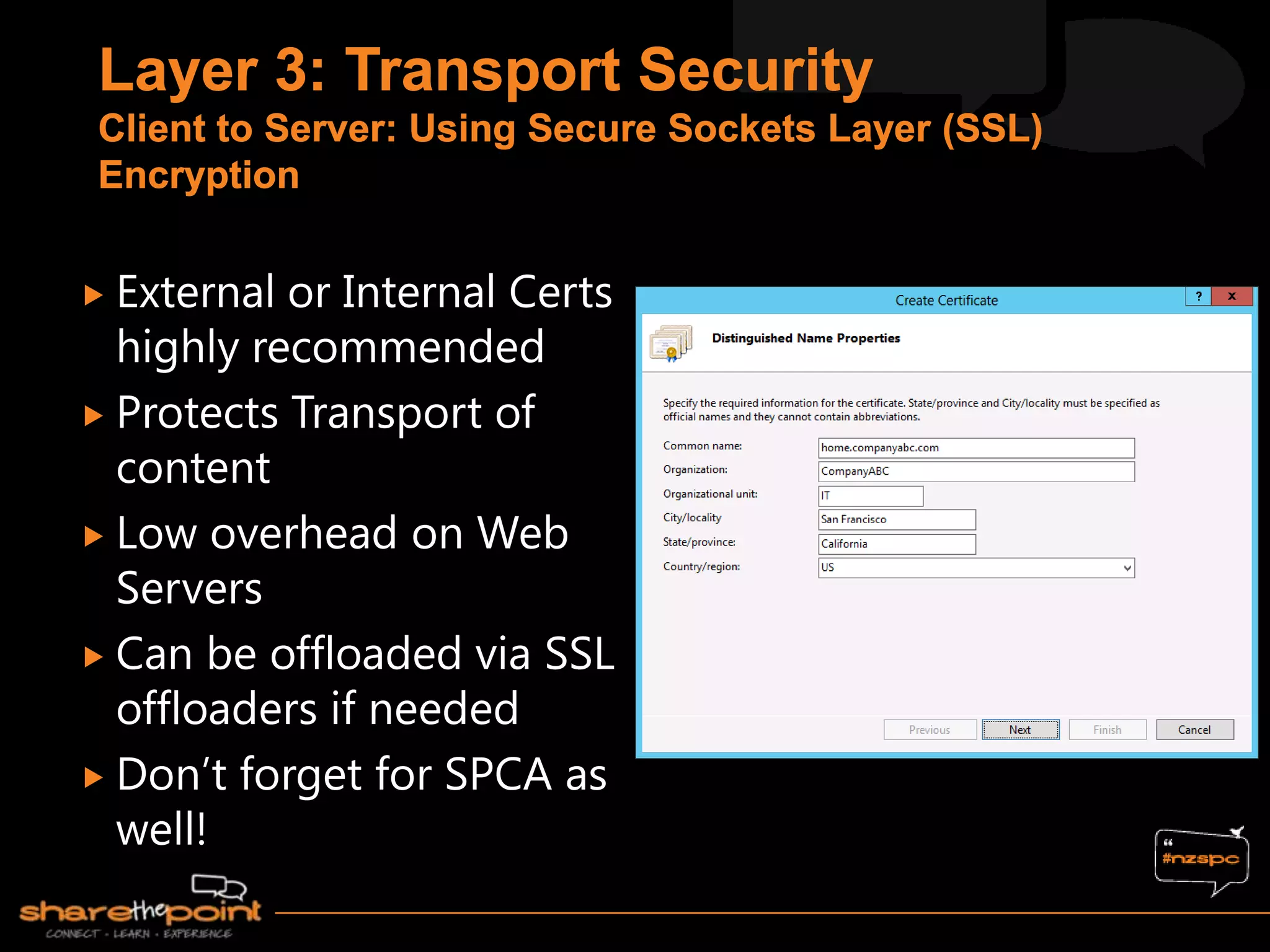
 External or Internal Certs
highly recommended
 Protects Transport of
content
 Low overhead on Web
Servers
 Can be offloaded via SSL
offloaders if needed
 Don‟t forget for SPCA as
well!
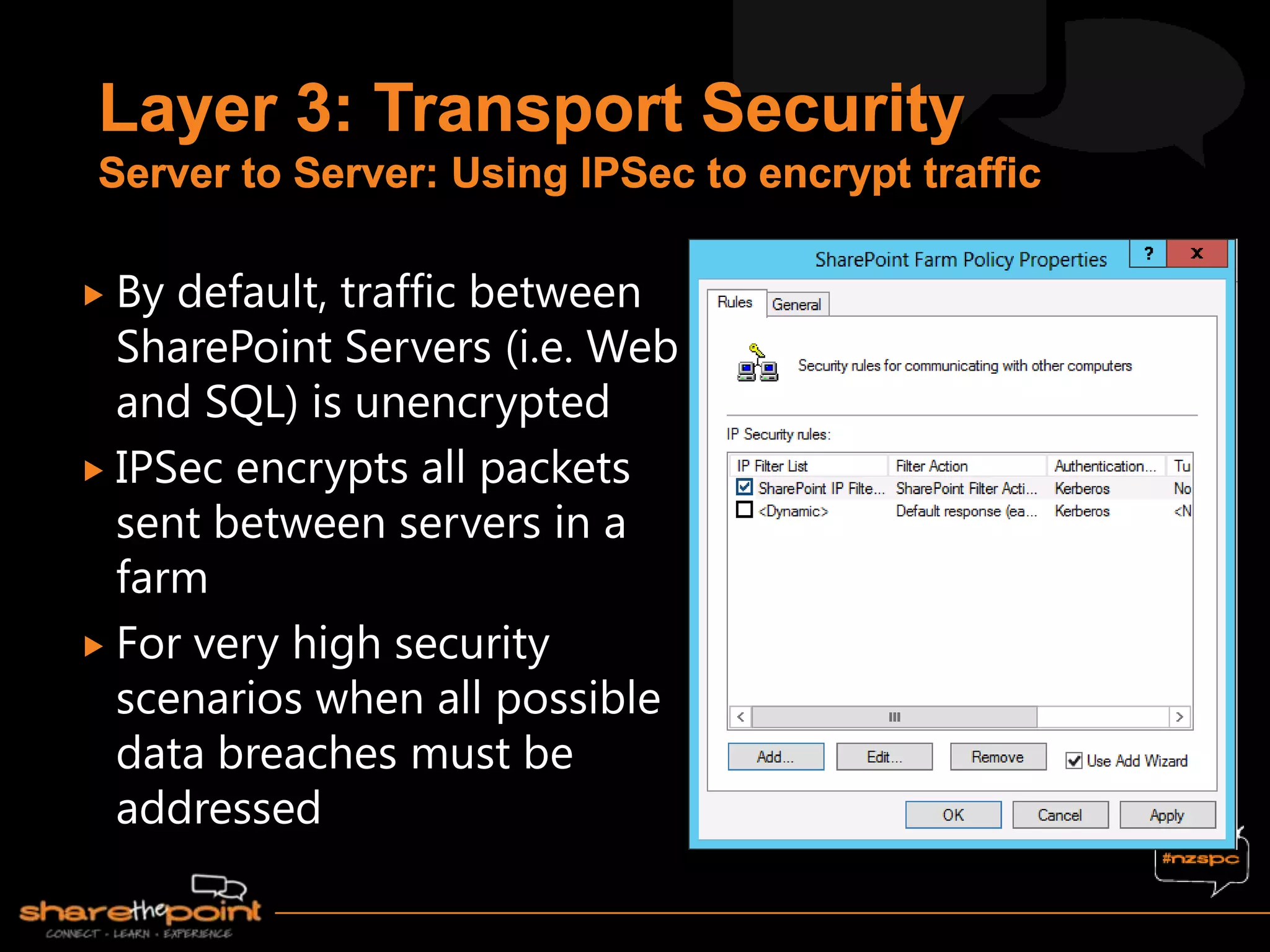
 By default, traffic between
SharePoint Servers (i.e. Web
and SQL) is unencrypted
 IPSec encrypts all packets
sent between servers in a
farm
 For very high security
scenarios when all possible
data breaches must be
addressed
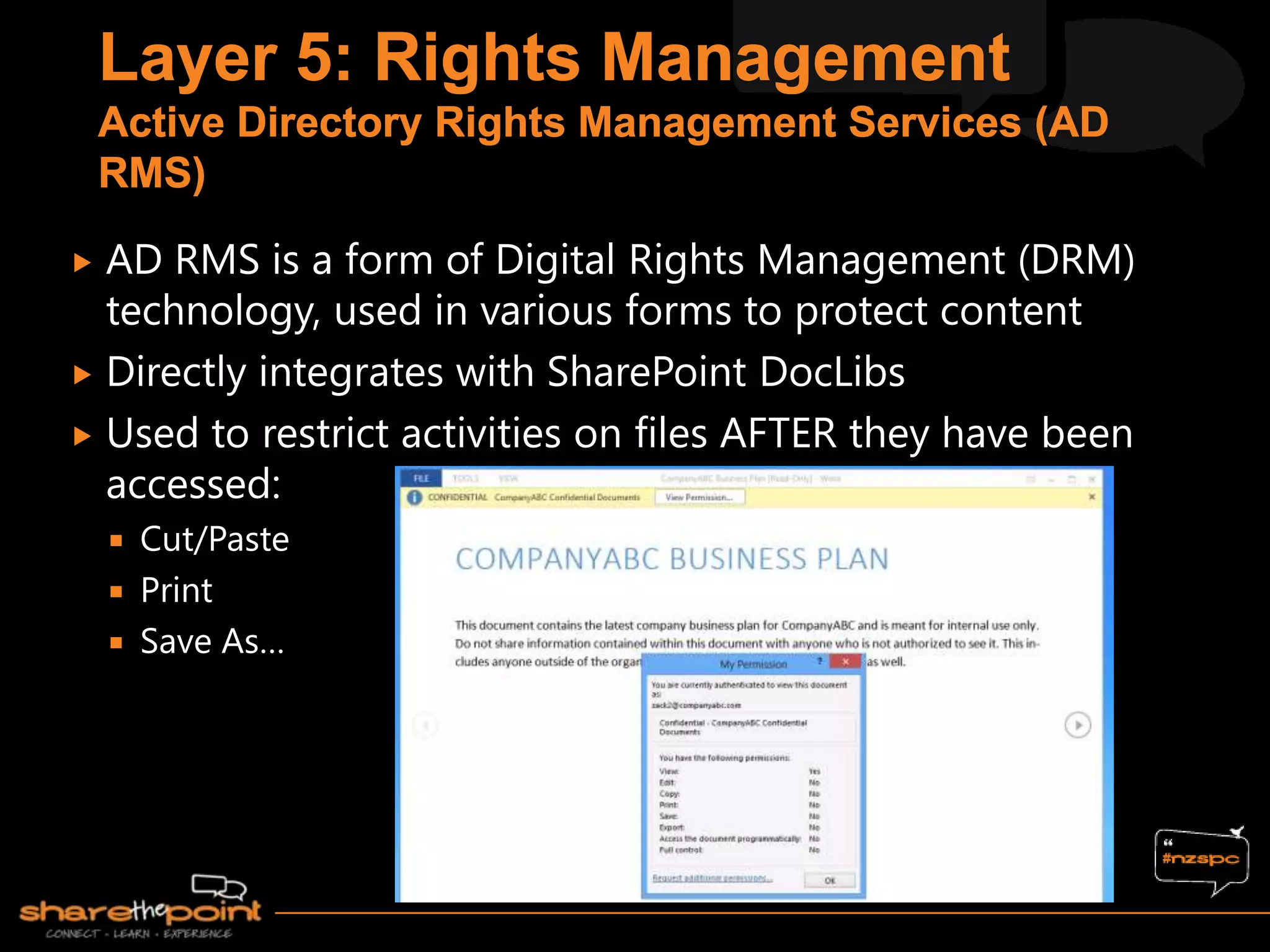
 AD RMS is a form of Digital Rights Management (DRM)
technology, used in various forms to protect content
 Directly integrates with SharePoint DocLibs
 Used to restrict activities on files AFTER they have been
accessed:
 Cut/Paste
 Print
 Save As…
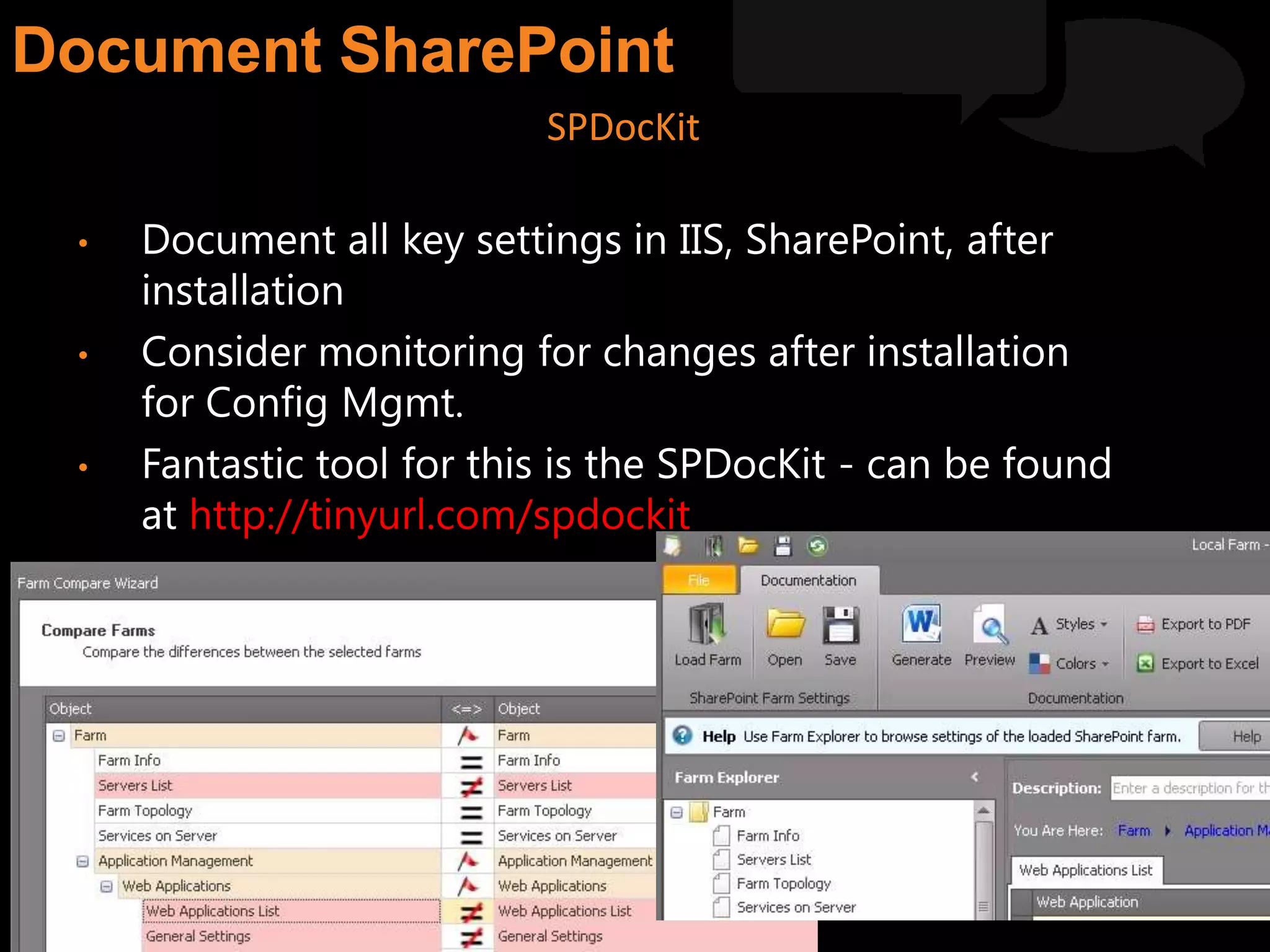
• Document all key settings in IIS, SharePoint, after
installation
• Consider monitoring for changes after installation
for Config Mgmt.
• Fantastic tool for this is the SPDocKit - can be found
at http://tinyurl.com/spdockit
SPDocKit
Company Site: www.cco.com
Twitter: twitter.com/michaeltnoel
LinkedIn:
linkedin.com/in/michaeltnoel
Facebook:
facebook.com/michaelnoel
VK: vk.com/sharingtheglobe
Slides: slideshare.net/michaeltnoell
Travel blog: sharingtheglobe.com
Thank you to our sponsors

NZSPC 2013 - Ultimate SharePoint Infrastructure Best Practices Session

  • 1.
  • 2.
     Author ofSAMS Publishing titles “SharePoint 2013 Unleashed,” “SharePoint 2010 Unleashed”, “Windows Server 2012 Unleashed,” “Exchange Server 2013 Unleashed”, “ISA Server 2006 Unleashed”, and a total of 19 titles that have sold over 300,000 copies.  Partner at Convergent Computing (www.cco.com) – San Francisco, U.S.A. based Infrastructure/Security specialists for SharePoint, AD, Exchange, System Center, Security, etc.
  • 4.
     Windows Server2008 R2 SP1 or Windows Server 2012 (Preferred)  SQL Server 2008 R2 w/SP1 or SQL Server 2012 (Preferred) Type Memory Processor Dev/Stage/Test server 8GB RAM 4 CPU „All-in-one‟ DB/Web/SA 24GB RAM 4 CPU Web/SA Server 12GB RAM 4 CPU DB Server (medium environments) 16GB RAM 8 CPU DB Server (small environments) 8GB RAM 4 CPU Software/Hardware Requirements
  • 5.
     Office WebApps is no longer a service application  Web Analytics is no longer service application, it‟s part of search  New service applications available and improvements on existing ones  App Management Service – Used to manage the new SharePoint app store from the Office Marketplace or the Application Catalog  SharePoint Translation Services – provides for language translation of Word, XLIFF, and PPT files to HTML  Work Management Service – manages tasks across SharePoint, MS Exchange and Project.  Access Services App (2013) – Replaces 2010 version of Access Services Changes in Service Applications and New Service Applications
  • 6.
     A newWindows service – the Distributed Cache Service – is installed on each server in the farm when SharePoint is installed  It is managed via the Services on Server page in central admin as the Distributed Cache service  The config DB keeps track of which machines in the farm are running the cache service Distributed Cache Service
  • 7.
     The purposeof the Request Management feature is to give SharePoint knowledge of and more control over incoming requests  Having knowledge over the nature of incoming requests – for example, the user agent, requested URL, or source IP – allows SharePoint to customize the response to each request  RM is applied per web app, just like throttling is done in SharePoint 2010 Request Management (RM)
  • 8.
     Option 1(AD Import): Simple one-way Sync (a la SharePoint 2007)  Option 2 (SharePoint Profile Sync): Two- way, possible write-back to AD options using small FIM service on UPA server (a la 2010)  Option 3: (Enable External Identity Manager): Full Forefront Identity Manager (FIM) Synchronisation, allows for complex scenarios – Larger clients will appreciate this User Profile Sync – Three Options for Deployment
  • 9.
     SharePoint 2013continues to offer support for both claims and classic authentication modes  However claims authentication is THE default authentication option now  Classic authentication mode is still there, but can only be managed in PowerShell – it‟s gone from the UI  Support for classic mode is deprecated and will go away in a future release  There also a new process to migrate accounts from Windows classic to Windows claims – the Convert-SPWebApplication cmdlet Claims-based Authentication - Default
  • 10.
     Stores newversions of documents as „shredded BLOBs that are deltas of the changes  Promises to reduce storage size significantly Shredded Storage
  • 11.
     New Search architecture(FAST based) with one unified search  Personalised search results based on search history  Rich contextual previews Search – FAST Search now included
  • 13.
    Web Service Apps Data Three Layersof SharePoint Infrastructure
  • 14.
     „All-in-One‟ (Avoid) DB and SP Roles Separate Small Farm Models
  • 15.
     2 SharePointServers running Web and Service Apps  2 Database Servers (AlwaysOn FCI or AlwaysOn Availability Groups)  1 or 2 Index Partitions with equivalent query components  Smallest farm size that is fully highly available Smallest Highly Available Farm
  • 16.
     2 DedicatedWeb Servers (NLB)  2 Service Application Servers  2 Database Servers (Clustered or Mirrored)  1 or 2 Index Partitions with equivalent query components Best Practice ‘Six Server Farm’
  • 17.
    • Separate farmfor Service Applications • One or more farms dedicated to content • Service Apps are consumed cross- farm • Isolates „difficult‟ service apps like User Profile Sync and allows for patching in isolation Ideal – Separate Service App Farm + Content Farm(s)
  • 18.
    • Multiple Dedicated WebServers • Multiple Dedicated Service App Servers • Multiple Dedicated Query Servers • Multiple Dedicated Crawl Servers, with multiple Crawl DBs to increase parallelisation of the crawl process • Multiple distributed Index partitions (max of 10 million items per index partition) • Two query components for each Index partition, spread among servers Large SharePoint Farms
  • 20.
     Allows organisationsthat wouldn‟t normally be able to have a test environment to run one  Allows for separation of the database role onto a dedicated server  Can be more easily scaled out in the future Sample 1: Single Server Environment
  • 21.
     High- Availability across Hosts All components Virtualised Sample 2: Two Server Highly Available Farm
  • 22.
     Highest transaction servers are physical Multiple farm support, with DBs for all farms on the SQL AOAG Sample 3: Mix of Physical and Virtual Servers
  • 23.
    Scaling to LargeVirtual Environments
  • 24.
     Processor (HostOnly)  <60% Utilisation = Good  60%-90% = Caution  >90% = Trouble  Available Memory  50% and above = Good  10%-50% = OK  <10% = Trouble  Disk – Avg. Disk sec/Read or Avg. Disk sec/Write  Up to 15ms = fine  15ms-25ms = Caution  >25ms = Trouble • Network Bandwidth – Bytes Total/sec – <40% Utilisation = Good – 41%-64% = Caution – >65% = Trouble • Network Latency - Output Queue Length – 0 = Good – 1-2= OK – >2 = Trouble Virtualisation of SharePoint Servers Virtualisation Performance Monitoring
  • 26.
  • 27.
     Can reducedramatically the size of Content DBs, as upwards of 80%-90% of space in content DBs is composed of BLOBs  Can move BLOB storage to more efficient/cheaper storage  Improve performance and scalability of your SharePoint deployment – But highly recommended to use third party Remote BLOB Storage (RBS)
  • 29.
    DB-A File 1 DB-B File 1 Volume#1 DB-A File 2 DB-B File 2 Volume #2 DB-A File 3 DB-B File 3 Volume #3 DB-A File 4 DB-B File 4 Volume #4 Tempdb File 1 Tempdb File 2 Tempdb File 3 Tempdb File 4 Multiple Files for SharePoint Databases
  • 30.
    • Break ContentDatabases and TempDB into multiple files (MDF, NDF), total should equal number of physical processors (not cores) on SQL server. • Pre-size Content DBs and TempDB to avoid fragmentation • Separate files onto different drive spindles for best IO perf. • Example: 50GB total Content DB on Two-way SQL Server would have two database files distributed across two sets of drive spindles = 25GB pre-sized for each file. Multiple Files for SharePoint Databases
  • 31.
    • Implement SQLMaintenance Plans! • Include DBCC (Check Consistency) and either Reorganize Indexes or Rebuild Indexes, but not both! SQL Database Optimisation SQL Maintenance Plans • Add backups into the maintenance plan if they don’t exist already • Make sure you are doing transaction log backups as well to clean up the logs. Also, note that only DBCC SHRINKFILE recovers whitespace
  • 33.
    High Availability andDisaster Recovery SQL Server Solution Potential Data Loss (RPO) Potential Recovery Time (RTO) Automatic Failover Additional Readable Copies AlwaysOn Availability Groups – Synchronous (Dual-phase commit, no data loss, can’t operate across WAN) None 5-7 Seconds Yes 0 - 2 AlwaysOn Availability Groups – Asynchronous (Latency tolerant, cross WAN option, potential for data loss) Seconds Minutes No 0 - 4 AlwaysOn Failover Cluster Instance (FCI) – Traditional shared storage clustering NA 30 Seconds to several minutes (depending on disk failover) Yes N/A Database Mirroring - High-safety (Synchronous) Zero 5-10 seconds Yes N/A Database Mirroring - High-performance (Asynchronous) Seconds Manually initiated, can be a few minutes if automated No N/A SQL Log Shipping Minutes Manually initated, can be a few minutes if automated, by typically hours No Not during a restore Traditional Backup and Restore Hours to Days Typically multiple hours, days, or weeks No Not during a restore Comparison of High Availability and Disaster Recovery Options
  • 34.
  • 35.
  • 36.
     Hardware BasedLoad Balancing (F5, Cisco, Citrix NetScaler – Best performance and scalability  Software Windows Network Load Balancing fully supported by MS, but requires Layer 2 VLAN (all packets must reach all hosts.) Layer 3 Switches must be configured to allow Layer 2 to the specific VLAN.  If using Unicast, use two NICs on the server, one for communications between nodes.  If using Multicast, be sure to configure routers appropriately  Set Affinity to Single (Sticky Sessions)  If using VMware, note fix to NLB RARP issue (http://tinyurl.com/vmwarenlbfix) Network Load Balancing
  • 38.
    • Infrastructure Securityand Best practices  Physical Security  Best Practice Service Account Setup  Kerberos Authentication • Data Security  Role Based Access Control (RBAC)  Transparent Data Encryption (TDE) of SQL Databases • Transport Security  Secure Sockets Layer (SSL) from Server to Client  IPSec from Server to Server • Edge Security  Inbound Internet Security (Forefront UAG/TMG) • Rights Management Five Layers of SharePoint Security
  • 39.
    Service Account NameRole of Service Account Special Permissions COMPANYABCSRV-SP-Setup SharePoint Installation Account Local Admin on all SP Servers (for installs) COMPANYABCSRV-SP-SQL SQL Service Account(s) – Should be separate admin accounts from SP accounts. Local Admin on Database Server(s) (Generally, some exceptions apply) COMPANYABCSRV-SP-Farm SharePoint Farm Account(s) – Can also be standard admin accounts. RBAC principles apply ideally. N/A COMPANYABCSRV-SP-Search Search Account N/A COMPANYABCSRV-SP-Content Default Content Access Account Read rights to any external data sources to be crawled COMPANYABCSRV-SP-Prof Default Profiles Access Account Member of Domain Users (to be able to read attributes from users in domain) and „Replicate Directory Changes‟ rights in AD. COMPANYABCSRV-SP-AP-SPCA Application Pool Identity account for SharePoint Central Admin. DBCreator and Security Admin on SQL. Create and Modify contacts rights in OU used for mail. COMPANYABCSRV-SP-AP-Data Application Pool Identity account for the Content related App Pool (Portal, MySites, etc.) Additional as needed for security. N/A
  • 40.
     When creatingany Web Applications, USE KERBEROS. It is much more secure and also faster with heavy loads as the SP server doesn‟t have to keep asking for auth requests from AD.  Kerberos auth does require extra steps, which makes people shy away from it, but once configured, it improves security considerably and can improve performance on high-load sites.  Should also be configured on SPCA Site! (Best Practice = Configure SPCA for NLB, SSL, and Kerberos (i.e. https://spca.companyabc.com)
  • 41.
     Role Groupsdefined within Active Directory (Universal Groups) – i.e. „Marketing,‟ „Sales,‟ „IT,‟ etc.  Role Groups added directly into SharePoint „Access Groups‟ such as „Contributors,‟ „Authors,‟ etc.  Simply by adding a user account into the associated Role Group, they gain access to whatever rights their role requires. User1 User2 AD and/or SP Group SharePoint Permissions
  • 42.
     SQL Server2008, 2008 R2, 2012 Enterprise Edition Feature  Encrypts SQL Databases Transparently, SharePoint is unaware of the encryption and does not need a key  Encrypts the backups of the database as well
  • 43.
     External orInternal Certs highly recommended  Protects Transport of content  Low overhead on Web Servers  Can be offloaded via SSL offloaders if needed  Don‟t forget for SPCA as well!
  • 44.
     By default,traffic between SharePoint Servers (i.e. Web and SQL) is unencrypted  IPSec encrypts all packets sent between servers in a farm  For very high security scenarios when all possible data breaches must be addressed
  • 46.
     AD RMSis a form of Digital Rights Management (DRM) technology, used in various forms to protect content  Directly integrates with SharePoint DocLibs  Used to restrict activities on files AFTER they have been accessed:  Cut/Paste  Print  Save As…
  • 47.
    • Document allkey settings in IIS, SharePoint, after installation • Consider monitoring for changes after installation for Config Mgmt. • Fantastic tool for this is the SPDocKit - can be found at http://tinyurl.com/spdockit SPDocKit
  • 48.
    Company Site: www.cco.com Twitter:twitter.com/michaeltnoel LinkedIn: linkedin.com/in/michaeltnoel Facebook: facebook.com/michaelnoel VK: vk.com/sharingtheglobe Slides: slideshare.net/michaeltnoell Travel blog: sharingtheglobe.com
  • 49.
    Thank you toour sponsors